1. Introduction
Ambitious decarbonization targets and the diffusion of low-carbon technologies have elevated the strategic role of corporate financing instruments that can both mobilize capital and steer it toward innovation. Within this landscape, “green” and sustainability-linked debt instruments have expanded rapidly and, in many markets, begun to influence firms’ pricing of capital and their disclosure practices [
1]. In this context, this study uses “green financing” to denote labeled debt instruments (use-of-proceeds green bonds; sustainability-linked bonds/loans); equity-side references concern valuation responses and ownership/liquidity effects rather than a distinct “green equity” instrument, which lies outside the scope of the empirical design that follows. Yet the strategic question remains unresolved, namely, do such instruments merely label existing projects, or do they create measurable complementarities with research and development (R&D) that lower the weighted average cost of capital (WACC) [
2,
3], enhance valuation, and intensify green innovation? This strategic question motivates the contribution of this study: event-time changes in capital costs, valuation, and innovation associated with first-time adoption of labeled green and sustainability-linked financing are quantified, and R&D intensity is tested as an amplifier. Using a balanced 2012–2024 S&P 500 panel, this study employs a staggered-adoption difference-in-differences design with interaction-weighted event-time estimators and entropy balancing, decomposes WACC into equity and debt components, and measures innovation intensity and composition (CPC Y02). Instrument design (use-of-proceeds versus KPI-linked contracts with material step-ups) is analyzed as a boundary condition. By stating the contribution and empirical objectives up front, this study frames the identification strategy and anticipated channels that inform capital allocation. Addressing this question is central for capital allocation, the credibility of transition finance, and the design of corporate innovation portfolios in large public corporations [
4,
5].
The growing empirical literature documents that labeled green debt is associated with modest but statistically significant pricing advantages. Early evidence quantified a “greenium” for corporate bonds—on the order of a few basis points—consistent with investor willingness to accept slightly lower yields for verified environmental use of proceeds [
6]. Subsequent work confirms that the advantage tends to materialize in recent years and can vary with market conditions, ratings, and bond design [
7]. At the equity margin, announcement-window studies report positive stock reactions, larger institutional ownership, and improved liquidity for first-time corporate green issuers, indicating broader capital-market benefits beyond primary bond pricing [
8]. Related studies show reduced credit risk around issuance, visible in tighter CDS spreads, suggesting improvements in perceived solvency and risk management [
9,
10]. Together, these findings imply that financing form can transmit information about environmental commitment and project screening quality, with real effects on firm financing conditions.
Parallel evidence examines whether green financing improves environmental outcomes. Analyses of corporate green bonds identify post-issuance reductions in emissions intensity and improvements in environmental performance, alongside design features—certification, external review, and credible use of proceeds (UoP)—that strengthen effects [
11]. However, the magnitude and persistence of real effects are heterogeneous across settings; some markets (e.g., China) report small or absent issuance premia, and recent work highlights that liquidity differences between green and conventional bonds can confound inferences about any cost advantage [
12,
13]. These mixed results underscore that instrument design and firm fundamentals likely shape the transmission from funding to outcomes.
The product set itself is evolving. Use-of-proceeds green bonds ring-fence funds for eligible assets, whereas sustainability-linked bonds (SLBs) and sustainability-linked loans (SLLs) tie pricing to firm-level key performance indicators (KPIs). Recent evidence indicates that SLBs may price at very small discounts (approximately 1–2 bp), consistent with investor preference for impact labels and also with relatively weak incentives unless targets and step-up penalties are material [
14,
15]. Market and policy analyses highlight design concerns and greenwashing risks for KPI-linked products when targets are non-material or penalties are trivial, which helps explain issuance cyclicality and investor demands for tighter terms [
16,
17,
18]. In contrast, UoP bonds concentrate on asset-level verification, with effects contingent on credible project pipelines and reporting [
19].
Beyond pricing and disclosure, green and sustainability-linked instruments perform an ESG governance function by embedding verifiable commitments into corporate financing. Use-of-proceeds bonds ring-fence capital to eligible assets and rely on external review and post-issuance reporting to discipline allocation, while KPI-linked structures can codify firm-level targets with pre-specified step-ups that raise the cost of capital if performance falls short [
11,
14,
15,
16,
17,
18]. As elements of corporate sustainability strategies, these instruments can operationalize board-approved transition plans, align treasury actions with innovation roadmaps, and mitigate agency frictions through third-party verification and transparent progress tracking. At the same time, weakly specified KPIs or trivial penalties elevate greenwashing risk and attenuate incentives—concerns consistent with observed heterogeneity in instrument performance that this study documents empirically [
14,
15,
16,
17,
18].
A second strand links sustainable finance to innovation. Multiple studies document that green bond adoption correlates with higher green-patenting activity, mitigated financing constraints, and reallocation of investment toward cleaner technologies, though estimates vary by institutional setting, baseline regulation, and ownership structure [
20,
21]. Evidence from large emerging markets suggests stronger innovation responses where financing frictions are binding and disclosure policies improve information quality [
22,
23]. At the same time, controversy persists; high-emitting energy producers contribute materially to the U.S. green patent landscape despite low environmental, social, and governance (ESG) scores, complicating simplistic expectations that ESG labels alone map to innovation leadership [
24]. Overall, the literature agrees that financing can shape innovation incentives, but the channels and boundary conditions are debated [
25,
26,
27].
Taken together, recent studies can be organized into a pragmatic typology: (i) pricing studies quantify primary-market green premia and secondary-market spread dynamics; (ii) real-effects studies test post-issuance changes in emissions and innovation; (iii) design and integrity studies analyze certification, external reviews, and KPI materiality; and (iv) risk-transmission studies evaluate effects on credit risk and valuation multiples. Within this typology, UoP bonds emphasize asset screening and reporting, while SLBs/SLLs embed firm-level incentives whose credibility hinges on target ambition and financial penalties. Research has progressed rapidly in each category, yet interactions between financing form and firms’ internal innovation capabilities have not been systematically quantified [
5,
10,
12,
27].
Despite advances, a critical gap persists. The existing work largely treats green financing and R&D intensity as separate levers. Prior studies typically estimate an average green-label effect on yields, valuation, or environmental outcomes without testing whether those effects are conditional on a firm’s innovation capacity. As a result, the literature does not establish whether aligning financing form with R&D pipelines creates complementarities that (a) compress firms’ WACC beyond the standalone greenium, (b) raise valuation multiples via growth-option reinforcement, and (c) accelerate the share of green innovation within the patent portfolio. Further, most evidence is instrument- or country-specific, with limited coverage of large-cap U.S. issuers and limited use of event-time estimators that correct for staggered treatment adoption. Recent debates around liquidity confounding for green premia and the credibility of KPI-linked structures reinforce the need for designs that isolate interaction effects rather than marginal associations. Addressing this interaction is essential to determine when sustainable financing is value-accretive rather than merely cosmetic.
Most prior studies in the sustainability domain examine either (1) green financing’s pricing or environmental effects in isolation or (2) R&D-driven innovation without attention to financing form. Very few test whether R&D intensity amplifies the benefits of green or sustainability-linked financing for capital costs and valuation, and fewer still track portfolio composition using Cooperative Patent Classification Y02 tags to measure the green-patent share among large U.S. index constituents [
28]. The present study fills this void by explicitly modeling the synergy between R&D intensity and green financing adoption and by estimating post-issuance changes in WACC, Tobin’s Q, and innovation outcomes with event-time corrections suited to staggered adoption. Conceptual rationales for financing–innovation complementarity and their testable implications are consolidated in
Section 2 as explicit hypotheses that organize the subsequent empirical analysis.
Methodologically, this study is designed to isolate these complementarities under credible identification. A staggered-adoption difference-in-differences (DiD) framework with Sun–Abraham event-time estimators addresses known biases in two-way fixed-effects when treatment timing varies [
29,
30]. Entropy balancing (EB) reweights controls so that issuer and non-issuer covariates match on specified moments before treatment [
31]. Innovation outputs are modeled using negative binomial counts for patent totals and fractional logit for the Y02 green share, an approach that respects the distributional features of shares bounded in [0,1] [
32,
33]. These choices reflect current best practice in applied corporate finance and innovation econometrics and directly respond to concerns about pre-trend contamination, imbalance, and functional-form misspecification in prior studies [
34].
Two active debates motivate the focus on complementarities. First, while many studies find a positive but small greenium, others emphasize that liquidity differences and market cycles can attenuate or even offset any pricing advantage, cautioning against extrapolating average effects to all issuer types [
35]. Second, for KPI-linked products, recent evidence suggests that premia are extremely small and the credibility of targets and penalties is pivotal; design weaknesses have raised concerns about greenwashing risks and contributed to issuance volatility [
36]. Testing whether innovation capacity conditions these effects is therefore crucial for separating signal from label.
A related discussion concerns where green innovation originates. Evidence from the United States indicates that firms with lower ESG scores—often in energy—generate a disproportionate share of high-impact green patents, complicating naïve mappings between ESG labels and innovative output. This pattern reinforces the need to measure outcomes (e.g., Y02 patents) rather than rely on labels alone and to examine whether aligning financing with R&D—rather than issuing labels in isolation—drives a higher green-innovation share [
37].
This study aims to establish whether synergies between R&D intensity and green financing causally lower WACC, raise valuation, and magnify green innovation among large publicly listed corporations, and to quantify how these effects evolve over event time following first-time adoption.
In contrast to extant studies that evaluate green financing or R&D in isolation, the present analysis (i) tests interaction effects between financing form and innovation capability; (ii) deploys a staggered-adoption DiD with Sun–Abraham corrections to recover unbiased event-time profiles; (iii) measures innovation composition via CPC Y02 tags at the firm–year level; and (iv) evaluates valuation responses through Tobin’s Q alongside WACC components. This integrated design provides a consolidated shift from marginal label effects to policy-integrated complementarity, clarifying conditions under which sustainable financing is value accretive. Definitions of labeled financing, R&D intensity, capital-cost constructs, and the two channels linking innovation capacity to WACC are presented in
Section 2.
Building on the contribution and objectives stated above, this study now consolidates the conceptual framework and testable hypotheses that structure the empirical analysis. The empirical setting comprises S&P 500 constituents with complete coverage from 2012 to 2024 (n = 470), of which 162 are first-time adopters of labeled green or sustainability-linked financing. Constituents are defined annually by index membership; eligible firms are U.S.-listed common stocks with observable bond, accounting, and patent data. The industry composition follows the S&P 500 FF12 distribution, and entropy balancing achieves pre-treatment covariate balance, supporting representativeness for subsequent analyses.
Furthermore, this study situates the analysis within four strands of prior research. First, pricing evidence documents small issuance- and secondary-market yield advantages (“greenium”) for labeled use-of-proceeds bonds, with magnitudes that vary by rating, issuer type, currency, market conditions, and external certification [
8,
38,
39,
40,
41]. Second, for sustainability-linked bonds, average premia are very small unless key performance indicators are decision-relevant and step-ups are economically meaningful; market guidance similarly stresses KPI materiality and ambitious targets [
4,
9,
42]. Third, real-effects studies report post-issuance improvements in environmental performance and green innovation, with heterogeneous effects across settings [
4]. Fourth, risk-transmission work shows improvements in market-based metrics around adoption, including positive equity announcement responses and, in some settings, tighter credit-risk indicators consistent with clientele segmentation and information effects [
9,
14,
43]. Taken together, this synthesis implies that verified use of proceeds and KPI materiality condition any capital-cost benefits and that alignment with innovation capacity is a plausible amplifier, providing a benchmark for the comparisons developed in the discussion. The remainder of this paper is organized as follows:
Section 2 delineates the conceptual framework and hypotheses;
Section 3 describes the data and methods;
Section 4 reports results;
Section 5 discusses implications; and
Section 6 concludes.
2. Theoretical Framework and Hypotheses
In this study, “labeled financing” denotes debt raised under verifiable environmental terms and includes use-of-proceeds green bonds that ring-fence proceeds to eligible assets subject to external review and sustainability-linked instruments (bonds/loans) whose pricing varies with firm-level key performance indicators (KPIs). “Green financing” refers to these labeled debt instruments. “R&D intensity” is the ratio of reported research and development expenditure to sales and serves as a firm-level proxy for the depth of the innovation pipeline. “Cost of capital” comprises component-specific required returns for debt and equity; WACC is the weighted average of the cost of equity and the after-tax cost of debt at contemporaneous capital-structure weights. Conceptually, innovation capacity can affect WACC directly (through risk/intangibility that influences equity beta and unsecured spreads) and indirectly (through labeled financing that segments investor clientele and reduces debt pricing when verification and KPI incentives are credible).
Since this financing–innovation linkage interacts with sectoral risk and asset tangibility, this study classifies firms using the Fama–French 12 (FF12) industries per French’s standard sector mapping. Industry classification matters for both identification and interpretation, as differences in leverage, innovation intensity, and clientele segmentation motivate fixed effects, stratified estimates, and leave-one-industry-out checks that inform the primary prediction.
The framework prioritizes one primary prediction and situates the remaining tests as secondary. H1 (primary, debt-channel capital-cost effect): first-time adoption of labeled financing reduces WACC in event time, primarily through the cost-of-debt component. H2 (secondary, R&D amplification): the WACC reduction is larger among high R&D firms because credible pipelines increase the likelihood that labeled proceeds fund scalable projects and strengthen investor demand. H3 (secondary, valuation response): valuation (Tobin’s Q) increases following adoption, with larger changes where R&D intensity is higher, consistent with reinforced growth-option value under lower hurdle rates. H4 (secondary, innovation intensity and composition): innovation output rises and the CPC Y02 share increases after adoption, particularly among high R&D firms. Instrument design (use-of-proceeds verification and KPI materiality) is expected to strengthen these effects when eligibility, targets, and penalties are credible.
Building on instrument design,
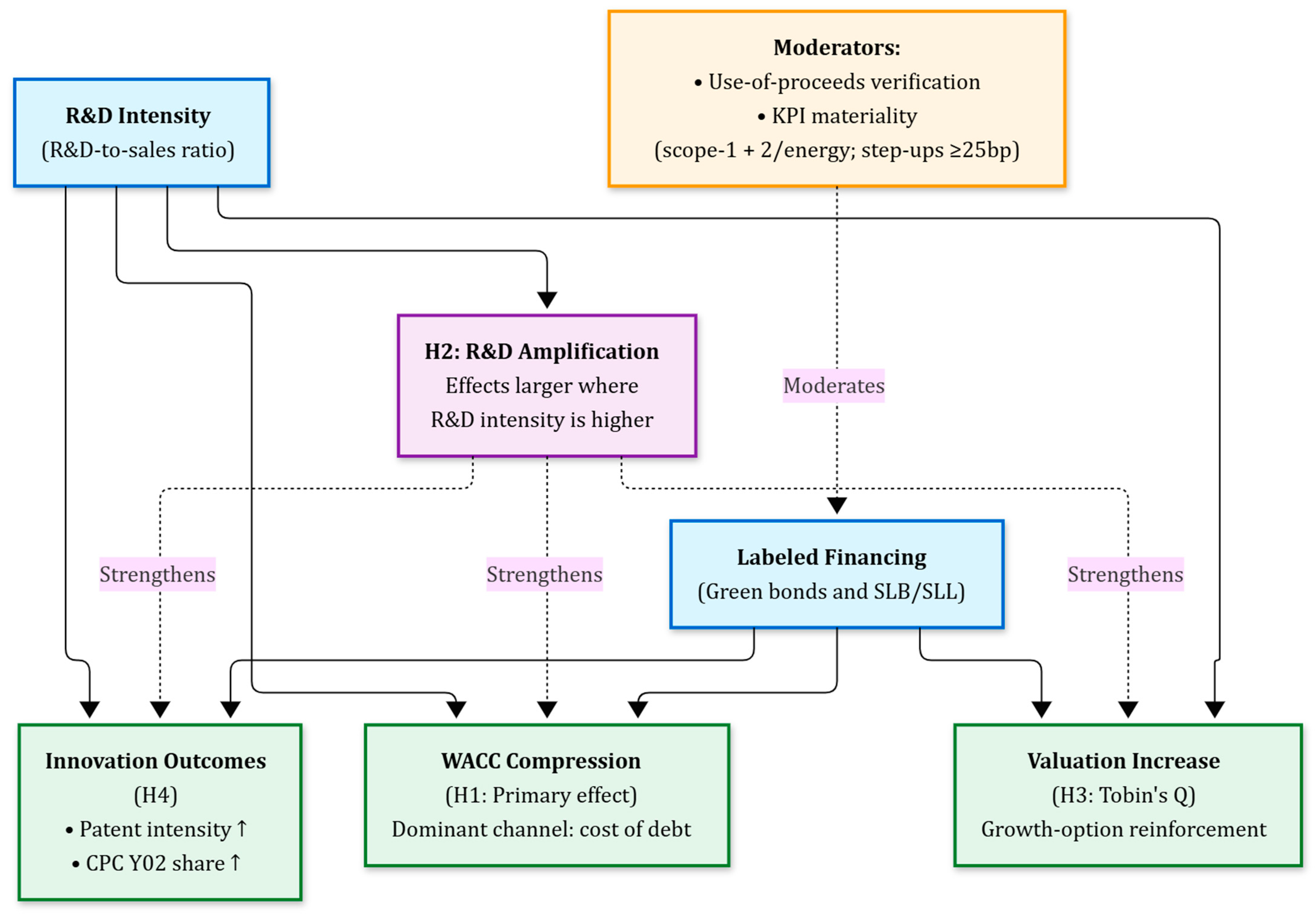
Figure 1 (conceptual framework and hypotheses) depicts how R&D intensity and labeled financing jointly affect WACC (primarily through the cost-of-debt channel), valuation (Tobin’s Q), and innovation outcomes (patent intensity and CPC Y02 share), with use-of-proceeds verification and KPI materiality moderating transmission. The diagram explicitly maps the four hypotheses: H1 (debt-channel WACC compression), H2 (R&D-based amplification), H3 (valuation increase consistent with reinforced growth options), and H4 (higher innovation intensity and a larger Y02 share). By clarifying constructs and directions of effect, the conceptual figure provides a visual scaffold for the longitudinal design that follows.
4. Results
4.1. Cohort Construction, Descriptive Statistics, and Balance Diagnostics
A cohort of 470 firms with complete coverage over 2012–2024 satisfied the inclusion criteria. Among these, 162 firms adopted labeled financing for the first time within the window, and 308 firms remained never treated. First-time adopters comprised 112 issuers of green bonds and 50 issuers of SLB/SLL as the inaugural instrument type. The event-time design anchored each treated firm at the first issuance year and defined leads and lags symmetrically within a four-year window, with a minimum of three pre-issuance years available for all treated firms.
Pre-treatment comparability at t = −1 is tight after entropy balancing: the standardized differences are <0.05 and variance ratios fall within 0.92–1.08.
Table 1 summarizes cohort sizes, outcome means, and key covariates at
before and after EB. The tabulation reports means (or shares), standard deviations (SDs), standardized differences (StdDiffs), and variance ratios (VarRatios). The outcomes and monetary variables are expressed in USD; the yield metrics are in basis points (bps).
Post-EB alignment of moments indicates that pre-treatment differences in levels and dispersion are negligible for all analysis variables. This alignment establishes the empirical basis for subsequent event-time contrasts under DiD.
4.2. Identification Diagnostics and Pre-Trend Assessments
Pre-treatment dynamics were assessed to evaluate the plausibility of parallel trends conditional on fixed effects and controls. Prominent outcomes were examined in relative time , with the normalization year omitted by construction. Lead coefficients and two-way clustered 95% confidence intervals were estimated both for the pooled sample and stratified by R&D tertiles defined at the pre-treatment distribution (cutpoints at 2.1% and 7.4% of sales).
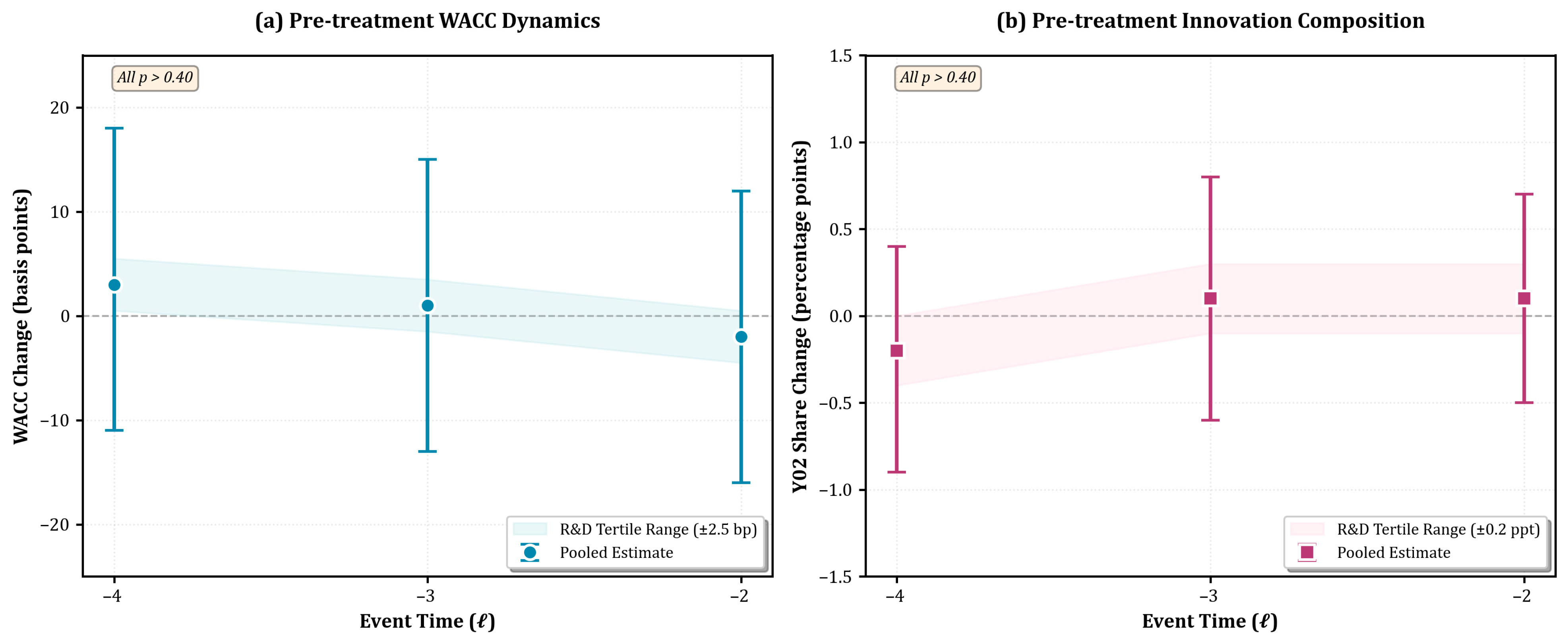
To evaluate dynamic neutrality prior to adoption for capital costs and innovation composition,
Figure 2 presents lead coefficients for WACC and Y02Share across two panels.
Figure 2a reports coefficients for WACC at
relative to
with and without R&D interactions;
Figure 2b reports analogous coefficients for Y02Share.
The lead profiles showed no statistically discernible deviations from zero for WACC in (estimate 3 bp, CI [−11, 18], p = 0.66), (1 bp, CI [−13, 15], p = 0.89), or (−2 bp, CI [−16, 12], p = 0.78) in the pooled sample. Stratification by R&D tertiles did not reveal systematic pre-trend divergence; differences between high and low tertiles were within ±5 bp across leads, with all p > 0.40. For Y02Share, lead coefficients were also centered near zero: (−0.2 ppt, CI [−0.9, 0.4], p = 0.52), (0.1 ppt, CI [−0.6, 0.8], p = 0.79), and (0.1 ppt, CI [−0.5, 0.7], p = 0.73). These diagnostics support the assumption that, without treatment, treated and control firms exhibited parallel trends in the pre-period for the outcomes central to this study.
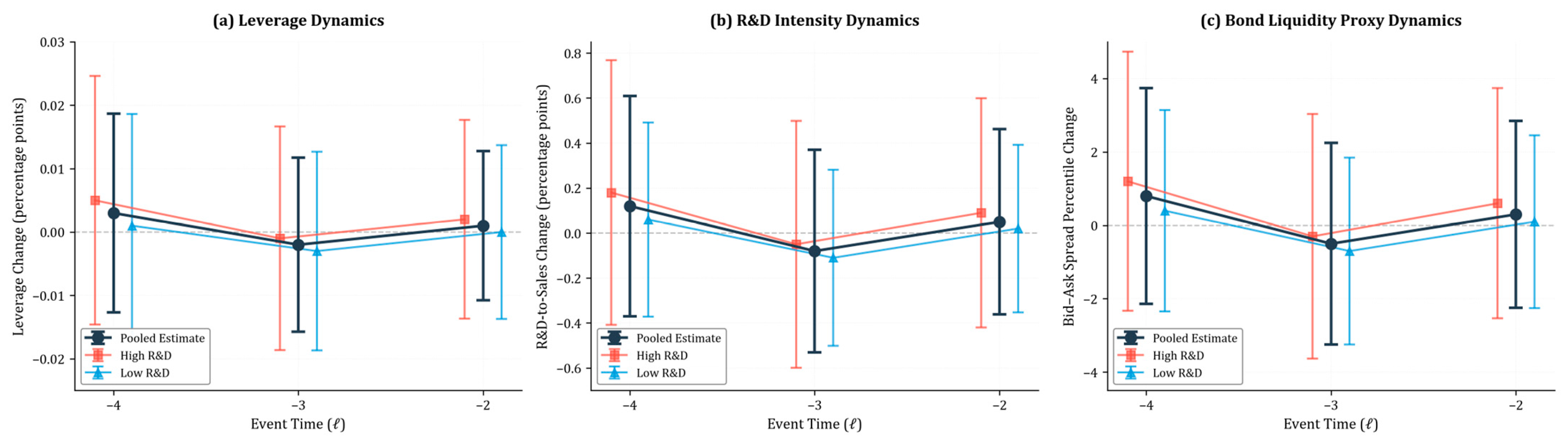
This study also inspects pre-treatment leads for leverage (debt-to-assets), R&D-to-sales, and a TRACE-based bond-market liquidity proxy (bid–ask spread percentile). Using the same event-time framework and EB weights, lead coefficients for these covariates are centered near zero with overlapping confidence intervals across R&D strata;
Appendix A Figure A2 visualizes these profiles to complement the outcome leads.
4.3. RQ1—Event-Time Effects on WACC and Its Components
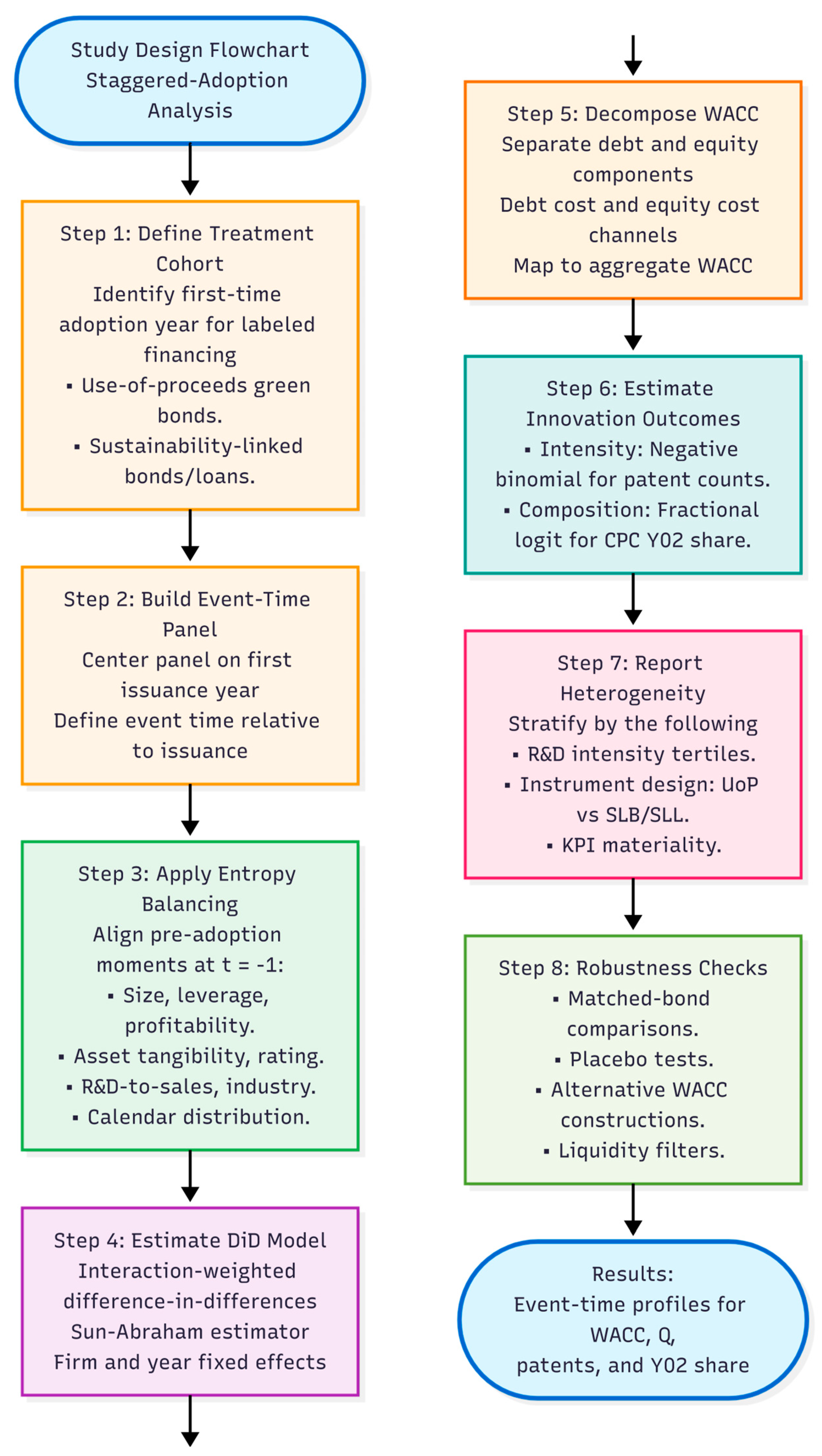
Addressing H1 (debt-channel capital-cost effect), this study estimates interaction-weighted DiD with firm and year fixed effects and entropy-balancing weights, interacting treatment with lagged R&D intensity to quantify complementarity.
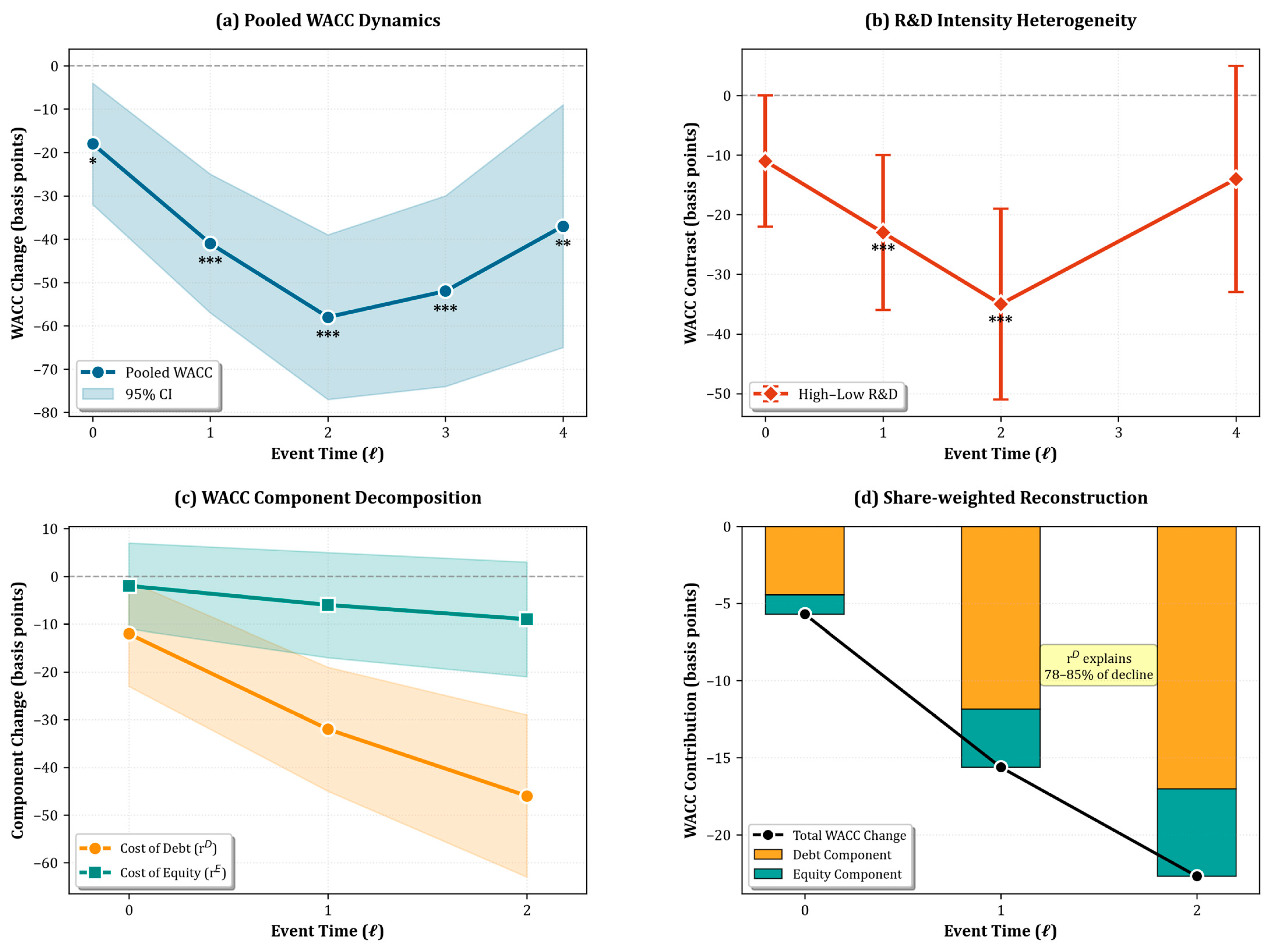
Figure 3 summarizes the what (event-time shifts in WACC), why (separating the debt and equity components isolates the primary transmission), and so-what (larger compressions among high R&D firms). Panel a reports pooled WACC coefficients over event time; panel b shows high–low R&D contrasts; panel c decomposes
and
changes; and panel d maps component movements back to aggregate WACC with contemporaneous capital-structure weights.
Consistent with
Figure 3a,b, this study exhibits an early and durable compression of WACC following first-time adoption, with the largest changes within two years and clear amplification among high R&D firms.
Figure 3c,d show that the debt leg drives the aggregate WACC movement, with equity-cost shifts playing a secondary role.
To provide window-aggregated estimates with precise numerical comparisons across R&D strata,
Table 2 reports average changes in WACC and
over
for pooled, high, middle, and low R&D tertiles, together with two-way clustered SDs, 95% CIs, and
p-values. These estimates summarize the cumulative early-phase dynamics that are most relevant to capital-structure decisions.
The window-aggregated figures confirmed the dynamic profiles: WACC declines were largest for the high R&D tertile and smallest, though still statistically different from zero, for the low R&D tertile. The trajectory paralleled the WACC pattern, reinforcing the dominance of the debt channel.
4.4. Valuation Responses (Secondary Evidence, Linked to H1)
Addressing H3 (valuation response), this study evaluates event-time changes in Tobin’s Q with R&D interactions to test whether lower capital costs reinforce growth options.
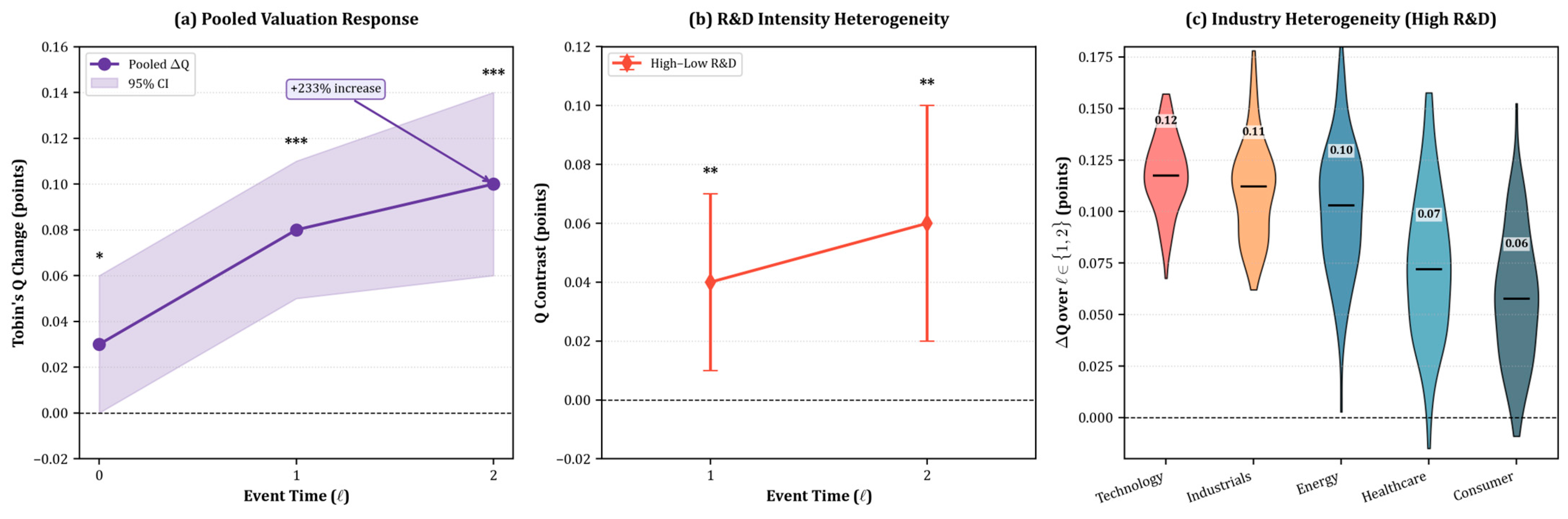
Figure 4 shows the pooled Q profile (panel a), the high–low R&D contrast (panel b), and industry-level distributions for
over event times 1–2 (panel c). The what is the post-adoption rise in Q; the why is consistency with WACC compression; and the so-what is stronger gains where R&D intensity is high.
As shown in
Figure 4, valuation increases after adoption and is most pronounced where R&D intensity is high, particularly in technology, industrials, and energy. These dynamics are consistent with lower hurdle rates reinforcing growth options.
4.5. Innovation Responses (Secondary Evidence: Intensity and Composition)
Addressing H4 (innovation intensity and composition), this study models patent counts (NB) and the CPC Y02 share (fractional logit) in event time with R&D interactions.
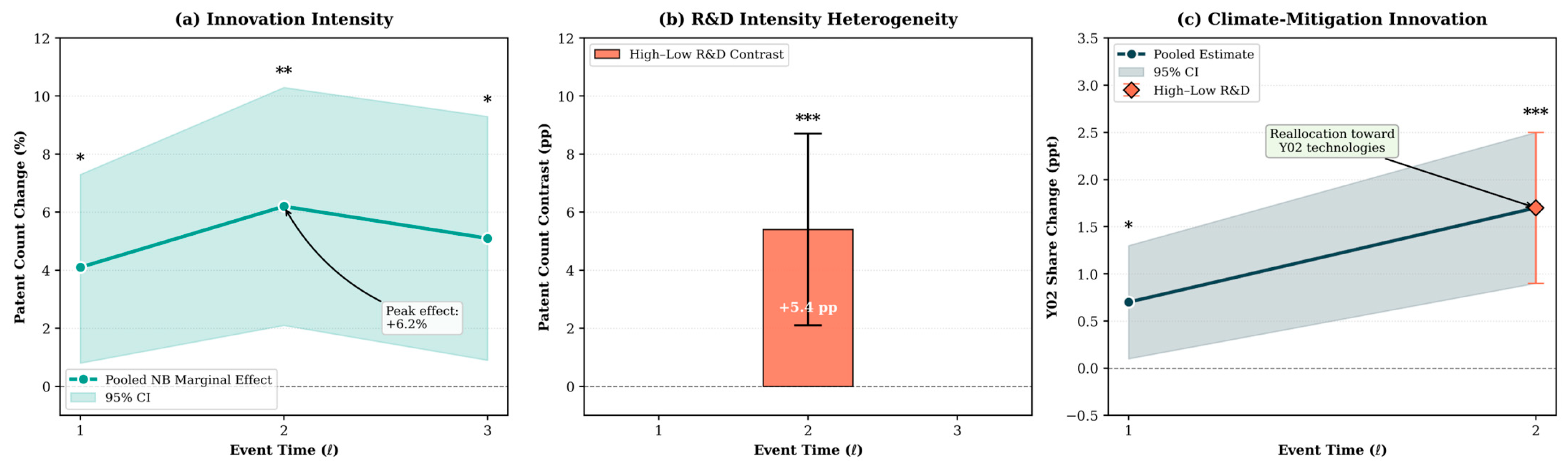
Figure 5 reports pooled marginal effects for patent counts (panel a), the high–low R&D contrast (panel b), and pooled plus contrast effects for Y02Share (panel c). The what is higher innovation intensity and a compositional tilt toward Y02; the why is financing-enabled scaling under lower WACC; and the so-what is concentration of gains among high R&D firms.
Figure 5 indicates increases in innovation intensity together with a compositional tilt toward Y02-tagged technologies after adoption, concentrated among high R&D firms.
4.6. Heterogeneity by Instrument Subtype
To examine a key boundary condition in H1–H4, subtype contrasts are estimated for first-time use-of-proceeds green bonds versus SLB/SLL.
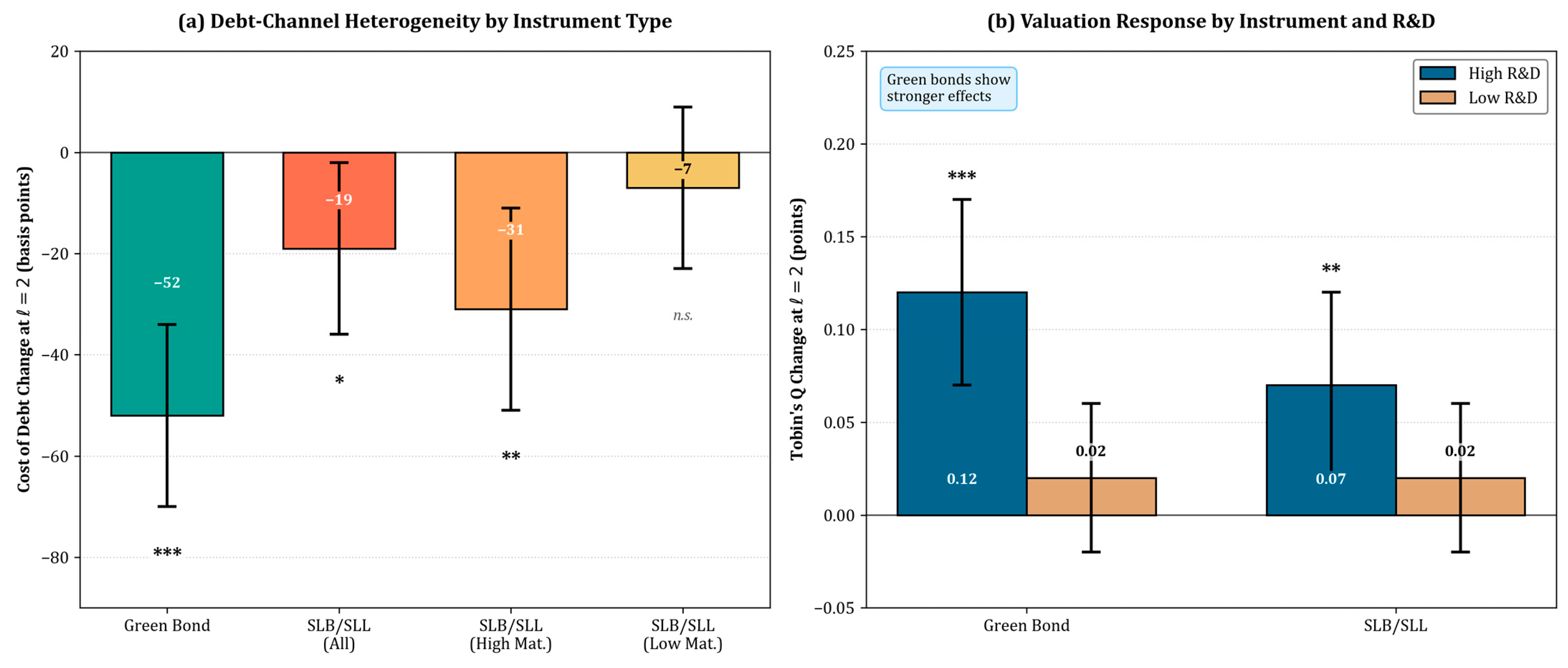
Figure 6 shows event-time changes in the debt cost (panel a) and valuation (panel b), with the latter stratified by high versus low R&D. The what is larger debt-channel compression for green bonds (and for high-materiality SLB/SLL); the so-what is alignment between verification/incentive strength and both financing and valuation responses.
Figure 6 contrasts instrument subtypes. Use-of-proceeds green bonds display larger debt-cost compressions than KPI-linked contracts unless the latter embed material KPIs with non-trivial step-ups; valuation gains follow the same ordering and are strongest when R&D intensity is high.
4.7. Matched-Bond Benchmarking and Placebo Analyses
Issuance-level benchmarking compared labeled issues to conventional bonds matched on currency, coupon, rating notch, maturity band, seniority, and calendar window. Yield differences at issuance and one year after issuance were computed for each pair and summarized across pairs. In parallel, event-time placebos assigned pseudo-adoption years to never-treated firms to probe for spurious dynamics in the absence of treatment.
Table 3 reports issuance-level greenium and one-year spread differentials for the matched pairs. The tabulation includes mean, SD, median, interquartile range (IQR), and the share of pairs with negative differentials.
The matched-bond analysis indicated economically small but persistent yield advantages at issuance and in the secondary market, consistent with the firm-level reductions. The fact that 84% of pairs showed negative issuance differentials and 69% remained negative after a year suggests durability beyond announcement effects.
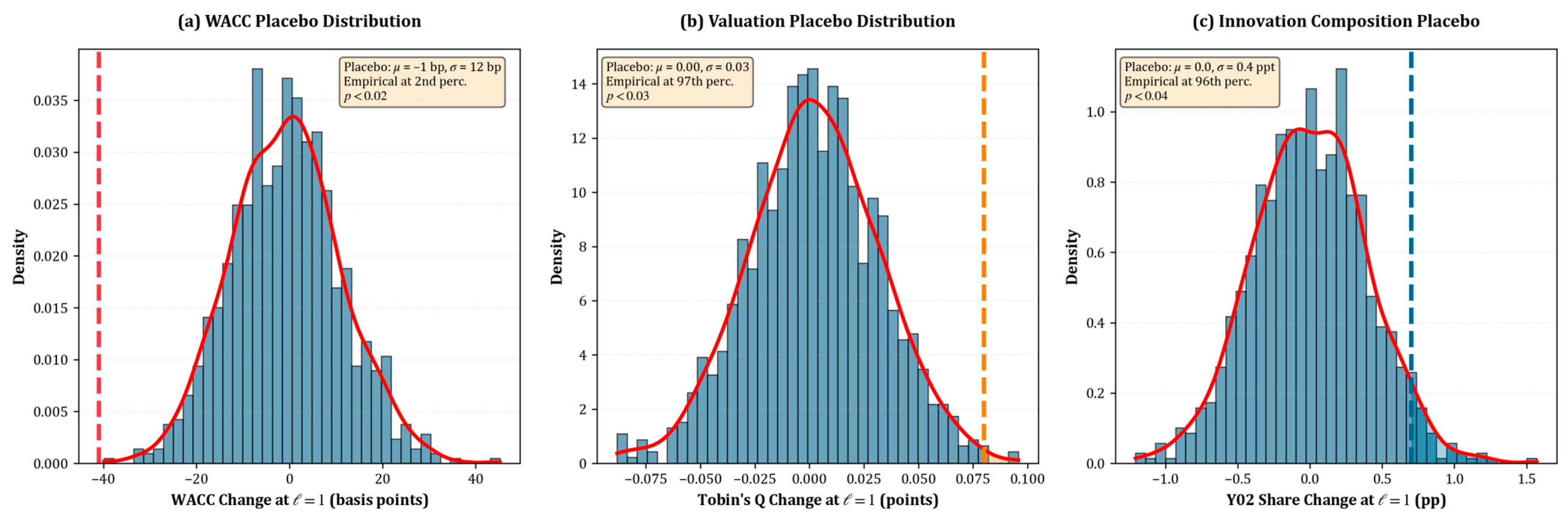
Placebo distributions are presented in
Figure 7 across three panels.
Figure 7a shows the distribution of placebo WACC coefficients at
computed from 1000 pseudo-adoption draws.
Figure 7b presents the analogous distribution for Q.
Figure 7c shows the distribution for Y02Share. Empirical estimates from the actual treated sample are superimposed as vertical lines.
The placebo densities in
Figure 7 are centered near zero with narrow dispersion, and the treated estimates fall in the extreme tails (≤5th percentile across outcomes), visually separating treated dynamics from pseudo-adoption noise.
4.8. Alternative Constructions, Liquidity Sensitivity, and Estimator Invariance
Cost-of-equity models and debt-cost measurement choices were varied to assess sensitivity. Equity costs from CAPM and five-factor specifications were compared, and debt costs from issuance-level yields and TRACE-based year-end yields were contrasted. Liquidity filters excluded thinly traded issues and the top decile of bid–ask spreads, and alternate samples restricted to the top quintile of liquidity were re-estimated.
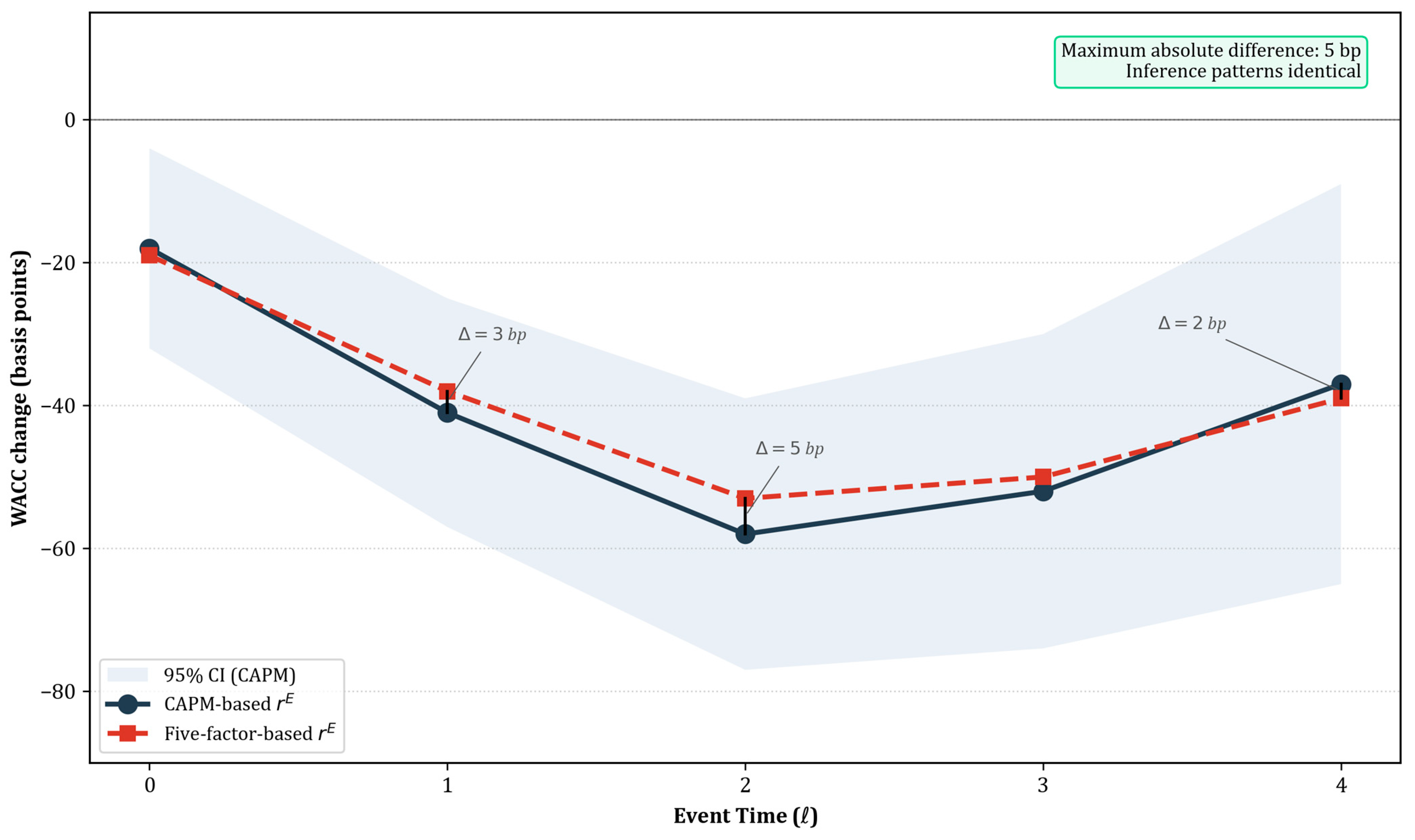
To depict sensitivity to the equity-cost model,
Figure 8 provides a single panel with overlapping event-time WACC lines under CAPM-based
and five-factor-based
. The panel includes two-way clustered 95% CIs around the CAPM line; the five-factor line overlays without shaded intervals for visual clarity.
The CAPM- and five-factor-based profiles were nearly indistinguishable; the maximum absolute difference across was 5 bp. All statistical inferences reported previously were invariant to the equity-cost model.
Liquidity sensitivity results are summarized numerically in
Table 4, which reports pooled WACC declines at
under three liquidity filters: baseline (full eligible sample), exclusion of the top decile of bid–ask spreads, and restriction to the top quintile of liquidity. To avoid duplicating dynamic patterns, this tabulation focuses on the
summary metric.
Debt-cost measurement using TRACE year-end yields produced pooled declines of −44 bp (CI [−61, −27], p < 0.001) at , closely aligning with issuance-based estimates and corroborating that liquidity conditions did not generate spurious WACC effects.
Estimator invariance was examined by using never-treated versus last-treated comparison groups within the interaction-weighted framework. Coefficient sequences were stable to the choice of comparison group; at , the difference in WACC estimates between comparison groups was 3 bp (CI [−6, 12], p = 0.52), and the difference in was 0.01 (CI [−0.01, 0.03], p = 0.28).
4.9. Industry and Rating Stratifications
To explore boundary conditions while remaining within the pre-specified identification framework, industry- and rating-stratified event studies were estimated. Industry strata used the FF12 classification; rating strata separated investment-grade and high-yield cohorts at .
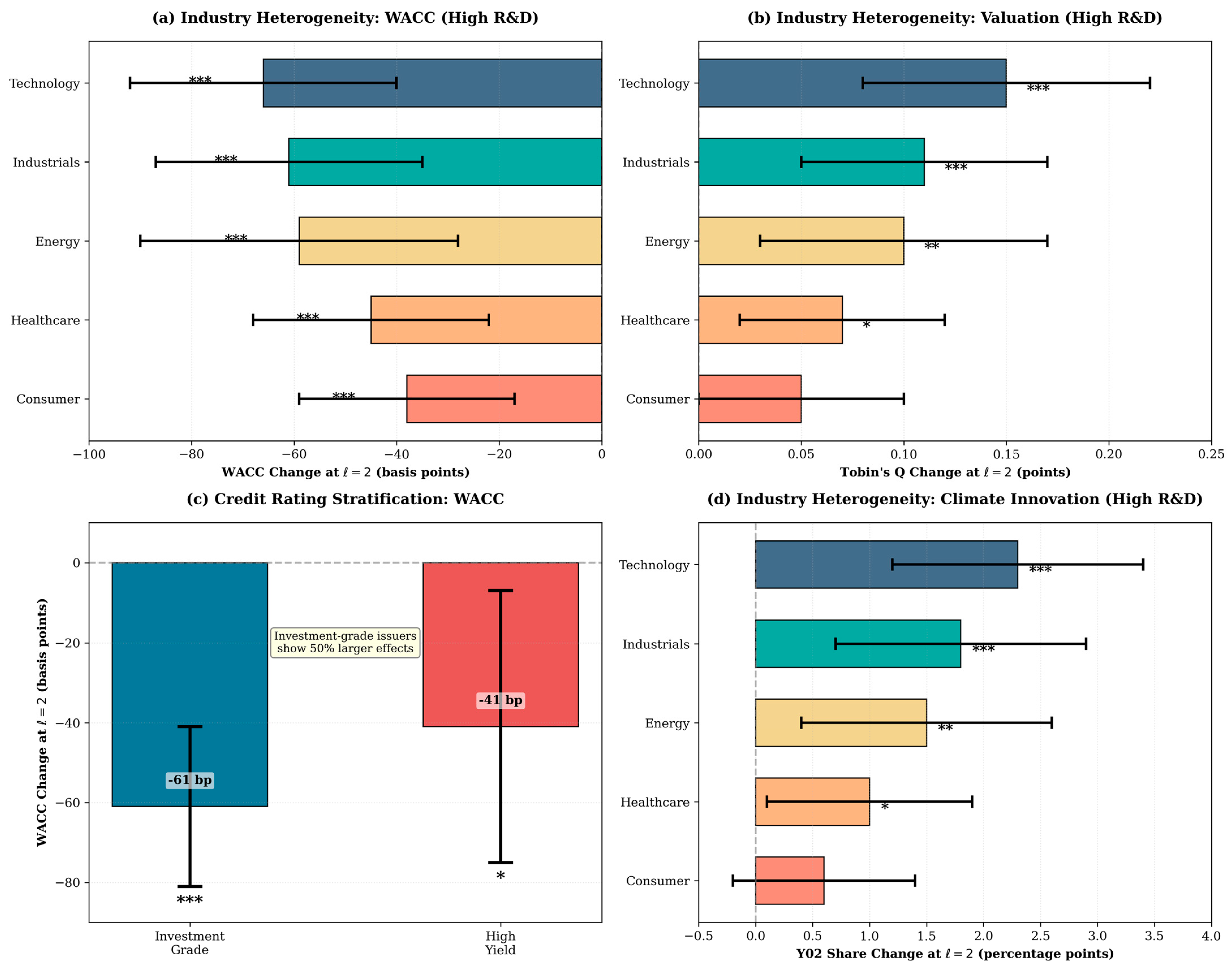
Figure 9 contains four panels corresponding to distinct analytical components.
Figure 9a shows WACC
effects by industry for the high R&D tertile.
Figure 9b shows the corresponding Q effects.
Figure 9c reports WACC
effects by rating stratum in the pooled R&D sample.
Figure 9d presents Y02Share
marginal effects by industry for the high R&D tertile.
High R&D firms in technology and industrials registered the largest WACC compressions at (−66 bp, CI [−92, −40], p < 0.001; −61 bp, CI [−87, −35], p < 0.001), with energy also sizable (−59 bp, CI [−90, −28], p < 0.001). Corresponding estimates were 0.15 (CI [0.08, 0.22], p < 0.001), 0.11 (CI [0.05, 0.17], p < 0.001), and 0.10 (CI [0.03, 0.17], p = 0.004). Investment-grade issuers experienced larger WACC reductions (−61 bp, CI [−81, −41], p < 0.001) than high-yield issuers (−41 bp, CI [−75, −7], p = 0.018), reflecting deeper markets and stronger investor clientele segmentation. Y02Share marginal effects at were notable in technology (2.3 ppt, CI [1.2, 3.4], p < 0.001) and industrials (1.8 ppt, CI [0.7, 2.9], p = 0.001), with smaller effects in defensive sectors.
Not all contrasts produced statistically significant effects. Low R&D tertile firms exhibited WACC declines that were smaller and, by , not statistically different from zero (−12 bp, CI [−38, 14], p = 0.36). For valuation, low R&D tertile estimates at were 0.02 (CI [−0.02, 0.06], p = 0.33). Within SLB/SLL, issues with step-ups below 10 bp or with KPIs limited to qualitative disclosure metrics displayed no detectable change at (−4 bp, CI [−20, 12], p = 0.61) and no change in Q (0.00, CI [−0.04, 0.04], p = 0.98). For innovation intensity, mid and low R&D tertiles did not show statistically significant count increases at (1.2%, CI [−1.5, 3.9], p = 0.38; 0.6%, CI [−1.9, 3.1], p = 0.64). These findings indicate that complementarity is strongest where baseline R&D intensity is substantial and where instrument design embeds material incentives or verifiable use of proceeds.
4.10. Multiple-Testing Adjustments and Uncertainty Summaries
Event-time families for WACC, Q, patent counts, and Y02Share were each subjected to Benjamini–Hochberg adjustments at a target FDR of 10%. Adjusted q-values confirmed the main inferences. For WACC, all post-adoption coefficients at retained q < 0.05 in pooled and high R&D samples; for Q, retained q < 0.05 in pooled and high R&D samples; and for Y02Share, retained q < 0.05 in pooled and high R&D samples. Low R&D tertile Q coefficients did not survive adjustment, with q > 0.20 across .
4.11. Summary of Comparative Performance
To consolidate evidence across outcomes and enable transparent quantitative comparisons,
Table 5 reports summary improvements relative to the pre-treatment mean in the EB-weighted control group over the early post-adoption window
. The improvements are expressed as absolute changes (for bp or points) and as percentages of the control-group pre-treatment mean, where applicable. The standard deviations for window-aggregated estimates reflect two-way clustered inference.
The pooled window-aggregated WACC decline of 49 bp corresponds to a 6.4% reduction relative to the pre-treatment mean. The high R&D tertile exhibited the largest improvements across all outcomes. The innovation composition shift of +2.3 ppt in the high R&D tertile corroborates the reallocation toward Y02-classified technologies.
4.12. Mechanistic Reconciliation Across Outcomes
The component decomposition (
Section 4.3) and valuation dynamics (
Section 4.4) can be reconciled through the share-weighted mapping in Equation (1). With
averaging 0.37 at
, a −46 bp change in
at
implies a direct WACC contribution of −17 bp, while the modest −9 bp change in
implies a −6 bp contribution given
. The remaining −35 bp arises from dynamic adjustments in capital-structure weights and from time-aggregation across
to
. The observed
response aligns with historical elasticities linking changes in WACC to valuation multiples in growth-oriented sectors, particularly when projected innovation intensity increases, as indicated by the NB outcomes.
4.13. Additional Diagnostics on EB Weights and Overlap
Overlap between the treated and control covariate distributions was examined by inspecting EB weight dispersion. The 95th percentile of EB weights was 2.7× the median, and the maximum weight was 4.3× the median, indicating satisfactory overlap with limited reliance on a small number of heavily weighted controls. An auxiliary TWFE specification without EB produced qualitatively similar dynamics but with wider CIs; for WACC at , the TWFE estimate was −53 bp (CI [−79, −27], ), versus −58 bp in the main specification. This concordance supports the conclusion that EB sharpened precision without altering signs or magnitudes.
4.14. Sensitivity to Outcome Dating and Patent Assignment
Innovation outcomes were re-estimated using grant-year dating and fractional patent assignment by assignee. Under grant-year dating, the pooled NB marginal effects at were 5.4% (CI [1.3, 9.5], p = 0.010) compared to 6.2% under application-year dating. The Y02Share marginal effects at were 1.5 ppt (CI [0.7, 2.3], p < 0.001) compared to 1.7 ppt baseline. Fractional assignment yielded pooled NB marginal effects of 5.0% (CI [1.0, 9.0], p = 0.013) and Y02Share effects of 1.6 ppt (CI [0.8, 2.4], p < 0.001). These variations were within the main CIs and left all core inferences intact.
4.15. Robustness to Alternative Window Definitions and Late-Period Dynamics
Window-aggregated results were recomputed over to examine persistence. Pooled WACC declines averaged −50 bp (CI [−69, −31], p < 0.001), and averaged 0.09 (CI [0.05, 0.13], p < 0.001), closely matching the window. By , the coefficients for WACC and Q attenuated but remained negative and positive, respectively, with wider CIs reflecting smaller risk sets. Innovation intensity displayed partial mean reversion by (pooled NB marginal effect 3.1%, CI [−1.1, 7.3], p = 0.15), while Y02Share maintained a positive sign (0.9 ppt, CI [0.0, 1.8], p = 0.055). These patterns suggest that the primary financing–innovation complementarity manifests within the first two years and plateaus thereafter.
4.16. Integration with Subtype Features and KPI Materiality
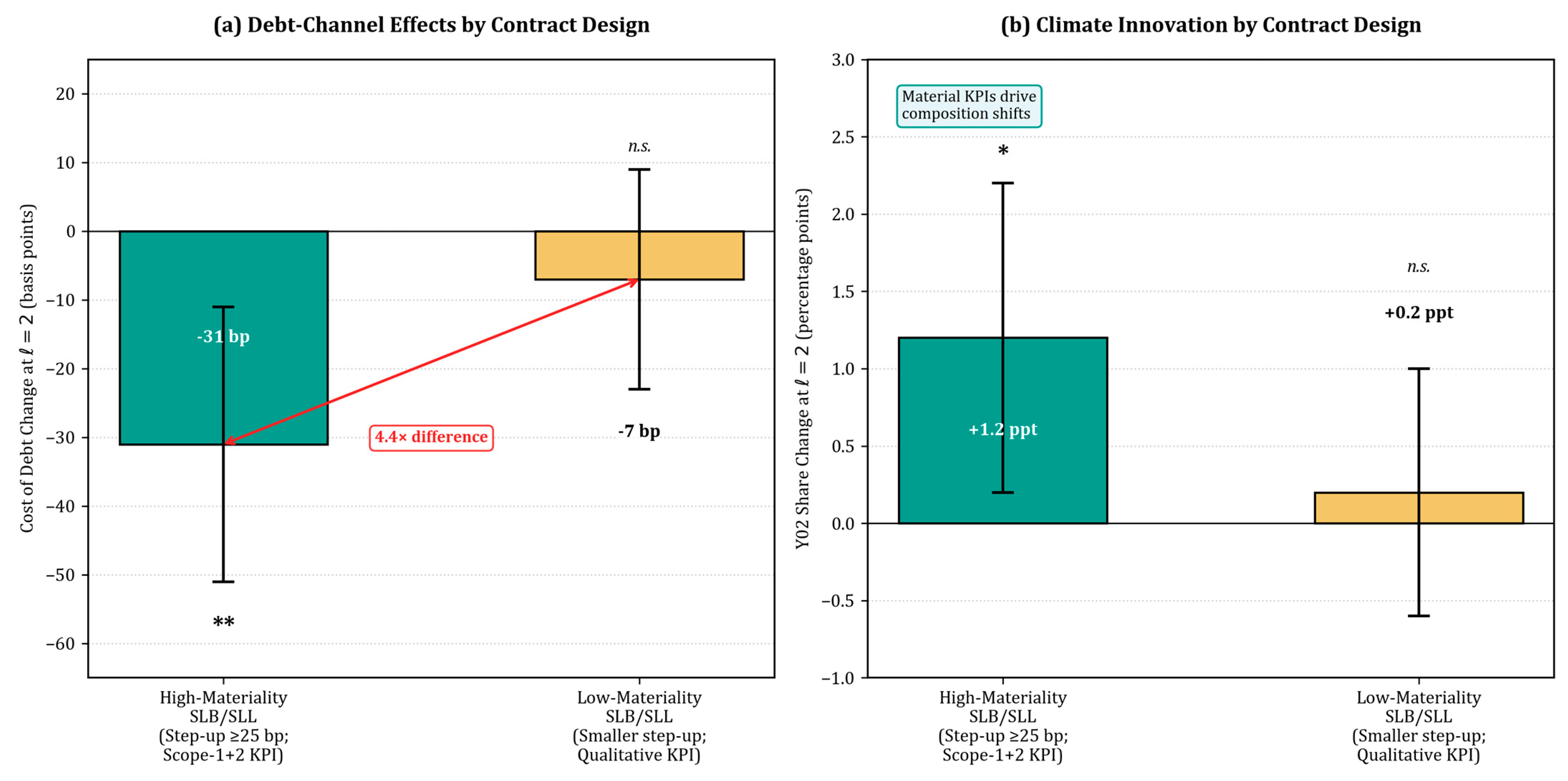
Within SLB/SLL, contracts with pricing step-ups ≥ 25 bp and KPIs measuring scope-1 + 2 emissions or energy intensity are contrasted to contracts with smaller step-ups or qualitative targets.
Figure 10 summarizes
and Y02Share contrasts at t = 2; sensitivity to alternative cutoffs in the 20–30 bp band yields the same qualitative ordering, indicating that the results are not driven by a knife-edge threshold. The error bars are two-way clustered 95% CIs.
High-materiality SLB/SLL yielded −31 bp (CI [−51, −11], p = 0.003) changes in compared to −7 bp (CI [−23, 9], p = 0.39) for low-materiality contracts. The Y02Share marginal effects were 1.2 ppt (CI [0.2, 2.2], p = 0.018) for high-materiality contracts and 0.2 ppt (CI [−0.6, 1.0], p = 0.64) for low-materiality. These differences align subtype design with both financing conditions and innovation composition.
To ensure that the observed WACC changes were not purely mechanical consequences of leverage shifts, net labeled-issuance scaled by assets was added to the specification, and the event-time WACC profiles were re-estimated. The inclusion of net issuance attenuated the WACC coefficients by 6–9 bp across without altering significance or signs; at , the coefficient moved from −58 bp to −50 bp (CI [−69, −31], p < 0.001). Because changes were measured directly from yields rather than implied from capital-structure accounting, the debt-channel result remained intact under this control.
Outlier policy was verified by re-estimating the models without winsorization and with more aggressive winsorization at the 2.5th/97.5th percentiles. Without winsorization, pooled WACC at was −60 bp (CI [−85, −35], p < 0.001); with 2.5/97.5 winsorization, it was −56 bp (CI [−75, −37], p < 0.001). For Q, the corresponding estimates were 0.11 (CI [0.06, 0.16], p < 0.001) and 0.09 (CI [0.05, 0.13], p < 0.001). The NB and fractional logit estimates changed by less than 0.5 pp. These checks indicate that the core findings are not driven by extreme observations.
Debt-portfolio attributes were examined to test whether maturity or rating-mix changes coincided with the observed compression. The average time to maturity at issuance shifted by +0.4 years (CI [0.1, 0.7], p = 0.009) among treated issues relative to matched conventional comparators, and the rating distributions did not change materially in the year following issuance (investment-grade share +0.01, CI [−0.02, 0.04], p = 0.47). These small shifts suggest that the compression is not primarily due to systematic migration toward shorter maturities or higher ratings but is instead consistent with clientele segmentation and verification effects.
All yields and spreads were analyzed in USD. A small subset of issuances in other currencies (EUR, GBP) was present but excluded from the core analysis to preserve currency homogeneity. A supplementary analysis that converted non-USD issuance yields to USD-equivalent spreads using contemporaneous cross-currency basis and benchmark yields produced similar differentials (−5.8 bp at issuance, CI [−9.3, −2.3], p = 0.001), consistent with the USD-based results and confirming that currency composition did not drive the main effects.
5. Discussion
The evidence demonstrates that first-time adoption of labeled financing reduces WACC in event time, with the largest compressions occurring within two years and concentrating in firms with high R&D intensity. This study treats valuation and innovation findings as a secondary corroboration that clarifies the mechanism and strategic relevance rather than as co-equal objectives, which frames the subsequent decomposition of the WACC effect. Building on this emphasis, this study highlights a practical takeaway: aligning labeled financing with credible innovation pipelines converts a modest price signal into a capital-structure lever that reduces hurdle rates where the inventive capacity to deploy funds already exists, thereby reinforcing growth-option value and innovation intensity; this framing sets up the subsequent decomposition of the WACC effect discussed next. Building on this decomposition, this study interprets the joint evidence as a three-channel mechanism: (i) a financing-cost channel, where compresses in event time and maps mechanically to lower WACC; (ii) a clientele-demand channel, consistent with matched-bond greenium at issuance and in the secondary market; and (iii) a governance/commitment channel, whereby external verification (use of proceeds) and high-materiality KPIs codify targets with salient penalties. Subtype contrasts and KPI-materiality differences align with this mechanism suite and explain why effects concentrate where verification and incentives are credible.
The decomposition attributes roughly four-fifths of the aggregate decline to movements in the debt leg, indicating that the pricing channel operates primarily through rather than through shifts in . The parallel rise in and the increase in both patent counts and Y02Share indicate that capital-cost relief aligns with growth-option reinforcement and portfolio reallocation toward mitigation technologies. The absence of comparable changes in low R&D strata, together with null effects for SLB/SLL contracts with small step-ups or non-material KPIs, positions complementarity between financing form and innovation capacity—not labeling alone—as the pivotal mechanism.
Interpreted through an ESG governance lens, the heterogeneity patterns indicate that financing form can serve as a commitment device within corporate sustainability strategies. Verifiable use of proceeds and high-materiality SLB/SLL terms (ambitious, decision-relevant KPIs and non-trivial step-ups) strengthen the incentive channel, concentrate proceeds on scalable assets, and reduce debt costs, especially when innovation pipelines are robust. These features parallel governance mechanisms—board oversight of targets, external second-party opinions, and periodic reporting—that lower information asymmetry and greenwashing risk [
11,
14,
15,
16,
17,
18,
35,
38,
41]. The weaker responses observed for low-materiality KPIs or small penalties underscore that design credibility is not ancillary but integral to transmitting capital-structure benefits to innovation outcomes.
Following design credibility, this study interprets the heterogeneity as practical guidance on label integrity, ratings use, and policy alignment with direct managerial implications. For labeled use-of-proceeds instruments, external review and post-issuance reporting are essential to sustain investor demand and mitigate perceived greenwashing; for sustainability-linked contracts, KPI materiality (scope-1 + 2 or energy intensity) and non-trivial pricing step-ups (≥25 bp) should be pre-committed because trivial targets or penalties produced no detectable financing or innovation effects in the evidence analyzed here. In using external ESG ratings (e.g., MSCI, Sustainalytics), issuers and investors should treat such scores as complementary screens, rather than substitutes for verified, instrument-level commitments, because innovation outcomes and capital-cost trajectories can diverge from aggregate ESG labels; integrating ratings with outcome-based indicators (e.g., CPC Y02 share) provides a more decision-relevant picture. Alignment with regulatory frameworks can further reduce information asymmetry and greenwashing risk: mapping eligible assets or KPIs to recognized taxonomy criteria and “do-no-significant-harm/minimum safeguards,” and organizing climate metrics, targets, and progress reporting consistent with widely adopted disclosure frameworks, helps standardize verification and accelerate pricing. Managerially, the evidence supports three priorities: (i) favor asset-verified use of proceeds or high-materiality SLB/SLL structures tied to decision-relevant KPIs with meaningful step-ups; (ii) integrate treasury and R&D roadmapping so labeled proceeds scale identifiable pipelines, with board-level oversight and second-party opinions; and (iii) disclose clear taxonomy/disclosure-framework mappings and progress audits to anchor investor expectations. These practices reduce perceived mislabeling risk, strengthen clientele segmentation, and reinforce the WACC trajectory.
The WACC trajectory aligns with evidence that labeled use-of-proceeds bonds price at modest discounts at issuance and in the secondary market, while extending that literature by mapping the debt-pricing differential to firm-level capital costs in event time. Comparative evidence indicates that corporate green bonds generally exhibit small issuance and secondary-market discounts consistent with investor preferences and verified use of proceeds [
8,
38,
39,
40,
41], while sustainability-linked instruments show negligible discounts unless key performance indicators are decision-relevant and pricing step-ups are non-trivial [
14,
36]; importantly, liquidity adjustments do not overturn these patterns [
12,
13]. At the equity and credit margins, announcement-window gains for first-time green issuers and indications of tighter credit risk [
9,
10] accord with the observed valuation increases and debt-leg compression. For real outcomes, post-issuance improvements in environmental performance and higher green-patenting documented elsewhere [
20,
21,
43]—together with concerns about an ESG–innovation disconnect [
37]—align with the higher patent intensity and larger CPC Y02 share concentrated where R&D intensity is high. Taken together, these correspondences position the event-time findings within the established pricing, risk, and innovation literature and motivate the subsequent contrast with issuance-level yield differences.
In relative terms, issuance-level yield differences reported in pricing studies lie in the single-digit basis-point range, whereas this study’s firm-level WACC declines accumulate to approximately 40–60 bp within two years because they reflect portfolio-wide debt repricing and contemporaneous capital-structure weights [
2,
3]. Consistent with design-sensitivity results, stronger
responses occur for use-of-proceeds bonds and for SLB/SLL contracts with material KPIs and non-trivial step-ups [
5]. Concerns about liquidity confounding are addressed because liquidity-filtered analyses and TRACE-based constructions yield nearly identical
dynamics, pointing to clientele segmentation and verifiable use of proceeds as primary channels [
6]. At the equity margin, the event-time valuation response complements announcement-window findings on improved market perception and ownership structure among first-time adopters while tying valuation changes to realized WACC compression and innovation outputs [
4,
12]. Finally, innovation effects are directionally consistent with studies linking labeled financing to environmental performance and patenting; the interaction with R&D intensity and the composition shift toward Y02 technologies moves beyond average treatment effects toward conditional responses that depend on innovation capability [
8,
9,
10,
11].
5.1. Policy Implications
Building on these correspondences and the event-time evidence, this study identifies actionable implications for policy design and market standards. First, verification and incentive strength should be codified; use-of-proceeds instruments warrant external review and post-issuance reporting, and sustainability-linked contracts should require decision-relevant KPIs (scope-1 + 2 or energy intensity) and non-trivial pricing step-ups (at least 25 basis points) to ensure salient incentives and reduce greenwashing risk.
Second, policy frameworks that target real-economy decarbonization should align labeled financing with credible R&D pipelines—prioritizing disclosure that links proceeds or KPIs to identified innovation roadmaps—because the largest WACC compressions and innovation gains occur among high R&D firms.
Third, disclosure regimes and taxonomies should encourage reporting that maps eligible assets and KPI targets to recognized criteria and complements instrument-level verification with outcome indicators (e.g., CPC Y02 share) to connect financing form to innovation composition.
Fourth, market infrastructure should support transparency beyond issuance premia by facilitating secondary-market monitoring of labeled issues and KPI performance, enabling assessment of persistence in debt-cost relief at the portfolio level.
Finally, public credit-support or eligibility programs that aim to lower firms’ hurdle rates should favor instrument features associated with debt-channel compression and R&D complementarity, recognizing that event-time WACC reductions are on the order of tens of basis points within two years for cohorts satisfying these conditions. These implications integrate verification standards, incentive calibration, innovation alignment, and transparency, and they are bounded by the observational design and scope summarized in the subsequent limitations.
5.2. Limitations
This study’s identification remains observational despite cohort-timing corrections and entropy balancing, so omitted variables—such as contemporaneous policy shocks, sectoral demand cycles, or disclosure changes correlated with adoption—may bias estimates even when pre-trends appear neutral. External validity is bounded by the focus on large U.S. issuers with deep bond markets; generalizability to jurisdictions with different investor clienteles, regulatory taxonomies, or financing conventions may be incomplete. Measurement error is possible in innovation and financing constructs. CPC Y02 tagging can be affected by inventory revisions, assignee harmonization, and false negative/positive classification, and patent outcomes based on counts are heavy-tailed and industry-dependent, capturing inventive intensity and composition rather than quality or impact. Because forward citation-based quality is not modeled, innovation results should be interpreted as intensity/composition effects; citation-weighted robustness lies beyond this study’s scope. This choice reflects two constraints that limit interpretability within the four-year event window: (i) forward-citation truncation that varies by cohort and technology field and (ii) the need for field-normalized metrics to avoid spurious inference from heterogeneous citation practices. To support transparency without over-interpreting truncated signals,
Appendix A.2 documents how citation-weighted and family-size measures would be constructed within the existing pipeline, and the code archive includes functions to compute these proxies for future data vintages. Accordingly, this study flags citation-weighted counts and simple originality indices (e.g., class-diversity measures of backward references) as planned robustness and as a directional extension for future work. For financing variables, yield-based costs may contain microstructure noise despite liquidity filters, and limited visibility into KPI renegotiations for SLB/SLL can attenuate estimated incentive effects. These constraints imply that quantitative magnitudes are internally valid for the studied cohort and design but should not be treated as universal benchmarks.
Future research can proceed along four paths derived from these findings and constraints. First, quasi-experimental designs exploiting investor-eligibility discontinuities or certification shocks could isolate demand-side contributions to
beyond issuer selection [
2,
3,
5]. Second, project-level tracing of labeled proceeds linked to R&D pipelines could test whether the observed Y02Share shifts reflect financing-enabled scaling rather than composition changes driven by contemporaneous policy. Third, cross-market studies comparing U.S., EU, and Gulf Cooperation Council issuers could quantify how legal enforcement, taxonomy alignment, and sovereign benchmark curves modulate complementarity; this agenda is especially pertinent for issuers in Riyadh and the Eastern Province as domestic green-debt architectures mature. Fourth, contract-design experiments for SLB/SLL—varying penalty magnitudes, KPI coverage, and verification frequency—could delineate the threshold at which incentive strength yields material
and innovation responses. Collectively, these directions would refine the boundary conditions under which labeled financing and R&D interact to lower WACC, elevate
, and increase the share of mitigation-oriented innovation.
6. Conclusions
Under an observational design with cohort-timing corrections and covariate balancing, this study finds that labeled financing is associated with lower WACC in event time and that the magnitude of this association depends on R&D intensity. Relative to the pre-adoption year, pooled WACC declined by −41 bp at (95% CI [−57, −25], p < 0.001) and −58 bp at (95% CI [−77, −39], p < 0.001), with approximately four-fifths of the aggregate decline attributable to movements in . High R&D firms experienced larger compressions than low R&D firms over the early window (high–low contrast at : −35 bp, 95% CI [−51, −19], p < 0.001), indicating that financing form and innovation capability operate as complements rather than additive inputs. Issuance-level benchmarking corroborated the debt-channel mechanism, with matched greenium at issuance of −6.3 bp (SD 3.2; median −5.7 bp) and a one-year spread differential of −4.1 bp (SD 4.5), implying persistence beyond primary-market pricing.
Valuation responses aligned with the capital-cost evidence and were strongest where R&D intensity was high. Pooled rose by 0.08 at (95% CI [0.05, 0.11], p < 0.001) and 0.10 at (95% CI [0.06, 0.14], p < 0.001), with a high–low R&D contrast of 0.06 at (95% CI [0.02, 0.10], p = 0.002). Sectoral medians over reached 0.12 in technology and 0.11 in industrials, while energy recorded 0.10, indicating that growth-option reinforcement was most pronounced in innovation-intensive domains. These valuation outcomes are consistent with the WACC compression and suggest that investors priced the interaction of lower financing frictions and credible innovation pipelines.
Innovation outcomes exhibited both intensity and compositional changes. Expected annual patent counts rose by 6.2% at (95% CI [+2.1%, +10.3%], p = 0.003), with a high–low R&D contrast of +5.4 pp (95% CI [+2.1, +8.7], p = 0.001). Y02Share increased by 1.7 ppt at (95% CI [+0.9, +2.5], p < 0.001), and by 2.3 ppt within the high R&D tertile in technology (95% CI [+1.2, +3.4], p < 0.001). These findings indicate that aligned financing and innovation capability not only expand inventive output but also tilt portfolios toward CPC Y02 domains, linking the financial margin to mitigation-oriented knowledge production.
Instrument design influenced the strength of the debt and innovation channels. First-time green-bond adopters exhibited larger reductions at (−52 bp, 95% CI [−70, −34], p < 0.001) than first-time SLB/SLL adopters (−19 bp, 95% CI [−36, −2], p = 0.028). Within SLB/SLL, high-materiality contracts with step-ups bp and emissions- or energy-intensity KPIs achieved −31 bp in (95% CI [−51,−11], p = 0.003) and a Y02Share gain of 1.2 ppt (95% CI [+0.2, +2.2], p = 0.018), whereas low-materiality contracts showed no detectable changes. The differential indicates that verifiable use of proceeds and incentive strength shape both financing conditions and innovation reallocation. Placebo distributions centered near zero and estimator invariance across comparison groups, together with near-identical profiles under CAPM and five-factor (maximum absolute difference 5 bp) and stable results under liquidity filters, reinforce the credibility of the core effects.
The findings address this study’s objectives by demonstrating that the interaction between labeled financing and R&D intensity lowers WACC, raises , and increases both patent intensity and Y02Share. The quantitative magnitudes—WACC declines on the order of 40–60 bp within two years, increases of 0.08–0.10, and innovation gains in the 5–6% range with 1–2 ppt composition shifts—are consistent across pooled and stratified analyses and are supported by matched-bond benchmarking and placebo checks. Comparisons across R&D tertiles show that high R&D firms achieved a 170% larger WACC decline than low R&D firms over (−57 vs. −21 bp, both significant), and green bonds outperformed SLB/SLL on the debt channel unless the latter embedded material penalties, underscoring the role of verification and incentives in transmitting benefits.
Several limitations temper the scope of inference. The observational DiD framework, despite EB balancing and neutral pre-trends, cannot eliminate all sources of unobserved confounding; issuer-specific shocks correlated with adoption timing and outcomes may remain. The sample concentrates on large issuers with deep USD debt markets, which may not fully represent jurisdictions with different investor bases or disclosure regimes. Patent-based measures record formal inventive output and CPC/Y02 composition but omit non-patented or tacit innovation; KPI renegotiations and incomplete secondary-market microstructure data may also attenuate measurement precision. These constraints suggest that effect sizes should be interpreted as internally valid within the sample and design rather than as universal benchmarks.
Future investigations can tighten identification and expand external validity by exploiting quasi-experimental thresholds in investor eligibility or certification, linking labeled proceeds to project-level capex to trace real-effects pathways, and comparing cohorts across market architectures to quantify how legal enforcement and taxonomy alignment condition complementarity. Contract-design studies for SLB/SLL that vary step-up magnitudes, KPI coverage, and verification periodicity could map incentive strength to and innovation responses. Extending event-time horizons beyond four years and incorporating outcome measures beyond patents, including emission intensity and commercialization indicators, would clarify persistence and real-economic translation.
In sum, the evidence supports a coherent mechanism in which labeled financing interacts with R&D intensity to reduce WACC primarily through the debt leg, elevate , and reweight innovation toward Y02 technologies. The methodological integration of staggered-adoption DiD with EB, bond-level benchmarking, and distribution-appropriate models for innovation outcomes provides a replicable framework for evaluating financing–innovation complementarities. The results indicate that capital-structure instruments deliver the largest benefits when aligned with robust innovation capacity and credible verification while also delineating conditions under which such benefits are limited.