




How Can Stakeholder Co-Creation Foster Climate-Resilient Coastal Tourism Through Integrated Management of Climate, Water-Energy, and Beach-Dune Systems?
 , , ,
, , ,
Abstract
1. Introduction
2. Literature Review
2.1. Climate, Tourism, and Sustainability: A General Overview
2.2. Climate Assessment for Tourist Activities
2.3. Climate Change Impacts and Tourism
2.4. Climate Change Adaptation and Maladaptation
2.5. Water, Energy, and Beach-Dune Systems in Tourism: Balancing Resources and Resilience?
3. Study Area and Methodology
3.1. Study Area
3.2. Approach to User Engagement
3.3. Co-Creation Methodology for Understanding Stakeholders’ Perception
4. Results
4.1. Optimal Meteo-Climatic Conditions for Each Tourism Activity: Sub-Question 1
4.2. Adaptive Actions for Tourism Destinations, WCCC Perspective: Sub-Question 1
4.3. Mitigation and Adaptive Measures Based on Their Priority and Feasibility, WAEN Perspective: Sub-Question 2
4.4. Perception of Beach Dune Systems in Tourist Destinations, BEDU Perspective: Sub-Question 3
4.5. Key Takeaways on Climate Adaptation for Tourism: Integrated Perspectives on Optimal Conditions, Adaptive Actions, and Stakeholder Perceptions
5. Discussion
6. Conclusions
Supplementary Materials
Author Contributions
Funding
Institutional Review Board Statement
Informed Consent Statement
Data Availability Statement
Acknowledgments
Conflicts of Interest
Abbreviations
| WAEN | Water and Energy |
| BHCH | Behavioral change |
| WCCC | Weather, Climate, and Climate Change |
| BEDU | Beach-dune system |
References
- Ebrahimzadeh, I.; Ziaee, M.; Farzin, M.R. Feasibility Studies of the West Coast Sample of Tourism (Chabahar); Geosciences Research Institute of Sistan and Baluchestan: Zahedan, Iran, 2009. [Google Scholar]
- Scott, D.; Lemieux, C. Weather and climate information for tourism. Procedia Environ. Sci. 2010, 1, 146–183. [Google Scholar] [CrossRef] [Scilit]
- Becken, S. The importance of climate and weather for tourism: Literature review. Land Environ. People 2010. Available online: https://researcharchive.lincoln.ac.nz/server/api/core/bitstreams/868f02cb-bcea-4ccf-8db1-038839a2ec7b/content (accessed on 8 September 2025).
- Gómez-Martín, M.B. Weather, climate and tourism: A geographical perspective. Ann. Tour. Res. 2005, 32, 571–591. [Google Scholar] [CrossRef] [Scilit]
- de Freitas, C.R. Tourism climatology: Evaluating environmental information for decision making and business planning in the recreation and tourism sector. Int. J. Biometeorol. 2003, 48, 45–54. [Google Scholar] [CrossRef] [Scilit] [PubMed]
- Scott, D.J.; Lemieux, C.J.; Malone, L. Climate services to support sustainable tourism and adaptation to climate change. Clim. Res. 2011, 47, 111–122. [Google Scholar] [CrossRef] [Scilit]
- Damm, A.; Köberl, J.; Stegmaier, P.; Alonso, E.J.; Harjanne, A. The market for climate services in the tourism sector–An analysis of Austrian stakeholders’ perceptions. Clim. Serv. 2020, 17, 100094. [Google Scholar] [CrossRef] [Scilit]
- Patterson, M.; Hardy, D. Economic drivers of change and their oceanic-coastal ecological impacts. In Ecological Economics of the Oceans and Coasts; Edward Elgar Publishing: Northampton, MA, USA, 2008; Volume 15, pp. 187–209. [Google Scholar]
- Scott, D.; Sim, R.; Simpson, M. Sea level rise impacts on coastal resorts in the Caribbean. J. Sustain. Tour. 2012, 20, 883–898. [Google Scholar] [CrossRef] [Scilit]
- Garola, A.; López-Dóriga, U.; Jiménez, J.A. The economic impact of sea level rise-induced decrease in the carrying capacity of Catalan beaches (NW Mediterranean, Spain). Ocean. Coast. Manag. 2022, 218, 106034. [Google Scholar] [CrossRef] [Scilit]
- Bigano, A.; Goria, A.; Hamilton, J.; Tol, R.S. The Effect of Climate Change and Extreme Weather Events on Tourism; Edward Elgar: Cheltenham, UK, 2005; pp. 173–190. [Google Scholar]
- Marshall, N.A.; Tobin, R.C.; Marshall, P.A.; Gooch, M.; Hobday, A.J. Social vulnerability of marine resource users to extreme weather events. Ecosystems 2013, 16, 797–809. [Google Scholar] [CrossRef] [Scilit]
- Hernández, M.M.G.; Leon, C.J.; García, C.; Lam-González, Y.E. Assessing the climate-related risk of marine biodiversity degradation for coastal and marine tourism. Ocean. Coast. Manag. 2023, 232, 106436. [Google Scholar] [CrossRef] [Scilit]
- Bows, A.; Anderson, K.; Peeters, P. Air transport, climate change and tourism. Tour. Hosp. Plan. Dev. 2009, 6, 7–20. [Google Scholar] [CrossRef] [Scilit]
- Michailidou, A.V.; Vlachokostas, C.; Moussiopoulos, Ν. Interactions between climate change and the tourism sector: Multiple-criteria decision analysis to assess mitigation and adaptation options in tourism areas. Tour. Manag. 2016, 55, 209–224. [Google Scholar] [CrossRef] [Scilit]
- Vukadin, I.M.; Islam, N.U.; Baus, D.; Krešić, D. Capacities of adaptation and mitigation measures in tourism to answer challenges of the climate crisis. In Tourism in a VUCA World: Managing the Future of Tourism; Emerald Publishing Limited: Leeds, UK, 2024; pp. 43–63. [Google Scholar]
- Li, J.; Coca-Stefaniak, J.A.; Nguyen, T.H.H.; Morrison, A.M. Sustainable tourist behavior: A systematic literature review and research agenda. Sustain. Dev. 2024, 32, 3356–3374. [Google Scholar] [CrossRef] [Scilit]
- Olya, H.; Kim, N.; Kim, M.J. Climate change and pro-sustainable behaviors: Application of nudge theory. J. Sustain. Tour. 2024, 32, 1077–1095. [Google Scholar] [CrossRef] [Scilit]
- Greene, D.; Demeter, C.; Dolnicar, S. The comparative effectiveness of interventions aimed at making tourists behave in more environmentally sustainable ways: A meta-analysis. J. Travel Res. 2024, 63, 1239–1255. [Google Scholar] [CrossRef] [Scilit]
- Rasheed, A.F.; Balakrishnan, J. Shaping sustainable tourism: How minimalism and citizenship behavior influence tourists’ proenvironmental behavior. Consum. Behav. Tour. Hosp. 2024, 19, 590–603. [Google Scholar] [CrossRef] [Scilit]
- Kurniawan, R. Sustainable Tourism Development: A Systematic Literature Review of Best Practices and Emerging Trends. Int. J. Multidiscip. Approach Sci. Technol. 2024, 1, 97–119. [Google Scholar] [CrossRef] [Scilit]
- Martins, P.; Correia, A. Beyond sun and sand: How the Algarve region is pioneering innovative sustainable practices in tourism. In From Overtourism to Sustainability Governance; Routledge: London, UK, 2024; pp. 47–58. [Google Scholar]
- Vashishth, T.K.; Sharma, V.; Agarwal, S.; Gupta, N.; Singh, S.; Sharma, R. Embracing the current challenges in sustainable waste management in tourism and hospitality. In Hotel and Travel Management in the AI Era; IGI Global: Hershey, PA, USA, 2024; pp. 219–256. [Google Scholar]
- Kaseva, M.E.; Moirana, J.L. Problems of solid waste management on Mount Kilimanjaro: A challenge to tourism. Waste Manag. Res. 2010, 28, 695–704. [Google Scholar] [CrossRef] [Scilit]
- Lin, H.H.; Lee, S.S.; Perng, Y.S.; Yu, S.T. Investigation about the impact of tourism development on a water conservation area in Taiwan. Sustainability 2018, 10, 2328. [Google Scholar] [CrossRef] [Scilit]
- Morgan, M.; Chompreeda, K. The relative effect of message-based appeals to promote water conservation at a tourist resort in the Gulf of Thailand. Environ. Commun. 2015, 9, 20–36. [Google Scholar] [CrossRef] [Scilit]
- Erdoğan, S.; Gedikli, A.; Cevik, E.I.; Erdoğan, F. Eco-friendly technologies, international tourism and carbon emissions: Evidence from the most visited countries. Technol. Forecast. Soc. Change 2022, 180, 121705. [Google Scholar] [CrossRef] [Scilit]
- Sushchenko, O.A.; Kozubova, N.V.; Prokopishyna, O.V. Eco-friendly behavior of local population, tourists and companies as a factor of sustainable tourism development. Int. J. Eng. Technol. 2018, 7, 514–518. [Google Scholar] [CrossRef] [Scilit]
- Andereck, K.L. Tourists’ perceptions of environmentally responsible innovations at tourism businesses. J. Sustain. Tour. 2009, 17, 489–499. [Google Scholar] [CrossRef] [Scilit]
- Kasim, A. Socio-environmentally responsible hotel business: Do tourists to Penang Island, Malaysia care? J. Hosp. Leis. Mark. 2004, 11, 5–28. [Google Scholar] [CrossRef] [Scilit]
- Mejjad, N.; Rossi, A.; Pavel, A.B. The coastal tourism industry in the Mediterranean: A critical review of the socio-economic and environmental pressures & impacts. Tour. Manag. Perspect. 2022, 44, 101007. [Google Scholar] [CrossRef] [Scilit]
- Mieczkowski, Z. The tourism climatic index: A method of evaluating world climates for tourism. Can. Geogr./Le Géogr. Can. 1985, 29, 220–233. [Google Scholar]
- Alonso-Pérez, S.; López-Solano, J.; Rodríguez-Mayor, L.; Márquez-Martinón, J.M. Evaluation of the tourism climate index in the Canary Islands. Sustainability 2021, 13, 7042. [Google Scholar] [CrossRef] [Scilit]
- Noome, K.; Fitchett, J.M. An assessment of the climatic suitability of Afriski Mountain Resort for outdoor tourism using the Tourism Climate Index (TCI). J. Mt. Sci. 2019, 16, 2453–2469. [Google Scholar] [CrossRef] [Scilit]
- Fang, Y.; Yin, J. National assessment of climate resources for tourism seasonality in China using the tourism climate index. Atmosphere 2015, 6, 183–194. [Google Scholar] [CrossRef] [Scilit]
- Scott, D.; Rutty, M.; Amelung, B.; Tang, M. An inter-comparison of the holiday climate index (HCI) and the tourism climate index (TCI) in Europe. Atmosphere 2016, 7, 80. [Google Scholar] [CrossRef] [Scilit]
- Rutty, M.; Scott, D.; Matthews, L.; Burrowes, R.; Trotman, A.; Mahon, R.; Charles, A. An inter-comparison of the Holiday Climate Index (HCI: Beach) and the Tourism Climate Index (TCI) to explain Canadian tourism arrivals to the Caribbean. Atmosphere 2020, 11, 412. [Google Scholar] [CrossRef] [Scilit]
- Hejazizadeh, Z.; Karbalaee, A.; Hosseini, S.A.; Tabatabaei, S.A. Comparison of the holiday climate index (HCI) and the tourism climate index (TCI) in desert regions and Makran coasts of Iran. Arab. J. Geosci. 2019, 12, 803. [Google Scholar] [CrossRef] [Scilit]
- Tang, M. Comparing the ‘Tourism Climate Index’ and ‘Holiday Climate Index’ in Major European Urban Destinations. Master’s Thesis, University of Waterloo, Waterloo, ON, Canada, 2013. [Google Scholar]
- Manono, G.; Thiong’o, S.; Wishitemi, B.E. An Investigation of Climate Change and Tourism Climatic Suitability in Narok County, Kenya. In Tourism, Climate Change and Biodiversity in Sub-Saharan Africa; Leiden University: Leiden, The Netherlands, 2022; pp. 49–65. [Google Scholar]
- Gao, C.; Liu, J.; Zhang, S.; Zhu, H.; Zhang, X. The Coastal Tourism Climate Index (CTCI): Development, Validation, and Application for Chinese Coastal Cities. Sustainability 2022, 14, 1425. [Google Scholar] [CrossRef] [Scilit]
- De Freitas, C.R.; Scott, D.; McBoyle, G. A second generation climate index for tourism (CIT): Specification and verification. Int. J. Biometeorol. 2008, 52, 399–407. [Google Scholar] [CrossRef] [Scilit]
- Baaghideh, M.; Mayvaneh, F.; Shekari Badi, A.; Shojaee, T. Evaluation of human thermal comfort using UTCI index: Case study Khorasan Razavi, Iran. Nat. Environ. Change 2016, 2, 165–175. [Google Scholar]
- Boqué-Ciurana, A.; Menendez, M.; Suarez Bilbao, M.; Aguilar, E. Exploring the climatic potential of Somo’s surf spot for tourist destination management. Sustainability 2022, 14, 8496. [Google Scholar] [CrossRef] [Scilit]
- Vodopivec, M.; Konečnik Ruzzier, M. Opportunities in identifying and marketing windsport tourism destinations: High-resolution wind analysis. Sustainability 2022, 14, 16589. [Google Scholar] [CrossRef] [Scilit]
- Velea, L.; Bojariu, R.; Irimescu, A.; Craciunescu, V.; Puiu, S.; Gallo, A. Climate Suitability for Tourism in Romania Based on HCI: Urban Climate Index in the Near-Future Climate. Atmosphere 2023, 14, 1020. [Google Scholar] [CrossRef] [Scilit]
- Díaz-Poso, A.; Royé, D.; Martínez Ibarra, E. Turismo y Cambio Climático: Aplicación del Holiday Climate Index (HCI: Urban) en España en los meses de verano para mediados y finales de siglo. Investig. Turísticas 2023, 26, 274–296. [Google Scholar] [CrossRef] [Scilit]
- Day, J.; Chin, N.; Sydnor, S.; Widhalm, M.; Shah, K.U.; Dorworth, L. Implications of climate change for tourism and outdoor recreation: An Indiana, USA, case study. Clim. Change 2021, 169, 29. [Google Scholar] [CrossRef] [Scilit]
- Sadrpour, N.; Reineman, D. The impacts of climate change on surfing resources. Shore Beach 2023, 91, 32–48. [Google Scholar] [CrossRef] [Scilit]
- Nicholas, K.; Gracious Kazaara, D.A.; Deus, T.; Moses, N. Examining the Influence of Climatic Change Patterns on Tourism Activities in Uganda. Int. J. Acad. Pedagog. Res. 2023, 7, 72–79. [Google Scholar]
- Haldane, E.; MacDonald, L.; Kressin, N.; Furlotte, Z.; Kınay, P.; Guild, R.; Wang, X. Sustainable tourism in the face of climate change: An overview of Prince Edward Island. Sustainability 2023, 15, 4463. [Google Scholar] [CrossRef] [Scilit]
- Filimonau, V.; Dickinson, J.; Robbins, D.; Reddy, M.V. The role of ‘indirect’ greenhouse gas emissions in tourism: Assessing the hidden carbon impacts from a holiday package tour. Transp. Res. Part A Policy Pract. 2013, 54, 78–91. [Google Scholar] [CrossRef] [Scilit]
- Dubois, G.H.; Ceron, J.P. Greenhouse gas emissions from tourism under the light of equity issues. In Tourism, Recreation and Climate Change; De Gruyter Brill: Berlin, Germany, 2005; pp. 97–115. [Google Scholar]
- Gan, H.; Zhu, D.; Waqas, M. How to decouple tourism growth from carbon emission? A panel data from China and tourist nations. Heliyon 2024, 10, e35030. [Google Scholar] [CrossRef] [Scilit] [PubMed]
- Samora-Arvela, A.; Ferreira, J.; Panagopoulos, T.; Vaz, E. Tourism and climate change: Mitigation and adaptation in the path of transformation. Interdiscip. Soc. Hum. Sci. 2016, 5, 447. [Google Scholar]
- Black, K.P.; Baba, M.; Mathew, J.; Kurian, N.P.; Ilic, A. Guidelines to Prepare India’s Coast for Climate Change. J. Coast. Res. 2021, 37, 1117–1129. [Google Scholar] [CrossRef] [Scilit]
- Cholakova, S.; Dogramadjieva, E. Climate change adaptation in the ski industry: Stakeholders’ perceptions regarding a mountain resort in southeastern Europe. J. Outdoor Recreat. Tour. 2023, 42, 100611. [Google Scholar] [CrossRef] [Scilit]
- Salim, E. Glacier tourism without ice: Envisioning future adaptations in a melting world. Front. Hum. Dyn. 2023, 5, 11. [Google Scholar] [CrossRef] [Scilit]
- Cholat, F.; Gwiazdzinski, L.; Tritz, C.; Tuppen, J. Tourismes et Adaptations; Elya Éditions: SeySSinet-Pariset, France, 2019; p. 372. [Google Scholar]
- Li, Z.; Zhang, X.; Yang, K.; Singer, R.; Cui, R. Urban and rural tourism under COVID-19 in China: Research on the recovery measures and tourism development. Tour. Rev. 2021, 76, 718–736. [Google Scholar] [CrossRef] [Scilit]
- IPCC. Special Report on the Impacts of Global Warming of 1.5 °C Above Pre-Industrial Levels and Related Global Greenhouse Gas Emission Pathways, in the Context of Strengthening the Global Response to the Threat of Climate Change, Sustainable Development, and Efforts to Eradicate Poverty; IPCC: Geneva, Switzerland, 2018. [Google Scholar]
- Sealey, K.S.; Andiroglu, E.; Lamere, J.; Sobczak, J.; Suraneni, P. Multifunctional performance of coastal structures based on South Florida Coastal environs. J. Coast. Res. 2021, 37, 656–669. [Google Scholar] [CrossRef] [Scilit]
- Arnall, A. Where land meets sea: Islands, erosion and the thing-power of hard coastal protection structures. Environ. Plan. E Nat. Space 2023, 6, 69–86. [Google Scholar] [CrossRef] [Scilit]
- Le Xuan, T.; Ba, H.T.; Thanh, V.Q.; Wright, D.P.; Tanim, A.H.; Anh, D.T. Evaluation of coastal protection strategies and proposing multiple lines of defense under climate change in the Mekong Delta for sustainable shoreline protection. Ocean. Coast. Manag. 2022, 228, 106301. [Google Scholar] [CrossRef] [Scilit]
- Steiger, R.; Scott, D.; Abegg, B.; Pons, M.; Aall, C. A critical review of climate change risk for ski tourism. Curr. Issues Tour. 2019, 22, 1343–1379. [Google Scholar] [CrossRef] [Scilit]
- Rouch, L.; George, E. Tourism diversification paths in ski mid-mountain territories: Any transformations? Curr. Issues Tour. 2024, 27, 4430–4445. [Google Scholar] [CrossRef] [Scilit]
- Schipper, E.L.F. Maladaptation: When adaptation to climate change goes very wrong. One Earth 2020, 3, 409–414. [Google Scholar] [CrossRef] [Scilit]
- Njoroge, J.M.; Chemeli, A. Sustainable-Adaptation. In Encyclopedia of Tourism Management and Marketing; Edward Elgar: Cheltenham, UK, 2022. [Google Scholar]
- Scott, D.; Knowles, N.; Steiger, R. Is snowmaking climate change maladaptation? J. Sustain. Tour. 2024, 32, 282–303. [Google Scholar] [CrossRef] [Scilit]
- Magnan, A.K.; Schipper, E.L.F.; Burkett, M.; Bharwani, S.; Burton, I.; Eriksen, S.; Gemenne, F.; Schaar, J.; Ziervogel, G. Addressing the risk of maladaptation to climate change. Wiley Interdiscip. Rev. Clim. Change 2016, 7, 646–665. [Google Scholar] [CrossRef] [Scilit]
- Gössling, S.; Peeters, P.; Hall, C.M.; Ceron, J.-P.; Dubois, G.; Lehmann, L.V.; Scott, D. Tourism and water use: Supply, demand, and security. An international review. Tour. Manag. 2012, 33, 1–15. [Google Scholar] [CrossRef] [Scilit]
- Scott, D.; Gössling, S.; Hall, C.M. International tourism and climate change. Wiley Interdiscip. Rev. Clim. Change 2012, 3, 213–232. [Google Scholar] [CrossRef] [Scilit]
- Scott, D.; Hall, C.M.; Gössling, S. Global tourism vulnerability to climate change. Ann. Tour. Res. 2019, 77, 49–61. [Google Scholar] [CrossRef] [Scilit]
- Hadjikakou, M.; Chenoweth, J.; Miller, G. Estimating the direct and indirect water use of tourism in the eastern Mediterranean. J. Environ. Manag. 2013, 114, 548–556. [Google Scholar] [CrossRef] [Scilit] [PubMed]
- Becken, S. Water equity–Contrasting tourism water use with that of the local community. Water Resour. Ind. 2014, 7–8, 9–22. [Google Scholar] [CrossRef] [Scilit]
- Psuty, N.P. Sediment budget and dune/beach interaction. J. Coast. Res. 1988, 3, 1–4. [Google Scholar]
- Garcia-Lozano, C.; Roig-Munar, F.X.; Martí-Llambrich, C.; Pinto, J.; Santana-Cordero, A.M. Management of coastal dunes on the Catalan and on the Valencian shorelines (Spain). Cuad. Investig. Geográfica 2022, 48, 363–376. [Google Scholar] [CrossRef] [Scilit]
- Alvarez, S. Regenerative management of coastal tourism destinations for the anthropocene. J. Travel Res. 2024, 63, 769–774. [Google Scholar] [CrossRef] [Scilit]
- Nopera Rauzi, E.; Aulia, F. Designing resilient coastal tourism facilities based on landscape characteristics and local wisdom. Plan. Malays. J. 2022, 20, 1–13. [Google Scholar] [CrossRef] [Scilit]
- Cardell, M.F.; Amengual, A.; Romero, R. Present and future climate potentials for several outdoor tourism activities in Spain. J. Sustain. Tour. 2022, 31, 2219–2249. [Google Scholar] [CrossRef] [Scilit]
- Diffenbaugh, N.S.; Giorgi, F. Climate change hotspots in the CMIP5 global climate model ensemble. Clim. Change 2012, 114, 813–822. [Google Scholar] [CrossRef] [Scilit]
- Paeth, H.; Vogt, G.; Paxian, A.; Hertig, E.; Seubert, S.; Jacobeit, J. Quantifying the evidence of climate change in the light of uncertainty exemplified by the Mediterranean hot spot region. Glob. Planet. Change 2017, 151, 144–151. [Google Scholar]
- Tuel, A.; Eltahir, E.A. Why is the Mediterranean a climate change hot spot? J. Clim. 2020, 33, 5829–5843. [Google Scholar] [CrossRef] [Scilit]
- IPCC. Summary for policymakers. Climate change 2021: The physical science basis. In Contribution of Working Group I to the Sixth Assessment Report of the Intergovernmental Panel on Climate Change; Masson-Delmotte, V., Ed.; Cambridge University Press: Cambridge, UK, 2021. [Google Scholar]
- UNWTO. Global Tourism Trends: 2018 Edition; United Nations World Tourism Organization: Madrid, Spain, 2018. [Google Scholar]
- Rutty, M.; Scott, D. Will the Mediterranean become “too hot” for tourism? A reassessment. Tour. Hosp. Plan. Dev. 2010, 7, 267–281. [Google Scholar] [CrossRef] [Scilit]
- Amengual, A.; Homar, V.; Romero, R.; Ramis, C.; Alonso, S. Projections for the 21st century of the climate potential for beach-based tourism in the Mediterranean. Int. J. Climatol. 2014, 34, 3569–3583. [Google Scholar] [CrossRef] [Scilit]
- Kovács, A.; Unger, J. Modification of the Tourism Climatic Index to Central European climatic conditions–examples. Időjárás/Q. J. Hung. Meteorol. Serv. 2014, 118, 147–166. [Google Scholar]
- Grillakis, M.G.; Koutroulis, A.G.; Seiradakis, K.D.; Tsanis, I.K. Implications of 2 °C global warming in European summer tourism. Clim. Serv. 2016, 1, 30–38. [Google Scholar] [CrossRef] [Scilit]
- Font-Barnet, A.; Boqué-Ciurana, A.; Olano Pozo, J.X.; Russo, A.; Coscarelli, R.; Antronico, L.; De Pascale, F.; Saladié, Ò.; Anton-Clavé, S.; Aguilar, E. Climate services for tourism: An applied methodology for user engagement and co-creation in European destinations. Clim. Serv. 2021, 23, 100249. [Google Scholar] [CrossRef] [Scilit]
- Cisneros, M.; Pozo, J.X.O.; Boqué-Ciurana, A.; Cimolai, C.; Dermit, D.; Arnal, A.; Masip, M.; Sigro, J.; Aguilar, E. Unravelling climate misinformation: Fact-checking of climate disinformation in spanish-speaking podcasts. Environ. Res. Commun. 2025, 7, 075029. [Google Scholar] [CrossRef] [Scilit]
- Boqué-Ciurana, A.; Aguilar, E. Expected distribution of surfing days in the Iberian Peninsula. J. Mar. Sci. Eng. 2020, 8, 599. [Google Scholar] [CrossRef] [Scilit]
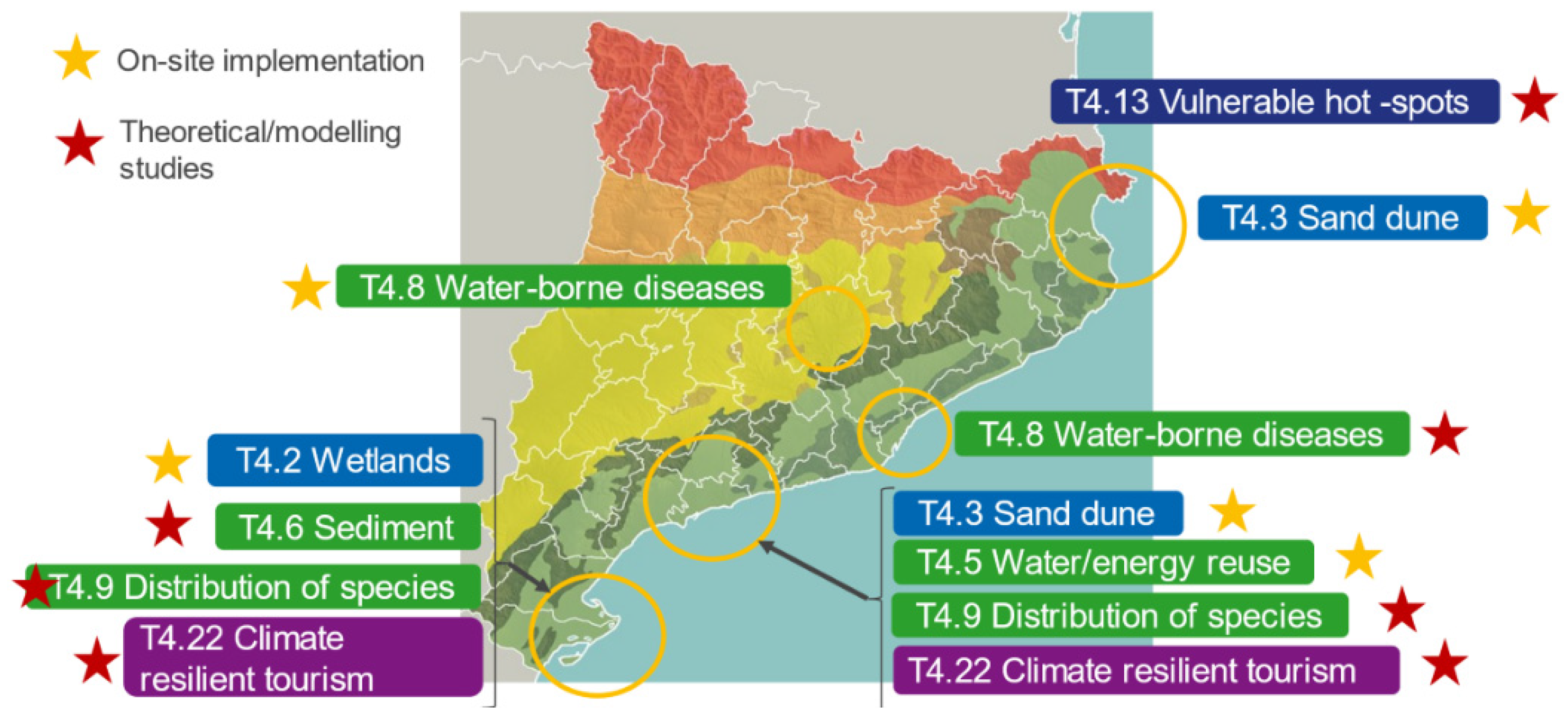
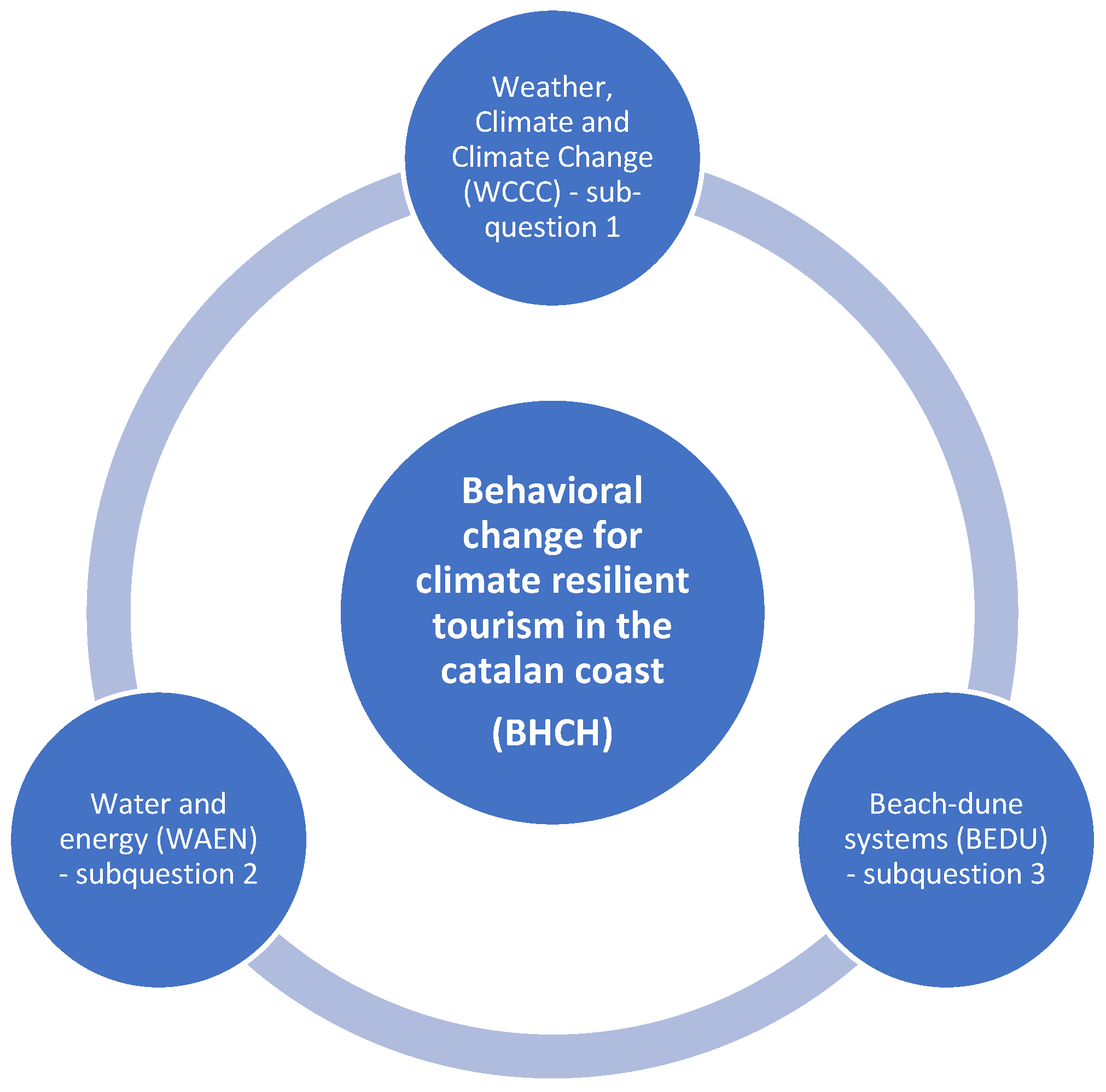
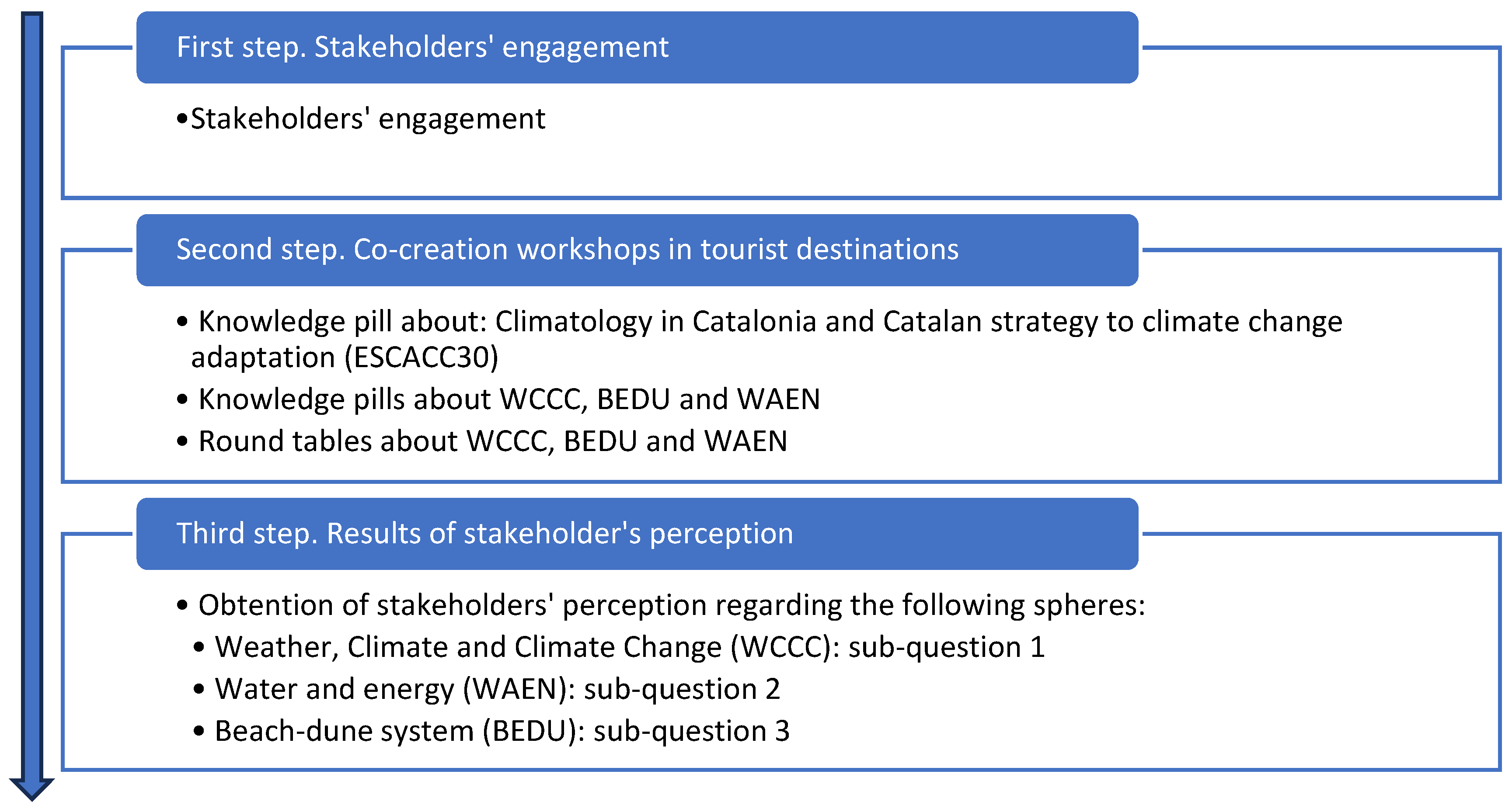
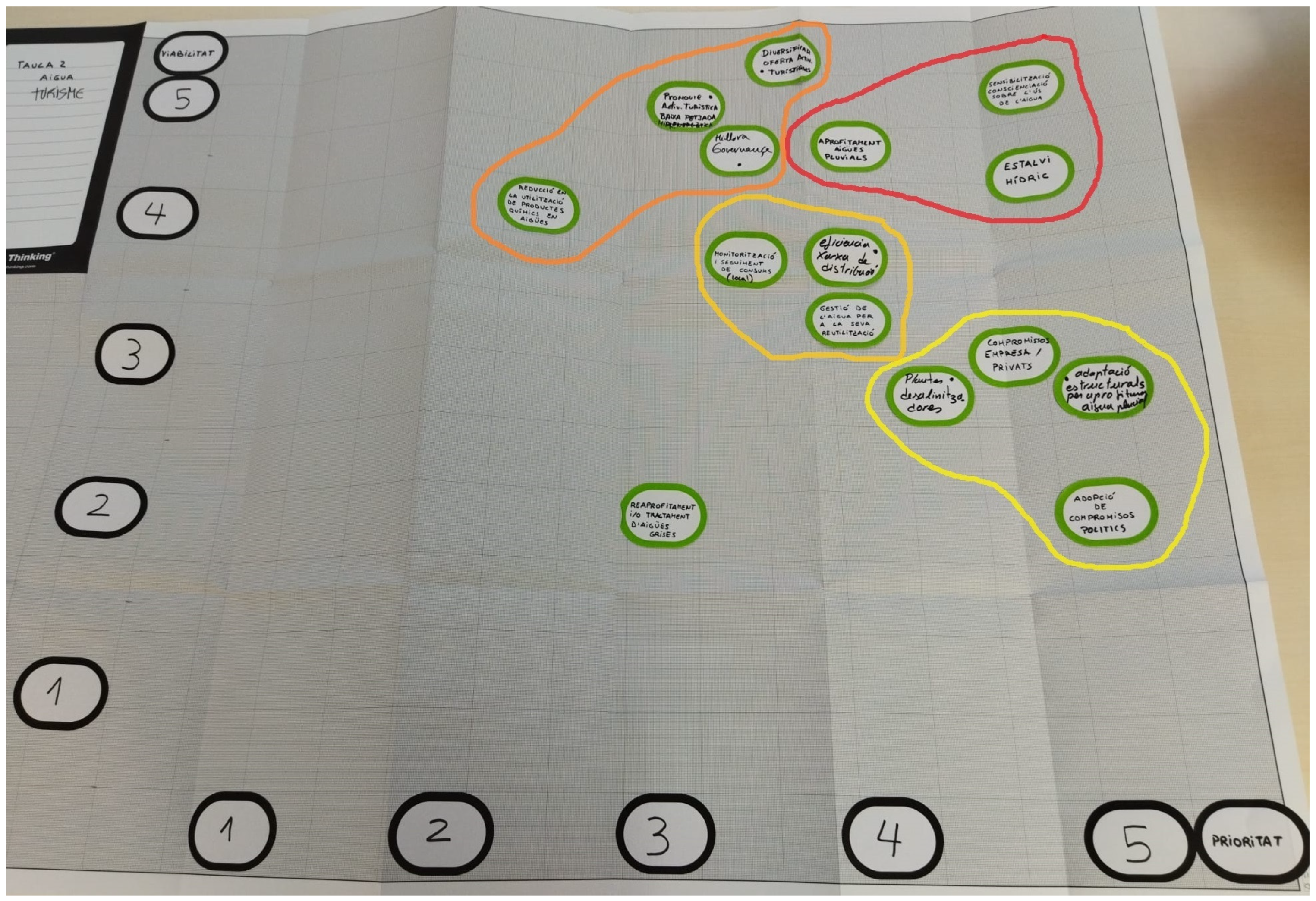
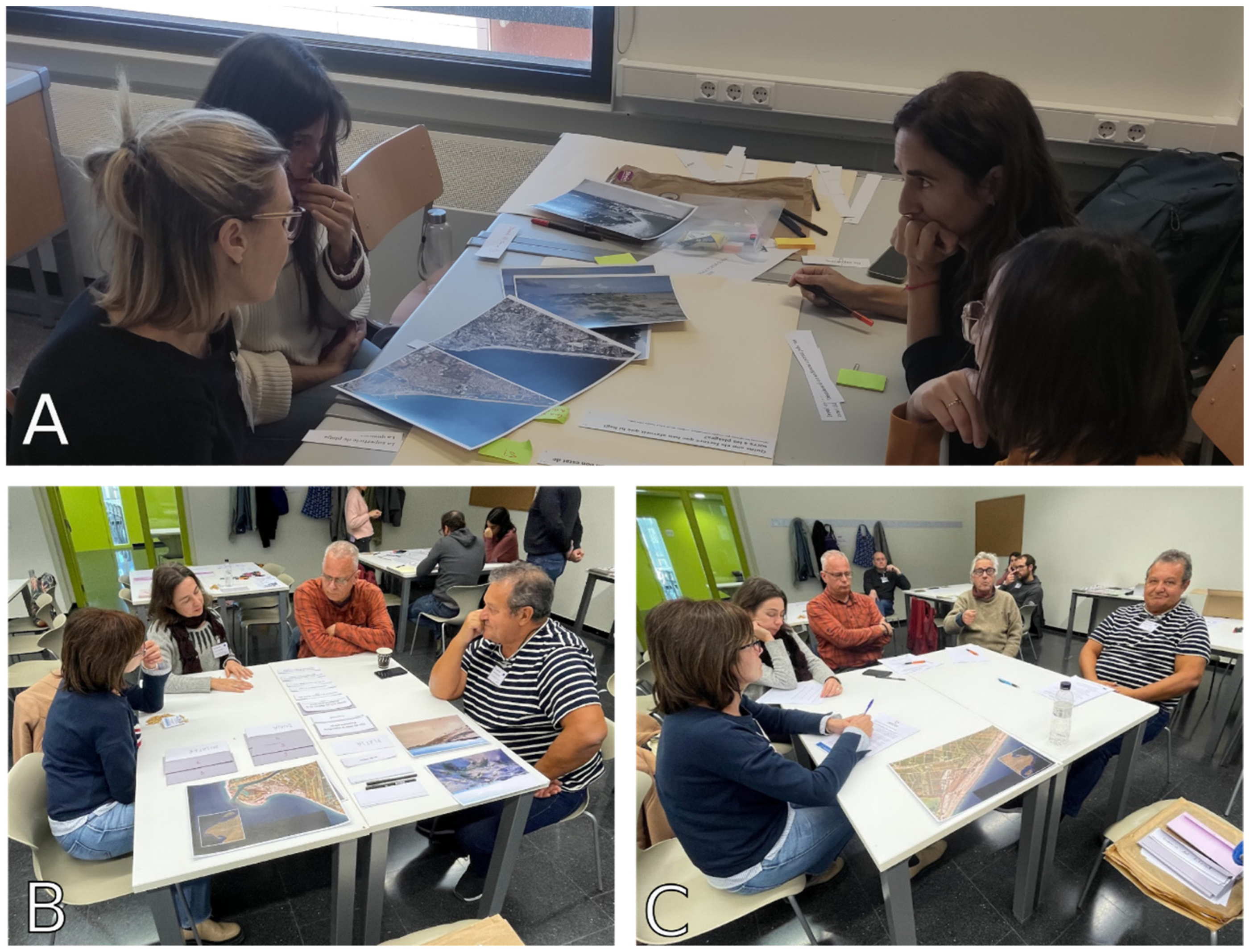
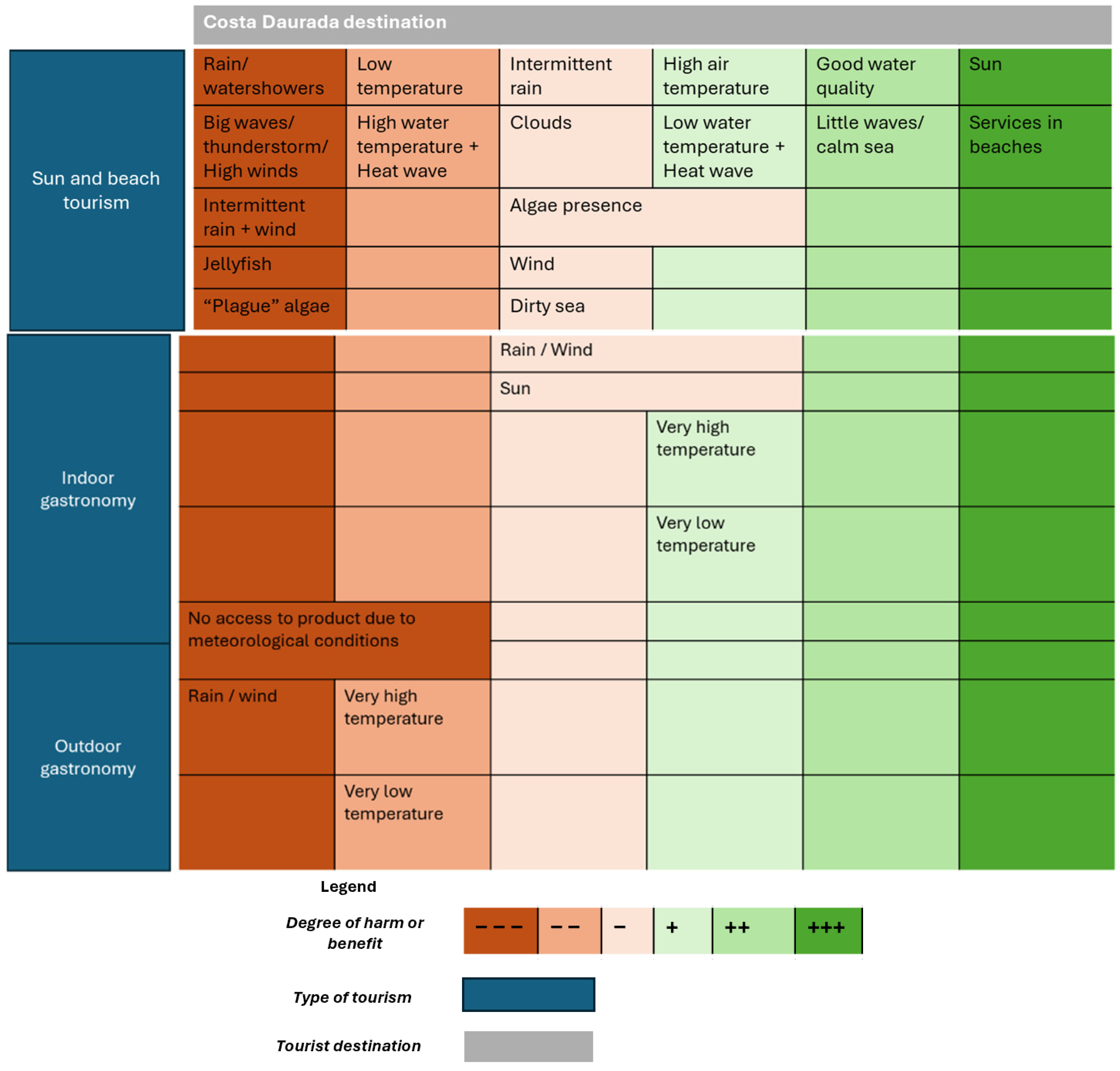
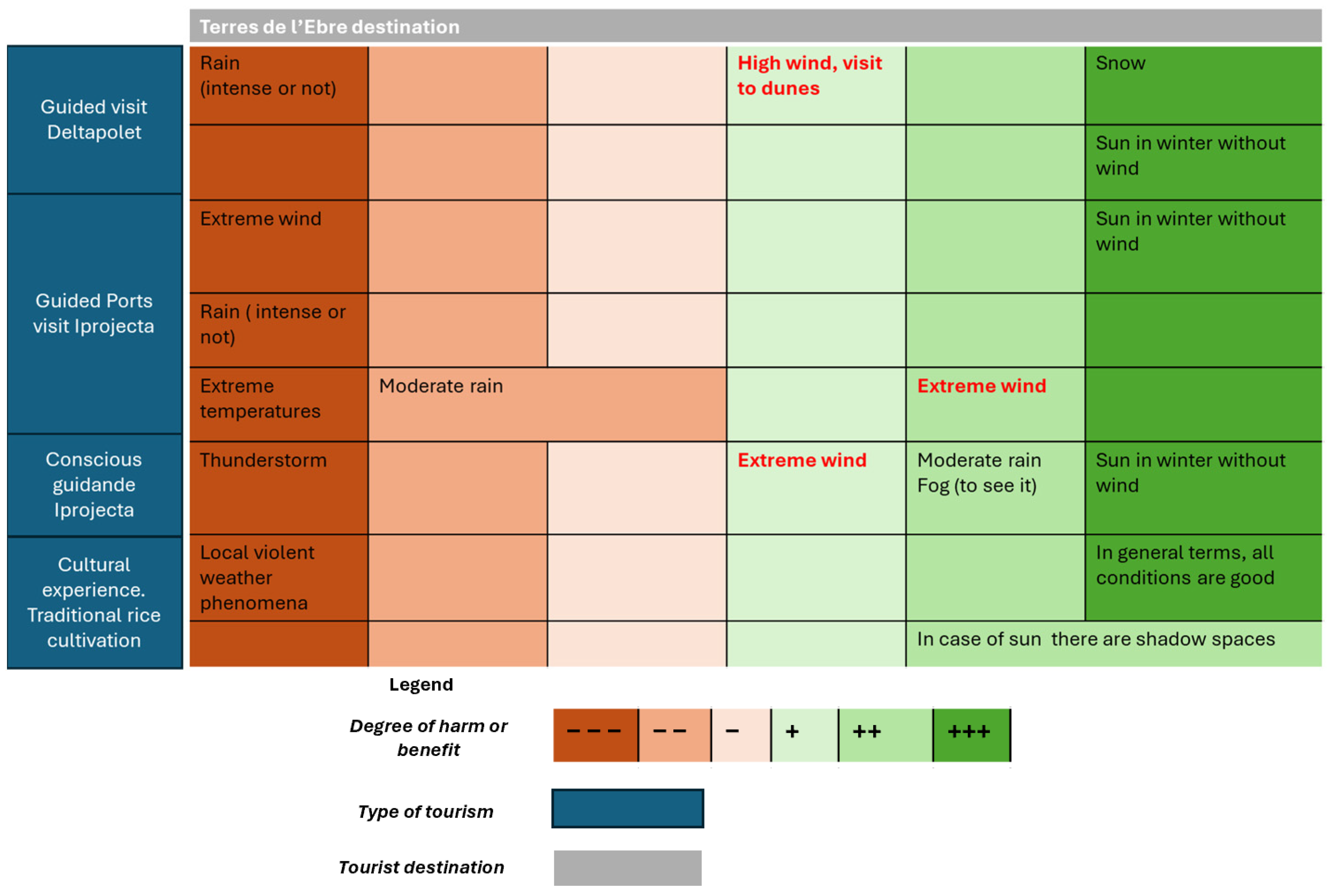
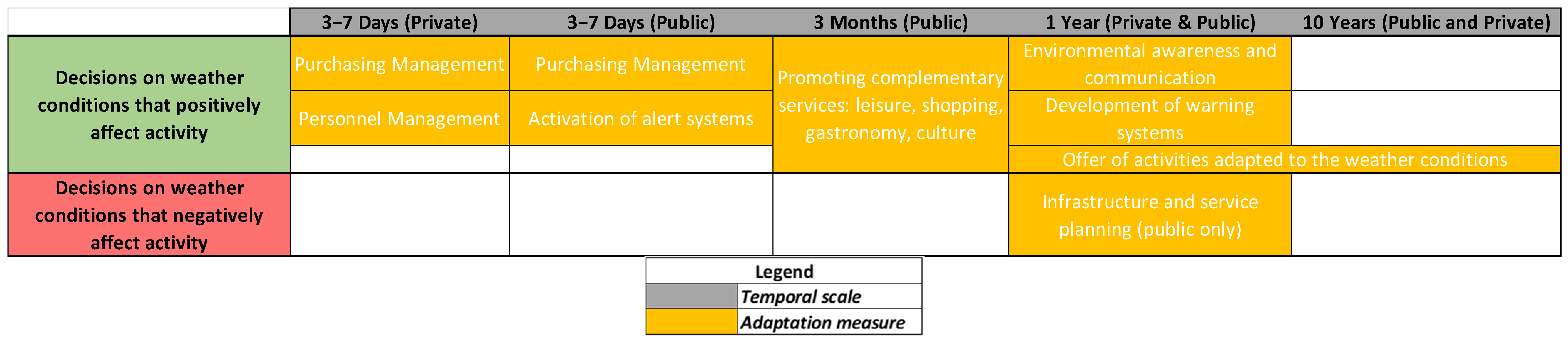
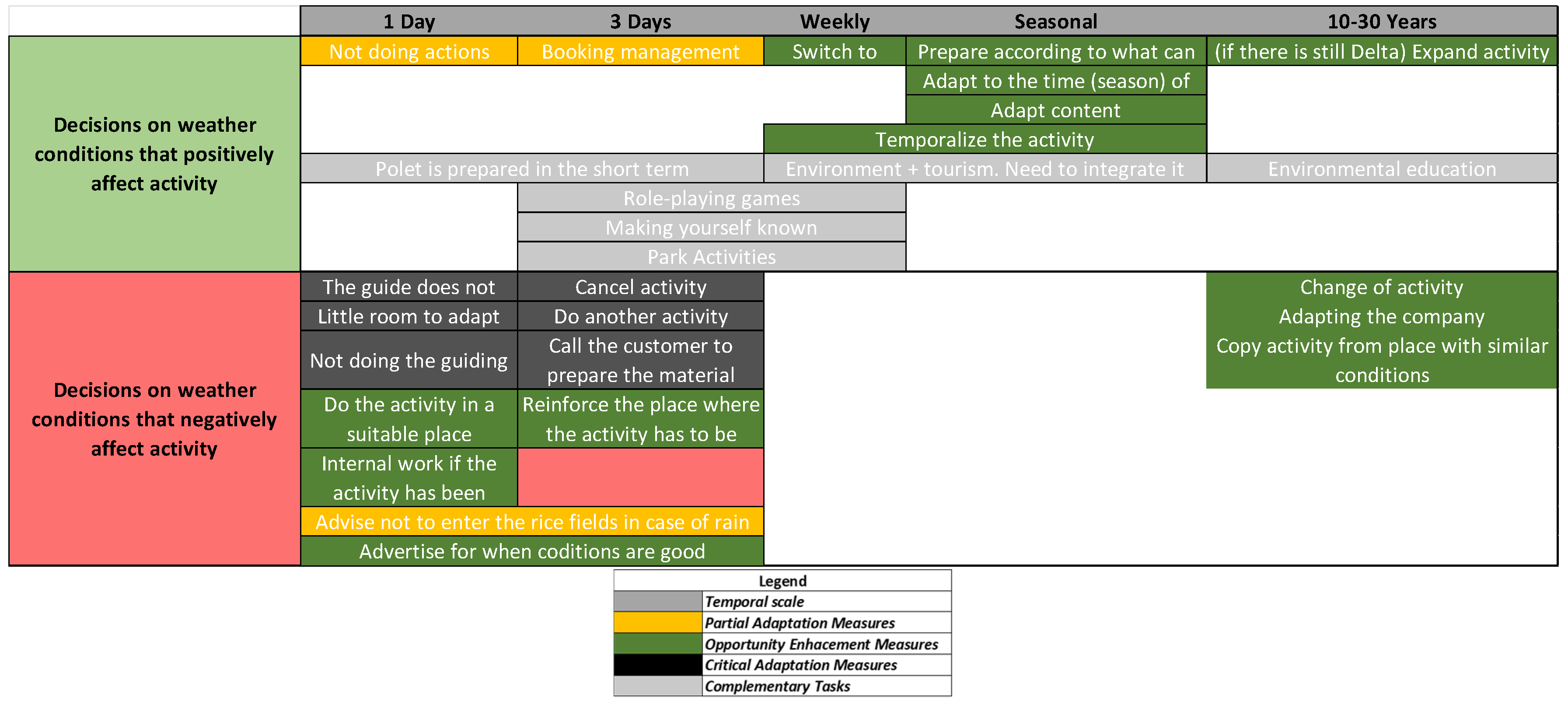
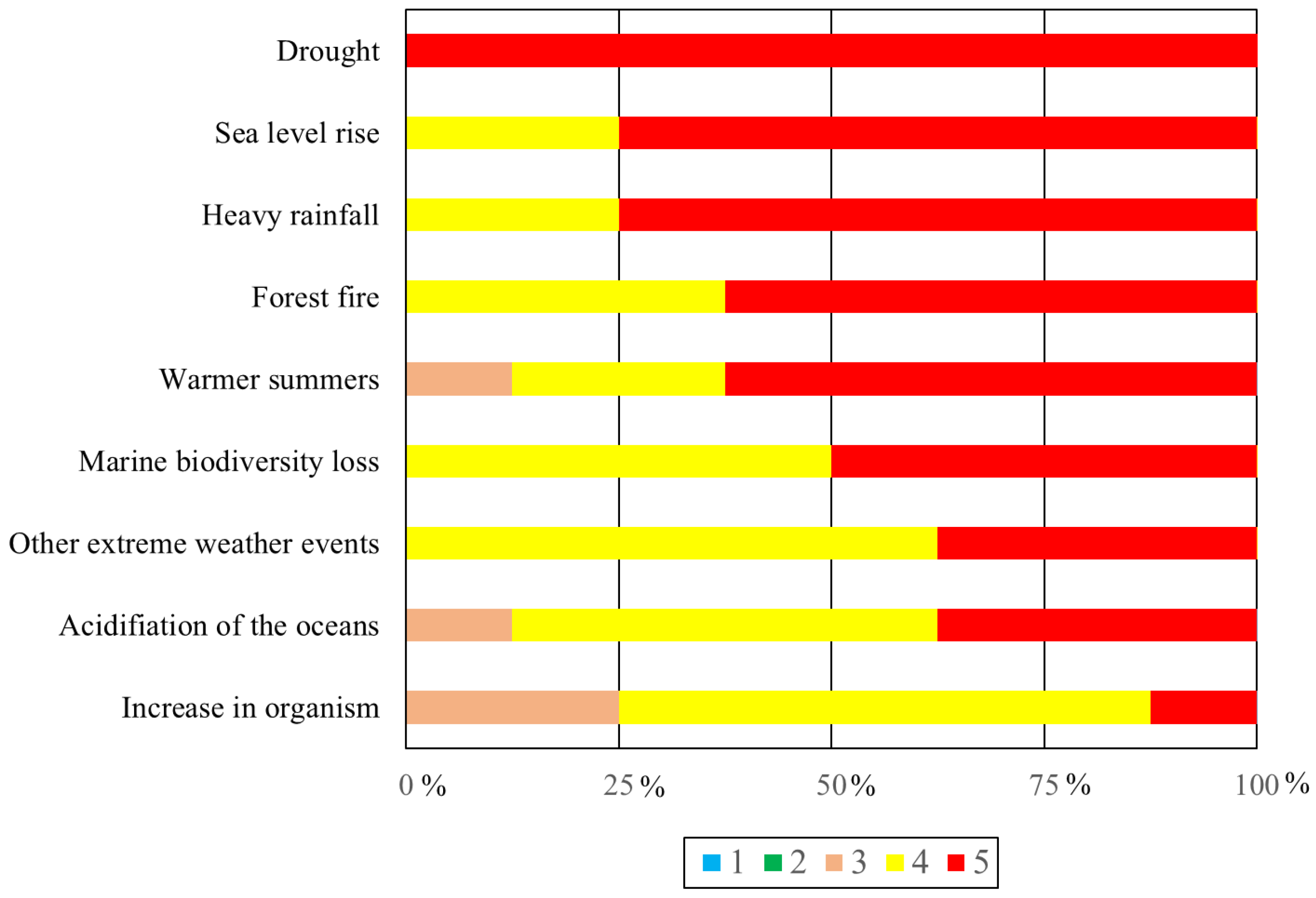
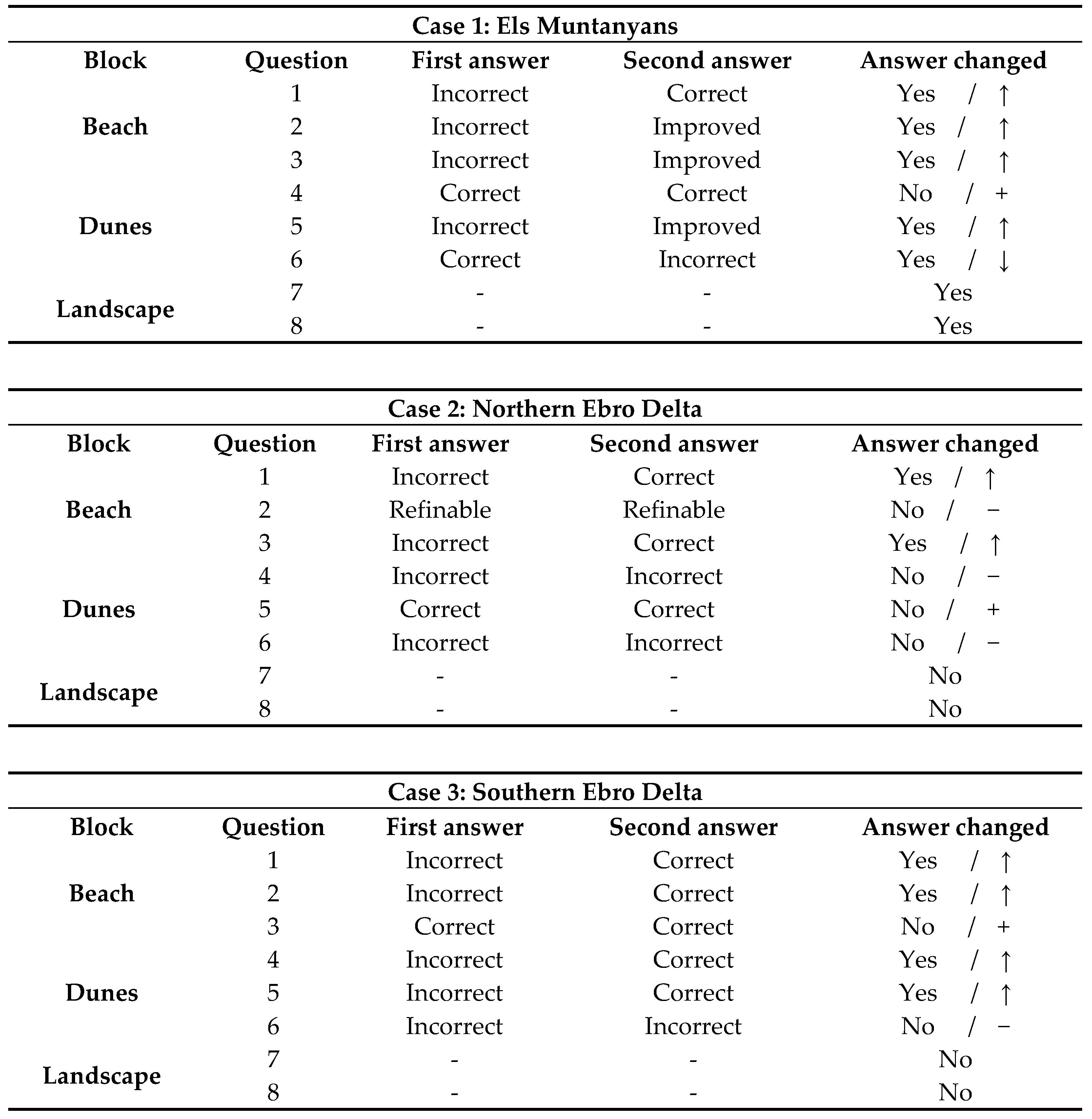
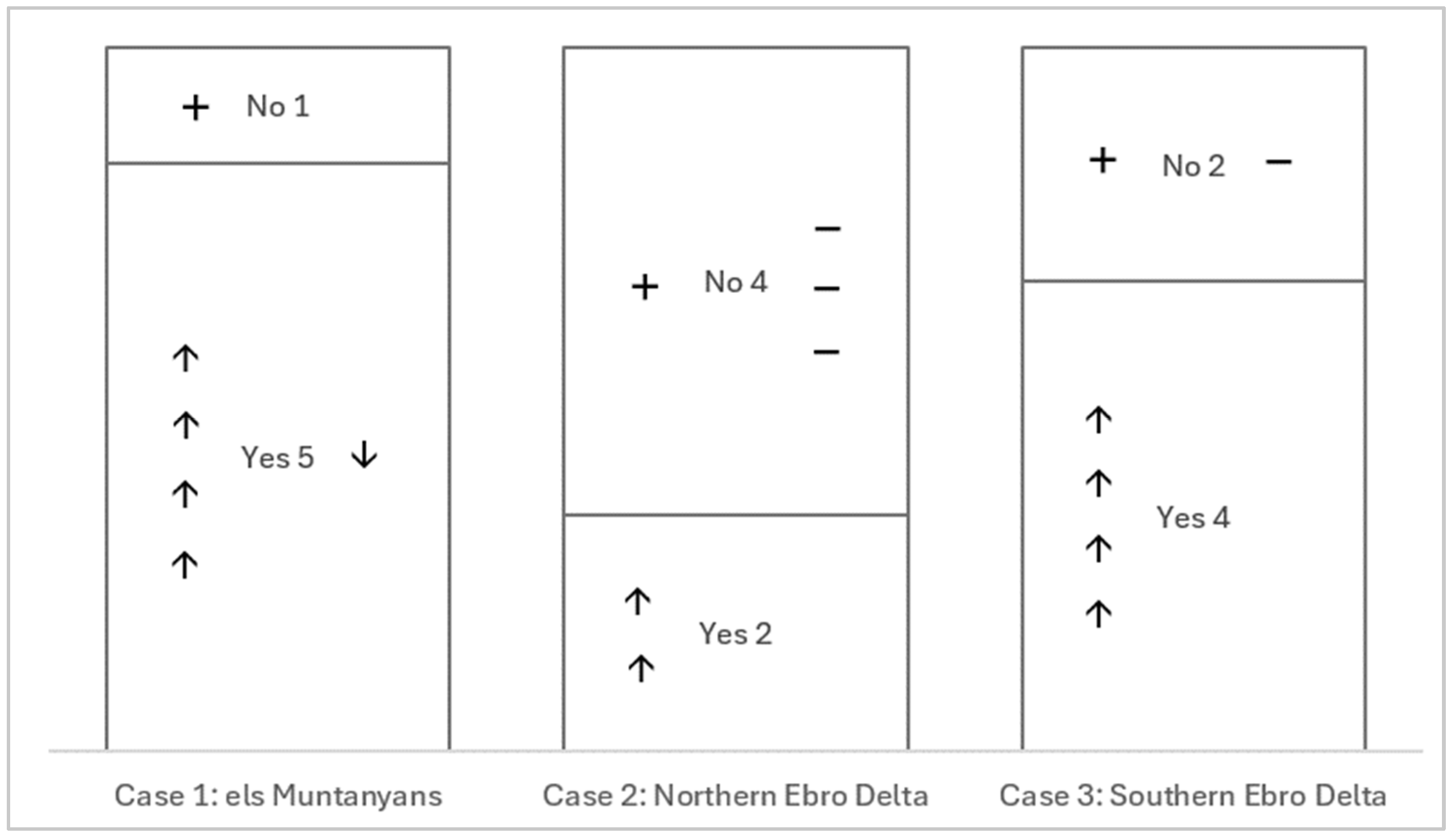

| Topic | Policy Makers | Local Tourism Offices | Research Centres/Universities | Conservation/Civil Organizations | Private Entrepreneurs | Private Consultancies | Number of Attendees | |
|---|---|---|---|---|---|---|---|---|
| Vila-seca, Costa Daurada (7 November 2023) | WCCC | 1 | 0 | 5 | 0 | 0 | 3 | 22 |
| WAEN | 3 | 1 | 2 | 0 | 3 | 0 | ||
| BEDU | 1 | 0 | 2 | 1 | 0 | 0 | ||
| Tortosa, Terres de l’Ebre (18 December 2023) | WCCC | 4 | 0 | 1 | 0 | 5 | 0 | 29 |
| WAEN | 7 | 0 | 0 | 1 | 1 | 1 | ||
| BEDU | 7 | 0 | 0 | 1 | 0 | 1 |
| Water | Energy |
|---|---|
| Very high feasibility—Very high priority | Very high feasibility—Very high priority |
| Reduction in water consumption | Increase controls: incentives and penalties |
| Rainwater harvesting | Monitoring of energy consumption |
| Awareness campaigns on water consumption | Awareness campaigns on energy consumption |
| Very high/High feasibility—High priority | Very high/High feasibility—High priority |
| Diversification of the activity offer | Decreasing consumption by increasing efficiency |
| Low water footprint activities | Promoting low-energy consumption activities |
| Improvement of the governance | Electricity supplied from renewable sources |
| Reduction in chemical products in the water | |
| Medium feasibility—Medium priority | Low feasibility—High priority |
| Improving the efficiency of the water distribution network | Adoption of commitments by public stakeholders |
| Monitoring of water consumption | Own generation of electricity from renewable sources |
| Improving water management | |
| Medium feasibility—Very high/high priority | Medium feasibility—Very high/high priority |
| Adoption of commitments by public stakeholders | Improve tourist mobility in the destinations |
| Adoption of commitments by private stakeholders | Adoption of commitments by private stakeholders |
| Desalination plants | Technology innovation |
| Low feasibility—Medium priority | Low/very low feasibility—very high priority |
| Treatment and reuse of grey water | Promoting sustainable mobility from the tourist origin to the destination |
Disclaimer/Publisher’s Note: The statements, opinions and data contained in all publications are solely those of the individual author(s) and contributor(s) and not of MDPI and/or the editor(s). MDPI and/or the editor(s) disclaim responsibility for any injury to people or property resulting from any ideas, methods, instructions or products referred to in the content. |
© 2025 by the authors. Licensee MDPI, Basel, Switzerland. This article is an open access article distributed under the terms and conditions of the Creative Commons Attribution (CC BY) license (https://creativecommons.org/licenses/by/4.0/).
Share and Cite
Boqué-Ciurana, A.; Saladié, Ò.; Rovira-Soto, M.T.; Garcia-Lozano, C.; Martí, C.; Tonda, M.; Borràs, G.; Aguilar, E. How Can Stakeholder Co-Creation Foster Climate-Resilient Coastal Tourism Through Integrated Management of Climate, Water-Energy, and Beach-Dune Systems? Sustainability 2025, 17, 10163. https://doi.org/10.3390/su172210163
Boqué-Ciurana A, Saladié Ò, Rovira-Soto MT, Garcia-Lozano C, Martí C, Tonda M, Borràs G, Aguilar E. How Can Stakeholder Co-Creation Foster Climate-Resilient Coastal Tourism Through Integrated Management of Climate, Water-Energy, and Beach-Dune Systems? Sustainability. 2025; 17(22):10163. https://doi.org/10.3390/su172210163
Chicago/Turabian StyleBoqué-Ciurana, Anna, Òscar Saladié, Maria Trinitat Rovira-Soto, Carla Garcia-Lozano, Carolina Martí, Marta Tonda, Gabriel Borràs, and Enric Aguilar. 2025. "How Can Stakeholder Co-Creation Foster Climate-Resilient Coastal Tourism Through Integrated Management of Climate, Water-Energy, and Beach-Dune Systems?" Sustainability 17, no. 22: 10163. https://doi.org/10.3390/su172210163
APA StyleBoqué-Ciurana, A., Saladié, Ò., Rovira-Soto, M. T., Garcia-Lozano, C., Martí, C., Tonda, M., Borràs, G., & Aguilar, E. (2025). How Can Stakeholder Co-Creation Foster Climate-Resilient Coastal Tourism Through Integrated Management of Climate, Water-Energy, and Beach-Dune Systems? Sustainability, 17(22), 10163. https://doi.org/10.3390/su172210163

