Article

Is There Any Economic Penalty for Sustainability? A Difference-in-Differences Analysis of Italian Wineries


by
Valentina Di Chiara
1,2,*,
Leonardo Cei
1,2 and
Eugenio Pomarici
1,2
1
Department of Land, Environment, Agriculture and Forestry (TESAF), University of Padua, 35020 Legnaro, Italy
2
Interdepartmental Center for Research in Viticulture and Oenology (CIRVE), University of Padua, 31015 Conegliano, Italy
*
Author to whom correspondence should be addressed.
Sustainability 2025, 17(22), 10162; https://doi.org/10.3390/su172210162
Submission received: 12 September 2025 / Revised: 4 November 2025 / Accepted: 11 November 2025 / Published: 13 November 2025
(This article belongs to the Section Economic and Business Aspects of Sustainability)

Abstract

Amid increasing pressure on sustainability across sectors, the wine industry is also being called to adopt sustainable and responsible practices. However, a potential concern for firms is whether and to what extent sustainability efforts, while beneficial for the environment and society, require some sacrifice on the economic side. Specifically, this study investigates whether adopting a holistic sustainability approach by wine firms leads to economic issues in the short term. We focus on Italian wineries certified under Equalitas certification, a three-pillar certification integrating environmental, social, and economic dimensions, and evaluate their financial performance using a difference-in-differences (DiD) approach. The analysis relies on firm-level economic data from the AIDA database, covering a sample of 631 companies observed over a six-year period from 2018 to 2023. Overall, the results show no statistically significant short-term changes in profitability or liquidity indicators across the entire sample. These findings suggest that, while short-term economic gains are not guaranteed, embarking on a sustainability path does not undermine financial performance and may offer benefits under certain organizational conditions. The study contributes to the literature by providing robust empirical evidence on the economic implications of the adoption holistic sustainability approaches in the wine sector.

1. Introduction

The modern wine sector is facing critical challenges, caused by a variety of factors, from socio-political events, like wars and tariffs, to changes in consumer preferences and lifestyles, to increasingly evident effects of climate change, which directly affects wine production and quality. In this complex scenario, wineries need to find appropriate tools and strategies to navigate these complex dynamics. In this respect, a potential solution may come from the adoption of a sustainability perspective, as long as this perspective embraces all its dimensions (environmental, social, and economic), thus allowing wineries to respond to challenges of different nature.

1.1. The Three Dimensions of Sustainability in Wine Sector

The environmental dimension is critical for adapting to and mitigating climate change effects through practices that take into account the local environment and preserve soil health, water availability and biodiversity, while reducing greenhouse gas emissions across the production process [1,2]. This would enable wineries to cope with rising temperatures, low water availability, and the occurrence of extreme weather events [3], which are affecting vine phenology [4], the organoleptic and technological profile of grapes [5,6], and the vocation of some historical wine-growing regions [2].
The social dimension is essential to not subjugate the interests of citizens and workers to the objectives of the business. In addition to its social desirability, however, this dimension is also important for companies to improve their internal and external image, reducing social conflicts and thus operating in collaborative social environments [7]. On the one hand, the social dimension is intimately connected to the environmental one. Indeed, wineries do not operate in isolation, but their activity is carried out in local territories, shared with other economic activities and populated by citizens. In this respect, the interests of the local communities, which increasingly demand a reduction in the use of pesticides, a higher protection of biodiversity, and a greater respect for the landscape [8], should not be subordinated to productive interests. On the other hand, social sustainability entails the adoption of transparent labor policies, the provision of safe workplaces, and the attention to workers’ needs, from professional training to inclusiveness. Paying attention to these aspects seems even more important in a sector, like agriculture, where crop cycles generate peaks of labor requirements, which necessitate temporary workers, who may be more at risk of insecurity, in several respects, than permanent employees [9].
Finally, the presence of an economic dimension of sustainability is vital to ensure the long-term viability of businesses, by promoting efficient resource use, resilience to market fluctuations, and innovation in response to global challenges. In traditional wine countries, such viability is necessary to maintain the competitiveness of the sector in face of the increased number of competitors from the “New World” of wine [10]. In addition, at the local level, assuring an adequate economic return to wine companies may contribute to the preservation of economic activities in rural areas and to the creation and distribution of added value, with positive impacts on local development [11].

1.2. Institutional and Policy Landscape of Sustainable Vitiviniculture

The need for a more integrated approach to sustainability has been recognized, in the European Union, also by political and legislative institutions. Within the Common Agricultural Policy, the attention to the environmental dimension, expressed, for example, by the agro-ecological payments or by the environmental cross-compliance, has been flanked by the inclusion of social aspects, such as with the provisions related to social conditionality. This is clearly reflected in Articles 5 (general objectives) and 6 (specific objectives) of the Regulation (EU) 2021/2115 [12], where the integration of environmental, economic and social dimensions is explicitly stated. As a general political address, the new EU Competitiveness Compass draws a roadmap that merges together pathways of environmental protection, valorization of human capital, and economic development [13]. For agriculture, this translates into a strategic vision envisaging a sector that is competitive and resilient to global challenges, that operates in harmony with nature, that ensures a fair standard of living, and that capitalizes on emerging income opportunities [14].
The wine sector, in some sense, came up even earlier with the realization that a balanced approach to sustainability was needed to meet the incumbent challenges.
The International Organization of Vine and Wine (OIV) has issued, since 2004, resolutions defining the concept and the principles of sustainable vitiviniculture based on a holistic vision [15] and providing guidelines for its integration within business organizations [16].
Furthermore, at the international level, numerous initiatives have emerged within the supply chain players themselves, with the aim of promoting the sharing of knowledge and the adoption of sustainable practices. These initiatives include, for example, The Porto Protocol and the Sustainable Wine Roundtable, two collaborative platforms that aim to support the wine sector’s transition toward greater sustainability. In addition, national or regional sustainability standards specifically dedicated to the wine sector have been developed in major wine-producing countries. These standards define a set of good practices that, depending on the case, focus on one or more of the three pillars of sustainability. The first standard was developed in 1992 by the Lodi Wine Grape Commission in California. Since then, following the California example, numerous other standards have been developed in both “Old World” and “New World” wine countries [17,18]. Some of these can be considered examples of “three-pillar sustainability standards” (in the text, we refer to “three-pillar sustainable certifications” to indicate certification schemes that assess sustainability based on environmental, social, and economic criteria; we consider them as expressions of the “holistic approach” to sustainability we refer to in the manuscript), since they ensure a holistic and integrated approach to sustainability, being structured around compliance with environmental, social and economic criteria.

1.3. Competitive Dynamics and Barriers to Change

On the demand side of the market, consumers’ willingness to pay a price premium for sustainable wines is not guaranteed. In fact, sustainability does not yet represent the primary criterion in consumer choices. Consumers tend to favor more traditional attributes such as product organoleptic quality, appellation of origin, and price [19,20,21]. This is also reflected in the willingness to pay a premium price (WTP) for sustainable wines; while, in some cases, the willingness exists, it is conditional on the perception of an adequate level of quality. If such expectations are not met, consumers may be unwilling to recognize a premium price [19]. In addition, the magnitude of premium price for sustainable wines varies depending on product characteristics. It has been observed, for example, that consumers are more likely to recognize a premium for wines in lower-middle price ranges or from lesser-known appellations [22,23]. In contrast, when wines have high selling prices or come from appellations with a high reputation, consumers may not recognize a price premium for sustainability attributes. Moreover, despite extensive empirical evidence supporting the existence of WTP, a gap between stated preferences and actual behaviors in real purchase contexts exists. This gap introduces a level of uncertainty regarding the true market potential for sustainable wine [24]. These dynamics may therefore lead producers to perceive no real competitive advantage associated with adopting a sustainability management approach and obtaining sustainability certifications [25].
On the supply side, many companies believe that embarking on a path to sustainability is not economically convenient because of the additional costs and increased labor requirements [26]. Indeed, integrating sustainability into an organization often entails meeting a number of requirements that, in many cases, imply substantial changes in organizational and management practices, especially when sustainability is spread across the organization and necessitate the active involvement of the company’s [27]. Such transformations require both financial and human resources [17,28]. Although in the long run such investments can generate positive returns, through improvements in operational efficiency or corporate reputation [29], they are often perceived by firms as costs, not immediately offset economic benefits [30]. Therefore, the perception that the costs outweigh the benefits could be a determining factor in business decisions regarding the adoption of sustainable practices [25,26].

1.4. Research Objective

Considering the limited knowledge on the topic, the objective of this study is to investigate whether embarking on holistic sustainability paths generates issues for the economic performance of wineries. However, considering the multiple ways in which the three dimensions of sustainability can be integrated within a company, it is often difficult to distinguish firms that have embarked on a holistic sustainability path from those that have not. For this reason, the analysis focuses on companies that have obtained the Equalitas sustainability certification in Italy (further details on the Equalitas Standard are provided in Section 3.2 Method and Data). Thanks to its holistic approach to sustainability, covering all three dimensions (environmental, social and economic), the Equalitas standard is currently recognized as one of the most comprehensive sustainability standards worldwide. This is even more evident in some markets, such as those in Northern Europe, where it allows access to specific tenders or facilitates the placement of wines on shelves dedicated to sustainable products.
Exploiting a quantitative impact analysis strategy, the study therefore evaluates the short-term economic effect of adopting the Equalitas sustainability certification, specifically in terms of profitability and liquidity indicators. In this regard, this study contributes to existing literature by expanding the limited body of empirical evidence based on real economic data aimed at identifying the economic impact of sustainability, while simultaneously considering all three of its dimensions. This represents an advancement compared to previous studies, which have mainly focused on the environmental aspects of sustainability, often neglecting the social and economic ones.
The paper is structured as follows. First, a comprehensive literature review is presented to identify the context and highlight the key contribution of previous research on the topic. This section is followed by the materials and methods section, which outlines the theoretical framework and details the methodology adopted in the study. Subsequently, the results section presents the main findings. Finally, the paper concludes with the discussion and conclusions sections, where the results are interpreted and their implications are explored.

2. Literature Review and Research Hypotheses

The existing literature focusing on the relationship between economic performance and the adoption of good environmental and social practices does not present a clear and univocal picture; on the contrary, it presents mixed results influenced by the practices adopted, the time frame considered and the corporate structure.
Most studies have assessed managers’ and business owners’ perceptions of the economic benefit of being sustainable. However, an ambivalent picture emerges from these studies: on the one hand, sustainability is recognized by producers as a strategic lever for innovation and competitiveness; on the other hand, it is perceived as a significant economic burden, especially in the short term.
Some studies highlight how some environmental practices have high costs or require significant workforce commitment that are not offset by adequate benefits in economic terms [30]. In particular, the use of sustainable energy sources [31,32,33], or vineyard management with less impacting practices [32,33] turn out to have costs that often outweigh the economic benefits, according to companies.
In other studies, on the other hand, the adoption of good sustainability practices is correlated with improved production efficiency [29,34] which leads to economic savings through reduced consumption, for example, of energy or fuel [35], but also increased productivity [36]. Some practices in fact show economic benefits that outweigh the costs required to implement them, such as phytosanitary, water, and weed management [31,32,33].
In terms of competitive advantage, a diverse view emerges: some manufacturers do not consider sustainability certifications as tools that are capable, alone, of generating a competitive advantage on the market, especially if they are not accompanied by communication or positioning strategies [37]. However, in several cases sustainability is considered a strategic lever for differentiation, especially in foreign markets that are more sensitive to environmental issues [36,38]. Environmental practices are perceived as a tool to strengthen competitiveness, but only if they are part of a broader strategy that also involves marketing, supply chain relations, and internal governance [34,35,37]. More structured firms, with greater managerial resources and organizational capabilities, are better able to capture the competitive benefits of sustainability. In contrast, smaller firms or those that focus exclusively on production have greater difficulty in integrating these practices competitively, partly because of structural or market constraints [39].
Studies also highlight that the environmental proactivity of managers and business owners influences economic performance, or at least their perception of it. Indeed, the study by Guerrero-Villegas et al. [40] shows different results when using objective and subjective measures to evaluate performance. When looking at actual economic data, in fact, corporate social responsibility (CSR) practices do not improve business performance through innovation, that is, they do not enhance innovation in a way that generates a direct economic return. Conversely, managers perceive that responsible behavior actually improves economic performance through innovation. A similar picture emerges from the study by Junquera and Barba-Sánchez [41] which shows that environmental proactivity has a significant positive effect on managers’ perceptions of economic performance. However, such proactivity does not translate into a direct improvement in financial performance. In particular, competitive advantages based on differentiation improve positive perceptions of performance but may negatively affect actual economic performance.
However, the literature using objective economic data is limited. Several studies comparing the costs of environmental practices with conventional ones show different results, sometimes highlighting an economic convenience in adopting sustainable approaches [42,43,44], while in other cases detecting an economic advantage in adopting conventional practices [45].
The study by Muñoz et al. [46] points out that more environmentally committed firms perform less well economically, suggesting that the costs associated with sustainable transition may hurt profitability in the short term. The authors invoke the trade-off hypothesis [47] that social responsibility entails additional economic burdens that can undermine immediate economic performance. However, the same authors point out that the lack of positive effects in the short run does not imply the absence of benefits in the long run. These findings contrast with the results of Dainelli e Daddi [28], which observed an improvement in the Return on Investment (ROI) among organic wineries, primarily driven by an increase in Return on Sales (ROS). In addition, organic firms recorded higher growth compared to conventional ones, as well as an increase in added value, while conventional firms experienced a decline in this indicator. Other contributions, such as the ones proposed by Junquera and Barba-Sánchez [41] and Guerrero-Villegas et al. [40], as previously discussed, suggest that sustainability initiatives may shape manager’s perceptions of performance but do not produce significant effects of objective profitability indicators, such as ROA (Return on Asset). In light of the findings from this literature review, the following hypothesis is proposed:
H1: 
Adopting a holistic sustainability approach has no significant effect on wineries’ profitability in the short term.
Profitability, however, might not be the only economic indicator affected by the adoption of a sustainable approach. Specifically, the need to anticipate the costs connected to sustainable practices can also create issues of financial liquidity for companies. Specifically, the need to anticipate the costs connected to sustainable practices can also create issues of financial liquidity for companies. In this regard, the short-term economic equilibrium of a firm should consider not only profitability but also monetary equilibrium, as the latter reflects the firm’s ability to meet its short-term financial commitments and maintain adequate cash flow. Even in the presence of positive profitability, a lack of liquidity can compromise the company’s operational stability and its capacity to sustain investments required by sustainability-oriented strategies.
To the best of our knowledge, however, the research focusing on the relationship between sustainability and liquidity is quite limited. A study by Dainelli and Daddi’s [28], focusing on organic firms, shows that these firms grow faster and have higher ROIs and operating margins, but face liquidity challenges due to higher working capital requirements and greater reliance on bank credit in the early stage. This evidence supports the formulation of the following hypothesis:
H2: 
Adopting a holistic sustainability approach has a negative effect on wineries’ liquidity in the short term.

3. Research Method

To address the objective of assessing the economic effects of adopting a holistic sustainability approach, we investigate the short-term economic impact of a three-pillar sustainable certification on Italian wineries. The decision to focus on the short-term is primarily based on the relatively recent adoption of these standards, which means that sufficient data for conducting long-term analyses is not yet available. In addition, from a theoretical perspective, a negative economic impact in the short term could constitute a barrier for the adoption of this type of certification and, more generally, for engaging in sustainability pathways. Indeed, although there may be benefits in the long term, companies could be discouraged by the prospect of making substantial investments or facing initial costs that are not immediately offset by market advantages. For these reasons, a short-term analysis results particularly relevant.
To estimate the economic impact of the adoption of the certification on wineries, we followed a structured logical strategy to conduct the analysis:
i.
Selection of the target outcome parameters: relevant economic indicators are selected, based on the hypothesized short-term effects of the certification.
ii.
Definition of a causal model (intervention logic): the potential causal paths through which the certification is expected to affect the selected economic indicators are drawn.
iii.
Identification of potential confounders: based on the causal model, the factors that need to be controlled for in the econometric analysis to obtain unbiased causal estimates are identified.
iv.
Selection of the evaluation technique: based on the causal model and on available data, the most suitable econometric technique was chosen to estimate the impact. Specifically, a difference-in-differences (DiD) approach has been implemented, as illustrated in Section 3.2. This empirical strategy allows for the estimation of causal effects by comparing changes in economic performance indicators between certified and non-certified companies over time, thereby controlling for unobserved heterogeneity.
In the following, all the mentioned steps of the impact analysis implementation are illustrated in detail.

3.1. Economic Indicators and Causal Model

The effect of the certification on economic performance was evaluated considering two economic dimensions: profitability and liquidity. Structural indicators, such as those related to financial solidity or independence, were not included, as they are less meaningful in a short-term perspective. These indicators reflect in fact the financial structure and long-term sustainability of a firm, typically influenced by strategic decisions and investment that unfold over extended periods. Since this study aims to assess the short-term effects of certification, it is more appropriate to focus on more immediate outcomes, such as profitability and liquidity indicators, rather than on structural variables whose variation generally requires a longer time horizon.
Specifically, EBITDA/Sales and ROA were used to measure the impact of the sustainable certification on wineries’ profitability. The choice fell on these two indicators because, compared to others such as ROI, ROE (Return on Equity) or ROS, they allow for more direct and effective assessment of operational profitability and efficiency in the use of company resources. ROA and EBITDA/Sales are widely used in financial analysis and provide timely signals of operational and strategic changes, thus aligning coherently with the objective of assessing the short-term impacts of sustainability certification [48,49]. EBITDA (Earnings before interest, taxes, depreciation, and amortization) divided by sales, measures the operational efficiency of a company expressing its ability to generate profits from its operations. A variation in this indicator for sustainable wineries may be due to a different level of operating costs or to different volumes and/or prices of the sales. On the other hand, the ROA measures the profitability of a firm relative to its total assets and thus helps to understand how much profit a company can generate with its assets. Again, a variation in ROA for sustainable wineries could be due to a different degree of efficiency in the management of resources.
Liquid ratio (LR) and Current Ratio (CR) were used to evaluate the impact of sustainable certification on liquidity. The literature on measuring the effects of adopting sustainable practices on liquidity is rather limited, especially in a short period. Therefore, the choice fell on these indicators as they are reliable and commonly used measures to assess a company’s ability to meet its short-term financial obligations [50]. The LR expresses a company’s ability to cover its short-term liabilities with its liquid assets. The CR measures a company’s ability to cover its current liabilities with its total current assets (also including inventories). Compared to LR, CR is less stringent as it also includes inventories, which may not be easily convertible to cash. Both indexes express the short-term financial strength of a company, and their potential variation for sustainable wineries could be due to a different ease of access to credit by obtaining financing with more or less favorable terms or, again, due to different efficiency of resource management or different levels of sales and revenues.
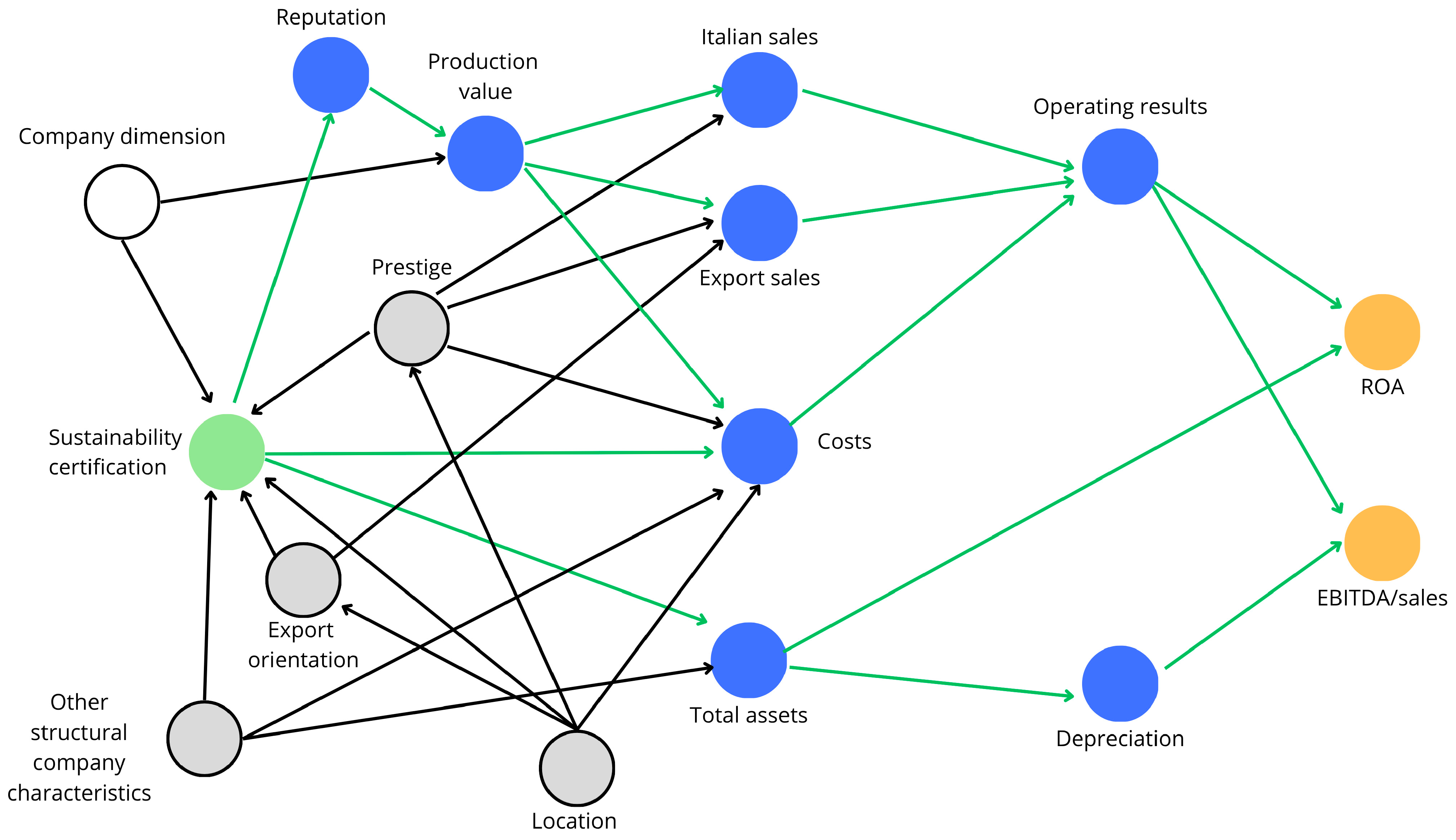
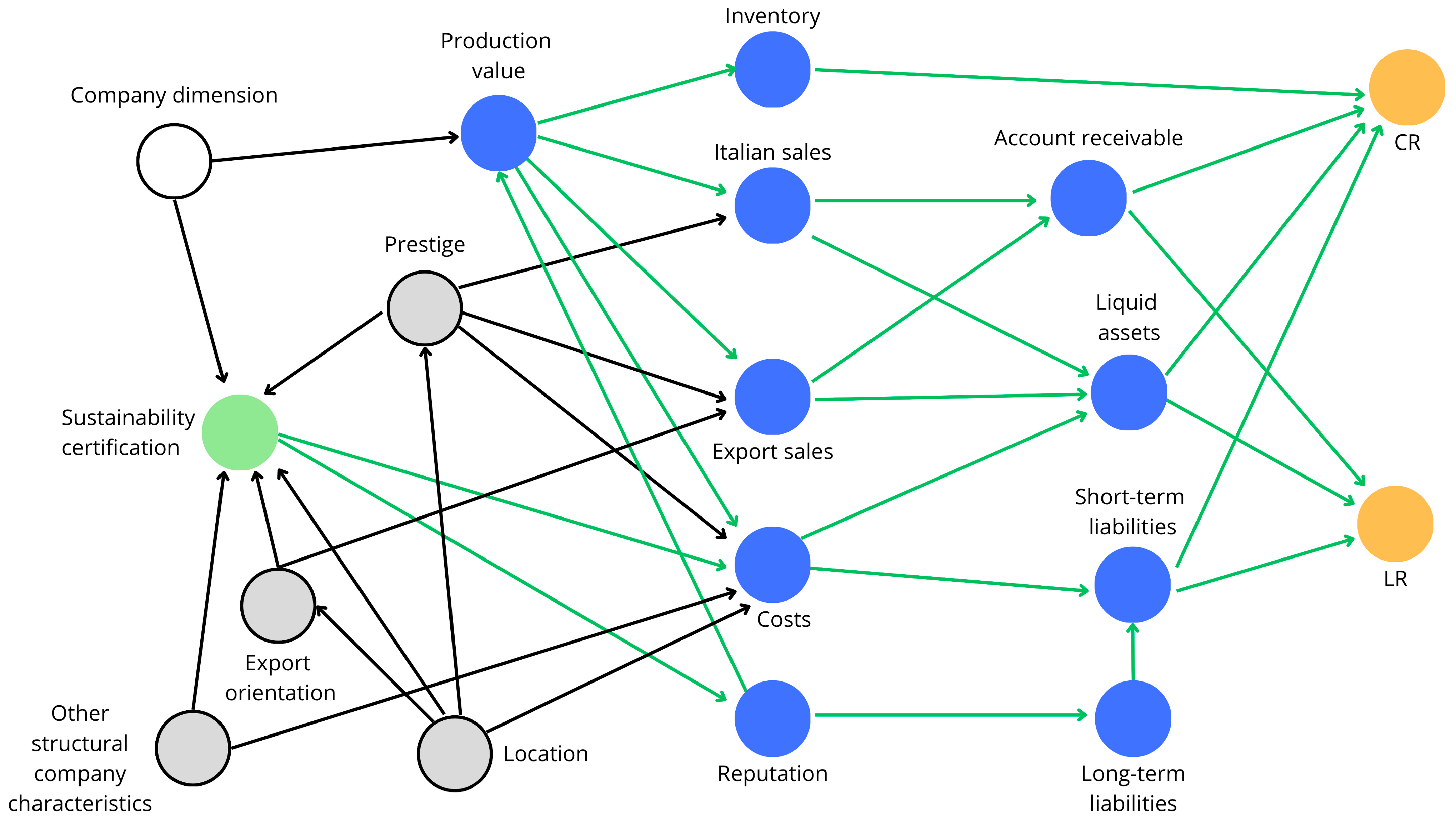
The logic behind the effects of the certification on the outcome indicators is represented in the form of directed acyclic graphs (DAGs—Figure 1 and Figure 2). In impact evaluation, DAGs play a double role. First, they are a useful way to stimulate analytical reasoning about the causal relationships between the treatment, the outcomes, and other factors possibly affecting these relationships. Second, they allow, through a set of standardized rules, to identify potential confounders to control for in the analysis in order to avoid biased causal estimates. The last feature is particularly important, as it allows the researcher to select the estimation technique and the econometric model specification based on theory. Conversely, when the covariates are included blindly in the model specification, without considering their position within the causal chain, biases may be introduced, thus distorting the causal effect that is the object of estimation [51].
As such, the DAGs in the figures visually represent how sustainability certification is hypothesized to affect wineries’ profitability (Figure 1) and liquidity (Figure 2) through a network of direct and indirect pathways mediated by various economic variables.
In terms of profitability, it is hypothesized that certification affects performance through three main channels. Operationally, certification (Sustainable certification in the figure) may lead to changes in the company’s cost structure (Costs). While sustainable practices could generate savings in the medium to long term (e.g., through increased efficiency), they may result in higher initial costs. In addition, the certification cost itself (i.e., the fee to pay to be certified) adds to the standard operating costs, increasing them. Higher operating costs, in turn, negatively affect the operating income (Operating results), influencing both EBITDA/Sales and ROA values.
On the asset side, certification may require new investments in sustainable processes and technologies, increasing the value of Total assets. On the one hand, the increased value of assets, if not matched by an equivalent increase in operating results, directly lowers the ROA. On the other hand, asset increase leads to increased Depreciation, potentially negatively impacting also EBITDA/Sales.
In terms of potential benefits, the certification may increase the Reputation of the company, a particularly relevant element in the wine sector, where product image and perceived quality play a central role in purchasing decisions. In a market perspective, a higher Reputation is expected to lead to increased demand, which might be reflected (i) in higher quantities sold at the same price, (ii) in the same quantity sold at a higher price, or (iii) in a combination of the two. In all these cases, this leads to an increase in the Production value, which can be allocated in the national (Italian sales) and/or in the export (Export sales) market in different shares, producing an increase in Operating results.
The second DAG (Figure 2) describes the hypothesized relationships between certification and liquidity performance. Again, certification can influence liquidity through multiple mechanisms. First, the certification may contribute to the improvement of corporate Reputation. On the one hand, the effect of Reputation is similar to that observed for profitability indicators. In terms of liquidity, the higher values of national and export sales are expected to generate more liquid assets and accounts receivable, directly modifying the target indicators. On the other hand, a stronger reputation could increase the trust of financial institutions and other stakeholders, facilitating access to credit and leading to a reduction in Long-term liabilities. The decrease in long-term debt, in turn, could reduce the need to resort to Short-term liabilities, with positive effects on both liquidity indicators. Conversely, a higher level of long-term debt, resulting from substantial investments in sustainability, could also affect short-term indebtedness, potentially worsening liquidity indicators.
In addition, higher production levels naturally lead to increased Inventory levels. While inventories do not influence the LR, they represent an essential component of current assets, thereby positively affecting the CR. Finally, the certification can have an additional effect on liquid assets, modifying the company’s cost structure. As illustrated before, the certification may produce an increase in the operating costs, at least in the short run, potentially affecting the accumulation of Liquid assets and Accounts receivable.
In both graphs, it is possible to identify a set of contextual variables that may simultaneously influence both the likelihood of obtaining sustainability certification and the economic performance under analysis. Specifically, Company dimension, Prestige, Export orientation, Location and Other structural company characteristics (such as type of company, characteristics of decision makers) are included in the DAGs as potential confounding variables. Although these do not play a mediating role between certification and economic performance, they can affect both dimensions, introducing potential bias if not properly controlled for [51].
Larger firms generally have greater financial and organizational resources and are more exposed to stakeholder pressures, elements that may favor the adoption of sustainable certification schemes. At the same time, financial strength and potentially easier access to credit could translate into better liquidity positions, positively affecting the CR and LR. In addition, economies of scale and operational efficiency typical of larger firms could contribute to improved profitability, reflecting on indicators such as EBITDA/Sales and ROA [39].
Similarly, firms characterized by high prestige, understood as the quality level of their productions, may be more inclined to adopt certifications, as they are consistent with a strategy oriented toward excellence and adherence to high standards throughout the production chain. This quality orientation, in addition to supporting profitability through the ability to charge higher prices, can also articulately affect liquidity.
Export orientation could influence both the propensity for certification and economic performance [25]. More internationalized firms, in fact, may find themselves needing to adapt to more stringent environmental and social standards demanded by foreign markets, which could incentivize the adoption of certification. In addition, access to diversified and, in some cases, higher value-added markets could boost profitability. With regard to liquidity, export activity could have mixed effects: on the one hand, it could prolong the time it takes to collect trade receivables; on the other hand, access to more solid and reliable customers could strengthen financial stability and support, in particular, the CR.
Location can also influence both profitability and liquidity. In particular, it affects not only access to markets and services, but also cost structure and expected revenues, especially when companies operate in areas characterized by different reputations or take part in more or less profitable appellations, influencing both economic performance and propensity to adopt sustainability standards.
Finally, other structural characteristics of the company, such as the type of company in terms of ownership structure or characteristics of decision makers, can influence both profitability and liquidity and the propensity to adopt sustainability certifications. Firms with more articulated corporate structure or managerial management tend to have greater organizational and financial resources, which facilitate the adoption of sustainable standards and more efficient cost and liquidity management. Similarly, decision makers with high education or innovation orientation are more sensitive to the strategic benefits of certification [52].

3.2. Data and Econometric Strategy

To assess the impact of sustainability certifications on firms’ economic performance, we use data extracted from the AIDA platform (last consultation March 2025). AIDA is a public database containing annual financial statement data of Italian companies for which financial reporting is mandatory. The database includes information on key economic indicators such as revenue, assets, profitability and liquidity.
In structuring the impact analysis, the treatment is represented by the achievement of the Sustainable Organization certification according to the Equalitas SOPD (Sustainable Organization–Product–Designation of origin) standard. Equalitas is, together with VIVA—Sustainability in vitiviniculture (the public standard developed in 2011 by the Ministry of Environment and Energy Security) [53], one of the two sustainability standards in the Italian wine sector. It is promoted by Federdoc, the National Confederation of Voluntary Consortia for the Protection of Italian Wine Denominations and provides a holistic approach to sustainability. In fact, the Equalitas standard requires the adoption of a structured sustainability management system. In line with its nature of a three-pillar sustainability certification, this scheme is based on the integration of environmental, social and economic requirements that affect the entire wine supply chain: from vineyard management, winemaking and bottling to relations with suppliers, workers and local communities, also including economic stability and communication practices. The standard promotes a systemic approach based on continuous improvement and objective measurement of performance through specific indicators, periodic audits and reporting tools, such as the sustainability report. In Italy, around 300 companies are certified under Equalitas SOPD standard, accounting for approximately 45% of the total revenue of the national wine sector.
Based on this definition of the treatment variable, the treated sample (TS) was selected by identifying from the Equalitas website (last consultation November 2024) the companies that achieved the SO certification in 2021–2022 and selecting those that had a public balance sheet on AIDA. The control sample (CS) was identified by selecting from AIDA the companies with an ATECO code–Italian Classification System used to categorize economic activities—corresponding to grape or wine production. Firms with the VIVA sustainable certification and in liquidation were excluded. In addition, the sample was further refined by excluding control companies with turnover above or below the maximum or minimum turnover of certified companies, considering a margin of +/−15%, in order to limit the impact analysis on a reliable common support region. The analysis was repeated using alternative thresholds of 5%, 10%, 20%: the results remained substantially stable, confirming the robustness of the findings. Cooperatives were excluded from both TS and CS since, given their goal of maximizing profits for members through the payment for grapes, they have indicators that are not comparable to those of private companies. Companies that did not have available all financial statement data necessary for the analysis were also excluded. This resulted in 59 companies for TS, of which 24 certified in 2021 and 35 certified in 2022, and 631 companies for CS.
To understand which factors we need to control for to obtain unbiased estimates of the causal effects of interest, we applied the back-door criterion [51] on the DAGs reported in Figure 1 and Figure 2. The back-door criterion postulates that one should control for (and only for) those variables that affect both the treatment (in our case, the decision to certify) and the outcome (in our case, the profitability and liquidity indicators). Following this logic, five confounders (i.e., variables that may bias the target causal estimate) are identified: Company dimension, Prestige, Export, Location and Other structural characteristics. These contextual variables and their effects on both certification and on outcomes are already presented in Section 3.1. Economic indicators and causal model. One of them, Company dimension, is observable, since the AIDA dataset, reporting information on companies’ turnover, makes it possible to measure their economic size. Therefore, this variable was used as a control variable to take into account differences in firms’ economic size that might affect the results.
However, the other confounders remain unobservable, since the AIDA dataset does not contain suitable data to measure them. Since failing to control for them would, according to our causal model, introduce a bias in the estimation of the economic impacts of the certification, we exploit the panel nature of the dataset. Because firms voluntarily decide to obtain the certification rather than being exposed to an exogenous intervention, we adopt a DiD framework, which allows us to control for unobserved firm- and owner-specific characteristics that are stable over time. In fact, a key strength of the DiD approach is its capacity to control for time-invariant factors that may otherwise confound the relationship between treatment and outcome [54]. Among the factors assumed to be time-invariant, in addition to the companies’ structural characteristics, we can include regional characteristics (Location), such as natural conditions, regional market reputation, or policy support. Since the unbiasedness of the results critically hinges on this assumption, we decided to conduct the analysis over a 6-years period (from 2018 to 2023), where the assumption is more reliable.
In addition, since different companies certify in different years, the evaluation context is one of staggered treatment adoption. When the adoption of the treatment is staggered, its effect can be heterogeneous, depending on the year when a unit receives the treatment, on the year when the effect is measured, or on the time spent under the treatment. Treatment effect heterogeneity has been observed for other certification schemes [55] and introduces a potential bias when using the classical two-way fixed effect (TWFE) estimator [56,57,58,59,60]. To address this issue, the estimation of the certification effect is performed computing the Weighted Average of Slopes (WAS) through the nonparametric estimator introduced by [61], which overcomes the issues connected with the standard TWFE estimator. Like other non-parametric estimators, it aims at identifying the Average Treatment Effect on the Treated (ATT) in its usual formulation in (1),
A T T = E Y 2 D 2 = 1 Y 2 D 1 = 0 | S = 1 ,   X
where Y 2 indicates the value of the outcome variable in the second time period, D t indicates the treatment status at period t , S is a treatment indicator (1 for treated units, 0 for control units), and X is a vector of covariates. As already mentioned, in our case, the latter contains only the size of the company, as the others considered in the causal model are assumed to be time-invariant and therefore automatically controlled for by the DID nature of the estimator. For simplicity, we do not report here the full form of the estimator that allows to compute the counterfactual term ( Y 2 D 1 = 0 ), as its definition is not immediate and its explanation would require, in our opinion, an excessive load of technical information with respect to the objectives of this paper. The interested reader can directly refer to [58] for a comprehensive understanding of the non-parametric estimator.
As a validity check, we tested the parallel trends assumption, conditional on the selected covariates, which requires that, in the absence of treatment, the evolution of the outcome for treated and untreated firms would have followed similar paths. The placebo estimators proposed in [58] comparing pre-treatment trends of switchers and stayers are used for this purpose, ensuring that the identification strategy is credible.

4. Results

4.1. Sample Description

The treated group, consisting of certified wineries, has a prevalence of limited liability companies (LLCs), accounting for 74.6% (n = 44), while joint stock companies (JSCs) account for 25.4% (n = 15). In terms of prevalent activity, 66.1% of the companies are active in wine production and marketing, while the remaining 33.9% focus on grape cultivation and wine production from predominantly own grapes, configuring a more integrated production structure. Company size, in terms of employment, ranges from a minimum of 1 to a maximum of 238 employees. In economic terms, the sum of average annual revenues on a six-year basis is about €1460 million, while in 2023 total revenues reached €1691 million. 46% of the wineries have less than €10 million of revenue, while 54% of the wineries have more than €10 million. The average revenue per enterprise in the latest available year was €28.66 million (Table 1).
The control group, composed of non-certified firms, consists of 90.8% LLCs (n = 573) and the remaining 9.2% JSCs (n = 58). 54.9% of the companies are oriented toward wine production and marketing, while 45.1% specialize in grape growing and wine production from their own grapes. The number of employees ranges from 0 to a maximum of 426. The sum of the average annual revenue over the reference period (six years) is about €3989 million, while in 2023 the total revenue reached €4552 million. 89% of wineries have less than €10 million of revenue, while 11% of wineries have more than €10 million. The average revenue per company in the most recent year is €7.23 million (Table 1).
It is worth noting that in both groups the lower bound of the number of employees is very small. This is due to the way the variable is reported in the AIDA database, where the number of employees is taken directly from companies’ financial statements and represents the average annual number of full-time equivalent (FTE) employees. As a result, firms that employ only seasonal or family labor, or that have personnel working for limited periods during the year, may appear with zero employees. Furthermore, in the wine sector it is quite common for companies to rely on external workers with VAT registration, self-employed service providers, or temporary workers hired through employment agencies, rather than on formally hired staff.
Altogether, the two groups considered account for an aggregate volume of revenues of about €6.2 billion in 2023, equivalent to around 46% of the total revenue of the Italian wine sector for the same year, estimated at €13.5 billion [62].

4.2. Impact Evaluation

The results of the impact analysis are reported in Table 2. The analysis investigates the effect of Equalitas sustainability certification on four outcomes -CR, LR, EBITDA/sales, ROA—over the period 2018–2023, using the WAS estimator. The results display some heterogeneity across indicators, but the lack of statistical significance highlights the absence of a systematic effect, either positive or negative, on firms’ economic performance.
For CR and LR, the treatment effects are positive (CR = 0.535; LR = 0.468), but the estimates are not statistically significant, as confidence intervals include zero. The placebo tests are also non-significant, supporting the plausibility of the parallel trends assumption. Overall, these findings suggest no significant effect of certification on firms’ short-term liquidity, which contrasts with our hypothesis H2, that predicted a negative effect.
Regarding EBITDA/Sales, the treatment effect is negative (−0.997), with large standard errors and wide confidence intervals, indicating high uncertainty and no statistical significance. Similarly, the placebo tests show alternating signs but remain insignificant. This implies that certification does not exert a clear impact on firms’ operating profitability relative to sales.
Finally, ROA shows a negative treatment effect (−1.182), not statistically significant. However, in the placebo tests, the third placebo (Placebo3) yields a positive and statistically significant estimate (1.510; 95% CI [0.389; 2.631]), suggesting the presence of diverging pre-treatment trends. This casts some doubt on the validity of the parallel trends assumption for ROA and indicates caution when interpreting its estimates. Further investigation reveals that this deviation is mainly driven by firms in the 2022 certification cohort, which exhibit a failure of the parallel-trend assumption in ROA three years before obtaining certification, likely reflecting temporary performance improvements unrelated to the certification process itself. Nevertheless, since the violation emerges only in this isolated case, it does not appear to be systematic and does not substantially undermine the overall interpretation of the findings. These results are in line with our hypothesis H1.
In sum, it is possible to state that sustainability certification does not appear to have a significant impact on the economic performance indicators considered.
To further explore the heterogeneity in treatment effects, additional analyses were conducted by segmenting the sample based on the prevalent production model. In particular, firms were categorized in two groups considering their ATECO code: (i) those with ATECO code referring to grape cultivation, which predominantly produce wine from their grapes, reflecting a more integrated production model and (ii) those whose ATECO code denotes a stronger orientation toward wine production and sales. In the case of integrated firms, the TS comprises 20 firms and the CS includes 285, while, for firms more oriented toward wine production and sales, the TS consists of 39 firms and CS of 346 firms. Table 3 and Table 4 report the treatment effect for each group of wineries.
Regarding CR and LR, the treatment effects remain small and statistically insignificant in both groups. The estimated coefficients are positive in most cases, but confidence intervals systematically include zero. The placebo tests are also insignificant, supporting the plausibility of the parallel trends assumption. In accordance with the previous analysis, these results suggest that certification does not significantly affect firms’ short-term liquidity, both among integrated producers and among those primarily oriented towards wine production and sales, thus contrasting with our initial hypothesis (H2).
Also for EBITDA/Sales, certification does not reveal any statistically significant effect, either positive or negative. For integrated firms, the estimated coefficient is positive, whereas for those more oriented towards wine production and commercialization it is negative; however, in both cases the confidence intervals include zero, ruling out the existence of robust impacts. Moreover, the absence of relevant effects in the placebo tests confirms that, also for this dimension, the parallel trends assumption can be regarded as substantially satisfied.
Finally, for ROA, although the results reveal a clear divergence between the two groups of firms, they are not statistically significant. Specifically, integrated firms show a tendency to display higher ROA indicators after obtaining certification, whereas firms more oriented toward wine production exhibit a negative coefficient. However, given the lack of statistical significance, these patterns cannot be interpreted as robust evidence.
It is nevertheless important to note that, in the case of wineries more oriented toward production and commercialization of wine, the third placebo test produces a positive and significant effect, indicative of diverging pre-treatment trajectories, as in the analysis of the full sample. This evidence suggests that the estimated effects on ROA should be interpreted with caution, as the violation of the parallel trends assumption weakens the inferential robustness of the results.
Overall, although caution is required due to the isolated violation of the parallel trends assumption for ROA, the evidence suggests that certification does not generate significant negative impacts on profitability performance, which is consistent with our initial hypothesis (H1).
Taken together, even when assessing the effect of certification separately for the two groups of firms, characterized by different levels of integration, no significant difference in impact emerges between them.
Moreover, an additional analysis by revenue class was conducted, dividing the sample into firms with revenues ≤10 million euros and those with revenues >10 million euro. Also in this case, the results did not reveal any statistically significant effects, confirming the overall evidence (Appendix ATable A2). This suggests that firm size does not appear to significantly moderate the impact of sustainability certification on firms’ economic performance.
Further additional analyses exploring potential sources of heterogeneity are reported in Appendix A.

5. Discussion

5.1. Business Implications

The study investigates the effect of implementing a holistic sustainability management approach (represented, in the present research, by obtaining the Equalitas sustainability certification) on a range of firm’s financial performance indicators in the Italian wine sector, adopting a difference-in-differences framework.
The main objective of the research was to evaluate whether the considered sustainability certification yields measurable benefits or causes negative drawbacks in terms of liquidity and profitability in the years immediately following its adoption. The findings of this study contribute to the growing, but still limited literature, on the economic consequence of the adoption of sustainability best practices in the wine sector, adopting an analysis based on objective economic data.
The results depict a rather clear picture: certification does not generate significant effects, either positive or negative, on firms’ economic-financial performance.
Regarding profitability, although the estimates point to some differences in direction of EBITDA/Sales and ROA between integrated and non-integrated firms, they do not reach statistical significance, suggesting that the adoption of certification does not translate, at least in the short term, into systematic impacts on profitability indicators considered.
In this regard, our first hypothesis, which maintains that sustainability certification has no significant effect on short-term profitability, can be accepted. These results are in continuity with the existing literature, which similarly found no statistically significant impact of sustainable management approach on the firm’s economic performance. Previous studies, such as the one of [41] found that although environmental proactivity in Spanish wineries can generate a competitive advantage, this does not translate into significant improvements in profitability in the short term. In fact, their study shows that although differentiation-based strategies positively impact managerial perceptions of financial performance, they may negatively or insignificantly affect financial metrics like ROA. Similarly, the authors of [40] found that CSR tends to influence economic performance through innovation, but only from the perspective of managers. When objective data are considered, this relationship becomes insignificant. Within this framework, the results of the present study confirm that there is no significant average effect of sustainability certification on the profitability of the entire sample in the short term.
With regard to liquidity, the results highlighted, also in this case, that certification does not generate statistically significant effects on either CR or LR. In most cases, CR shows positive though non-significant signs, whereas LR remains largely unaffected. The fact that neither liquidity indicator exhibits significant deterioration suggests that certification does not impose short-term financial strains on firms. These results are in contrast with some previous evidence, such as that of [28], who documented critical cash flow issues among organic farms, especially in the early stages after conversion. One possible explanation for the difference lies precisely in the three-pillar approach analyzed in the present paper, which, in contrast to the organic standard, promotes the adoption of structured management systems geared toward continuous improvement and internal monitoring, incentivizing more careful planning and more efficient use of financial resources.
In general, it is important to emphasize that the Equalitas certification is not limited to environmental compliance but is structured as an integrated management system grounded on the combination of environmental, social, and economic pillars. Within this framework, the economic dimension explicitly requires wineries to monitor key indicators such as cost control, planned and sustained investments, and, more broadly, the economic and financial stability of the firm. This system-oriented approach encourages companies to adopt a more responsible and proactive economic management, aimed at anticipating potential inefficiencies and optimizing the use of resources even before, and sometimes in preparation for certification. Such preventive cost planning and continuous performance monitoring may help avoid short-term financial tensions and explain the absence of significant economic penalties immediately after certification, both in term of liquidity and profitability dimension. Therefore, the Equalitas standard, by promoting ongoing internal control and balanced performance across the three dimensions of sustainability, fosters managerial discipline and financial prudence, which contributes to mitigating possible short-term economic burdens. In light of these results, our second research hypothesis, which maintains that sustainability certification has a negative effect on corporate liquidity in the short term, can be rejected.
Overall, the results suggest that, although sustainability certification represents an important step toward the formalization of a holistic management approach to sustainability, its economic implications appear neutral in the short term. Certification does not seem to entail either measurable financial benefits or significant drawbacks in terms of profitability and liquidity, at least in the years immediately following adoption. This evidence reinforces the idea that the main value of sustainability certification lies not so much in short-term economic returns, but rather in its potential to generate medium/long-term strategic advantages, such as reputational benefits, stakeholder trust, and improved organizational practices.

5.2. Market Development Considerations

To conclude our discussion, it seems useful to elaborate on our findings from a time perspective, in order to better contextualize our results and to speculate on the potential development of markets for three-pillar certified products. In this respect, we can base our reasoning on three time horizons, the short, the medium and the long term.
The short term is defined as the period right after the adoption of the certification, to which our results directly apply. The adoption of the certification immediately entails some costs, like the certification fee or those associated with the restructuring of the asset and organizational components of the company, while benefits might require more time to show up. On the internal side, for instance, the cost savings resulting from efficiency improvements that the certification is supposed to stimulate may derive from economies of learning, which require time for learning processes to fully develop. Similarly, on the external side, the development of reputation is usually a longer process [63], despite certifications may accelerate it exploiting the third-party assurance mechanism [64]. As such, while economic returns can be expected in a longer time period, our results show that the certification studied does not pose relevant threats, in economic terms, to the business of wine companies in the short run. This is essential to arrive at ripening potential future benefits.
The medium term has to be intended as an intermediate phase where the market evolves from a single-product (not certified) market to a vertically differentiated market [65,66], where certified and non-certified versions of the product coexist and are characterized by distinct supply and demand curves. From a theoretical perspective, during this time frame, some producers will turn from the production of the non-certified version of the product to the production of the certified version. The driver of this shift, from an economic perspective, will be the higher profitability of the certified version, which attracts more producers, thus increasing its supply (to simplify the discussion, our considerations here are purely economical, but other drivers (e.g., ethical) may foster the decision of producers to shift to a sustainable (certified) approach). This is exactly the time frame where the profitability of certified companies may be expected, on average, to be higher than the profitability of non-certified ones. As already pointed out, our results do not extend to this time horizon. However, verifying the existence of such an economic incentive (higher returns for certified products) will be an important task for future research on the topic. This will contribute to understanding whether the conversion to a three-pillar sustainability approach will remain confined to ‘highly sustainability-involved’ producers or whether it can attract the interest of larger groups of wineries.
Finally, the long term is the standard economic time horizon where a market equilibrium is reached. Here, the classical theoretical analysis of vertically differentiated markets predicts that the profitability in the two sub-markets (certified and non-certified versions) will be equal, so that (economic) incentives will disappear for producers to move from one sub-market to the other. As such, in the long run, certified companies are not expected to perform better than non-certified ones. While the practical relevance of this theoretical scenario is probably modest, adopting a long-term perspective is useful to consider the potential realization of different types of equilibrium.
In this respect, one possibility to consider is that, at least in some markets, sustainable certifications may become a very barrier to entry into the market, acquiring the role of a basic quality standard. Indeed, in certain markets, such as in Northern European countries, where wine commercialization is regulated by monopolies, certifications are often a prerequisite for market access. In other markets, their importance may grow in the next few years, also due to the increasing attention from international trade actors, who are beginning to implement internal policies aimed at ensuring a wine supply from more sustainable producers. Moreover, the new EU Regulation 2024/1143 on Geographical Indications (GIs) explicitly integrates sustainability as a core principle, assigning GI producer groups a strategic role in the transition toward sustainable practices, granting them the authority to include sustainable practices within GI product specifications.
In this long-run scenario, our results acquire an additional interpretation. Indeed, the presence of economic penalties in the short term would have prevented access to these (potential) markets to companies not having the necessary financial resources to stand short-term economic difficulties. Conversely, the absence of short-term economic barriers makes these markets within the reach of wine companies with less financial means as well.

6. Conclusions

In summary, the results of this study suggest that the adoption of a holistic approach to sustainability, which jointly embraces the environmental, the social, and the economic dimension of sustainability, does not pose a barrier to the economic viability of wineries in the short term.
These results offer valuable insight for companies considering the implementation of sustainable best practices to cope with the current challenges of the wine sector, highlighting the feasibility of integrating such practices without disrupting financial stability in the short term. In fact, the absence of immediate benefits should not be misinterpreted as a lack of value. On the contrary, embarking on a sustainability journey can represent a strategic choice whose benefits are likely to emerge over a longer time horizon.
Despite the novel approach adopted to study the impact of a holistic sustainable approach in the wine sector, we are aware that this study presents some limitations. First, due to the unavailability of data, we were forced, in the impact analysis, to treat some confounding variables as time-invariant. While we deem this assumption reasonable over the relatively short time frame we used in the analysis, having the possibility to remove this assumption and thus directly controlling for these confounders using appropriate data, would make the findings more robust. Second, it is important to remember that our study estimates the impact of using a sustainable certification, which is only a proxy for the adoption of sustainable production behavior. Indeed, the certification is not the only pathway toward sustainability, and some non-certified wineries may still adopt environmentally and socially responsible practices. In our sample, those companies inevitably enter into the control group, partly affecting the estimated impact of the certification. However, given the detailed and comprehensive requirements set by the Equalitas certification scheme, it is unlikely that enough control farms adopt equivalently strict standards to significantly impact the results. Third, while placebo tests generally support the validity of the parallel trends assumption, in the case of ROA, for the analysis of the full sample and of the wineries more oriented towards wine production and commercialization, the third placebo yielded a significant estimate, suggesting diverging pre-treatment trajectories. Although this violation appears to be isolated and does not undermine the overall interpretation of the findings, it nevertheless calls for caution when assessing certification impacts on profitability indicators. Finally, the AIDA database does not include the financial statements of companies that are not subject to mandatory reporting requirements, which are therefore excluded from the analysis. Since these are typically smaller firms and they represent a significant share of wine producers in Italy, at least in numerical terms, their absence limits the representativeness of the sample and makes it more difficult to generalize the results to the entire sector. In this respect, we can consider our results to apply to agricultural firms characterized by a relatively high level of entrepreneurship, which, as observed by several authors [67,68] represent only a subset of the Italian agricultural production units. Considering that smaller wineries generally face tighter financial constraints and have more limited managerial capacity, their exclusion might lead to a slight overestimation of the sector’s average economic performance and resilience. However, it should also be noted that only a small number of micro and small wineries have obtained the Equalitas certification so far; therefore, their exclusion does not substantially affect the estimated treatment effect. Future research could address this limitation by integrating financial data with survey-based or qualitative evidence, in order to capture the sustainability and economic dynamics of smaller wineries that are currently underrepresented in official databases.

Author Contributions

Conceptualization, V.D.C., L.C. and E.P.; methodology, V.D.C. and L.C.; validation, V.D.C. and L.C.; formal analysis, V.D.C. and L.C.; data curation, V.D.C.; writing—original draft preparation, V.D.C.; writing—review and editing, L.C. and E.P., visualization, V.D.C.; supervision, E.P. All authors have read and agreed to the published version of the manuscript.

Funding

This research received no external funding.

Institutional Review Board Statement

Not applicable.

Informed Consent Statement

Not applicable.

Data Availability Statement

Data are available on AIDA https://login.bvdinfo.com/R1/AidaNeo. (Accessed on 3 March 2025).

Conflicts of Interest

The authors declare no conflicts of interest.

Appendix A

This appendix presents a set of additional analyses carried out to further assess the robustness of the results discussed in the main text. Specifically, the impact of sustainability certification on firms’ liquidity and profitability indicators is examined by certification cohort (2021–2022), by production model (integrated vs. wine-oriented firms), and by revenue class (≤€10 million and >€10 million).
These additional estimations allow for a deeper exploration of potential heterogeneity in the treatment effects across different firm characteristics and certification periods. The results, reported in Table A1, Table A2, Table A3, Table A4, Table A5 and Table A6, confirm the overall findings presented in the main analysis, indicating the absence of a generalized statistical significance in the estimated effects across groups or cohorts.
However, a single statistically significant result emerges for ROA in the 2022 cohort of firms more oriented towards wine production and sales (Table A3). Considering that the significance of the placebo test reported in the main text (Results section) is mainly attributable to a trend divergence in ROA for the 2022 cohort occurring three years before certification, this result should be interpreted with caution. Its isolated occurrence and the lack of consistent significance across other indicators or cohorts suggest that it does not represent a systematic effect. In this sense, the result does not alter the overall conclusion that certification does not exert a significant or stable influence on firms’ profitability performance.
Table A1. Results of impact analysis of sustainability certification on liquidity and profitability indexes by certification cohort (2021–2022).
Treatment Effect
CRLR
EstimateSECI 95%EstimateSECI 95%
Cohort
20210.1210.082[−0.041; 0.283]0.0620.069[−0.074; 0.198]
20220.7610.812[−0.831; 2.353]0.6740.768[−0.832; 2.180]
EBITDA/SalesROA
EstimateSECI 95%EstimateSECI 95%
Cohort
2021−0.2672.220 [−4.618; 4.083] 1.3281.188[−1.000; 3.656]
2022−1.488 1.777[−4.971; 1.994]−2.4281.391[−5.155; 0.299]
Legenda: SE= Standard Error; CI = Confidence Interval; Source: Authors’ own elaboration.
Table A2. Results of impact analysis of sustainability certification on liquidity and profitability indexes by certification cohort (2021–2022) for firms with a more integrated production model.
Treatment Effect
CRLR
EstimateSECI 95%EstimateSECI 95%
Cohort
20210.1420.254[−0.356; 0.640]0.1500.177[−0.197; 0.497]
20220.0090.338[−0.654; 0.671]0.0690.157[−0.238; 0.377]
EBITDA/SalesROA
EstimateSECI 95%EstimateSECI 95%
Cohort
20210.2696.750[−12.962; 13.499]3.7623.051[−2.217; 9.741]
2022−1.0334.235[−9.334; 7.267]−0.1061.481[−3.008; 2.797]
Legenda: SE= Standard Error; CI = Confidence Interval; Source: Authors’ own elaboration.
Table A3. Results of impact analysis of sustainability certification on liquidity and profitability indexes by certification cohort (2021–2022) for firms more oriented towards wine production and sales.
Treatment Effect
CRLR
EstimateSECI 95%EstimateSECI 95%
Cohort
20210.0940.080[−0.064; 0.251] 0.0610.063[−0.063; 0.184]
20220.6780.710[−0.714; 2.070]0.5280.684[−0.813; 1.869]
EBITDA/SalesROA
EstimateSECI 95%EstimateSECI 95%
Cohort
2021−0.9061.190[−3.239; 1.427]0.3380.634[−0.905; 1.581]
2022−1.0601.277[−3.563; 1.443]−3.177 **1.521[−6.158; −0.197]
Legenda: SE= Standard Error; CI = Confidence Interval; The presence of double asterisks (**) denote significance at 5%. Source: Authors’ own elaboration.
Table A4. Results of impact analysis of sustainability certification on liquidity and profitability indexes for firms by revenue class (≤€10 million and >€10 million).
Treatment Effect
Revenue ≤ €10 million
EstimateSECI 95%
CR−0.0500.150[−0.344;0.244]
LR−0.0750.120[−0.311; 0.162]
EBITDA/Sales−0.3892.312[−4.922; 4.143]
ROA−0.1111.489[−3.030; 2.808]
Revenue > €10 million
EstimateSECI 95%
CR0.1290.079[−0.026; 0.284]
LR0.0710.061[−0.049; 0.191]
EBITDA/Sales0.3960.970[−1.505; 2.297]
ROA−0.5140.790[−2.063; 1.035]
Legenda: SE= Standard Error; CI = Confidence Interval; Source: Authors’ own elaboration.
Table A5. Results of impact analysis of sustainability certification on liquidity and profitability indexes by certification cohort (2021–2022) for firms with revenue ≤ €10 million.
Treatment Effect–Revenue ≤ €10 million
CRLR
EstimateSECI 95%EstimateSECI 95%
Cohort
20210.0590.088[−0.114; 0.232]−0.0040.074[−0.148; 0.141]
2022−0.129 0.258[−0.634; 0.376]−0.1260.205[−0.527; 0.275]
EBITDA/SalesROA
EstimateSECI 95%EstimateSECI 95%
Cohort
2021−1.0153.213[−7.313; 5.282]1.5392.143[−2.661; 5.739]
20220.0563.255[−6.323; 6.436]−1.4271.976[−5.300; 2.446]
Legenda: SE= Standard Error; CI = Confidence Interval; Source: Authors’ own elaboration.
Table A6. Results of impact analysis of sustainability certification on liquidity and profitability indexes by certification cohort (2021–2022) for firms with revenue > €10 million.
Treatment Effect–Revenue > €10 million
CRLR
EstimateSECI 95%EstimateSECI 95%
Cohort
20210.1300.138[−0.142; 0.401]0.1110.121[−0.126; 0.348]
20220.1020.098[−0.090; 0.292]0.0220.068[−0.112; 0.157]
EBITDA/SalesROA
EstimateSECI 95%EstimateSECI 95%
Cohort
20212.5101.946[−1.305; 6.325]1.3111.064[−0.773; 3.396]
2022−0.7960.892[−2.545; 0.954]−1.5160.999[−3.474; 0.441]
Legenda: SE= Standard Error; CI = Confidence Interval; Source: Authors’ own elaboration.

References

  1. Mozell, M.R.; Thach, L. The Impact of Climate Change on the Global Wine Industry: Challenges & Solutions. Wine Econ. Policy 2014, 3, 81–89. [Google Scholar] [CrossRef]
  2. Tscholl, S.; Candiago, S.; Marsoner, T.; Fraga, H.; Giupponi, C.; Egarter Vigl, L. Climate Resilience of European Wine Regions. Nat. Commun. 2024, 15, 6254. [Google Scholar] [CrossRef] [PubMed]
  3. Malavika, N.; Saraswathy, S.; Muthuvel, I.; Djanaguiraman, M.; Jagadeeswaran, R. Climatic Factors Affecting Grapevine Growth and Production. Plant Sci. Today 2025, 12, 1–7. [Google Scholar] [CrossRef]
  4. Alikadic, A.; Pertot, I.; Eccel, E.; Dolci, C.; Zarbo, C.; Caffarra, A.; De Filippi, R.; Furlanello, C. The Impact of Climate Change on Grapevine Phenology and the Influence of Altitude: A Regional Study. Agric. For. Meteorol. 2019, 271, 73–82. [Google Scholar] [CrossRef]
  5. Drappier, J.; Thibon, C.; Rabot, A.; Geny-Denis, L. Relationship between Wine Composition and Temperature: Impact on Bordeaux Wine Typicity in the Context of Global Warming-Review. Crit. Rev. Food Sci. Nutr. 2019, 59, 14–30. [Google Scholar] [CrossRef]
  6. Parker, A.K.; García de Cortázar-Atauri, I.; Gény, L.; Spring, J.-L.; Destrac, A.; Schultz, H.; Molitor, D.; Lacombe, T.; Graça, A.; Monamy, C.; et al. Temperature-Based Grapevine Sugar Ripeness Modelling for a Wide Range of Vitis vinifera L. Cultivars. Agric. For. Meteorol. 2020, 285–286, 107902. [Google Scholar] [CrossRef]
  7. García-Piqueres, G.; García-Ramos, R. Complementarity between CSR Dimensions and Innovation: Behaviour, Objective or Both? Eur. Manag. J. 2022, 40, 475–489. [Google Scholar] [CrossRef]
  8. European Food Safety Authority. Food Safety in the EU; Publications Office: Luxembourg, 2019.
  9. Gore, T.; Alesting, M.; Banerji, S.; Ceccarelli, G. The Workers Behind Sweden’s Italian Wine. An Illustrative Human Rights Impact Assessment of Systembolaget’s Italian Wine Supply Chains; Oxfam Research Reports; Oxfam International: Oxford, UK, 2021; Available online: https://policy-practice.oxfam.org/resources/the-workers-behind-swedens-italian-wine-an-illustrative-human-rights-impact-ass-621266/ (accessed on 10 July 2025).
  10. Parcero, O.J.; Villanueva, E. The Success of New Exporting Countries in a Traditional Agri-Business Industry, 1961-2005. J. Agric. Food Ind. Organ. 2012, 10, 1–25. [Google Scholar] [CrossRef]
  11. Cvijanović, D.; Novakovic, D.J.; Vojinović, Z. Wine Industry as a Source of Rural Growth and Development. In Proceeding of the International Scientific Conference “Strategies for the Agri-Food Sector and Rural Areas–Dilemmas of Development, Licheń Stary, Poland, 19–21 June 2017. [Google Scholar]
  12. Regulation (EU) 2021/2115 of the European Parliament and of the Council of 2 December 2021 Establishing Rules on Support for Strategic Plans to Be Drawn up by Member States under the Common Agricultural Policy (CAP Strategic Plans) and Financed by the European Agricultural Guarantee Fund (EAGF) and by the European Agricultural Fund for Rural Development (EAFRD) and Repealing Regulations (EU) No 1305/2013 and (EU) No 1307/2013. 2021. Available online: https://eur-lex.europa.eu/eli/reg/2021/2115/oj/eng (accessed on 10 July 2025).
  13. European Commission. Communication from the Commission to the European Parliament, the Council, the European Economic Social Committee, the Committee of the Regions: A Competitiveness Compass for the, E.U. Brussels. 2025. Available online: https://eur-lex.europa.eu/legal-content/EN/TXT/?uri=celex:52025DC0030 (accessed on 25 August 2025).
  14. European Commission. Communication from the Commission to the European Parliament, the Council, the European Economic and Social Committee and the Committee of the Regions: A Vision for Agriculture and Food Shaping Together an Attractive Farming and Agri-Food Sector for Future Generations. Brussels. 2025. Available online: https://eur-lex.europa.eu/legal-content/EN/TXT/?uri=celex:52025DC0075 (accessed on 25 August 2025).
  15. Resolution OIV- CST 518/2016 OIV General Principles of Sustainable Vitiviniculture—Environmental, Social, Economic and Cultural Aspects 2016. Available online: https://www.oiv.int/public/medias/5766/oiv-cst-518-2016-en.pdf (accessed on 15 July 2025).
  16. Resolution OIV-VITI 641/2020 OIV Guide for the Implementation of Principles of Sustainable Vitiviniculture 2020. Available online: https://www.oiv.int/public/medias/7601/oiv-viti-641-2020-en.pdf (accessed on 10 July 2025).
  17. Galli, M.; Sebastiani, R.; Anzivino, A. Sustainability and Omnichannel Strategies in the Italian Wine Industry. In Corporate Responsibility, Sustainability and Markets: How Ethical Organisations and Consumers Shape Markets; Palgrave Studies in Governance, Leadership and Responsibility; Springer International Publishing: Cham, Switzerland, 2021; pp. 31–51. [Google Scholar] [CrossRef]
  18. Pomarici, E.; Sardone, R. EU Wine Policy in the Framework of the CAP: Post-2020 Challenges. Agric. Food Econ. 2020, 8, 17. [Google Scholar] [CrossRef]
  19. Barisan, L.; Galletto, L.; Franceschi, D.; Caracciolo, F. From Vineyard to Glass: Measuring Consumers’ Willingness to Pay for Innovative Rootstock-Produced Wine through an Experimental Auction. J. Clean. Prod. 2024, 475, 143574. [Google Scholar] [CrossRef]
  20. Capitello, R.; Agnoli, L.; Charters, S.; Begalli, D. Labelling Environmental and Terroir Attributes: Young Italian Consumers’ Wine Preferences. J. Clean. Prod. 2021, 304, 126991. [Google Scholar] [CrossRef]
  21. Schmit, T.M.; Rickard, B.J.; Taber, J. Consumer Valuation of Environmentally Friendly Production Practices in Wines, Considering Asymmetric Information and Sensory Effects. J. Agric. Econ. 2013, 64, 483–504. [Google Scholar] [CrossRef]
  22. Delmas, M.A.; Lessem, N. Eco-Premium or Eco-Penalty? Eco-Labels and Quality in the Organic Wine Market. Bus. Soc. 2017, 56, 318–356. [Google Scholar] [CrossRef]
  23. Ruggeri, G.; Mazzocchi, C.; Corsi, S. Drinking Biodiversity: A Choice Experiment on Franciacorta Sparkling Wines. Br. Food J. 2020, 122, 2531–2549. [Google Scholar] [CrossRef]
  24. Schäufele, I.; Pashkova, D.; Hamm, U. Which Consumers Opt for Organic Wine and Why? An Analysis of the Attitude-Behaviour Link. Br. Food J. 2018, 120, 1901–1914. [Google Scholar] [CrossRef]
  25. Cambra-Fierro, J.; Ruiz-Benítez, R. Sustainable Business Practices in Spain: A Two-case Study. Eur. Bus. Rev. 2011, 23, 401–412. [Google Scholar] [CrossRef]
  26. De Steur, H.; Temmerman, H.; Gellynck, X.; Canavari, M. Drivers, Adoption, and Evaluation of Sustainability Practices in Italian Wine SMEs. Bus. Strategy Environ. 2020, 29, 744–762. [Google Scholar] [CrossRef]
  27. Prajogo, D.; Tang, A.K.Y.; Lai, K.-H. The Diffusion of Environmental Management System and Its Effect on Environmental Management Practices. Int. J. Oper. Prod. Manag. 2014, 34, 565–585. [Google Scholar] [CrossRef]
  28. Dainelli, F.; Daddi, T. Does an Organic Strategy Pay? An Explanatory Study of the Italian Wine Industry. Br. Food J. 2019, 121, 2322–2336. [Google Scholar] [CrossRef]
  29. Gilinsky, A., Jr.; Newton, S.K.; Atki, T.S.; Santini, C.; Cavicchi, A.; Casas, A.R.; Huertas, R. Perceived Efficacy of Sustainability Strategies in the US, Italian, and Spanish Wine Industries a Comparative Study. Int. J. Wine Bus. Res. 2015, 27, 164–181. [Google Scholar] [CrossRef]
  30. Amarando, M.; Assenov, I.; Visuthismajarn, P. Sustainable Wine Tourism and Vineyards’ Environmental Consciousness in Thailand. Afr. J. Hosp. Tour. Leis. 2019, 8, 1–13. [Google Scholar]
  31. Jourjon, F.; Chou, H.-C.; Gezart, A.; Kadison, A.E.; Martinat, L.; Pomarici, E.; Vecchio, R. Wineries Evaluation of Costs and Benefits of Sustainability Certification Program: The Case of Terra Vitis in France. Recent Pat. Food Nutr. Agric. 2016, 8, 138–147. [Google Scholar] [CrossRef][Green Version]
  32. Lubell, M.; Hillis, V.; Hoffman, M. Innovation, Cooperation, and the Perceived Benefits and Costs of Sustainable Agriculture Practices. Ecol. Soc. 2011, 16, 23. [Google Scholar] [CrossRef]
  33. Pomarici, E.; Vecchio, R.; Mariani, A. Wineries’ Perception of Sustainability Costs and Benefits: An Exploratory Study in California. Sustainability 2015, 7, 16164–16174. [Google Scholar] [CrossRef]
  34. Annunziata, E.; Pucci, T.; Frey, M.; Zanni, L. The Role of Organizational Capabilities in Attaining Corporate Sustainability Practices and Economic Performance: Evidence from Italian Wine Industry. J. Clean. Prod. 2018, 171, 1300–1311. [Google Scholar] [CrossRef]
  35. Montalvo-Falcón, J.V.; Sánchez-García, E.; Marco-Lajara, B.; Martínez-Falcó, J. Green Human Resource Management and Economic, Social and Environmental Performance: Evidence from the Spanish Wine Industry. Heliyon 2023, 9, e20826. [Google Scholar] [CrossRef] [PubMed]
  36. Carchano, M.; Carrasco, I.; González, Á.; Sáez-Martínez, F.J. Analysis the Nexus between Internationalization and Financial Performance in Wine Industry: The Effect of Proactive Environmental Strategy and Eco-Innovation. Corp. Soc. Responsib. Environ. Manag. 2024, 31, 5954–5970. [Google Scholar] [CrossRef]
  37. Stranieri, S.; Varacca, A.; Casati, M.; Capri, E.; Soregaroli, C. Adopting Environmentally-Friendly Certifications: Transaction Cost and Capabilities Perspectives within the Italian Wine Supply Chain. Supply Chain Manag. Int. J. 2022, 27, 33–48. [Google Scholar] [CrossRef]
  38. Barba-Sánchez, V.; Atienza-Sahuquillo, C. Environmental Proactivity and Environmental and Economic Performance: Evidence from the Winery Sector. Sustainability 2016, 8, 1014. [Google Scholar] [CrossRef]
  39. Ingrassia, M.; Chironi, S.; Grasso, G.L.; Gristina, L.; Francesca, N.; Bacarella, S.; Columba, P.; Altamore, L. Is Environmental Sustainability Also “Economically Efficient”? The Case of the “SOStain” Certification for Sicilian Sparkling Wines. Sustainability 2022, 14, 7359. [Google Scholar] [CrossRef]
  40. Guerrero-Villegas, J.; Sierra-García, L.; Palacios-Florencio, B. The Role of Sustainable Development and Innovation on Firm Performance. Corp. Soc. Responsib. Environ. Manag. 2018, 25, 1350–1362. [Google Scholar] [CrossRef]
  41. Junquera, B.; Barba-Sánchez, V. Environmental Proactivity and Firms’ Performance: Mediation Effect of Competitive Advantages in Spanish Wineries. Sustainability 2018, 10, 2155. [Google Scholar] [CrossRef]
  42. Baiano, A. An Overview on Sustainability in the Wine Production Chain. Beverages 2021, 7, 15. [Google Scholar] [CrossRef]
  43. Ferrara, C.; Migliaro, V.; Ventura, F.; De Feo, G. An Economic and Environmental Analysis of Wine Packaging Systems in Italy: A Life Cycle (LC) Approach. Sci. Total Environ. 2023, 857, 159323. [Google Scholar] [CrossRef]
  44. Perrin, A.; Czyrnek-Delêtre, M.; Ben Jaballah, M.; Rouault, A.; van der Werf, H.M.G.; Ghali, M.; Sigwalt, A.; Renaud-Gentié, C. A Participatory Ecodesign Framework to Address Both Environmental and Economic Dimensions in Viticulture at Farm Scale. Agron. Sustain. Dev. 2022, 42, 10. [Google Scholar] [CrossRef]
  45. Falcone, G.; De Luca, A.I.; Stillitano, T.; Strano, A.; Romeo, G.; Gulisano, G. Assessment of Environmental and Economic Impacts of Vine-Growing Combining Life Cycle Assessment, Life Cycle Costing and Multicriterial Analysis. Sustainability 2016, 8, 793. [Google Scholar] [CrossRef]
  46. Muñoz, R.M.; Fernández, M.V.; Salinero, Y. Sustainability, Corporate Social Responsibility, and Performance in the Spanish Wine Sector. Sustainability 2021, 13, 7. [Google Scholar] [CrossRef]
  47. Friedman, M. The Social Responsibility of Business Is to Increase Its Profits. In Corporate Ethics and Corporate Governance; Zimmerli, W.C., Holzinger, M., Richter, K., Eds.; Springer: Berlin/Heidelberg, Germany, 2007; pp. 173–178. ISBN 978-3-540-70818-6. [Google Scholar]
  48. Okeke, C.M.-G. Evaluating Company Performance: The Role of EBITDA as a Key Financial Metric. Int. J. Comput. Appl. Technol. Res. 2020, 09, 336–349. [Google Scholar]
  49. Zubeltzu-Jaka, E.; Erauskin-Tolosa, A.; Barinaga-Rementeria, I. Throwing Light on the Relationship between Voluntary Environmental Certification and Corporates’ Financial Performance: A Meta-Analysis-Based Study. Env. Dev Sustain 2024. [Google Scholar] [CrossRef]
  50. Higgins, R.C. Analysis for Financial Management, 10th ed.; McGraw Hill Education: Columbus, OH, USA, 2012; ISBN 978-0-07-803468-8. [Google Scholar]
  51. Pearl, J.; Glymour, M.; P Jewell, N. Causal Inference in Statistics: A Primer; John Wiley & Sons.: Hoboken, NJ, USA, 2016; ISBN 978-1-119-18686-1. [Google Scholar]
  52. Ferrer, J.R.; García-Cortijo, M.-C.; Pinilla, V.; Castillo-Valero, J.-S.; Serrano, R. Sustainability and Growth: Evidence from Spanish Wine Industry. Span. J. Agric. Res. 2023, 21, e0104. [Google Scholar] [CrossRef]
  53. Rev. 05 Equalitas-Sustainability of the Wine Production Chain: Organisations, Products, Designation of Origin. Rome, Italy. 2024. Available online: https://www.equalitas.it/ (accessed on 9 November 2025).
  54. Gertler, P.J.; Martinez, S.; Premand, P.; Rawlings, L.B.; Vermeersch, C.M.J. Impact Evaluation in Practice, 2nd ed.; Inter-American Development Bank and World Bank: Washington, DC, USA, 2016; ISBN 978-1-4648-0779-4. [Google Scholar]
  55. Cei, L.; Stefani, G.; Defrancesco, E. The Role of Group-Time Treatment Effect Heterogeneity in Long Standing European Agricultural Policies. An Application to the European Geographical Indication Policy. Bio-Based Appl. Econ. 2021, 9, 85–107. [Google Scholar] [CrossRef]
  56. Athey, S.; Imbens, G.W. Design-Based Analysis in Difference-In-Differences Settings with Staggered Adoption. J. Econom. 2022, 226, 62–79. [Google Scholar] [CrossRef]
  57. Borusyak, K.; Jaravel, X.; Spiess, J. Revisiting Event-Study Designs: Robust and Efficient Estimation. Rev. Econ. Stud. 2024, 91, 3253–3285. [Google Scholar] [CrossRef]
  58. Goodman-Bacon, A. Difference-in-Differences with Variation in Treatment Timing. J. Econom. 2021, 225, 254–277. [Google Scholar] [CrossRef]
  59. Imai, K.; Kim, I.S. On the Use of Two-Way Fixed Effects Regression Models for Causal Inference with Panel Data. Political Anal. 2021, 29, 405–415. [Google Scholar] [CrossRef]
  60. Sun, L.; Abraham, S. Estimating Dynamic Treatment Effects in Event Studies with Heterogeneous Treatment Effects. J. Econom. 2021, 225, 175–199. [Google Scholar] [CrossRef]
  61. De Chaisemartin, C.; D’Haultfœuille, X.; Pasquier, F.; Vazquez-Bare, G. Difference-in-Differences for Continuous Treatments and Instruments with Stayers 2022. Available online: http://dx.doi.org/10.2139/ssrn.4011782 (accessed on 29 August 2025).
  62. Mediobanca Il Settore Vitivinicolo in Italia 2024. Available online: https://www.areastudimediobanca.com/it/eventi/il-settore-vinicolo-italia-ed-2024 (accessed on 15 May 2025).
  63. Shapiro, C. Premiums for High Quality Products as Returns to Reputations*. Q. J. Econ. 1983, 98, 659–679. [Google Scholar] [CrossRef]
  64. Menapace, L.; Moschini, G. Quality Certification by Geographical Indications, Trademarks and Firm Reputation. Eur. Rev. Agric. Econ. 2012, 39, 539–566. [Google Scholar] [CrossRef]
  65. Moschini, G.; Menapace, L.; Pick, D. Geographical Indications and the Competitive Provision of Quality in Agricultural Markets. Am. J. Agric. Econ. 2008, 90, 794–812. [Google Scholar] [CrossRef]
  66. Zago, A.M.; Pick, D.H. Labeling Policies in Food Markets: Private Incentives, Public Intervention, and Welfare Effects. J. Agric. Resour. Econ. 2004, 29, 1–16. [Google Scholar]
  67. Arzeni, A.; Sotte, F. Imprese e Non-Imprese Nell’agricoltura Italiana. Una Analisi Sul Censimento Dell’Agricoltura 2010. Working Paper Gruppo 2013, 20, Coldiretti, Roma. 2013. Available online: https://www.gruppo2013.it/wp-content/uploads/2019/11/imp_WORKING-PAPER2013.pdf (accessed on 17 May 2025).
  68. Rocchi, B.; Landi, C. Livelli Di Imprenditorialità Nell’agricoltura Toscana. Agriregionieuropa 2013, 34, 93–97. [Google Scholar]
Figure 1. Directed Acyclic Graph—graphical representation of relationship between economic-financial variables in mediating the impact of sustainability certification on the profitability indexes EBITDA/Sales and ROA. Legend: green circle= treatment, orange circle = outcome, blue circle = mediator, gray circle = unobserved confounder, white circle = observed confounder.
Sustainability 17 10162 g001
Figure 2. Directed Acyclic Graph—graphical representation of relationship between economic-financial variables in mediating the impact of sustainability certification on the liquidity indexes CR and LR. Legend: green circle= treatment, orange circle = outcome, blue circle = mediator, gray circle = unobserved confounder, white circle = observed confounder.
Sustainability 17 10162 g002
Table 1. Treated and Control Samples Characteristics.
Company’s CharacteristicsTreated GroupControl Group
SampleNumber of companies59631
Type of companyLimited liability companies (%)74.6%90.8%
Joint stock companies (%)25.4%9.2%
Prevalent activity orientationGrape cultivation and wine production (%)33.9%45.1%
Wine production and marketing (%)66.1%54.9%
EmployeesMin10
Max238426
Revenue<€10 million46%89%
>€10 million54%11%
Source: Authors’ own elaboration.
Table 2. Results of Impact Analysis of Sustainability Certification on Liquidity and Profitability Indexes.
CRLR
EstimateSECI 95%EstimateSECI 95%
Treatment Effect0.5350.518[−0.480; 1.551]0.4680.491[−0.497; 1.430]
Placebo10.026 0.103[−0.175; 0.228]0.0030.077[−0.149; 0.154]
Placebo20.162 0.172[−0.176; 0.500]0.1850.158[−0.125; 0.495]
Placebo30.5170.395[−0.258; 1.291]0.4290.342[−0.241; 1.100]
EBITDA/SalesROA
EstimateSECI 95%EstimateSECI 95%
Treatment Effect−0.9971.521[−3.978; 1.984]−1.182 1.214[−3.561; 1.197]
Placebo1−3.8962.635[−9.060; 1.267]−1.0060.908[−2.786; 0.774]
Placebo24.9692.669[−0.263; 10.199]1.5231.077[−0.588; 3.635]
Placebo3−3.3032.256[−7.727; 1.122]1.510 **0.572[0.389; 2.631]
Legenda: SE= Standard Error; CI = Confidence Interval; The presence of double asterisks (**) denote significance at 5%. Source: Authors’ own elaboration.
Table 3. Results of Impact Analysis of Sustainability Certification on Liquidity and Profitability Indexes for Firms with a More Integrated Production Model.
CRLR
EstimateSECI 95%EstimateSECI 95%
Treatment Effect0.0800.204[−0.319; 0.479]0.0950.112[−0.124; 0.315]
Placebo1−0.1680.116[−0.395; 0.060]−0.1190.104[−0.323; 0.085]
Placebo20.0060.141[−0.270; 0.282]0.0590.098[−0.134; 0.252]
Placebo30.2310.246[−0.252; 0.714]0.1130.102[−0.087; 0.314]
EBITDA/SalesROA
EstimateSECI 95%EstimateSECI 95%
Treatment Effect0.6873.228[−5.639; 7.014]1.4581.435[−1.354; 4.271]
Placebo1−4.5793.122[−10.699; 1.541]−1.7071.413[−4.477; 1.064]
Placebo25.3013.662[−1.877; 12.479]1.5031.113[−0.679; 3.684]
Placebo3−10.5127.028[−24.287; 3.263]−0.4321.093[−2.574; 1.711]
Legenda: SE = Standard Error; CI = Confidence Interval; Source: Authors’ own elaboration.
Table 4. Results of Impact Analysis of Sustainability Certification on Liquidity and Profitability Indexes for Firms More Oriented Towards Wine Production and Sales.
CRLR
EstimateSECI 95%EstimateSECI 95%
Treatment Effect0.4750.465[−0.436; 1.385]0.3710.438[−0.487; 1.229]
Placebo10.0990.141[−0.177; 0.376]0.0780.109[−0.135; 0.292]
Placebo20.1140.136[−0.153; 0.381]0.1320.121[−0.106; 0.369]
Placebo30.4340.333[−0.219; 1.086]0.3770.295[−0.200; 0.954]
EBITDA/SalesROA
EstimateSECI 95%EstimateSECI 95%
Treatment Effect−1.3010.989[−3.240; 0.638]−2.1111.202[−4.467; 0.244]
Placebo1−1.1231.354[−3.776; 1.530]−00130.818[−1.604; 1.602]
Placebo22.6841.420[−0.098; 5.466]0.9120.941[−0.940; 2.76]
Placebo31.4780.922[−0.329; 3.285]2.208 **0.766[0.706; 3.710]
Legenda: SE = Standard Error; CI = Confidence Interval; The presence of double asterisks (**) denote significance at 5%. Source: Authors’ own elaboration.
Disclaimer/Publisher’s Note: The statements, opinions and data contained in all publications are solely those of the individual author(s) and contributor(s) and not of MDPI and/or the editor(s). MDPI and/or the editor(s) disclaim responsibility for any injury to people or property resulting from any ideas, methods, instructions or products referred to in the content.