1. Introduction
The global pursuit of sustainable development has positioned education as a pivotal force in preparing societies to address interconnected challenges. In response, Education for Sustainable Development (ESD) has emerged as a foundational framework, aiming to equip learners of all ages with the knowledge, skills, values, and agency necessary to shape a more just and sustainable future [
1]. Central to this endeavor is the cultivation of key competencies for sustainability, which inherently rely on skills such as collaborative problem-solving, empathetic communication, and adaptive resilience—core domains of social and emotional skills [
2]. Consequently, modern educational systems are increasingly tasked with moving beyond traditional academic metrics to nurture these holistic competencies, thereby aligning with the vision of Sustainable Development Goal 4 (SDG 4) for inclusive and equitable quality education [
3]. While formal educational institutions are the primary agents of ESD, a systemic perspective recognizes that effective and sustainable learning ecosystems are composed of multiple interconnected actors, with the family unit being a fundamental and enduring component [
4]. Within this broader educational context, the family environment serves as a critical setting where attitudes towards learning, future aspirations, and key socio-emotional competencies are initially formed. Parental educational expectations are a powerful influence on adolescent development, shaping academic motivation, self-efficacy, and future aspirations [
5,
6]. However, the pathway to holistic development is often complicated when these parental expectations diverge from the aspirations held by the children themselves—a phenomenon termed parent–child discrepancies on educational expectations [
7]. Such a misalignment represents more than a simple family communication issue, it signifies a critical disconnect within the broader educational support system, potentially undermining the cohesive environment required for sustainable learning outcomes and the development of the collaborative, resilient, and emotionally intelligent individuals needed to tackle sustainability challenges.
Extensive research has established that these discrepancies can negatively impact academic achievement [
8] and psychological well-being [
9]. However, their specific effect on the development of social and emotional skills—the very skills that underpin ESD competencies and are essential for navigating complex sustainability issues—remains less explored. This gap is critical because adolescence is a sensitive period for social and emotional skills development, during which youth navigate not only academic pressures but also multifaceted stressors from family, school, and the wider society [
10,
11]. If expectation discrepancies function as a chronic psychosocial stressor within the family microsystem, they may disrupt the very processes through which children learn to manage emotions, collaborate with others, and engage constructively with the world—skills imperative for lifelong sustainability engagement [
12]. Furthermore, differences in children’ cognitive maturity, autonomous consciousness development, and identity recognition needs across different ages and genders may result in varying sensitivity to the influence of these discrepancies. Exploring this heterogeneity is crucial as it helps to uncover group-specific mechanisms and avoid treating children as homogeneous groups while ignoring key developmental differences [
13]. Grounded in the imperative of strengthening the entire educational ecosystem for sustainability and recognizing the family as a foundational element within this system, this study leverages a robust dataset from the 2019 OECD Survey on Social and Emotional Skills (SSES) to address the following research questions:
- 1.
What is the causal impact of parent–child discrepancies on educational expectations on children’s social and emotional skills?
- 2.
Does this impact exhibit heterogeneity across different genders (boys vs. girls) and age groups (10-year-olds vs. 15-year-olds)?
- 3.
What are the pathways through which parent–child discrepancies on educational expectations affects children’s social and emotional skills?
By answering these questions, this study aims to provide evidence that transcends the family context. The findings are intended to inform the development of systemic interventions, pedagogical supports, and strengthened home–school partnerships that collectively contribute to building the resilient, socially and emotionally competent generation required to meet the sustainability challenges of the 21st century. Ultimately, this research underscores the importance of aligning key relational and motivational factors within the learning ecosystem to advance the goals of sustainable education.
2. Literature Review and Research Hypotheses
2.1. Parent–Child Discrepancies on Educational Expectations and Children’ Social and Emotional Skills
Social and emotional skills, as defined by the OECD’s framework derived from the Big Five personality model, encompass a suite of measurable competencies including open-mindedness, emotional regulation, collaboration, task performance, and engaging with others [
2]. Their development is thus critical for both personal well-being and academic success [
14,
15]. More critically for the context of sustainable development, these very skills—such as collaborative problem-solving, empathetic engagement, and resilient task performance—constitute the core competencies that Education for Sustainable Development (ESD) seeks to cultivate, as they are indispensable for navigating the interconnected social, economic, and environmental challenges of our time [
3].
The development of these multifaceted skills, however, is highly susceptible to the influence of the immediate external environment, particularly the family system [
16]. The congruence, or lack thereof, between these parental expectations and the children’s own aspirations is increasingly recognized not just as a family dynamic issue [
17], but as a critical factor influencing the psychosocial resources available for sustainable learning and development. A growing body of empirical evidence supports a causal pathway from parental expectations, particularly discrepancies between parents and children, to children’s psychological and behavioral outcomes. For example, Yang and Wang (2025) demonstrated using a national Chinese dataset that the “expectation gap” between parents and children negatively predicts academic self-efficacy and emotional stability over time [
6]. Similarly, Marcenaro-Gutierrez and Lopez-Agudo (2017) found through a quasi-experimental design that misalignment in educational aspirations leads to lower academic motivation and increased socio-emotional stress in adolescents [
8]. In a longitudinal analysis, Schoon and Burger (2022) also confirmed that incongruence between parental and adolescent aspirations hinders academic and socio-emotional adjustment, even after controlling for baseline skills [
18]. These studies collectively provide strong support that parent–child expectation discrepancies serve as an antecedent of emotional maladjustment. Building on this robust empirical foundation and grounded in the Family Stress Model (FSM) [
19,
20], a previous study conceptualized parent–child discrepancies in educational expectations as a psychosocial stressor that undermines the family’s supportive function, leading to weaker social and emotional skills among children [
19]. These discrepancies not only profoundly affect daily communication and interaction among family members but also play an undeniable role in the comprehensive growth of children [
21,
22]. When children’s self-identity is at odds with their parents’ expectations of them, conflict and stress can arise, and this stress can sometimes lead to the appearance of negative affectivity [
23,
24]. Consequently, a family environment characterized by misaligned educational expectations may inadvertently stifle the development of the social and emotional skills that a sustainable future demands. Based on this theoretical and empirical foundation, this study proposes the following hypothesis:
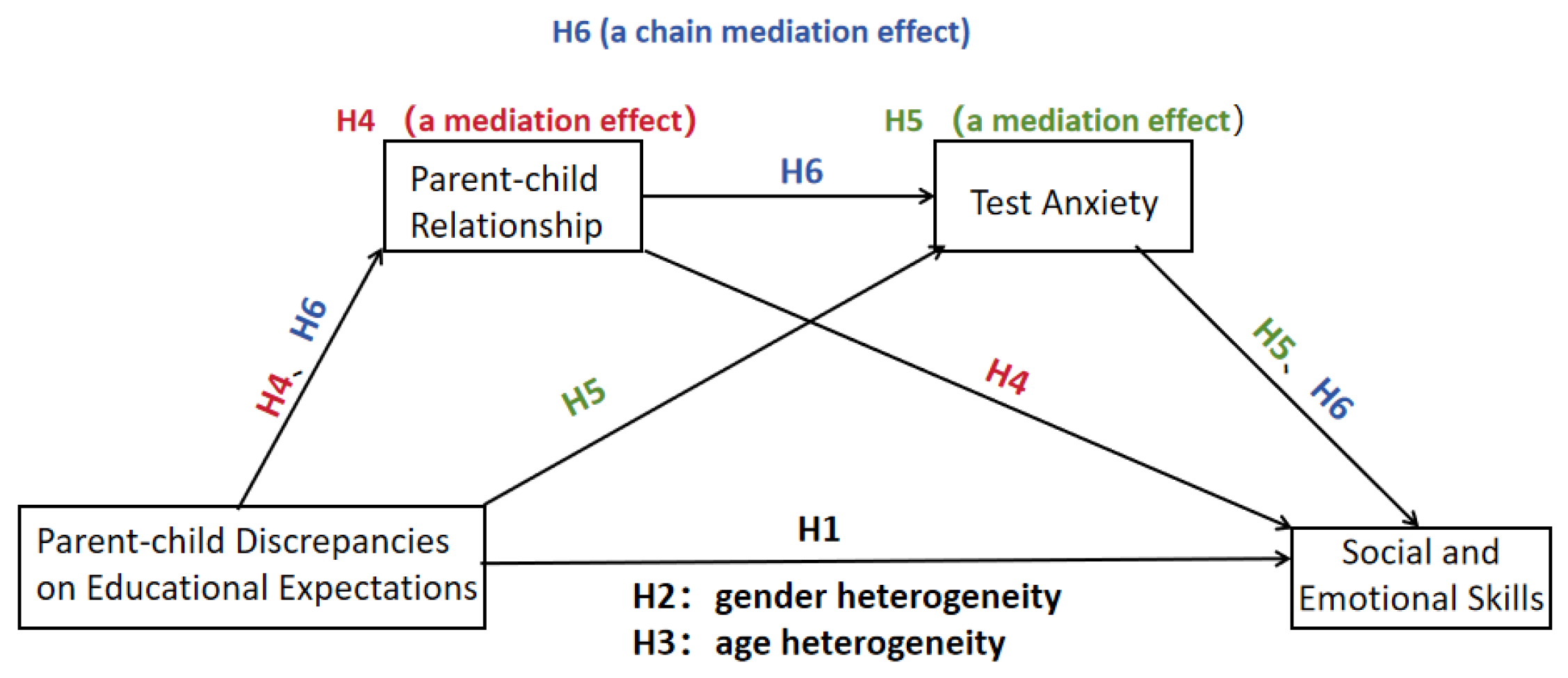
Hypothesis 1 (H1). Parent–child discrepancies on educational expectations have a significant negative impact on the development of social and emotional skills of children.
2.2. Gender and Age Differences in the Impact of Parent–Child Discrepancies on Educational Expectations on Children’s Social and Emotional Skills
The detrimental impact of expectation discrepancies is unlikely to be uniform across all children, with gender and developmental stage representing key sources of heterogeneity. A sustainable educational ecosystem must be responsive to such diversity to ensure equitable development of the social and emotional skills essential for all future citizens. From a gender perspective, girls generally have higher expectations [
18,
25], exhibit more compliant characteristics in the learning process and perform better in non-cognitive abilities such as language comprehension and interactive communication [
26], potentially enabling them to better understand parental perspectives and navigate differences. Consequently, compared to boys, girls have smaller differences in educational expectations with their parents. Additionally, research suggests that boys and girls also differ in the extent to which their expectations are affected by those of their parents. Zhang et al. revealed that the effects of parents’ expectations on students’ expectations were stronger among boys than among girls [
6,
27]. These gender patterns suggest that boys may be more vulnerable to the relational strains arising from misaligned expectations.
In terms of age characteristics, personal educational expectations are initially generated under the guidance and influence of parental educational expectations [
28]. With personal cognitive development and external environmental influences, parent–child educational expectations may deviate [
19]. Research has shown that as teenagers grow older, children’s sense of identity gradually increase, which can influence the magnitude and perception of expectation gaps [
29]. This developmental trajectory interacts with the natural progression of social and emotional skills, which typically show higher aggregate scores among 10-year-olds and boys across various domains [
2]. This age-sensitive dynamic carries significant implications for the timing and focus of educational interventions. The early adolescent period (around age 10) may present a critical window for fostering alignment and strengthening foundational social and emotional skills, while mid-adolescence (age 15) demands more nuanced support to navigate identity formation and mitigate the acute negative impacts of expectation discrepancies. A sustainable educational approach must therefore be developmentally attuned, offering differentiated support that aligns with the evolving needs and capacities of learners at different stages. Based on educational expectation discrepancies and group heterogeneity in social and emotional development, this study proposes the following hypotheses:
Hypothesis 2 (H2). Compared with girls, the negative impact of parent–child discrepancies on educational expectations on the social and emotional skills of boys is greater.
Hypothesis 3 (H3). Compared with 10-year-old children, the negative impact of parent–child discrepancies on educational expectations on the social and emotional skills of 15-year-old children is greater.
2.3. The Impact of Parent–Child Relationship and Test Anxiety on the Relationship Between Parent–Child Discrepancies on Educational Expectations and Children’s Social and Emotional Skills
To effectively translate the findings on expectation discrepancies into actionable insights for sustainable educational practice, it is crucial to uncover the underlying mechanisms. A holistic, systems-oriented perspective—central to sustainability education—demands that we look beyond direct effects and understand the relational and psychological processes at play. Consistent with the FSM framework, the pathway from expectation discrepancies (stressor) to impaired social and emotional skills (outcome) is likely mediated by disruptions in family relational dynamics (resource) and heightened negative cognitive-affective states (appraisal) [
19].
The parent–child relationship constitutes the primary relational context in which educational values and expectations are communicated and negotiated. Discrepancies in educational expectations represents a significant stressor that may affect parents’ interaction with their children. Excessive expectations may lead to parents putting too much pressure on their children, while low expectations may result in insufficient support from parents for their children [
30]. When the aspirations of parents and children are misaligned, their behaviors and communication styles often become inconsistent with each other’s needs, leading to conflicts between parents and children and damaging the parent–child relationship [
31,
32]. A harmonious relationship, in contrast, provides a secure base and a practicing ground for adolescents to safely develop and refine social and emotional skills, such as conflict resolution, emotional regulation, and empathetic communication [
33]. Thus, the quality of the parent–child relationship acts as a key conduit through which macro-level educational aspirations either support or undermine the micro-level development of sustainability competencies. Based on this, this study proposes the following hypothesis:
Hypothesis 4 (H4). The parent–child relationship plays a mediating role between the parent–child discrepancies on educational expectations and children’s social and emotional skills.
Test anxiety, a negative emotional state characterized by worry and tension in evaluative situations [
34,
35], represents a critical barrier to the type of engaged and resilient learning that ESD promotes. Research has shown that test anxiety not only affects students’ academic grades and mental health but also has negative effects on their non-cognitive abilities such as emotional regulation [
36,
37]. The family environment is a primary antecedent of such anxiety. When parents hold educational expectations that are perceived as excessively high or inflexible, they can inadvertently create a climate of performance pressure, thereby elevating their children’s test anxiety [
38]. This highlights a critical misalignment between certain family-driven achievement cultures and the supportive, low-threat learning environments needed to foster the curiosity and risk-taking inherent in sustainability education. Based on this, this study proposes the following hypothesis:
Hypothesis 5 (H5). Test anxiety mediates the relationship between parent–child discrepancies on educational expectations and children’s social and emotional skills.
Building on the FSM’s sequential pathways and integrating insights from family systems theory, we propose a chain mediation process that reflects a cascading effect within the child’s ecosystem. In fact, the quality of the parent–child relationship is intrinsically linked to a child’s experience of test anxiety. A positive family environment can serve as a buffering factor for anxiety in children, where open communication, encouragement for personal growth, and effective maintenance of the family system can effectively reduce the level of exam anxiety in children [
39]. Song et al. (2024) found that the parent–child relationship plays a mediating role in the relationship between parental education expectation discrepancies and students’ positive emotions [
40]. Positive emotions can help students cope better with test anxiety. This proposed chain—where relational distress at home fuels academic anxiety, which in turn impairs the development of broader social and emotional competencies—reveals a systemic vulnerability. It underscores the imperative for educational strategies that address the interconnectedness of relational well-being, emotional security, and skill development to build a truly sustainable and supportive learning ecosystem. Based on this, this study proposes the following hypothesis:
Hypothesis 6 (H6). The parent–child relationship and test anxiety play chain mediating roles between parent–child discrepancies on educational expectations and children’s social and emotional skills.
In summary, based on parent–child discrepancies on educational expectations, parent–child relationship, test anxiety, and the interrelationships between social and emotional skills, combined with previous theories and research, a theoretical hypothesis model was constructed as shown in
Figure 1.
3. Methods
3.1. Data Resource
The research data in this article comes from the 2019 Organization for Economic Cooperation and Development (OECD) Survey on Social and Emotional Skills (SSES) project. The survey aims to assess the level of social and emotional skills development among young people worldwide and explore the environmental factors in families, schools, and communities that influence the development of these abilities. This study selected a sample from one city in China. This city is representative of developed regions in China’s economy, culture, and education. Its educational ecology, such as the distribution of urban and rural schools and differences in socioeconomic levels, covers a diverse range of educational scenarios. Consequently, the research results are typical and representative. The sampling method employed was a stratified two-stage cluster sampling design. In the first stage (school sampling), schools were systematically selected from a comprehensive sampling frame of all eligible schools. The stratification for this stage was based on key institutional characteristics to ensure the sample’s representativeness, including school sector (public vs. private), school socioeconomic status (categorized by location: urban, town, and rural), school level (primary schools for the 10-year-old cohort; junior high schools, senior high schools, and vocational schools for the 15-year-old cohort), and school type (general vs. vocational). From a frame of 387 primary and combined lower-secondary schools, 76 schools were selected for the 10-year-old cohort. Similarly, from a frame of 88 upper-secondary and vocational schools, 75 schools were selected for the 15-year-old cohort. In the second stage (student sampling), 50 age-eligible students were randomly selected from the enrollment roster of each participating school in the first stage. After the above two steps, 3800 and 3750 subjects were selected for the 10-year-old and 15-year-old groups, respectively, with a total sample size of 7550. According to research needs, samples with missing key variables were excluded, and the final sample size used was 7080 people. Among them, there were 3743 boys (52.87%), 3337 girls (47.13%), 3578 children in the 10-year-old group (50.54%), and 3502 children in the 15-year-old group (49.46%).
3.2. Variables
3.2.1. Social and Emotional Skills
The dependent variable of this study is the social and emotional skills of children. SSES draws on the Big Five personality model to construct a framework for assessing social and emotional skills by five dimensions [
41]: Task Performance (e.g., I usually plan ahead before starting a difficult task), Emotional Regulation (e.g., I stay calm even when facing a big test or exam), Open-mindedness (e.g., I respect the opinions of people who are different from me), Collaboration (e.g., It upsets me to see another student being treated badly), and Engaging with Others (e.g., I usually feel full of energy). Each dimension includes three sub-skills, totaling 15 sub-skills. The OECD has designed a sub-questionnaire for each sub-skill that includes multiple items and is scored using a Likert-type scale. Extensive psychometric validation, including reliability analysis, confirmatory factor analysis (CFA), and measurement invariance testing, was conducted on the Chinese sample [
2]. The results demonstrated strong internal consistency (α and Ω > 0.70 for most scales), acceptable model fit in CFAs, and measurement equivalence across age and gender groups, supporting the structural validity and cultural appropriateness of the instrument in the Chinese educational context. To ensure the cross-national comparability of social and emotional skills, the study implemented a rigorous scaling procedure anchored in Item Response Theory (IRT). After recoding all 5-point items to a 0–4 metric (with reverse-worded items inverted), the Generalized Partial Credit Model was fitted to the pooled sample of 10- and 15-year-olds This one-dimensional polytomous IRT model simultaneously estimated item discrimination and ordered threshold parameters while applying senate weights so that each city contributed equally. Next, individual latent scores were extracted via the Weighted Likelihood Estimate algorithm, yielding unbiased initial ability values on the logit scale. These values were subsequently adjusted for the acquiescence response style through a linear correction derived from 25 balanced item pairs, and the resulting logits were linearly transformed into a standardized metric in which the weighted mean of the 10-year-old cohort was set to 500 and its standard deviation to 100, thereby producing final scores that are directly comparable across cities, age groups, and genders [
2].
3.2.2. Parent–Child Discrepancies on Educational Expectations
The core independent variable of this study is parent–child discrepancies on educational expectations. The measurement items for both children’s and parents’ educational expectations were sourced from the SSES, with raw responses coded according to International Standard Classification of Education (ISCED) levels and subsequently categorized into the three predefined tiers: 1—[ISCED level 3 or lower] (signifying completion expectations ranging from no formal education up to and including the end of high school or equivalent vocational training), 2—[ISCED level 4 or 5] (representing qualifications beyond upper secondary but below a full bachelor’s degree), 3—[ISCED level 6 or higher] (indicating aspirations for a full bachelor’s degree, master’s degree, doctorate, or comparable advanced academic or professional qualifications). When constructing the variable “parent–child discrepancies on educational expectations”, three sub-types were matched according to the equation of “parent–child discrepancies on educational expectations = parental education expectation—children education expectation”: congruent parent–child education expectation, higher parental education expectation, and lower parental education expectation.
3.2.3. Parent–Child Relationship and Test Anxiety
The items measuring the parent–child relationship and test anxiety were drawn from the original SSES questionnaire. The parent–child relationship refers to the state that children perceive when interacting with their parents. There are three items in total, namely “get upset easily with my parents”, “hard to talk with my parents”, and “feel angry with my parents”. Children rate the items on a 4-point scale based on their level of conformity with their own description, with scores ranging from ”almost never“ to ”almost always“. After reverse scoring the items, the higher the score, the more harmonious the parent–child relationship. Test anxiety is measured using three question items, namely ”worry it will be difficult taking a test“, ”well prepared for a test but very anxious”, and ”very tense when studying for a test“. Students are required to rate each question on a scale of 1–5 (from 1 = “strongly disagree” to 5 = “strongly agree”), with higher values indicating higher levels of test anxiety.
3.2.4. Control Variables
In addition to the above factors, this study also controlled for other variables that were selected based on prior research and theoretical considerations, as they are likely associated with both the formation of parent–child education expectations and the development of social and emotional skills: (1) basic demographic characteristics of a participant, including: gender (0 = “girls”, 1 = “boys”), age (0 = “10-year-old group”, 1 = “15-year-old group”), and whether one is an only child (0 = “no”, 1 = “yes”); (2) previous research and theoretically relevant factors, including: academic grades (mainly including Chinese and math grades) and family socioeconomic status (SES). Among them, the socioeconomic status (SES) of the family is composed of three indicators: the highest level of parental occupation, the highest level of parental education, and family property. It is standardized with the average value of SES as 0 and the standard discrepancy as 1 for all samples.
3.3. Research Design
This study first used Ordinary Least Squares (OLS) to preliminarily estimate the relationship between parent–child discrepancies on educational expectations and children social and emotional skills. Among them,
Z_skills represents the standardized score of social and emotional skills,
Exp represents a dummy variable of parent–child discrepancies on educational expectations (coded 0 if parental expectation = children’s expectation, 1 otherwise),
Ci represents the control variables, including: gender, age, only child, SES, academic grade and
ε is the random error. This initial analysis also served to explore potential gender and age heterogeneity by running separate OLS regressions for girls vs. boys and for the 10-year-old vs. 15-year-old groups.
When analyzing the relationship between parent–child discrepancies on educational expectations and children’s social and emotional skills, OLS regression methods may not fully address sample selection bias and the potential correlation between independent variables and error terms. The propensity score matching (PSM) method reduces sample selection bias by matching individuals with similar propensity scores. PSM allows researchers to simulate the effects of random allocation in non-randomized experimental designs, thereby more accurately estimating treatment effects and better identifying the causal relationship between parental education expectation discrepancies and children’s social and emotional skills. In the PSM model, the corresponding average treatment effect (ATT) of the treatment group is shown in the following equation.
Among them, Di represents the dummy variables of parent–child discrepancies on educational expectations. In order to further reveal the impact of parent–child discrepancies on educational expectations on the social and emotional skills of children, the PSM specifically divides parent–child discrepancies on educational expectations into three types to identify their causal effects: congruent parent–child education expectation, higher parental education expectation, and lower parental education expectation. Y1i and Y0i are dependent variables, representing the total scores of social and emotional skills of adolescents when Di = 1 and Di = 0. p(Xi) is the propensity score value, which represents the probability that adolescent individual i is of the “congruent parent–child education expectation” or the “higher parental education expectation”, controlling for gender, age, academic grade, being an only child, and family socioeconomic status. The average treatment effect of ATT corresponding to the treatment group represents the net effect of parent–child discrepancies on educational expectations on the development of social and emotional skills in children. Crucially, to test hypotheses H2 (gender heterogeneity) and H3 (age heterogeneity), the PSM analysis and ATT estimation were performed separately within the girl subgroup, boy subgroup, 10-year-old subgroup, and 15-year-old subgroup for both comparisons.
Finally, in order to further explore the mechanism by which the parent–child discrepancies on educational expectations affects the social and emotional skills of children, this research uses the bias-corrected percentile bootstrap method to test the mediating effect, with 5000 bootstrap samples. This model tested the hypothesized chain mediation where the parent–child relationship (M1) and test anxiety (M2) sequentially mediate the relationship between parent–child discrepancies on educational expectations (X) and social and emotional skills (Y).
This structured approach—initial OLS exploration, PSM for causal inference and subgroup heterogeneity testing, followed by mediation analysis—provided a comprehensive examination of the impact, differential susceptibility, and underlying mechanisms of parent–child discrepancies on educational expectations on children’s social and emotional skills.
4. Result
4.1. Descriptive Statistics
Table 1 presents the descriptive statistical results of each variable. Among the three types of parent–child discrepancies on educational expectations, the group of “congruent parent–child education expectation” has the highest proportion (5718, accounting for about 80.76%), followed by the group of “higher parental education expectation” (1211, accounting for about 17.10%), and the group of “lower parental education expectation” has the lowest proportion (151, accounting for about 2.14%). It indicates that the educational expectations of parents and children in most families are consistent, but there is still a proportion of families where parents have higher educational expectations than adolescents. However, it is relatively rare for parents’ expectations to be lower than their children’s own expectations. In terms of overall scores in social and emotional skills and academic grades, the group of “congruent parent–child education expectation” scored the highest, followed by the group of “higher parental education expectation”, and the group of “lower parental education expectation” scored the lowest.
Among children with consistent parent–child education expectation and those with lower parental education expectation, the gender and age distribution is relatively balanced. While for those with higher parental education expectations, the proportion of boys and 10-year-old children are relatively higher. Secondly, in terms of family socioeconomic status, the two types of families with higher parental education expectations and lower parental education expectations have a lower socioeconomic status. This may be due to factors such as family resources, parenting styles, and parental involvement, which lead to discrepancy in the concept of educating children and corresponding educational behaviors, resulting in a mismatch between parents’ educational expectations for children and their actual abilities or expectations.
4.2. Common Method Bias Test and Correlation Analysis
Harman’s single-factor test indicated no significant common method bias, with the first unrotated factor accounting for 33.41% of the total variance, which is below the critical threshold of 50%. This result suggests that common method variance is not a substantial concern in the current data, thereby supporting the validity of the measured constructs and the robustness of the subsequent analyses.
As shown in
Table 2, the correlation analysis revealed statistically significant associations among key variables, providing preliminary support for the proposed chained mediation model. Specifically, parent–child discrepancies on educational expectations demonstrated a significant negative correlation with parent–child relationships and a positive correlation with test anxiety, while showing a direct negative association with social and emotional skills. Furthermore, parent–child relationships were significantly and negatively correlated with test anxiety and positively correlated with social and emotional skills. Test anxiety, meanwhile, was negatively correlated with social and emotional skills. These interrelated correlation patterns substantiate the theoretical proposition that parent–child discrepancies on educational expectations may impair children’s social and emotional skills through the sequential deterioration of parent–child relationships and subsequent exacerbation of test anxiety.
4.3. Ordinary Least Squares (OLS) Regression Result
OLS regression was used to estimate the influencing factors of adolescent social and emotional skills, and the regression results are shown in
Table 3. For all sample, the coefficient β
1 is 0.197 (
p < 0.001), indicating that children with discrepancies scored 0.197 SD lower on average than those with congruent expectations. The estimation results by gender and age group indicate that there are differences in the impact of parent–child discrepancies on educational expectations on social and emotional skills among different gender and age groups. Specifically, the negative coefficient was significantly larger in magnitude for boys (β
1 = −0.248) than for girls (β
1 = −0.130), and for 15-year-olds (β
1 = −0.208) than for 10-year-olds (β
1 = −0.168). This suggests that the detrimental association of expectation discrepancies with social and emotional skills was stronger for girls and older children.
4.4. Propensity Score Matching (PSM) Results
This article first uses the Probit binary selection model to estimate the influencing factors of parent–child discrepancies on educational expectations.
Table 4 showed that gender, age, family socioeconomic status, academic grade have a significant impact on the parent–child discrepancies on educational expectations.
Secondly, to verify the data balance between the treatment group (
Di = 1) and the control group (
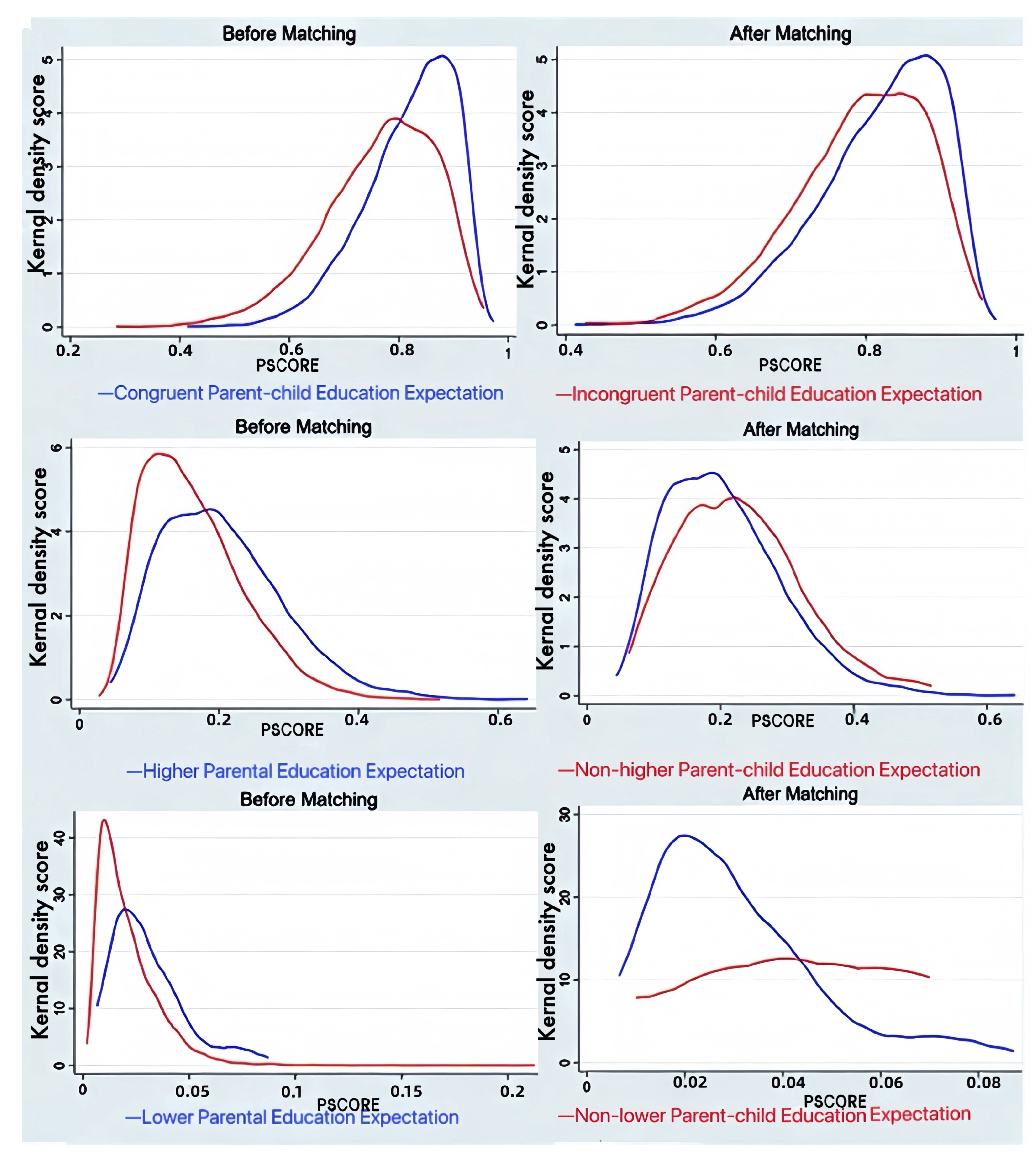
Di = 0), this survey characterizes Kernel Density Plot using propensity scores before and after data matching. Specifically, we focused on two key comparisons: (1) congruent expectations vs. incongruent expectations (combining both higher and lower parental expectation subgroups) to estimate the overall causal effect of any discrepancy; and (2) higher parental expectation vs. non-higher expectation (including both congruent and lower parental expectation subgroups) to isolate the specific effect of parents holding higher expectations than their child. The “lower parental education expectation” group was excluded from formal PSM analysis due to its small size (N = 151) and resultant inability to achieve satisfactory covariate balance across matching methods. As illustrated in
Figure 2, the overlap area of the first two comparison groups widened after data matching, and the density distribution curves of the two groups also became more fitted, indicating that the matching process effectively reduced the difference in propensity score between the two groups. Meanwhile,
Table 5 shows the balance of covariates before and after propensity score matching based on the nearest neighbor matching test. After nearest-neighbor matching, covariate standard errors fell and between-group differences disappeared, confirming a successful balance.
Based on sample balance testing, we used three matching strategies, nearest neighbor matching, radius matching (caliper = 0.01), and kernel matching, to estimate the average processing effect of parent–child discrepancies on educational expectations. Among them, nearest neighbor matching adopts a one-to-one matching strategy.
Table 6 presents the ATT results calculated based on matched samples. Overall, after controlling for children’s academic grades, whether they are only children, gender, age, and family socioeconomic status, the ATT parameter values estimated by the nearest neighbor matching, radius matching, and kernel matching methods are basically consistent and significant at the 1% level, indicating that the estimation results have a certain degree of robustness. Specifically, children with congruent expectations with parents have social and emotional skills that are 15.358 to 18.060 higher than those with inconsistent expectations, while children with higher parental education expectations have social and emotional skills that are 13.752 to 14.812 lower than those with non-higher expectations. This further indicates that congruent expectations for parent–child education can significantly promote the development of children’s social and emotional skills, while excessively high parental education expectations can have a negative impact on the development of children’ social and emotional skills. Hypothesis H1 holds true.
On this basis, we further explore the gender and age differences in the impact of parental education expectation bias on children’ social and emotional skills. The PSM grouping estimation results indicate that the impact of parental education expectation discrepancy varies among different genders and age groups. As shown in
Table 6, in terms of gender, boys with consistent educational expectations have social and emotional skills that are 20.332 to 22.722 higher than those without consistent expectations, while the difference between the two groups of girls is only 9.165 to 10.237, and the impact on girls is not significant. Boys with higher parental education expectations have social and emotional skills that are 15.031 to 18.638 lower than those with non-higher parental education expectations. The difference between the two groups of girls is only 7.282 to 7.762, and the impact on girls is not significant. Therefore, compared to girls, the discrepancies on parent–child education expectations have a greater impact on boys. Hypothesis H2 holds true.
In terms of age, the analysis reveals that the beneficial effect of congruent (vs. incongruent) parent–child educational expectations on social and emotional skills is significant for both age groups, and the difference between the two age groups is small. However, the social and emotional development level of 15-year-old children with higher parental education expectations differs from that of 15-year-old children with non-higher parental education expectations by 17.562 to 21.245, while the difference in 10-year-old children is only 10.408 to 12.855. Therefore, compared to the 10-year-old group, the impact of parental education expectation discrepancy on children in the 15-year-old group is significantly higher than that in the 10-year-old group. Hypotheses H3 is valid.
4.5. Mediating Effect Analysis
Based on the OLS and PSM findings, this analysis focused on the pathways through which educational expectation discrepancies impact social and emotional skills, using parent–child relationship and test anxiety as mediators.
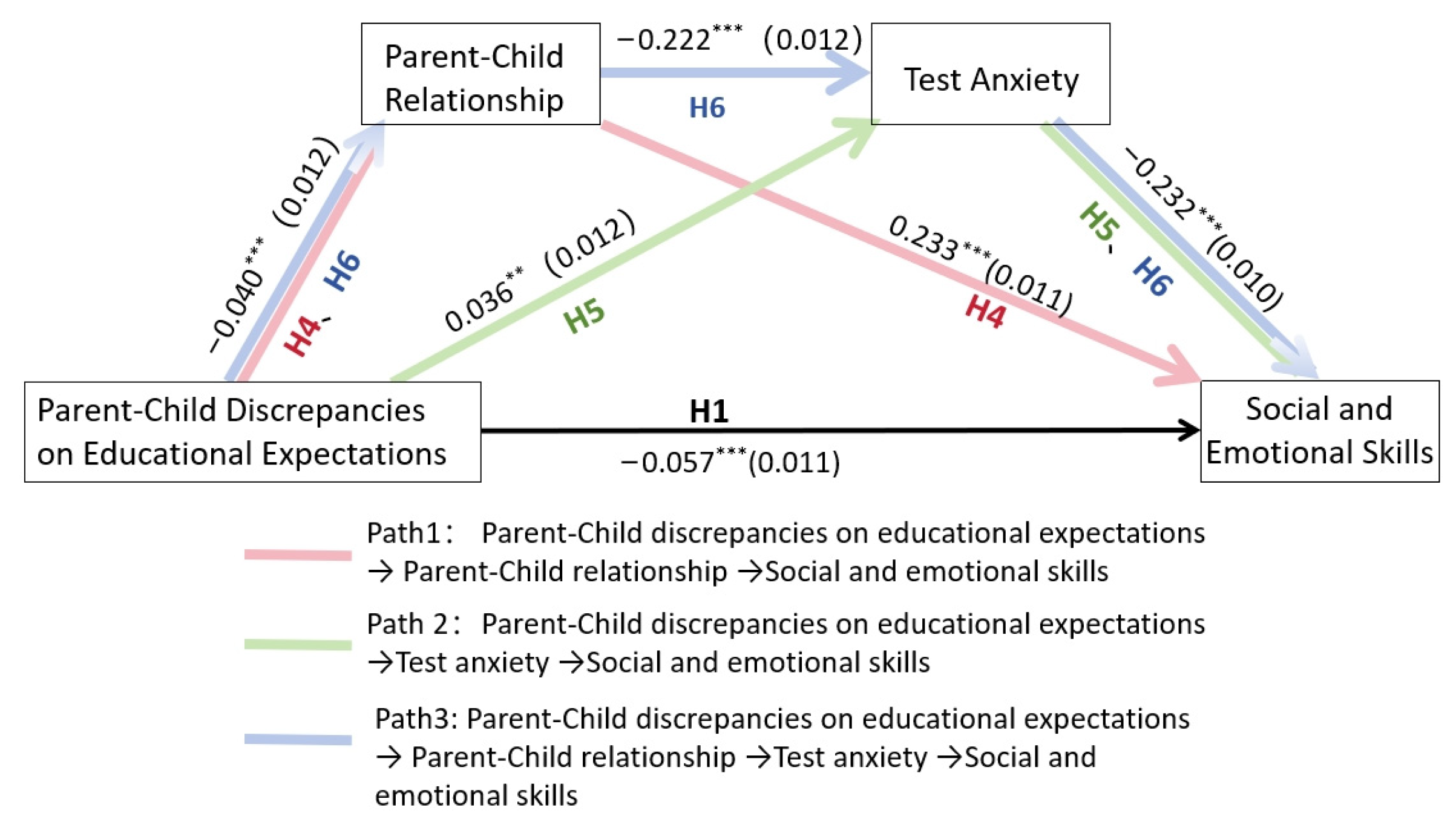
Using the SPSS (27.0) macro-PROCESS (4.1) plugin Model 6 developed by Hayes, with the effects of gender, age, family socioeconomic status, academic grades, and being an only child were controlled for. The path coefficient results of the chain mediation are shown in
Figure 3. The total mediation effect model is significant, R
2 = 0.457, F = 370.968,
p < 0.001. Using the bootstrap sampling method to test the chain mediation effect, the indirect effect of path 1 with parent–child relationship as the mediator variable is −0.094 (95% CI = [0.015, 0.004]), and the confidence interval does not include 0, indicating that the parent–child discrepancies on educational expectations is inconducive to the development of the parent–child relationship, which has a significant negative impact on children’s social and emotional skills. Hypothesis H4 holds true.
The indirect effect of path 2 mediated by test anxiety is −0.084 (95% CI = [−0.014, −0.003]), and the confidence interval does not include 0, indicating that the parent–child discrepancies on educational expectations will aggravate children’s test anxiety and then have a negative impact on their social and emotional skills. Hypothesis H5 holds true. The indirect effect of chain mediation pathway 3 with the parent–child relationship and test anxiety as mediating variables is −0.021 (95% CI = [−0.003, −0.001]), and the confidence interval does not include 0, indicating that educational expectations discrepancies significantly affect the social and emotional skills of children through the chain mediation effect of the parent–child relationship and test anxiety. Hypothesis H6 holds true. The total indirect effect of all pathways is −0.198 (95% CI = [−0.029, −0.010]).
5. Discussion and Conclusions
This study, grounded in the need to build resilient and sustainable educational ecosystems, investigated the impact of parent–child discrepancies in educational expectations on children’s social and emotional skills. Our findings illuminate a critical link between family dynamics and the development of competencies that are fundamental to Education for Sustainable Development (ESD). First, the prevalence of parent–child discrepancies on educational expectations, particularly where parents hold higher aspirations than their children, remains a persistent issue across many families, with a higher incidence observed in those from lower socioeconomic status (SES) backgrounds. This finding aligns with existing literature indicating that children’ own educational expectations often fall short of those held by their parents [
7], and that such mismatches are more common within socioeconomically disadvantaged households [
42]. The Family Stress Model (FSM) offers a relevant framework, positing that economic strain exacerbates parental stress and undermines supportive parenting practices [
43,
44], which may in turn affect how educational expectations are communicated and internalized within the family. Parents with a lower SES may place particularly high emphasis on educational attainment as a pathway to upward social mobility, thereby amplifying expectations beyond their children’s own aspirations [
6].
Second, and most critically for the agenda of sustainable education, parent–child discrepancies on educational expectations, especially when parental expectations are higher, can have a negative impact on the development of social and emotional skills. This conclusion supports the identification control theory and Coleman’s social capital theory [
45,
46]. When the expectations for parent–child education are consistent, children can perceive a unified and stable value orientation and goal setting from their parents and can calmly cultivate social and emotional skills such as social confidence and empathy [
12,
47]. Such an environment mirrors the supportive and coherent learning ecosystems that ESD aims to establish. However, parents’ excessively high educational expectations often exceed the actual capacity or ability of children, causing them to bear a heavy psychological pressure for a long time, easily falling into self-doubt and anxiety, and hindering the positive progress of social and emotional skills [
11,
28]. This chronic stress directly impairs the emotional regulation and task performance skills needed to persevere in the face of complex sustainability challenges. Meanwhile, excessive focus on learning and grades may lead to inadequate development of children’s abilities in social interaction and emotional expression. They may not have enough time to participate in peer interactions, cultivate friendships, and lack opportunities to exercise communication and coordination skills in teamwork [
9]. It is noteworthy that the core finding that discrepant educational expectations function as a psychosocial stressor is not isolated to the Chinese context. Studies conducted in various Western countries have reported similar negative associations between parent–child expectation discrepancies and adolescent well-being or academic outcomes [
5,
18]. This parallel suggests that the underlying mechanism, rooted in universal family stress and identity processes, may have cross-cultural validity. However, the intense focus on academic achievement within Chinese society might amplify the prevalence of high parental expectations and the potency of their negative effects when mismatched with children’s own aspirations.
Third, the finding that parental education expectation discrepancies have a more significant impact on boys and 15-year-olds offers crucial insights for equitable and developmentally attuned educational interventions. In reality, cultural stereotypes (which may include traditional gender roles and/or racial or ethnic stereotypes) can influence parents’ expectations [
48]. Boys may be expected to have more independent, competitive, and strong willpower qualities. Consistent with previous research conclusions, when there is a discrepancy in expectations for parent–child education, boys may have greater impacts [
27,
49]. Failing to address this vulnerability risks creating a gender gap in the socio-emotional competencies required for inclusive and collaborative sustainability efforts. In contrast, when faced with a parental education discrepancy, girls may be more inclined to relieve stress through emotional communication and other means, with relatively less negative impact on social and emotional skills. In terms of age difference, teenagers in the 10-year-old group are in the transition stage from childhood to adolescence, with a relatively high degree of dependence on their parents. Parents’ expectations are more of a guide for them. Even if there are discrepancies in educational expectations, they may not have enough self-awareness to deeply appreciate the negative impact of this discrepancy. However, children in the 15-year-old group are in adolescence, with a high level of self-awareness and a greater emphasis on self-identity [
50]. They are beginning to form their own values and plans for the future and make their own judgments about their parents’ expectations [
44]. When there is a discrepancy in expectations for education, they will be more sensitive to this inconsistency. This type of conflict can exacerbate their inner conflicts and struggles, causing more serious damage to their emotional stability and social relationships and thus having a profound negative impact on their social and emotional skills.
Finally, the identified chain mediation involving parent–child relationships and test anxiety provides a dynamic and actionable model for understanding how familial stressors cascade through a child’s life. When parents and children reach a consensus on educational expectations, mutual understanding and trust between parents and children are easier to establish, thereby making the parent–child relationship more harmonious [
51], which is a core component of a nurturing learning ecosystem. On the contrary, if expectations are inconsistent, it may lead to conflicts and affect the quality of parent–child relationships. A good or tense parent–child relationship can further affect the level of test anxiety in children. Poor parent–child relationships may make teenagers feel insecure and more prone to anxiety under exam pressure [
52]. This highlights a critical misalignment: a family environment intended to motivate academic success may instead create the very anxiety that undermines the resilient and reflective learning ESD promotes. Ultimately, the level of test anxiety among children can have an impact on their social and emotional skills. Lower test anxiety helps teenagers invest more psychological energy into interpersonal communication, self-regulation, and other aspects, which is beneficial for enhancing their social and emotional skills. This chain of effects underscores that efforts to foster sustainability competencies must address the entire learning environment, from family relationships to assessment-related stress.
6. Contribution and Implications
The findings of this study carry significant theoretical, methodological, and practical implications for advancing the agenda of Education for Sustainable Development (ESD) and for building educational systems capable of nurturing the competencies required for a sustainable future. Theoretically, this research extends the Family Stress Model by positioning the family microsystem as an integral component of the sustainable learning ecosystem. We demonstrate that non-economic stressors—specifically, discrepancies in educational expectations between parents and children—serve as critical risk factors that can fracture intra-familial harmony and thereby impede the development of the collaborative, resilient, and emotionally intelligent individuals that a sustainable future demands. The introduction of a chain mediation mechanism, through which parent–child relationship quality and test anxiety sequentially transmit the negative effects of expectation discrepancies, offers a more dynamic and process-oriented understanding of how stressors within one part of the educational ecosystem (the family) can cascade to undermine “whole child” development, which is central to ESD. This aligns with the systemic perspective called for in sustainability education, highlighting the interconnectedness of family dynamics, student well-being, and the development of key sustainability competencies. Methodologically, the application of propensity score matching enhances the causal credibility of the findings by addressing selection bias. This robust approach provides a stronger evidence base for designing targeted interventions and formulating educational policies aimed at fostering supportive learning environments and strengthening the home–school partnerships that are essential for a cohesive and sustainable educational system.
Based on this study’s findings, this research offers concrete implications for constructing sustainable educational ecosystems, spanning family, instructional, and policy dimensions. At the family level, parents and caregivers are encouraged to engage in open and developmentally sensitive communication to align educational expectations with their children’s own aspirations, while consciously mitigating academic pressure and test anxiety. At the school level, educators should embed social and emotional learning (SEL) into sustainability-oriented pedagogy and receive professional development focused on mental health awareness and family engagement strategies. Systemically, these efforts should be reinforced by policy measures that integrate SEL and ESD competencies into curriculum standards, teacher preparation, and school evaluation systems, shifting emphasis from purely academic outcomes to holistic development. Concrete policy actions should include revising national curriculum frameworks to incorporate specific SEL and ESD standards, allocating dedicated resources for teacher professional development in areas of mental health support and constructive parent–teacher communication, and redesigning school evaluation metrics to include indicators of student well-being and positive school climate. Adopting a multi-tiered and aligned approach that engages families, schools, and policymakers as co-creators through multi-stakeholder collaboration is essential for fostering resilient, socially and emotionally skilled learners, aligning closely with the implementation framework of Sustainable Development Goal 17.
7. Limitations and Future Research Direction
Notwithstanding its contributions, this study’s limitations offer pathways for advancing research on sustainable educational ecosystems. First, the data were collected from a single city in China, and the cultural context, characterized by a strong emphasis on academic achievement, is integral to interpreting the results. This specificity cautions against overgeneralization and highlights the need for future cross-cultural comparisons. Second, the data for this study were collected in 2019, prior to the global COVID-19 pandemic and significant subsequent geopolitical shifts. These events have undoubtedly reshaped educational environments, family stress levels, and children’s social and emotional experiences. Consequently, the generalizability of our findings to the post-pandemic context may be limited, and the specific effect sizes reported here might not fully reflect the current reality. This underscores the need for replication studies with more recent data to assess the stability and evolution of these relationships over time. Furthermore, the restricted age range, while insightful, underscores the need for longitudinal studies to map the lifelong impact of expectation discrepancies on sustainability competencies. Unmeasured confounders from the broader school and community environment, alongside the lack of qualitative depth into family interactions, highlight the utility of future research employing comprehensive ecological models and mixed-methods designs. Ultimately, from a dynamic family system perspective, it would be theoretically meaningful to investigate the potential reverse causal pathway, whereby students’ pre-existing social and emotional skills may shape subsequent parent–child expectation discrepancies. Empirical examination of this reciprocal dynamic, for instance through cross-lagged panel modeling or longitudinal dyadic analyses, would offer a more holistic understanding of how family expectations and child development co-evolve over time.
Author Contributions
Conceptualization, Z.W. and H.C.; Formal analysis, Z.W. and K.Z.; Funding acquisition, C.L.; Investigation, K.Z. and Y.J.; Methodology, H.C., K.Z., Z.G. and J.T.; Resources, C.L.; Software, Z.W. and H.C.; Visualization, Z.G. and J.T.; Writing—original draft, Z.W.; Writing—review & editing, H.C., K.Z., Y.J., Z.G., J.T. and C.L. All authors have read and agreed to the published version of the manuscript.
Funding
This work was supported by the Zhejiang Provincial Philosophy and Social Science Planning Project (grant number 24NDJC066YB) and The Qingdao Philosophy and Social Science Planning Project (grant number QDSKL2401291).
Institutional Review Board Statement
The study was conducted in accordance with the Declaration of Helsinki and approved by the Ethics Committee of the Department of Psychology, Qingdao University (protocol code QDU-HEC-2023256 and date of approval 1 May 2019).
Informed Consent Statement
Informed consent was obtained from all subjects involved in the study.
Data Availability Statement
The data presented in this study are available on request from the corresponding authors.
Conflicts of Interest
The authors declare no conflict of interest.
References
- UNESCO. Education for Sustainable Development: A Roadmap; UNESCO: Paris, France, 2020; Available online: https://unesdoc.unesco.org/ark:/48223/pf0000374802 (accessed on 12 September 2025).
- OECD. Beyond Academic Learning: First Results from the Survey of Social and Emotional Skills; OECD Education Working Papers No. 259; OECD Publishing: Paris, France, 2021; pp. 1–224. [Google Scholar]
- Shulla, K.; Filho, W.L.; Lardjane, S.; Sommer, J.H.; Borgemeister, C. Sustainable development education in the context of the 2030 Agenda for sustainable development. Int. J. Sustain. Dev. World Ecol. 2020, 27, 458–468. [Google Scholar] [CrossRef]
- Park, H.; Buchmann, C.; Choi, J.; Merry, J.J. Learning beyond the school walls: Trends and implications. Annu. Rev. Sociol. 2016, 42, 231–252. [Google Scholar] [CrossRef]
- Schörner, K.; Bittmann, F. Children’s aspirations, their perceptions of parental aspirations, and parents’ factual aspirations—Gaining insights into a complex world of interdependencies. Eur. Sociol. Rev. 2024, 40, 981–995. [Google Scholar] [CrossRef]
- Yang, J.; Wang, Y. The Goldilocks Effect of parental educational aspirations on academic achievement: The benefit of expectations and harm of the gap. Eur. J. Psychol. Educ. 2025, 40, 22. [Google Scholar] [CrossRef]
- Wang, Y.; Benner, A.D. Parent-child discrepancies in educational expectations: Differential effects of actual versus perceived discrepancies. Child Dev. 2014, 85, 891–900. [Google Scholar] [CrossRef]
- Marcenaro-Gutierrez, O.D.; Lopez-Agudo, L.A. The influence of the gap between parental and their children’s expectations on children’s academic attainment. Child Indic. Res. 2017, 10, 57–80. [Google Scholar] [CrossRef]
- Liu, Y.W.; Su, Y.T.; Liu, K.S.; Jin, Z.Y. The health costs associated with “looking forward to success”: Educational expectations and children’s health. Inf. Child Dev. 2024, 33, e2524. [Google Scholar] [CrossRef]
- Roisman, G.I.; Haltigan, J.D.; Haydon, K.C.; Booth-LaForce, C. Earned-security in retrospect: Depressive symptoms, family stress, and maternal and paternal sensitivity from early childhood to mid-adolescence. Monogr. Soc. Res. Child Dev. 2014, 79, 85–107. [Google Scholar] [CrossRef]
- Zhang, L. Parent-child expectation discrepancy and adolescent mental health: Evidence from “China Education Panel Survey”. Child Indic. Res. 2024, 17, 705–730. [Google Scholar] [CrossRef]
- Buchmann, M.; Grütter, J.; Zuffianò, A. Parental Educational Aspirations and Children’s Academic Self-Concept: Disentangling State and Trait Components on Their Dynamic Interplay. Child Dev. 2022, 93, 7–24. [Google Scholar] [CrossRef]
- Godgings, A.-L.; Beltz, A.; Peper, J.S.; Crone, E.A.; Braams, B.R. Understanding the role of puberty in Structural and Functional Development of the Adolescent Brain. J. Res. Adolesc. 2019, 29, 32–53. [Google Scholar] [CrossRef] [PubMed]
- Liu, Z.P.; Guo, J.S.; Huang, H.Y.; Tang, X. Which social-emotional skills are most important for students’ learning and well-being? An international comparison among China, USA and Finland. Learn. Individ. Differ. 2025, 121, 102703. [Google Scholar] [CrossRef]
- Guo, J.; Tang, X.; Marsh, H.W.; Parker, P.; Basarkod, G.; Sahdra, B.; Ranta, M.; Salmela-Aro, K. The roles of social–emotional skills in students’ academic and life success: A multi-informant and multicohort perspective. J. Pers. Soc. Psychol. 2023, 124, 1079–1110. [Google Scholar] [CrossRef] [PubMed]
- Compas, B.E.; Connor-Smith, J.K.; Saltzman, H.; Thomsen, A.H.; Wadsworth, M.E. Coping with stress during childhood and adolescence: Problems, progress, and potential in theory and research. Psychol. Bull. 2001, 127, 87–127. [Google Scholar] [CrossRef]
- Hao, L.X.; Bonstead-Bruns, M. Parent-child differences in educational expectations and the academic achievement of immigrant and native students. Sociol. Educ. 1998, 71, 175–198. [Google Scholar] [CrossRef]
- Schoon, I.; Burger, K. Incongruence between parental and adolescent educational aspirations hinders academic attainment. Longitud. Life Course Stud. 2022, 13, 575–595. [Google Scholar] [CrossRef]
- Masarik, A.S.; Conger, R.D. Stress and child development: A review of the Family Stress Model. Curr. Opin. Psychol. 2017, 13, 85–90. [Google Scholar] [CrossRef]
- Lucas-Thompson, R.G.; Goldberg, W.A. Family relationships and children’s stress responses. Adv. Child Dev. Behav. 2011, 40, 243–299. [Google Scholar]
- Kapetanovic, S.; Boson, K. Discrepancies in parents’ and children’s reports on parent-adolescent communication and associations to children’s psychological health. Curr. Psychol. 2022, 41, 4259–4270. [Google Scholar] [CrossRef]
- Hou, Y.; Kim, S.Y.; Benner, A.D. Parent–adolescent discrepancies in reports of parenting and adolescent outcomes in Mexican immigrant families. J. Youth Adolesc. 2018, 47, 430–444. [Google Scholar] [CrossRef]
- Ayano, G.; Betts, K.; Lin, A.; Tait, R.; Alati, R. Maternal and paternal mental health problems and the risk of offspring depression in late adolescence: Findings from the Raine Study. J. Ment. Health 2021, 30, 349–357. [Google Scholar] [CrossRef]
- Monti, J.D.; Rudolph, K.D. Maternal depression and trajectories of adolescent depression: The role of stress responses in youth risk and resilience. Dev. Psychopathol. 2017, 29, 1413–1429. [Google Scholar] [CrossRef] [PubMed]
- Mello, Z.R.; Swanson, D.P. Gender differences in African American children’s personal, educational, and occupational expectations and perceptions of neighborhood quality. J. Black Psychol. 2007, 33, 150–168. [Google Scholar] [CrossRef]
- Vander Graaff, J.; Branje, S.; de Wied, M.; Hawk, S.; van Lier, P.; Meeus, W. Perspective taking and empathic concern in adolescence: Gender differences in developmental changes. Dev. Psychol. 2014, 50, 881–888. [Google Scholar] [CrossRef] [PubMed]
- Zhang, Y.; Haddad, E.; Torres, B.; Chen, C. The reciprocal relationships among parents’ expectations, children’s expectations, and children’s achievement: A two-wave longitudinal analysis of the NELS data. J. Youth Adolesc. 2011, 40, 479–489. [Google Scholar] [CrossRef]
- Chen, G.; Oubibi, M.; Liang, A.; Zhou, Y. Parents’ educational anxiety under the ‘double reduction’ policy based on the family and students personal factors. Psychol. Res. Behav. Manag. 2022, 15, 2067–2082. [Google Scholar] [CrossRef]
- Rimkute, L.; Hirvonen, R.; Tolvanen, A.; Aunola, K.; Nurmi, J.-E. Parents’ role in children’s educational expectations. Scand. J. Educ. Res. 2012, 56, 571–590. [Google Scholar] [CrossRef]
- Yin, X.; Jia, S.; Shao, Y.; Zhang, L. The impact of parental educational expectations on subjective well-being among children: The serial mediating role of self-efficacy and learning engagement. BMC Psychol. 2025, 13, 353. [Google Scholar] [CrossRef]
- Zapf, H.; Boettcher, J.; Haukeland, Y.; Orm, S.; Coslar, S.; Fjermestad, K. A systematic review of the association between parent-child communication and adolescent mental health. JCPP Adv. 2023, 4, e12205. [Google Scholar] [CrossRef]
- Ioffe, M.; Pittman, L.D.; Kochanova, K.; Pabis, J.M. Parent-adolescent communication influences on anxious and depressive symptoms in early adolescence. J. Youth Adolesc. 2020, 49, 1716–1730. [Google Scholar] [CrossRef]
- Wu, Q.; Han, S.J.; Tawfiq, D.; Jalapa, K.; Lee, C.R.; Pocchio, K. A family systems investigation on couple emotional intimacy, parent-child relationships, and child social skills in middle childhood. Child Dev. 2024, 95, 2195–2214. [Google Scholar] [CrossRef]
- Collie, R.J.; Ginns, P.; Martin, A.J.; Papworth, B. Academic buoyancy mediates academic anxiety’s effects on learning strategies. Educ. Psychol. 2017, 37, 947–964. [Google Scholar] [CrossRef]
- Zeidner, M. Test anxiety in educational contexts. In Emotions in Education; Schutz, P.A., Pekrun, R., Eds.; Elsevier: Amsterdam, The Netherlands, 2007; pp. 165–184. [Google Scholar]
- Hou, R.; Jin, L.; He, J.; Wang, J.-L. Peer support and learning outcomes in “Study with Me” among Generation Z college students: Mediating roles of motivation, test anxiety, and self-efficacy. Front. Psychol. 2025, 16, 1582857. [Google Scholar] [CrossRef] [PubMed]
- Alshareef, N.; Giga, S.; Fletcher, I. Test anxiety, emotional regulation and academic performance among medical students: A qualitative study. Med. Educ. Online 2025, 30, 2505177. [Google Scholar] [CrossRef] [PubMed]
- Peleg, O.; Deutch, C.; Dan, O. Test anxiety and perceived parental expectations. Learn. Individ. Differ. 2016, 49, 428–436. [Google Scholar] [CrossRef]
- Peleg-Popko, O. Children’s test anxiety and family interaction patterns. Anxiety Stress Coping 2002, 15, 45–59. [Google Scholar] [CrossRef]
- Song, Y.; Wu, J.; Zhou, Z.; Tian, Y.; Li, W.; Xie, H. Parent-adolescent discrepancies in educational expectations, relationship quality, and study engagement: A multi-informant study using response surface analysis. Front. Psychol. 2024, 15, 1288644. [Google Scholar] [CrossRef]
- Kankaraš, M.; Suarez-Alvarez, J. Assessment Framework of the OECD Study on Social and Emotional Skills; OECD Education Working Papers No. 207; OECD Publishing: Paris, France, 2019; pp. 1–92. [Google Scholar]
- Zhang, Y.; Jiang, M. Parent–child mismatch in educational expectations and depressive symptoms among Chinese children. Healthcare 2024, 12, 1792. [Google Scholar] [CrossRef]
- Conger, R.D.; Donnellan, M.B. An interactionist perspective on the socioeconomic context of human development. Annu. Rev. Psychol. 2007, 58, 175–199. [Google Scholar] [CrossRef]
- Cooper, C.E.; Crosnoe, R.; Suizzo, M.A.; Pituch, K.A. Poverty, race, and parental involvement during the transition to elementary school. J. Fam. Issues 2010, 31, 859–883. [Google Scholar] [CrossRef]
- Eccles, J.S.; Wigfield, A. Motivational beliefs, values, and goals. Annu. Rev. Psychol. 2002, 53, 109–132. [Google Scholar] [CrossRef] [PubMed]
- Coleman, J.S. Social capital in the creation of human capital. Am. J. Sociol. 1988, 94, S95–S120. [Google Scholar] [CrossRef]
- De Los Reyes, A.; Ohannessian, C.M. Introduction to the special issue: Discrepancies in adolescent-parent perceptions of the family and adolescent adjustment. J. Youth Adolesc. 2016, 45, 1957–1972. [Google Scholar] [CrossRef] [PubMed]
- Wigfield, A.; Eccles, J.S. Development of competence beliefs and achievement values. In Development of Achievement Motivation; Phye, G., Ed.; Academic Press: San Diego, CA, USA, 2002; pp. 91–120. [Google Scholar]
- Kleinjans, K.J. Family background and gender differences in educational expectations. Econ. Lett. 2010, 107, 125–127. [Google Scholar] [CrossRef]
- Ryan, R.M.; Deci, E.L. Self-determination theory and the facilitation of intrinsic motivation, social development, and well-being. Am. Psychol. 2000, 55, 68–78. [Google Scholar] [CrossRef]
- Almroth, M.; László, K.D.; Kosidou, K.; Galanti, M.R. Academic expectations and mental health in adolescence: A longitudinal study involving parents’ and their children’s perspectives. J. Adolesc. Health 2019, 64, 783–789. [Google Scholar] [CrossRef]
- Ringeisen, T.; Raufelder, D. The interplay of parental support, parental pressure and test anxiety—Gender differences in children. J. Adolesc. 2015, 45, 67–79. [Google Scholar] [CrossRef]
| Disclaimer/Publisher’s Note: The statements, opinions and data contained in all publications are solely those of the individual author(s) and contributor(s) and not of MDPI and/or the editor(s). MDPI and/or the editor(s) disclaim responsibility for any injury to people or property resulting from any ideas, methods, instructions or products referred to in the content. |
© 2025 by the authors. Licensee MDPI, Basel, Switzerland. This article is an open access article distributed under the terms and conditions of the Creative Commons Attribution (CC BY) license (https://creativecommons.org/licenses/by/4.0/).