Acceptance of a Mobile Application for Circular Economy Learning Through Gamification: A Case Study of University Students in Peru

 , , , , , , and
Abstract
1. Introduction
2. Conceptual Framework
2.1. Circular Economy
2.2. Gamification in Higher Education
2.3. Sustainable Education SDG 4 and SDG 12
2.4. Synthesis and Relevance to the Study
3. Materials and Methods
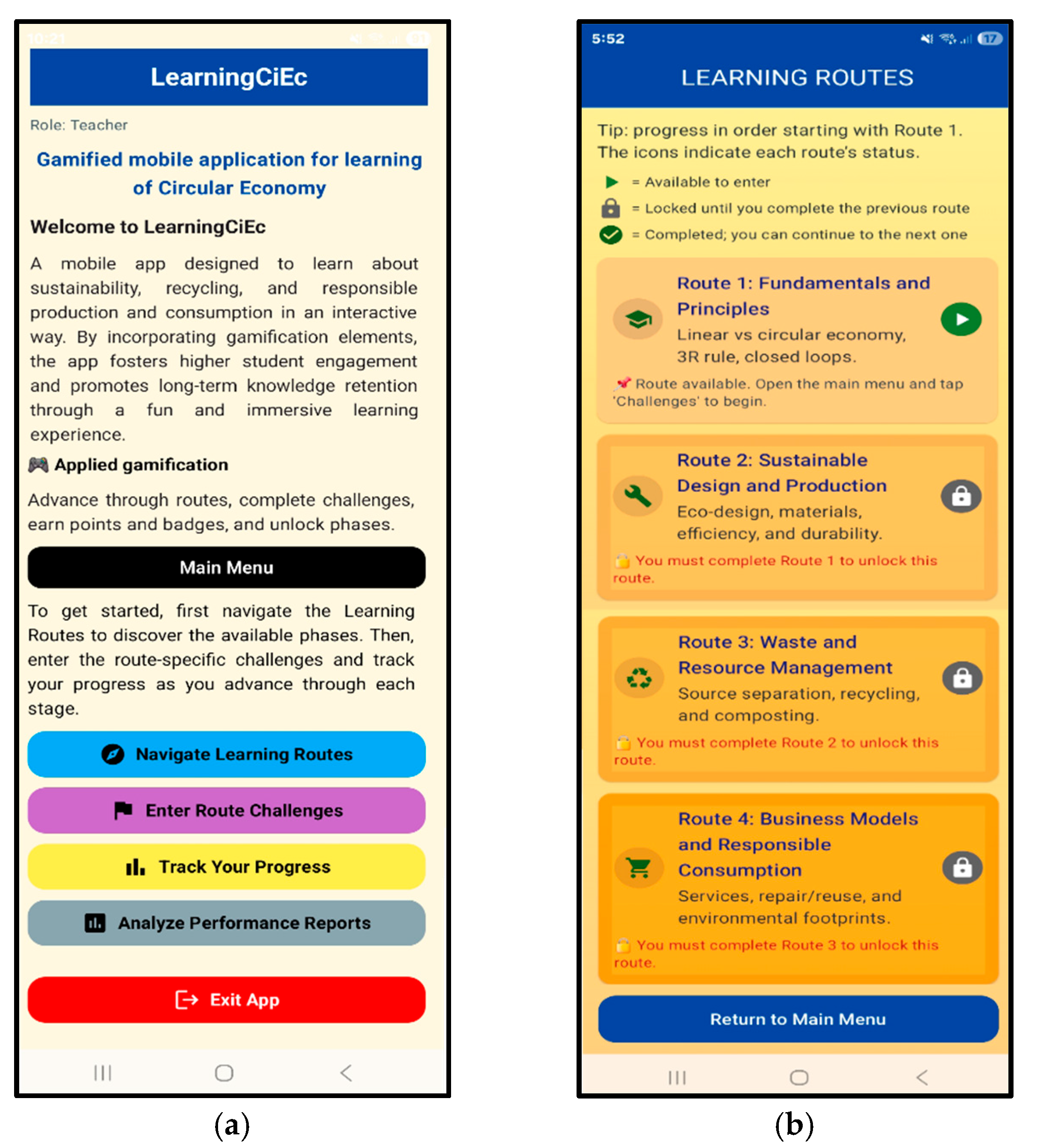
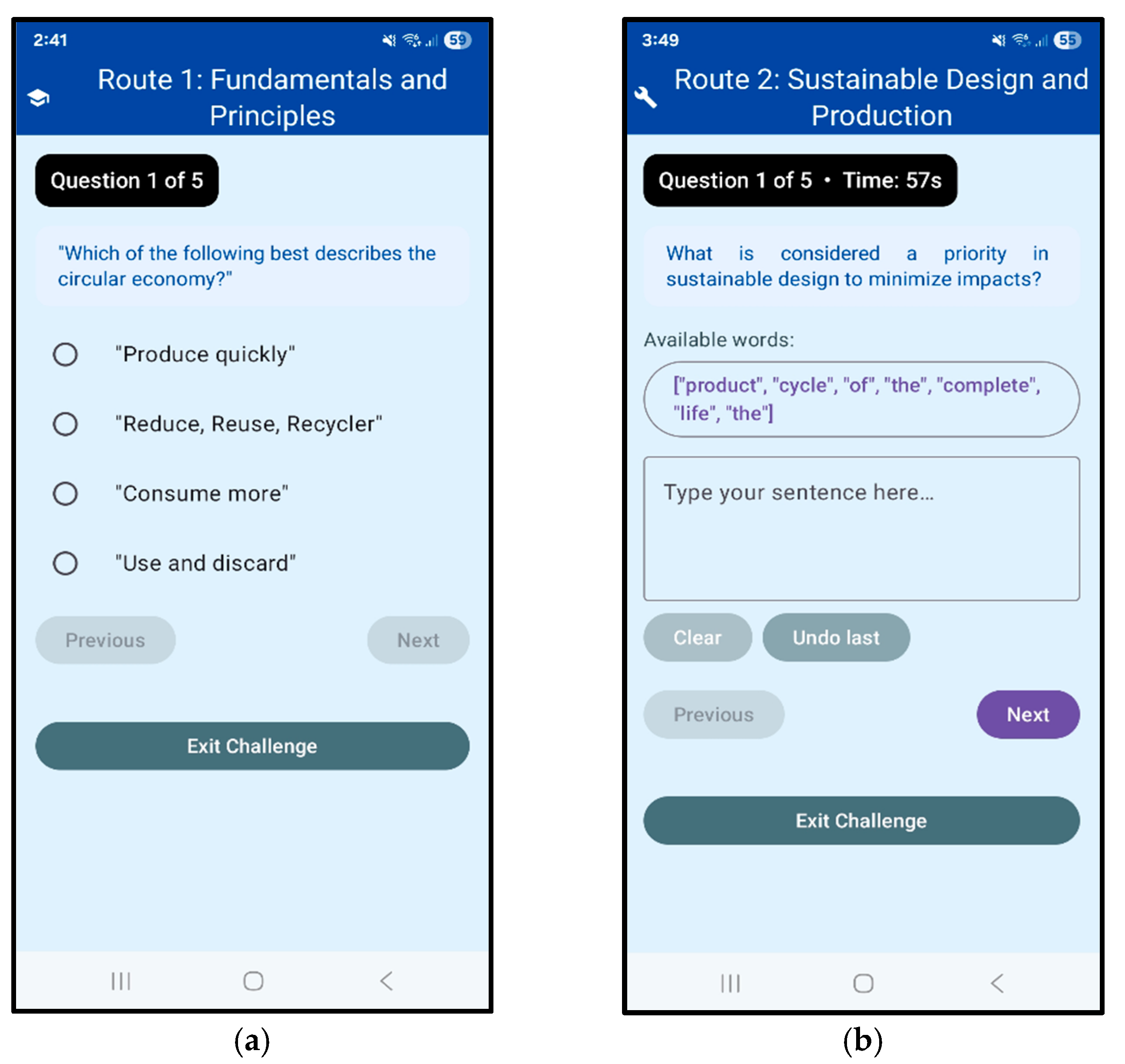
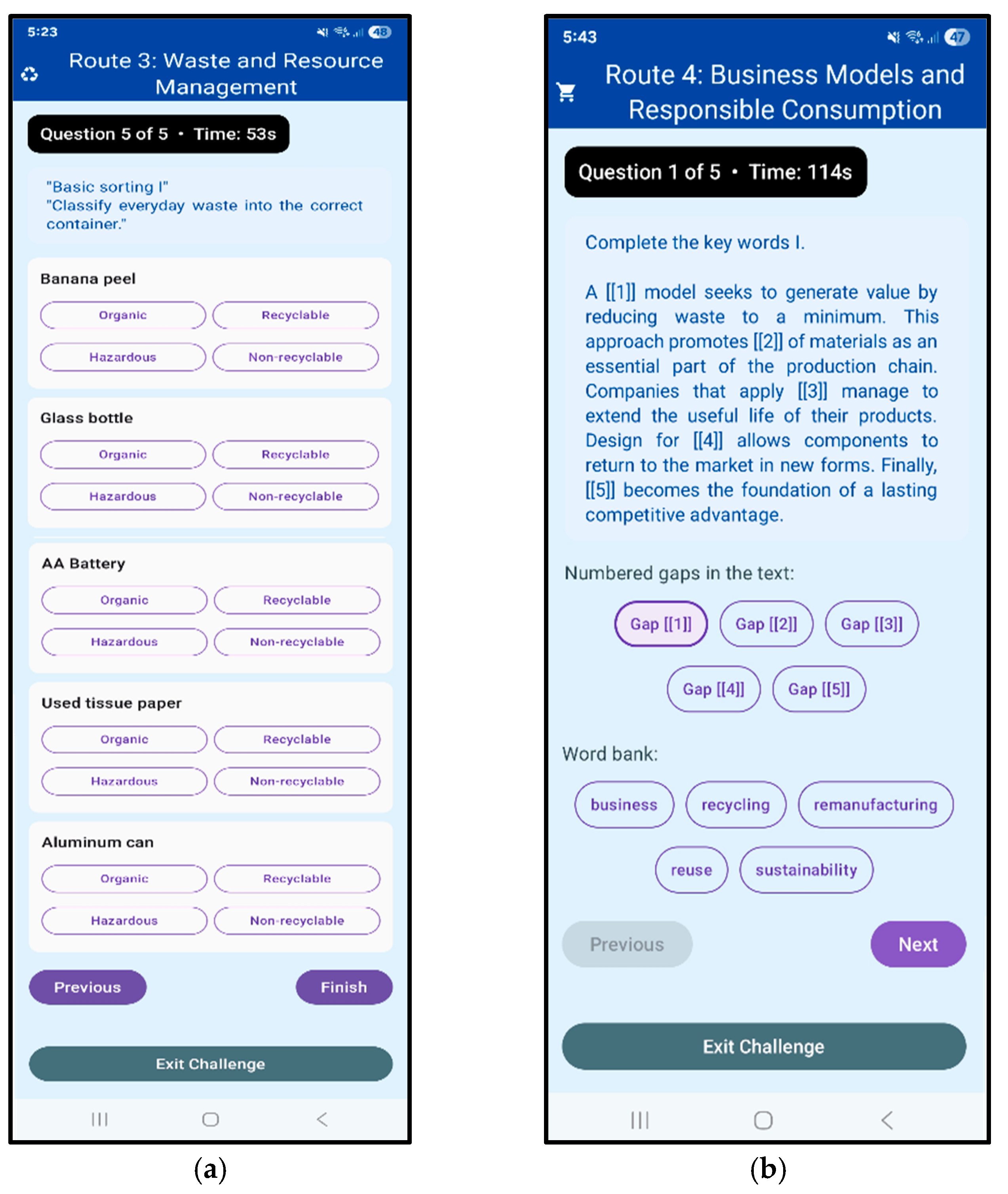
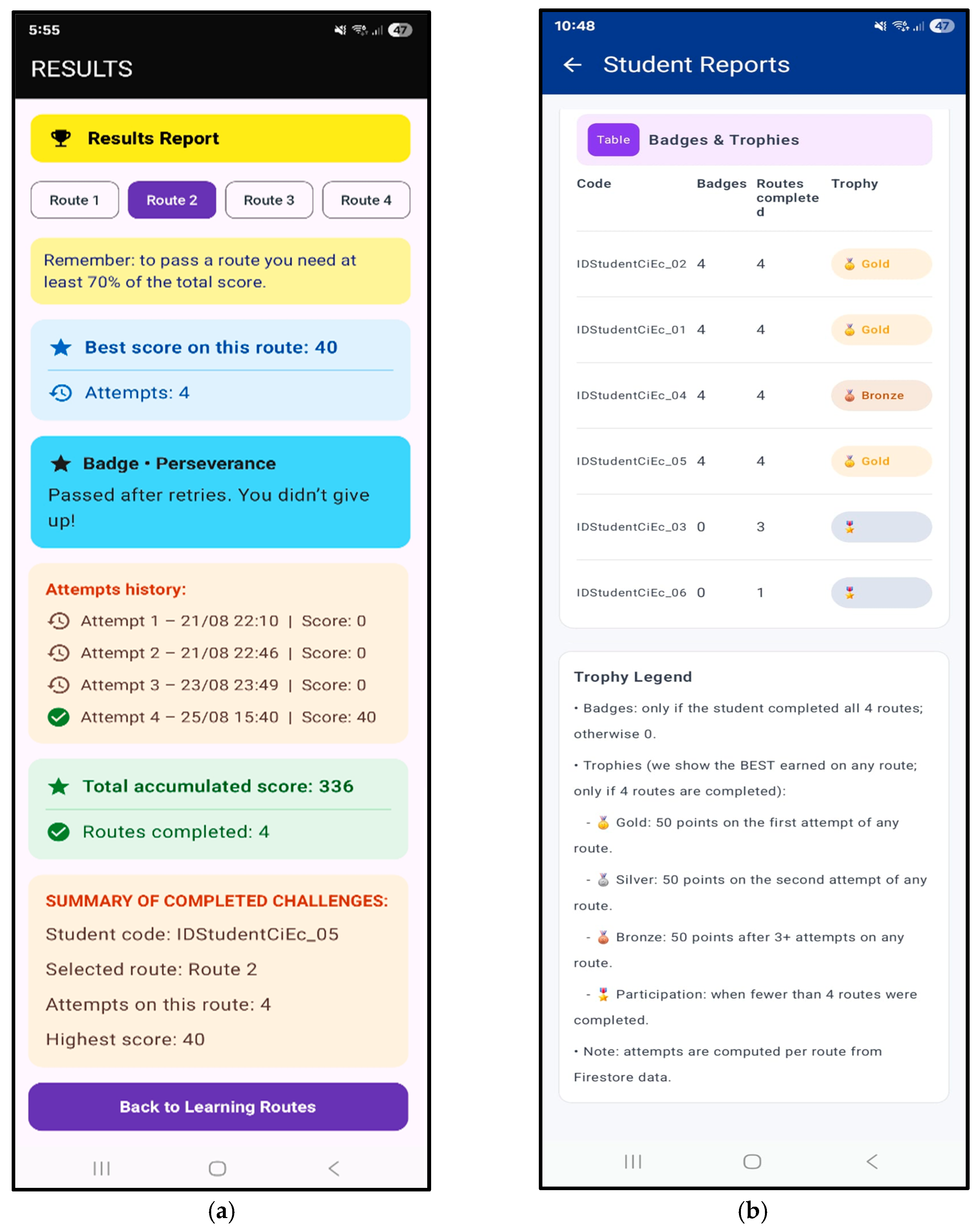
3.1. Description of the Gamified Mobile Application LearningCiEc
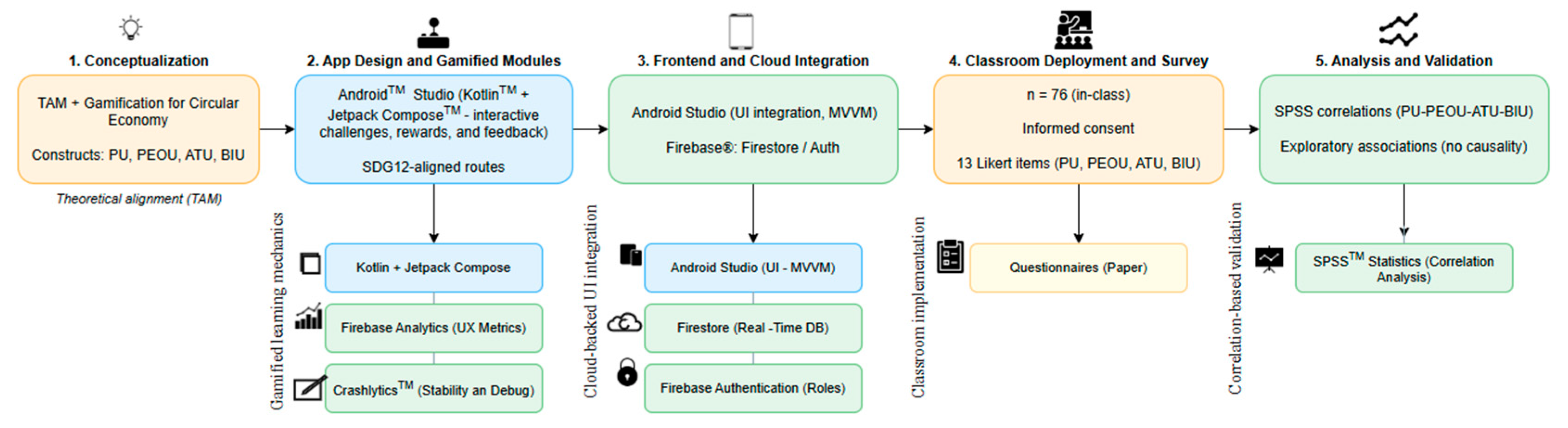
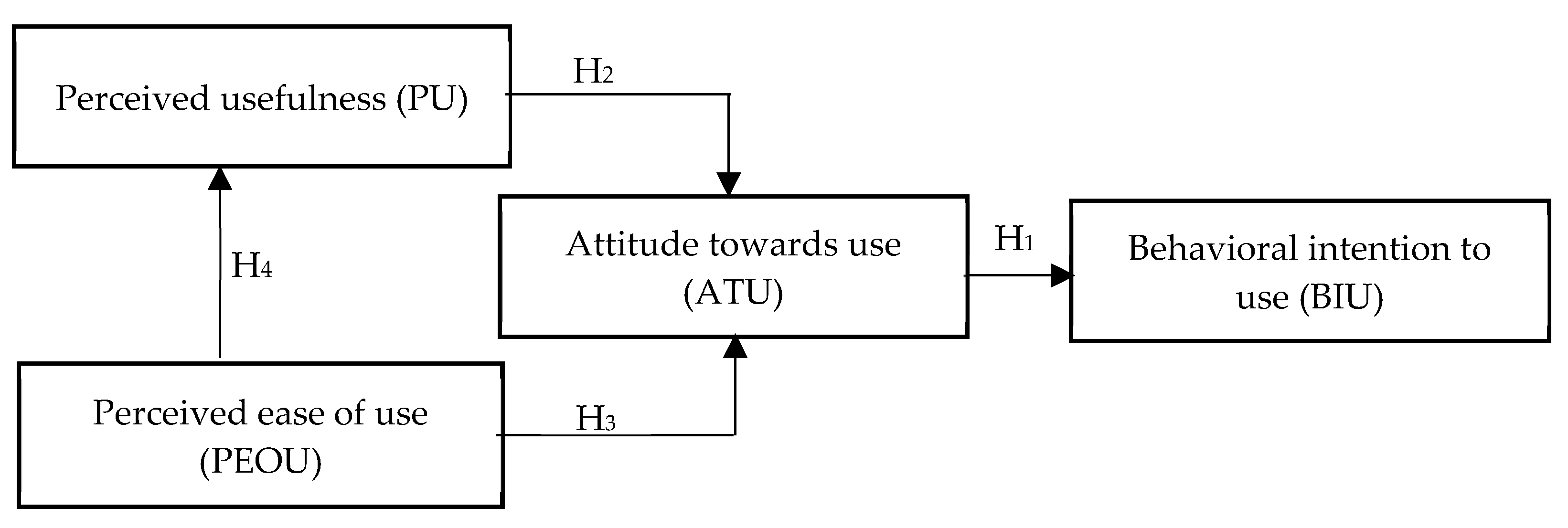
3.2. Method
4. Results
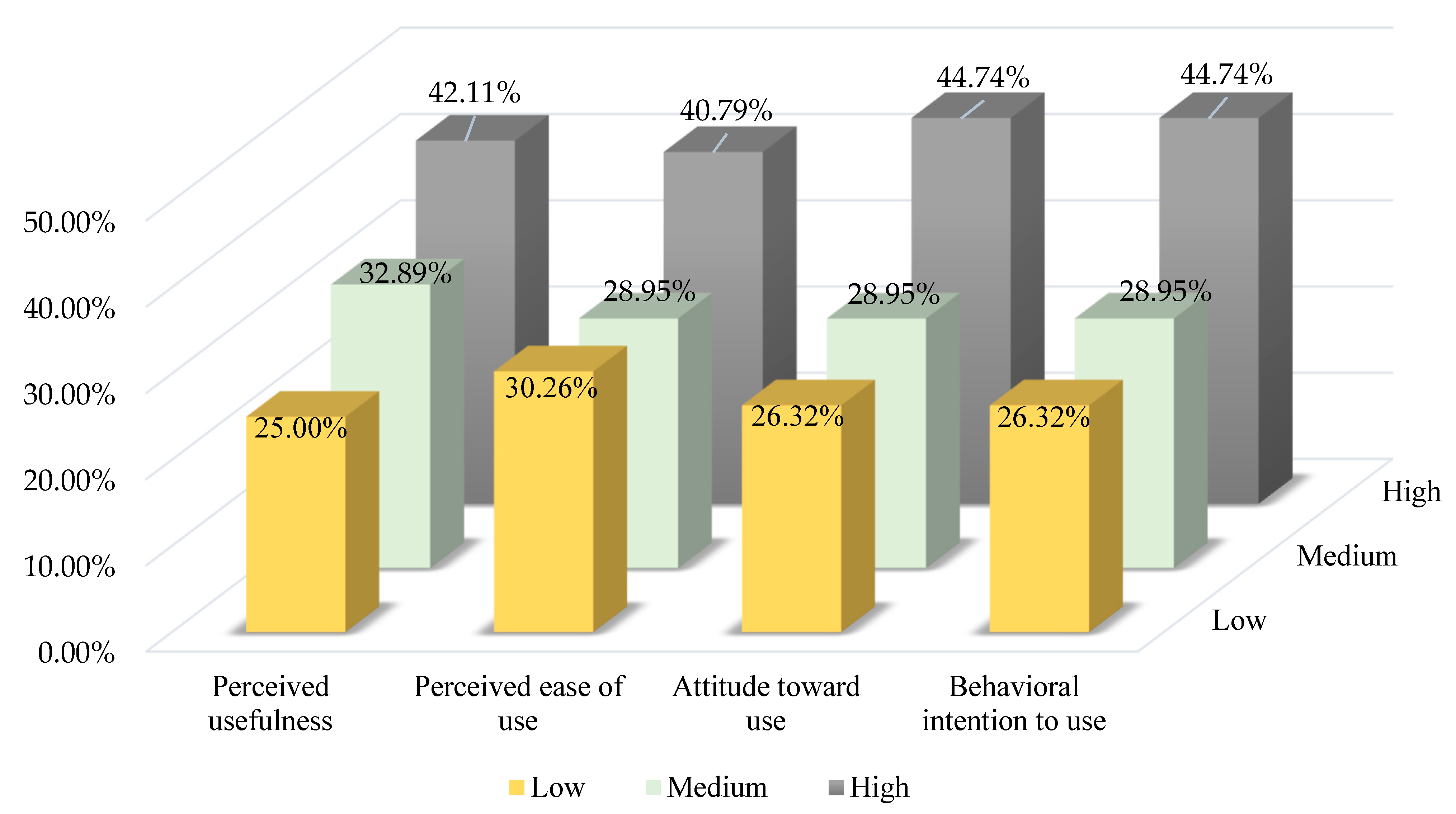
4.1. Results for Acceptance of Use of the Gamified Mobile Application
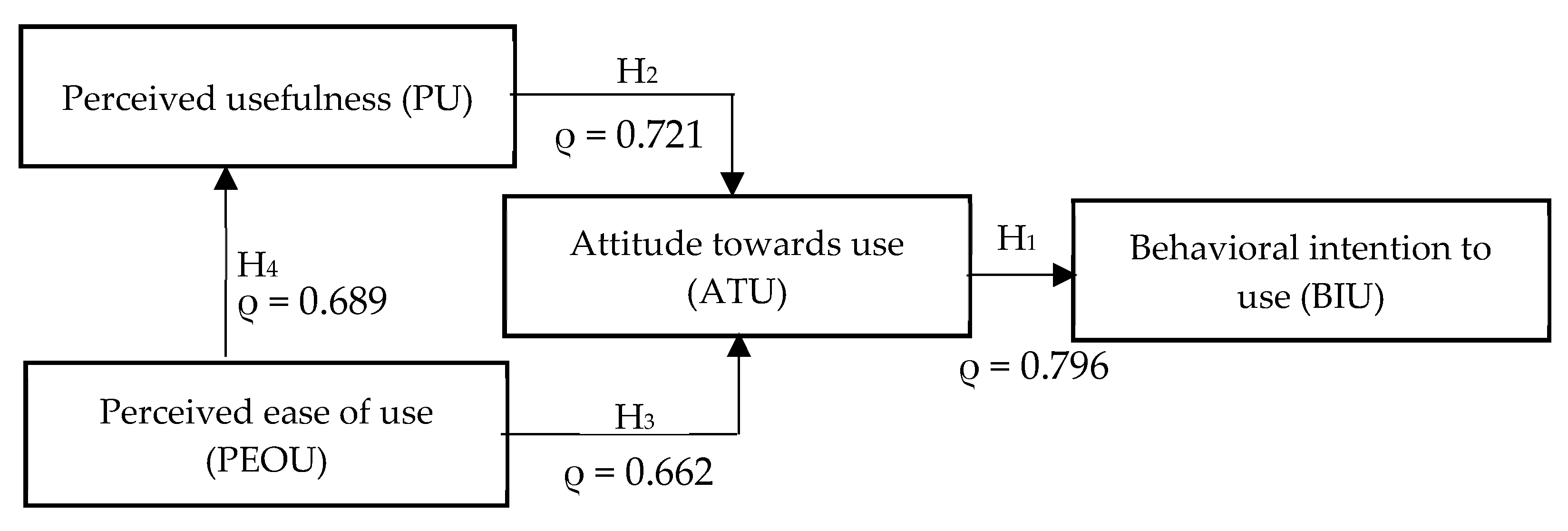
4.2. Results of the Correlational Analysis
5. Discussion
5.1. Gamification and Motivation
5.2. TAM and Technological Adoption
6. Conclusions
7. Limitations of the Study
Supplementary Materials
Author Contributions
Funding
Institutional Review Board Statement
Informed Consent Statement
Data Availability Statement
Acknowledgments
Conflicts of Interest
Abbreviations
| AI | Artificial Intelligence |
| AR | Augmented Reality |
| ATU | Attitude Toward Use |
| BIU | Behavioral Intention to Use |
| 3R | Reduce, Reuse, Recycle (Principles of Circular Economy) |
| DB | Database |
| IQR | Interquartile Range |
| MVVM | Model-View-ViewModel (software architecture pattern) |
| PEOU | Perceived Ease of Use |
| PLS-SEM | Partial Least Squares Structural Equation Modeling |
| PU | Perceived Usefulness |
| SD | Standard Deviation |
| SDG | Sustainable Development Goal |
| SDG 4 | Sustainable Development Goal 4: Quality Education |
| SDG 12 | Sustainable Development Goal 12: Responsible consumption |
| SPSS | Statistical Package for the Social Sciences |
| TAM | Technology Acceptance Model |
| UI | User Interface |
| UX | User Experience |
References
- Medina, G.I.; Vinueza, B.A.; Castro, A.D.; Polanco, Q.B. Digital transformation in Ecuadorian education: Impact of educational technology on teaching and learning. Rev. Soc. Front. 2025, 5, e565. [Google Scholar] [CrossRef]
- Almache, D.V.J.; Jiménez, A.A.M.; Calderón, G.D.E.; Vásquez, R.S.F. Digital transformation in higher education learning processes. Mag. Cienc. Investig. Innov. 2024, 9, 52–73. [Google Scholar] [CrossRef]
- Guarnizo, C.J.E.; Andrade, S.T.C.; Sánchez, C.V.A.; Quichimbo, A.A.C.; Bravo, V.S.J. Digital transformation in rural Ecuadorian education: Obstacles and opportunities. Cienc. Lat. Rev. Cienc. Multidiscip. 2025, 9, 11640–11651. [Google Scholar] [CrossRef]
- Santana, G.L.A.; Deler, F.G. The digital transformation in the Cuban socioeducational context. Ref. Pedagog. 2023, 11, 59–74. [Google Scholar]
- Mejía, D.Y.Y.; Mejía, D.O.A. Digital transformation in higher education institutions in the wake of COVID-19: Technological maturity of students in Colombia. Rev. Univ. Empres. 2021, 23, 71–106. [Google Scholar] [CrossRef]
- Vargas, Z.M.; Guerrero, C.Y.; Medina, M.E.; Salinas, R.M. The implementation of technology for the teaching Learning process. Rev. Tecnol. Educ. Docentes 2.0 2024, 17, 286–295. [Google Scholar] [CrossRef]
- Aguilar-Muñoz, J.A.; Gaibor-Bifarini, J.M.; Vizcaino-Pusda, V.D.; Muyolema, G.V.A. The digital transformation in higher education and its impact on teaching and learning. Space Sci. 2023, 1, 15–28. [Google Scholar] [CrossRef]
- Moral, P.E.; Barreda, T.R.; Gallego, V.L.; Pedrosa, O.C.; Martínez, A.C. Active learning and ICT in the teaching of economics at university. Rev. Estud. Empres. Segunda Época 2024, 1, 39–53. [Google Scholar] [CrossRef]
- Zambrano-Noboa, H.A.; Pinargote-Delgado, I.M.; Cedeño-Pinargote, L.M.; Guillen-García, J.F. Analysis of the digital economy and its contribution to higher education: Integration, challenges, and future prospects. Rev. Científica Multidiscip. Arbitr. Yachasun 2024, 8, 2–18. [Google Scholar]
- Barrios, B.B.; Lopes, M.I.; Delgado, F.T.; Noya, D.L.; Gerke, G. Capacity building in the circular economy in the teaching-learning process of industrial engineering. Rev. Cubana Adm. Pública Empres. 2023, 7, e256. [Google Scholar] [CrossRef]
- Mendoza, S. Influence of the circular economy on the transformation of environmental awareness among students at Cesar Vallejo University. Cienc. Lat. Rev. Cienc. Multidiscip. 2023, 7, 3781–3793. [Google Scholar] [CrossRef]
- Pino, C.; Jacome, O.; Vásquez, M.; Pena, R. Circular economy model for technical and technological institutes. Univ. Cienc. Tecnol. 2024, 28, 121–132. [Google Scholar] [CrossRef]
- Loayza, M.E.F. Mobile learning (m-learning) at university during COVID-19: A training tool in higher education. Educare Comunicare Rev. Investig. Fac. Humanid. 2022, 10, 5–12. [Google Scholar] [CrossRef]
- Boude, O.R. Design of mobile learning strategies in higher education through a professor training process. Form. Univ. 2021, 14, 181–188. [Google Scholar] [CrossRef]
- Gómez, M.P.; Jiménez, G.M.; González, R.E. Educational application to promote mobile learning. RIDE Ibero-Am. J. Educ. Res. Dev. 2024, 14, e630. [Google Scholar] [CrossRef]
- Santos-Vélez, K.A.; Franco-Menéndez, J.A.; Márquez-Bravo, Y.J. Sustainability of the circular economy for knowledge transfer in Latin America from a public management perspective. Rev. Cienc. INGENIAR 2024, 7, 2–9. [Google Scholar]
- Torres-Taborda, S.; Casillas-Martín, S.; Cabezas-González, M. Innovation in training style to transform realities in higher education. Rev. Estilos Aprendiz. 2024, 17, 30–51. [Google Scholar] [CrossRef]
- Marcillo, F. Using mobile applications to raise awareness about e-waste recycling among higher education students in Ecuador. Rev. Cienc. Kosmos 2024, 3, 49–66. [Google Scholar] [CrossRef]
- Guendulain, T.; Guendulain, G.; Ibarra, N.I.; Baldarotta, S.; Bonafé, F. BioTEC: Generating technologies with an impact on the circular economy. Bitácora Dig. 2022, 9, 45–51. [Google Scholar]
- Silva, A.J.A.; Manzano, D.O.; Gonzalez, C.Y. Theoretical analysis of materials life cycle optimization using artificial Intelligence and big data technologies: Reuse strategies in the circular. Rev. Cienc. Profund. Constr. Futuro 2024, 21, 123–138. [Google Scholar] [CrossRef]
- Mendoza-Rangel, J.M.; Díaz-Aguilera, J.H. Circular economy in the Latin American cement and concrete industry: A sustainable solution in design, durability, materials, and processes. Rev. ALCONPAT 2023, 13, 328–348. [Google Scholar] [CrossRef]
- Pegalajar, P.M.C. Implications of gamification in higher education: A systematic review of student perceptions. Rev. Investig. Educ. 2021, 39, 169–188. [Google Scholar] [CrossRef]
- Nivela-Cornejo, M.A.; Otero-Agreda, O.E.; Morales-Caguana, E.F. Gamification in higher education. Rev. Publicando 2021, 8, 165–176. [Google Scholar] [CrossRef]
- Díaz-García, A.K.; González-Herrera, S.L.; Santiago-Roque, I.; Hernández-Lozano, M.; Soto-Ojeda, G.A. Gamification through the use of the Genially application to innovate learning processes in higher education. Rev. Eduscientia Divulg. Cienc. Educ. 2022, 5, 129–139. [Google Scholar]
- Ojeda-Lara, O.; Zaldívar-Acosta, M. Gamification as an innovative methodology for higher education students. Rev. Tecnol. Educ. Docentes 2.0 2023, 16, 5–11. [Google Scholar] [CrossRef]
- Olivo, G.E.; Moreno, B.R.; Mondragón, H.R. Gamification and ubiquitous learning in higher education: Applying learning styles. Apertura 2023, 15, 20–35. [Google Scholar] [CrossRef]
- Carrión, C.E.; Sotomayor, N.S.; Medel, M.I. The use of video games and gamification as innovative teaching materials for learning social sciences in higher education. Edmetic Rev. Educ. Mediat. TIC 2022, 11, 6. [Google Scholar] [CrossRef]
- Medel-San, E.Y.L.; Moreno, B.R.; Aguirre, C.E. Implementation of gamification in virtual teaching-learning environments for higher education. RIDE. Rev. Iberoam. Para Investig. Desarro. Educ. 2023, 14, e527. [Google Scholar] [CrossRef]
- Lazarte, I.M.; Gómez, S.G. Application of the Quizizz tool as a gamification strategy in higher education. In Proceedings of the XXIII Workshop of Computer Science Researchers, RedUNCI, Chilecito, Argentina, 15–16 April 2021; pp. 313–317. Available online: https://riaa-tecno.unca.edu.ar/handle/123456789/967 (accessed on 20 September 2025).
- Poveda, D.F.; Limas-Suárez, S.J.; Cifuentes, J.E. Gamification as a learning strategy in higher education. Educ. Educadores 2023, 26, e2612. [Google Scholar] [CrossRef]
- León-Garrido, A.; Gutiérrez-Castillo, J.J.; Barroso-Osuna, J.M.; Cabero-Almenara, J. Evaluating the use and acceptance of mobile apps in higher education using the TAM model. RIED-Rev. Iberoam. Educ. A Distancia 2025, 28, 107–126. [Google Scholar] [CrossRef]
- Clucas, J.S. Promoting Current App Usage Through the Adoption of a Gamified Loyalty Program; A Quantitative Study Based on the Technology Acceptance Model (TAM). Master’s Thesis, University of Zaragoza, Zaragoza, Spain, 2023. Available online: https://zaguan.unizar.es/record/128570 (accessed on 20 September 2025).
- Calle-Díaz, D.M.; Porras-Cruz, F.L.; Santamaría-Freire, E.J. Modelo de aceptación tecnológica y la difusión de contenidos en estudiantes universitarios. MQRInvestigar 2024, 8, 5685–5705. [Google Scholar] [CrossRef]
- Campoverde-Calle, M.S.; Sañay-Sañay, S.I.; Cabrera-Duffaut, A.E. Development of an app validation methodology based on the Technology Acceptance Model: Case study BodyUC. MQRInvestigar 2024, 8, 3742–3770. [Google Scholar] [CrossRef]
- Usuga-Escobar, J.F.; Palacio-Baena, L.G.; Barrios, D. Technological acceptance of a mobile application for dairy business management. Rev. CEA 2022, 8, e2007. [Google Scholar] [CrossRef]
- Valencia-Arias, A.; Gómez-Molina, S.; Vélez-Holguín, R.M.; Cardona-Acevedo, S. Disposition to use mobile learning (m-learning) in virtual programs: A hybrid technology acceptance model (TAM) and the theory of planned behavior (TPB). Form. Univ. 2023, 16, 25–34. [Google Scholar] [CrossRef]
- Terminel, Z.C.; Mendoza, L.J.; García, O.J. Application of a technology acceptance model on the use of the digital driver’s license through a mobile application among adults in the state of Sonora, Mexico. Rev. Sinergia 2023, 1, 7–16. [Google Scholar]
- Abundis, E.V.M.; Hinojosa, L.J.I. Evaluating the Microsoft Teams application using the Technology Acceptance Model (TAM). Rev. Acad. Investig. 2023, 14, 86–99. [Google Scholar]
- Schöggl, J.-P.; Stumpf, L.; Baumgartner, R.J. The narrative of sustainability and circular economy—A longitudinal review of two decades of research. Resour. Conserv. Recycl. 2020, 163, 105073. [Google Scholar] [CrossRef]
- Matarneh, S.; Pipriani, A.Z.; Ellahi, R.M.; Nguyen, D.N.; Le, T.M.; Nazir, S. Industry 4.0 technologies and circular economy synergies: Enhancing corporate sustainability through sustainable supply chain integration and flexibility. Environ. Technol. Innov. 2024, 35, 103723. [Google Scholar] [CrossRef]
- Anderluh, A.; Raffler, C.; Hackl, R.; Mesbahi, Z.; Pellegrin, T. Consumers’ affinity to the circular economy: Empirical evidence utilizing the circular economy cube. J. Clean. Prod. 2025, 525, 146539. [Google Scholar] [CrossRef]
- Lombani, I.; Fraccascia, L.; Giannoccaro, I. Economic complexity tools to analyze circular economy capabilities in global economy. Resour. Conserv. Recycl. Adv. 2025, 28, 200286. [Google Scholar] [CrossRef]
- Ibach, M.; Tatum, K.; Knieling, J. Crafting open innovation for collaboration: Insights into multi-actor dynamics for the circular economy transformation. J. Innov. Knowl. 2025, 10, 100799. [Google Scholar] [CrossRef]
- Rosário, A.T.; Lopes, P.; Rosário, F.S. Sustainability and the circular economy business development. Sustainability 2024, 16, 6092. [Google Scholar] [CrossRef]
- Hosseini, C.; Humulung, O.; Fagerstrom, A.; Haddara, M. An experimental study on the effects of gamification on task performance. Procedia Comput. Sci. 2022, 196, 999–1006. [Google Scholar] [CrossRef]
- Legaki, N.-Z.; Xi, N.; Hamari, J.; Karpouzisa, K.; Assimakopoulosa, V. The effect of challenge-based gamification on learning: An experiment in the context of statistics education. Int. J. Hum.-Comput. Stud. 2020, 144, 102496. [Google Scholar] [CrossRef]
- Dzandu, M.D.; Hanu, C.; Amegbe, H. Gamification of mobile money payment for generating customer value in emerging economies: The social impact theory perspective. Technol. Forecast. Soc. Change 2022, 185, 122049. [Google Scholar] [CrossRef]
- Wang, Y.-F.; Hsu, Y.-F.; Fang, K. The key elements of gamification in corporate training—The Delphi method. Entertain. Comput. 2022, 40, 100463. [Google Scholar] [CrossRef]
- Vittia, M.; Trevisana, A.H.; Ocampo, H.R.; Cuentas, V.K.; Sarbazvatan, S.; Terzi, S.; Sassanelli, C. A competency map for circular economy education. Procedia Comput. Sci. 2025, 253, 336–345. [Google Scholar] [CrossRef]
- Rejeb, H.B.; Muxika, E.; Ghadimi, P. Summer school on circular economy for sustainable manufacturing: A case study and lessons learned. Procedia CIRP 2024, 122, 952–957. [Google Scholar] [CrossRef]
- Alhashmi, S.M.; Al-Qudah, I.; Hashem, I.A.; Alsinglawi, B.; Borreo, R.; Migdadi, H.S.; Chen, W. Connecting the Dots: IoT, sustainability, and SDGs. Sustain. Futures 2025, 10, 101170. [Google Scholar] [CrossRef]
- Liu, L.; Li, K.; Yue, L.; Arshad, M.Z. Burnout and leadership in special education: A sustainable approach through the Lens of SDG 3 and SDG 4. Acta Psychol. 2025, 259, 105421. [Google Scholar] [CrossRef]
- Rahman, M.; Hossain, E. Green technology, policy and sustainable finance nexus with SDG-12: Moderating effects of stakeholder awareness. Sustain. Futures 2024, 8, 100405. [Google Scholar] [CrossRef]
- McCowan, T. The crosscutting impact of higher education on the sustainable development goals. Int. J. Educ. Dev. 2023, 103, 102945. [Google Scholar] [CrossRef]
- Khajuria, A.; Verma, P.; Vella, A.; Zanini-Freitag, D.; Xin, H.; Murthy, I.K.; Arora, J.K.; Sylva, K.; Menon, L.; Pardeshi, S.; et al. The SDG accelerator: Circular economy solutions through efficient sustainable consumption. Cir. Econ. 2025, 4, 100140. [Google Scholar] [CrossRef]
- Greenland, S.J.; Saleem, M.; Misra, R.; Nguyen, N.; Mason, J. Reducing SDG complexity and informing environmental management education via an empirical six-dimensional model of sustainable development. J. Environ. Manag. 2023, 344, 118328. [Google Scholar] [CrossRef] [PubMed]
- Bashir, H.; Araci, Z.C.; Obaideen, K.; Alsyouf, I. An approach for analyzing and visualizing the relationships among key performance indicators for creating sustainable campuses in higher education institutions. Environ. Sustain. Indic. 2023, 19, 100267. [Google Scholar] [CrossRef]
- Mashroof, M.M.; Haleem, A.; Nawaz, H.; Saldeen, M.A. E-learning adoption for sustainable higher education. Heliyon 2023, 9, e17505. [Google Scholar] [CrossRef]
- Andujar, A.; Salaberri-Ramiro, M.S.; Martínez, M.S.C. Integrating Flipped Foreign Language Learning through Mobile Devices: Technology Acceptance and Flipped Learning Experience. Sustainability 2020, 12, 1110. [Google Scholar] [CrossRef]
- Lo, J.-H.; Lai, Y.-F.; Hsu, T.-L. The Study of AR-Based Learning for Natural Science Inquiry Activities in Taiwan’s Elementary School from the Perspective of Sustainable Development. Sustainability 2021, 13, 6283. [Google Scholar] [CrossRef]
- Lau, F.; Kuziemsky, C. Chapter 2: Benefits Evaluation Framework. In Handbook of eHealth Evaluation: An Evidence-Based Approach; University of Victoria: Victoria, BC, Canada, 2017; pp. 23–54. Available online: https://www.ncbi.nlm.nih.gov/books/NBK481590/ (accessed on 20 September 2025).
- Spector, P.E. Do Not Cross Me: Optimizing the Use of Cross-Sectional Designs. J. Bus. Psychol. 2019, 34, 125–137. [Google Scholar] [CrossRef]
- Al-Adwan, A.S.; Li, N.; Al-Adwan, A.; Abbasi, G.A.; Albelbisi, N.A.; Habibi, A. Extending the Technology Acceptance Model (TAM) to Predict University Students’ Intentions to Use Metaverse-Based Learning Platforms. Educ. Inf. Technol. 2023, 28, 15381–15413. [Google Scholar] [CrossRef] [PubMed]
- Hoi, V.N. Understanding higher education learners’ acceptance and use of mobile devices for language learning: A Rasch-based path modeling approach. Comput. Educ. 2020, 146, 103761. [Google Scholar] [CrossRef]
- Valencia-Arias, A.; Cardona-Acevedo, S.; Gómez-Molina, S.; Vélez, H.R.; Valencia, J. Adoption of mobile learning in the university context: Systematic literature review. PLoS ONE 2024, 19, e0304116. [Google Scholar] [CrossRef]
- Queiro-Ameijeiras, C.M.; Seguí-Mas, E.; Martí-Parreño, J. Determinants of gamification acceptance in higher education: An empirical model. RIED-Rev. Iberoam. Educ. A Distancia 2025, 28, 127–155. [Google Scholar] [CrossRef]
- Wendy, J.; Grainne, O.; Nikki, S. Improving retention while enhancing student engagement and learning outcomes using gamified mobile technology. Account. Educ. 2025, 34, 366–386. [Google Scholar] [CrossRef]
- Vankúš, P. Game-Based learning and gamification technologies in the preparation of future mathematics teachers. Int. J. Interact. Mob. Technol. 2023, 17, 53–67. [Google Scholar] [CrossRef]
- Cudok, A.; Lawrenz, S.; Rausch, A.; Vietor, T. Circular economy driven communities-Sustainable behavior driven by mobile applications. Procedia CIRP 2022, 105, 362–367. [Google Scholar] [CrossRef]
- Venturi, S.; Zulauf, K.; Cuel, R.; Wagner, R. Trash to treasure: Gamification and informed recycling behavior. Resour. Conserv. Recycl. 2025, 215, 108108. [Google Scholar] [CrossRef]
- Zeng, J.; Sun, D.; Looi, C.-K.; Wai, F.A.C. Exploring the impact of gamification on students’ academic performance: A comprehensive meta- analysis of studies from the year 2008 to 2023. Br. J. Educ. Technol. 2024, 55, 2478–2502. [Google Scholar] [CrossRef]
- Khaldi, A.; Bouzidi, R.; Nader, F. Gamification of e-learning in higher education: A systematic literature review. Smart Learn. Environ. 2023, 10, 10. [Google Scholar] [CrossRef] [PubMed]
- Van, D.B.L. Re-thinking invigilation implementation: A mixed method approach to student perceptions and system usability for digital assessment adoption. Int. J. Educ. Integr. 2025, 21, 10. [Google Scholar] [CrossRef]
- Shishakly, R.; Almaiah, M.A.; Al-Otaibi, S.; Lutfi, A.; Alrawad, M.; Almulhem, A. A new technological model on investigating the utilization of Mobile Learning Applications: Extending the TAM. Multimodal Technol. Interact. 2023, 7, 92. [Google Scholar] [CrossRef]
- Qazi, A.; Hasan, N.; Owusu-Ansah, C.M.; Hardaker, G.; Dey, S.K.; Haruna, K. SentiTAM: Sentiments centered integrated framework for mobile learning adaptability in higher education. Heliyon 2022, 9, e12705. [Google Scholar] [CrossRef]
- Toșa, C.; Paneru, C.P.; Joudavi, A.; Tarigan, A.K.M. Digital transformation, incentives, and pro-environmental behavior: Assessing the uptake of sustainability in companies’ transition towards circular economy. Sustain. Prod. Consum. 2024, 47, 632–643. [Google Scholar] [CrossRef]
- Tundjungsari, V.; Putranto, B.P.D.; Ulum, M.B.; Anwar, N. An integrated model for circular waste management using the internet of things, semantic web, and gamification (Circonomy): Case study in Indonesia. JMIR Serious Games 2025, 13, e66781. [Google Scholar] [CrossRef] [PubMed]
- Teixeira, J.; Carvalho, B.; Pereira, S.; Sousa, C.; Véreb, V.; Gouveia, A.J. AppCycle—Reducing electronic and textile wastes. Procedia Comput. Sci. 2024, 239, 2126–2134. [Google Scholar] [CrossRef]
- Akhtar, M.A.; Sarea, A.; Khan, I.; Khan, K.A.; Singh, M.P. The moderating role of gamification toward intentions to use mobile payments applications in Bahrain: An integrated approach. PSU Res. Rev. 2025, 8, 706–726. [Google Scholar] [CrossRef]



| RQ | Focus of Action | Objective |
|---|---|---|
| RQ1: What is the level of acceptance of the gamified mobile application for learning about the circular economy? | Student acceptance of the gamified mobile application. | To identify the level of student acceptance of the use of the gamified mobile application for learning about the circular economy. |
| RQ2: To what extent are the relationships proposed in the TAM that explain the acceptance of the gamified mobile application fulfilled? | Statistical validation of the relationships between the constructs of the TAM. | Statistically validate the relationships between the constructs of the TAM regarding the gamified mobile application. |
| Item | Indicators | Cronbach’s Alpha If the Item Had Been Deleted |
|---|---|---|
| PU1 | The gamified mobile app helps me better understand the fundamentals of the circular economy. | 0.977 |
| PU2 | The app adds value to my learning in this course. | 0.977 |
| PU3 | With the app you can achieve the learning objectives of the subject. | 0.978 |
| PU4 | The mobile app allows me to apply circular economy concepts to real-life situations. | 0.977 |
| PEOU1 | Learning to use the app was easy for me. | 0.978 |
| PEOU2 | Interaction with gamified activities is clear and intuitive. | 0.978 |
| PEOU3 | It was easy to find functions and progress through activities. | 0.978 |
| ATU1 | My attitude towards using this application is positive. | 0.977 |
| ATU2 | I enjoyed using this app during class sessions. | 0.977 |
| ATU3 | I consider it appropriate to use this application to learn about the circular economy. | 0.977 |
| BIU1 | I would like to continue using this mobile app in this and other subjects. | 0.978 |
| BIU2 | I would recommend this app to my colleagues. | 0.977 |
| BIU3 | I prefer activities with this application over traditional methodologies. | 0.977 |
| PU | PEOU | ATU | BIU | |||
|---|---|---|---|---|---|---|
| Spearman’s Rho | PU | Correlation coefficient | 1.000 | 0.689 ** | 0.721 ** | 0.674 ** |
| Sig. (bilateral) | - | 0.000 | 0.000 | 0.000 | ||
| N | 76 | 76 | 76 | 76 | ||
| PEOU | Correlation coefficient | 0.689 ** | 1.000 | 0.662 ** | 0.627 ** | |
| Sig. (bilateral) | 0.000 | - | 0.000 | 0.000 | ||
| N | 76 | 76 | 76 | 76 | ||
| ATU | Correlation coefficient | 0.721 ** | 0.662 ** | 1.000 | 0.796 ** | |
| Sig. (bilateral) | 0.000 | 0.000 | - | 0.000 | ||
| N | 76 | 76 | 76 | 76 | ||
| BIU | Correlation coefficient | 0.674 ** | 0.627 ** | 0.796 ** | 1.000 | |
| Sig. (bilateral) | 0.000 | 0.000 | 0.000 | - | ||
| N | 76 | 76 | 76 | 76 | ||
Disclaimer/Publisher’s Note: The statements, opinions and data contained in all publications are solely those of the individual author(s) and contributor(s) and not of MDPI and/or the editor(s). MDPI and/or the editor(s) disclaim responsibility for any injury to people or property resulting from any ideas, methods, instructions or products referred to in the content. |
© 2025 by the authors. Licensee MDPI, Basel, Switzerland. This article is an open access article distributed under the terms and conditions of the Creative Commons Attribution (CC BY) license (https://creativecommons.org/licenses/by/4.0/).
Share and Cite
Arévalo-Tuesta, J.A.; Morales-Romero, G.; Quispe-Andía, A.; Trinidad-Loli, N.; León-Velarde, C.; Arones, M.; Aybar-Bellido, I.; Chamorro-Atalaya, O. Acceptance of a Mobile Application for Circular Economy Learning Through Gamification: A Case Study of University Students in Peru. Sustainability 2025, 17, 9694. https://doi.org/10.3390/su17219694
Arévalo-Tuesta JA, Morales-Romero G, Quispe-Andía A, Trinidad-Loli N, León-Velarde C, Arones M, Aybar-Bellido I, Chamorro-Atalaya O. Acceptance of a Mobile Application for Circular Economy Learning Through Gamification: A Case Study of University Students in Peru. Sustainability. 2025; 17(21):9694. https://doi.org/10.3390/su17219694
Chicago/Turabian StyleArévalo-Tuesta, José Antonio, Guillermo Morales-Romero, Adrián Quispe-Andía, Nicéforo Trinidad-Loli, César León-Velarde, Maritza Arones, Irma Aybar-Bellido, and Omar Chamorro-Atalaya. 2025. "Acceptance of a Mobile Application for Circular Economy Learning Through Gamification: A Case Study of University Students in Peru" Sustainability 17, no. 21: 9694. https://doi.org/10.3390/su17219694
APA StyleArévalo-Tuesta, J. A., Morales-Romero, G., Quispe-Andía, A., Trinidad-Loli, N., León-Velarde, C., Arones, M., Aybar-Bellido, I., & Chamorro-Atalaya, O. (2025). Acceptance of a Mobile Application for Circular Economy Learning Through Gamification: A Case Study of University Students in Peru. Sustainability, 17(21), 9694. https://doi.org/10.3390/su17219694