1. Introduction
People-oriented urbanization in China needs to focus on promoting the high-quality citizenization of rural migrants, so as to promote the coordinated development of urban and rural areas. The promotion of social integration is one of the key actions in China’s urbanization, of which, residential integration of rural migrants is an important dimension. Under the guidance of the national policy of “living a livable life”, the urban living quality of rural migrants is one of the core issues to improve the high-quality citizenship for rural migrants and realize their residential integration [
1].
China’s rapid economic development has raised people’s expectations for a better life. In 2024, the total number of rural migrants in China has reached 29.973 million (an increase of 0.7% over 2023), as released in the Migrant Workers Monitoring Survey Report of 2024. However, as a result of institutional barriers, such a large group still faces systematic exclusion in housing security, thus impeding their social integration. Such institutional barriers not only reduce the transformation efficiency of the demographic dividend but also form social isolation in the process of New-type urbanization in China [
2].
Nowadays, the digital economy, as an emerging engine of growth [
3], is penetrating into various social domains and profoundly reshaping social structure. In China, the “Digital China” strategy leverages massive data resources and diverse application scenarios to foster deep integration between digital technologies and the real economy, thereby enhancing the strength and influence of the country’s digital economy [
4]. Driven by these developments, digital technologies have created new employment opportunities and significantly facilitated the occupational transformation of rural migrants [
5]. Existing research shows that the digital economy, especially digital inclusive finance, significantly bolsters migrants’ income levels [
6,
7] and supports their economic integration to some extent [
8]. Moreover, digital economic development has been shown to help narrow educational and healthcare disparities between migrants and urban residents [
9]. While prior research has explored the relationship between digital transformation—such as financial digitization—and labor mobility (e.g., [
10]) or urban settlement intentions (e.g., [
11]), less attention has been paid to how digitization influences living quality, a crucial dimension of residential integration. This study seeks to address this gap by examining the impact of urban digitization on the dwelling quality of rural migrants—a key manifestation of housing inequality.
This study aims to contribute to the existing literature in the following respects. First, building on previous works [
12,
13], rural migrants’ urban living quality is described using the Dwelling Quality Index, showing residential stratification and housing inequality among rural migrants. Second, this study explores how urban digitization may exert a nonlinear impact on rural migrants’ urban living quality. That is, this study analyzes the dynamic relationship between urban digital transformation and the living quality of rural migrants in host cities. This investigation enriches understanding of the nexus between urban digitization and migrant livability—a critical issue within contemporary China’s urbanization process. Third, this study investigates how the impact of urban digitization on migrants’ living quality varies across subgroups, particularly by educational attainment, migration scope and duration. These insights may inform the design of equitable digital policies and inclusive urbanization strategies in China and other developing contexts.
The remainder of this paper proceeds as follows.
Section 2 reviews the relevant literature and contextual background.
Section 3 develops the research hypotheses.
Section 4 describes the data sources and variable selection.
Section 5 presents the empirical results and discusses key findings.
Section 6 examines the underlying mechanisms, while
Section 7 explores heterogeneity across subgroups. Concluding remarks and policy implications are provided in
Section 8.
2. Literature Review and Research Background
2.1. Literature on Living Quality for Migrants
Living quality for migrants is a core issue in the process of urbanization, of which the research scope is extensive and in-depth, whether in China or in other parts of the world, especially emerging countries (e.g., [
14,
15,
16]). The existing literature firstly analyzed the factors affecting the migrants’ living quality from the perspective of economics, such as family income [
17] and immigration employment legality [
18]. Secondly, institutional factors, as another important consideration, have directly or indirectly shaped residents’ urban living quality, including government housing policies, urban planning and social security system [
19]. For example, government-led affordable housing projects [
20], land expropriation compensation measures and hometown land holdings were observed to exert influences on migrants’ urban living quality and affected migrants’ social integration [
13,
21]. China’s hygienic cities initiative can also significantly improve the living quality of residents by creating a livable urban environment and providing public services [
22]. On the other hand, scholars not only focus on determinants of living quality, but also explore how living quality (e.g., indoor and outdoor environment and safety) could affect subjective evaluation from migrants [
23]. Substandard living quality was found to lead to lower levels of mental health for residents, while a satisfactory community environment could buffer the negative impact of poor living quality on residents’ mental health [
24].
To sum up, despite influencing factors and mechanisms of living quality having been extensively studied from multiple perspectives in the existing literature, few studies have analyzed the influencing factors of living quality from a digitization perspective. Nowadays, digital transformation is producing profound changes in Chinese society. The application of digital technologies may significantly improve living quality by enhancing the efficiency of housing loan approvals, increasing accessibility of public services, and facilitating access to housing information—effects that have not yet been fully explored.
2.2. Urban Digitization in China
Digitization, a key engine for the global economy, is fundamentally altering how societies produce, consume, and live. It is simultaneously fueling the upgrade of traditional industries and the rapid rise of new business models [
25]. The multi-dimensional impacts brought by the digital economy have received widespread attention. As an important research variable, the digital economy could be constructed by differential dimensions, e.g., internet penetration rate [
26], employment situation, output situation [
27], mobile phone penetration rate, and digital financial inclusion [
28].
Firstly, deep integration of digitization with the financial sector has played an important role in reducing residents’ income inequality and promoting inclusive growth of society [
29]. From the macro-level perspective, digital finance was verified to accelerate economic growth by improving payment convenience, boosting household consumption, and making up for shortcomings of traditional financial instruments [
30]. For instance, digital financial inclusion (e.g., household-level services) has been shown to significantly increase income per capita among low-income households. Furthermore, digital financial inclusion can alleviate income inequality through channels such as technological innovation and infrastructure development [
31]. These benefits, however, are strongly influenced by broader institutional factors. The existing literature reveals that improving a country’s quality of regulation, technological advancement, and residents’ financial literacy significantly contributes to the development of its financial inclusion. This research finding is not only applicable to China but also can be used in emerging countries such as those along the Belt and Road Initiative [
32].
Policymakers should prioritize enhancing these drivers to advance sustainable development goals [
33]. From a micro-level perspective, improving the financial literacy of residents or households could encourage more people to participate in the formal financial system, thereby increasing their savings and boosting investment or consumption [
34], which in turn promotes economic growth [
35]. This conclusion also applies to other emerging countries. In emerging countries, increased digital access enhances financial inclusion by expanding the utilization of financial services [
36].
Second, digital technology is observed to have a profound impact on population migration and urban–rural integration in China. The more developed a city’s digital economy is, the more immigrants it attracts. It was investigated that the impact of digital inclusive finance on the urban settlement intentions of migrants has a nonlinear relationship between digital inclusion, financial development and the intentions of migrants. Furthermore, the digital economy was verified to promote the settlement intention of migrants by increasing their entrepreneurship and household income, especially for migrants with agricultural hukou [
37]. Plus, the vigorous development of the digital economy has improved the level of urban–rural coordinated development by narrowing the urban–rural income gap [
38].
Above all, urban digitization plays a pivotal role in China’s economic and social development, which could facilitate the upgrading of residents’ consumption structures, support innovation among small or medium-sized enterprises, and promote urban–rural integration. However, existing research has paid little attention to its impact on quality of life, particularly for migrants—another crucial aspect of high-quality urbanization in China.
3. Research Hypothesis
According to the push–pull theory, rural areas are usually faced with slow economic growth and insufficient public services, which has become the “pushing” force for rural–urban migrants to migrate to urban areas [
39]. On the other hand, higher incomes, attractive career development opportunities, and improved public service systems in urban areas represent key ‘pull’ factors. These effects are further amplified by advances in digital technology, particularly in enhancing information access, job matching, and public service availability (e.g., [
40]).
In the early stage of digitization, due to barriers to technology access, rural migrants (especially the low-skilled subgroup) may lack the necessary digital skills or equipment and thus are unable to fully enjoy the convenience brought by digitization. The complexity and technical barriers of digital information platforms may make it difficult for rural migrants with low financial literacy and insufficient digital skills to use these tools effectively [
41]. The group with low financial literacy and insufficient digital skills may face greater challenges due to information asymmetry and technical barriers [
42,
43]. According to the 2024 Survey Report on Financial Literacy of Chinese Residents, the average financial literacy score among Chinese residents is 68.7 out of 100. Scores are particularly low among the elderly, low-income individuals, and those with low educational attainment.
On the one hand, the “Digital Divide” may lead to the elimination of some low-skilled positions (such as automation replacing simple labor), thereby reducing employment opportunities or lowering wages for rural migrants. On the other hand, rural migrants with low financial literacy have to rely on traditional or non-digital information channels (such as intermediary agencies, acquaintance introductions, etc.) when making housing choices. Limited access to these information channels makes it difficult for rural migrants to find suitable housing, often forcing them into options with poor locations and inadequate facilities, thereby lowering their urban living quality. Furthermore, by attracting highly skilled, high-income talent, digitization may increase urban living costs (e.g., rent and housing prices), making it difficult for rural migrants to afford housing. All the above reasons may lead to a temporary decline in migrants’ urban living quality (“short-term pain”).
With the enhancement of financial digital inclusiveness, a narrowing of the “Digital Divide” may lead to a significant improvement in rural migrants’ urban living quality. Through the promotion of digital skills training programs and infrastructure construction by local governments, it could be easier for rural migrants to integrate themselves into the digital society [
44]. First, digital information platforms could offer them the possibility to compare housing prices, rents and living costs in different regions, enabling migrants to make housing decisions more effectively by digital tools [
45]. Secondly, digital technology could promote the intelligent upgrade of public services [
46]. For instance, online government services, smart medical appointments and community service, and the sharing of educational resources could improve the living comfort and safety of rural migrants [
47]. With a relatively high degree of financial digitization, rural migrants’ urban living quality can be comprehensively enhanced through the support of intelligent technologies and digital platforms. This not only improves their living environment but also strengthens their sense of belonging and satisfaction with urban life (“long-term gain”) [
48].
On this basis, this paper puts forward the following hypothesis:
H1. The degree of urban financial digitization has a positive U-shaped impact on the urban living quality of rural migrants. That is, as the degree of financial digitization increases, the impact on urban living quality of rural migrants first decreases and then increases.
4. Research Design
4.1. Data Collection
The data used in this paper are mainly collected from the following three databases:
- (1)
The Peking University Digital Financial Inclusion Index of China, released by the Institute of Digital Finance, Peking University, describes the degree of digital finance development in prefecture-level cities in China. It covers 31 provinces, 337 cities at the prefecture level, and 2800 counties. The dimension of “Digitization degree” in the China Digital Financial Inclusion Index, with high accuracy and authority, is constructed based on detailed data statistics and scientific methodology, which is widely applied in economic analysis (e.g., [
49]).
- (2)
The special survey data of “Living Conditions of Migrants and Influencing factors of Major diseases” derived from CMDS 2017, which is an annual survey of the floating population conducted by the National Health and Family Planning Commission of China. The total number of samples in the CMDS 2017 was 13,998, and the data covers eight cities of China: Guangzhou, Suzhou, Zhengzhou, Chongqing, Changsha, Qingdao, Urumqi and Xishuangbanna Dai Autonomous Prefecture in Yunnan. The spatial scope of the sample covers cities of different city levels, population sizes and development levels. According to the definition of rural migrants (migrants with agricultural household registration who have resided in the inflow areas for more than 6 months), the total sample size used in this paper is 9469 after data cleaning.
- (3)
City-level control variables (population size, relative structural proportion of secondary industry and tertiary industry, etc.) were obtained from the China Urban Statistical Yearbook in the corresponding year. Data on urban control variables added to the empirical model are lagged by one year to avoid possible endogeneity, which may be caused by bidirectional causality.
4.2. Variables
4.2.1. Explanatory Variable: Urban Financial Digitization
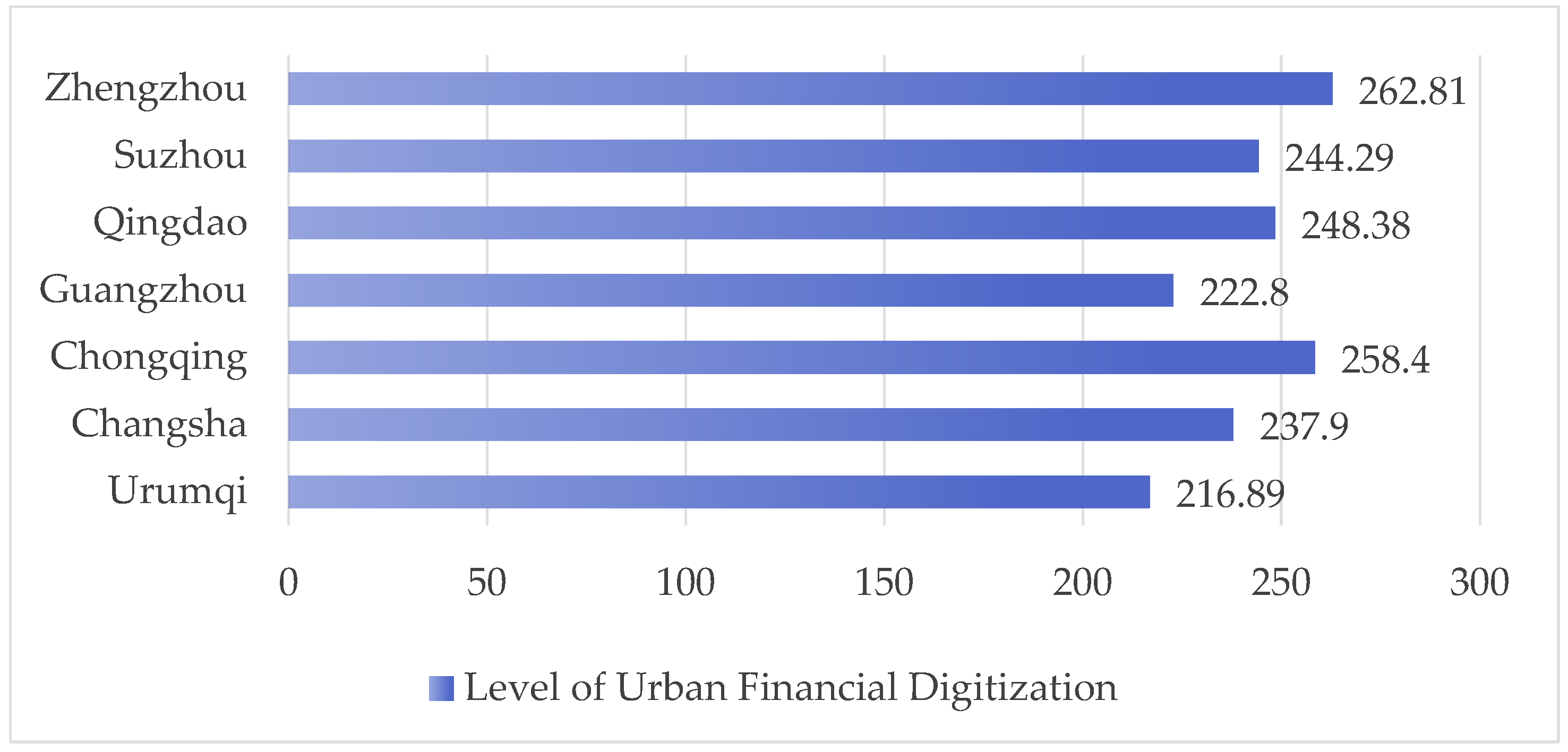
The core explanatory variable of this paper is the level of urban financial digitization for rural migrants’ inflows, which is described by the Peking University Digital Financial Inclusion Index of China as mentioned above. The digitization index measures the extent of digital technology adoption in regional financial services, including innovative service models such as mobile payment, online wealth management, and intelligent risk control. It is used to capture the impact of digital technology on urban living quality for rural migrants. These digital technologies and services have transformed not only how financial transactions are conducted but also residents’ daily lives and consumption habits. By enhancing convenience, digital technology improves residents’ daily efficiency. Furthermore, the intelligence and personalization of public services enable residents to access convenient community support, thereby enhancing their quality of life. As shown in
Figure 1, there are significant differences in degrees of financial digitization across cities. Specifically, Zhengzhou has the highest digitization degree with 262.81, followed by Chongqing with 258.40. In contrast, Urumqi has the lowest level with only 216.89.
4.2.2. Explained Variable: Dwelling Quality Index
As the dependent variable, the Dwelling Quality Index (DQI) measures the urban living quality of rural migrants. It is constructed from multiple housing characteristics, such as crowding and living conditions, as established in the existing literature. Specifically, housing crowding is the key to assessing residential stratification and housing inequality. Meanwhile, the quality of living conditions covers the safety and convenience of the community environment, which is also directly related to the quality of life and happiness of residents. The above indicators together build a complete framework for accurately measuring the urban living quality of rural migrants.
In this paper, the degree of crowding of a living space is directly quantified by the housing floor area per capita (or living area), which can objectively reflect the rationality of living density. On the other hand, the quality of the living conditions is also captured from the dual perspectives of community environment and housing functions, covering attributes such as sanitary conditions, convenience, comfort and community health of housing. As mentioned above, the 2017 CMDS was the first to capture detailed aspects of migrants’ urban housing conditions via questionnaire, covering accommodation category, healthcare access, sanitation conditions, water supply, size of the living quarters, privacy, etc.. Expanding the previous work [
13], the DQI in this paper is composed of nine components, each of which is assigned an appropriate value so as to quantify rural migrants’ urban living quality. Specifically, the DQI (Digital Quality Index) is calculated as the z-score obtained from the summation of all nine housing condition components as
Table 1 shown, standardized to facilitate comparison. It is worth noting that housing affordability is added as one of the components for describing the dwelling quality index, which may be a contribution to the previous literature.
4.2.3. Control Variables
According to the existing literature, a series of micro-level and city-level attributes that may affect rural migrants’ living quality are added in empirical models as control variables. Specifically, it includes age, gender, marital status, education level, fertility, net income, employment status, job specialization, homeownership, social security, industrial structure, population scale, and GRP per capita [
50,
51]. The definition and descriptive statistics of variables in empirical analysis are shown in
Table 2 and
Table 3.
4.3. Modelling
To examine the relationship between urban financial digitization and the living quality of rural migrants, we estimate the following regression model (1) as follows, using city-level financial digitization as the independent variable (Digit). And its squared term (Digit_sqr) is included to capture potential nonlinear effects. The benchmark model is constructed as follows:
where the subscript i denotes the migrants, respectively; the variable
denotes the dwelling quality index for rural migrants in inflows. The variable
represents the level of urban financial digitization for the host city, and
is its square term
contains a set of demographic sociological characteristics for rural migrants, plus city-level attributes.
is the residual item.
and
jointly depict the nonlinear influence of the development of the financial digitization degree on urban living quality for rural migrants.
5. Empirical Results
5.1. Benchmark Regression Results
Distinct from the existing articles, which mainly focus on the technology itself, such as the digital divide [
26,
29], the paper explores the relationship between the macroscopic level of digitization and the micro-level living quality of migrants. As shown in
Table 4, M
1–M
3 show benchmark regression results of how urban financial digitization affects rural migrants’ dwelling quality in inflow areas. M
1 shows the regression results without the addition of control variables, while only micro-level attributes for rural migrants were added to the regression model in M
2. Furthermore, the control variables for both micro-level and city-level attributes were added in M
3. The full results showing micro-level characteristics and city-level attributes are listed in
Table A1 of
Appendix A.
The results show that regardless of whether control variables are added or not, the coefficient of urban financial digitization (Digit) and its quadratic term are significantly positive at 1% level, indicating that the digitization level of the inflow area has a positive U-shaped relationship with urban living quality for rural migrants. Thus, hypothesis H
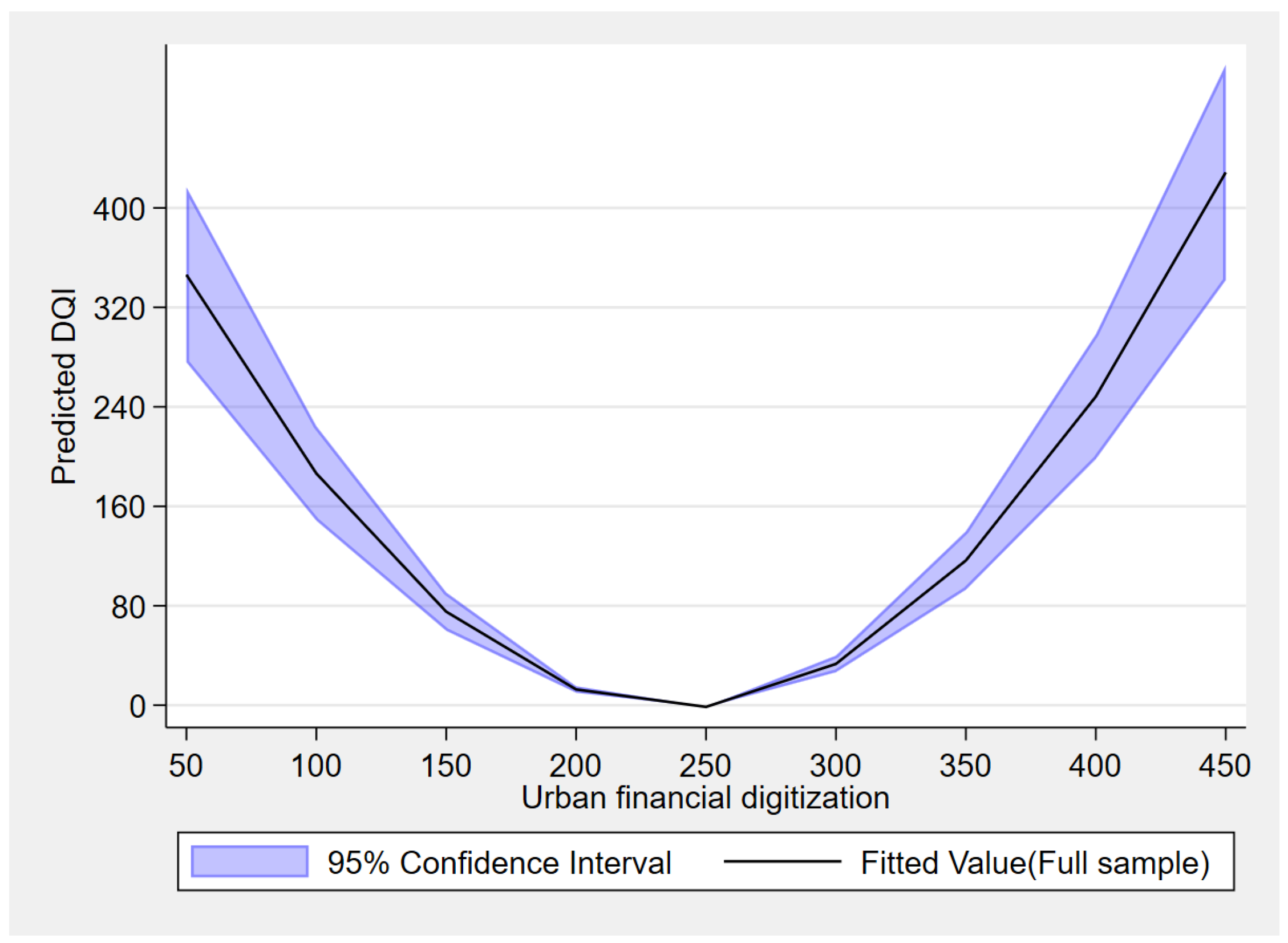
1 is verified. That is, with the improvement of digitization development level, the urban living quality of rural migrants first decreases and then increases. The relationship between the degree of financial digitization and the urban living quality of rural migrants is graphically presented in
Figure 2. Specifically, the Mann–Whitney U test results indicate a statistically significant negative slope of −0.416 (
p < 0.01) for the left interval and a statistically significant positive slope of 0.431 (
p < 0.01) for the right interval, with an inflection point at 239.45 (representing the degree of urban digitization). For policymakers, the inflection point is a crucial policy threshold and a benchmark for investment decisions. It implies that urban digitization construction is not simply a matter of “the more, the better”, but there exists a critical threshold where it shifts from being a “burden” to an “empowerment”, both for migrants and cities.
As mentioned earlier, in the early stage of the digitization process, due to the existence of the “digital divide”, rural migrants lack the necessary digital skills or equipment, making it difficult for them to fully enjoy the convenience brought by digitization. Meanwhile, the emergence of low-skilled positions being replaced by automation during the digitization process can increase the risk of unemployment for migrants and thereby may reduce their income in urban areas. Furthermore, urban digitization attracts highly skilled talents, leading to their convergence. This influx drives up local living costs, exacerbating the financial burden on migrants with limited means. Therefore, in the early stage, the advancement of urban financial digitization could not be observed to bring about a significant improvement in the living quality for rural migrants. It needs to be recognized that at the early stages of digitization, inclusive digital policies such as large-scale digital skills training, the retention and support of offline services, and regulations to protect the rights and interests of migrants must be implemented in tandem to cushion the pain brought by urban financial digitization and prevent the marginalization of vulnerable groups.
With the deepening of digitization and society’s increasing emphasis on digital inclusiveness, the situation could be changed. Cities would enter a stage where the benefits of digital dividends are widely shared. The government can launch a series of measures aimed at narrowing the “digital divide”, such as providing digital skills training to help rural migrants better adapt to digital society. Meanwhile, high levels of digitization foster the emergence of new digital businesses—including food delivery services, ride-hailing platforms, and live-streaming e-commerce—which generate substantial flexible employment opportunities for migrants. In addition, digitization could significantly enhance the efficiency of public services, such as intelligent traffic management, so as to improve the living environment for rural migrants in inflows. Plus, the digitization of social media can help rural migrants build a broader social network to enhance their sense of social belonging in urban areas, which is conducive to significantly improving their quality of life in the inflows. In conclusion, the research findings suggest that urban digitization policies should be formulated in stages. Especially, the inflection point within the curve provides policymakers with a scientific and quantifiable “action switch”.
5.2. Robust Checks
In this section, we test the robustness of empirical findings firstly by using an alternative measurement of Digit (shown in M
4 of
Table 5). In M
4, the digitization degree of the inflow city is replaced by that of the provincial level where the inflow area is located. The results show that the coefficient of Digit and its quadratic term are still significantly positive at the 1% level, indicating that the main effect is not affected by the replacement of the core explanatory variable.
For M5, the robustness test is conducted by using the method of eliminating special samples. Compared with medium or small cities, there are complex industrial structures, richer medical and educational resources, and relatively higher household registration thresholds in megacities such as Guangzhou. These may lead to significant differences in the residence choices of rural migrants in megacities, thereby affecting the empirical analysis results. Thus, this section eliminated samples from megacities and re-conducted the regression process. The regression results are shown in M5. The empirical results still show a significant positive U relationship between urban financial digitization level and rural migrants’ living quality in inflows.
Thirdly, based on Equation (1), quartile regression analysis (25%, 50%, and 75% for the DQI) was carried out to examine how urban digitization influences rural migrants’ living quality in urban areas as a robustness test (as shown in columns 4–6 of
Table 5). The quartiles of the DQI, to a certain extent, could be interpreted as housing stratification of rural migrants in host cities. The results in
Table 5 show that all the regressions yield consistent findings and suggest that our benchmark findings are robust.
6. Exploration on Influencing Mechanism
The living quality of rural migrants can be regarded as an objective reflection of the decision-making of living choices of this group. From a benefit–cost perspective, the positive U-shaped effect can be attributed to a trade-off between the economic benefits of urban digitization and the learning costs incurred by migrants.
In the early stage of urban digitization, rural migrants have to face high adaptation costs derived from the “digital divide”. Due to the lack of digital skills, they may have difficulty being competent for jobs that require digital technology, resulting in limited employment opportunities. In other words, migrants are under the dual pressure of “high cost of skill learning” and “low expected income”. Even if host cities offer better infrastructure and social security, both current low income and expected low revenue in the future would still weaken their willingness to settle down in the long term. “Temporary residence attention” could lower their living quality in urban areas. In addition, groups that are unable to access digital financial services may have difficulty improving their housing conditions due to financing difficulties.
With the improvement of financial digitization levels and the enhancement of digital inclusiveness, digital platforms can reduce information asymmetry and provide more high-income job opportunities for rural migrants. At this point, the economic benefits brought by income growth exceed the cost of digital learning. Urban digitization could enhance migrants’ willingness to settle down by raising their current income and, more importantly, strengthening their confidence in the future. The intention for “long-term residence” may motivate rural–urban migrants to increase investments in their dwellings, consequently enhancing their living conditions in cities.
Based on the above analysis, a mediating variable of “Settlement intention due to income” is constructed based on the questionnaire of CMDS. According to the reasons for the rural migrants’ settlement intention in inflows presented in the CMDS, the mediating variable “Settlement intention due to income” is assigned a value of 1 if the answer is “settlement for high income”, and 0 if otherwise. This variable can comprehensively reflect migrants’ satisfaction with the current income or expectation of future income potential. The urban financial digitization could affect settlement decisions of migrants by altering their expectations on income potential.
By applying the procedure of the mediating effect test [
52], the influencing mechanism is empirically verified as follows:
Step 1: Based on Equation (1), the nonlinear impact of urban financial digitization on the dwelling quality index (DQI) of rural migrants in urban areas is identified (shown in Step 1 of
Table 6).
Step 2: To test the effect of urban financial digitization on “Settlement intention due to income”, probit regression is used following the model (2) below.
where the subscript i refers to the migrant. The variable
refers to the willingness to settle down in inflows due to current income or expected income. ε
i is the residual item.
As shown in Step 2 of
Table 6, controlling for micro-level and city-level control variables, urban financial digitization has a significant positive U-shaped impact on rural migrants’ willingness to settle down for income in inflows.
Step 3: Urban financial digitization (
), together with the variable
, are put into the empirical model of living quality of rural migrants. The model (3) is shown as follows:
The mediating effect of rural migrants’ settlement attention due to income in the impacts of urban financial digitization on migrants’ urban livability is identified as shown in
Table 6. In Step 3, we focus on coefficient
of
and coefficient
and
of
and its quadratic term. The empirical results in
Table 6 show that the U-shaped impact of urban financial digitization on rural migrants’ living quality in urban areas can be partially achieved through the intermediary variable (migrants’ urban settlement intention due to income).
7. Heterogeneity in Subgroup
7.1. Heterogeneity Across Education Attainment
Educational attainment may serve as a critical enabler for migrants to bridge the digital divide and leverage digital tools effectively, optimizing living experiences through improved information access, service convenience, safety, and environmental conditions.
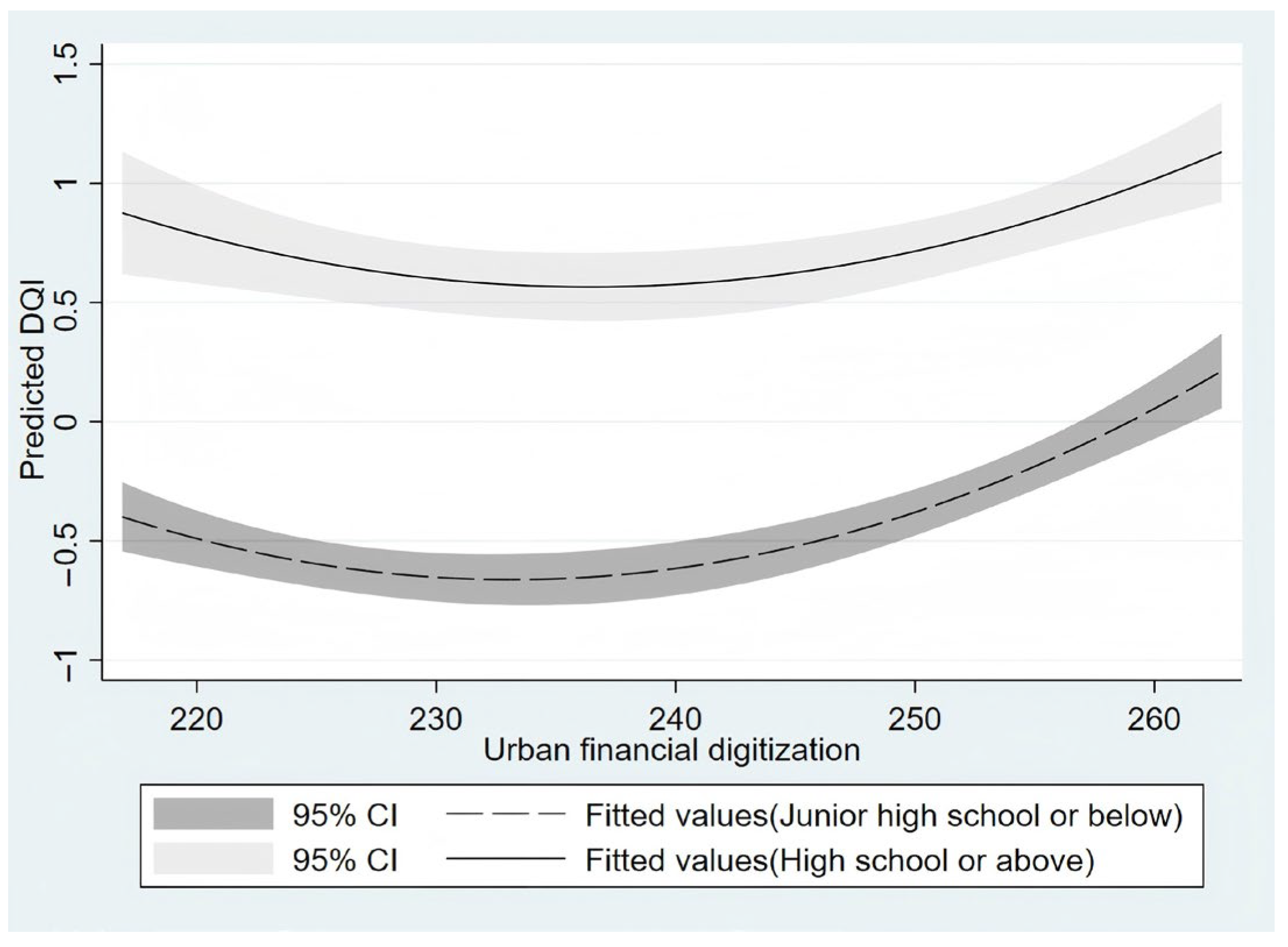
Table 7 presents heterogeneity analysis on the impact of urban financial digitization on migrants’ livability across educational attainment. The coefficients for the key explanatory variable are all significant and their signs are consistent with those in the benchmark model, indicating that the impact of urban digitization on the living quality of rural migrants shows a positive U-shaped relationship, regardless of the educational levels of migrants.
Figure 3 shows that, at equivalent levels of urban financial digitization, rural migrants with a high school education or above enjoy a higher living quality than those with a junior high school education or below. Furthermore, rural migrants with lower educational attainment are more susceptible to the effects of financial digitization on their urban living quality in inflows.
This observation aligns with the human capital theory in migration studies, which posits that educational attainment enhances individuals’ ability to absorb and leverage economic opportunities [
53]. The rural migrants with higher educational levels usually have stronger information literacy and learning abilities, which may give them advantages in obtaining housing information, using digital public services and so on. However, rural migrants with lower educational levels often encounter obstacles such as unfamiliarity with digital device operation, making it difficult for them to enjoy the benefits of digitization and possibly exacerbating inequality in living quality.
7.2. Heterogeneity Across Migration Scopes
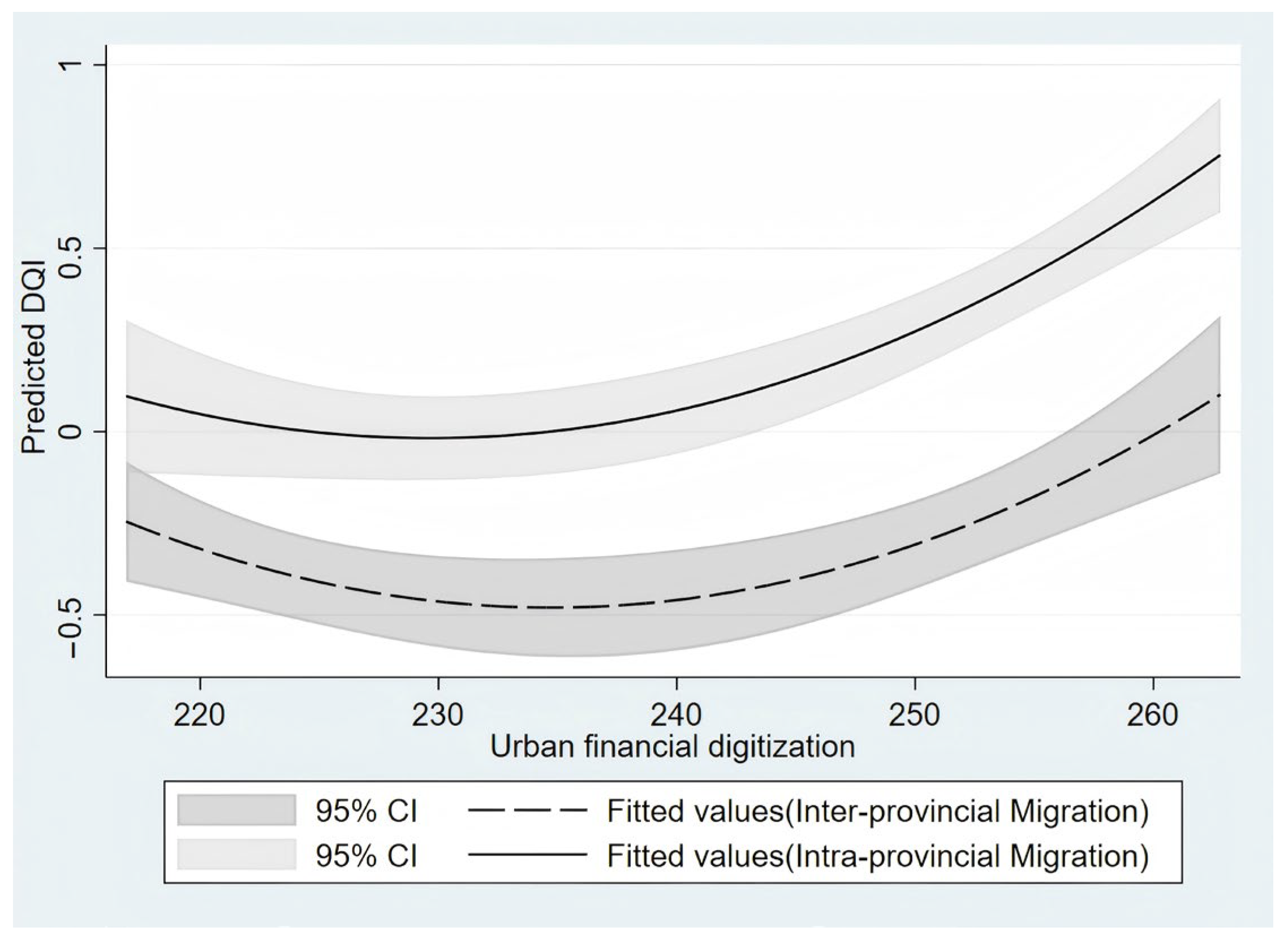
Intra-provincial migration (including inter-cities or inter-counties within the province) and inter-provincial migration are two types of migration scope chosen by rural migrants. According to the 2024 Migrant Workers Monitoring Report issued by China’s National Bureau of Statistics, rural migrants working within their province of household registration constitute 61.7%, nearly twice the proportion of those engaged in inter-provincial migration.
Table 7 also shows heterogeneity analysis across migration scope, which is visualized in
Figure 4.
As shown in
Table 7 and
Figure 4, under the same level of urban financial digitization, the living quality of rural migrants is often better than that of inter-provincial migrants. This observation can be explained through the lens of migration network theory, which emphasizes the role of geographic proximity, cultural familiarity, and localized policy support in facilitating integration [
54]. In other words, rural migrants with intra-provincial migration, relying on cultural affinity and policy benefits, could be able to utilize digital tools more efficiently to improve the quality of living. By contrast, for inter-provincial migrants, the marginal effect of urban digitization on living quality is relatively lower, constrained by institutional divisions and local cultural barriers. The specific analysis is as follows: first, migrants flowing within the province are familiar with the local geographical environment and can use digital platforms to precisely match housing that is convenient for commuting. By contrast, due to information asymmetry, those moving across provinces are more likely to rely on intermediaries and are prone to being forced to choose low-quality housing such as “urban villages”. Second, rural migrants moving within the province gain access to local financial channels—such as reliable rental platforms—through social networks (e.g., relatives or villagers), thereby reducing housing information costs. Those with inter-provincial migration have to rely on intermediary recommendations or unfamiliar platforms and are more cautious in using digital finance. For instance, groups with inter-provincial migration are unfamiliar with financial rules in inflows and are forced to adopt a rental model with high cash flow pressure, thereby squeezing out the budget for improving their urban living conditions.
7.3. Heterogeneity Across Migration Duration
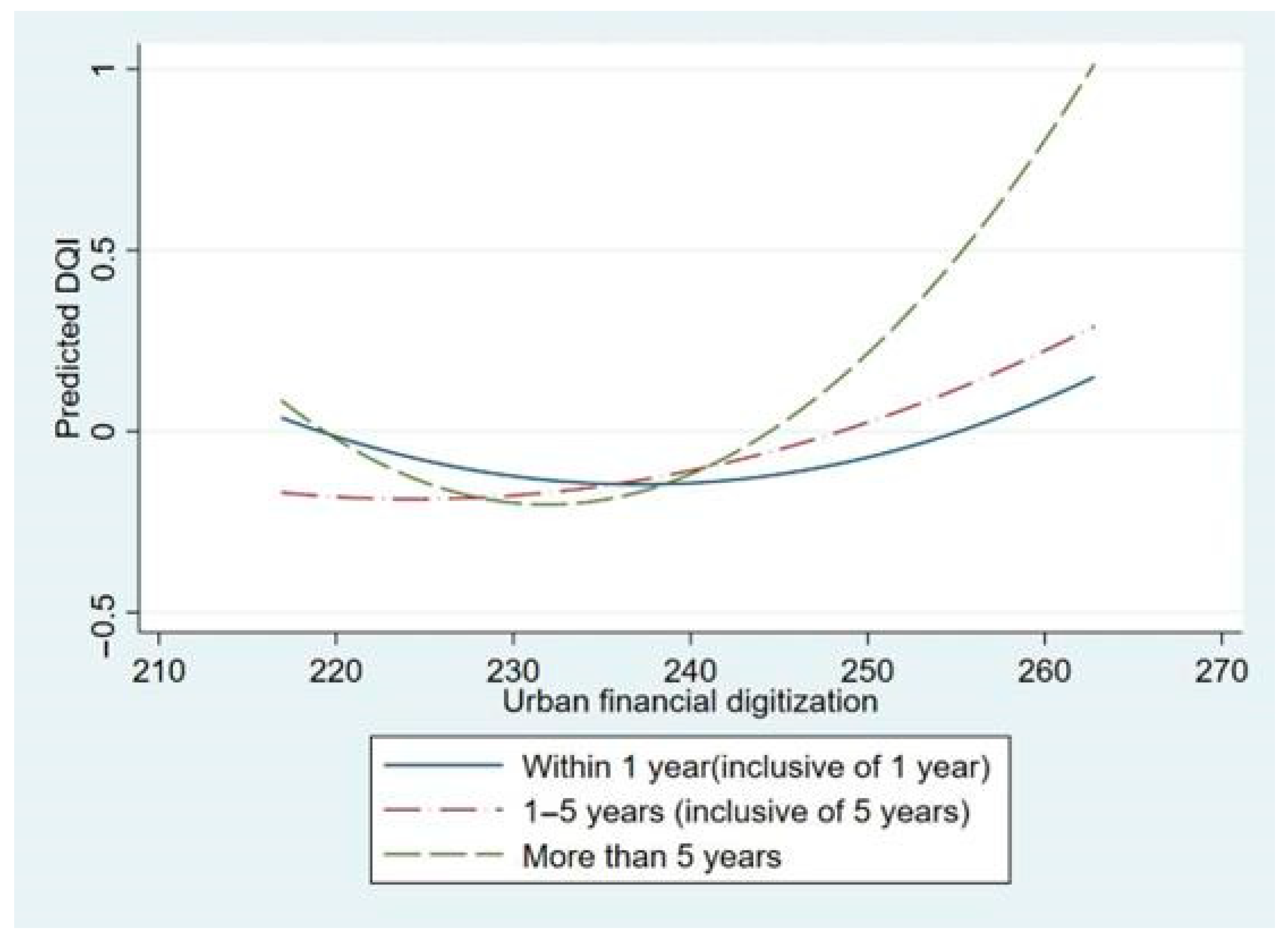
Urban financial digitization has become a crucial infrastructure for meeting the core living needs (payment convenience, credit support, service access) of individuals. Heterogeneity across migration duration for rural migrants was shown in
Table 8 and visualized in
Figure 5. Regardless of the length of the flow period, the relationship between urban financial digitalization and the living quality of rural migrants shows a positive U-shaped pattern. In the early stage of urban digital finance development, regardless of their migration duration, the level of urban financial digitization has a negative impact on rural migrants’ urban living quality. With the improvement of digital finance in cities, it is estimated as shown in
Figure 5 and
Table 8 that the curve corresponding to rural migrants staying in inflows for more than five years (colored in green in
Figure 5) firstly touch a turning point. More importantly, the sensitivity of urban living quality for rural migrants to urban financial digitization will increase as their migration duration extends. Migrants with long migration duration would gradually effectively access and utilize digital financial services, so as to establish credit records, which could be well explained by migrant assimilation theory and the learning-by-doing theory in digital adoption. According to assimilation theory, longer residence enables migrants to gradually adapt to the socio-economic environment of the host city, accumulate localized social capital, and improve their ability to navigate formal and informal institutions—including digital financial systems [
55]. It would help migrants enjoy low-threshold financial services based on digital credit (e.g., rent installment payments), thereby improving rural migrants’ urban living quality. By contrast, migrants with short-term migration duration may rely on traditional financial services, which may continuously cause inconvenience in their lives (such as being unable to conveniently pay rent and utility bills) and be excluded from inclusive financial services (such as credit loans).
8. Conclusions and Policy Implications
Building a livable, resilient and intelligent modern city is a grand goal for China’s high-quality urbanization [
56], and it is also a pursuit for the world as it enters the digital age [
57]. In the era of urban digital transformation, ensuring the housing rights and improving the living quality of migrants is an important part of building a livable and smart city in China.
Based on the large-scale survey data of migrants, this paper contributes to the literature on migrants’ urban living quality by showing that the degree of urban financial digitization exhibits a positive U-shaped relationship with the urban living quality of rural migrants. Specifically, as digitization advances, their living quality first declines and then subsequently rises. In the initial stage of the financial digital development, the living quality of rural migrants (especially those with low skills and low incomes) may decline, mainly due to the amplification of the “digital exclusion” effect. For instance, digitization has rapidly shifted financial services (such as payment, credit, and leasing) to online platforms at an early stage. Nevertheless, rural migrants generally have low digital literacy and lack trust in digital platforms. This has led to an increase in the barriers for them to access convenient and affordable financial services, which may likely squeeze their budgets for basic living and housing in urban areas. That is to say, the initial digitization was not inclusive for rural migrants. Instead, it may increase barriers to financial and housing services and widen “short-term pain” (e.g., information gaps and potential discrimination), causing a temporary decline in migrants’ living quality during the digital transition. With the further advancement of digitization in urban finance, the housing payment capacity of rural migrants could be enhanced by reducing financial exclusion, strengthening policy support and expanding income-generating channels, thereby improving their urban living quality and offering “long-term gain”.
Our findings have the following policy implications. Firstly, in the early stage of promoting urban financial digitization, transitional safeguard measures for migrants need to be introduced simultaneously. When developing smart cities, developing nations should establish digital social impact assessment frameworks and prioritize preventing technology-driven social exclusion of vulnerable populations. For instance, it is recommended that local governments take proactive and inclusive measures to mitigate potential disruptions. Specifically, local authorities should consciously retain offline basic financial service channels—such as physical bank counters, postal savings outlets, and social security service windows—to ensure continuous access to essential financial services for vulnerable groups. At the same time, a special training fund should be established to systematically improve the digital literacy of rural migrants. This fund could support the development and implementation of community-based workshops and one-on-one digital assistance programs tailored to the needs of less-educated migrants. By doing so, the government can prevent the sudden collapse of the traditional financial support system and avoid further marginalization of this population amid rapid technological transition.
Secondly, empirical analysis verified that the sensitivity of the urban living quality of rural migrants to the financial digitization level of inflow areas shows group heterogeneities across education attainment, migration scope and duration. Thus, it is necessary to establish stratified and categorized digital training programs and housing security policies for different subgroups of rural migrants. For example, in the digital literacy training, an adaptation module for inter-provincial migration should be added. The training content could take into account common dialects and diverse cultural backgrounds, and focus on covering functions such as cross-provincial remote services, to help them effectively utilize digital tools to obtain social resources in inflow places. Plus, it is recommended that more flexible off-site credit assessment systems and low-threshold digital credit products might be designed for cross-provincial migrants, enhancing their ability to utilize digital financial services to alleviate short-term liquidity constraints. Specifically, a credit guarantee mechanism for rental deposits across regions could be established, targeting inter-provincial migrants, which could allow credit records from outflows to be used in other regions. Through these targeted measures, the additional challenges faced by migrants with inter-provincial migration in the process of urban digitization can be effectively alleviated, thereby achieving fair coverage of the beneficiaries of digitization. These findings not only inform urban–rural integration strategies in China but also offer actionable insights for improving the living conditions of vulnerable populations in developing economies. Nevertheless, the study’s limitations may include its reliance on the 2017 CMDS data, which may not capture post-2020 developments; potential endogeneity issues between settlement intentions and digitization; and a China-specific institutional context that may limit the findings’ generalizability to other countries.
Author Contributions
Conceptualization, W.W. and X.G.; methodology, W.W. and G.L.; software, W.W. and G.L.; validation, W.W.; formal analysis, W.W.; data accumulation, W.W., G.L. and Y.L.; writing—original draft preparation, W.W. and G.L.; writing—review and editing, W.W. and X.G.; visualization, W.W. and G.L.; funding acquisition, W.W. and X.G. All authors have read and agreed to the published version of the manuscript.
Funding
This research was funded by the National Natural Science Foundation of China (grant number 52268002), the Doctoral Research Startup Fund of Guilin University of Technology (No. RD2500001251) and the Research Projects of Philosophy and Social Sciences in Guangxi (No. 23FYJ025).
Institutional Review Board Statement
Not applicable.
Informed Consent Statement
Not applicable.
Data Availability Statement
Data sharing is not applicable to this article.
Acknowledgments
The authors thank all the personnel who either provided technical support or helped with data collection. We also acknowledge all the reviewers for their useful comments and suggestions.
Conflicts of Interest
The authors declare no conflict of interest.
Appendix A
Table A1.
Estimated results of urban financial digitization level and living quality of rural migrants (full results showing micro-level characteristics and city-level attributes).
Table A1.
Estimated results of urban financial digitization level and living quality of rural migrants (full results showing micro-level characteristics and city-level attributes).
| Full Sample | Baseline Regression |
|---|
| | M1 | M2 | M3 |
|---|
| Independent Variables | Coef. | Coef. | Coef. |
|---|
| Digit | −0.277 *** | −0.395 *** | −4.421 *** |
| | (−4.142) | (−6.194) | (−9.499) |
| Digit_sqr | 0.001 *** | 0.001 *** | 0.009 *** |
| | (4.321) | (6.352) | (9.509) |
| Micro-level characteristics | | | |
| Age | | 0.008 ** | 0.004 |
| | | (2.233) | (1.136) |
| Male | | −0.055 | −0.047 |
| | | (−1.013) | (−0.874) |
| Education | | 0.580 *** | 0.531 *** |
| | | (13.472) | (12.231) |
| Married | | −0.344 *** | −0.264 *** |
| | | (−3.562) | (−2.743) |
| Childbirth | | −0.050 | −0.049 |
| | | (−0.403) | (−0.398) |
| Childlocal | | −0.121 * | −0.133 ** |
| | | (−1.904) | (−2.063) |
| Self-employed | | 0.817 *** | 0.703 *** |
| | | (13.318) | (11.266) |
| Professional | | 0.256 *** | 0.266 ** |
| | | (2.525) | (2.234) |
| Migrate_time | | −0.016 *** | −0.005 |
| | | (−2.693) | (−0.881) |
| Medicare | | 0.470 *** | 0.574 *** |
| | | (6.766) | (8.148) |
| Net_DI | | −0.105 | 0.029 |
| | | (−1.204) | (0.333) |
| Homeownership | | 1.220 *** | 1.233 *** |
| | | (26.450) | (26.439) |
| City-level attributes | | | |
| POP(Ln) | | | −2.299 *** |
| | | | (−8.688) |
| PerGDP(Ln) | | | 6.531 *** |
| | | | (8.512) |
| Secondary_percent | | | −0.849 *** |
| | | | (−9.662) |
| Tertiary_percent | | | −0.892 *** |
| | | | (−9.642) |
| Constant | 31.637 *** | 43.111 *** | 548.580 *** |
| | (3.963) | (5.659) | (9.621) |
| Pseudo R2 | 0.006 | 0.149 | 0.161 |
| Observations | 9469 | 9469 | 9469 |
References
- State Council of the P.R.C. Opinions on Further Deepening Rural Reforms and Vigorously Promoting the Comprehensive Revitalization of Rural Areas. Available online: https://www.moa.gov.cn/ztzl/2025yhwj/zxgz_29966/202502/t20250224_6470398.htm (accessed on 24 February 2025).
- Li, Q.; Wang, X. Urban-rural dual structure and the urbanization of migrant workers: Challenges and path selection. Sociol. Res. 2020, 35, 45–60. (In Chinese) [Google Scholar]
- Fan, X.Y.; Ding, G.X.; Long, S.; Dong, Y.R.; Yan, J.J. Digital divide or dividend? Exploring the impact of digital economy on regional gaps of high-quality economic development in China using relational data model. Int. Rev. Econ. Financ. 2025, 101, 104222. [Google Scholar] [CrossRef]
- Zhang, S.B.; Yang, S.C.; Mao, K.J. Research on the Effects and Mechanisms of the Digital Economy’s Impact on the Integrated Development of Urban and Rural Areas—An Empirical Study Based on 274 Cities. Explor. Econ. Probl. 2024, 10, 60–83. [Google Scholar]
- Guo, L.; Xiao, F. Digital economy, aging of the labor force, and employment transformation of migrant workers: Evidence from China. Econ. Anal. Policy 2024, 84, 787–807. [Google Scholar] [CrossRef]
- Zhou, J.; Yang, S.Y. Common prosperity in the era of technological transformation: Digital inclusive finance, technological progress, and the income distribution of migrant workers. Financ. Res. Lett. 2025, 81, 107486. [Google Scholar] [CrossRef]
- Zheng, X.D.; Wang, Y.L.; Wu, Q.; Zhou, Y.R. Digital inclusive finance and migrant wages: Evidence from over 700,000 internal migrants in China. Financ. Res. Lett. 2024, 62 Pt A, 105123. [Google Scholar] [CrossRef]
- Yang, R.H.; Li, Y.Q.; Li, Y.B. The spatial effects of digital inclusive finance and traditional finance on the income of the migrant population: A comparative analysis of 243 cities in China. Int. Rev. Financ. Anal. 2025, 102, 104054. [Google Scholar] [CrossRef]
- Xu, Q.; Li, X.; Dong, Y.; Guo, F. How digital infrastructure development affects residents’ health: A quasi-natural experiment based on the “Broadband China” strategy. Cities 2025, 157, 105611. [Google Scholar] [CrossRef]
- Huang, W.H.; Huang, Y.H.; Huo, Q. How does the urban digital economy affect labor mobility? An analysis from inflow and outflow perspectives. Telecommun. Policy 2025, 103029. [Google Scholar] [CrossRef]
- Yu, L.Z.; Wang, J.N.; Lou, S.Y.; Wei, X.H. To leave or to stay: Digital economy development and migrant workers’ location. J. Asian Econ. 2024, 94, 101792. [Google Scholar] [CrossRef]
- Hu, M.; Lin, Z.G.; Liu, Y.C. Housing Disparity between Homeowners and Renters: Evidence from China. Real Estate Finan Econ. 2022, 68, 28–51. [Google Scholar] [CrossRef]
- Wang, W.; Luo, G.; Gong, X. Association between Hometown Landholdings and Housing Quality of Rural Migrants in Urban Areas: Evidence from China. Buildings 2024, 14, 1027. [Google Scholar] [CrossRef]
- Adhvaryu, A.; Nyshadham, A.; Xu, H.Y. Hostel takeover: Living conditions, reference dependence, and the well-being of migrant workers. J. Public Econ. 2023, 226, 104949. [Google Scholar] [CrossRef]
- LanzDuret-Hernandez, J.; Grajdura, S.; Rowangould, D. “We have the right and we need better transportation”: Mobility, community, and connection of Latin American migrant workers in Vermont. J. Transp. Geogr. 2024, 118, 103947. [Google Scholar] [CrossRef]
- Ahmad, S.; Munir, F.; Avtar, R.; Sowgat, T.; Kundu, D.; Wang, Y.P. Housing adequacy in Delhi, Dhaka and Karachi: Strategies for promoting sustainable and inclusive housing. Cities 2025, 160, 105779. [Google Scholar] [CrossRef]
- Tella, R.D.; MacCulloch, R.J.; Oswald, A.J. The macroeconomics of happiness. Rev. Econ. Stat. 2003, 85, 809–827. [Google Scholar] [CrossRef]
- Burgers, J. Formal determinants of informal arrangements: Housing and undocumented immigrants in Rotterdam. J. Ethn. Migr. Stud. 1998, 24, 295–312. [Google Scholar] [CrossRef]
- Bardhan, R.; Pan, J.Y.; Chen, S.S.; Cho, T.Y. Breathing space in a compact city: Impacts of urban re-densification on Mumbai’s low-income housing environment. Habitat Int. 2024, 149, 103098. [Google Scholar] [CrossRef]
- Zheng, S.; Song, Z.; Sun, W. Do affordable housing programme facilitate migrants’ social integration in Chinese cities? Cities 2020, 96, 102449. [Google Scholar] [CrossRef]
- Hao, P. Do landholdings affect social mobility in China? A study of rural migrants in Jiangsu. Cities 2021, 111, 102977. [Google Scholar] [CrossRef]
- Zhao, Q.J.; Wang, Y. Cleaner air, happier life? Evaluating the impact of air quality on migrants’ subjective quality of life. J. Environ. Manag. 2025, 391, 126600. [Google Scholar] [CrossRef]
- Harju, C.; Häyrinen, L.; Strandell, A.; Lähtinen, K. Environmental worries as drivers of housing preferences: Views of Finnish citizens. Cities 2025, 167, 106314. [Google Scholar] [CrossRef]
- You, H.; Guo, X.; Wu, X. Housing satisfaction and migrant health in urban China: Empirical evidence and implications for housing policy. J. Hous. Built Environ. 2022, 37, 1199–1220. [Google Scholar] [CrossRef]
- Vigoda-Gadot, E.; Mizrahi, S. The digital governance puzzle: Towards integrative theory of humans, machines, and organizations in public management. Technol. Soc. 2024, 77, 102530. [Google Scholar] [CrossRef]
- Petrovčič, A.; Reisdorf, B.C.; Anabel Quan-Haase, A.; Bartol, J.; Grošelj, D. Digital inequalities among internet users before and during the COVID-19 pandemic: A comparison from two cross-sectional surveys in Slovenia. Technol. Forecast. Soc. 2024, 209, 123745. [Google Scholar] [CrossRef]
- Cicchiello, A.F.; Pietronudo, M.C.; Perdichizzi, S.; Cheng, Y. Does a rising tide lift all boats? An empirical analysis of the relationship between country digitalization and low-tech SMEs performance. Technol. Forecast. Soc. 2024, 207, 123632. [Google Scholar] [CrossRef]
- Ren, J.; Xu, Z.; Hu, M. Digital economy and settlement intention of migrants in urban China. Telecommun. Policy 2023, 47, 102666. [Google Scholar] [CrossRef]
- Reddick, C.; Enriquez, R.; Harris, R.; Flores, J. Understanding the levels of digital inequality within the city: An analysis of a survey. Cities 2024, 148, 104844. [Google Scholar] [CrossRef]
- Zhao, C.; Li, X.; Yan, J. The effect of digital finance on Residents’ happiness: The case of mobile payments in China. Electron. Commer. Res. 2024, 24, 69–104. [Google Scholar] [CrossRef]
- Omar, M.A.; Inaba, K. Does financial inclusion reduce poverty and income inequality in developing countries? A panel data analysis. J. Econ. Struct. 2020, 9, 37. [Google Scholar] [CrossRef]
- Song, X.; Qin, X.; Feng, X. Creating financial inclusion in “Belt and Road” countries in Europe, Asia and Africa: Regulation, technology and financial literacy. J. Financ. Regul. Compl. 2024, 32, 445–461. [Google Scholar] [CrossRef]
- Suhrab, M.; Chen, P.; Ullah, A. Digital financial inclusion and income inequality nexus: Can technology innovation and infrastructure development help in technology innovation and infrastructure development help in achieving sustainable development goals? Technol. Soc. 2024, 76, 102411. [Google Scholar] [CrossRef]
- Yu, C.; Jia, N.; Li, W. Digital inclusive finance and rural consumption structure-evidence from Peking University digital inclusive financial index and China household finance survey. In China Agricultural Economic Review; Financial Index and China Household Finance Survey; Emerald Publishing: Leeds, UK, 2022; Volume 14, pp. 165–183. [Google Scholar] [CrossRef]
- Hasan, M.; Le, T.; Hoque, A. How does financial literacy impact on inclusive finance? Financ. Innov. 2021, 7, 40. [Google Scholar] [CrossRef]
- Adel, N. The impact of digital literacy and technology adoption on financial inclusion in Africa, Asia, and Latin America. Heliyon 2024, 10, e40951. [Google Scholar] [CrossRef]
- Guo, X.; Zhong, S. Unintended consequences: How does digital inclusive finance affect migrants’ urban settlement intentions? Int. Rev. Financ. Anal. 2023, 89, 102766. [Google Scholar] [CrossRef]
- Cheng, Y.; Zheng, D. Does the digital economy promote coordinated urban-rural development? Evidence from China. J. Sustain. 2023, 15, 5460. [Google Scholar] [CrossRef]
- Wang, C.; Shen, J. Settlement intention of migrants in urban China: The effects of labor-market performance, employment status, and social integration. Appl. Geogr. 2022, 147, 102773. [Google Scholar] [CrossRef]
- Qing, G.; Liu, X.; Li, S.S. Manufacturing workers or platform gig workers? The impact of digital transformation in manufacturing and service sectors on job quality and labor allocation. J. Digit. Econ. 2025, 4, 72–94. [Google Scholar] [CrossRef]
- Zhang, J.; Wang, D.Q.; Ji, M.; Yu, K.; Qi, M.S.; Wang, H. Digital literacy, relative poverty, and common prosperity for rural households. Int. Rev. Financ. Anal. 2024, 96 Pt B, 103739. [Google Scholar] [CrossRef]
- Zou, J.; Deng, X. To inhibit or to promote: How does the digital economy affect urban migrant integration in China? Technol. Forecast. Soc. 2022, 179, 121647. [Google Scholar] [CrossRef]
- Solarz, M.; Adamek, J. Determinants of digital financial exclusion as a barrier to the adoption of mobile banking services in Poland. Ekon. I Prawo. Econ. Law 2022, 21, 503–525. [Google Scholar] [CrossRef]
- Liu, G.L.; Liu, R.F.; Tian, M.L.; Wang, J.; Ma, H.Y. Heterogeneous impact of digital economy on employment quality of female migrant workers in an emerging economy: Evidence from China. World Dev. 2025, 195, 107127. [Google Scholar] [CrossRef]
- Zhang, M.; Luo, Z.; Qiao, S.; Yeh, A.G.-O. Financialization, platform economy and urban rental housing: Evidence from Chengdu, China. Appl. Geogr. 2023, 156, 102993. [Google Scholar] [CrossRef]
- Yang, Y.; Gong, B. Digital financial inclusion and public service equalization. Financ. Res. Lett. 2025, 71, 106440. [Google Scholar] [CrossRef]
- Zhang, L.; Azam, S.M.F.; Tham, J. Impact of Digital Inclusive Finance on the High-Quality Development of Rural Economy: Evidence from China. Res. World Agr. Econ. 2025, 6, 192–210. [Google Scholar] [CrossRef]
- Zhang, W.; Chen, S.; Guo, D.; Li, B. The impact of internet real estate intermediary platform on the real estate market. In Proceedings of the 4th International Conference on Crowd Science and Engineering, Jinan, China, 18–21 October 2019; pp. 132–139. [Google Scholar] [CrossRef]
- Zhu, H.J.; Zhu, J.L.; Zhu, Y.L. Quantifying change: The impact of digital financial inclusion across income quantiles in China. J. China Econ. Rev. 2025, 91, 102399. [Google Scholar] [CrossRef]
- Niu, G.; Zhao, G. Living condition among China’s rural–urban migrants: Recent dynamics and the inland–coastal differential. J. Hous. Stud. 2018, 33, 476–493. [Google Scholar] [CrossRef]
- Arrondel, L.; Lefebvre, B. Consumption and investment motives in housing wealth accumulation: A French study. Urban Econ. 2001, 50, 112–137. [Google Scholar] [CrossRef]
- Baron, R.M.; Kenny, D.A. The moderator–mediator variable distinction in social psychological research: Conceptual, strategic, and statistical considerations. Pers. Soc. Psychol. 1986, 51, 1173–1182. [Google Scholar] [CrossRef]
- Becker, G.S. (Ed.) Human Capital: A Theoretical and Empirical Analysis with Special Reference to Education, 3rd ed.; NBER: Cambridge, MA, USA, 1994; Volume 18, p. 556. [Google Scholar] [CrossRef]
- Portes, A. Social Capital: Its Origins and Applications in Modern Sociology. Annu. Rev. Sociol. 1998, 24, 1–24. [Google Scholar] [CrossRef]
- Uzi, R. Assimilation in American Life: An Empirical Assessment of Milton Gordon’s Multi-dimensional Theory. J. Contemp. Relig. 2015, 30, 473–496. [Google Scholar] [CrossRef]
- State Council of the P.R.C. Comprehensively Implement the Five-Year Action Plan for the New Type of Urbanization Strategy Based on People-Oriented Principles. 2024. Available online: https://www.gov.cn/zhengce/content/202407/content_6965542.htm (accessed on 31 July 2024).
- United Nations. The Sustainable Development Goals. 2018. Available online: https://www.un.org/en/node/83734 (accessed on 9 July 2018).
| Disclaimer/Publisher’s Note: The statements, opinions and data contained in all publications are solely those of the individual author(s) and contributor(s) and not of MDPI and/or the editor(s). MDPI and/or the editor(s) disclaim responsibility for any injury to people or property resulting from any ideas, methods, instructions or products referred to in the content. |
© 2025 by the authors. Licensee MDPI, Basel, Switzerland. This article is an open access article distributed under the terms and conditions of the Creative Commons Attribution (CC BY) license (https://creativecommons.org/licenses/by/4.0/).