Dolmen UNESCO Sites Are Tourism Attractions in Korea: Semiotics of Sustainability for Cultural Heritage

Abstract
1. Introduction
- Present an overview of the archaeological and political history of Dolmen remains up until their inscription as a UNESCO heritage site in 2000.
- Review three classic theoretical themes in tourism, including ‘destination lifecycle’, ‘sense of place’, and ‘semiotic of attractions’, and their explanatory power for the cultural-heritage-based Dolmen tourism attractions.
- Employ social semiotic methodology using fieldwork to study the denotative and connotative features of the three Dolmen sites/attractions.
- Evaluate the ‘Dolmen UNESCO Heritage Sites/Tourism Attractions and Sights’ entity using semiotics methodology based on three classic tourism theoretical themes.
- Propose theoretical and practical implications for World Heritage Sites and the sustainable management of tourism attraction sights.
2. Literature Review
2.1. Dolmen, Archaeology, the State, and UNESCO
2.1.1. Han Hŭng-Su’s ‘Genealogy of Discovery’
2.1.2. Archaeology of the Dolmen
2.1.3. The State
3. UNESCO Designation
4. Classic Tourism Theoretical Themes
5. Methods and Analysis
- Social semiotics was performed through full walkthroughs at all three locations, including at museums and interpretive centers, activities, guided tours, concessionaires, and the Dolmens.
- The social semiotics method focused on visual representations of the Dolmens, UNESCO influences, government authority, and community involvement.
- Tools for fieldwork included a camera and notepad for fieldnotes.
- Semiotic research is empirical, employing a mimetic approach (judgmental on the part of the researcher) to identify signs that stood out as signifying defining, contrasting, or theoretically relevant visual information at each location.
- Onsite documentation of onsite observations with fieldnotes in real time.
- No additional data such as interviews, surveys, or text analysis are included in this social semiotic fieldwork.
- Social semiotic fieldwork must be based on the science of the sign and its signifying properties, including its denotative and connotative representations. Otherwise, the results would be an essay or interpretive opinion piece rather than empirical research.
- Social semiotic fieldwork must also be based on theory (not opinion) that guides the judgment of the researcher toward meaningful representations.

| Method | Gochang | Hwasun | Ganghwa |
|---|---|---|---|
| Sampling | Purposive: Preliminary online background research including UNESCO topographical surveys. Comprehensive: Full fieldwork walkthrough at all three sites, gathering photos and other materials. | ||
| Coding and Collection: Signs as data—conceptualized August 2024, completed by December 2024. | |||
| Signs as data | Post hoc online image search confirming morphology and presentation of the Dolmen. See ad hoc checklist (Table 4). | ||
| Semiotic sign interpretation: | |||
| Denotative | Forms analogical to reality interpreted as physical entities: Museums and interpretive centers, guided tours, activities, concessionaires, and the Dolmen. | ||
| Connotative Interpretive Analysis | ‘Dolmen UNESCO Heritage Sites/Tourism Attractions and Sights’ Supplemental to reality, interpreted theoretically as ideals. Specifically interpreted as seen through the lenses of traditional ideas like: ‘Destination Lifecycle’, ‘Sense of Place’, and a ‘Semiotics of Attractions’ | ||
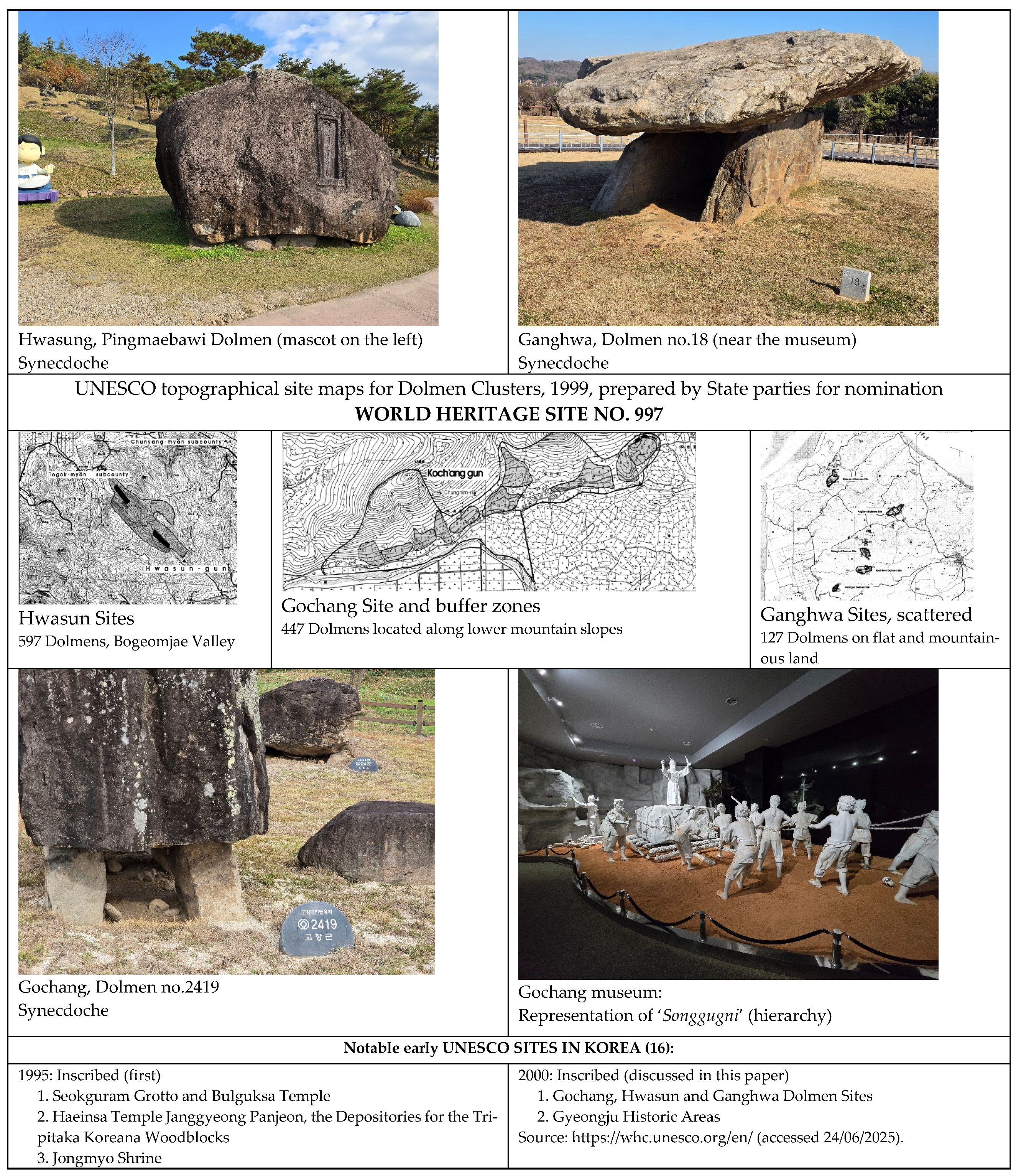
| Synecdoche | Gochang, Dolmen No. 2419 † | Hwasung, Pingmaebawi Dolmen † | Ganghwa, Dolmen No. 18 † |
| Decision 24 COM X.C.1 Id. No: 977 State Party: Republic of Korea | Gochang | Hwasun | Ganghwa |
|---|---|---|---|
| Universal Heritage UNESCO Criterion (iii): ‘Global prehistoric phenomenon’ | Y Y | Y Y | Y Y (Original inscription site) |
| Stones defined, typologies with morphology Scattered or clustered Prominent singular stones based on size act as each location’s semiotic synecdoche | Y Clustered Y | Y Clustered Y | Y Scattered clusters Y |
| UNESCO Criterion (iii) Actions Topographical maps Inventory and numbering with markers Integrity of the sites (origins, history) Authenticity (untouched and intact) UNESCO Protection and Management Protected: Ensuring buffer zones Protected: Fenced with signs Development and intervention Open to the public, belonging to all: hospitality to visitors Responsible party (policy, funding): Korea Cultural Heritage Administration | Y (1999) Y Y Y Y Y Not observed Y Y | Y (1999) Y Y Y Y Y Not observed Y Y | Y (1999) Y Y Y Remote sites, natural buffers Y Not observed Y Y |
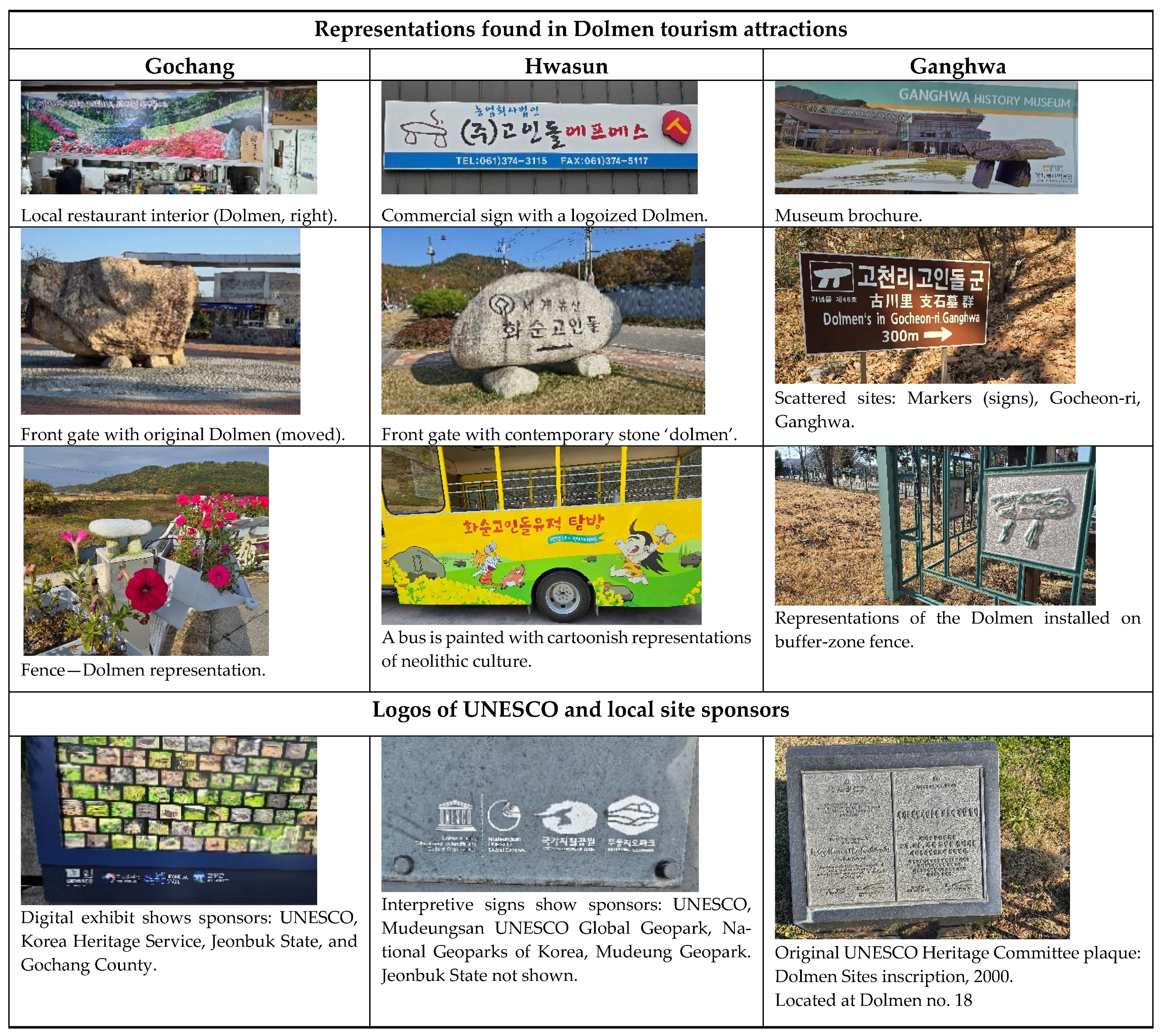
| Local management actions Provide information to visitors Maps, pamphlets, literature Mini-bus and guide Fences, paths, and access Scientific research Site physical maintenance—landscaping Routing visitors with paths, signage, access roads, interpretation Public awareness: Community involvement Festivals and events Activities for visitors Offsite markers Logoization (inc. mascots) Souvenirs | Dolmen Museum—good Good, multilingual Good Y N/A Y Y Y Y N Y N N | Site protection pavilion One pamphlet Excellent Y N/A Y Y Y Y Good Y N N | History Museum—poor Poor N Poor—remote sites, no map N/A Y Only museum site adjacent Y N N N N N |
| NOTES: A unique chaordic management style is evident at the Dolmen Heritage locations: The influence of UNESCO and the responsible party is evident in the regulation of the site. Each location conforms to policy, but the character and culture of the community is evident in their management. Visitors can enjoy an authentic experience of Dolmen cultural heritage whether they visit one location or all three. Sustainability: All locations are guaranteed tourism attraction sustainability by UNESCO and the central government authority, not just by tourism market demand. All locations’ management and staff are highly motivated to ensure the representation of cultural continuity of the Dolmen—from the Neolithic to the present day and for future generations. | |||
| Role of the Community Dolmen site characterized by the following: Hiring locals Ensuring cultural continuity over time: Festivals, events, and other activities Representations in the community Planning and design: Layers of site management over time (new markers, paths, markers added but do not replace their previous versions) | Interpretative site Y Y Y Good Y | Experience-oriented site Y Y Y Good Y | Integrated into the community N Y Y Good Y |
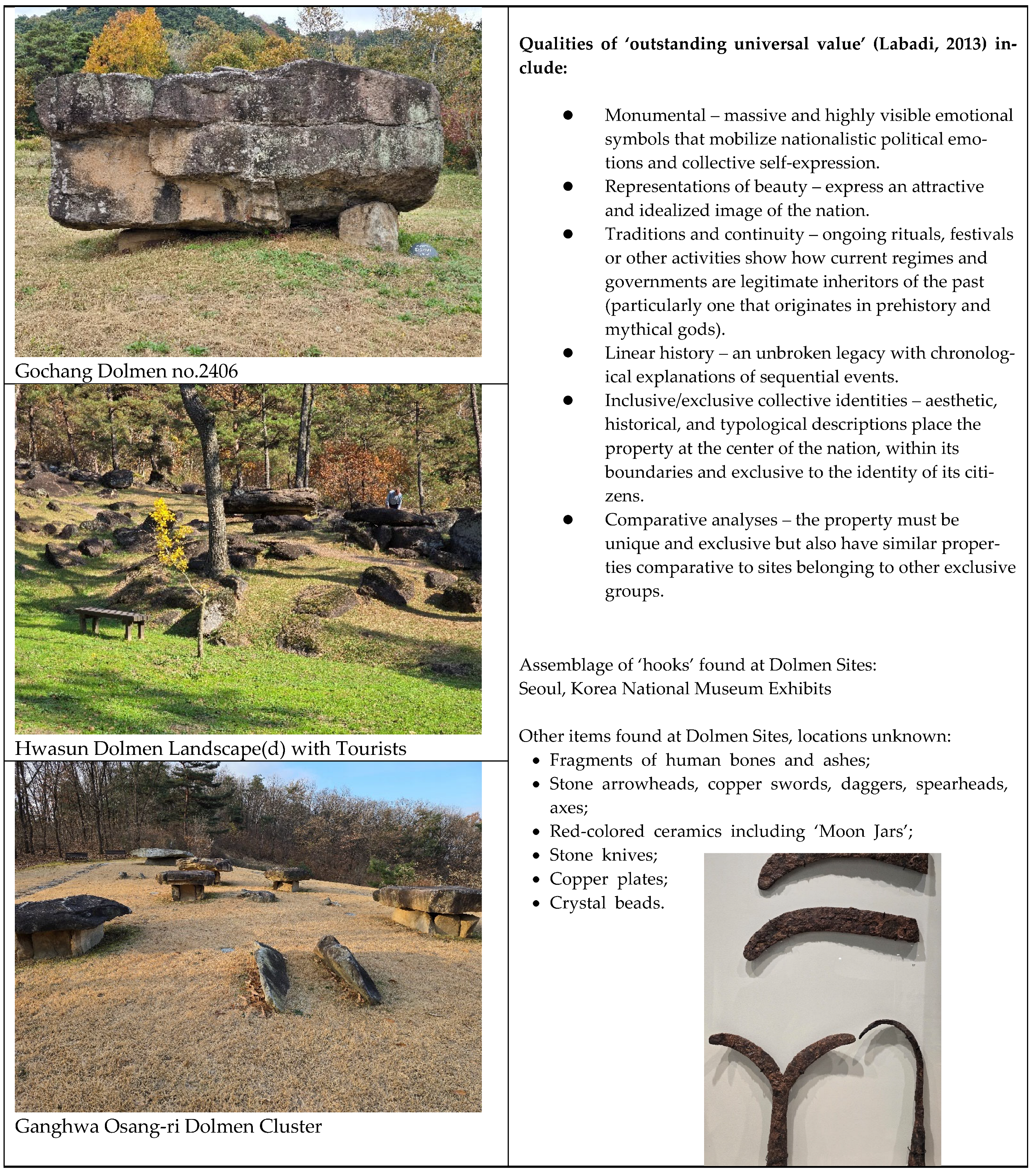
| Role of the National Museum: Only a few iron and bronze artifacts related to the Dolmen on display from the Baekje Kingdom region/era, including ‘hooks’ (see Figure 1). Locations of all items unclear | |||
| Sites Surveyed in This Study | |||
| Gochang: site and buffer zones. Includes 447 Dolmens located along lower mountain slopes. Surveyed: All Hwasun: site and buffer zone. Includes: 597 Dolmens located in the Bogeomjae Valley. Surveyed: All | Ganghwa: scattered clusters. Includes: 127 Dolmens on flat and mountainous land. Surveyed: Clusters in Osang-ri; Mangwol-ri; Gocheon-ri; Bugeun-ri (Aretmal, Hado-ri, museum site, and Tampang-gil’s single large megalith). | ||
6. Results
6.1. Denotative Semiotic Representations
6.2. Connotative Semiotic Representations
6.3. A New Semiotic of Attractions
7. Conclusions
8. Implications
9. Limitations and Future Research
Funding
Data Availability Statement
Conflicts of Interest
Correction Statement
References
- Luo, Y.; Hunter, W.C. A semiology of representations in tourism destination image: Social construction of a Korean Hallyu narrative. J. Tour. Cult. Change 2024, 22, 421–437. [Google Scholar] [CrossRef]
- Saarinen, J. Traditions of sustainability in tourism studies. Ann. Tour. Res. 2006, 33, 1121–1140. [Google Scholar] [CrossRef]
- Dans, E.P.; González, P.A. Sustainable tourism and social value at World Heritage Sites: Towards a conservation plan for Altamira, Spain. Ann. Tour. Res. 2019, 74, 68–80. [Google Scholar] [CrossRef]
- Alvarado-Ramírez, D.F.; Manjarrez, P.L.; García, J.T.S.; Cruz-Cárdenas, G.; Tejeda, P.G. Cultural heritage and lacustrine landscape conservation: The case of “Procession of the Wise Men” in Cajititlán, Jalisco. Sustainability 2025, 17, 6047. [Google Scholar] [CrossRef]
- Terkenli, T.S.; Georgoula, V. Tourism and Cultural Sustainability: Views and Prospects from Cyclades, Greece. Sustainability 2022, 14, 307. [Google Scholar] [CrossRef]
- Andrianto, T.; Kusumah, A.H.G. The journey of mapping the entire destination lifecycle. J. Kepariwisataan Destin. Hosp. Dan Perjalanan 2021, 5, 10–19. [Google Scholar] [CrossRef]
- Olmedo, E.; Mateos, R. Quantitative characterization of chaordic tourist destination. Tour. Manag. 2015, 47, 115–126. [Google Scholar] [CrossRef]
- Butler, R.W. The Concept of a Tourist Area Cycle of Evolution: Implications for Management of Resources. Can. Geogr./Géographies Can. 1980, 24, 5–12. [Google Scholar] [CrossRef]
- Relph, E.C. Place and Placelessness; Pion Limited: London, UK, 1976. [Google Scholar]
- MacCannell, D. The Tourist: A New Theory of the Leisure Class; University of California Press: Oakland, CA, USA, 2013. [Google Scholar]
- Peirce, C.S. Philosophical Writings of Peirce; Dover Publications: Garden City, NY, USA, 1955. [Google Scholar]
- Soini, K.; Dessein, J. Culture-Sustainability relation: Towards a conceptual framework. Sustainability 2016, 8, 167. [Google Scholar] [CrossRef]
- Han, H. The Neolithic Culture of Korea (1940). R. Asiat. Soc. Korea Branch 2012, 87, 15–34. [Google Scholar]
- Ko, I. Constructing Bronze Age Lives: Social reproduction and the construction and use of dolmen burials from the Yongdam complex in Jinan, southern Korea. Doctoral Dissertation, University of Sheffield, Sheffield, UK, 2007. [Google Scholar]
- Löwensteinová, M. Han Hŭng-su—Father of Czechoslovak Korean Studies; Nova vlna: Prague, The Czech Republic, 2014. [Google Scholar]
- Chun, K.S. 평양정권이 숙청한 인류학자 한흥수 (韓興洙, 1909∼?): 굴절과 파행의 ‘고려인류학 (高麗人類學)’. 근대서지 2015, 11, 390–465. (In Korean) [Google Scholar]
- Nesterkina, A.L.; Portnova, A.A.; Fedorova, A.A.; Yondri, L. The megalithic tradition of East and Southeast Asia. Archaeol. Ethnol. Anthropol. Eurasia 2022, 50, 39–48. [Google Scholar] [CrossRef]
- Rhee, S.N. Emerging Complex Society in Prehistoric Southwest Korea; University of Oregon: Eugene, OR, USA, 1984. [Google Scholar]
- Bae, C.J.; Kim, B. Korean Prehistory: Current Perspectives. Asian Perspect. 2015, 54, 1–10. [Google Scholar] [CrossRef]
- Barrett, J.C. A perspective on the early architecture of western Europe. In Constructing Power: Architecture, Ideology and Social Practice; Maran, J., Ed.; Lit Verlag: Münster, Germany, 2006; pp. 15–30. [Google Scholar]
- Barrett, J.C. Archaeology as the investigation of the contexts of humanity. In Deconstructing Context: A Critical Approach to Archaeological Practice; Papaconstantinou, D., Ed.; Oxbow Books: Oxford, UK, 2006; pp. 194–211. [Google Scholar]
- Zoh, M. The Impacts of Authorised Dictatorial Discourse on Heritage Management-Case study: South Korea’s Military Dictatorship Era 1961–1988. Doctoral Dissertation, University of Cambridge, Cambridge, UK, 2018. [Google Scholar]
- Yu, S.H. Hyeonjang Sokui Munhwajae Jeongchaek [Cultural Heritage Policy in the Field]; Minsokwon: Seoul, Republic of Korea, 2004. [Google Scholar]
- Lee, H. Dealing with Difficult Heritage: South Korea’s response to Japanese Colonial Architecture. Doctoral Dissertation, University of Cambridge, Cambridge, UK, 2015. [Google Scholar]
- Jang, S.H. A representation of nationhood: The National Museum of Korea. Doctoral Dissertation, University of Leicester, Leicester, UK, 2015. [Google Scholar]
- Lurie, E.; Stocking, G.W. Race, Culture, and Evolution: Essays in the History of Anthropology. J. Am. Hist. 1970, 56, 943. [Google Scholar] [CrossRef]
- Kroeber, A.L.; Kluckhohn, C. Culture A Critical Review of Concepts and Definitions; Vintage Books: New York, NY, USA, 1952. [Google Scholar]
- Tylor, E.B. Primitive Culture: Researches into the Development of Mythology, Philosophy, Religion, Art, and Custom; J. Murray: London, UK, 1974; Volume 1. [Google Scholar]
- Hahn, G.S. Korean Museums, Intangible Heritage, and the formation of national identity. Doctoral Dissertation, University of Leicester, Leicester, UK, 2022. [Google Scholar]
- Labadi, S. UNESCO, Cultural Heritage, and Outstanding Universal Value: Value-Based Analyses of the World Heritage and Intangible Cultural Heritage Conventions; Rowan & Littlefield: New York, NY, USA, 2013. [Google Scholar]
- Smith, L. Uses of Heritage; Routledge: Oxford, UK, 2006. [Google Scholar] [CrossRef]
- Alvarado-Sizzo, I. Spatial representations, heritage and territorial-synecdoche in contemporary tourism. Tour. Geogr. 2021, 25, 467–486. [Google Scholar] [CrossRef]
- Buonincontri, P.; Marasco, A.; Ramkissoon, H. Visitors’ Experience, Place Attachment and Sustainable Behaviour at Cultural Heritage Sites: A Conceptual Framework. Sustainability 2017, 9, 1112. [Google Scholar] [CrossRef]
- Brumann, C. Anthropological utopia, closet eurocentrism, and culture chaos in the UNESCO World Heritage Arena. Anthropol. Q. 2018, 91, 1203–1233. [Google Scholar] [CrossRef]
- DeLanda, M. Assemblage Theory; Edinburgh University Press: Edinburgh, UK, 2016. [Google Scholar]
- DeSoucey, M.; Elliott, M.A.; Schmutz, V. Rationalized authenticity and the transnational spread of intangible cultural heritage. Poetics 2019, 75, 101332. [Google Scholar] [CrossRef]
- Elliott, M.A.; Schmutz, V. World heritage. Poetics 2016, 40, 256–277. [Google Scholar] [CrossRef]
- Brumann, C. Shifting tides of world-making in the UNESCO World Heritage Convention: Cosmopolitanisms colliding. Ethn. Racial Stud. 2014, 37, 2176–2192. [Google Scholar] [CrossRef]
- Hollinshead, K.; Ateljevic, I.; Ali, N. Worldmaking Agency-Worldmaking Authority: The Sovereign Constitutive role of Tourism. Tour. Geogr. 2009, 11, 427–443. [Google Scholar] [CrossRef]
- Scott, D.A. Conservation and authenticity: Interactions and enquiries. Stud. Conserv. 2015, 60, 291–305. [Google Scholar] [CrossRef]
- Cameron, C. The UNESCO imprimatur: Creating global (in)significance. Int. J. Herit. Stud. 2020, 26, 845–856. [Google Scholar] [CrossRef]
- Huttunen, M. Heritage for sustainable peace: The politics of contested histories and the Nanjing controversy at UNESCO. Front. Political Sci. 2024, 6, 1249745. [Google Scholar] [CrossRef]
- Funk, W.; Groß, F.; Huber, I. Exploring the empty plinth. In The Aesthetics of Authenticity: Medial Constructions of the Real; Transcript Verlag: Bielefeld, Germany, 2012; pp. 1–9. [Google Scholar] [CrossRef]
- Stovel, H. Effective use of authenticity and integrity as world heritage qualifying conditions. City Time 2007, 2, 21–36. [Google Scholar]
- Gfeller, A.É. The Authenticity of Heritage: Global Norm-Making at the Crossroads of Cultures. Am. Hist. Rev. 2017, 122, 758–791. [Google Scholar] [CrossRef]
- Zhu, Y. Cultural effects of authenticity: Contested heritage practices in China. Int. J. Herit. Stud. 2015, 21, 594–608. [Google Scholar] [CrossRef]
- Ballantyne, R.; Hughes, K.; Ding, P.; Liu, D. Chinese and international visitor perceptions of interpretation at Beijing built heritage sites. J. Sustain. Tour. 2013, 22, 705–725. [Google Scholar] [CrossRef]
- Lumbanraja, V. Tourism area life cycle in Lake Toba. Indones. J. Geogr. 2012, 44, 150–160. [Google Scholar]
- Hovinen, G.R. Revisiting the destination lifecycle model. Ann. Tour. Res. 2002, 29, 209–230. [Google Scholar] [CrossRef]
- Getz, D. Tourism planning and destination life cycle. Ann. Tour. Res. 1992, 19, 752–770. [Google Scholar] [CrossRef]
- Martin, B.S.; Uysal, M. An examination of the relationship between carrying capacity and the tourism lifecycle: Management and policy implications. J. Environ. Manag. 1990, 31, 327–333. [Google Scholar] [CrossRef]
- Cole, S. Synergy and congestion in the tourist destination life cycle. Tour. Manag. 2012, 33, 1128–1140. [Google Scholar] [CrossRef]
- Baum, T. Taking the exit route: Extending the tourism area life cycle model. Curr. Issues Tour. 1998, 1, 167–175. [Google Scholar] [CrossRef]
- Hay, R. Sense of place in developmental context. J. Environ. Psychol. 1998, 18, 5–29. [Google Scholar] [CrossRef]
- Hummon, D.M. Community attachment: Local sentiment and sense of place. In Place attachment; Springer: Boston, MA, USA, 1992; pp. 253–278. [Google Scholar]
- MacCannell, D. Reciprocal reviews. Places 1987, 1, 54–57. [Google Scholar]
- Kyle, G.; Chick, G. The social construction of a sense of place. Leis. Sci. 2007, 29, 209–225. [Google Scholar] [CrossRef]
- Williams, D.R.; Patterson, M.E.; Roggenbuck, J.W.; Watson, A.E. Beyond the commodity metaphor: Examining emotional and symbolic attachment to place. Leis. Sci. 1992, 14, 29–46. [Google Scholar] [CrossRef]
- Shamai, S. Sense of place: An empirical measurement. Geoforum 1991, 22, 347–358. [Google Scholar] [CrossRef]
- Low, S.M.; Altman, I. Place attachment: A conceptual inquiry. In Place Attachment; Plenum Press: New York, NY, USA, 1992; pp. 1–12. [Google Scholar]
- Stokowski, P.A. Languages of Place and Discourses of Power: Constructing new senses of place. J. Leis. Res. 2002, 34, 368–382. [Google Scholar] [CrossRef]
- Lee, R.G. The social definition of outdoor recreation places. In Social Behavior, Natural Resources, and the Environment; Burch, W., Cheek, N., Taylor, L., Eds.; Harper Row: New York, NY, USA, 1972; pp. 64–84. [Google Scholar]
- MacCannell, D. Keeping symbolic interaction safe from semiotics: A response to Harman. Symb. Interact. 1986, 9, 161–168. [Google Scholar] [CrossRef]
- MacCannell, D. Symbolic Capital: Urban design for tourism. Journeys 2000, 1, 157–182. [Google Scholar] [CrossRef]
- Naegele, K.D.; Goffman, E. The presentation of self in everyday life. Am. Sociol. Rev. 1956, 21, 631. [Google Scholar] [CrossRef]
- Boorstin, D.J. The Image, A Guide to Pseudo-Events in America; Vintage: New York, NY, USA, 1961. [Google Scholar]
- Levine, D.N. Simmel as a resource for sociological metatheory. Sociol. Theory 1989, 7, 161. [Google Scholar] [CrossRef]
- Simmel, G. The Sociology of Georg Simmel; Simon Schuster: New York, NY, USA, 1950. [Google Scholar]
- Frisby, D. Georg Simmel: First sociologist of modernity. Theory Cult. Soc. 1985, 2, 49–67. [Google Scholar] [CrossRef]
- Levine, D.N. Simmel at a Distance: On the history and systematics of the sociology of the Stranger. Sociol. Focus 1977, 10, 15–29. [Google Scholar] [CrossRef]
- Kilzer, E.; Wolff, K.H. The Sociology of Georg Simmel. Am. Cathol. Sociol. Rev. 1950, 11, 172. [Google Scholar] [CrossRef]
- Hunter, W.C. The good souvenir: Representations of Okinawa and Kinmen islands in Asia. J. Sustain. Tour. 2012, 20, 81–99. [Google Scholar] [CrossRef]
- Yakin, H.S.M.; Totu, A. The Semiotic Perspectives of Peirce and Saussure: A Brief Comparative study. Procedia Soc. Behav. Sci. 2014, 155, 4–8. [Google Scholar] [CrossRef]
- Hénault, A. Semiotic theory and experiences of life: The vital abstraction. Chin. Semiot. Stud. 2014, 10, 409–426. [Google Scholar] [CrossRef]
- Frohlick, S.; Harrison, J. Engaging ethnography in tourist research: An introduction. Tour. Stud. 2008, 8, 5–18. [Google Scholar] [CrossRef]
- Manning, P.K. Symbolic Communication: Signifying Calls and the Police Response; MIT Press: Cambridge, MA, USA, 1988. [Google Scholar]
- Gobo, G. Re-Conceptualizing Generalization: Old issues in a New frame. In The Sage Handbook of Social Research Methods; SAGE Publications: Los Angeles, CA, USA, 2012; pp. 193–213. [Google Scholar] [CrossRef]
- Ding, E. Towards a dynamic model of the sign. Semiotica 2017, 2017, 137–144. [Google Scholar] [CrossRef]
- Chandler, D. Semiotics: The Basics; Routledge: London, UK, 2007. [Google Scholar]
- Keane, W. Semiotics and the social analysis of material things. Lang. Commun. 2003, 23, 409–425. [Google Scholar] [CrossRef]
- Berger, A.A. Tourism as a postmodern semiotic activity. Semiotica 2011, 183, 105–119. [Google Scholar] [CrossRef]
- Bramham, P. Review of Rojek and Urry’s “touring cultures, transformations of travel and theory”. Leis. Stud. 2000, 19, 301–303. [Google Scholar]
- Smith, A. Conceptualizing city Image Change: The ‘Re-Imaging’ of Barcelona. Tour. Geogr. 2005, 7, 398–423. [Google Scholar] [CrossRef]
- Knudsen, D.C.; Soper, A.K.; Metro-Roland, M. Commentary: Gazing, Performing and Reading: A Landscape Approach to Understanding Meaning in Tourism Theory. Tour. Geogr. 2007, 9, 227–233. [Google Scholar] [CrossRef]
- Masood, A.; Rahim, A.A. Synergising Hallyu and halal economy for wealth creation. Malays. J. Soc. Space 2020, 16, 23–35. [Google Scholar] [CrossRef]
- Culler, J. SEMIOTICS OF TOURISM. Am. J. Semiot. 1981, 1, 127–140. [Google Scholar] [CrossRef]
- Baudrillard, J. The vanishing point of communication. In Jean Baudrillard: Fatal Theories; Clarke, D., Doel, M.A., Merrin, W., Smith, R.G., Eds.; Routledge: London, UK, 2009; pp. 15–23. [Google Scholar]
- Kim, D.W. Goindols and prehistoric East Asian life: The secret landscape of Dolmens on the Korean Peninsula. Int. J. Crit. Cult. Stud. 2023, 21, 1–23. [Google Scholar] [CrossRef]
- Ashworth, G.J. Senses of Place: Senses of Time; Routledge: London, UK, 2017. [Google Scholar]
- Shin, G.; Freda, J.; Yi, G. The politics of ethnic nationalism in divided Korea. Nations Natl. 1999, 5, 465–484. [Google Scholar] [CrossRef]
- Lowenthal, D. Counterfeit art: Authentic fakes? Int. J. Cult. Prop. 1992, 1, 79–104. [Google Scholar] [CrossRef]
- Csurgó, B.; Smith, M.K. Cultural Heritage, Sense of Place and Tourism: An Analysis of Cultural Ecosystem Services in Rural Hungary. Sustainability 2022, 14, 7305. [Google Scholar] [CrossRef]
- Broćić, M.; Silver, D. The influence of Simmel on American sociology since 1975. Annu. Rev. Sociol. 2021, 47, 87–108. [Google Scholar] [CrossRef]
- Yi, X.; Fu, X.; Lin, B.; Sun, J. Authenticity, identity, self-improvement, and responsibility at heritage sites: The local residents’ perspective. Tour. Manag. 2024, 102, 104875. [Google Scholar] [CrossRef]
- Bornstein, M.H.; Gibson, J.J. The ecological approach to visual Perception. J. Aesthet. Art Crit. 1980, 39, 203. [Google Scholar] [CrossRef]
- Hardy, A.; Beeton, R.J.S.; Pearson, L. Sustainable Tourism: An Overview of the Concept and its Position in Relation to Conceptualisations of Tourism. J. Sustain. Tour. 2002, 10, 475–496. [Google Scholar] [CrossRef]
- Köksaldı, E.; Turkan, Z. Urban Furniture in Sustainable Historical Urban Texture Landscapes: Historical Squares in the Walled City of Nicosia. Sustainability 2023, 15, 9236. [Google Scholar] [CrossRef]
- Schmutz, V.; Elliott, M. Tourism and Sustainability in the Evaluation of World Heritage Sites, 1980–2010. Sustainability 2016, 8, 261. [Google Scholar] [CrossRef]
- De Oliveira, R.A.; Baracho, R.M.A.; Cantoni, L. The perception of UNESCO World Heritage Sites’ managers about concepts and elements of cultural sustainability in tourism. J. Cult. Herit. Manag. Sustain. Dev. 2022, 14, 297–311. [Google Scholar] [CrossRef]
- Hunter, W.C. Performing culture at indigenous culture parks in Taiwan: Using Q method to identify the performers’ subjectivities. Tour. Manag. 2014, 42, 294–304. [Google Scholar] [CrossRef]


 | |
| Archaeological Sites Dolmen clusters and artifacts
MEGALITH: 3 TYPES Dolmen: Goindol 고인돌 or ‘Dsisök’ ‘Menhir’: Standing stones Stone cases: Sunken boxes lined with stones | Political Demarcation ‘North’ (to Manchuria) vs. ‘South’ (to Japan) Neolithic North: Ganghwa, North (Gyeonggi-Do)—Goguryeo Kingdom Southwest: Favored by Chun Doo Hwan Gochang and Hwasun: Honam region (Jeolla-Do)—Baekje Kingdom Southeast: Favored by Park Chung Hee (Gyeongju historic areas) Gyeongju: Yongnam region (Gyeongsang-Do)—Shilla Kingdom |
| Historical Periods 4000 years of continuous Korean History Neolithic or the Dan-gun period, 2000 B.C. Megalithic/Bronze age culture: Songgugni way of life
Japanese occupation, modern South Korea | Dolmen ‘Genealogy of Discovery
|
| UNESCO United Nations Educational, Scientific, and Cultural Organization Advisory Bodies ICOMOS The International Council on Monuments and Sites IUCN The International Union for Conservation of Nature ICCROM The International Centre for the Study of the Preservation and Restoration of Cultural Property | Organizational Structure UNESCO headquarters in Paris hosts the World Heritage Centre. World Heritage Committee and Advisory Bodies. World Heritage Convention: An international treaty with governing bodies. State Authorities: Nation states with UNESCO properties. State Delegations: career diplomats, officials from ministries, and public agencies dealing with cultural and natural heritage and other UNESCO concerns, and representatives from World Heritage properties and candidate sites. |
Selected World Heritage Conventions and Other Items
| |
| Denotative semiotics of the Dolmen—as Heritage | Notes: |
| The iconic form of the Dolmen: The symbolic form of the Dolmen: The indexical form of the Dolmen: |
|
| Connotative semiotics of the Dolmen—as Heritage | Notes: |
| The iconic identity of the Dolmen: The symbolic identity of the Dolmen: The indexical identity of the Dolmen: |
|
| Connotative semiotics of the Dolmen—for Tourism and Sustainability | Notes: |
| Sense of Place Destination Lifecycle Semiotics of Attractions |
|
Disclaimer/Publisher’s Note: The statements, opinions and data contained in all publications are solely those of the individual author(s) and contributor(s) and not of MDPI and/or the editor(s). MDPI and/or the editor(s) disclaim responsibility for any injury to people or property resulting from any ideas, methods, instructions or products referred to in the content. |
© 2025 by the author. Licensee MDPI, Basel, Switzerland. This article is an open access article distributed under the terms and conditions of the Creative Commons Attribution (CC BY) license (https://creativecommons.org/licenses/by/4.0/).
Share and Cite
Hunter, W.C. Dolmen UNESCO Sites Are Tourism Attractions in Korea: Semiotics of Sustainability for Cultural Heritage. Sustainability 2025, 17, 8021. https://doi.org/10.3390/su17178021
Hunter WC. Dolmen UNESCO Sites Are Tourism Attractions in Korea: Semiotics of Sustainability for Cultural Heritage. Sustainability. 2025; 17(17):8021. https://doi.org/10.3390/su17178021
Chicago/Turabian StyleHunter, William Cannon. 2025. "Dolmen UNESCO Sites Are Tourism Attractions in Korea: Semiotics of Sustainability for Cultural Heritage" Sustainability 17, no. 17: 8021. https://doi.org/10.3390/su17178021
APA StyleHunter, W. C. (2025). Dolmen UNESCO Sites Are Tourism Attractions in Korea: Semiotics of Sustainability for Cultural Heritage. Sustainability, 17(17), 8021. https://doi.org/10.3390/su17178021