Participatory Digital Solutions for Nature-Based Solution Urban Projects: A Systematic PRISMA Literature Review




Abstract
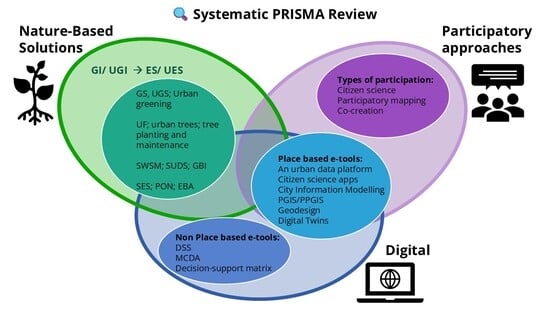
1. Introduction
1.1. Theoretical Framework and Rationale for the Review
1.2. Research Questions and Objectives
- (RQ1): What is the state of the art on the use of technologies and methods for participatory approaches for NBS in urban environments?
- (RQ2): Which kind of participation can they stimulate and which level of participation?
- (RQ3): What are the drivers and barriers for the implementation of these solutions?
2. Materials and Methods
2.1. Identification
2.2. Screening
2.3. Bibliometric and Content Analysis Performed
3. Results
3.1. Overview of the Reviewed Papers
3.2. Type of Nature-Based Solutions
3.3. Methods, Tools, and Frameworks
3.3.1. Place Based E-Tools
3.3.2. Non-Place Based Tools
3.4. Type of Participation
3.4.1. Citizen Science
3.4.2. Participatory Mapping
3.4.3. Participatory Planning or Co-Creation
3.5. Drivers and Barriers on the Implementation
- Stakeholder acceptance and better design: Incorporating co-design, participatory approaches, and feedback loops increases acceptance and usability of the solutions. Participatory mapping and community input enhance data quality, capture local knowledge, and promote inclusive planning. Addressing equity and social justice through participatory methods allows for marginalized voices to be represented in decision-making [69,71]. Mattijssen et al. [105] points out that transparency should be the key for co-creation processes, because it allows trust to be built between stakeholders and contributes to the acceptance of outcomes. Public participation is effective if citizens are not only consulted, but if there is an actual exchange of opinions, leading to shared decisions.
- E-participation and e-governance: E-tools can promote e-participation and e-governance practices, linking to forms of place-based governance or mosaic governance. However, these e-tools should not be seen as a standalone participatory practice but rather complement and enlarge traditional ways of data collection and participation with qualitative methods, and offline meetings and activities [69,70].
- Technology integration for broader participation: The use of digital engagement solutions can enhance broader participation [52,61,101], allowing us to compensate through volume and engagement, for citizen-sourced data inaccuracies, taken with traditional methods. Digital tools like smartphone apps and visualization platforms could be an effective way of adapting scientific traditional approaches to practical urban planning tools that are relevant and usable. Balancing intuitive interfaces with scientifically robust models ensures accessibility without compromising accuracy [54,62,105].
- Cost and time efficiency: The use of digital resources, like digital twins, digital platforms, and smartphone apps can significantly reduce the time and cost of the planning and management process. Efficient and accessible tools are essential, particularly for smaller cities with limited resources [52,54,94,96,101].
- Adaptability and scalability: The digital tools, like the Nature Smart Cities Business Model [96] or citizen mapping apps [52] and digital integrated methods [34,94,105], have the advantage of being easier to adapt to diverse local contexts and scalable for place-based knowledge across various urban planning applications.
- Complexity and accessibility of data: Data integration challenges, uncertainties about data quality, limited availability of high-quality datasets, and difficulty in interpreting complex data could hinder effective deployment of these solutions. Data collected from sensors and other digital tools may present uncertainties or may not be so representative of the entire community or area concerned, leading in the end to ineffective decisions. [47,63,70,71,94,130,133]
- Technical and legal challenges: The implementation of digital tools and GIS faces technical complexity and legal constraints, including privacy, GDPR compliance, and delayed planning processes [130]. Concerns about data security, privacy, and accuracy of citizen-sourced data hinder the widespread use of participatory tools [59,71,72,73]. Barriers include compliance with ethics and legal frameworks, delays due to legislative processes, and balancing open data access with privacy requirements [133].
- Institutional barriers: Lack of institutional support, and lack of training and organization in local authorities are reported among the main obstacles in UGI planning. Silo-based thinking in public administrations and poor integration of tools with other systems make comprehensive planning difficult [96,133]. The lack of unified standards and practical guidelines is also reported as a barrier along with uncertainties over costs and current policies and administrative procedures [63,74,96].
- Participatory inclusion issues: Digital divide, demographic biases, and lack of inclusion of older adults and underrepresented groups in participatory platforms may create barriers to equitable citizen engagement [62,70,71,73]. Digital divide is described as one of the main threats, because it is rooted in the societal conditions and could become a higher risk for participant exclusion. Education, age, and gender, along with individual motivations, are the strongest factors influencing differences in internet usage, whereas internet experience, income, and residency seem to hold less importance. Tool and app usability plays a crucial role [74,96,130].
- Resource constraints: Financial limitations, staffing shortages, and insufficient maintenance resources pose challenges, particularly for smaller municipalities [63,74,81,94,96]. The difficulty in solid economic evaluation and in the use of existing valuation toolkits is also considered a barrier to the implementation [96].
4. Discussion
5. Conclusions
Supplementary Materials
Author Contributions
Funding
Institutional Review Board Statement
Informed Consent Statement
Data Availability Statement
Conflicts of Interest
Abbreviations
| NBS | Nature-based solutions |
| EU | European Union |
| IoT | Internet of Things |
| ICT | Information and Communication Technology |
| ES/UES | Ecosystem Services/Urban Ecosystem Services |
| GI/UGI | Green Infrastructure/ Urban Green Infrastructure |
| SWOT | Strengths, Weaknesses, Opportunities and Threats |
| GIS | Geographic Information System |
| PRISMA | Preferred Reporting Items for Systematic Reviews |
| PGIS/PPGIS | Public/ Participation Geographic Information System |
| UGI | Urban Green Infrastructure |
| GS/UGS | Green Spaces /Urban Green Spaces |
| UF | Urban Forest |
| SWSM | Storm Water Sustainable Management |
| SUDS | Sustainable Urban Drainage System |
| GBI | Green and Blue Infrastructure |
| SES | Social Ecological Systems |
| PON | Politics of Nature |
| EBA | Ecosystem-Based Approaches |
| BMPs | Best Management Practices |
| LID | Low-Impact Development |
| DSS | Decision Support Systems |
| MCDA | Multi-Criteria Decision Analysis |
References
- Calvin, K.; Dasgupta, D.; Krinner, G.; Mukherji, A.; Thorne, P.W.; Trisos, C.; Romero, J.; Aldunce, P.; Barrett, K.; Blanco, G.; et al. IPCC, 2023: Climate Change 2023: Synthesis Report. Contribution of Working Groups I, II and III to the Sixth Assessment Report of the Intergovernmental Panel on Climate Change, 1st ed.; Core Writing Team, Lee, H., Romero, J., Eds.; Intergovernmental Panel on Climate Change: Geneva, Switzerland, 2023. [Google Scholar]
- World Bank. A Catalogue of Nature-Based Solutions for Urban Resilience; World Bank: Washington, DC, USA, 2021. [Google Scholar]
- European Environmental Agency. Nature-Based Solutions in Europe: Policy, Knowledge and Practice for Climate Change Adaptation and Disaster Risk Reduction; Publications Office of the European Union: Luxembourg, 2021. [Google Scholar] [CrossRef]
- Frantzeskaki, N.; McPhearson, T.; Collier, M.J.; Kendal, D.; Bulkeley, H.; Dumitru, A.; Walsh, C.; Noble, K.; Van Wyk, E.; Ordóñez, C.; et al. Nature-Based Solutions for Urban Climate Change Adaptation: Linking Science, Policy, and Practice Communities for Evidence-Based Decision-Making. BioScience 2019, 69, 455–466. [Google Scholar] [CrossRef]
- Kabisch, N.; Frantzeskaki, N.; Pauleit, S.; Naumann, S.; Davis, M.; Artmann, M.; Haase, D.; Knapp, S.; Korn, H.; Stadler, J.; et al. Nature-Based Solutions to Climate Change Mitigation and Adaptation in Urban Areas: Perspectives on Indicators, Knowledge Gaps, Barriers, and Opportunities for Action. Ecol. Soc. 2016, 21, 39. [Google Scholar] [CrossRef]
- Faivre, N.; Fritz, M.; Freitas, T.; de Boissezon, B.; Vandewoestijne, S. Nature-Based Solutions in the EU: Innovating with Nature to Address Social, Economic and Environmental Challenges. Environ. Res. 2017, 159, 509–518. [Google Scholar] [CrossRef]
- European Commission. Directorate General for Research and Innovation. Towards An EU Research and Innovation Policy Agenda for Nature-Based Solutions & Re-Naturing Cities: Final Report of the Horizon 2020 Expert Group on ’Nature Based Solutions and Re Naturing Cities’ (Full Version); Publications Office of the European Union: Luxembourg, 2015. [Google Scholar]
- European Commission. Directorate General for Research and Innovation. Guidelines for Co-Creation and Co-Governance of Nature-Based Solutions: Insights Form EU Funded Projects; Publications Office of the European Union: Luxembourg, 2023. [Google Scholar]
- Dai, Y.; Hasanefendic, S.; Bossink, B. A Systematic Literature Review of the Smart City Transformation Process: The Role and Interaction of Stakeholders and Technology. Sustain. Cities Soc. 2024, 101, 105112. [Google Scholar] [CrossRef]
- Lund, N.S.V.; Borup, M.; Madsen, H.; Mark, O.; Arnbjerg-Nielsen, K.; Mikkelsen, P.S. Integrated Stormwater Inflow Control for Sewers and Green Structures in Urban Landscapes. Nat. Sustain. 2019, 2, 1003–1010. [Google Scholar] [CrossRef]
- Anderson, V.; Gough, W.A. A Typology of Nature-Based Solutions for Sustainable Development: An Analysis of Form, Function, Nomenclature, and Associated Applications. Land 2022, 11, 1072. [Google Scholar] [CrossRef]
- Adina, D.; European Commission. Directorate-General for Research and Innovation. In Evaluating the Impact of Nature-Based Solutions, A Handbook for Practitioners; Publications Office of the European Union: Luxembourg, 2021. [Google Scholar]
- Escobedo, F.J.; Giannico, V.; Jim, C.Y.; Sanesi, G.; Lafortezza, R. Urban Forests, Ecosystem Services, Green Infrastructure and Nature-Based Solutions: Nexus or Evolving Metaphors? Urban For. Urban Green. 2019, 37, 3–12. [Google Scholar] [CrossRef]
- Raymond, C.M.; Frantzeskaki, N.; Kabisch, N.; Berry, P.; Breil, M.; Nita, M.R.; Geneletti, D.; Calfapietra, C. A Framework for Assessing and Implementing the Co-Benefits of Nature-Based Solutions in Urban Areas. Environ. Sci. Policy 2017, 77, 15–24. [Google Scholar] [CrossRef]
- Frantzeskaki, N.; Mahmoud, I.H.; Morello, E. Nature-Based Solutions for Resilient and Thriving Cities: Opportunities and Challenges for Planning Future Cities. In Nature-Based Solutions for Sustainable Urban Planning; Springer Nature: Cham, Switzerland, 2022; Volume F4, pp. 3–17. ISSN 25228404. [Google Scholar]
- Arnstein, S.R. A Ladder of Citizen Participation. J. Am. Plann. Assoc. 1969, 35, 216–224. [Google Scholar] [CrossRef]
- World Bank. The World Bank Participation Sourcebook; World Bank, Ed.; World Bank: Washington, DC, USA, 1996; ISBN 978-0-8213-3558-1. [Google Scholar]
- Patrizia, N.; Mariam, F. La Partecipazione Dei Cittadini: Un Manuale, Metodi Partecipativi: Protagonisti, Opportunità e Limiti; Regione Emilia-Romagna Assemblea Legislativa: Bologna, Italy, 2014. [Google Scholar]
- Luyet, V.; Schlaepfer, R.; Parlange, M.B.; Buttler, A. A Framework to Implement Stakeholder Participation in Environmental Projects. J. Environ. Manag. 2012, 111, 213–219. [Google Scholar] [CrossRef]
- Maier, C.; Lindner, T.; Winkel, G. Stakeholders’ Perceptions of Participation in Forest Policy: A Case Study from Baden-Württemberg. Land Use Policy 2014, 39, 166–176. [Google Scholar] [CrossRef]
- Wilker, J.; Rusche, K.; Rymsa-Fitschen, C. Improving Participation in Green Infrastructure Planning. Plan. Pract. Res. 2016, 31, 229–249. [Google Scholar] [CrossRef]
- Fung, A. Varieties of Participation in Complex Governance. Public Adm. Rev. 2006, 66, 66–75. [Google Scholar] [CrossRef]
- Berman, T. Public Participation as a Tool for Integrating Local Knowledge into Spatial Planning: Planning, Participation, and Knowledge; Springer International Publishing: Cham, Switzerland, 2016; p. 220. ISBN 978-331948063-3. [Google Scholar]
- Forester, J. Bridging Interests and Community: Advocacy Planning and the Challenges of Deliberative Democracy. J. Am. Plan. Assoc. 1994, 60, 153–158. [Google Scholar] [CrossRef]
- Albrechts, L.; Balducci, A. Practicing Strategic Planning: In Search of Critical Features to Explain the Strategic Character of Plans. DisP—Plan. Rev. 2013, 49, 16–27. [Google Scholar] [CrossRef]
- Healey, P. In Search of the “Strategic” in Spatial Strategy Making. Plan. Theory Pract. 2009, 10, 439–457. [Google Scholar] [CrossRef]
- Puskás, N.; Abunnasr, Y.; Naalbandian, S. Assessing Deeper Levels of Participation in Nature-Based Solutions in Urban Landscapes—A Literature Review of Real-World Cases. Landsc. Urban Plan. 2021, 210, 104065. [Google Scholar] [CrossRef]
- Page, M.J.; McKenzie, J.E.; Bossuyt, P.M.; Boutron, I.; Hoffmann, T.C.; Mulrow, C.D.; Shamseer, L.; Tetzlaff, J.M.; Akl, E.A.; Brennan, S.E.; et al. The PRISMA 2020 Statement: An Updated Guideline for Reporting Systematic Reviews. BMJ 2021, 372, n71. [Google Scholar] [CrossRef] [PubMed]
- Kabisch, N.; Haase, D. Green Justice or Just Green? Provision of Urban Green Spaces in Berlin, Germany. Landsc. Urban Plan. 2014, 122, 129–139. [Google Scholar] [CrossRef]
- Herreros-Cantis, P.; McPhearson, T. Mapping Supply of and Demand for Ecosystem Services to Assess Environmental Justice in New York City. Ecol. Appl. 2021, 31, e02390. [Google Scholar] [CrossRef]
- Barr, S. Personal Mobility and Climate Change. WIREs Clim. Change 2018, 9, e542. [Google Scholar] [CrossRef]
- Eisenman, T.S.; Churkina, G.; Jariwala, S.P.; Kumar, P.; Lovasi, G.S.; Pataki, D.E.; Weinberger, K.R.; Whitlow, T.H. Urban Trees, Air Quality, and Asthma: An Interdisciplinary Review. Landsc. Urban Plan. 2019, 187, 47–59, Erratum in Landsc. Urban Plan. 2020, 199, 103772. [Google Scholar] [CrossRef]
- White, G.; Zink, A.; Codecá, L.; Clarke, S. A Digital Twin Smart City for Citizen Feedback. Cities 2021, 110, 103064. [Google Scholar] [CrossRef]
- Ives, C.D.; Oke, C.; Hehir, A.; Gordon, A.; Wang, Y.; Bekessy, S.A. Capturing Residents’ Values for Urban Green Space: Mapping, Analysis and Guidance for Practice. Landsc. Urban Plan. 2017, 161, 32–43. [Google Scholar] [CrossRef]
- Nitoslawski, S.A.; Galle, N.J.; van den Bosc, C.K.; Steenberg, J.W.N. Smarter Ecosystems for Smarter Cities? A Review of Trends, Technologies, and Turning Points for Smart Urban Forestry. Sustain. Cities Soc. 2019, 51, 101770. [Google Scholar] [CrossRef]
- Pecero-Casimiro, R.; Fernandez-Rodriguez, S.; Tormo-Molina, R.; Monroy-Colin, A.; Silva-Palacios, I.; Cortes-Perez, J.P.; Gonzalo-Garijo, A.; Maya-Manzano, J.M. Urban Aerobiological Risk Mapping of Ornamental Trees Using a New Index Based on LiDAR and Kriging: A Case Study of Plane Trees. Sci. Total Environ. 2019, 693, 133576. [Google Scholar] [CrossRef]
- Zheng, Y.; Zhang, M.; Wang, S.; Wang, L. The Impacts of Low-Carbon City Pilot Policies on Natural Population Growth: Empirical Evidence from China’s Prefecture-Level Cities. Front. Public Health 2023, 11, 1214070. [Google Scholar] [CrossRef]
- Yin, D.; Xu, C.; Jia, H.; Yang, Y.; Sun, C.; Wang, Q.; Liu, S. Sponge City Practices in China: From Pilot Exploration to Systemic Demonstration. Water 2022, 14, 1531. [Google Scholar] [CrossRef]
- Falfan, I.; Zambrano, L. Lacustrine Urban Blue Spaces: Low Availability and Inequitable Distribution in the Most Populated Cities in Mexico. Land 2023, 12, 228. [Google Scholar] [CrossRef]
- Millennium Ecosystem Assessment (Ed.) Ecosystems and Human Well-Being: Synthesis; The Millennium Ecosystem Assessment series; Island Press: Washington, DC, USA, 2005; ISBN 978-1-59726-040-4. [Google Scholar]
- Van Oijstaeijen, W.; Van Passel, S.; Cools, J. Urban Green Infrastructure: A Review on Valuation Toolkits from an Urban Planning Perspective. J. Environ. Manag. 2020, 267, 110603. [Google Scholar] [CrossRef]
- Benedict, M.A.; McMahon, E.T. Green Infrastructure: Linking Landscapes and Communities; Island press: Washington, DC, USA, 2012; ISBN 1-59726-764-3. [Google Scholar]
- Green Infrastructure—European Commission. Available online: https://environment.ec.europa.eu/topics/nature-and-biodiversity/green-infrastructure_en (accessed on 22 July 2025).
- Biodiversity Strategy for 2030—European Commission. Available online: https://environment.ec.europa.eu/strategy/biodiversity-strategy-2030_en (accessed on 22 July 2025).
- European Commission. Communication from the Commission to the European Parliament, the Council, the European Economic and Social Committee and the Committee of the Regions—Green Infrastructure (GI): Enhancing Europe’s Natural Capital; Publications Office of the European Union: Luxembourg, 2013. [Google Scholar]
- Gill, S.E.; Handley, J.F.; Ennos, A.R.; Pauleit, S. Adapting Cities for Climate Change: The Role of the Green Infrastructure. Built Environ. 2007, 33, 115–133. [Google Scholar] [CrossRef]
- Ferrara, E.; Liotta, A.; Erhan, L.; Ndubuaku, M.; Giusto, D.; Richardson, M.; Sheffield, D.; McEwan, K. A Pilot Study Mapping Citizens’ Interaction with Urban Nature. In Proceedings of the IEEE International Symposium on Dependable, Autonomic and Secure Computing, Athens, Greece, 12–15 August 2018; Institute of Electrical and Electronics Engineers Inc.: New York, NY, USA, 2018; pp. 828–835. [Google Scholar]
- Yin, S.; Kasraian, D.; Wang, G.; Evers, S.; Van Wesemael, P. Children’s Ideal Nature-Related Digital Tools: A Co-Design Experiment. In HCI International 2023 Posters; Stephanidis, C., Antona, M., Ntoa, S., Salvendy, G., Eds.; Communications in Computer and Information Science; Springer Nature: Cham, Switzerland, 2023; Volume 1832, pp. 176–181. ISBN 978-3-031-35988-0. [Google Scholar]
- Cooper, J.E.J.; Plummer, K.E.; Middlebrook, I.; Siriwardena, G.M. Using Butterfly Survey Data to Model Habitat Associations in Urban Developments. J. Appl. Ecol. 2024, 61, 773–783. [Google Scholar] [CrossRef]
- Dickin, S.K.; Schuster-Wallace, C.J.; Elliott, S.J. Mosquitoes and Vulnerable Spaces: Mapping Local Knowledge of Sites for Dengue Control in Seremban and Putrajaya Malaysia. Appl. Geogr. 2014, 46, 71–79. [Google Scholar] [CrossRef]
- Barrie, H.; Soebarto, V.; Lange, J.; Corry-Breen, F.M.; Walker, L. Using Citizen Science to Explore Neighbourhood Influences on Ageing Well: Pilot Project. Healthcare 2019, 7, 126. [Google Scholar] [CrossRef]
- Gupta, K.; Puntambekar, K.; Roy, A.; Pandey, K.; Mahavir; Kumar, P. Smart Environment Through Smart Tools and Technologies for Urban Green Spaces: Case Study: Chandigarh, India. In Smart Environment for Smart Cities; Vinod Kumar, T.M., Ed.; Advances in 21st Century Human Settlements; Springer: Singapore, 2020; pp. 149–194. ISBN 9789811368219. [Google Scholar]
- Kajosaari, A.; Hasanzadeh, K.; Fagerholm, N.; Nummi, P.; Kuusisto-Hjort, P.; Kytta, M. Predicting Context-Sensitive Urban Green Space Quality to Support Urban Green Infrastructure Planning. Landsc. Urban Plan. 2024, 242, 104952. [Google Scholar] [CrossRef]
- Erhan, L.; Ndubuaku, M.; Ferrara, E.; Richardson, M.; Sheffield, D.; Ferguson, F.J.; Brindley, P.; Liotta, A. Analyzing Objective and Subjective Data in Social Sciences: Implications for Smart Cities. IEEE Access 2019, 7, 19890–19906. [Google Scholar] [CrossRef]
- Korpilo, S.; Jalkanen, J.; Virtanen, T.; Lehvavirta, S. Where are the Hotspots and Coldspots of Landscape Values, Visitor Use and Biodiversity in an Urban Forest? PLoS ONE 2018, 13, e0203611. [Google Scholar] [CrossRef] [PubMed]
- Alba, S.; Baldo, M.; De Benedetti, L.; Deimichei, S.; Mazzino, F.; Margagliotti, A.; Polin, V.; Quaglia, D.; Tardivo, S.; Tocco Tussardi, I. A Participatory Inventory Project to Kick-Start the Creation of a Hospital Park: The Experience of the University of Verona (North-Eastern Italy). Sustainability 2023, 15, 3905. [Google Scholar] [CrossRef]
- Nordh, H.; Olafsson, A.S.; Kajosaari, A.; Praestholm, S.; Liu, Y.; Rossi, S.; Gentin, S. Similar Spaces, Different Usage: A Comparative Study on How Residents in the Capitals of Finland and Denmark Use Cemeteries as Recreational Landscapes. Urban For. Urban Green. 2022, 73, 127598. [Google Scholar] [CrossRef]
- Bucchiarone, A.; Bertoldo, G.; Favargiotti, S. Agrihood: A Motivational Digital System for Sustainable Urban Environments. In HCI International 2021—Late Breaking Posters, Proceedings of the 23rd HCI International Conference, Virtual Event, 24–29 July 2021; Stephanidis, C., Antona, M., Ntoa, S., Eds.; Springer: Cham, Switzerland, 2021; Volume 1498, pp. 435–442. [Google Scholar]
- Pauleit, S.; Gulsrud, N.; Raum, S.; Taubenböck, H.; Leichtle, T.; Erlwein, S.; Rötzer, T.; Rahman, M.; Moser-Reischl, A. Smart Urban Forestry: Is It the Future? In Informed Urban Environments; Springer: Cham, Switzerland, 2022; pp. 161–182. ISSN 2365757X. [Google Scholar]
- Wirtz, Z.; Hagerman, S.; Hauer, R.J.; Konijnendijk, C.C. What Makes Urban Forest Governance Successful?—A Study among Canadian Experts. Urban For. Urban Green. 2021, 58, 126901. [Google Scholar] [CrossRef]
- Smaniotto Costa, C.; Bahillo Martínez, A.; Álvarez, F.J.; Šuklje Erjavec, I.; Menezes, M.; Pallares-Barbera, M. Digital Tools for Capturing User’s Needs on Urban Open Spaces: Drawing Lessons from Cyberparks Project. In Citizen Empowerment and Innovation in the Data-Rich City; Springer: Cham, Switzerland, 2017; pp. 177–193. ISSN 2366259X. [Google Scholar]
- Vander Meer, E. Green Infrastructure Mapping for Adaptation, Biodiversity, and Health and Wellbeing: A Tool Development Case Study in Edinburgh. In Business and Policy Solutions to Climate Change; Palgrave Macmillan: Cham, Switzerland, 2022; pp. 39–62. ISSN 26621320. [Google Scholar]
- Suits, K.; Annus, I.; Kändler, N.; Karlsson, T.; Maris, A.V.; Kaseva, A.; Kotoviča, N.; Rajarao, G.K. Overview of the (Smart) Stormwater Management around the Baltic Sea. Water 2023, 15, 1623. [Google Scholar] [CrossRef]
- Levin, S.; Xepapadeas, T.; Crépin, A.-S.; Norberg, J.; De Zeeuw, A.; Folke, C.; Hughes, T.; Arrow, K.; Barrett, S.; Daily, G.; et al. Social-Ecological Systems as Complex Adaptive Systems: Modeling and Policy Implications. Environ. Dev. Econ. 2013, 18, 111–132. [Google Scholar] [CrossRef]
- Latour, B. Politics of Nature; Harvard University Press: Cambridge, MA, USA, 2009; ISBN 978-0-674-03996-4. [Google Scholar]
- Raffn, J.; Lassen, F. Politics of Nature: The Board Game. Soc. Stud. Sci. 2021, 51, 139–164. [Google Scholar] [CrossRef]
- Raffn, J.; Christensen, A.A.; De Witt, M.; Lewis, C.; Büchner-Marais, C. Introducing a Flat Ontology into Landscape Research: A Case Study of Water Governance Experiments in South Africa. Landsc. Ecol. 2023, 38, 4193–4209. [Google Scholar] [CrossRef]
- Algaba, M.H.-P.; Huyghe, W.; van Leeuwen, K.; Koop, S.; Eisenreich, S. Assessment and Actions to Support Integrated Water Resources Management of Seville (Spain). Environ. Dev. Sustain. 2023, 26, 7347–7375. [Google Scholar] [CrossRef]
- Maurer, M.; Chang, P.; Olafsson, A.S.; Møller, M.S.; Gulsrud, N.M. A Social-Ecological-Technological System Approach to Just Nature-Based Solutions: A Case of Digital Participatory Mapping of Meaningful Places in a Marginalized Neighborhood in Copenhagen, Denmark. Urban For. Urban Green. 2023, 89, 128120. [Google Scholar] [CrossRef]
- Steen Møller, M.; Stahl Olafsson, A. The Use of E-Tools to Engage Citizens in Urban Green Infrastructure Governance: Where Do We Stand and Where Are We Going? Sustainability 2018, 10, 3513. [Google Scholar] [CrossRef]
- Møller, M.S.; Olafsson, A.S.; Vierikko, K.; Sehested, K.; Elands, B.; Buijs, A.; van den Bosch, C.K. Participation Through Place-Based e-Tools: A Valuable Resource for Urban Green Infrastructure Governance? Urban For. Urban Green. 2019, 40, 245–253. [Google Scholar] [CrossRef]
- Fernandez de Osso Fuentes, M.J.; Keegan, B.J.; Jones, M.V.; MacIntyre, T. Digital Placemaking, Health & Wellbeing and Nature-Based Solutions: A Systematic Review and Practice Model. Urban For. Urban Green. 2023, 79, 127796. [Google Scholar] [CrossRef]
- Lido, C.; Mason, P.; Hong, J.; Gorash, N.; Anejionu, O.C.D.; Osborne, M. Integrated Multimedia City Data: Exploring Learning Engagement and Greenspace in Glasgow. Built Environ. 2020, 46, 574–598. [Google Scholar] [CrossRef]
- Katsou, E.; Nika, C.-E.; Buehler, D.; Marić, B.; Megyesi, B.; Mino, E.; Almenar, J.B.; Bas, B.; Bećírović, D.; Bokal, S.; et al. Transformation Tools Enabling the Implementation of Nature-Based Solutions for Creating a Resourceful Circular City. Blue-Green Syst. 2020, 2, 188–213. [Google Scholar] [CrossRef]
- Sercaianu, M.; Petrescu, F.; Aldea, M.; Oana, L.; Rotaru, G. Web-GIS Platform for Green Infrastructure in Bucharest, Romania. In Proceedings of the Third International Conference on Remote Sensing and Geoinformation of the Environment, Paphos, Cyprus, 16–19 March 2015. [Google Scholar]
- Georgiadis, C.; Mallinis, G.; Patias, P. Development of a Smart Tool for the Monitoring Urban Biodiversity Using Earth Observation Data, in-Situ Sensors, and Citizen Science in the City of Thessaloniki. In Proceedings of the Ninth International Conference on Remote Sensing and Geoinformation of the Environment (RSCy2023); Themistocleous, K., Michaelides, S., Hadjimitsis, D.G., Papadavid, G., Eds.; SPIE: Ayia Napa, Cyprus, 2023; p. 1. [Google Scholar]
- Oikonomaki, E.; Papadaki, I.; Kakderi, C. Promoting Green Transformations through Smart Engagement: An Assessment of 100 Citizen-Led Urban Greening Projects. Land 2024, 13, 556. [Google Scholar] [CrossRef]
- Kumar, N.; Belhumeur, P.N.; Biswas, A.; Jacobs, D.W.; Kress, W.J.; Lopez, I.C.; Soares, J.V.B. Leafsnap: A Computer Vision System for Automatic Plant Species Identification. In Computer Vision—ECCV 2012; Fitzgibbon, A., Lazebnik, S., Perona, P., Sato, Y., Schmid, C., Eds.; Lecture Notes in Computer Science; Springer: Berlin/Heidelberg, Germany, 2012; Volume 7573, pp. 502–516. ISBN 978-3-642-33708-6. [Google Scholar]
- Joly, A.; Bonnet, P.; Goëau, H.; Barbe, J.; Selmi, S.; Champ, J.; Dufour-Kowalski, S.; Affouard, A.; Carré, J.; Molino, J.-F.; et al. A Look inside the Pl@ntNet Experience: The Good, the Bias and the Hope. Multimed. Syst. 2016, 22, 751–766. [Google Scholar] [CrossRef]
- McEwan, K.; Richardson, M.; Brindley, P.; Sheffield, D.; Tait, C.; Johnson, S.; Sutch, H.; Ferguson, F.J. Shmapped: Development of an App to Record and Promote the Well-Being Benefits of Noticing Urban Nature. Transl. Behav. Med. 2020, 10, 723–733. [Google Scholar] [CrossRef]
- Kwon, R.; Ryu, Y.; Yang, T.; Zhong, Z.; Im, J. Merging Multiple Sensing Platforms and Deep Learning Empowers Individual Tree Mapping and Species Detection at the City Scale. ISPRS J. Photogramm. Remote Sens. 2023, 206, 201–221. [Google Scholar] [CrossRef]
- Wolf, S.; Mahecha, M.D.; Sabatini, F.M.; Wirth, C.; Bruelheide, H.; Kattge, J.; Moreno Martínez, Á.; Mora, K.; Kattenborn, T. Citizen Science Plant Observations Encode Global Trait Patterns. Nat. Ecol. Evol. 2022, 6, 1850–1859. [Google Scholar] [CrossRef]
- Wider Countryside Butterfly Survey|UKBMS. Available online: https://ukbms.org/wider-countryside-butterfly-survey (accessed on 22 July 2025).
- iRecord Butterflies. Available online: https://butterfly-conservation.org/our-work/recording-and-monitoring/irecord-butterflies (accessed on 22 July 2025).
- John, E.E.; Astell-Burt, T.; Yu, P.; Brennan-Horley, C.; Feng, X. Green Space Type and Healthy Ageing in Place: An Australian Longitudinal Study. Urban For. Urban Green. 2023, 84, 127903. [Google Scholar] [CrossRef]
- Laumer, D.; Lang, N.; Van Doorn, N.; Mac Aodha, O.; Perona, P.; Wegner, J.D. Geocoding of Trees from Street Addresses and Street-Level Images. ISPRS J. Photogramm. Remote Sens. 2020, 162, 125–136. [Google Scholar] [CrossRef]
- Brown, G. Public Participation GIS (PPGIS) for Regional and Environmental Planning: Reflections on a Decade of Empirical Research. URISA J. 2012, 25, 5–16. [Google Scholar]
- Brown, G.; Reed, P.; Raymond, C.M. Mapping Place Values: 10 Lessons from Two Decades of Public Participation GIS Empirical Research. Appl. Geogr. 2020, 116, 102156. [Google Scholar] [CrossRef]
- Lehto, C.; Hedblom, M.; Filyushkina, A.; Ranius, T. Seeing through Their Eyes: Revealing Recreationists’ Landscape Preferences through Viewshed Analysis and Machine Learning. Landsc. Urban Plan. 2024, 248, 105097. [Google Scholar] [CrossRef]
- Do Carmo De Lima Bezerra, M.; Do Amaral, R.; Marques Zyngier, C. Geodesign in Regional Green Infrastructure Planning. In Computational Science and Its Applications—ICCSA 2022 Workshops; Gervasi, O., Murgante, B., Misra, S., Rocha, A.M.A.C., Garau, C., Eds.; Lecture Notes in Computer Science; Springer International Publishing: Cham, Switzerland, 2022; Volume 13379, pp. 148–164. ISBN 978-3-031-10544-9. [Google Scholar]
- Moura, A.C.M.; Freitas, C.R.; Cavalcanti, S.S. Geodesign in Salvador Metropolitan Region: Regional Planning Based on Reproducible and Defensible Criteria. In Computational Science and Its Applications—ICCSA 2022 Workshops; Gervasi, O., Murgante, B., Misra, S., Rocha, A.M.A.C., Garau, C., Eds.; Lecture Notes in Computer Science; Springer International Publishing: Cham, Switzerland, 2022; Volume 13379, pp. 132–147. ISBN 978-3-031-10544-9. [Google Scholar]
- Campagna, M. Geodesign from Theory to Practice: From Metaplanning to 2nd Generation of Planning Support Systems. Tema J. Land Use Mobil. Environ. 2014. [Google Scholar] [CrossRef]
- Furlan, C.; Mazzarella, C.; Arlati, A.; Arciniegas, G.; Obersteg, A.; Wandl, A.; Cerreta, M. Exploring a Geodesign Approach for Circular Economy Transition of Cities and Regions: Three European Cases. Cities 2024, 149, 104930. [Google Scholar] [CrossRef]
- Kavouras, I.; Sardis, E.; Protopapadakis, E.; Rallis, I.; Doulamis, A.; Doulamis, N. A Low-Cost Gamified Urban Planning Methodology Enhanced with Co-Creation and Participatory Approaches. Sustainability 2023, 15, 2297. [Google Scholar] [CrossRef]
- Longato, D.; Cortinovis, C.; Balzan, M.; Geneletti, D. A Method to Prioritize and Allocate Nature-Based Solutions in Urban Areas Based on Ecosystem Service Demand. Landsc. Urban Plan. 2023, 235, 104743. [Google Scholar] [CrossRef]
- Van Oijstaeijen, W.; Silva, M.F.E.; Back, P.; Collins, A.; Verheyen, K.; De Beelde, R.; Cools, J.; Van Passel, S. The Nature Smart Cities Business Model: A Rapid Decision-Support and Scenario Analysis Tool to Reveal the Multi-Benefits of Green Infrastructure Investments. Urban For. Urban Green. 2023, 84, 127923. [Google Scholar] [CrossRef]
- Lee, G.-G.; Lee, H.-W.; Lee, J.-H. Greenhouse Gas Emission Reduction Effect in the Transportation Sector by Urban Agriculture in Seoul, Korea. Landsc. Urban Plan. 2015, 140, 1–7. [Google Scholar] [CrossRef]
- Wild, T.C.; Henneberry, J.; Gill, L. Comprehending the Multiple ‘Values’ of Green Infrastructure—Valuing Nature-Based Solutions for Urban Water Management from Multiple Perspectives. Environ. Res. 2017, 158, 179–187. [Google Scholar] [CrossRef]
- Hecht, R.; Artmann, M.; Brzoska, P.; Burghardt, D.; Cakir, S.; Dunkel, A.; Gröbe, M.; Gugulica, M.; Krellenberg, K.; Kreutzarek, N.; et al. A Web App to Generate and Disseminate New Knowledge on Urban Green Space Qualities and Their Accessibility. In Proceedings of the 6th International Conference on Smart Data and Smart Cities; Coors, V., Rodrigues, P., Ellul, C., Zlatanova, S., Laurini, R., Eds.; Copernicus GmbH: Göttingen, Germany, 2021; Volume 8, pp. 65–72. [Google Scholar]
- Villanueva, C.M.S. Initiating an Emerald Link in the City of Manila. In Advancing Smart Cities; Bibri, S.E., Visvizi, A., Troisi, O., Eds.; Advances in Science, Technology & Innovation; Springer Nature: Cham, Switzerland, 2024; pp. 209–230. ISBN 978-3-031-52302-1. [Google Scholar]
- Geropanta, V.; Karagianni, A.; Parthenios, P.; Ampatzoglou, T.; Fatouros, L.; Simantiraki, V.; Brokos-Melissaratos, O.; Eleftheriadis, D. Digitalization of Participatory Greening: The Case of UnionYouth in Chania. In Proceedings of the 40th International Conference on Education and Research in Computer Aided Architectural Design in Europe (eCAADe); Pak, B., Wurzer, G., Stouffs, R., Eds.; Education and Research in Computer Aided Architectural Design in Europe: Ghent, Belgium, 2022; Volume 1, pp. 469–478. [Google Scholar]
- Tsekeri, E.; Lilli, A.; Katsiokalis, M.; Gobakis, K.; Mania, A.; Kolokotsa, D. On the Integration of Nature-Based Solutions with Digital Innovation for Health and Wellbeing in Cities. In Proceedings of the 7th International Conference on Smart and Sustainable Technologies (SpliTech); Solic, P., Nizetic, S., Rodrigues, J.J.P.C., Rodrigues, J.J.P.C., Gonzalez-de-Artaza, D.L.-d.-I., Perkovic, T., Catarinucci, L., Patrono, L., Eds.; Institute of Electrical and Electronics Engineers Inc.: New York, NY, USA, 2022. [Google Scholar]
- Gallos, P.; Menychtas, A.; Panagopoulos, C.; Bimpas, M.; Maglogiannis, I. Quantifying Citizens’ Well-Being in Areas with Natural Based Solutions Using Mobile Computing. In Informatics and Technology in Clinical Care and Public Health; Mantas, J., Hasman, A., Househ, M.S., Gallos, P., Zoulias, E., Liasko, J., Eds.; IOS Press: Amsterdam, The Netherlands, 2022; Volume 289, pp. 465–468. [Google Scholar]
- Paranunzio, R.; Anton, I.; Adirosi, E.; Ahmed, T.; Baldini, L.; Brandini, C.; Giannetti, F.; Meulenberg, C.; Ortolani, A.; Pilla, F.; et al. A New Approach towards a User-Driven Coastal Climate Service to Enhance Climate Resilience in European Cities. Sustainability 2023, 16, 335. [Google Scholar] [CrossRef]
- Mattijssen, T.J.M.; Hennen, W.; Buijs, A.E.; De Dooij, P.; Van Lammeren, R.; Walet, L. Urban Greening Co-Creation: Participatory Spatial Modelling to Bridge Data-Driven and Citizen-Centred Approaches. Urban For. Urban Green. 2024, 94, 128257. [Google Scholar] [CrossRef]
- Kimic, K.; Polko, P. Greenery as A Matter of Security for Citizens Involved in Digital Crime Mapping by the Use of Gis-Based Tool in Poland. In Proceedings of the Public Recreation and Landscape Protection—With Environment Hand in Hand; Fialova, J., Ed.; Mendel University in Brno: Brno, Czech Republic, 2022; pp. 152–156. [Google Scholar]
- IWUN. Available online: https://iwun.sites.sheffield.ac.uk/ (accessed on 22 July 2025).
- Shmapped. Available online: https://mainstreaminggreeninfrastructure.com/resources.php?shmapped-iwun (accessed on 22 July 2025).
- Home. Available online: https://plantnet.org/en/ (accessed on 22 July 2025).
- Tools. euPOLIS. Available online: https://eupolis-project.eu/tools/ (accessed on 9 February 2025).
- Lido, C.; Reid, K.; Osborne, M. Lifewide Learning in the City: Novel Big Data Approaches to Exploring Learning with Large-Scale Surveys, GPS, and Social Media. Oxf. Rev. Educ. 2019, 45, 279–295. [Google Scholar] [CrossRef]
- Thakuriah, P.V.; Sila-Nowicka, K.; Hong, J.; Boididou, C.; Osborne, M.; Lido, C.; McHugh, A. Integrated Multimedia City Data (iMCD): A Composite Survey and Sensing Approach to Understanding Urban Living and Mobility. Comput. Environ. Urban Syst. 2020, 80, 101427. [Google Scholar] [CrossRef]
- Cochrane, L.; Corbett, J. Participatory Mapping. In Handbook of Communication for Development and Social Change; Servaes, J., Ed.; Springer: Singapore, 2018; pp. 1–9. ISBN 978-981-10-7035-8. [Google Scholar]
- Maptionnaire Community Engagement Platform|Online Software. Available online: https://www.maptionnaire.com/ (accessed on 22 July 2025).
- New European Bauhaus: Beautiful, Sustainable, Together—European Union. Available online: https://new-european-bauhaus.europa.eu/index_en (accessed on 22 July 2025).
- Foster, S.R.; Iaione, C. Co-Cities: Innovative Transitions Toward Just and Self-Sustaining Communities; The MIT Press: Cambridge, MA, USA, 2022; ISBN 978-0-262-36993-0. [Google Scholar]
- Hossain, M.; Leminen, S.; Westerlund, M. A Systematic Review of Living Lab Literature. J. Clean. Prod. 2019, 213, 976–988. [Google Scholar] [CrossRef]
- Mahmoud, I.; Morello, E. Co-Creation Pathway for Urban Nature-Based Solutions: Testing a Shared-Governance Approach in Three Cities and Nine Action Labs. In Smart and Sustainable Planning for Cities and Regions; Green Energy and Technology; Bisello, A., Vettorato, D., Ludlow, D., Baranzelli, C., Eds.; Springer International Publishing: Cham, Switzerland, 2021; pp. 259–276. ISBN 978-3-030-57763-6. [Google Scholar]
- Varcities—Future Cities. Available online: https://varcities.eu/ (accessed on 26 April 2024).
- Platform.Score-Eu-Project.Eu. Available online: https://platform.score-eu-project.eu/#/ (accessed on 22 July 2025).
- Falco, E.; Kleinhans, R. Digital Participatory Platforms for Co-Production in Urban Development: A Systematic Review. Int. J. E-Plan. Res. 2018, 7, 52–79. [Google Scholar] [CrossRef]
- Bruzzone, M. Medium-Sized Smart Cities: A Smart Vision for Urban Centralities and Buildings. From the European Case History, to a Proposal for the City of Parma, Italy. In Organizing Smart Buildings and Cities; Lecture Notes in Information Systems and Organisation; Magnaghi, E., Flambard, V., Mancini, D., Jacques, J., Gouvy, N., Eds.; Springer International Publishing: Cham, Switzerland, 2021; Volume 36, pp. 99–123. ISBN 978-3-030-60606-0. [Google Scholar]
- Fegert, J.; Pfeiffer, J.; Peukert, C.; Wei, C. Enriching E-Participation through Augmented Reality: First Results of a Qualitative Study. In WI2020 Zentrale Tracks; GITO Verlag: Berlin, Germany, 2020; pp. 560–567. ISBN 978-3-95545-335-0. [Google Scholar]
- Wolf, M.; Söbke, H.; Wehking, F. Mixed Reality Media-Enabled Public Participation in Urban Planning: A Literature Review. In Augmented Reality and Virtual Reality; Jung, T., Tom Dieck, M.C., Rauschnabel, P.A., Eds.; Progress in IS; Springer International Publishing: Cham, Switzerland, 2020; pp. 125–138. ISBN 978-3-030-37868-4. [Google Scholar]
- Hennen, W.; Daane, A.; Van Duijvendijk, K. Global-Detector—GIS- and Knowledge-Based Tool for a Global Detection of the Potential for Production, Supply and Demand. In Proceedings of the 3rd International Conference on Geographical Information Systems Theory, Applications and Management; SCITEPRESS—Science and Technology Publications: Porto, Portugal, 2017; pp. 161–168. [Google Scholar]
- Berni, M.; Rizzo, A.; Menin, A.; Bittini, L.; Pacchierotti, E.; Duina, R.; Masi, F. Start Park Project: Co-Designing Green-Blue Infrastructures to Build Resilient Communities to Climate Change. In Enhancing Environmental Education Through Nature-Based Solutions; Springer: Cham, Switzerland, 2022; pp. 231–247. [Google Scholar] [CrossRef]
- Poplin, A. Games and Serious Games in Urban Planning: Study Cases. In Computational Science and Its Applications—ICCSA 2011; Lecture Notes in Computer Science; Murgante, B., Gervasi, O., Iglesias, A., Taniar, D., Apduhan, B.O., Eds.; Springer: Berlin/Heidelberg, Germany, 2011; Volume 6783, pp. 1–14. ISBN 978-3-642-21886-6. [Google Scholar]
- Poplin, A. Playful Public Participation in Urban Planning: A Case Study for Online Serious Games. Comput. Environ. Urban Syst. 2012, 36, 195–206. [Google Scholar] [CrossRef]
- A Participatory Approach as a Preliminary Action for Urban Projects Based on Nature-Based Solutions. In Lecture Notes in Networks and Systems; Springer Nature: Cham, Switzerland, 2024; pp. 3–16. ISBN 978-3-031-74678-9.
- Domaradzka, A.; Biesaga, M.; Domaradzka, E.; Kołodziejczyk, M. The Civil City Framework for the Implementation of Nature-Based Smart Innovations: Right to a Healthy City Perspective. Sustainability 2022, 14, 9887. [Google Scholar] [CrossRef]
- Chelleri, L.; Kua, H.W.; Sánchez, J.P.R.; Md Nahiduzzaman, K.; Thondhlana, G. Are People Responsive to a More Sustainable, Decentralized, and User-Driven Management of Urban Metabolism? Sustainability 2016, 8, 275. [Google Scholar] [CrossRef]
- Galle, N.J.; Nitoslawski, S.A.; Pilla, F. The Internet of Nature: How Taking Nature Online Can Shape Urban Ecosystems. Anthr. Rev. 2019, 6, 279–287. [Google Scholar] [CrossRef]
- Volk, R.; Rambhia, M.; Naber, E.; Schultmann, F. Urban Resource Assessment, Management, and Planning Tools for Land, Ecosystems, Urban Climate, Water, and Materials—A Review. Sustainability 2022, 14, 7203. [Google Scholar] [CrossRef]
- Moriggi, A.; Soini, K.; Franklin, A.; Roep, D. A Care-Based Approach to Transformative Change: Ethically-Informed Practices, Relational Response-Ability & Emotional Awareness. Ethics Policy Environ. 2020, 23, 281–298. [Google Scholar] [CrossRef]
- Geneletti, D.; Cortinovis, C.; Zardo, L.; Esmail, B.A. Planning for Ecosystem Services in Cities; Springer Briefs in Environmental Science; Springer International Publishing: Cham, Switzerland, 2020; ISBN 978-3-030-20023-7. [Google Scholar]
- Lefebvre, H.; Kofman, E.; Lebas, E. Writings on Cities; Blackwell: Malden, MA, USA, 1996; ISBN 978-0-631-19188-9. [Google Scholar]
- Foth, M.; Brynskov, M.; Ojala, T. (Eds.) Citizen’s Right to the Digital City; Springer: Singapore, 2015; ISBN 978-981-287-917-2. [Google Scholar]
- Wang, Y.; Ni, Z.; Chen, S.; Xia, B. Microclimate Regulation and Energy Saving Potential from Different Urban Green Infrastructures in a Subtropical City. J. Clean. Prod. 2019, 226, 913–927. [Google Scholar] [CrossRef]



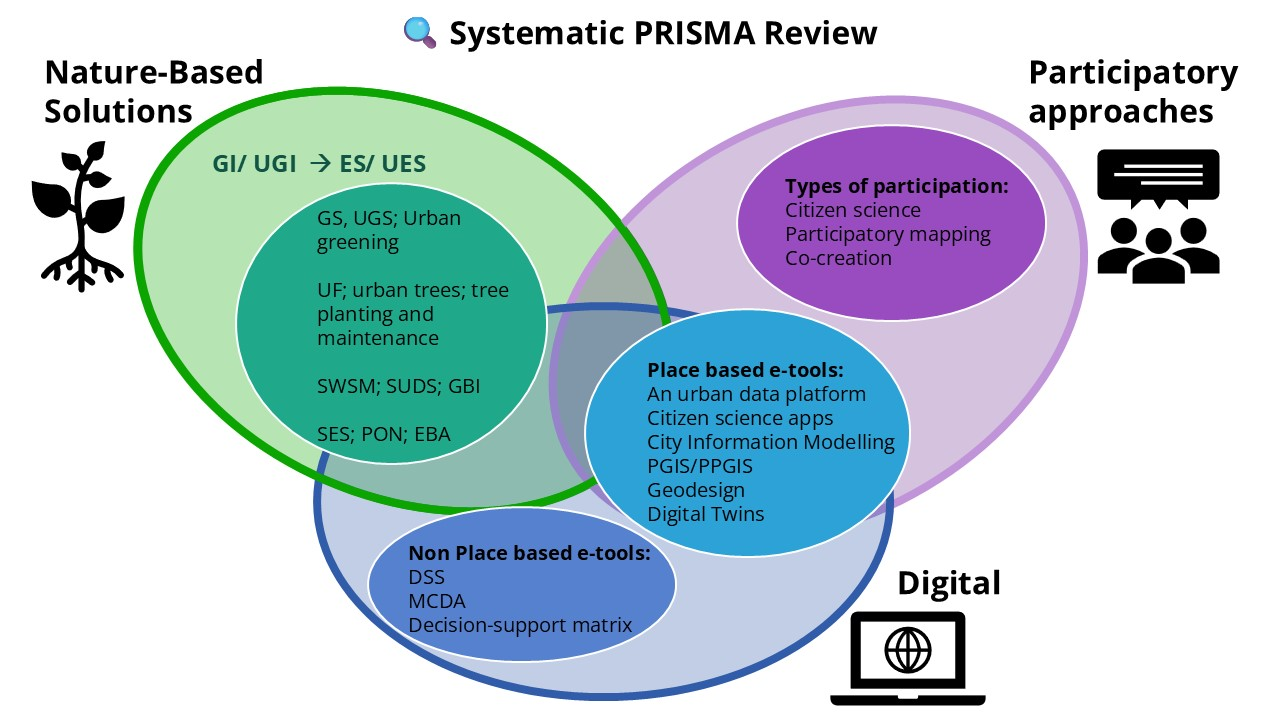
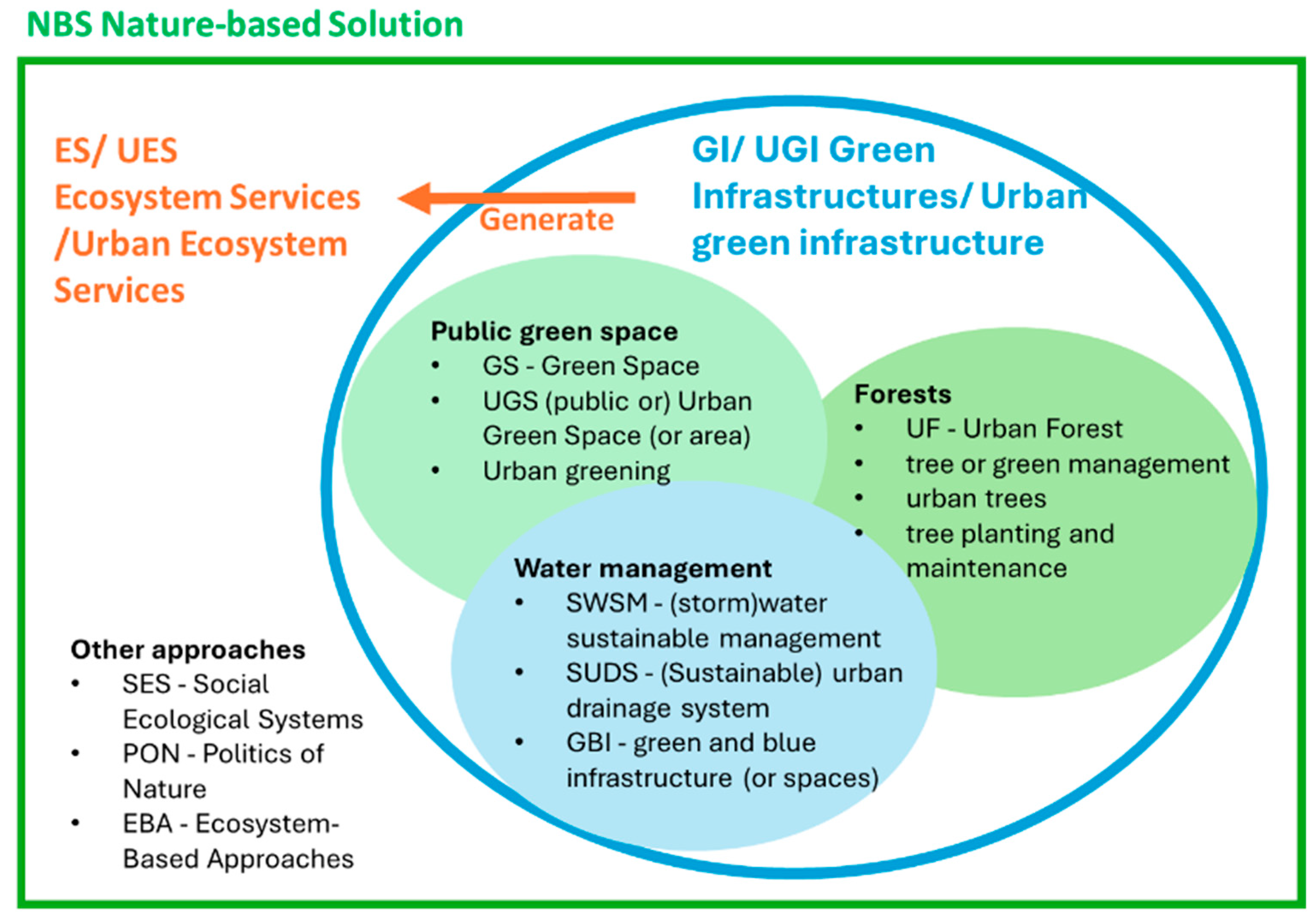
| Concept | Structural Application | Green Space | Forests | Water Management | Other Cited Approaches | ||
|---|---|---|---|---|---|---|---|
| Cited terms | NBS—Nature-Based Solutions | ES—Ecosystem Services UES—Urban Ecosystem Services | GI—Green Infrastructure UGI—Urban Green Infrastructure | GS—Green Space UGS (public or) Urban Green Space (or area) “Urban greening” | UF—Urban Forest “tree or green management” “urban trees” “tree planting and maintenance” | SWSM—(Storm)Water Sustainable Management SUDS—(Sustainable) Urban Drainage System GBI—Green and Blue Infrastructure (or spaces) | SES—Social Ecological Systems PON—Politics of Nature EBA—Ecosystem-Based Approaches |
| Number of references | 11 | 10 | 14 | 25 | 5 | 6 | 4 |
| Type of Participatory Approach | Citizen Science | Participatory Mapping | Co-Creation |
|---|---|---|---|
| Reference count | 10 case studies | 9 case studies | 13 case studies |
| Degree of power [19] | Information: 4 Consultation: 3 Collaboration: 4 Co-decision: 0 Empowerment: 0 | Information: 2 Consultation: 2 Collaboration: 7 Co-decision: 2 Empowerment: 0 | Information: 4 Consultation: 6 Collaboration: 2 Co-decision: 5 Empowerment: 0 |
| Participatory Techniques [19] | Information | Consultation | Collaboration | Co-Decision | Records Count |
|---|---|---|---|---|---|
| Presentations, public hearings | [52] | [96,99,100] | 4 | ||
| Internet webpages, platforms or apps | [101,102] | [52,61,101] | 4 | ||
| Interviews, questionnaires,and surveys | [68,75,102] | [34,50,52,53,55,56,57,69,73,103,104] | 14 | ||
| Field visit and interactions | [52,105] | [69,73] | 4 | ||
| Workshops | [96,100,105] | [48,69,94,104] | 7 | ||
| Participatory mapping | [34,50,54,55,57,62,69,89,106] | [53] | 9 | ||
| Focus groups | [50,67] | [69,94] | 4 | ||
| Geospatial, Decision support system | [105] | 1 | |||
| Role playing | [67,104] | 2 | |||
| Multicriteria analysis | [99] | [55] | 2 | ||
| Gamification | [58] | [94] | 2 | ||
| Citizen science | [47,81] | [47,49,51,54,56,62,76] | 8 | ||
| Co-design | [48,96,101] | 3 |
| Case Study | NBS Used | Participatory Approach | People Involved | Degree of Power Shared [19] | Method of Engagement | Kind of Tool Used | Kind of Technology Used for the Tool | Information Database or Framework Used | Tool Extra Info |
|---|---|---|---|---|---|---|---|---|---|
| Bucharest, Romania [75] | GI | citizen science | citizens | information, collaboration | online survey with a WebAPP | urban data web-based digital platform | Web-GIS application | GIS data, geodatabase, ortophotoplans, green cadastre, GI, and citizen requests data survey | |
| Urban sites in Britain; United kingdom [49] | GI; UGS | citizen science | citizens | collaboration | citizen science digital survey | online survey; smartphone app | ArcGIS; R | survey data WCBS; Ordnance Survey Master Map; Topography Layer; Land cover map | Wider Countryside Butterfly Survey (WCBS) [83]; iRecord Butterflies app [84] |
| South Australia, Greater Metropolitan Adelaide; Australia [51] | Green spaces | citizen science | Old people | collaboration | in-depth interviews; people’s diary, pictures; workshop for participation in decision-making around data collection interpretation and analysis | Outdoor Space Audit Tool, online tool for smartphone | smartphones and digital cameras; ESRI platform to host the tool; Survey123™ platform for the statistical data, SPSS Statistics Version 26. NVivo | spatial data; preliminary demographic survey and Survey 123™ audit data; recorded and transcribed interview data | |
| Urban forest of Seich Sou, Thessaloniki, Kalamaria, Panorama, and Kalochori, Greece [76] | UGI; ES | citizen science | citizens | collaboration | field data collection platform for citizen science | web-based citizen science digital platform; | in situ sensors; database management subsystem, Web-GIS graphical user interfaces subsystem; the data fusion geoprocessing subsystem | indicators for earth observation data; satellite data; mobile sensors and citizen science data; DSM | |
| Sheffield (UK) [47,54] | Green areas, NBS | citizen science | citizens | collaboration | citizen science, participatory mapping via phone app | phone app to monitor citizen data regarding health and wellbeing in green areas | smart sensing; the Internet of Things; data science; smartphone app Shmapped | subjective data: personal feelings, type of social interactions, type of activity, and perception of space; objective data: sensor data, location, time, photos, GPS | IWUN [107]; Shmapped [80,108] |
| Suwon city, South Korea [81] | ES; tree mapping | citizen science | citizens | consultation | smartphone application for citizen science tree mapping | CADA smartphone application for tree mapping | smartphones sensors; web-based airborne images, vehicle-mounted sensors | airborne-sensed imagery, 2020, citizen science data | |
| Verona, Italy [56] | Urban green area | citizen science | university students | information, consultation | citizen science events and qualitative interviews with target groups: university students; hospital staff, patients, visitors | digital identification of trees using Smartphone application Pl@ntNet | cloud-based web application | quantitative: citizen mapping data, ‘Open StreetMap’ + qualitative: focus groups and interviews | Pl@ntNet [79,109] |
| Belgrade, Lodz, Piraeus, and Gladsaxe [103] | NBS | citizen science | citizens | information | monitor citizen wellbeing with phone and smartwatch or a smart band; Questionnaire | smartphone app, euPOLIS by BioAssist application | smartphone app | citizens’ parameters | [110] |
| Glasgow, UK [73] | Urban green spaces | citizen science | citizens | consultation | household survey, individuals’ travel diaries | Multimedia City Data, a multi-stranded collection of urban datasets | GPS trails around the city, urban administrative datasets on area deprivation and greenspace | analyses of data from the iMCD project, person-level and sensed information; five linked data strands and external administrative datasets: household survey; travel diary; and GPS trails, data on deprivation and greenspace | Lifewide learning in the city [111] Integrated Multimedia City Data (iMCD) [112] |
| Case Study | NBS Used | Participatory Approach | People Involved | Degree of Power Shared [19] | Method of Engagement | Kind of Tool Used | Kind of Technology Used for the Tool | Information Database or Framework Used | Tool Extra Info |
|---|---|---|---|---|---|---|---|---|---|
| Central Park, Helsinki, Finland [55] | UGI, UF, ES, SES | participatory mapping | experts, stakeholders, citizens | citizen(collaboration); stakeholders, experts (co-decision) | interviews, multicriteria decision-making, survey, web-based PPGIS study | public participation GIS(PPGIS) | web-based PPGIS tool “MyDinamicForest”, ArcGIS | hot/cold spot mapping, questionnaire, and route data GPS tracked | https://app.dynamic-forest.com (accessed on 22 July 2025); |
| Putrajava and Serembran municipalities, Malaysia [50] | GS | participatory mapping | local community; semi-structured interviews with key informants including community leaders and public health staff. | community mapping (collaboration) | semi-structured interviews; focus groups; physical community mapping transferred online; PGIS | maps digitized into GIS to create a georeferenced map of community knowledge | ArcGIS | community mapping data; GIS satellite images google | |
| Poland [106] | Urban green areas; | citizen mapping | citizens | information; collaboration | reports geographically mapped | GIS-based tool | GIS | citizen data reports | |
| Lower Hunter region of NSW, Australia [34] | GS, GI | participatory mapping | citizens | collaboration | socio-demographic survey, physical community mapping | PPGIS, community mapping transferred online with ArcGIS | ArcGIS | spatial data layers from local councils and governments, Google maps, Google street view imagery, and Gregory’s Newcastle Street Directory (2012) | |
| Edinburgh, UK [62] | UGS, UGI, ES | participatory mapping | citizens (citizen science) and residents (emotional mapping survey); university partners (app development) | collaboration | participatory mapping with the app and survey; green space participatory mapping, emotional mapping; citizen science | Natural Capital Standard for GI digital mapping tool. “How Green is Your Campus” app | GIS, ESRI | the scoring system based on the Natural Capital Standard for GI developed by the Scottish Wildlife Trust, survey | https://www.thrivinggreenspaces.scot/news/article/5/green-infrastructure-mapping-pilot-project (accessed on 22 July 2025) |
| Green cemeteries in Copenhagen (Denmark) and Helsinki (Finland) [57] | GS, Green and blue spaces, Urban ecosystem services | participatory mapping | citizens | collaboration | socio-demographic survey and digital PPGIS survey | PPGIS digital survey | online tool | Urban Atlas 2018, spatial population data at a 100 m grid resolution by Statistics Denmark. Building-level population data | |
| (Hørgården) in Copenhagen, Denmark [69] | NBS | participatory mapping | citizens | information; co-decision, collaboration; | digital PPGIS, community and resident engagement street interviews | PPGIS tool | digital tool | Social–ecological–technological systems; data from the PPGIS | |
| Espoo, Finland [53] | UGS | participatory mapping/participatory planning | citizens | consultation | PPGIS online survey on visiting frequency and citizen perception | PPGIS | IBM Statistics SPSS v28 and spatial analyses with ESRI ArcGIS | Urban Atlas land cover data; land use data | |
| Umeå, Sweden [89] | Green spaces GS | participatory mapping | citizens | consultation | PPGIS digital survey | online survey tool Maptionnaire | machine learning modeling, LiDAR data, OpenStreetMap | Open Street Map | Maptionnaire [114] |
| Case Study | NBS Used | Participatory Approach | People Involved | Degree of Power Shared [19] | Method of Engagement | Kind of Tool Used | Kind of Technology Used for the Tool | Information Database or Framework Used | Tool Extra Info |
|---|---|---|---|---|---|---|---|---|---|
| Rotterdam, Netherlands [48] | UGI, GS | co-design | secondary school children | co-decision | two days of activities: co-design, participatory design workshop | nature-related digital tools | |||
| Costal cities from Ireland, Italy, Portugal, Spain, Poland, Slovenia, Turkey [104] | NBS; costal water related solutions; ecosystem-based approaches | co-creation | citizens and decision makers | consultation, collaboration (citizens); co-decision (decision-makers) | online surveys and workshops with project partners, citizens, scientists, and decision-makers | ICT digital data platform SCORE ICT Platform SIP | web GIS application; digital technologies like digital twins, advanced climate and hydraulic/hydrogeological modelling, ICT, low-cost sensing technologies and citizen science kits; DTM | reliable climate information: wave data, sea-level data, hydrological data, meteorological data, Copernicus data | SCORE tform SIP https://platform.score-eu-project.eu/#/ (accessed on 22 July 2025) |
| Trento; Italy (proposal) [58] | GS; vertical farming | co-creation with gamification | citizens | information | active participatory process and gamification | Agrihood digital system, gamified app to monitor urban garden cultures | mobile app; IoT-based monitoring sensors | open data platform, Opendatatrentino | |
| Chania, Greece [102] | NBS | co-creation | citizens | information | co-creation; questionnaires and surveys, interviews. use of the platform, use of the app | game application: GoNature game, Health and wellbeing platform | digital techniques (IoT, mixed reality, ICT), digital data platform, and smartphone app game | open data platform with real time data provided by smart devices regrading climate monitoring, air pollution, noise pollution, citizen science, KPIs | VARCITIES Health and wellbeing platform https://varcities.eu/resources/hwb-platform/ (accessed on 22 July 2025) |
| Kapelle, Netherlands [96] | GI, NBS, ES | co-design | academic and local authority partners | co-decision | co-creation and co-design, stakeholder engagement, design thinking; capacity building workshops | Nature Smart Cities Business Model NSC-MB tool | Nature Smart Cities Business Model NSC-MB tool | MCDA, cost benefit | |
| Piraeus, Greece and Gladsaxe, Denmark [94] | NBS | co-creation | experts (architects, engineers, team members) + non-experts (citizens, city council, etc.), | cooperation, co-decision | co-creation, co-evaluation, gamification of the planning process, citizen collaboration with feedback and proposals | digital twin for planning with 3D visualization and game engine | 3D reconstruction (digital twin): 3D Digital Terrain Model + ArcGIS satellite/Blender or Blender OSM, Open street map; game engine software: Unreal Engine 5 | online GIS Data: cadaster data, digital terrain models, digital elevation models, satellite data; user-generated data. various geospatial data: digital elevation models or digital terrain models; raster images Open Topography, ArcGIS Satellite, Google Earth, OpenStreetMap, Cesium, Mapbox | |
| Barcelona, Lisbon and Ljubljana [61] | GS | participatory planning, citizen science | citizens | consultation | app for citizen science; opinions and proposals from the citizens | ICT, digital tool WAY Cyberparks | The Cyberparks smart phone application, server/cloud and web services | information on participant profile, position, answers, and suggestions (weather conditions, real-time positions and paths) | https://cyberparks-project.eu/ (accessed on 22 July 2025) |
| Chania, Greece [101] | GS, GI | co-design | citizen, youths | consultation, collaboration | co-design with an app | digital platform and a mobile app consisting of engagement tools | UnionYouth Chania, digital platform and mobile app | citizen real-time data that is generated using community procedures | https://dmlab.tuc.gr/project/union-youth/ (accessed on 22 July 2025) |
| Chandigarh, India [52] | UGS | ICT tools to obtain citizen centric services | citizens | information, consultation | participatory surveys, web-based tools, mobile apps, and collaborative planning groups, field visits, public meetings, and household surveys | citizen-centric smart web-based tools for monitoring and management of urban green spaces | open source tools such as PHP, JavaScript, CSS, HTML, Leaflet for Front End Design and PostgreSQL, Post GIS in backend. ArcMap, Geoserver, OpenGeoSuit; mobile application | citizen science data | |
| Dresden and Heidelberg in Germany [99] | UGS, urban ecosystem services | users’ preferences | citizens | consultation | surveys, multi-criteria evaluation approach, local events co-promoted by the pilot cities with users | web app meinGrün web-based dashboard user interface that provides a simple way to see and manage implicit and explicit feedback | the web/mobile app meinGrün and browser-based dashboard for the OpenRouteService, OpenStreetMap, Java | data to calculate green or shaded routes derived from 3D point cloud data, municipal tree cadastre data or openly available OSM and Sentinel-2 satellite imagery | https://meingruen.org/ (accessed on 22 July 2025) |
| Manila, Philippines [100] | GS | participatory planning | citizens | consultation | participatory design, active participatory process, participants in online and face-to-face interactions, workshops | participants in online and face-to-face interactions | virtual online platform, mobile phones, and desktop computers | participants’ information | |
| Amsterdam, the Netherlands [105] | GS | participatory planning | citizens | consultation | participatory GIS-approach to define indicators and locations for greening; site visits, stakeholder engagement | Global-Detector, a knowledge-based GIS-method, in which experts and stakeholders are involved to jointly convert spatial data into relevant indicators | integrated GIS | GIS-based spatial data, stakeholder knowledge | Global-Detector [125] |
| Eerste River catchment in South Africa [67] | water sustainable management, Politics of Nature, ES | participatory planning; role playing | stakeholders | collaboration, co-decision | role playing stakeholder engagement and discussion | data documenting these processes were collected digitally | digital sessions on Skype; virtual seminar; digital platform; web development application Jam.py | SQLite data structure |
Disclaimer/Publisher’s Note: The statements, opinions and data contained in all publications are solely those of the individual author(s) and contributor(s) and not of MDPI and/or the editor(s). MDPI and/or the editor(s) disclaim responsibility for any injury to people or property resulting from any ideas, methods, instructions or products referred to in the content. |
© 2025 by the authors. Licensee MDPI, Basel, Switzerland. This article is an open access article distributed under the terms and conditions of the Creative Commons Attribution (CC BY) license (https://creativecommons.org/licenses/by/4.0/).
Share and Cite
Biancifiori, S.; Torabi Moghadam, S.; Lombardi, P. Participatory Digital Solutions for Nature-Based Solution Urban Projects: A Systematic PRISMA Literature Review. Sustainability 2025, 17, 7945. https://doi.org/10.3390/su17177945
Biancifiori S, Torabi Moghadam S, Lombardi P. Participatory Digital Solutions for Nature-Based Solution Urban Projects: A Systematic PRISMA Literature Review. Sustainability. 2025; 17(17):7945. https://doi.org/10.3390/su17177945
Chicago/Turabian StyleBiancifiori, Sara, Sara Torabi Moghadam, and Patrizia Lombardi. 2025. "Participatory Digital Solutions for Nature-Based Solution Urban Projects: A Systematic PRISMA Literature Review" Sustainability 17, no. 17: 7945. https://doi.org/10.3390/su17177945
APA StyleBiancifiori, S., Torabi Moghadam, S., & Lombardi, P. (2025). Participatory Digital Solutions for Nature-Based Solution Urban Projects: A Systematic PRISMA Literature Review. Sustainability, 17(17), 7945. https://doi.org/10.3390/su17177945