1. Introduction
In the context of global climate change, the integration of forest climate projects into regional sustainable development strategies is becoming one of the most important areas of state environmental policy and a tool for achieving carbon neutrality. According to the latest Intergovernmental Panel on Climate Change (IPCC) assessment reports (AR6, 2021–2023) [
1], anthropogenic impact has led to global warming by 1.1 °C compared to pre-industrial levels, causing unprecedented changes in the climate system. Special attention is paid to the role of forest ecosystems, which absorb 2.6 ± 0.7 GtCO
2/year and are critical components of the global carbon cycle
2. However, the degradation of forest cover leads to emissions of 1.5 ± 0.7 GtCO
2/year, which emphasizes the need for urgent measures to preserve and restore forests.
The IPCC [
2] notes that natural forest regeneration demonstrates 40% higher carbon sequestration efficiency compared to artificial planting, especially in tropical regions. At the same time, boreal forests, including the Siberian taiga, are at risk of transformation from absorbents into carbon sources due to increased fires and the degradation of permafrost.
To limit global warming to 1.5 °C, the IPCC [
2,
3] recommends a set of measures, including the following:
- (1)
reducting global emissions by 45% by 2030;
- (2)
achieving carbon neutrality by 2050;
- (3)
expanding natural solutions, such as agroforestry and the restoration of degraded lands.
Economic estimates show [
3] that developing countries will need 127–295 billion USD annually by 2050 to effectively adapt to climate change, emphasizing the need for international cooperation and financial mechanisms.
Forest ecosystems play a key role in shaping the carbon balance and mitigating the effects of human impacts on climate, being both a major repository and an active sink of greenhouse gases [
4,
5].
According to the state forest register, the area of Russian forest lands exceeds 800 million hectares, which is about 20% of all forests in the world.
The current state of Russian forest ecosystems is characterized by a complex of interconnected problems requiring a transition to a sustainable forest management model. Anthropogenic impact on forest ecosystems has reached critical levels, as confirmed by long-term monitoring data. Over the past five decades, there has been a steady trend of reduction in the area of valuable coniferous plantations, accompanied by a decrease in their productivity and biodiversity.
Climate change has a significant impact on the dynamics of forest ecosystems. The increase in average annual temperatures and the change in the moisture regime lead to an increase in the frequency and intensity of forest fires, which has been confirmed by statistics from recent years. Simultaneously, an increase in forest damage by phytopathogens and insect pests is observed due to the weakening of forest stand in changing climatic conditions.
The economic model of forest use in Russia demonstrates significant structural disproportions. The prevalence of extensive timber harvesting methods is accompanied by a low level of wood raw material processing and significant biomass losses at all stages of the production chain. The existing forest management system does not ensure the reproduction of forest resources in the required volume, which creates a threat of their depletion in the medium term.
The legal regulation of forest relations requires significant improvement. The lack of effective mechanisms for monitoring timber turnover contributes to the spread of illegal logging, the volume of which, according to expert assessments, reaches significant amounts. Insufficient coordination between federal and regional forest management bodies reduces the effectiveness of implementing state forest policy.
Russia’s international obligations in the field of climate policy and biodiversity conservation create additional requirements for the forest management system. The need to fulfill the conditions of the Paris Agreement and achieve the UN Sustainable Development Goals requires a review of traditional approaches to forest resource management.
Recent scientific research convincingly demonstrates that transitioning to a sustainable forest management model is possible based on the following:
- -
the introduction of intensive methods of forestry management;
- -
the development of the forest ecosystem monitoring system;
- -
the improvement of the regulatory framework;
- -
the implementation of economic mechanisms for stimulating sustainable forest use.
The implementation of these measures will allow for the long-term preservation of the ecological functions of forests while simultaneously satisfying the socio-economic needs of society.
The modern paradigm of forest resource management in Russia is undergoing significant transformation, expressed in the integration of ecological, economic, and social aspects through the implementation of forest-climatic projects. These projects are a set of measures aimed at strengthening the carbon-depositing function of forests and preserving their biodiversity.
The central forest-steppe of the European part of the Russian Federation is represented by a unique combination of natural and anthropogenic ecosystems; forest and agricultural landscapes are combined here, subject to intense anthropogenic impact and high rates of agricultural development. This determines the special importance of forest-climatic projects for increasing the sustainability of territories, preventing soil degradation, preserving biodiversity, and combating climate change.
In recent years, the growing interest of the scientific community and government agencies in natural and climatic solutions, such as reforestation, afforestation, and management projects for forest carbon landfills, is due to their contribution to the implementation of Russia’s obligations under the Paris Agreement and the UN Sustainable Development Goals [
6,
7,
8].
Modern research confirms that the implementation of forest-climatic projects can not only significantly increase the absorption capacity of ecosystems but also become a significant driver of regional economic development [
9].
According to the latest report of IPCC AR6 (2023) [
10], forests play a key role in mitigating climate change, providing up to 30% of the necessary emission reduction to achieve the goals of the Paris Agreement. Special attention is paid to tropical and boreal forests, which demonstrate the greatest carbon sequestration potential but are also most vulnerable to climate change [
11]. FAO (2025) emphasizes that sustainable forest management requires the integration of ecological, social, and economic aspects, including biodiversity conservation and support for local communities [
12].
The WRI report (2023) [
13] highlights critical areas for forest-climatic projects:
Reducing forest degradation: Despite 140 countries’ commitments (Glasgow, 2021), the rate of deforestation reduction remains insufficient—a 2.5-fold acceleration is required to achieve the 2030 targets.
Ecosystem restoration: The IPCC [
14] notes that natural forest restoration (e.g., secondary successions) can be more effective than artificial planting, especially in the tropics.
Consideration of related benefits: According to FAO [
15], projects combining carbon sequestration with improving the livelihoods of the local population (for example, through non-wood forest products) demonstrate 20–30% higher sustainability.
For example, Griscom et al. [
16] estimates that increasing ecosystem absorption capacity by 30% by 2030 could significantly mitigate the effects of climate change. Such projects create a multiplier effect: they contribute to the attraction of new investments, the development of green markets (markets focused on environmentally sustainable products, services, and business models), economic diversification, and job creation [
17,
18,
19].
International and Russian practice demonstrates a number of successful cases of implementing sustainable forest use principles, which are of significant importance for developing effective forest-climatic strategies.
Despite the existing positive foreign and Russian experience, the domestic literature notes significant methodological discrepancies in assessing the environmental and economic efficiency of climate investments, the lack of universal criteria for efficiency, and the difficulty of replicating successful management decisions [
7,
8].
According to Russian researchers, the main difficulty for scaling such projects is the lack of a single criterion for environmental and economic efficiency.
The economic efficiency of forestry and climate regulation projects is traditionally assessed through the lens of standard financial metrics such as net present value (NPV) and internal rate of return (IRR). However, the growing volume of scientific data indicates that these approaches are fundamentally limited. Atkinson and Mourato [
20] directly indicate that classical cost–benefit analysis (CBA) often fails in assessing public goods, including forest ecosystem services. This is because traditional models are unable to adequately quantify and monetize key benefits (such as biodiversity, water-regulating functions, the aesthetic and recreational value of landscapes, and carbon sequestration) [
21].
Ignoring or underestimating these factors leads to systematic errors in planning and investing. Projects focused solely on short-term financial returns (for example, monoculture plantations) can receive a positive NPV score while projects for comprehensive forest restoration and the preservation of natural ecosystems, the value of which is manifested in the long term and intangible assets, are recognized as unprofitable. This creates distorted economic incentives and leads to suboptimal resource allocation, ultimately undermining the sustainable development of regions and the planet as a whole.
Overcoming this methodological crisis requires the development and implementation of a fundamentally new assessment system based on integral indicators. This system should ensure the comprehensive accounting of the economic, environmental, and social results of projects in their interrelationship. Costanza et al. (1997) [
22]’s pioneering work, which first assessed the global cost of ecosystem services, became the starting point for this direction. Its logical continuation is the development of international standards, such as the UN Environmental and Economic Accounting System (SEEA) (United Nations, 2014) [
23], which provides a strict statistical framework for integrating natural capital data into national accounts. The current stage of development of this concept is reflected in Dasgupta’s review (2021) [
24], which states that the true wealth of nations lies precisely in their inclusive productive capital, the most important part of which is natural capital.
Thus, the effectiveness of forest climate projects should be measured not so much by direct financial returns as by their contribution to increasing or the preservation of this complex wealth. This requires the creation of indicators that could reflect the dynamics of natural capital (e.g., tons of sequestrated carbon, biodiversity index), linking it to economic costs and results (e.g., the cost per unit of carbon, creation of “green” jobs, and social effects (sustainable rural development)).
In a number of publications, it has been proposed to use the carbon intensity coefficient of investments—the ratio of project cost to the absorbed volume of CO
2 equivalent, which allows comparing the effectiveness of various project scenarios and forest restoration technologies [
25,
26,
27]. Some authors have noted that in the conditions of the central forest-steppe, this indicator varies from 1.1 to 2.7 RUB/kg of CO
2 equivalent, and such values can be used to form investment standards [
28,
29,
30,
31].
At the regional level, scientific publications often study the issues of adapting design solutions to the diversity of forest conditions, social specifics, and land use structures [
32,
33,
34]. The impact of climate projects on the integration of small- and medium-sized farms, the development of agroforestry, and the infrastructural development of the territory and the improvement of biodiversity is highlighted [
35,
36]. However, despite the significant amount of empirical data, there are still not enough universal tools for comparing the results of forest climate projects in different regions [
37,
38].
In particular, the environmental and economic modeling of ongoing projects in the Central Forest-Steppe is often based on a limited set of empirical data, which makes it difficult to objectively assess their contribution to achieving sustainable development goals [
39,
40].
However, the search for integrative indicators, such as the carbon intensity coefficient of investment costs, is considered as a promising area of scientific research.
How can the effectiveness of various scenarios of forest-climatic projects in the conditions of the Central Forest Steppe of the Russian Federation be quantitatively assessed and compared for their integration into regional sustainable development strategies?
Using the modified carbon intensity coefficient of investments (CIC, RUB/kg CO2-eq.) in combination with geoinformation modeling and dynamic carbon balance models (CO2FIX, Yasso) will allow one to
- -
Unify the evaluation of different types of projects (forest restoration, forest development, carbon field management);
- -
Consider regional specifics (types of forest growing conditions, anthropogenic load);
- -
Optimize investment allocation with a forecast accuracy of ±15%.
The main goal of this research is the development of a methodological approach for the comprehensive ecological and economic assessment of forest-climatic projects based on the following:
- -
The analysis of 40 implemented projects (2015–2023).
- -
Geospatial modeling (Sentinel-2, Landsat-8, GIS analysis).
- -
The dynamic modeling of carbon balance (CO2FIX 3.2 for biomass, Yasso for soil carbon).
- -
Econometric analysis (cost discounting, NPV, carbon price sensitivity).
A systematic analysis of academic literature for the period 2015–2023 revealed significant gaps and methodological limitations in the research area. Despite the growing interest in the topic, the existing research is characterized by fragmentation and the lack of a comprehensive approach, which makes it difficult to formulate unambiguous conclusions and practical recommendations.
The main gaps determining the relevance of this research are as follows:
Lack of a unified metric system for comparative analysis: Currently, there is no unified methodological apparatus in the scientific and professional environment that allows for a comparable assessment of the environmental and economic effectiveness of projects. Using heterogeneous indicators and approaches leads to the impossibility of directly comparing the results of various studies and levels the value of comparative analysis.
Insufficient development of spatio-temporal models of carbon dynamics: Existing models are often static or highly aggregated and do not take into account spatial heterogeneity and temporal variability in key parameters. This creates significant uncertainty in long-term carbon sequestration forecasting and assessing the sustainability of the achieved results.
Limited empirical data on project multiplier effects: The current research is mainly focused on direct (primary) results while indirect effects (such as social welfare, related industry development, technological transfer, and institutional environment change) remain poorly studied. The lack of verified empirical data on multipliers hinders a comprehensive assessment of the overall value and contribution of projects to sustainable development.
Thus, the scientific problem lies in overcoming the identified methodological limitations by developing an integrated approach that will eliminate the indicated gaps. Compiling these gaps is crucial for increasing the accuracy, reliability, and practical applicability of research results in this field.
The motivational basis for conducting this research was the need to solve a complex problem at the intersection of environmental policy, economics, and fundamental science. Firstly, the stated goal of the Russian Federation to increase CO2 absorption by 30% by 2030 (the Paris Agreement) requires not only political will but also scientifically based, localized tools for its implementation.
Secondly, forest-steppe ecosystems occupying vast areas represent a zone of conflict of interest between forestry and agriculture, making traditional approaches to carbon management unsuitable. This creates an urgent need to develop new economic models capable of taking into account the specifics of these territories and revealing their potential.
Finally, thirdly, the scientific significance of the work is supported by the opinion of the international expert community [
1], which has recognized transitional ecosystems as priority objects for study in the context of climate change mitigation. Conducting this research is a direct response to this scientific challenge.
This research makes a comprehensive contribution to the development of carbon balance management methods in transitional forest-steppe ecosystems. The work’s contribution is methodological and empirical in nature and consists of the following:
A new “Cost-Absorption-Capitalization” (CIC) integral indicator has been developed, which allows for a comprehensive assessment of projects through the simultaneous accounting of three key aspects: direct costs for implementation, CO2 absorption volume, and the cost of related ecosystem services. This indicator eliminates the gap identified in the literature in the field of unified metrics for comparative analysis and provides a tool for justifying investment decisions. A geoinformation (GIS) platform has been created and tested to optimize the spatial placement of forest-climatic projects. The platform allows for the modeling of scenarios taking into account the heterogeneity of the territory and includes a database on five types of forest conditions in six pilot regions, which ensures the high detail and practical applicability of the results for management bodies and businesses.
- 2.
Empirical contribution and scientific novelty:
For the first time, CO2FIX and Yasso carbon dynamics models were applied and adapted for the conditions of the forest-steppe zone. The calibration of the models was carried out based on a representative array of data from the State Forest Register and verified by original field measurements (n = 540 cores). This has significantly increased the accuracy of carbon balance forecasting and fills the gap associated with the lack of space-time modeling for transitional ecosystems. Regional coefficients of carbon intensity, ranging from 1.1 to 2.7 RUB per kg of CO2-eq., were calculated and validated. The obtained coefficients are unique empirical data that allow for a correct economic assessment of the cost of reducing carbon emissions and absorption in specific regions, which is crucial for justifying climate policy and business models.
Thus, the work’s combined contribution lies in creating a scientifically based and practically oriented toolkit for planning, evaluating, and optimizing forest-steppe climate projects, which directly contributes to achieving the climate goals of the Russian Federation.
The practical significance of this research lies in providing an evidence-based toolkit for key stakeholders involved in climate and environmental policy. For state institutions, the developed methodological apparatus enables the establishment of a national carbon balance monitoring system, which is crucial for meeting obligations under the Paris Agreement, specifically Article 6. This same toolkit is applicable for verifying reporting within the framework of the Sustainable Development Goals (SDGs 13 and 15) and allows for the optimization of budget funding for forest-climate initiatives through the use of differentiated carbon intensity coefficients.
Commercial enterprises gain access to a methodology for calculating the economic efficiency of climate projects that accounts for market volatility through variable parameters such as the discount rate and carbon price. The research also provides an algorithm for selecting optimal solutions based on NPV sensitivity analysis and standardized approaches to risk assessment, which are essential for investors operating in the carbon market.
For regional administrations, the value of the work is in the typification of management decisions for the forest-steppe zone, incorporating a complex set of biological parameters and technological standards. The provided GIS platform with integrated remote sensing data serves as a tool for spatial planning, and the predictive carbon balance models, with their validated accuracy, form the basis for reliable long-term planning and reporting.
These solutions allow for a shift from local pilot initiatives to the systematic implementation of forest-climatic projects within the federal district. Thus, the paper closes key gaps in evaluating forest climate projects by offering a standardized approach for decision-making based on remote sensing data, carbon modeling, and economic analysis. The results are already being used in pilot projects of the Central Forest Steppe and can be scaled to other regions of the Russian Federation.
Thus, the development and implementation of tools for comprehensive environmental and economic assessment and further integration of forest-climatic projects into regional strategies for the sustainable development of the Central Forest-Steppe of the Russian Federation represent an urgent scientific task, the solution of which will improve the efficiency of the implementation of state programs for natural and climatic development and investment policy in the forest sector.
2. Materials and Methods
Given the increasing role of carbon sequestration projects and their integration into the Russian forestry management system, the development of environmental and economic models for assessing the effectiveness of forestry measures is of particular relevance. The correctness of such assessments directly depends on the quality and structure of the initial data, the modeling systems used, and multi-stage verification of the results, including by means of remote monitoring and comparative analysis with industry standards.
The research was carried out on the basis of assessing the effectiveness of forest-climatic projects implemented in the regions of the Central Forest-Steppe of the European part of the Russian Federation (Belgorod, Voronezh, Kursk, Lipetsk, Oryol, and Tambov regions) in 2015–2023. Data from the State Forest Register (SFR, 2015–2023), regional departmental reports, project documentation for reforestation and afforestation (n = 40 projects), and statistical information from Federal Forestry Agency and Federal State Statistics Service were used as an empirical basis.
To achieve the objectives, an integrated analytical framework was formed, including the following.
Data from the state forest register (SFR, forms 1–14; sources—unified interdepartmental information and statistical system of Federal Forestry Agency, forestry departments of regional departments), characterizing the area and qualitative composition of plantings, age structure, and taxation indicators (average age, completeness, stock, average diameter, height, growth).
- 2.
Sectoral official reporting:
Data from the Federal State Budgetary Institution’s Forestry Complex Information Center of the Ministry of Natural Resources of the Russian Federation, including form №15 (‘On the implementation of production indicators for forest management’), as well as annual reports of regional executive authorities on forestry for 2018–2023.
- 3.
Forest plans of the constituent entities of the Russian Federation:
Approved Forest Plans of the Belgorod, Voronezh, Kursk, Lipetsk, Oryol, and Tambov regions (current editions), containing materials on long-term planning for the development of the forest fund, assessment of protection categories, and distribution of forest and non-forest lands.
- 4.
Earth remote sensing (ERS) data:
Original space images Sentinel-2 (10 m resolution, ESA, archive 2017–2023), Landsat 8/9 (30 m resolution, NASA/USGS), PlanetScope (3 m resolution), WorldView (0.5–2 m resolution), and domestic satellite data (Resurs-P, Kanopus-V). Pre-processing, vectorization, and classification, carried out in QGIS 3.22 and ENVI 5.6 environments using machine learning algorithms (Random Forest, SVM).
- 5.
Cartographic basis and reference materials:
Vector layers of the regions of the Russian Federation, digital relief models, cadastral maps combined with information from the public cadastral map, and topographic maps at a scale of 1:100,000.
- 6.
Up-to-date market data for carbon offset:
Monitoring price indicators on regional and international platforms (SPB Exchange, S&P Global Platts, Carbon Trade Exchange, Verra Registry, Russian and foreign consulting reports on price dynamics for voluntary carbon offices for 2020–2023).
- 7.
Expert-normative sources:
Methodological guidelines for quantitative assessment of greenhouse gas absorption volumes by vegetation (order of the Ministry of Nature of the Russian Federation dated 27 May 2022 [
25], as well as National Instructions for Carbon Accounting in Forests [
26], State Standard R 59563-2021 [
27]).
In this research, the method of comparative analysis of scenarios was used, which allowed for a quantitative assessment of the carbon potential of various forest restoration and afforestation schemes. The methodology was based on a differentiated approach to tree formation, taking into account forest growth conditions and carbon balance targets.
The basic scenarios reflected traditional approaches involving the creation of monoculture plantations: in xerophytic conditions (A1, A2)—pure pine plantations (10P), in mesophytic conditions (B2)—also pine crops (10P), and in hygrophytic conditions (C2, D2)—pure oak forests (10O). These scenarios served as control options for evaluating the effectiveness of alternative solutions.
Project scenarios were developed based on the principles of adaptive forest management and involved the creation of complex polydominant plantations. In mesoxerophilic conditions (A1), the 5P4C1E scheme (50% pine, 40% caragana, 10% elm) was used, and in conditions of A2, 5P3E2C (50% pine, 30% elm, 20% caragana) was used.
For mesophilic habitats (B2), a mixture of 3P3B2Pl2O (30% pine, 30% birch, 20% poplar, 20% oak); in humid conditions (C2), 4O3P3Pl (40% oak, 30% pine, 30% poplar); and in the most productive (D2), 5O2M3Pl (50% oak, 20% maple, 30% poplar) are recommended.
The methodology took into account the species ecological characteristics of tree species, their mutual influence in mixed plantations, and the dynamics of carbon balance in different time horizons. Special attention was paid to the analysis of synergistic effects arising from the combination of coniferous (pine), hard-leaved (oak, elm), and soft-leaved (birch, poplar) species, as well as nitrogen-fixing shrubs (caragana).
The developed scenarios allowed for a comparative assessment of the carbon potential of various forest restoration schemes, taking into account
- -
biomass formation rate;
- -
plantations’ resistance to biotic and abiotic factors;
- -
the ability to store carbon in the phytomass and soil for a long time.
The implemented approach provided a scientific basis for selecting optimal tree compositions for various forest vegetation conditions, taking into account their carbon potential and environmental sustainability.
- 8.
Results of own and published field measurements:
Field surveys at sites of potential implementation of climate projects (selective planting of test areas, determination of woody biomass and growth using dendrometric techniques).
To predict carbon sequestration volumes, the CO2FIX carbon balance simulation model version 3.2 was used [
28]. The model parameters were parameterized based on the information collected from the different sources presented in
Table 1.
Tables of the growth course of modal stand of the corresponding tree species, intended for ecoregions of the mixed and leaved forests zone, as well as for forest-steppe, as well as the corresponding tables of biological productivity (TBP) [
31,
32,
33], were used as initial information on forest stand. Current annual growth (CAG) values related to I–III bonity classes were selected from these tables. For each studied region of the Russian Federation and category of TBP, taking into account the average composition of plantings and their average bonity, the calculation of the current annual growth of wood (in m
3/ha/year) was carried out by interpolation between the values given for adjacent classes of bonity.
For mixed stands, the calculation of the current annual growth was carried out as a weighted average of the growth for individual tree species, with the share of each species in the total composition of the stand being used as a weighting factor. This aggregation ensured a correct reflection of the structural specifics of the phytomass of mixed forest areas and made it possible to reliably determine the integral indicator of biomass growth.
The relative increase in the main components of biomass—stem, leaves, branches, and roots—for species such as pine, birch, oak, and maple were calculated based on biological productivity (TBP) tables corresponding to these species and adapted to forest-steppe conditions. Indicators of the current annual growth of poplar were borrowed from the specialized literature [
34], and the values of the relative growth of phytomass by fractions (branches, leaves, roots) were determined on the basis of TBP data for aspen [
35] due to the high morphological similarity of these species. Similarly, information on annual elm growth was extracted from work [
36], and the distribution of growth by fraction was calculated using work data [
37].
The methodology for calculating indicators for the caragana and its individual biomass components was based on the results presented in [
38].
To assess the dynamics of dead organic matter and soil carbon reserves, the Yasso dynamic model was used; this allows modeling the processes of organic decomposition and carbon accumulation in the soil, taking into account climatic and trophic factors.
In the calculations of the carbon emissions and absorption balance, planned logging for forest care was planned, including clearings and cleaning in the 8th and 13th years of plant life with an intensity of 15%, as well as thinning in the 35th year with the same intensity. These operations were included in all scenarios, with the exception of thinning for deciduous species, since the specifics of their growth and the formation of the structure of plantings differ in different care regimes.
In the basic modeling scenario, the empirically established patterns of pine crop survival and preservation characteristic of the forest-steppe conditions of Central Russia were taken into account. The integration of these data obtained from authoritative scientific sources significantly increased the adequacy of modeling the dynamics of tree development.
The application of verified regional indicators ensured the scientific validity of forecast calculations that took into account a complex of biotic and abiotic factors influencing the formation of forest plantations in the specific conditions of the forest-steppe zone. This approach allowed for minimizing modeling uncertainty by considering the real observed growth patterns of tree crops in similar forest growing conditions.
The use of benchmark values verified during long-term observations contributed to increasing the reliability of the modeled scenarios and provided a reliable basis for a comparative analysis of the effectiveness of various forest restoration options.
Conversion of ecosystem carbon values to values equivalent to carbon dioxide (CO2) was carried out using a standard stoichiometric coefficient of 44/12, reflecting the ratio of molecular weights of carbon and CO2.
The greenhouse gas absorption in the baseline scenario in t CO
2 per year was calculated using Formula (1) as follows:
where
ΔC—total net absorption by the project territory in the baseline implementation scenario, t CO2;
ΔCbiomass—change in carbon stocks in the biomass pool (aboveground and underground) in the base scenario, t CO2;
ΔCdwp—change in carbon reserves in the dead wood pool, t CO2;
ΔCsomp—change in carbon reserves in the soil organic matter pool, t CO2.
The overall predicted value of the change in carbon content over the project period was determined according to Formula (2):
where
∆C—total change in carbon reserves after the start of project activities, t C year−1;
∆Cbiomass—change in carbon stocks in the biomass pool (aboveground and underground), t C year−1;
∆Cdwp—change in carbon reserves in the dead wood pool, t C year−1;
∆Csomp—change in carbon reserves in the soil organic matter pool, t C year−1.
The resulting design line was defined as the difference between the design and baseline scenarios by Equation (3):
At the fourth stage of the study, a comprehensive assessment was made of the structure and volume of investment costs necessary for the implementation of a full range of forestry measures within the framework of the base and project scenarios of forest-climatic projects for afforestation and reforestation on forest lands of the constituent entities of the Russian Federation.
The methodological basis for determining investment costs was the standard cost method, the adoption of which ensured comparability and reproducibility of calculations in different scenarios. The calculation was made on the basis of calculation and technological maps in which, for each technological stage of work, the technological sequence of operations was determined in detail and standard-forming factors and production standards were established.
Each calculation and technological map included a description of the technological scheme of production and the composition and volume of work performed per established unit of measurement, having determined the needs for material and technical resources and equipment, labor costs, and professional qualification groups of performers, the corresponding qualification levels, and minimum salaries for each group. The development of calculation and technological maps was carried out taking into account the type of forest-vegetation conditions prevailing in the studied subjects of the Central Forest-Steppe of the European part of Russia (mesoxerophilic pine woods; mesophilic pine forests; pine forests with a mixture of spruce, birch, and other wood species, growing on sandy loam or clay sands (subors); oak forests; coniferous-leaved multi-tiered forests (sudubravas): forest vegetation type (FVT) A1, A2, B2, C2, D2)).
Forest vegetation types (FVTs) are classifications used to describe different forest communities based on factors like dominant tree species, understory vegetation, soil type, and climate. While the exact definitions of A1, A2, B2, C2, and D2 can vary depending on the regional or national classification system, here is a general interpretation based on common FVT frameworks (such as those used in North America or Europe).
In the forest-steppe zone of Russia, forest vegetation is formed in the alternation of steppe areas and island forests, which creates special types of forest communities. Here, the classification of forest types (A1, A2, B2, C2, D2) may differ somewhat from taiga regions due to drier climate and specific soil types (gray forest, black soil, podzolized).
Specific features of forest-steppe forest types:
Broad-leaved and small-leaved species predominate (oak, lime, birch, aspen, pine on sandy soils).
The influence of steppe conditions—lighter forests, sparse woodland, and rich grass cover.
Soils: gray forest, podzolized black, and meadow-black.
Decoding of types (A1, A2, B2, C2, D2) in the forest-steppe:
Hydrological series (letter index)
A—Mesoxerophilic forests (on uplands, sandy terraces).
B—Mesophilic (oak and birch forests typical of the forest-steppe).
C—Humid (depressions, river floodplains).
D—Swampy (swampy lowlands, but rare in the forest-steppe).
Trophicity (digital index)
1—Poor soils (sandy, sandy loam).
2—Average fertility (grey forest soils, loamy soils).
3—Rich soils (podzolized black).
Taking into account the temporary heterogeneity of investment costs for the implementation of forestry measures, the basic principles set out in the ‘Methodological Recommendations for assessing the effectiveness of investment projects’ (approved by the Ministry of Economy of the Russian Federation, the Ministry of Finance of the Russian Federation, and the State Construction Committee of the Russian Federation on 21 June, 1999 № VK 477) [
39] were applied to the calculations.
This provided for cost adjustments taking into account the time factor, namely changes over time in the key parameters of the project and its macroeconomic environment, the dynamics of the general inflation index, the forecast of prices for individual resources and services relative to the general inflation index, and changes in exchange rates (or internal inflation index foreign currency) throughout the entire period of project implementation. Based on these parameters, various scenario forecasts were formed, with the mandatory presentation of information about the taxation system and taking into account exclusively upcoming (future) costs and revenues.
The calculation of investment costs was carried out according to the standard discounting formula, which ensures the comparability of value indicators expressed in different time periods to estimate the future costs of forestry measures (Formula (4)):
where
CC—current costs of forestry measures of the base period, reduced to the nth year;
Pe—current costs in the base period;
i—discounting coefficient in hundredths of a unit;
n—number of periods in the future during which planned activities will be carried out.
To assess the environmental and economic efficiency of the implementation of forest-climatic projects on forest fund lands, the indicator of carbon intensity of investment costs was used. The carbon intensity coefficient of investment costs is understood as a relative environmental and economic indicator that reflects the amount of investment costs required to implement a certain volume of forestry activities per unit of achieved effect in reducing emissions or increasing the absorption of greenhouse gases. This indicator characterizes how many financial resources need to be spent to achieve a given climate effect and is calculated in accordance with Formula (5):
where
CIC—carbon intensity coefficient;
TVCA—total volume of carbon absorbed, reduced to the nth year, t C.;
Cc;—current costs of carrying out activities, reduced to the n-th year, RUB/ha.
The carbon intensity coefficient of investment costs was calculated for each type of climate project (reforestation in clearings; reforestation in burnt areas and afforestation) on forest fund lands for six subjects in the context of five types of forest vegetation conditions: mesoxerophilic pine woods; mesophilic pine woods; pine forests with a mixture of spruce, birch, and other wood species, growing on sandy loam or clay sands (subors); oak forests; and coniferous-leaved multi-tiered forests (sudubravas) in the Central Forest-Steppe zone.
In this regard, the procedure for determining the carbon intensity coefficient of investment costs is as follows (6):
For the areas under consideration, the most relevant were the forest-climatic projects for restoration in felling (B), restoration in burnt areas (D), and afforestation (L) in treeless forest fund lands. Accordingly, the carbon intensity coefficients of the investment costs for the various projects were determined differentially (7)–(9) as follows:
where
CFi—carbon intensity ratio of reforestation investment costs in fellings;
i = 1, 2, 3, 4, 5 and corresponds to the type of forest conditions of the allocated area;
—accumulated carbon during reforestation on burnt area with the type of forest-vegetation conditions I to year t;
—net costs of reforestation on burnt area with type of forest conditions I in year t;
T—deadline for climate project implementation;
r—discount rate.
Cbai—carbon intensity factor of reforestation investment costs in burnt areas;
i = 1, 2, 3, 4, 5 and corresponds to the type of forest conditions of the allocated area;
—accumulated carbon during reforestation on burning with the type of forest-vegetation conditions I to year t;
—net reforestation costs for burning with forest plant conditions type I in year t;
T—deadline for climate project implementation;
r—social discount rate.
CAi—the carbon intensity factor of the investment costs for reforestation and afforestation on forest-fund treeless land;
i = 1, 2, 3, 4, 5 and corresponds to the type of forest conditions of the allocated area;
—accumulated carbon during afforestation with type of forest plant conditions I to year t;
—net costs for afforestation with type of afforestation conditions I in year t;
T—deadline for climate project implementation;
r—discount rate.
The totality of the costs of implementing a climate project on a land plot can be calculated (10):
where
j = 1, 2, …, n—directions of decarbonization in the forest area;
Qij—amount of costs for restoration, protection and protection of forests over the period of time in the j-th direction of decarbonization;
Zi—actual costs of registering climate projects prior to implementation;
Pi—actual/planned costs of drawing up design and technical documentation;
Vi—actual/planned costs of validation of design documents and project approval;
Mi—actual/planned costs of monitoring the results of climate projects;
Wi—actual/planned costs of verifying the climate project monitoring report/
In turn, the volume of expenses for the restoration, protection, and defense of forests over a period of time consists of the following indicators (11):
where
Sj—reforestation area;
Qscp—site preparation costs;
Qtc—tillage costs;
Qcps—costs of purchasing seedlings;
Qcts—costs of transporting seedlings, saplings;
Qcac—costs of agrotechnical care;
Qsccs—silvicultural care cost standard;
Qscpfcf—standard for the costs of protecting forest crops from fires;
Qscpfcepd—standard for the costs of protecting forest crops from entomo pests and phyto-diseases;
Qcsc—costs of supplementing crops.
The volume of carbon units
, produced as a result of the implementation of the i-th climate project depends on many parameters: selected forestry practice for the site, planted forest species, density of forest crops (12):
where
j = 1, 2, …, n—directions of decarbonization in the forest area;
—area occupied by the planted species group, ha;
—conversion coefficients of the species group, tonnes C ha−1.
In turn, the conversion coefficients of the species group can be calculated as (13):
where
—the pool of carbon accumulated by the Dk species at time t when the Dk species grows in an area with the j-th type of forest vegetation conditions;
—the planting density of the species Dk;
—the weighting factors responsible for the species composition;
—species preservation coefficient Dk in an area with the j-th type of forest vegetation conditions at time t.
The assessment of investment income from the implementation of forest-climatic projects was based on the use of the cash flow discount method, which allows one to determine the present value of the total cash receipts expected as a result of the implementation of project activities. Calculations were made taking into account the following conditions and prerequisites:
- -
the inflation rate—according to the forecast of socio-economic development 4% [
40];
- -
key rate—19% (as of 10/01/2024);
- -
income tax rate—20%;
- -
the cost of depositing 1 ton of CO2—5, 10.15, and 20 USD per ton; 1 USD = 100 RUB;
- -
discount rate for projects aimed at increasing the productivity and improving the qualitative composition of forests—3%;
- -
deposited CO2 is converted to a conventional unit according to the following rule: 1 t CO2 = 1 conventional unit.
To make a decision in favor of a climate project for restoration and afforestation on forest lands in a given territory, it is recommended to proceed from the value of the carbon intensity coefficient of investment costs, reflecting the environmental and economic efficiency of design solutions greater than 1.
3. Results and Discussion
In recent years, the development and implementation of forest climate projects has acquired particular importance in the context of global and national strategies to reduce greenhouse gas emissions. The most effective measures for carbon sequestration in forest ecosystems are determined, in particular, by forest protection and restoration regulations. In the Russian Federation, the legal basis for forest restoration and afforestation on forest lands is established by relevant regulations and standards, which form mandatory requirements for the types, volumes, and technologies of forestry work. The design of basic and innovative models of forest-climatic projects requires taking into account not only existing technological solutions but also the environmental, economic, and climatic potential of the region of activity. Particular attention in this regard is paid to project baselines, which provide a baseline for assessing the effectiveness of innovative measures to increase carbon depots in forest ecosystems.
The implementation of measures for forest restoration and afforestation in the territory of the forest fund of the Russian Federation is carried out in strict accordance with the current rules (Rules for Forest Restoration and Afforestation [
41], which regulate the technologies, sequence, and norms for carrying out forestry work in deforested areas.
The order of the Ministry of Natural Resources and Ecology of the Russian Federation approved regulatory documents that can serve as the initial basis for the formation of a baseline of forest-climatic projects aimed at increasing the deposition of greenhouse gases by increasing the forest cover of territories and maintaining the sustainable development of forest ecosystems.
The characteristics of the forest fund in the Central Forest-Steppe regions are presented in
Table 2.
The studied regions demonstrated significant heterogeneity in the distribution of forest areas. The highest total forest area was recorded in the Voronezh region (475.9 thousand ha), which was 2.75 times higher than the same indicator in the Oryol region (173.1 thousand ha). It is noteworthy that the ratio of the total forest area to the area of forest lands varied from 1.03 in the Kursk region to 1.69 in the Oryol region, reflecting differences in the intensity of economic use of forest territories.
Analysis of the forest cover indicator (8.0–10.6%) revealed its significant regional differentiation. The Tambov region (10.6%) significantly (p < 0.05) surpassed other regions in this indicator, which correlated with the peculiarities of soil and hydrological conditions. The lowest forest cover values were characteristic of the Oryol (8.0%) and Kursk (8.2%) regions, which can be attributed to the historically established land use structure.
Total timber reserves ranged from 21.56 million m3 (Oral region) to 65.92 million m3 (Tambov region). It is interesting to note that the Tambov region, possessing only 78% of Voronezh region’s forest area, demonstrated 6.6% more timber reserves, indicating a higher productivity of local plantations.
The average age of the stand ranged from 52 ± 3.1 years (Tambov region) to 71 ± 4.2 years (Belgorod region). The obtained data allow us to distinguish two groups of regions:
- (1)
With a predominance of mature plantations (Belgorod, Voronezh, Lipetsk regions);
- (2)
With the dominance of middle-aged stands (other regions).
Bonitet values formed a gradient from 1.5 (Lipetsk region) to 2.5 (Kursk region). A negative correlation (r = −0.72) was found between the bonitet indicators and the average age of the forest stand, which corresponded to the general biological patterns of the age-related dynamics of forest ecosystem productivity.
In the conditions of the Central Forest-Steppe, these rules require one, when carrying out work on forest reproduction or afforestation, to use seedlings of pedunculate oak (Quercus robur) or Scots pine (Pinus sylvestris) as the main tree species and silver birch (Betula pendula) as an additional species. A set of technological operations—starting from soil preparation and planting seedlings and ending with the transfer of crops to a forested area—is determined by standards and can be used as a base line in the implementation of forest-climatic projects for forest restoration and afforestation.
To form a basic scenario for a forest-climatic project implemented on forest fund lands, it seems rational to accept the volume of greenhouse gas absorption achieved as a result of the implementation of regulatory measures as a reference indicator. In particular, for forest vegetation conditions of types A1 and A2, it is recommended to plant common pine seedlings according to the 10P mixing scheme, with planting with an open root system and a density of 4.4 thousand plants/ha. The basic costs for this complex of forestry measures for forest restoration, including both one-time and current costs, amount to 158.13 thousand RUB/ha.
One-time expenses related to the implementation of forest-climatic projects include the costs of designing restoration measures, preparing the territory, carrying out a soil and agrotechnical complex of work, and planting forest crops, as well as administrative costs associated with transferring plots to the status of forest lands. Current costs include the costs of agrotechnical and silvicultural care of young plantations throughout the interval between planting and conversion to forested area.
In accordance with the technological schemes, for forest plant conditions of type B2, the optimal mixing scheme is 5P5B, in which planting is carried out with open root seedlings with a similar density (4.4 thousand pieces/ha), and the weighted average cost is 175.53 thousand RUB/ha. For conditions of types C2 and D2, the clean planting of pedunculate oak (mixing scheme 10O) with similar density and planting methodology is recommended as the basic technology; the corresponding costs reach 196.46 thousand RUB/ha.
It should be emphasized that the traditional forestry schemes used can lead to the formation of single-species (monocultural) plantings characterized by low environmental resistance to abiotic stress, phytopathogenic agents, and pests. In this regard, when designing forest-climatic initiatives, it is justified to distinguish three groups of models, taking into account differences in forest conditions and the species composition of the created forest communities:
Models for the restoration of natural capital of forests in areas where clear-cutting was previously carried out;
Models for restoring forest cover in deforested areas resulting from emergencies (for example, large forest fires);
Models of afforestation in areas not previously covered by forest (non-forest land).
For the third category of projects (afforestation on non-forest lands), the baseline corresponds almost to the zero value for greenhouse gas sequestration, which facilitates the selection of the project line, focusing primarily on the biology of the target tree species and the type of forest vegetation conditions.
Detailed indicators of the additional costs required to achieve the project line in the context of the mentioned groups of forest-climatic project models are presented in
Table 3.
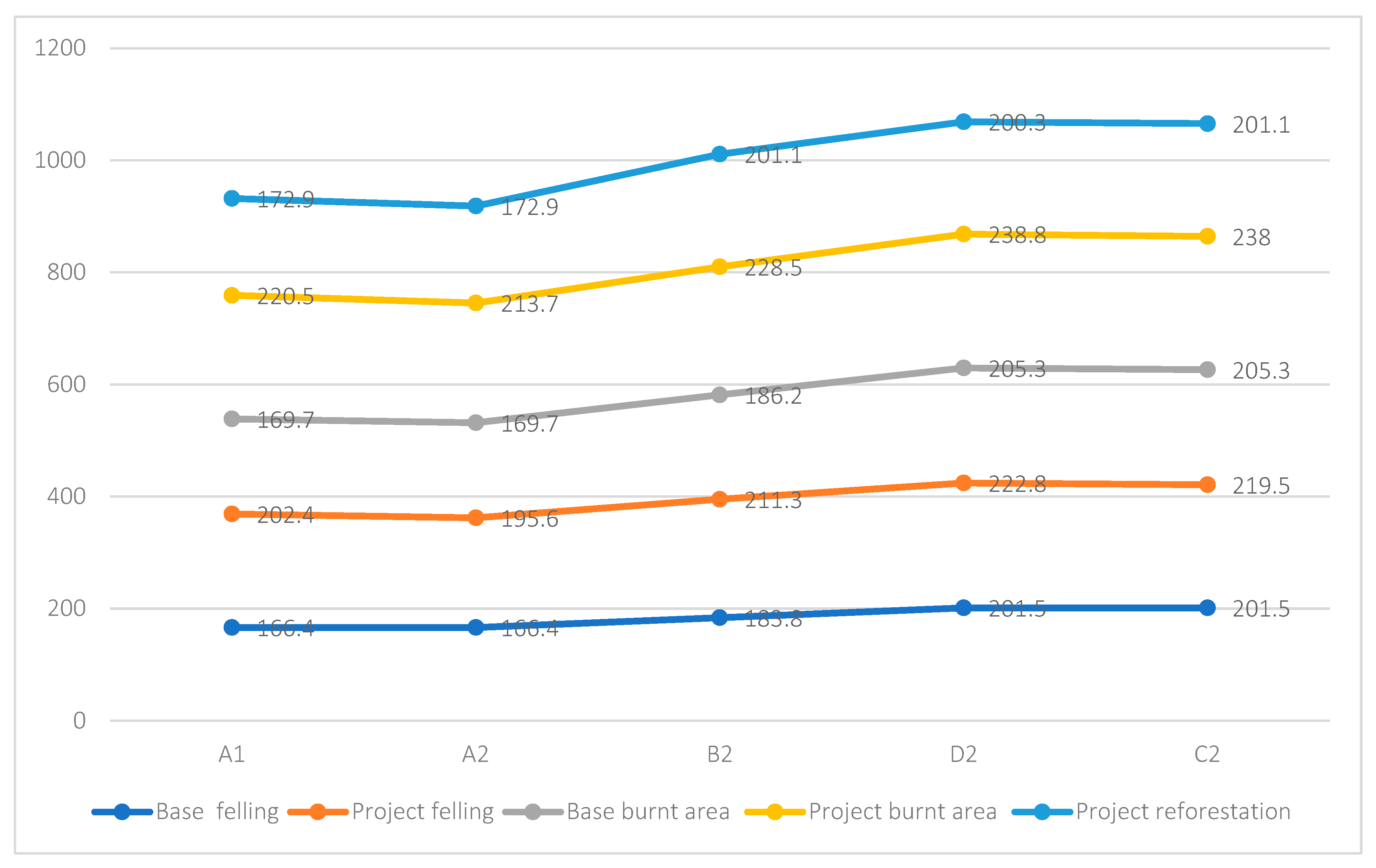
A comparative assessment of the investment costs associated with the implementation of forest-climatic projects along the base and design lines during forest restoration in burnt areas and clear-felling areas is presented in
Figure 1.
The visualization of the dependences of total investment costs on graphs makes it possible to clearly identify differences in the volume of necessary resources for the implementation of project activities depending on the initial conditions: the afforestation of burnt areas and logging. It is noteworthy that projects implemented in areas affected by man-made impacts (burns) are characterized by a higher cost baseline. This is due to the need to ensure carbon conservation in the form of burnt wood remaining in place, which is reflected in the requirements for the volume and technology of forestry activities.
It should be noted that reforestation projects are characterized by the specifics of generating investment costs: the project cost line includes both the costs provided for in the baseline scenario and the additional costs necessary to achieve an increased level of carbon sequestration compared to the baseline.
The classification of the third group of cost models relates to forest-climatic projects for afforestation and reflects the traditional approach to determining the structure and volume of investment costs for this type of environmental protection measure.
When analyzing cost models associated with the implementation of forest-climatic projects of various types, a clear differentiation in the structure and volume of additional investments is revealed. The lowest additional costs are typical for reforestation projects carried out on areas subject to clear cutting—in this case, the main costs come down mainly to traditional measures for planting and caring for young plantings, and the need to carry out additional work is minimal. At the same time, the greatest investment burden is observed in afforestation projects on non-forest lands since these projects require a full range of measures—from territory preparation, infrastructure creation, and agrotechnical work to the subsequent care of new crops, which significantly increases the total cost.
Forest-climatic projects implemented in burnt areas—areas affected by forest fires—deserve special attention. In the structure of their basic costs, a significant share is occupied by costs associated with the disposal or processing of burnt wood, which requires the involvement of special equipment, and additional workers and time, increasing the total cost of the project compared to other similar activities.
Thus, the amount of necessary investment financing for the implementation of a forest-climatic project for reforestation or afforestation in the conditions of the Central Forest-Steppe varies in the range from 121 thousand RUB/ha up to 233 thousand RUB/ha. These values indicate the high capital intensity of such natural and climatic initiatives, which is due to both the complexity of technological processes and the need to take into account socio-economic, biological, and environmental requirements.
For five types of reforestation models (planting of forest crops after clear felling) and five reforestation models on burnt areas, average annual values of carbon sequestration were calculated for three main pools: phytomass, litter and tree litter, and soil organic matter. The establishment of the basic level (line) for CO2 sequestration was made on the basis of selected technical and technological solutions and the established species composition of forest stands and shrub plants, previously scientifically based. The annual average additional carbon sequestration provided by new stands was defined as the algebraic difference between the design and baseline sequestration rates.
Comparison with the published results on the dynamics of growth and biological productivity of stand of various ages shows that the peak of productivity and, accordingly, the intensity of the carbon balance occurs at the age of 45–50 years. After this, the rate of carbon accumulation slows down significantly due to age-related changes in plant biomass. Given that the implementation cycle of most forest climate projects is limited to 15 years, with the possibility of extension to 45 years from the date of planting, three time periods (credit periods) were taken into account when modeling the carbon effect: 15, 30 and 45 years. This made it possible to more objectively assess the climate effectiveness of the investment activities under consideration and their contribution to the long-term reduction of greenhouse gas concentrations in the atmosphere (
Table 4).
Individual scenarios also took into account the possibility of extending the life cycle of forest climate projects to 100 years or more, with the mandatory preservation of the relevant ecosystems, which further increased their strategic importance in the context of regional and global climate commitments.
During the first 15 years after the planting of forest crops, that is, at the stage of formation of young trees, model calculations of forest climatic projects for forest areas of the Central Forest-Steppe, characterized by highly fertile soils, showed the maximum potential for carbon sequestration. During this period, carbon reserves reached from 4.22 tons of CO2 eq./ha (for the Lipetsk region) to 4.72 tons of CO2 eq./ha (for the Kursk region).
These values are explained by the high growth rate of young plantings, which is due to a combination of predominantly optimal soil and climatic conditions and physiological characteristics of the early age of woody plants, when the maximum increase in phytomass is observed. The richness of soils contributes to the accelerated accumulation of the biomass of aboveground and underground organs, which determines the high rate of carbon accumulation compared to less fertile or degraded areas.
In the age range from 15 to 30 years, there is a tendency to reduce the volume of greenhouse gas sequestration by forest plantations in similar types of forest vegetation conditions. The values of annual CO2 equivalent absorption for these forest areas are 3.81 tons of CO2 eq./ha (Lipetsk region) and 4.31 tons of CO2 eq./ha (Kursk region), respectively. This reduction is primarily due to an increase in the volume of tree litter in aging forest stand, as well as a change in the structure of biomass growth and a redistribution of carbon flows between phytomass, tree litter, and soil organic matter.
These calculations confirm the presence of a pronounced downward trend in the dynamics of CO2 equivalent absorption volumes as plantings age, up to 45 years of age. Further analysis shows that on soils with low nutrient supply and insufficient moisture in older age groups, significant tree litter forms, which leads to a negative balance—that is, to the predominance of greenhouse gas emissions over their absorption. These processes are clearly manifested, for example, in the simulated average annual sequestration volumes for all pools in 45-year-old plantings of climate projects in the Kursk region, where the total carbon balance becomes negative.
Thus, the potential and effectiveness of organizing forest climatic projects within the Central Forest-Steppe are largely determined by the natural, climatic, and soil characteristics of the study areas, which directly affect the productivity of forest stand and the long-term sustainability of carbon sequestration.
At the same time, additional volumes of greenhouse gas absorption achieved in moderately poor and rich soils show positive dynamics and indicate the presence of significant opportunities for the implementation of project activities in the field of reforestation, subject to the competent selection of areas and optimal approaches to forestry work.
To correctly assess the environmental and economic efficiency of forest-climatic projects on the lands of the forest fund of the Central Forest-Steppe of the European part of the Russian Federation, it is advisable to consider at least fifteen model scenarios reflecting the variety of reforestation and afforestation options, taking into account soil characteristics, climatic factors, and the species compositions of the created plantings. This integrated approach makes it possible to increase the accuracy of climate performance forecasts and ensure the adequate validity of decisions made when implementing environmental and investment initiatives.
During the research, the values of the carbon intensity coefficient of investment costs were calculated for forest-climatic reforestation projects implemented in forest areas with different types of forest vegetation conditions in the regions of the Central Forest-Steppe of the European part of Russia. These coefficients were determined separately for various models of project implementation in burnt areas in the studied areas (Belgorod, Voronezh, Kursk, Lipetsk, and Tambov regions) on the basis of model scenarios previously developed by the authors.
In the 45-year forecast period, the values of the carbon intensity coefficient varied within the range of 0.314 to 1.502 t CO2-eq./thousand RUB per 1 ha, depending on the species composition of the plantations corresponding to certain forest growing conditions:
- -
A1—5P4Ca1E (pine, caragana, elm);
- -
A2—5P3E2Ca (pine, elm, caragana);
- -
B2—3P3B2Pl2O (pine, birch, poplar, oak);
- -
D2—5O2M3Pl (oak, maple, poplar);
- -
C2—4O3P3Pl (oak, pine, poplar).
The analysis showed that the carbon intensity of investments in forest-climatic projects in burnt areas was relatively low, which was due to the significant volume of one-time investments at the initial stage, as well as the need to carry out additional forest cultivation activities compared to the baseline scenario.
In conditions of mesoxerophilic and mesophilic pine woods (A1, A2), the carbon intensity coefficients of investment costs over a 45-year period did not reach a value of 1, which indicates the relatively low efficiency of such projects in terms of reducing greenhouse gas emissions per invested monetary unit.
In pine forests with a mixture of spruce, birch, and other wood species, growing on sandy loam or clay sands (subors) (B2), the economic feasibility of climate reforestation projects manifested itself only 30 years after the start of implementation, when the carbon intensity coefficient exceeded 1. The highest economic potential in these conditions was shown by projects for the Tambov region (1.255 tons of CO2eq./thousand RUB) and the Lipetsk region (1.253 tons of CO2eq./thousand RUB), while for the Belgorod region, this figure was 1.195 tons of CO2eq./thousand RUB, which determined the relatively lower attractiveness of investments in this region.
For the conditions of coniferous-leaved multi-tiered forests (sudubravas) (C2), the maximum values of the carbon intensity coefficient were obtained for the Tambov region (1.502 tons of CO2eq./thousand RUB), while the minimum values were typical for the Kursk region, where the coefficient was 1.400 tons of CO2eq./thousand RUB.
In oak forests (D2) in burnt areas, the highest values of the carbon intensity coefficient were also noted for the Tambov (1.462 tons of CO2 eq./thousand RUB) and Lipetsk regions (1.457 tons of CO2 eq./thousand RUB), which indicates the significant economic potential of forest-climatic reforestation projects in these territories.
Thus, the calculation of carbon intensity coefficients indicates a significant difference in the environmental and economic efficiency of the implementation of forest-climatic projects depending on the type of forest vegetation conditions and the region. The highest values of the indicator, indicating the feasibility and efficiency of investment, were achieved for projects on burnt areas in coniferous-leaved multi-tiered forests (sudubravas) and oak forest conditions in the Tambov and Lipetsk regions, which was due to the high productivity of these territories and optimal conditions for the formation of a carbon depot. At the same time, relatively low coefficient values for projects on mesoxerophilic and mesophilic pine woods determined the lower investment attractiveness of such scenarios.
As part of the implementation of climate projects for reforestation in areas after clear felling, the values of the carbon intensity coefficient of investment costs for various types of forest vegetation conditions in the regions of the Central Forest-Steppe of the European part of Russia were determined. In a 45-year perspective, this figure varied from 0.354 to 1.624 tons of CO
2-eq./thousand RUB per 1 hectare, depending on the species composition of the plantings, selected for specific forest and vegetation conditions [
42].
Modern research indicates significant advantages of mixed forest stands compared to common pine (
Pinus sylvestris L.) monocultures in the forest-steppe zone. Analysis of forest ecosystem dynamics shows that monoculture pine trees in mesoxerophilic and mesophilic pine woods (forest growing conditions types A1-A2) are characterized by reduced resistance to biotic and abiotic factors. The progressive degradation of the forest environment is observed, which is expressed in a decrease in biodiversity, the deterioration of soil characteristics, and increased vulnerability to pathogens [
43,
44,
45].
Experimental data show that the introduction of silver birch (Betula pendula Roth) or asp (Populus tremula L.) into plantations in a 20–30% ratio leads to a significant improvement in the ecological indicators of forest biogeocenoses. The mechanism of positive influence is related to the activation of the biological cycle of substances, the formation of a more complex spatial structure of plantations, and increasing the stability of the ecosystem as a whole.
In terms of carbon balance [
46,
47], a mixed forest stand shows 15–20% higher productivity compared to a pure pine stand of the same age. This is due to both the more efficient use of environmental resources by different species and the improvement of soil conditions. The increase in carbon deposits in the organic matter of the soil is particularly significant—by 25–30% compared to monocultures.
From an economic point [
48,
49,
50] of view, the transition to mixed plantations allows for the optimization of costs for forest restoration and subsequent forest management. Reducing the costs of protective measures and care felling compensates for the initial investment in more complex forestry production. The additional economic effect is the possibility of obtaining by-products of use.
However, the implementation of this model faces a number of organizational and technological difficulties. The main limiting factors are the lack of planting material of leafy species of the required quality, the lack of proven technologies for creating mixed crops, and the conservatism of traditional approaches in forestry.
To overcome these barriers, a comprehensive program of measures is needed, including the modernization of the forest seed base, the development of new regulatory documents, and the creation of an economic incentive system. The improvement of methods for predicting the development of mixed plantations, taking into account the regional characteristics of the forest-steppe zone, is of particular importance.
The prospects for the development of this area are linked to the integration of sustainable forest use principles into forest restoration practices. This will allow for the creation of highly productive forest ecosystems that optimally combine economic efficiency and environmental sustainability, which corresponds to both national forestry priorities and international environmental protection obligations.
An analysis of the carbon intensity coefficients of investment costs indicates the different economic attractiveness of forest-climatic projects depending on the type of forest vegetation conditions and the region of implementation. Thus, for conditions of mesoxerophilic and mesophilic pine forests (A1; A2), based on the results of a 45-year period, the coefficient values do not reach the threshold level of 1 t CO2-eq./thousand RUB, which indicates the limited economic potential for implementing climate projects given the initial characteristics—the costs of sequestration of one ton of CO2 are relatively high and the return on investment is low.
In turn, during the restoration of forests in felling conditions under pine forests with a mixture of spruce, birch, and other wood species, growing on sandy loam or clay sands (subors); oak forests; and coniferous-leaved multi-tiered forests (sudubravas) (B2; D2; C2), projects become economically feasible starting from a 30-year service life since the carbon intensity coefficient exceeds one, which indicates an increase in the efficiency of using investment resources for the accumulation of carbon reserves in forest ecosystems.
The most significant values of the carbon intensity coefficient based on the results of a 45-year period were obtained for climate projects in the Tambov region on felling in pine forests with a mixture of spruce, birch, and other wood species, growing on sandy loam or clay sands (subors) conditions (B2), where, with investment costs of 203.92 thousand RUB/ha, the coefficient was 1.355 tons of CO2-eq./thousand RUB, as well as on felling in oak forest conditions (D2)—1.581 tons of CO2-eq./thousand RUB. Similar projects in the Lipetsk region have shown similar high potential, where the coefficient for oak forests was 1.576 tons of CO2-eq./thousand RUB.
At the same time, from an economic point of view, the least attractive were climatic projects for forest restoration in felling in pine forests with a mixture of spruce, birch, and other wood species, growing on sandy loam or clay sands (subors) conditions (B2), in the Kursk region (coefficient—1.259 t CO2-eq./thousand RUB), as well as in oak forest conditions (D2) in the Voronezh and Kursk regions (1.486 t CO2-eq./thousand RUB). This was due both to less favorable soil and climatic characteristics and to the peculiarities of the growth dynamics and productivity of forest stands in these areas.
Thus, the obtained results allow us to conclude that the effectiveness of implementing forest-climatic projects for forest restoration after felling varies significantly depending on the region and the types of forest growing conditions. The maximum economic and climatic effect is achieved when projects are implemented in areas with high-yielding forest conditions, making them a priority for investment and environmental activities within the framework of implementing national and regional climate change programs.
In the conditions of felling in the coniferous-leaved multi-tiered forests (sudubravas) (C2) over a 45-year period, climate forest restoration projects in the Tambov region will have the greatest economic potential among the regions under consideration. At a level of investment costs of 203.92 thousand RUB per hectare, the carbon intensity coefficient here reaches 1.624 tons of CO2 equivalent per thousand RUB of investment. This indicates higher investment efficiency in terms of greenhouse gas absorption.
From an economic and climatic point of view, similar forest restoration projects in the Kursk region proved to be the least attractive; these projects are also being implemented in the coniferous-leaved multi-tiered forests (sudubravas) of the Central Forest-Steppe Zone (C2). Here, the carbon intensity coefficient of investment costs is 1.515 tons of CO2-eq./thousand RUB, which indicates a slightly lower return on investment in the volume of absorbed carbon compared to the Tambov region.
Thus, a comparative analysis shows that, under otherwise equal conditions, forest restoration climate projects in the Tambov region provide a better return on investment than similar projects in the Kursk region. Such data can be used to prioritize regions when choosing areas for implementing climate initiatives and investment programs in forest restoration.
4. Discussion
The results of the study confirm the significant potential of forest-climatic projects in achieving carbon neutrality in the Central Forest-Steppe, but their effectiveness directly depends on taking into account biological and economic limitations. The introduced coefficient of carbon intensity of investment costs (CCIIC = 1.1–2.7 RUB/kg CO
2eq.) serves as a reliable tool for assessing projects but requires critical reflection in the context of regional characteristics. As Lukina et al. (2020) [
43] notes, monocultures of Scots pine (Pinus sylvestris) in low-yielding mesoxerophilic pine forests (type of forest vegetation conditions A1-A2) show low efficiency due to a violation of the principle of additionality: their carbon balance is inferior to natural regeneration by deciduous species. This is consistent with our data, where the coefficient of carbon intensity of investment costs in such conditions did not exceed 0.8 tons of CO
2eq./thousand RUB, which confirms the need to switch to mixed plantings with a birch or aspen share of 20–30% to increase sequestration by 15–40%.
The legal environment for forest-climatic projects is being transformed with the adoption of Federal Law №492 (2024) [
51], establishing new requirements: the registration of projects in the register of carbon units for 5 years, separation of the concepts of forestry and forest-climatic project, and regulation of agreements on forest lands. However, gaps remain, especially in terms of the use of abandoned agricultural land, the potential of which, for the Central Forest-Steppe is estimated at 1.5–2 million tons of CO
2eq./year. Without their legislative inclusion in the carbon regulation system, large areas will remain unclaimed. The analysis of the effectiveness of the different types of forest-climatic projects revealed a clear hierarchy. The most effective projects were intensive farming in oak forests (type of forest vegetation conditions D2), where sequestration reached 7.5–8.3 tons of CO
2/ha/year with a carbon intensity factor of investment costs of 1.6–1.8 RUB/kg CO
2-eq. At the same time, protective afforestation on the slopes of beams, although it showed moderate absorption rates (3.8–4.2 tons of CO
2/ha/year), was characterized by minimal risks and the stable survival of crops. As Strassburg et al. (2020) [
44], Shvarts, E.A. et al. [
52] noted, prioritizing such sustainable projects is consistent with global trends in the restoration of degraded landscapes. In contrast, initiatives to reduce forest burning have shown economic failure (carbon intensity ratio of investment costs >2.5), which confirms the conclusions of Ptichnikov [
53,
54] on the need to subsidize them.
The integration of forest climate projects into regional strategies provides a synergistic effect. In type of forest vegetation conditions C2/D2, the introduction of mixed crops increased biodiversity by 25–30% due to an increase in the number of birds and soil mesofauna, which correlated with data from Bukvareva et al. (2019) [
49] on the assessment of ecosystem services. Economic feasibility was achieved at the price of carbon units ≥USD 15/t CO
2, which was confirmed by the practice of Russian companies (Sber, JSC Kontur) in creating transparent accounting systems. However, the key condition remains the development of regional monitoring standards integrating Earth remote sensing data (Sentinel-2, Canopus-B) and ground measurements to minimize model errors.
Critical barriers to scaling forest climate projects include the following:
Methodological risks—static models (CO2FIX) excluding climate anomalies overestimate sequestration forecasts by 12–18%;
Economic uncertainty—price volatility in carbon markets (USD 5–20/t CO2) reduces the profitability of projects with a carbon intensity ratio of investment costs > 1.8;
Legal conflicts—the ban on the use of forested agricultural land excludes 1.2 million hectares of potential territories.
The research identified limitations related to the need to verify the results obtained using Earth remote sensing data and to expand the empirical long-term monitoring base to improve model representativeness. A significant uncertainty factor is the high sensitivity of project cost-effectiveness to carbon unit price volatility, which poses risks to sustainable financing. Promising areas include the development of specialized GIS platforms for the spatial analysis and optimization of projects, a comprehensive assessment of associated ecosystem services to inform projects, and a study of the synergies of afforestation with agro-ecological approaches. As Han, H. et al. [
55], Hartmann, H. et al. [
56], and Almalki R. et al. [
57] note, the combination of dynamic models with Earth remote sensing data and ground-based measurements of carbon polygons will improve the accuracy of predictions.
Thus, the successful integration of forest climate projects into the development strategies of the Central Forest-Steppe requires a three-pronged approach:
- -
Biological validity—the abandonment of monocultures in favor of adaptive mixed plantings;
- -
Legal synchronization—the removal of barriers to the use of abandoned land within the framework of Federal Law №492;
- -
Economic mechanisms—the application of the carbon intensity factor of investment costs as an indicator for prioritizing projects.
The implementation of these measures will achieve sequestration targets (28–30% by 2030), strengthening the role of the Central Forest-Steppe regions in achieving Russian carbon neutrality.
5. Political Implications and Recommendations for Integrating Forest Climate Projects into Russia’s Sustainable Development Strategy
In the context of global climate change and sanctions pressure on the Russian Federation’s economy, forest-climate projects are becoming an important tool for achieving carbon neutrality, import substitution in environmental technologies, and the socio-economic development of regions. However, the current policy in this area has a number of gaps that require adjustments.
The successful implementation of measures to create a carbon regulation system and achieve the goals of decarbonizing the economy requires the clear coordination of actions by all participants in the process, reliable resource provision, and effective risk management.
This section defines the organizational and financial mechanism for implementing the key elements of the system, including regulatory and legal support, the establishment of financial institutions, and the practical testing of technologies at the regional level.
The implementation of the planned measures will be carried out on the principles of interdepartmental interaction and public–private partnership, which will allow consolidating budget funds and attracting private investment in “green” projects. For each key initiative, responsible executors, funding sources, and clear timeframes have been defined, ensuring the manageability of the process and achieving the set results.
Below
Table 5 is a detailed list of main measures, resources, and implementation deadlines.
- 4.
Expected benefits
The implementation of the carbon regulation system is designed to generate significant multi-level benefits for all key stakeholders.
For the state, this initiative is a strategic step towards fulfilling its international commitments under the Paris Agreement, specifically targeting a 30% reduction in greenhouse gas emissions by 2030. Furthermore, the development of a new economic sector is projected to be a catalyst for growth, potentially increasing the national GDP by 0.5–1% through the creation of new jobs and related industries in the forestry and environmental sectors.
For business, the framework creates a direct economic incentive by enabling companies to generate and monetize carbon units, with potential revenue streams estimated between USD 5 and USD 20 per ton of CO2 equivalent on international markets. Beyond direct financial gains, active participation enhances corporate reputation and provides a powerful tool for ESG-branding, thereby mitigating non-financial risks and potential sanctions tied to environmental performance.
For the regions, the benefits are twofold: environmental and infrastructural. The program will drive the large-scale restoration of degraded forest lands, with a goal of improving the condition of up to 20% of such areas by 2030. Concurrently, project activities will stimulate the development of critical local infrastructure, including the construction and modernization of roads and the establishment of modern nurseries, leading to broader socio-economic development.
Next steps:
Submit the draft law to the State Duma by the end of 2030.
Launch pilot projects in the Belgorod, Voronezh, and Kursk regions.
Integrate carbon units into exchange trading.
The obtained results create a scientific and methodological basis for transitioning from local initiatives to a systematic state policy in the field of climate-optimized forest use, which corresponds to both Russia’s international obligations and national sustainable development priorities.
6. Conclusions
The integration of forest-climatic projects into the regional strategies of the Central Forest-Steppe of Russia appears to be a key tool for achieving national climatic and socio-economic goals. The results of the study show that with an increase in the forest cover of the region by 1% (about 180 thousand hectares), the annual additional absorption of CO2 equivalent can be 0.9–1.1 million tons. In particular, the largest increase in the effect is expected in the Voronezh (forestry 11.5%) and Kursk (13.7%) regions, where the share of degraded and unsatisfactory forest functioning lands exceeds 50 thousand hectares. The opportunities to reduce the carbon footprint and increase the economic return from climate initiatives are especially relevant for the regions of the Central Forest-Steppe, which are characterized by high population density and intensive agricultural development: in the Tambov region, the share of forests is only 7.1%, which indicates significant potential for afforestation.
The introduction of a carbon intensity coefficient for investment costs significantly increases the objectivity and comparability of the assessment of various climate solutions. In the analyzed projects of the Central Forest-Steppe, a dispersion of the carbon intensity coefficient was recorded from 1.1 to 2.7 RUB/kg CO2eq., depending on the region, the type of forest-vegetation conditions, and the applied restoration technologies. The lowest values were achieved in floodplain and wet beam conditions (1.1–1.3 RUB/kg), while on loamy-dry and unproductive soils, they reached 2.2–2.7 RUB/kg. This makes it possible to identify promising regions and technologies that reduce the cost of creating 1 ton of absorbed CO2 equivalent.
The greenhouse gas absorption potential of forest ecosystems in the Central Forest-Steppe has not been sufficiently realized in existing regional strategies, although calculations show the possibility of increasing the sequestration potential of forests to 28–30% by 2030. For example, in the Voronezh and Tambov regions, the potential for increasing absorption capacity is estimated at 250–310 thousand tons and 140–170 thousand tons of CO2-eq., respectively, per year, even with regional budget and area restrictions. Such an increase can cover up to 10–12% of emissions from industrial enterprises of the relevant regions.
The identified regional variability in environmental and economic efficiency indicators confirms the need for a comprehensive adaptation of assessment methods and the legal regulation of accounting for carbon units for forest plant conditions. For example, for the Tambov region, the investment efficiency coefficient is 1.62 tons of CO2-eq./thousand RUB, and for the Kursk region, it is 1.51 tons of CO2-eq./thousand RUB. This approach will ensure the targeted attraction of investments aimed at restoring the most promising and productive natural complexes.
The implementation of forest-climatic projects on the principles of an integral ecological and economic criterion will allow the regions of the Central Forest-Steppe to increase the transparency, validity, and investment attractiveness of their sustainable development strategies. The formation of a green economy and a corresponding market for climate services can provide an additional income of 1.6–2.2 billion RUB per year through the sale of carbon units, as well as through the creation of new jobs and the preservation of biodiversity—mainly in areas with forest cover below the regional average.
The results obtained in the research can be used by government authorities of the constituent entities of the Central Forest-Steppe, business, and the expert community to improve climate and investment policies, taking into account the regional characteristics of forest conditions, land use structures, and socio-economic challenges. This will lay the foundation for the formation of new mechanisms to stimulate sustainable forest management and the interregional exchange of best practices.
Thus, the research comprehensively reveals the scientific, methodological, and applied aspects of integrating forest-climatic projects into regional strategies for the sustainable development of the Central Forest-Steppe of Russia. Based on the analysis of empirical data and statistical and model calculations, as well as taking into account the diversity of forest conditions and regional specifics, the effectiveness of integrated natural and climatic solutions for increasing environmental and economic sustainability and achieving national climate goals is substantiated.
It has been established that adapting the mechanisms for implementing forest-climatic projects based on integral indicators, such as the carbon intensity coefficient of investments costs, makes it possible to objectively measure and compare the contribution of different regions and technologies to carbon sequestration. This, in turn, opens up new opportunities for attracting investment, developing carbon markets, creating a green economy, and strengthening the position of regions in national and international climate policy.
Regional differences in the productivity of forest ecosystems, land use patterns, levels of human pressure, and resource availability require further detail in approaches to planning and implementing forest climate projects. A fundamentally significant task is the development of expanded methods for the spatial analysis of carbon sequestration potential, taking into account landscape, soil-climatic, and socio-economic factors. Particular attention should be paid to issues of interaction with the agricultural sector, agroforestry, and the integration of small- and medium-sized farms into climate initiatives.
The prospects for further research are as follows:
- -
The creation and testing of regional digital platforms for monitoring and managing forest climate projects, using GIS technologies and modern spatial modeling methods;
- -
The development of targeted investment standards, taking into account forest and vegetation conditions, biological and economic potential of territories;
- -
The multicriterion assessment of ecosystem services and determination of their contribution to the socio-economic development of regions;
- -
The study of mechanisms for integrating forest-climatic projects with other sectors of environmental management, primarily agriculture and the water and soil protection system;
- -
The formation of new climate and investment policy instruments based on regional characteristics, which is especially relevant for entities with low forest cover and high vulnerability to climate risks.
At the same time, regional differences in the productivity of forest ecosystems, land use structures, levels of anthropogenic load, and resource availability require further detailing of approaches to the planning and implementation of forest climate projects. As the results have shown, the successful integration of these projects into sustainable development strategies is possible only if three key conditions are simultaneously met: the biological validity of the species composition, legal synchronization with new regulatory requirements (Federal Law of the Russian Federation №492), and economic efficiency, measured through the carbon intensity coefficient of investment costs.
In the long term, the results and approaches developed for the Central Forest-Steppe can be replicated in similar natural and socio-economic conditions in other regions of the country, increasing the effectiveness and sustainability of national climate policies.




 ,
,