Systematic Review

A Systematic Review of Technological Strategies to Improve Self-Starting in H-Type Darrieus VAWT

by
Jorge-Saúl Gallegos-Molina
1 and
Ernesto Chavero-Navarrete
2,*
1
Posgrado CIATEQ AC, Centro de Tecnología Avanzada, Lerma de Villada 52004, Estado de México, Mexico
2
CIATEQ AC, Centro de Tecnología Avanzada, Querétaro 76150, Querétaro, Mexico
*
Author to whom correspondence should be addressed.
Sustainability 2025, 17(17), 7878; https://doi.org/10.3390/su17177878
Submission received: 29 July 2025 / Revised: 24 August 2025 / Accepted: 29 August 2025 / Published: 1 September 2025

Abstract

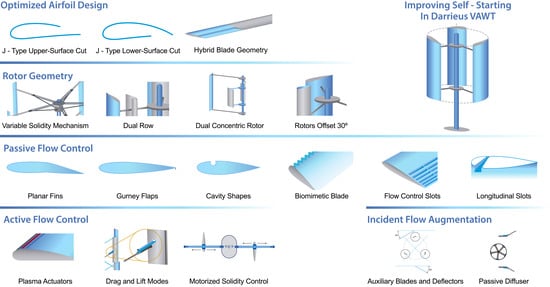
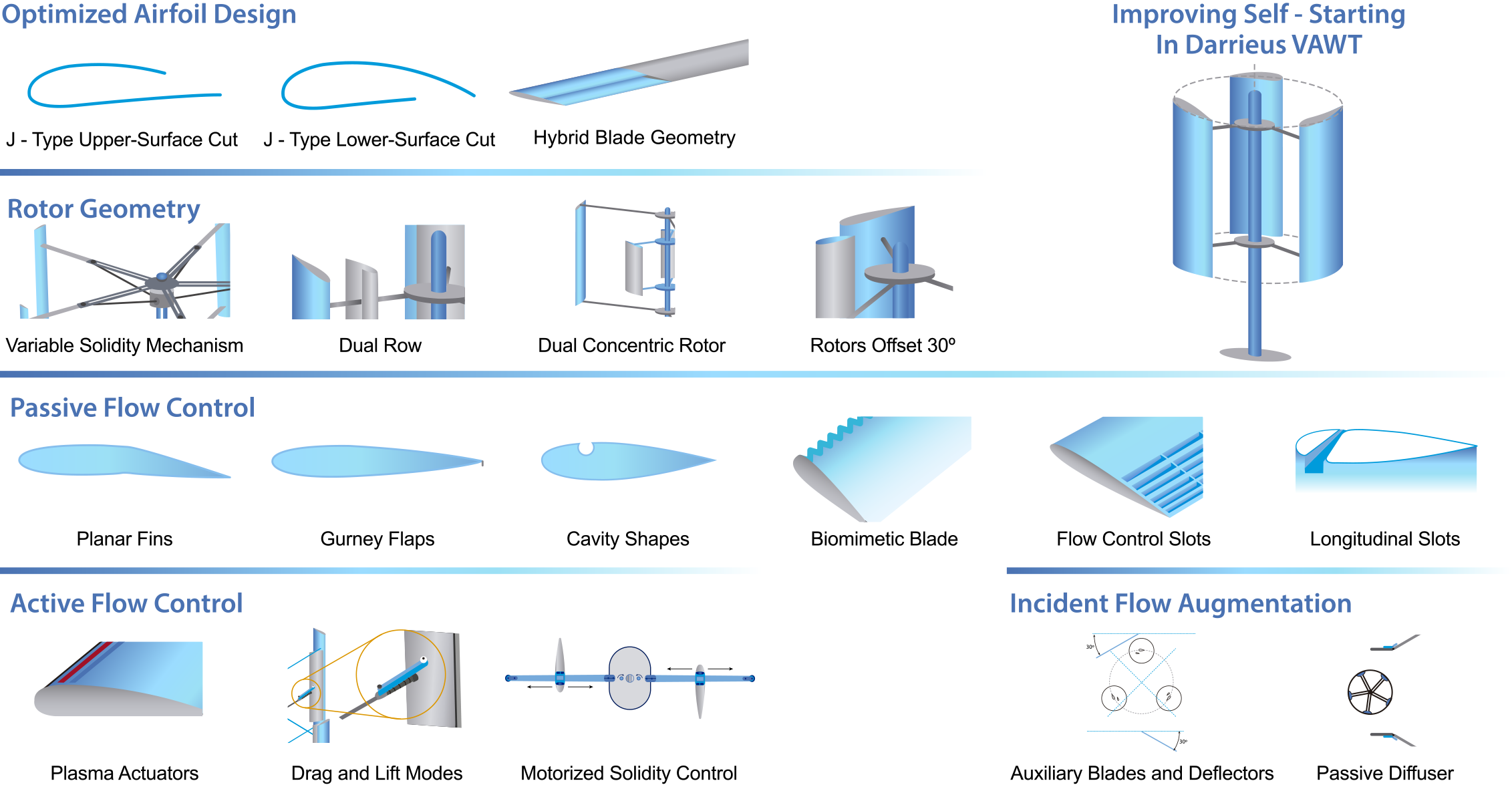
The self-starting capability of straight-bladed H-type Darrieus Vertical Axis Wind Turbines (VAWTs) remains a major constraint for deployment, particularly in urban, low speed, and turbulent environments. We conducted a systematic review of technological strategies to improve self-starting, grouped into five categories: (1) aerodynamic airfoil design, (2) rotor configuration, (3) passive flow control, (4) active flow control, and (5) incident flow augmentation. Searches in Scopus and IEEE Xplore (last search 20 August 2025) covered the period from 2019 to 2026 and included peer-reviewed journal articles in English reporting experimental or numerical interventions on H-type Darrieus VAWTs with at least one start-up metric. From 1212 records, 53 studies met the eligibility after title/abstract screening and full-text assessment. Data were synthesized qualitatively using a comparative thematic approach, highlighting design parameters, operating conditions, and performance metrics (torque and power coefficients) during start-up. Quantitatively, studies reported typical start-up torque gains of 20–30% for airfoil optimization and passive devices, about 25% for incident-flow augmentation, and larger but less certain improvements (around 30%) for active control. Among the strategies, airfoil optimization and passive devices consistently improved start-up torque at low TSR with minimal added systems; rotor-configuration tuning and incident-flow devices further reduced start-up time where structural or siting constraints allowed; and active control showed the largest laboratory gains but with uncertain regarding energy and durability. However, limitations included heterogeneity in designs and metrics, predominance of 2D-Computational Fluid Dynamics (CFDs), and limited 3D/field validation restricted quantitative pooling. Risk of bias was assessed using an ad hoc matrix; overall certainty was rated as low to moderate due to limited validation and inconsistent uncertainty reporting. In conclusions, no single solution is universally optimal; hybrid strategies, combining optimized airfoils with targeted passive or active control, appear most promising. Future work should standardize start-up metrics, adopt validated 3D Fluid–Structure Interaction (FSI) models, and expand wind-tunnel/field trials.

Graphical Abstract

1. Introduction

Growing concerns about climate change, environmental degradation, and the depletion of natural resources have led to a global imperative to reduce dependence on fossil fuels for power generation. This challenge has been further intensified by rapid population growth and the resulting increase in energy demand, which has exacerbated the environmental impacts associated with intensive fossil fuel use [1].
In this context, renewable energy sources have become a central pillar in the transition toward more sustainable energy systems. Among these, wind energy has emerged as one of the most promising alternatives due to its technical viability and its potential to significantly reduce greenhouse gas emissions. According to the International Energy Agency [2], the power sector emitted 13 gigatons of carbon dioxide in 2021, more than one-third of global energy-related emissions. To meet global climate targets by 2030, renewable capacity must triple, with wind and photovoltaic solar power leading this growth.
The International Electrotechnical Commission [3] emphasizes that expanding renewable energy not only helps mitigate climate change but also supports rising energy demand, particularly in developing regions. In this regard, Vertical Axis Wind Turbines (VAWTs) have regained attention for small-scale and urban applications due to their ability to capture wind from any direction and operate more reliably in turbulent environments [4,5].
Among VAWT configurations, the H-type Darrieus turbine stands out for its compact design and structural simplicity, making it suitable for residential or distributed generation scenarios. While their nominal power output is typically low due to size constraints, large-scale deployment of these turbines could significantly contribute to renewable electricity generation. However, the following key limitation remains: their poor self-starting capability, primarily due to insufficient starting torque at low tip speed ratios (TSRs). This dimensionless parameter describes the relationship between the tangential velocity at the blade tip and the incident wind speed. A low TSR indicates that the blades are moving slowly relative to the wind, whereas a high TSR means they are rotating substantially faster, both of which directly influence aerodynamic performance and start-up efficiency [4,6,7].
This problem has been extensively documented in the literature, prompting the development of various strategies aimed at improving start-up performance through aerodynamic blade redesign. Common approaches include asymmetric profiles, modified geometries, hybrid Savonius-Darrieus rotors, and both passive and active pitch control mechanisms [8,9]. Many of these solutions involve a trade-off between improved self-starting and reduced steady-state efficiency, typically reflected in a lower power coefficient (CP) at high TSR values. CP represents the fraction of the wind’s available kinetic power that the turbine converts into useful mechanical power at the rotor shaft. Its theoretical maximum value, defined by Betz’s law, is 0.593, meaning that no wind turbine can capture more than 59.3% of the wind’s kinetic energy. [4].
Given the diversity of existing approaches, this systematic review aims to identify, classify, and critically compare technological strategies to enhance the self-starting performance of straight-bladed, H-type Darrieus VAWTs. Specifically, we synthesize evidence into five categories: (1) airfoil geometry optimization, (2) rotor structural configuration, (3) passive flow-control devices, (4) active flow-control systems, and (5) incident-flow augmentation. Under low-TSR conditions, we evaluate start-up performance outcomes, including cut-in wind speed, CP, and Torque Coefficient (CM). The latter is a dimensionless parameter representing the ratio between the aerodynamic torque developed by the rotor and the kinetic energy available in the incident flow. Secondary objectives are to assess methodological quality and risk of bias, quantify typical effect sizes where possible, and outline trade-offs, feasibility, and applicability for small-scale and urban deployments.
The remainder of the article is organized as follows: Section 2 introduces the technical fundamentals of self-starting in Darrieus wind turbines covering aerodynamic principles, operating characteristics, and performance formulations. Section 3 details the materials and methods, structured in accordance with PRISMA 2020 guideline [10], including the search strategy, eligibility criteria, study selection, data extraction, synthesis methodology, and risk-of-bias assessment. Section 4 presents the results, featuring the PRISMA flow diagram and a comparative synthesis of evidence grouped by five strategy families, along with cross-cutting analyses of heterogeneity, publication/reporting bias, and certainty of the evidence; Section 5 delivers a critical discussion; Section 6 highlights research gaps and emerging trends; and Section 7 provides the main conclusions.

2. Technical Fundamentals of Self-Starting in H-Type Darrieus Wind Turbines

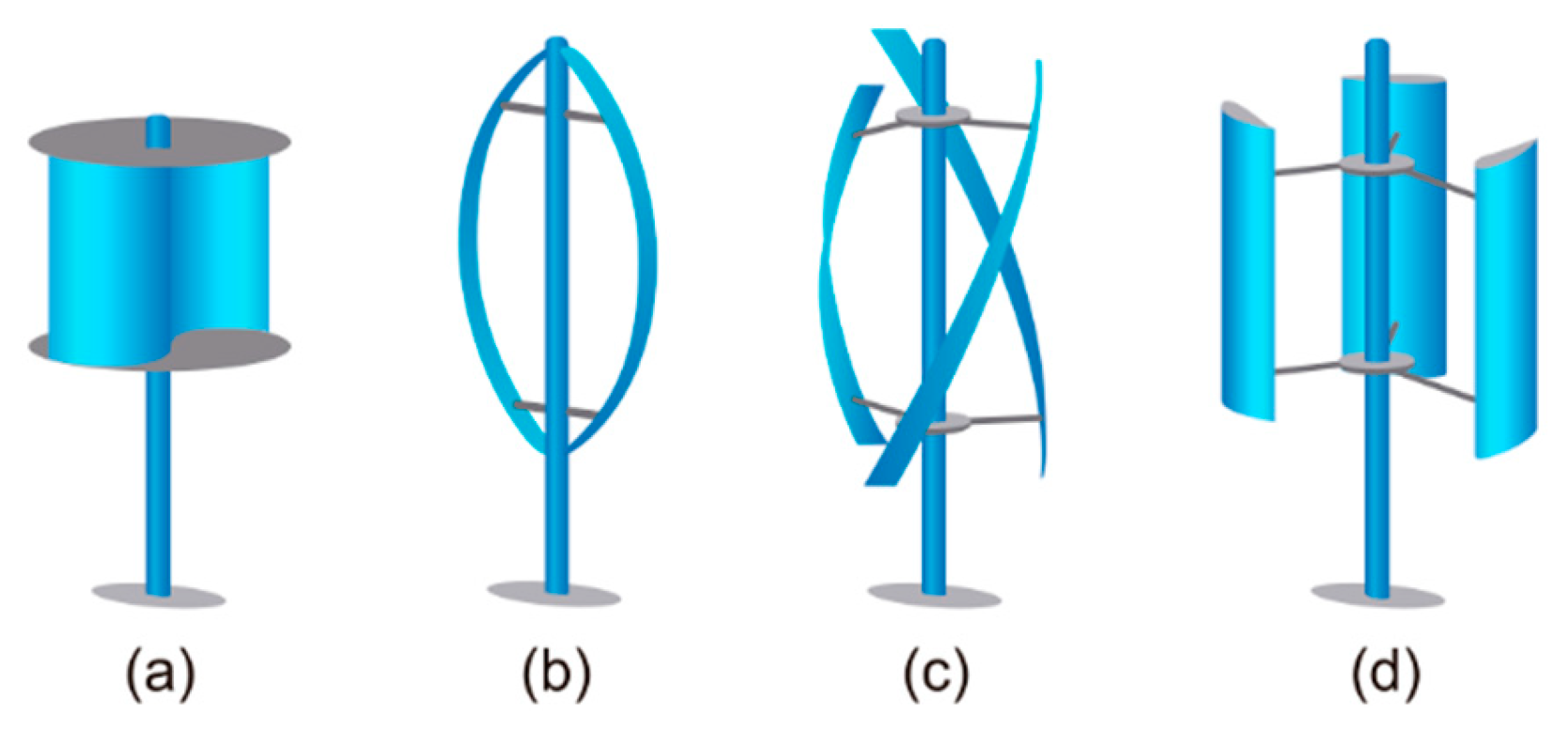
Wind turbines are generally classified into two categories based on the orientation of their rotational axis: Horizontal Axis Wind Turbines (HAWTs) and VAWTs [11]. HAWTs feature a horizontal axis parallel to the ground and operate in either upwind or downwind configurations [12]. In contrast, VAWTs are further subdivided according to the dominant aerodynamic force acting on their blades: drag-driven designs, such as the Savonius rotor, and lift-driven designs, with the Darrieus rotor being the primary representative. The latter can be categorized into three main variants based on blade geometry: the eggbeater (curved-blade) type, the helical type, and H-type with straight blades [13]. Figure 1 illustrates the principal VAWT configurations, highlighting their distinct geometric characteristics.
The H-type Darrieus VAWT employs straight blades arranged parallel to the rotational axis, connected to a central shaft via radial arms. This geometric configuration provides an efficient structural solution that maintains a consistent lift path throughout the rotor’s revolution. Compared to other variants, such as helical or eggbeater designs, the H-type exhibits a simpler aerodynamic behavior that is easier to model, although it remains highly sensitive to incoming flow conditions. In this turbine configuration, blade design, including airfoil profile, angle of attack, and angular positioning, plays a critical role in aerodynamic torque generation [5]. Therefore, understanding the operating principles and aerodynamic interactions associated with this configuration is essential for optimizing overall performance, particularly during transitional phases such as start-up.

2.1. Evolution of the Self-Starting Concept and Torque Generation in Darrieus-Type Turbines

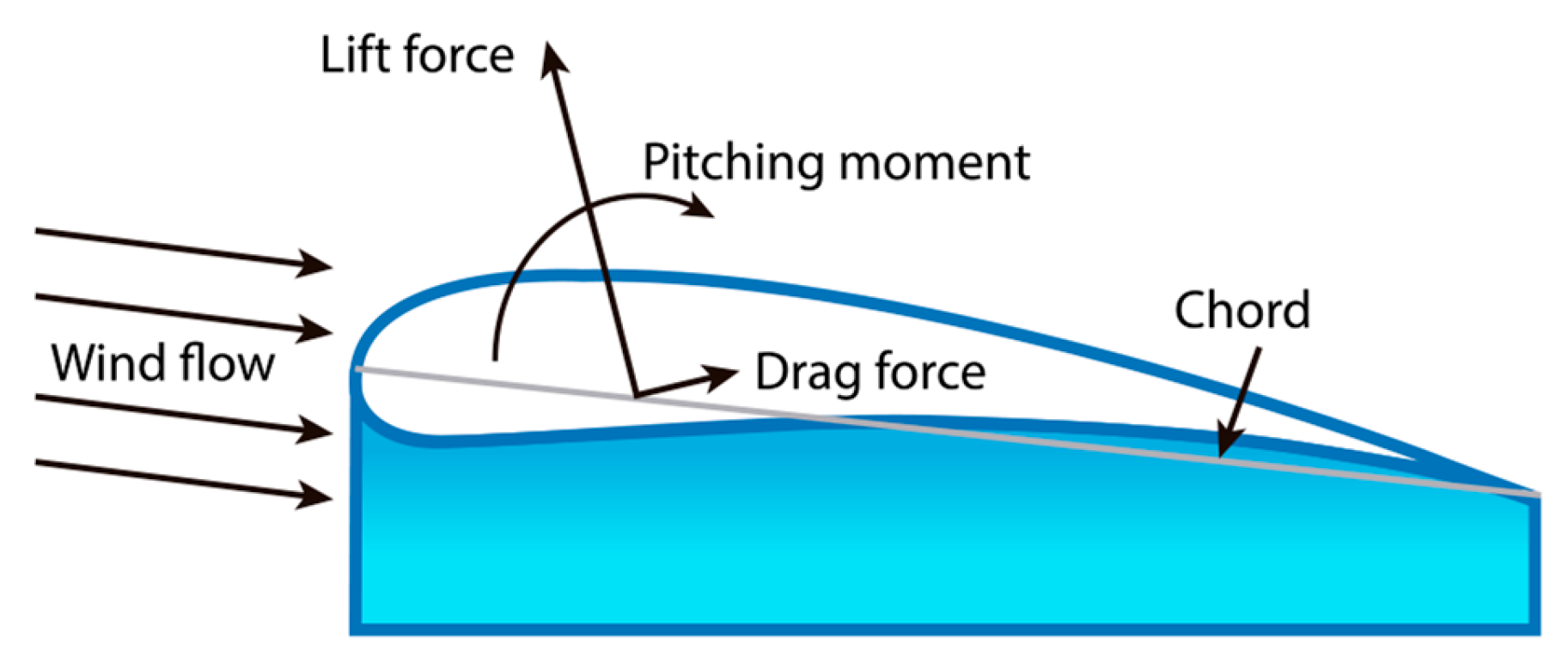
VAWTs of the H-Type Darrieus configuration operate based on a lift-driven principle. When wind flows over the blade, a Lift Force (FL) is generated perpendicular to the relative airflow. This force results from the pressure difference between the upper and lower surfaces of the airfoil. If the angle of attack is appropriate, a component of this force aligns with the direction of rotor rotation, producing the torque needed to drive the system. Simultaneously, a drag force (FD) acts parallel to the airflow, opposing the blade motion, and originates from friction and pressure differences [14]. Figure 2 presents a schematic representation of the lift and drag forces acting on the blades to generate the aerodynamic torque that drives the system.
At low wind speeds, such as those present during start-up from rest, the blades traverse regions of the rotation cycle where the angle of attack changes abruptly, making it challenging to sustain favorable lift generation. Consequently, the aerodynamic torque often falls short of overcoming system inertia, preventing sustained acceleration. The pitching moment induced by these aerodynamic forces influences the blade’s angular stability, particularly during transient phases [12]. The self-starting behavior in H-type Darrieus turbines is therefore closely linked to how aerodynamic torque develops in the initial stages of rotation. Blade profile design and its interaction with the incoming flow play a decisive role in enabling a turbine to start without external assistance. This challenge has motivated extensive research aimed at redefining and better understanding the self-starting concept through both experimental and theoretical approaches.
Over time, multiple studies have sought to more precisely define the self-starting behavior in these turbines. In the context of HAWTs, Ebert and Wood [15] defined startup as complete when the turbine begins extracting significant power from the wind. This definition was later adapted for VAWTs by Kirke [16], who proposed that a turbine is considered self-starting if it can accelerate from rest to the point of producing useful power without the need for external assistance.
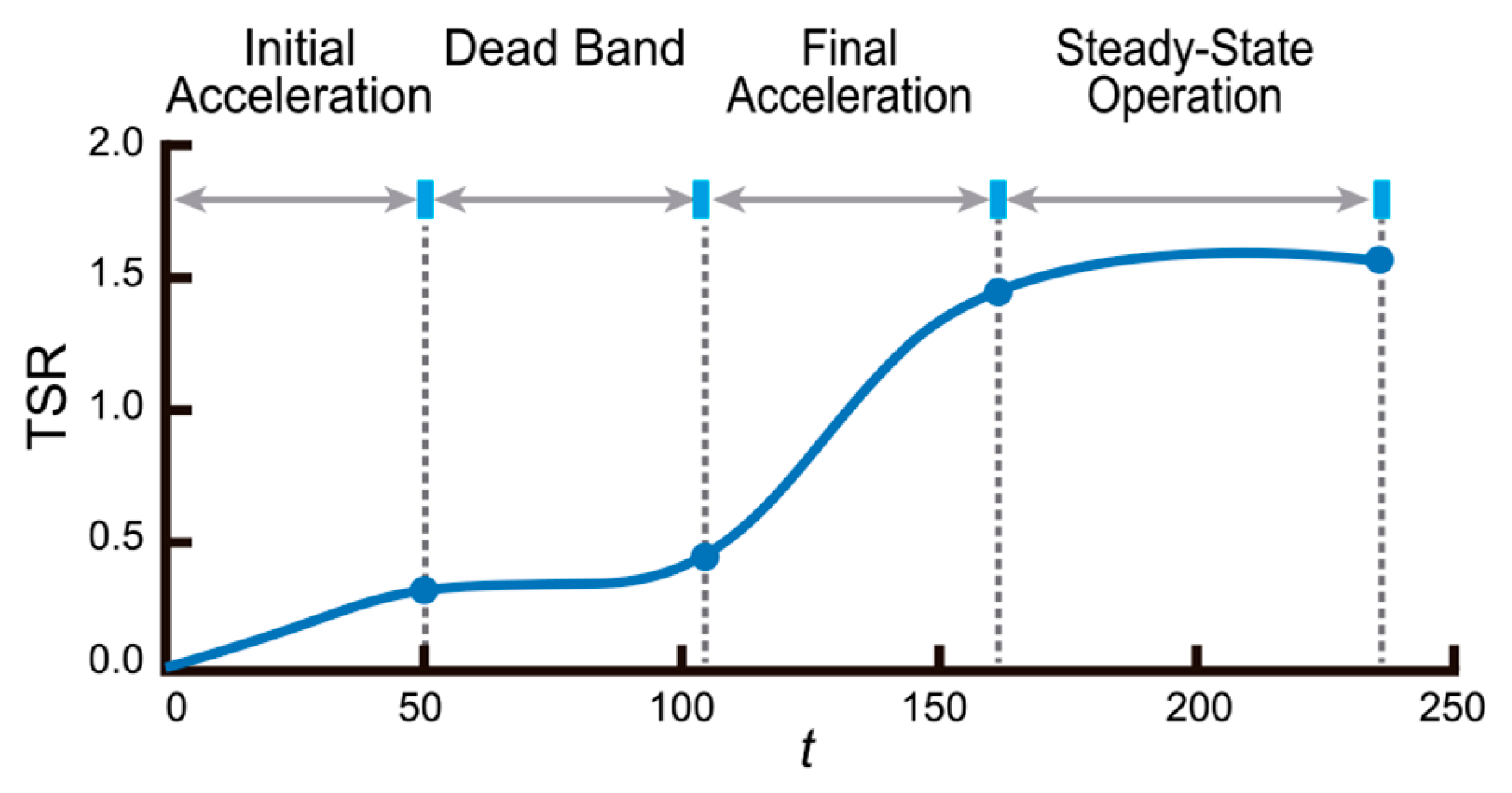
Hill et al. [17] experimentally analyzed the startup of a three-bladed Darrieus turbine (NACA0018 profile) in a wind tunnel at 6.0 m/s, identifying four distinct phases: (1) initial acceleration, (2) dead band, (3) final acceleration, and (4) steady operation. This sequence was subsequently confirmed by Sun et al. [18], who evaluated H-type turbines with NACA0018 and NACA4418 profiles under both laminar and turbulent flow conditions. The dead band, also referred to as the plateau phase, is characterized by near-zero or even negative net torque, which makes continued rotor acceleration difficult. Nevertheless, experimental and field observations have shown that, in some cases, the turbine can traverse this region without external intervention [19]. Figure 3 illustrates the start-up process of an H-type Darrieus wind turbine, highlighting the four identified phases.
Worasinchai et al. [20] challenged the “significant power” criterion due to its dependence on the load connected to the system, arguing that it lacks precision. They proposed a more robust definition: a turbine should be considered self-starting only if it can accelerate from rest to a TSR at which continuous aerodynamic thrust is generated along the blade path, allowing it to overcome resistive torque and achieve a stable operating regime.
This perspective was supported by Du [21], who emphasized that start-up should be considered successful only if the turbine reaches its optimal operating condition without any mechanical or electrical assistance. In line with this perspective, Celik [22] defined self-starting as the process by which a turbine accelerates from rest to a TSR high enough to sustain stable operation.
More recently, Selvarajoo and Mohamed [23] investigated the effects of dynamic stalls phenomena on the startup of a three-bladed Darrieus turbine using NACA0012 profiles. Using simulations with QBlade and a custom MATLAB module named DRAFA (Darrieus Rotor Aerodynamic Force Analysis) (the version was not specified), they visualized aerodynamic forces and flow trajectories. Their results showed that, during the dead band phase, reverse dynamic stall events occur, producing a negative average torque. Effective start-up begins when dynamic stalls events emerge, enabling sustained rotor acceleration. These findings underscore the critical role of dynamic flow behavior on turbine start-up performance and highlight the importance of aerodynamic insight for designing blades with reliable self-starting capability.

2.2. Critical Parameters for the Characterization of Aerodynamic Performance

The aerodynamic behavior of an H-type Darrieus turbine is strongly influenced by dimensionless parameters that enable the evaluation of its performance under both steady-state and transient operating conditions. These parameters allow for standardized comparisons between different designs and help predict the system’s behavior in response to airflow conditions.
The FL and FD, generated by the interaction between the airflow and the aerodynamic profile, are used to define the dimensionless coefficients Lift Coefficient (CL), which quantify the relationship between the lift force generated by an airfoil and the kinetic energy of the incident flow, and the drag coefficient (CD), which represents the ratio between the drag force and the kinetic energy of the incident flow, as described by Zhu et al. [24]. These are critical parameters for characterizing aerodynamic performance.
C L = 2 F L ρ c V r e l 2    
C D = 2 F D ρ c V r e l 2      
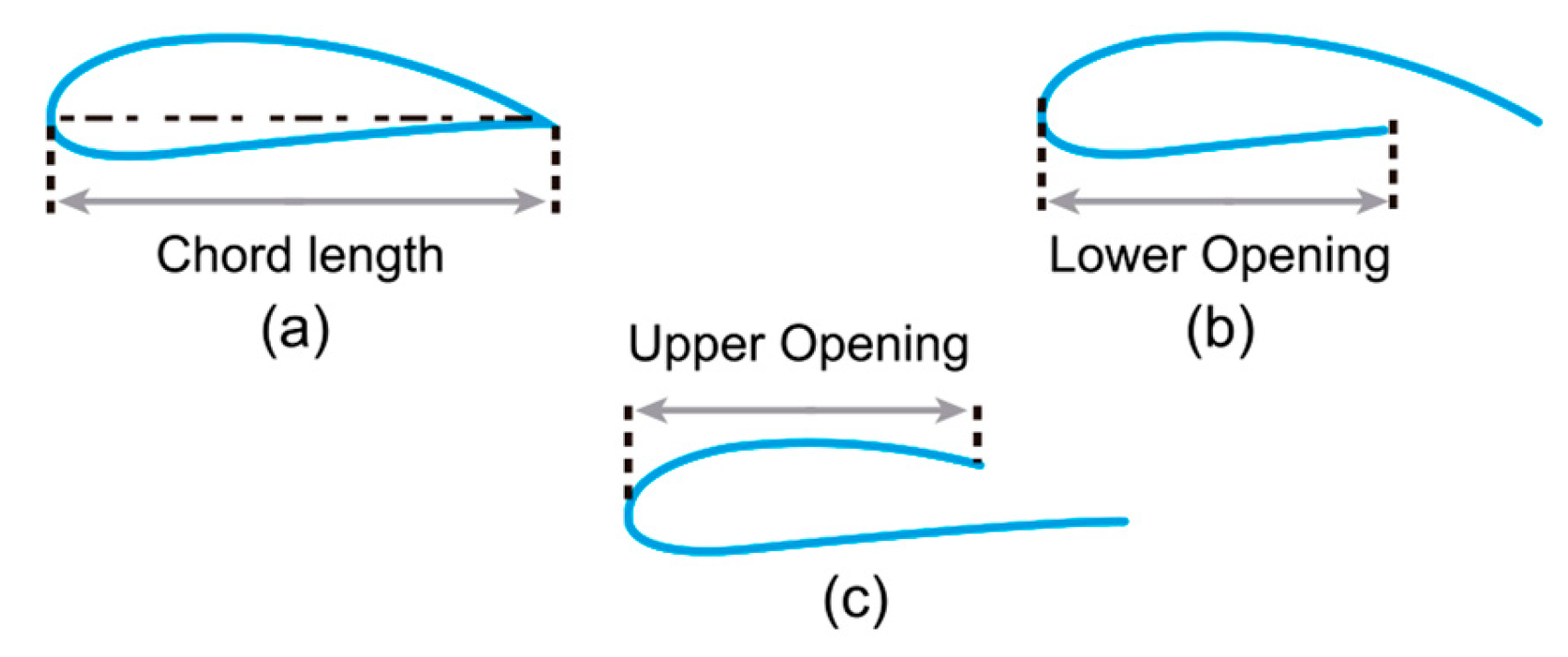
where ρ is the air density, c is the chord length (the straight-line distance between the leading and trailing edges of an airfoil, measured perpendicular to the span), and Vrel is the effective velocity of the airflow that directly impacts the blade.
Additionally, Zhu et al. [24] emphasized the importance of the CM and the CP for characterizing the overall performance of the system, given by
C M = 2 T ¯ ρ A R V 2    
C P = 2 P ρ A V 3
where A is the swept area of the rotor, and V is the free-stream wind velocity. T ¯ refers to the average torque over a full revolution, and P is the generated power, calculated as
T ¯ = 0 2 π T θ    
P = ω T ¯    
where ω is the angular velocity of the turbine rotor in rad/s. According to Burton et al. [25], the CP is used to estimate the efficiency of a wind turbine by relating the mechanical power extracted to the available kinetic power of the wind.
The Tangential Force (FT) is the component of the aerodynamic force that acts in the tangential direction to the blade’s path, directly contributing to torque generation and, consequently, to rotational motion. The Normal Force (FN), on the other hand, is the component of the aerodynamic force that acts perpendicular to the blade’s surface, influencing the structural load and the generation of lift. Both forces are used to calculate their corresponding dimensionless coefficients, CT and CN, which enable the analysis of the aerodynamic behavior and efficiency of the wind turbine under different operating conditions [24]. These coefficients are determined using the following equations:
C T = 2 F T ρ c V r e l 2    
C N = 2 F N ρ c V r e l 2    
Another essential parameter is the Reynolds number (Re), which relates inertial forces to viscous forces in the flow and determines the aerodynamic regime (laminar or turbulent) [12], as follows:
R e = ρ V D μ = I n e r t i a l   f o r c e s V i s c o u s   f o r c e s  
where D is the rotor diameter and μ is the dynamic viscosity, which is related to the kinematic viscosity (v) by
ν = μ ρ
In the case of a rotating blade, the Reynolds number can also be estimated using the blade’s linear velocity (Vb) and c, as follows:
R e = ρ V b c μ  
TSR (also referred to as λ) is one of the most critical parameters as it directly affects energy extraction efficiency [26]. It is defined as the ratio between the blade tip speed and the free-stream wind velocity [27], as follows:
λ = V b V = ω R V = π D N r p m 60 V
Nrpm is the angular velocity in revolutions per minute (rpm), and R is the rotor radius. Alternatively, it can be expressed in terms of the CP and CM [25], as follows:
λ = C P C M    
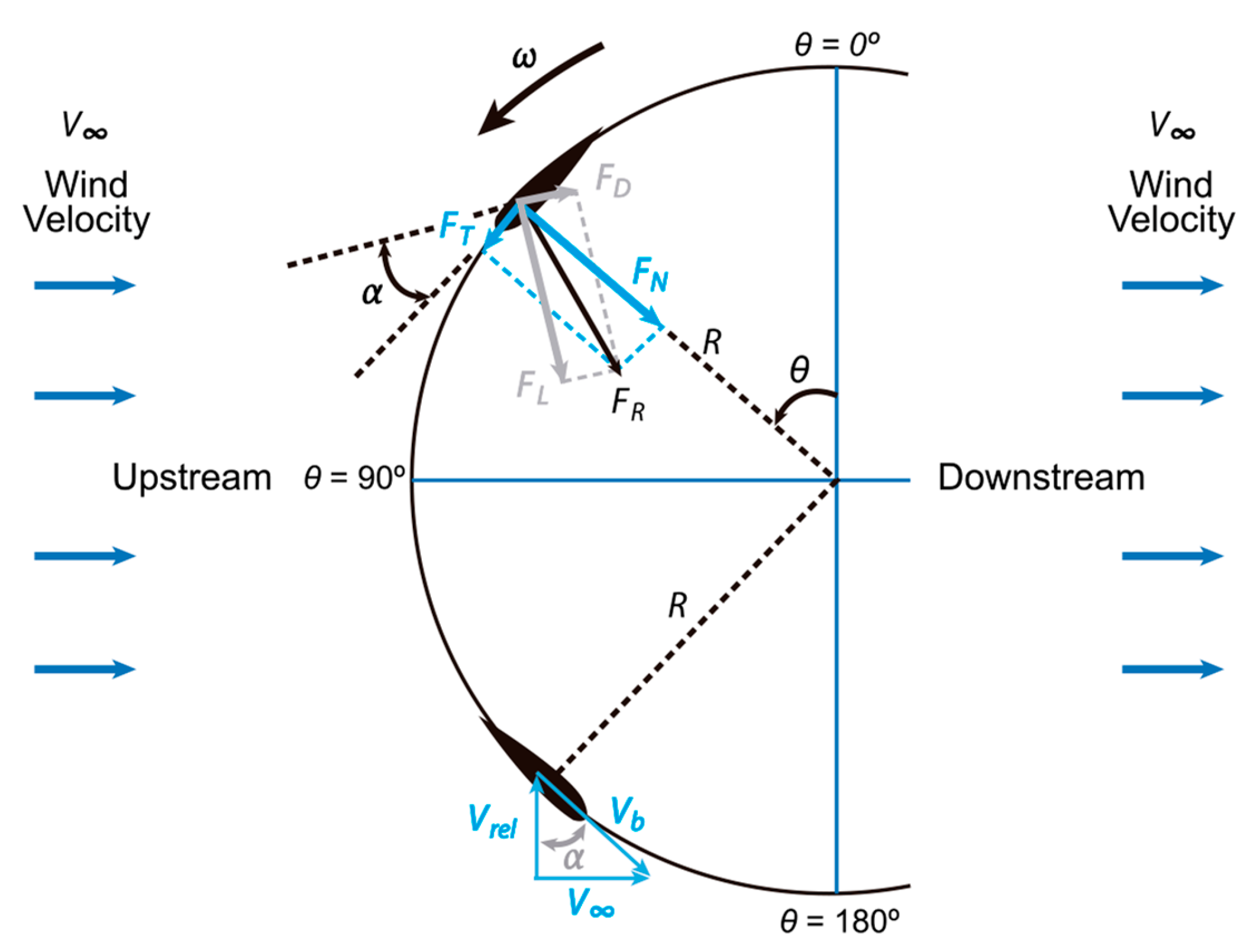
Figure 4 illustrates the velocity triangle and the main forces acting on the blade, facilitating the understanding of the aerodynamic analysis.

2.3. Specific Self-Starting Challenges

Improving self-starting capability and reducing the time required to initiate rotation are critical for Darrieus-type VAWTs, especially in regions with low wind speeds [28]. A major limitation of these turbines lies in their low aerodynamic torque generation at low TSR, which can occasionally result in negative net torque, preventing the rotor from overcoming its initial inertia [29].
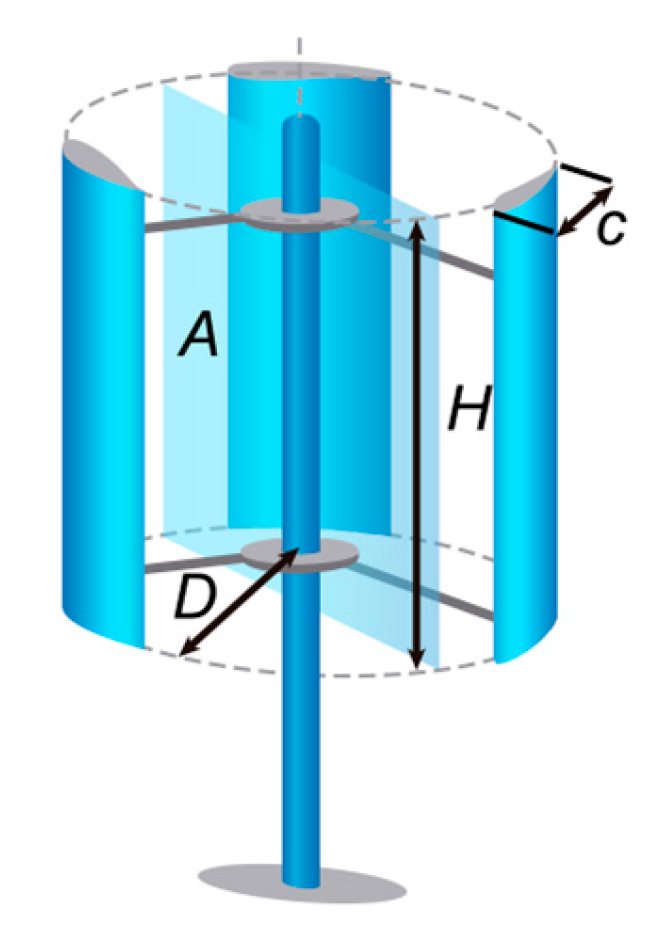
This behavior is intensified in the so-called dead zone, a phase during which the net torque is nearly zero or negative, hindering the transition to sustained acceleration. Overcoming this region without external assistance strongly depends on rotor geometry and optimized design parameters [18,21]. Figure 5 illustrates some of the geometric parameters relevant to H-type Darrieus turbines.
Solidity (σ), defined as the ratio between the total blade area and the swept rotor area, directly influences startup torque. High solidity increases the initial torque but reduces the CP, shifting its optimal value to lower TSRs [30,31]. Conversely, low-solidity turbines are more aerodynamically efficient but less capable of self-starting at low TSR values. The number of blades (N) also affects startup stability; turbines with three blades have demonstrated effective self-starting performance when appropriately designed [21,32].
The airfoil shape of the blades is also critical. Classic symmetrical NACA airfoils (e.g., NACA0012, NACA0018) have been widely used, but recent designs focus on improved aerodynamic performance under non-ideal conditions. These include natural laminar flow airfoils, thick symmetrical profiles, and biomimetic modifications such as sinusoidal tubercles on the leading edge, inspired by humpback whale fins [33,34].
The angle of attack (α), the angle between the chord line of the blade profile and the relative wind velocity, varies cyclically as the rotor spins, impacting lift generation and consequently torque output. Poor control over this angle can induce dynamic stall, compromising startup performance. Blade pitch angle (β) control, defined as the angle between the blade chord and the rotor’s plane of rotation, can mitigate these effects by maintaining an optimal angle of attack across azimuthal positions [14,22].
Under low wind conditions, the rotor’s moment of inertia (J), a measure of the rotor’s resistance to changes in angular velocity and dependent on mass distribution and radius, and the Resistive Torque (TResist) become dominant. These include the Frictional Torque (TF), which depends on the bearing condition and the material and surface roughness of the blades; the Inertial Torque (TJ), determined by the blade’s mass and radius; and the aerodynamic Drag Torque (TD), which is influenced by CD, a dimensionless number representing the ratio between the aerodynamic drag force and the dynamic pressure acting on the reference area of the blade.
To achieve an effective startup, all of these must be overcome by the aerodynamic torque (TA) generated by lift forces. The balance among these torques defines the self-starting capability of the system [22,27], as follows:
T R e s i s t = T F + T J   + T D
T S e l f S t a r t i n g = T R e s i s t T A
Minimizing TResist and maximizing TA through refined blade design and material selection is essential to ensuring reliable autonomous startups.

3. Materials and Methods

This review was conducted and reported in accordance with the Preferred Reporting Items for Systematic Reviews and Meta-Analyses (PRISMA 2020) guidelines [10]. Its objective was to systematically identify, appraise, and synthesize experimental and numerical evidence on technological interventions aimed at improving the self-starting capability of H-type Darrieus VAWTs. The protocol predefined the information sources, search strategy, eligibility criteria, study selection procedures, data extraction template, and qualitative synthesis methods. The following subsections detail each methodological step.

3.1. Search Strategy and Eligibility

A systematic search was last updated on 20 August 2025 in Scopus and IEEE Xplore. The query combined thematic keywords with database filters to limit results to peer-reviewed journal articles published in English between 2019 and 2026: (“cut-in speed” OR “self-start” OR “self-starting” OR “low wind speed”) AND (“Darrieus-H” OR “vertical axis” OR “VAWT”) AND (“airfoil” OR “shape J” OR “flap Gurney”) AND PUBYEAR > 2018 AND PUBYEAR < 2026 AND (LIMIT-TO (LANGUAGE, “English”)) AND (LIMIT-TO (DOC-TYPE, “article”)). The same string was applied in both databases.
This search yielded a total of 1212 records: 817 from Scopus and 395 from IEEE Xplore.

3.2. Study Selection and Data Extraction

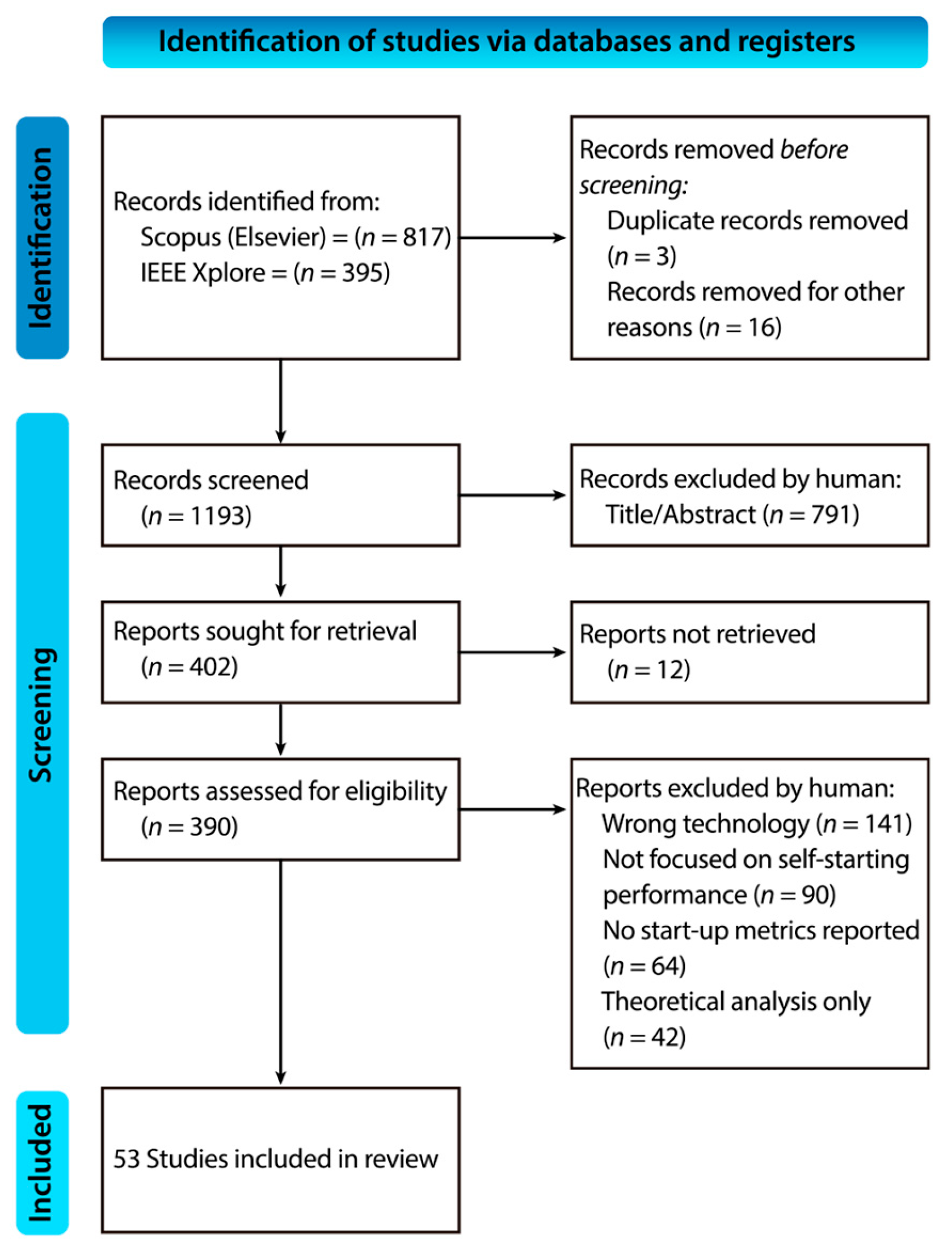
Two independent reviewers conducted the study selection in two stages. After removing 19 records (3 duplicates and 16 database errors), 1.193 titles/abstracts were screened and 791 were excluded. A total of 402 full-text articles were sought; 12 could not be retrieved, leaving 390 for eligibility assessment. Of these, 335 were excluded (non-relevant turbine type, n = 141; not focused on self-starting, n = 90; no start-up metrics, n = 64; purely theoretical without Computational Fluid Dynamics (CFD) or experimental validation, n = 42). Consequently, 53 studies were included.
Data extraction was carried out independently by two reviewers using a piloted form, with discrepancies resolved through consensus. For each study, a standardized extraction sheet recorded airfoil geometry, blade and support configuration, test type (CFD, wind tunnel, or field), start-up metrics (CM, CP, cut-in speed), and a detailed description of the technological intervention. These descriptions enabled the identification of structural and methodological commonalities, forming the basis for the thematic classification into five technological approaches presented in the Results section.

3.3. Synthesis Method

Given the heterogeneity of designs, operating configurations, and reported metrics, the extracted data, comprising airfoil geometry, blade arrangement, control method, torque and power coefficients, experimental or simulation protocols, and key findings, were synthesized qualitatively and thematically. The evidence was grouped into five main technological approaches, highlighting the strengths and limitations of each. Summary tables present both the extracted metrics and qualitative findings for each technological approach.
For each study, two reviewers conducted a narrative risk-of-bias assessment using an ad hoc checklist developed by the review team. Key methodological features (e.g., the clarity and reproducibility of methods, analysis approach, turbine parameter reporting, and coverage start-up metrics) were recorded in a shared Microsoft Excel® spreadsheet (Microsoft Excel for Microsoft 365, Version 2508, 64-bit), and consensus was reached on potential sources of bias. No data normalization or transformation was necessary, as the review qualitatively focused on whether each intervention reduced the cut-in speed rather than on absolute coefficient values; therefore, no quantitative effect measures were calculated.
To address heterogeneity, subgroup analyses were performed based on the five identified technological approaches; no additional sensitivity analyses were conducted due to the small sample sizes within each subgroup.
The search was limited to peer-reviewed journal articles. The grey literature (e.g., theses, preprints, technical reports) was excluded to ensure traceable quality control and replicability; a complementary search in institutional repositories confirmed that no additional peer-reviewed evidence was missing. This restriction may introduce a degree of publication bias, which is acknowledged as a limitation of the review.
Overall certainty was appraised using a GRADE (Grading of Recommendations Assessment, Development and Evaluation)-inspired framework adapted to engineering evidence, evaluating risk of bias, inconsistency, indirectness, imprecision, and publication/reporting bias. Two reviewers rated the certainty and resolved disagreements by consensus.

4. Results: Technological Approaches for Enhancing the Self-Starting Capability of H-Type VAWTs

To contextualize the findings, the systematic search yielded 1212 records. Prespecified eligibility criteria were applied, restricting inclusion to peer-reviewed journal articles published in English between 2019 and 2026. After removing 19 duplicates and invalid entries caused by database errors, 1193 records underwent title and abstract screening by two independent reviewers. Of these, 390 full-text articles were assessed for eligibility. Only studies that reported experimental or numerical interventions aimed at improving the self-starting of H-type Darrieus VAWTs and included at least one start-up metric (cut-in speed, CM, or CP) were retained. Purely theoretical analyses without numerical or experimental validation were excluded. Ultimately, 53 studies were included in the qualitative synthesis. Figure 6 presents the PRISMA 2020 flow diagram of the study-selection process.
The 53 selected studies comprised 47 numerical investigations based on CFD (88%, including 38 two-dimensional, 6 three-dimensional analyses, and 3 combined-dimensional analyses), 6 experimental studies conducted in wind tunnels (11%), and 18 investigations that combined CFD and Experimentation (34%). Most examined three-blade H-rotors employed NACA00-series or J-type profiles, with diameters ranging from 0.30 to 4.70 m, chord lengths from 0.06 to 0.50 m, and solidity values between 0.05 and 1.15. Typical operating ranges were TSR (λ) = 0–6 and wind speeds from 0.5 to 20 m/s. The most frequently reported performance metrics were CM, CP, and the cut-in (start-up) wind speed.
Based on the thematic synthesis, the evidence was categorized into five technological approaches for enhancing self-starting capability: (1) geometrical optimization of the airfoil, (2) rotor structural configuration, (3) passive flow control, (4) active flow control, and (5) incident-flow augmentation. The key findings for each category are presented in the following sections.

4.1. Geometrical Optimization of the Airfoil

Geometrical optimization of airfoils represents one of the most direct and effective strategies to enhance the self-starting capability of H-type Darrieus wind turbines. This approach focuses on modifying the blade shape to control critical phenomena such as vortex formation, dynamic stall onset, and recovery at low angles of attack, all of which are decisive for performance during the startup phase. Comparative evaluation of existing airfoils represents the first step in the geometrical optimization of Darrieus turbine blades. In this regard, Abul-Ela et al. [35] investigated symmetric airfoils (NACA0012, NACA0021, Eppler 474, S1048) and cambered ones (S1210, NACA6712, DU-06-W200, Clark Y, FX63-137) in a three-bladed H-Darrieus rotor. Using 2D CFD simulations, performance was assessed for TSRs from 1.2 to 3.5. The NACA6712 cambered-in showed the best low-TSR behavior (CP = 0.3645 at TSR = 2.037, ≈180% higher than NACA0012), while the Eppler 474 excelled at mid-to-high TSRs (CP = 0.3557 at TSR = 3.0). Clark Y and S1210 performed poorly in cambered-in orientation but improved significantly when flipped (cambered-out), with Clark Y showing superior self-starting capability.
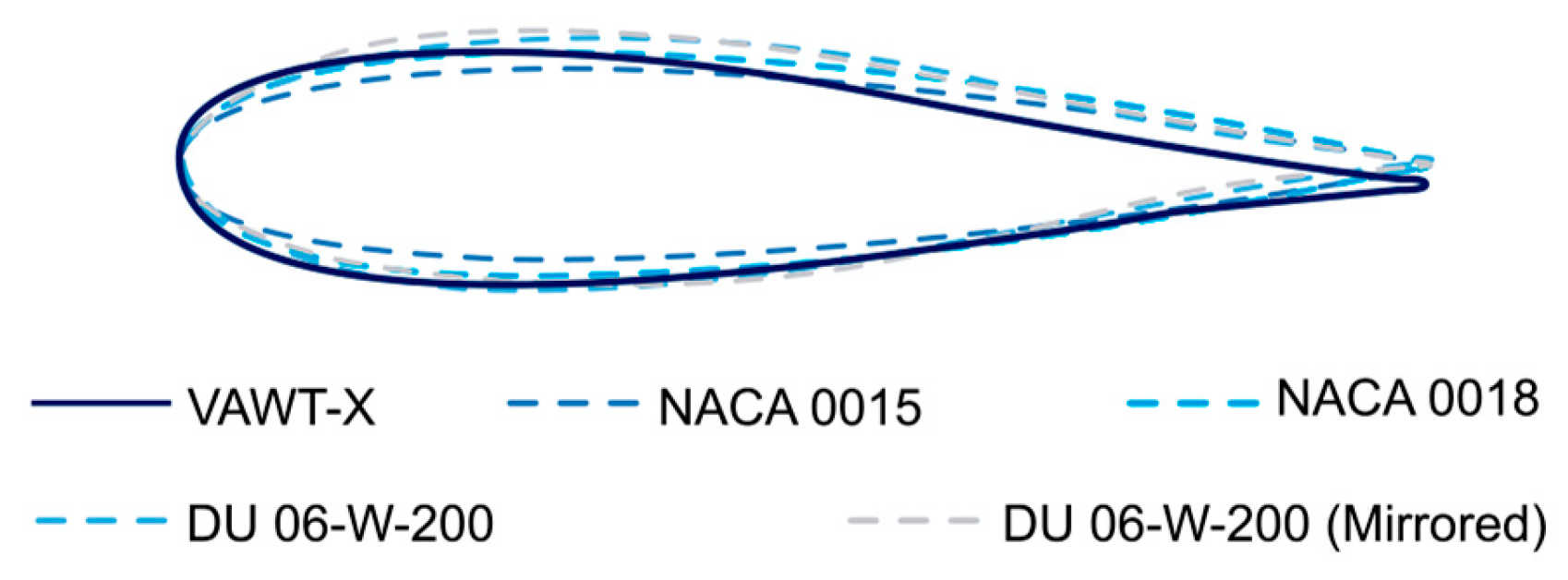
Several studies have explored the influence of conventional and innovative airfoil designs on aerodynamic efficiency, proposing configurations capable of improving initial torque and reducing the dependence on external assistance devices. In this context, Abdolahifar et al. [36] evaluated the patented VAWT-X profile, a symmetric airfoil with a concave trailing edge, specifically designed for small and medium-scale Darrieus turbines, whose performance was compared with conventional airfoils such as NACA 0015, NACA 0018, and DU 06-W-200 variants (standard and mirrored), as shown in Figure 7. Using three-dimensional CFD simulations with the Shear Stress Transport k-ω (SST) turbulence model, validated against experimental data, the authors analyzed the aerodynamic behavior across a TSR range of 0.25–4.0. The results showed that the VAWT-X exhibited superior vortex control, leading to a 34% increase in average torque at TSR = 0.5, as well as a maximum CP of 0.24 at TSR = 3.0, compared with 0.082 at TSR = 2.5 for the DU profile. These findings confirm that the patented airfoil outperforms traditional designs during the startup phase and validate its potential for improving the efficiency of next-generation Darrieus turbines.
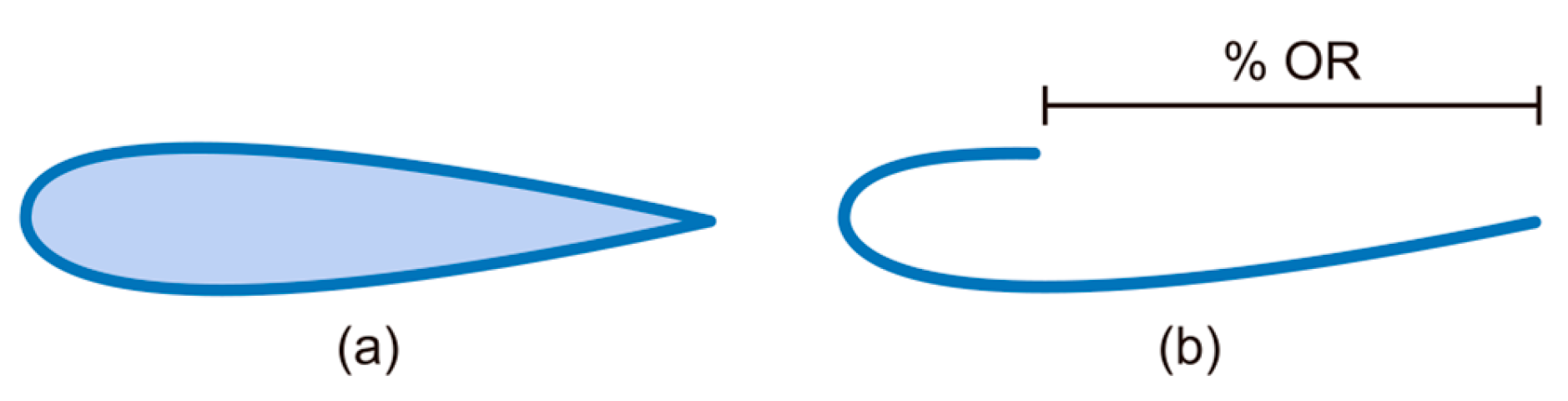
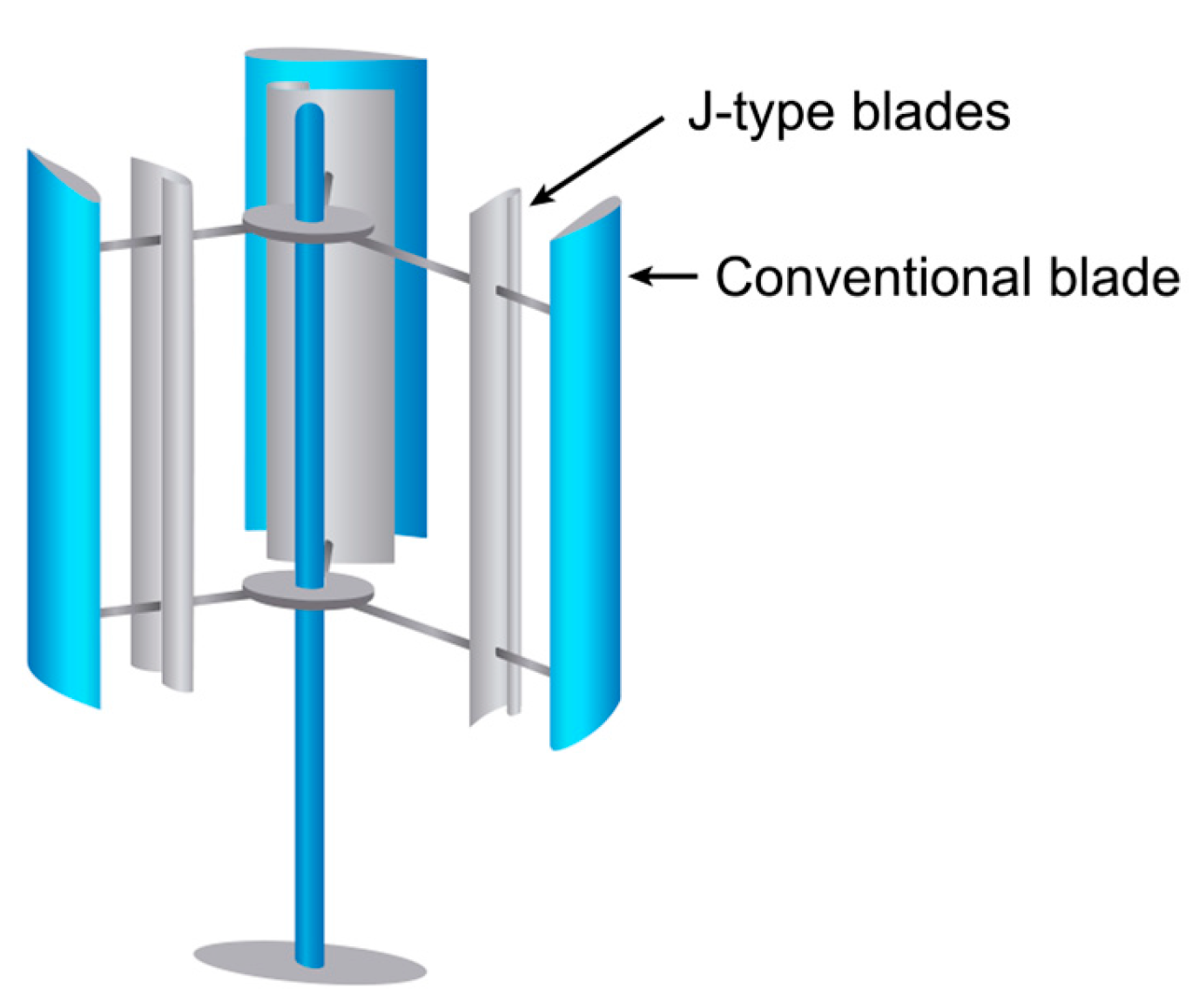
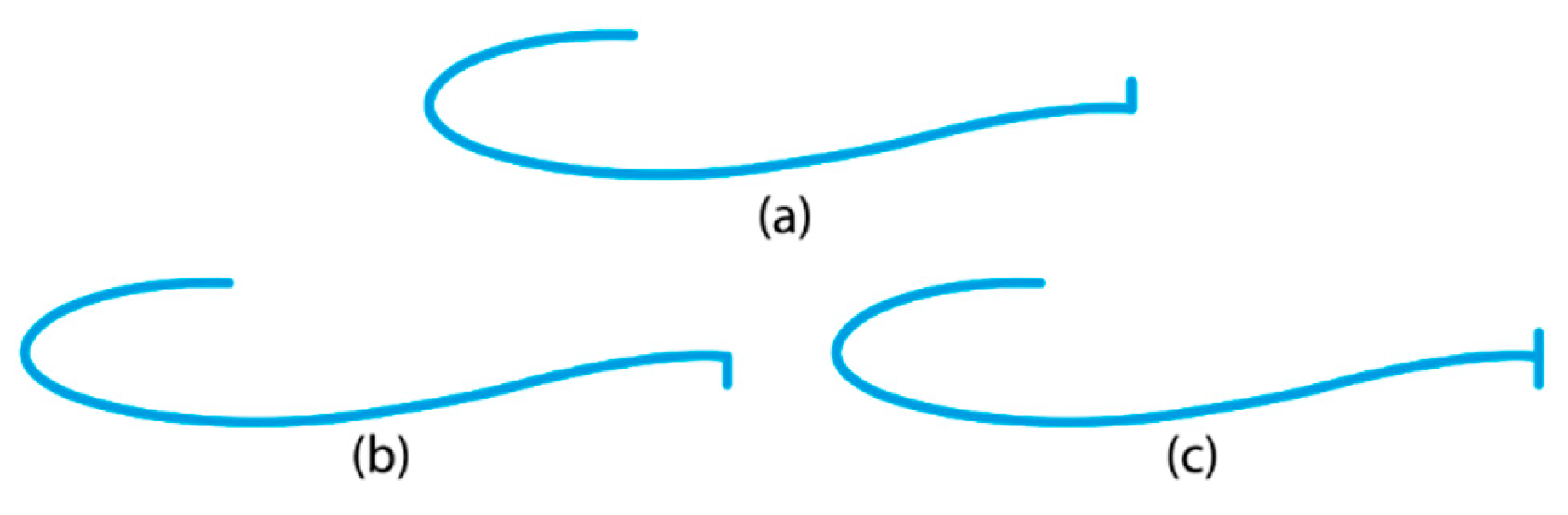
This strategy includes studies focused on the design and analysis of novel aerodynamic profiles; one of the most promising proposals has been the use of “J”-type blades. This profile is derived from modifications to conventional “S”-type airfoils by partially removing a section of the upper or lower surface, resulting in an asymmetric shape that enhances vortex formation in specific regions of the blade. The extent of this modification is quantified by the Opening Ratio (OR), defined as the percentage of the chord length removed near the trailing edge relative to the original chord. A higher OR indicates a larger cut and greater asymmetry, which can significantly influence both self-starting torque and steady-state efficiency. Figure 8 illustrates the “S” and “J” airfoil types, highlighting their key geometric differences and the OR measurement reference. These profiles are shown at a proportional scale for visual comparison purposes only; actual chord length and thickness values vary depending on the specific turbine design.
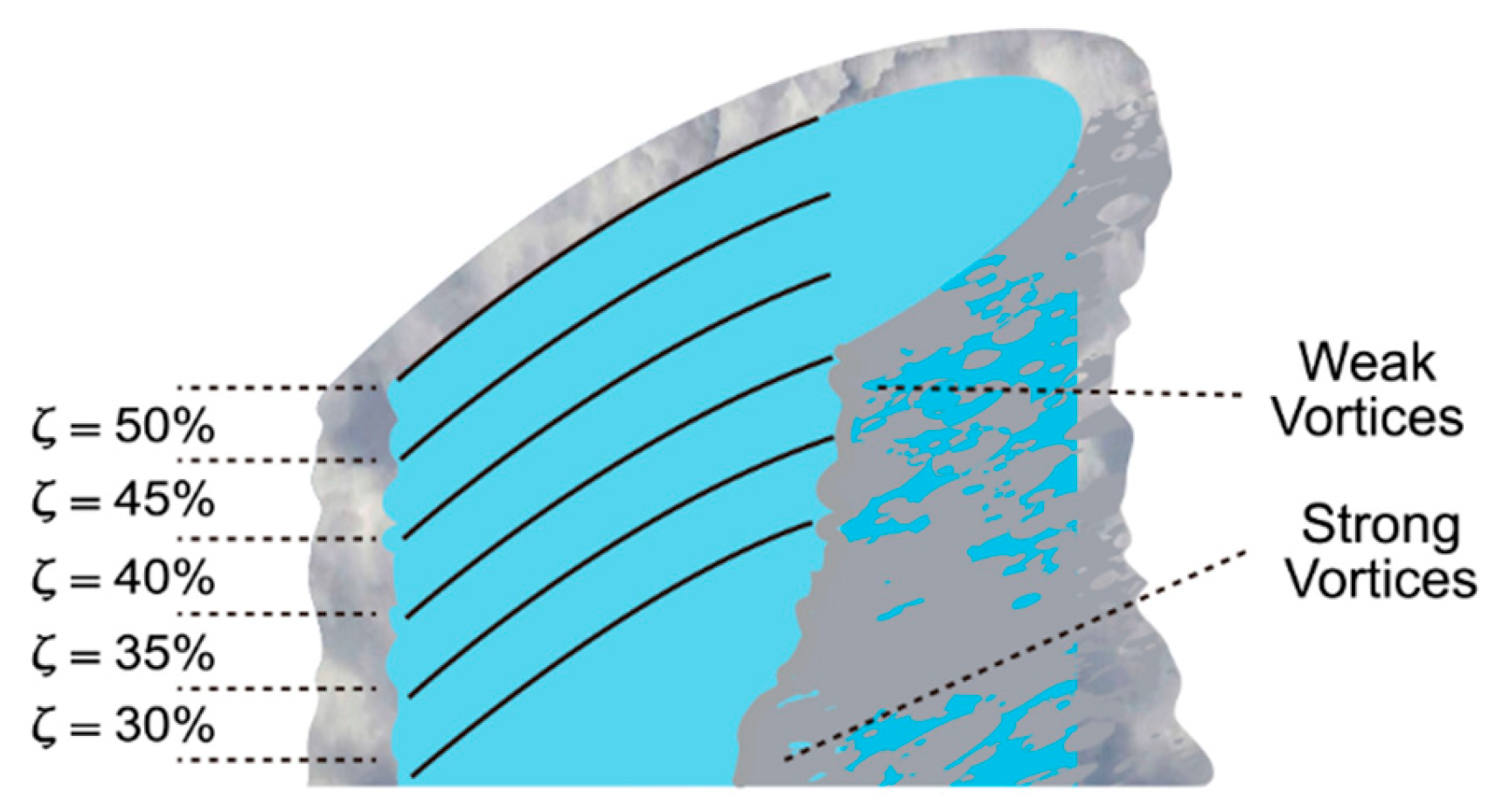
Several studies have explored the effectiveness of this modified geometry. Farzadi et al. [37] analyzed J-shaped blades derived from the NACA0021 profile using 3D CFD simulations, applying the Unsteady Reynolds-Averaged Navier–Stokes (URANS) approach. Two turbulence models were employed: k-ω (SST), a hybrid model combining k-ω near the wall and k-ε in the free stream to improve flow-separation prediction, and the k-ε model, which is robust for fully developed flows but less accurate near solid boundaries. The blade was examined by segmenting its spanwise length using the dimensionless parameter ξ, which ranges from 0% at the mid-span section to 50% at the tip section, on both sides. The study evaluated performance under various TSR and different blade heights.
Their results indicate that dynamic stall vortices dominate the mid-span region of the blade, and as the blade height increases, these vortices shift toward the blade tips, extending stagnation regions that contribute positively to torque generation. At TSR = 1.0, an increase in CM of 10% was observed for a height of 0.8 m and up to 44% for a height of 3.0 m. Figure 9 shows the three-dimensional vortex distribution along the surface of the J-type blade, highlighting how its geometry enhances torque production.
Naik and Sahoo [29] conducted a combined experimental and numerical investigation on curved J-type airfoils derived from the NACA4418 profile, generated by removing sections near the trailing edge. Their findings revealed that an airfoil with a 70% OR enhanced the turbine’s efficiency by approximately 25% and significantly improved the self-starting torque. In earlier work, Naik and Sahoo [38] modified the NACA4415 profile by trimming portions of either the upper or lower surface, producing J-type variants with different opening ratios. Two-dimensional CFD simulations showed that airfoils with ORs ranging from 40% to 80% achieved CP between 0.488 and 0.517, consistently higher than those of the original NACA4415. Moreover, upper-surface cuts delivered superior aerodynamic performance compared to lower-surface modifications. Figure 10 illustrates the three airfoil configurations evaluated: the baseline NACA4415, a J-type profile with an upper-surface cut, and another with a lower-surface cut, offering a direct geometric comparison of the structural alterations introduced.
Author [39] examined a J-shaped blade for H-Darrieus turbines, benchmarking it against NACA0015 using 2D CFD simulations (URANS, SST k-ω). The J-blade achieved a 142% increase in starting torque at TSR = 0.2 and delivered more uniform torque with 12.3% less wake turbulence at TSR = 1.6. Despite a minor 3.6% torque reduction at TSR = 2.5, the results highlight the J-blade’s potential to enhance startup and efficiency in low-wind urban environments.
Farzadi and Bazargan [40] conducted 3D CFD simulations to analyze vortex interactions induced by the J-type geometry under various wind conditions, using blades derived from the NACA0021 profile. Their results showed that at low TSRs, the J-type blades increased the average torque by 37.5% at a wind speed of 5.0 m/s and by 26.9% at 10.0 m/s. However, at higher TSR values, torque reduction of up to 10% was observed, attributed to vortex shedding from the blade tips.
Bel Laveda et al. [41] performed an aerodynamic evaluation of a three-bladed VAWT (blade length = 3.0 m, J-type NACA0015 profile, chord length 0.4 m, fixed angle of attack) using CFD simulations based on the URANS approach with two turbulence models (k-ω SST and k-ε), combined with Finite Element Analysis (FEA) for structural evaluation. The results showed an improvement in the CM of 18.34% with the k-ω SST model and 5.84% with the k-ε model, relative to the straight NACA0015 blade.
Author [42] compared a three-bladed H-Darrieus rotor with a standard NACA0015 airfoil against a J-shaped blade design, using high-fidelity 3D CFD simulations with the SST turbulence model and Improved Delayed Detached Eddy Simulation (IDDES) model. This hybrid approach combines Reynolds-Averaged Navier–Stokes (RANS), used to capture mean flow behavior, with Large Eddy Simulation (LES), which directly resolves large-scale turbulent structures, enabling a more accurate representation of vortices associated with dynamic stall. The results showed that the J-blade achieved a 13.5% higher peak CM and 7% higher average CM at TSR = 1, along with an 11% increase in CL during dynamic stalls. At TSR = 1.6, improvements were smaller (+1.8% CM, +1.5% CL), but the onset of stall was delayed by 4–6°, with reduced crossflow and lower susceptibility to flow separation. Moreover, the J-blade generated a stronger tip vortex, produced fewer residual vortices in the wake, and enabled faster flow recovery, confirming its superior performance over the symmetrical design under low-to-medium TSR conditions.
Maalouly et al. [43] employed CFD simulations combined with the Taguchi method to evaluate NACA 0012, 0015, 0017, and 0021 airfoils, varying the chord length between 0.2 and 0.8 m and the angle of attack at 0°, 2°, and 4°. Their findings revealed that chord length was the most influential parameter: longer chords improved self-starting capability, while shorter chords favored steady-state efficiency. The optimal configuration was a NACA0017 airfoil with a 0.6 m chord length and a 4° angle of attack, providing the best compromise between startup performance and operational efficiency.
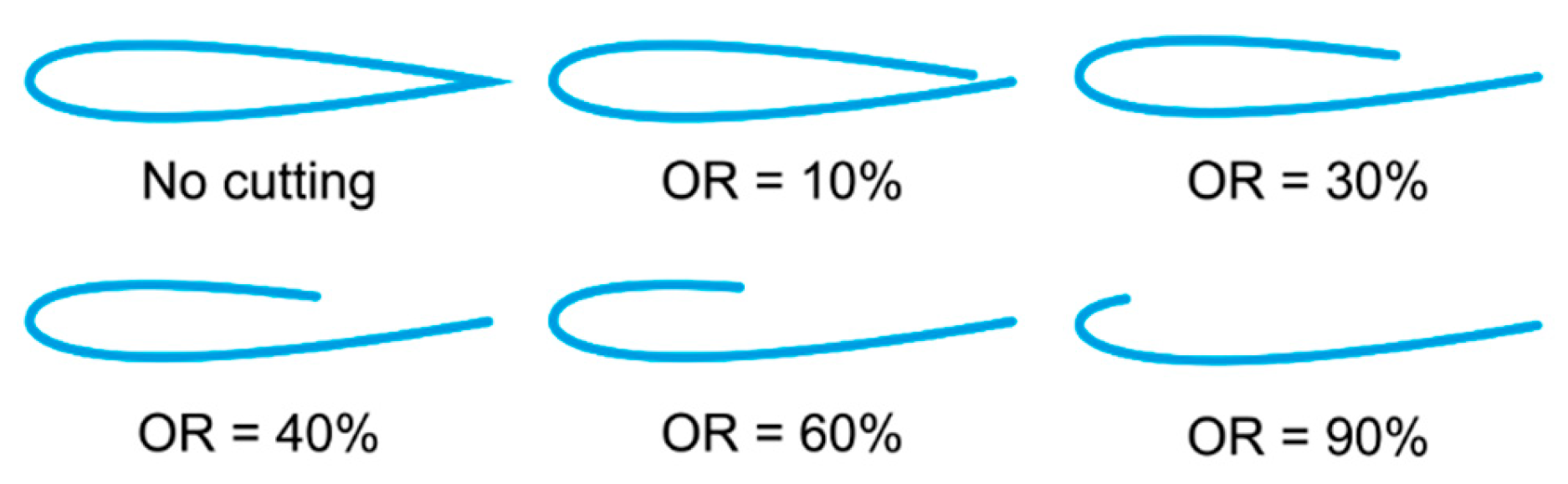
Celik et al. [30] proposed a series of J-shaped airfoils with OR values from 0% to 90%, applied to a VAWT with a diameter of 0.75 m and three blades based on various baseline profiles (NACA0012, 0018, 2518, and 4518, in both standard and inverted configurations). Each blade had a chord length of 0.083 m and a moment of inertia of 0.3 kg·m2, operating under TSR values between 1.5 and 3.0. Two-dimensional CFD simulations using the Semi-Implicit Method for Pressure-Linked Equations (SIMPLE) were performed to assess dynamic self-starting behavior, emphasizing that this capability cannot be inferred solely from CP or static CM. Their results indicate that larger ORs substantially improved self-starting performance; however, an OR of 90% reduces efficiency at higher TSR values. Additionally, a slight pitch angle of 2° enhances startup, while an OR of only 10% was insufficient to overcome static inertia. Figure 11 presents the geometric variations in J-type airfoils, clearly illustrating how the OR influences aerodynamic form.
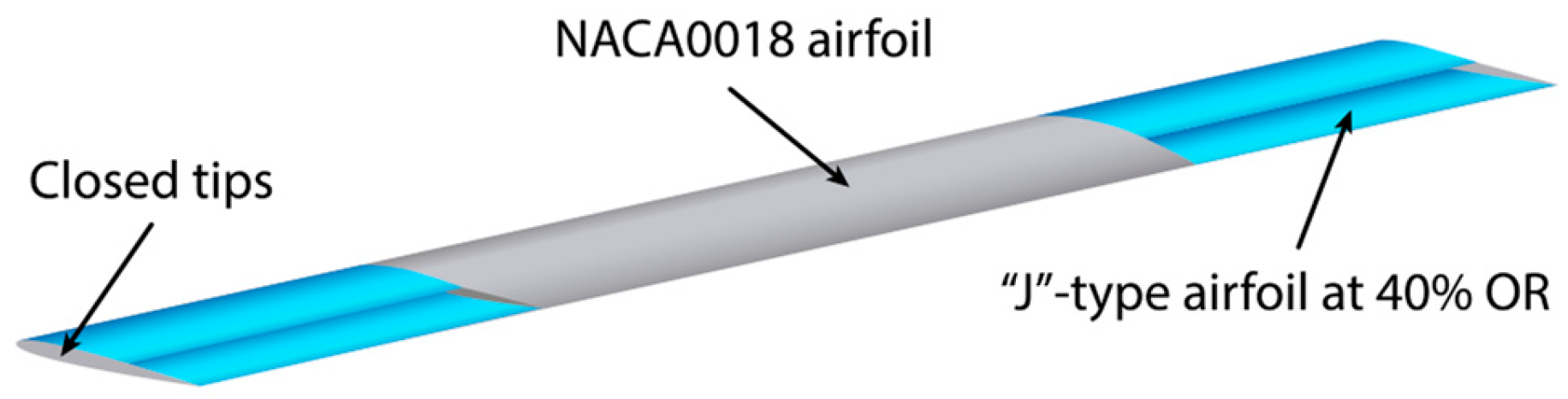
Finally, Celik et al. [4] designed six hybrid blade configurations that combined a NACA0018 central section with J-type tips, varying the opening ratio (40% and 90%), the tip condition (open or closed), and the placement of the J-profile along the blade. Using 2D and 3D CFD simulations, they evaluated these six variants alongside the baseline blade. The configuration with closed tips and a 40% opening ratio demonstrated the best performance, achieving a final tip speed ratio of 3.35, the highest among all configurations tested and superior to the baseline design. Figure 12 illustrates the geometry of the optimal hybrid blade, emphasizing the transition between conventional and modified segments.
Table 1 summarizes the principal findings from these studies within the aerodynamic design strategy aimed at enhancing the self-starting capability of the Darrieus-type VAWTs.

4.2. Geometric Configuration Strategies for H-Type Darrieus VAWTs

One of the most effective strategies to enhance the self-starting capability of Darrieus VAWTs lies in the geometric configuration of the rotor. Sun et al. [18] conducted a comparative study in a closed-loop wind tunnel to evaluate the aerodynamic power performance and self-starting behavior of H-type three-bladed Darrieus turbines and helical-bladed VAWTs under controlled turbulence levels (0%, 6.7%, and 11.9%). The study employed NACA0018 and NACA4418 airfoils with pitch angles of 0°, −3°, and −6°, analyzing CP, CM, TSR, and startup time. The results showed that, while helical turbines operated over a wider TSR range, H-type turbines required 25% to 53% less startup time. The NACA0018 profile provided higher aerodynamic efficiency but lower self-starting capability, whereas the NACA4418 profile improved startup performance under turbulent conditions at the cost of a reduced CP. Additionally, a moderate negative pitch angle (β = −3°) did not significantly improve performance compared to a neutral setting (β = 0°), and a more negative angle (β = −6°) led to a considerable reduction in CP in both turbine types.
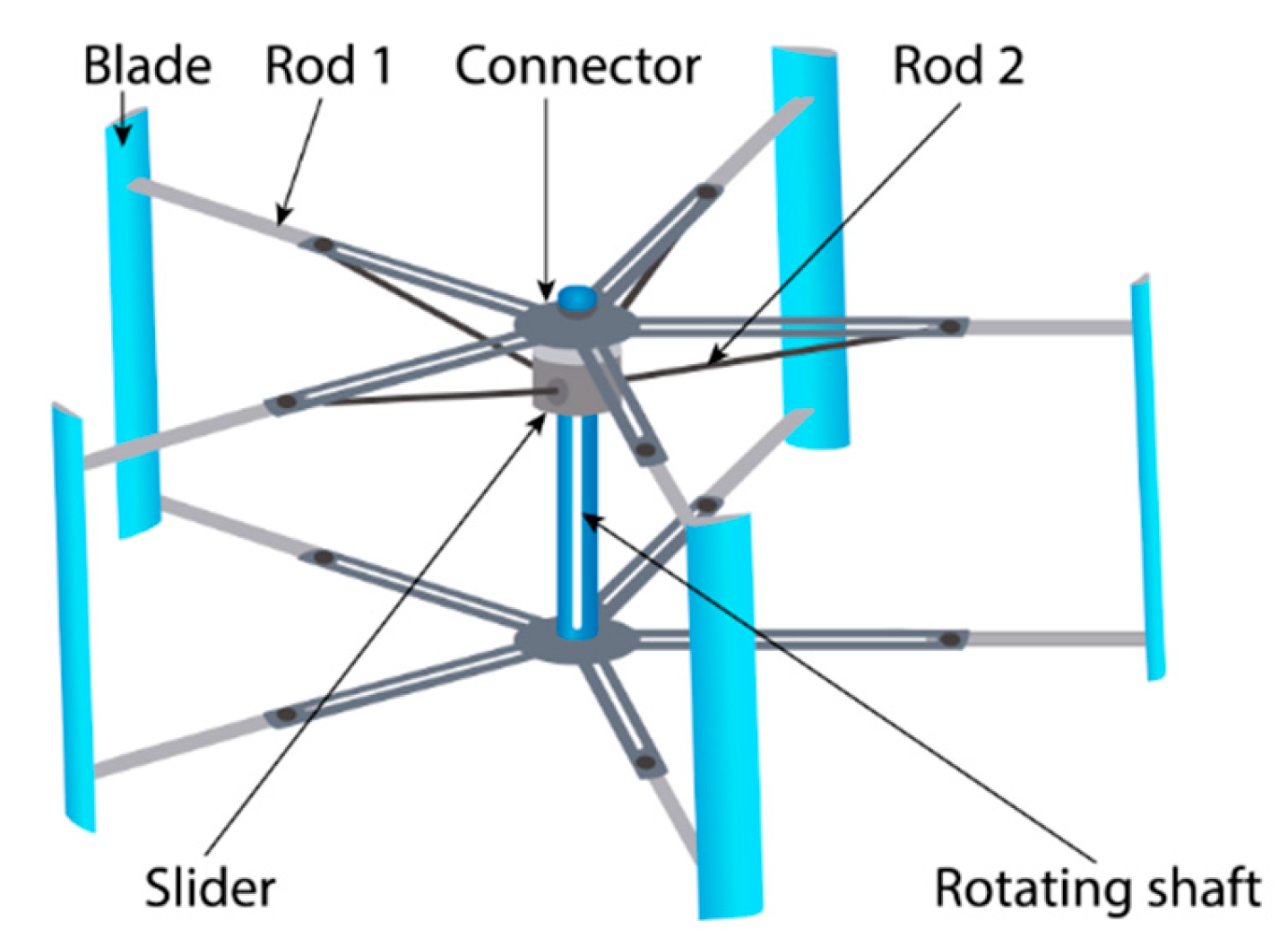
Huang et al. [44] proposed a five-bladed H-type Darrieus turbine with variable solidity, modeled through 2D CFD simulations across three operational stages: self-startup, steady rotation, and power generation underload. The results demonstrated that an initially high solidity (σ = 0.83) reduced the self-starting time, while a subsequent lower solidity (σ = 0.417) improved efficiency during steady-state operation. This strategy increased the rotor’s projected area from 0.486 m2 to 0.972 m2 and the generated power from 53.42 W to 100.39 W, representing a 188% improvement. Figure 13 illustrates the proposed five-bladed H-type Darrieus wind turbine, specifically designed to vary solidity across different operational stages.
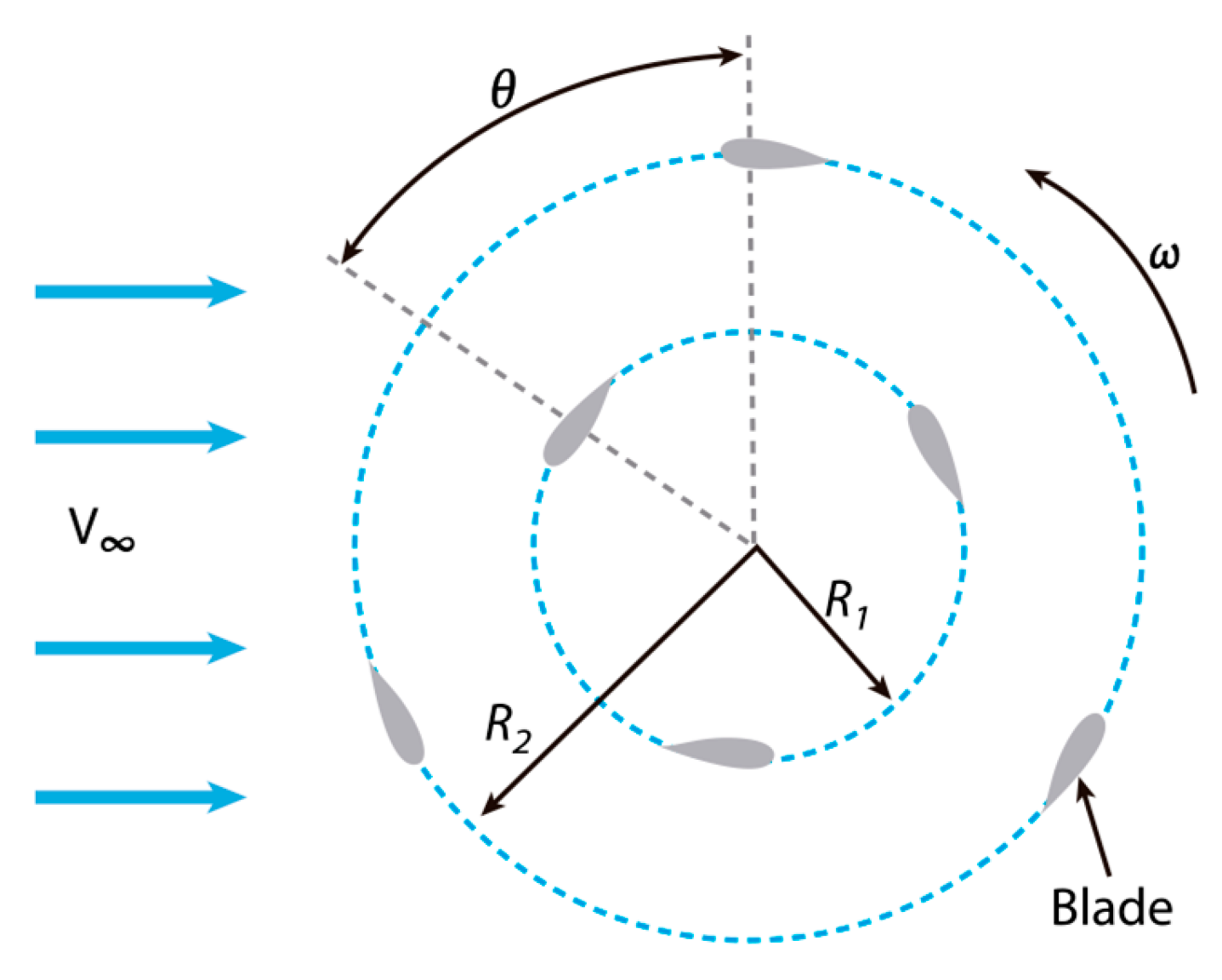
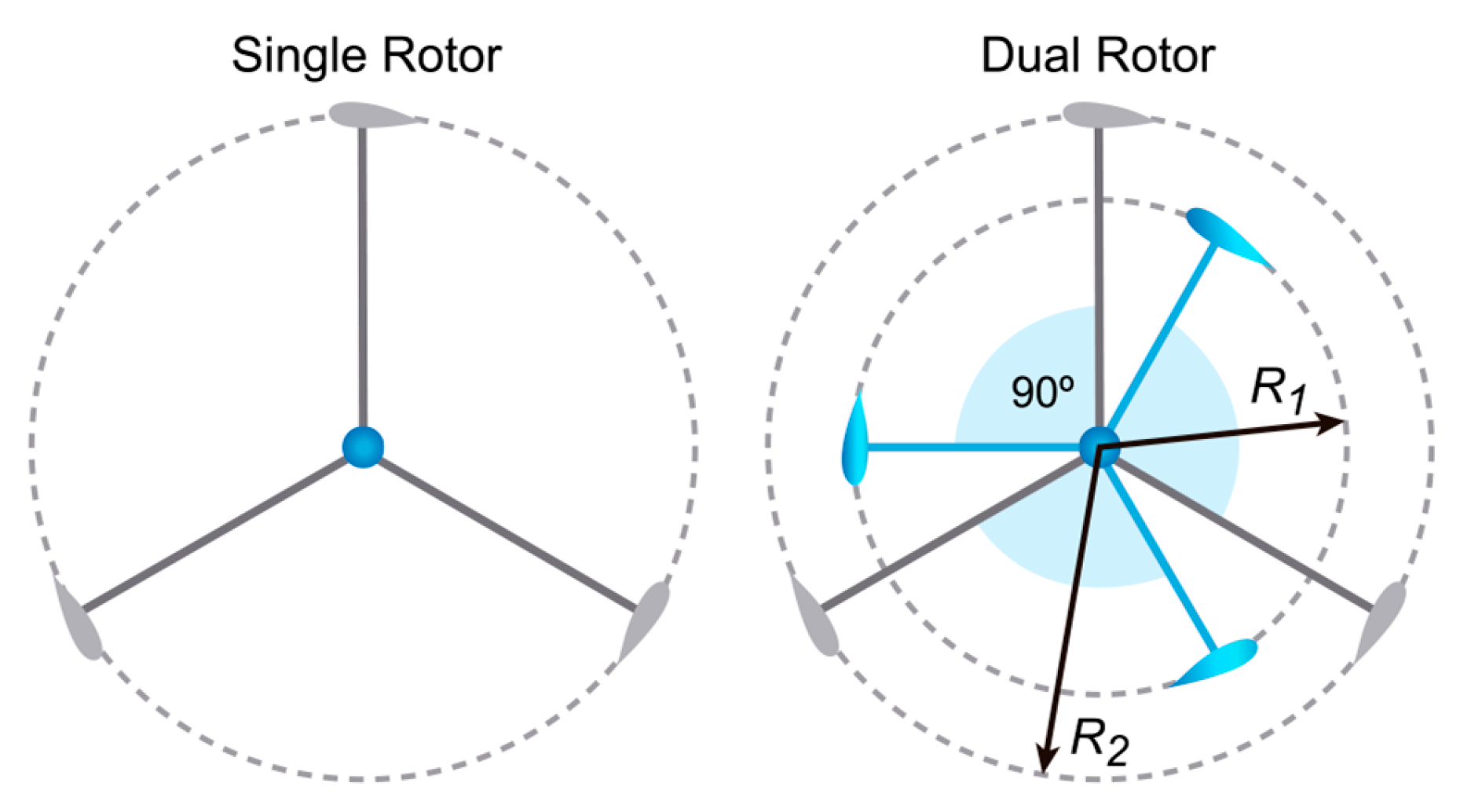
In a separate study, Huang et al. [45] evaluated the application of a locally variable radius in a six-bladed Darrieus turbine configuration, consisting of three inner and three outer blades equipped with NACA0018 airfoils. The inner radius (R1) was varied as a fraction of the fixed outer radius (R2 = 0.4 m), yielding three models with R1 values of 0.15 m, 0.20 m, and 0.25 m. Two-dimensional CFD simulations revealed that the model with R1 = 0.25 m achieved an increase of up to 2.8 times in minimum static torque compared with the baseline configuration, demonstrating notable gains in self-starting capability. Figure 14 illustrates the proposed geometric configuration, highlighting the R1 and R2 distributions across the six-blade layout. Nevertheless, experimental validation and three-dimensional simulations remain necessary to capture the influence of 3D flow effects.
Du et al. [46] carried out an experimental wind tunnel study on Darrieus turbines using NACA0021, NACA4415, and DU06W200 airfoils manufactured from laminated wood. The investigation examined the effects of surface roughness (wooden blades with coarse texture vs. aluminum tape with smooth finish), pitch angle (0°, −2°, −4°), solidity (σ = 0.67, 0.81, 1.0), and Aspect Ratio (AR), defined as the ratio between rotor height (H) and diameter (D), with values of AR = 6 and AR = 7 tested. The results showed that increasing AR from 6.0 to 7.0 and applying certain negative pitch angles improved self-starting performance. Moreover, rough surfaces delayed flow separation and enhanced efficiency at high solidity, whereas they proved unfavorable at low solidity.
Regarding hybrid configurations, Mirzaeian et al. [47] proposed a dual-row VAWT comprising three conventional airfoils in the outer row and three J-shaped blades in the inner row, as illustrated in Figure 15. Using 2D CFD based on RANS equations combined with a Taguchi Design of Experiments, the authors optimized key parameters including airfoil type, TSR, inter-blade angular spacing, solidity, and radial ratio. The resulting design achieved a peak CP of 0.52 and showed enhanced vortex entrapment, which reduced downstream vorticity and improved self-starting performance.
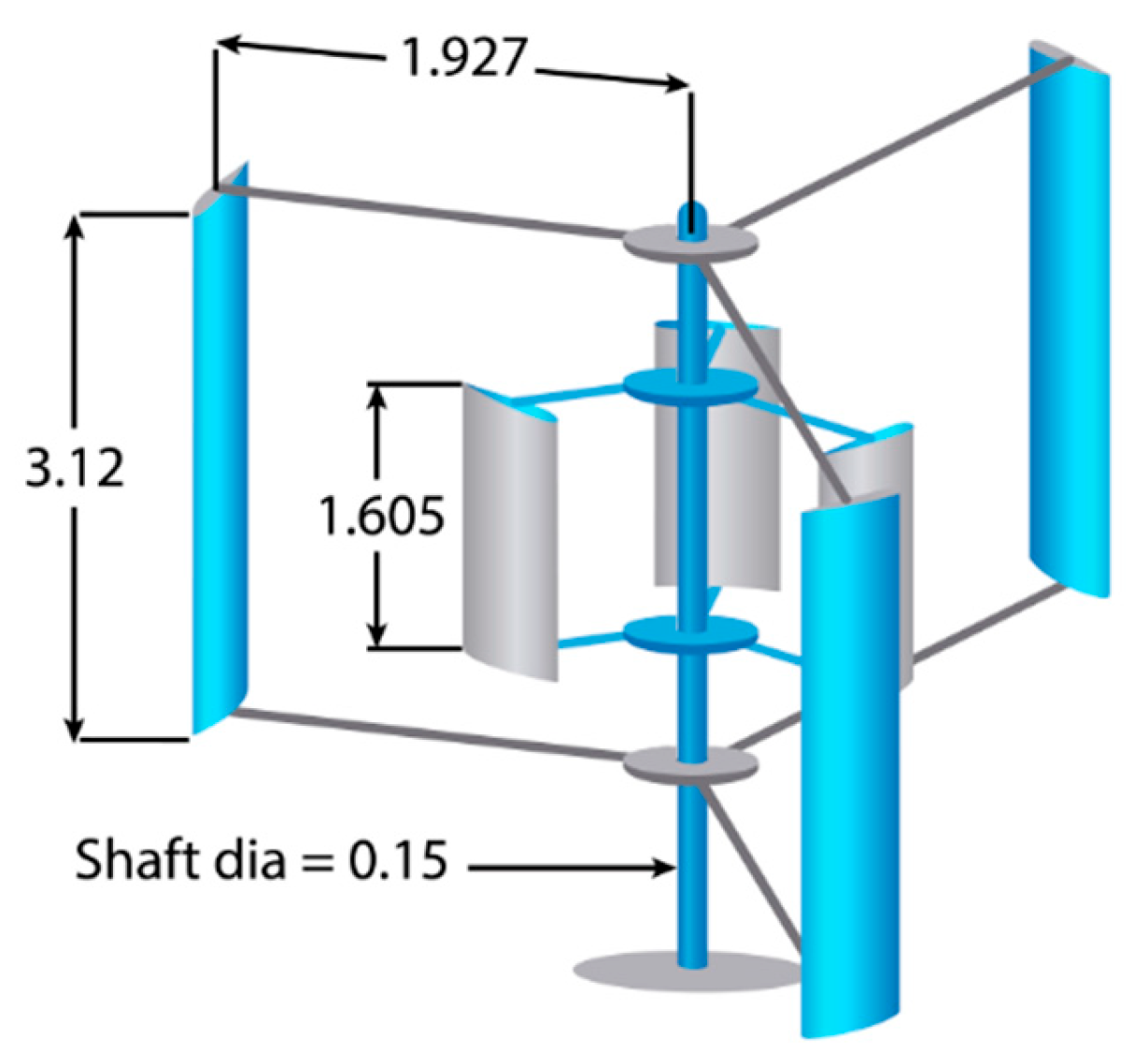
Ahmad et al. [48] developed a hybrid VAWT consisting of two concentric rotors: an inner H-rotor with three curved DU06-W-200 blades and an outer rotor with three straight NACA0018 blades. Two-dimensional CFD simulations revealed a maximum CP of 0.486 at a TSR of 3.0, outperforming conventional hybrid turbines by 11–13%. In addition, the static torque remained positive across the entire azimuthal range, confirming the system’s self-starting capability. In a related study, Ahmad et al. [49] replaced the Savonius rotor of an existing hybrid VAWT with a concentric Darrieus H-rotor. Employing a Design of Experiments (DOEs) framework based on the Box–Behnken method, along with 3D CFD simulations employing a sliding mesh technique and optimized curved blade profiles, the resulting model achieved a CP of 0.491 and self-started at a wind speed of 2.81 m/s. Figure 16 illustrates the proposed geometric configuration of the hybrid Darrieus-based VAWT with dual concentric rotors.
Other approaches, such as the incorporation of auxiliary blades in H-Darrieus rotors, have shown a significant impact on aerodynamic performance. In a recent study, a rotor was designed with blades based on the NREL S823 airfoil profile, where the main blades had a chord length of 100 mm and the auxiliary blades a chord length of 50 mm. Both sets of blades were arranged at an incidence angle of 0°, maintaining a longitudinal spacing equivalent to 26% and a vertical spacing equivalent to 20% of the rotor radius. Figure 17 presents a schematic of this configuration. Two-dimensional CFD simulations revealed that the modified rotor achieved a 22% increase in CP and an 84% increase in CM compared to the conventional rotor, thereby enhancing the competitiveness of this turbine type in low wind-speed regions [50].
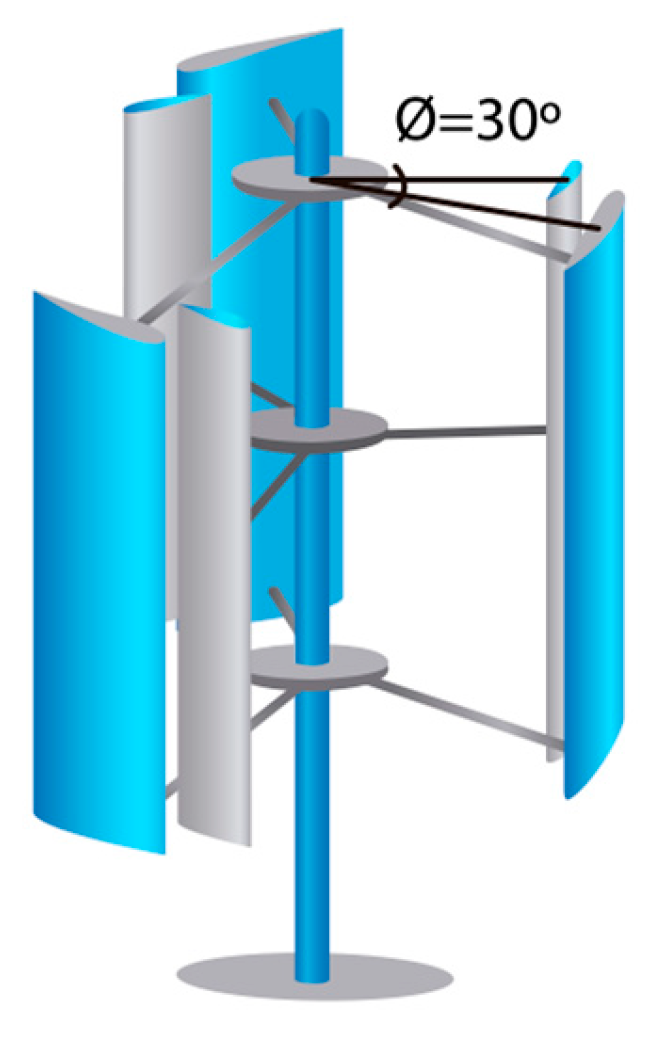
The use of dual-stage turbines with variable phase angles has been proposed as an alternative configuration. This study analyzed a dual-stage H-Darrieus rotor consisting of six NACA0018 blades (three per rotor), with a chord length of 0.06 m, an outer rotor radius of 0.5 m, and a radius ratio of R1/R2 = 0.85 as shown in Figure 18. The AR = 0.06 was maintained in both rotors, with a reference area of 1 m2. The cases considered included a single-stage configuration, a dual-stage arrangement without phase shift (ϕ = 0°), and phase angles of 30°, 60°, and 90°, under free-stream velocities of 4–10 m/s. Two-dimensional CFD simulations were performed to evaluate the start-up response time until a stable angular velocity was reached. The results showed that the 30° phase angle achieved the fastest start, reducing the response time by 25.44%, followed by 90° with 16.16% and 60° with 7.89%, compared to the single-stage turbine (t ≈ 120). These improvements are attributed to the stabilization of shear layers, enhanced vortex capture by the blades, and suppression of turbulent wake structures, collectively enabling a faster transition to steady-state rotation [51].
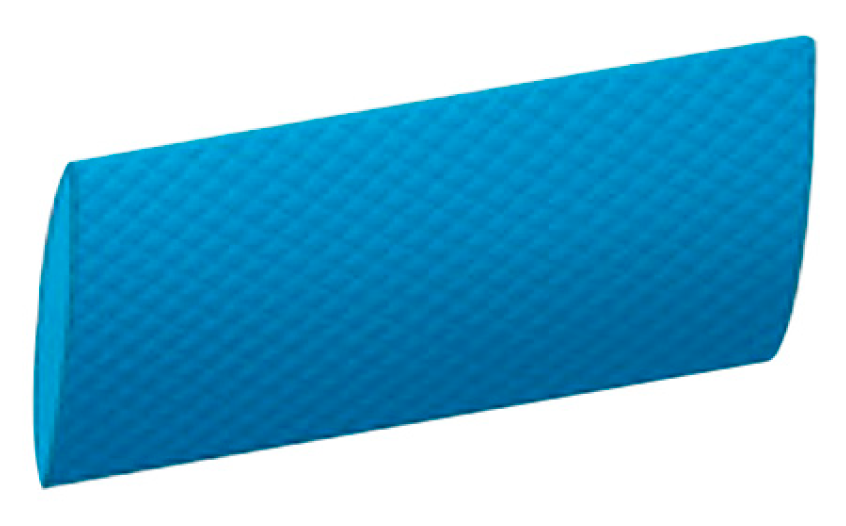
Recent innovations include the use of blades with surface texture. Seifi et al. [27] analyzed 43 rotor configurations at a chord-based Reynolds number of 45,192, selecting the NACA0015, NACA4412, and NACA4415 airfoils due to their superior CP. To enhance their aerodynamic performance, these profiles were optimized using DMST combined with Particle Swarm Optimization (PSO), with the thickness-to-chord ratio as the main design variable. The optimization results showed that the NACA0015 rotor achieved the highest CP, evidencing its effectiveness in improving Darrieus VAWTs. Moreover, complementary analyses revealed that incorporating surface embossing on these blades could provide up to a 21.97% increase in starting torque compared to smooth conventional designs, although the specific geometrical characteristics of the textured patterns were not disclosed. In a follow-up study, Seifi et al. [7] evaluated NACA0015 blades with embossed features through DMST simulations and wind tunnel tests at wind speeds ranging from 1.0 m/s to 9.0 m/s. Their findings indicated a 34.6% reduction in the required starting force and an increase of 12.5% in CP. Figure 19 illustrates the proposed NACA0015 blade with surface embossing as analyzed in these studies.
Table 2 provides a comparative summary of the most relevant recent studies on geometric configuration strategies for vertical-axis Darrieus wind turbines aimed at enhancing their self-starting capability.

4.3. Passive Flow Control Implementation for Self-Starting Enhancement

To facilitate self-starting, flow control adjusts transition, turbulence, and separation, thereby stabilizing the boundary layer at critical azimuth angles. In its passive form, flow control is achieved through fixed blade modifications such as Gurney flaps (GFs), surface cavities, or added roughness on the blade surface, without the need for external energy input.
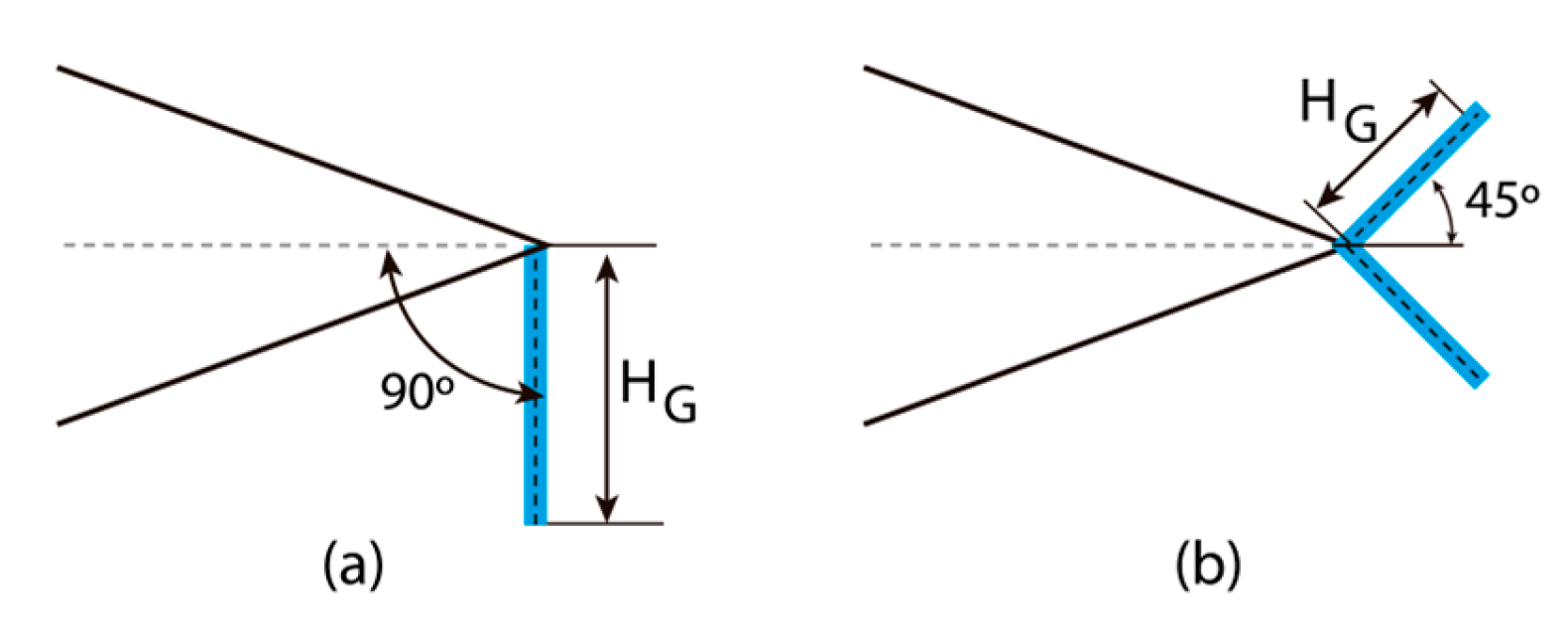
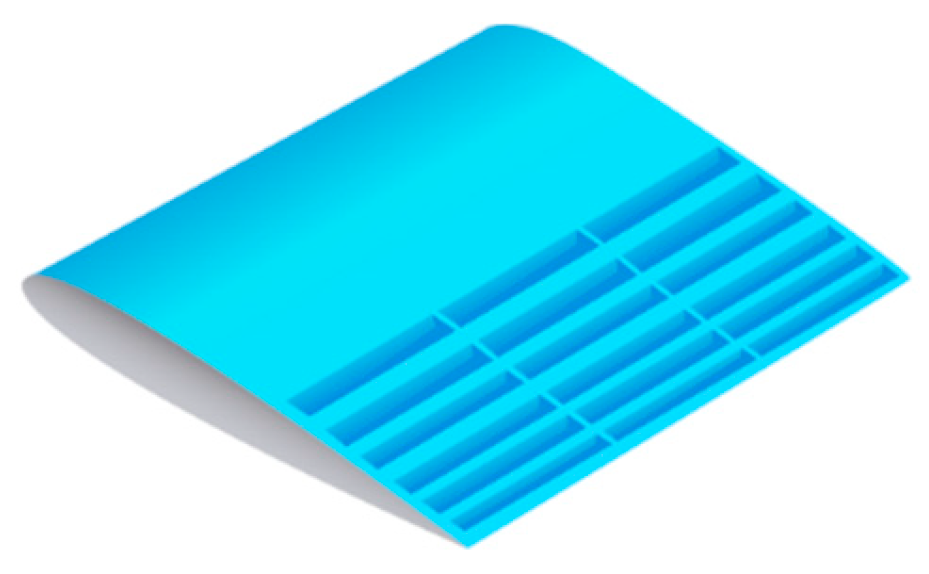
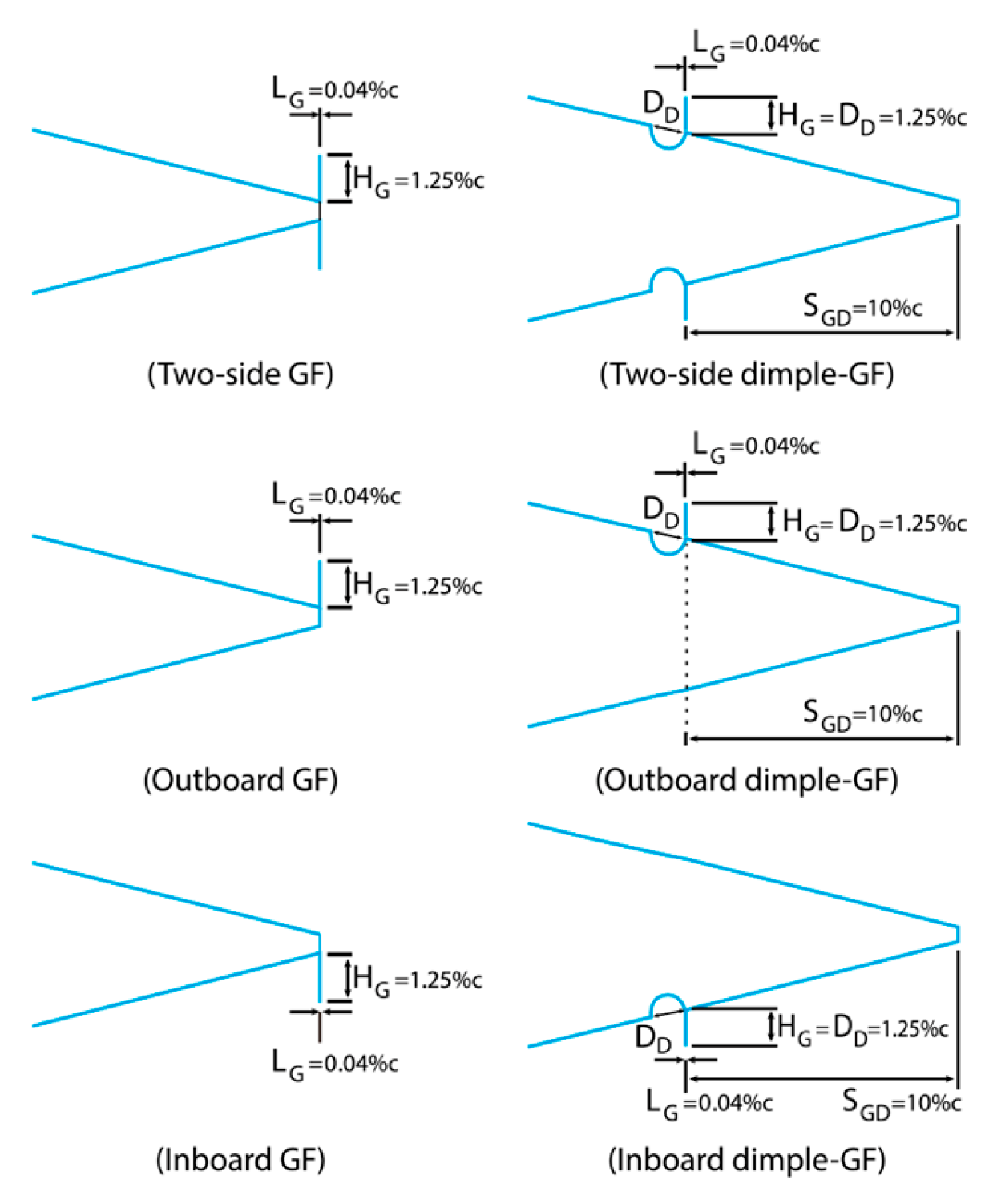
Wiśniewski et al. [52] compared two mounting configurations for the NACA0021 airfoil: a conventional unilateral setup installed either on the inner or outer side of the blade with a 90° angle and a bilateral “fish-tail” arrangement positioned at 45°, as illustrated in Figure 20. Two-dimensional CFD simulations showed that unilateral flaps maximize the CP, whereas bilateral flaps increase the CM, albeit with a slight reduction in overall aerodynamic efficiency. They reported an improvement in CP of 89.47% using a unilateral GF is located on the pressure side (underside) of the blade. The GF height corresponded to 3.4% of the blade chord length, with a solidity ratio of σ = 0.25.
Yan et al. [53] conducted a numerical study to evaluate the effects of GF on the aerodynamic performance of the NACA0018 airfoil and on a three-blade H-type Darrieus wind turbine rotor. The analysis was performed using URANS-based CFD simulations, considering flap heights ranging from 1% to 5% of the airfoil chord. The results showed that GFs significantly increase lift and the lift-to-drag ratio by inducing additional vortices at the trailing edge, which contributes to delaying flow separation and mitigating dynamic stall effects. Consequently, improvements were confirmed in both the CP and the CM under low TSR conditions (1–2), a range in which these turbines typically exhibit low power production.
Chakroun and Bangga [54] conducted a numerical investigation of GF heights ranging from 0.005c to 0.06c and installation angles between 90° and 105°, mounted at the trailing edge of the NACA0018 airfoil. The 90° configuration provided a greater lift enhancement compared to the 105° setup. A flap height of 0.5%c yielded the maximum lift-to-drag ratio with only a minimal increase in CD. The optimal configuration was identified as a 0.06c GF at a 90° angle, which produced the highest power output at a TSR of 2.13. Within the range 1 ≤ λ ≤ 2.5, increasing flap height further elevated the CP to values exceeding 0.3.
Bianchini et al. [55] reported a 21.3% increase in CP when employing a GF with a height equivalent to 3% of the chord, mounted on the inner side of NACA0021 blades. Syawitri et al. [56] identified the optimal GF configuration by evaluating flap height, angle, and position on the NACA0021 airfoil through 2D CFD simulations combined with the Taguchi DOE. The optimal geometry, defined by a flap height of 0.03c and an installation angle of 90°, achieved average improvements in CP of 233.19% at low TSR, 69.94% at medium TSR, and 41.36% at high TSR.
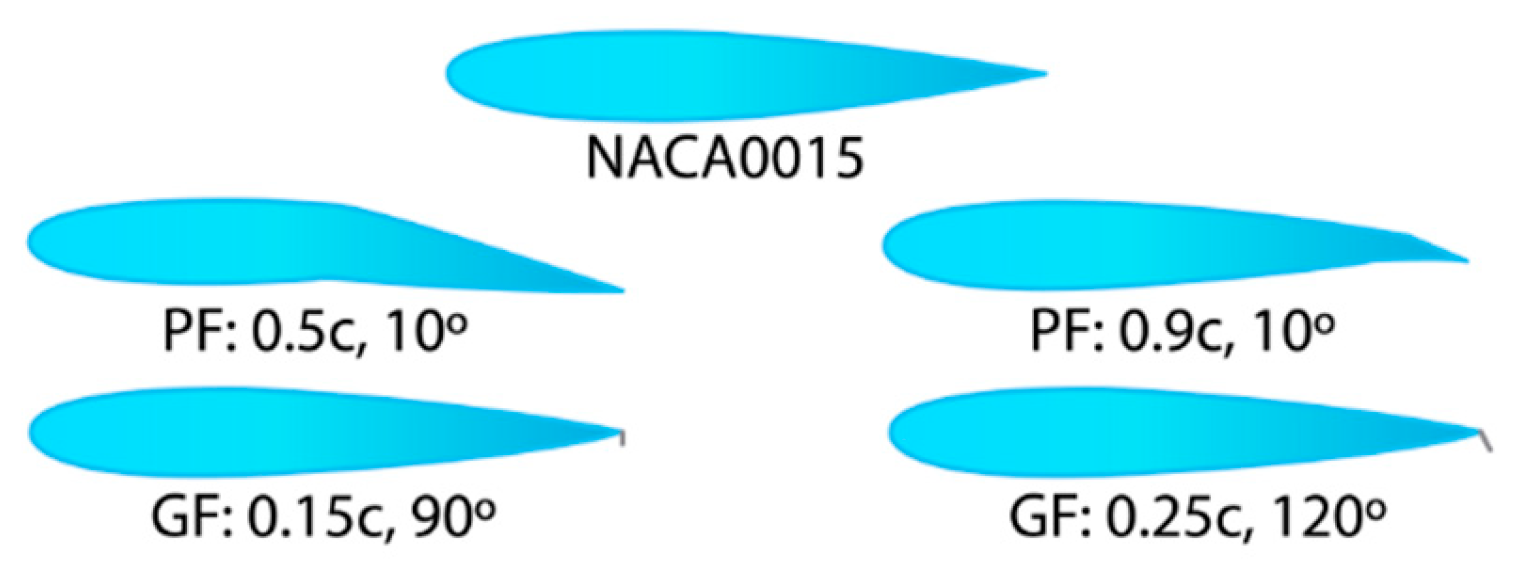
More recently, Eltayeb and Somlal [57] carried out a comparative CFD study on GFs and Planar Fins (PFs) applied to NACA0015 blades, analyzing positions from 50% to 90% of the chord, deflection angles of 10°, 90°, and 120°, and heights between 0.15c and 0.25c, as shown in Figure 21. Their results showed that PFs, especially at 0.6c with 10°, outperformed GFs by up to 9.8%, reducing negative torque and improving startup torque stability by 35%. On the other hand, GF with 0.25c and 120° achieved stable torque but increased drag at low wind speeds, lowering efficiency. Overall, the study indicates that while GFs provide torque stability, PFs in optimized configurations offer a better balance between startup performance and aerodynamic efficiency, making them a robust alternative for high-solidity VAWTs.
Sengupta et al. [58] conducted a CFD study using S1046 and NACA0021 airfoils to evaluate the aerodynamic impact of circular cavities placed on either the inner or outer surface of the airfoil, at chordwise distances of 0.25c, 0.5c, and 0.75c from the leading edge. Simulations were carried out at wind speeds of 5, 6, and 7 m/s. The results revealed that circular cavities enhanced self-starting capability only at 5 m/s, whereas at 7 m/s, the smooth blade without cavities demonstrated superior aerodynamic performance. Ibrahim et al. [9] integrated circular suction cavities into NACA0021 airfoils. Through 2D CFD simulations employing a URANS model, they reported up to a 28% increase in the CP at TSR = 2.0 compared to blades without cavities, attributing this improvement to stall suppression under low and moderate TSR regimes.
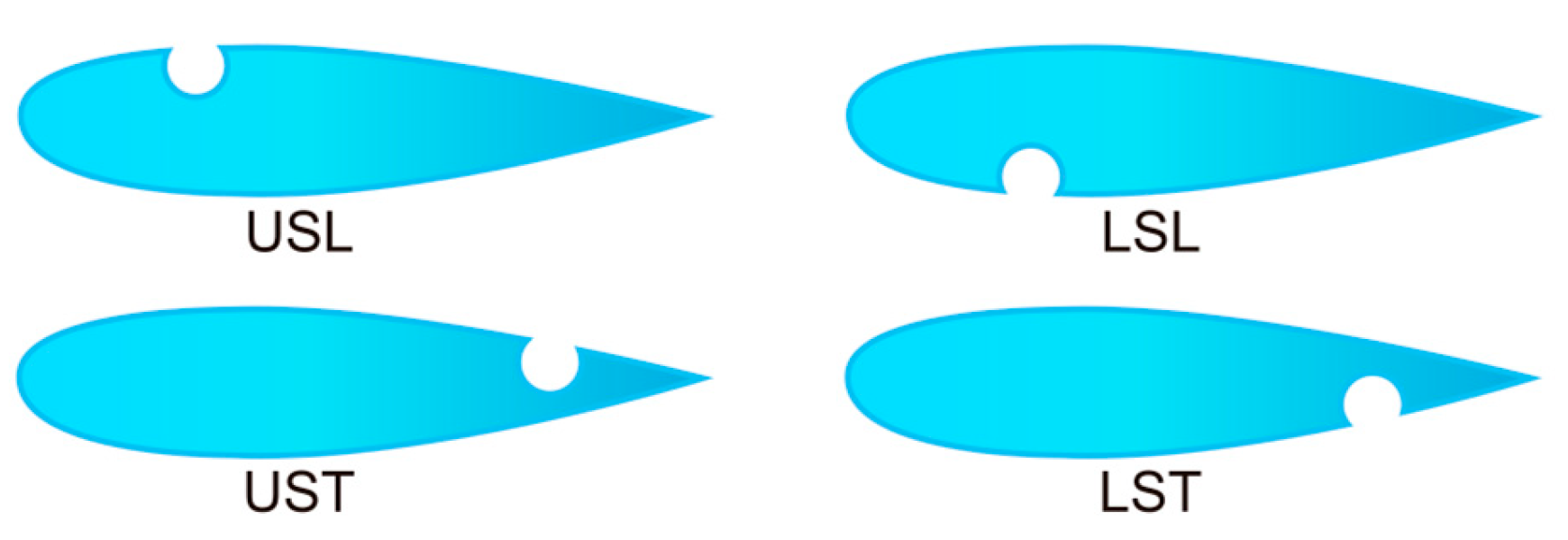
Yousefi et al. [59] evaluated circular cavities located near the leading edge of NACA0021 blades, each with a relative size of 0.08c. CFD simulations assessed variations in the number, size, location, and geometry of cavities, as illustrated in Figure 22. The findings demonstrated an 18% increase in CP at TSR = 3.5, alongside improved torque availability, thereby enhancing the self-starting capability.
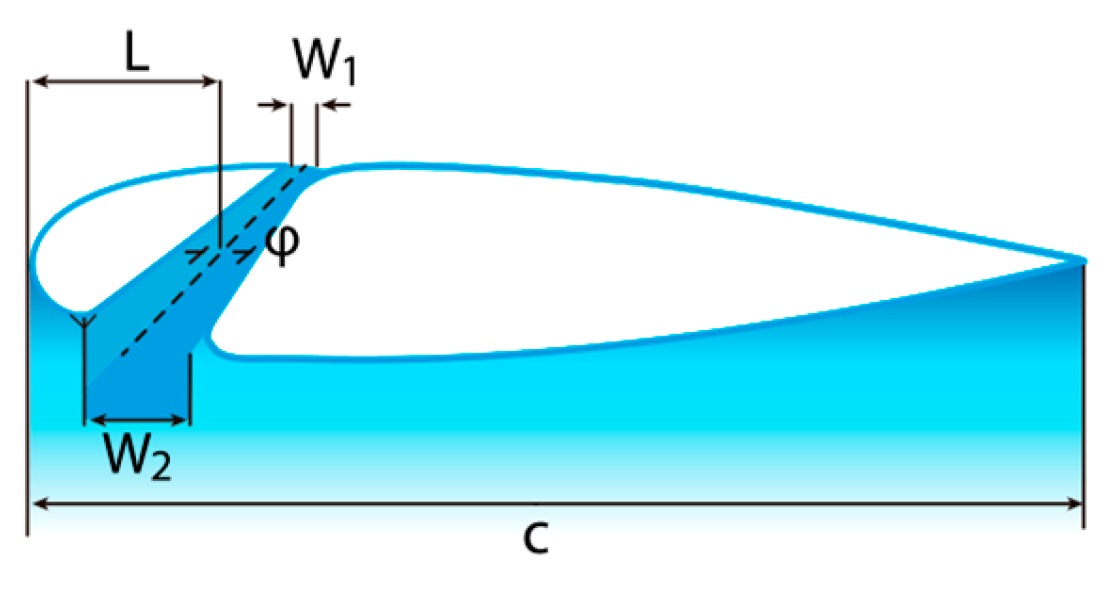
Yoo and Oh [60] optimized the position, diameter, and depth of dimples on NACA0021 airfoils. Combining CFD with artificial neural networks and genetic algorithms, they tested diameters of 0.02c, 0.04c, and 0.06c positioned between 0.5c to 0.9c. The results indicated that small dimples located near the trailing edge increased CP by up to 6.5% and improved CM due to delayed flow separation and reduced wake effects. Mitchell et al. [61] introduced flow-control slots on NACA0012 airfoils, as shown in Figure 23. Using 2D CFD simulations, they investigated the influence of slot number and size on aerodynamic performance. The results indicated that both CM and CP nearly tripled at high angles of attack (>90°) and low TSRs. In contrast, at lower angles and higher TSRs, torque coefficients decreased.
Zhu et al. [62] examined combinations of GF and circular cavities on NACA0021 airfoils, as illustrated in Figure 24. The results showed that all GF configurations enhanced CP, with the configuration of an external-side flap and cavity yielding the highest performance: a 17.9% increase in CP at TSR ≈ 3.1, while also substantially reducing torque fluctuations.
Kord and Bazargan [63] integrated GFs into J-type airfoils, as illustrated in Figure 25, with relative heights of 0.75%, 1.75%, and 2.75% of the chord. Using RANS-based CFD simulations with a k–ω SST turbulence model at an inlet velocity of 10 m/s, they found that an internal flap with 0.75% chord height increased power generation by 10–12% at TSR ≈ 2.25. In contrast, external and dual-side configurations reduced overall efficiency.
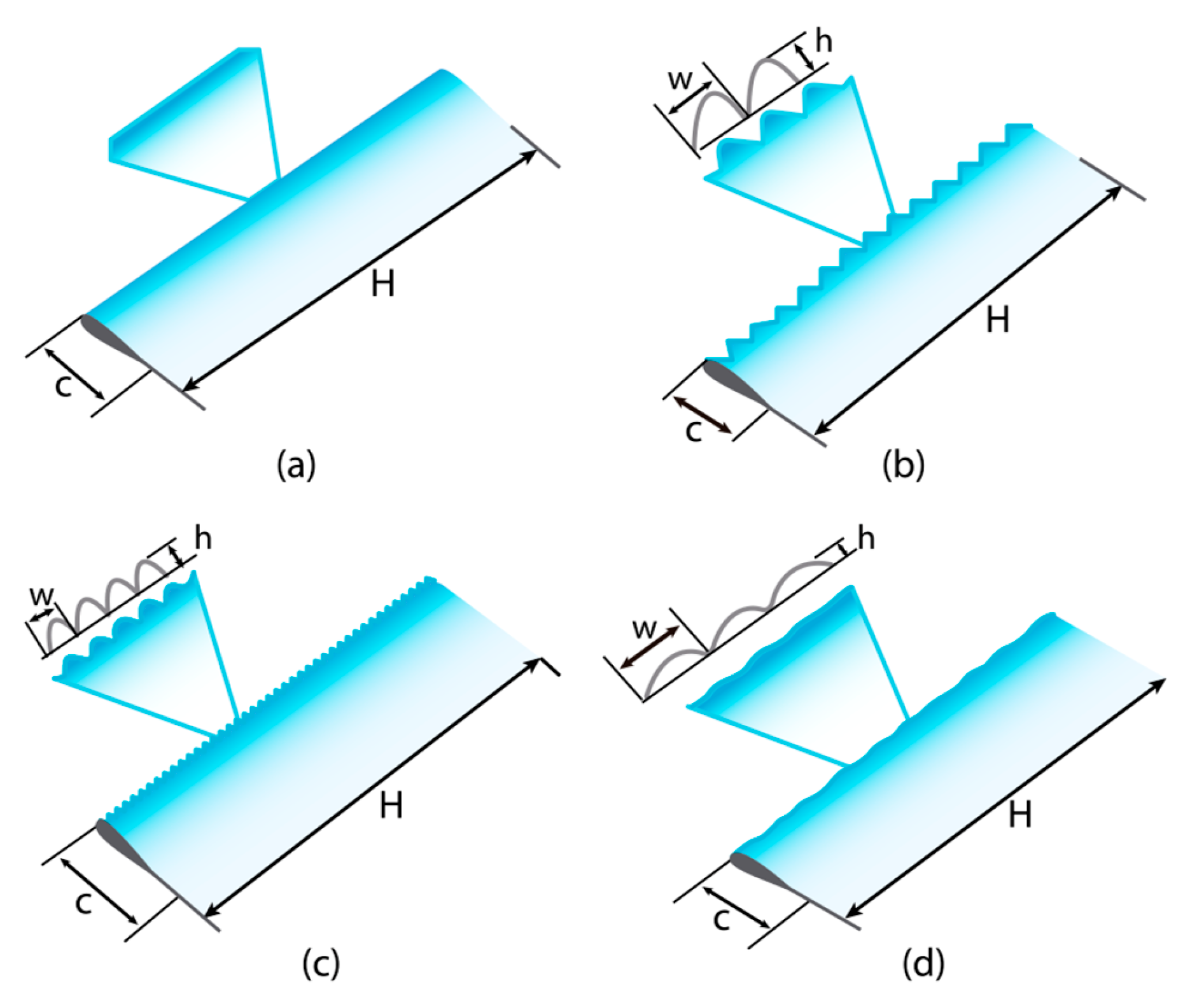
The use of tubercles or leading-edge protuberances (LEPs), inspired by the biomimetic design of humpback whale flippers, has proven to be an effective strategy. Elangovan and Pillai [34] investigated the application of LEP on a four-bladed rotor with variable-speed and variable-pitch control between −20° and 20°. The rotor featured a diameter of 0.90 m and a height of 0.70 m, resulting in an AR of 0.78 and a baseline solidity of 0.59. The blades were designed using the S1046 airfoil, with a baseline chord length of 0.14 m. Three LEP blade designs were implemented with distinct chord modifications: LEP1 (0.16 m), LEP2 (0.148 m), and LEP3 (0.1435 m). Each LEP configuration introduced sinusoidal perturbations along the leading edge with specific wavelength–amplitude ratios. The baseline profile had no modifications, while LEP1 used a wavelength of 0.36c with an amplitude of 0.14c, LEP2 used a wavelength of 0.14c with an amplitude of 0.057c, and LEP3 incorporated a wavelength of 0.36c with a smaller amplitude of 0.025c, as illustrated in Figure 26. Their results demonstrated that the LEP3 configuration nearly eliminated dynamic stall, substantially improving the self-starting ability of the turbine across wind speeds from 6 to 20 m/s. The negative pitch angles generated higher initial torque due to pronounced peaks in the CM.
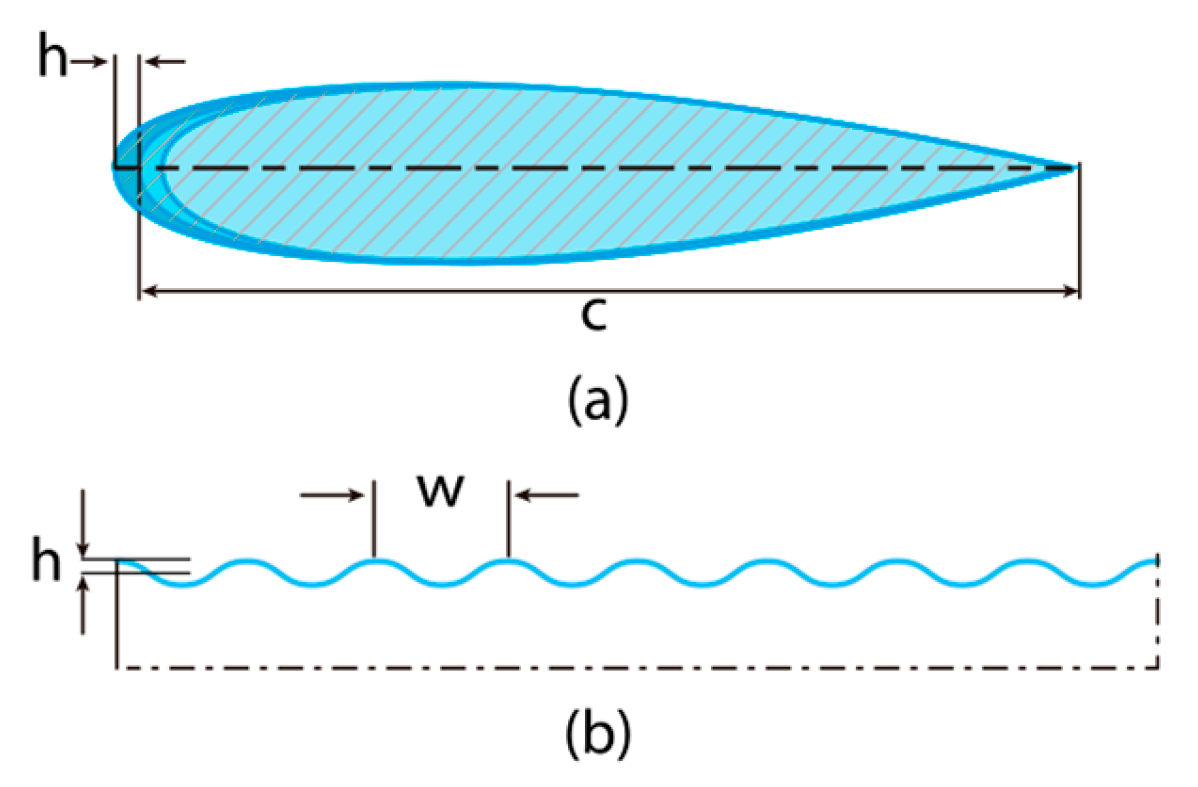
Gonçalves et al. [64] introduced sinusoidal leading-edge protuberances on NACA0018 airfoils, as shown in Figure 27, testing four amplitudes (h = 0.008c, 0.015c, 0.025c, 0.035c) and four wavelengths (w = 1/10c, 1/8c, 1/6c, 1/3c). CFD simulations revealed increases of up to 46% in the CP at 5.5 m/s and 20% at 9.0 m/s, along with improved self-starting, reducing the cut-in wind speed from 7.0 to 5.5 m/s compared to unmodified blades.
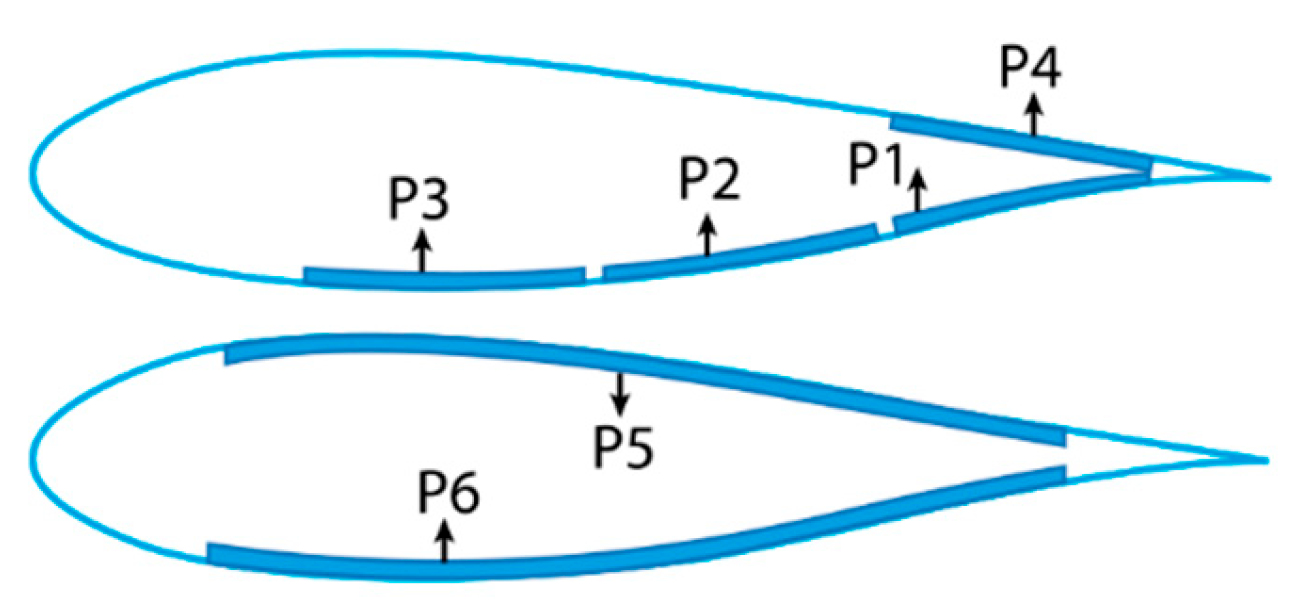
Zamani et al. [65] incorporated porous materials applied to the DU06-W-200 airfoil. Six different porous locations (P1-P6) were investigated to find the optimum place for porous media as shown in Figure 28 and different angles of attack between 0 and 20°. Two-dimensional CFD simulations and URANS and SIMPLE algorithms showed consistent improvements in CP and CM across a broad TSR range, with superior starting ability especially when the porous medium was placed on the pressure side of the blade. Under TSR < 2, the P1 configuration exhibited the best performance, whereas for TSR > 2, the P3 configuration achieved the maximum CP, thereby extending the turbine’s operational range. Moreover, a marked increase in CM was observed, resulting in enhanced self-starting capability and reduced cut-in speed. The use of porous materials further promoted flow adherence to the airfoil surface, suppressed separation zones, stabilized the flow, and mitigated mechanical loads on the rotor shaft.
Finally, Mohamed et al. [66] incorporated a longitudinal slot into the NACA0018 airfoil, as shown in Figure 29. Two-dimensional CFD simulation demonstrated that the slot significantly delayed flow separation, resulting in CM close to 0.15 and CP around 0.30 at a TSR = 2, representing up to a threefold increase compared to the baseline.
Table 3 provides a comparative summary of the passive control strategies applied to the blades of Darrieus-type VAWTs aimed at improving their self-starting capability.

4.4. Active Flow Control Implementation for Self-Starting Enhancement

Unlike passive control, active flow control involves the application of external energy or dynamic mechanisms to deliberately modify aerodynamic behavior in real time. This approach allows for greater adaptability under varying operating conditions [67]. By employing actuators such as plasma devices, adaptive blades, or synchronized moving mechanisms, active control offers considerable potential to improve self-starting capability and maximize operational efficiency.
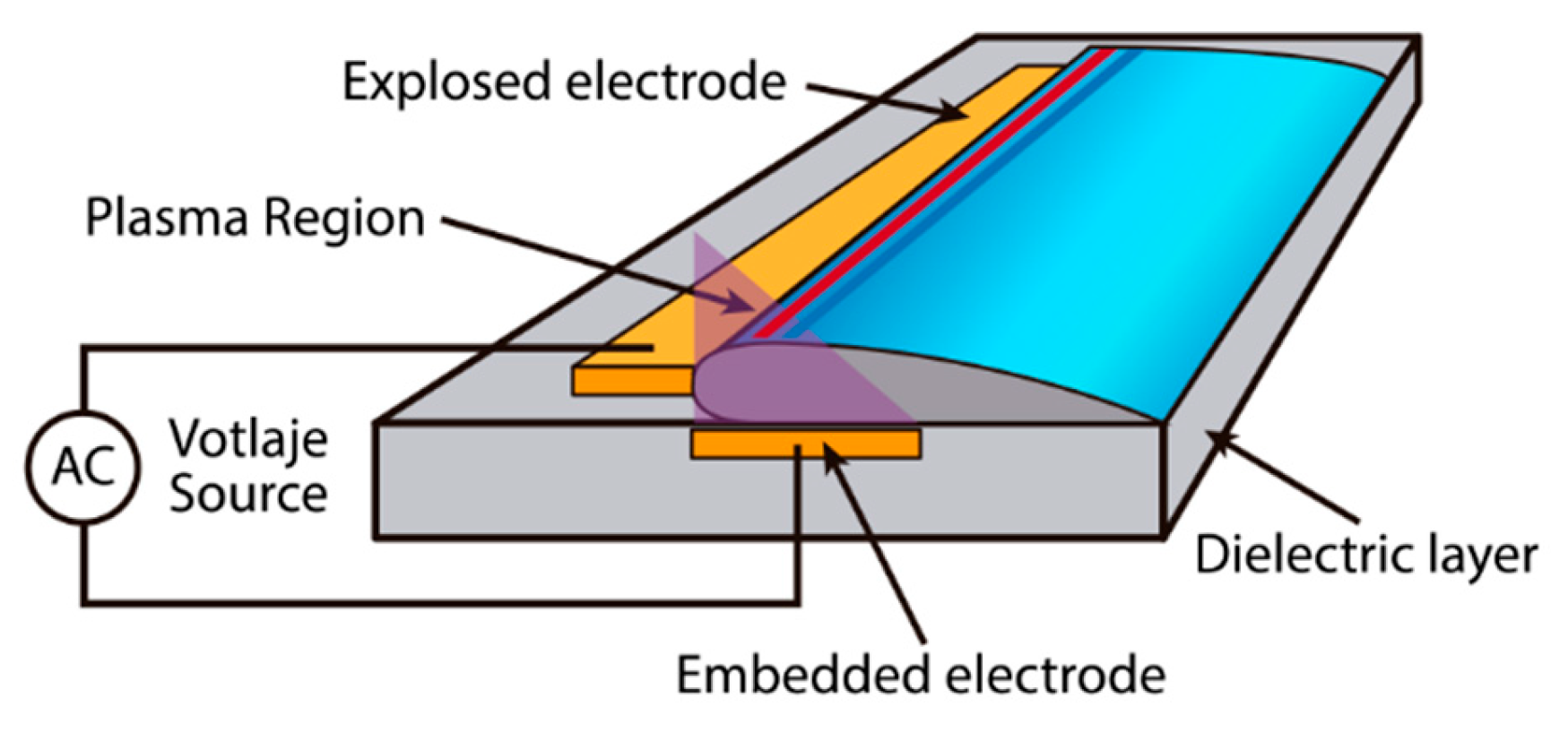
Under this concept, some research focused on analyzing flow behavior and mitigating dynamic loss in blades using plasma actuators. The operating principle is based on generating an electric field between two electrodes by applying a high voltage alternating current. This process ionizes the surrounding air, producing a jet attached to the wall that delays the separation of the flow over the surface of the airfoil [68].
A recent study proposed an active flow control scheme to mitigate dynamic stall in H-type Darrieus VAWTs using dielectric-barrier-discharge (DBD) plasma actuators. As shown in Figure 30, the operating principle and schematic implementation of the plasma actuators were applied to the blades. The computational setup modeled a three-bladed rotor with NACA0022 profiles (c = 0.1 m, R = 0.3 m), analyzed under 2D URANS simulations (unit height) at an inflow velocity of 5.07 m/s and across a TSR range of 1–3, with emphasis on TSR = 2.15 since it corresponds to the experimental maximum CP. Plasma actuators were positioned between 5% and 90% chord, with the 0.3c location yielding the best results, achieving a 36% increase in CP compared to the baseline. The optimal control strategy involved pulsed plasma actuation in the 60–120° azimuth range, which significantly increased the Tangential Force coefficient during the critical phase and delayed secondary vortex formation from 135° to 155°, thus partially suppressing dynamic stall and enhancing aerodynamic efficiency [69].
Chavoshi and Ebrahimi [70] examined the impact of plasma actuators on Darrieus VAWT through CFD simulations based on the finite volume method and URANS with transition modeling. They assessed rotor performance under both constant and variable angular velocity. With the plasma deactivated, negative torque was observed for TSR < 1.5. When activated at TSR = 0.5, the torque improved by 128%, becoming positive. For 1.5 < TSR < 2.0, power output increased by up to 260%. Under free rotation conditions, TSR improved by 8%, reducing startup time.
In a prior study, Chavoshi and Ebrahimi [71] evaluated the ability of dielectric barrier discharge plasma actuators to control dynamic stalls. Three configurations were simulated: internal, external, and double-sided. The internal and double-sided setups mitigated Karman vortices and improved CP by 10%, while the external actuator showed minimal impact.
Daraee and Abbasi [72] analyzed the influence of actuator location, ranging from 10% to 90% of the chord, on both inner and outer surfaces, and activation timing, concluding that optimal placement delays flow separation and enhances self-starting. Subsequently, Abbasi and Daraee [73] explored the use of time-varying plasma actuators.
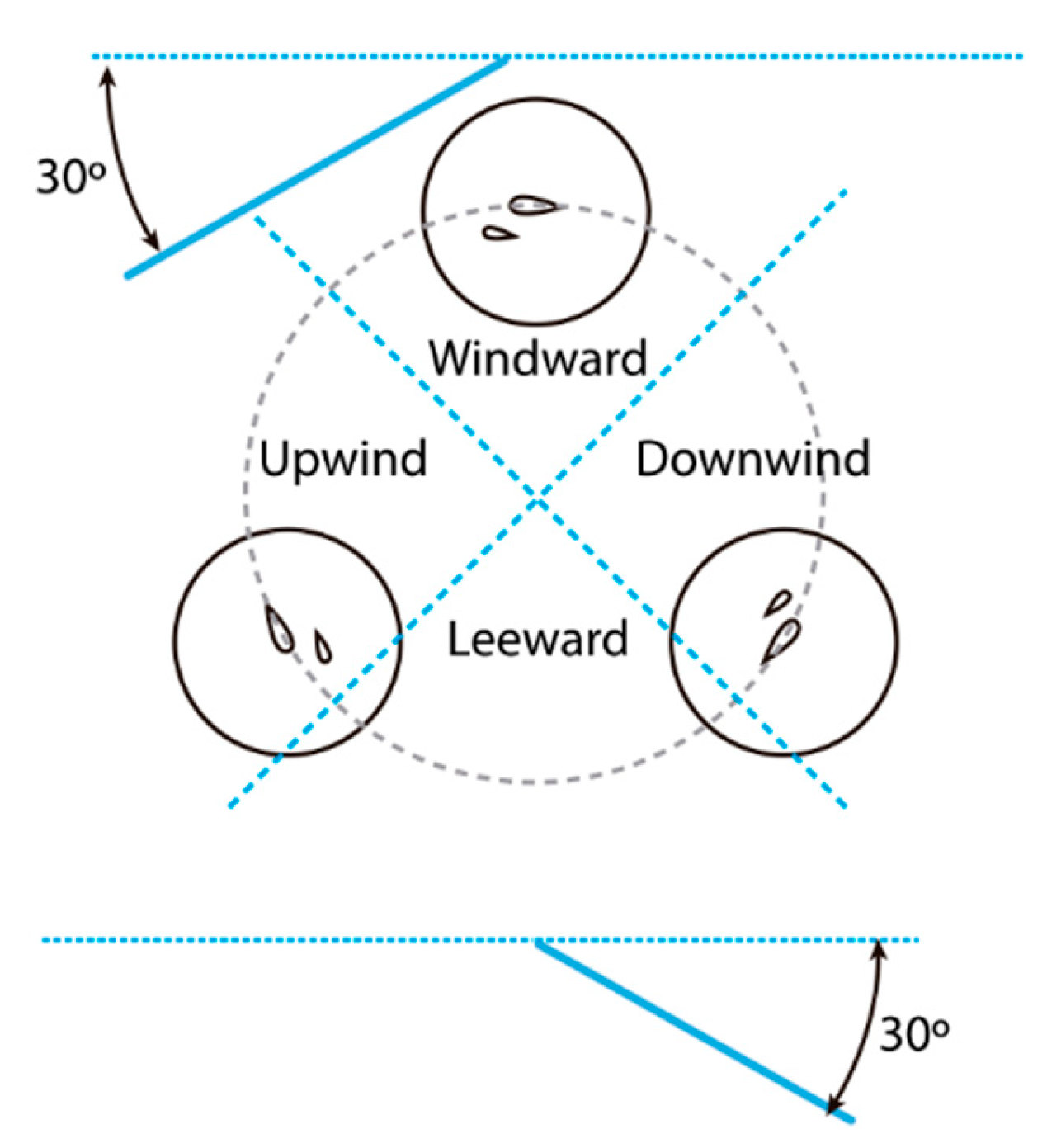
Gao et al. [74] developed an adaptive blade system for a four-bladed Darrieus VAWT with NACA0018 profile, integrating drag-mode and lift-mode operation through hybrid active control, as shown in Figure 31. At low wind speeds, the blades operate in drag mode; at high speeds, they switch to lift mode. The CFD simulations with 6DOF and dynamic meshing used were validated against wind tunnel experiments. They reported a 34.7% reduction in cut-in wind speed and an increase in CM by up to 1.82 times at a blade opening angle of 80°. However, the long-term structural durability of the system was not assessed.
Liu et al. [75] proposed a combined cavity and GF configuration for a three-blade Darrieus VAWT with a NACA0021 profile, in which the GF changes position during rotation to reduce drag in the upwind zone while enhancing the CP. In 2D CFD simulations, they compared clean blades, cavity + fixed GF, and cavity + movable GF. The fixed GF increased CP by 37.5% (TSR = 2.04) and 21.2% (TSR = 2.33). The moving GF further improved performance by reducing flow separation and increasing starting torque, with the activation angle identified as the most critical parameter.
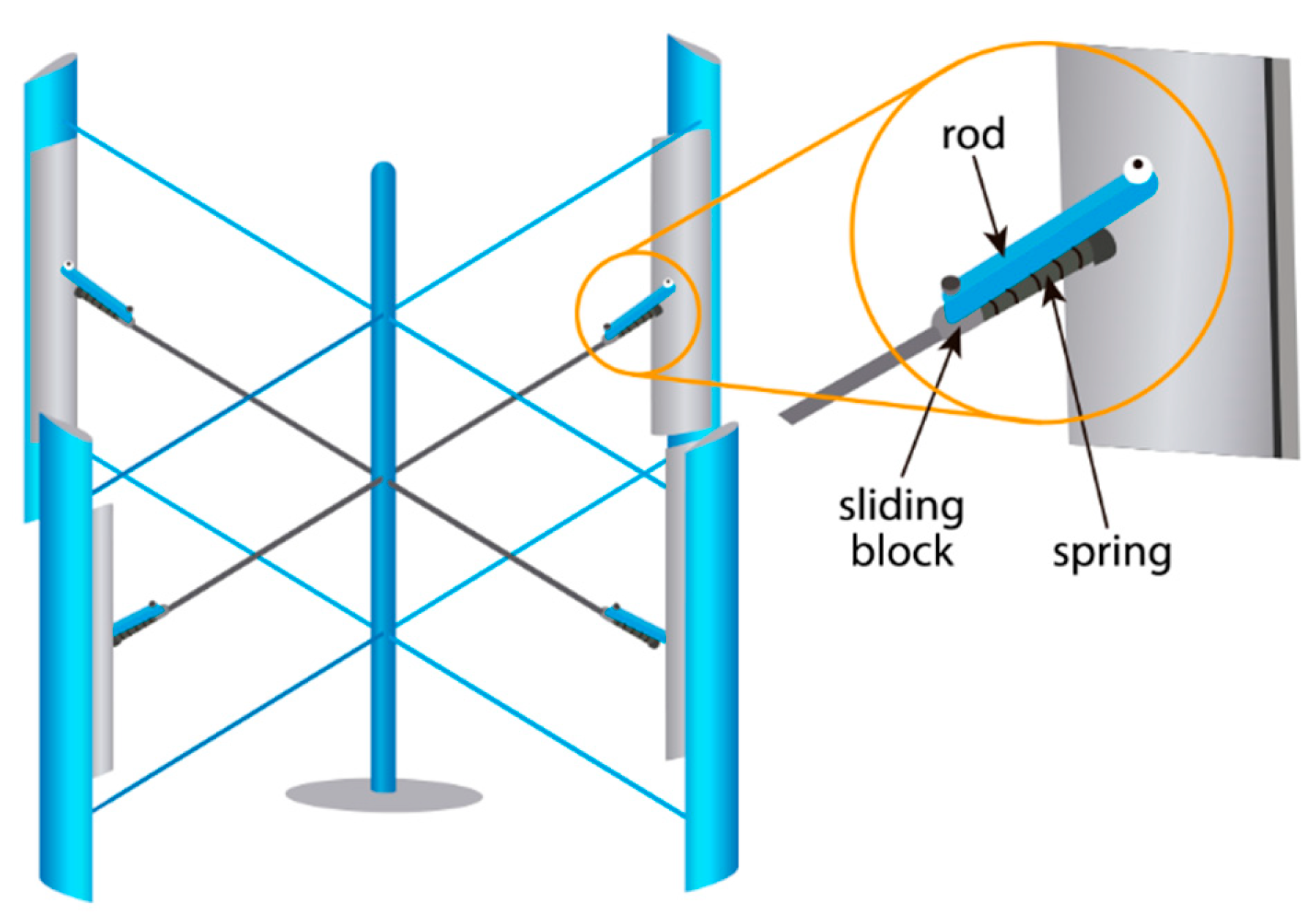
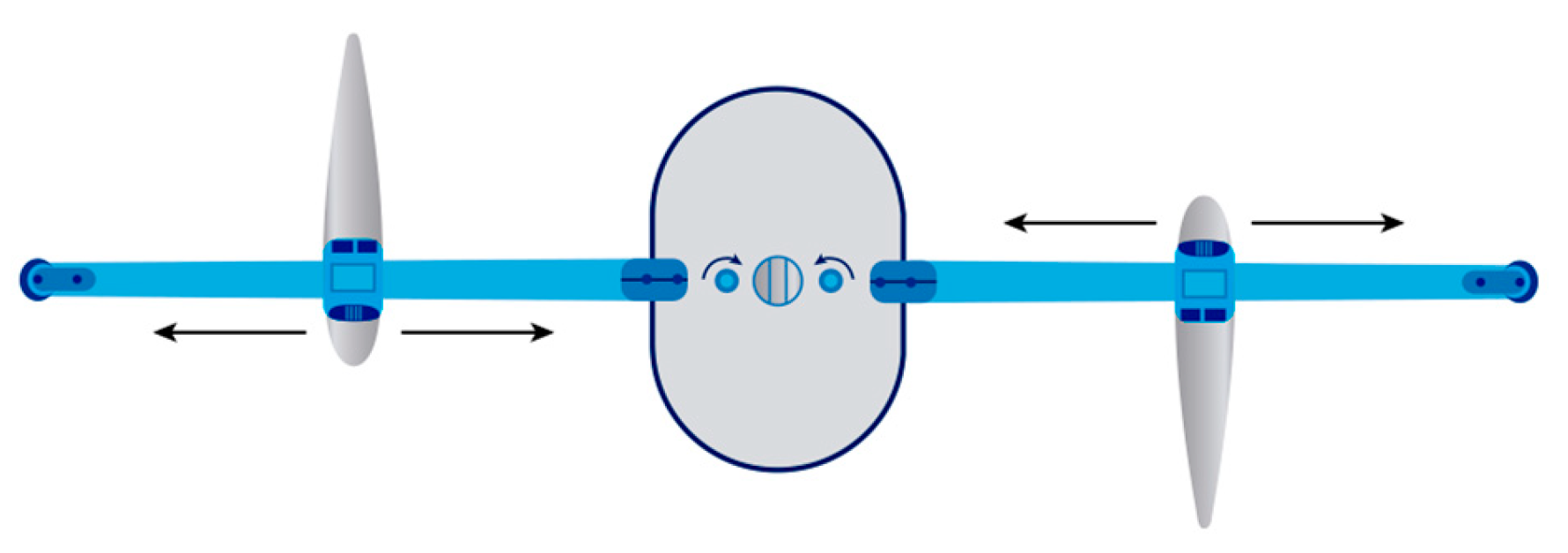
Lee et al. [76] proposed an innovative Variable Diameter VAWT (VD-VAWT), based on a two-bladed H-Darrieus rotor with NACA0018 profiles, in which the blades slide radially along the struts through a motorized mechanism, as shown in Figure 32. The aim was to dynamically adjust rotor solidity under varying wind speeds and TSR conditions. Using a wind tunnel prototype, fixed-diameter configurations (300–800 mm) were compared with the actively controlled variable-diameter turbine. The results indicated that at a fixed diameter, the best performance occurred at D = 600 mm (σ = 0.5) with CP = 0.2748, while the variable-diameter system outperformed it by +34% compared to 600 mm and +68% compared to 800 mm, achieving a peak power output of 19.92 W at 224 RPM. In addition, the VD-VAWT enhanced self-starting, enabled dynamic self-regulation, and offered potential storm protection, albeit with a control energy cost of about 32% of generated power. These findings confirm the potential of variable-diameter systems as an effective strategy to expand the operating range and improve efficiency in fluctuating wind environments.
Table 4 summarizes these strategies focused on the implementation of active flow control systems in Darrieus VAWT blades to enhance self-starting capability.

4.5. Incident Flow Enhancement for Improved Starting Performance

The power extracted by a VAWT is proportional to the cube of the incoming wind speed. Consequently, even modest increases in flow velocity can markedly improve aerodynamic efficiency and self-starting capability. This relationship has motivated the development of several technological strategies aimed at augmenting the airflow impinging on the rotor blades. These include ducts, stators, diffusers, guide vanes, wind concentrators, and auxiliary blades. Recent studies have also investigated wake interactions between neighboring turbines as a collaborative passive mechanism to facilitate startup.
Chegini et al. [77] proposed a hybrid configuration that combines a three-blade NACA0021 Darrieus rotor with a two-bladed Savonius rotor, further enhanced by flat deflectors. Using unsteady CFD simulations with the SST k-ω turbulence model, they observed a 26.91% increase in CP at TSR = 1.45 compared with the unmodified Darrieus rotor. However, performance decreased at higher TSRs due to the inherent inefficiency of the Savonius rotor. The implementation of front, lateral, and combined deflectors yielded additional improvements of up to 40%, underscoring the potential of passive devices in hybrid VAWTs, albeit with directional constraints.
Ghafoorian et al. [8] investigated the integration of auxiliary blades and deflectors into an NACA0021-based VAWT rotor, as shown in Figure 33. Using 2D CFD simulations, they optimized the pitch angle and positioning of the auxiliary blades, achieving both enhanced efficiency and a reduction in the minimum TSR required for startup, from 1.4 to 0.7. While deflectors improved performance at high TSRs, their influence on startup was negligible. The study’s limitations include the use of a single blade profile for both primary and auxiliary blades, as well as the absence of 3D simulations to capture the full aerodynamic effects.
Wang et al. [78] examined the aerodynamic influence of a passive diffuser positioned downstream of a five-bladed Darrieus VAWT, as depicted in Figure 34. Through CFD simulations and laboratory, they analyzed the effects of the diffuser length and opening angle. The results demonstrated a 31.42% increase in the maximum CP at TSR = 0.65–0.75 and a 26.79% enhancement in CM, indicating a clear positive contribution of the diffuser to self-starting capability.
Fatahian et al. [79] conducted 2D and 3D CFD simulations to evaluate the startup dynamics of a three-blade NACA0018 VAWT, accounting for rotor inertia. By applying the Taguchi method and Analysis of Variance (ANOVA), they optimized parameters such as the angular spacing between adjacent turbines. The findings revealed that the optimized configuration reduced the start-up time of the downstream turbine from 6.7 to 4.6 s by leveraging the accelerated wake generated by the upstream rotor. This study highlights promising avenues for collaborative layout design in VAWT wind farms.
Li et al. [80] designed convex wind concentrators based on B-spline curves, positioned above and below a straight-bladed Darrieus rotor. Using CFD simulations combined with an orthogonal experimental design, they optimized the concentrator’s geometric parameters. The results indicated that the device increased flow velocity near the blades, reduced low-pressure regions, and enhanced the maximum CP by 52.7% as well as the average CM by 24.7%.
Table 5 provides a comparative overview of the reviewed strategies aimed at enhancing incident airflow to improve the self-starting performance of Darrieus-type VAWTs.

4.6. Cross-Cutting Appraisal and Strength of the Evidence

In this subsection, the entire body of evidence undergoes a comprehensive critical appraisal: first, the methodological quality of each study is evaluated; next, overarching trends and observed heterogeneity are synthesized; potential publication or reporting biases are then examined; and, finally, a level of confidence is assigned to the available findings.

4.6.1. Risk of Bias in the Included Studies

To systematically evaluate the methodological quality of the included studies, an ad hoc matrix with four weighted and ranked domains was developed:
  • Methodological clarity and reproducibility—40%;
  • Analytical approach, giving preference to studies that combine CFD with experimental or statistical validation—30%;
  • Coverage of start-up metrics (cut-in speed, CM, CP)—20%;
  • Complete reporting of turbine parameters—10%.
Each domain was scored on a 0–3 scale (0 = absent, 1 = minimal, 2 = adequate, 3 = outstanding) and multiplied by its weighting factor, giving a total score from 0 to 30. Overall risk was classified as low (25–30 points), moderate (17–24), or high (10–16). Two reviewers applied the matrix independently and resolved discrepancies by consensus. This range was defined considering that the eligibility criteria had already excluded studies lacking minimum methodological standards; therefore, the effective lowest score per domain should be 1, corresponding to a minimum total of 10 points. However, to maintain consistency and account for the possibility of partial omissions, a practical lower bound of zero points was retained. This classification preserves the proportionality of the scale by assigning the moderate-risk category to half of the remaining interval between the low- and high-risk thresholds. The consolidated results were 35 studies at low risk, 12 at moderate risk, and 6 at high risk.
Inter-rater agreement was assessed using Cohen’s Kappa for each of the four domains of the risk-of-bias matrix. The results were methodological clarity and reproducibility (κ = 0.47), analytical approach (κ = 0.80), coverage of start-up metrics (κ = 0.45), and reporting of turbine parameters (κ = 0.90). The moderate Kappa values observed for methodological clarity and start-up metrics reflect greater discrepancies between reviewers in judging whether methodological descriptions were sufficiently explicit or whether start-up metrics were adequately reported. These aspects often require interpretive judgment and depend heavily on reviewer experience. In contrast, the higher agreement in turbine parameters and analytical approach suggests that these domains rely more on checklist-type criteria, which reduce subjectivity. The overall weighted Kappa across all domains was κ = 0.61, which, according to Landis and Koch’s benchmarks, indicates a moderate to substantial agreement. This result supports the reproducibility of the appraisal framework while acknowledging the interpretive nature of certain domains.
Supplementary Materials have been included, providing the full risk-of-bias assessment along with the inter-rater Kappa analysis to ensure methodological transparency.

4.6.2. Global Synthesis and Heterogeneity

Taken together, the five intervention lines deliver a clear boost in starting torque, though with varying magnitudes and levels of certainty.
Profile-shape optimization achieves a median ΔCT/CM increase close to 25% (range 6–38%). J–type or J-tipped blades yield the largest gains when the rotor operates below TSR ≈ 1.5 and OR exceeds 40%. The main weakness is the scant validation on full 3D, prototype-scale models.
Rotor-configuration changes, higher solidity, large aspect ratio, surface texturing, or dual-rotor layouts deliver improvements in the order of 20–35% (median ≈ 30%). Wide variation in the blade length (0.3–2.1 m), airfoil shape, and test method introduces considerable heterogeneity and demands verification of the impact on operating-regime efficiency.
Passive flow-control devices such as Gurney flaps, tubercles, or cavities show a reliable effect of ≈22% (range 15–35%). The spectacular jumps (up to 300%) are confined to very specific setups (e.g., slots at extreme angles of attack). Trade-offs in nominal CP and full-scale performance remain unknown.
Under active control, the few prototypes using plasma actuators, adaptive blades, or movable flaps post a notable increase between 30% and 100% (median ≈ 60%) by eliminating negative torque and shortening start-up times. Evidence, however, is limited to laboratory rotors, and the energy balance and durability have yet to be quantified.
Finally, incident-flow-augmentation techniques, diffusers, concentrators, or cooperative layouts raise initial torque by roughly 25% (21–32%) and, in twin-rotor cases, cut the start-up time by one-third. Structural impact, installation cost, and wind-direction sensitivity are still sparsely documented.
In summary, passive and geometric strategies provide consistent 20–30% gains with negligible energy consumption; structural tweaks and flow-management layouts add comparable benefits if several parameters are co-optimized; and active solutions exhibit the highest absolute potential but need scale-up validation and cost–benefit analysis before industrial adoption.
The spread in ΔCT/CM values is driven not only by design variations but also by substantial differences in turbine size (diameters 0.3–4.7 m), methodological fidelity (2D/3D CFD, wind-tunnel, field prototypes), turbulence models (k-ω SST, k-ε, LES), and operating conditions (wind speeds 0.5–20 m/s, target TSR 0–6). For rotor configuration, diversity in solidity and the aspect ratio broadens dispersion; without normalizing aerodynamic loading and inertia, the ≈30% median must be interpreted cautiously. In active control, mixing plasma actuators, adaptive blades, and movable flaps, tested only on lab rotors, limits the extrapolation of the ≈60% gain to commercial turbines.
Moreover, each study employs a different baseline airfoil (NACA 0012, 0015, 0021, 4415, S1046, DU06-W-200) and reports torque increase with disparate metrics: absolute ΔCT/CM, relative percentage, or start-up time. By contrast, profile-geometry and passive-device strategies reveal more reproducible flow patterns across studies; even so, the absence of full-scale prototypes remains a source of uncertainty.
This variability precludes numerical aggregation without bias. Consequently, a qualitative synthesis using the median as a robust indicator was chosen, and typical magnitudes are presented as ranges rather than weighted averages.
In conclusion, the typical gain per strategy offers practical guidance, but methodological and geometric heterogeneity mean the values should be viewed as indicative trends, not definitive effect estimates.
Pre-specified sensitivity analyses (e.g., excluding high-risk studies or 2D-only CFD) were not undertaken because no subgroup reached ≥10 comparable studies; conclusions were qualitatively checked for robustness against reliance on any single study and remained unchanged.

4.6.3. Publication and Reporting Bias

Marked heterogeneity across studies and an insufficient number of comparable comparisons per subgroup prevented the construction of funnel plots or the application of formal tests (Egger/Begg), which typically require ≥10 homogeneous studies per comparison. Instead, we performed a qualitative review with completeness counts.
Regarding the type of effect reporting, 39/53 (~74%) studies provide quantitative results (e.g., percent improvement, N·m, cut-in, peak CP, start-up time), while 26/53 (~26%) give qualitative descriptions without figures. For metrics (non-exclusive categories), CM or CT appear in 28/53 (~53%), CP in 24/53 (~45%), start-up time in 12/53 (~23%), and cut-in in 4/53 (~8%).
By strategy, the included studies are distributed as follows: airfoil geometry 12/53 (~23%); rotor configuration 11/53 (~21%); passive flow control 17/53 (~32%); active flow control 8/53 (~15%); and incident-flow augmentation 5/53 (~9%). The within-strategy quantification rates were airfoil 9/12 (75%), configuration 9/11 (~82%), passive 12/17 (~71%), active 7/8 (~88%), and incident-flow 2/5 (40%).
We identified several trade-offs and non-favorable outcomes:
  • J-profiles improve torque at low TSR but reduce CP at high TSR;
  • External or bilateral Gurney flaps raise start-up torque but lower CP in rated operation;
  • Cavities help at 5 m/s but a clean blade performs better at 7 m/s;
  • Very high OR (90%) eases start-up but penalizes CP at high TSR; very low OR (10%) does not start at all;
  • Darrieus–Savonius hybrids ensure self-starting, but the Savonius stage adds drag at high TSR;
  • Active control (plasma, adaptive blades) improves start-up but consumes energy and raises durability/cost concerns;
  • High solidity and surface roughness favor start-up but can penalize performance in nominal operations.
These observations do not suggest a systematic omission of negative findings within the included set.
No prospective protocols were found in PROSPERO or OSF, limiting the assessment of selective reporting. In addition, the review was restricted to English-language, indexed literature, so publication bias due to the exclusion of grey literature or other languages cannot be ruled out.
Conclusion. Based on these checks, we found no consistent patterns indicative of publication or reporting bias; however, the low proportion of quantified results, the absence of registered protocols, and the scope limitations of the included studies prevent us from excluding such biases with certainty.

4.6.4. Certainty of the Evidence

Confidence in the evidence was assessed using a GRADE framework adapted to engineering, considering five domains: risk of bias, inconsistency (unexplained heterogeneity), indirectness (differences between test conditions and real-world use), imprecision (sample sizes/lack of uncertainty estimates), and publication/reporting biases. Overall certainty for the primary outcome (improvement in start-up torque coefficient, ΔCT/CM) was rated as high, moderate, low, or very low by strategy.
Airfoil geometry optimization (J-type and variants): moderate. Consistent effect (≈20–40% typical) and reproducible at low TSR; downgraded due to limited 3D validation and scarcity of full-scale prototypes, introducing indirectness.
Rotor configuration: low to moderate. Positive signal (≈20–35%) but with high heterogeneity (solidity, AR, layouts) and mixed methods (2D CFD versus wind tunnel). Inconsistency and imprecision (few replications) reduce confidence.
Passive flow control: moderate. Repeated gains in tunnel/CFD (≈10–40%, with outliers under extreme conditions). Downgraded for possible CP trade-offs at rated TSR and lack of full-scale testing (indirectness).
Active flow control: low. Large effects (≈30–100%) but based on few lab studies, with imprecision, indirectness (energy consumption/durability unquantified), and a higher risk of bias.
Incident-flow augmentation: moderate. Coherent effects (≈21–32%) for diffusers/concentrators and cooperative layouts; downgraded due to structural/economic uncertainty and site sensitivity (indirectness).
To increase certainty, future work should include pre-registered protocols; standardized reporting (CP–λ and CM–λ curves with uncertainty), 3D and multi-site field validation, and cost–benefit analyses (including energy balance for active control).

5. Critical Discussion of the State of the Art on Self-Starting Strategies in Darrieus VAWTS

The evidence synthesized in this work shows a wide range of solutions to improve the self-starting of straight-bladed Darrieus VAWTs. The five families analyzed, aerodynamic airfoil optimization, rotor configuration, passive flow control, active flow control, and incident-flow augmentation, address different facets of the start-up phenomenon and differ in operating envelope, implementation complexity, and validation maturity.
In practical terms, geometric airfoil optimization and certain passive devices provide consistent torque gains at low TSR with a modest integration burden, although their impact on rated-TSR efficiency should be assessed on a case-by-case basis. Configuration tuning (solidity, aspect ratio, and layout) also shortens start-up when structural and aerodynamic parameters are co-optimized. Flow-augmentation techniques (diffusers, concentrators, cooperative arrays) increase incident velocity and reduce start-up time, though their effect is highly dependent on siting and available space. Active solutions show the largest gains in the lab, but real-world adoption requires demonstrating net energy balance, robustness, and maintainability.
These results should be interpreted considering limitations in the body of studies: predominance of 2D CFD, limited 3D and wind-tunnel/field validation, heterogeneous outcome reporting (ΔCT/CM, CP, cut-in speed, start-up time), and disparate baselines. These factors increase heterogeneity and justify this review’s emphasis on medians and qualitative trends rather than a formal meta-analysis.
The review process itself also has constraints: the search was limited to English-language, the indexed literature; no prospectively registered protocols were identified for the included studies; and the protocol for this review was not preregistered. Although no consistent signals of publication/reporting bias were found, these conditions prevent ruling it out entirely.
Finally, design decisions should weigh the trade-offs identified in the results. For small-scale or urban applications where simplicity and low auxiliary power are priorities, a pragmatic route is to pair an optimized airfoil with selective passive devices and fine-tune rotor configuration. In contrast, flow-augmentation and active-control strategies remain attractive candidates for advanced prototypes, yet their adoption must be supported by robust validation. Most current evidence is derived from 2D CFD simulations, which, while valuable for design screening, fail to capture three-dimensional phenomena such as tip vortices, spanwise redistribution, or aeroelastic coupling. This limitation may lead to discrepancies between simulated and real-world performance, particularly under turbulent urban inflows. Therefore, systematic progress requires 3D CFD/FSI analyses complemented by wind-tunnel and field experiments, bridging the gap between idealized simulation environments and practical deployment.
Despite the qualitative contrasts highlighted between passive, active, and hybrid strategies, most existing studies do not report directly comparable quantitative metrics (e.g., net energy balance, durability under cyclic loading, or maintenance requirements). This lack of standardized performance data prevents rigorous trade-off analysis. Addressing this gap requires future research to establish shared benchmarking protocols that enable direct comparisons of energy consumption, reliability, and long-term efficiency between active and passive implementations.

6. Research Gaps and Future Trends

Building on the discussion above, we outline a forward agenda to make self-starting strategies robust, scalable, and field-ready:
  • Standardized benchmarking and reporting. Adopt a shared start-up benchmark: minimum data package (CP–λ and CM–λ curves with uncertainty, cut-in speed, start-up time, ΔCT/CM vs. baseline), reference inflow (turbulence intensity, shear), and geometry descriptors (solidity, AR, chord/R, airfoil family, opening ratio, pitch). Provide machine-readable tables and uncertainty budgets;
  • Three-dimensional fidelity and coupled physics. Deploy-validated 3D CFD + FSI workflows for start-up with mesh/time-step independence, y+ control, dynamic-stall modeling, and structural modes (bending/torsion). Extend simulations to capture aeroelastic effects such as blade and tower deformation, flutter, and cyclic fatigue, which are critical for full-scale rotor behavior. Publish verification/validation (V&V) artifacts, uncertainty quantification, and open benchmark cases to enable replication and cost-aware design translation. Pioneering full-scale 3D FSI simulations of Darrieus turbines (e.g., the Windspire VAWT model) have demonstrated the capacity to predict self-starting dynamics under realistic deformations [81], while morphing blade concepts via FSI shed light on the role of flexible structures in performance [82];
  • Wind tunnel and field trials. Follow a progression: scaled tunnel tests → instrumented pilots → multi-site field trials in urban/turbulent settings. Particular attention should be paid to scale effects, since aerodynamic behaviors validated at small-scale (e.g., Reynolds dependence, stall onset, wake recovery) may not directly extrapolate to full-scale rotors and urban turbulence. Ensuring similitude in key nondimensional parameters (e.g., Reynolds number, TSR, turbulence intensity) is essential for meaningful translation of findings. Report reproducible protocols (sensor layout, calibration, inflow characterization) and share raw time series;
  • Manufacturability, durability, and certification. Translate promising geometries/devices into manufacturable designs; test fatigue, erosion, and environmental aging; quantify maintenance. Align with small-wind standards to accelerate adoption;
  • Energy and economics. Report net energy balance for active control (actuator power vs. start-up gains) and cost–benefit for incident-flow devices (CAPEX, footprint, siting constraints). Normalize performance (e.g., Δ annual energy at site class);
  • Multi-objective optimization with ML. Use surrogate-assisted or physics-informed ML (Bayesian optimization, reinforcement learning) to co-optimize aero–structural–control variables under constraints (loads, noise, cost). Publish surrogates and sensitivity analyses. Recent applications of surrogate-based metaheuristics for VAWTs have shown their capability to reduce computational burden while achieving significant performance gains [83];
  • Additive manufacturing and tailored materials. Leverage AM to prototype hybrid blades (e.g., J-tips, textured leading edges) with localized stiffness/damping; document process windows, anisotropy, and QA/QC. Pilot studies confirm that AM can accelerate design iterations and enable customized geometries for improved self-starting performance at reduced cost [84];
  • Alignment with Sustainable Development Goals (SDGs) and urban renewable targets. Future research should explicitly evaluate how self-starting strategies contribute to global sustainability agendas, particularly the UN SDGs. Beyond aerodynamic and structural performance, studies should quantify the role of enhanced VAWT self-starting in expanding distributed wind energy, reducing reliance on fossil-based peak demand, and enabling integration in urban and peri-urban contexts. Such analysis would link technical progress with societal impact, supporting SDG 7 (Affordable and Clean Energy), SDG 11 (Sustainable Cities and Communities), and SDG 13 (Climate Action), as well as national renewable energy targets [85]. Incorporating life-cycle assessment, socio-economic indicators, and policy frameworks into future validations would strengthen the relevance of VAWT self-starting research for real-world deployment;
  • Toward an integrated design framework. Future work should consolidate aerodynamic, structural, and control dimensions into a unified design philosophy for VAWT self-starting. Rather than treating each strategy in isolation, research should emphasize how optimized airfoil profiles, structural robustness under cyclic loading, and active/passive control mechanisms interact as a cohesive system. Such integration would support scalable and reliable designs, enabling systematic trade-off analysis across performance, durability, and cost dimensions. Establishing this framework could accelerate the transition from isolated experimental insights toward holistic engineering solutions for urban and distributed applications;
  • Techno-economic feasibility and urban deployment. Future studies should incorporate cost–benefit analyses to evaluate the practicality of self-starting strategies in real-world contexts, especially urban environments where space, noise, and reliability constraints are critical. Comparative assessments of capital and maintenance costs versus expected energy yield would help determine the viability of passive versus active strategies. Integrating life-cycle cost analysis and urban siting constraints would provide decision-makers with a clearer pathway toward sustainable deployment.
Near-term deliverables: open benchmark datasets, reference geometries, V&V packages, and a minimal reporting checklist tailored to VAWT start-up studies.

7. Conclusions

This review systematizes five families of strategies to enhance the self-starting of straight-bladed Darrieus VAWTs. No single approach is universally optimal: geometric airfoil optimization and selective passive devices offer reliable, low-power gains at low TSR; configuration tuning and incident-flow devices add further improvements where structure and sitting allow; and active control delivers the largest laboratory gains but requires proof of net energy and durability.
To support clearer prioritization, Table 6 provides a comparative synthesis of these strategies, structured around criteria such as technological feasibility, implementation cost, scalability, reliability, and maintainability. While not a prescriptive decision matrix, this summary offers a first-level roadmap, enabling designers and researchers to identify context-appropriate strategies according to turbine size, location, and wind regime.
As a visual complement, Figure 35 provides a graphical roadmap summarizing the interconnections among these strategies and their relative positioning, offering readers an integrated overview of the field.
Practically, hybrid designs, pairing an optimized airfoil with targeted passive elements and configuration tuning, offer the most robust near-term pathway. Table 7 summarizes representative hybrid strategies investigated in the literature, combining aerodynamic optimization, passive flow devices, and rotor configuration adjustments. These combinations generally report greater torque enhancement at low TSR compared to individual strategies, though validation remains limited to CFD or small-scale experiments. Bridging to deployment will require standardized benchmarking, validated 3D/FSI models, transparent uncertainty reporting, coordinated tunnel/field campaigns, and manufacturability and cost–benefit assessments.
Finally, advances in AI-assisted optimization, additive manufacturing, and open, reproducible workflows can accelerate the transition from promising prototypes to reliable urban-scale implementations, supporting wider adoption of distributed wind.

Supplementary Materials

The following supporting information can be downloaded at: https://www.mdpi.com/article/10.3390/su17177878/s1.

Author Contributions

Conceptualization, J.-S.G.-M.; methodology, E.C.-N.; software, J.-S.G.-M.; validation, E.C.-N.; formal analysis, J.-S.G.-M. and E.C.-N.; investigation, J.-S.G.-M. and E.C.-N.; resources, J.-S.G.-M. and E.C.-N.; data curation, J.-S.G.-M. and E.C.-N.; writing—original draft preparation, J.-S.G.-M.; writing—review and editing, E.C.-N.; visualization, J.-S.G.-M.; supervision, E.C.-N.; project administration, J.-S.G.-M. and E.C.-N.; funding acquisition, J.-S.G.-M. and E.C.-N. All authors have read and agreed to the published version of the manuscript.

Funding

This research received no external funding.

Institutional Review Board Statement

Not applicable.

Informed Consent Statement

Not applicable.

Data Availability Statement

The original contributions presented in the study are included in the article; further inquiries can be directed to the corresponding author.

Acknowledgments

The authors thank the CIATEQ graduate program for the support provided in carrying out this research work.

Conflicts of Interest

The authors declare no conflicts of interest.

References

  1. Kumar, Y.; Roga, S.; Wanmali, N.K. Experimental analysis of hybrid VAWT and the effect of semi-cylindrical attachment to the trailing edge. Energy Sustain. Dev. 2023, 74, 115–0826. [Google Scholar] [CrossRef]
  2. International Energy Agency (IEA). World Energy Outlook 2022; IEA: Paris, France, 2022; Available online: https://www.iea.org/reports/renewables-2022 (accessed on 27 July 2025).
  3. Renewable Energies. Available online: https://www.iec.ch/energies/renewable-energies (accessed on 27 July 2025).
  4. Celik, Y.; Ingham, D.; Ma, L.; Pourkashanian, M. Novel hybrid blade design and its impact on the overall and self-starting performance of a three-dimensional H-type Darrieus wind turbine. J. Fluids Struct. 2023, 119, 103876. [Google Scholar] [CrossRef]
  5. De Tavernier, D.; Ferreira, C.; Goude, A. Vertical-Axis Wind Turbine Aerodynamics. Handb. Wind Energy Aerodyn. 2022, 64, 1317–1361. [Google Scholar] [CrossRef]
  6. Mohammed, S.; Naik, R.L. Design, development and experimental investigation of H-rotor vertical axis wind turbine under low wind speeds. Int. J. Renew. Energy Res. 2023, 13, 49–58. [Google Scholar] [CrossRef]
  7. Seifi Davari, H.; Botez, R.M.; Seify Davari, M.; Chowdhury, H.; Hosseinzadeh, H. Numerical and experimental investigation of Darrieus vertical axis wind turbines to enhance self-starting at low wind speeds. Results Eng. 2024, 24, 103240. [Google Scholar] [CrossRef]
  8. Ghafoorian, F.; Enayati, E.; Mirmotahari, S.R.; Wan, H. Self-starting improvement and performance enhancement in Darrieus VAWTs using auxiliary blades and deflectors. Machines 2024, 12, 806. [Google Scholar] [CrossRef]
  9. Ibrahim, A.A.; Elbaz, A.M.R.; Melani, P.F.; Mohamed, O.S.; Bianchini, A. Power augmentation of Darrieus wind turbine blades using trapped vortex cavity. J. Wind Eng. Ind. Aerodyn. 2022, 223, 104949. [Google Scholar] [CrossRef]
  10. Page, M.J.; McKenzie, J.E.; Bossuyt, P.M.; Boutron, I.; Hoffmann, T.C.; Mulrow, C.D.; Shamseer, L.; Tetzlaff, J.M.; Akl, E.A.; Brennan, S.E.; et al. The PRISMA 2020 Statement: An Updated Guideline for Reporting Systematic Reviews. BMJ 2021, 372, n71. [Google Scholar] [CrossRef] [PubMed]
  11. Anderson, C.G. Wind Turbines: Theory and Practice; Cambridge University Press: New York, NY, USA, 2020. [Google Scholar]
  12. Manwell, J.F.; McGowan, J.G.; Brandlard, E.; Ram, B. Wind Energy Explained: On Land and Offshore, 3rd ed.; John Wiley & Sons Ltd.: Hoboken, NJ, USA, 2024. [Google Scholar]
  13. Tayebi, A.; Torabi, F. Flow control techniques to improve the aerodynamic performance of Darrieus vertical axis wind turbines: A critical review. J. Wind Eng. Ind. Aerodyn. 2024, 252, 105820. [Google Scholar] [CrossRef]
  14. Ritschel, U.; Beyer, M. Designing Wind Turbines: Engineering and Manufacturing Process in the Industrial Context; Springer: Cham, Switzerland, 2022. [Google Scholar] [CrossRef]
  15. Ebert, P.R.; Wood, D.H. Observations of the starting behaviour of a small horizontal-axis wind turbine. Renew. Energy 1997, 12, 245–257. [Google Scholar] [CrossRef]
  16. Kirke, B. Evaluation of Self-Starting Vertical Axis Wind Turbines for Stand-Alone Applications. Ph.D. Thesis, Griffith University, Brisbane, Australia, 1998. [Google Scholar]
  17. Hill, N.; Dominy, R.; Ingram, G.; Dominy, J. Darrieus turbines: The physics of self-starting. Proc. Inst. Mech. Eng. A J. Power Energy 2008, 223, 21–29. [Google Scholar] [CrossRef]
  18. Sun, S.Y.; Liu, H.J.; Peng, H.Y. Power performance and self-starting features of H-rotor and helical vertical axis wind turbines with different airfoils in turbulence. Energy Convers. Manag. 2023, 292, 117405. [Google Scholar] [CrossRef]
  19. Du, L.; Ingram, G.; Dominy, R.G. A review of H-Darrieus wind turbine aerodynamic research. Proc. Inst. Mech. Eng. C J. Mech. Eng. Sci. 2019, 233, 7590–7616. [Google Scholar] [CrossRef]
  20. Worasinchai, S.; Ingram, G.L.; Dominy, R.G. The physics of H-Darrieus turbine starting behavior. J. Eng. Gas Turbines Power 2016, 138, 062605. [Google Scholar] [CrossRef]
  21. Du, L. Numerical and Experimental Investigations of Darrieus Wind Turbine Start-Up and Operation. Ph.D. Thesis, Durham University, Durham, UK, 2015. [Google Scholar]
  22. Celik, Y. Aerodynamics and Self-Starting of Vertical Axis Wind Turbines with J-Shaped Aerofoils. Ph.D. Thesis, University of Sheffield, Sheffield, UK, 2021. [Google Scholar]
  23. Selvarajoo, S.; Mohamed, Z. The effects of dynamic stalls on the aerodynamics and performance of a Darrieus rotor during self-start. Phys. Fluids 2024, 36, 017107. [Google Scholar] [CrossRef]
  24. Zhu, H.; Hao, W.; Li, C.; Luo, S.; Liu, Q.; Gao, C. Effect of geometric parameters of Gurney flap on performance enhancement of straight-bladed vertical axis wind turbine. Renew. Energy 2021, 165, 464–480. [Google Scholar] [CrossRef]
  25. Burton, T.; Jenkins, N.; Bossanyi, E.; Sharpe, D.; Graham, M. Wind Energy Handbook, 3rd ed.; Wiley: Hoboken, NJ, USA, 2021. [Google Scholar]
  26. Rosato, M.A. Small Wind Turbines for Electricity and Irrigation: Design and Construction; CRC Press: Boca Raton, FL, USA; Taylor & Francis Group: Boca Raton, FL, USA, 2019. [Google Scholar]
  27. Seifi Davari, H.; Botez, R.M.; Seify Davari, M.; Chowdhury, H.; Hosseinzadeh, H. Blade height impact on self-starting torque for Darrieus vertical axis wind turbines. Energy Convers. Manag. X 2024, 24, 100814. [Google Scholar] [CrossRef]
  28. Sang, L.Q.; Phengpom, T.; Thin, D.V.; Duc, N.H.; Hang, L.T.T.; Huyen, C.T.T.; Huong, N.T.T.; Tran, Q.T. A method to design an efficient airfoil for small wind turbines in low wind speed conditions using XFLR5 and CFD simulations. Energies 2024, 17, 4113. [Google Scholar] [CrossRef]
  29. Naik, K.; Sahoo, N. Aerodynamic performance and starting torque enhancement of small-scale Darrieus type straight-bladed vertical axis wind turbines with J-shaped airfoil. J. Renew. Sustain. Energy 2024, 16, 033304. [Google Scholar] [CrossRef]
  30. Rezaeiha, A.; Montazeri, H.; Blocken, B. Towards optimal aerodynamic design of vertical axis wind turbines: Impact of solidity and number of blades. Energy 2018, 165, 1129–1148. [Google Scholar] [CrossRef]
  31. Celik, Y.; Ingham, D.; Ma, L.; Pourkashanian, M. Design and aerodynamic performance analyses of the self-starting H-type VAWT having J-shaped aerofoils considering various design parameters using CFD. Energy 2022, 251, 123881. [Google Scholar] [CrossRef]
  32. Kumar, P.M.; Sivalingam, K.; Lim, T.C.; Ramakrishna, S.; Wei, H. Strategies for enhancing the low wind speed performance of H-Darrieus wind turbine. Part 1. Clean Technol. 2019, 1, 185–204. [Google Scholar] [CrossRef]
  33. Bak, C. Airfoil design. In Handbook of Wind Energy Aerodynamics; Stoevesandt, B., Schepers, G., Fuglsang, P., Sun, Y., Eds.; Springer: Cham, Switzerland, 2022; pp. 95–122. [Google Scholar] [CrossRef]
  34. Elangovan, K.; Pillai, S.N. Effect of pitch angle on structural and aerodynamic characteristics of vertical-axis wind turbines (VAWTs) using leading-edge protuberance blades. Energies 2025, 18, 286. [Google Scholar] [CrossRef]
  35. Abul-Ela, M.S.; ElRefaie, M.E.; Sayed, A.I. Enhancing Vertical-Axis Wind Turbine Self-Starting with Distinctive Blade Airfoil Designs. J. Eng. Appl. Sci. 2025, 72, 95. [Google Scholar] [CrossRef]
  36. Abdolahifar, A.; Montazeri, H.; Zanj, A. Towards Enhanced Startup Performance of Darrieus Vertical-Axis Wind Turbines: Key Flow Features at Moderate Tip Speed Ratios. Renew. Energy 2026, 256 Pt B, 123778. [Google Scholar] [CrossRef]
  37. Farzadi, R.; Gharapetian, D.; Bazargan, M. Comprehensive study of vortices interaction and blades height effect in a Darrieus vertical axis wind turbine with J-type blades. Energy Sci. Eng. 2024, 12, e1892. [Google Scholar] [CrossRef]
  38. Naik, K.; Sahoo, N. Synergistic effect of J-shape airfoil on the performance of Darrieus-type straight-bladed vertical axis wind turbine. J. Energy Resour. Technol. 2023, 145, 102301. [Google Scholar] [CrossRef]
  39. Abdallah, A.; William, M.A.; Moharram, N.A.; Zidane, I.F. Boosting H-Darrieus Vertical Axis Wind Turbine Performance: A CFD Investigation of J-Blade Aerodynamics. Results Eng. 2025, 27, 106358. [Google Scholar] [CrossRef]
  40. Farzadi, R.; Bazargan, M. 3D numerical simulation of the Darrieus vertical axis wind turbine with J-type and straight blades under various operating conditions including self-starting mode. Energy 2023, 278, 128040. [Google Scholar] [CrossRef]
  41. Bel Laveda, O.; Roche, M.A.; Phadtare, M.; Sauge, L.; Xavier, K.J.; Bhat, G.; Saxena, D.; Saini, J.S.; Verdin, P.G. Numerical investigation of aerodynamic performance and structural analysis of a 3D J-shaped based small-scale vertical axis wind turbine. Energies 2023, 16, 7024. [Google Scholar] [CrossRef]
  42. Zhang, T.; Wang, G.; Li, Q. Effects of a J-Shaped Blade on the Performance of a Vertical-Axis Wind Turbine Using the Improved Delayed Detached Eddy Simulation Method. Machines 2025, 13, 403. [Google Scholar] [CrossRef]
  43. Maalouly, M.; Souaiby, M.; ElCheikh, A.; Issa, J.S.; Elkhoury, M. Transient analysis of H-type Vertical Axis Wind Turbines using CFD. Energy Rep. 2022, 8, 4570–4588. [Google Scholar] [CrossRef]
  44. Huang, H.; Luo, J.; Li, G. Study on the optimal design of vertical axis wind turbine with novel variable solidity type for self-starting capability and aerodynamic performance. Energy 2023, 271, 127031. [Google Scholar] [CrossRef]
  45. Huang, H.; Li, J.; Li, G. Improving the self-starting and operating characteristics of vertical axis wind turbine by changing center distance in part of blades. J. Build. Eng. 2023, 68, 105974. [Google Scholar] [CrossRef]
  46. Du, L.; Ingram, G.; Dominy, R.G. Experimental study of the effects of turbine solidity, blade profile, pitch angle, surface roughness, and aspect ratio on the H-Darrieus wind turbine self-starting and overall performance. Energy Sci. Eng. 2019, 7, 2421–2436. [Google Scholar] [CrossRef]
  47. Mirzaeian, H.; Ghobadian, B.; Mirhosseini, M. Performance analysis and optimization of dual-row vertical axis wind turbines with innovative hybrid blades. Energy Sci. Eng. 2025, 13, e70095. [Google Scholar] [CrossRef]
  48. Ahmad, M.; Shahzad, A.; Shah, S.I.A. Experimental investigation and analysis of proposed hybrid vertical axis wind turbine design. Energy Environ. 2023, 34, 1801–1817. [Google Scholar] [CrossRef]
  49. Ahmad, M.; Shahzad, A.; Akram, F.; Ahmad, F.; Shah, S.I.A. Design optimization of Double-Darrieus hybrid vertical axis wind turbine. Ocean Eng. 2022, 254, 111171. [Google Scholar] [CrossRef]
  50. Uma Reddy, K.; Deb, B.; Roy, B. A numerical and experimental study on the performance of a conventional H-Darrieus wind rotor with auxiliary blades. Ocean Eng. 2023, 280, 114697. [Google Scholar] [CrossRef]
  51. Khalid, M.S.U.; Wood, D.; Hemmati, A. Self-starting characteristics and flow-induced rotation of single- and dual-stage vertical-axis wind turbines. Energies 2022, 15, 9365. [Google Scholar] [CrossRef]
  52. Wiśniewski, P.; Balduzzi, F.; Buliński, Z.; Bianchini, A. Numerical analysis on the effectiveness of Gurney flaps as power augmentation devices for airfoils subject to a continuous variation of the angle of attack by use of full and surrogate models. Energies 2020, 13, 1877. [Google Scholar] [CrossRef]
  53. Yan, Y.; Avital, E.; Williams, J.; Cui, J. Performance improvements for a vertical axis wind turbine by means of Gurney flap. J. Fluids Eng. 2020, 142, 021103. [Google Scholar] [CrossRef]
  54. Chakroun, Y.; Bangga, G. Aerodynamic characteristics of airfoil and vertical axis wind turbine employed with Gurney flaps. Sustainability 2021, 13, 4284. [Google Scholar] [CrossRef]
  55. Bianchini, A.; Balduzzi, F.; Di Rosa, D.; Ferrara, G. On the use of Gurney flaps for the aerodynamic performance augmentation of Darrieus wind turbines. Energy Convers. Manag. 2019, 184, 402–415. [Google Scholar] [CrossRef]
  56. Syawitri, T.P.; Yao, Y.; Yao, J.; Chandra, B. Geometry optimisation of vertical axis wind turbine with Gurney flap for performance enhancement at low, medium and high ranges of tip speed ratios. Sustain. Energy Technol. Assess. 2022, 49, 101779. [Google Scholar] [CrossRef]
  57. Eltayeb, W.A.; Somlal, J. Performance enhancement of Darrieus wind turbines using plain flap and Gurney flap configurations: A CFD analysis. Results Eng. 2024, 24, 103400. [Google Scholar] [CrossRef]
  58. Sengupta, A.R.; Kumar, Y.; Biswas, A.; Gupta, R. Performance investigation of cavity shaped blade on H-Darrieus wind turbine in built environmental condition. Energy Sources A Recover. Util. Environ. Eff. 2022, 44, 1–17. [Google Scholar] [CrossRef]
  59. Yousefi, M.R.; Khaleghinia, J.; Eshagh, M.N.; Salarian, H. Performance improvement of Darrieus wind turbine using different cavity layouts. Energy Convers. Manag. 2021, 246, 114693. [Google Scholar] [CrossRef]
  60. Yoo, S.; Oh, S. Flow analysis and optimization of a vertical axis wind turbine blade with a dimple. Eng. Appl. Comput. Fluid Mech. 2021, 15, 1666–1681. [Google Scholar] [CrossRef]
  61. Mitchell, S.; Ogbonna, I.; Volkov, K. Improvement of self-starting capabilities of vertical axis wind turbines with new design of turbine blades. Sustainability 2021, 13, 3854. [Google Scholar] [CrossRef]
  62. Zhu, H.; Hao, W.; Li, C.; Ding, Q. Numerical study of effect of solidity on vertical axis wind turbine with Gurney flap. J. Wind Eng. Ind. Aerodyn. 2019, 186, 17–31. [Google Scholar] [CrossRef]
  63. Kord, K.; Bazargan, M. Numerical investigation on J-shaped straight-bladed Darrieus vertical axis wind turbines equipped with Gurney flaps. Int. J. Energy Res. 2024, 48, 8992210. [Google Scholar] [CrossRef]
  64. Gonçalves, A.N.C.; Pereira, J.M.C.; Sousa, J.M.M. Passive control of dynamic stall in a H-Darrieus vertical axis wind turbine using blade leading-edge protuberances. Appl. Energy 2022, 324, 119700. [Google Scholar] [CrossRef]
  65. Zamani, M.; Sangtarash, A.; Maghrebi, M.J. Numerical study of porous media effect on the blade surface of vertical axis wind turbine for enhancement of aerodynamic performance. Energy Convers. Manag. 2021, 245, 114598. [Google Scholar] [CrossRef]
  66. Mohamed, O.S.; Ibrahim, A.A.; Etman, A.K.; Abdelfatah, A.A.; Elbaz, A.M.R. Numerical investigation of Darrieus wind turbine with slotted airfoil blades. Energy Convers. Manag. X 2020, 5, 100026. [Google Scholar] [CrossRef]
  67. Li, S.; Zhang, P. Enhancing flow separation control using hybrid passive and active actuators in a matrix configuration. Aerospace 2024, 11, 422. [Google Scholar] [CrossRef]
  68. Abdolahifar, A.; Zanj, A. A review of available solutions for enhancing aerodynamic performance in Darrieus vertical-axis wind turbines: A comparative discussion. Energy Convers. Manag. 2025, 327, 119575. [Google Scholar] [CrossRef]
  69. Ma, L.; Wang, X.; Zhu, J.; Kang, S. Dynamic stall of a vertical-axis wind turbine and its control using plasma actuation. Energies 2019, 12, 3738. [Google Scholar] [CrossRef]
  70. Chavoshi, M.Z.; Ebrahimi, A. Self-starting and performance improvement of a Darrieus type wind turbine using the plasma actuator. Phys. Fluids 2024, 36, 057120. [Google Scholar] [CrossRef]
  71. Chavoshi, M.Z.; Ebrahimi, A. Plasma actuator effects on the flow physics of dynamic stall for a vertical axis wind turbine. Phys. Fluids 2022, 34, 075131. [Google Scholar] [CrossRef]
  72. Daraee, M.A.; Abbasi, S. A novel approach to performance improvement of a VAWT using plasma actuators. J. Clean. Prod. 2023, 424, 138876. [Google Scholar] [CrossRef]
  73. Abbasi, S.; Daraee, M.A. Improving vertical-axis wind turbine performance through innovative combination of deflector and plasma actuator. Phys. Fluids 2024, 36, 047114. [Google Scholar] [CrossRef]
  74. Gao, Q.; Lian, S.; Yan, H. Aerodynamic performance analysis of adaptive drag-lift hybrid type vertical axis wind turbine. Energies 2022, 15, 5600. [Google Scholar] [CrossRef]
  75. Liu, Q.; Miao, W.; Ye, Q.; Li, C. Performance assessment of an innovative Gurney flap for straight-bladed vertical axis wind turbine. Renew. Energy 2022, 185, 1124–1138. [Google Scholar] [CrossRef]
  76. Lee, K.-Y.; Cruden, A.; Ng, J.-H.; Wong, K.-H. Maximizing Efficiency with Active Diameter Modulation of Vertical Axis Wind Turbine. Sustain. Energy Technol. Assess. 2025, 80, 104363. [Google Scholar] [CrossRef]
  77. Chegini, S.; Asadbeigi, M.; Ghafoorian, F.; Mehrpooya, M. An investigation into the self-starting of Darrieus–Savonius hybrid wind turbine and performance enhancement through innovative deflectors: A CFD approach. Ocean Eng. 2023, 287, 115910. [Google Scholar] [CrossRef]
  78. Wang, X.H.; Wong, K.H.; Chong, W.T.; Ng, J.H.; Qiu, C.J.; Khor, C.S. Performance evaluation of a downwind diffuser on vertical axis wind turbine. Int. J. Energy Res. 2022, 46, 351–369. [Google Scholar] [CrossRef]
  79. Fatahian, E.; Mishra, R.; Jackson, F.F.; Fatahian, H. Optimization and analysis of self-starting capabilities of vertical axis wind turbine pairs: A CFD-Taguchi approach. Ocean Eng. 2024, 302, 117614. [Google Scholar] [CrossRef]
  80. Li, Y.; Tong, G.; Ma, Y.; Feng, F.; Tagawa, K. Numerical study on aerodynamic performance improvement of the straight-bladed vertical axis wind turbine by using wind concentrators. Renew. Energy 2023, 219, 119545. [Google Scholar] [CrossRef]
  81. Bazilevs, Y.; Korobenko, A.; Deng, X.; Yan, J.; Kinzel, M.; Dabiri, J.O. Fluid–Structure Interaction Modeling of Vertical-Axis Wind Turbines. J. Appl. Mech. 2014, 81, 081006. [Google Scholar] [CrossRef]
  82. Liu, W.; Xiao, Q. Investigation on Darrieus-type straight blade vertical axis wind turbine with flexible blade. Ocean Eng. 2015, 56, 112–125. [Google Scholar] [CrossRef]
  83. Moreno-Armendáriz, M.A.; Muñoz, J.; Ríos, J.; Probst, O. Metaheuristic and Surrogate-Based Optimization of Savonius Vertical Axis Wind Turbines. Energies 2022, 15, 233. [Google Scholar] [CrossRef]
  84. Guerrero-Villar, F.; Rodríguez-López, J.; Sánchez-Caldera, L. Prototyping Vertical Axis Wind Turbines by Additive Manufacturing. Procedia Eng. 2015, 132, 963–970. [Google Scholar] [CrossRef][Green Version]
  85. Tsionas, I.; Llaguno-Munitxa, M.; Stephan, A. Environmental effects of urban wind energy harvesting: A review. Build. Cities 2025, 6, 1–24. [Google Scholar] [CrossRef]
Figure 1. Main configurations of VAWTs: (a) Savonius, (b) Darrieus Eggbeater, (c) Helical Darrieus, (d) H-rotor Darrieus.
Sustainability 17 07878 g001
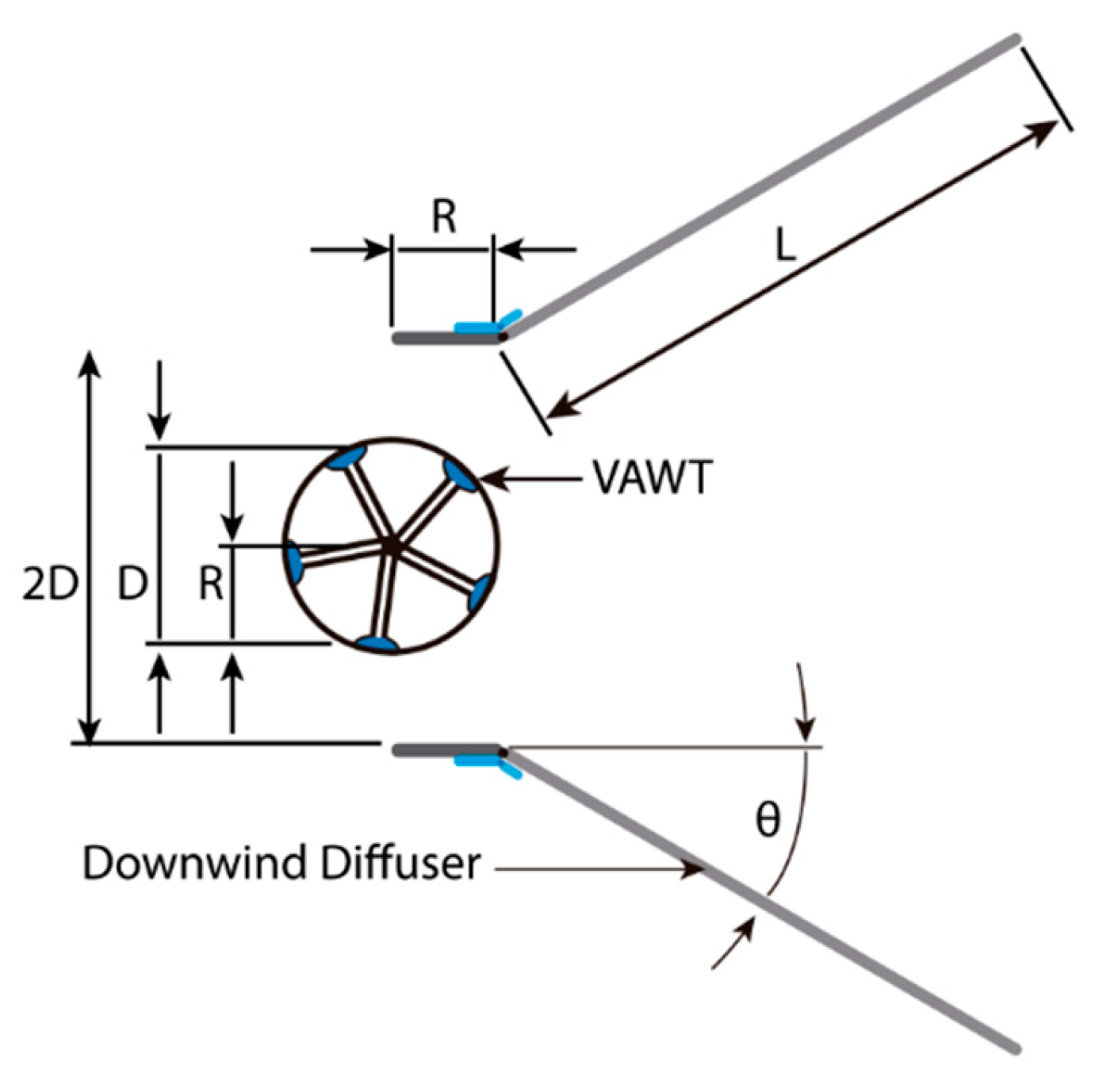
Figure 2. Schematic of aerodynamic forces acting on the blades of an H-type VAWT.
Sustainability 17 07878 g002
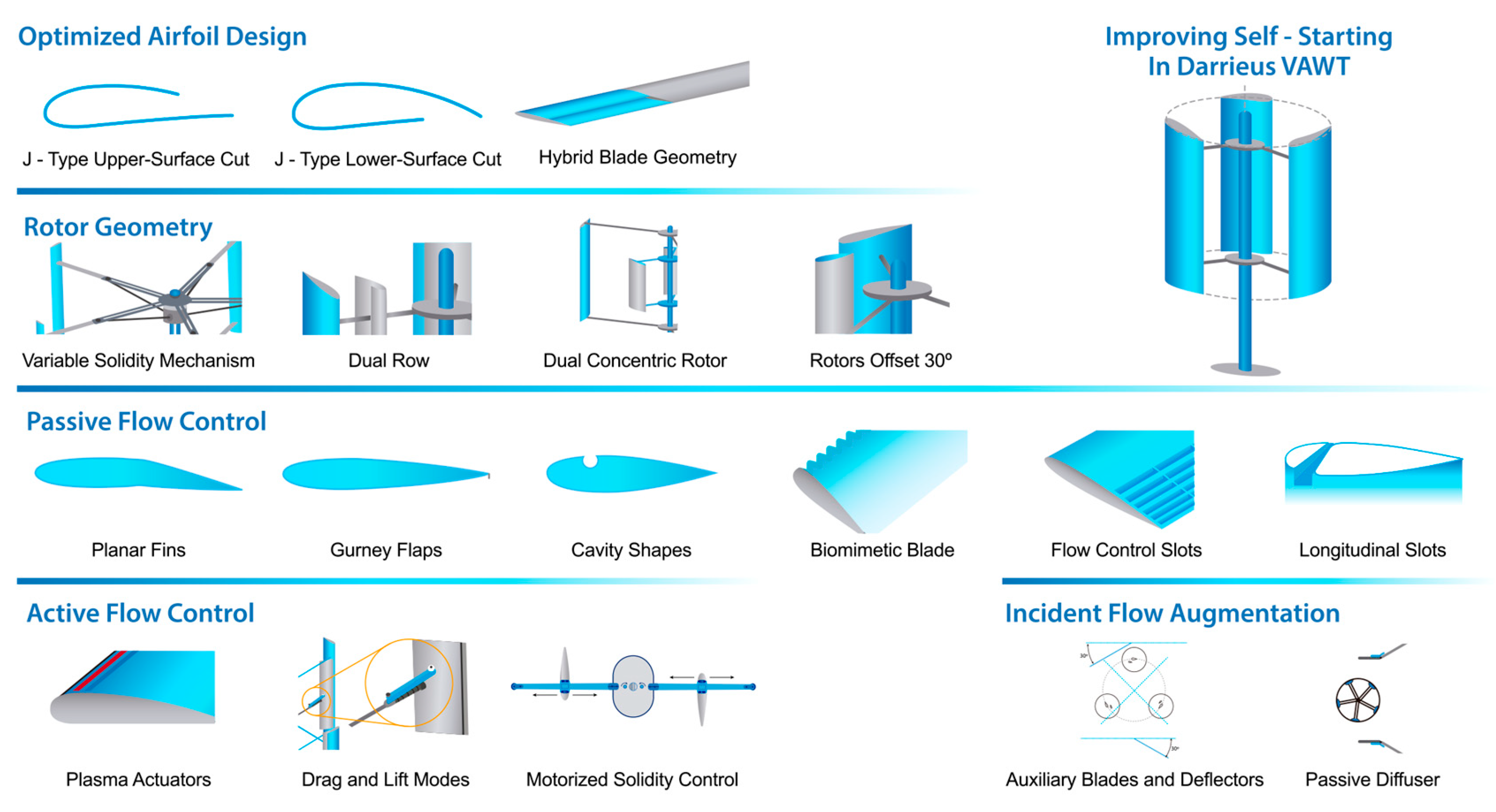
Figure 3. Transient self-start behavior of an H-type Darrieus wind turbine showing TSR evolution through four operational phases. The blue line represents the evolution of TSR over time. Blue dots indicate TSR values at the boundaries of each phase, and blue squares mark the transition points between phases. Vertical dotted lines separate the operational phases.
Sustainability 17 07878 g003
Figure 4. Velocity triangle and aerodynamic force decomposition on a rotating blade in a Darrieus-type wind turbine. Modified from Celik [22].
Sustainability 17 07878 g004
Figure 5. Characteristic geometric parameters of H-Type Darrieus VAWT. Rotor diameter (D), blade height (H), chord length (c), and swept area (A).
Sustainability 17 07878 g005
Figure 6. PRISMA 2020 flow diagram of the study-selection process.
Sustainability 17 07878 g006
Figure 7. Comparison of the patented VAWT-X airfoil with conventional profiles: NACA 0015, NACA 0018, and DU 06-W-200 variants.
Sustainability 17 07878 g007
Figure 8. Surface geometry comparison between (a) S-type and (b) J-type airfoils used in VAWTs blades, indicating the OR as the percentage of chord length removed near the trailing edge relative to the original chord.
Sustainability 17 07878 g008
Figure 9. Three-dimensional vortex distribution over a J-type airfoil section (ξ = 30–50%), illustrating stronger vortices in the mid-span region and weaker vortices toward the blade tip at TSR = 1. Adapted from Farzadi et al. [37].
Sustainability 17 07878 g009
Figure 10. Geometric comparison of airfoil configurations: (a) baseline NACA4415, (b) J-type profile with lower-surface cut, (c) J-type profile with upper-surface cut. The dotted lines indicate the reference boundaries used to measure chord and opening lengths. Adapted from Naik and Sahoo [38].
Sustainability 17 07878 g010
Figure 11. Geometric variations in J-type airfoils with different opening ratios (OR), baseline S-type profile (OR = 0%), and J-type profiles with OR = 10%, 30%, 40%, 60%, and 90%. All configurations share the same chord length of 0.083 m, with OR measured relative to this chord. Adapted from Celik et al. [30].
Sustainability 17 07878 g011
Figure 12. Proposed hybrid blade configuration with a central NACA0018 section and J-type tips featuring a 40% OR, including NACA0018 end caps. Image adapted from Celik et al. [4].
Sustainability 17 07878 g012
Figure 13. Five-bladed H-type Darrieus wind turbine with a variable solidity mechanism for enhanced multi-stage performance, as proposed by Huang et al. [44].
Sustainability 17 07878 g013
Figure 14. Six-bladed H-type Darrieus turbine with a locally variable radius (R1/R2) for improved self-starting performance, as proposed by Huang et al. [45].
Sustainability 17 07878 g014
Figure 15. Dual-row VAWT configuration with outer conventional blades and inner J-type blades, as proposed by Mirzaeian et al. [47].
Sustainability 17 07878 g015
Figure 16. Hybrid Darrieus-based VAWT with dual concentric rotors: inner curved DU06-W-200 blades and outer straight NACA0018 blades, as proposed by Ahmad et al. [49].
Sustainability 17 07878 g016
Figure 17. Dual-stage VAWT configurations with 30° phase-shifted rotors and integrated auxiliary blades. Modified from [50].
Sustainability 17 07878 g017
Figure 18. Conceptual diagram of a dual-stage Darrieus-type VAWT with a 90° inter-rotor phase shift. Modified from [51].
Sustainability 17 07878 g018
Figure 19. Textured NACA0015 blade with surface embossing for self-starting enhancement, as investigated by Seifi et al. [7].
Sustainability 17 07878 g019
Figure 20. Schematic representation of GF configurations: (a) unilateral and (b) bilateral “fish-tail” type. HG denotes the height of the flap expressed as a percentage of the blade chord length. Modified from [52].
Sustainability 17 07878 g020
Figure 21. Geometric configurations of Gurney flaps (GFs) and Planar Fins (PFs) evaluated on NACA0015 blades, as studied by Eltayeb and Somlal [57]. For each airfoil profile, the GF height and angle, together with the PF location and orientation, are indicated.
Sustainability 17 07878 g021
Figure 22. Circular cavity configurations on NACA0021 blades were evaluated for self-starting improvement, based on Yousefi et al. [59]. USL = Upper Surface (Leading edge), LSL = Lower Surface (Leading edge), UST = Upper Surface (Trailing edge), LST = Lower Surface (Trailing edge).
Sustainability 17 07878 g022
Figure 23. NACA0012 airfoil with flow-control slots used for self-starting enhancement, as proposed by Mitchell et al. [61].
Sustainability 17 07878 g023
Figure 24. NACA0021 airfoil with combined Gurney flap and circular cavity configurations, as analyzed by Zhu et al. [62]. HG = Flap height, LG = Flap width, DD = Dimple diameter, SGD = Distance from the trailing edge to the Dimple/Flap.
Sustainability 17 07878 g024
Figure 25. Gurney flap configurations applied to J-type airfoils: (a) internal side, (b) external side, and (c) both sides, as evaluated by Kord and Bazargan [63].
Sustainability 17 07878 g025
Figure 26. Biomimetic blade geometries with leading-edge protuberances (LEPs) inspired by humpback whale flippers: (a) straight blade, (b) large-amplitude LEP1, (c) moderate-amplitude LEP2, and (d) low-amplitude LEP3. H = blade height, c = chord length, h = amplitude, w = wavelength [34].
Sustainability 17 07878 g026
Figure 27. Schematic diagram of a NACA0018 airfoil featuring a biomimetic sinusoidal leading-edge protuberance: (a) definition of chord (c) and amplitude (h); (b) sinusoidal profile illustrating amplitude (h) and wavelength (w). Adapted from Gonçalves et al. [64].
Sustainability 17 07878 g027
Figure 28. Application of porous material on the pressure side of a DU06-W-200 airfoil, showing the six locations (P1–P6) investigated by Zamani et al. [65].
Sustainability 17 07878 g028
Figure 29. NACA0018 airfoil modified with a longitudinal slot to enhance aerodynamic performance, as studied by Mohamed et al. [66]. L = Location of the midpoint of the slot from the leading edge, W1 = slot outlet width, W2 = slot inlet width, φ = slot inclination angle.
Sustainability 17 07878 g029
Figure 30. Operating principle and schematic implementation of Dielectric Barrier Discharge (DBD) plasma actuators for active flow control in VAWT blades [69].
Sustainability 17 07878 g030
Figure 31. Hybrid active control system integrating drag and lift modes in an adaptive-blade Darrieus VAWT, as proposed by Gao et al. [74].
Sustainability 17 07878 g031
Figure 32. Variable-diameter VAWT prototype illustrating the radial displacement range of the blades along the struts. The arrows indicate the sliding motion enabled by the central manual/electric adjustment mechanism. Modified from [76].
Sustainability 17 07878 g032
Figure 33. VAWT configuration with integrated auxiliary blades and deflectors to enhance starting performance and efficiency, as investigated by Ghafoorian et al. [8].
Sustainability 17 07878 g033
Figure 34. Aerodynamic enhancement of a five-blade Darrieus VAWT using a downstream passive diffuser, as studied by Wang et al. [78]. R = rotor radius, D = rotor diameter, L = diffuser length, and θ = diffuser angle.
Sustainability 17 07878 g034
Figure 35. Graphical synthesis of technological strategies for self-starting enhancement in Darrieus-type VAWTs.
Sustainability 17 07878 g035
Table 1. Aerodynamic profile design strategies for improving VAWT self-starting performance.
Ref.Method Profile/Config.ConditionsSelf-Starting Improvement
[4]Sustainability 17 07878 i005 CFD 2D/3D
+ Self-start Model
NACA0018 center + J-type (OR = 40%, 90%) + tips (open, closed); N = 3, D = 0.75 m, H = 3.0 m, c = 0.083 mλ = 1.5–3.0
V = 5.0 m/s
Sustainability 17 07878 i001Hybrid 40% OR closed tip → λ = 3.35 ↑
[29]Sustainability 17 07878 i005 CFD 2D
k-ω SST
NACA4418 → J-type 40–80% OR
D = 2.5 m, H = 1.0 m, c = 0.4 m
λ = 1.6
V = 10.0 m/s
Sustainability 17 07878 i002 OR = 70% → 25% efficiency ↑
Upper-surface cut > lower
[30]Sustainability 17 07878 i005 CFD 2D (k-ω SST)
+ SIMPLE
NACA0012/18/25/45; N = 3, D = 0.75 m, H = 0.6 m, c = 0.083 m, OR 0–90%λ = 1.5–3.0
V = 4.0–6.0 m/s
Sustainability 17 07878 i002 OR = 90% → strong startup
OR = 10% → fails
β = 2° → optimal
[35]Sustainability 17 07878 i005 CFD 2D
k-ω SST
NACA0012/21, E474, S1048, S1210, NACA6712, DU-06-W-200, Clark Y, FX63-137. N = 3, D= 1.03 m, σ = 0.5.λ = 1.2–3.5
V = 9.0 m/s
Sustainability 17 07878 i003 NACA 6712, 2.037 TSR → CP = 0.3645
E474, 3.0 TSR → CP = 0.3557
NACA6712, 2.0 TSR → 180% CP ↑NACA0012
[36]Sustainability 17 07878 i005 CFD 3D
k-ω SST
VAWT-X, NACA0015/18, DU06-W-200 (Estándar and Mirror). N = 2, H = 1m, σ = 0.24.λ = 0.25–4.0
V = 6.0 m/s
Sustainability 17 07878 i002 VAWT-X
Low TSR → 37.6% CM
0.5 TSR → 34% CM
2.5 TSR → CM = 0.082
3.0 TSR → CP = 0.24
[37]Sustainability 17 07878 i005 CFD 2D/3D (URANS, k-ω SST, k-ε)NACA0021 → J-type; N = 3, D = 1.2 m, H = 0.8–3.0 m, c = 0.2 mλ = 0.25–1.5
V = 10.0 m/s
Sustainability 17 07878 i003 Low TSR → CM
More effective for longer blades
[38]Sustainability 17 07878 i005 CFD 2D (URANS, k-ω SST)
Sustainability 17 07878 i006 Wind Tunnel
NACA4415 → J-type 40–80% OR N = 3, D = 2.5 m, H = 1.0 m, c = 0.4 mλ = 1.6
V = 10.0 m/s
Sustainability 17 07878 i001 OR = 80%, TSR = 1.6 → CP = 0.517
1.6 TSR → 31% CM↑
[39]Sustainability 17 07878 i005 CFD 2D (URANS, k-ω SST)NACA0015 → J-type; N = 3, D = 2.5 m, H = 3.0 m, c = 0.4 mλ = 0.2–2.5
V = 10.0 m/s
Sustainability 17 07878 i004 0.2 TSR → 142% CM
1.6 TSR → 12.3% CM
2.5 TSR → 3.6% CM
[40]Sustainability 17 07878 i005 CFD 3D (URANS, k-ω SST)NACA0021 → J-type; N = 3, D = 1.2 m, H = 1.2 m, c = 0.2 mλ = 0.5–1.5
V = 5–20 m/s
Sustainability 17 07878 i002 5 m/s → 37.6% CM
10 m/s → 26.9% ↑
High TSR → 10% CM
[41]Sustainability 17 07878 i005 CFD 3D (URANS, k-ω SST, k-ε)
Sustainability 17 07878 i007 FEA
NACA0015 → J-type; N = 3, D = 2.5 m, H = 3.0 m, c = 0.4 mλ = 0.6–1.6
V = 10.0 m/s
Sustainability 17 07878 i004 k-ω SST →18.34% CM
k-ε → 5.84% CM
[42]Sustainability 17 07878 i005 CFD 3D
(IDDES, k-ω SST)
NACA0015 → J-type; N = 3, D = 2.5 m, H = 3.0 m, c = 0.4 mλ = 1, 1.6, 1.8, 2
V = 10.0 m/s
Sustainability 17 07878 i003 1.0 TSR → 13.5% CM ↑(peak)
1.0 TSR → 7% CM
1.6 TSR → 1.8% CM
[43]Sustainability 17 07878 i005 CFD 2D (k-ω SST)
+ Taguchi Opt.
NACA0012/15/17/21; β = 0–4°; N = 3, D = 0.85 m c = 0.2–0.8 m;λ = 0–3.5
V = 7.0 m/s
Sustainability 17 07878 i002 NACA0017, Long chord, c = 0.6 m, β = 4°→ better startup;
 Sustainability 17 07878 i005 = simulation; Sustainability 17 07878 i006 = experimentation; Sustainability 17 07878 i007 = Structural; Sustainability 17 07878 i004 = slight gain; Sustainability 17 07878 i003 = moderate gain; Sustainability 17 07878 i002 = high gain; Sustainability 17 07878 i001 = best performance.
Table 2. Design configuration strategies to enhance self-starting in Darrieus-type VAWT.
Ref.Method Profile/Config.ConditionsSelf-Starting Improvement
[7]Sustainability 17 07878 i005 DMST + PSO opt.
Sustainability 17 07878 i006 Wind tunnel
NACA0015/4412/4415; N = 3, R = 0.175 m, H = 0.35–0.75 m, c = 0.071 mλ = 0–3.0,
V = 1.0–10.0 m/s
Sustainability 17 07878 i003 Optimized NACA0015 (embossing) → 21.97% CM
[18]Sustainability 17 07878 i006 Wind tunnel (closed-circuit)NACA0018/4418; straight and helical blades; β = 0°, −3°, −6°; D = 0.68 m, AR = 1.25, c = 0.172 mλ = 0.25–3.0, V = 5.0 m/sSustainability 17 07878 i004 Straight blades → 53% start time ↓
NACA0018 → CPCM↓NACA4418 → CPCM
[27]Sustainability 17 07878 i005 DMST, MATLAB
Sustainability 17 07878 i006 Wind tunnel (4 fans)
NACA0015 (embossed); N = 3, R = 0.175 m, H = 0.35 m, σ = 1.15, c = 0.071 mλ = 0–2.5,
V = 0.5–11.0 m/s
Sustainability 17 07878 i002 Embossed blades → 34.6% starting force ↓
[44]Sustainability 17 07878 i005 CFD 2D (URANS, k-ω SST)NACA0018; N = 5; D = 0.6–2.10 m; σ = 0.417–0.83, c = 0.075 m; Jz = 0.0683–0.8362 kgm2λ = 1.25–5.0, V = 7.9 m/sSustainability 17 07878 i003 High σ → better self-starting.
Low σ → better generation ↑ 188% power vs. fixed σ
[45]Sustainability 17 07878 i005 CFD 2D
(SIMPLE, k-ω SST)
NACA0018 (dual); N = 5; H = 0.54 m; c = 0.075 m; D1 = 0.30, 0.40, 0.50 m (inner); D2 = 0.8 m (outer);λ = 1.0–5.0,
V = 0–30 m/s
Sustainability 17 07878 i002 Model D0.3 = 100% CM
Model D0.4 = 80% CM
Model D0.5 = 180% CM
[46]Sustainability 17 07878 i006 Wind tunnelNACA0021/4415/DU06W200; β = 0°, −2°, −4°; R = 0.30–0.45 m; H = 0.6–0.7 m; σ = 0.67–1.0λ = 0.2–2.5,
V = 7.0 m/s
Sustainability 17 07878 i003 Higher AR and–β → better self-starting
Surface roughness → high solidity only
[47]Sustainability 17 07878 i005 CFD 2D (RANS, k-ω SST),
+ Taguchi DOE
Hybrid: NACA0015 (outer), DU06-W-200 → J-Type (inner); N = 3 c = 0.4 m (outer), 0.27 m (inner)λ = 0.5–2.5, V   = 10.0 m/sSustainability 17 07878 i003 Dual row → CP = 0.52 (Peak)
Downstream vorticity ↓
Low TSR efficiency ↑
[48]Sustainability 17 07878 i005 CFD 2DNACA0018 (outer), DU06-W-200 (inner); N = 3 (both)λ = 1.0–5.0, V = 2.81–7.5 m/sSustainability 17 07878 i002 TSR = 3.0 → CP = 0.486
Conventional design 11–13% CM
[49]Sustainability 17 07878 i005 CFD 3D (RANS, DMS Q-Blade)
+ DOE (Box-Behnken)
DU06W200; N = 3, R = 0.789 m, H = 1.605 m, σ = 0.67–1.0; β = −3.41°; c = 0.547 mλ = 1.0–5.0, V = 2.81–7.5 m/sSustainability 17 07878 i001 TSR = 3.0 → CP = 0.491
self-start at 2.81 m/s
Static torque positive
[50]Sustainability 17 07878 i005 CFD 2D (k-ε)
Sustainability 17 07878 i006 Wind tunnel
NREL S823 + aux blades; N = 3, D = 0.3 m, c = 0.1 m (main), 0.05 m (aux)λ = 0.4–2.0, V = 6.0 m/sSustainability 17 07878 i002 Facilitated start-up at low wind speeds.
22% CP
84% CM
[51]Sustainability 17 07878 i005 CFD 2DTwin-rotor + phase shift (30–90°); NACA0018; R = 0.5 m (outer), R1/R2 = 0.85; c = 0.06 mλ = 0–6.0, V = 4.0–10.0 m/sSustainability 17 07878 i003 Phase-shifted twin-rotor 30° → response time ↓ 25.44%
90° → response time ↓ 16.66%
 Sustainability 17 07878 i005 = simulation; Sustainability 17 07878 i006 = experimentation; Sustainability 17 07878 i004 = slight gain; Sustainability 17 07878 i003 = moderate gain; Sustainability 17 07878 i002 = high gain; Sustainability 17 07878 i001 = best performance.
Table 3. Passive flow control strategies for improving the self-starting capability of Darrieus-type VAWTS.
Ref.Method Profile/Config.ConditionsSelf-Starting Improvement
[9]Sustainability 17 07878 i005 CFD 2D (URANS, k–ω SST)NACA0021 + circular cavity, N = 3, D = 1.03 m, σ = 0.25, c = 0.0858 mλ = 1.6–3.1Sustainability 17 07878 i003 TSR = 2.0 → 28% CP
Stall suppression at low/moderate TSR.
[34]Sustainability 17 07878 i006 Wind tunnelS1046 with tubercles
N = 4, D = 0.90 m
H = 0.70 m, σ = 0.78
c = 0.1435–0.16 m
β = −20° to 20°
V = 6.0–20.0 m/sSustainability 17 07878 i002 LEP3 → eliminates stall.
6–20 m/s → self-starting↑ (-) Pitch → Initial torque↑ CM (peak)
[52]Sustainability 17 07878 i005 CFD 2D (URANS, k–ω SST)NACA0012/15/18/21 + GF inner and outer side 0–5% and bilateral. N = 3, D = 1.03–3.50 m, σ = 0.057–0.250, c = 0.086–0.200 m.λ = 3.30–4.45, V = 8.0–13.0 m/sSustainability 17 07878 i003 NACA0012 GF inner 0.8%c → 48% CMCP = 0.342
NACA0015 GF outer 3%c → 82% CM↑, CP = 0.425
NACA0018 GF fish-tail 2%c → 70% CM ↑ CP = 0.367
[53]Sustainability 17 07878 i005 CFD 2D (URANS)NACA0018 + GF = 1.0–5.0%, N = 3, R = 0.85 m, c = 0.246 m.λ = 1.0–3.5, V = 8.0 m/sSustainability 17 07878 i003 GF inner → dynamic stalls ↓, CP
TSR (1–2) → CM
[54]Sustainability 17 07878 i005 CFD 2D (URANS, k–ω SST)NACA0021 + GF = 0.5–6%, 90° and 105°; N = 2, R = 1.0 m, β = 6°, c = 0.265 m.λ = 0.5–3.0, V = 8.0 m/sSustainability 17 07878 i002 GF inner 90°, 0.5%c → lift and load ↑
GF inner 90°, 1%c, λ = 1–2.5 → CP. ↑
GF inner 90°, 6%c, λ = 2.13 → Optimal
[55]Sustainability 17 07878 i005 CFD 2D (URANS, k–ω SST)NACA0021 + GF = 1–3%, N = 3, R = 0.515 m, c = 0.0858 m, σ = 0.249λ = 2.1–6.0, V = 9.0 m/sSustainability 17 07878 i001 GF inner 3%, 90° → 21.3% CP
[56]Sustainability 17 07878 i005 CFD 2D
+ DOE Taguchi
NACA0021 + GF = 0.02c–0.04c height, 0–0.07c position, 60–135°. D = 1.03 m, N = 3, c = 0.0858 m.λ = 1.44–3.3,
V = 9 m/s
Sustainability 17 07878 i002 Opt. GF inner 3%, 90°
Low TSR → 233.19% CP
Medium TSR → 69.94 CP
High TSR → 41.36 CP
[57]Sustainability 17 07878 i005 CFD 2D (URANS, k–ω SST)NACA0015 + GF 15–25%, 90–120° + PF 50–90%, 10–120°; N = 3, R = 1.0–2.5 m, c = 0.16–0.4 m.λ = 0.8–4.5,
V = 5–10 m/s
Sustainability 17 07878 i002 PF 6%, 10° vs. GF 25%, 120°→69.94% performance ↑, CM ↓, 35% torque stability↑, Stable torque
[58]Sustainability 17 07878 i005 CFD 2D (k–ε)
Sustainability 17 07878 i006 Wind tunnel
S1046, NACA0021 + Circular cavities, N = 3, D = 0.4 m, H = 0.4 m, σ = 0.6, c = 0.08 mλ = 0.5–2.0,
V = 5–7 m/s
Sustainability 17 07878 i004 Improved self-start only at 5 m/s; Higher wind speeds → Smooth blade ↑
[59]Sustainability 17 07878 i005 CFD 2D (URANS, k–ω SST)NACA0021 + Circular cavities, N = 3, R = 1.03 m, c = 0.0858 mλ = 2.0–3.5, V = 8.0 m/sSustainability 17 07878 i003 TSR = 3.5 → 18% CP ↑; Higher torque availability → better self-starting.
[60]Sustainability 17 07878 i005 CFD 2D (URANS)
+ GA
NACA0021 + Dimples 0.02–0.06c from 0.5c–0.9c; N = 3λ = 2.5,
V = 9.0 m/s
Sustainability 17 07878 i002 Small dimples near the trailing edge → 6.5% CP ↑; Maximize CM → Delayed separation, reduced wake.
[61]Sustainability 17 07878 i005 CFD 2D (k–ω SST)NACA0012 + Vent slots, N = 3, R = 1.0 m, c = 0.2 mλ = 0–3.0,
V = 5.0 m/s
Sustainability 17 07878 i004 Angles of attack > 90° + low TSR → CP, CM ↑.
Angles of attack < 90 + higher TSR → CM ↓.
[62]Sustainability 17 07878 i005 CFD 2D (k–ω SST)Hybrid NACA0021 + GF 2% + cavities, N = 3–6, c = 0.0858 m, σ = 0.175–0.5λ = 1.0–3.1, V = 9.0 m/sSustainability 17 07878 i002 TSR = 3.1 → 18% CP; External-side flap + cavity → best performance.
[63]Sustainability 17 07878 i005 CFD 2D (RANS, k–ω SST)Hybrid Du06-W-200 + J-profile + GF 0.75–2.75%; N = 3, D = 3.7 m, c = 0.297 m.λ = 0.6–2.5, V = 10 m/sSustainability 17 07878 i004 Internal GF at 0.75% ↑ 10–12% Power, TSR = 2.25.
External GF and dual flaps ↓ Global efficiency.
[64]Sustainability 17 07878 i005 CFD 3D (k–ε)
Sustainability 17 07878 i006 Wind tunnel
NACA0018 + sinusoidal LEPs, N = 3, D = 0.45 m, H = 0.45 m, σ = 0.5, c = 0.075 mλ = 1.0–4.0, V = 5.5–9.0 m/sSustainability 17 07878 i003V = 5.5 m/s → 46% CP ↑Cut-in wind speed ↓ 7.0 to 5.5 m/s.
[65]Sustainability 17 07878 i005 CFD 2D (URANS, k–ω SST)DU06-W-200 + porous stripes (6), N = 3, D = 3.7 m, H = 3.3 m, c = 0.27 mλ = 0.5–4.0, V = 10.0 m/sSustainability 17 07878 i002 Porous → CM, CP ↑; Pressure-side porous layout → stronger start
[66]Sustainability 17 07878 i005 CFD 2D (k–ε)NACA0018 + slot, N = 3, D = 4.7 m, c = 0.47 m, σ = 0.3λ = 0–4.0, V = 8.0 m/sSustainability 17 07878 i001 TSR < 2 → CM = 0.15, CP = 0.30. Longitudinal slot delays separation
 Sustainability 17 07878 i005 = simulation; Sustainability 17 07878 i006 = experimentation; Sustainability 17 07878 i004 = slight gain; Sustainability 17 07878 i003 = moderate gain; Sustainability 17 07878 i002 = high gain; Sustainability 17 07878 i001 = best performance.
Table 4. Active flow control strategies for improving the self-starting capability of Darrieus-type VAWTS.
Ref.Method Profile/Config.ConditionsSelf-Starting Improvement
[69]Sustainability 17 07878 i005 CFD 2D (URANS)
+ Shyy’s model
NACA0022 + plasma actuator
N = 3, D = 0.6 m, H = 1 m, c = 0.1 m.
λ = 1, 1.5, 2, 2.5 and 3
V = 5.07 m/s
Sustainability 17 07878 i003 Plasma actuator 0.3c TSR = 2.15 → 36% CP
60–12° Opt.
[70]Sustainability 17 07878 i005 CFD 2D (URANS)
+ Suzen–Hoang
NACA0021 + plasma actuator
N = 3, D = 1.028 m, H = 1.0 m, c = 0.085 m, σ = 0.25.
λ = 0.5–3
V = 9.02 m/s
Sustainability 17 07878 i003 Plasma actuator TSR = 0.5 → 128% CM ↑, 8% startup time ↓, 260% Power output ↑.
[71]Sustainability 17 07878 i005 CFD 2D (URANS, γ–Reθt)
+ Shyy’s model
NACA0021 + plasma actuator (inboard, outboard, double sided) N = 3, D = 1.028 m, H = 1.0 m, c = 0.085 m, σ = 0.25.λ = 0.5–3
V = 9.02 m/s
Sustainability 17 07878 i003 Inboard and Double-sided → 10% CP
135–180°azumit → (+) CM
[72]Sustainability 17 07878 i005 CFD 2D (URANS (k–ω) SST)
+ Shyy’s model
NACA0022 + plasma actuator 10%, 30%, 50%, 70%, 90% c
D = 0.6 m, c = 0.1 m, H = 0.4 m, σ = 1.
λ = 2.45
V = 5.07 m/s
Sustainability 17 07878 i003 Inner edge 10–30% → CM ↑, 50–90% → CM ↓,
29.2% CP
[73]Sustainability 17 07878 i005 CFD 2D (URANS (k–ω) SST)NACA0022 + plasma actuator + deflector plate
D = 0.6 m, c = 0.1 m, H = 0.4 m, σ = 1.
λ = 2.45
V = 5.07 m/s
Sustainability 17 07878 i002 Deflectors opt → 13.37% CP ↑,
Plasma + Deflector → 45.68% CP
[74]Sustainability 17 07878 i005 CFD 2D (URANS, k–ε)
+ 6DOF, RNG
Sustainability 17 07878 i006 Wind tunnel
NACA0018 + drag-lift adaptive blade
N = 4, R = 0.66 m, H = 0.73 m, c = 0.1 m.
λ = 0–5
V = 6.0 m/s
Sustainability 17 07878 i001 Hybrid control → 34.7% cut-in wind speed↓.
At 80° blade opening → 82% CM ↑, Startup performance ↑.
[75]Sustainability 17 07878 i005 CFD 2D (URANS, (k–ω) SST)Hybrid NACA0021 + moving GF 1.5% + cavity
N = 3, D = 1.03 m, c = 0.086 m, σ = 0.25.
λ = 1.43–3.29
V = 9.0 m/s
Sustainability 17 07878 i004 Cavity + GF → efficiency ↑, Moving GF > Fixed GF → Negative torque ↓, startup performance ↑, 37.5% CP ↑ at TSR = 2.04.
[76]Sustainability 17 07878 i006 Wind tunnelNACA0018 + moving D 0.3–0.8 m (motor).
N = 3, H= 0.7 m, β = 6°, c = 0.15 m, σ = 0.375–1.0
λ = 0.25–2
V = 5.61 m/s
Sustainability 17 07878 i002D = 600 mm, σ = 0.5 → CP = 0.2748, 34% Power yield ↑
D = 800 mm, σ = 0.375 → 68% Power yield ↑
224 RPM → PMAX = 19.92 W
 Sustainability 17 07878 i005 = simulation; Sustainability 17 07878 i006 = experimentation; Sustainability 17 07878 i004 = slight gain; Sustainability 17 07878 i003 = moderate gain; Sustainability 17 07878 i002 = high gain; Sustainability 17 07878 i001 = best performance.
Table 5. Incident flow augmentation techniques for improved starting performance in Darrieus VAWTS.
Ref.Method Profile/Config.ConditionsSelf-Starting Improvement
[8]Sustainability 17 07878 i005 CFD 2D (URANS, k–ω SST)NACA0021 + Auxiliary blades + Deflectors
N = 3, D = 1.03 m, c = 0.0858 m
λ = 0.5–3.5
V = 9.0 m/s
Sustainability 17 07878 i004 Auxiliary blades → starting performance ↑.
Deflectors → CM ↑.
[77]Sustainability 17 07878 i005 CFD 2D (URANS, k–ω SST)NACA0021 + Flat diffuser
N = 5, D = 1.03 m, H = 1.456 m
λ = 1.5–4.5
V = 9.0 m/s
Sustainability 17 07878 i001 Diffuser at TSR 0.65–0.75 → 31.42% CP ↑, 26.79% CM ↑.
[78]Sustainability 17 07878 i005 CFD 2D (URANS, k–ω SST)
Sustainability 17 07878 i006 Wind tunnel
Hybrid Darrieus: NACA0021, N = 3, D = 1.03 m, c = 0.0858 m
Savonius: N = 2, D = 0.2 m
λ = 1.0–4.0
V = 9.0 m/s
Sustainability 17 07878 i003 Hybrid turbines at low TSR → self-starting ↑.
[79]Sustainability 17 07878 i005 CFD 2D/3D
+ Taguchi
+ ANOVA
NACA0021 Two Darrieus VAWTs
N = 3, D = 0.75 m, H = 1.0 m, c = 0.083 m
λ = 1.0–4.0
V = 8.0 m/s
Sustainability 17 07878 i002 Optimized turbine → 31.3% start-up time ↓.
[80]Sustainability 17 07878 i005 CFD 2D (URANS, k–ω SST)
+ orthogonal DOE
NACA0018 + Upper and lower wind concentrators
N = 3, D = 0.6 m, H = 0.5 m, c = 0.1 m
λ = 0.2–2.2
V = 4, 5, 8, 10 m/s
Sustainability 17 07878 i002 Concentrators → CM ↑:
23.3% at 4.0 m/s, 24.7% at 5.0 m/s, 22.8% at 8.0 m/s, 21% at 10.0 m/s.
 Sustainability 17 07878 i005 = simulation; Sustainability 17 07878 i006 = experimentation; Sustainability 17 07878 i004 = slight gain; Sustainability 17 07878 i003 = moderate gain; Sustainability 17 07878 i002 = high gain; Sustainability 17 07878 i001 = best performance.
Table 6. Comparative summary of technological strategies to enhance the self-starting of Darrieus-type VAWTS.
StrategyMain ObjectiveKey AdvantagesLimitationsValidation Level
Aerodynamic Profile OptimizationIncrease torque at low TSR by modifying blade shape and parametersNo external systems; effective at low wind speedsTrade-off with high-TSR efficiencyMainly 2D CFD; limited experimental validation
Structural ConfigurationRedistribute aerodynamic forces through blade arrangement and structureCan enhance torque generation without energy inputRequires structural adjustments; mechanical complexityNumerical with some experimental models
Passive Flow ControlDelay flow separation using surface modifications (e.g., Gurney flaps, cavities)Low-cost; no external energy requiredLimited effectiveness across wide TSR rangeValidated in CFD; limited full-scale trials
Active Flow ControlActively modify flow via actuators to boost torque during startupHigh adaptability and potential performance boostRequires energy, complex control systems, and robust materialsMostly CFD; lacks real-world validation
Incident Flow EnhancementIncrease wind speed impacting rotor via ducts, deflectors, auxiliary bladesImproves local wind velocity and startup performanceSpace requirements, sensitivity to wind directionCombination of CFD and experiments; mostly 2D
Table 7. Summary of hybrid strategies reported in the literature to enhance the self-starting of Darrieus-type VAWTs.
Ref.Hybrid StrategyValidation Level Reported Performance Gain
[4]NACA0018 center + J-type + tipsSustainability 17 07878 i005 CFD 2D/3D
+Self-start Model
Sustainability 17 07878 i001 Hybrid 40% OR closed tip →λ = 3.35 ↑
[47]NACA0015 (outer), DU06-W-200 → J-type (inner). Dual rotor.Sustainability 17 07878 i005 CFD 2D (RANS, k-ω SST),
+Taguchi DOE
Sustainability 17 07878 i003 Dual row → CP = 0.52 ↑ (Peak); downstream vorticity↓; low TSR efficiency ↑.
[62]NACA0021 + GF 2% + cavitiesSustainability 17 07878 i005 CFD 2D
+RANS + k-ω SST
Sustainability 17 07878 i002 External-side flap + cavity at TSR = 3.1 → best performance, 18% CP ↑;
[63]Du06-W-200 + J-profile + GF 0.75–2.75%Sustainability 17 07878 i005 CFD 2D
+RANS + k-ω SST
Sustainability 17 07878 i004 Internal GF at 0.75% at TSR = 2.25 → 10–12% Power ↑.
External GF and dual flaps → Global efficiency ↓.
[75]NACA0021 + moving GF 1.5% + cavitySustainability 17 07878 i005 CFD 2D
+URANS + k–ω SST
Sustainability 17 07878 i004 Cavity + GF at TSR = 2.04 → efficiency ↑, Negative torque ↓, startup performance ↑, 37.5% CP ↑.
[78]NACA0021 + SavoniusSustainability 17 07878 i005 CFD 2D
+URANS + k–ω SST
Sustainability 17 07878 i003 Hybrid turbines at low TSR → self-starting ↑.
 Sustainability 17 07878 i005 = simulation; Sustainability 17 07878 i004 = slight gain; Sustainability 17 07878 i003 = moderate gain; Sustainability 17 07878 i002 = high gain; Sustainability 17 07878 i001 = best performance.
Disclaimer/Publisher’s Note: The statements, opinions and data contained in all publications are solely those of the individual author(s) and contributor(s) and not of MDPI and/or the editor(s). MDPI and/or the editor(s) disclaim responsibility for any injury to people or property resulting from any ideas, methods, instructions or products referred to in the content.