Article

Spatio-Temporal Differentiation and Enhancement Path of Tourism Eco-Efficiency in the Yellow River Basin Under the “Dual Carbon” Goals


Tourism College, Inner Mongolia University of Finance and Economics, Hohhot 010070, China
*
Author to whom correspondence should be addressed.
Sustainability 2025, 17(17), 7827; https://doi.org/10.3390/su17177827
Submission received: 18 July 2025 / Revised: 25 August 2025 / Accepted: 28 August 2025 / Published: 30 August 2025

Abstract

Enhancing tourism eco-efficiency (TEE) is crucial for achieving China’s “dual carbon” objectives. This study examines nine provinces in the Yellow River Basin from 2010 to 2022, employing a super-efficiency SBM model, kernel density estimation, gravity center migration, standard deviation ellipse, Tobit regression, and fuzzy-set Qualitative Comparative Analysis (fsQCA) to investigate spatial-temporal variations and influencing factors. The results show that TEE increased steadily before 2019, declined during the COVID-19 pandemic, and recovered after 2021. Spatially, widening disparities and a polarization trend were observed, with the efficiency center remaining relatively stable in Shaanxi Province. Factors such as advancements in tourism economic development, regional economic growth, technological innovation, and infrastructure improvements significantly promote TEE, whereas stringent environmental regulations and greater openness exert constraints, and the impact of human capital remains uncertain. Four types of condition combinations were identified—economic-driven, market-innovation-driven, scale-innovation-driven, and balanced development. Managerial implications highlight the need for region-specific pathways and regional cooperation, with a dual focus on technological and institutional drivers as well as ecological value orientation, to sustainably enhance TEE in the Yellow River Basin.

1. Introduction

Global climate change has emerged as a major challenge for human society, and the transition to green and low-carbon development has become a shared strategy for countries seeking sustainable growth. China has proposed the “dual carbon” goals of peaking carbon emissions by 2030 and achieving carbon neutrality by 2060, with the objectives of optimizing the energy structure, reducing greenhouse gas emissions, and advancing the green transformation of the economy. Within this strategic context, tourism has traditionally been regarded as a low-carbon industry, given its relatively low energy consumption, pollution, and emissions. However, as tourism continues to expand and evolve into one of the most dynamic global economic sectors, its dependence on energy-intensive activities in transportation, accommodation, and scenic-area operations has increased, thereby intensifying carbon emissions and ecological pressures. This has increasingly challenged the traditional classification of tourism as a low-carbon industry [1]. Empirical studies indicate that tourism accounts for approximately 5–14% of global carbon dioxide emissions (UNWTO, 2009) and contributed about 8% of global greenhouse gas emissions between 2009 and 2013 (Lenzen et al., 2018) [2], underscoring the tension between tourism’s economic benefits and environmental costs. The Yellow River Basin, functioning as both a critical ecological barrier and an economic corridor in China, has experienced rapid tourism growth in recent years. However, its tourism development remains characterized by extensive and resource-intensive growth patterns. Research shows that carbon emissions from the region’s tourism industry rose from 16.52 million tons in 2006 to 43.72 million tons in 2018, with an average annual growth rate of nearly 13%. Over the same period, tourism revenue grew from less than 600 billion yuan to 3958.74 billion yuan, representing more than a seven-fold increase [3]. Although the rapid expansion of tourism has generated substantial economic benefits, it has simultaneously exacerbated carbon emissions, thereby intensifying the contradiction between environmental protection and industrial development. Consequently, under the “dual carbon” strategy, scientifically assessing and improving TEE in the Yellow River Basin has become an urgent priority.
In 1990, Schaltegger and Sturn introduced the concept of eco-efficiency, emphasizing the need to maximize economic output while minimizing environmental consumption and costs [4]. The concept has since been widely applied in ecological and economic assessments across agriculture, industry, and construction [5,6,7]. In tourism, Gössling et al. (2005) introduced the concept of TEE, highlighting its importance in promoting sustainable industry development [8]. Research on TEE has since become increasingly abundant.
The measurement of TEE. Scholars have primarily employed the Single-Indicator method [9], the game cross-efficiency model [10], comprehensive indicator methods [11,12], and the Data Envelopment Analysis (DEA) model [13], with DEA currently being the most widely used approach. Early studies primarily applied radial DEA models such as CCR and BCC, which struggled to address slack variables and undesired outputs [14]. Consequently, the slack-based SBM-DEA model, which accounts for both input redundancy and output insufficiency while explicitly incorporating undesired outputs such as carbon emissions, has become standard in tourism research [15]. Scholars frequently employ Malmquist and Malmquist–Luenberger decomposition techniques to capture intertemporal changes in technological progress and efficiency, distinguishing between pure technological efficiency and scale efficiency [16]. Some studies further combine Environmental Extended Input-Output (EEIO) analysis with DEA to evaluate both direct and total carbon emissions, thereby more accurately tracing the carbon footprint and efficiency evolution of tourism sectors such as transportation, catering, and accommodation [17]. Over time, the concept of TEE has become increasingly refined [18]. To reduce measurement error, this study incorporates labor, capital, energy, and resources as input indicators, while using tourism revenue, tourist arrivals, and tourism-related carbon emissions as output indicators to construct a Super-SBM model.
The distribution of TEE. The distributional characteristics of TEE have become a central research focus in recent years. At the object level, studies have examined enterprises [19,20], regions [21,22,23], and cities [24], while some have evaluated cruise TEE at the national level [25]. Methodologically, scholars have applied static development analysis, spatial analysis, and directional distribution analysis. For instance, Zhang et al. found that TEE in the Beijing–Tianjin–Hebei region was relatively low during 2010–2019 but exhibited an upward trend [26]. Liao Z. and Zhang L. demonstrated that regional differences in China’s TEE follow a dynamic convergence trend, with significant and gradually stabilizing spatial clustering [27]. However, few studies have investigated directional patterns, such as the trajectory of the gravity center of TEE. To address this gap, this study applies kernel density analysis, the standard deviation ellipse, and gravity center trajectory analysis to explore spatial distribution patterns.
The factors of TEE. Prior research highlights multiple drivers. For example, urbanization significantly influences TEE [28], while other studies identify economic development, environmental regulations, industrial structure, transportation conditions, resource endowments, and tourism facilities as important factors. Similarly, technological progress and urbanization have been emphasized as critical determinants [29,30,31]. Since TEE values typically range between 0 and 1, it constitutes a constrained dependent variable. Using linear models such as OLS risks biased estimates and inaccurate identification of determinants. By contrast, the Tobit model effectively addresses this truncation and is widely recommended [24,32,33]. Accordingly, this study employs the Tobit model to empirically analyze the determinants of TEE in the Yellow River Basin.
Recent research on the TEE in the Yellow River Basin has steadily expanded. Scholars have primarily focused on efficiency measurement, the evolution of spatio-temporal patterns, and the identification of driving mechanisms. Several studies have applied methods such as the DPSIR-SBM model and the Malmquist–Luenberger index to reveal that the overall TEE of the Basin remains relatively low and exhibits pronounced spatial heterogeneity [34,35]. In terms of influencing factors, various elements—including economic development, market openness, and tourism industry agglomeration—significantly influence TEE. Nevertheless, most of the existing literature remains limited to static efficiency measurements and descriptions of spatial disparities, lacking in-depth analyses of dynamic evolutionary mechanisms and explorations of improvement pathways.
Based on the aforementioned research background, this study takes the nine provinces/autonomous regions in the Yellow River Basin as the research units and focuses on the core issue of TEE, addressing the following key questions: what are the dynamic evolution characteristics of TEE in the nine provinces (autonomous) regions of the Yellow River Basin during the research period and whether there are significant differences in the evolution trends across different reaches of the Basin; what spatial distribution pattern TEE presents in the nine provinces (autonomous) regions of the Yellow River Basin and whether there are spatial laws such as regional agglomeration, gradient differentiation, or gravity center migration; for future development scenarios, what are the core driving factors affecting the improvement of TEE in the nine provinces (autonomous) regions of the Yellow River Basin and what specific types of targeted pathways can promote the continuous optimization of TEE. To systematically address these questions, the present study adopts a comprehensive methodological framework. Specifically, this study targeted the synergistic optimization of the Yellow River Basin’s ecological-economic system. We constructed a TEE input-output index system incorporating carbon emissions and measured efficiency values for the nine provinces and autonomous regions (2010–2022) using the super-efficiency SBM model. Employing a spatiotemporal analysis framework, we: (1) analyze static spatial differentiation patterns via kernel density estimation; (2) track dynamic evolution using standard deviational ellipses and center of gravity migration trajectories; (3) identify multidimensional drivers (social, economic, ecological) using Tobit regression; and (4) explore efficiency improvement path configurations under multi-factor synergy using fsQCA. Theoretically, by aligning with the strategic goals of “carbon peaking and carbon neutrality,” this study seeks to respond to the practical demands of the green transformation of the tourism industry and contribute to the refinement of the theoretical framework of TEE. Practically, the study explores multiple pathways for improving TEE in the Yellow River Basin, provides actionable recommendations for provincial and regional governments, and offers decision-making support for the green development of tourism in the Basin, with broader reference value for other ecologically fragile regions.
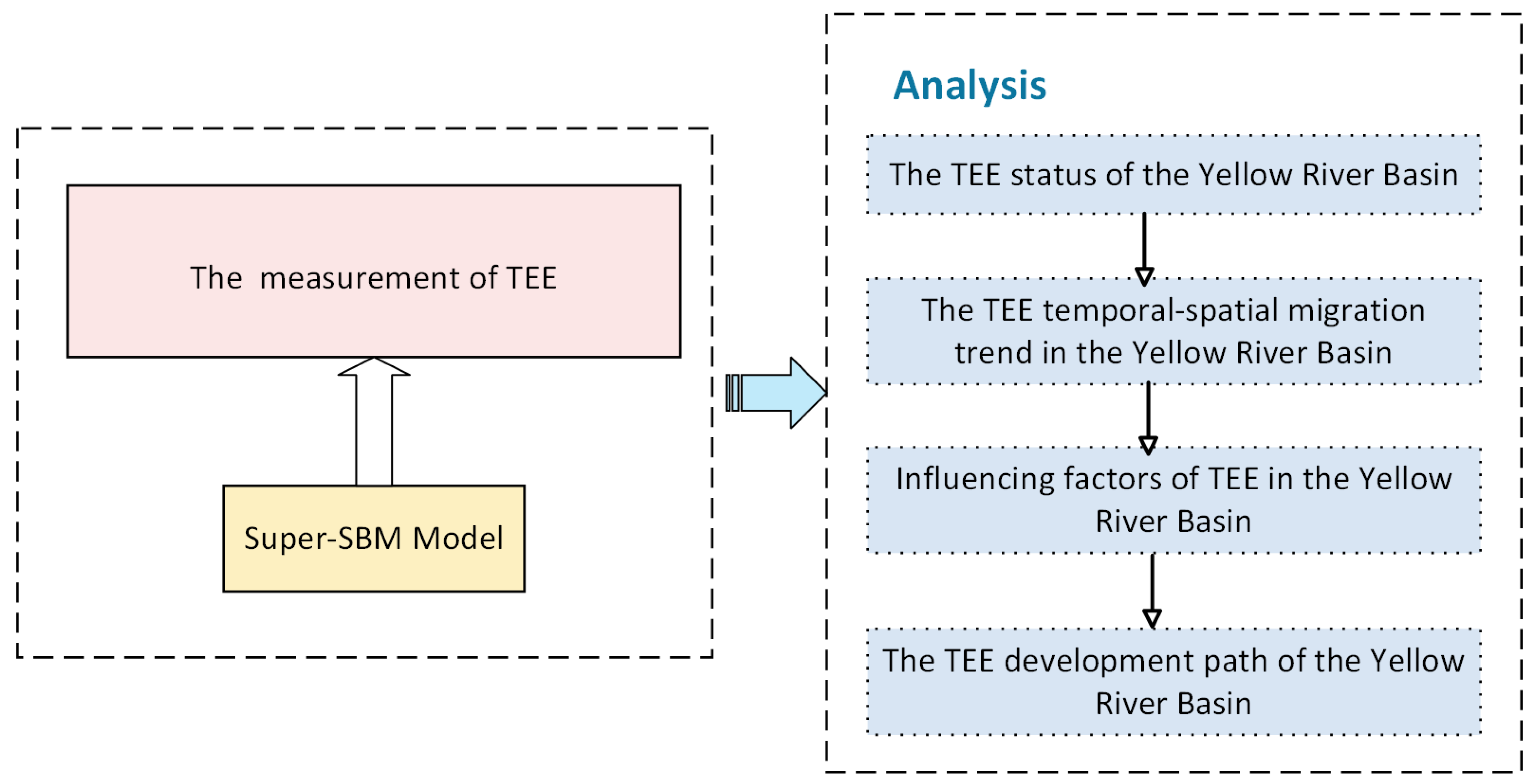
The structure of this article is as follows: Section 2 introduces the materials and methods; Section 3 presents the results; Section 4 includes discussions; Section 5 includes conclusions and suggestions. The overall research framework is illustrated in Figure 1.

2. Materials and Methods

2.1. Research Area

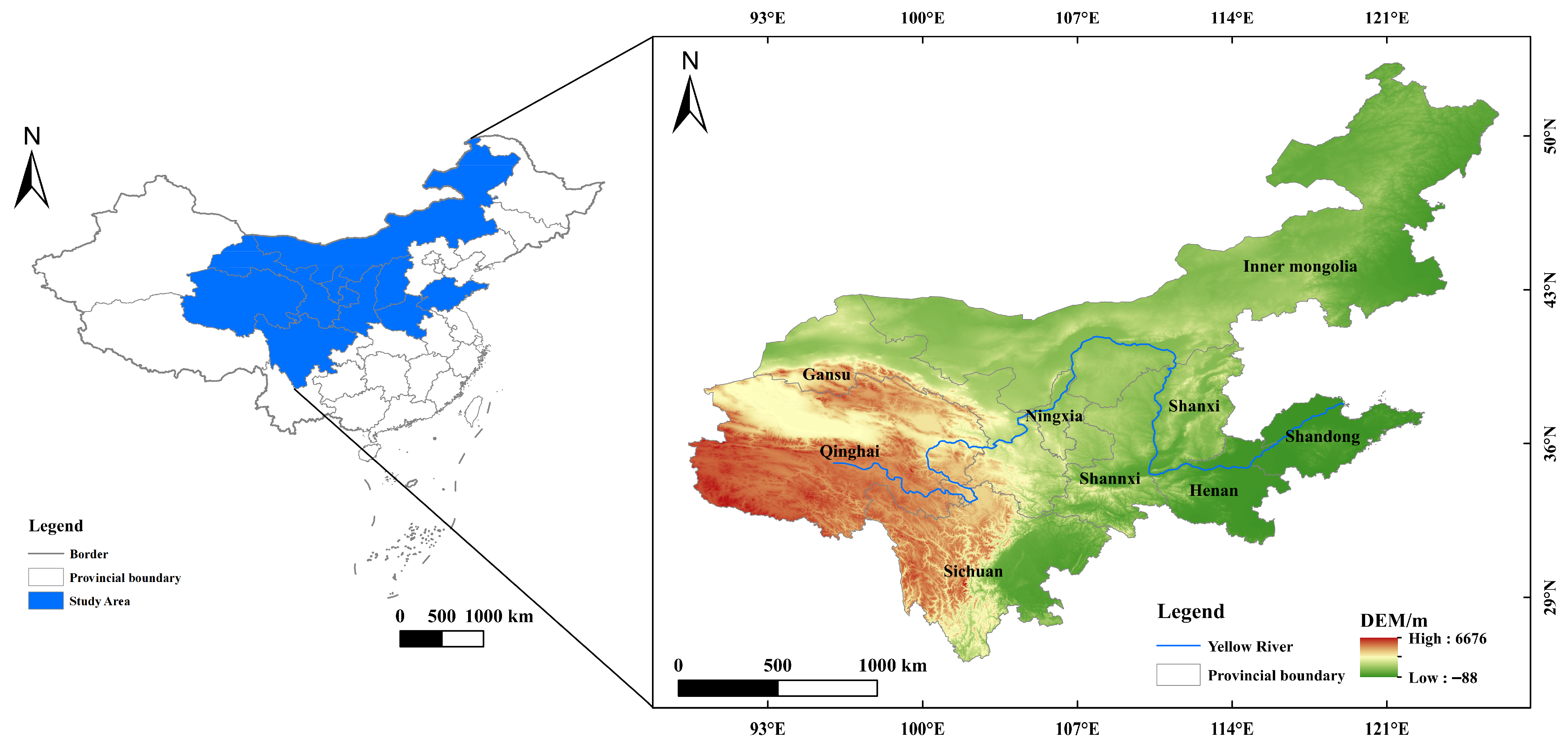
The Yellow River Basin extends from 89°24′ E to 126°04′ E and 26°03′ N to 53°23′ N, spanning approximately 1900 km from east to west and 1100 km from north to south. With a total length of 5464 km, it ranks as the second-longest river in China and the fifth-longest river globally [36]. The river originates in the Bayan Har Mountains in Qinghai Province and flows eastward through four major geographical areas: the Qinghai-Tibet Plateau, Inner Mongolia Plateau, Loess Plateau, and Huang-Huai-Hai Plain. It traverses through nine provinces and autonomous regions—Qinghai, Sichuan, Gansu, Ningxia, Inner Mongolia, Shanxi, Shaanxi, Henan, and Shandong—before discharging into the Bohai Sea at Dongying City, Shandong Province. The basin is rich in tourism assets, featuring 20 UNESCO World Heritage Sites, more than 300,000 immovable cultural relics, 649 nationally recognized intangible cultural heritage items, 47 national comprehensive tourism demonstration zones, 84 national 5A-level tourist attractions, 9 national tourist resorts, 329 national key rural tourism villages, and 85 national red tourism classic scenic spots [37]. The upper reaches (Qinghai–Sichuan–Gansu–Ningxia–Inner Mongolia), encompassing the river source, canyons, and alluvial plains, function as China’s main hydropower base and a focal area for major ecological programs, including the Three-North Shelter Forest and grassland restoration initiatives. The middle reach (Shaanxi-Shanxi), centered on the Hetao Plain, focuses on soil erosion control and industrial pollution mitigation. The lower section (Henan-Shandong) encompasses the Yellow River Delta, China’s largest and most ecologically intact coastal wetland, which sustains vital biodiversity and estuarine health. Economically, the basin generated a GDP of RMB 24.74 trillion in 2020 (accounting for approximately one quarter of the national total), maintaining its role as a growth engine amid structural improvements [38]. However, its resource and environmental carrying capacity is approaching critical thresholds, positioning the basin as a strategic priority for national ecological security and sustainable development.
This study adopts the period 2010–2022 as the research timeframe. During this timeframe, data exhibit a high degree of reliability and completeness. Moreover, it spans the 12th, 13th, and early stages of the 14th Five-Year Plans, thereby capturing the evolutionary characteristics of TEE in the Yellow River Basin across different policy stages. Accordingly, the nine provinces and regions of the Yellow River Basin are designated as the empirical spatial units (Figure 2).

2.2. Methods

2.2.1. Superefficient SBM Model

The Super-Efficiency Slack-Based Measure (SBM) model, pioneered by Petersen and Andersen (1993) [39], is a non-radial, non-oriented extension of the Data Envelopment Analysis (DEA) methodology. Unlike traditional DEA models (e.g., CCR, BCC), this approach removes radial measurement constraints by allowing independent and simultaneous optimization of all input and output variables. In addition, it addresses slack variable limitations inherent in conventional efficiency analyses, permitting efficiency scores to exceed unity. This advancement enables discriminative ranking among efficient Decision-Making Units (DMUs)—addressing a fundamental limitation of classical models [40]. This method was implemented through calculations performed using MATLAB R2021b (MathWorks, Natick, MA, USA). The mathematical formulation is as follows:
m i n p = 1 m i = 1 m x ¯ x i k 1 r 1 + r 2 s = 1 r 1 y d ¯ y s k d + q = 1 r 2 y μ ¯ y q k μ x ¯ j = 1 , j k n x i j λ j ; y d ¯ j = 1 , j k n y s j d λ j ; y d ¯ j = 1 , j k n y q j d λ j x ¯ x k ; y d ¯ y k d ; y μ ¯ y k μ ; λ j 0 , i = 1 , 2 , , m j = 1 , 2 , , n ; s = 1 , 2 , , r 1 ; q = 1 , 2 , , r 2

2.2.2. Kernel Density Estimation Method

The non-parametric probability density estimation method, kernel density estimation (KDE), was employed to explore the spatiotemporal patterns and evolutionary dynamics of TEE across the Yellow River Basin during 2010–2022. This method characterizes distributional attributes through curve position, peak morphology (including peak count and interval evolution), stepwise patterns, and distributional extensibility. The estimator is formally defined as follows:
f x = 1 N h i = 1 n K X i x h
where N denotes the total number of samples, corresponding to the nine provinces (autonomous regions) within the Yellow River Basin. The parameter h represents the bandwidth used in the density estimation, while K denotes the kernel function. A larger bandwidth produces a smoother density curve but may introduce greater estimation bias, whereas a smaller bandwidth captures more local fluctuations at the expense of increased variance. The kernel density curves were plotted using MATLAB R2021b software(MathWorks, Natick, MA, USA).

2.2.3. Center of Gravity Shift and Standard Deviation Ellipse

To characterize the spatiotemporal dynamics of TEE, this study applies centroid migration analysis and standard deviational ellipses methods. The centroid model identifies the trajectory of spatial attribute changes by calculating the mean center of regional distributions, thereby revealing directional trends of developmental imbalances [41]. In parallel, the standard deviational ellipses capture spatial dispersion characteristics through three parameters: (1) the ellipse centroid (distribution focus), (2) the azimuth angle (dominant orientation), and (3) the axial lengths (dispersion anisotropy) [42]. Integrating these two approaches enables a comprehensive depiction of the evolutionary path of TEE in the Yellow River Basin, including gravity center shifts, spatial concentration, directional tendencies, and morphological patterns of efficiency distribution. The calculation and mapping of the Center of Gravity shift and standard deviation ellipse were performed using ArcGIS 10.8 (Esri, Redlands, CA, USA).

2.2.4. Tobit Regression Model

This study employs a panel random-effects Tobit regression model to analyze the determinants of TEE under the constraints of a censored distribution. Originally proposed by Tobin (1958) for limited dependent variables, this approach is well-suited for addressing the left-censoring characteristic of efficiency values, which are bounded at zero [43]. The model specification can be expressed as follows:
E E i , t = α 1 + β 1 l n X 1 + β 2 l n X 2 + β 3 X 3 + β 4 X 4 + β 5 X 5 + β 6 X 6 + β 7 X 7 + β 8 X 8 + β 9 X 9 + ε i , t
where E E i , t denotes the TEE of province i in year t, α 1 is the constant term, β i represents the coefficients of the explanatory variable, and ε i t is the random disturbance term. Stata 17.0 (StataCorp LLC, College Station, TX, USA) was utilized to run the Tobit model.

2.2.5. Fuzzy Set Qualitative Comparative Analysis (fsQCA)

Fuzzy set Qualitative Comparative Analysis (fsQCA) is a case-oriented research method grounded in configurational and set-theoretic thinking. It integrates qualitative and quantitative approaches to investigate complex causal relationships, particularly how multiple factors interact to produce specific outcomes [44]. In this study, fsQCA is applied to examine the pathways that enhance TEE in the Yellow River Basin. The calculations for this method were performed using fsQCA 4.1 (Department of Sociology, University of California, Irvine, CA, USA).

2.2.6. Construction of the Index System

Drawing on the concept of TEE—defined as the ratio of input production factors to corresponding output factors within a given period—and integrating the data envelopment analysis (DEA) method with the characteristics of the tourism industry, this study constructs a multi-input, multi-output evaluation index system for the Yellow River Basin. The selection of specific indicators is based on existing academic research, as follows.
Regarding input indicators, the tourism industry is a comprehensive sector encompassing multiple segments—food, accommodation, transportation, travel, shopping, and entertainment—most of which fall within the tertiary industry. Thus, regional tourism development strongly depends on the labor force of the tertiary sector. Due to the absence of long-term, continuous employment data for the tourism industry in some provinces, previous studies generally use the number of employees in the tertiary sector as a proxy for tourism labor input. Although this substitution may weaken the sector-specific characteristics of the labor force, it remains feasible under data availability constraints [26,45,46,47]. Capital is calculated as societal fixed-asset investment × (tourism revenue/GDP), ensuring consistency with the actual scale of tourism development [48,49]. Given the fundamental role of tourism resources in regional development, resource endowments are quantified through assigned values. The calculation formula is as follows:
T R j = i = 1 10 W i N i j
In the formula, T R j denotes the assigned value of tourism resource endowment in province j; N i j represents the number of World Heritage Sites, national scenic spots, and 5A and 4A tourist areas in province j; and W i   indicates the weights assigned to different grades of resources. Specifically, weights of 10, 6, 4, and 2 are assigned to World Heritage Sites, national scenic spots, and 5A and 4A tourist areas, respectively [50]. Energy is estimated via regional consumption × (tourism revenue/GDP), thereby reflecting the energy intensity of tourism development [51].
Output indicators encompass expected economic outputs (total tourism revenue: domestic + international receipts) and social outputs (tourist arrivals), alongside non-expected tourism carbon emissions quantified through a bottom-up sectoral approach covering transportation, accommodation, and activities [52,53,54]. The comprehensive indicator framework, presented in Table 1, synthesizes established methodologies from tourism sustainability literature, thereby ensuring consistency with the ecological–economic dynamics of the basin while meeting DEA’s requirements for multi-dimensional modeling.

2.3. Data Sources

The data were primarily obtained from national and provincial statistical publications covering the period 2010–2022. These sources include the China Statistical Yearbook, China Regional Economic Statistical Yearbook, China Tourism Statistical Yearbook, China Transportation Statistical Yearbook, and the Statistical Yearbooks and Statistical Bulletins on National Economic and Social Development of the nine Yellow River Basin provinces and autonomous regions. Missing values were estimated through linear interpolation.

3. Results

3.1. Measurement of TEE in the Yellow River Basin

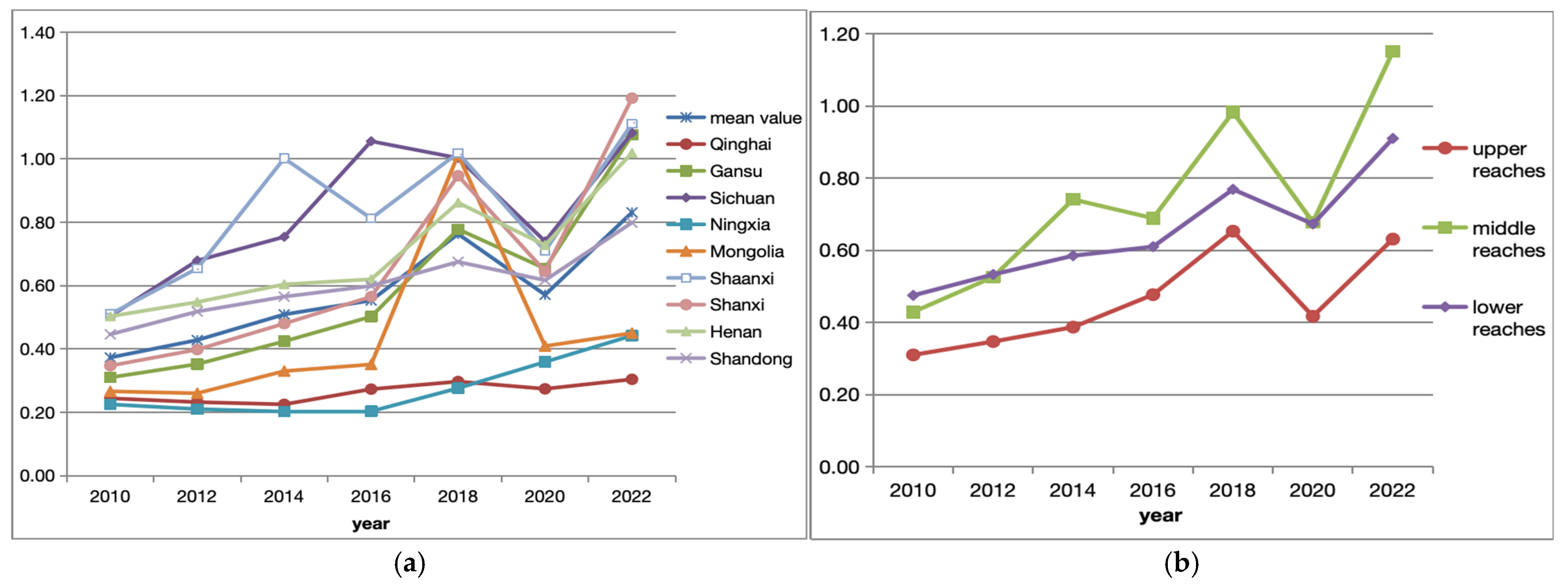
This study calculated the annual comprehensive TEE for the nine provinces of the Yellow River Basin from 2010 to 2022. As shown in Table 2, the basin’s average TEE increased significantly from 0.373 in 2010 to 0.831 in 2022, while the overall mean during the period remained relatively low at 0.595. This relatively low efficiency can be attributed to overreliance on natural ecology and tourism resources, an unfavorable input-output ratio, and the limited adoption of green, low-carbon tourism practices. Efficiency exhibited considerable fluctuations between 2018 and 2022, with a marked decline from 2018 to 2020, largely attributable to the severe impact of the COVID-19 pandemic on the tourism sector.
The provincial-level analyses revealed substantial disparities in efficiency across the region. Qinghai, Ningxia, and Inner Mongolia demonstrated efficiency levels below the basin average. In contrast, Gansu, Sichuan, Shaanxi, Shanxi, Henan, and Shandong recorded efficiencies above the basin average. Sichuan attained the highest efficiency, whereas Qinghai recorded the lowest, resulting in a range of 0.579 and underscoring the pronounced regional imbalance.
Geographically, average efficiencies varied substantially across the river’s reaches: upper reaches (Inner Mongolia, Gansu, Qinghai, Sichuan, Ningxia), middle reaches (Shanxi, Shaanxi), and lower reaches (Shandong, Henan). This produced a distinct efficiency pattern of middle reaches > lower reaches > upper reaches (Figure 3), with a maximum inter-regional disparity of 0.258. Significant intra-regional disparities were also observed. The upper reaches exhibited the largest variance. Within the middle reaches, Shaanxi recorded efficiencies above the regional average, whereas Shanxi remained below it. In the lower reaches, Henan performed above the regional average, while Shandong lagged, with a comparatively smaller range. Intra-regional imbalance was most pronounced in the upper reaches, although notable disparities persisted across all regions. These multi-level disparities—both inter-regional and intra-regional—underscore the complexity and challenges of fostering balanced tourism development in the Yellow River Basin.

3.2. The Spatio-Temporal Evolution Trajectory of TEE in the Yellow River Basin

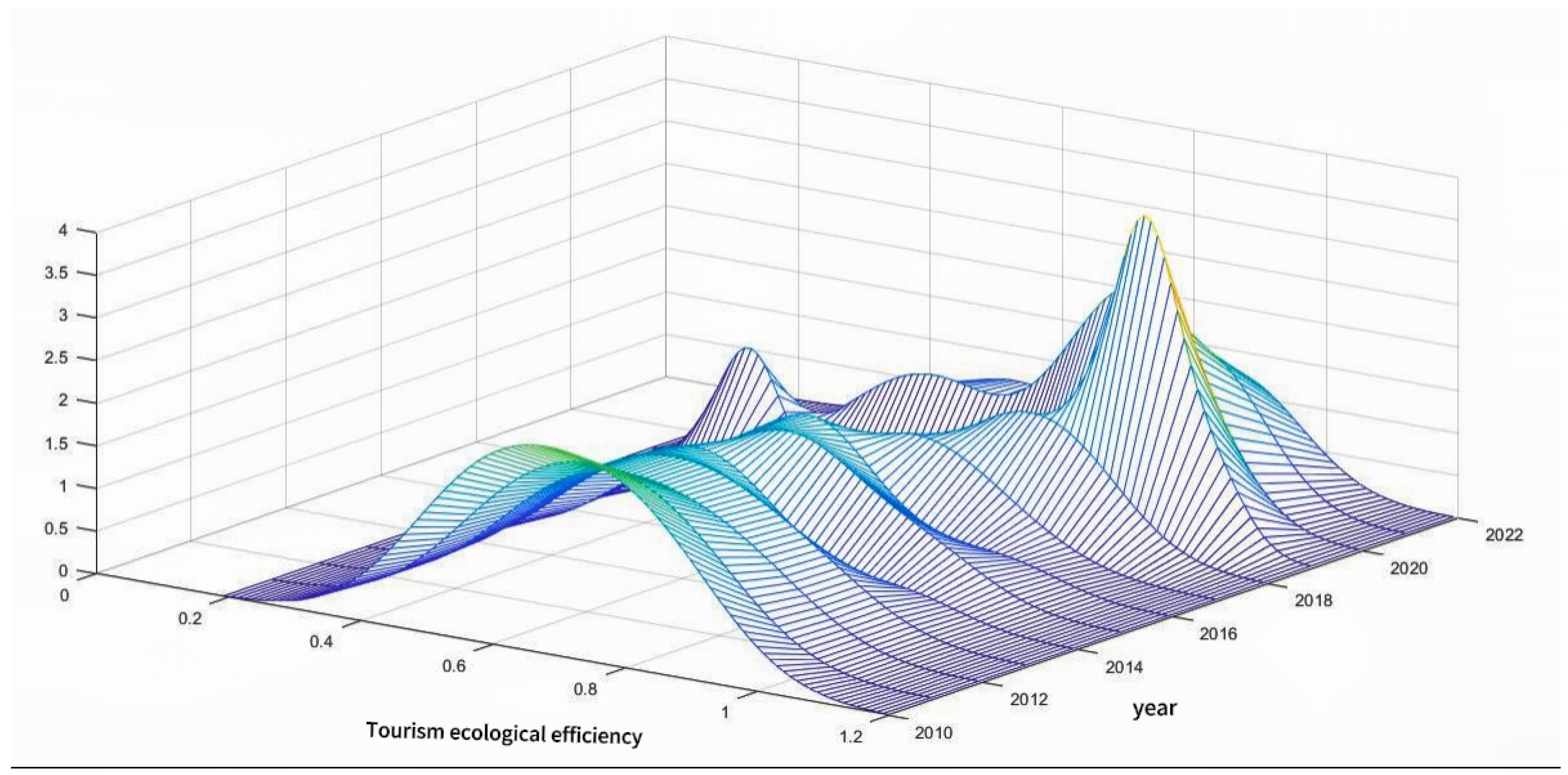
The TEE of the nine provinces in the Yellow River Basin exhibited pronounced temporal dynamics (Figure 4). Between 2010 and 2018, the kernel density curve exhibited a unimodal distribution with a peak density of approximately 2.4. Starting in 2019, however, the distribution evolved into a bimodal structure, with a weaker peak around 1.4 and a stronger peak near 3.8, indicating greater efficiency differentiation. At the same time, efficiency values shifted from clustering predominantly around 0.7 during 2010–2018 to forming two distinct clusters near 0.3 and 0.9 after 2019, with a stronger concentration at 0.9. These patterns indicate a tendency towards high efficiency concentration in most provinces, accompanied by persistent inefficiency in a few, thereby intensifying regional disparities and polarization.
The location of the primary kernel density peak remained stable across the study period. Before 2019, reductions in tail thickness and area suggested increasing distribution concentration and diminishing spatial differences. Between 2020 and 2022, increased tail thickness reflected a resurgence of regional disparities, likely driven by significant efficiency gains in certain provinces.
In terms of distribution pattern, the kernel density curve shifted from a right-skewed form with a low peak and wide base (2010–2016) to one characterized by a higher peak and narrower base (2017–2019). However, this pattern weakened after 2020.
Overall, the TEE in the Yellow River Basin reveals the coexistence of high-value concentration and polarization. Inter-provincial differences shifted from convergence to divergence, reflecting instability closely associated with tourism’s inherent susceptibility to external shocks.
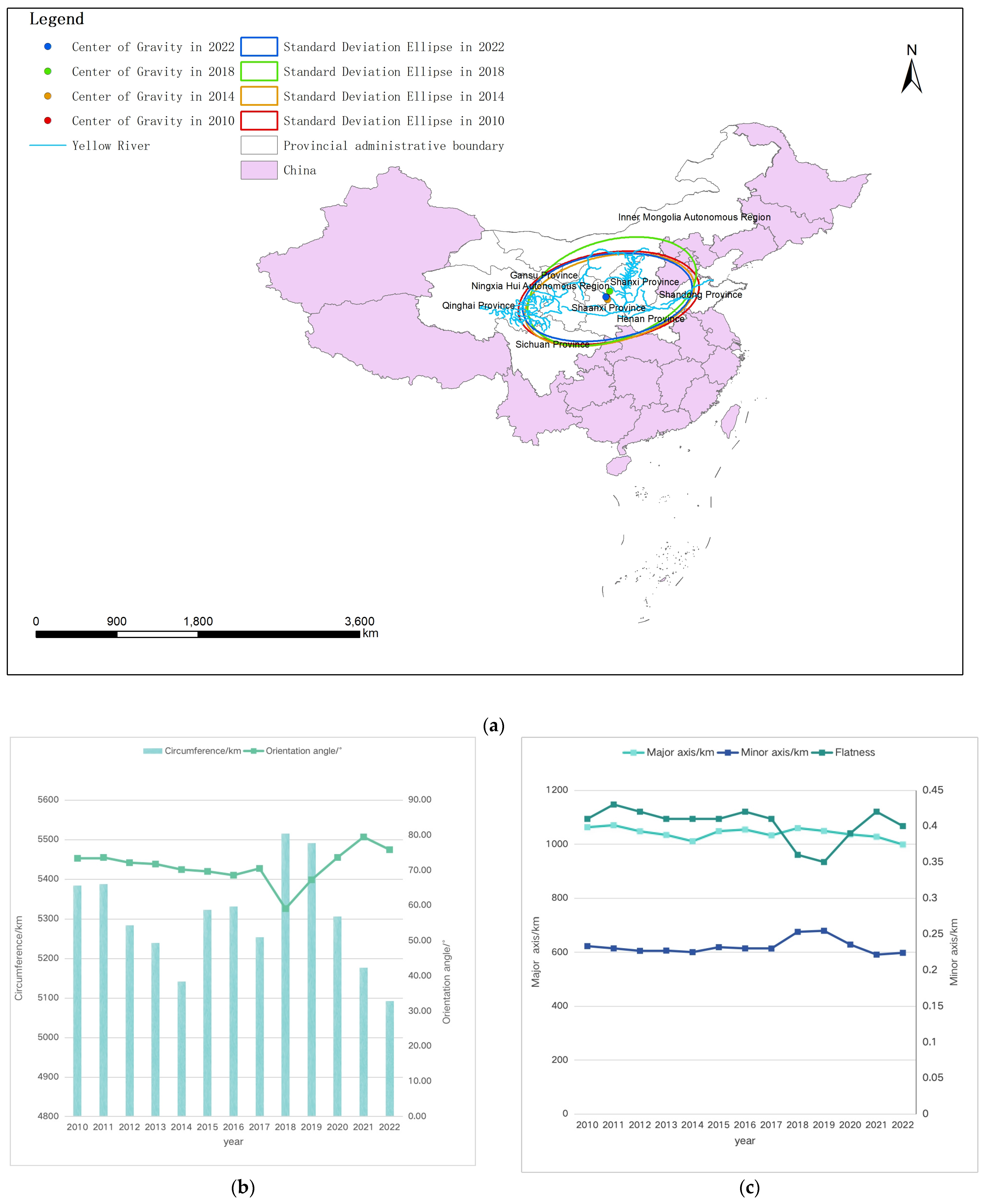
As shown in Figure 5, the standard deviation ellipse maintained a persistent northeast-southwest orientation throughout the study period, with the major axis consistently longer than the minor axis. The major half-axis exhibited relative stability, increasing slightly from 1062.31 km in 2010 to 1069.81 km in 2011, declining to 1010.31 km in 2014, recovering to 1059.08 km in 2018, and ultimately decreasing to 998.14 km in 2022. This net reduction of 64.17 km indicates strengthened east-west agglomeration. By contrast, the minor half-axis displayed greater volatility, declining from 622.33 km in 2010 to 600.10 km in 2014, rising to 679.28 km in 2019, and then falling to 597.44 km in 2022, resulting in a net decrease of 24.89 km and confirming north-south agglomeration. Changes in azimuth progressed from steady development to sharp decline, followed by continuous increase, culminating in a cumulative rise of 2.45° between 2010 and 2022. This pattern signals an overall spatial shift toward east-west alignment.
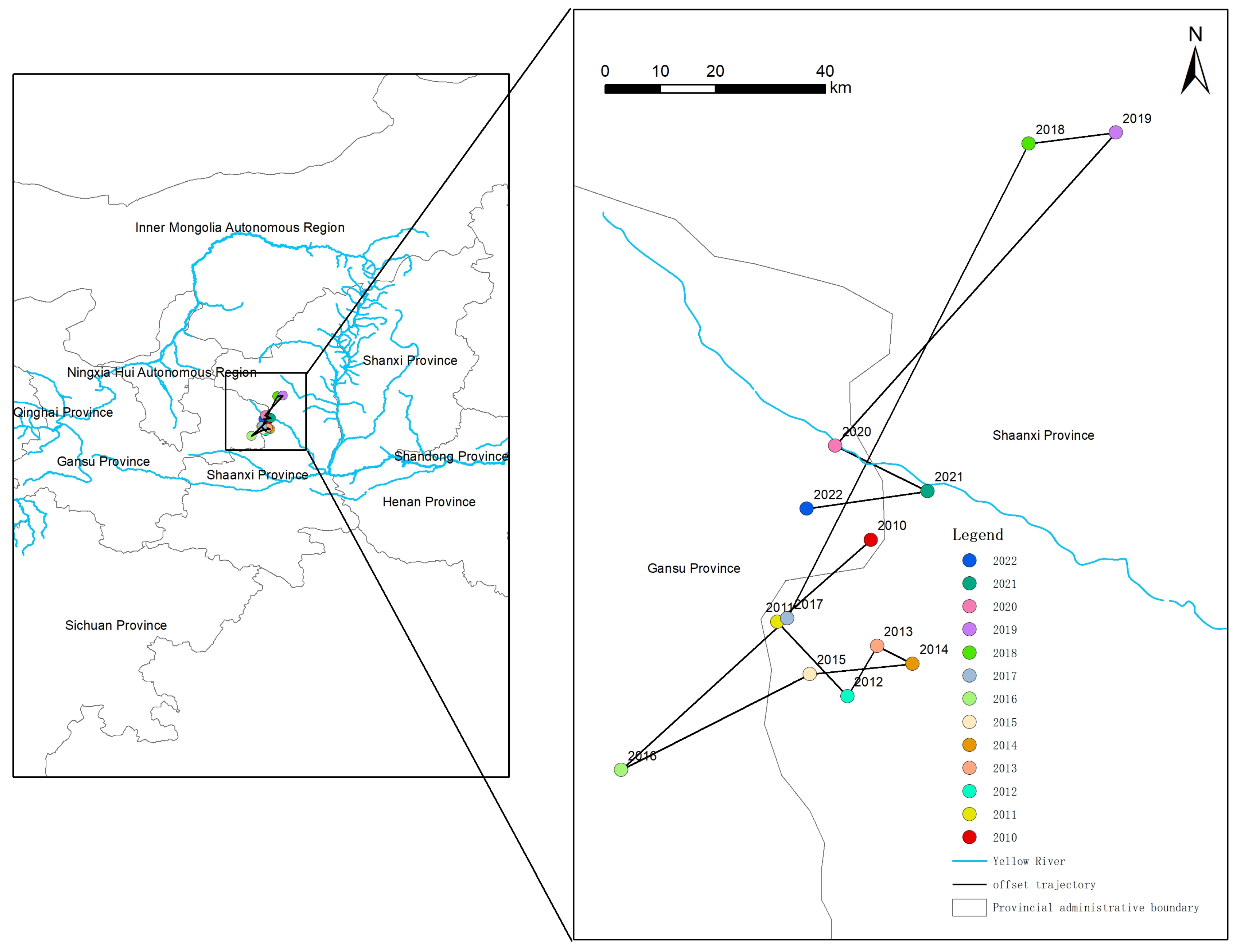
Figure 6 further illustrates three distinct phases of center-of-gravity migration: erratic shifting (2010–2016), pronounced northeastward displacement (2016–2019), and marked southwestward movement toward the Gansu-Shaanxi border (2019–2022). Collectively, these patterns reflect the southwestward migration and spatial agglomeration of TEE. Regional strategies underlie this spatial reorganization. For example, Sichuan leverages Sanxingdui heritage, Shuhan culture, and mountainous resources to foster cross-regional tourism ecosystems and optimize spatial layouts through ecological planning. Meanwhile, economically advanced provinces such as Shandong and Henan enhance efficiency through managerial innovation, emerging business models, and technology-driven industrial transformation.

3.3. Analysis of Factors Influencing TEE in the Yellow River Basin

Considering the complexity and particularity of the tourism ecosystem in the Yellow River Basin, we identified nine factors across seven dimensions. This study systematically identifies seven categories of key factors influencing TEE in the basin: tourism economic development, regional economic development, technological innovation, human capital, environmental regulation, openness, and infrastructure construction, with targeted quantitative indicators selected for each category.
For tourism economic development, two indicators are selected: total tourism revenue (lnX1) and the number of tourist attractions rated 3A or above (lnX2) [55,56]. Total tourism revenue reflects the economic output scale of the regional tourism industry. Expansion of this scale may enhance resource-use efficiency through agglomeration effects or, conversely, place pressure on the ecological environment through overdevelopment, making it a core variable for assessing the relationship between tourism activities and ecological carrying capacity. The number of 3A-and-above attractions reflects the supply quality and attractiveness of regional tourism resources. A dense distribution of high-grade attractions may reduce per capita ecological consumption through professional management but simultaneously increase demands for ecological protection. Together, these indicators capture the dual pathways through which the tourism economy influences TEE. For regional economic development, the proportion of the tertiary industry in GDP (X3) is selected as the core indicator [57]. This measure reflects the service-oriented nature of the regional economic structure. A higher tertiary share indicates reduced dependence on resource-intensive industries, thereby providing greener support for tourism and aligning with the Yellow River Basin’s strategic orientation of “ecological priority and green development.” For technological innovation, the number of invention patent applications (X4) serves as a proxy for regional innovation capacity [45]. Its impact on TEE operates through two channels: (i) innovations in equipment and energy-saving technologies can directly reduce energy consumption and emissions in scenic operations; and (ii) applications of big data and the Internet of Things optimize resource allocation, mitigating ecological pressure. Thus, this indicator effectively captures the role of technological progress in promoting TEE. For human capital, two indicators are selected: the ratio of urban registered population to permanent population (X5) and population density, measured as year-end population per administrative area (X6) [45,56]. The first reflects the quality of urbanization, with higher levels implying greater professional capacity and environmental awareness among tourism practitioners, thereby enhancing ecological efficiency through refined management. The second reflects labor agglomeration: moderate density reduces service costs via specialization, whereas excessive density increases ecological load. Together, these indicators capture the quality and quantity dimensions of human capital’s impact on TEE. For environmental regulation, total investment in pollution control (X7) measures the intensity of environmental management [58]. In the ecologically fragile Yellow River Basin, higher investment directly improves environmental quality while also compelling tourism enterprises to adopt greener technologies through a “reverse force mechanism,” thereby reducing ecological damage. For openness, the ratio of trade volume to GDP (X8) serves as a representative indicator [59]. Greater openness can enhance tourism service quality and ecological standards by incorporating international demand and management practices. Moreover, foreign investment may introduce environmentally friendly development models, expanding opportunities to improve TEE. For infrastructure, the green coverage rate of built-up areas (X9) is selected as a comprehensive measure of tourism reception capacity and ecological quality [45]. Green coverage not only reflects the urban ecological environment but also signals the “greening” of infrastructure. For the Yellow River Basin, higher coverage strengthens ecosystem stability, buffers tourism’s environmental impact, and directly supports TEE improvement. Using provincial TEE as the dependent variable and these indicators as independent variables, we conducted Tobit regression analysis (Stata 17.0) to address data censoring, with results detailed in Table 3.
  • Tourism Economic Development
Total tourism revenue and the number of Grade 3A and above tourist attractions are significantly and positively correlated with TEE. As a core output indicator, tourism revenue growth directly reflects enhanced economic benefits and contributes to improved efficiency. Serving as comprehensive tourism carriers, 3A and above scenic spots integrate transportation, accommodation, and catering infrastructure, thereby fostering stronger linkages between tourism, ecological resources, and regional culture. The promotion of green development facilitates low-carbon transformation across industries, generating synergistic effects. Therefore, tourism economic development serves as a critical driver of enhanced ecological efficiency.
  • Regional Economic Development
The regression coefficient for the tertiary industry’s GDP share (X3) is 0.688 and is statistically significant at the 1% level, confirming a positive relationship between regional economic development and TEE. Regional economic advancement actively promotes the development of TEE. The basin’s abundant cultural resources and strategic geographic location ensure that it remains highly dependent on local ecological conditions. Economic maturation fosters diversification into rural, wellness, and educational tourism, while digital transformation enhances industry intelligence. Consequently, the sector is transitioning toward digitalization and greening, enhancing product personalization, innovating green tourism experiences, and reconciling economic growth with ecological protection.
  • Technological Innovation
Technological innovation exhibits a significant positive relationship with TEE. The adoption of green technologies facilitates the transformation of production processes and enhances resource utilization, while technological advancements strengthen control capabilities throughout both and treatment phases.
  • Human Capital
The urbanization rate exhibits a significant negative correlation with TEE, whereas population density demonstrates no statistically insignificant effect. The effect of human capital remains ambiguous due to countervailing forces, namely the reduction in labor dependence resulting from technological progress and the increase in service demand driven by urbanization. Consequently, the influence of human capital is highly context-dependent and exhibits considerable complexity.
  • Environmental Regulation
Environmental regulation exhibits a significant negative correlation with TEE. Such regulations may exacerbate local ecological pressures, as profit-driven enterprises tend to externalize environmental costs in the presence of enforcement gaps. Persistent noncompliance further impedes efficiency improvement.
  • Openness Level
The degree of openness demonstrates a significant negative correlation with TEE. Inflows of international tourists and foreign capital increase pressure on the ecological carrying capacity, while growth-oriented policies often dilute environmental governance, thereby constraining efficiency gains.
  • Infrastructure Improvement
Infrastructure development shows a significant negative correlation with TEE. While efficient transportation can reduce energy consumption and enhance reception capacity, the resource intensity and environmental disruption associated with the construction phase may temporarily outweigh these benefits, leading to short-term efficiency declines.
In the baseline Tobit model, although the impacts of various explanatory variables on TEE have been identified, the analysis may be subject to exogeneity bias due to the omission of major policy shocks. In particular, the strategy for ecological protection and high-quality development of the Yellow River Basin was elevated to a national strategy in 2019 [60]. This policy demonstrates clear exogeneity: both its implementation timeline (2019) and spatial coverage (nine provinces/municipalities along the Yellow River) were centrally determined by the Chinese government, and it was not designed with reference to regional TEE levels. Thus, it can be regarded as an exogenous institutional shock. Neglecting such shocks may bias the estimation results. To address this issue, this study incorporates a policy implementation dummy variable (“policy”) into the baseline model: “policy” takes the value of 1 for observations in years after implementation and 0 otherwise. Table 3 reports the Tobit model estimation results after introducing the policy variable.
The regression results indicate that the coefficient of the policy variable is significantly positive, thereby confirming the effectiveness of the ecological protection strategy in the Yellow River Basin. The strategy has provided exogenous impetus for enhancing TEE through centrally coordinated resource allocation and strengthened regulatory oversight. A comparison of the explanatory variables across models with and without the policy variable yields the following insights: The coefficients of tourism revenue (lnX1) and invention patent applications (X4) increased substantially after the inclusion of the policy variable, while their statistical significance remained stable. This suggests that the strategy, through ecological compensation mechanisms and technological innovation incentives, has enhanced the synergistic effect of economic growth and green technology adoption on TEE, thereby producing marginal gains in their positive association. The absolute values of the coefficients for the number of tourist attractions rated 3A and above (lnX2) and the urbanization rate (X5) declined, accompanied by lower significance levels. Following policy implementation, the traditional “quantity-expansion” model of scenic spot development and the “extensive” urbanization path—both conflicting with ecological protection goals—saw their explanatory power for TEE partially replaced by a policy-driven “quality-first” development logic, thereby reflecting a structural transformation in development patterns. The coefficients and significance levels of the proportion of the tertiary industry (X3) and environmental governance investment (X7) exhibited no substantial differences before and after policy implementation. This finding confirms that the efficiency-enhancing role of a service-oriented industrial structure is embedded in the inherent trajectory of economic transformation, whereas the institutional nature of administrative environmental governance renders its impact relatively immune to short-term policy shocks, thereby exhibiting path dependence. Dynamic changes were observed in the coefficients and significance levels of population density (X6), openness (X8), and infrastructure construction (X9). This suggests that, under the policy shock, the mechanisms through which factor agglomeration, openness, and infrastructure layout influence TEE are undergoing short-term adaptation and adjustment, with their long-term effects requiring further observation.

3.4. Pathways for Improving the Ecological Efficiency of Tourism in the Yellow River Basin

3.4.1. Variable Setting and Calibration

Provincial TEE values in the Yellow River Basin were quantified for 2010–2022 using the super-efficiency SBM model in combination with Tobit regression analyses. These values were found to be influenced by technological innovation capacity, tourism development intensity, external openness, infrastructural investment, regional economic performance, and the stringency of environmental regulations. Accordingly, TEE (Y) was designated as the outcome variable, and the following indicators were selected as condition variables: total tourism revenue (X1), count of 3A+ grade tourist attractions (X2), tertiary industry GDP share (X3), invention patent applications (X4), urbanization rate (X5), environmental regulation intensity (X7), external openness index (X8), and built-up area green coverage rate (X9).
Calibration thresholds for both condition and outcome variables were determined using sample percentiles: the 95th percentile for full membership, the 50th percentile for the crossover point, and the 5th percentile for full non-membership. To mitigate classification ambiguities associated with cases having a crossover score of exactly 0.5, the threshold was adjusted from 0.5 to 0.501, in line with the methodological refinement proposed by Greckhamer et al. [61]. This adjustment preserved sample integrity while enhancing analytical validity.

3.4.2. Necessary Condition Analysis

Necessity testing of individual conditions was conducted using QCA to identify prerequisites for both high and low TEE outcomes. The results (Table 4) indicate that no single condition achieved a consistency threshold ≥0.9 for high TEE, suggesting the absence of necessary causal conditions. This finding implies that the emergence of high TEE in the Yellow River Basin results from conjunctural causality rather than isolated determinants.
By contrast, for low TEE outcomes, invention patent applications (X4) were identified as a necessary condition with a consistency score exceeding the 0.9 threshold, while all other conditions remained below this benchmark. This establishes X4 as a necessary condition for low TEE, with substantial explanatory power. Notably, its coverage value further confirms its substantive relevance. The results of the bivariate necessity analysis of the preconditions are also reported in Table 4.

4. Discussion

4.1. Path Analysis

To further unpack the causal complexity underlying the improvement of TEE in the Yellow River Basin (i.e., the non-linear synergies and asymmetric relationships among influencing factors), this section focuses on interpreting the fsQCA configuration results. Prior to the substantive analysis of configurations, the key parameter settings and solution selection logic for the fsQCA analysis—consistent with case heterogeneity and academic norms—are first clarified as a basis for subsequent discussions:
In line with case heterogeneity considerations, a consistency threshold of 0.8 and a frequency threshold of 2 were adopted. The Boolean minimization procedure produced three solution types: complex (incorporating no logical remainders), intermediate (incorporating plausible remainders based on theoretical expectations), and parsimonious (incorporating all remainders). Following established QCA conventions [44], the intermediate solution was prioritized for substantive interpretation, with the parsimonious solution serving as a robust reference.
This analysis identified six sufficient configuration pathways driving high TEE in the Yellow River Basin (Table 5). Key metrics demonstrated a robust model fit.
Overall solution consistency = 0.920 (exceeding the 0.75 benchmark)
Individual path consistency > 0.80 (all- analysis surpassing minimum thresholds)
Solution coverage = 0.693 (accounting for 69.3% of observed high-TEE cases)
These results empirically substantiate that multiple conjunctural pathways—rather than a singular optimal route—explain TEE improvement. The specific configurations (elaborated below) represent distinct, equifinal strategic combinations for enhancing regional tourism sustainability. The specific paths are listed in Table 5.
In this study, the fsQCA configurations are named according to the “synergy patterns of core conditions” and the “logical differences underlying the improvement of TEE,” as detailed below: The “economy-oriented type” (Configurations 1 and 2) is characterized by the combination of total tourism revenue (X1, core condition) and invention patents (X4, peripheral condition) as its primary drivers. The proportion of the tertiary industry (X3) and the urbanization rate (X5) exert weak effects, highlighting a single-driving logic of “economic scale dominance with limited structural synergy.” The “market-innovation type” (Configuration 3) relies on the dual-core drivers of tourism revenue (X1) and invention patents (X4), while abandoning traditional paths such as the number of 3A-level scenic spots (X2) and environmental regulation (X7). It reflects a development logic of “spontaneous synergy between market forces and innovation, coupled with the avoidance of administrative intervention.” The “scale-innovation type” (Configuration 4) emphasizes the proportion of the tertiary industry (X3, core condition) and invention patents (X4, peripheral condition) as key factors, while attenuating the influence of tourism revenue (X1) and urbanization (X5). This configuration reflects a development path prioritizing “industrial structure quality over scale expansion.” The “balanced development type” (Configurations 5 and 6) integrates multiple core elements, including tourism revenue (X1), invention patents (X4), environmental regulation (X7), and the level of openness (X8). The tertiary industry (X3) and urbanization (X5) play moderate roles, embodying a balanced development logic of “multi-dimensional synergy without single-factor dominance.”
(1)
Economy-oriented
Pathway 1 indicates that strong tourism economic development (X1), when combined with moderate technological innovation (X4), stringent environmental regulation (X7), and external openness (X8), can offset deficiencies in human capital, regional economy (X3), and infrastructure (X9). This configuration achieved a coverage score of 0.292 and a consistency score of 0.969, with Henan Province exemplifying its application through digital resource management platforms, cultural heritage preservation systems, and green product certification mechanisms. The synergy between policy guidance and technological applications facilitated rational resource allocation and the establishment of circular tourism models.
Pathway 2 primarily relies on tourism economic strength (X1) supported by human capital availability, environmental regulation (X7), and infrastructure (X9). It remains effective despite low technological innovation (X4) and openness (X8), distinguished by reducing external dependencies (coverage = 0.226, consistency = 0.913). Inner Mongolia exemplified this pathway through tourism-industrial integration policies, infrastructure modernization, and experience-oriented scenario development, demonstrating how institutional coordination can compensate innovation deficits by leveraging scale efficiencies.
(2)
Market-driven innovation
Pathway 3 is primarily anchored in tourism economic development (X1), supported by external openness (X8) and technological innovation (X4) as auxiliary conditions. This configuration mitigates constraints related to regional economy (X3), infrastructure (X9), environmental regulation (X7), and human capital, achieving coverage of 0.237 and consistency of 0.995. Sichuan Province exemplifies this pathway through cultural brand development (“Ancient Shu Culture”), visa liberalization policies, and digital-tourism integration, illustrating how market globalization facilitates leapfrog development through innovation absorption.
(3)
Scale-Innovation
Pathway 4 (Tertiary Sector-Innovation) relies on tertiary sector dominance (X3) and technological innovation (X4) as core drivers, compensating for deficiencies in the tourism economy (X1), infrastructure (X9), environmental regulation (X7), and human capital. His configuration achieves coverage of 0.228 and consistency of 0.947. Gansu Province demonstrates this configuration through heritage digitization projects, immersive performance systems, and cultural-tourism economic zones, highlighting how structural innovation transforms resource endowments into experiential capital.
(4)
Balanced development type
Pathway 5 (Balanced Development) integrates tourism economic development (X1), technological innovation (X4), environmental regulation (X7), openness (X8), and infrastructure (X9), operating effectively despite limitations in regional economic (X3) and human capital. This configuration achieves coverage of 0.535 and consistency of 0.952. Cases from Qinghai, Ningxia, and Shanxi illustrate ecological resource monetization, digital management systems, and transnational tourism corridors, demonstrating how institutional completeness facilitates systemic optimization beyond developmental constraints.
Pathway 6 (Economic-Technological Synergy) is driven by three core conditions: tourism economy (X1), regional economic foundation (X3), and technological innovation (X4), with environmental regulation (X7) and human capital (X6) as auxiliary factors. Notably, attraction quantity (X2) is deemed irrelevant, confirming its non-necessity with coverage of 0.447 and consistency of 0.969. Shandong and Shaanxi Provinces exemplify this pathway through industrial-tourism integration models, all-for-one tourism demonstration zones, and green production certifications, demonstrating how economic and technological dynamics generate cross-sectoral efficiency gains.

4.2. Comparison with Existing Studies

Empirical analysis revealed that the TEE of the Yellow River Basin exhibited a significant upward trend, consistent with the conclusion of “steady improvement” in national TEE reported by Lu et al. (2020) [62]. This cross-scale consistency verifies the reliability of the present findings and confirms the effectiveness of the national “ecology-first, green development” strategy at the regional level. Both nationally and within the Yellow River Basin, the tourism industry has entered a critical transition from a “scale-expansion-oriented” model to a “quality- and efficiency-oriented” model. This transformation provides a solid foundation for the sustained enhancement of ecological efficiency.
Regarding the determinants of TEE, this study confirms that infrastructure development and regional economic growth exert a positive effect, echoing the findings of Xue et al. (2020) in the Yangtze River Economic Belt [63]. They proposed a “basic support system” framework for TEE, emphasizing that the regional economic foundation determines the intensity of environmental protection investment, while infrastructure development directly influences tourist distribution efficiency; together, these factors drive improvements in ecological efficiency. The empirical analysis of the Yellow River Basin not only validates the universality of this framework but also demonstrates that its “basic supporting role” is particularly pronounced in the middle reaches, consistent with regional characteristics such as dense cultural tourism resources and urgent infrastructure demands. This finding supplements the “basic support system” theory with evidence of basin-level heterogeneity.
Notably, in contrast to the above consistencies, the core finding that “technological innovation positively influences TEE” diverges from the results of Sun et al. (2022), who reported a significant negative correlation between technological innovation and TEE in the three major urban agglomerations (Beijing-Tianjin-Hebei, Yangtze River Delta, and Pearl River Delta) [31]. While Sun et al. found a significant negative correlation in those urban agglomerations, the present analysis demonstrates that technological innovation in the Yellow River Basin serves as a positive driver of TEE [31]. Two primary factors explain this divergence. First, differences in development stage are a fundamental prerequisite. The tourism industry in the three major urban agglomerations has entered a “scale saturation period,” where resource consumption and environmental pressure from expansion outweigh the marginal efficiency gains. In contrast, the Yellow River Basin remains in a stage of “increasing returns to scale,” where tourism growth relies on the intensive utilization of underused ecological resources rather than incremental resource consumption, thereby directly enhancing TEE. Second, the orientation of technological innovation is a critical inducement. In the urban agglomerations, innovation primarily targets “experience upgrading,” which, although enhancing tourist satisfaction, entails high energy consumption and capital investment, thereby generating an “innovation–efficiency paradox.” In contrast, innovation in the Yellow River Basin focuses on “ecological protection,” directly mitigating the negative environmental externalities of tourism activities and producing a positive effect on TEE.

5. Conclusions and Suggestions

5.1. Conclusions

This study examined the dynamics of TEE in China’s Yellow River Basin from 2010 to 2022 using an integrated spatiotemporal analytical framework. The findings indicate that provincial TEE exhibited sustained improvement over the study period; however, substantial regional disparities persisted. Efficiency differentials were particularly pronounced in the upper basin compared to the more developed middle and lower reaches, with some provinces consistently leading in performance while others lagged significantly.
Spatiotemporal evolution patterns were revealed, indicating a transition toward a polarized efficiency landscape. Geographical analysis confirmed a predominant northeast-southwest orientation in efficiency distribution, with the regional centroid exhibiting a net southwestward shift while remaining relatively stable within the basin’s central area. This spatial restructuring reflects persistent imbalances in sustainable tourism development.
Determinant analysis identified infrastructure development, regional economic strength, tourism economic scale, and technological innovation as significant positive drivers of efficiency improvement. In contrast, stringent environmental regulation and greater external openness exerted counterproductive effects. The impact of human capital remained statistically ambiguous, suggesting context-dependent effects that require further investigation.
Importantly, pathway analysis demonstrated that high-efficiency outcomes arise from configurational causality rather than isolated factors. Four equifinal pathways were identified: (i) economy-oriented development leveraging policy-technology synergy, (ii) market-innovation models driven by openness, (iii) tertiary-sector transformation through service-industrial integration, and (iv) balanced institutional approaches. This multifaceted framework offers actionable guidance for regional policymakers pursuing ecological modernization in tourism-dependent river basins, emphasizing context-specific implementation over universal solutions.

5.2. Scholarly Contribution

Theoretically, this study supplements and refines the existing research framework for TEE. On one hand, it further aligns TEE evaluation with China’s strategic goals of “carbon peaking and carbon neutrality,” optimizing the adaptability of existing evaluation logics in the context of dual carbon targets. This not only responds to the practical demand for the green transformation of the tourism industry but also enriches the scenario-specific content of the TEE theoretical framework. On the other hand, by combining spatiotemporal differentiation analysis with configurational pathway identification, the study breaks through the limitation of “single-factor or subjective strategy analysis” in existing research, clarifies the synergistic mechanism through which multiple factors (including infrastructure and technological innovation) influence TEE, and supplements the multi-dimensional analytical logic for TEE driving mechanisms.
Practically, this study focuses on the Yellow River Basin—a typical region featuring the “synergy between ecological protection and tourism development.” Relying on empirically validated pathways, it not only provides provincial policymakers with references for formulating differentiated strategies but also offers decision-making support for integrating tourism green development with ecological protection in the Yellow River Basin. Additionally, given the Yellow River Basin’s representativeness as an ecologically fragile area, the research findings also hold broader reference value for other ecologically sensitive regions facing similar “protection-development” dilemmas, particularly in terms of TEE improvement and sustainable tourism governance.

5.3. Managerial Implications

(1) Strengthen Ecological Protection and Basin-Scale Sustainable Development. Ecological protection should be embedded across all stages of basin tourism development to promote the implementation of sustainable development models. On the one hand, strategies for ecological protection and sustainable resource utilization must be rigorously enforced. By regulating energy-intensive and ecologically disruptive tourism projects, establishing ecological compensation mechanisms, and implementing dynamic monitoring systems, the intensity of tourism resource development can be aligned with ecological carrying capacity, thereby ensuring long-term sustainable use. On the other hand, management systems and operational efficiency should be systematically optimized. Enhancing workforce training, improving service standards and incentive mechanisms, and upgrading infrastructure and governance frameworks can foster collaboration among enterprises, communities, and technological entities, thereby elevating the overall quality of basin tourism management and services. Demonstration projects should serve as catalysts for upgrading tourism products. Efforts should focus on advancing the green transformation of scenic areas and optimizing product structures by developing green demonstration sites, eco-hotels, and low-carbon villages; fostering emerging formats such as leisure vacations and cultural heritage experiences; and generating benchmarking and spillover effects. On this basis, technological innovation should be leveraged to support service upgrading. Introducing high-level technical expertise and promoting the application of smart energy management, low-carbon buildings, and digital tourism services can optimize product supply structures, thereby achieving the coordinated development of economic benefits and ecological protection. Furthermore, long-term cross-regional cooperation mechanisms should be established to promote collaboration among the upper, middle, and lower reaches of the basin as well as among urban agglomerations. Such mechanisms should facilitate the sharing of management experience and technological resources and support the development of differentiated tourism products grounded in regional cultural characteristics, thereby enhancing the overall sustainable development capacity of the basin.
(2) Promote the development priorities of the upper, middle, and lower reaches, considering local conditions. Qinghai and Ningxia should prioritize overcoming infrastructure deficiencies by optimizing transportation networks, upgrading tourism accommodation facilities, and developing information service systems. By systematically enhancing tourism service support, these regions can strengthen their tourism reception capacity and improve service accessibility. Inner Mongolia should position technological innovation as the core driver by accelerating the development of smart scenic areas and digital management platforms. By leveraging technological empowerment to optimize scenic area operations, management efficiency can be improved while reducing the carbon intensity of tourism activities. Gansu should prioritize the dual enhancement of human capital and green technologies by increasing investment in skill training for tourism practitioners, while simultaneously promoting energy-saving and emission-reduction technologies and implementing low-carbon operational measures to consolidate the foundation for improving TEE. Leveraging its extensive experience in tourism development and ecological governance, Sichuan can assume a leading role in establishing regional cooperation and technology-sharing mechanisms. Through knowledge dissemination and technical assistance, Sichuan can help narrow the development gap with neighboring provinces such as Qinghai, Ningxia, Inner Mongolia, and Gansu, thereby fostering a coordinated development pattern in the upper reaches. From the perspective of overall development orientation in the upper reaches, a core framework driven by the dual engines of “technology + institutions” should be adopted. On the one hand, strengthening infrastructure and upgrading technological capabilities can provide robust structural support for development; on the other hand, improving environmental supervision mechanisms and ecological compensation systems can establish a strong institutional guarantee. Meanwhile, the ecological advantages of the upper reaches should be leveraged to emphasize the orientation of ecological value. Priority should be given to fostering low-carbon tourism formats, including ecological research tours, hiking, and cultural heritage experiences, while developing differentiated eco-tourism brands with strong regional recognition. By precisely targeting high-value tourist groups, the coordinated improvement of both tourism economic benefits and ecological protection outcomes can ultimately be achieved.
(3) Synergistically Enhance Key Supporting Elements. With the synergistic upgrading of key elements as the focus, the foundation for the sustainable development of basin tourism should be consolidated. First, efforts should be made to accelerate the quality improvement and efficiency enhancement of infrastructure: prioritize increasing investment in new energy transportation, smart energy, and low-carbon public facilities in underdeveloped areas of the upper reaches to strengthen the sustainable carrying capacity of tourism. Second, promote the optimization of an economy oriented toward green development: adjust industrial layouts to reduce reliance on energy-intensive industries, cultivate cultural-tourism-integrated industrial chains, and ensure the coordinated development of tourism and ecological protection. Third, strengthen the improvement of scenic area energy efficiency and service quality: optimize operational management processes, enhance energy efficiency supervision and service quality development, and realize the coordinated advancement of tourism revenue growth and low-carbon emissions. Fourth, empower green tourism development through technology: support the R&D and application of technologies such as smart energy management, energy-saving buildings, and digital services; establish a “technology + green” development model; and comprehensively improve the overall efficiency of basin tourism.

5.4. Limitations and Research Directions

Three principal limitations of this study warrant acknowledgment:
(1)
Spatial granularity constraints: The provincial-scale analysis (N = 9) restricts the generalizability of the findings. Future research should incorporate smaller administrative units (e.g., counties or prefecture-level cities) or adopt cross-basin comparative approaches to improve external validity.
(2)
Carbon accounting methodology: Tourism-related carbon emission calculations relied on generalized conversion coefficients without basin-specific adjustments. This approach may underestimate emissions in resource-dependent economies undergoing structural transitions. Refined methodologies that incorporate regionalized parameters and life-cycle assessment are therefore recommended.
(3)
Antecedent selection trade-offs: The spatial scale of provincial panel data necessitated restricting antecedents to satisfy fsQCA’s case-to-condition ratio requirements. Future research should conduct nested analyses at municipal or county levels to incorporate additional determinants and uncover nuanced causal complexities. Collectively, these directions would enhance both methodological rigor and practical relevance in sustainable tourism research.

Author Contributions

D.Z.: Conceptualization, Data curation, Formal analysis, Investigation, Validation, Writing—original draft; Y.L.: Conceptualization, Methodology, Supervision, Writing—original draft; L.L.: Conceptualization, Supervision, Writing—review and editing. Y.M.: Conceptualization, Data curation, Writing—review and editing. G.X.: Conceptualization, Visualization, Writing—review and editing. All authors have read and agreed to the published version of the manuscript.

Funding

This research was supported by three projects. The first one is the Project of the National Social Science Foundation of China, “Research on the Construction and Realization Path of Tourism Ecological Compensation Mechanism in Rocky Desertification Areas of Yunnan, Guangxi and Guizhou” (Grant No. 22BJY155). The second one is the project of the Inner Mongolia Regional Digital Economy and Digital Governance Research Center titled “A Study on the Effects of Digital Technology in Promoting High-Quality Development of the Tourism Industry in the Yellow River Basin” (Grant No. szzl202505). The third one is another project of the same center titled “A Study on the Pathways through Which the Digital Economy Facilitates High-Quality Development of the Tourism Industry” (Grant No. szzl202538).

Institutional Review Board Statement

Not applicable.

Informed Consent Statement

Not applicable.

Data Availability Statement

The original contributions presented in the study are included in the Article. Further inquiries can be directed to the corresponding author.

Conflicts of Interest

The authors declare no conflicts of interest.

References

  1. Sun, Y.-Y. Decomposition of tourism greenhouse gas emissions: Revealing the dynamics between tourism economic growth, technological efficiency, and carbon emissions. Tour. Manag. 2016, 55, 326–336. [Google Scholar] [CrossRef]
  2. Lenzen, M.; Sun, Y.-Y.; Faturay, F.; Ting, Y.-P.; Geschke, A.; Malik, A. The carbon footprint of global tourism. Nat. Clim. Change 2018, 8, 522–528. [Google Scholar] [CrossRef]
  3. Huang, G.Q.; Wang, Z.L.; Shi, P.F.; Zhou, Y. Measurement and Spatial Heterogeneity of Tourism Carbon Emission and Its Decoupling Effects:A Case Study of the Yellow River Basin in China. China Soft Sci. 2021, 4, 82–93. [Google Scholar]
  4. Schaltegger, S.; Sturm, A. Öologische rationalität (German/in English: Environmental rationality). Die Unternehm. 1990, 4, 117–131. [Google Scholar]
  5. Zhang, Y.; Min, Q.; Bai, Y.; Li, X. Practices of cooperation for eco-environmental conservation (CEC) in China and theoretic framework of CEC: A new perspective. J. Clean. Prod. 2018, 179, 515–526. [Google Scholar] [CrossRef]
  6. Jiskani, I.M.; Cai, Q.; Zhou, W.; Shah, S.A.A. Green and climate-smart mining: A framework to analyze open-pit mines for cleaner mineral production. Resour. Policy 2021, 71, 102007. [Google Scholar] [CrossRef]
  7. Liu, B.; Gao, Q.; Liang, L.; Sun, J.; Liu, C.; Xu, Y. Ecological relationships of global construction industries in sustainable economic and energy development. Energy 2021, 234, 121249. [Google Scholar] [CrossRef]
  8. Gössling, S.; Peeters, P.; Ceron, J.-P.; Dubois, G.; Patterson, T.; Richardson, R.B. The eco-efficiency of tourism. Ecol. Econ. 2005, 54, 417–434. [Google Scholar] [CrossRef]
  9. Li, J.; Li, Y. Digitalization, green transformation, and the high-quality development of Chinese tourism enterprises. Financ. Res. Lett. 2024, 66, 105588. [Google Scholar] [CrossRef]
  10. Li, D.L.; Zhai, Y.J.; Tian, G. Spatial and Temporal Variation in Tourism Eco-efficiency of Inter-provincial Forest Parks in China Using Game Intersection. J. Northeast. For. Univ. 2022, 50, 81–86. [Google Scholar]
  11. Mandić, A. Structuring challenges of sustainable tourism development in protected natural areas with driving force–pressure–state–impact–response (DPSIR) framework. Environ. Syst. Decis. 2020, 40, 560–576. [Google Scholar] [CrossRef]
  12. Xu, A.; Wang, C.; Tang, D.; Ye, W. Tourism circular economy: Identification and measurement of tourism industry ecologization. Ecol. Indic. 2022, 144, 109476. [Google Scholar] [CrossRef]
  13. Tsaples, G.; Papathanasiou, J. Data envelopment analysis and the concept of sustainability: A review and analysis of the literature. Renew. Sustain. Energy Rev. 2021, 138, 110664. [Google Scholar] [CrossRef]
  14. Castilho, D.; Fuinhas, J.A.; Marques, A.C. The impacts of the tourism sector on the eco-efficiency of the Latin American and Caribbean countries. Socio-Econ. Plan. Sci. 2021, 78, 101089. [Google Scholar] [CrossRef]
  15. Chiwaridzo, O.T. Unleashing tomorrow’s energy for sustainable development: Pioneering green building technologies and green tourism supply chain management in Zimbabwe’s tourism sector. Energy Sustain. Dev. 2024, 78, 101382. [Google Scholar] [CrossRef]
  16. Chen, Y.; Ma, L.; Zhu, Z. The environmental-adjusted energy efficiency of China’s construction industry: A three-stage undesirable SBM-DEA model. Environ. Sci. Pollut. Res. 2021, 28, 58442–58455. [Google Scholar] [CrossRef]
  17. Xia, B.; Dong, S.; Li, Z.; Zhao, M.; Sun, D.; Zhang, W.; Li, Y. Eco-efficiency and its drivers in tourism sectors with respect to carbon emissions from the supply chain: An integrated EEIO and DEA approach. Int. J. Environ. Res. Public Health 2022, 19, 6951. [Google Scholar] [CrossRef]
  18. Roodbari, H.; Olya, H. An integrative framework to evaluate impacts of complex tourism change initiatives. Tour. Manag. 2024, 100, 104829. [Google Scholar] [CrossRef]
  19. Zhang, D.; Tu, J.; Zhou, L.; Yu, Z. Higher tourism specialization, better hotel industry efficiency? Int. J. Hosp. Manag. 2020, 87, 102509. [Google Scholar] [CrossRef] [PubMed]
  20. Pérez-Granja, U.; Inchausti-Sintes, F. On the analysis of efficiency in the hotel sector: Does tourism specialization matter? Tour. Econ. 2023, 29, 92–115. [Google Scholar] [CrossRef]
  21. Niavis, S. Evaluating the spatiotemporal performance of tourist destinations: The case of Mediterranean coastal regions. J. Sustain. Tour. 2020, 28, 1310–1331. [Google Scholar] [CrossRef]
  22. Wang, Y.; An, L.; Chen, H. Spillover effects and influencing factors of tourism eco-efficiency for sustainable development: A case study of cities in the Yangtze River Delta. Sustain. Dev. 2024, 32, 6201–6214. [Google Scholar] [CrossRef]
  23. Zhang, W.; Lang, J.; Xu, Y.; Streets, D.G. Whither green means eco-efficiency? Evaluating the spatiotemporal dynamics of eco-efficiency and its driving factors in coastal cities of the Bohai Sea region. Environ. Dev. Sustain. 2025, 1–23. [Google Scholar] [CrossRef]
  24. Li, J.; Wen, B.; Qiu, R. Measuring the ecoefficiency of tourism in typical tourist cities and analyzing the influencing factors—Anhui Huangshan city as an example. Sustainability 2024, 16, 10706. [Google Scholar] [CrossRef]
  25. Sun, R.; Ye, X.; Li, Q.; Scott, N. Assessing the eco-efficiency of cruise tourism at the national Level: Determinants, challenges, and opportunities for sustainable development. Ecol. Indic. 2024, 160, 111768. [Google Scholar] [CrossRef]
  26. Zhang, Y.; Li, Y. Regional Differences in Tourism Eco-Efficiency in the Beijing–Tianjin–Hebei Region: Based on Data from 13 Cities. Sustainability 2023, 15, 2907. [Google Scholar] [CrossRef]
  27. Liao, Z.; Zhang, L. Spatiotemporal interaction characteristics and transition mechanism of tourism environmental efficiency in China. Sci. Rep. 2023, 13, 14196. [Google Scholar] [CrossRef]
  28. Guo, L.; Li, P.; Zhang, J.; Xiao, X.; Peng, H. Do socio-economic factors matter? A comprehensive evaluation of tourism eco-efficiency determinants in China based on the Geographical Detector Model. J. Environ. Manag. 2022, 320, 115812. [Google Scholar] [CrossRef] [PubMed]
  29. Fan, Y.; Bai, B.; Qiao, Q.; Kang, P.; Zhang, Y.; Guo, J. Study on eco-efficiency of industrial parks in China based on data envelopment analysis. J. Environ. Manag. 2017, 192, 107–115. [Google Scholar] [CrossRef] [PubMed]
  30. Wang, R.; Xia, B.; Dong, S.; Li, Y.; Li, Z.; Ba, D.; Zhang, W. Research on the spatial differentiation and driving forces of eco-efficiency of regional tourism in China. Sustainability 2020, 13, 280. [Google Scholar] [CrossRef]
  31. Sun, Y.; Hou, G.; Huang, Z.; Zhong, Y. Spatial-temporal differences and influencing factors of tourism eco-efficiency in China’s three major urban agglomerations based on the Super-EBM model. Sustainability 2020, 12, 4156. [Google Scholar] [CrossRef]
  32. He, W.; Fu, J.; Luo, Y. A study of well-being-based eco-efficiency based on Super-SBM and Tobit Regression Model: The case of China. Soc. Indic. Res. 2023, 167, 289–317. [Google Scholar] [CrossRef]
  33. Gökgöz, F.; Yalçın, E. Dynamics of energy and economic transportation efficiency: An analysis of EU transportation sector. Environ. Prog. Sustain. Energy 2025, e70026. [Google Scholar] [CrossRef]
  34. Wang, S.; Qiao, H.; Feng, J.; Xie, S. The spatio-temporal evolution of tourism eco-efficiency in the Yellow River Basin and its interactive response with tourism economy development level. Econ. Geogr. 2020, 40, 81–89. [Google Scholar]
  35. Zhang, H.; Duan, Y.; Wang, H.; Han, Z.; Wang, H. An empirical analysis of tourism eco-efficiency in ecological protection priority areas based on the DPSIR-SBM model: A case study of the Yellow River Basin, China. Ecol. Inform. 2022, 70, 101720. [Google Scholar]
  36. Institute of Geographic Sciences and Natural Resources Research, Chinese Academy of Sciences. Available online: http://www.igsnrr.cas.cn/cbkx/kpyd/zgdl/cnszy/202009/t20200910_5692424.html (accessed on 10 March 2025).
  37. Guangming Online. Available online: https://www.toutiao.com/article/7023526934147498527/?upstream_biz=doubao&source=m_redirect (accessed on 27 March 2025).
  38. Huanghe Online. Available online: http://www.yrcc.gov.cn/hdjl/jypl/202312/t20231228_409824.html (accessed on 15 April 2025).
  39. Andersen, P.; Petersen, N.C. A procedure for ranking efficient units in data envelopment analysis. Manag. Sci. 1993, 39, 1261–1264. [Google Scholar] [CrossRef]
  40. Yang, G.Q.; Ji, Y.F.; Wang, S.; Meng, S. Efficiency and Influencing Mechanism of Regional Air Pollution Governance in China——Based on the Super SBM and the Threshold Regression Model. Chin. J. Environ. Manag. 2020, 12, 71–79. [Google Scholar]
  41. Wu, Y.; Xu, A.; Wang, C.; Shi, Y. Spatial and temporal evolution and influencing factors of tourism eco-efficiency in Fujian province under the target of carbon peak. Sci. Rep. 2023, 13, 23074. [Google Scholar] [CrossRef] [PubMed]
  42. Zhou, T.; Niu, A.; Ma, J.; Xu, S. Spatio-temporal pattern of national wetland parks. J. Nat. Resour. 2019, 34, 26–39. [Google Scholar] [CrossRef]
  43. Tobin, J. Estimation of relationships for limited dependent variables. Econom. J. Econom. Soc. 1958, 26, 24–36. [Google Scholar] [CrossRef]
  44. Fiss, P.C. Building better causal theories: A fuzzy set approach to typologies in organization research. Acad. Manag. J. 2011, 54, 393–420. [Google Scholar] [CrossRef]
  45. Qian, H.J.; Fang, Y.B.; Lu, L.; Cao, W.D. Spatial-temporal Evolution Characteristics and Influencing Factors of Tourism Eco-efficiency in Changjiang River Delta Urban Agglomeration. Resour. Dev. Mark. 2022, 38, 350–359. [Google Scholar]
  46. Xue, D.; Li, X.; Ahmad, F.; Abid, N.; Mushtaq, Z. Exploring tourism efficiency and its drivers to understand the backwardness of the tourism industry in Gansu, China. Int. J. Environ. Res. Public Health 2022, 19, 11574. [Google Scholar] [CrossRef]
  47. Wang, C.; Zheng, Q.; Wu, F.; Jiang, J. Measurement of tourism eco-efficiency, spatial distribution, and influencing factors in China. Humanit. Soc. Sci. Commun. 2025, 12, 1084. [Google Scholar] [CrossRef]
  48. Li, Z.L.; Wang, D.Y. Temporal and Spatial Differentiation of Tourism Economy-Ecological Efficiency and Its Influencing Factors in Wuling Mountain Area. Econ. Geogr. 2020, 40, 233–240. [Google Scholar]
  49. Cheng, H.; Xu, Q.; Zhao, M.Y. Research on spatial correlation network structure of China’s tourism eco-efficiency and its influencing factors. Ecol. Sci. 2020, 39, 169–178. [Google Scholar]
  50. Wang, D.G.; Chen, T.; Lu, L.; Wang, L.; Alan, A.L. Mechanism and HSR effect of spatial structure of regional tourist flow: Case study of Beijing-Shanghai HSR in China. Acta Geogr. Sin. 2015, 70, 214–233. [Google Scholar]
  51. Huang, D.C.; Wang, Z.F. Evolution of Spatial Network Structure of Tourism Eco-efficiency and Its Effect of Urban Agglomeration in Middle Reaches of Yangtze River. Resour. Environ. Yangtze Basin 2023, 32, 2326–2337. [Google Scholar]
  52. Shi, P.H.; Wu, P.A. Rough Estimation of Energy Consumption and CO2 Emissionin Tourism Sector of China. Acta Geogr. Sin. 2011, 66, 235–243. [Google Scholar]
  53. Wang, K.; Xiao, Y.; Li, Z.M.; Liu, H.L. Decomposition of China’s Tourism Carbon Emissions:Based on LMDI Method. Tour. Sci. 2016, 30, 13–27. [Google Scholar]
  54. Guo, L.J.; Li, C.; Peng, H.S.; Zhong, S.; Zhang, J.; Yu, H. Tourism eco-efficiency at the provincial level in China in the context of energy conservation and emission reduction. Prog. Geogr. 2021, 40, 1284–1297. [Google Scholar] [CrossRef]
  55. Tian, H.; Zhao, Q.P. Evaluation on regional tourism ecological efficiency under high quality development: A case of Shandong province. J. Arid. Land Resour. Environ. 2022, 36, 201–208. [Google Scholar]
  56. Jin, Y.; Dai, H.; Li, T.; Zhou, J. Spatio-temporal Evolution and Influencing Paths of Tourism Eco-efficiency in the Dongting Lake Region under the Beautiful China Initiative. Econ. Geogr. 2024, 44, 222–229. [Google Scholar]
  57. Zhao, J.; Guo, P.Y.; Wang, H. Spatial-temporal Variation of Tourism Eco-efficiency and Its Influencing Factors in Shaanxi Province. J. South China Norm. Univ. (Nat. Sci. Ed.) 2024, 56, 71–81. [Google Scholar]
  58. Wu, X.; Liang, X. Tourism development level and tourism eco-efficiency: Exploring the role of environmental regulations in sustainable development. Sustain. Dev. 2023, 31, 2863–2873. [Google Scholar] [CrossRef]
  59. Chaabouni, S. China’s regional tourism efficiency: A two-stage double bootstrap data envelopment analysis. J. Destin. Mark. Manag. 2019, 11, 183–191. [Google Scholar] [CrossRef]
  60. Xinhua News Agency. Available online: https://www.gov.cn/xinwen/2019-09/19/content_5431299.htm (accessed on 19 May 2025).
  61. Greckhamer, T.; Furnari, S.; Fiss, P.C.; Aguilera, R.V. Studying configurations with qualitative comparative analysis: Best practices in strategy and organization research. Strateg. Organ. 2018, 16, 482–495. [Google Scholar] [CrossRef]
  62. Lu, F.; Gong, H.P. Research on the Measurement, Spatio-Temporal Characteristics and Influencing Factors of Tourism Ecological Efficiency in China. Stat. Decis. 2020, 36, 96–100. [Google Scholar]
  63. Xue, M.Y.; Wang, H.X.; Zhao, J.L.; Li, M.C. Spatial Differentiation Pattern and Influencing Factors ofTourism Economy in the Yellow River Basin. Econ. Geogr. 2020, 40, 19–27. [Google Scholar]
Figure 1. The framework map of TEE in the Yellow River Basin.
Sustainability 17 07827 g001
Figure 2. Research area.
Sustainability 17 07827 g002
Figure 3. Line Chart of TEE in the Yellow River Basin from 2010 to 2022: (a) Line chart of the nine provincial administrative regions, (b) Line graph of the upper, middle, and lower reaches of the Yellow River Basin.
Sustainability 17 07827 g003
Figure 4. Estimates of the time kernel density of TEE in the Yellow River Basin from 2010 to 2022.
Sustainability 17 07827 g004
Figure 5. The TEE standard deviation ellipse and center of gravity migration in the Yellow River Basin from 2010 to 2022: (a) spatial distribution pattern of SDE, (b) SDE’s circumference and orientation angle, (c) SDE’s major axis, minor axis, and flatness.
Sustainability 17 07827 g005
Figure 6. The migration trajectory of the TEE center of gravity in the Yellow River Basin from 2010 to 2022.
Sustainability 17 07827 g006
Table 1. Input and output indicators of TEE.
Indicator TypeIndicator CategoryIndicator CompositionData Sources
Input IndicatorsTourism Labor InputEmployees in the Tertiary Industry/10,000 peopleChina Statistical Yearbook
Tourism Capital InputFixed Asset Investment in Tourism/100 million RMBChina Tourism Statistics Yearbook
Tourism Energy InputEnergy Consumption in Tourism/10,000 tons of standard coalChina Statistical Yearbook; China Tourism Statistics Yearbook; Provincial Statistical Yearbook
Tourism Resource Input(Number of 4A Scenic Spots × 2 + 5A Scenic Spots × 4 + National Scenic Areas × 6 + World Heritage Sites × 10)/scoreChina Tourism Statistics Yearbook; Provincial Statistical Yearbook; Provincial Statistical Bulletin
Number of Star-rated Hotels and Travel Agencies/units
Output IndicatorsDesired OutputTotal Tourism Revenue/100 million RMBChina Tourism Statistics Yearbook
Total Number of Tourists/10,000 people
Undesired OutputCO2 Emissions from Tourism/105 kgChina Statistical Yearbook; China Tourism Statistics Yearbook; Provincial Statistical Yearbook
Table 2. TEE values in the Yellow River Basin of China from 2010 to 2022.
Year/Provincial RegionThe Yellow River BasinQinghaiGansuSichuanNingxiaInner MongoliaShaanxiShanxiHenanShandongCoefficient of Variation
20100.3730.2440.3100.5040.2250.2660.5100.3470.5030.4460.319
20110.4080.2630.3580.6140.2200.2600.5550.3810.5170.5030.354
20120.4280.2320.3520.6790.2100.2600.6540.3980.5480.5180.419
20130.4570.2250.3960.6920.2370.2890.7370.4390.5600.5430.414
20140.5090.2250.4240.7540.2020.3301.0020.4800.6040.5650.505
20150.4970.2350.4540.8350.1940.3360.7490.4980.5950.5730.440
20160.5530.2730.5021.0560.2030.3510.8120.5650.6200.5990.483
20170.6240.2730.6441.0040.2500.3980.8680.7980.7300.6530.424
20180.7630.2970.7781.0030.2761.0131.0190.9470.8620.6750.385
20190.8920.3001.1721.0240.3161.0191.0611.0971.0361.0050.375
20200.5710.2740.6540.7400.3590.4090.7100.6450.7280.6170.307
20210.8240.3141.1271.0020.4890.4120.9381.0361.0871.0060.390
20220.8310.3041.0761.0820.4420.4501.1111.1921.0190.7990.413
Annual average value0.5950.2660.6350.8450.2790.4460.8250.6790.7240.6540.364
Table 3. Estimation of Tobit model parameters.
Explanatory VariablesRegression Coefficient
(1)(2)
lnX10.089 ***0.122 ***
(0.023)(0.025)
lnX20.0943 **0.0299
(0.043)(0.047)
X30.688 ***0.455 *
(0.251)(0.256)
X40.077 ***0.0731 ***
(0.016)(0.015)
X5−0.739 **−0.784 **
(0.362)(0.350)
X6−8.58 × 10⁻⁵−0.00273
(0.0118)(0.0114)
X7−0.044 ***−0.0359 **
(0.0154)(0.0151)
X8−0.757 ***−0.544 **
(0.270)(0.271)
X91.884 **1.246 *
(0.740)(0.747)
policy 0.128 ***
(0.044)
Note: ***, **, * indicate significance at the 1%, 5%, and 10% levels, with the values in parentheses being standard errors.
Table 4. Bivariate necessary analysis.
Antecedent ConditionsHigh TEEHigh TEENon-High TEENon-High TEE
ConsistencyCoverageConsistencyCoverage
Total Tourism Revenue0.8080.8550.3860.445
~Total Tourism Revenue0.4750.4160.8740.832
Number of Tourist Attractions Rated 3A and above0.7740.8420.4040.478
~Number of Tourist Attractions Rated 3A and above0.5200.4450.8660.807
Proportion of Tertiary Industry in GDP0.7390.6820.5280.530
~Proportion of Tertiary Industry in GDP0.4900.4880.6830.740
Number of Invention Patent Applications0.8340.9270.3500.424
~Number of Invention Patent Applications0.4820.4060.9400.860
Urbanization Rate0.6670.6230.5990.609
~Urbanization Rate0.5810.5710.6290.673
Environmental Regulation0.7200.7580.4570.524
~Environmental Regulation0.5470.4810.7880.754
Degree of Openness to the Outside World0.7000.7510.4830.564
~Degree of Openness to the Outside World0.5930.5130.7860.741
Green Coverage Rate of Built-up Areas0.7500.7220.5100.535
~Green Coverage Rate of Built-up Areas0.5170.4930.7350.762
Table 5. Configuration factor analysis of optimization paths for TEE in the Yellow River Basin Table.
TypeEconomic-Oriented TypeMarket-Innovation TypeScale-Innovation TypeBalanced Development Type
VariableConfiguration 1Configuration 2Configuration 3Configuration 4Configuration 5Configuration 6
Total Tourism Revenue
Number of 3A and Above Tourists
Attractions
Proportion of Tertiary Industry
Number of Invention Patent Applications
Urbanization Rate
Environmental
Regulation
Degree of Openness
Green Coverage Rate in Built-up Areas
Raw Coverage0.2920.2260.2370.2280.5350.447
Consistency0.9690.9130.9950.9470.9520.969
Overall Coverage0.693
Overall Consistency0.920
Note: “⬤” indicates the presence of the condition, and “Ⓧ” indicates the absence of a condition. A large dot () represents a core condition, and a small dot (●) represents a peripheral condition. A blank space indicates that the presence or absence of a condition does not affect the outcome.
Disclaimer/Publisher’s Note: The statements, opinions and data contained in all publications are solely those of the individual author(s) and contributor(s) and not of MDPI and/or the editor(s). MDPI and/or the editor(s) disclaim responsibility for any injury to people or property resulting from any ideas, methods, instructions or products referred to in the content.