Article

Dynamic Process Modeling and Innovative Tertiary Warning Strategy for Weir-Outburst Debris Flows in Huocheng County, China


1
School of Traffic and Transportation Engineering, Xinjiang University, Urumqi 830017, China
2
Xinjiang Key Laboratory of Green Construction and Maintenance of Transportation Infrastructure and Intelligent Traffic Control, Urumqi 830017, China
3
School of Geography and Remote Sensing Sciences, Xinjiang University, Urumqi 830017, China
*
Author to whom correspondence should be addressed.
Sustainability 2025, 17(17), 7694; https://doi.org/10.3390/su17177694
Submission received: 29 June 2025 / Revised: 14 August 2025 / Accepted: 24 August 2025 / Published: 26 August 2025

Abstract

In China, weir-gully-type debris flows pose severe threats to transportation infrastructure, yet existing studies lack systematic analysis of their dynamic processes and early-warning strategies. This study innovatively integrates depth-integral modeling and field monitoring to investigate two unstable weirs upstream of the Zangyinggou Tunnel on the G30 Saiguo Expressway. The main research conclusions are as follows: (1) the influence of terrain and water source conditions on the weir-valley debris flow plays a dominant role; (2) the debris flows triggered by Weir I and II collapses reach the G30 Saiguo Expressway at 3560 s and 4000 s, respectively, with peak destructive capacities (cross-sectional sweep areas of 10.26 m2/s and 11.69 m2/s); (3) a three-level early-warning strategy was proposed, mainly based on water-level gauge monitoring and early warning, supplemented by video surveillance and regular measurement by small unmanned aerial vehicles. This study has established a brand-new idea for the monitoring and early warning of debris flow disasters induced by the collapse of barrier lakes along the G30 km line in Xinjiang. These achievements provide feasible insights for disaster reduction in mountainous transportation corridors, thus having significant practical value for promoting the sustainable development of infrastructure under the United Nations Sustainable Development Goals (SDGs).

1. Introduction

Debris flow is a mixed flow of soil, water, and air in mountainous areas or valleys caused by landslides. It contains large amounts of sediments and rocks due to heavy precipitation or other natural disasters. In recent years, the frequent occurrence of debris flows has posed a serious threat to highways and caused significant loss of life and property in China [1,2,3]. When climate change occurs, unstable environments and extreme weather events can exacerbate the frequency and severity of debris flows and cause them to evolve rapidly [4]. Consequently, debris flows are difficult to observe and prevent in advance. For example, an increase in rainfall and snowfall induces the risk of debris flows in mountainous areas, while an increase in temperature causes glacial meltwater to exacerbate the frequency of debris flows. According to global disaster data, China had 350 major geological disasters in the past 20 years. Although the number of disasters accounted for only 5.28% of the world’s, the population affected by the disaster reaches as high as 4.43 billion. The number of deaths is also very high—16,050. Debris flow disasters account for 37% of geological hazard events in mountainous areas, and economic losses caused by these events account for 52% of the total [5]. The triggering of debris flow is not only affected by a single factor. Rainfall, snow and ice melt, earthquakes, volcanic activities, and freeze–thaw cycles may trigger disasters; moreover, the effects of different factors vary, adding difficulties to providing early warning [6]. The study of debris flows requires the integration of meteorological, geological, geomorphological, and other data, and, thus, it also adds workload to the study in terms of data sources.
The formation of weirs is frequently associated with a disaster chain that consists of multiple hazards, such as debris flows, floods, landslides, and earthquakes; however, current research is still in the preliminary stage [7,8,9]. The disaster chain of debris flows may include the following stages: (1) debris flow forms an increasing fan area; (2) this fan area blocks the river, forming a weir or a dam; and (3) flooding or induced debris flow occurs after the weir breaks down [10]. Existing studies have shown that in the chain of weir-forming disasters, the kinetic energy of the debris flow is gradually dissipated during its movement due to the effects of friction and collision, eventually blocking the river channel and forming a large weir zone [11]. When the debris flow occurs repeatedly, the weir length will be further expanded due to the increase in dam height, which, in turn, affects the settlement rate of the weir [8]. The above research results clearly demonstrate the disaster chain process from the formation of weirs to their collapse, providing a reference basis for subsequent research.
In predicting or reproducing debris flow disasters by using numerical simulation, the precise topography at the time of the event is inherently speculative. Therefore, selecting the appropriate modeling and algorithms is critical when addressing the unique characteristics of disasters in different regions. To mitigate the damage caused by debris flows, Dong Ho Nam et al. developed two models and evaluated them using RAMMS v1.8.0 software, a debris flow runoff model, to quantify the damage caused by debris flows to buildings [11]. Jakob Matthias et al. selected the FLO-2D computer numerical model as a tool based on known outflow distances, mud and rock deposition, and depositional thickness. They used the calibrated modeling parameters to predict possible directions for debris flow at the landfill site. FLO-2D was used as a modeling tool to predict the probable flow direction during the debris flow recurrence period [12]. To characterize debris flow hazard in China, Chaojun Ouyang et al. developed the Massflow numerical simulation software using the 2D Mountain Massflow Dynamic Procedure Solver (Massflow-2D) with the MacCormack–TVD finite difference scheme [13]. A novel two-phase flow dynamics model, based on the coupling of the depth-integrated continuum method and the discrete element method (DEM), was proposed in this numerical simulation method, in which the fluid phase was calculated using the depth-integrated continuum method and the solid phase was modeled with the discrete element method [14,15,16,17]. The method efficiently establishes the depth integration-based 3D kinematic model of debris flows, and the computational framework exhibits the unique advantage of solving some challenging problems in the field of fluid–solid interaction.
Based on an understanding of the debris-flow-triggering mechanism and the flow characteristics of the whole process, designing appropriate warning or alarm models for specific geographical areas is necessary. The selection and application of monitoring techniques are highly dependent on site and hazard characteristics, and the definition and selection of thresholds in the monitoring system informs the real-time early-warning system. Mingli Li et al. improved the Intensity, Slope Angle, and Duration (ISD) model of rainfall and the Interpretive Structural Model (ISM) [18]. Xuedong Wang et al. combined rainfall thresholds with geo-environmental conditions and proposed a debris-flow early-warning method based on the infinite irrelevance method and self-organized feature mapping, improving prediction accuracy compared with traditional machine learning [19]. Jun Li et al. investigated the extension behavior of debris flows based on an improved genetic algorithm and the debris flow hazard monitoring network [20]. The above research indicates that rainfall threshold models are highly effective in determining thresholds for debris flow disaster monitoring and early-warning systems. However, rainfall distribution in complex mountainous regions is extremely uneven, and the limited density of rainfall stations can lead to spatial false positives or false negatives. Additionally, rainfall thresholds rely on historical disaster inversion, and sample bias, climate change, and human activity interference can distort historical thresholds. Since rainfall is a triggering condition for landslides rather than a direct indicator of landslide movement itself, this suggests that rainfall threshold models often overlook geological structure and source conditions. To enhance the reliability of landslide monitoring, more scholars are exploring the combined use of multiple monitoring sensors. Kofei Liu et al. established a system comprising two network cameras, two micro-electromechanical systems (MEMS), and a rain gauge. The system detects and confirms the arrival of a landslide using network camera images and MEMS signals. Once a landslide is detected, the system automatically issues an alert to the affected area via voice messages, line messages, broadcasts, and online alerts [21]. Marcel Hürlimann et al. provided a detailed overview of nine typical debris-flow monitoring sites worldwide (as shown in Table 1) [22], indicating that multi-sensor integration and multi-level early-warning systems represent the future trend in this field.
In summary, existing research has identified key stages of the weir–debris-flow disaster chain and proposed many innovative methods to improve the accuracy of monitoring and early warning. However, current research on determining debris-flow warning thresholds mainly focuses on rainfall threshold (I-D) models [18,19,20,23,32], which often ignore geological structure and material source conditions, leading to false alarms or missed alarms in threshold determination. Moreover, studies on the dynamic hazard chain, from weir breach to highway inundation, and warning strategies are scarce, especially for the G30 Saiguo Expressway in Xinjiang Province, China. The sudden occurrence of debris flows induced by weir breach poses the threat of blockage and damage to highways, severely affecting infrastructure sustainability.
To address the above issues, this study takes the Zangyinggou Tunnel weir on the G30 Saiguo Expressway in Xinjiang Province, China, as the research object. Based on geological survey reports and high-precision digital elevation model (DEM) data, numerical simulation experiments were conducted using a depth-integral model to analyze the influence of topographic factors on simulation results. Combined with dam-break dynamics numerical simulations, this study innovatively proposes a new approach to determine site-specific mud-level thresholds, overcoming the limitations of traditional rainfall-based models. An adaptive three-level warning strategy coupled with dynamic monitoring data is presented. This study integrates debris-flow dynamics with real-time monitoring, providing feasible insights for disaster reduction in mountainous transportation corridors and promoting sustainable infrastructure development under the United Nations Sustainable Development Goals (SDGs).

2. Study Area

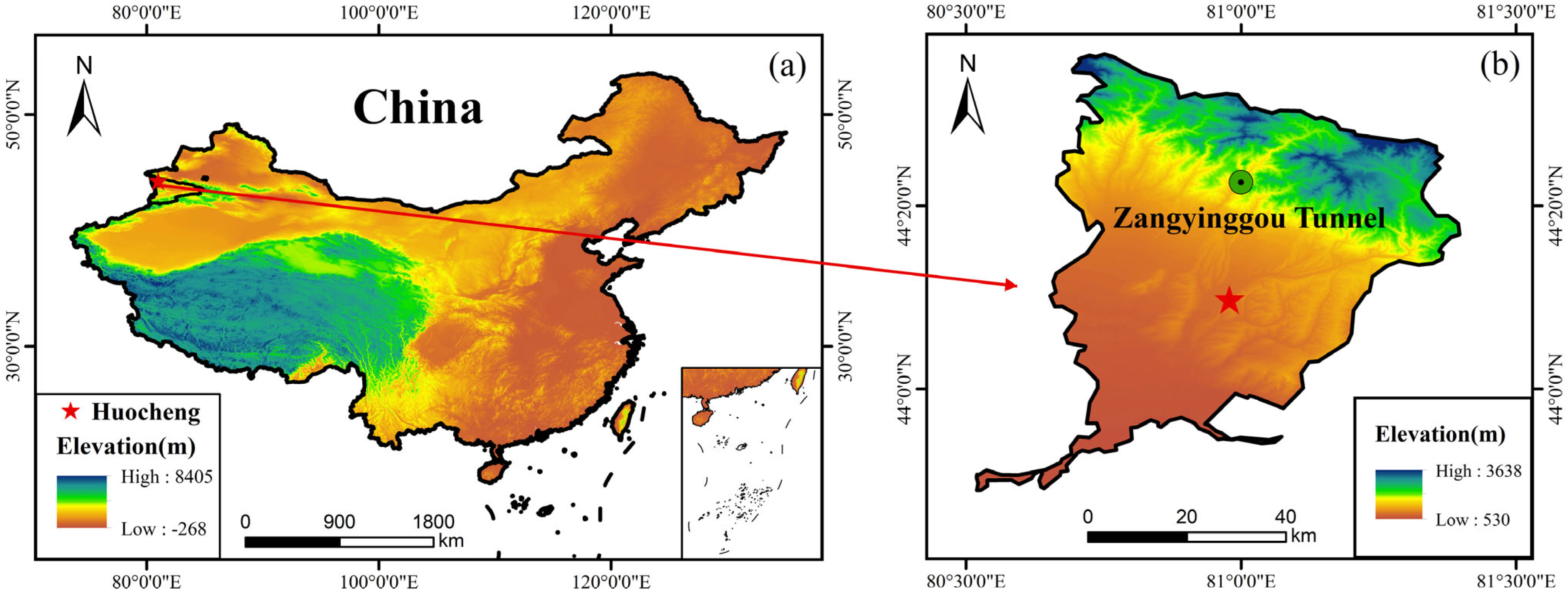
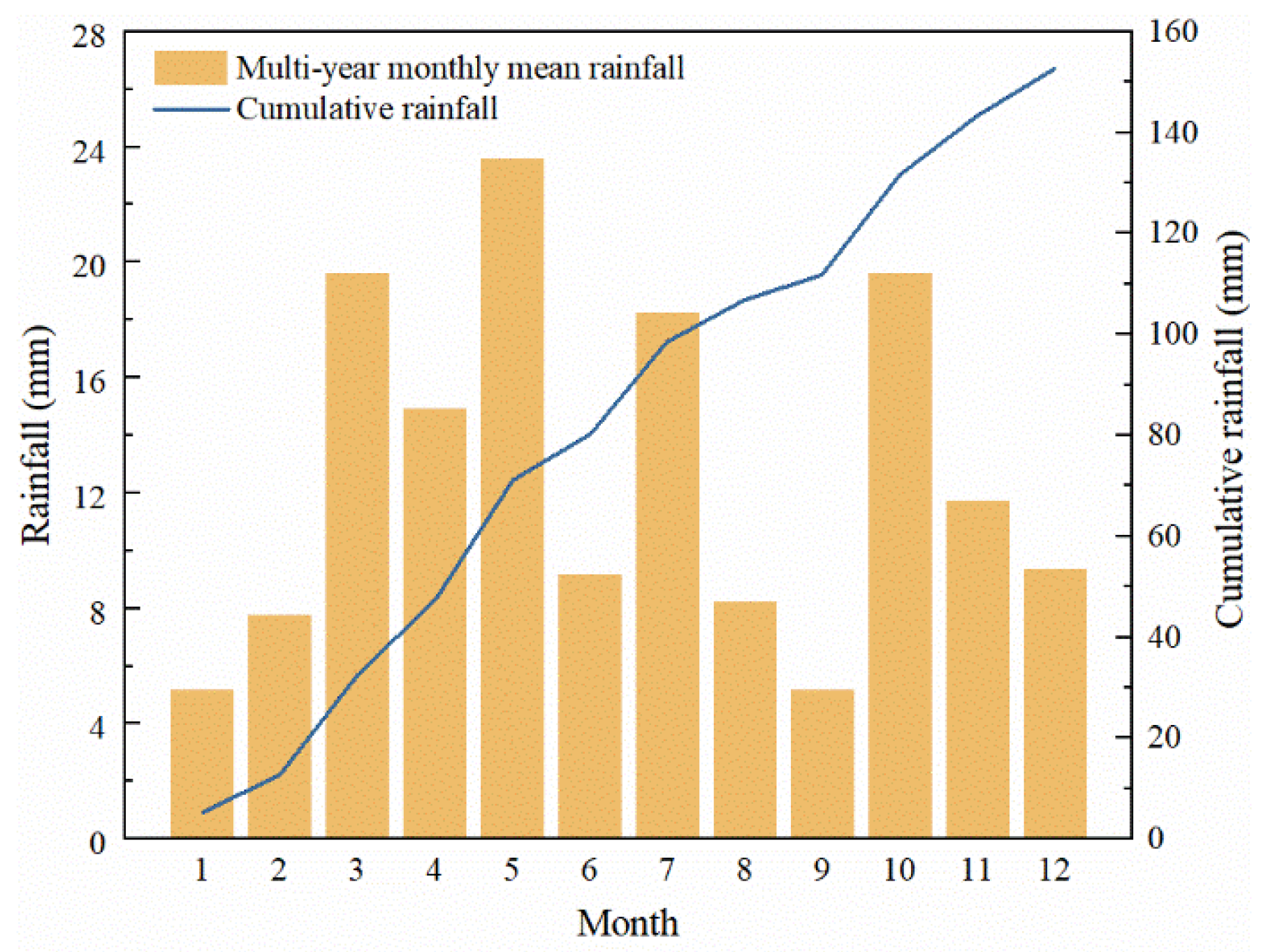
Located in the northwestern part of Ili River Valley in the Xinjiang Uygur Autonomous Region, as shown in Figure 1 (the base map source is NASA SRTM 12.5 m DEM [33] and National Bureau of Surveying, Mapping and Geoinformation 1:250,000 base map [34]), Huocheng County is adjacent to the Tianshan Mountains in the north and the hot-spring counties of the Bortala Mongol Autonomous Prefecture and Bole City. It borders Ili River on the south and Chabchal County across the water, Yining County and Kokdara City on the east, and Horgos City on the west. It is about 120 km long from north to south and 85 km wide from east to west, with a total area of 3184 km2. The northern and northeastern parts of Huocheng County are mountainous and pre-mountainous hills, and the south of the hilly area is a plain, with the terrain sloping from northeast to southwest. The altitude is 530–4283 m. Huocheng County has a continental semiarid climate characterized by more pronounced seasonal changes in terms of precipitation. Rainfall in the area is low, with an average annual precipitation of about 153 mm from 2020 to 2024, and the distribution of precipitation exhibits a certain degree of volatility, as illustrated in Figure 2.
Zangyinggou Tunnel is located north of Huocheng County, China, and the road to which it belongs is the G30 Saiguo Expressway, which consists of sections along the lake, over the ridge, and along the stream. According to the ground investigation report, no geological disaster occurs on the plain on the east shore of Sayram Lake. However, for the highway along the creek section located at the bottom of the valley of Guozigou, the road section is steep and exhibits a relatively significant height difference. In addition, the stratigraphy along the creek section mostly consists of fill soil, rounded gravel soil, conglomerate soil, limestone, conglomerate, and mudstone. Loose accumulations are widely distributed along the highway, and these accumulations can serve as the material basis for the occurrence of various types of disasters. Fast-flowing water in Guozigou is abundant all year round, and the topography and landscape of the area are complicated and extremely unstable. The region’s tectonic movement is strong, providing the material basis and power conditions for the formation and development of all forms of geological disasters. Avalanches, landslides, debris flows, flash floods, earthquakes, and other disasters occur frequently along the route. Among which, debris-flow disasters are the most serious.
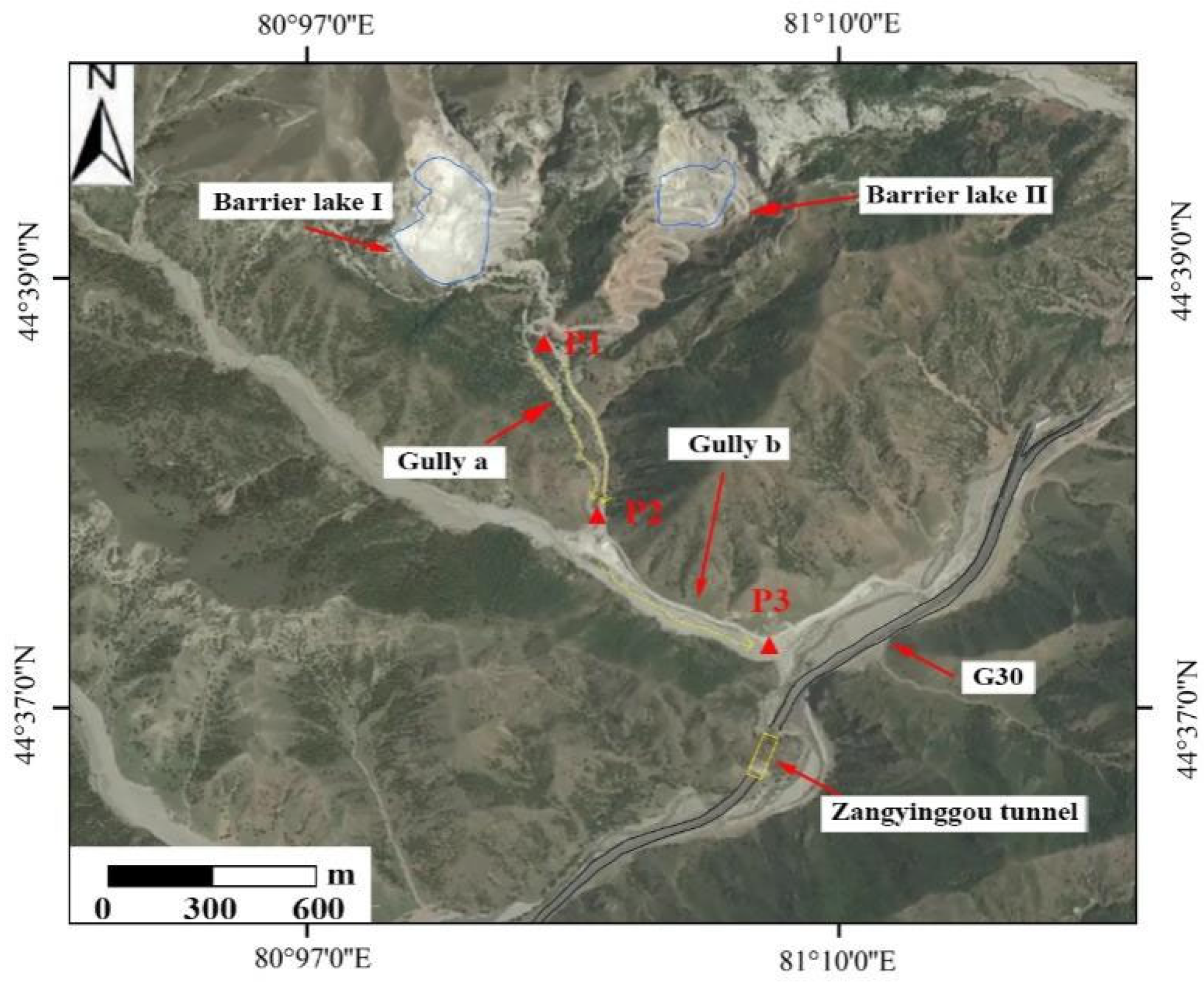
The Zangyinggou Tunnel section is an extremely high-risk area because most of the upstream section of this tunnel has a gradient of about 30°, and the rock body is severely weathered. The upper part of the gully stratigraphy consists of Quaternary alluvial and diluvial gravelly silty clay and boulders, underlain by completely or strongly weathered mudstone and conglomerate. This condition is suitable for the development of debris flows, which are highly likely to occur when influenced by external triggering factors. In addition, two unstable weirs (I and II) are formed by the division of natural ditches in the upstream of Zangyinggou Tunnel. Surface water accumulates after rainfall and snowfall, resulting in abundant water sources in the weir lakes at the elevation (particularly Weir I). Once the riverbed collapses and breaks down, the induced debris flow will seriously threaten the safety of the Zangyinggou Tunnel section. It is one of the influential factors that poses an “extremely high risk”. However, the situation and early-warning countermeasures of the whole movement process of debris-flow occurrence induced by a weir-collapse valley are not yet clear. To address this problem, the two gullies that flowed through after weir collapse were chosen as the basis for this study, and three monitoring points (P1–P3 in Figure 3) were set to investigate changes in the thickness of debris-flow accumulation and flow velocity within the time range that began from the moment of weir collapse to the moment when debris flow hit G30 Saiguo Highway. The monitoring points were arranged at the upstream, midstream, and downstream of the debris-flow gully, as follows: one at the entrance of Trench a (P1) to monitor the mud depth entering Trench a from the weir; one at the intersection of Trenches a and b (P2) to monitor the mud depth as debris flows from Trench a into Trench b; and one at the outlet of Trench b (P3) to monitor the mud depth of the debris flow approaching the G30 Saiguo Expressway and Zangyinggou Tunnel.

3. Data Sources

To obtain accurate topographic data, this study used NASA SRTM DEM data [33] before the weir breach, which have an accuracy of 12.5 m. First, based on the administrative boundary vector data, the spatial coordinate system framework of Huocheng County was established in ArcGIS pro 3.4 software, and data cropping was performed in combination with the county boundary polygons to ensure the spatial consistency of the elevation model and the administrative division. Second, on the basis of the national satellite base map and the location coordinates of Zangyinggou Tunnel, the specific location was determined, cropped, and masked in ArcGIS. Finally, the accurate topographic data required for numerical simulation experiments were obtained.
In addition, in accordance with the information from the ground investigation report, three soil samples were selected in the study area for direct shear tests. Among these, soil sample 1 is an upstream soil sample from the debris flow, with a sampling depth of 15.00–15.20 m. Soil samples 2 and 3 are downstream soil samples from the debris flow, with sampling depths of 1.50–1.70 m and 3.50–3.70 m, respectively. Although the soil properties exhibit variability at the microscopic level due to changes in sampling locations, they collectively represent the soil characteristics of the study area. Through direct shear tests, the cohesion and internal friction angle of the soil samples were determined ( c = 19.0 kPa, φ = 25.6°), and the density parameters of the soil samples were measured through three laboratory tests ( ρ = 17.6 kg/m3). However, the parameters provided in the current ground investigation report do not include other parameters required for the numerical simulation of debris flows, such as the basal friction angle and turbulence coefficient in the Voellmy model. Therefore, according to the previous cases of debris-flow research [35], the range of the basal friction angle is 10–20, while the range of the turbulence coefficient is 200–500. These variables are chosen as input parameters. These parameters are varied with a gradient of 2°, 50 m/s2, and combined into different parameter conditions for simulation. Combining the degree of spatial matching of the simulation results of the 42 pre-test combinations of parameters and the literature on simulation using depth-integrated method [36,37], the set of parameters ( φ = 14°, ξ = 400) that are closest to the normal operating conditions and have the highest degree of spatial matching to the real space are finally selected for display and analysis. The results from the combination of different numerical simulation parameters will be used later in analyzing and evaluating the three-level warning thresholds as an important basis for various operating conditions.

4. Methodology

4.1. Modeling of Debris-Flow Dynamic Processes

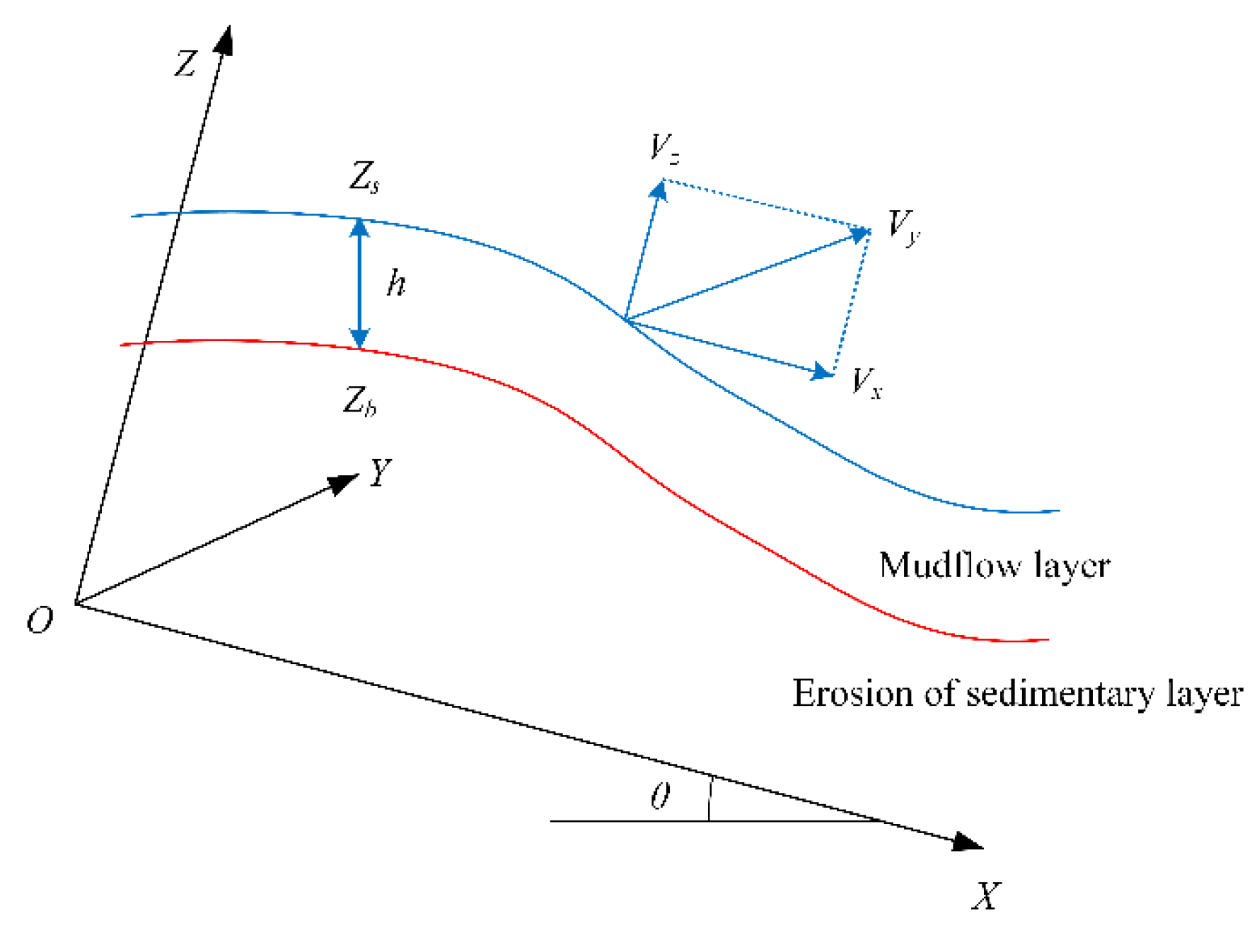
Due to the diverse composition of debris flows and the influence of topography and landforms during their flow, the entire process is complex and uncertain. Therefore, in this study, mud–rock flow is regarded as an incompressible fluid with constant density and viscosity coefficients, and the erosion effect of the fluid on the substrate is not considered. The coordinate system is established in the Cartesian coordinate system, and the debris flow schematic is shown in Figure 4. The X and Y axes are rotated at the angles of θ x and θ y , respectively, and the thickness of the flow layer is h = Z s Z b . V x , V y , and V z represent the fluid velocity components in the directions of the X-, Y-, and Z-axes, respectively.
Before depth integration is performed for the most classical 3D Navier–Stokes equations of fluid dynamics [38,39], deriving the formula for mass conservation, i.e., Equation (1), which must be satisfied for the flow layer, is necessary, along with the momentum conservation equations in the x , y , and z directions, based on the theory of continuous media, i.e., Equations (2)–(4).
ρ t + ρ v x x + ρ v y y + ρ v z z = 0
ρ v x t + ρ v x 2 x + ρ v x v y y + ρ v x v z z = ρ g x + τ x x x + τ y x y + τ z x z
ρ v y t + ρ v x v y x + ρ v y 2 y + ρ v y v z z = ρ g y + τ x y x + τ y y y + τ z y z
ρ v z t + ρ v y v z x + ρ v x v z y + ρ v z 2 z = ρ g z + τ x z x + τ y z y + τ z z z
where ρ denotes fluid density; t denotes time; τ x x , τ y y , and τ z z denote the principal stresses in the x , y , z directions; τ x y ,   τ y x , τ y z , τ z y , τ x z , and τ z x denote the tangential stresses in the x y , y x , y z , z y , x z , and z x directions; v x , v y , and v z denote the components of the velocity vectors in the x , y , and z axes; and g x , g y , and g z denote the components of gravitational acceleration in the x , y , and z directions, respectively.
As the fluid moves to the boundary, it must also satisfy the boundary conditions. Therefore, by substituting the base material, the upper and lower boundaries of the flow layer should satisfy Equations (5) and (6), as follows:
z s t + ν x s z s x + ν y s z s y ν z s = 0
z b t + ν x b z b x + ν y b z b y ν z b = 0
The boundary conditions must also be satisfied when the fluid moves to the boundary. Therefore, by substituting the base material, the upper and lower boundaries of the flow layer should satisfy Equations (5) and (6), respectively, where ν x s , ν y s , and ν z s denote the velocity components in the x , y , and z directions on the flow surface Z s of the debris flow, respectively; and ν x b , ν y b , and ν z b denote the velocity components in the x , y , and z directions on the base boundary Z b , respectively.
The Voellmy model is based on the Mohr–Coulomb criterion, which primarily considers the effect of the turbulence term added during the motion on the basal friction. Its expression is as follows:
τ b = ρ g h t a n φ + ρ g ν 2 ξ
where φ is the basal friction angle, and ξ is the turbulence coefficient.

4.2. Simplification of Control Equations

To quantitatively predict the dynamic process of the Zangyinggou weir breach and analyze the distribution of debris-flow depth and velocity during the process, the depth-integrated continuum method is adopted. Assuming the debris flow as an incompressible fluid with constant density, the 3D fluid mass and momentum conservation equations are simplified to 2D shallow water wave equations after depth-averaging [40,41], as follows:
h t + h v ¯ x x + h v ¯ y y = 0
h ν ¯ x t + h ν ¯ x 2 + k a p g z h 2 / 2 ) x + h ν ¯ x ν ¯ y y = g x h k a p g z h Z b x τ z x b ρ ¯
h ν ¯ y t + h ν ¯ x ν ¯ y x + h ν ¯ y 2 + k a p g z h 2 / 2 ) y = g y h k a p g z h Z b y τ z y b ρ ¯
where h represents the flow height, ρ is the average density of the landslide, u and v are flow velocity in the x and y directions, respectively, τ z x b and τ z y b are basal resistance components, and k a p is the lateral earth pressure coefficient. The value of k a p depends on the strain rate of the moving material columns. It is defined as follows [42]:
k a p = k a c t i v e u / x + v / y > ε 1 | u / x + v / y | ε k p a s s i v e u / x + v / y < ε
where ε is a small value used as a threshold to avoid machine precision errors. k a c t i v e and k p a s s i v e represent the lateral earth pressure coefficients in the active elongation and passive compression, respectively. They are defined as follows:
k a c t i v e k p a s s i v e = 2 c o s 2 φ × 1 1 1 + t a n 2 δ c o s 2 φ 1
where φ and δ are the internal and basal friction angles of the flow material, respectively. The integrated mass conservation equation and momentum conservation equation are written in the following vector form:
X t + F x + G y = S + T
where the vectors X , F , G , S , and T are represented as follows:
X = h h v ¯ x h v ¯ y ,   F = h v ¯ x β v x v x h v ¯ x v ¯ x + k a p g z h 2 2 β v x v y h v ¯ x v ¯ y ,   G = h v ¯ y β v x v y h v ¯ x v ¯ y β v y v y h v ¯ y v ¯ y + k a p g z h 2 2 , S = 0 g x h k a p g h z b x τ z x b ρ 0 ,   T = 0 0 g y h k a p g h z b y τ z y b ρ .

4.3. Solution Algorithm

4.3.1. MacCormack–TVD Finite Difference Computation Algorithm

The numerical solution of the equations governing the mechanics of a continuous medium for the generalized depth integrals of this study is in the MacCormack–TVD finite-difference format with second-order accuracy in time and space, and the programming language is Fortran [13]. The vector form of Equation (13) is solved by splitting it into two operators of one dimension using the operator splitting technique, as follows:
X t + F x = S , X t + G y = T .

4.3.2. Adaptive Algorithms and Mesh Redistribution Algorithms

The advancement of the unknowns of the system of equations in time is performed using a Strang-type-operator splitting technique, which can be expressed in the following form:
X i , j n + 1 = L x 2 Δ t 2 L y 2 Δ t 2 L y 1 Δ t 2 L x 1 Δ t 2 X i , j n
where L x and L y represent one prediction-correction-averaging computational step in the x and y directions, respectively, and each splitting operator needs to be performed twice to get the result of the next moment step. The flux limiter function is φ θ , and the MC limiter is used in this study, which can be written in the following form:
φ θ = m a x 0 , m i n 2 , 2 θ , 1 + θ 2
where θ is a function variable. The Courant number, C r , used to calculate the time step, is defined as follows:
C r = u ¯ + g h Δ t 2 Δ x
In this study, a uniform grid of 10 m was generated using SRTM DEM data processed from ArcGIS pro 3.4 software sourced to 12.5 m accuracy. Considering the strong fluidity of debris flows, open boundaries were adopted as the boundaries for the simulation. When debris flows reach the open boundaries, they can freely flow in or out according to the properties of the open boundaries, and the debris flows will not terminate. The methodology of depth-integrated Navier–Stokes equations combined with MacCormack–TVD finite-difference was independently validated in multiscale study scenarios such as comparisons with analytical solutions, other measured debris flows, and laboratory flumes. The errors were controlled within the engineering acceptable range, so that the model can be used as a reliable basis for simulation of weir-gully debris flows [13,43,44,45].

5. Results

5.1. Zangyinggou Tunnel Weir Failure Prediction

5.1.1. Prediction of Mud Depth Thickness

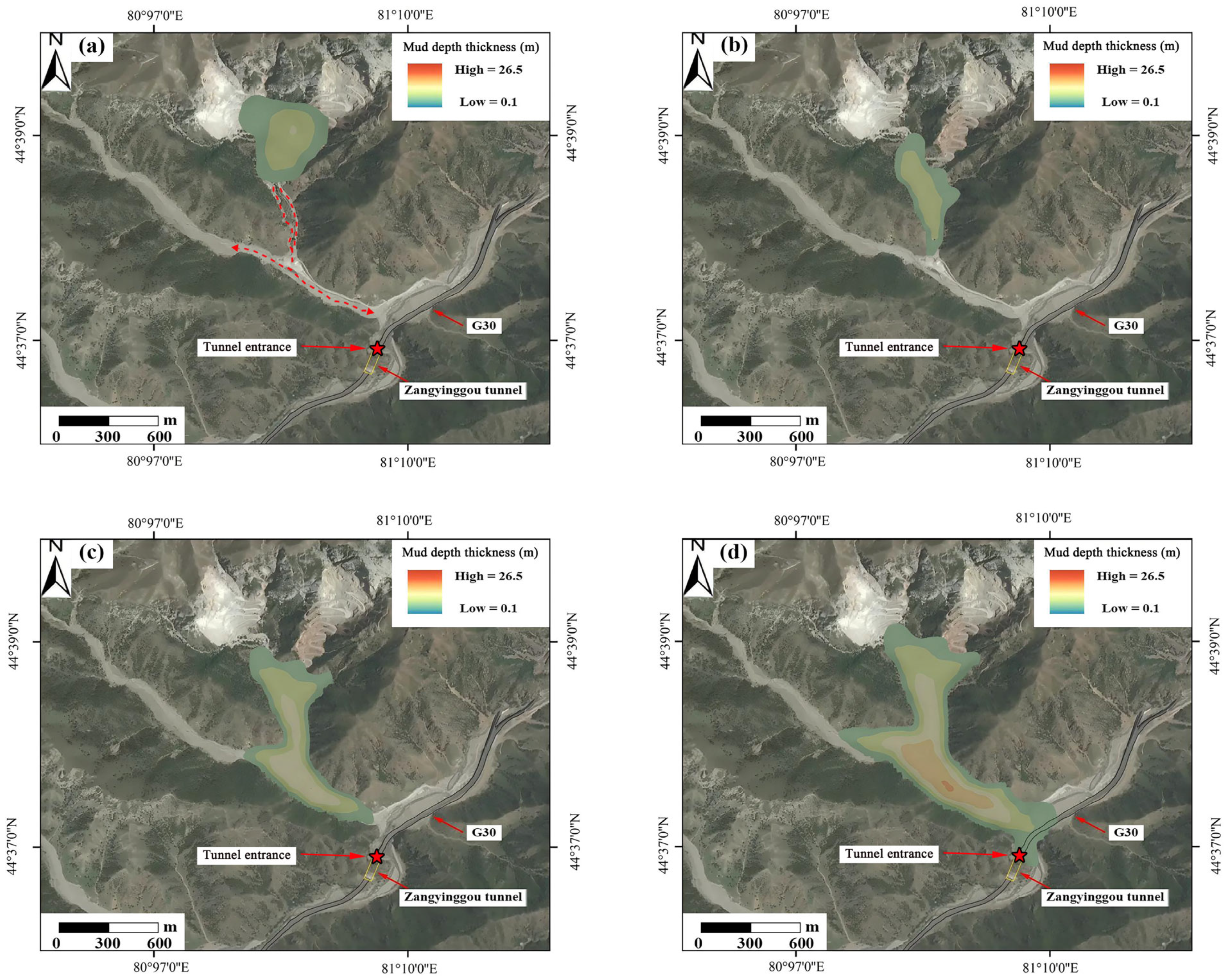
As mentioned above, two potentially debris-flow-prone and hazard-prone unstable weirs are present (Figure 3). To avoid further hazards to roads, vehicles, and tunnels, we use the depth integration method to explore the movement trend and potential impact range of the two unstable massifs. Compared with Weir II, Weir I has a larger overall area and more abundant water conditions, posing a greater threat to roads and tunnels. Figure 5 shows the mud depth thickness accumulation of the debris flow after Weir I collapsed for the whole process that took 4000 s. The mud depth thickness accumulation of the debris flow after the collapse of Weir I is shown in Figure 5. Accumulation was completed within 100 s after the collapse of Weir I, and the leading edge of the debris flow reached P1 by 200 s. The debris flow was in deep thickness at 4000 s after the collapse of Weir I. From 200 s to 1400 s, the debris flow propagated down Channel a. In addition, the debris flow slowly accumulates large amounts of debris in the channel as it propagates down the channel. By 1400 s, the leading edge of the debris flow reached P2. From 1400 s to 3000 s, the debris flow began to spread out along Channel b. However, the debris flow moved further down the channel, and at 3000 s, the leading edge reached P3. At 3000 s, the front of the debris flow reached P3. After 3000 s, the flow started to spread toward the G30 Saiguo Expressway, and at 3560 s, the front of the debris flow reached the highway and blocked traffic. At 4000 s, the debris flow reached the tunnel entrance, where it piled up, posing a serious threat to the safety of vehicles, as depicted in Figure 5d. Then, 4000 s later, the debris flow spread to both sides of the G30 Saiguo Expressway, and the scope of the disaster continued to expand.
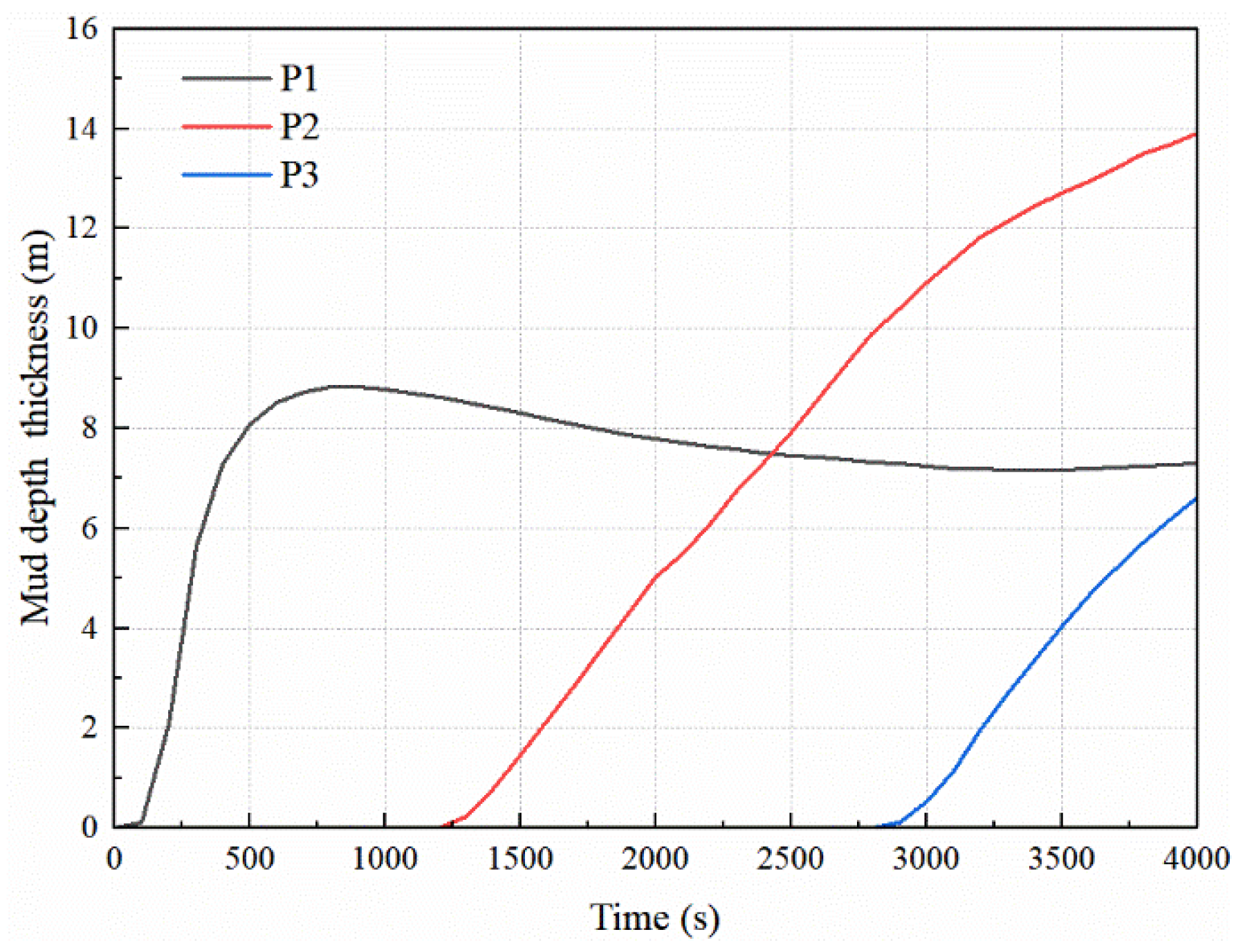
Figure 6 shows the mud depth thickness of debris-flow accumulation at the three monitoring points (P1–P3) as a function of time. P1 is at the entrance of Trench a, which is narrow, and, thus, the debris flow accumulates rapidly before 500 s. Finally, the accumulation thickness reaches the maximum value of 8.83 m. As the debris flow spreads downward, its accumulation thickness at P1 decreases slowly and stabilizes after 800 s. The accumulation thickness of the debris flow at P2 and P3 exhibits a slowly increasing trend after 1200 s and 2900 s, respectively. When the debris flow reaches the entrance of the Zangyinggou Tunnel at 4000 s, the accumulation thickness of the debris flow at P2 and P3 reaches 13.90 m and 6.63 m, respectively. P2 is located at the crossroads of Trenches a and b. That is, more debris flows from Trenches A to B, and finally piles up in Trench B. The results of P2 are the same as those of the numerical simulation of the debris flow at 4000 s, and the accumulation thickness of the mud flow at P2 and P3 reaches 13.90 m. The results of the mud depth accumulation from the numerical simulation of debris flow are consistent, as shown in Figure 5d.

5.1.2. Prediction of Flow Rate

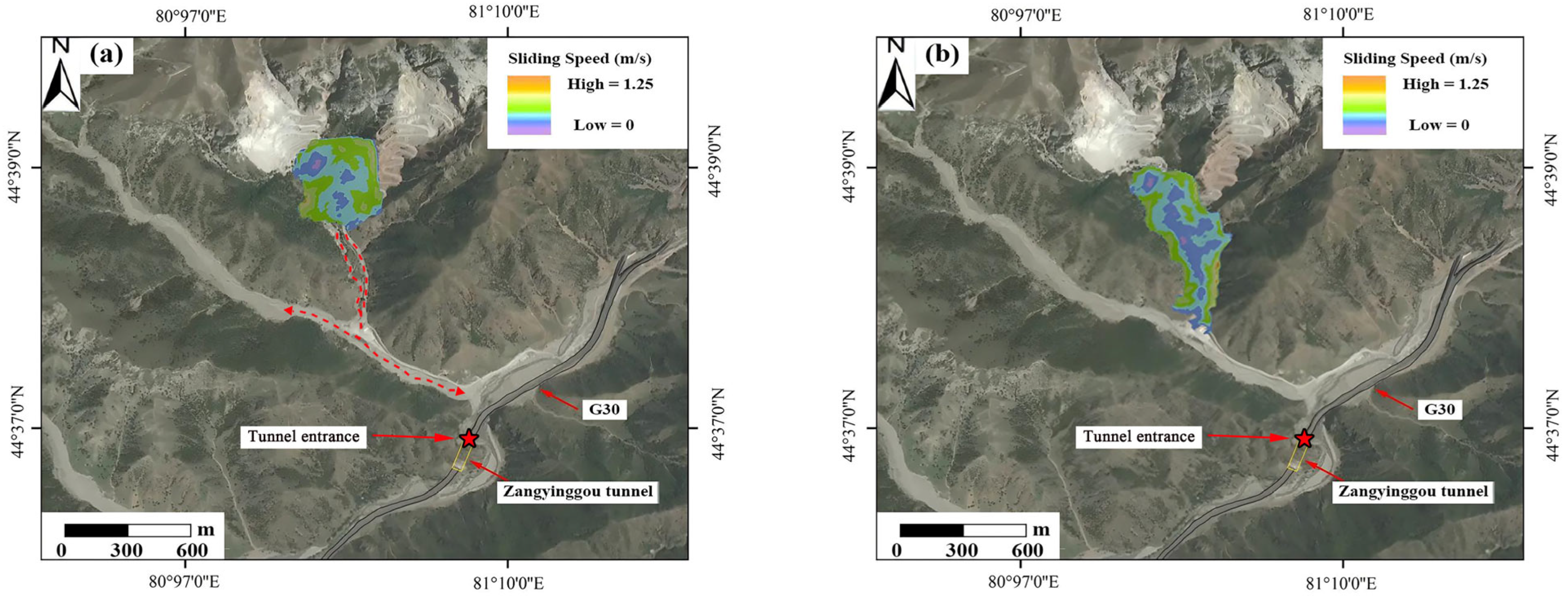
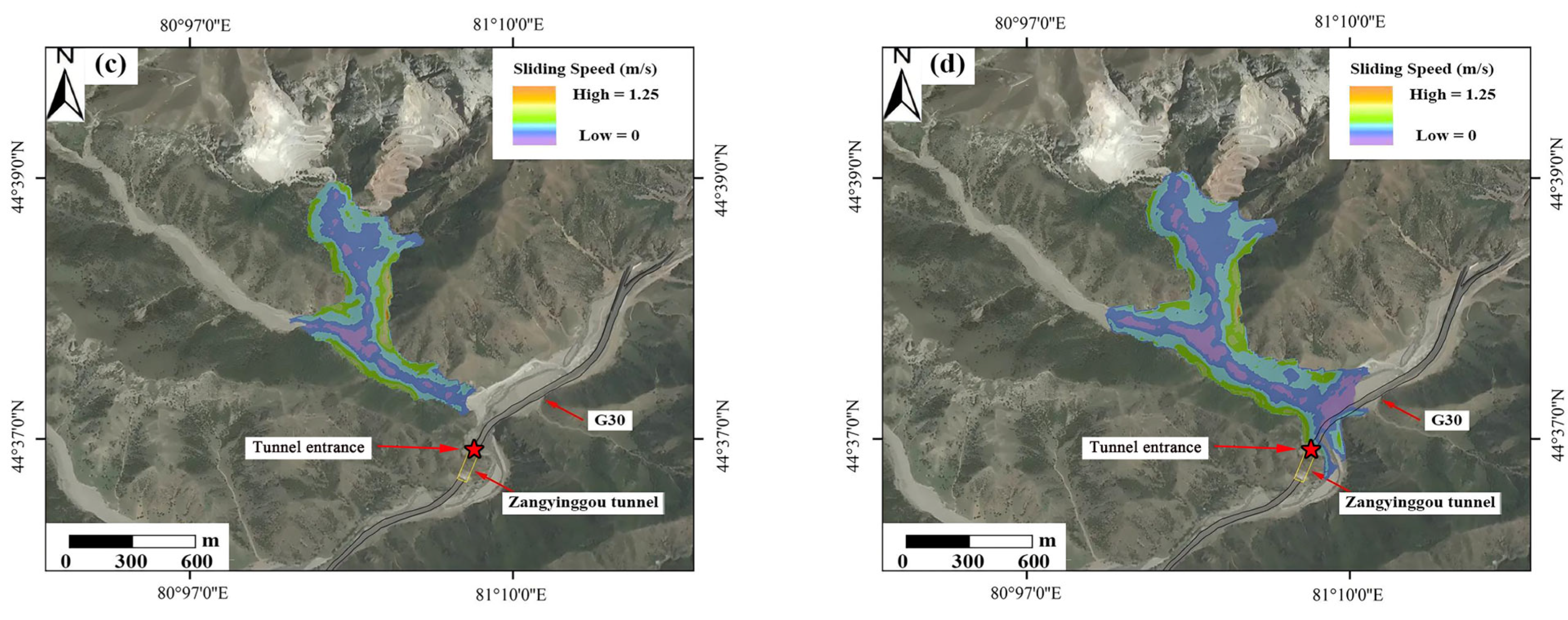
Figure 7 illustrates the movement velocity of the debris flow for the process that takes 4000 s after the collapse of Weir Ⅰ. After 0–200 s, Weir Ⅰ collapsed, the debris flow rapidly piled up, and the trailing edge and both sides moved faster. At 200–1400 s, the debris flow spread downward in Trench a. As shown in Figure 7b, both sides of the debris flow flushed the edge of the trench at a faster speed, and the middle part of the debris flow began to exhibit a decrease in velocity. At 1400–3000 s, the debris flow continued to spread in Trench b. The middle part of the debris flow exhibited a significant decrease in motion velocity, and it started to demonstrate a decrease in motion. The debris flow at the center appeared to move with a significant decrease in velocity and gradually piled up. Compared with that on the debris flow at the center, velocity on both sides of the debris flow was faster and continued to drive the overall debris flow toward the highway. After 4000 s, the debris flow piled up on the highway as a whole, interrupted traffic, and continued to move to both sides, despite its slow movement. Notably, part of the debris flow spread to the Zangyinggou Tunnel, causing the debris flow to pile up and start washing out the entrance of the Zangyinggou Tunnel, further threatening its safety.
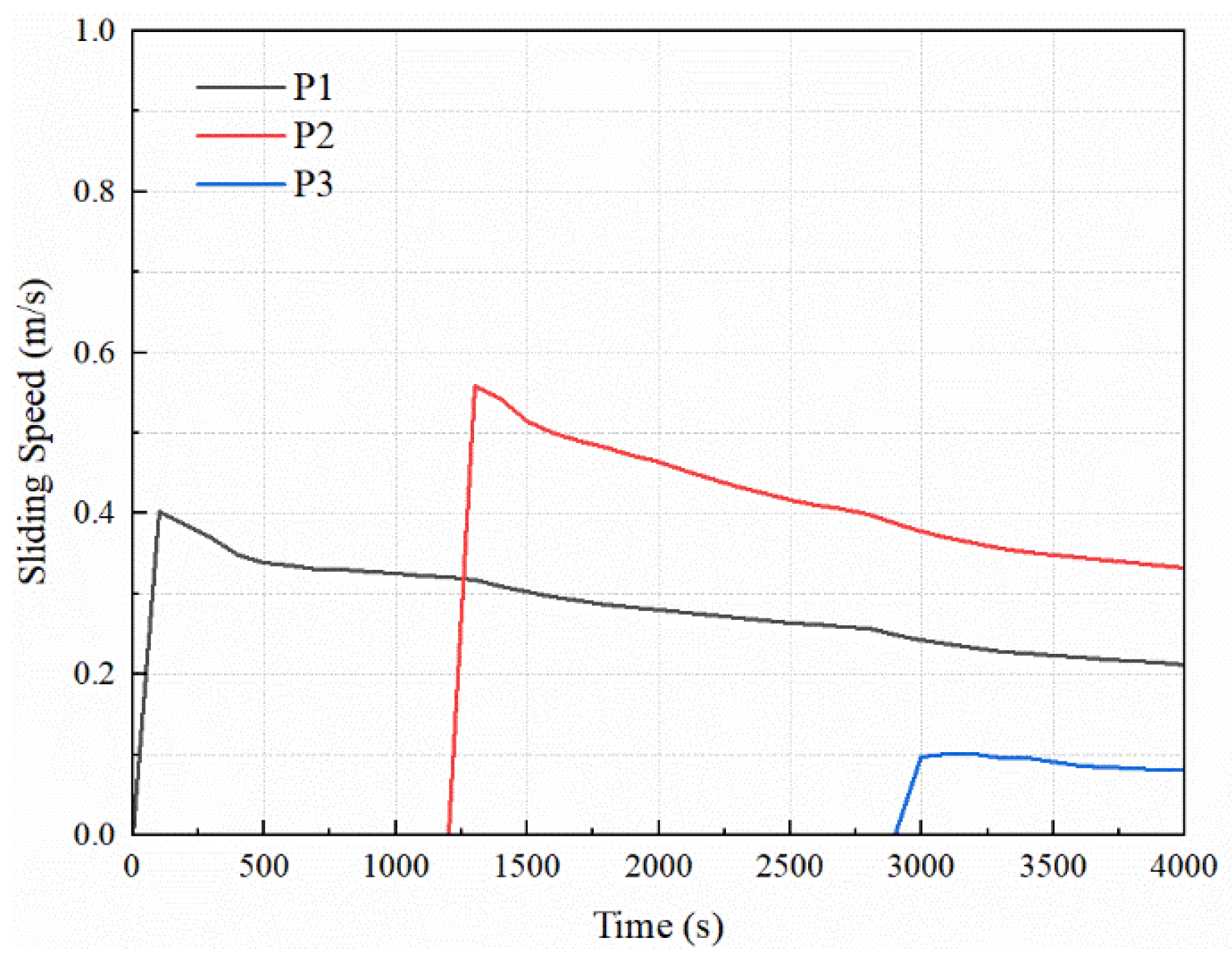
Figure 8 shows the flow velocity changes at the three monitoring points when the debris flow passed through. Overall, the three monitoring points exhibit the trend of a slow decrease in debris flow velocity with time, with debris flow velocity at P2 being the highest at the three monitoring points at 1300–4000 s. The highest velocity reached 0.56 m/s at 1300 s. The debris flow in the process at 0–4000 s and the overall flow velocity show “the slowest in front, the fastest in the middle, while the back is in between,” which is due to the narrower Channel a compared with Channel b. The debris flow in Channel b is fastest in the middle. Compared with Channel b, Channel a is narrower, and the debris flow accumulates more energy, which is converted into kinetic energy. In addition, the flow velocity at the leading edge of the debris flow is faster than that at the middle of the flow. This condition is similar to the results of the flow velocity change during the whole process of the debris flow, as illustrated in Figure 6.

5.1.3. Summary

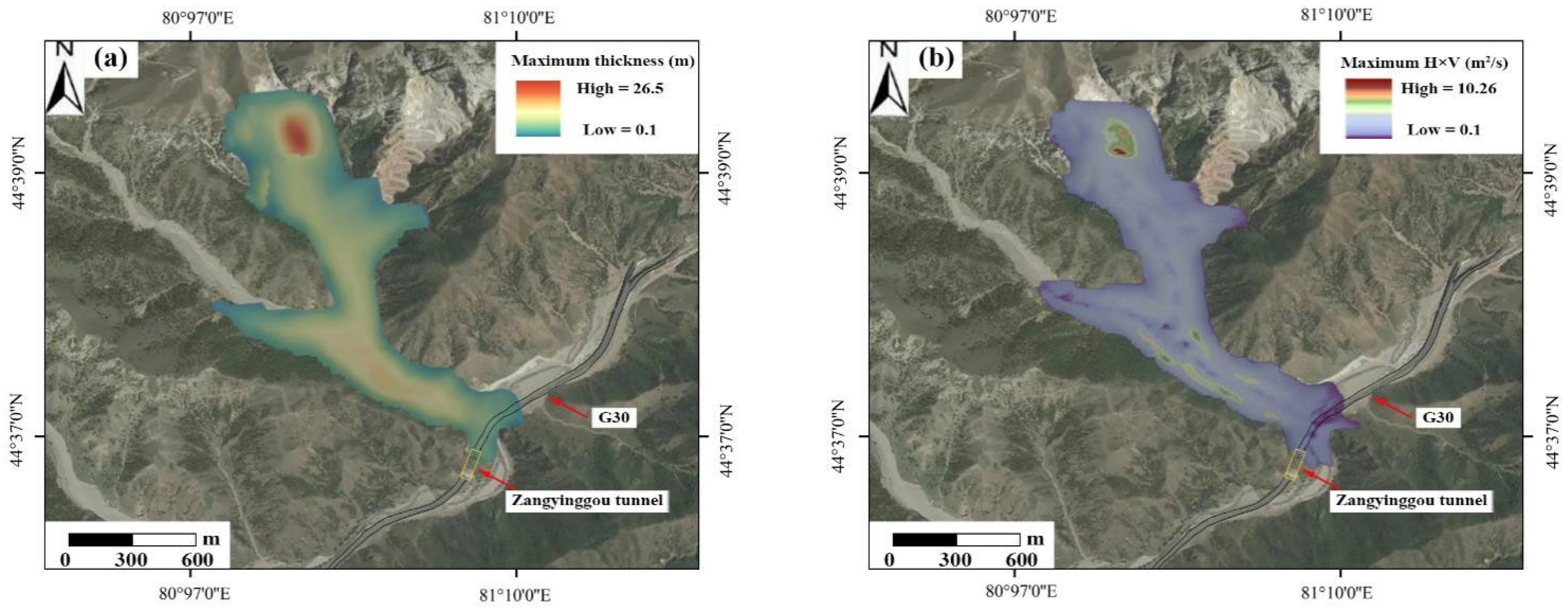
In summary, if the riverbed of Weir I collapses, then the debris flow will move downward along the channel with a large area of 6.3 × 10⁵ m2. The numerical simulation results also show that most of the debris flow will pile up in Channels a and b, particularly in Channel b, and the leading edge of the debris flow will arrive at the G30 Saiguo Highway in about 3560 s after Weir I’s collapses (Figure 9). During the debris-flow movement, the maximum accumulation thickness was 26.5 m (i.e., the initial accumulation thickness), and the thickness (H) × velocity (V) = 10.26 m2/s (H × V is the cross-sectional area swept by the debris flow per unit time). The unstable weir is located at a high level, and its gravitational potential energy is large. Thus, damage is considerable when the weir’s outburst is initiated, and the overall flow rate exhibits a gradually decreasing trend during its movement.

5.2. Kinematic Characteristics of Debris Flow Induced by Weir II’s Collapse

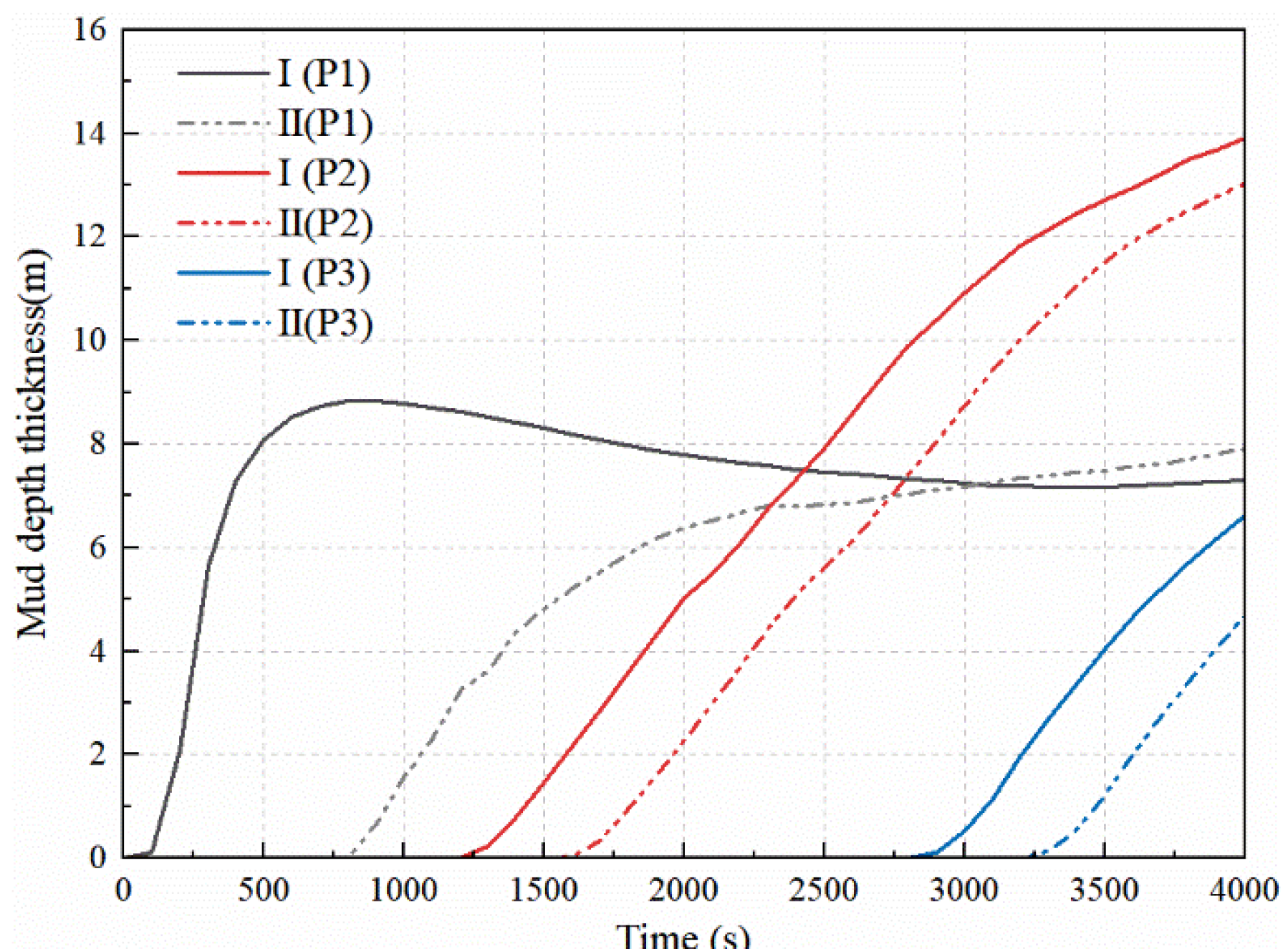
To further compare the motion characteristics of the debris-flow disasters induced by the breaching of Weirs I and II, we set the same debris-flow motion parameters ( φ = 14, ξ = 400) for the breaching of Weir II as those of Weir I and analyzed them through a comparison of the debris-flow accumulation thickness and flow velocity of the three monitoring points. From the monitoring line graph of debris-flow accumulation thickness (Figure 10), the debris flow induced by the collapse of Weir II arrived at P1 at 600 s. The accumulation thickness exhibited a continuously increasing trend, while the debris flow induced by the collapse of Weir I arrived at P1 at 100 s, and the accumulation thickness of the debris flow increased rapidly from 100 s to 500 s. Accumulation thickness reached up to 8.83 m and then demonstrated a decreasing trend. Thereafter, it presented a decreasing trend. The reason for this result is that compared with Weir I, Weir Ⅱ is farther away from P1 (the entrance of Trench a), and the water condition is not abundant, and thus, it takes longer to reach P1, and debris-flow accumulation thickness is slow. For P2 and P3, the debris flow induced by Weirs I’s and II’s outbursts demonstrates the same trend of accumulation thickness, with both continuously increasing. However, the debris flow induced by the outburst of Weir Ⅱ was delayed to a certain extent compared with that induced by the outburst of Weir II due to the difference in water conditions, and delay time was about 400 s. The debris flow induced by the outburst of Weir II was delayed to a certain extent compared with that induced by the outburst of Weir I.
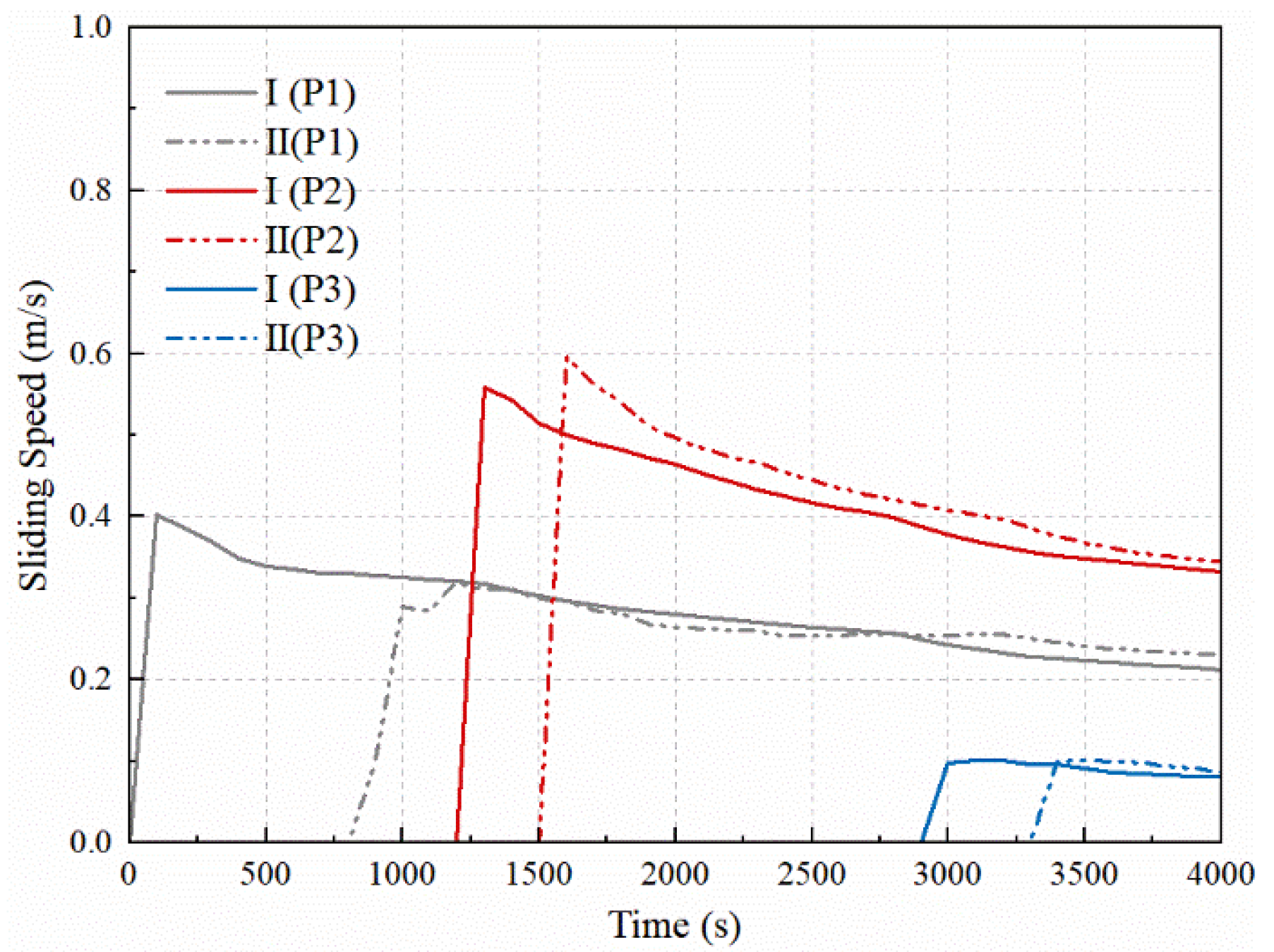
As illustrated from the monitoring line graph of debris-flow velocity (Figure 10), the size and trend of the debris-flow velocity induced by the collapse of Weir II are consistent with those of Weir I within 1200–4000 s. The data from P2 and P3 show that the changing trends of the debris-flow velocity induced by Weirs I and II are the same, but the debris-flow velocity induced by Weir II reaches a peak of 0.60 m/s at 1600 s, which is higher than the peak of the debris-flow velocity induced by Weir I. In addition, the line graphs of the weir and debris-flow accumulation thickness are similar, and the debris flow induced after Weir II’s breaching lags behind the debris flow induced after Weir I’s breaching by about 400 s. The results of the line graphs of weir and debris-flow accumulation thickness are similar.
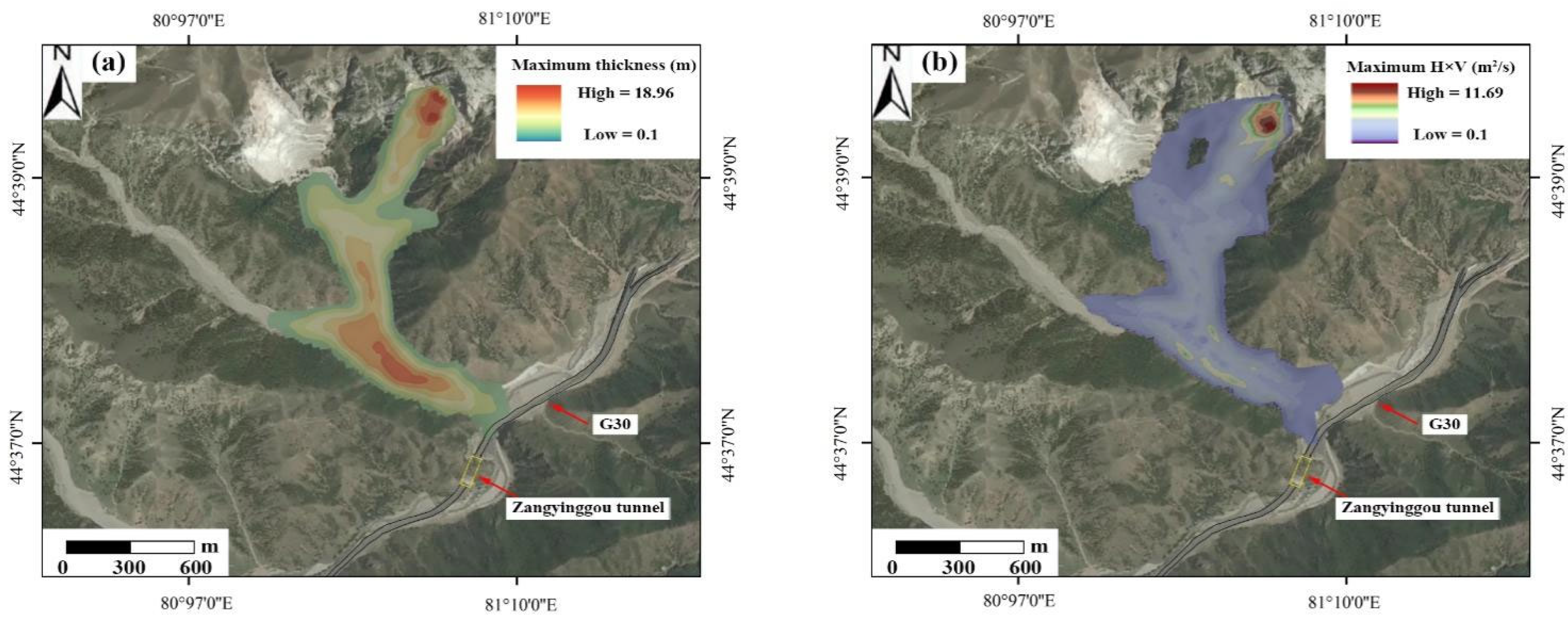
Figure 11 depicts the dynamical processes and potential hazards of debris flows in the unstable Weir II. If the bed of the unstable Weir II collapses, then the induced path of debris-flow movement is similar to that induced by the collapse of Weir I. The leading edge of the debris flow will reach the highway at 4000 s after the collapse. The dynamic process parameters are presented in Figure 12a and Table 2, and the maximum accumulation thickness of the debris flow is 18.96 m. As shown in Figure 12b, the debris flow’s destructive force is more potent at the instant of Weir II’s collapse, and the maximum value of H × V is 11.69 m2/s.
The results of the above analysis show that, in addition to topographic conditions, the location of the weir and water conditions are the key factors that determine the characteristics of debris-flow movement. Among them, the complex topographic conditions of the weir and the extended distance from the entrance of the ditch will prolong the time for the debris flow to reach the G30 Saiguo Expressway and the entrance of the tunnel. The abundant water conditions will rapidly increase the speed of the debris flow accumulating in the ditch. In particular, the debris flow accumulates more thickly at the entrance of the ditch. The preceding analysis and results provide a good reference for exploring subsequent warning strategies.

5.3. Early-Warning Thresholds Based on Debris-Flow Mud Levels

Debris-flow ditches can be divided into the formation, circulation, and accumulation areas. Based on the characteristics of debris-flow movement and disaster prevention requirements, mud level meters are generally arranged in the circulation area, which can monitor the mud level changes in the formed debris-flow movement in the ditch at a timely manner, i.e., when the mud level reaches the early warning before the debris flow rushes out of the ditch and causes harm. From the above results, the debris flow induced by the Zangyinggou weir failure has an extensive influence range. Once it occurs, the debris-flow accumulation thickness is extensive, which will cause severe damage to the highway and vehicles. However, the results of the numerical simulation show that the overall flow velocity of the debris flow propagation is slow, taking 4000 s from the occurrence of the weir breach to the edge of the highway. In addition, the debris-flow accumulation thickness does not differ considerably from the flow velocity data in accordance with the results of the debris-flow impact tests with 42 different parameter combinations. Therefore, we set up three mud level meter monitoring locations in the debris-flow circulation area and selected the instantaneous accumulation mud depth with the fastest elevation rate under normal working conditions ( φ = 14, ξ = 400) in the numerical simulation results as the upper warning limit and multiplied the upper warning limit mud depths of P1, P2, and P3 by 75%, 50%, and 25%, respectively, as the lower warning limit mud depths. The three-level warning threshold results are provided in Table 3.
Therefore, in combination with the above discussion, the three-level warning strategy based on the water-level meter monitoring presented in this study is as follows: When the debris flow triggers the No. 1 mud-meter warning (Level 1 warning), with the drone and video surveillance measures to determine the occurrence of debris flows, vehicle traffic is reduced, and thus, traffic on the road section is channelized. When the debris flow triggers the No. 2 mud-gauge warning (Level 2 warning), the inevitable occurrence of a debris-flow disaster is confirmed, and the road section is closed to prevent vehicles from entering. When the debris flow triggers the No. 3 mud-gauge alert (Level 3 warning), the debris flow is about to reach the highway, and the highway is not evacuated for emergency, waiting for rescue and desilting work to be performed.

6. Discussion

6.1. Influences of the Rheological Parameters of Debris Flows

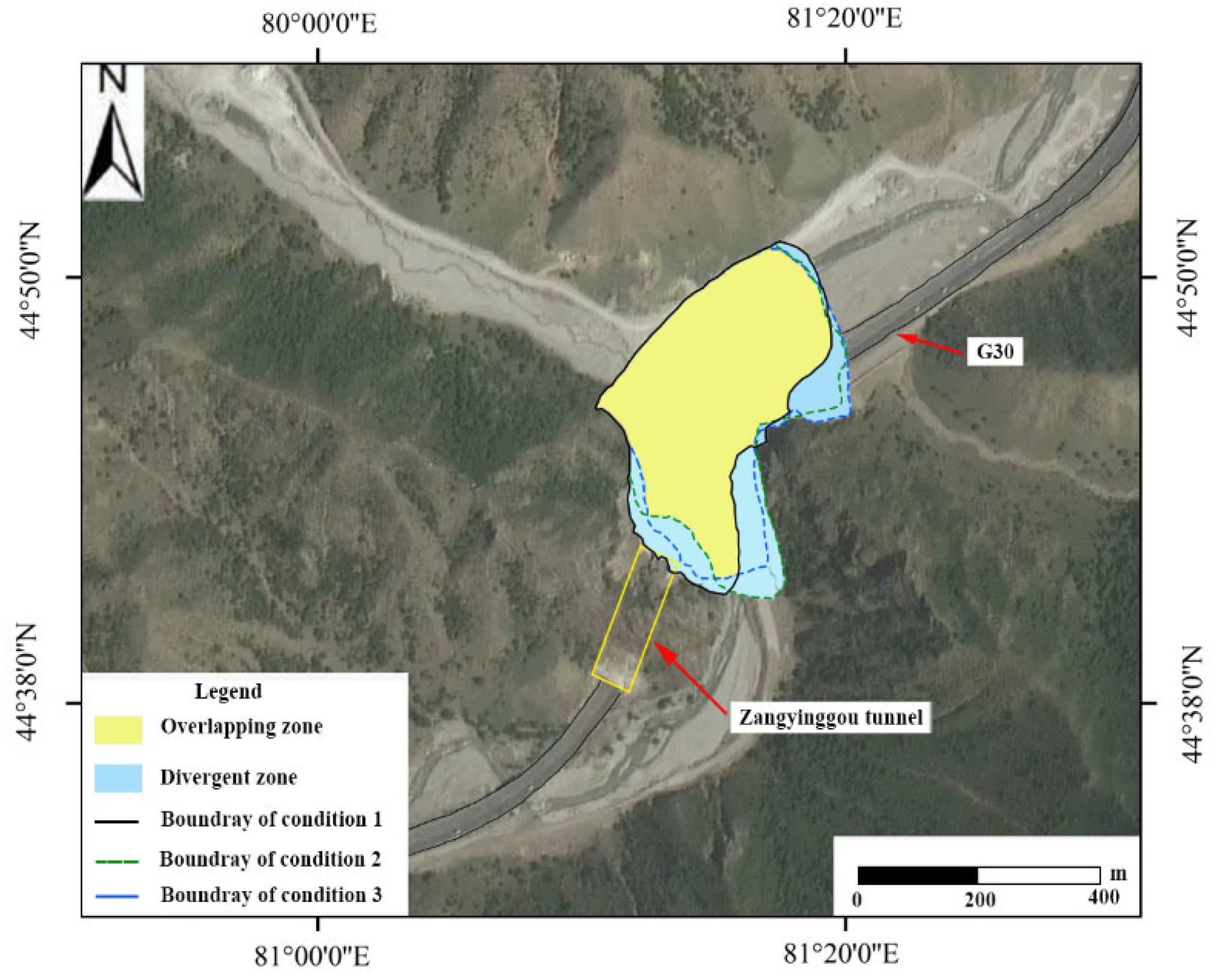
To further investigate the different effects of the rheological parameters on the results of the numerical simulation, we added two groups of special conditions for the collapse of Weir I and the original conditions for comparative analysis (e.g., Table 4). The specific parameter settings were as follows: In Condition 1 (initial condition), the parameter values are set to φ = 14 and ξ = 400. In Condition 2, φ increases by 50% compared with that in Condition 1, while the other parameters remain unchanged. In Condition 3, ξ increases by 50% compared with that in Condition 1, while the rest of the parameters remain unchanged. In Condition 2, φ is increased by 50% compared with that in Condition 1, while the remaining parameters are unchanged. In Condition 3, ξ is increased by 50% compared with that in Condition 1, and the rest of the parameters remain unchanged. A comparison of the simulation results is presented in Figure 13, which shows that, overall, the accumulation (diffusion) extent of the debris flow varies less when the time is 4000 s. A larger φ (21 instead of 14) does not limit the debris flow from spreading well, while a larger ξ value (600 instead of 400) does not exhibit a significant change trend, although it increases the debris flow extent. In addition, the accumulation mud depth and flow velocity results over time at the three monitoring sites are consistent. The above results confirm that the debris flow induced by the failure of Zangyinggou Weir I is influenced by topographic factors, such as channel and slope.
Second, the basal friction angle and the turbulence coefficient affect the dynamic characteristics of debris flows and high-speed remote landslides at varying degrees. A large basal friction angle produces a large and fast energy dissipation process through an increase in the drag term, resulting in an overall lag of the motion process and a slight reduction in the size of the debris flow. Meanwhile, a high turbulence coefficient will cause the turbulence term to increase significantly, raising the momentum exchange intensity between the fluid layers. It exhibits a high ability to mix with the surrounding bounding mass, increase the coiling and sucking effect on the surrounding medium, and increase movement speed and volume. Accordingly, the scale of the debris flow is slightly increased. This result is the same as that of the analysis in a previous debris-flow research case, proving our experiment’s reliability from another angle [43].

6.2. Methodological Framework and Limitations

In this study, high-resolution DEM data and depth-integrated modeling were combined to simulate the complete process of instability and flow evolution in gully-type debris flows triggered by weir breaching. The simulations reveal that debris-flow velocity increases markedly in narrow gullies but declines as the channel widens and approaches the road, whereas the deposit thickness displays the opposite trend. This behavior is consistent with previous debris-flow studies [46,47], confirming that topographic gradient is a dominant control on flow dynamics in weir-breach debris-flow disasters. Yet, despite the relatively long travel times and low velocities observed, the risk to transportation infrastructure remains high, underscoring the complex interplay between Xinjiang’s rugged terrain and the vulnerability of engineered structures [13].
In this study, the MacCormack–TVD finite difference method was used to process the deep integration model [13]. The MacCormack–TVD finite difference method includes adaptive mesh refinement, which ensures a balance between terrain detail and numerical stability. Since the control equations retain only two-dimensional planar variables after depth integration, vertical details are eliminated through integration, naturally reducing sensitivity to DEM grid resolution. A TVD limiter (MC limiter) is employed to suppress high-frequency oscillatory noise. Although the above methods have improved the stability of single data source models to some extent, further exploration is needed as to whether they can be used with raster data from other images to extract attributes. The use of data fusion or data enhancement processes can reduce the noise to a certain extent, making it suitable for situations involving the integration of gridded data from multiple sources of remote sensing [48,49].
Preliminary modeling results indicate that the runout length of channelized debris flows triggered by weir breaching far exceeds their deposit thickness, validating the simplification of the vertical momentum equation to a hydrostatic pressure distribution. Additionally, the slow-moving nature of these flows reduces the influence of erosion–deposition coupling on simulation outcomes [50]. These findings support the use of a single-phase flow assumption at the macro scale, treating the debris flow as an “equivalent fluid” with constant density. Consequently, this study adopts an incompressible, constant-density equivalent fluid to simplify the Navier–Stokes equations and enable efficient numerical modeling of basic flow behavior. However, it is important to note that real debris flows are mixtures of sediment particles and water of varying sizes. As the flow moves through narrow channels, the water layer erodes the bed and deposits material along the path, causing the bulk density to vary. Therefore, the constant-density assumption may neglect volume growth and momentum enhancement due to erosion, potentially overestimating flow resistance and underestimating runout distance. Building on these preliminary findings, future work will incorporate pore-water pressure diffusion [51] and erosion terms [13] to more accurately assess the dynamics of weir-outburst debris flows at the micro scale.

6.3. Debris-Flow Early-Warning System and Strategies Based on Multiple Monitoring Methods

Different regions and types of debris flows exhibit distinct characteristics; therefore, conducting region-specific adaptability studies is essential for improving the universality and applicability of early-warning strategies. However, due to harsh field conditions—such as steep gullies and high relief—and the wide spatial variability of terrain, developing a universally reliable warning scheme is difficult. Numerical simulations show that debris-flow events following weir breaching along the G30 Zangyinggou reach in Xinjiang are characterized by long travel distances and extended arrival times at the highway. Traditional monitoring systems (e.g., piezometers) can be effective for local debris-flow surveillance, yet extremely rapid and destructive surges triggered by rainfall remain difficult to forecast because they occur with little or no warning [52]. This difficulty stems from threshold biases in conventional warning systems that may fail to capture precursor signals. This study innovatively derives mud-gauge warning thresholds directly from depth-integrated numerical results, offering a new methodological framework. Similar to our proposed three-level warning strategy, Jošt Sodnik et al. combined periodic UAV photogrammetry with hydrometeorological measurements from rain gauges and water-level sensors [53]. This theoretically confirms that a tertiary warning scheme anchored to water-level gauges—supplemented by video surveillance and periodic UAV surveys—will be an effective tool for monitoring and early warning of weir-breach hazards at the Zangyinggou Tunnel in Xinjiang.
The clay sensitivity constitutes one of the geological drivers for initiating debris-flow or landslide events and thus can provide a scientific basis for early warning and disaster mitigation. This concern has been the subject of several studies in terms of monitoring soil-saturation processes in clay–shale hillslopes [54], interpreting the identified landslide using CPTu and clay sensitivity [55,56], delineating soil layers in 3D at 1 m intervals using CPTu-based clay sensitivity to reduce environmental risks [57], and 3D temperature-field modeling framework with high transferability [58]. On the other hand, the depth to bedrock (DTB) is also a critical subsurface parameter controlling landslide initiation. From this point of view, visualizing the DTB models and quantifying the uncertainty in terms of different approaches, like gene expression programming, hybrid ensemble deep-learning frameworks, and multiscale landslide morphological-feature extraction based on LiDAR data, have been used to reveal the morphology of the clay–bedrock contact zone as the potential sliding surface [59,60,61]. These methods have demonstrated high precision, noise resistance, and an automated pathway for the early identification and understanding of landslide mechanisms. As a result, to monitor the sensitive clays and early warning of weir-breach debris flows at the Zangyinggou Tunnel in Xinjiang, integrating CPTu data with machine learning algorithms, 3D modeling, and uncertainty management constitutes a promising direction for improving the accuracy of warnings and tertiary alert systems. Although the current study deals with the role of topographic factors (e.g., gully slope and catchment area) on the movement trajectory of debris-flow movement, considering solutions for unifying and standardizing dynamic databases through various factors was beyond the scope of the carried out research plan due to the limitations of the dataset. As a result, the future work can be lied in conducting normalization of large-scale data including temporal data (e.g., groundwater or seasonal factors) and deep integration models in order to better improve our early-warning strategy [56,58,59].

7. Conclusions

In this study, the weir at the tunnel section of Zangyinggou on the G30 Saiguo Expressway in Xinjiang Province, China, was used as a project to research the movement process, impact factors, and early-warning strategies for highly remote weir-gully debris flows. Based on the DEM data obtained from the ground investigation report and the open website, 42 numerical simulation tests were conducted for Weirs I and II, divided by the natural gully using the depth integral method. The group of test results that is closest to the normal working conditions and exhibits the highest degree of spatial matching was selected and analyzed. Finally, the mud-level warning thresholds based on a mud-level meter were summarized based on the numerical simulation results, and the three-level warning strategy was discussed.
The results of the numerical simulation show that Weirs I and II take 3560 s and 4000 s to impact on the highway (from breaching to impact), and the maximum accumulation thicknesses of the debris-flow source area are 26.5 m and 18.96 m, respectively, while the total areas covered by the debris flow reach 6.30 × 10⁵ m2 and 6.70 × 10⁵ m2, respectively, at 4000 s. The debris flow exhibits strong destructive capacity at the moment of weir breaching and will further wash away the Zangyinggou Tunnel and bury part of the G30 Sai Guo Highway after arriving at the highway. After reaching the highway, the debris flow will further wash away the Zangyinggou Tunnel and pile up mud at its entrance, burying part of the G30 Saiguo Highway. In addition, the results of the sensitivity analysis show that the topography (e.g., channel, slope and location of the weir) and water conditions are the key factors that affect the severity of the disaster of the weir-valley debris flow in a highly remote area. Simultaneously, the turbulence coefficient and the base friction coefficient are the secondary factors that affect the weir-valley debris flow in a highly remote area, and an increase in the aforementioned parameters will cause the debris flow to increase and decrease in magnitude, respectively.
Installing mud gauges at the entrances and exits of the two gullies through which the Zangyinggou Tunnel weir-valley debris flow must pass is an effective early-warning measure for dealing with this potential disaster when the debris flow triggers the first mud-gauge warning (Level 1 warning), with drone and video surveillance measures, to determine the occurrence of debris flows, reducing vehicle traffic, and, consequently, ease traffic on the roadway. When the debris flow triggers mud-level gauge warning No. 2 (Level 2 warning), we will confirm the inevitable occurrence of a debris-flow disaster and close the roadway to prevent vehicles from entering. When the debris flow triggers the No. 3 mud-gauge warning (Level 3 warning), the debris flow is about to reach the highway, and the highway has not been evacuated for emergency shelter, waiting for rescue and dredging work to be performed. In future studies, further research will continue to focus on the two-weir coordinated collapse, extreme conditions (e.g., heavy rainfalls, snowstorms, and earthquakes) under the debris-flow early-warning strategy to comprehensively improve the disaster emergency-response system and minimize the risk of hazards of the debris flow in the Zangyinggou Tunnel.

Author Contributions

Conceptualization, X.D. and X.S.; methodology, X.S. and Z.Z.; formal analysis, X.D., X.S., Z.Z. and D.H.; investigation, X.S., Z.Z., Y.M. and M.M.; resources, X.D.; data curation, X.S., Y.M. and M.M.; writing—original draft preparation, X.S., F.S. and D.H.; writing—review and editing, X.D., X.S., F.S., D.H. and Z.Z.; supervision, X.D. All authors have read and agreed to the published version of the manuscript.

Funding

This research is one part of the phase results of the Xinjiang Key R&D Program Projects (grant number: 2022B03033-1), the Xinjiang Uygur Autonomous Region “Dr. Tianchi” Project, and the general project of the National Innovation Training Program of Xinjiang University (grant number: 202410755073).

Institutional Review Board Statement

Not applicable.

Informed Consent Statement

Not applicable.

Data Availability Statement

The data are contained within the article.

Conflicts of Interest

The authors declare no conflicts of interest.

References

  1. Sun, Y.; Ge, Y.; Chen, X.; Zeng, L.; Liang, X. Risk assessment of debris flow along the northern line of the Si-chuan-Tibet highway. Geomat. Nat. Haz. Risk. 2023, 14, 1. [Google Scholar] [CrossRef]
  2. Ali, S.; Haider, R.; Abbas, W.; Basharat, M.; Reicherter, K. Empirical assessment of rockfall and debris flow risk along the Karakoram Highway, Pa-kistan. Nat. Hazards. 2021, 106, 2437–2460. [Google Scholar] [CrossRef]
  3. Qing, F.; Zhao, Y.; Meng, X.; Su, X.; Qi, T.; Yue, D. Application of Machine Learning to Debris Flow Susceptibility Mapping along the China–Pakistan Karakoram Highway. Remote Sens. 2020, 12, 2933. [Google Scholar] [CrossRef]
  4. Du, Y.; Liu, H.; Li, H.; Xie, M.; Chicas, S.; Wu, J.; Lv, F.; Wu, Y. Exploring the initiating mechanism, monitoring equipment and warning indicators of gully-type debris flow for disaster reduction: A review. Nat. Hazards 2024, 120, 13667–13692. [Google Scholar] [CrossRef]
  5. Han, X.; Yin, Y.; Wu, Y.; Wu, S. Risk assessment of population loss posed by earthquake-landslide-debris flow disaster chain: A case study in Wenchuan, China. ISPRS Int. J. Geo-Inf. 2021, 10, 363. [Google Scholar] [CrossRef]
  6. Allen, S.K.; Rastner, P.; Arora, M. Lake outburst and debris flow disaster at Kedarnath, June 2013: Hydrometeorological triggering and topographic predisposition. Landslides 2016, 13, 1479–1491. [Google Scholar] [CrossRef]
  7. Yang, H.; Chen, G.; Chong, Y.; Jin, J.; Shi, W. Quantitative Prediction of Outburst Flood Hazard of the Zhouqu "8.8" Debris Flow-Barrier Dam in Western China. Water 2021, 13, 639. [Google Scholar] [CrossRef]
  8. Ning, L.; Hu, K.; Wang, Z.; Luo, H.; Qin, H.; Zhang, X.; Liu, S. Multi-Hazard Chain Reaction Initiated by the 2020 Meilong Debris Flow in the Dadu River, Southwest China. Front. Earth. Sci. 2022, 10, 827438. [Google Scholar] [CrossRef]
  9. Chen, T.; Xu, G.; Hiraishi, T. New Understandings of the Shaziba Landslide-Debris Flow in Hubei Province, China. J. Earth. Sci. 2025, 36, 1632–1649. [Google Scholar] [CrossRef]
  10. Meng, Z.; Lyu, L.; Xu, M.; Yu, G.; Ma, C.; Wang, Z.; Stoffel, M. Effects of Frequent Debris Flows on Barrier Lake Formation, Sedimentation and Vegetation Disturbance, Palongzangbo River, Tibetan Plateau. Catena 2023, 220, 106697. [Google Scholar] [CrossRef]
  11. Nam, D.H.; Kim, M.; Kang, D.H.; Kim, B.S. Debris Flow Damage Assessment by Considering Debris Flow Direction and Direction Angle of Structure in South Korea. Water 2019, 11, 328. [Google Scholar] [CrossRef]
  12. Matthias, J.; Friele, P.A. Frequency and magnitude of debris flows on Cheekye River, British Columbia. Geomorphology 2010, 114, 382–395. [Google Scholar] [CrossRef]
  13. Ouyang, C.J.; He, S.M.; Xu, Q.; Luo, Y.; Zhang, W.C. A MacCormack-TVD Finite Difference Method to Simulate the Mass Flow in Mountainous Terrain With Variable Computational Domain. Comput. Geosci. 2013, 52, 1–10. [Google Scholar] [CrossRef]
  14. Pastor, M.; Tayyebi, S.M.; Stickle, M.M.; Yague, A.; Molinos, M.; Navas, P.; Manzanal, D. A Depth-Integrated, Coupled, Two-Phase Model for Debris Flow Propagation. Acta Geotech. 2021, 16, 2409–2433. [Google Scholar] [CrossRef]
  15. Yu, P.C.; Peng, X.Y.; Chen, G.Q.; Fu, H.Y.; Zhang, Y.B.; Han, Z.; Zhang, H. A New Coupled Depth-Integrated Model Incorporating 3D DDA on Debris Flow With Large Boulders. Int. J. Rock. Mech. Min. Sci. 2023, 170, 105496. [Google Scholar] [CrossRef]
  16. Zhang, N.; Matsushima, T. Simulation of Rainfall-Induced Debris Flow Considering Material Entrainment. Eng. Geol. 2016, 214, 107–115. [Google Scholar] [CrossRef]
  17. Tayyebi, S.M.; Pastor, M.; Hernandez, A.; Gao, L.; Stickle, M.M.; Yifru, A.L.; Thakur, V. Two-Phase Two-Layer Depth-Integrated SPH-FD Model: Application to Lahars and Debris Flows. Land 2022, 11, 1629. [Google Scholar] [CrossRef]
  18. Li, M.L.; Jiang, Y.J.; Yang, T. Early Warning Model for Slope Debris Flow Initiation. J. Mt. Sci. 2018, 15, 1342–1353. [Google Scholar] [CrossRef]
  19. Wang, X.; Wang, C.; Zhang, C. Early Warning of Debris Flow Using Optimized Self-Organizing Feature Mapping Network. Water 2020, 20, 2455–2470. [Google Scholar] [CrossRef]
  20. Li, J.; Tanoli, J.I.; Zhou, M.; Gurkalo, F. Monitoring and Early Warning Method of Debris Flow Expansion Behavior Based on Improved Genetic Algorithm and Bayesian Network. Water 2024, 16, 908. [Google Scholar] [CrossRef]
  21. Liu, K.F.; Wei, S.C. Real-Time Debris Flow Monitoring and Automated Warning System. J. Mt. Sci. 2024, 21, 4050–4061. [Google Scholar] [CrossRef]
  22. Hürlimann, M.; Coviello, V.; Bel, C.; Guo, X.J.; Berti, M.; Graf, C.; Hübl, J.; Miyata, S.; Smith, J.B.; Yin, H.Y. Debris-flow monitoring and warning: Review and examples. Earth-Sci. Rev. 2019, 199, 102981. [Google Scholar] [CrossRef]
  23. Coe, J.A.; Kinner, D.A.; Godt, J.W. Initiation conditions for debris flows generated by runoff at Chalk Cliffs, central Colorado. Geomorphology 2008, 96, 270–297. [Google Scholar] [CrossRef]
  24. Guo, X.; Cui, P.; Li, Y.; Zou, Q.; Kong, Y. The formation and development of debris flows in large watersheds after the 2008 Wenchuan Earthquake. Landslides 2016, 13, 25–37. [Google Scholar] [CrossRef]
  25. Comiti, F.; Marchi, L.; Macconi, P.; Arattano, M.; Bertoldi, G.; Borga, M.; Brardinoni, F.; Cavalli, M.; Agostino, V.D.; Penna, D.; et al. A new monitoring station for debris flows in the European Alps: First observations in the Gadria basin. Nat. Hazards 2014, 73, 1175–1198. [Google Scholar] [CrossRef]
  26. McArdell, B.W.; Bartelt, P.; Kowalski, J. Field observations of basal forces and fluid pore pressure in a debris flow. Geophys. Res. Lett. 2007, 34, L07406. [Google Scholar] [CrossRef]
  27. Suwa, H.; Okano, K.; Kanno, T. Forty years of debris-flow monitoring at Kamikamihorizawa Creek, Mount Yakedake, Japan. Ital. J. Eng. Geol. Environ. 2011, 605–613. [Google Scholar] [CrossRef]
  28. Hübl, J.; Schimmel, A.; Koschuch, R. Evaluation of Different Methods for Debris Flow Velocity Measurements at the Lattenbach Creek. In Proceedings of the International Symposium INTERPRAEVENT 2018 Toyama, Toyama, Japan, 26–30 November 2018; INTERPRAEVENT: Klagenfurt, Austria, 2018. Available online: https://archive.interpraevent.at/palm-cms/upload_files/Publikationen/Tagungsbeitraege/2018_1_2.pdf (accessed on 23 August 2025).
  29. Navratil, O.; Liébault, F.; Bellot, H.; Travaglini, E.; Theule, J.; Chambon, G.; Laigle, D. High-frequency monitoring of debris-flow propagation along the Réal Torrent, Southern French Prealps. Geomorphology 2013, 201, 157–171. [Google Scholar] [CrossRef]
  30. Hürlimann, M.; Abancó, C.; Moya, J.; Vilajosana, I. Results and experiences gathered at the Rebaixader debris-flow monitoring site, Central Pyrenees, Spain. Landslides 2014, 11, 939–953. [Google Scholar] [CrossRef]
  31. Yi, H.Y.; Huang, C.J.; Chen, C.Y.; Fang, Y.M.; Lee, B.J.; Chou, T.Y. The present development of debris flow monitoring technology in Taiwan–A case study presentation. Ital. J. Eng. Geol. Environ. 2013, 623–631. [Google Scholar] [CrossRef]
  32. Zhao, Y.; Li, Y.; Zheng, J.Y.; Wang, Y.R.; Meng, X.M.; Yue, D.X.; Guo, F.Y.; Chen, G.; Qi, T.J.; Zhang, Y.J. A New Rainfall Intensity−Duration Threshold Curve for Debris Flows Using Comprehensive Rainfall Intensity. Eng. Geol. 2025, 347, 107949. [Google Scholar] [CrossRef]
  33. NASA. Shuttle Radar Topography Mission. Available online: https://lpdaac.usgs.gov/products/srtmgl1v003/ (accessed on 13 August 2025).
  34. National Catalogue Service For Geographic Information. Available online: https://www.webmap.cn/commres.do?method=result25W (accessed on 13 August 2025).
  35. Mikoš, M.; Bezak, N. Debris Flow Modelling Using RAMMS Model in the Alpine Environment With Focus on the Model Parameters and Main Characteristics. Front. Earth. Sci. 2021, 8, 605061. [Google Scholar] [CrossRef]
  36. Jiang, L.C.; Xiang, H.Y.; Nan, J.; Bo, L.H.; Wen, Z.J. Risk assessment and landslide prevention design using numerical modelling—A case study in Qingliu, China. J. Mt. Sci. 2023, 20, 943–961. [Google Scholar] [CrossRef]
  37. Wang, D.P.; Li, Y.Z.; Wang, Z.W.; Yang, W.B.; Ouyang, C.J.; Zhu, X.; Scaringi, G. Threat from above! Assessing the risk from the Tonghua high-locality landslide in Sichuan, China. Landslides 2022, 19, 1–16. [Google Scholar] [CrossRef]
  38. Temam, R. Navier–Stokes Equations: Theory and Numerical Analysis; Studies in Mathematics and its Applications; North-Holland Publishing Co.: Amsterdam, The Netherlands, 1977; Volume 2. [Google Scholar] [CrossRef]
  39. Li, J.P.; Wang, S.H. Some Mathematical Problems in Geophysical Fluid Dynamics. In Handbook of Mathematical Fluid Dynamics; North-Holland: Amsterdam, The Netherlands, 2004; Volume III, pp. 535–657. [Google Scholar] [CrossRef]
  40. Iverson, R.; Ouyang, C.J. Entrainment of bed material by earthsurface mass flows: Review and reformulation of depth-integrated theory. Rev. Geophys. 2015, 53, 27–58. [Google Scholar] [CrossRef]
  41. Ouyang, C.; An, H.C.; Zhou, S.; Wang, Z.W.; Su, P.C.; Cheng, D.X.; She, J.X. Insights from the failure and dynamic characteristics of two sequential landslides at Baige village along the Jinsha River, China. Landslides 2019, 16, 1397–1414. [Google Scholar] [CrossRef]
  42. Savage, S.B.; Hutter, K. The motion of a finite mass of granular material down a rough incline. J. Fluid Mech. 1989, 199, 177–215. [Google Scholar] [CrossRef]
  43. Ouyang, C.J.; He, S.M.; Tang, C.A. Numerical analysis of dynamics of debris flow over erodible beds in Wenchuan earthquake-induced area. Eng. Geol. 2015, 194, 62–72. [Google Scholar] [CrossRef]
  44. Iverson, R.M.; George, D.L.; Logan, M. Modelling landslide liquefaction, mobility bifurcation and the dynamics of the 2014 Oso disaster. Géotechnique 2016, 66, 175–187. [Google Scholar] [CrossRef]
  45. Ouyang, C.J.; Zhao, W.; An, H.C.; Zhou, S.; Wang, D.P.; Xu, Q.; Li, W.L.; Peng, D.L. Early identification and dynamic processes of ridge-top rockslides: Implications from the Su Village landslide in Suichang County, Zhejiang Province, China. Landslides 2019, 16, 799–813. [Google Scholar] [CrossRef]
  46. Chen, J.; Chen, X.Q.; Li, Y.; Wang, F. An Experimental Study of Dilute Debris Flow Characteristics in a Drainage Channel with an Energy Dissipation Structure. Eng. Geol. 2015, 193, 224–230. [Google Scholar] [CrossRef]
  47. Dai, X.; Liu, Q.; Liu, Z.; Wu, X. Hazard Assessment of Highway Debris Flows in High-Altitude Mountainous Areas: A Case Study of the Laqi Gully on the China–Pakistan Highway. Sustainability 2025, 17, 6411. [Google Scholar] [CrossRef]
  48. Abbaszadeh Shahri, A.; Spross, J.; Johansson, F.; Larsson, S. Landslide Susceptibility Hazard Map in Southwest Sweden Using Artificial Neural Network. Catena 2019, 183, 104225. [Google Scholar] [CrossRef]
  49. Mishra, V.K.; Nareti, U.; Kumar, R.; Pant, T.; Aleem, A.; Singh, A.; Biable, S.E. GDF: A Novel Image Fusion Approach for Compelling Depiction of Earthly Features. J. Sens. 2023, 2023, 9429505. [Google Scholar] [CrossRef]
  50. Hutter, K.; Svendsen, B.; Rickenmann, D. Debris flow modeling: A review. Continuum Mech. Thermodyn. 1994, 8, 1–35. [Google Scholar] [CrossRef]
  51. Iverson, R.M. Debris-flow mechanics. In Debris-Flow Hazards and Related Phenomena; Jakob, M., Hungr, O., Eds.; Springer: Berlin, Germany, 2005; pp. 105–134. [Google Scholar] [CrossRef]
  52. Dong, L.; Shu, W.W.; Sun, D.Y.; Li, X.B.; Zhang, L.Y. Pre-Alarm System Based on Real-Time Monitoring and Numerical Simulation Using Internet of Things and Cloud Computing for Tailings Dam in Mines. IEEE Access 2017, 5, 21080–21089. [Google Scholar] [CrossRef]
  53. Sodnik, J.; Mikoš, M.; Bezak, N. Torrential Hazards’ Mitigation Measures in a Typical Alpine Catchment in Slovenia. Appl. Sci. 2023, 13, 11136. [Google Scholar] [CrossRef]
  54. Grandjean, G.; Hibert, C.; Mathieu, F.; Garel, E.; Malet, J.P. Monitoring water flow in a clay-shale hillslope from geophysical data fusion based on a fuzzy logic approach. C. R. Geosci. 2009, 341, 937–948. [Google Scholar] [CrossRef]
  55. Abbaszadeh Shahri, A.; Malehmir, A.; Juhlin, C. Soil classification analysis based on piezocone penetration test data—A case study from a quick-clay landslide site in southwestern Sweden. Eng. Geol. 2015, 189, 32–47. [Google Scholar] [CrossRef]
  56. Abbaszadeh Shahri, A. An Optimized Artificial Neural Network Structure to Predict Clay Sensitivity in a High Landslide Prone Area Using Piezocone Penetration Test (CPTu) Data: A Case Study in Southwest of Sweden. Geotech. Geol. Eng. 2016, 34, 745–758. [Google Scholar] [CrossRef]
  57. Ghaderi, A.; Abbaszadeh Shahri, A.; Larsson, S. A visualized hybrid intelligent model to delineate Swedish fine-grained soil layers using clay sensitivity. Catena 2022, 214, 106289. [Google Scholar] [CrossRef]
  58. Mirfallah Lialestani, S.P.; Parcerisa, D.; Himi, M.; Abbaszadeh Shahri, A. Generating 3D geothermal maps in Catalonia, Spain using a hybrid adaptive multitask deep learning procedure. Energies 2022, 15, 4602. [Google Scholar] [CrossRef]
  59. Abbaszadeh Shahri, A.; Kheiri, A.; Hamzeh, A. Subsurface Topographic Modeling Using Geospatial and Data Driven Algorithm. ISPRS Int. J. Geo-Inf. 2021, 10, 341. [Google Scholar] [CrossRef]
  60. Abbaszadeh Shahri, A.; Chunling, S.; Larsson, S. A hybrid ensemble-based automated deep learning approach to generate 3D geo-models and uncertainty analysis. Eng. Comput. 2024, 40, 1501–1516. [Google Scholar] [CrossRef]
  61. Shi, W.; Deng, S.; Xu, W. Extraction of multi-scale landslide morphological features based on local Gi* using airborne LiDAR-derived DEM. Geomorphology 2018, 303, 229–242. [Google Scholar] [CrossRef]
Figure 1. (a) Location of Huocheng County in China and (b) location of Zangyinggou Tunnel in Huocheng County.
Sustainability 17 07694 g001
Figure 2. The average monthly rainfall in Huocheng County.
Sustainability 17 07694 g002
Figure 3. Overview of Zangyinggou Tunnel.
Sustainability 17 07694 g003
Figure 4. Diagram of debris flow.
Sustainability 17 07694 g004
Figure 5. Mud depth thickness of the debris flow at (a) t = 200 s, (b) t = 1400 s, (c) t = 3000 s, and (d) t = 4000 s.
Sustainability 17 07694 g005
Figure 6. P1–P3 debris flow thicknesses over time.
Sustainability 17 07694 g006
Figure 7. Sliding speed of the debris flow at (a) t = 200 s, (b) t = 1400 s, (c) t = 3000 s, and (d) t = 4000 s.
Sustainability 17 07694 g007aSustainability 17 07694 g007b
Figure 8. P1–P3 debris flow velocities over time.
Sustainability 17 07694 g008
Figure 9. (a) Maximum buildup thickness during Weir I’s collapse and (b) maximum HV during Weir I’s collapse.
Sustainability 17 07694 g009
Figure 10. Variation curves of the thicknesses of the debris-flow accumulation induced by Weirs I’s and II’s failures shown by the three monitoring points.
Sustainability 17 07694 g010
Figure 11. Variation curves of the debris-flow velocities induced by Weirs I’s and II’s failures shown by the three monitoring points.
Sustainability 17 07694 g011
Figure 12. (a) Maximum buildup thickness during Weir II’s collapse and (b) maximum HV during Weir II’s collapse.
Sustainability 17 07694 g012
Figure 13. Spread of the accumulation body using different parameter values. Condition 1: φ = 14, ξ = 400; Condition 2: φ = 21, ξ = 400; and Condition 3: φ = 14, ξ = 600.
Sustainability 17 07694 g013
Table 1. A brief review of the main monitoring methods used at nine global debris-flow monitoring stations.
Monitoring StationResearchersBasin Area (km2)Monitoring ParametersTechnical Advantages
Chalk Cliffs (USA)Coe et al. [23]0.3Rainfall, flow depth, pore water pressure, vibrationErosion sensors and laser velocimetry
Ergou (China)Guo et al. [24]39.4Rainfall, flow rate, flow depth, stressesMeasure the density with a force plate
Gadria (Italy)Comiti et al. [25]6.3Rainfall, soil moisture, vibration, flow depthsEarly-warning algorithm testing
Illgraben (Switzerland)McArdell et al. [26]11.7Rainfall, vibration, flow depth, substrate stressesMulti-parameter monitoring of shear walls
Kamikamihori (Japan)Suwa et al. [27]0.8Rainfall, flow depth, vibration, tripwire sensorsLong-term monitoring of volcanic mudflows (1970 to present)
Lattenbach (Austria)Hübl et al. [28]5.3Rainfall, 2D laser scanning, Doppler radarReal-time measurement of channel flow velocity
Réal (France)Navratil et al. [29]2.3Rainfall, flow depth, vibrationDistinguish between debris flow and flood types
Rebaixader (Spain)Hürlimann et al. [30]0.53Rainfall, soil moisture, pore water pressure, vibrationHydrological monitoring of source areas
Shenmu (Taiwan, China)Yin et al. [31]72.2Rainfall, vibration, tripwire, soil moistureEarly-warning system for seismic signals
Table 2. Comparison of the parameters of the dynamic processes of debris flow induced by unstable Weirs I’s and II’s breaches.
StageRegionEstimated Area (105 m2)Maximum Stacking Thickness (m)Maximum H × V (m2/s)
Pre-delusionI1.4626.5-
II0.7618.96-
After the collapse of a dam (at 4000 s)I6.3026.510.26
II6.7018.9611.69
Table 3. Unstable Weirs I and II level-three warning thresholds.
RegionThresholdsP1 Predicted Depth of Mud (m)P2 Predicted Depth of Mud (m)P3 Predicted Depth of Mud (m)
Weir ILimit4.161.221.53
Lower Limit3.120.610.38
Weir IILimit2.303.702.00
Lower Limit1.731.850.50
Table 4. Parameter values under the three conditions used in the sensitivity analyses.
-Condition 1Condition 2Condition 3
Parameter- φ ξ
Growth ratio-+50%+50%
Accumulation area (m2)630,091610,897696,686
Variation-−0.03%+0.11%
Disclaimer/Publisher’s Note: The statements, opinions and data contained in all publications are solely those of the individual author(s) and contributor(s) and not of MDPI and/or the editor(s). MDPI and/or the editor(s) disclaim responsibility for any injury to people or property resulting from any ideas, methods, instructions or products referred to in the content.