1. Introduction
Hydrological drought refers to a natural phenomenon in which the hydrological cycle is adversely affected due to factors such as reduced precipitation, decreased river flow, lowered lake water levels, and reduced groundwater levels over a specific time scale. Global warming is the primary cause of drought. Since the mid-20th century, global temperatures have risen at an average rate of approximately 0.15 °C per decade, while China’s temperature increase has reached 0.26 °C per decade. Data released by the European Union’s Copernicus Climate Change Service indicates that 2024 was the hottest year on record since 1850. The Secretariat of the United Nations Convention to Combat Desertification has pointed out that 15% to 20% of China’s population will face more frequent moderate to severe droughts by the end of this century. According to a report by China’s National Emergency Management Department, drought disasters in 2024 affected nearly 11.49 million people nationwide, with crop-affected areas reaching 1,206,000 hectares and direct economic losses amounting to 8.4 billion yuan. The Chinese government has repeatedly expressed its concern about climate change. In 2013, the Chinese government issued the National Strategy for Adapting to Climate Change. In 2020, the Chinese government announced its carbon emission commitments at the United Nations General Assembly. In 2022, the Chinese government submitted the Progress Report on the Implementation of China’s Nationally Determined Contribution Targets to the United Nations. At the Third Plenary Session of the 20th Central Committee of the Communist Party of China in 2024, it was once again emphasized that China must actively address climate change and steadily advance the goals of carbon peaking and carbon neutrality. The Xin’an River originates in Huangshan City, Anhui Province, flows eastward to Chun’an County, Zhejiang Province, and empties into the Thousand Island Lake Reservoir, providing water and power resources to multiple provinces and cities in the East China region. Hydrological droughts in the upper reaches of the Xin’an River directly impact the power supply and water security of the East China region. Analyzing the runoff and hydrological drought trends in the upper reaches of the Xin’an River is not only crucial for ensuring the water resource supply security of Huangshan City but also contributes to safeguarding the long-term water and power supply of the East China region.
Droughts are generally categorized into meteorological, hydrological, agricultural and socio-economic droughts, depending on their causes. Hydrological droughts are directly related to the availability and utilization of water resources, and are the development and final result of meteorological and agricultural droughts, and may trigger other types of droughts, which in turn have wide and far-reaching socio-economic impacts. Compared to other drought types, hydrological drought has fewer characterization indices. Scholars have long been keen to explore how to quantify the degree of hydrological drought in watersheds [
1,
2]. Proposed by Shukla and Wood [
3] in 2008 based on the Standardized Precipitation Index, the Standardized Runoff Index (SRI) [
4] has been applied by researchers [
5] to characterize the intensity of hydrological drought in watersheds. To address the climate challenge, the Coupled Model International Comparison Program (CMIP) [
6] provides a standard comparative framework for comparing the performance of different climate models on a global scale, which can be used to simulate climate change in the coming decades or centuries, and to help the international community to make decisions on addressing climate change. The latest CMIP6 data is currently open access to researchers via the Earth System Grid Federation (ESGF) starting in 2018. Compared with the previous CMIP, CMIP6 not only maintains the interface with CMIP5, but also introduces the new concept of Shared Socioeconomic Pathways (SSP). In CMIP6, different SSPs are incorporated into the design of climate models in order to better synthesize the impacts of socioeconomic development on climate change [
7]. Each SSP is associated with a specific set of social, economic, and energy development scenarios, thus providing more options for climate scientists and policy makers to assess the response of the climate system under different future pathways. With the development and improvement of CMIP, an increasing number of scholars tend to simulate the evolution trend of future runoff based on the meteorological data provided by CMIP and in combination with the SWAT (Soil and Water Assessment Tool) model. For example, Yang [
8] assessed the impacts of droughts on the Kelantan River Basin, based on data from CMIP6 and combined with the Soil and Water Assessment Tool (SWAT) and a Deep Learning model, to evaluate the potential impacts of climate change on runoff in the Kelantan River Basin. Lin [
9] couples the maximum entropy and the Future Land Use Simulation model to predict the areas prone to waterlogging in the future. Sun [
10] combined the SWAT model and the CMIP6 scenario to quantitatively analyze the impact of climate change on runoff. Kong [
11] combines CMIP6 data and the SWAT model to optimize the water resource allocation in the Minjiang River Basin. Sivokhip [
12] analyzed the study of the CMIP 5 based on data from Regional effects of regional climate change to identify the shifting trends of temperature in runoff parameters. Nagireddy [
13] analyzed the trends of water quality and quantity in Nagavalli and Vamsadhara basins based on CMIP 6 and SWAT models.
A review of the existing literature reveals that most scholars, although committed to predicting future runoff trends under different scenarios, tend to stop at the direct prediction of runoff values, and seldom go further than the calculation of standardized runoff indices (SRIs). Although this approach can reveal the changes in runoff itself, it lacks a standardized and comparable quantitative framework to comprehensively assess the severity of hydrological droughts and their potential impacts on future water resources management. Meanwhile, most scholars have used the traditional Mann–Kendall (MK) test to analyze the trend of runoff, but the autocorrelation of time series data may reduce the reliability of the traditional MK test.
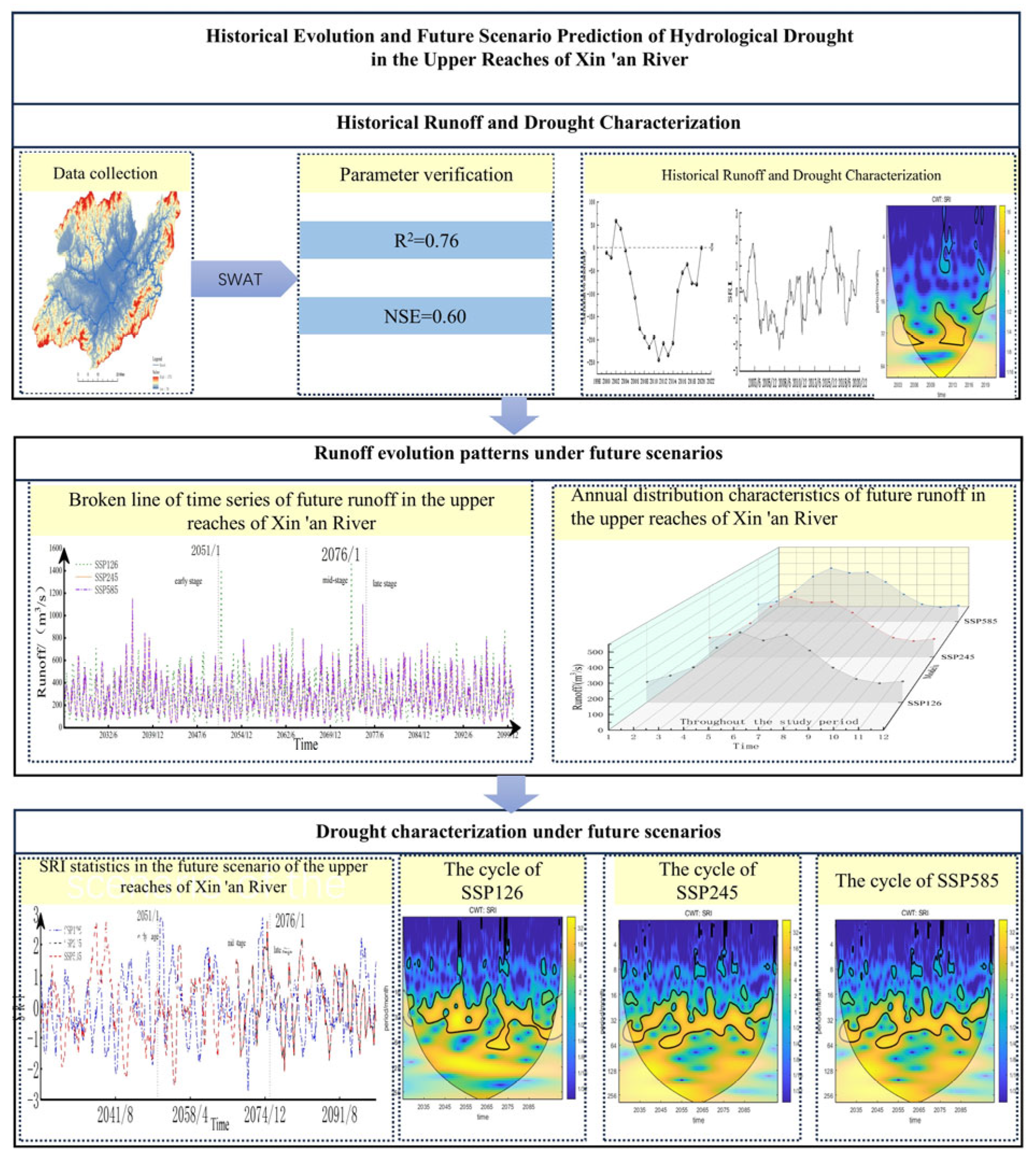
Therefore, this study comprehensively assesses the hydrological drought conditions in the upper reaches of the Xin’an River. Based on predicting runoff values under different future scenarios, the SRI is further calculated to eliminate natural variability caused by factors such as climate, geography, and seasonality, enabling runoff data from different years and sub-basins to be compared on the same scale. Additionally, to reduce the autocorrelation of the data, prewhitening processing is applied to make the data more closely resemble independent and identically distributed (i.i.d.) data, thereby making it more suitable for the MK test. Furthermore, cumulative anomaly tests and continuous wavelet transform methods are combined to provide a more comprehensive analysis of the runoff and hydrological drought characteristics of the upper reaches of the Xin’an River. The technical roadmap is shown in
Figure 1.
2. Study Area and Methodology
2.1. Overview of the Study Area
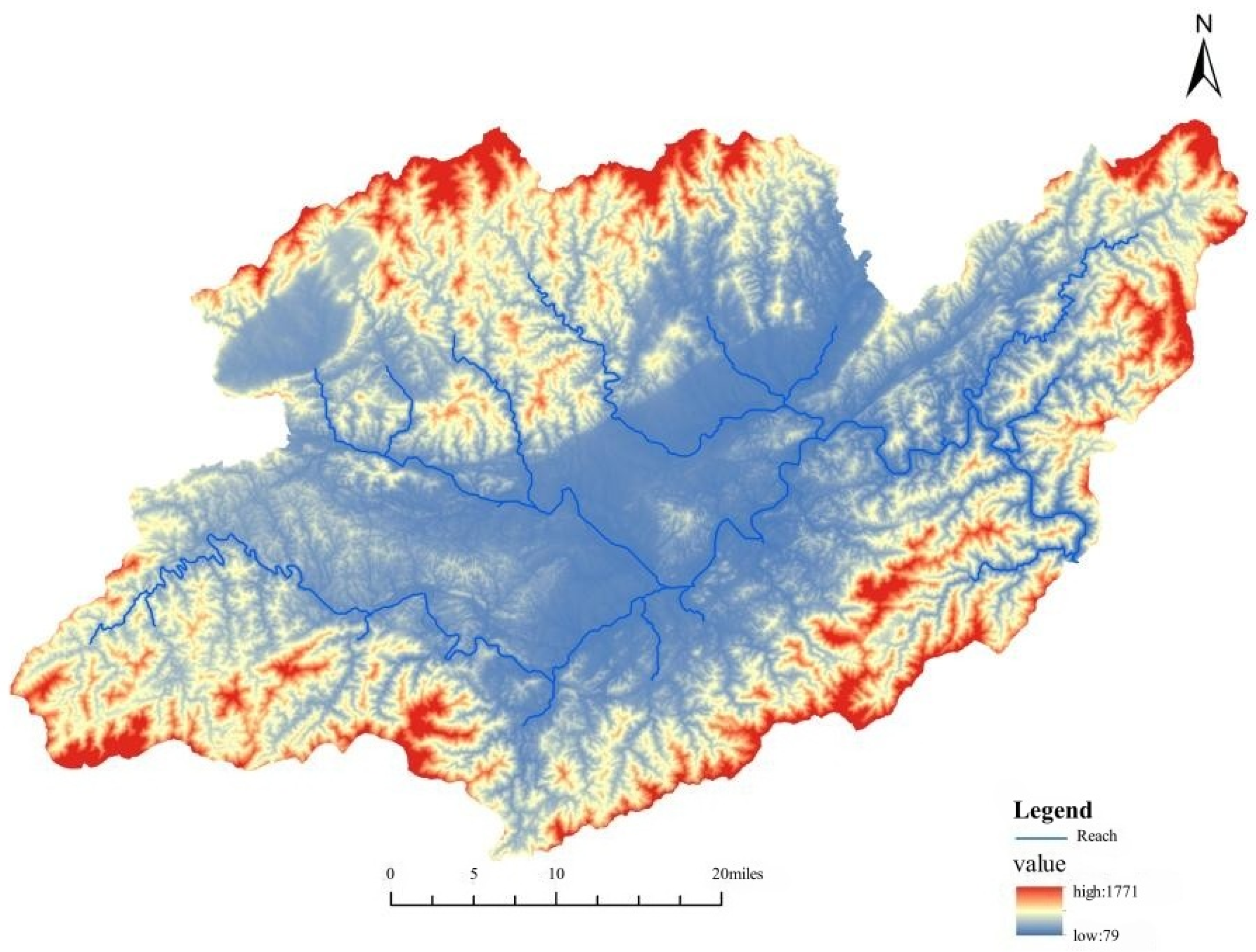
As shown in
Figure 2, Xin’an River originates from Xiuning County, Huangshan City, Anhui Province, passes through Qiandao Lake and Fuchun River, and finally joins the Qiantang River. According to the geographic location and basin characteristics, the upper reaches of Xin’an River refers to the section from its origin to Qiandao Lake. The upper reaches of Xin’an River are mostly mountainous and hilly, covering an area of about 5000 km
2. The basin has a subtropical monsoon climate, with an average annual temperature of about 16 °C. Typical vegetation types include evergreen broad-leaved forests and evergreen deciduous broad-leaved mixed forests. The main soil types are yellow loam and mountain yellow-brown loam, with thick soil layers and high gravel content.
2.2. Research Data
The data used to run the SWAT model are shown in
Table 1. Among them, the DEM data is downloaded from the geospatial data cloud, and a resolution of 30 m is selected. Soil type data is used to describe the hydrological characteristics of different soils within the watershed, while land use data reflects surface cover conditions and influences hydrological processes in the region. Meteorological data are sourced from the National Meteorological Science Data Center, including daily average wind speed, solar radiation, maximum and minimum temperatures, etc., which are important factors influencing runoff changes. The Jiekou Hydrological Station is located at the junction of the upper and lower reaches of the Xin’an River. Selecting runoff data from the Jiekou Hydrological Station can assess the water volume transported from the upper to the lower reaches of the Xin’an River. However, according to the Taihu Basin Administration Bureau’s Government Information Disclosure Leading Group Office, the Jiekou Water Level Station was only approved by the Ministry of Water Resources in December 2020 to be included in the national basic hydrological station network. As a result, only runoff records from 2022 to 2023 are available, which lack statistical significance. The applicability of Copernicus Climate Data Center (ERA5) data in the Chinese context has been verified by many scholars [
14,
15], so the runoff data downloaded from ERA5 was chosen to be regarded as measured data for rate-setting the SWAT model parameters.
The predicted meteorological data were obtained from CMIP6, which is the sixth phase of the Global Climate Model Comparison Project (GCMCP), aiming to improve the understanding of the behavior of the climate system and the ability to predict future climate change by comparing and evaluating global climate models. Referring to existing studies, the future meteorological data of SSP126 (low-intensity emission model), SSP245 (medium-emission model), and SSP585 (high-emission model) under the MRI-ESM2-0 climate model, which has a high accuracy of climate simulation for China, are selected. The differences between the models are shown in
Table 2.
Specifically, SSP126 represents a more sustainable social and economic development pathway. Assuming that more stringent climate policies and sustainable development practices are followed in the future [
16], CO
2 emissions decline significantly, reaching net zero by mid-century, with CO
2 emissions declining by about 2.6% by 2100 compared to 2010, average temperature increases within 2 °C, and radiative forcing stabilizing at about 2.6 W/m
2. SSP245 denotes a moderate social and economic development pathway with moderate response measures to climate change, with CO
2 emissions beginning to decline in 2050, average temperature increase of about 2.7 °C in 2100, and radiative forcing stabilizing at about 4.5 W/m
2. SSP585 denotes a high-intensity social and economic development pathway accompanied by higher GHG emissions, with CO
2 emissions in 2050 increasing from current levels by approximately doubles, with an average temperature increase of 4.4 °C by the end of the century and a stabilization of the radiative forcing at about 8.5 W/m
2.
2.3. Research Methodology
2.3.1. SWAT Model
The SWAT model is a hydrological model at the basin scale. Although it requires a large amount of data-driven models and is complex to operate, due to its comprehensive simulation ability of each link in the hydrological cycle and its meticulous consideration of natural factors such as soil, vegetation and terrain, it can accurately capture the reduction and changes in water resources under drought conditions in this study. The simulation process of the SWAT model is mainly divided into two parts: the sub-basin module (or called the land surface water cycle process) and the confluence calculus module (or called the water surface process). The sub-basin module is responsible for simulating flow generation and slope convergence, and controlling the input of water, sediment, nutrients and chemicals in the main river channels of each sub-basin. The confluence calculation module determines the transport movement of substances such as water and sand from the river network to the outlet of the basin. The water balance expression of the SWAT model is as follows:
where
SWt is the final soil water content (mm),
t is the length of the calculation (days),
SW0 is the initial soil water content (mm),
Pd is the daily rainfall (mm),
Qs is the daily surface runoff (mm),
Ea is the daily evapotranspiration (mm),
Ws is the amount of water (mm), returned to the stream
Wg is the soil profile leakage (mm).
In general, the correlation coefficient R
2 and the Nash efficiency coefficient NES to assess the simulation effect, and the relevant formulas are calculated as follows:
where
Q0 is the measured runoff, m
3/s;
Qp,
Qq for the runoff simulation and its average, m
3/s;
Qs for the average measured runoff, m
3/s;
n is the number of data.
2.3.2. Standard Runoff Index
Standardized Runoff Index (SRI) is a hydrologically based statistical analysis method to measure the extent to which a river deviates from its natural operating conditions [
17]. The SRI index is calculated by the following formula:
where Y represents the runoff volume under a certain time scale, mm; F is the cumulative distribution probability; C
0 = 2.515517, C
1 = 0.802853, C
2 = 0.010328, d
1 = 1.432788, d
2 = 0.189269, d
3 = 0.001308;
I = (lnF − 2) 0.5, combined with the study area actual situation to divide the hydrological drought level standard. The hydrological drought grade standards are shown in
Table 3.
2.3.3. Cumulative Anomaly Method
Cumulative anomaly is a method commonly used to analyze the trend of hydrological time series data, calculating the cumulative sum of the differences between data points and the mean value, and determining the degree of dispersion and the relative trend of the data series. The “inflection points” on the curve can be used to characterize the stages of the data. In this study, the cumulative horizon method can distinguish between “water-rich” and “dry” periods. When the cumulative distance level continues to rise, it means that the data in that period are generally higher than the average value, which is characteristic of “water-abundant period”. On the other hand, a decrease in the cumulative distance level indicates that the data are below the average and a “dry period” has been reached. Specifically, the cumulative level is calculated using the formula:
where
is the average of runoff or SRI.
Xj is the runoff or SRI in year
i.
Xj is the cumulative distance level in year
j.
2.3.4. Modified Mann–Kendall
The persistence of time series can interfere with the analytical results of the traditional Mann–Kendall test. In order to eliminate the autocorrelation of time series, the Modified Mann-Kendall (MMK) test is used in this study to pre-whiten the runoff data and SRI in advance to analyze the trend of runoff data and SRI. The MMK test method, compared with the MK test method, adds a prewhitening process for the data. Firstly, it standardizes the mean and variance of the original time series to eliminate the dimensional influence. Then, it constructs an independent white noise sequence of the same length as the original sequence (the variance is adjusted according to the first-order autocorrelation coefficient), and superimposes the standardized sequence with the white noise to disrupt the autocorrelation structure of the original sequence. Finally, the original dimension was restored through destandardization, and a new sequence with significantly reduced autocorrelation was obtained.
where
β is the trend of runoff or SRI index under different emission scenarios,
ti and
tj are time series, and
xi and
xj denote the extreme index values at moments
i and
j. MMK statistic Z with an absolute value greater than 1.96 indicates that it passes the 0.05 significance test.
2.3.5. Continuous Wavelet Transform
Continuous Wavelet Transform (CWT) [
18] was proposed by French scientist Morlet in 1980 when he analyzed seismic wave data. It can obtain the representation of a signal at different times and frequencies by convolving it with a wavelet function. By changing the scale of the wavelet function, the information of the signal on the corresponding time scale can be obtained. In this study, CWT is used to identify the start and end time of drought events and severity, as well as periodic and trend changes in runoff data, and to develop appropriate responses. The method is defined as f(t) ∈ L
2(R).
In Equation (8) wf (a,b) are the wavelet transform coefficients, a and b are the scale factor and translation factor, respectively, ψ(t) is the basis wavelet, which is the molert wavelet in this paper, t is the time, and f(t) is the original signal.
Meanwhile, red noise is used as the background spectrum to test the continuous wavelet transform energy spectrum. The first-order autoregressive equation (AR1) modeled the test process with the background red noise power defined as
In Equation (9) a2 is the correlation coefficient of the autoregressive equation in the red noise power spectrum, and k is the Fourier frequency exponent, chosen with 95% confidence.
3. Research Results
3.1. Parameterization Results
Based on the DEM image of the upper reaches of Xin’an River after filling the depressions, the boundaries of the entire basin were extracted. According to information such as slope and flow direction, the basin was divided into 35 sub-basins with relatively independent hydrological characteristics. The thresholds for land use, soil and slope were set at 10%, 16% and 23%, respectively, and further divided into 35 sub-basins with a total of 341 hydrological response units. Input the weather data from the meteorological station, set the period from 2000 to 2001 as the preheating period, run the model, and obtain the initial simulation results. To ensure the simulation accuracy, this study calibrated and verified all parameters. Although it increased the workload, it improved the accuracy of the parameters. Referring to relevant literature [
19], with the period from 2002 to 2014 as the rate period and the period from 2015 to 2020 as the verification period, a total of 228 sample numbers, using the SUFI-2 algorithm, the simulated runoff values and the measured runoff values were imported into Swat-CUP 2012, and the initial range of SWAT operation parameters was also imported. After 4000 iterations, The optimal parameter Settings are obtained, as shown in
Table 4.
The simulation results are shown in
Figure 2. Nash coefficient (NSE) and deterministic coefficient (R
2) were used to evaluate the fitting effect. It is generally believed that when R
2 > 0.5 and NSE > 0.5, the runoff fitting degree is more ideal. As can be seen from
Table 5, NES and R2 in the rate period and verification period are above 0.60, and the fitting effect is good, indicating that the SWAT model has high applicability in the upper reaches of Xin’an River.
3.2. Historical Runoff and Drought Characterization
Changes in runoff volume are a direct reflection of hydrologic drought, so when studying the trend of SRI, the changes in runoff volume need to be paid full attention to.
According to the simulation results, it can be found that the runoff from the upper Xin’an River at Jiekou Hydrological Station is concentrated 100–300 m
3/s, with an average monthly runoff of 197.35 m
3/s, and the peak of the annual runoff is around June. According to the MMK test method to analyze the historical runoff trend changes, the results are shown in
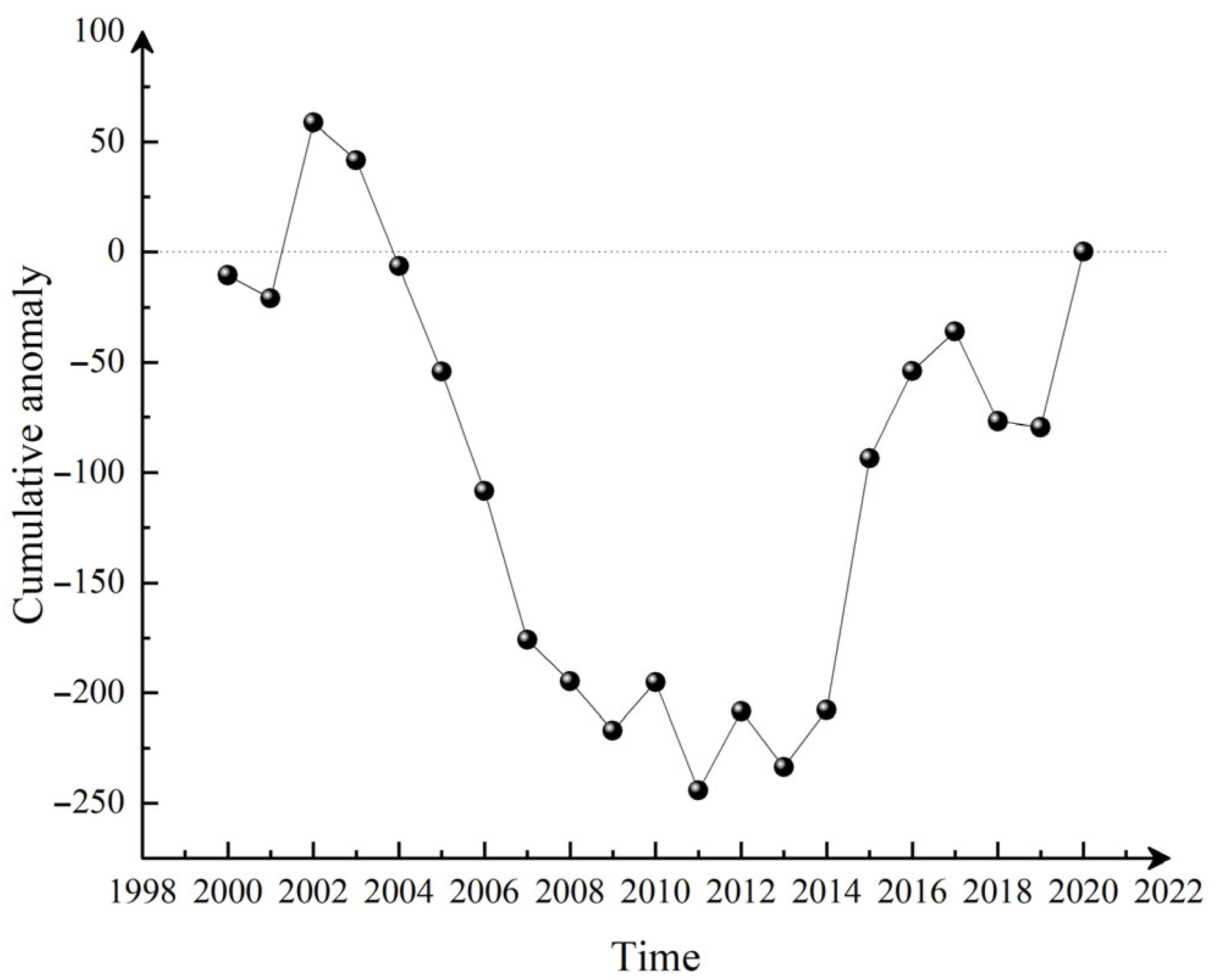
Table 6, which shows that the runoff in the upper reaches of Xin’an River is a non-significant during the period of 2000–2020 positive trend. In order to analyze the trend change in runoff in the upper Xin’an River, according to Equation (6), a cumulative distance plot is drawn as shown in
Figure 3, and the years from 2002 to 2009 are dry years, from 2009 to 2013 are flat years, and the years from 2013 to 2020 are abundant years.
As shown in
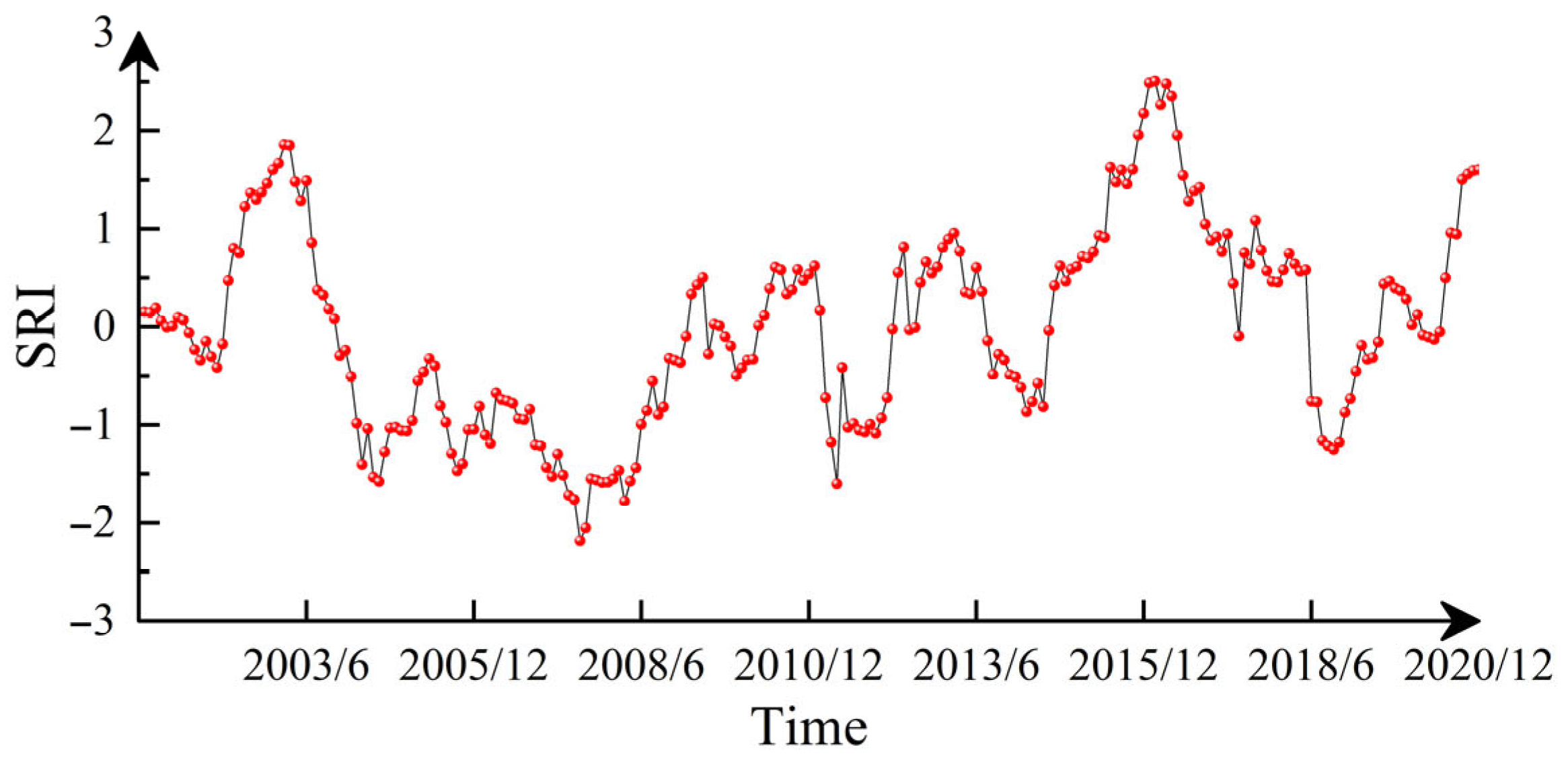
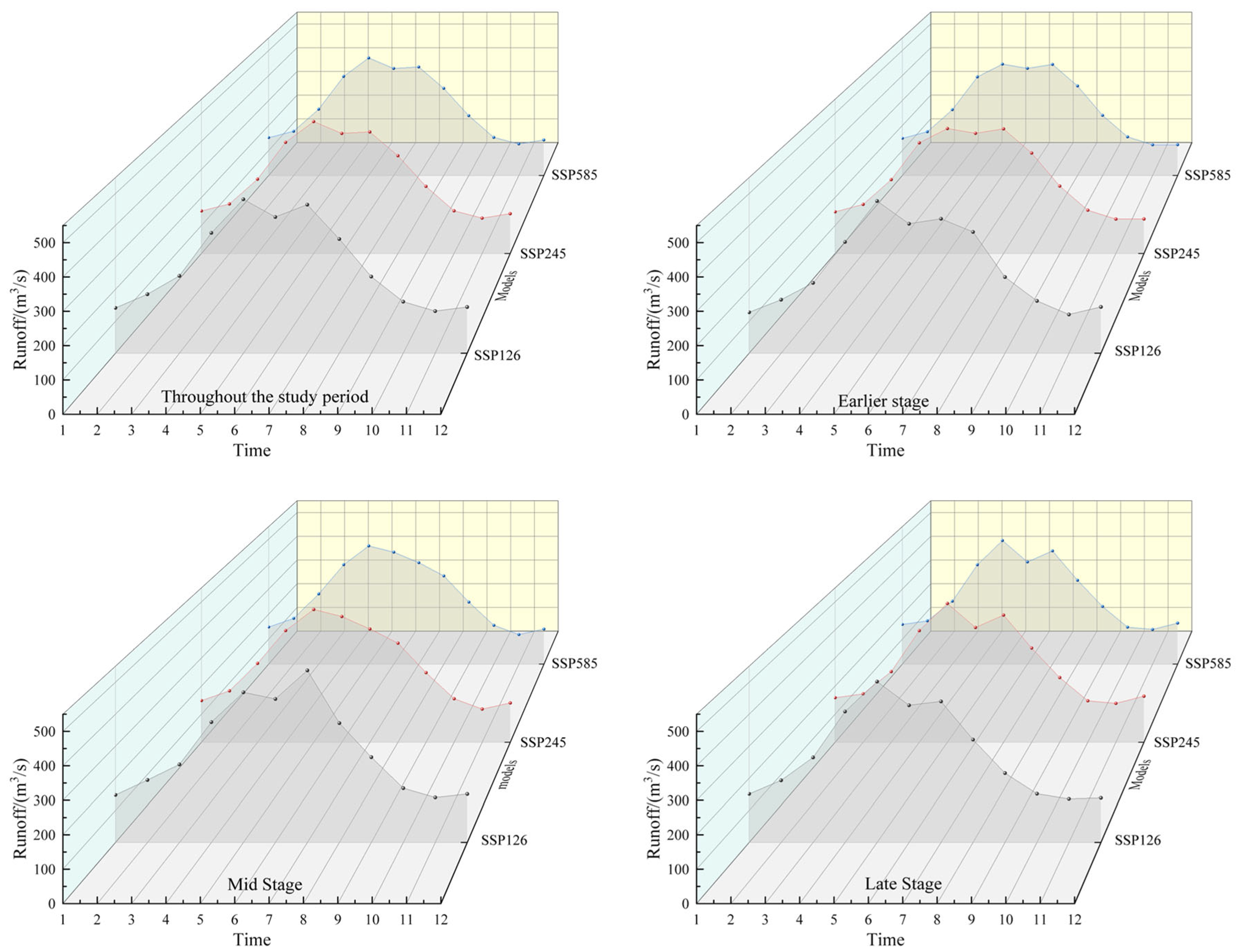
Figure 4, the average monthly runoff distribution throughout the year exhibits a consistent unimodal pattern under all three emission scenarios. This single-peak characteristic is evident across the near-term, mid-term, and long-term future periods, as well as over the entire study time series. The number of months with mild, moderate, severe, and exceptional drought were 34, 29, 14, and 2 months, respectively. According to
Table 6, the SRI in the upper reaches of the Xin’an River was a non-significant positive trend during 2000–2020. From
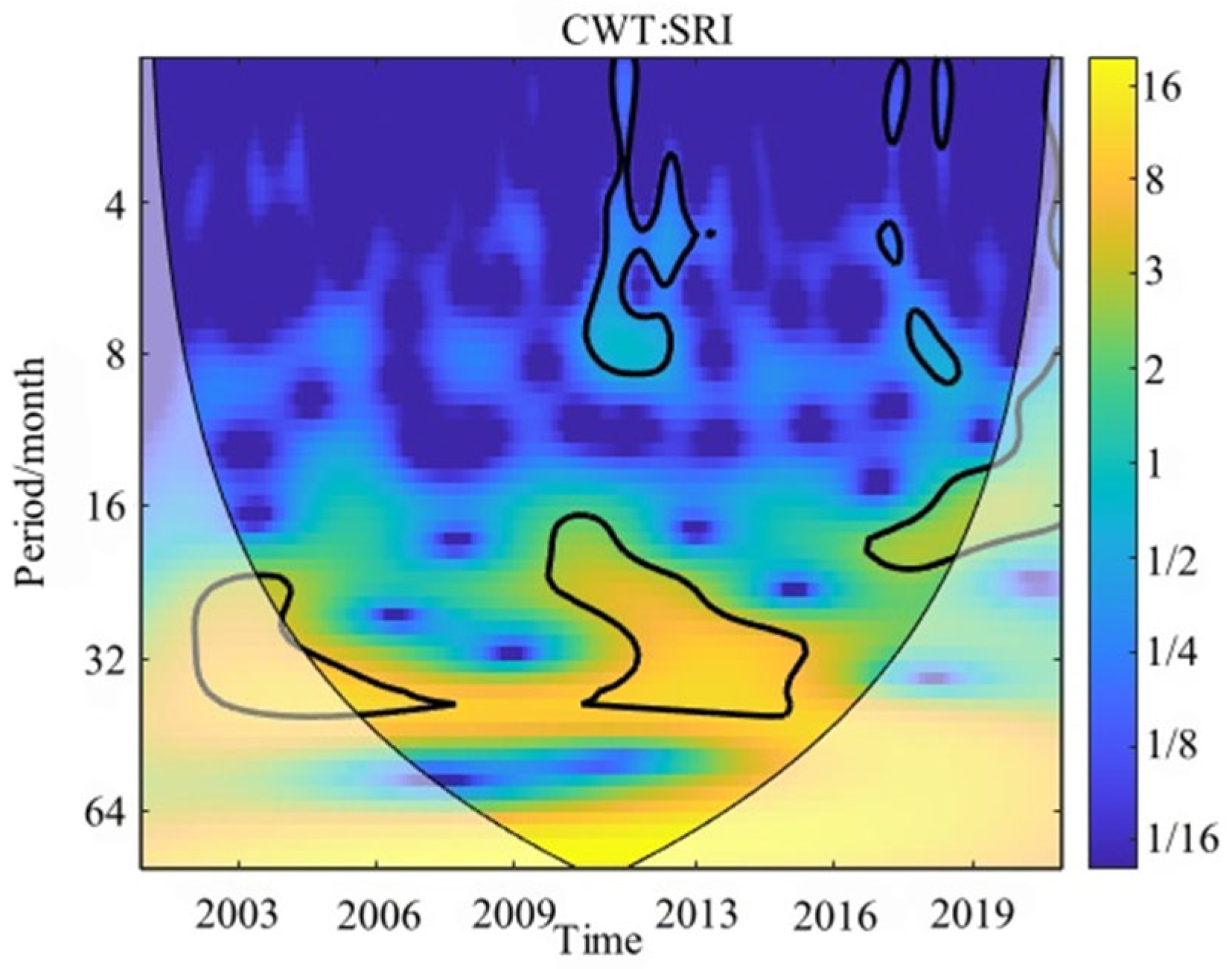
Figure 5, a 69-month oscillation cycle exists in 2009–2015.
3.3. Runoff Evolution Patterns Under Future Scenarios
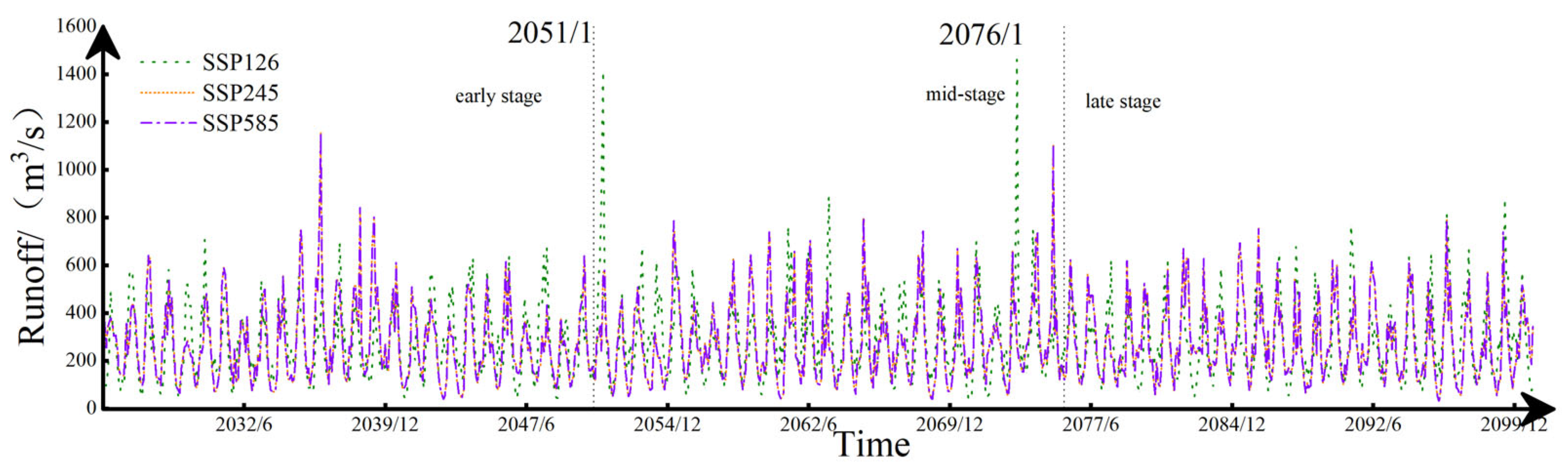
To refine the study, the time series of the study was divided into near-term (2025–2050), medium-term (2051–2075), and far-term (2076–2100). The future meteorological data of the three models were downscaled by bilinear interpolation and imported into the weather generator of SWAT to obtain the future runoff data of the upper Xin’an River region, as shown in
Figure 6.
Figure 6 shows that for the period 2025–2100, the monthly average runoff under the scenarios SSP126, SSP245, and SSP585 is, respectively, 279.68 m
3/s, 277.74 m
3/s, and 277.71 m
3/s. The increase in monthly average runoff compared to the historical period is 41.72%, 40.74%, and 40.72%, respectively. This is because in future scenarios, the rise in temperature leads to a dual consequence of increased evaporation and increased precipitation. However, the increase in precipitation far exceeds the evaporation consumption, resulting in a significant increase in runoff. In terms of different emission discharge patterns, the monthly mean runoff decreases with the increase in GHG emission concentration, and the monthly mean runoff and its increase in the SSP126 scenario is slightly higher than the other two scenarios, while the average monthly runoff of SSP245 is only 0.03m
3/s more than that of the SSP585 scenario. In terms of the degree of dispersion of the runoff, the fluctuation in the monthly mean runoff of the SSP126 scenario is the standard deviation of the SSP126 scenario is 163.39, and the extreme runoff values occur in July 2051 and July 2073, with average monthly runoffs of 1413 m
3/s and 1461 m
3/s. The fluctuation of the SSP245 and SSP585 scenarios is smaller, with standard deviations of 162.26 and 162.40. The SSP245 and SSP585 scenarios have a lower fluctuation, with standard deviations of 162.26 and 162.40. The extreme runoff values under both scenarios occur in July 2036 and June 2075 and have magnitudes of 1157 m
3/s and 1107 m
3/s.
From a longitudinal perspective, there are differences in the trends of runoff volume under the three scenarios. According to
Table 6, the runoff volume under the three future emission scenarios is a non-significant positive trend. The average monthly runoff volume of SSP126 in the near-term, medium-term, and far-term are 267.95 m
3/s, 292.49 m
3/s, and 279.07 m
3/s, with a spiral upward trend of increasing and then decreasing. The average monthly runoff volume of SSP245 is 274.97 m
3/s, 279.05 m
3/s, and 279.32 m
3/s, showing a continuous upward trend, but the mid-term increase of 1.5% is significantly higher than that of 0.1% in the long term. The average monthly runoff of SSP585 is 274.82 mm
3/s, 279.14 mm
3/s, 279.28 mm
3/s. The trend is basically the same as that of SSP245.
Expanding the analysis from a cross-sectional perspective, the monthly average runoff volume of SSP126 is higher than the other two emission scenarios for 462 months during the period of 2025–2100, accounting for 50.7% of the total number of months. In contrast, although there is a similarity in the trend of monthly mean runoff between the two scenarios SSP245 and SSP585, SSP245 has a higher monthly mean runoff than the SSP585 scenario for 767 months, accounting for 84.1% of the total months.
In order to analyze the annual distribution characteristics of future runoff, the annual average monthly runoff of the upper reaches of Xin’an River was calculated, as shown in
Figure 7.
As can be seen from
Figure 7, the distribution characteristics of the average monthly runoff within a year under the three emission scenarios in the near term, medium term, long term and the entire research time series are basically similar, showing a unimodal curve distribution. And the peak runoff volume was all in May, June and July. From the perspective of seasonal scale, the runoff volume under the three emission scenarios is mainly concentrated in late spring and early summer, accounting for about 40% of the annual runoff volume.
3.4. Drought Characterization Under Future Scenarios
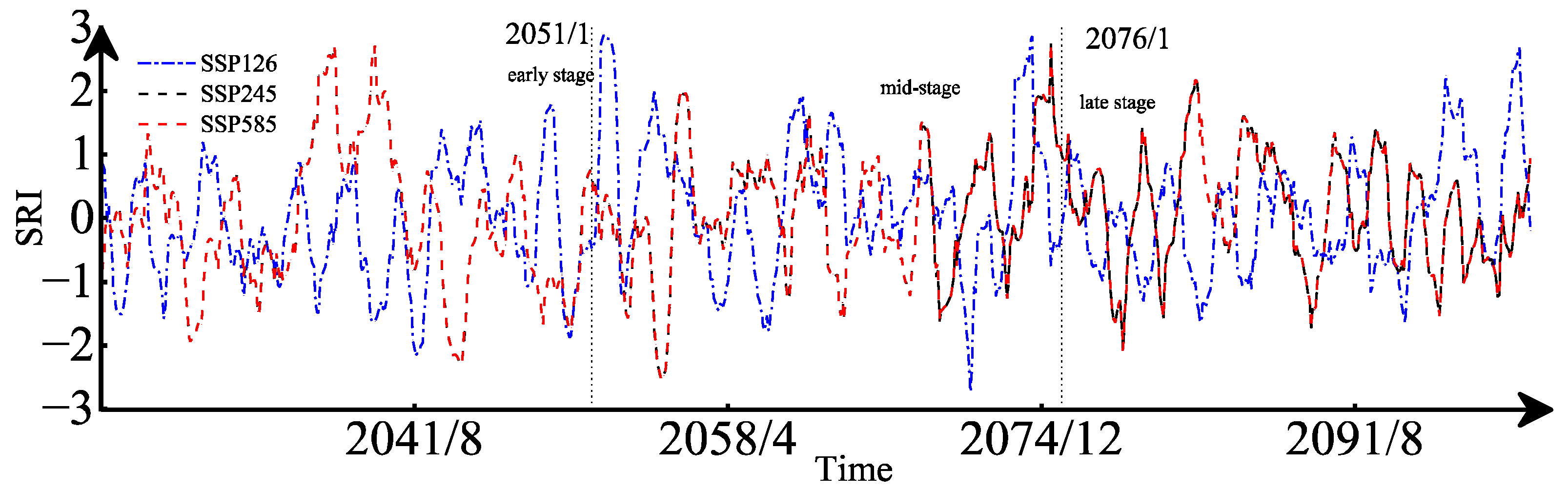
The simulated runoff data for the three future scenarios were brought into the equation to calculate the standard runoff index for the three future scenarios, and the results are shown in
Figure 8.
From
Figure 8, it is easy to see that as the concentration of GHG emissions increases, the proportion of drought-free months increases less, but the proportion of extra-dry months increases more. For example, from the perspective of the whole time series, the mean value of the annual-scale SRI of SSP126 is 0.04. The dynamics of the annual-scale SRIs of SSP245 and SSP585 maintain a high degree of similarity, and the mean value is the same as 0.05. According to the statistics of the annual-scale SRIs, it can be seen that during the period of December 2000 to December 2020, the number of drought-free in the SSP126 scenario is 630 months. There were 630 months, accounting for 69.1% of the total number of months. There are 153, 93, 28, and 8 months of mild, moderate, severe, and exceptional drought, respectively. 651 months, or 71.4% of the total number of months, are drought-free under the SSP245 scenario. There were 140, 71, 33, and 17 months of mild, moderate, severe, and exceptional drought, respectively. 660 months, or 72.4% of the total, were drought-free under the SSP585 scenario. There were 148, 77, 39, and 25 months of mild, moderate, severe, and exceptional drought, respectively. In terms of the dispersion of the annual-scale SRI, the SSP126 scenario had the smallest fluctuation in the annual-scale SRI, with a standard deviation of 0.96, and the standard deviation of both SSP245 and SSP585 was 0.98.
According to
Table 6, the SRIs for the three future emission scenarios have a non-significant positive trend. When analyzed in the near, medium, and distant future, the average SRIs were −0.20, 0.28, and 0.05, respectively, for SSP126, −0.04, 0.09, and 0.11, respectively, for SSP245, and −0.04, 0.09, and 0.11, respectively, for SSP585. It can be seen that over time, the hydrologic drought under the SSP126 emission scenario, the hydrological aridity was the lowest in the middle future, but then gradually increased in the far future. The hydrological aridity of the SSP245 and SSP585 scenarios, on the other hand, tended to decrease slowly from the near future to the long term.
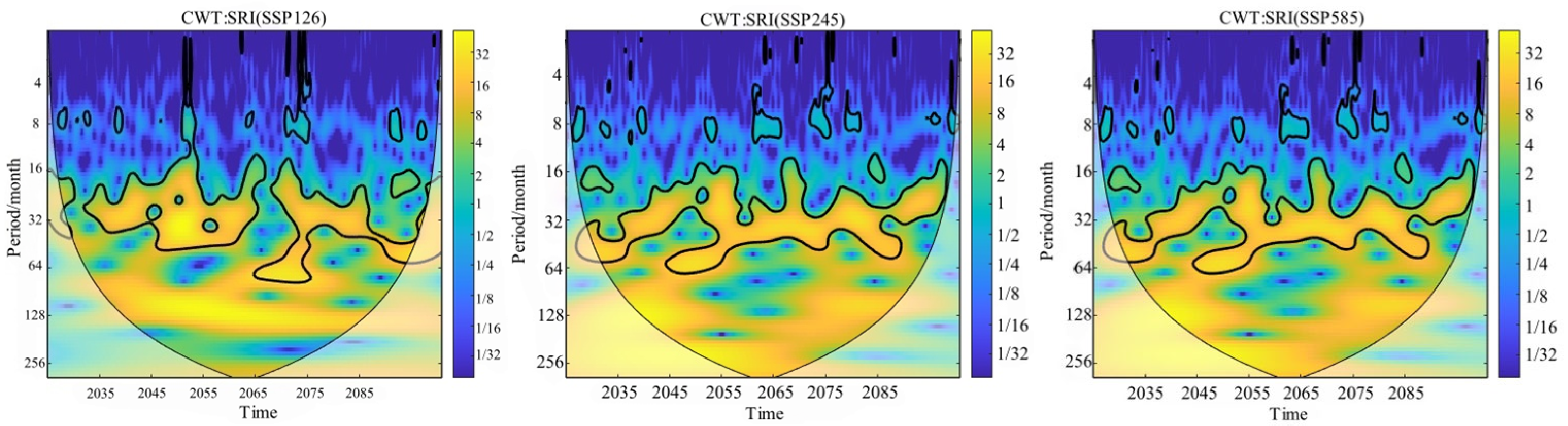
In order to further analyze the hydrological drought characteristics under three scenarios, the CWT continuous wavelet transform was chosen to analyze the drought distribution cycle in the upper Xin’an River region (SSP126, SSP245, and SSP585), and the continuous wavelet frequencies are shown in
Figure 9.
It can be seen from
Figure 9 that there are two oscillation periods in the SSP125 scenario. The first cycle period is from 2032 to 2065, lasting approximately 400 months. The second cycle is from 2064 to 2093, lasting approximately 359 months. Since the SRI in the SSP245 and SSP585 scenarios is highly similar, there is not much difference in their continuous wavelet frequency graphs. After passing the 95% confidence level test, the SRI in both the SSP245 and SSP585 scenarios has an 835-month oscillation period, with the period from 2028 to 2098.
4. Discussion
4.1. Discussion on the Evolution Trend of Historical Hydrological Drought
Based on the historical changes in runoff and SRI in the upper reaches of Xin’an River, the turning point from hydrological drought to hydrological wet period in the study area occurred around 2012, and the hydrological wet period ended around 2020. The implementation period of the lateral ecological compensation policy for Xin’an River was from 2012 to 2020, which highly overlapped with the hydrological wet period of the upper reaches of Xin’an River. Compared with the NDVI before and after 2012, the NDVI in 2014 was 0.81 and that in 2010 was 0.80, indicating that ecological compensation measures have increased the vegetation coverage rate. This indicates that the ecological compensation policy of Xin’an River Basin can alleviate the severity of drought in the policy area by increasing the vegetation coverage rate. Compared with previous studies [
20] that only focused on the promoting effect of ecological compensation policies on water supply, this study delved deeper into the level of hydrological drought and analyzed the alleviating effect of ecological compensation policies on hydrological drought. In addition, by observing the cumulative deviation curves of historical runoff and SRI in the upper reaches of the Xin’an River, it was found that there was a trend of hydrological drought lasting for about two years around 2017. This is because 2017 was the third pilot stage of the Xin’an River Horizontal ecological compensation policy. The central government’s ecological compensation funds decreased and the regulatory intensity of the central government weakened, resulting in a decline in the implementation effect of the policy. This, in turn, led to the trend of hydrological drought, further verifying that the ecological compensation policy can alleviate the hydrological drought situation in the policy area, which is consistent with the research results of Wang [
21]. This is because the ecological compensation funds are specifically used for afforestation, wetland protection and other ecological restoration projects in the upstream areas, enhancing the water retention capacity of the upstream areas. In addition, Anhui and Zhejiang provinces have collaborated on water resource monitoring and allocation to ensure ecological flow during drought periods. In addition, this policy encourages the development of low-water-consuming industries in the upstream areas, reducing water demand.
4.2. Discussion on the Evolution Trend of Hydrological Drought in the Future
Based on changes in the SRI under three future scenarios for the upper reaches of the Xin’an River, the hydrological drought trend is more stable under the SSP126 scenario, and the proportion of extreme drought months is significantly lower than in the other two scenarios. This indicates that as greenhouse gas concentrations increase, extreme weather events in the study area become more frequent, and hydrological drought conditions become increasingly unstable, consistent with the findings of Chen [
22]. The primary reason lies in the accelerated evaporation of surface water due to temperature increases caused by carbon emissions, which reduces soil moisture and accelerates surface water loss. Additionally, rising carbon emissions may alter precipitation patterns, affecting precipitation amounts and distribution, triggering extreme precipitation events, and thereby impacting the supply and distribution of surface water resources, exacerbating regional hydrological drought conditions.
5. Conclusions
Based on the meteorological data and DEM data of the upper reaches of Xin’an River, a SWAT model was constructed. The model parameters were adjusted based on the hydrological data from 2000 to 2020. Based on the meteorological data of three scenarios in CMIP6, the daily runoff of the upper reaches of Xin’an River from 2025 to 2100 was predicted. The hydrological drought characteristics of the upper reaches of Xin’an River under the shared path of social economy were analyzed, and the following conclusions were drawn:
(1) The calibration and validation of the SWAT model using ERA5 runoff data yielded a NSE of 0.60 and a coefficient of R2 of 0.76, both meeting the acceptable standards for hydrological modeling (NSE > 0.5, R2 > 0.5). This outcome not only demonstrates the reliability of ERA5 runoff data within the study area, indicating that discrepancies between the dataset and actual hydrological conditions are within acceptable limits, but also validates the strong applicability of the SWAT model in the upper Xin’an River basin, confirming its effectiveness in simulating fundamental hydrological processes in this region. 2002 to 2009 is a dry period, and 2013 to 2020 is an abundant period, and 2012 is the year when the hydrological drought shifted to hydrological wetness. The SRI of the upper Xin’an River has a 69-month oscillation cycle from 2009 to 2015. Horizontal ecological compensation policies can effectively alleviate hydrological droughts in the Xin’an River basin. It is recommended that the cyclical differences in hydrological droughts be fully considered to ensure that compensation funds are accurately allocated to critical periods. It should be noted that in this study, the ERA5 reanalysis product, as a historical runoff benchmark dataset, has seen its accuracy widely verified and basically meets the analysis requirements for runoff trend changes. However, there are still potential uncertainties. To minimize prediction errors to the greatest extent, it is necessary to continuously monitor and obtain the long-term observed runoff data of Jiekou Hydrological Station in the future, improve the reliability of hydrological drought prediction, and ensure more powerful support for drought risk management and water resources planning in the Xin ‘an River Basin.
(2) The average monthly runoff under the three scenarios in the future will increase compared with the historical period, and the SSP126 scenario has the most significant change, but the highest degree of dispersion. The annual average monthly runoff under the three emission scenarios was concentrated in May, June and July. Therefore, the seasonal allocation of water resources should be strengthened in the future. In the peak of runoff, improve the storage and regulation capacity of the reservoir to ensure sufficient water supply in the dry season. Relying on the Xin’an—Qiandao Lake ecological compensation mechanism, an emergency water diversion channel between Anhui and Zhejiang will be built, and multiple regulating reservoirs will be constructed upstream to meet the emergency needs during the dry season. At the same time, through the cross-basin water transfer project, the excess water resources can be deployed to the water-scarce areas to improve the utilization efficiency of water resources.
(3) The hydrological drought in the three scenarios will be alleviated in the future, but with the increase in emission intensity, the drought-free and drought-intensive months will increase at the same time, and the drought characteristics in the study area will become more obvious. SRI in the SSP126 scenario has two oscillation cycles of 400 months and 359 months, respectively. The continuous wavelet frequency graphs of SSP245 and SSP585 are similar, and both have an oscillation cycle of 835 months. In response to the polarized trend of “no drought—extreme drought” in future hydrological droughts, it is suggested to establish a hierarchical drought resistance system, set four levels of early warning indicators and make dynamic adjustments in combination with seasons, and alleviate the impact of drought through the coordinated efforts of “precise emergency response—cycle adaptation—low-carbon regulation”. During periods of extreme drought, priority should be given to ensuring water supply for residents and implementing agricultural quotas. In periods without drought, groundwater replenishment should be carried out. Simultaneously promote drought-resistant crops and water-saving irrigation technologies, and optimize the irrigation district renovation nodes based on drought cycles of 400 months, 359 months and 835 months. The promotion of water-saving technologies adopts a three-level subsidy mechanism. The basic subsidy is linked to water-saving benefits and carbon sink income. At the same time, a water-saving points system and an incentive system for farmers’ cooperatives are established.
Author Contributions
Conceptualization, L.Q. and G.H.; methodology, L.Q.; software, L.Q.; validation, L.Q.; formal analysis, L.Q.; investigation, L.Q.; resources, L.Q.; data curation, L.Q.; writing—original draft preparation, G.H.; writing—review and editing, G.H.; visualization, G.H.; supervision, L.Q.; project administration, L.Q. All authors have read and agreed to the published version of the manuscript.
Funding
This research received no external funding.
Institutional Review Board Statement
Not applicable.
Informed Consent Statement
Not applicable.
Data Availability Statement
Dataset available on request from the authors.
Conflicts of Interest
The authors declare no conflicts of interest.
Abbreviations
The following abbreviations are used in this manuscript:
| SSPs | Shared Socioeconomic Pathways |
| SRI | Standardized Runoff Index |
| ESGF | Earth System Grid Federation |
| SWAT | Soil and Water Assessment Tool |
| CMIP | Coupled Model Intercomparison Project |
| MK | Mann–Kendall |
References
- Shah, D.; Zhao, G.; Li, Y.; Singh, V.P.; Gao, H. Assessing Global Reservoir-Based Hydrological Droughts by Fusing Storage and Evaporation. Geophys. Res. Lett. 2024, 51, e2023GL106159. [Google Scholar] [CrossRef]
- Wu, J.; Wang, G.; Chen, X.; Yuan, X.; Yao, H.; Chen, X.; Lan, T.; Zheng, Y.; AghaKouchak, A. Hydrological drought characterization considering onset, maximum streamflow deficit, and termination. Adv. Water Resour. 2024, 184, 104613. [Google Scholar] [CrossRef]
- Shukla, S.; Wood, A.W. Use of a standardized runoff index for characterizing hydrologic drought. Geophys. Res. Lett. 2008, 35, L02405. [Google Scholar] [CrossRef]
- Hayes, M.; Svoboda, M.; Wall, N.; Widhalm, M. The Lincoln Declaration on Drought Indices. Bull. Am. Meteorol. Soc. 2011, 92, 485–488. [Google Scholar] [CrossRef]
- Wang, H.; Wang, Z.; Bai, Y.; Wang, W. Propagation characteristics of meteorological drought to hydrological drought considering nonlinear correlations—A case study of the Hanjiang River Basin, China. Ecol. Inform. 2024, 80, 102512. [Google Scholar] [CrossRef]
- Touze-Peiffer, L.; Barberousse, A.; Le Treut, H. The Coupled Model Intercomparison Project: History, uses, and structural effects on climate research. Wiley Interdiscip. Rev.-Clim. Change 2020, 11, e648. [Google Scholar] [CrossRef]
- O’Neill, B.C.; Tebaldi, C.; van Vuuren, D.P.; Eyring, V.; Friedlingstein, P.; Hurtt, G.; Knutti, R.; Kriegler, E.; Lamarque, J.-F.; Lowe, J.; et al. The Scenario Model Intercomparison Project (ScenarioMIP) for CMIP6. Geosci. Model Dev. 2016, 9, 3461–3482. [Google Scholar] [CrossRef]
- Yang, S.; Tan, M.L.; Song, Q.; He, J.; Yao, N.; Li, X.; Yang, X. Coupling SWAT and Bi-LSTM for improving daily-scale hydro-climatic simulation and climate change impact assessment in a tropical river basin. J. Environ. Manag. 2023, 330, 117244. [Google Scholar] [CrossRef]
- Lin, J.; He, P.; Yang, L.; He, X.; Lu, S.; Liu, D. Predicting future urban waterlogging-prone areas by coupling the maximum entropy and FLUS model. Sustain. Cities Soc. 2022, 80, 103812. [Google Scholar] [CrossRef]
- Sun, J.; Yan, H.; Bao, Z.; Wang, G. Investigating impacts of climate change on runoff from the Qinhuai River by using the SWAT model and CMIP6 scenarios. Water 2022, 14, 1778. [Google Scholar] [CrossRef]
- Kong, Z.; Wang, J.; Li, Q.; Zhang, H.; Yi, Z. Optimized coordination of urban water usage in China’s Minjiang River Basin under the influence of climate change. J. Water Resour. Plan. Manag. 2024, 150, 04024041. [Google Scholar] [CrossRef]
- Sivokhip, Z.T.; Pavleichik, V.M.; Chibilyov, A.A. Regional Effects of Global Climate Changes in the Ural River Basin. Dokl. Earth Sci. 2023, 509, 230–235. [Google Scholar] [CrossRef]
- Nagireddy, N.R.; Keesara, V.R.; Rao, G.V.; Sridhar, V.; Srinivasan, R. Assessment of the Impact of Climate Change on Streamflow and Sediment in the Nagavali and Vamsadhara Watersheds in India. Appl. Sci. 2023, 13, 7554. [Google Scholar] [CrossRef]
- Lei, X.; Xu, W.; Chen, S.; Yu, T.; Hu, Z.; Zhang, M.; Jiang, L.; Bao, R.; Guan, X.; Ma, M.; et al. How Well Does the ERA5 Reanalysis Capture the Extreme Climate Events Over China? Part I: Extreme Precipitation. Front. Environ. Sci. 2022, 10, 921658. [Google Scholar] [CrossRef]
- Xu, W.; Lei, X.; Chen, S.; Yu, T.; Hu, Z.; Zhang, M.; Jiang, L.; Bao, R.; Guan, X.; Ma, M.; et al. How Well Does the ERA5 Reanalysis Capture the Extreme Climate Events Over China? Part II: Extreme Temperature. Front. Environ. Sci. 2022, 10, 921659. [Google Scholar] [CrossRef]
- Tokarska, K.B.; Stolpe, M.B.; Sippel, S.; Fischer, E.M.; Smith, C.J.; Lehner, F.; Knutti, R. Past warming trend constrains future warming in CMIP6 models. Sci. Adv. 2020, 6, eaaz9549. [Google Scholar] [CrossRef]
- Sarwar, A.N.; Waseem, M.; Azam, M.; Abbas, A.; Ahmad, I.; Lee, J.E.; Haq, F.U. Shifting of Meteorological to Hydrological Drought Risk at Regional Scale. Appl. Sci. 2022, 12, 5560. [Google Scholar] [CrossRef]
- Huang, X.; Wang, X.; Baishan, K.; An, B. Hyperspectral Estimation of Soil Organic Carbon Content Based on Continuous Wavelet Transform and Successive Projection Algorithm in Arid Area of Xinjiang, China. Sustainability 2023, 15, 2587. [Google Scholar] [CrossRef]
- Valencia, S.; Villegas, J.C.; Hoyos, N.; Duque-Villegas, M.; Salazar, J.F. Streamflow response to land use/land cover change in the tropical Andes using multiple SWAT model variants. J. Hydrol. Reg. Stud. 2024, 54, 101888. [Google Scholar] [CrossRef]
- Yu, H.; Chen, C.; Shao, C.F. Spatial and temporal changes in ecosystem service driven by ecological compensation in the Xin’an River Basin, China. Ecol. Indic. 2023, 146, 109798. [Google Scholar] [CrossRef]
- Wang, Y.; Yang, R.; Li, X.; Zhang, L.; Liu, W.; Zhang, Y.; Liu, Y.; Liu, Q. Study on Trans-Boundary Water Quality and Quantity Ecological Compensation Standard: A Case of the Bahao Bridge Section in Yongding River, China. Water 2021, 13, 1488. [Google Scholar] [CrossRef]
- Chen, L.; Brun, P.; Buri, P.; Fatichi, S.; Gessler, A.; McCarthy, M.J.; Pellicciotti, F.; Stocker, B.; Karger, D.N. Global increase in the occurrence and impact of multiyear droughts. Science 2025, 387, 278–284. [Google Scholar] [CrossRef]
| Disclaimer/Publisher’s Note: The statements, opinions and data contained in all publications are solely those of the individual author(s) and contributor(s) and not of MDPI and/or the editor(s). MDPI and/or the editor(s) disclaim responsibility for any injury to people or property resulting from any ideas, methods, instructions or products referred to in the content. |
© 2025 by the authors. Licensee MDPI, Basel, Switzerland. This article is an open access article distributed under the terms and conditions of the Creative Commons Attribution (CC BY) license (https://creativecommons.org/licenses/by/4.0/).