Article

Sustainable Analysis of Wind Turbine Blade Fatigue: Simplified Method for Dynamic Load Measurement and Life Estimation


by
Cristofer Aguilar Jiménez
1,
Geovanni Hernández Gálvez
2,
José Rafael Dorrego Portela
3,
Antonio Verde Añorve
1,
Guillermo Ibáñez Duharte
1,
Joel Pantoja Enríquez
1,
Orlando Lastres Danguillecourt
1,
Alberto-Jesus Perea-Moreno
4,
David Muñoz-Rodriguez
4 and
Quetzalcoatl Hernandez-Escobedo
5,*
1
Instituto de Investigación e Innovación en Energías Renovables, Universidad de Ciencias y Artes de Chiapas, Libramiento Norte Poniente 1150, Colonia Lajas Maciel, Tuxtla Gutiérrez 29039, Mexico
2
División de Ciencias Básicas e Ingeniería, Universidad Popular de la Chontalpa, Carretera Cárdenas-Huimanguillo km 2, Ranchería Paso y Playa, Cárdenas 86556, Mexico
3
División de Estudios de Posgrado, Universidad del Istmo, Campus Tehuantepec, Ciudad Universitaria S/N, Barrio Santa Cruz, 4a. Sección, Santo Domingo, Tehuantepec 70760, Mexico
4
Departamento de Física Aplicada, Radiología y Medicina Física, Campus Universitario de Rabanales, Universidad de Córdoba, 14071 Córdoba, Spain
5
Escuela Nacional de Estudios Superiores Unidad Juriquilla, Universidad Nacional Autónoma de Mexico, Campus Juriquilla, Queretaron 76230, Mexico
*
Author to whom correspondence should be addressed.
Sustainability 2025, 17(17), 7615; https://doi.org/10.3390/su17177615
Submission received: 14 June 2025 / Revised: 16 August 2025 / Accepted: 21 August 2025 / Published: 23 August 2025
(This article belongs to the Special Issue Sustainable Energy System: Efficiency and Cost of Renewable Energy)

Abstract

This study presents a novel approach to addressing the challenges associated with wind turbine blade fatigue, focusing on the development of a simplified method for dynamic load measurement and life estimation. Wind turbine blades are subjected to complex and varied loads during their operational life, leading to fatigue-induced damage that can significantly impact the overall performance and longevity of the turbine. The proposed method integrates advanced sensor technologies and data analytics to capture dynamic loads on the blades more effectively. Dynamic load measurement and fatigue estimation for a wind turbine blade are quite challenging tasks, since the real-time wind-induced load is irregular and stochastic, and the associated load history affects blade fatigue life in complex ways. This paper shows the implementation of a simplified method for damage and life estimation of a 1.5 kW wind turbine blade with an aerodynamic stall-limiting system. The findings from this research contribute to advancing the field of wind energy by providing a streamlined and efficient approach to addressing blade fatigue issues, ultimately promoting the sustainable and economic utilization of wind power resources. The proposed method simplifies the processes of dynamic load measurement and fatigue life estimation by employing a resonance-based approach. This reduces energy and cost requirements compared to forced displacement methods, while maintaining accuracy in replicating damage equivalent loads. Additionally, it avoids the complexities of simulating real-world turbulence by using controlled conditions, ensuring reproducibility.

1. Introduction

Currently, wind turbine blades must undergo structural testing to ensure their structural integrity, as this aspect is related to fatigue-induced failures [1,2]. Essentially, the fatigue study seeks to replicate the damage accumulated in the material caused by fluctuating loads [3]; therefore, designing the type of load to be applied to the element is a challenging task [4].
Kong et al. [5] and Castro et al. [6] proposed a structural design for the development of a medium-scale blade manufactured from glass fiber. The design loads were deter-mined from various load cases specified in the international standards IEC 61400-1 and GL (Germanischer Lloyd) for the study [7]. On the other hand, since the wind flow and the aerodynamic load it exerts on the element are random, Chanprasert et al. [8] employed a stochastic approach to develop a computer code to simulate wind flow with a random nature on the blade and, subsequently, each load case was analyzed for its rate of occurrence using the Weibull distribution [9].
Part of the fatigue analysis consists of physically verifying the state of the blade during the fatigue test. Such was the case in the study conducted by Kang et al. [10], in which they report a study of the damage detected in a 10 MW wind turbine blade. This damage consisted of cracks located in the transition zone close to the root.
The procedure for carrying out fatigue tests on blades is defined in IEC 61400-23 (full-scale structural test on wind rotor blades) Zhang et al. [11] who adopted a procedure for conducting fatigue tests under constant amplitude on a shaft. The process consists of the following points: (a) obtaining a load time series [12], (b) performing load cycle counts [13], and (c) applying the damage equivalent load model [14].
Currently, there are two widely adopted approaches to fatigue testing: forced dis-placement testing and resonance testing, or a combination of both. Xiong et al. [15] presented a method for resonance fatigue testing by applying loads perpendicular to the soffit and perpendicular to the leading edge, where they are tested simultaneously, which also allows the interactions between the two loads perpendicular to each other to be investigated. These fatigue tests are performed using numerical environments to avoid destructive testing. However, Wang et al. [16] estimated the fatigue life of a blade vibrating at its first natural resonant frequency. The article proposes a model to evaluate life and damage based on the assumption that the rate of damage growth in a composite material depends on the maximum value of elastic strain energy per cycle.
One of the most critical areas in blades where fatigue damage accumulation is most severe is the root-transition zone junction. In a study conducted by Akpan et al. [17], fatigue analysis was carried out using a numerical environment. The objective of this fatigue analysis was to investigate the initiation and growth of disbanding at the root junction and predict the fatigue life of the root junction. Their numerical results concluded that the horizontal position is the critical position for the blade under fatigue loading.
Fewer studies of fatigue analysis applied to low-power blades have been performed in contrast to studies of larger blades. However, Vassilopoulos [18] performed a study that aimed to estimate the fatigue life for an average wind speed distribution within 10 min on a low-power wind turbine blade, by combining the Von Karman turbulence model and the Weibull distribution obtained from the wind time series.
One of the mechanical properties that degrades due to fatigue loading is stiffness. In a study conducted by Lee and Park [19], two different approaches to fatigue damage estimation and remaining life predictions of wind turbine blades are explored. The first approach uses the rain counting algorithm. The second approach comes from a fatigue damage model that describes the propagation of damage at the microscopic scale due to matrix cracks that manifest at the macroscopic scale as stiffness loss. The fatigue life in a blade is also affected by the load exerted by the centrifugal force, according to a study carried out by Spini and Bettini [20]. A fatigue test was performed so that the blade life to failure was shown to be approximately 17 years for a turbine operating speed of 36 rpm and approximately 15.8 years for an operating speed of 47 rpm.
The tendency in fatigue analysis entails employing composite materials in blades, as exemplified by a study conducted by Pacheco et al. [21]. They determined the fatigue behavior of a wind turbine blade in response to different frequencies and compared the fatigue behavior with different composite materials such as Kevlar, glass fiber-reinforced plastic (GFRP), and carbon fiber-reinforced plastic (CFRP).
One of the difficulties in fatigue testing is the design of the test load. Dai et al. [22] propose a simplified method to directly convert the blade load spectrum into a test load. First, beam theory is used to obtain the relationship among stress, strain, and the bending moment of the blade cross-section. Based on the assumption of local stress concentration and the linear relationship between stress and strain, the M–N curves (applied moment versus allowable number of cycles in case of failure) are defined. Secondly, based on the linear cumulative damage theory and Miner’s constant life diagram, the equivalent cumulative fatigue damage is obtained from the load spectrum, which is equal to the full-scale fatigue test damage. Panteli et al. [23] presented a new methodology for the continuous assessment of fatigue damage propagation in wind turbine blades subjected to stochastic wind loads. The new tool was built around an aeroelastic model based on thin-walled beam theory (TWB) and blade element momentum (BEM). Ma et al. [24] compare finite element variations with a deviation of less than 7% in various blade configurations using a multibody dynamic transfer matrix methodology.
When it comes to choosing the level of loading and the number of cycles to be tested, there are no clear guidelines, and it will depend on the engineer’s skill to make the test as close to reality as possible [25]. Some people only look at the damage caused, although the level of loads is nothing like the actual spectrum [26]. However, if fatigue research is to evolve, the tendency should be to look for tests that, in addition to causing the same damage, consider load levels similar to the real spectrum [27]. It is true that, in the real spectrum, there are an infinite number of cycles, which makes it difficult to represent a test that resembles this spectrum. However, most of the damage is caused by only a few cycles, while most of the cycles in the matrix cause negligible damage [28].
The benefits of this study are that (a) it develops a short-term wind profile prediction with the characteristics of a specific site, (b) it allows approximation of the parameters for the application of resonance loading to carry out an experimental analysis, and (c) it extends the fatigue analysis for the most critical areas of the blade, such as the root and the transition zone, where there could be material failure through the presence of cracks or material delamination. Limitations are (d) failure to develop a long-term wind profile prediction model for sites that do not have sufficient historical wind measurement data and (e) reliance on aeroelastic software for fatigue load estimation.
The contribution of this work is to develop a fatigue test methodology for low-power wind turbine blades coupled to the wind resource, using a fatigue analysis approach to estimate the material damage and replicate the equivalent load to the damage using dynamic resonance load modeling.
A review of macromechanical fatigue models allows adoption of a stiffness degradation-based approach for fatigue assessment. This methodology employs experimental modal analysis to evaluate material stiffness reduction, thereby predicting accumulated damage in wind turbine blades. In composite materials, fatigue-induced damage manifests as progressive stiffness loss, which serves as a quantifiable, non-destructive metric for assessing fatigue resistance. The correlation between stiffness degradation and material deterioration enables estimation of residual fatigue life in structural components [29,30].
This proposed work introduces a simplified methodology for stiffness degradation analysis under constant amplitude loading, aligned with the IEC 61400-2 standard [31]. The standard mandates that test-induced damage must equal or exceed the target load-induced damage in all examined blade sections. To minimize error propagation, consistent techniques are applied for both target and test load damage evaluation.
This study has two approaches. The first is to perform a theoretical analysis of the target load. The conventional method for calculating this load proceeds as follows:
(1)
Develop a wind time series over a period of 10 min.
(2)
Calculate the load produced on each section of the blade using aeroelastic software.
(3)
Use the rain flow counting method to create Markov matrices.
(4)
Calculate the damage equivalent load (target load).
(5)
Use Goodman’s criterion to calculate the cycles to failure and Miner’s rule to determine the damage.
The second approach is based on an experimental study that seeks to replicate the target load through a resonance fatigue study. The process is as follows:
(1)
From a dynamic analysis perspective, the goal is to match the target load with a test load.
(2)
The first natural frequency of the blade is calculated in a pre-experimental analysis.
(3)
The blade is subjected to experimental dynamic lysis by inducing a resonance load under controlled amplitude.
(4)
The first natural frequency of the blade is calculated in a post-experimental analysis.
To clarify our contributions, Table 1 compares our work with existing resonance fatigue testing methods.

2. Materials and Methods

The design process of wind turbine blades includes several factors, such as aerodynamics, noise, manufacturing, and ultimately their structural integrity [32]. As the latter aspect presents a more pronounced problem with regards to fatigue due to the relatively long periods of operation (around 20 years, with an equivalent of 108 to 109 cycles) and the fluctuating wind load, it has become the focus of study for several lines of research [33].
Specifically, the blade is a critical element prone to fatigue damage due to its slender geometry, given its high strength-to-weight ratio and its versatility in adapting to specific aerodynamic and structural requirements [34].
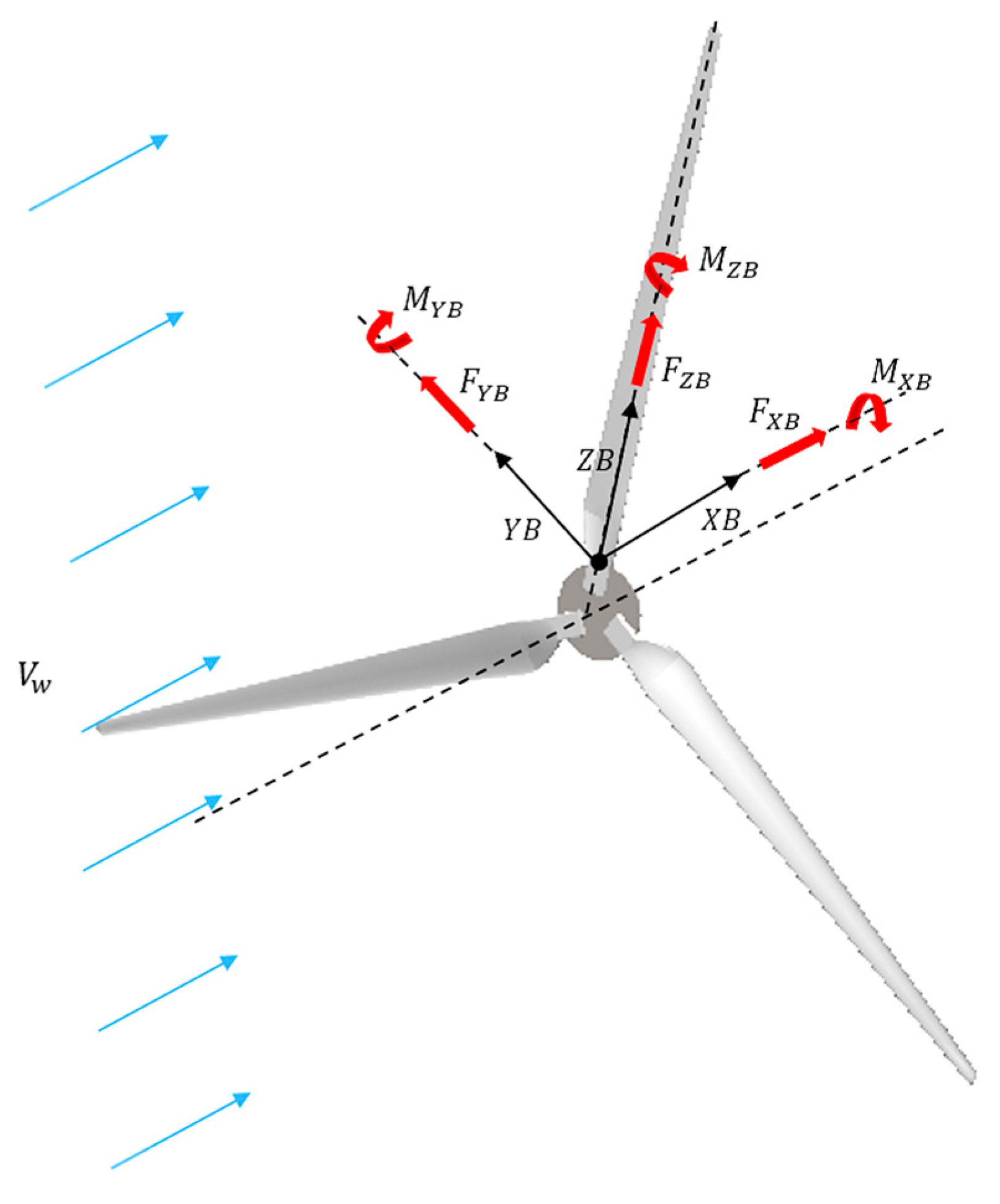
The vane generates six loads simultaneously—FXB, FYB, FZB, MXB, MYB, and MZB—according to the coordinate system shown in Figure 1.
The main loads causing fatigue damage to the blade are stochastic in origin and nature [35]. There are deterministic loads due to bending caused by the blade weight; these loads are usually within the plane of rotation or edge direction (edgewise, FYB), and their cyclic nature is justified by the change of the blade position while it is rotating, causing a moment MXB. Aerodynamic loads, on the other hand, are usually variable and stochastic, due to the ever-varying wind speed [36]. It should be noted that these loads are in a direction outside the plane of rotation or flap-wise (FXB) causing a moment MYB.
A full-scale fatigue test seeks to replicate the same damage in the critical areas of the blade as if it had operated during its lifetime by inducing a controlled load that generates a bending moment with constant amplitude and reducing the number of cycles (typically 106) [37]. Currently, there are two widely adopted approaches to fatigue testing: forced displacement testing and resonance testing, or a combination of both [7,38].
Resonant testing has several advantages over forced displacement testing. It requires much less energy and capital investment [39]; the bending moment distribution can be adjusted by adding static masses to the blade to adjust its modal shape and can be scaled for larger blades [14].
However, regardless of the type of method used, the problem lies in how to design the appropriate test load. To address these shortcomings, work has been carried out to model the propagation of wind turbine blade failures under realistic conditions and to allow for a progressive accumulation of damage.
The IEC [40] specifies that, for the blade to be tested, the damage caused by the test load must be shown to be equal to or greater than the damage caused by the design load. The conventional method for determining the test load is as follows.
Initially, a software simulation of the rotor must be performed to estimate the time series of fatigue loads on the blade during one hour.
Next, the rain flow counting method is applied. This method decomposes the time spectrum by grouping it into groups of cycles ni with the same average load Sm and load range Sr.
Using the measured or assumed S–N curve of the material and the constant life diagram of composite laminates (modified Goodman diagram), the tolerable cycles Ni can be obtained for each stress Si. Then, the Palmgren Miner rule is applied to determine the cumulative design damage, using Equation (1).
D d e s i g n = n i N i
The GL standard [41] directly shows the equation for calculating the tolerable cycles before failure, Ni, which depends on the force the material can withstand for a given load level (mean and range).
N i = R k , t + R k , c 2 γ M a S m , i R k , t + R k , c 2 γ M b C 1 b S a , i m
where Sm,i and Sa,i are the mean values and the amplitude of the cycle, respectively, obtained from the rainflow. Rk,t and Rk,c are the static tensile strength and static compressive strength, respectively, in the form of stress or strains. m takes the value of the slope of the S–N curve of the material (the typical range is between 8 and 12 for glass fiber). γMa and γMb are the static safety factors for the material and the dynamic load safety for the material, respectively.
In case the S–N diagram is not available, the value of parameter m depends on the material of the wind turbine blade. Possible values for this parameter and the corresponding material are given in [39]: m = 9 for polyester resin matrix blades, m = 10 for epoxy resin matrix blades, and m = 14 for carbon-reinforced plastic blades [22].
The safety factors are determined by Equation (3).
γ M x = γ M 0 i C i x
Therefore, γ M 0 = 1.35 and C i x are the reduction factors. The values of the coefficients are described in more detail in reference [39].
The equivalent load that causes the same damage as the complex load spectrum is calculated using the following mathematical model; see Equation (4) [42].
S e q = i S i m · n i n e q 1 / m
where Seq is the damage equivalent load, Si represents the amplitude of the load i, ni is the number of cycles of the load, neq corresponds to the number of total cycles, and m is the material exponent.
The equivalent damage of the test loads must be greater than the load spectrum; this is given by Equation (5).
D t e s t = n t e s t N t e s t > D d e s i g n
where ntest is the cycles of action of the test load. Generally, it should be more than 106 to prevent an excessive test load from causing blade failure. Ntest is the allowable cycles for the test load and can be calculated using Equation (2). The Rload ratio, the load amplitude Sa, and the mean load Sm correspond to Ntest, which can be obtained from the S–N curves and subsequently converted to test loads.

Dynamic Resonance Loading Model

The fatigue analysis of a wind turbine blade depends on the selected test method [41]. In this case, so-called resonance loading is selected [42]. The resonant excitation system of the rotating mass excites the blade by periodic centrifugal force in the form of a sine wave. The frequency ω of the motor is set to the natural frequency of the system ωn, which creates the resonance phenomenon, where the u ( t ) coordinate describes the position of the blade tip and increases indefinitely at resonance, maintaining a maximum amplitude.
The blades can be simplified as a cantilever beam model embedded at one end [43]. The problem at hand is one-dimensional, since both the forces and the displacements occur in the same dimension, i.e., in the plane. Therefore, it is not necessary to use more complex elements, since the other dimensions do not provide additional information. Thus, the beam element is considered one-dimensional according to the Euler–Bernoulli theory [44].
To derive the equation that models the problem relating to a blade embedded at the root, a series of assumptions are made in accordance with the Euler–Bernoulli theory.
Elastic behavior: the beam material is linearly elastic, with a negligible Young’s modulus and Poisson’s ratio, i.e., it does not reach the plastic regime. The loads generated on the blade are below the maximum load that the material can withstand before failure.
Vertical deflection: at each point of the beam, the vertical displacement depends only on x (longitudinal coordinate).
The flat cross-sections of the undeformed beam remain flat for the deformed beam.
Only bending moment deformation is taken into account; shear deformation is neglected (the blades are very thin), and normal forces on the section under study are not considered. Consequently, the deformation energy of the beam only considers deformation due to the bending moment.
The deformations are small enough that the action of external forces is not modified, in the first approximation, by deformation.
The blade can be treated as a cantilever, and a two-node beam element can be applied to discretize it. The stiffness method will be used, employing a four-degree-of-freedom (4DOF) beam element (2D), which is equivalent to two degrees of freedom per node. Assuming that L is the length of the element, ρ e is the density of the element, N is a shape function, E is the elastic modulus, and I is the sectional moment of inertia, the mass matrix M e and the stiffness matrix K e for each element can be obtained by Equations (6) and (7):
M e = ρ e A   N T N d x
K e = E I d 2 N d x 2 T   d 2 N d x 2 d x
A is the cross-sectional area of the element. The shape matrix is defined by Equation (8).
N = N 1 x , N 2 x ,   N 3 x ,   N 4 ( x )
where N i ( x ) are cubic polynomials that can be expressed as Equation (9).
N = 1 3 x L 2 + 2 x L 3 , x 2 L x L 2 + L x L 3 ,   3 x L 2 2 x L 3 , L x L 2 + L x L 3
Substituting (4) into (1) and (2), Equation (10) is obtained:
K e = E I L 12 6 L 12 6 L 6 L 4 L 2 6 L 2 L 2 12 6 L 12 6 L 6 L 2 L 2 6 L 4 L 2 M e = ρ A L 420 156 22 L 54 13 L 22 L 4 L 2 13 L 3 L 2 54 13 L 156 22 L 13 L 3 L 2 22 L 4 L 2
The sectional stiffness of the blade is generally indicated in the longitudinal and transverse directions; however, dynamic responses in the in-plane and out-of-plane directions are actually necessary. Therefore, first, it is necessary to convert the stiffness to the in-plane and out-of-plane directions, considering the sectional torsion angle. Assuming that O is the sectional centroid, the stiffness of the section is calculated in terms of bending, both in-plane (Equation (11)) and out-of-plane (Equation (12)).
E I X = E I F   cos 2   θ b   +   E I c   sin 2   θ b
E I Y = E I F   sin 2   θ b   +   E I c   cos 2   θ b
The aforementioned models have been used in other similar works; in [44], a large-scale wind turbine blade model was created using the same stiffness procedure, treating the material as isotropic. Newton’s second law for linear motion is the generalized equation used for dynamic analysis. It should be noted that the Timoshenko and Euler–Bernoulli beam models are not the best theories for describing structural dynamics. However, they are used because they represent a simplification of the analysis to obtain displacements [45,46,47].
Additionally, in dynamic analysis, if it is assumed that the blade vibrates at its natural frequency, it is possible to neglect damping as a simplified analysis method. Damping is neglected because there appear to be no forces that dissipate energy. In this research, aerodynamic force was considered as an energy-dissipating force due to the relative displacement between the blade and the air.
Since aerodynamic losses are proportional to the projected area, it is necessary to consider the chord of the blade if the direction is outside the plane of rotation and the thickness if it is inside the plane. This aerodynamic force is normally broken down into two parts: drag and lift.
Applying the matrix stiffness method and assuming that the blade will be vibrating at its first natural frequency and neglecting damping, Equation (13) models the dynamic system.
m u ¨ t + k u t = F t
where the global linear mass matrix [m] is determined by the distribution of densities within the kg/m domain, the global stiffness matrix [k] is obtained from the elastic properties of the medium Nm2, and both matrices [m] and [k] are positive definite symmetric matrices. The position is defined by u ( t ) and its second derivative as the acceleration, and F ( t ) is the force vector, where the contribution of the centrifugal force is considered. F c is the aerodynamic force as a function of air resistance F r and the force caused by the weight of the blade F g (Equation (14)).
m u ¨ t + k u t = F t
The aerodynamic losses are proportional to the projected area of the blade chord in the case of the flap-wise direction and the blade thickness in the case of the edgewise direction. This is denoted by Equation (15).
F r t = 0.5   ρ C x A x V 2
where ρ is the air density (equivalent to 1.225 kg/m3) and Cx is the aerodynamic coefficient. Being treated as a flat plate, the coefficient takes a unit value. A is the projected area in the direction of motion in m2, and V is the velocity of the blade relative to the medium, which is the first derivative of the position u ˙ t . To implement the mathematical model of the resonance excitation device, the theory of rotating machines was used, which states that, if an unbalanced behavior is generated, it will provide a centrifugal force which is given by a mass, an eccentric radius, and the square of the rotational speed, defined by Equation (16).
F c t = m   e   ω 2 sin ( ω t )
m is the rotating mass in kg, e is the eccentricity of m, and ω is the angular velocity, which must coincide with the natural frequency of the blade. In addition, the force generated by the blade weight itself is considered. Fg(t) = meg, where g is gravity.
The natural frequency of a system is that at which the system would vibrate freely without taking damping into account. Therefore, the force vector of free vibrations is not considered, and the matrix equation to determine the mode of vibration and the natural frequencies is calculated using Equation (17)
m 1 + k U = ω n U
The amplitude vector U will be the eigenvector, also called the mode of vibration in this case because it describes how the vane vibrates. On the other hand, the eigenvalue will be ω n 2 . Since the problem has been solved where the system vibrates freely without damping, ωn will be the natural frequency of vibration of the system in rad/s.
Solving the second-order differential Equation (6) reduces it to two first-order equations. Therefore, it can be rewritten as Equation (18).
u ¨ t = m 1 F t [ k ] u ( t ) = f ( u ,   u ˙ ,   t )
Defining y0 = u(t) and y1 = u ˙ t , Equation (18) can be rewritten as two first-order Equation (12).
y 0 ˙ = y 1 y 1 ˙ = f ( u ,   u ˙ ,   t )
Equation (19) is written by replacing the variables; see Equation (20).
d d t y 0 y 1 = y 1 m 1 F t k y 0
Time-dependent discretization is performed by means of iterative numerical integration methods for the approximation of solutions of ordinary differential equations using numerical methods. For this, initial conditions must be defined. Then, u 0 ( 0 ) will be the initial displacement vector, which will be taken as the deflection of the blade by its own weight. u 0 ˙ ( 0 ) will be the vector which approximates the first derivatives of the displacement vector with respect to time, i.e., the velocity vector at the initial instant. This is taken to be zero, since the vane starts from rest.
For discretization in time, the Runge–Kutta–Nyström (RKN) method was used, which is applied to a generic system of equations similar to Equation (13). Simplifying the analysis, Runge–Kutta–Nyström method is applied to rigid second-order problems that can be characterized by the Butcher table.
These methods can be seen as a generalization of the Runge–Kutta method applied to the first-order system equivalent in Equation (13) [48]. Therefore, it is a powerful numerical tool for solving second-order differential equations, especially in oscillatory problems, and is distinguished by its ability to handle variable integration steps, as well as its efficiency compared to traditional methods.
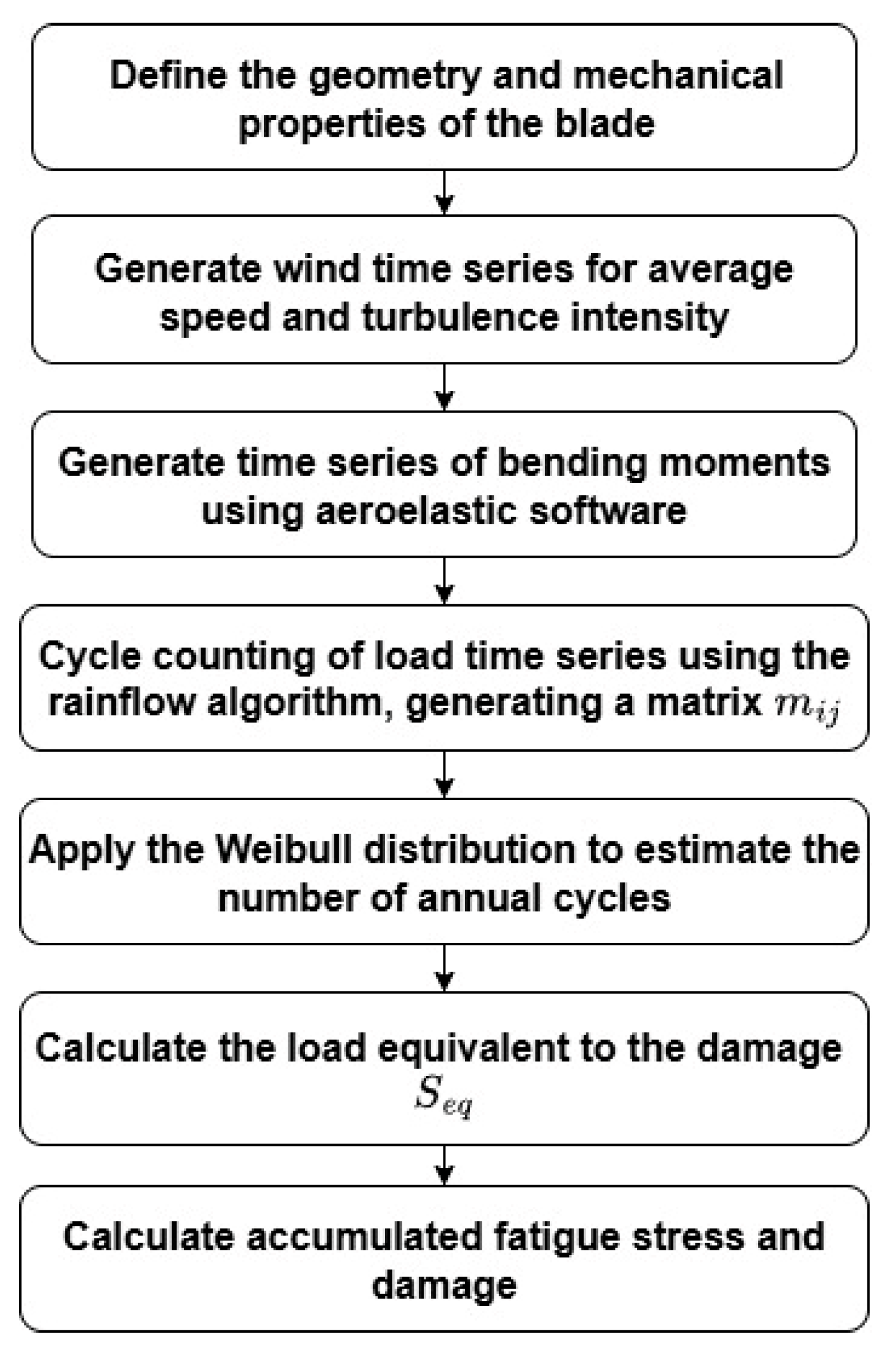
The calculation of the damage equivalent load for a given period and the simulation of a dynamic test are the main contributions of this work. The methodology is broken down into two parts. Figure 2 shows the conventional methodology for fatigue damage estimation. The process starts by defining the case study element, followed by generating a time series of the wind speed using Qblade software, version 0.8 for which it is necessary to define the average speed and the turbulence intensity. The fatigue loads are generated using the FAST sub-module incorporated in Qblade, then the cycle count of the load time series is performed by grouping them in a matrix m i j . Then, from the Weibull distribution, we calculate the probability that the wind speed will be in the same direction as the wind speed. f(Vp < V0 < Vp+1) indicates that the wind speed is between Vp and Vp+1. The damage equivalent load is calculated for several cycles, equivalent to its lifetime of 20 years.
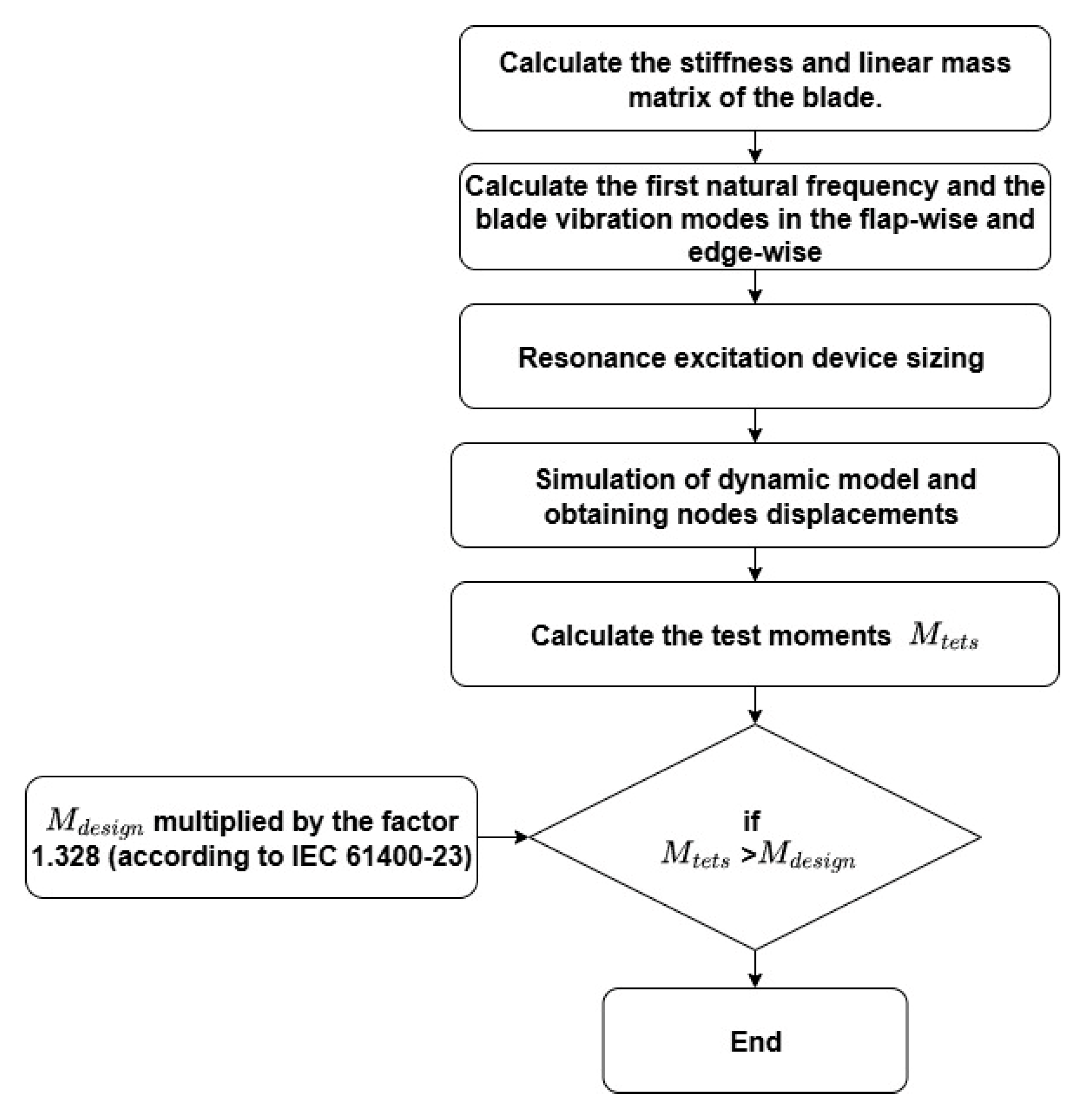
Once the load equivalent to the damage is replicated in the root, and some sections of the blade are known, dynamic response simulation is performed, which creates an algorithm capable of calculating the first natural frequency in the blade in the flap-wise and edgewise direction. The following flowchart (Figure 3) describes the basic sequence, followed by the algorithm to determine the test load (Mtest). First, the linear mass and stiffness matrices of the case study blade are calculated from the stiffness matrix method. Then, the first natural frequencies in the flap-wise and edgewise directions of the blade are calculated using the modal analysis method, followed by a description of the resonance load sizing. Subsequently, dynamic analysis is performed: this part of the algorithm proceeds to time discretization of the root-embedded blade problem. The program solves the temporal problem for the conditions entered by the user. For time integration, a second-order Runge–Kutta method was used, with which we obtain approximations of the vector of displacement { u } of the blade at different moments in time. To do this, the number of cycles to be performed, the time step (h), and the percentage of the natural frequency at which the test is to be carried out were determined.

3. Results

3.1. Blade Characterization

The blade under study comes from a 1.5 kW rated wind turbine, designed by professor-researchers in the graduate studies division of UNISTMO. The airfoil used is FX 63-137 and is made of glass fiber-reinforced epoxy resin. In terms of fatigue resistance, carbon fiber-reinforced epoxy resin has better performance; its use in the market is limited by its cost. The properties of these materials were compared in [45], where the S–N curve of GFRE and CFRE is shown; it can be observed that (b) has higher fatigue strength than (a), due to the slope that is formed at the beginning of the load and that later remains flat for (a).
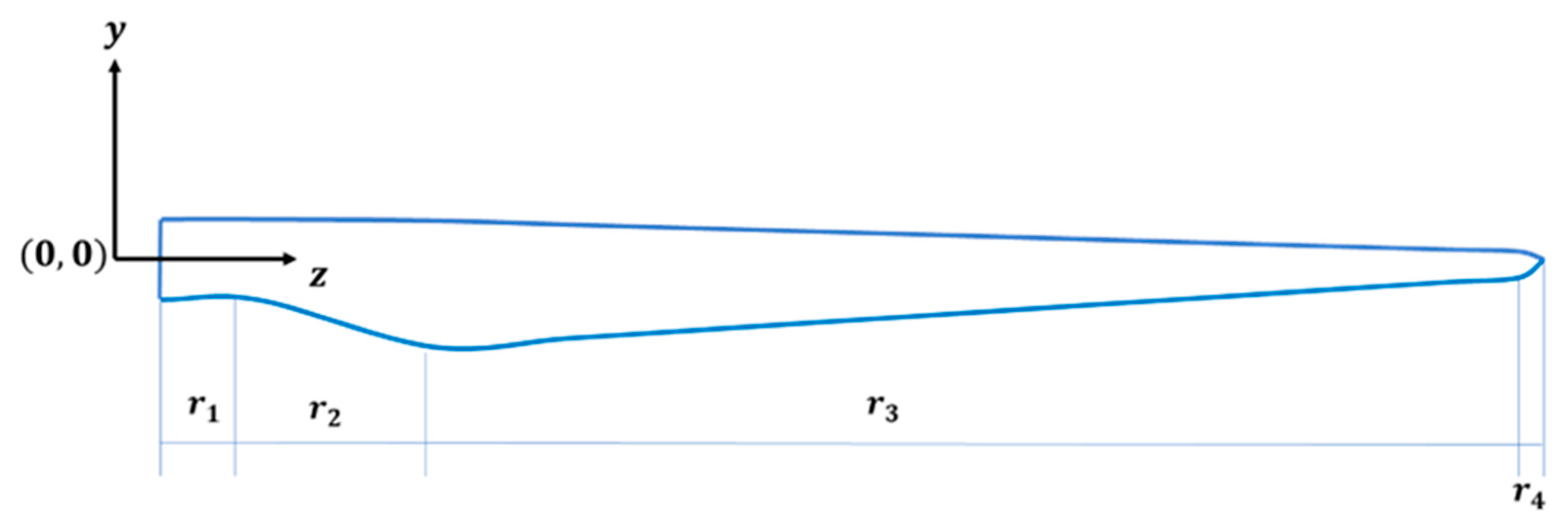
The characterization consists of defining the blade geometry and its constituent mechanical properties. The geometry is determined by specifying the chord distribution, twist, thickness, and profile type along the longitudinal axis of the blade. The geometry of the case study blade is specified in Table 2 below, and a plan view of the blade is shown in Figure 4.
The structural parameters of the blade depend on the material it is made of and its geometry in each local section. For this case study, glass-reinforced plastic (GFRP) was considered. Table 3 shows that the mechanical properties of the material remain constant and uniform over the entire length of the blade.
The linear mass is defined as the product of the area times the density of each local area of the blade mlin = ρA. The local stiffness is determined by the product of the moment of inertia of each principal axis times the modulus of elasticity of the material. D = EI. Table 4 shows the structural parameters for determining the stiffness and linear mass matrices of the case study element.

3.2. Wind Time Series

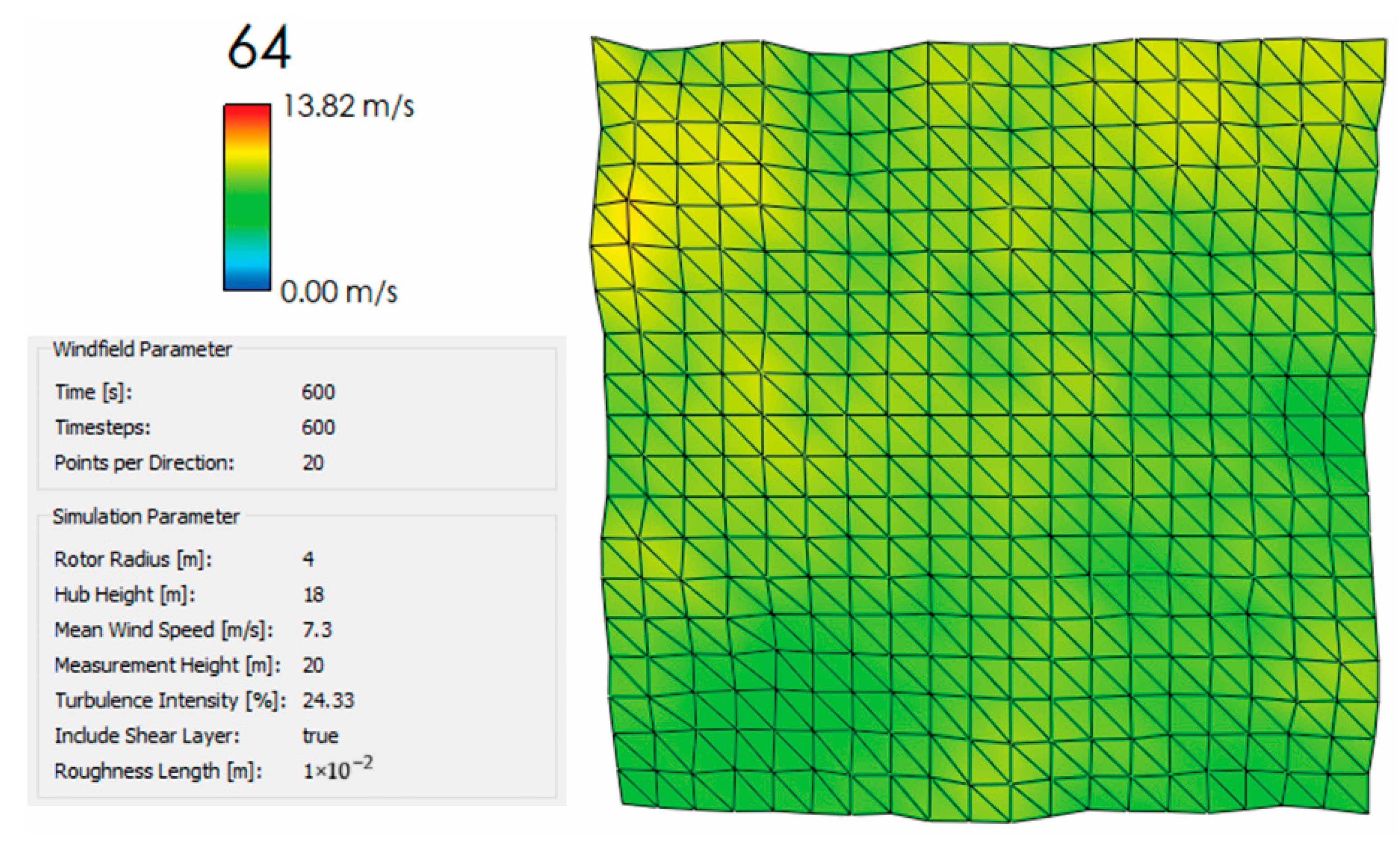
Long-term wind speed measurement for more than one year requires tremendous expense and time-consuming efforts. Predicting the fatigue life of a blade requires at least a 0.5 Hz wind speed history. However, it is extremely difficult to measure such a wind speed history over a year [23]. To overcome this limitation, the wind field was determined using Qblade software. Qblade allows generation of a wind speed history for a simulation time of 10 min from a given average wind speed. Table 5 defines the input data. For the rotor radius, a slightly larger value is added to avoid convergence problems in the simulation with the aeroelastic algorithm.

3.3. Fatigue Loads

The forces and moments generated in the rotor when operating under defined conditions are determined using the FAST sub-module incorporated in the Qblade software program. The FAST (Fatigue, Aerodynamics, Structures, and Turbulence) code is a comprehensive aeroelastic simulator capable of predicting the extreme and fatigue loads of two- and three-bladed horizontal axis wind turbines (HAWTs).
The simulation time selected for the FAST sub-module is 10 min. To obtain the time series, simulations of the previous stages are needed, such as a simulation of the rotor using BEM, a simulation of the wind field, and the structural data of the blade, defined as a solid without internal structure. The parameters necessary to carry out the FAST simulation are shown in Table 6 below, where the rotational speed is considered constant at its nominal value.
The parameters that Qblade allows modification of for execution of the FAST algorithm are:
-
StallMod [STEADY/BEDDOES]: this parameter adjusts the simulation to consider stall dynamics (BEDDOES) or not (STEADY) [23]. For wind turbines with stall, “BEDDOES” must be selected, and for wind turbines with pitch, “STEADY” must be selected. This is the only parameter of the FAST simulation to be considered for the simulations to be performed.
-
UseCm [NO_CM].
-
InfModel: [EQUIL/DYNIN]: select between the generalized dynamic wakefulness model (DYNIN) or the balanced inflow model (EQUIL) [23]. For this case, the balanced inflow model has been selected.
-
IndModel [SWIRL/WAKE/NONE]: if the simulation has a balanced inflow model, the “SWIRL” option [23] must be selected for this parameter.
-
TLModel [PRANDTL/GTECH/NONE]: this parameter enables the peak loss model [23].
-
HLModel [PRANDTL/NONE]: enables the hub loss model [23].
The output of the FAST sub-module is the time series of moments on the principal axes for each blade section.

3.3.1. Cumulative Fatigue Damage

The model used to generate the wind signal was not validated with real measurements. What was used was an annual database with measurements at 10 min intervals, where descriptive statistics were obtained from the database, such as average speed and standard deviations at a reference height, and the turbulence index was defined according to the IEC 61400-2 standard.
Once the 10 min cycle count is complete, the cumulative fatigue damage is estimated. Then, from the Weibull distribution, the probability of the wind speed, being between Vp and Vp+1, is calculated using Equation (21).
f V p < V 0 < V p + 1 = e x p V p c k e x p V p + 1 c k
where c is the scale parameter estimated as c = V ¯ Γ ( 1 + 1 k ) , k is the shape parameter estimated as k = σ V ¯ 1.086 , and V ¯ and σ are the mean wind value and standard deviation of the wind data samples, respectively. The actual number of annual 10 min periods in which the wind speed is in this range is 6 · 8760 · P(VP < V0 < Vp+1), where 8760 is the number of hours in a year, and 6 corresponds to the number of 10 min intervals in an hour. The number of cycles per year, nij, is calculated by summing the contributions of each wind speed interval using Equation (22).
n i j = p = 0 P 1 m i j V p < V 0 < V p + 1 · 6 · 8760 · P V p < V 0 < V p + 1
where P is the maximum wind speed recorded in the wind time history. The matrix with elements nij represents the number of annual cycles. Therefore, the total number of cycles in the whole lifetime is presented in Equation (23).
n t o t , i j = T · n i j
where the useful life T is measured in years. To estimate T, the Palmgren–Miner rule, Equation (16), is used for the accumulated damage during cyclical loading. This rule assumes that the ratio of the number of applied load cycles nij with a mean load level Mm,i and a load range Mr,i to the number of cycles Nij, which, at the same average load and the same load range would lead to failure, constitutes the fatigue life wear portion, and that the sum of these ratios is thus the damage D. Thus, the criterion for non-failure is that D is less than 1 ; see Equation (24).
D = 1 n t o t , i j N i j

3.3.2. Equivalent Effort

The stress σZB(x, y) in any blade cross-section comes from the bending moments about the two principal axes MX and MY and the normal force [46], and is calculated by the following equation relating stress and strain (Equation (25)).
σ Z B x , y = E x , y ε Z B ( x , y )
The deformation ε is calculated according to Equation (26).
ε Z B x , y = M Y B x E   I Y M X B y E   I X + F Z B   E A
where E is the elastic model of the material, IX, IY, and A are structural properties of each local station, and x and y are the distances from the cross-section surface to the neutral axis.
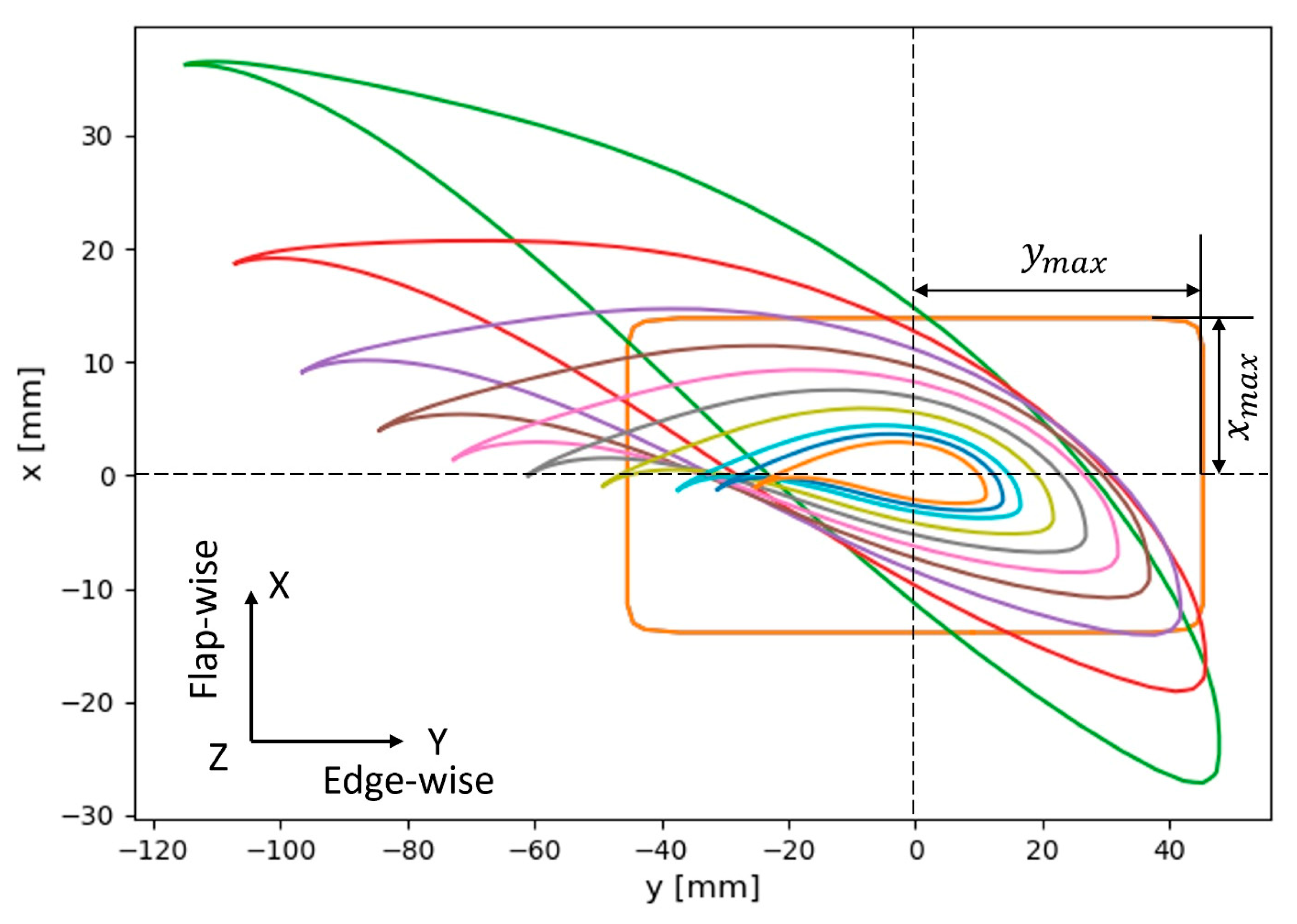
It is assumed that the main axis of the blade coincides with the centroid of the cross section of the clamping zone and the airfoil zone. The maximum stress is mainly con-centrated on the surface of Xmax and Ymax of each aerodynamic profile and the (rectangular) root profile, as shown in Figure 5. Therefore, the deformation of each local zone due to the bending moment is expressed by Equations (27) and (28).
ε Z B , B = M X B y m a x E   I X
ε Z B , A = M Y B x m a x E   I Y
The validation of the experimental modal analysis for dynamic characterization of the pre-experimented and post-experimented system is described below.
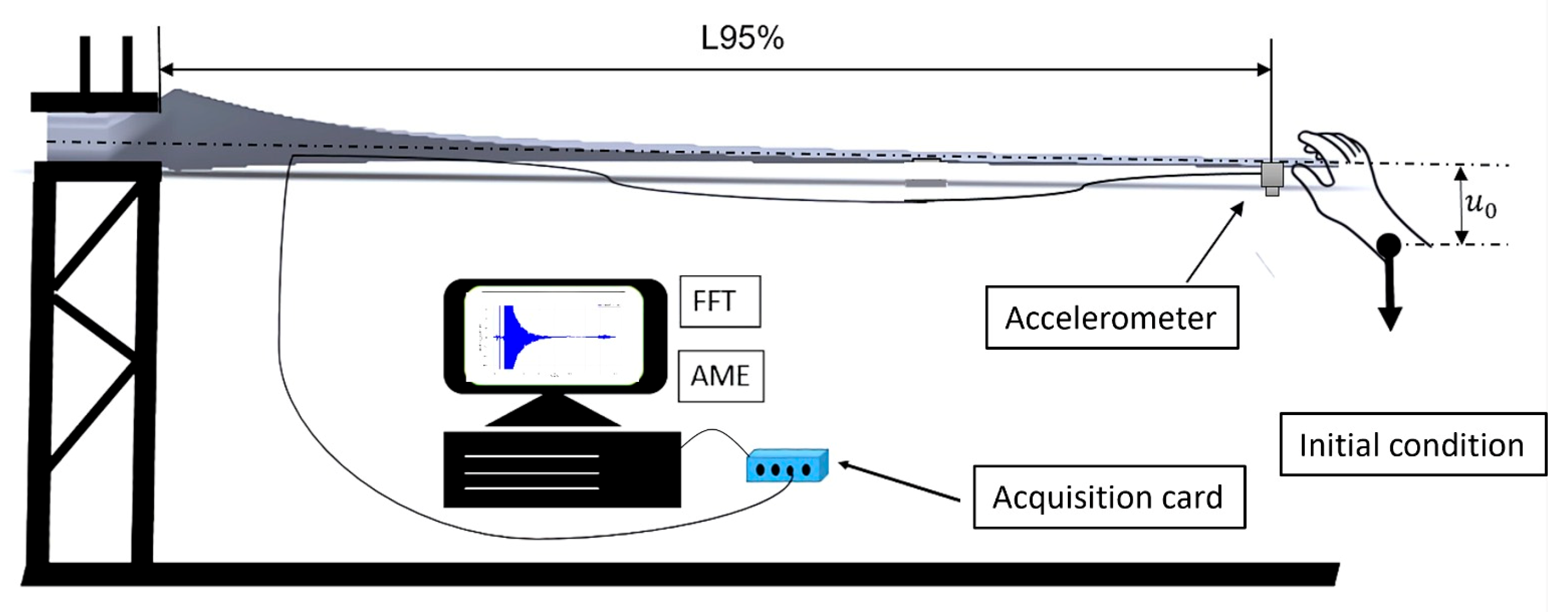
To validate the mathematical models, it is necessary to submit the element to fatigue analysis. Initially, the dynamic response was determined to emphasize the natural frequency of the first mode of vibration of the blade. Figure 6 shows an ideal study system for dynamic characterization of a blade and census of its free response behavior. Within this system, a working environment configuration was developed using a Kistler accelerometer type 8640A5 (Kistler Group, Winterthur, Switzerland) with a sensitivity of 1061 mV/g. The measuring equipment was located at the tip of the blade (L95%) to observe the behavior at a deformation of 8 cm of the initial condition (u0). The Fast Fourier Transform (FFT) technique was implemented, with the objective of transforming the time domain to the frequency domain and obtaining the frequency response function (FRF).
For development of the resonance excitation device that was built for the experimental platform (see Figure 6), the theory of rotating machines was implemented, which states that, if it has generated an unbalanced behavior, it will provide a centrifugal force that is given by a mass, an eccentric, and the square of the rotation speed.
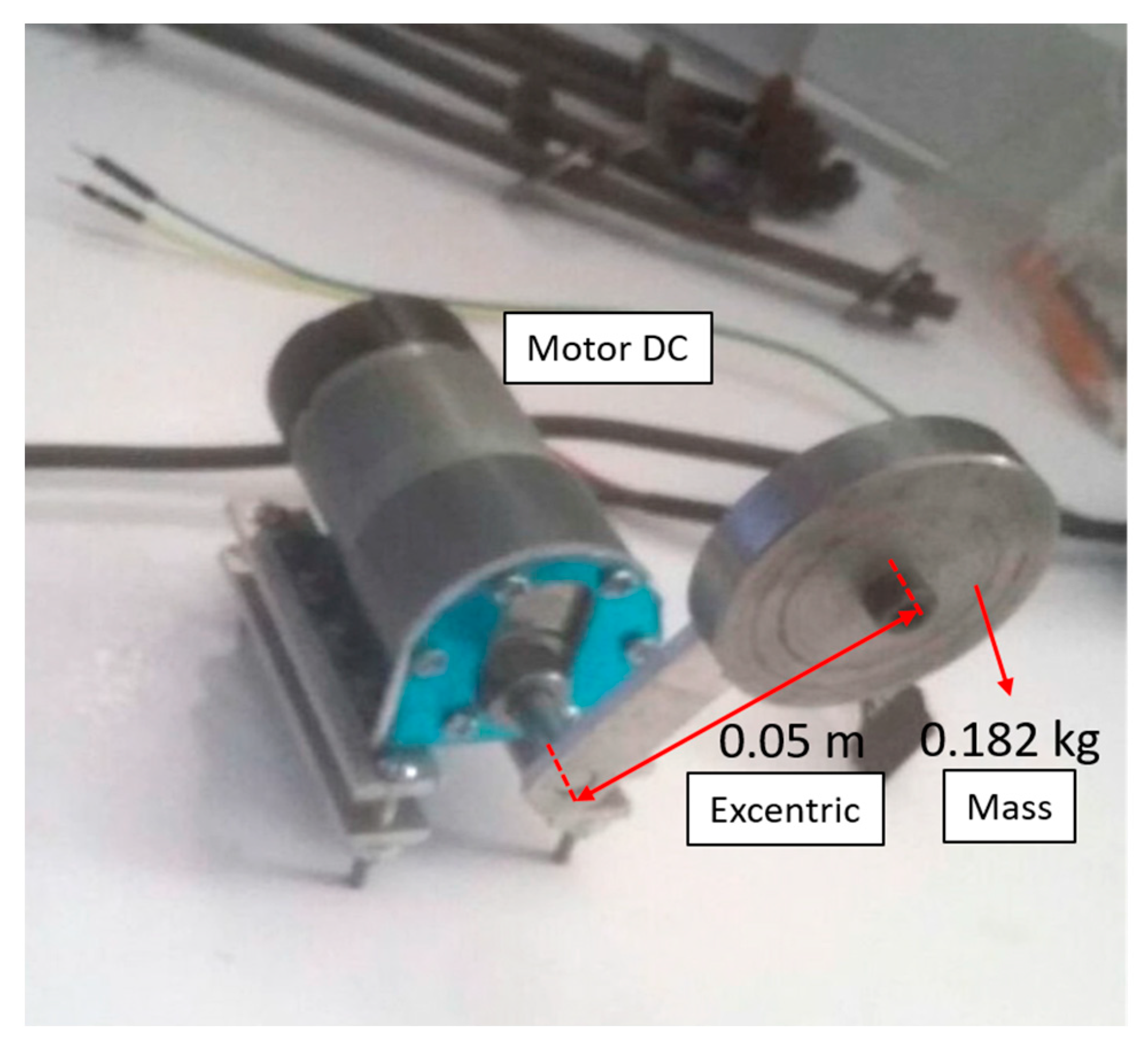
The weight of the rotating mass that makes up the exciter device was determined empirically, and tests were also carried out with different modifications of the motor rotation center, resulting in the optimal and necessary values to create a resonance excitation mechanism, as shown in Figure 7. Applying Equation (9) and eliminating the sinusoidal function, the maximum centrifugal force that can be reconstructed in the dynamic tests is calculated, being written as Equation (29):
F c , m a x = m · e · ω 2
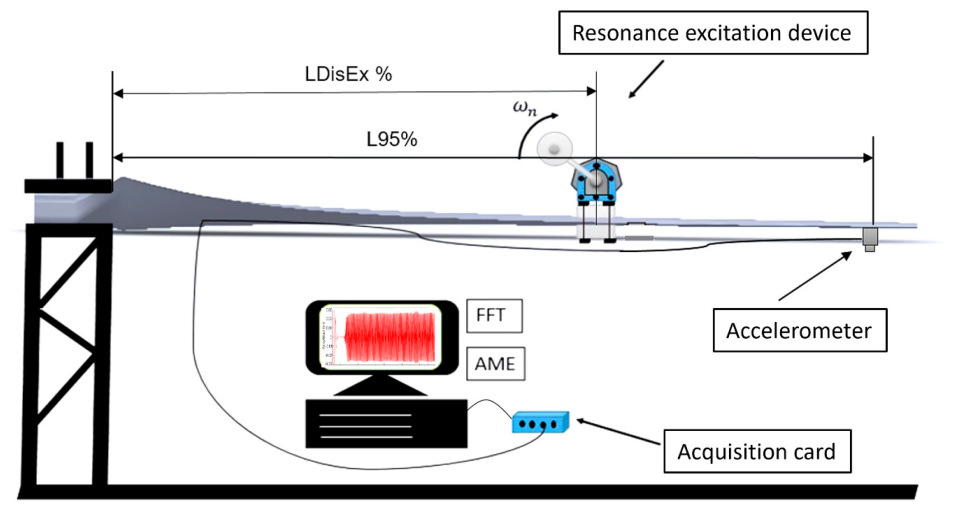
After having obtained the parameters of the experimental system, we proceeded to configuration of the fatigue behavior analysis based on the test bench accelerometer technique for wind turbine blades, as shown in Figure 8. The parameters to be considered to reproduce the target load (Mtraget) on the test bench are the location of the excitation device with respect to the blade length from the second root profile (LDisEx%) and the percentage of the angular velocity to be applied in the rotating system (ωn).
The values that are compared analytically and experimentally are the natural frequency and the displacement amplitude at the blade tip. In the experimental tests, the resonances for the first mode of vibration may have more than two values, so the value closest to the theoretical resonance frequency is considered. The result of the frequency may have been an error in the analysis due to the variation in the geometrical shape of the manufacture against the shape of the blade in the CAD.
The experimental modal analysis for dynamic characterization of the system pre-experimentation and post-experimentation is described below.
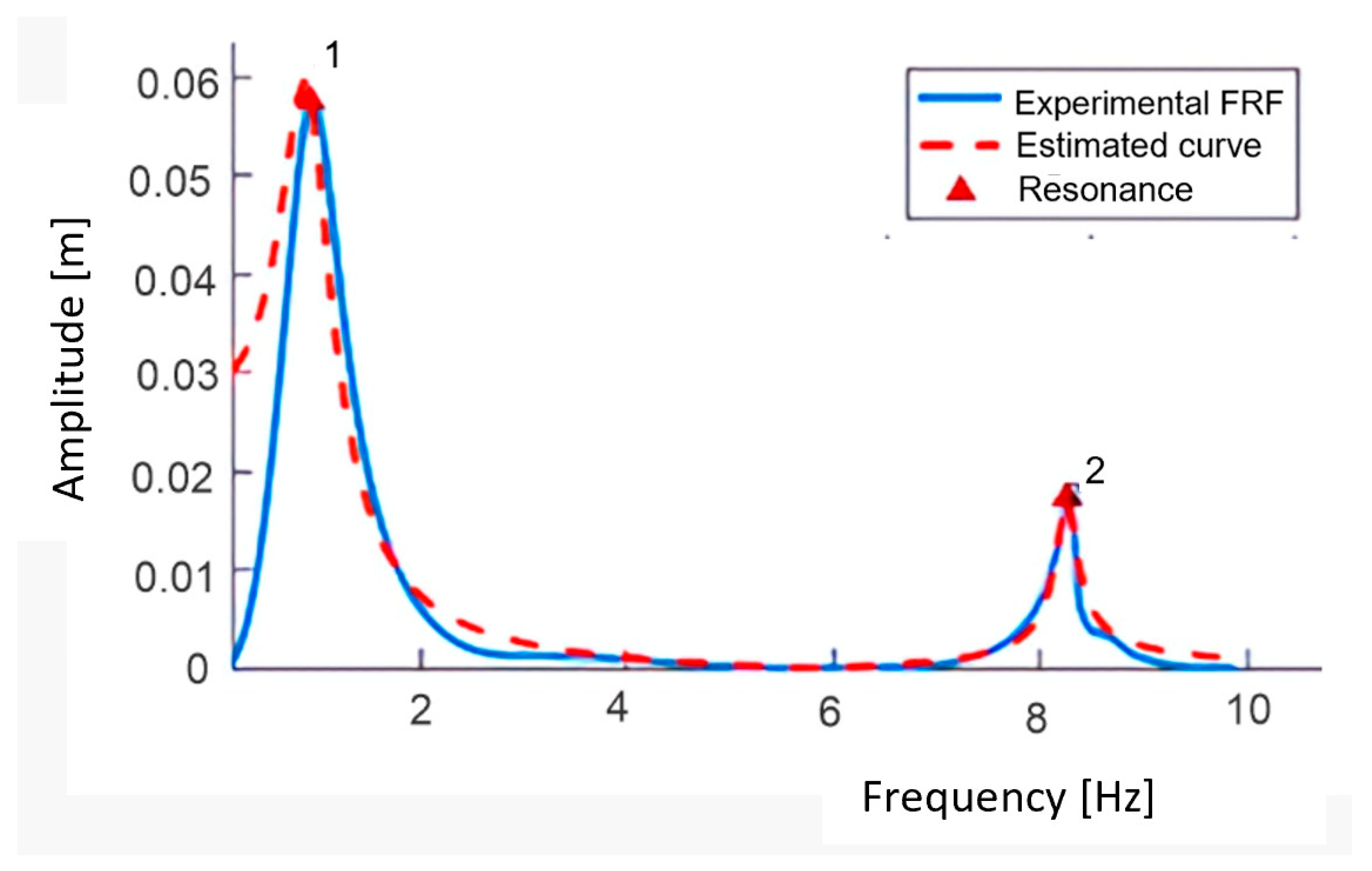
In the pre-experimental stage, after having surveyed the blade behavior in the time domain analogous to a cantilever beam and applying the FFT to obtain the FRF, as shown in Figure 9, whose values can be appreciated, the peak with the highest amplitude gives a natural frequency value between the range of 0–2 Hz corresponding to the first mode, and the smallest peak registers a natural frequency between the range of 8–10 Hz, corresponding to the second vibratory mode. These are unidirectional results; in this way, it is only possible to identify this type of vibration experimentally.
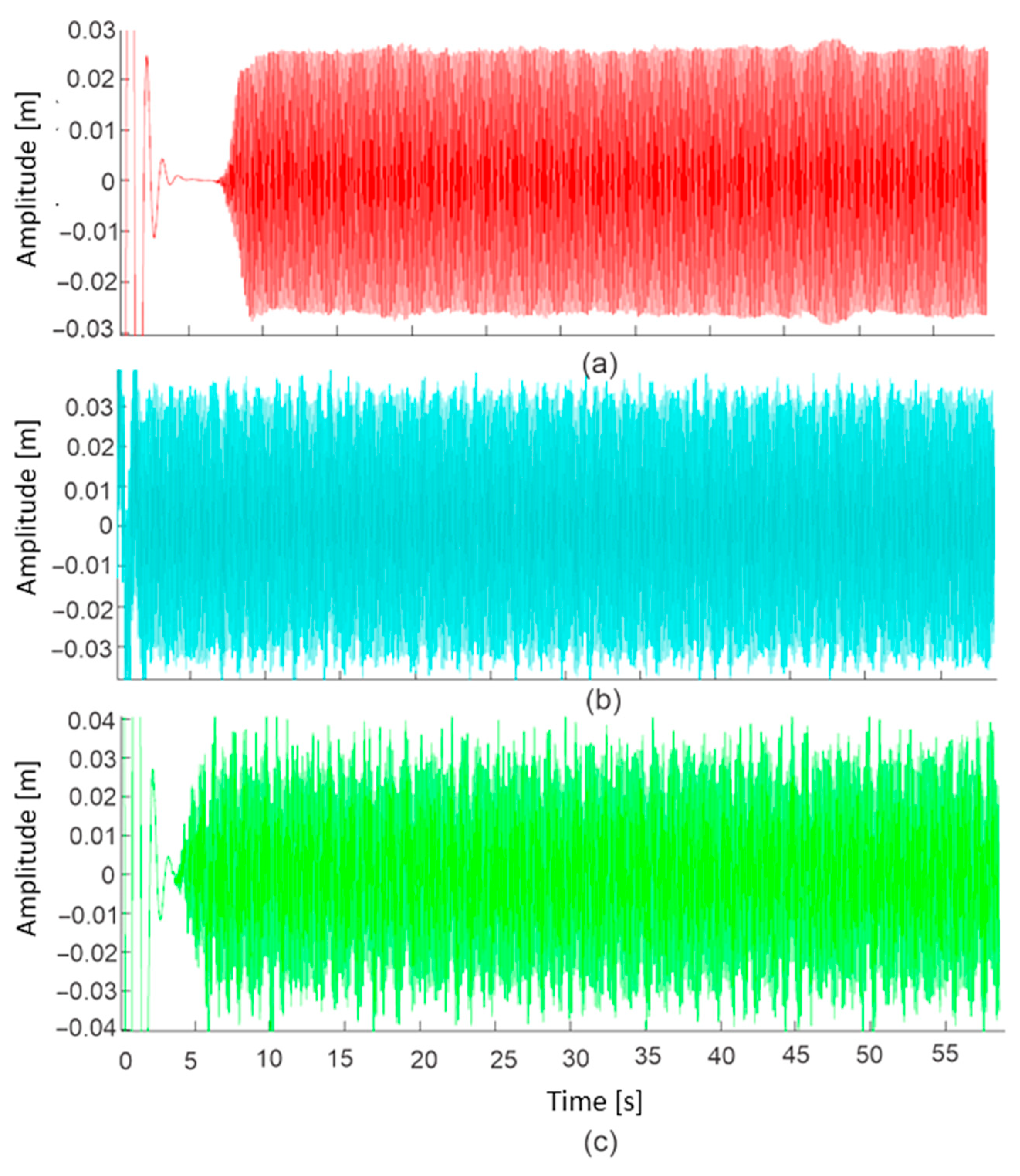
For the study of fatigue behavior and to observe the degradation of the material stiffness caused by the dynamic behavior to which the blade was exposed, the vertical displacement amplitude was reconstructed with the parameters obtained in the dynamic simulation. For this purpose, trial and error measurements were carried out, which were censored by the accelerometer located at 95% of the blade length (1.452 m) and the position of the exciter system at 75% (1.146 m). The measurements were performed in periods of 10 h of experimentation and thus give a time margin to generate damage in the system caused by the reconstructed reversible load. Figure 10 shows three different time series of vertical displacement in the accelerometer position with respect to time; in Figure 10a, it has the amplitude for the beginning of the first 10 h of measurement, and we can notice a more stable amplitude that remains constant. In Figure 10b, it has the measurement of the beginning for 30 h, and it is possible to notice perturbations in the amplitude. Finally, in Figure 10c, it has the measurement of the onset for 40 h, and the variation of the amplitude is more noticeable.
In the post-experimental stage, we sought to measure the behavior of the vibratory response of the blade after having suffered damage caused by the exciter device. The frequency response function signal obtained by the impact hammer was able to show two vibratory modes. The comparison of the pre-experimentation and post-experimentation tests using an impulse as excitation is shown in Table 7, where it can be observed that the maximum difference is 6.769%, corresponding to the first mode, and the minimum discrepancy is 2.273%, resulting from the second mode. In this way, through experimental modal analysis, the cumulative damage suffered by a blade subject to fatigue behavior in an experimental environment is predicted. The percentage error of 6.769% is taken as a metric to quantify the percentage error caused in the material. If the error moves away from zero, the material will have absorbed considerable damage.
The test frequency ranging from 8.2353 Hz reduces the fatigue test to 53.83 h for several cycles, equivalent to 1.6 × 10⁶ cycles. For this, the damage stored in the material corresponds to 6.769%. Using Miner’s approach, the damage caused in the simulation for several cycles to failure of N = 8.6012 × 10⁶ corresponds to 0.1860, fulfilling the criterion for non-failure.
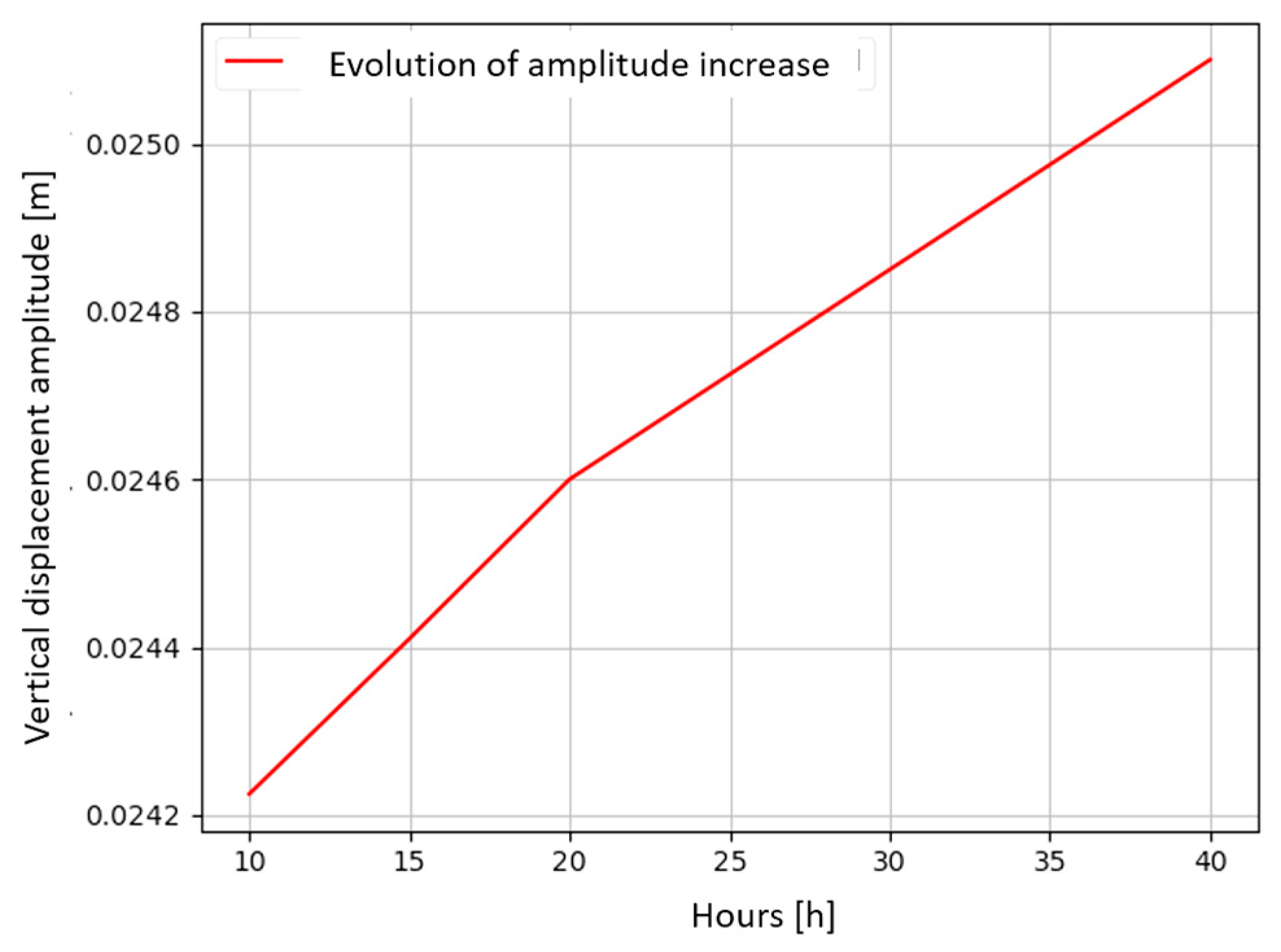
Figure 11 shows the graph of the evolution of the amplitude of the censored signals for each hour, showing a behavior that tends to be linear, but there is a margin of error caused by the vibration and the shock provided by the excitation device to the structure at the moment of taking the readings with the accelerometer. The results show an increase in amplitude magnitude ranging from 0.02425 to 0.02511 m, with a relative difference with respect to the first measured amplitude equivalent to 3.42%.
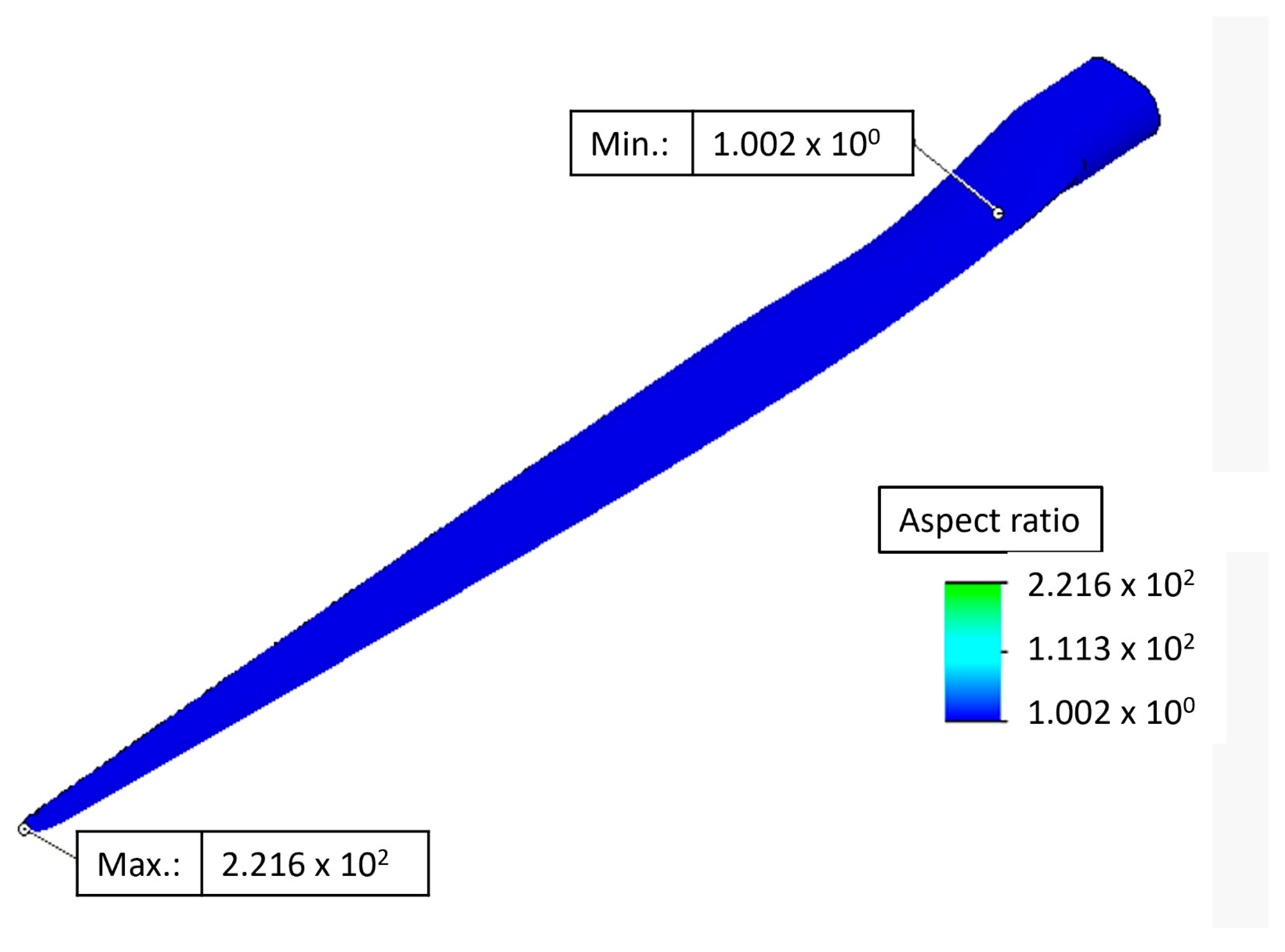
Based on the load data, the blade was simulated by means of CAD and numerical solution, previously verifying the quality of the mesh. The aspect ratio is a parameter to measure the quality of the elements in a mesh. The aspect ratio of a perfect tetrahedral element is 1.0. A good-quality mesh has an aspect ratio of less than five for most of its elements (90% and higher).
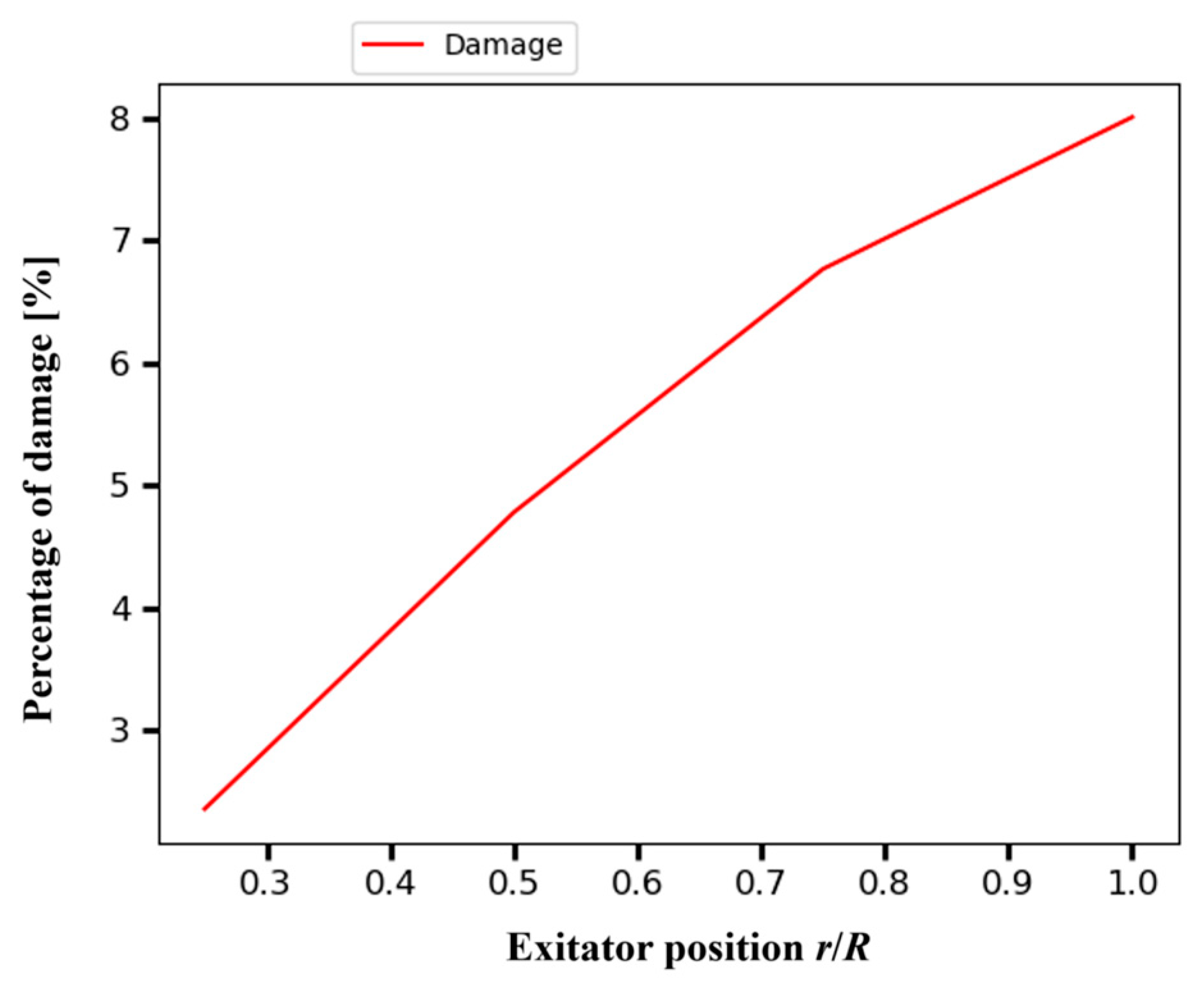
A sensitivity study was conducted to examine how the dependent variable relates to the location of the excitatory device on the blade. Figure 12 shows that the damage increases linearly, with the position at the tip producing the most significant damage. Therefore, it could be concluded that the damage is proportional to the distance of the driver from the first root profile.
There is no empirical relationship linking the width at the tip of the blade due to loss of rigidity with damage. However, observing both behaviors, they show linear growth in their graphs. What this analysis seeks is the damage trend; the function that approximates this behavior is given by y   =   0.00 x   +   0.02 .
The aspect ratio is a parameter used to measure the quality of the elements in a mesh. The aspect ratio of a perfect tetrahedral element is 1.0. A good-quality mesh has an aspect ratio of less than five for most of its elements (90% and above). Figure 13 shows the aspect ratio of the elements of the blade; in the tip area, there is an element with a considerable aspect ratio.

4. Discussion

The results are consistent, because the lifetime depends on the estimated maximum damage. A previous study [13] presents the fatigue analysis for a 10 kW wind turbine blade. The authors define damage as a function of wind speed (Vi), turbulence intensity (IT), and power regulation system (reg). In this study, a speed of 6 m/s, a low IT, and a stall regulation system are used; applying Equation (17), a life period of 72.72 × 10³ was obtained. In [13], for the same conditions, life years on the order of 103 were obtained. The approach used in this study and those used in other references such as [1,23] are similar. In general, the approach of this work takes the methodology applied in the fatigue study of large-scale wind turbines and seeks to replicate it on a small scale, quantifying the damage in the material by increasing the amplitude at the blade tip and the variation in its natural frequency after the post-experimental stage. Additionally, considering the addition of real-time monitoring capabilities, as in [24], could lead to better results. For larger turbines, the effect of turbulence must first be taken into account, as this value varies with height. This is followed by applying the other load cases specified by the IEC 61400-1 standard for large turbines. In addition, gyroscopic forces, the effect of the yaw system, pitch, and emergency stops must be taken into account. In addition, it is important to be more specific about the lateral fatigue that occurs at the blade edge.
According to Liu [44], the most critical or sensitive thing about wind turbine blades is that they are made of different materials which are difficult to separate or recycle. The fatigue analysis was performed on design load case 1.1 (normal operation) at the root and at other local blade sections. This load case generates more significant damage than the other load cases. Real-time wind signal readings are discrete; measurements are taken every 10 min over a year, so behavior within this interval is unknown. To address this, a variable spectrum with a duration of 10 min is simulated. Taking into account the load cases for small-scale wind turbines in the IEC 61400-2 standard, which only considers normal operation, it is assumed that the wind turbine will be operating under normal conditions using a spectrum generated as a sum of harmonics. There is no guarantee that the simulated wind will consider the full range of stochastic events such as gusts. What is expected in this analysis is that the blade will not fail; rather, the intention is to quantify the accumulated damage to the material.
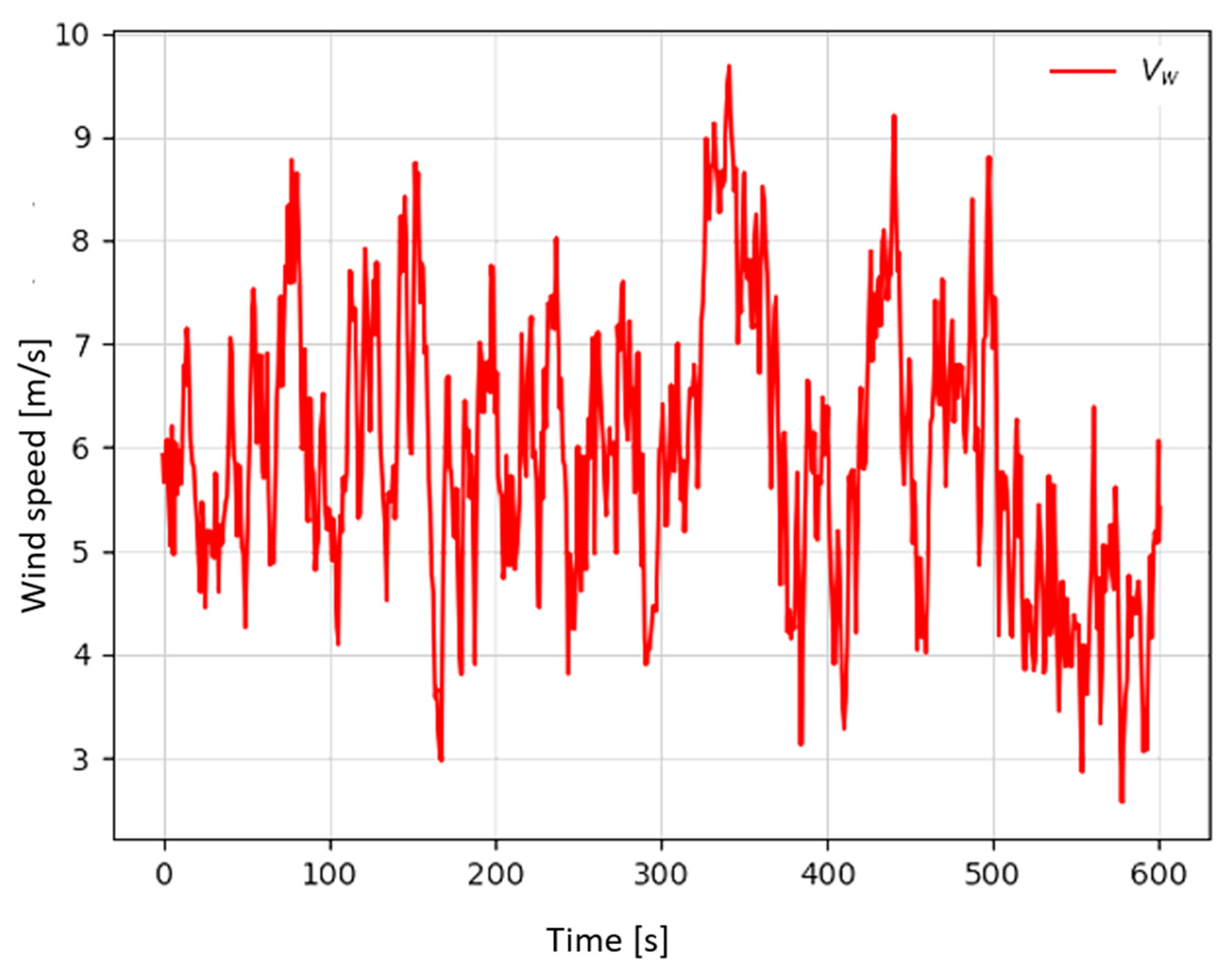
The load times series were carried out using FAST aeronautical software for wind speeds between 2 m/s and 10 m/s. First, a wind speed series was generated at 0.9983 Hz for a mean wind speed of 5.916 m/s and a simulation time of 600 s, as shown in Figure 14.
The fatigue analysis was carried out in accordance with the load case specified by IEC 61400-2 (design requirements for small wind turbines), applying the frequency of occurrence using the Weibull distribution, specifically design load case A: normal operation. During the measurement campaign, the data must be classified according to wind speed and turbulence intensity. This case involves considering wind variability for the entire rotor sweep area according to turbulence intensity.
The wind speed pattern is distributed unevenly over the wind turbine blades, as wind speed increases with altitude. As a result, there is torque fluctuation with low-frequency components that is proportional to the turbine speed.
The variation in wind speed in relation to height is called wind shear. The fluctuation in wind speed can be represented as Equation(30) [49].
U 2 U 1 = h 2 h 1 α
where h is the height of the point considered, U is the corresponding wind speed, and α is the empirical wind shear exponent that depends on the roughness of the terrain and its control range of the tilt angle from 0.25 to 0.35.
Therefore, although small turbines suffer from wind shear, the variation in wind speed between the upper and lower parts of the swept area is smaller than in large wind turbines. The wind speed profile in the rotor zone is almost uniform, because the swept area of a small turbine is smaller, which causes the effect of shear to be less pronounced in terms of cyclic load.
Additionally, because the wind field simulation was determined in QBlade, the wind direction is in a single direction (perpendicular to the plane of rotation), without any change in direction, so loads due to the yaw effect are not considered. The cyclic rotation of the wind turbine becomes a stochastic wind speed signal that changes over time, with periodic elements anywhere along the rotor blade. This is a consequence of the finite spatial coherence (different from zero and different from one) of real wind fields.
Uniform Wind Profiles: Even in “uniform wind field” mode, QBlade allows the user to define wind speed profiles with shear. Common models such as the power law or logarithmic profile can be used, allowing for realistic simulation of wind speed increase with height. This is crucial for understanding how higher wind speeds at the blade tip and lower speeds at the base affect performance and structural loads [48].
Turbulent Wind Fields: For more advanced and accurate simulations, QBlade integrates turbulent wind field generators, such as NREL’s TurbSim or DTU’s Mann generator. These third-party programs, which run in the background, create wind files that already include the effect of wind shear along with turbulence. These models are essential for meeting IEC (International Electrotechnical Commission) certification standards and for predicting fatigue loads.
Figure 14 shows the simulation of 600 s corresponding to a wind field with the simulation parameters mentioned above and with a turbulence intensity of 24.33% in QBlade software, enabling wind shear with a roughness length of 1 × 10⁻².
A hybrid dual-axis resonant/forced-displacement hybrid test method was developed at NREL, in which the blade loading was imparted by resonance, and the edge direction was forced by a hydraulic cylinder operating a bell crank. This method has the advantage of allowing the phase angle between the two loads to be controlled, but it will be difficult to scale for large blades, and the bending moment distribution at the edge can only be linear. However, its application on a small scale can be advantageous to save time in testing. Time series loadings were obtained at the blade root located at a radius of 1.171 m, as shown in Figure 15.
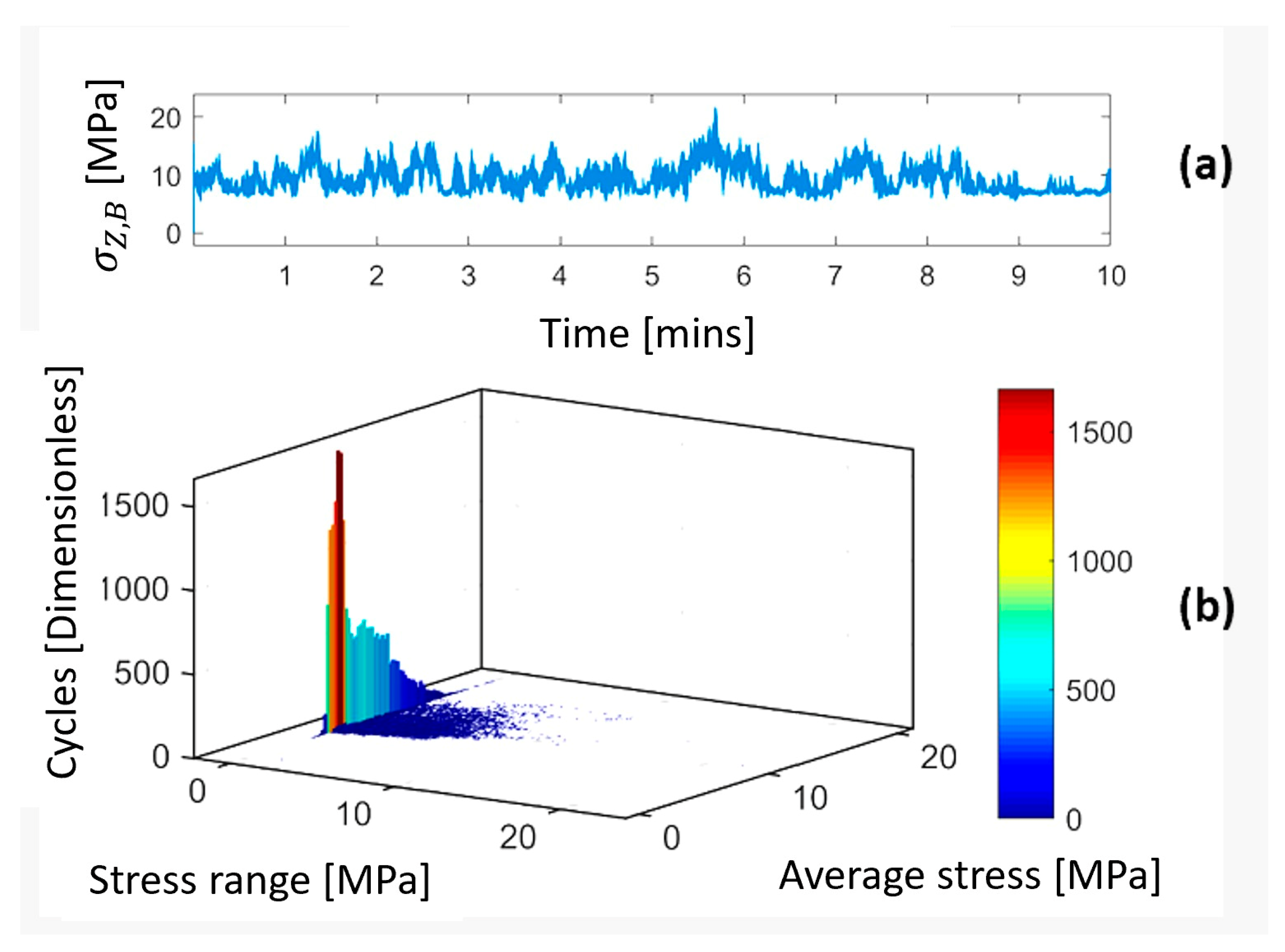
MYB moments are completely fluctuating loads due to wind variation, unlike MXB loads, which are of alternating type and depend on rotor rotation and the blade weight itself. The axial force FZB is fluctuating load and is generated due to centrifugal force due to rotor rotation. The stress was calculated by Equation (18) and generated a time series with a fluctuating-type load, where the contribution due to wind load is more significant. A cycle count of the stress time series σZB in Figure 15 was performed, generating a matrix that groups the load cycles (for each stress range and mean stress). Figure 16 shows a concentration of cycles for the stress range close to zero, and the mean stress close to 6 MPa. In the context of fatigue, the material accumulates the stress range, and the mean stress specifies the type of loading; in this case, a mean stress value greater than zero is defined as fluctuating loading.
To determine the contribution of each wind speed, the rainfall flow matrix was separated into sub-matrices corresponding to each wind speed interval, which allowed calculation of the equivalent stress and mean range for each condition. mij is separated into several matrices, each corresponding to each wind speed, so that the equivalent for the stress and mean range is calculated for each wind speed interval. Each matrix was weighted with a Weibull curve (a mean wind speed of 6 m/s was considered), and the number of hours for an annual distribution is shown in Table 8.
Table 9 shows the load range σz,range, the average load σz,mean for each wind speed range, and the total number of cycles for a one-year operation n i for an operating period of one year, as well as the number of cycles the material can withstand before failure. Ni is the number of cycles the material can withstand before failure. The damage caused by each wind speed interval is calculated using Miner’s rule. Dtot, the total damage, is less than unity, so the material will last for its lifetime.
Furthermore, the study’s use of the equivalent damage load provides a simplified yet accurate representation of cumulative damage over the blade’s lifetime. This method contrasts with more complex models requiring detailed turbulence and gyroscopic force simulations, as highlighted in Kong et al. [5]. While the simplifications reduce computational requirements, they may limit applicability to larger turbines, where these forces become significant.
The predicted fatigue life of over 20 years under normal operating conditions validates the robustness of the methodology. Comparisons with experimental data indicate an error margin of less than 10%, which is within acceptable limits for industry standards. However, future work should address the inclusion of non-linear effects, such as gyroscopic forces, to enhance the model’s applicability to a broader range of turbine designs.
These findings underscore the potential of resonance-based fatigue testing for small-scale wind turbines, offering a cost-effective and energy-efficient alternative to traditional methods. The results not only advance our understanding of blade fatigue behavior, but also pave the way for optimizing the design and testing of wind turbines in emerging markets.
The proposed method simplifies the process of dynamic load measurement and fatigue life estimation by employing a resonance-based approach. This reduces energy and cost requirements compared to forced displacement methods while maintaining accuracy in replicating damage equivalent loads. Additionally, it avoids the complexities of simulating real-world turbulence by using controlled conditions, ensuring reproducibility.
Scaling up fatigue analysis on large-scale wind turbine blades is a critical aspect of ensuring their durability, safety, and cost-effectiveness over their lifetime. As blades grow in size and flexibility, fatigue analysis challenges multiply. Therefore, it would be necessary to adapt a new aerolastic analysis to include such effects. Key strategies would be to focus initially on advanced modeling of loads and aerodynamics. Wind turbine blades are subjected to complex dynamic loads due to wind and rotation. For large-scale blades, more accurate modeling is crucial:
  • High-fidelity aerodynamics: Beyond simplified models, Computational Fluid Dynamics (CFD) is used to simulate the airflow around the blades. This allows capturing of complex phenomena such as turbulence, wake (the disturbance of air behind a blade), and nonlinear aerodynamic effects that are more pronounced in large, flexible blades.
  • Coupled aeroelasticity: The interaction between aerodynamic loads and blade structural deformation becomes critical. Coupled aeroelastic models simulate how the blade shape changes under wind and how this change, in turn, affects aerodynamic loads. This is essential to accurately predict fatigue-inducing bending moments and torques.
  • Realistic turbulence modeling: More sophisticated turbulence models that reflect actual site conditions (onshore or offshore) are used, as the intensity and spectrum of turbulence directly impacts the variability of fatigue loads.
Additionally, scaling strategies and uncertainty management are required:
  • Extensive Design Load Cases (DLCs): A large number of operational and environmental scenarios are defined according to international standards to cover all possible combinations of wind, operation, and failures. For larger blades, the number and complexity of these DLCs increases.
  • Long-term simulations and extrapolation: Aeroelastic simulations are run for significant periods of time. However, to cover the full lifetime (20–25 years), statistical and extrapolation techniques based on probability distributions of loads and damage are used.
  • High-Performance Computing (HPC): Detailed aeroelasticity and FEM analyses of large blades are computationally intensive, requiring the use of supercomputers and parallel algorithms to reduce simulation times.

5. Conclusions

This study has developed and validated a simplified model to estimate the fatigue life of wind turbine blades, using dynamic resonance techniques to replicate equivalent loads with an acceptable error of 10%. The primary objective of this work is to experimentally validate fatigue analysis of composite material blades using a simplified method that allows estimation of the load equivalent and enables the desired damage to be reproduced on a test bench. The case study element is for a low-power wind turbine subjected to high turbulence levels due to its height above the Earth’s surface. The tolerance for replicate loads is within a margin of 10%. This value has not been fully defined; rather, it is taken as a reference for this study. IEC 61400-23 does not specify the percentage to adjust the loads.
It is important to mention that the proposed method is potentially scalable to larger commercial turbines. The resonance-based approach for dynamic load measurement and fatigue life estimation is not inherently limited by the size of the turbine. However, scalability would require addressing additional complexities associated with larger turbines, such as increased material stresses, more pronounced aerodynamic forces, and gyroscopic effects. These factors would necessitate further validation through simulations and experiments tailored to the specific structural and operational characteristics of larger turbines. Future studies could explore these adaptations to confirm the method’s applicability at a commercial scale.
The comment on both energy and economic savings in this type of testing highlights one of the advantages provided by this method, due to its simplicity. To determine the cost of equipment, it is necessary to perform an analysis that considers both economics and energy consumption, an approach that is not addressed in this study. However, in a general comparison of certain equipment used in the industry, one finds the GREX (a system using ground resonance excitation) and the IREX (a system using inertial resonance excitation). GREX has a force capacity of up to 100 kN, which requires an accumulation of 150 L; on the other hand, the IREX produces a force of 50 kN and requires an accumulation of only 2 L.
Therefore, the fluctuating wind load, and consequently the damage stored in the material, are studied. Based on this conducted study of degradation and life prediction theories used to assess the behavior of blades under fatigue loads, as well as simulations and experimental tests, and analysis of the obtained results, the following conclusions are drawn:
(a)
The estimated blade lifespan meets the design requirement with a duration of over 20 years for the wind field generated, according to data from the Wind Technology Regional Center (CERTE) Meteorological Station. Therefore, only the design load case under normal operation according to the IEC 61400-2 standard is considered and analyzed. This standard is specifically intended for small-scale wind turbines. The programmed algorithm estimates the equivalent load and the damage caused to each wind speed interval in the generated field.
(b)
The estimated total damage does not consider contributions from damage caused by gyroscopic forces on the rotor; only normal force, tangential force, and centrifugal force were considered.
(c)
With the chosen input parameters for the excitation system in dynamic simulations for both out-of-plane and in-plane directions, the equivalent damage load is replicated. It is approximately 45% of the blade length in the areas closest to the root, with a tolerance of 10% in the error. Therefore, it is considered possible to reproduce the damage caused over a 20-year lifespan for the critical attachment zone on the blades.
(d)
The result of the first natural frequency calculated using the modal analysis method programmed in Matlab version R2018b has a relative error difference of 1.158% for the natural frequency with deflection in the out-of-plane direction compared to the experimental test. This validates the programmed algorithm, considering a 5% tolerance in the error difference, as previously documented.
(e)
The approximation of the target load with the experimental test was determined through trial and error, mainly due to the location of the excitation device. For the simulation, the device was placed at 62%, while for the experimental test, it was 75% concerning the radius, resulting in a 13% difference. What this part of the study actually sought to do was to experimentally replicate the same amplitude range at the tip of the blade as seen from a theoretical point of view; this is because the bending moment could not be measured in the experimental tests. The variation in the position of the load could be affected in the same way by the definition of stiffness, since this parameter depends on the geometric characteristics and elastic properties of the material. Seen from another point of view, the theoretical analysis was used to approximate the application of the oscillating load.

Author Contributions

Conceptualization, C.A.J., G.H.G., J.R.D.P., A.V.A., G.I.D., J.P.E., O.L.D., A.-J.P.-M., D.M.-R. and Q.H.-E.; methodology, C.A.J., G.H.G., J.R.D.P., A.V.A., G.I.D., J.P.E., O.L.D., A.-J.P.-M., D.M.-R. and Q.H.-E.; validation, C.A.J., G.H.G., J.R.D.P., A.V.A., G.I.D., J.P.E., O.L.D., A.-J.P.-M., D.M.-R. and Q.H.-E.; investigation, C.A.J., G.H.G., J.R.D.P., A.V.A., G.I.D., J.P.E., O.L.D., A.-J.P.-M., D.M.-R. and Q.H.-E.; writing—original draft preparation, C.A.J., G.H.G., J.R.D.P., A.V.A., G.I.D., J.P.E., O.L.D., A.-J.P.-M., D.M.-R. and Q.H.-E.; writing—review and editing, C.A.J., G.H.G., J.R.D.P., A.V.A., G.I.D., J.P.E., O.L.D., A.-J.P.-M., D.M.-R. and Q.H.-E. All authors have read and agreed to the published version of the manuscript.

Funding

This research received no external funding.

Institutional Review Board Statement

Not applicable.

Informed Consent Statement

Not applicable.

Data Availability Statement

Data will be made available upon request.

Acknowledgments

The authors express their gratitude to the Program for Support of Research and Technological Innovation Projects (PAPIIT) of the Universidad Nacional Autonoma de Mexico (UNAM) for the project “Determinación de fallas en álabes de aerogeneradores a través de procesamiento digital de imágenes y aprendizaje automático no supervisado IA103323”.

Conflicts of Interest

The authors declare no conflicts of interest.

Abbreviations

The following abbreviations are used in this manuscript:
MWMegawatt
IECInternational Electrotechnical Commission
BEMBlade element momentum
TWBThin-walled beam theory
GenAIGenerative artificial intelligence
UNISTMOUniversidad del Istmo
GFREGlass fiber-reinforced epoxy resin
CFRECarbon fiber-reinforced epoxy resin
GFRPGlass-reinforced plastic
HAWTHorizontal axis wind turbines
FASTFatigue, aerodynamics, structures, and turbulence
FFTFast Fourier Transform
FRFFrequency response function
CADComputer-Aided Design
MPaMegapascal
GREXGround resonance excitation
IREXInertial resonance excitation
CERTEWind Technology Regional Center

References

  1. Pimenta, F.; Ribeiro, D.; Román, A.; Magalhães, F. Predictive Model for Fatigue Evaluation of Floating Wind Turbines Validated with Experimental Data. Renew. Energy 2024, 223, 119981. [Google Scholar] [CrossRef]
  2. Cai, W.; Hu, Y.; Fang, F.; Yao, L.; Liu, J. Wind Farm Power Production and Fatigue Load Optimization Based on Dynamic Partitioning and Wake Redirection of Wind Turbines. Appl. Energy 2023, 339, 121000. [Google Scholar] [CrossRef]
  3. He, R.; Yang, H.; Sun, S.; Lu, L.; Sun, H.; Gao, X. A Machine Learning-Based Fatigue Loads and Power Prediction Method for Wind Turbines under Yaw Control. Appl. Energy 2022, 326, 120013. [Google Scholar] [CrossRef]
  4. Chanprasert, W.; Sharma, R.N.; Cater, J.E.; Norris, S.E. Large Eddy Simulation of Wind Turbine Fatigue Loading and Yaw Dynamics Induced by Wake Turbulence. Renew. Energy 2022, 190, 208–222. [Google Scholar] [CrossRef]
  5. Kong, C.; Bang, J.; Sugiyama, Y. Structural Investigation of Composite Wind Turbine Blade Considering Various Load Cases and Fatigue Life. Energy 2005, 30, 2101–2114. [Google Scholar] [CrossRef]
  6. Castro, O.; Belloni, F.; Stolpe, M.; Yeniceli, S.C.; Berring, P.; Branner, K. Optimized Method for Multi-Axial Fatigue Testing of Wind Turbine Blades. Compos. Struct. 2021, 257, 113358. [Google Scholar] [CrossRef]
  7. Zhang, Z.; Liu, L.; Shi, Y.; Zhang, K.; Liu, K.; Wang, S.; Hu, F. Analysis of Urban Turbulence Intensity Observed by Beijing 325-m Tower and Comparison with the IEC Turbulence Model for Small Wind Turbines. J. Wind Eng. Ind. Aerodyn. 2023, 241, 105511. [Google Scholar] [CrossRef]
  8. Chanprasert, W.; Sharma, R.N.; Cater, J.E.; Norris, S.E. Large Eddy Simulation of Wind Turbine Wake Interaction in Directionally Sheared Inflows. Renew. Energy 2022, 201, 1096–1110. [Google Scholar] [CrossRef]
  9. Bingöl, F. Comparison of Weibull Estimation Methods for Diverse Winds. Adv. Meteorol. 2020, 2020, 3638423. [Google Scholar] [CrossRef]
  10. Kang, Y.; Kim, H.; Lee, S. Benefits of Individual Pitch Control on Offshore Wind Turbine Submerged in Upstream Wake. Renew. Energy 2023, 217, 119127. [Google Scholar] [CrossRef]
  11. Zhang, Y.; Qin, X.; Han, Y.; Huang, Q. Vibration Amplitude Normalization Enhanced Fault Diagnosis under Conditions of Variable Speed and Extremely Limited Samples. Meas. Sci. Technol. 2023, 34, 125111. [Google Scholar] [CrossRef]
  12. de Aquino Ferreira, S.C.; Oliveira, F.L.C.; Maçaira, P.M. Validation of the Representativeness of Wind Speed Time Series Obtained from Reanalysis Data for Brazilian Territory. Energy 2022, 258, 124746. [Google Scholar] [CrossRef]
  13. Gruber, K.; Regner, P.; Wehrle, S.; Zeyringer, M.; Schmidt, J. Towards Global Validation of Wind Power Simulations: A Multi-Country Assessment of Wind Power Simulation from MERRA-2 and ERA-5 Reanalyses Bias-Corrected with the Global Wind Atlas. Energy 2022, 238, 121520. [Google Scholar] [CrossRef]
  14. Du, Y.; Zhou, S.; Jing, X.; Peng, Y.; Wu, H.; Kwok, N. Damage Detection Techniques for Wind Turbine Blades: A Review. Mech. Syst. Signal Process. 2020, 141, 106445. [Google Scholar] [CrossRef]
  15. Xiong, C.; Dai, K.; Luo, Y.; Yang, Z.; Du, H.; Tang, X. Integrated Fatigue Assessment Method Considering Average Stress Effects of Large-Scale Lattice Wind Turbine Support Structures. J. Constr. Steel Res. 2024, 214, 108492. [Google Scholar] [CrossRef]
  16. Wang, S.; Xing, Y.; Balakrishna, R.; Shi, W.; Xu, X. Design, Local Structural Stress, and Global Dynamic Response Analysis of a Steel Semi-Submersible Hull for a 10-MW Floating Wind Turbine. Eng. Struct. 2023, 291, 116474. [Google Scholar] [CrossRef]
  17. Akpan, A.E.; Ben, U.C.; Ekwok, S.E.; Okolie, C.J.; Epuh, E.E.; Julzarika, A.; Othman, A.; Eldosouky, A.M. Technical and Performance Assessments of Wind Turbines in Low Wind Speed Areas Using Numerical, Metaheuristic and Remote Sensing Procedures. Appl. Energy 2024, 357, 122503. [Google Scholar] [CrossRef]
  18. Vassilopoulos, A.P. 9-Fatigue Behavior and Life Prediction of Wind Turbine Blade Composite Materials. In Advances in Wind Turbine Blade Design and Materials, 2nd ed.; Brøndsted, P., Nijssen, R., Goutianos, S., Eds.; Woodhead Publishing: London, UK, 2023; pp. 287–340. ISBN 978-0-08-103007-3. [Google Scholar]
  19. Lee, H.; Park, H. Damage Modelling and Analysis of Composite Blade for Wind Turbine. Procedia Struct. Integr. 2024, 52, 252–258. [Google Scholar] [CrossRef]
  20. Spini, F.; Bettini, P. End-of-Life Wind Turbine Blades: Review on Recycling Strategies. Compos. Part B Eng. 2024, 275, 111290. [Google Scholar] [CrossRef]
  21. de Sá Sarmiento, F.I.P.; Oliveira, J.L.G.; Passos, J.C. Impact of Atmospheric Stability, Wake Effect and Topography on Power Production at Complex-Terrain Wind Farm. Energy 2022, 239, 122211. [Google Scholar] [CrossRef]
  22. Dai, J.; Li, M.; Zhang, F.; Zeng, H. Field Load Testing of Wind Turbines Based on the Relational Model of Strain vs Load. Renew. Energy 2024, 221, 119866. [Google Scholar] [CrossRef]
  23. Panteli, A.N.; Manolas, D.I.; Riziotis, V.A.; Spiliopoulos, K.V. Comparative Study of Two Geometrically Non-Linear Beam Approaches for the Coupled Wind Turbine System. J. Wind Eng. Ind. Aerodyn. 2022, 231, 105231. [Google Scholar] [CrossRef]
  24. Ma, Y.; Zhou, A.; Zhu, Y.; Shi, J.; Zhao, S.; Wu, J. Multi-Body Dynamic Transfer Matrix Modeling and Validation for Full-Scale Wind Turbine Blades in Biaxial Fatigue Testing Systems. Compos. Struct. 2025, 365, 119205. [Google Scholar] [CrossRef]
  25. Li, B.; Shi, H.; Rong, K.; Geng, W.; Wu, Y. Fatigue Life Analysis of Offshore Wind Turbine under the Combined Wind and Wave Loadings Considering Full-Directional Wind Inflow. Ocean Eng. 2023, 281, 114719. [Google Scholar] [CrossRef]
  26. Asgharzadeh, F.; Tabar, V.S.; Ghassemzadeh, S. Stochastic Bi-Level Allocation of Electric Vehicle Charging Stations in the Presence of Wind Turbines, Crypto-Currency Loads and Demand Side Management. Electr. Power Syst. Res. 2023, 220, 109383. [Google Scholar] [CrossRef]
  27. Wu, T.; Zhang, C.; Guo, X. Dynamic Responses of Monopile Offshore Wind Turbines in Cold Sea Regions: Ice and Aerodynamic Loads with Soil-Structure Interaction. Ocean Eng. 2024, 292, 116536. [Google Scholar] [CrossRef]
  28. Ren, C.; Xing, Y. AK-MDAmax: Maximum Fatigue Damage Assessment of Wind Turbine Towers Considering Multi-Location with an Active Learning Approach. Renew. Energy 2023, 215, 118977. [Google Scholar] [CrossRef]
  29. Gao, J.; Zhu, P.; Yuan, Y.; Wu, Z.; Xu, R. Strength and Stiffness Degradation Modeling and Fatigue Life Prediction of Composite Materials Based on a Unified Fatigue Damage Model. Eng. Fail. Anal. 2022, 137, 106290. [Google Scholar] [CrossRef]
  30. Lu, T.; Chen, R.; Wang, P.; Wu, J.; Steenbergen, M. Stiffness Profile Spectral Composition & Geometry Deterioration of Railway Tracks. Eng. Struct. 2023, 296, 116966. [Google Scholar] [CrossRef]
  31. UNE-EN 61400-2:2015; Aerogeneradores. Parte 2: Aerogeneradores. AENOR: Madrid, Spain, 2015. Available online: https://www.une.org/encuentra-tu-norma/busca-tu-norma/norma?c=N0054627 (accessed on 15 August 2025).
  32. Yang, C.; Xiao, L.; Deng, S.; Chen, P.; Liu, L.; Cheng, Z. An Experimental Study on the Aerodynamic-Induced Effects of a Semi-Submersible Floating Wind Turbine. Renew. Energy 2024, 222, 119930. [Google Scholar] [CrossRef]
  33. Chen, Y.; Wu, D.; Li, H.; Gao, W. Quantifying the Fatigue Life of Wind Turbines in Cyclone-Prone Regions. Appl. Math. Model. 2022, 110, 455–474. [Google Scholar] [CrossRef]
  34. Moroney, P.D.; Verma, A.S. Durability and Damage Tolerance Analysis Approaches for Wind Turbine Blade Trailing Edge Life Prediction: A Technical Review. Energies 2023, 16, 7934. [Google Scholar] [CrossRef]
  35. Dai, J.; Li, M.; Chen, H.; He, T.; Zhang, F. Progress and Challenges on Blade Load Research of Large-Scale Wind Turbines. Renew. Energy 2022, 196, 482–496. [Google Scholar] [CrossRef]
  36. Wang, H.; Chen, B. Investigation on Aerodynamic Noise for Leading Edge Erosion of Wind Turbine Blade. J. Wind Eng. Ind. Aerodyn. 2023, 240, 105484. [Google Scholar] [CrossRef]
  37. Safaeinejad, A.; Rahimi, M.; Zhou, D.; Blaabjerg, F. A Sensorless Active Control Approach to Mitigate Fatigue Loads Arising from the Torsional and Blade Edgewise Vibrations in PMSG-Based Wind Turbine System. Int. J. Electr. Power Energy Syst. 2024, 155, 109525. [Google Scholar] [CrossRef]
  38. Pacheco, J.; Pimenta, F.; Guimarães, S.; Castro, G.; Cunha, Á.; Matos, J.C.; Magalhães, F. Experimental Evaluation of Fatigue in Wind Turbine Blades with Wake Effects. Eng. Struct. 2024, 300, 117140. [Google Scholar] [CrossRef]
  39. Lu, L.; Wu, H.; Wu, J. A Case Study for the Optimization of Moment-Matching in Wind Turbine Blade Fatigue Tests with a Resonant Type Exciting Approach. Renew. Energy 2021, 174, 769–785. [Google Scholar] [CrossRef]
  40. Evans, S.P.; Bradney, D.R.; Clausen, P.D. Assessing the IEC Simplified Fatigue Load Equations for Small Wind Turbine Blades: How Simple Is Too Simple? Renew. Energy 2018, 127, 24–31. [Google Scholar] [CrossRef]
  41. Wang, Z.; Lu, Z.; Yi, W.; Hao, J.; Chen, Y. A Study of Nonlinear Aeroelastic Response of a Long Flexible Blade for the Horizontal Axis Wind Turbine. Ocean Eng. 2023, 279, 113660. [Google Scholar] [CrossRef]
  42. Quispitupa, A.; Vestergaard, B.; Sieradzan, T. Certification of Wind Turbine Blades—The DNV Procedure; DNV KEMA Energy & Sustainability: Arnhem, The Netherlands, 2013; pp. 103–112. [Google Scholar]
  43. Hansen, M. Aerodynamics of Wind Turbines; Routledge: Oxfordshire, UK, 2015; ISBN 1-315-76998-0. [Google Scholar]
  44. Liu, X. Dynamic response analysis of the rotating blade of horizontal axis wind turbine. Wind Eng. 2010, 34, 543–559. [Google Scholar]
  45. Adair, D.; Jaeger, M. Vibration analysis of a uniform pre-twisted rotating Euler–Bernoulli beam using the modified Adomian decomposition method. Math. Mech. Solids 2018, 23, 1345–1363. [Google Scholar] [CrossRef]
  46. Fudlailah, P.; Allen, D.H.; Cordes, R. Verification of Euler–Bernoulli beam theory model for wind blade structure analysis. Thin-Walled Struct. 2024, 202, 111989. [Google Scholar] [CrossRef]
  47. Xu, J.; Zhang, L.; Li, X.; Li, S.; Yang, K. A study of dynamic response of a wind turbine blade based on the multi-body dynamics method. Renew. Energy 2020, 155, 358–368. [Google Scholar] [CrossRef]
  48. Manwell, J.F.; McGowan, J.G.; Rogers, A.L. Wind Energy Explained: Theory, Design and Application; John Wiley & Sons: Hoboken, NJ, USA, 2009. [Google Scholar]
  49. Abo-Khalil, A.G.; Lee, D.-C. Dynamic modeling and control of wind turbines for grid-connected wind generation system. In Proceedings of the 2006 37th IEEE Power Electronics Specialists Conference, Jeju, Republic of Korea, 18–22 June 2006. [Google Scholar]
Figure 1. Wind turbine coordinate system.
Sustainability 17 07615 g001
Figure 2. Cumulative fatigue damage analysis.
Sustainability 17 07615 g002
Figure 3. Fatigue analysis under constant amplitude.
Sustainability 17 07615 g003
Figure 4. Blade geometry: r 1 is the length of the attachment section, r 2 is the length of the transition section, r 3 is the length of the aerodynamic section, and r 4 is the length of the tip section.
Sustainability 17 07615 g004
Figure 5. Scaled and rotated blade profiles, colored lines represent the experimental slope of the airfoil.
Sustainability 17 07615 g005
Figure 6. Technique for the study of a free response.
Sustainability 17 07615 g006
Figure 7. Rotating device with eccentric mass.
Sustainability 17 07615 g007
Figure 8. Technique for experimental assessment of fatigue behavior with the device.
Sustainability 17 07615 g008
Figure 9. FRF obtained in the pre-experimentation stage.
Sustainability 17 07615 g009
Figure 10. Measurement of the vertical displacement at 95% of the blade for (a) 10, (b) 30, and (c) 40 h of simulation.
Sustainability 17 07615 g010
Figure 11. Study of signal amplitudes because of stiffness degradation.
Sustainability 17 07615 g011
Figure 12. Percentage of damage stored in the material as a function of the excitement position.
Sustainability 17 07615 g012
Figure 13. Aspect ratio for CAD blade elements.
Sustainability 17 07615 g013
Figure 14. Simulation of the wind field at 7.3 m/s with IT of 24.33%.
Sustainability 17 07615 g014
Figure 15. Wind time series for a mean wind speed of 6 m/s and an IT of 24%, with a period of 600 s.
Sustainability 17 07615 g015
Figure 16. Rainfall flow count results: (a) Time series of load on the first section of the blade, (b) Histogram of the rainfall flow matrix in relation to the number of cycles for each average stress and range.
Sustainability 17 07615 g016
Table 1. Comparison of resonance fatigue testing methods for wind turbine blades.
StudyMethodologyApplicable ScenariosAdvantagesLimitationsNovelty
Kong et al. [5]Forced displacement testingMedium to large-scale bladesHigh accuracy in load replicationHigh energy consumption, complex equipmentUses resonance-based excitation for energy efficiency and cost savings.
Castro et al. [6]Multi-axial fatigue testingLarge-scale bladesComprehensive load simulationRequires extensive computational resourcesSimplified methodology tailored for small-scale turbines.
Xiong et al. [15]Hybrid resonance/forced-displacement testingLarge-scale bladesCombines benefits of both methodsDifficult to scale for small turbinesFocuses solely on resonance testing, avoiding hybrid complexity.
Lu et al. [30]Resonant excitation with moment matchingSmall- to medium-scale bladesAdjustable bending moment distributionLimited to specific blade geometriesIntroduces dynamic resonance loading model for broader applicability.
Proposed workResonance-based excitation with dynamic load modelingSmall-scale horizontal axis wind turbinesLower energy and cost, scalable, accurate damage replication in critical areasRelies on aeroelastic software for load estimationSimplifies load design and positioning, validated experimentally with <10% error.
Table 2. Geometric data of the blade (1.7 m length).
Radius (m)Chord (m)Torsion Angle (°)Thickness
(m)
Profile
r10.0510.0850.00.060Rectangular
0.1710.0850.00.060
r20.3400.17421.00.023FX63-137
r30.5100.15713.40.021
0.6800.1408.90.019
0.8500.1226.20.016
1.0200.1054.60.014
1.1900.0883.50.012
1.3600.0712.40.009
1.5300.0541.50.007
1.6150.0451.20.006
r41.7000.0361.10.004
Table 3. Mechanical properties of biaxial GFRP composite material.
Compound Thickness and WeightBIAX
Thickness (mm)0.65
Density of the compound, ρ (kg/m3)1835
Elastic constants of the material
Modulus of elasticity, E (MPa)12,400
Poisson’s ratio, v120.49
G12 (MPa)10,800
Permissible deflection
Tensile strain (µε)11,129
Deformation in compression (µε)12,258
Table 4. Structural parameters at each local blade section.
RadioLinear MassFlap StiffnessEdge StiffnessAreaM. Inertia FlapM. Inertia Edge
rmlinDYDXAIYIX
(m)(kg/m)(Nm)2(Nm)2(m)2(m)4(m)4
0.0514.041529.9616,329.512.20 × 10−31.23 × 10−71.32 × 10−6
0.1714.041529.9616,329.512.20 × 10−31.23 × 10−71.32 × 10−6
0.344.627116.6237,002.212.52 × 10−35.74 × 10−72.98 × 10−6
0.513.762662.2226,678.082.05 × 10−32.15 × 10−72.15 × 10−6
0.682.991073.2417,478.231.63 × 10−38.66 × 10−81.41 × 10−6
0.852.27463.3010,234.781.24 × 10−33.74 × 10−88.25 × 10−7
1.021.68214.795655.019.16 × 10−41.73 × 10−84.56 × 10−7
1.191.1895.032800.966.44 × 10−47.66 × 10−92.26 × 10−7
1.360.7736.481190.684.19 × 10−42.94 × 10−99.60 × 10−8
1.530.4410.65400.942.42 × 10−48.59 × 10−103.23 × 10⁻⁸
1.6150.315.38192.651.68 × 10−44.34 × 10−101.55 × 10⁻⁸
1.70.202.2681.591.10 × 10−41.82 × 10−106.58 × 10⁻⁹
Table 5. Input parameters for wind field simulation.
ParameterValue
Simulation time (s)600
Rotor radius (m)2
Hub height (m)18
Average wind speed (m/s)6
Measuring height (m)20
Turbulence intensity (%)24.33
Table 6. Input parameters for the simulation in FAST.
ParameterValue
Simulation time (s)600
Time step (s)0.001
Hub height (m)18
Number of blades3
Rotor rotational speed400
Blade structure
Type of configurationSolid—no internal structure
Degrees of freedomFlap-wise and edgewise
Environment
Gravity (m/s)29.81
Air density (kg/m)31.225
Kinematic viscosity (m2/s)1.466 × 10−5
Wind field
Source of wind fieldQblade data
Aerodynamics parameters
Aero time step (s)0.001
StallmodBEDDOES
UseCmNO_CM
InfModelEQUIL
IndModelSWIRL
TLModelPRANDTL
HLModelPRANDTL
Blade structure
ConfigurationSolid—no internal structure
Degrees of freedomFlapDOF 1
FlapDOF 2
EdgeDOF
Table 7. Comparison of the results before and after the experimental test.
Pre-Experimental StagePost-Experimental Stage
Modal Parameters Without DamageModal Parameters with DamageDifference %
ModesNatural Frequencies (Hz)CushioningNatural Frequencies (Hz)Cushioning
10.93810.25050.87560.25996.769
28.25530.01098.06760.00962.273
Table 8. Distribution of hours for each wind speed interval.
Average wind speed, Vave (m/s)6
k1.8
c (m/s)8.22
Wind speed in bin (m/s)hours/year
3778.88
4842.62
5854.48
6824.21
7762.67
8680.74
9588.29
Total5331.9
Table 9. Cumulative damage at each wind speed range.
σz,range (MPa)σz,mean (MPa)niNiDi
1.116.174.14 × 1082.71 × 10181.52 × 10−10
1.516.431.03 × 1091.59 × 10176.47 × 10−9
3.097.369.89 × 1082.10 × 10144.69 × 10−6
2.718.276.50 × 1085.78 × 10141.12 × 10−6
2.749.163.83 × 1084.27 × 10148.97 × 10−7
2.761.011.43 × 1083.25 × 10144.41 × 10−7
4.381.101.06 × 1074.28 × 10122.49 × 10−6
Dtot = 9.65 × 10⁻⁶
Disclaimer/Publisher’s Note: The statements, opinions and data contained in all publications are solely those of the individual author(s) and contributor(s) and not of MDPI and/or the editor(s). MDPI and/or the editor(s) disclaim responsibility for any injury to people or property resulting from any ideas, methods, instructions or products referred to in the content.