Article

Investigating the Key Factors Affecting Public Transport Ridership in Developing Countries through Structural Equation Modeling


1
Department of Transportation Engineering and Management, University of Engineering and Technology Lahore, Lahore 54890, Pakistan
2
Department of Computer Science, University of Engineering and Technology Lahore, Lahore 54890, Pakistan
3
Faculty of Engineering, Sohar University, Sohar 311, Oman
4
Department of Civil Engineering, The University of Hong Kong, Pokfulam Road, Hong Kong 999077, China
5
Department of Engineering and Architecture, University of Enna Kore, 94100 Enna, Italy
*
Authors to whom correspondence should be addressed.
Sustainability 2024, 16(11), 4426; https://doi.org/10.3390/su16114426
Submission received: 8 April 2024 / Revised: 13 May 2024 / Accepted: 20 May 2024 / Published: 23 May 2024
(This article belongs to the Collection Sustainability in Urban Transportation Planning)

Abstract

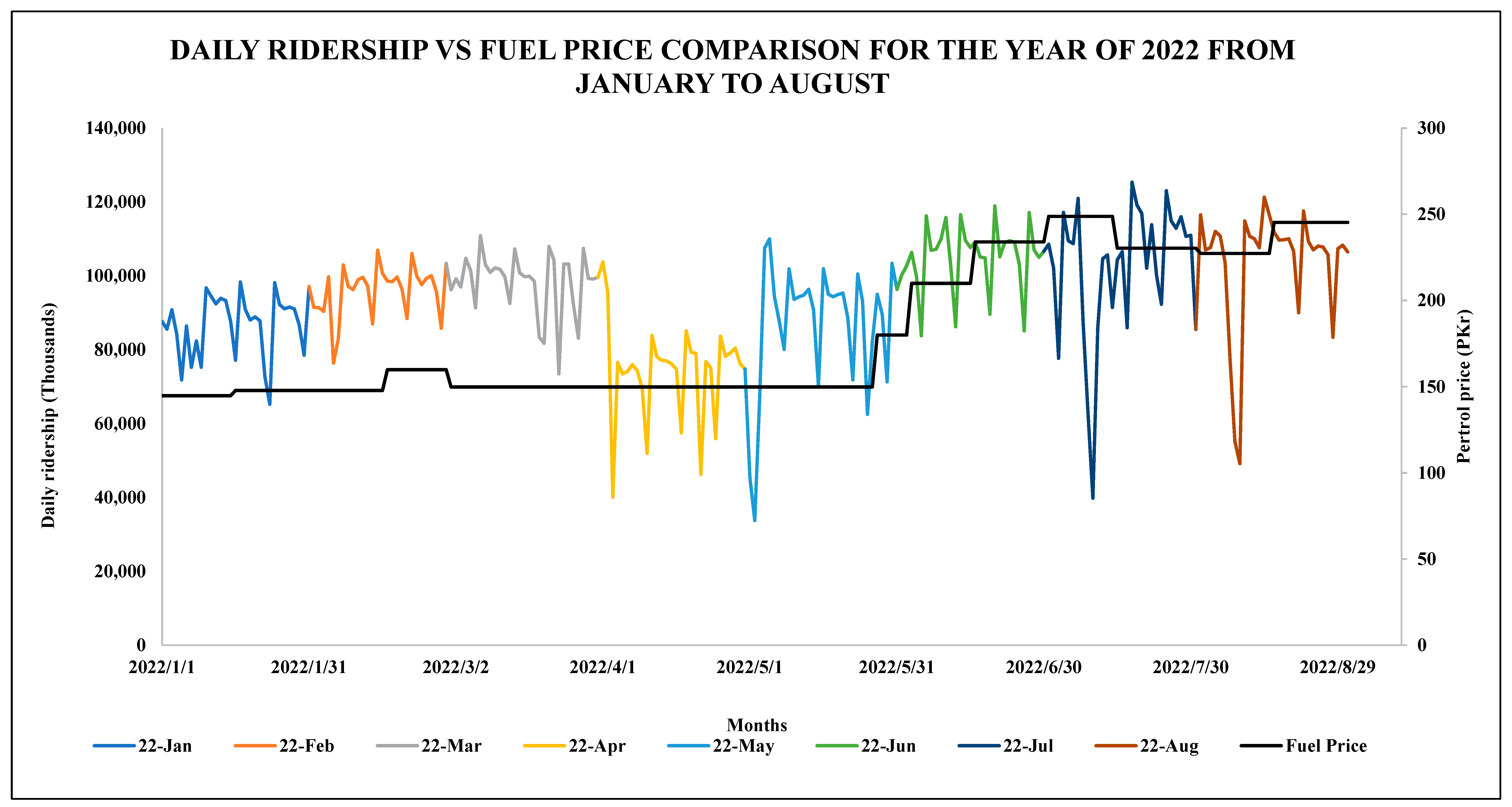
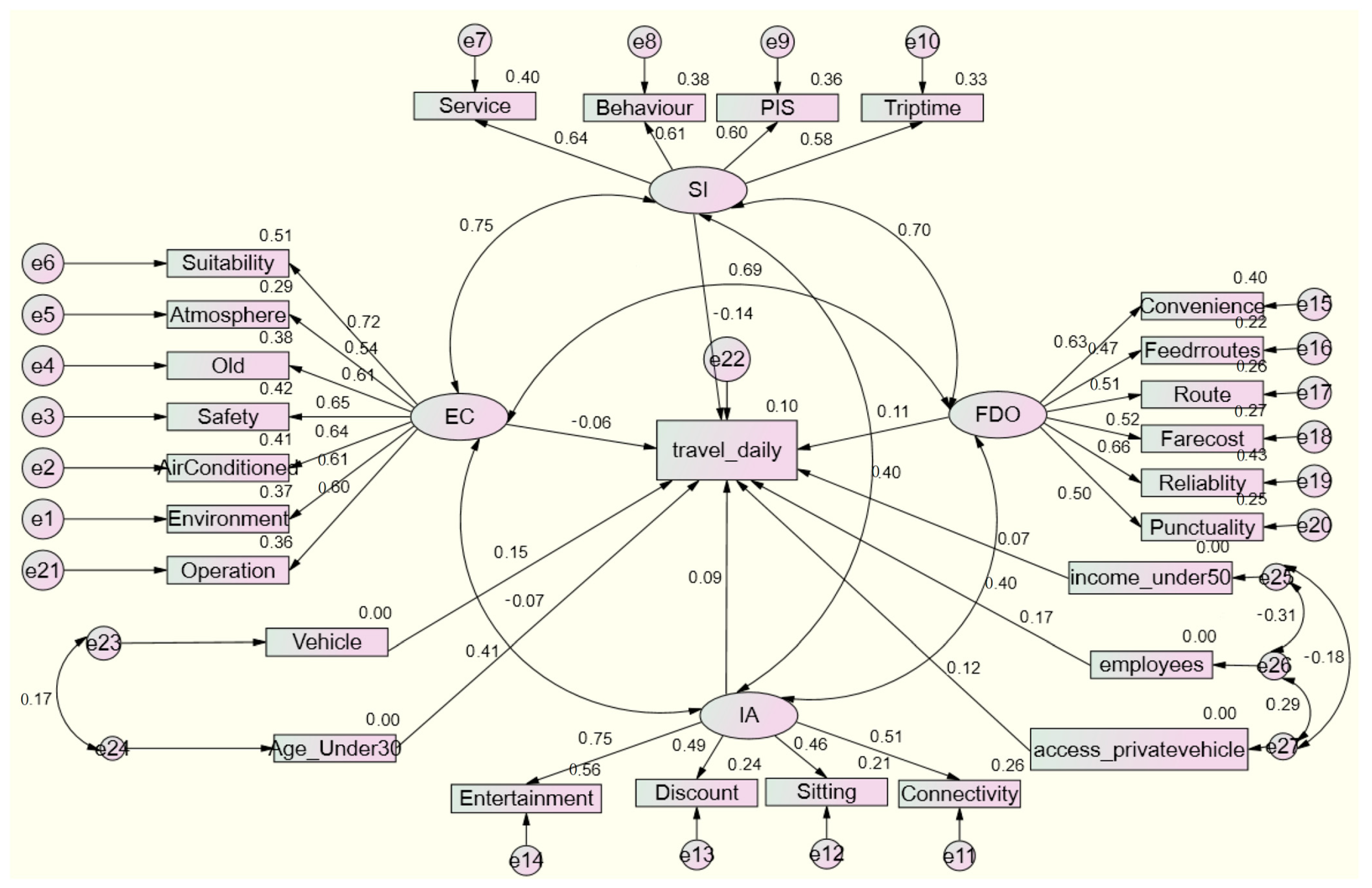
Every country requires efficient public transportation to reduce the reliance on motor vehicles, decrease harmful emissions and noise pollution, and, most importantly, provide accessible transportation for urban populations with limited resources. Yet, several challenges hinder the efficiency of the public transportation system, affecting factors like daily ridership, infrastructure, revenue, and operations. Therefore, this research investigated barriers and their impact on the daily ridership of rail transit services, especially in densely populated areas characterized by high automobile usage, inadequate pedestrian facilities, and limited connectivity to other transportation modes. To accomplish this goal, a self-administered questionnaire was developed, and a survey was conducted to collect responses from commuters at various public transport hubs. Structural equation modeling (SEM) was used to analyze data gathered from a sample of 1000 participants. The findings from the SEM model indicated a positive correlation between Instrumental Attractiveness (IA) and Facility Design and Operation (FDO) with daily travel. Conversely, Service and Information (SI) along with Environmental Comfort (EC) exhibited a negative correlation with daily travel. Private sector employees without personal vehicles and a monthly income below fifty thousand exhibited a strong preference for public transport. Individuals with higher incomes who owned vehicles showed lower preferences towards public transport usage. The main contributors to low ridership in public transport included poor connectivity with metro and feeder buses, lack of availability of discount tickets, insufficient seating at stations, and inadequate route map information. Gasoline prices have a notable impact on daily ridership too, as higher fuel prices tend to attract more travelers to use public transport. The ridership data demonstrate a positive trend in response to increased gasoline prices. The findings from this study are useful for transportation engineers, practitioners, planners, and policymakers.
Keywords: mass transit service; public transport; structural equation modelling; travel behavior mass transit service; public transport; structural equation modelling; travel behavior