Article

Shared Mobility and India’s Generation Z: Environmental Consciousness, Risks, and Attitudes

by
Swathi Palanichamy
1,
Priyakrushna Mohanty
1 and
James Kennell
2,*
1
Department of Business and Management, Christ University, Bengaluru 560076, India
2
School of Hospitality and Tourism Management, Faculty of Arts and Social Sciences, University of Surrey, Guildford GU2 7XH, UK
*
Author to whom correspondence should be addressed.
Sustainability 2024, 16(12), 5258; https://doi.org/10.3390/su16125258
Submission received: 29 March 2024 / Revised: 7 May 2024 / Accepted: 24 May 2024 / Published: 20 June 2024
(This article belongs to the Collection Sustainability in Urban Transportation Planning)

Abstract

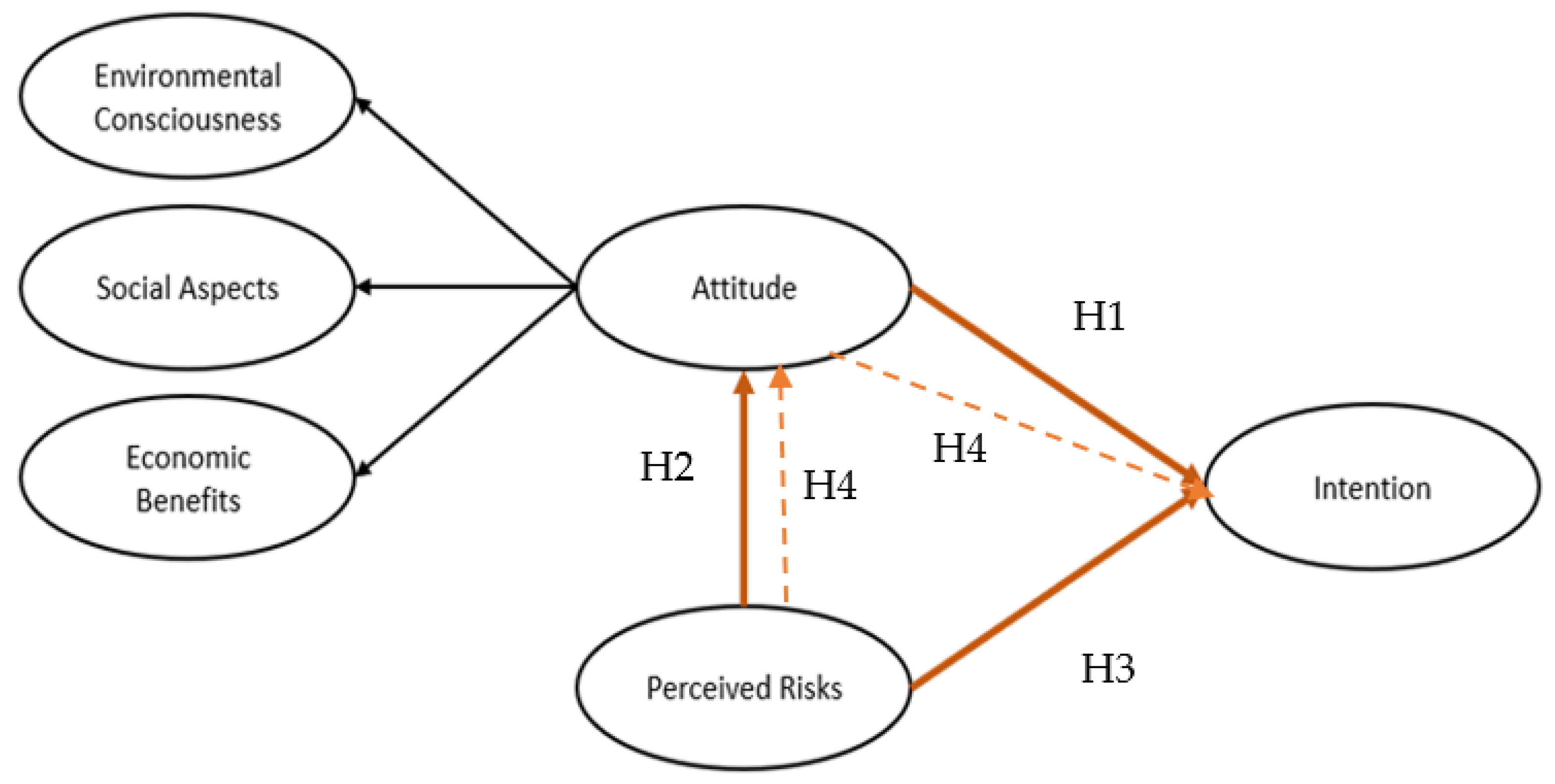
Shared mobility platforms have built scalable digital marketplaces that facilitate the allocation and sharing of transportation and promote sustainable urban travel. Generation Z’s attitude toward shared consumption is closely linked to their perceptions of the importance of sustainability. This study identifies Generation Z’s awareness of shared mobility platforms in India and the factors that influence their use. Data were collected from 318 respondents from Generation Z in India and analyzed using partial least squares structural equation modeling. Findings indicate that Generation Z’s intention to use shared mobility is influenced by environmental consciousness, social aspects, economic benefits, and perceived risks. Results also show that perceived risks have an indirect effect on intention, which is mediated by attitude. The novel conceptual model developed and tested in this research can be used to inform policies and business models for the adoption of shared mobility services for Generation Z, ultimately promoting more sustainable transportation systems and improved urban mobility.
Keywords: shared mobility; sharing economy; collaborative consumption; urban transport; Generation Z shared mobility; sharing economy; collaborative consumption; urban transport; Generation Z