Article

Ammonia Production from Clean Hydrogen and the Implications for Global Natural Gas Demand

1
Faculty of Engineering and Natural Sciences, Sabanci University, Orta Mahalle, Tuzla, 34956 Istanbul, Turkey
2
International Renewable Energy Agency (IRENA), Innovation and Technology Center, Willy-Brandt-Allee 20, 53113 Bonn, Germany
3
Organisation for Economic Co-Operation and Development (OECD), Environment Directorate, 46 Quai Alphonse Le Gallo, 92100 Boulogne-Billancourt, France
4
Ammonia Energy Association, 77 Sands Street, Brooklyn, NY 11201, USA
5
Proton Ventures, Karel Doormanweg 5, 3115 JD Schiedam, The Netherlands
6
World Bank Group, 1818 H Street NW, Washington, DC 20433, USA
7
Belfer Center for Science and International Affairs, Harvard University, Cambridge, MA 02138, USA
*
Author to whom correspondence should be addressed.
Sustainability 2023, 15(2), 1623; https://doi.org/10.3390/su15021623
Submission received: 31 October 2022 / Revised: 26 December 2022 / Accepted: 4 January 2023 / Published: 13 January 2023

Abstract

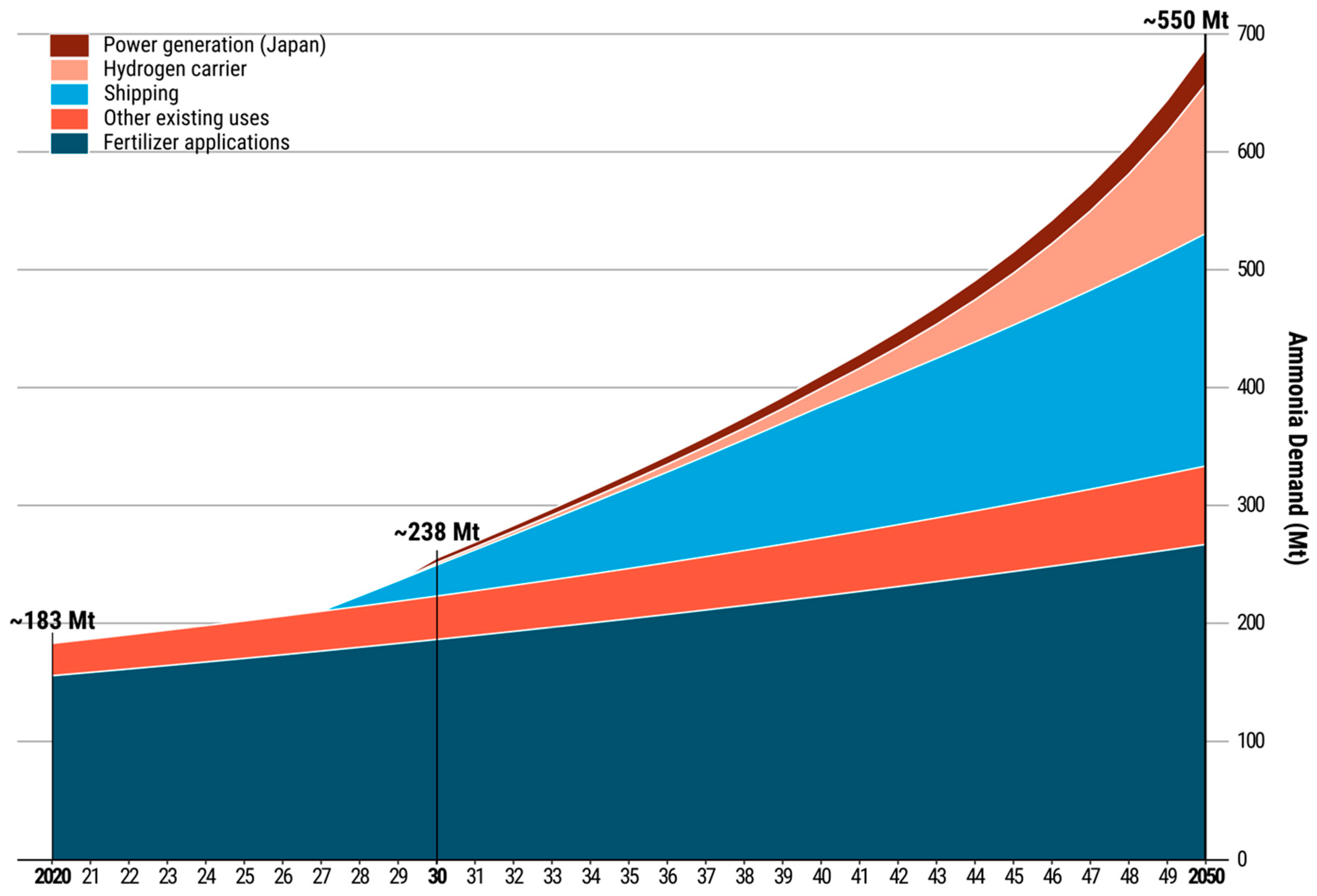
Non-energy use of natural gas is gaining importance. Gas used for 183 million tons annual ammonia production represents 4% of total global gas supply. 1.5-degree pathways estimate an ammonia demand growth of 3–4-fold until 2050 as new markets in hydrogen transport, shipping and power generation emerge. Ammonia production from hydrogen produced via water electrolysis with renewable power (green ammonia) and from natural gas with CO2 storage (blue ammonia) is gaining attention due to the potential role of ammonia in decarbonizing energy value chains and aiding nations in achieving their net-zero targets. This study assesses the technical and economic viability of different routes of ammonia production with an emphasis on a systems level perspective and related process integration. Additional cost reductions may be driven by optimum sizing of renewable power capacity, reducing losses in the value chain, technology learning and scale-up, reducing risk and a lower cost of capital. Developing certification and standards will be necessary to ascertain the extent of greenhouse gas emissions throughout the supply chain as well as improving the enabling conditions, including innovative finance and de-risking for facilitating international trade, market creation and large-scale project development.
Keywords: green ammonia; blue ammonia; natural gas; energy security; energy transition green ammonia; blue ammonia; natural gas; energy security; energy transition