Article

Functional End-Use of Hemp Seed Waste: Technological, Qualitative, Nutritional, and Sensorial Characterization of Fortified Bread


1
Research Centre for Cereal and Industrial Crops of Acireale, Council for Agricultural Research and Economics (CREA), 95024 Catania, Italy
2
Institute of BioEconomy (IBE), National Council of Research (CNR), 95126 Catania, Italy
3
Department of Biological, Chemical and Pharmaceutical Sciences and Technologies, University of Palermo, 90133 Palermo, Italy
4
Department of Health Sciences, University Magna Græcia of Catanzaro, Germaneto, 88100 Catanzaro, Italy
*
Authors to whom correspondence should be addressed.
Sustainability 2023, 15(17), 12899; https://doi.org/10.3390/su151712899
Submission received: 25 July 2023 / Revised: 12 August 2023 / Accepted: 24 August 2023 / Published: 25 August 2023
(This article belongs to the Special Issue By-Products of the Agri-Food Industry: Use for Food Fortification)

Abstract

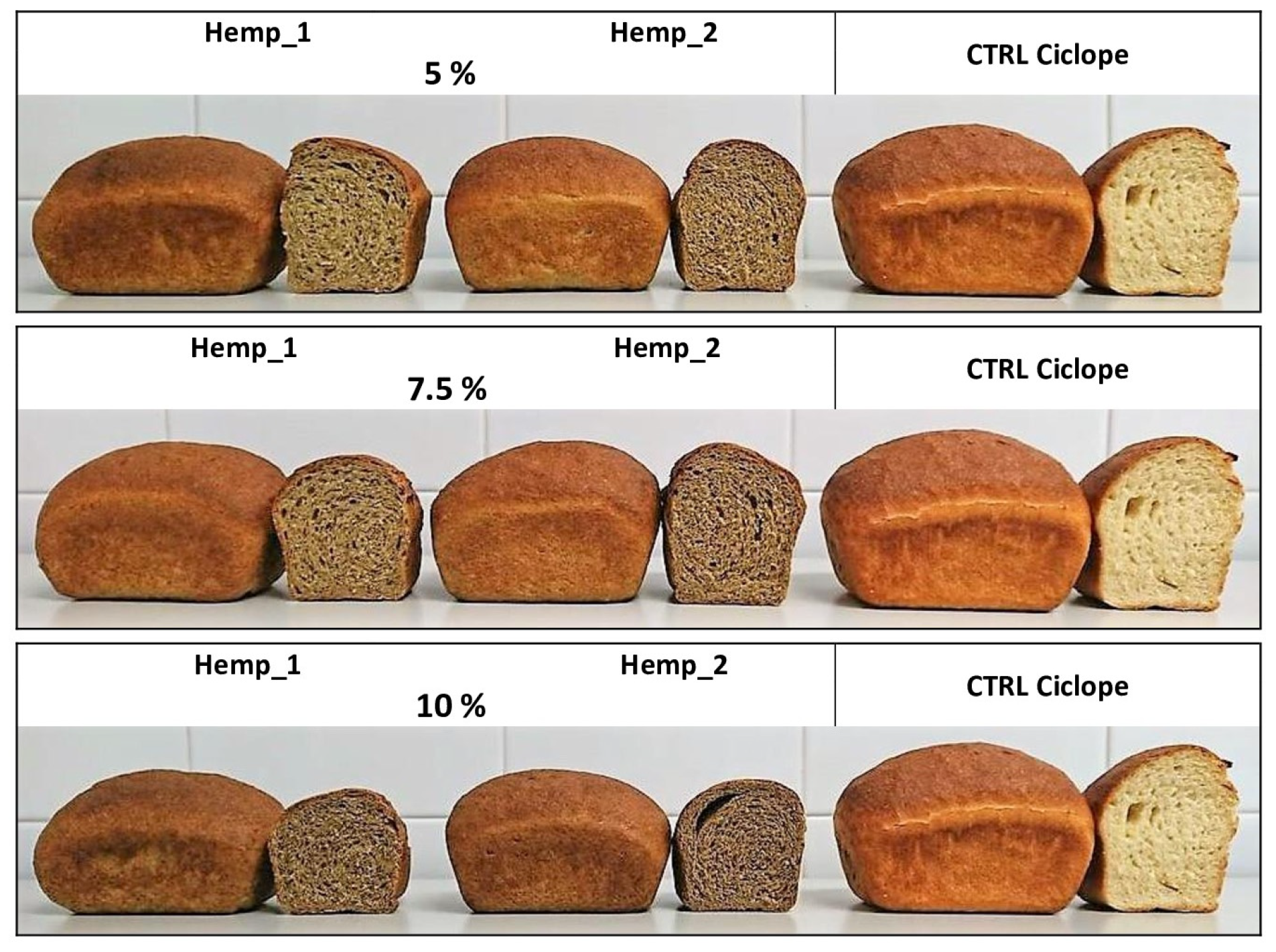
Due to its multipurpose usability, short production cycle, and low capital requirement in cultivation, hemp represents an excellent material applicable to the Sustainable Development Goals (SDGs) defined by the United Nations Organization as a strategy “to achieve a future better and more sustainable for all”. Hemp seeds represent the only edible part of Cannabis sativa and have a distinctly different nutritional composition from other representative foods such as rice and wheat (high protein content, low carbohydrate content, polyunsaturated fatty acids, dietary fiber, and gluten-free). Hemp seeds are mainly used for the production of oil; the waste obtained after extraction, reduced to a fine powder and rich in bioactive components, is added to durum wheat flour and used for the preparation of fortified bread. The aim of this study was to use varying percentages of hemp seed flour for bread production and determine the impact of fortification on texture, organoleptic characteristics, crumb color, changes in crumb texture, total polyphenols, the scavenging activity of free radicals, and amino acid content. The solid residue remaining after oil extraction from hemp seeds (generally discarded as waste or added to feed) was triturated and sieved to 0.530 mm (Hemp 1) or 0.236 mm (Hemp 2). Samples of fortified bread were obtained by replacing variable percentages of durum wheat semolina with the two hemp flours (5%, 7.5%, and 10%). The total phenolic content of the fortified bread was between 0.73 and 1.73 mg GAE/g, and the antiradical activity was between 1.17 and 3.18 mmol TEAC/100 g on the basis of the growing fortification. A comparison of Ciclope semolina bread with hemp flour-enriched bread showed a large increase in amino acid content in the fortified samples. In particular, bread enriched with 10% hemp flour 2 showed a higher content of glutamic acid, tyrosine, proline, and essential amino acids such as leucine and isoleucine compared to other samples with the same percentage of substitution. The amount of hemp seed flour influenced the color of the crumb by increasing the yellow index from 18.24 (100% Ciclope) to 21.33 (bread with 5% hemp flour 2). The results of the sensory analysis were very good, demonstrating the high acceptability of fortified breads at higher percentages.
Keywords: hemp waste; food fortification; Ciclope; Futura 75; hemp flour; dough mixing; amino acids; fatty acids hemp waste; food fortification; Ciclope; Futura 75; hemp flour; dough mixing; amino acids; fatty acids