Coupling Relationship of Urban Development and the Eco-Environment in Guanzhong Region, China
Abstract
1. Introduction
2. Materials and Methods
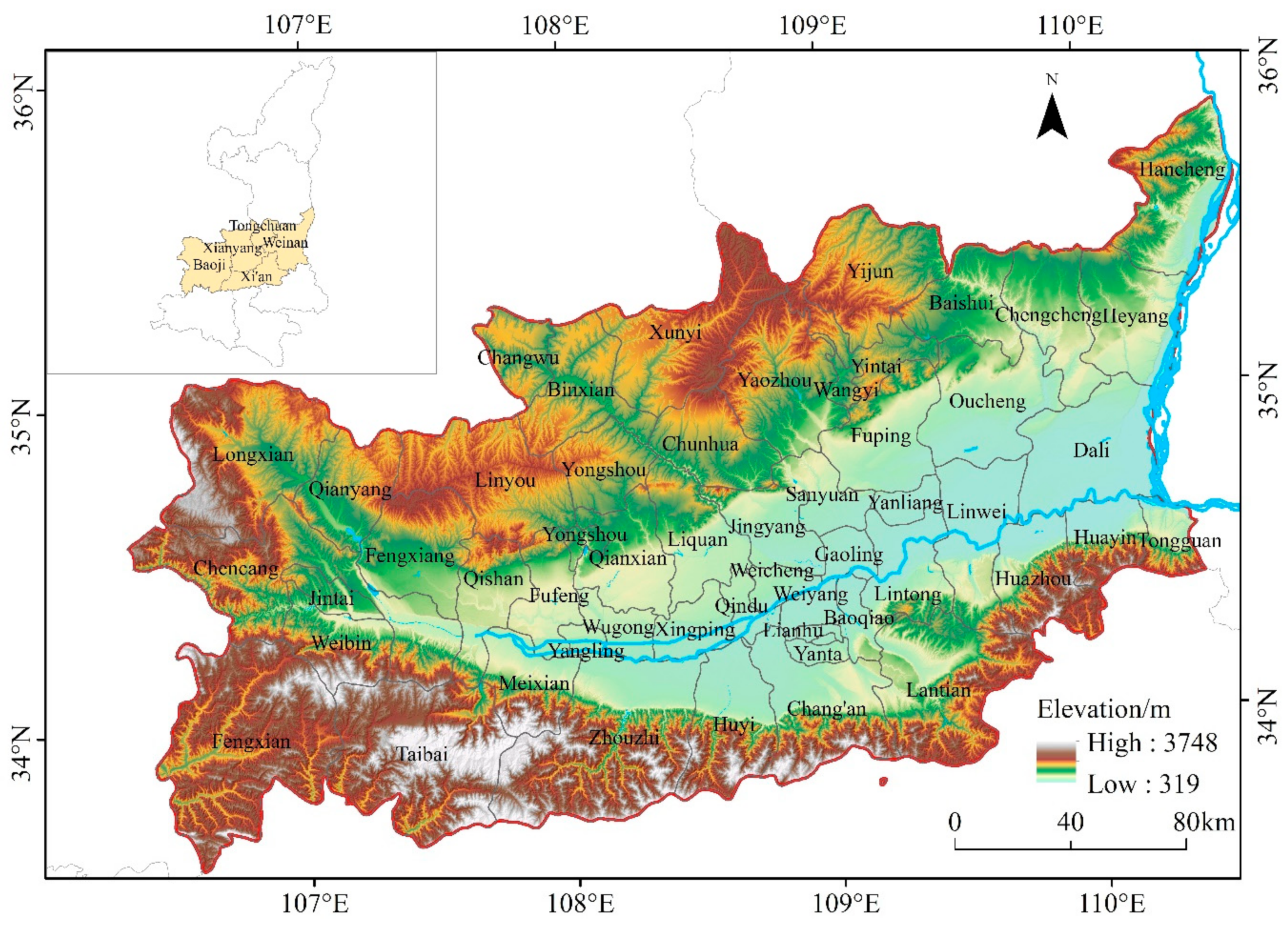
2.1. Study Area
2.2. Data Source
2.2.1. Night Light Data
2.2.2. MODIS Data
2.2.3. Land-Use Data
2.2.4. Auxiliary Data
2.3. Methods
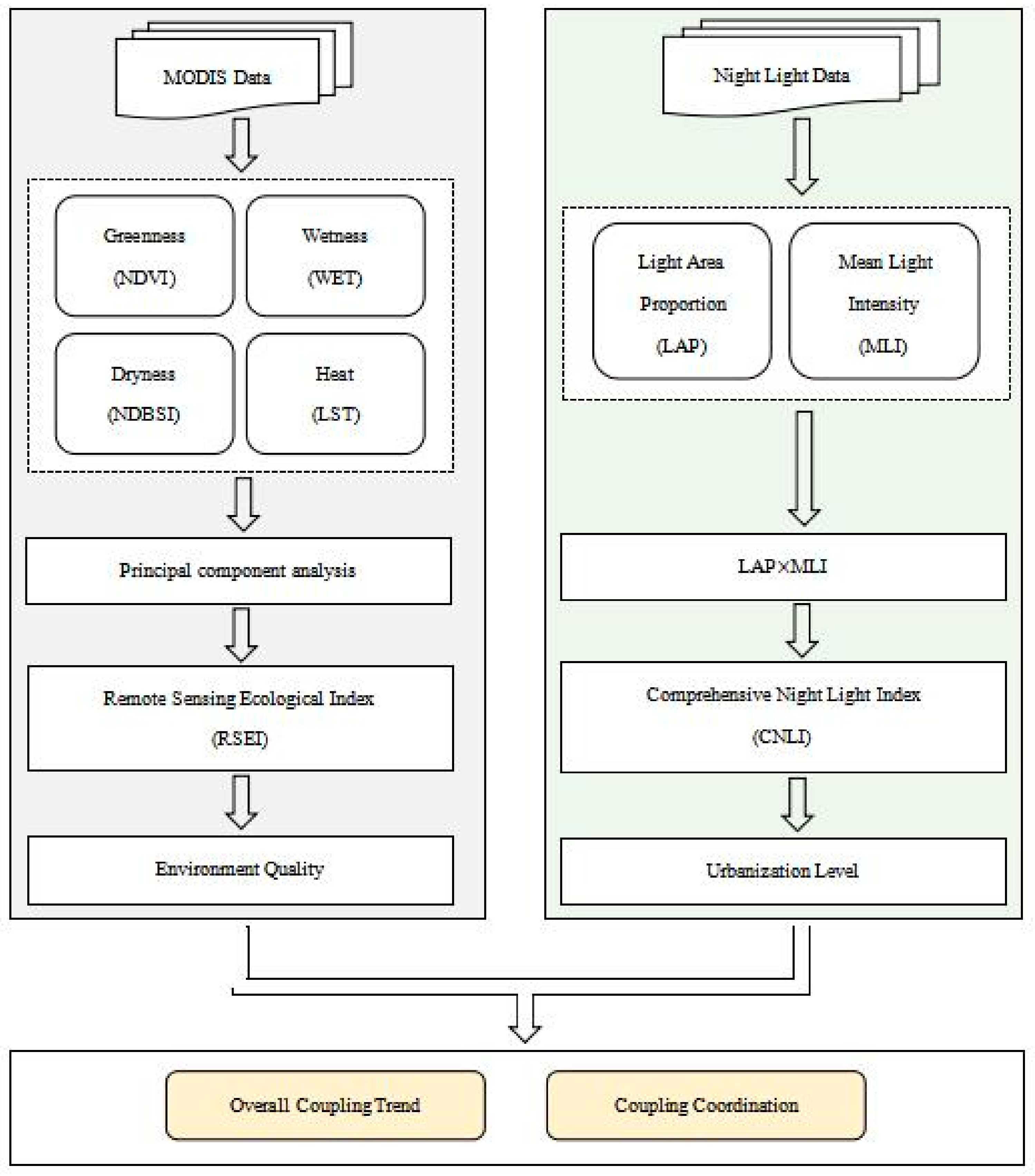
2.3.1. Construction of the CNLI
2.3.2. Construction of the RSEI
2.3.3. Overall Coupling Trend Model
2.3.4. Coupling Coordination Model
3. Results
3.1. Accuracy Verification
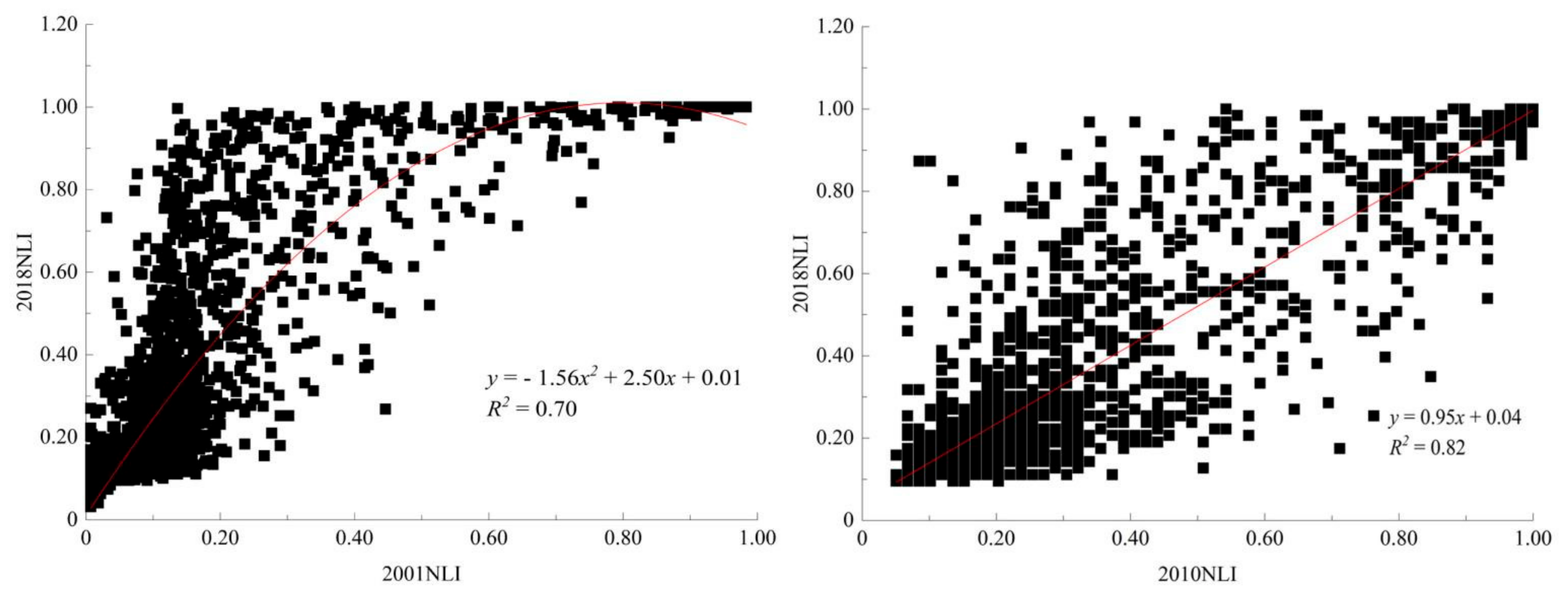
3.1.1. NLI Inspection
3.1.2. Principal Component Analysis Results
3.2. Spatial-Temporal Distribution of Urban Development and the Eco-Environment
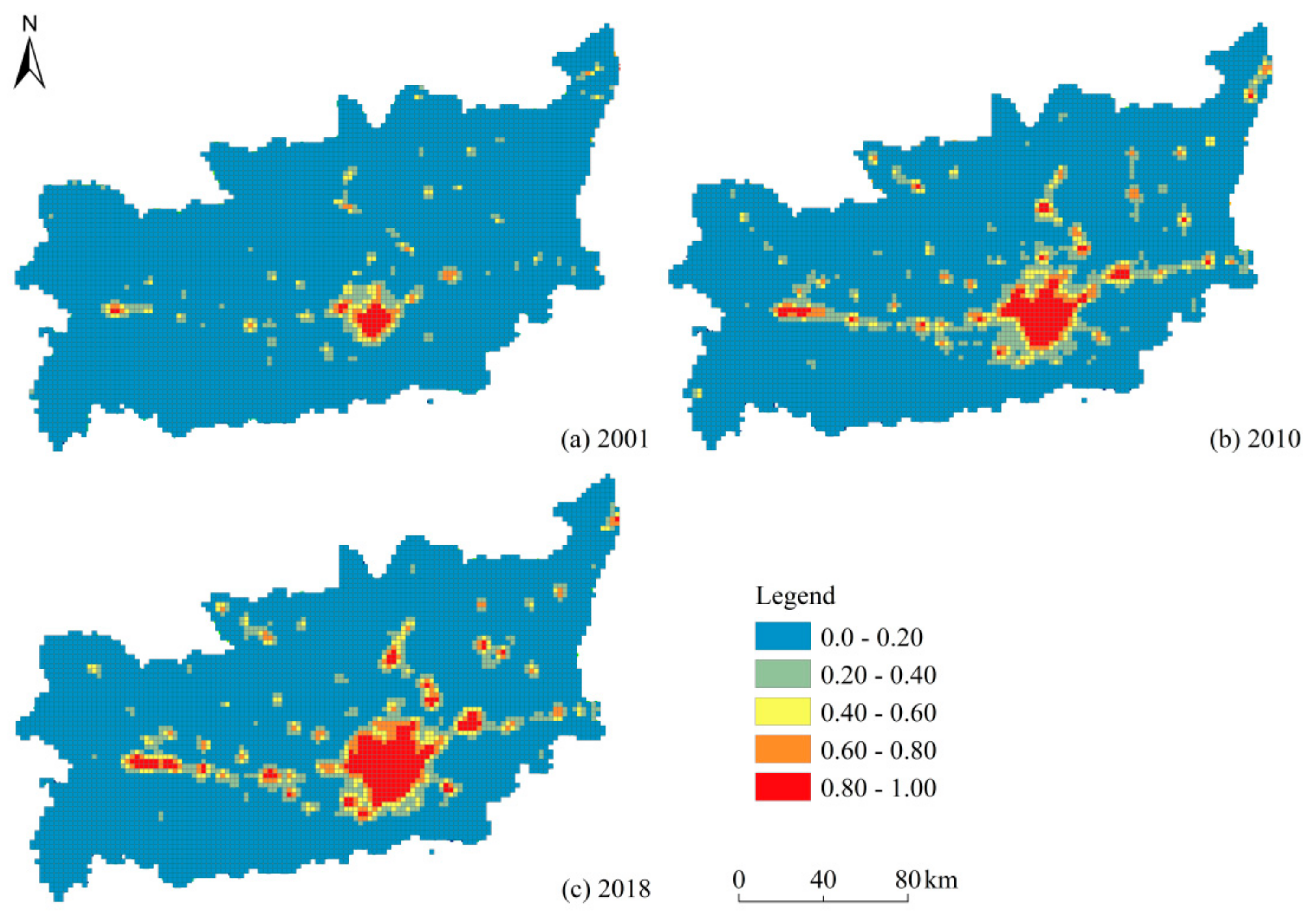
3.2.1. Guanzhong Region CNLI and Its Changes
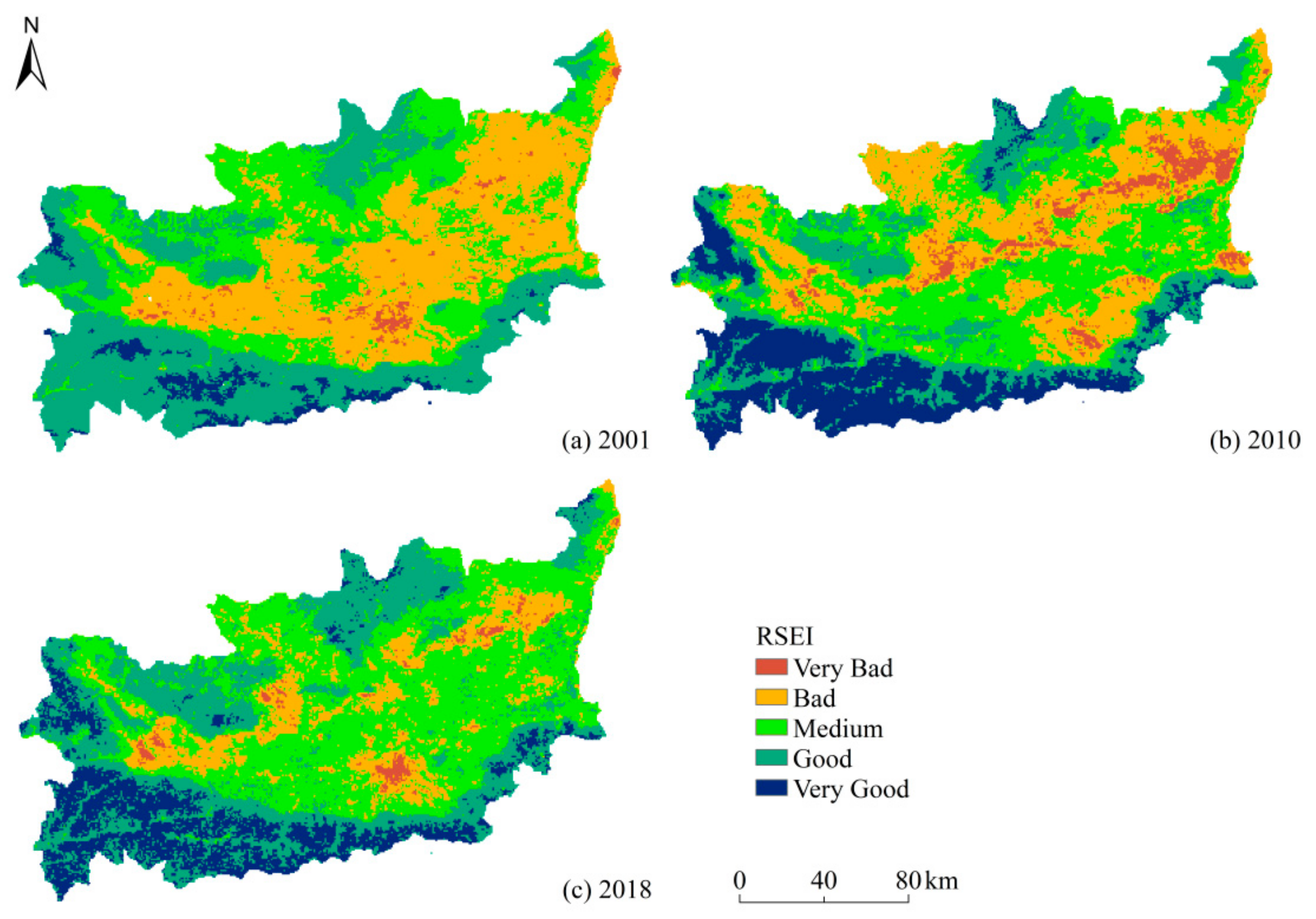
3.2.2. Guanzhong Region RSEI and Its Changes
3.3. Spatial-Temporal Coupling between the CNLI and the RSEI
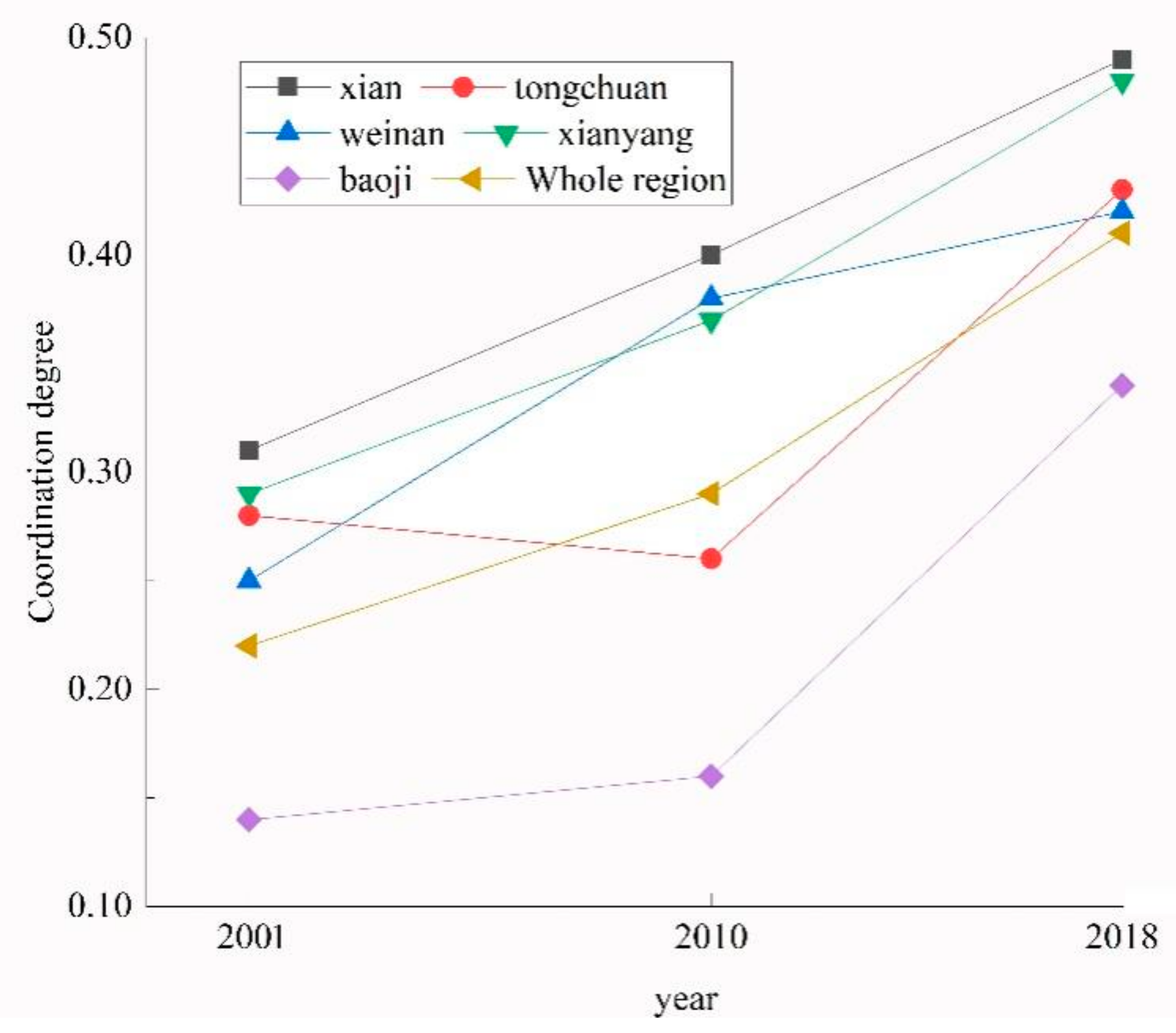
3.3.1. Temporal Coupling Trend of the CNLI and the RSEI
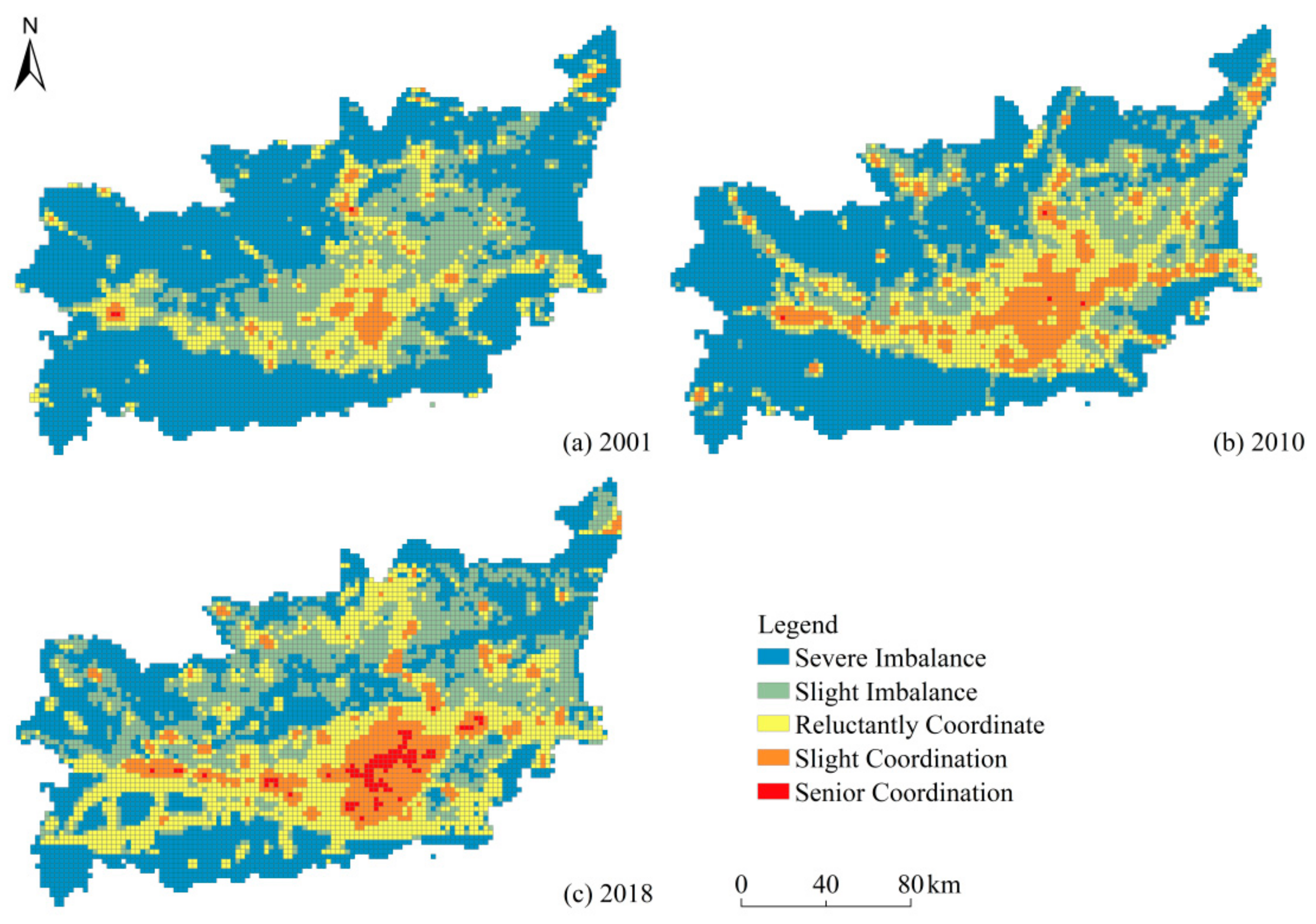
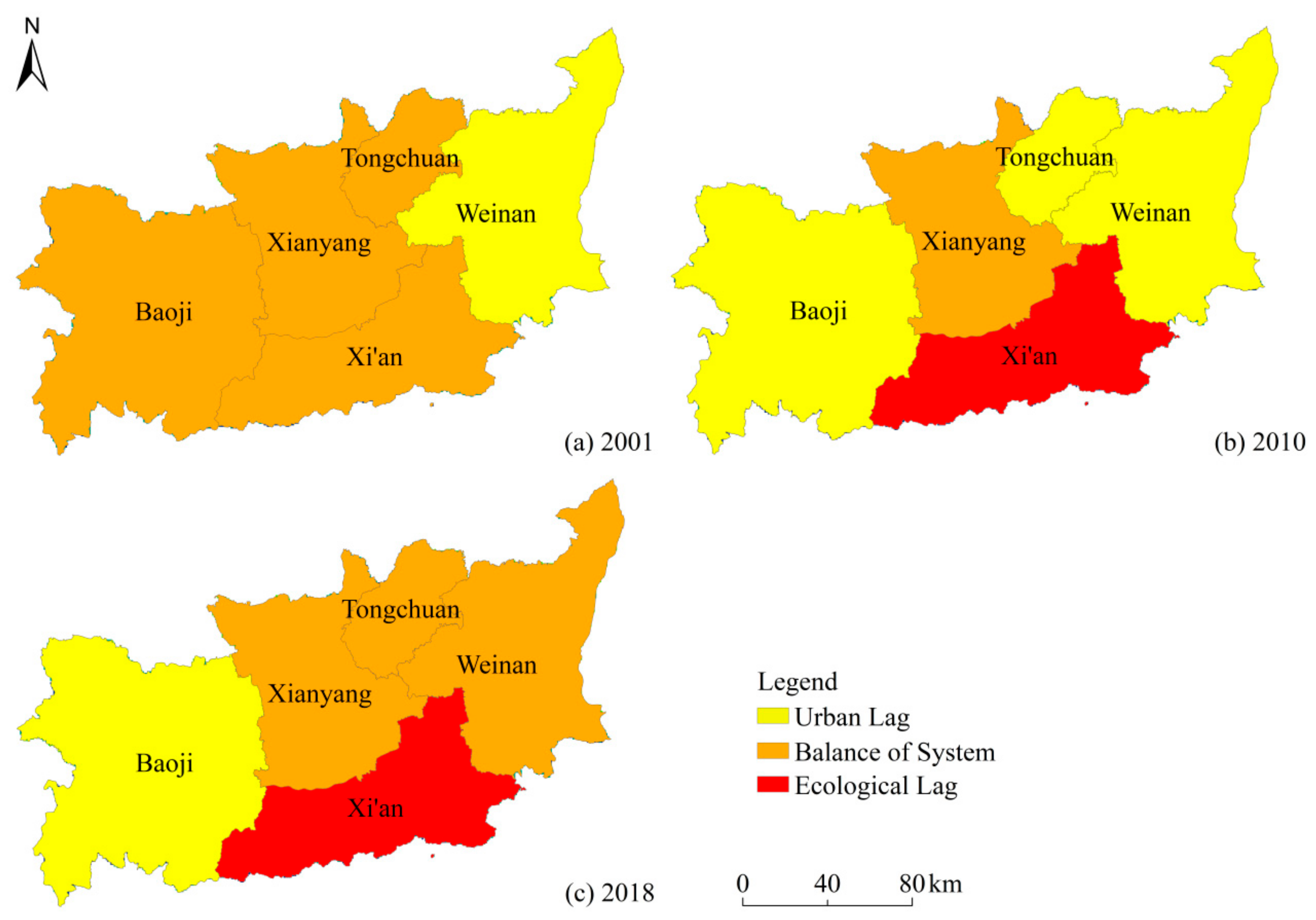
3.3.2. Spatial Coordination Characteristics of the CNLI and the RSEI
4. Discussion
4.1. Eco-Environment Changes in the Guanzhong Region
4.2. Urbanization Process of the Guanzhong Region
4.3. Interaction between Urban Development and the Eco-Environment
4.4. Limitations and Prospects
5. Conclusions
Author Contributions
Funding
Institutional Review Board Statement
Informed Consent Statement
Data Availability Statement
Conflicts of Interest
References
- Wu, Z.; Zhang, Q.; Song, C.; Zhang, F.; Zhu, X.; Sun, P.; Fan, K.; Yu, H.; Shen, Z. Impacts of urbanization on spatio-temporal variations of temperature over the Pearl River Delta. Acta Geograph. Sin. 2019, 74, 2342–2357. [Google Scholar]
- Ma, Y.; Zhao, M.; Li, J.; Wang, J.; Hu, L. Cooling Effect of Different Land Cover Types: A Case Study in Xi’an and Xianyang, China. Sustainability 2021, 13, 1099. [Google Scholar] [CrossRef] [Scilit]
- Deng, X.; Huang, J.; Rozelle, S.; Zhang, J.; Li, Z. Impact of urbanization on cultivated land changes in China. Land Use Policy 2015, 45, 1–7. [Google Scholar] [CrossRef] [Scilit]
- Song, X.; Hansen, M.C.; Stehman, S.V.; Potapov, P.V.; Tyukavina, A.; Vermote, E.F.; Townshend, J.R. Global land change from 1982 to 2016. Nature 2018, 560, 639–643. [Google Scholar] [CrossRef] [Scilit]
- Xu, D.; Yang, F.; Yu, L.; Zhou, Y.; Li, H.; Ma, J.; Huang, J.; Wei, J.; Xu, Y.; Zhang, C.; et al. Quantization of the coupling mechanism between eco-environmental quality and urbanization from multisource remote sensing data. J. Clean. Prod. 2021, 321, 128948. [Google Scholar] [CrossRef] [Scilit]
- Fan, W.; Wang, H.; Liu, Y.; Liu, H. Spatio-temporal variation of the coupling relationship between urbanization and air quality: A case study of Shandong Province. J. Clean. Prod. 2020, 272, 122812. [Google Scholar] [CrossRef] [Scilit]
- Fang, C.; Liu, H.; Wang, S. The coupling curve between urbanization and the eco-environment: China’s urban agglomeration as a case study. Ecol. Indic. 2021, 130, 108107. [Google Scholar] [CrossRef] [Scilit]
- He, L.; Zhang, X.; Yan, Y. Heterogeneity of the Environmental Kuznets Curve across Chinese cities: How to dance with ‘shackles’? Ecol. Indic. 2021, 130, 108128. [Google Scholar] [CrossRef] [Scilit]
- Tang, P.; Huang, J.; Zhou, H.; Fang, C.; Zhan, Y.; Huang, W. Local and telecoupling coordination degree model of urbanization and the eco-environment based on RS and GIS: A case study in the Wuhan urban agglomeration. Sustain. Cities Soc. 2021, 75, 103405. [Google Scholar] [CrossRef] [Scilit]
- Ahmad, M.; Jiang, P.; Murshed, M.; Shehzad, K.; Akram, R.; Cui, L.; Khan, Z. Modelling the dynamic linkages between eco-innovation, urbanization, economic growth and ecological footprints for G7 countries: Does financial globalization matter? Sustain. Cities Soc. 2021, 70, 102881. [Google Scholar] [CrossRef] [Scilit]
- Dong, L.; Longwu, L.; Zhenbo, W.; Liangkan, C.; Faming, Z. Exploration of coupling effects in the Economy–Society–Environment system in urban areas: Case study of the Yangtze River Delta Urban Agglomeration. Ecol. Indic. 2021, 128, 107858. [Google Scholar] [CrossRef] [Scilit]
- Li, W.; Wang, Y.; Xie, S.; Cheng, X. Coupling coordination analysis and spatiotemporal heterogeneity between urbanization and ecosystem health in Chongqing municipality, China. Sci. Total Environ. 2021, 791, 148311. [Google Scholar] [CrossRef] [Scilit]
- Geng, Y.; Zhang, H. Coordination assessment of environment and urbanization: Hunan case. Environ. Monit. Assess 2020, 192, 637. [Google Scholar] [CrossRef] [Scilit]
- Liu, N.; Liu, C.; Xia, Y.; Da, B. Examining the coordination between urbanization and eco-environment using coupling and spatial analyses: A case study in China. Ecol. Indic. 2018, 93, 1163–1175. [Google Scholar] [CrossRef] [Scilit]
- Cui, D.; Chen, X.; Xue, Y.; Li, R.; Zeng, W. An integrated approach to investigate the relationship of coupling coordination between social economy and water environment on urban scale—A case study of Kunming. J. Environ. Manag. 2019, 234, 189–199. [Google Scholar] [CrossRef] [Scilit]
- Fang, C.; Cui, X.; Li, G.; Bao, C.; Wang, Z.; Ma, H.; Sun, S.; Liu, H.; Luo, K.; Ren, Y. Modeling regional sustainable development scenarios using the Urbanization and Eco-environment Coupler: Case study of Beijing-Tianjin-Hebei urban agglomeration, China. Sci. Total Environ. 2019, 689, 820–830. [Google Scholar] [CrossRef] [Scilit]
- Fu, S.; Zhuo, H.; Song, H.; Wang, J.; Ren, L. Examination of a coupling coordination relationship between urbanization and the eco-environment: A case study in Qingdao, China. Environ. Sci. Pollut. Res. 2020, 27, 23981–23993. [Google Scholar] [CrossRef] [Scilit]
- Lu, Y.; Kong, L.; Yan, L. Measurement on the coordination degree of China’s urbanization and ecological environment. Urban Issues 2019, 13–22. [Google Scholar]
- Cai, J.; Li, X.; Liu, L.; Chen, Y.; Wang, X.; Lu, S. Coupling and coordinated development of new urbanization and agro-ecological environment in China. Sci. Total Environ. 2021, 776, 145837. [Google Scholar] [CrossRef] [Scilit]
- Ren, F.; Yu, X. Coupling analysis of urbanization and ecological total factor energy efficiency—A case study from Hebei province in China. Sustain. Cities Soc. 2021, 74, 103183. [Google Scholar] [CrossRef] [Scilit]
- Shao, Z.; Ding, L.; Li, D.; Altan, O.; Huq, M.E.; Li, C. Exploring the Relationship between Urbanization and Ecological Environment Using Remote Sensing Images and Statistical Data: A Case Study in the Yangtze River Delta, China. Sustainability 2020, 12, 5620. [Google Scholar] [CrossRef] [Scilit]
- Feng, Y.; He, S.; Li, G. Interaction between urbanization and the eco-environment in the Pan-Third Pole region. Sci. Total Environ. 2021, 789, 148011. [Google Scholar] [CrossRef] [Scilit]
- Zheng, Z.; Wu, Z.; Chen, Y.; Yang, Z.; Marinello, F. Exploration of eco-environment and urbanization changes in coastal zones: A case study in China over the past 20 years. Ecol. Indic. 2020, 119, 106847. [Google Scholar] [CrossRef] [Scilit]
- Hu, X.; Xu, H. A new remote sensing index for assessing the spatial heterogeneity in urban ecological quality: A case from Fuzhou City, China. Ecol. Indic. 2018, 89, 11–21. [Google Scholar] [CrossRef] [Scilit]
- Zhao, W.; Yan, T.; Ding, X.; Peng, S.; Chen, H.; Fu, Y.; Zhou, Z. Response of ecological quality to the evolution of land use structure in Taiyuan during 2003 to 2018. Alex. Eng. J. 2021, 60, 1777–1785. [Google Scholar] [CrossRef] [Scilit]
- Yang, X.; Bai, Y.; Che, L.; Qiao, F.; Xie, L. Incorporating ecological constraints into urban growth boundaries: A case study of ecologically fragile areas in the Upper Yellow River. Ecol. Indic. 2021, 124, 107436. [Google Scholar] [CrossRef] [Scilit]
- Liu, C.; Yang, M.; Hou, Y.; Zhao, Y.; Xue, X. Spatiotemporal evolution of island ecological quality under different urban densities: A comparative analysis of Xiamen and Kinmen Islands, southeast China. Ecol. Indic. 2021, 124, 107438. [Google Scholar] [CrossRef] [Scilit]
- Chen, Y.; Zheng, Z.; Wu, Z.; Qian, Q. Review and prospect of application of nighttime light remote sensing data. Prog. Geogr. 2019, 38, 205–223. [Google Scholar]
- Du, Z.; Li, X. Growth or shrinkage: New phenomena of regional development in the rapidly-urbanising Pearl River Delta. Acta Geogr. Sin. 2017, 72, 1800–1811. [Google Scholar]
- Pan, W.; Fu, H.; Zheng, P. Regional Poverty and Inequality in the Xiamen-Zhangzhou-Quanzhou City Cluster in China Based on NPP/VIIRS Night-Time Light Imagery. Sustainability 2020, 12, 2547. [Google Scholar] [CrossRef] [Scilit]
- Tan, M.; Li, X.; Li, S.; Xin, L.; Wang, X.; Li, Q.; Li, W.; Li, Y.; Xiang, W. Modeling population density based on nighttime light images and land use data in China. Appl. Geogr. 2018, 90, 239–247. [Google Scholar] [CrossRef] [Scilit]
- Liu, H.; Ma, L.; Xu, L. Estimating spatiotemporal dynamics of county-level fossil fuel consumption based on integrated nighttime light data. J. Clean. Prod. 2021, 278, 123427. [Google Scholar] [CrossRef] [Scilit]
- Zheng, Y.; He, Y.; Zhou, Q.; Wang, H. Quantitative Evaluation of Urban Expansion using NPP-VIIRS Nighttime Light and Landsat Spectral Data. Sustain. Cities Soc. 2022, 76, 103338. [Google Scholar] [CrossRef] [Scilit]
- Chen, Y.; Li, Z.; Li, P.; Zhang, Z.; Zhang, Y. Identification of Coupling and Influencing Factors between Urbanization and Ecosystem Services in Guanzhong, China. Sustainability 2021, 13, 10637. [Google Scholar] [CrossRef] [Scilit]
- Lin, Z.; Xu, H.; Chen, H. Urban heat island change and its relationship to the urbanization of three major urban agglomerations in China’s eastern coastal region. Res. Environ. Sci. 2018, 31, 1695–1704. [Google Scholar]
- Chen, S.; Hu, D.; Wong, M.S.; Ren, H.; Cao, S.; Yu, C.; Ho, H.C. Characterizing spatiotemporal dynamics of anthropogenic heat fluxes: A 20-year case study in Beijing–Tianjin–Hebei region in China. Environ. Pollut. 2019, 249, 923–931. [Google Scholar] [CrossRef] [Scilit]
- Chen, J.; Zhuo, L.; Shi, P.J.; Toshiaki, I. The study on urbanization process in China based on DMSP/OLS data: Development of a light index for urbanization level estimation. J. Remote Sens. 2003, 7, 168–175. [Google Scholar]
- Yang, C.; Zhan, Q.; Gao, S.; Liu, H. How Do the Multi-Temporal Centroid Trajectories of Urban Heat Island Correspond to Impervious Surface Changes: A Case Study in Wuhan, China. Int. J. Environ. Res. Public Health 2019, 16, 3865. [Google Scholar] [CrossRef] [Scilit]
- Yang, Z.; Chen, Y.; Qian, Q.; Wu, Z.; Zheng, Z.; Huang, Q. The coupling relationship between construction land expansion and high-temperature area expansion in China’s three major urban agglomerations. Int. J. Remote Sens. 2019, 40, 6680–6699. [Google Scholar] [CrossRef] [Scilit]
- Shen, L.; Huang, Y.; Huang, Z.; Lou, Y.; Ye, G.; Wong, S. Improved coupling analysis on the coordination between socio-economy and carbon emission. Ecol. Indic. 2018, 94, 357–366. [Google Scholar] [CrossRef] [Scilit]
- Ariken, M.; Zhang, F.; Liu, K.; Fang, C.; Kung, H. Coupling coordination analysis of urbanization and eco-environment in Yanqi Basin based on multi-source remote sensing data. Ecol. Indic. 2020, 114, 106331. [Google Scholar] [CrossRef] [Scilit]
- Du, X.; Huang, Z. Ecological and environmental effects of land use change in rapid urbanization: The case of hangzhou, China. Ecol. Indic. 2017, 81, 243–251. [Google Scholar] [CrossRef] [Scilit]
- Ramel, C.; Rey, P.; Fernandes, R.; Vincent, C.; Cardoso, A.R.; Broennimann, O.; Pellissier, L.; Pradervand, J.; Ursenbacher, S.; Schmidt, B.R.; et al. Integrating ecosystem services within spatial biodiversity conservation prioritization in the Alps. Ecosyst. Serv. 2020, 45, 101186. [Google Scholar] [CrossRef] [Scilit]
- Borie, M.; Gustafsson, K.M.; Obermeister, N.; Turnhout, E.; Bridgewater, P. Institutionalising reflexivity? Transformative learning and the Intergovernmental science-policy Platform on Biodiversity and Ecosystem Services (IPBES). Environ. Sci. Policy 2020, 110, 71–76. [Google Scholar] [CrossRef] [Scilit]
- Sun, Y.; Li, H. Data mining for evaluating the ecological compensation, static and dynamic benefits of returning farmland to forest. Environ. Res. 2021, 201, 111524. [Google Scholar] [CrossRef] [Scilit]
- Sun, C.; Zhang, S.; Song, C.; Xu, J.; Fan, F. Investigation of Dynamic Coupling Coordination between Urbanization and the Eco-Environment—A Case Study in the Pearl River Delta Area. Land 2021, 10, 190. [Google Scholar] [CrossRef] [Scilit]
- Zheng, H.; Khan, Y.A.; Abbas, S.Z. Exploration on the coordinated development of urbanization and the eco-environmental system in central China. Environ. Res. 2022, 204, 112097. [Google Scholar] [CrossRef] [Scilit]
- D’Acci, L. A new type of cities for liveable futures. Isobenefit Urbanism morphogenesis. J. Environ. Manag. 2019, 246, 128–140. [Google Scholar] [CrossRef] [Scilit]



| Index | Product | Spatial Resolution/m | Time Resolution/d | Indicator Description |
|---|---|---|---|---|
| NDVI | MODIS13A2 | 1000 | 16 | The NDVI is based on BRDF correction data, and performs various mask processes at the same time |
| LST | MODIS11A2 | 1000 | 8 | LST is obtained by the most common split-window algorithm |
| Wetness | MODIS09A1 | 500 | 8 | MODIS09A1 provides bands 1~7 at a 500 m resolution in a sinusoidal projected 8-day grid level 3 product |
| Dryness |
| Ecological Indicators | 2001 | 2010 | 2018 |
|---|---|---|---|
| NDVI | 0.52 | 0.53 | 0.53 |
| LST | −0.50 | −0.52 | −0.51 |
| Wetness | 0.43 | 0.35 | 0.45 |
| Dryness | −0.53 | −0.56 | −0.54 |
| Contribution rate | 79.45% | 63.48% | 75.61% |
| Grade | 2001 | 2010 | 2018 |
|---|---|---|---|
| Very Low | 94.22% | 84.97% | 84.62% |
| Low | 3.33% | 8.05% | 6.97% |
| Medium | 1.22% | 2.83% | 3.00% |
| High | 0.65% | 1.78% | 2.22% |
| Very High | 0.57% | 2.38% | 3.19% |
| Grade | 2001 | 2010 | 2018 | |||
|---|---|---|---|---|---|---|
| Area/km2 | Percentage% | Area/km2 | Percentage/% | Area/km2 | Percentage/% | |
| Very Bad | 645.87 | 1.17 | 2320.12 | 4.20 | 666.93 | 1.21 |
| Bad | 17,761.57 | 32.18 | 14,196.09 | 25.72 | 6960.49 | 12.61 |
| Medium | 17,044.6 | 30.88 | 18,141.65 | 32.87 | 23,185.85 | 42.01 |
| Good | 17,741.96 | 32.14 | 11,022.88 | 19.97 | 16,285.21 | 29.51 |
| Very Good | 2000.35 | 3.62 | 9513.61 | 17.24 | 8095.87 | 14.67 |
| Year | Weighted Center Coordinates | Weighted Center Distance/km | Period | Angle Change/° | |||
|---|---|---|---|---|---|---|---|
| CNLI | RSEI | ||||||
| Longitude/° | Latitude/° | Longitude/° | Latitude/° | ||||
| 2001 | 108.71 | 34.55 | 108.30 | 34.24 | 51.02 | 2001–2010 | 38.42 |
| 2010 | 108.81 | 34.53 | 108.35 | 34.35 | 46.68 | 2010–2018 | 27.03 |
| 2018 | 108.69 | 34.55 | 108.29 | 34.28 | 47.41 | 2001–2018 | 6.19 |
| Class | 2001 | 2010 | 2018 |
|---|---|---|---|
| Farmland | 0.41 | 0.42 | 0.49 |
| Forest | 0.69 | 0.76 | 0.76 |
| Grassland | 0.58 | 0.59 | 0.65 |
| Urban | 0.32 | 0.30 | 0.31 |
| Other | 0.40 | 0.47 | 0.48 |
Publisher’s Note: MDPI stays neutral with regard to jurisdictional claims in published maps and institutional affiliations. |
© 2022 by the authors. Licensee MDPI, Basel, Switzerland. This article is an open access article distributed under the terms and conditions of the Creative Commons Attribution (CC BY) license (https://creativecommons.org/licenses/by/4.0/).
Share and Cite
Wang, J.; Zhao, M.; Zhong, W.; Li, J.; Zheng, C. Coupling Relationship of Urban Development and the Eco-Environment in Guanzhong Region, China. Sustainability 2022, 14, 2969. https://doi.org/10.3390/su14052969
Wang J, Zhao M, Zhong W, Li J, Zheng C. Coupling Relationship of Urban Development and the Eco-Environment in Guanzhong Region, China. Sustainability. 2022; 14(5):2969. https://doi.org/10.3390/su14052969
Chicago/Turabian StyleWang, Jian, Mudan Zhao, Wei Zhong, Jianbo Li, and Chunyan Zheng. 2022. "Coupling Relationship of Urban Development and the Eco-Environment in Guanzhong Region, China" Sustainability 14, no. 5: 2969. https://doi.org/10.3390/su14052969
APA StyleWang, J., Zhao, M., Zhong, W., Li, J., & Zheng, C. (2022). Coupling Relationship of Urban Development and the Eco-Environment in Guanzhong Region, China. Sustainability, 14(5), 2969. https://doi.org/10.3390/su14052969