Article

Industrial Structure Upgrading, Green Total Factor Productivity and Carbon Emissions
1
School of Economics and Finance, Xi’an Jiaotong University, Xi’an 710061, China
2
Department of Academic Affairs, Xi’an University of Finance and Economics, Xi’an 710100, China
3
School of Economics and Management, Northwest University, Xi’an 710127, China
*
Author to whom correspondence should be addressed.
Sustainability 2022, 14(2), 1009; https://doi.org/10.3390/su14021009
Submission received: 16 November 2021 / Revised: 21 December 2021 / Accepted: 14 January 2022 / Published: 17 January 2022

Abstract

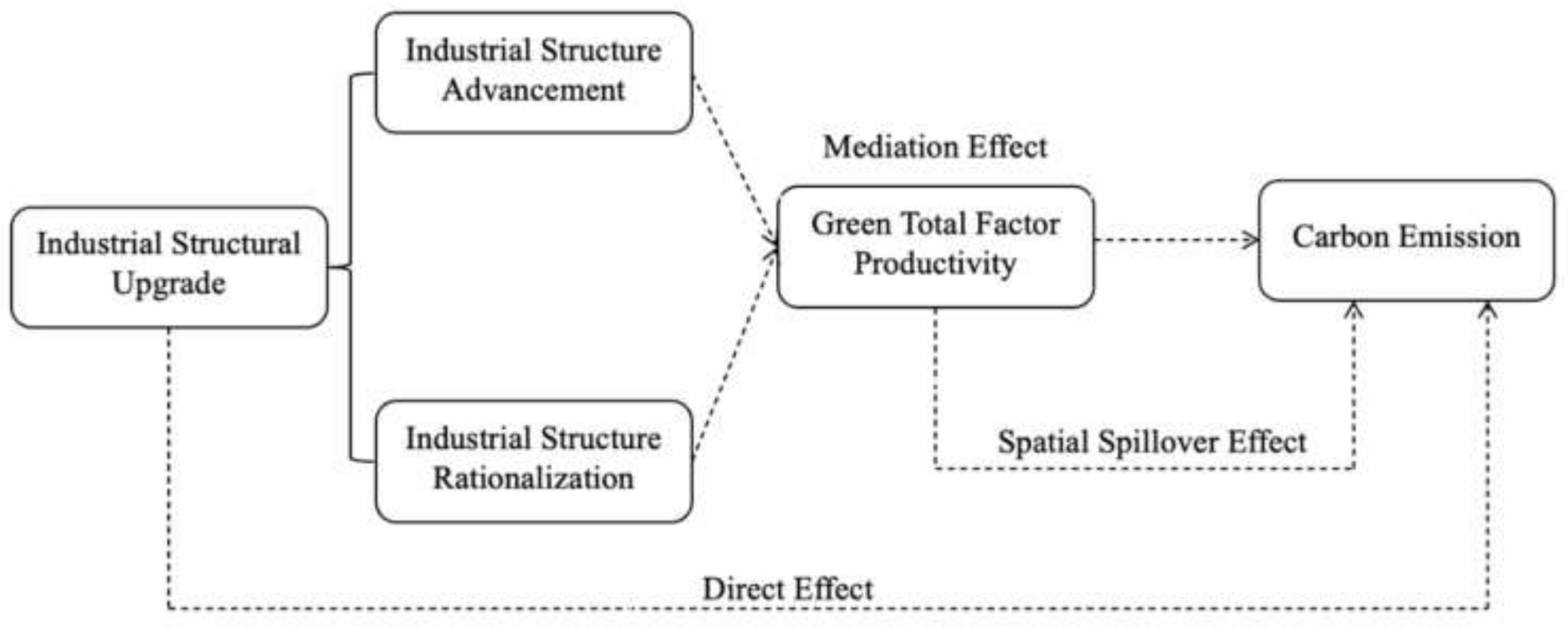
Carbon emission reduction is becoming a global issue. Methods of reducing carbon emissions in developing countries have become a hot topic of discussion. Based on the obvious structural transformation in developing countries, this paper discusses the logical mechanisms among industrial structure upgrading, green total factor productivity improvements, and carbon emission reduction. In addition, this paper empirically tests these relationships with provincial data from 2000 to 2017 in China. The conclusions are as follows: (1) industrial structure upgrades have a significant impact on carbon emissions. The industrial structure rationalization remains a noteworthy inhibition on carbon emissions. The industrial structure’s advancement has obvious features of development at the current stage, and its effect on carbon emissions shows an inverted “V” trend, which is initially accelerating but then restraining. (2) Upgrades to industrial structures will decrease carbon emissions by raising green total factor productivity. (3) The rise of green total factor productivity in a certain region will have a relatively obvious inhibitory effect on carbon emissions, but it will exhibit a negative spatial spillover effect on the adjacent areas.
Keywords: industrial structure upgrade; green total factor productivity; carbon emissions; inverted “V” trend; negative spatial spillover effect industrial structure upgrade; green total factor productivity; carbon emissions; inverted “V” trend; negative spatial spillover effect