Water Purification Effect of Ecological Floating Bed Combination Based on the Numerical Simulation

Abstract
:1. Introduction
2. Materials and Methods
2.1. Overview of the Study Area
2.2. Model Governing Equations
2.2.1. Hydrodynamic Model
2.2.2. Water Quality Model
2.3. 2D Model Construction of the Study Area
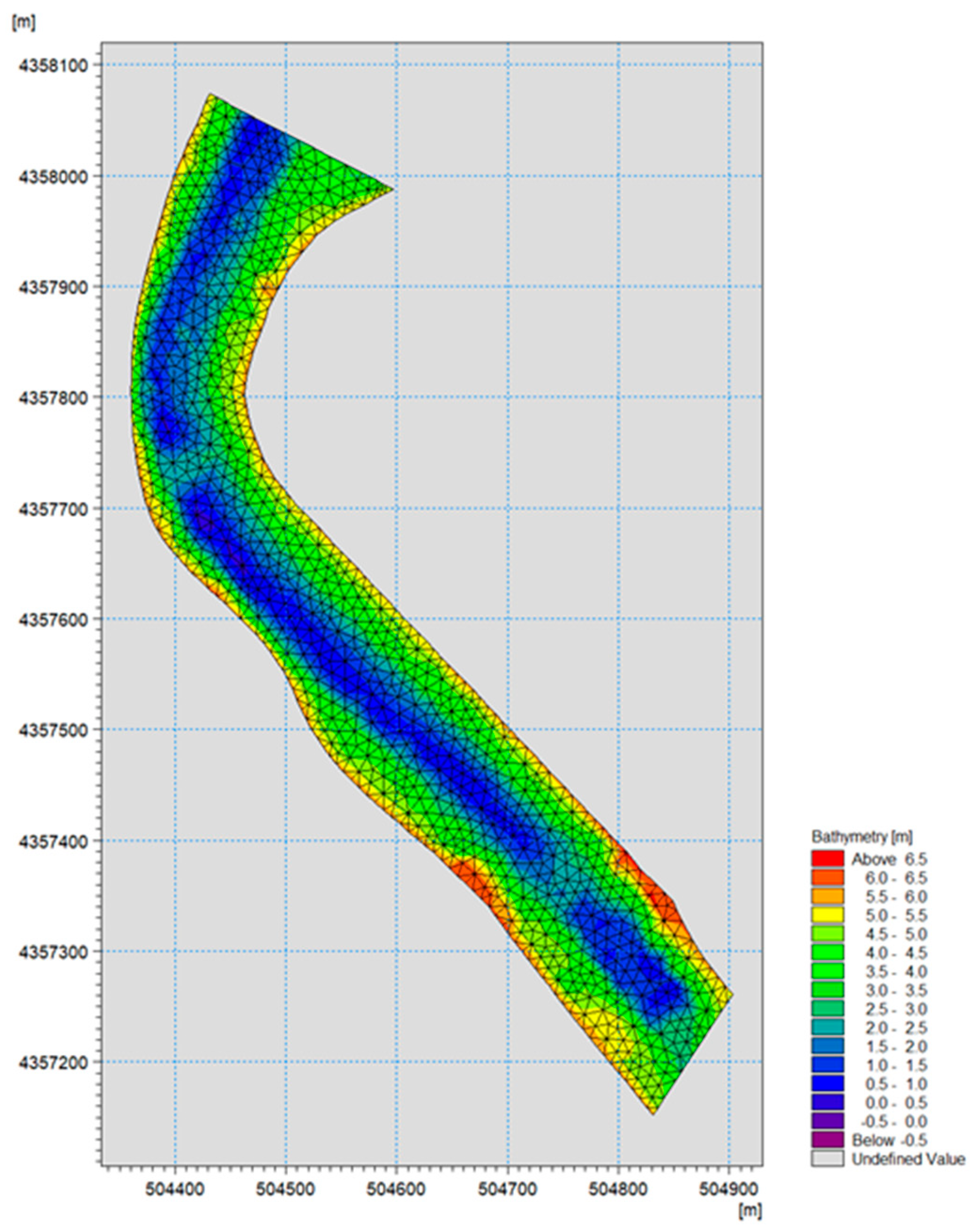
2.3.1. Study Area Generalization
2.3.2. Simulation Condition Settings
2.4. Model Parameter Calibration and Validation
3. Results and Analysis
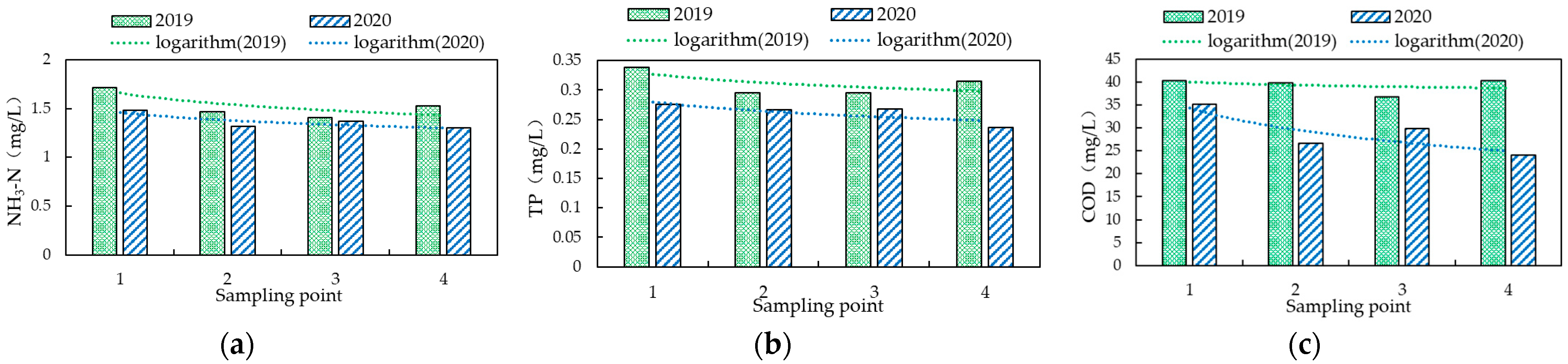
3.1. River Water Quality Monitoring
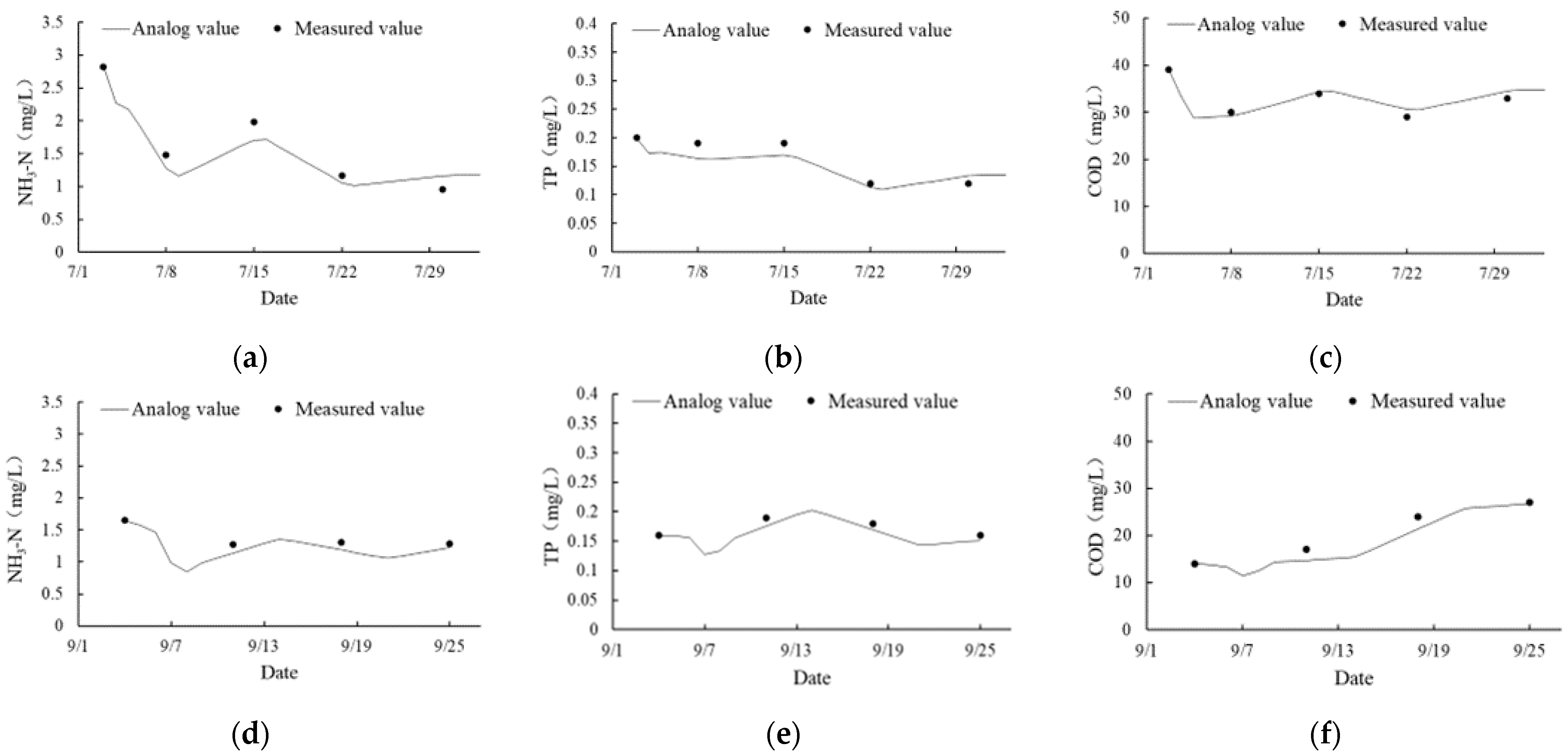
3.2. Analysis of Water Quality Calibration Results
3.3. Scenario
3.3.1. Research on the Formulation of an Ecological Floating Bed Combination Scheme in the River Reach
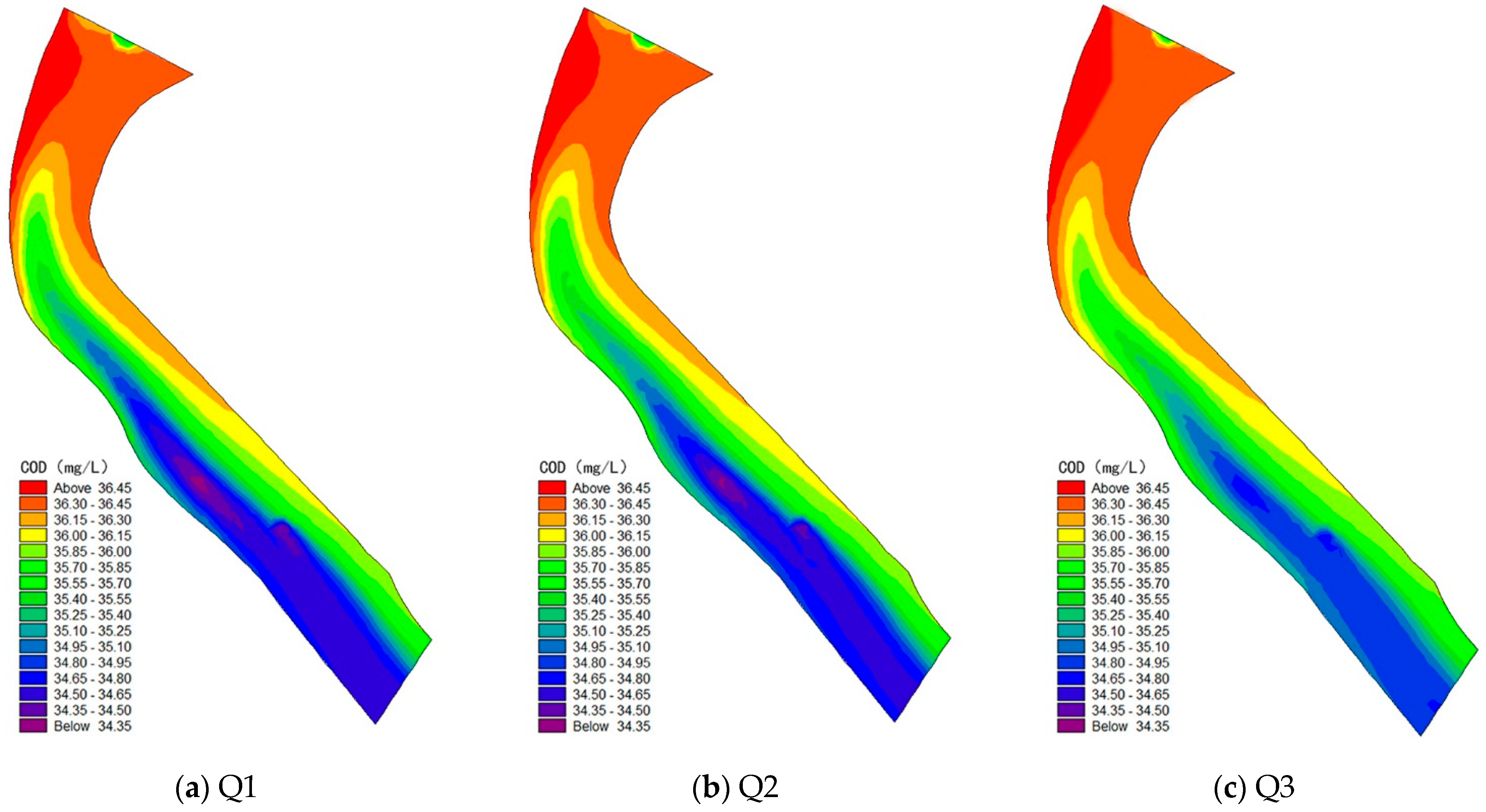
3.3.2. Analysis of the Water Quality Improvement Effect under Different Ecological Floating Bed Combinations
4. Discussion
5. Conclusions
Author Contributions
Funding
Institutional Review Board Statement
Informed Consent Statement
Data Availability Statement
Conflicts of Interest
References
- Cao, Y.; Sun, J.K.; Li, T. The Water Recycling Mode Based on Urban Tail Water Deep Purification and Ecological Restoration of Wetlands. J. Water Conserv. 2015, 29, 307–310. [Google Scholar] [CrossRef]
- Md Anawar, H.; Chowdhury, R. Remediation of Polluted River Water by Biological, Chemical, Ecological and Engineering Processes. Sustainability 2020, 12, 7017. [Google Scholar] [CrossRef]
- Yan, Z.; Song, B.; Li, Z. Effects of Submerged Plants on the Growth of Eutrophic Algae and Nutrient Removal in Constructed Wetlands. Open Access Libr. J. 2016, 3, 1–11. [Google Scholar] [CrossRef]
- Wei, X.D.; Yang, J.; Luo, P.P. Assessment of the variation and influencing factors of vegetation NPP and carbon sink capacity under different natural conditions. Ecol. Indic. 2022, 138, 108834. [Google Scholar] [CrossRef]
- Li, S.S.; Tian, K.; Liu, Y.G.; Zhou, Y.H.; Yang, H.M. Compare the purification effects of sewage by the wetland plant community composition and spatial patterns. J. Ecol. Environ. 2010, 19, 1951–1955. [Google Scholar] [CrossRef]
- Xia, Y.; Dou, P.; Lou, C.H.; Wang, C.; Li, Q.J. Simulation study on the effect of water quality improvement of landscape water body under different vegetation coverage scenarios. J. Environ. Sci. 2022, 42, 248–258. [Google Scholar] [CrossRef]
- Rao, L.; Wang, P.F.; Lei, Y. Coupling of the flow field and the purification efficiency in root system region of ecological floating bed under different hydrodynamic conditions. Res. Prog. Hydrodyn. Engl. Ed. 2016, 28, 1049–1057. [Google Scholar] [CrossRef]
- Zheng, L.; Wang, H. The Effect of Combined Ecological Floating Bed for Eutrophic Lake Remediation. In American Institute of Physics Conference Series; AIP Publishing LLC: Melville, NY, USA, 2017; p. 020058. [Google Scholar]
- Zhang, Q.; Achal, V.; Xu, Y. Aquaculture wastewater quality improvement by water spinach (Ipomoea aquatica Forsskal) floating bed and ecological benefit assessment in ecological agriculture district. Aquac. Eng. 2014, 60, 48–55. [Google Scholar] [CrossRef]
- Zhang, Y.H.; Gao, X.H. The Purification Mechanism and Application of Aquatic Plants in Water Pollution Control. China Compr. Util. Resour. 2020, 38, 199–201. [Google Scholar]
- Li, P.W.; Yang, G.M.; Chen, Z.; Sun, R.G. Effect Analysis of Plants in Water Purification in Stereo-ecological Floating Bed. Guangzhou Chem. Ind. 2016, 44, 129–130. [Google Scholar]
- Shen, W.; Huang, X.Q.; Luo, X.; Zhou, K.X.; Ling, H.; Xie, B.W. Comparative Study of Purification Capacity in Aquaculture Water between Lythrum salicaria and Eichhornia crassipes. J. Neijiang Norm. Univ. 2017, 32, 77–81. [Google Scholar] [CrossRef]
- Ji, F.; Zhang, Y.J.; Wang, F.; Peng, Q.Z.; Hua, W.F.; Chen, X.J. Research on the annual changes of nitrogen removal efficiency in a combined ecological floating bed system. J. Shanghai Ocean. Univ. 2017, 26, 235–242. [Google Scholar]
- Bai, X.M.; He, L.S.; Li, B.C.; Meng, R.; Meng, F.L.; Huang, C.H.; Dong, J.; Li, G. Application of Combined Aquatic Plants to Control Eutrophic Water in Baiyangdian Lake. Wetl. Sci. 2013, 11, 495–498. [Google Scholar] [CrossRef]
- Du, Y.L.; Zhang, S.H.; Wang, L.J.; Mao, Z.P.; Ma, X.Y. Numerical simulation of water purification effects of aquatic plant in artificial surface flow wetland. J. Hydraul. Eng. 2020, 51, 675–684. [Google Scholar] [CrossRef]
- Luo, P.; Liu, L.; Wang, S.; Ren, B.; He, B.; Nover, D. Influence assessment of new Inner Tube Porous Brick with absorbent concrete on urban floods control. Case Stud. Constr. Mater. 2022, 17, e01236. [Google Scholar] [CrossRef]
- Wang, S.; Cao, Z.; Luo, P.; Zhu, W. Spatiotemporal Variations and Climatological Trends in Precipitation Indices in Shaanxi Province, China. Atmosphere 2022, 13, 744. [Google Scholar] [CrossRef]
- Zhu, W.; Zha, X.; Luo, P.; Wang, S.; Cao, Z.; Lyu, J.; Zhou, M.; He, B.; Nover, D. A quantitative analysis of research trends in flood hazard assessment. Stoch. Environ. Res. Risk Assess. 2022, in press. [Google Scholar] [CrossRef]
- Rotiroti, M.; Bonomi, T.; Fumagalli, L.; Azzoni, A.; Pisaroni, B.; Demicheli, G. Methodological approach in the analysis of Arsenic, Iron and Manganese contamination phenomena in shallow aquifer, the case of the Cremona area. Eng. Hydro Environ. Geol. 2012, 15, 117–128. [Google Scholar]
- Cuiuli, E. Remarks on the hydrogeological setting of S. Eufemia Lamezia Plain through the developement of the top surface of the intermediate confined aquifer. Acq. Sotter.-Ital. J. Groundwat. 2015, 4, 45–52. [Google Scholar]
- Maringo, R.; Torretta, M. Stochastic modeling of radon gas distribution in the unsaturated as a function of groudwater depth. In Proceedings of the XXXVI Convegno Nazionale di Radioprotezione (AIRP), Palermo, Italy, 18–20 September 2013; ISBN 978-88-88648-38-5. [Google Scholar]
- Jing, Y.W.; Hu, X.L.; Xu, Z.L.; Liu, H.C. Research and Demonstration of Water Remediation Using Biological Floating Bed Technology. Beijing Water 2003, 6, 20–22. [Google Scholar] [CrossRef]
- Lu, J.D.; Chen, H.B.; Zhao, L.Y.; Li, Z.H. Study on the growth characteristics of seven plants cultivated on artificial floating rafts in eutrophic water. Environ. Pollut. Control. Technol. Equip. 2006, 7, 58–61. [Google Scholar]
- Xiao, C.T.; Xiao, K.Y. Plants Purification & Ecological Restoration; Jiangsu Phoenix Science and Technology Press: Nanjing, China, 2017. [Google Scholar]
- Li, Y.J.; Du, Y.L.; Bi, E.P.; Wang, L. Chen, C.B. Simulation of Water Quality Response of Guishui River Wetland Plants and Water Diversion. Environ. Sci. 2020, 41, 4095–4104. [Google Scholar] [CrossRef]
- ISO Standard n. 13164-3; Water Quality—Radon-222—Part 3: Test Method Using Emanometry. ISO—International Organization for Standardization: Geneva, Switzerland, 2013.
- Mook, W.G.; Gat, J.R.; Meijer, H.A.; Różański, K.; Froehlich, K.J. Environmental Isotopes in the Hydrological Cycle, Principles and Applications, Volumes I, IV and V; Technical Documents in Hydrology No. 39; IAEA-UNESCO: Paris, France, 2001. [Google Scholar]
- Samal, K.; Kar, S.; Trivedi, S. Ecological floating bed (EFB) for decontamination of polluted water bodies: Design, mechanism and performance. J. Environ. Manag. 2019, 251, 109550. [Google Scholar] [CrossRef] [PubMed]
- Luo, P.; Luo, M.; Li, F.; Qi, X.; Huo, A.; Wang, Z.; He, B.; Takara, K.; Nover, D. Urban flood numerical simulation: Research, methods and future perspectives. Environ. Model. Softw. 2022, 156, 105478. [Google Scholar] [CrossRef]
- Chen, C.C. Simulation and Study on Hydrodynamic and Water Quality of Urban Rivers Based on MIKE21—Taking the Xi’an Moat as an Example; Xi’an University of Technology: Xi’an, China, 2020. [Google Scholar] [CrossRef]
- Li, T.Y.; Li, Z.H.; Huang, B.B. Simulation on water quantity and quality of Shahe Reservoir by MIKE21 model. J. Environ. Sci. 2021, 41, 293–300. [Google Scholar] [CrossRef]
- Rehanguli, Y.M.T. Simulation analysis of river water quality in river basin based on ECOLab. Groundwater 2020, 42, 64–66+95. [Google Scholar] [CrossRef]
- Luo, P.P.; Mu, Y.; Wang, S.T.; Zhu, W.; Mishra, B.K.; Huo, A.D.; Zhou, M.M. Exploring sustainable solutions for the water environment in Chinese and Southeast Asian cities. Ambio 2021, 51, 1199–1218. [Google Scholar] [CrossRef]
- Munazzam, J.S.; Razia, T.; Muhammad, S.; Shafaqat, A.; Samina, I.; Muhammad, A. Remediation of polluted river water by floating treatment wetlands. Water Supply 2019, 19, 967–977. [Google Scholar] [CrossRef]
- Swastik, G.; Nishan, P.; Susmita, P.; Tunisha, G.; Apekshya, K.; Bandita, M.; Michael, J.A.; Shukra, R.P. Assessment of technologies for water quality control of the Bagmati River in Kath-mandu valley, Nepal. Groundw. Sustain. Dev. 2022, 18, 100770. [Google Scholar] [CrossRef]
- Luo, P.; Xu, C.; Kang, S.; Huo, A.; Lyu, J.; Zhou, M.; Nover, D. Heavy metals in water and surface sediments of the Fenghe River Basin, China: Assessment and source analysis. Water Sci. Technol. 2021, 84, 3072–3090. [Google Scholar] [CrossRef]
- Luo, P.; Zheng, Y.; Wang, Y.; Zhang, S.; Yu, W.; Zhu, X.; Huo, A.; Wang, Z.; He, B.; Nover, D. Comparative Assessment of Sponge City Constructing in Public Awareness, Xi’an, China. Sustainability 2022, 14, 11653. [Google Scholar] [CrossRef]
- Zhou, H.Y.; Liu, C. Two-dimensional water quality model based on MIKE 21 for Miyun reservoir. Beijing Water. 2017, 5, 15–18. [Google Scholar] [CrossRef]
- McCuen, R.H.; Knight, Z.; Cutter, A.G. Evaluation of the Nash–Sutcliffe efficiency index. J. Hydrol. Eng. 2006, 11, 597–602. [Google Scholar] [CrossRef]
- Nash, J.E.; Sutcliffe, J.V. River flow forecasting through conceptual models.Part 1:a discussion of principles. J. Hydrol. 1970, 10, 282–290. [Google Scholar] [CrossRef]
- Khodaverdiloo, H.; Homaee, M.; van Genuchten, M.T.; Dashtaki, S.G. Deriving and validating pedotransfer functions for some calcareous soils. J. Hydrol. 2011, 399, 93–99. [Google Scholar] [CrossRef]




| Sampling Point | Station | NH3-N (mg/L) | TP (mg/L) | COD (mg/L) |
|---|---|---|---|---|
| 1 | 0+000 | 3.01 | 0.19 | 30.0 |
| 2 | 0+250 | 2.60 | 0.18 | 31.0 |
| 3 | 0+800 | 2.84 | 0.18 | 32.0 |
| 4 | 1+000 | 2.82 | 0.20 | 39.0 |
| Parameter Description | Value | Unit |
|---|---|---|
| Temperature coefficient | 1.07177 | — |
| Decay rate BOD | 0.03 | /d |
| Nitrification rate | NH3-N.dfsu | /d |
| Denitrification rate | 0.2 | /d |
| Decay rate P_tot | TP.dfsu | /d |
| N/BOD ratio | 0.02 | Fraction |
| Nitrification yield factor | 2.57 | gO2/gNH3-N |
| Used for P sedimentation | 0 | — |
| Weir aeration coefficient in Holler equation | 0.21 | /m |
| ECOLab time step | 30 | Seconds |
| COD decay rate at 20 deg.C | COD.dfsu | /d |
| Temperature coefficient for COD decay rate | 1.02 | Dimensionless |
| Floating Bed Combination Area | Station Number Range | Plant Ratio/m2 | Plants as a Per-Centage of the River/% | Artificial Aquatic Plants Running Volume Ratio/% | NH3-N (/d) | TP (/d) | COD (/d) |
|---|---|---|---|---|---|---|---|
| Zone 1 | 0+020 to 0+400 | Scirpus validus Vahl 1000 + Iris 400 | Scirpus validus Vah 17.86 + Iris 7.14 | 16.2 | 1.50 | 0.60 | 0.30 |
| Zone 2 | 0+400 to 0+620 | Canna 300 + Lythrum salicaria 300 | Canna 12.5 + Lythrum salicaria 12.5 | 16.2 | 2.20 | 1.00 | 0.40 |
| Zone 3 | 0+620 to 0+700 | Iris 400 | Iris 25 | 16.2 | 1.60 | 0.60 | 0.30 |
| Plant-free area | — | — | — | — | 0.10 | 0.005 | 0.02 |
| Different Stage | Sampling Point | NH3-N | TP | COD | |||||||||
|---|---|---|---|---|---|---|---|---|---|---|---|---|---|
| RMSE (mg/L) | MAE (mg/L) | d | NSE | RMSE (mg/L) | MAE (mg/L) | d | NSE | RMSE (mg/L) | MAE | d | NSE | ||
| Parameter calibration | 1 | 0.12 | 0.09 | 0.99 | 0.97 | 0.00 | 0.00 | 0.99 | 0.99 | 0.37 | −0.22 | 0.99 | 0.98 |
| 2 | 0.22 | 0.14 | 0.97 | 0.89 | 0.01 | 0.00 | 0.93 | 0.63 | 1.24 | 1.02 | 0.94 | 0.76 | |
| 3 | 0.17 | −0.12 | 0.98 | 0.94 | 0.01 | −0.01 | 0.95 | 0.79 | 0.86 | −0.29 | 0.94 | 0.60 | |
| 4 | 0.18 | −0.08 | 0.98 | 0.92 | 0.02 | −0.01 | 0.94 | 0.80 | 1.03 | 0.54 | 0.98 | 0.91 | |
| Model validation | 1 | 0.09 | −0.08 | 0.99 | 0.96 | 0.01 | 0.00 | 0.99 | 0.98 | 1.41 | −1.05 | 0.99 | 0.97 |
| 2 | 0.11 | −0.07 | 0.98 | 0.91 | 0.01 | 0.00 | 0.99 | 0.94 | 1.24 | −0.66 | 0.99 | 0.98 | |
| 3 | 0.17 | −0.14 | 0.90 | 0.35 | 0.01 | −0.01 | 0.87 | 0.55 | 2.42 | −2.16 | 0.94 | 0.79 | |
| 4 | 0.10 | −0.08 | 0.93 | 0.61 | 0.02 | −0.01 | 0.82 | 0.39 | 1.75 | −1.31 | 0.97 | 0.89 | |
| Scenario | Floating Bed Combination Area | Plant Ratio/m2 | Plants as a Percentage of the River/% | Artificial Aquatic Plants Running Volume Ratio% | Water Quality Index Attenuation Coefficient/d | ||
|---|---|---|---|---|---|---|---|
| NH3-N | TP | COD | |||||
| Q1 | 1 | Canna 600 + Scirpus validus Vahl 400 + Lythrum salicaria 400 | Canna 10.72 + Scirpus validus Vahl 7.14 + Lythrum salicaria 7.14 | 16.2 | 1.58 | 0.89 | 0.37 |
| 2 | Scirpus validus Vahl 430 + Lythrum salicaria 170 | Scirpus validus Vahl 17.91 + Lythrum salicaria 7.09 | 16.2 | 1.22 | 0.70 | 0.34 | |
| 3 | Iris 400 | Iris 25 | 16.2 | 1.52 | 0.62 | 0.30 | |
| Q2 | 1 | Scirpus validus Vahl 1000 + Iris 400 | Scirpus validus Vahl 17.86 + Iris 7.14 | 16.2 | 1.50 | 0.60 | 0.30 |
| 2 | Lythrum salicaria 400 + Iris 200 | Lythrum salicaria 16.67 + Iris 8.33 | 16.2 | 0.86 | 0.85 | 0.35 | |
| 3 | Scirpus validus Vahl 200 + Canna 200 | Scirpus validus Vahl 12.5 + Canna 12.5 | 16.2 | 1.92 | 0.81 | 0.33 | |
| Q3 | 1 | Scirpus validus Vahl 700 + Canna 700 | Scirpus validus Vahl 12.5 + Canna 12.5 | 16.2 | 1.92 | 0.81 | 0.33 |
| 2 | Scirpus validus Vahl 430 + Iris 170 | Scirpus validus Vahl 17.91 + Iris 7.09 | 16.2 | 1.50 | 0.60 | 0.30 | |
| 3 | Iris 200 + Lythrum salicaria 200 | Iris 12.5 + Lythrum salicaria 12.5 | 16.2 | 1.02 | 0.80 | 0.37 | |
Publisher’s Note: MDPI stays neutral with regard to jurisdictional claims in published maps and institutional affiliations. |
© 2022 by the authors. Licensee MDPI, Basel, Switzerland. This article is an open access article distributed under the terms and conditions of the Creative Commons Attribution (CC BY) license (https://creativecommons.org/licenses/by/4.0/).
Share and Cite
Qiu, L.; Yu, P.; Li, S.; Ma, H.; Li, D.; Li, J. Water Purification Effect of Ecological Floating Bed Combination Based on the Numerical Simulation. Sustainability 2022, 14, 12276. https://doi.org/10.3390/su141912276
Qiu L, Yu P, Li S, Ma H, Li D, Li J. Water Purification Effect of Ecological Floating Bed Combination Based on the Numerical Simulation. Sustainability. 2022; 14(19):12276. https://doi.org/10.3390/su141912276
Chicago/Turabian StyleQiu, Lanqing, Ping Yu, Shaofei Li, Huixin Ma, Danying Li, and Jianzhu Li. 2022. "Water Purification Effect of Ecological Floating Bed Combination Based on the Numerical Simulation" Sustainability 14, no. 19: 12276. https://doi.org/10.3390/su141912276
APA StyleQiu, L., Yu, P., Li, S., Ma, H., Li, D., & Li, J. (2022). Water Purification Effect of Ecological Floating Bed Combination Based on the Numerical Simulation. Sustainability, 14(19), 12276. https://doi.org/10.3390/su141912276