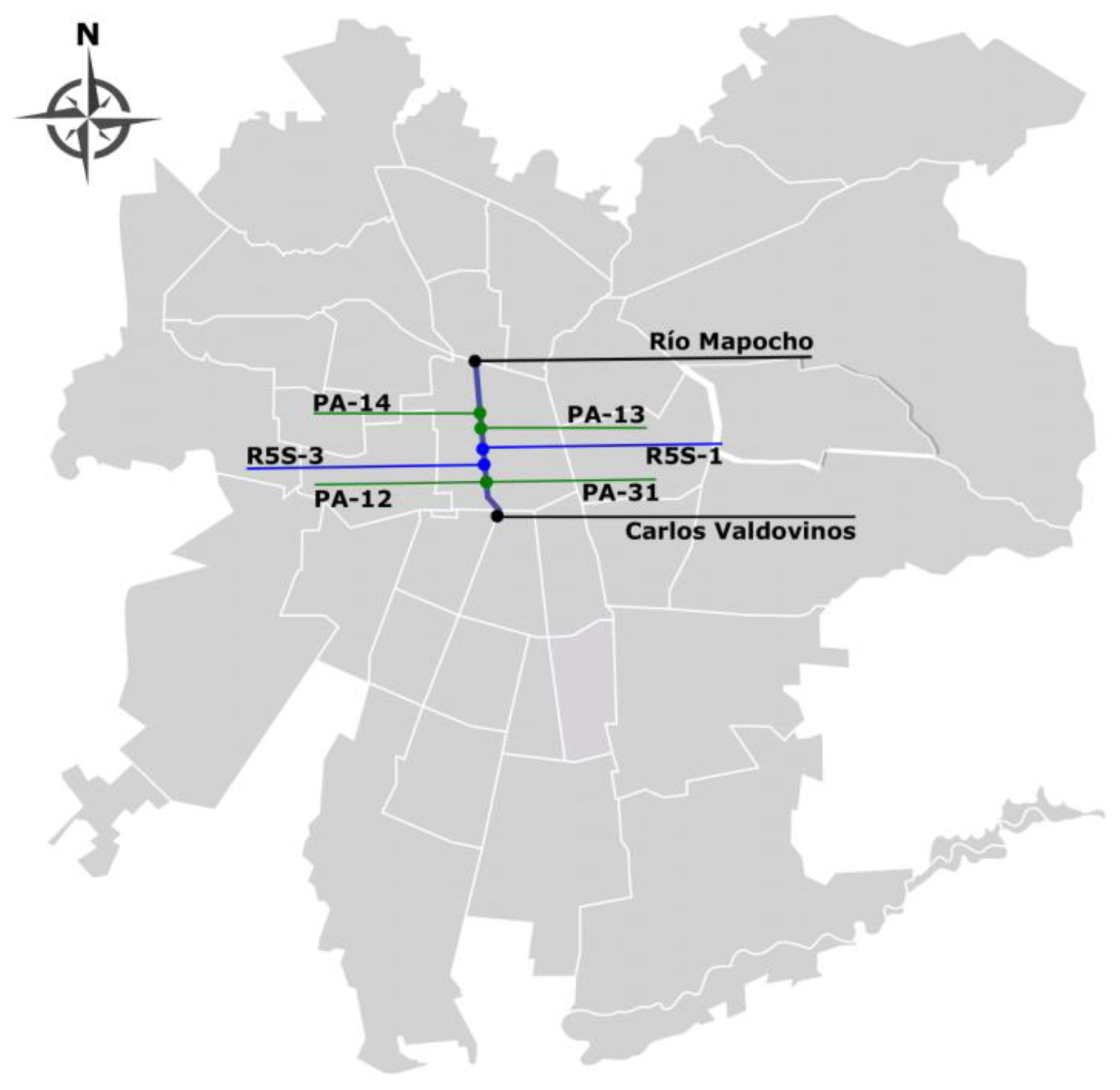
The Impact of Flashing on the Efficacy of Variable Message Signs: A Vehicle-by-Vehicle Approach

Abstract
1. Introduction
2. Literature Review
2.1. The Efficacy of VMS with Fixed Messaging
2.2. The Effect of the Chosen Method of Transmitting the Message on VMS
3. Methodology
3.1. Experimental Design
3.2. Materials
3.3. Participants
3.4. Description of Raw Data
3.5. Performance Measurement and Data Analysis
4. Analysis and Discussion of Results
4.1. Speed Moderation
4.1.1. Factors Relating to the Surroundings
4.1.2. Factors Relating to Drivers and Vehicles
4.1.3. Factors Relating to Message Typology
4.2. Lane Changes
4.2.1. Factors Relating to the Surroundings
4.2.2. Factors Relating to Drivers and Vehicles
4.2.3. Factors Relating to Message Typology
5. Conclusions
Author Contributions
Funding
Institutional Review Board Statement
Informed Consent Statement
Data Availability Statement
Acknowledgments
Conflicts of Interest
References
- Yan, X.; Wu, J. Effectiveness of variable message signs on driving behavior based on a driving simulation experiment. Discret. Dyn. Nat. Soc. 2014, 2014, 206805. [Google Scholar] [CrossRef]
- Levinson, D.M.; Huo, H. Effectiveness of Variable Message Signs Using Empirical Loop Detector Data. In Proceedings of the Annual Meeting of the Transportation Research Board, Washington, DC, USA, 12–16 January 2003. [Google Scholar]
- Tay, R. ITS and VMS. J. Adv. Transp. 2008, 42, 1–3. [Google Scholar] [CrossRef]
- Ronchi, E.; Nilsson, D.; Modig, H.; Walter, A.L. Variable Message Signs for road tunnel emergency evacuations. Appl. Ergon. 2016, 52, 253–264. [Google Scholar] [CrossRef]
- He, Y.; Li, Y.; Xing, L.; Qiu, Z.; Zhang, X. Influence of text luminance, text colour and background luminance of variable-message signs on legibility in urban areas at night. Lighting Res. Technol. 2021, 53, 263–279. [Google Scholar] [CrossRef]
- Currie, G.; Lai, H. Intermittent and dynamic transit lanes: Melbourne, Australia, experience. Transp. Res. Rec. 2008, 2072, 49–56. [Google Scholar] [CrossRef]
- Khattak, A.J.; Schofer, J.L.; Koppelman, F.S. Commuters’ enroute diversion and return decisions: Analysis and implications for advanced traveler information systems. Transp. Res. Part A Policy Pract. 1993, 27, 101–111. [Google Scholar] [CrossRef]
- Rämä, P.; Kulmala, R. Effects of variable message signs for slippery road conditions on driving speed and headways. Transp. Res. Part F 2000, 3, 85–94. [Google Scholar] [CrossRef]
- Erke, A.; Sagberg, F.; Hagman, R. Effects of route Guidance Variable Message Signs (VMS) on Driver Behaviour. Transp. Res. Part F 2007, 10, 447–457. [Google Scholar] [CrossRef]
- Shen, J.; Wang, H. Effects of urban road variable message signs on driving behavior. Adv. Mech. Eng. 2019, 11, 1687814019841843. [Google Scholar] [CrossRef]
- Wardman, M.; Bonsall, P.W.; Shires, J.D. Driver response to variable message signs: A stated preference investigation. Transp. Res. Part C Emerg. Technol. 1997, 5, 389–405. [Google Scholar] [CrossRef]
- Kawasaki, M.; Enoki, S.; Jumpei, O. Variations in Behaviour of Vehicles Travelling on Roads by Providing Travel Time Information. In Proceedings of the 7th World Congress on Intelligent Transport Systems, Turin, Italy, 6–9 November 2000. [Google Scholar]
- Chatterjee, K.; Hounsell, N.B.; Firmin, P.E.; Bonsall, P.W. Driver response to variable message sign information in London. Transp. Res. Part C Emerg. Technol. 2002, 10, 149–169. [Google Scholar] [CrossRef]
- Xu, T.; Sun, L.; Peng, Z.R. Empirical analysis and modeling of drivers’ response to variable message signs in Shanghai, China. Transp. Res. Rec. 2011, 2243, 99–107. [Google Scholar] [CrossRef]
- Poulopoulou, M.; Spyropoulou, I.; Antoniou, C. Parameters affecting professional driver response to VMS messages. In Proceedings of the 2015 IEEE 18th International Conference on Intelligent Transportation Systems, Las Palmas, Spain, 15–18 September 2015; pp. 1563–1568. [Google Scholar]
- Jamson, A.H.; Merat, N. The effectiveness of safety campaign VMS messages—A driving simulator investigation. In Proceedings of the 4th International Driving Symposium on Human Factors in Driver Assessment, Training, and Vehicle Design, Stevenson, WA, USA, 9–12 July 2007; pp. 459–465. [Google Scholar]
- Ma, J.; Smith, B.L.; Fontaine, M.D. Comparison of in-vehicle auditory public traffic information with roadside dynamic message signs. J. Intell. Transp. Syst. 2016, 20, 244–254. [Google Scholar] [CrossRef]
- Harms, I.M.; Dijksterhuis, C.; Jelijs, B.; de Waard, D.; Brookhuis, K.A. Don’t shoot the messenger: Traffic-irrelevant messages on variable message signs (VMSs) might not interfere with traffic management. Transp. Res. Part F Traffic Psychol. Behav. 2019, 65, 564–575. [Google Scholar] [CrossRef]
- Thomas, F.M.; Charlton, S.G. Inattentional blindness and information relevance of variable message signs. Accid. Anal. Prev. 2020, 140, 105511. [Google Scholar] [CrossRef] [PubMed]
- Romero, F.; Gomez, J.; Rangel, T.; Jurado-Piña, R.; Vassallo, J.M. The influence of variable message signs on en-route diversion between a toll highway and a free competing alternative. Transportation 2020, 47, 1665–1687. [Google Scholar] [CrossRef]
- Richards, A.; McDonald, M. Investigating limits of benefits provided by variable message signs in urban network. Transp. Res. Rec. 2007, 2000, 25–34. [Google Scholar] [CrossRef]
- Basso, F.; Cifuentes, A.; Pezoa, R.; Varas, M. A vehicle-by-vehicle approach to assess the impact of variable message signs on driving behavior. Transp. Res. Part C Emerg. Technol. 2021, 125, 103015. [Google Scholar] [CrossRef]
- Miller, J.S.; Smith, B.L.; Newman, B.R.; Demetsky, M.J. Effective use of Variable Message Signs: Lessons learned through development of users’ manuals. In Transportation Research Record: No.1495 Highway Operations, Capacity, and Traffic Control, Traffic Control Devices, Visibility, and Railroad Grade Crossings; National Academy Press: Washington, DC, USA, 1995. [Google Scholar]
- Dudek, C.L.; Huchingson, R.D.; Williams, R.D.; Koppa, R.J. Human Design of Dynamic Visual and Auditory Displays for Metropolitan Traffic Management, Vol. 2––Dynamic Visual Displays; Report FHWA-RD-81/040; Texas Transportation Institute: Bryan, TX, USA, 1981. [Google Scholar]
- Dutta, A.; Fisher, D.L.; Noyce, D.A. Use of a driving simulator to evaluate and optimize factors affecting understandability of variable message signs. Transp. Res. Part F Traffic Psychol. Behav. 2004, 7, 209–227. [Google Scholar] [CrossRef]
- Wang, J.H.; Cao, Y. A human factors study on message design of variable message sign. Int. J. Ind. Eng.-Theory Appl. Pract. 2003, 10, 339–344. [Google Scholar]
- Wang, J.H.; Hesar, S.G.; Collyer, C.E. Adding graphics to dynamic message sign messages. Transp. Res. Rec. 2007, 2018, 63–71. [Google Scholar] [CrossRef]
- Lai, C.J. An ergonomic study of Chinese font and color display on variable message signs. J. Chin. Inst. Ind. Eng. 2008, 25, 306–313. [Google Scholar] [CrossRef]
- Zhao, W.; Quddus, M.; Huang, H.; Lee, J.; Ma, Z. Analyzing drivers’ preferences and choices for the content and format of variable message signs (VMS). Transp. Res. Part C Emerg. Technol. 2019, 100, 1–14. [Google Scholar] [CrossRef]
- Yang, C.M.; Waters, D.; Cabrera, C.C.; Wang, J.H.; Collyer, C.E. Enhancing the messages displayed on dynamic message signs. In Proceedings of the Driving Assessment 2005: 3rd International Driving Symposium on Human Factors in Driver Assessment, Training, and Vehicle Design, Samoset Resort on the Ocean, Rockport, ME, USA, 27–30 June 2005. [Google Scholar]
- Lai, C.J. Effects of color scheme and message lines of variable message signs on driver performance. Accid. Anal. Prev. 2010, 42, 1003–1008. [Google Scholar] [CrossRef] [PubMed]
- Armstrong, J.D.; Upchurch, J.E. Human factors design considerations for variable message freeway signs. J. Transp. Eng. 1994, 120, 264–282. [Google Scholar] [CrossRef]
- Wang, J.H.; Cao, Y. Assessing message display formats of portable variable message signs. Transp. Res. Rec. 2005, 1937, 113–119. [Google Scholar] [CrossRef]
- Jamson, S.L.; Tate, F.N.; Jamson, A.H. Evaluating the effects of bilingual traffic signs on driver performance and safety. Ergonomics 2005, 48, 1734–1748. [Google Scholar] [CrossRef] [PubMed][Green Version]
- Lai, C.J.; Yen, K.T. Sedan drivers’ attention and response to variable message signs on freeway in Taiwan. In Proceedings of the 4th International Conference on Traffic and Transportation Psychology, Washington, DC, USA, 31 August–4 September 2004; pp. 8–12. [Google Scholar]
- Dudek, C.L. NCHRP Synthesis 237: Changeable Message Signs; Transportation Research Board, National Research Council: Washington, DC, USA, 1997. [Google Scholar]
- Proffitt, D.R.; Wade, M.M. Creating Effective Variable Message Signs: Human Factors Issues (No. VTRC 98-CR31); Virginia Transportation Research Council: Charlottesville, VA, USA, 1998. [Google Scholar]
- Durkop, B.R.; Dudek, C.L. Texas Driver Understanding of abbreviations for changeable message signs. Transp. Res. Rec. 2001, 1748, 87–95. [Google Scholar] [CrossRef]
- Huchingson, R.D.; Dudek, C.L. How to Abbreviate on Highway Signs; Transportation Research Record 904; Transportation Research Board: Thousand Oaks, CA, USA, 1983. [Google Scholar]
- Hustad, M.W.; Dudek, C.L. Driver understanding of abbreviations for changeable message signs in New Jersey. Transp. Res. Rec. 1999, 1689, 46–52. [Google Scholar] [CrossRef]
- Bonsall, P.; Palmer, I. The impact on route choice of direction advice and guidance from VMS signs. In Proceedings of the IEE Colloquium on Dynamic Control of Strategic Inter-Urban Road Networks, London, UK, 23–23 February 1995. [Google Scholar]
- Benson, B.G. Motorist attitudes about content of variable-message signs. Transp. Res. Rec. 1996, 1550, 48–57. [Google Scholar] [CrossRef]
- Peeta, S.; Ramos, J.L.; Pasupathy, R. Content of variable message signs and on-line driver behavior. Transp. Res. Rec. 2000, 1725, 102–108. [Google Scholar] [CrossRef]
- Dudek, L.; Schrock, S.; Ullman, G.; Chrysler, S. Flashing Message Features on Changeable Message Signs. Transp. Res. Rec. 2006, 1959, 122–129. [Google Scholar] [CrossRef]
- Charlton, S.G. Conspicuity, memorability, comprehension, and priming in road hazard warning signs. Accid. Anal. Prev. 2006, 38, 496–506. [Google Scholar] [CrossRef] [PubMed]
- Basso, F.; Cifuentes, Á.; Cuevas-Pavincich, F.; Pezoa, R.; Varas, M. Assessing influential factors for lane change behavior using full real-world vehicle-by-vehicle data. Transp. Lett. 2022. [Google Scholar] [CrossRef]
- Ronchi, E.; Nilsson, D. Traffic information signs, colour scheme of emergency exit portals and acoustic systems for road tunnel emergency evacuations. Dep. Fire Prot. Eng. Lund Univ. Rep. 2013, 3173, 1–50. [Google Scholar]
- Basso, F.; Basso, L.J.; Pezoa, R. The importance of flow composition in real-time crash prediction. Accid. Anal. Prev. 2020, 137, 105436. [Google Scholar] [CrossRef]
- Zhang, W.; Wang, C.; Chen, Q.; Liu, J.; Feng, Z.; Wang, K.; Shen, Y. Lane-change behavior in low illumination: Research based on a questionnaire investigation. J. Transp. Saf. Secur. 2020, 14, 1–22. [Google Scholar] [CrossRef]
- Kolisetty, V.G.B.; Iryo, T.; Asakura, Y.; Kuroda, K. Effect of variable message signs on driver speed behavior on a section of expressway under adverse fog conditions-A driving simulator approach. J. Adv. Transp. 2006, 40, 47–74. [Google Scholar] [CrossRef]
- Carlson, R.C.; Papamichail, I.; Papageorgiou, M.; Messmer, A. Optimal mainstream traffic flow control of large-scale motorway networks. Transp. Res. Part C Emerg. Technol. 2010, 18, 193–212. [Google Scholar] [CrossRef]
- De Waard, D. The Measurement of Drivers Mental Workload. Ph.D. Thesis, University of Groningen, Groningen, The Netherlands, 1996. [Google Scholar]
- De Waard, D.; Brookhuis, K.A. On the Measurement of Driver Mental Workload. In Traffic and Transport Psychology: Theory and Application; Rothengatter, J.A., Carbonell Vaya, E., Eds.; Pergamon Press: Oxford, UK, 1997; pp. 161–171. [Google Scholar]
- Chapman, P.; Underwood, G.; Roberts, K. Visual search patterns in trained and untrained novice drivers. Transp. Res. Part F Traffic Psychol. Behav. 2002, 5, 157–167. [Google Scholar] [CrossRef]
- Thackray, R.I.; Mark Touchstone, R. Effects of monitoring under high and low taskload on detection of flashing and coloured radar targets. Ergonomics 1991, 34, 1065–1081. [Google Scholar] [CrossRef] [PubMed]
- Duarte, E.; Rebelo, F.; Teles, J.; Wogalter, M.S. Behavioral compliance for dynamic versus static signs in an immersive virtual environment. Appl. Ergon. 2014, 45, 1367–1375. [Google Scholar] [CrossRef] [PubMed]
- Simons, R.H. Road lighting and accidents. In Lightec’92; Houldershaw Ltd.: Essex, UK, 1992; pp. 54–57. [Google Scholar]
- Plainis, S.; Murray, I.J. Reaction times as an index of visual conspicuity when driving at night. Ophthalmic Physiol. Opt. 2002, 22, 409–415. [Google Scholar] [CrossRef]
- Wang, Y.; Li, Z.; Ye, Z.; Zhang, Y. Nighttime safety evaluation for signalized intersections at the signal cycle level based on rear-end conflict models considering lighting and traffic conditions. Traffic Inj. Prev. 2020, 21, 87–92. [Google Scholar] [CrossRef]
- Hancock, K.L.; Lu, Q. Microsimulation of Large-Truck Activities at Tight Intersections (No. 06-0623). In Proceedings of the Transportation Research Board 85th Annual Meeting, Washington, DC, USA, 22–26 January 2006. [Google Scholar]
- Richtel, M. In study, texting lifts crash risk by large margin. The New York Times, 27 July 2009; p. 28. [Google Scholar]
- Dudek, C.; Ullman, G. Flashing Messages, Flashing Lines, and Alternating One Line on Changeable Message Signs. Transp. Res. Rec. J. Transp. Res. Board 2002, 1803, 94–101. [Google Scholar] [CrossRef]
- Basso, F.; Basso, L.J.; Bravo, F.; Pezoa, R. Real-time crash prediction in an urban expressway using disaggregated data. Transp. Res. Part C Emerg. Technol. 2018, 86, 202–219. [Google Scholar] [CrossRef]


| Message | Typology | Time | Intervals | Accumulated Duration [mins] | Vehicles |
|---|---|---|---|---|---|
| Reduce Speed | Flashing | 11.00 a.m. | 9 | 115 | 5949 |
| 3.00 p.m. | 14 | 161 | 7092 | ||
| 9.00 p.m. | 17 | 201 | 7378 | ||
| Static | 11.00 a.m. | 10 | 102 | 4698 | |
| 3.00 p.m. | 10 | 102 | 4755 | ||
| 9.00 p.m. | 33 | 453 | 15,475 | ||
| Use Central or Left Lanes | Flashing | 11.00 a.m. | 8 | 104 | 509 |
| 3.00 p.m. | 12 | 115 | 662 | ||
| 9.00 p.m. | 23 | 279 | 1763 | ||
| Static | 11.00 a.m. | 10 | 132 | 435 | |
| 3.00 p.m. | 12 | 124 | 609 | ||
| 9.00 p.m. | 30 | 349 | 2406 |
| Variable | Description |
|---|---|
| License plate | Plate number |
| Date | Date and time the vehicle passes through the gate. |
| Lanes | Lane number on which the vehicle travels as it passes through the gate. |
| Speed | Instantaneous vehicle speed as it passes through the gate [km/h]. |
| Vehicle type | Vehicle Type Number (1 = Automobile, 2, 3 = Heavy vehicle, 4 = Motorcycle) |
| Gate | Gate number through which the vehicle passes. |
| Variable | Description |
|---|---|
| Start Date | Date and time the message began to be displayed. |
| Stop Date | Date and time the message stopped being displayed. |
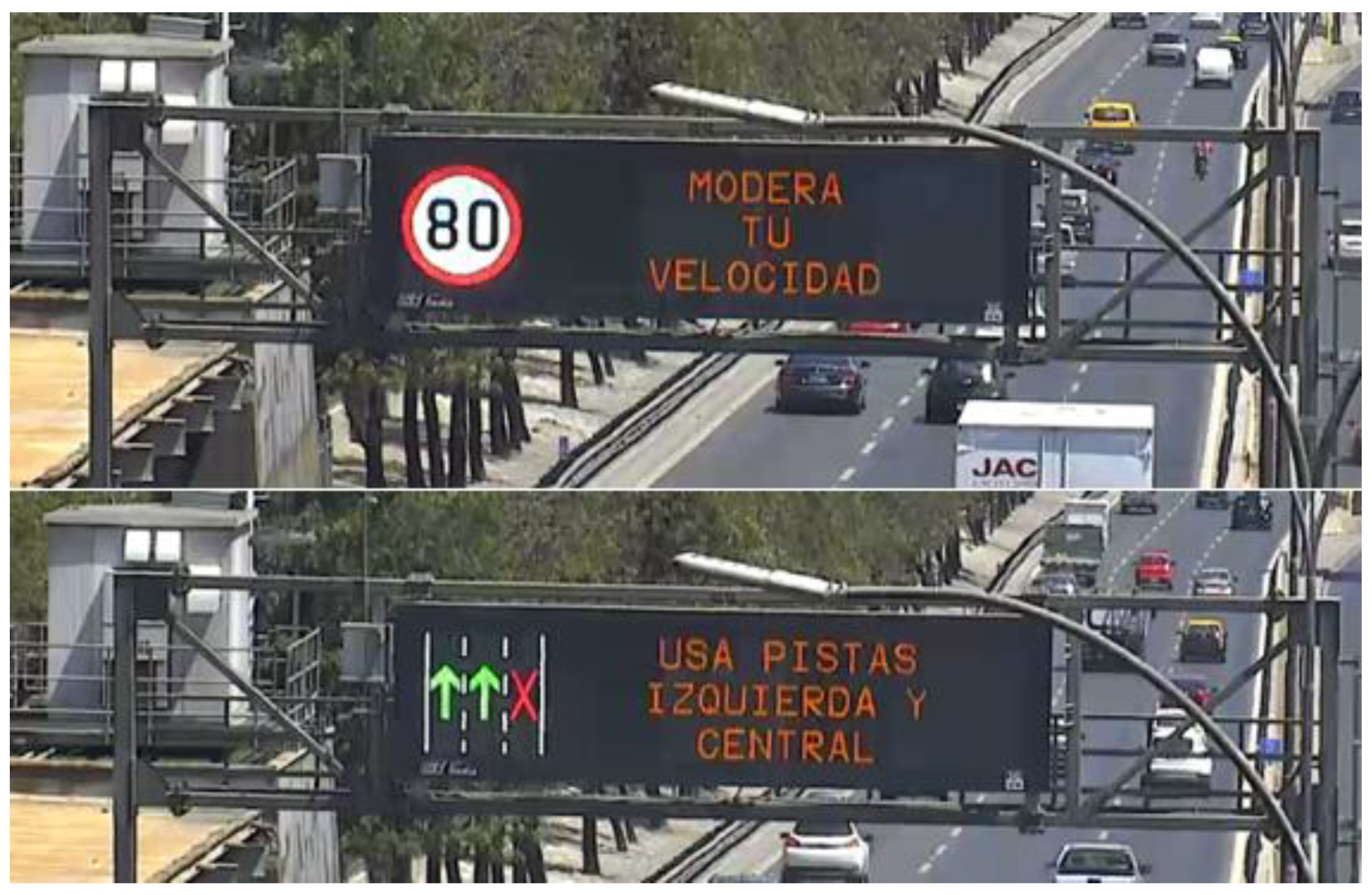
| Message | Message text “Use left and center lanes” or “Moderate your speed” |
| Message Type | Manner in which the message was transmitted (Static or Flashing) |
| Variable | Description |
|---|---|
| Flashing | Takes value 1 if the vehicle faced a flashing message, 0 if it faced a static message. |
| Darkness | Proxy of darkness on the route, calculated as the inverse of radiation (m2/W). |
| Flow previous minute | Number of vehicles circulating during the previous minute on the upstream gate (veh). |
| Speed previous minute | Average speed of circulating vehicles during previous minute in upstream gate (km/h). |
| Average km | Average traveled distance by vehicle during the previous year (km). |
| Category: Motorcycles | Takes value 1 if the vehicle is a motorcycle (Category = 4), 0 otherwise. |
| Category: Heavy vehicles | Takes value 1 if a heavy vehicle (Category = 2,3), 0 otherwise. |
| Gap | Separation from the vehicle that passed through the upstream gate in the same lane (s). |
| Variable | Coefficient Estimate | SE | p-Value |
|---|---|---|---|
| Intercept | −432.33 | 4.65 | <0.01 |
| Flashing | 118.00 | 7.07 | <0.01 |
| Darkness | −29.76 | 1.27 | <0.01 |
| Flow previous minute | 2.05 | 0.04 | <0.01 |
| Speed previous minute | 4.27 | 0.03 | <0.01 |
| Average km. | −0.63 | 0.18 | <0.01 |
| Category: Motorcycles | 8.49 | 9.93 | 0.39 |
| Category: Heavy vehicles | 11.63 | 2.67 | <0.01 |
| Gap | 0.48 | 0.15 | <0.01 |
| Flashing × Darkness | 13.50 | 1.95 | <0.01 |
| Flashing × Flow previous minute | −1.01 | 0.06 | <0.01 |
| Flashing × Speed previous minute | −0.95 | 0.06 | <0.01 |
| Flashing × Average km. | 0.57 | 0.26 | 0.03 |
| Flashing × Category: Motorcycles | 0.42 | 15.66 | 0.98 |
| Flashing × Category: Heavy vehicles | 0.21 | 3.78 | 0.96 |
| Flashing × Gap | −1.24 | 0.26 | <0.01 |
| Variable | Coefficient Estimate | SE | p-Value |
|---|---|---|---|
| Intercept | 0.17 | 0.39 | 0.67 |
| Flashing | 0.90 | 0.49 | 0.07 |
| Darkness | −0.18 | 0.08 | 0.03 |
| Flow previous minute | −1.32 × 10⁻³ | 2.79 × 10⁻³ | 0.63 |
| Speed previous minute | 1.43 × 10⁻³ | 3.24 × 10⁻³ | 0.66 |
| Average km. | 0.05 | 0.01 | <0.01 |
| Category: Motorcycles | −0.82 | 0.59 | 0.17 |
| Category: Heavy vehicles | −0.73 | 0.15 | <0.01 |
| Gap | −0.01 | 0.01 | 0.19 |
| Flashing × Darkness | 0.09 | 0.12 | 0.43 |
| Flashing × Flow previous minute | −0.01 | 3.80 × 10⁻³ | 0.02 |
| Flashing × Speed previous minute | −0.01 | 3.80 × 10⁻³ | 0.02 |
| Flashing × Average km. | 0.03 | 0.02 | 0.16 |
| Flashing × Category: Motorcycles | 0.18 | 0.75 | 0.81 |
| Flashing × Category: Heavy vehicles | −0.02 | 0.22 | 0.93 |
| Flashing × Gap | −0.01 | 0.01 | 0.54 |
Publisher’s Note: MDPI stays neutral with regard to jurisdictional claims in published maps and institutional affiliations. |
© 2022 by the authors. Licensee MDPI, Basel, Switzerland. This article is an open access article distributed under the terms and conditions of the Creative Commons Attribution (CC BY) license (https://creativecommons.org/licenses/by/4.0/).
Share and Cite
Basso, F.; Maldonado, P.; Pezoa, R.; Szoloch, N.; Varas, M. The Impact of Flashing on the Efficacy of Variable Message Signs: A Vehicle-by-Vehicle Approach. Sustainability 2022, 14, 9705. https://doi.org/10.3390/su14159705
Basso F, Maldonado P, Pezoa R, Szoloch N, Varas M. The Impact of Flashing on the Efficacy of Variable Message Signs: A Vehicle-by-Vehicle Approach. Sustainability. 2022; 14(15):9705. https://doi.org/10.3390/su14159705
Chicago/Turabian StyleBasso, Franco, Pedro Maldonado, Raúl Pezoa, Nicolás Szoloch, and Mauricio Varas. 2022. "The Impact of Flashing on the Efficacy of Variable Message Signs: A Vehicle-by-Vehicle Approach" Sustainability 14, no. 15: 9705. https://doi.org/10.3390/su14159705
APA StyleBasso, F., Maldonado, P., Pezoa, R., Szoloch, N., & Varas, M. (2022). The Impact of Flashing on the Efficacy of Variable Message Signs: A Vehicle-by-Vehicle Approach. Sustainability, 14(15), 9705. https://doi.org/10.3390/su14159705