1. Introduction
The term ″sustainable development″ was first discussed in depth in 1987 in the Brundtland Report (originally entitled Our Common Future), to point to the tension between the nature of current economic development and environmental protection [
1]. Since then, this conception has been fleshed out and developed, such that there are now multiple interpretations of the meaning of sustainable development, though all concur that, in order to achieve it, it is necessary to establish economically viable and socially equitable measures [
2]. Thus, this trend cannot be separated from the concept of sustainability, as sustainable development itself is the necessary route to achieve sustainability [
3].
This is why, at present, a much broader paradigm has been created, one that combines several perceptions that have traditionally been understood as individual struggles, such as human development and cooperation, ecology, ethics and global citizenship, among others [
4].
Despite the good intentions and interest shown by much of the population, attaining sustainability is no easy task, especially if it is to be achieved while maintaining the economic models currently in place, which foment thoughtless consumption by all.
For this reason, it is necessary to promote new resource management plans, as well as to reflect on the role of both the market and institutional, social, economic and environmental policies [
2]. In this context, education stands as one of the most reliable vehicles for moving towards sustainable development.
These approaches have also been taken up and expanded in the 2030 Agenda, which aims to guide governments and society towards sustainable development. Thus, in general, the Fourth Sustainable Development Goal (SDG) calls for ensuring inclusive, equitable and high-quality education and promoting lifelong learning opportunities for all. More specifically, Target 7 of this goal states that students should achieve the knowledge and skills needed to promote sustainable development [
5].
In light of all this, the different areas of education cannot remain indifferent to this environmental challenge. On the one hand, universities must be the main agents in the achievement of the SDGs, something that is not always the case [
6] because, in addition to preparing professionals with broad knowledge of their disciplines and professions, they are responsible for educating citizens with the capacity to function in a globalized, changing and sustainable-development-oriented society [
7,
8].
It is also necessary to teach these realities to students in the compulsory educational stages because basic values and behaviors that will be part of and shape their entire lives are acquired at this time. The inclusion of environmental content in the basic curriculum of primary education, as well as relating it to the social sciences, are of great importance to the successful comprehensive teaching of sustainable development, constituting an ever-more-pressing need for the educational systems of the 21st century [
9].
It should be noted that primary education is a stage essential to the improvement in behavior, social awareness and solidarity, preparing individuals to act responsibly in their daily lives [
10]. This is also the reason why schoolchildren’s interest in the environment should be stimulated [
8]. One of the main objectives of the educational system is to provide students with a comprehensive education that will endow them with basic notions of historical and critical awareness, thus ensuring their understanding of the social, political and economic reality in which they live [
11]. Here, the teaching and learning of the social sciences strongly favor the development of students’ social and critical thinking, which are necessary to understand social problems and, therefore, those related to the environment.
To achieve this, the participation and motivation of primary-education teachers is essential, as they must work to effect meaningful and functional learning that promotes the construction of a world in accordance with the needs of today’s society.
In light of the foregoing, the training of future teachers is a key aspect to achieve real social transformation ― training to deal with an uncertain future, full of possibilities, but also of challenges, so that they are capable of acquiring values, attitudes, critical capacities and ways of life guiding society towards a sustainable future; and so they embrace a commitment to the environment, an area where they cannot remain passive, [
12] and whose importance they must impress on their future students, as the current results indicate that there is much room for improvement.
As educators of future primary-education teachers, it was deemed necessary to look for answers that would help boost the quality of these educational processes related to the environment.
To this end, based on the teaching innovation proposed, and with the data obtained thanks to an interpretative questionnaire of a qualitative and quantitative nature, devised for this purpose, a study was carried out whose results were useful to optimize teaching/learning tasks through primary-education-degree students’ perceptions of stories as teaching resources in relation to the teaching of the SDGs [
13].
This topic was chosen due to the fact that, in recent years, the SDGs have become increasingly present in our daily lives given the urgent need to strive for their achievement. Hence, they should also be present in classrooms so that, acting as a catalyst, they become a way for students to understand the world in which they live, thus enabling them to build a more plural, just and egalitarian society [
7,
14,
15].
Recent decades have also seen a considerable increase in the number of works that analyze the educational use of narratives and their cognitive benefits for teachers to be, from varying conceptions, disparate points of view, and with different results [
16,
17]. One of the factors prompting this production was the need to improve students’ deficient grammatical and communicative skills, problems that are hampering the assimilation of the objectives and skills in question, especially among social-sciences students.
Stories are a pedagogical resource widely used by early-childhood-education teachers, but seldom used in primary-education classrooms. They constitute a very useful complement in this educational stage, in whatever form they take (oral, written, etc.). Stories are the first form of narration with which children have contact, which makes them a very engaging didactic instrument and one with which they feel comfortable [
18]. Through stories, they relax, have fun, reflect and learn concepts that would otherwise be more difficult for them. In fact, storytelling itself is a facilitator of learning, as it furthers language acquisition, communication, social interaction and peer relationships. It also promotes problem-based learning, such as environmental ones, from an early age [
19].
Narrations in story format, whether oral or written, allow us to organize our thoughts in a coherent way, according to mental patterns that we can classify as coherent. Sometimes, despite institutional efforts, education for sustainable development and sustainability has not been reflected in the training of teachers, who will be responsible for working on this approach with children in the future. In today’s world, analyzing the relationship between neoliberalism and environmental citizenship establishes how educational practices that are framed within environmental education can be unintentionally counterproductive by focusing on individual solutions and the loss of the importance of the common goods to neoliberalism. Therefore, a form of critical citizenship that seeks social justice, resists dominant power, and promotes participation is considered dangerous to the traditional system. Another of the intentions of the development of this type of practice in the university classroom is to prove is that this topic is studied in didactics of social sciences, given its objectives, but in a more theoretical or conceptual way and with a global approach, as opposed to the possibility of developing actions on a local scale that would keep students from being frustrated by the complexity of the environmental crisis that we face
It is important to highlight that the current Spanish Organic Law 8/2013 of December 9, 2013, for the improvement of educational quality (LOMCE), recognizes the importance of narratives in a special way. Its Article 10 acknowledges the need to develop, in a transversal manner, reading comprehension, oral and written expression, audiovisual communication, information and communication technologies, and enterprise and civic and constitutional education, elements inherent to communication and whose development will have a direct impact on the sound pedagogical use of stories so that students can better assimilate concepts and internalize them.
2. Materials and Methods
In the 2021/2022 academic year, an innovative initiative was implemented with 3rd- and 4th-year students studying for degrees in primary education at the University of Cordoba, to raise awareness of stories as a teaching resource, and their efficacy for teaching students about the environment through coverage of the Sustainable Development Goals and knowledge of them.
These are two annual subjects, Didactics of Social Sciences and Didactics of the Environment, which are composed of multiple and different students (teachers to be), who are part of up to four large learning groups.
This study employed a descriptive/interpretative analysis based on data obtained from a mixed qualitative–quantitative questionnaire. Inferential techniques were used to test the initial hypotheses, further the analysis, and identify possible measures to enhance the training of future primary-school teachers.
2.1. Objectives and Hypotheses
The objectives of the study were divided into the following general objectives (GO) and specific objectives (SOs):
GO-1: To propose methodological strategies that uphold environmental didactics and social sciences didactics in the primary-education classroom.
GO-2: To develop teachers to be’s critical awareness of issues related to the environment and sustainable development.
SO-1: To gauge perceptions of the educational innovation proposed, and the advisability of using narratives or stories in the classroom, among future teachers, as a resource for teaching environmental content and the SDGs.
SO-2: To assess the levels of motivation and interest generated by stories and narratives among students studying for primary-education degrees.
SO-3: To analyze the behavior of students in the use of stories or narratives as didactic resources and elements transmitting content related to the environment and the SDGs.
SO-4: To assess interest in the use of stories and narratives among primary-education-degree students in relation to environmental didactics and social sciences didactics.
SO-5: To promote meaningful learning about environmental issues through research and story writing.
The practices carried out throughout the 2021/2022 academic year in the aforementioned subjects, in which a positive evolution of the students in the subject of the SDGs was seen, which are endorsed in the questionnaire analyzed in this text, as well as in the evaluation and grades obtained by them. The main contribution of this work is the use of a traditional didactic resource, such as narratives and storytelling, for the teaching and learning of complex and current content, implementing a methodology related to environmental education and the SDGs. These are very useful tools because future teachers will be able to use them in their work in primary-education classrooms to teach subjects related to the environment. Furthermore, it is important to point out the need to work on environmental values from an early age in order to form a citizenry committed to sustainability. It is essential to work with children at school to raise awareness of environmental issues and responsibility in solving them, not as a cross-cutting subject or an ephemeral event, but as a central aspect, given the importance and urgency of generating pro-environmental behavior. At the primary-school stage, stories are one of the best resources for achieving this objective, which is why we have considered it essential to discuss with future teachers their didactic potential as a tool for efficient environmental education. The initial hypothesis of the study was that narratives, used as a teaching tool, could be a perfect pedagogical resource to transmit concepts effectively, and would also be presented as an ideal tool to significantly develop other types of skills, related to environmental problems and sustainable development. Likewise, that starting from the SDGs is a good way for the training of future primary-education teachers, since it could favor the development of critical thinking and citizen values, as well as an approach to the real problems of society in the one that inhabits
2.2. Research Design
For its implementation, the plan called for the designing of an activity characterized by its interactivity and flexibility, divided into a set of stages with their corresponding functions.
In an initial phase, and during the theory classes, the basic contents for teaching the environment in primary education were covered, including landscapes, environmental values, and the SDGs. Subsequently, the curriculum corresponding to the primary-education stage in the Autonomous Community of Andalusia was reviewed. Among all its contents, greater emphasis was placed on transversal elements, as they determine components linked to sustainable development and the environment. We also reviewed point b) social sciences, in Block 2, which deals with analyses of human influence on the environment and their environmental consequences.
Subsequently, we worked on the SDGs in the classroom. As a previous activity, a debate was held with the undergraduate students to spark their interest and get them thinking about the activity they were going to complete. The round table raised questions related to the definition of sustainable development; the origins and role of the United Nations; what the Millennium Summit and the Millennium Development Goals (MDGs) are; what the 2030 Agenda and the SDGs are; what they aim to achieve; who the beneficiaries of these goals are; and what sustainable development education is for.
In a later phase, already in the framework of the practical classes, the students were presented with the work to be carried out, its deadlines, as well as the criteria for its evaluation. The activity was proposed as a group task, dedicated to the drafting of a story that would be useful as a didactic resource to teach content related to the SDGs, which they would select, always following educational criteria: those that could be more appealing, amenable and interesting for children, etc.
For their drafting, we established some basic rules to ensure that the narratives met a set of minimum requirements. The stories had to illustrate a specific principle, present characters in a specific context (space and time), and feature a conflict requiring a resolution. No page limit was imposed, and the participants were encouraged to develop their imaginations in their creations.
In this way, the use of a methodology was encouraged that would promote meaningful learning among the trainee teachers. Undoubtedly, the writing of a story on the SDGs entails a research process that encourages critical analysis, research into and the selection of the objective, understanding the different problems and contexts involved, the origin of the problems related to the environment, a search for solutions to them, reflection on their role and that of those around them, as well as the institutions of their city or province, etc.
Four work sessions were organized, each lasting an hour and a half, dedicated to the completion of the required activity. All of them concluded with a discussion and exchange of opinions on the work carried out, to encourage collaborative work. In this forum, students were able to ask questions, make suggestions, share their difficulties carrying out the tasks, as well as explain how they overcame these problems.
First, the necessary time was dedicated to the forming of the work teams, limited to five people. The guidelines established to govern the practice and planning of the work for the following days were then explained. The students were able to work on content related to the SDGs in an effort to better understand their particularities and, thus, begin to think about the essay to be written.
In this session, each group chose the SDG they wanted to teach through storytelling, and continued discussing issues raised related to the objective selected. They were also able to expand their study by searching for articles, websites, blogs, etc., to round out their knowledge of the topic. The students also had the opportunity to start planning the writing of their stories.
The students were able to get their questions answered by turning to their classmates and the teacher. They also had enough time to finish the task.
The stories written by all the class groups were read and presented. For the students, there were no limitations on this presentation, and joint evaluation (teachers/students) was proposed to assess the competencies of the works based on a rubric prepared by the teachers.
2.3. Instrument
In order to obtain sound conclusions about the students’ perceptions of the educational experience carried out, once the first innovation period was over we proceeded to analyze the activity.
In order to complete this study, a mixed methodology [
20] was chosen, combining the tradition of qualitative research [
21], particularly phenomenological [
22,
23], with quantitative methods. The study was carried out on a potential sample of 217 primary-education students (N = 217) in Social Sciences Didactics and Environmental Didactics classes, these being taught in the third and fourth years of the Primary Education degree program, respectively, at the University of Cordoba’s School of Education Sciences. This sample was 69.6% female and 30.4% male.
It was organized in three blocks: one in which information was collected about our students, a second in which the students’ perceptions of the SDGs were analyzed, and a third block that focused on the validity of stories as a didactic resource for teaching content related to the environment and the SDGs. See
Table 1 and
Table 2.
The data collection was carried out in the classroom setting, using as the main instruments a questionnaire developed ad hoc entitled
The SDGs Through Narratives and Stories:
The Perspectives of Primary Education Students On Their Effectiveness and Usefulness, created on the Google Forms platform. All of them included close-ended questions (Likert scale) and open-ended ones, thus combining quantitative and qualitative methods, and following the fundamentals of the central core theory [
24,
25].
Through this type of procedure, it was possible to understand and resolve questions of a descriptive nature, such as those concerning the variables, after a systematic collection of information, which ensures the soundness of the data obtained [
26].
The tool was approved by seven experts from various Spanish universities by means of a questionnaire in which the specialists judged important issues such as its sufficiency, clarity and relevance, on a scale of 1–4. The results were valid in terms of presentation (3.3 on average), formal aspects (3.5 on average), content (3.2 on average), the achievement of objectives (3 on average) and global nature (3.25 on average). However, the experts presented a series of indications that were incorporated into the tool designed for the study, in a second phase of this validation process, before finalizing its definitive format. See
Table 3.
The data was coded and examined in the SPSS v.25.0 statistical program for Windows. Prior to data analysis, the reliability and validity index was assessed using the internal consistency procedure established by Cronbach’s Alpha, which makes it possible to assess the reliability of a measurement tool, combined with a set of Likert-scale-type items, obtaining an index of α = 0.77, which is considered good (α > 0.8) for an unidimensional scale [
27]. The reliability of the instrument was also assessed following the parameters of the McDonald Omega coefficient, appropriate for estimating internal consistency when the data are ordinal, using the Jamovi 1.6. software. In this sense, the instrument shows a result of ω = 0.78, which is an optimal result [
28,
29]. To test the data distribution, the Kolmogorov–Smirnov test was used to determine whether or not the data fit a normal distribution. All the variables present a non-normal distribution of the data (
p-value < 0.05 in all cases); therefore, the statistical study was performed using non-parametric methods.
Outliers and missing cases were completely removed from the data.
3. Results
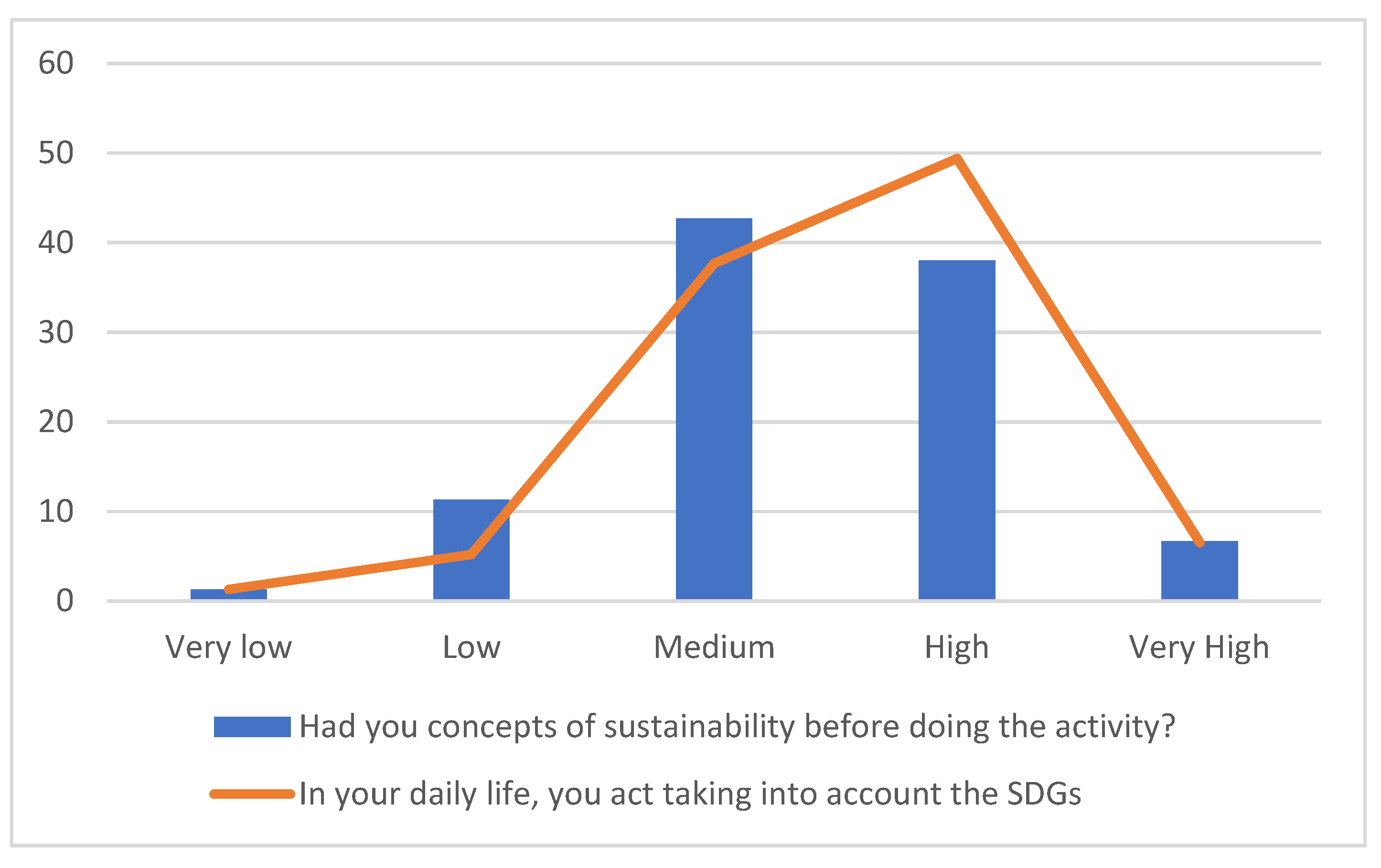
In general terms, the results show that, in general, the students studying for degrees in primary education assessed the task they were given positively. Initially, the students indicated that their knowledge of the SDGs and their application in their daily lives were quite consistent, as shown in
Figure 1.
However, when asked to define in their own words what the SDGs were, there was a high percentage of students (21%) who left this section unanswered, and many of those who responded did so in a vague and unspecific way. Some examples of the latter: "They are those that help us to improve the society in which we live and help to raise awareness among the population" (student 123); "Goals to end poverty on the planet" (student 27); "They are goals to combat injustice and achieve the common good" (student 156); "The goals we want to achieve to develop society’s enjoying wellbeing worldwide" (student 177); or "They are those goals that the world should pursue for a clean and natural life" (student 78).
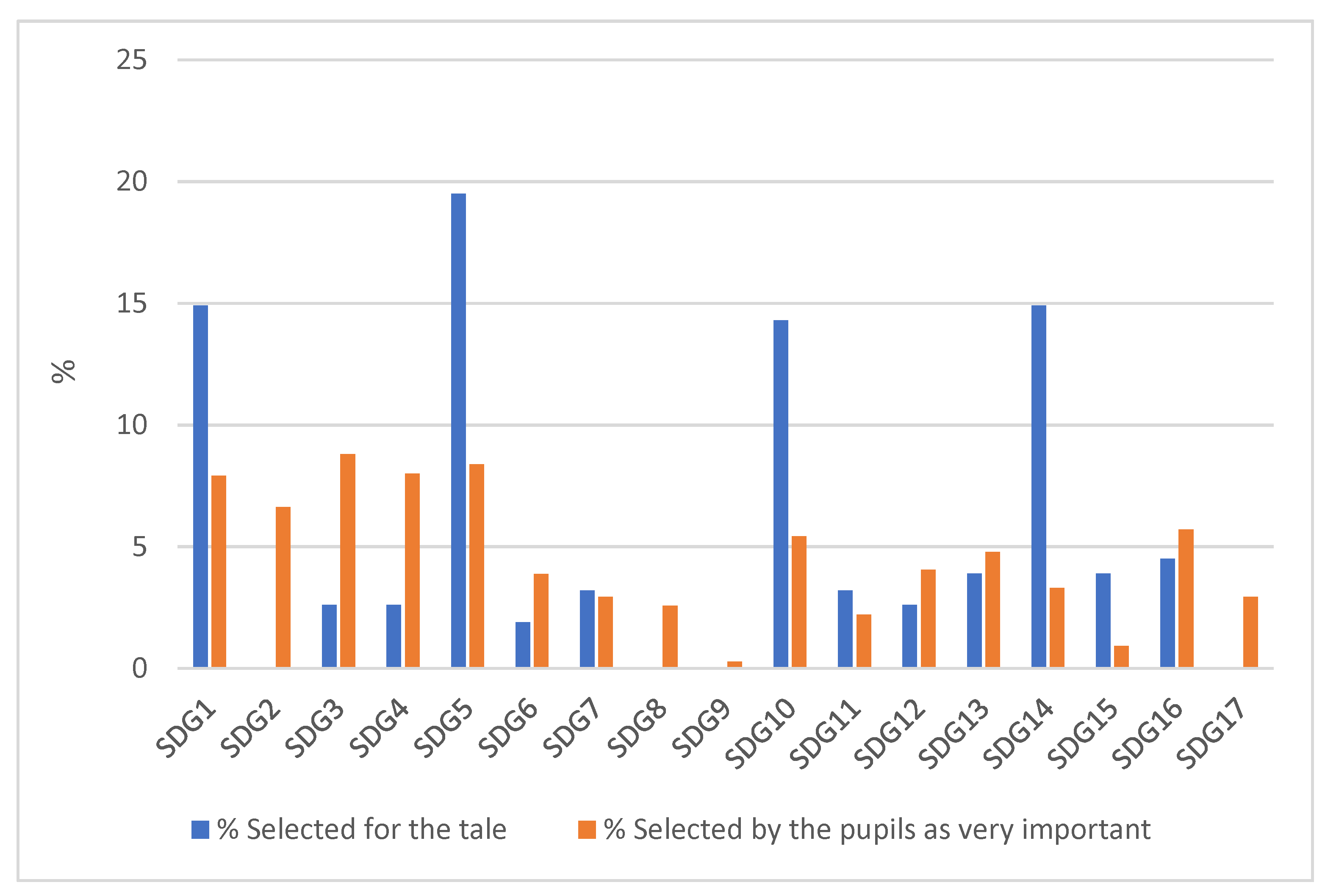
A total of thirteen SDGs were selected for the story, with two of them being discarded. The vast majority chose "Gender equality: SDG5" (19.5%), followed by "Underwater life: SDG14" (14.9%), "Ending poverty: SDG1" (14.9%), "Reducing inequalities: SDG10" (14.3%) and, to a lesser extent, "Responsible production and consumption: SDG12" (2.6%), "Health and well-being: SDG3 (2.6%)," Quality education: SDG4" (2.6%), and "Access to clean water and sanitation: SDG6" (1.9%). Not taken into account were "Zero Hunger: SDG2", "Decent work and economic growth: SDG8", "Industry, innovation and infrastructure: SDG9", and "Revitalizing the Global Partnership for Sustainable Development: SDG17".
However, when trainee teachers were asked which SDGs they thought were the most important, their answers did not coincide with those they chose to teach children in the classroom. Here, the most significant were: "Health and well-being: SDG3" (8.80%); "Gender equality: SDG5" (8.38%); "Achieving quality education: SDG4" (8.01%); "Ending poverty: SDG1" (7.92%) and "Hunger 0: SDG2" (6.63%). This can be seen in
Figure 2.
The activity also entailed the challenge of making students reflect on problems and conflicts related to ecosystems, both from more concrete perspectives and from a more general one, in order to develop their critical awareness. From the information collected, we can note that a large number of students—55.3%—believed that their skills had evolved very positively, while 32.7% believed they had done so positively.
The students were asked whether, over the course of the activity, they had identified some of the problems related to the SDGs in their surroundings that they had not previously noticed. Of the total, 25.8% noticed many cases, while 32.7% noticed quite a few. A total of 22.6% identified some, 4.1% detected few problems related to the SDGs, while 14.7% did not perceive any cases in their settings. When indicating the problems they detected in their personal settings, it is surprising that a high percentage (82.1%) pointed out problems that would seem to be, in reality, removed from them, such as "pollution" (in general), "pollution of the seas", "marine life" and "poverty", such that our students seem to exhibit a disconnect between their perceptions of the SDG goals and their immediate situations. While apparently viewing many of these problems as phenomena affecting other countries or places, they did state—up to 89.4%—that after writing the story they were more mindful of the SDGs.
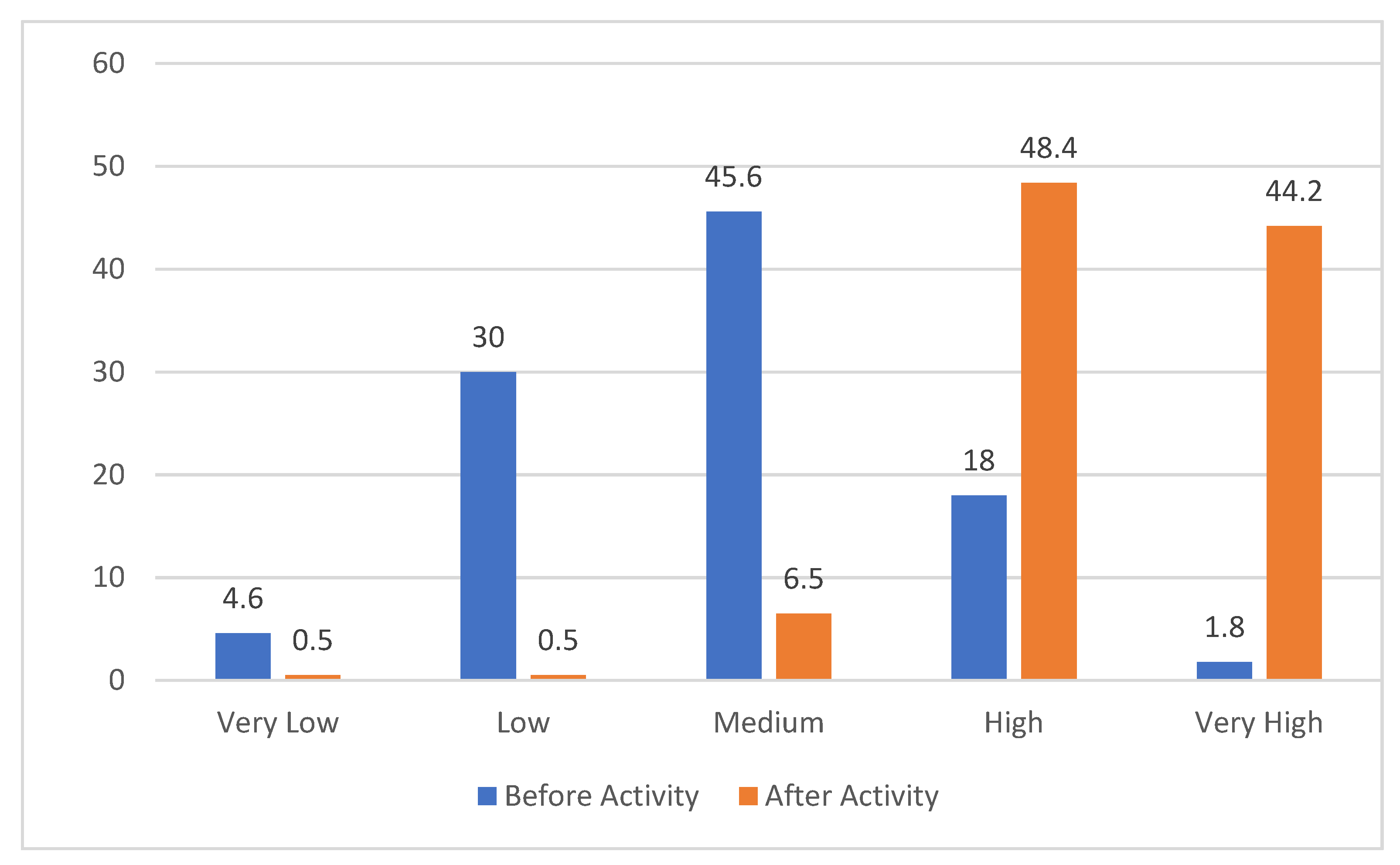
As the narrative aimed to teach primary-school children about one of the seventeen SDGs, initially, in order to carry out the activity, the trainee teachers had to research the issues related to the SDGs and the 2030 Agenda, gathering information on the most relevant topics, as well as the targets established for each goal. In order to evaluate the didactic intervention, and thus determine whether the objectives set when planning the project were ultimately achieved, students were asked to rate their knowledge of the SDGs before and after completing the activity. In these sections, very positive results were obtained: before, just 20.6% stated that their knowledge of the SDGs was high or very high, while
after carrying out the activity this percentage shot up to 92.6%. This data mirrors the low level of difficulty of reading and understanding the SDGs, as shown in
Figure 3.
After completing the task, the vast majority, 86.6%, believed that it was very necessary to teach the SDGs in primary education, while 11.5% stated that it was necessary. In general, the positive answers emphasized the benefits of raising awareness among children at school in order to favor consequent citizen action: "Because we are at a critical moment in which we need to make future generations aware of the problems that exist and the ways to find solutions" (student 3).
Therefore, most of the students considered stories to be a good didactic tool to teach the SDGs and environmental values at the primary-school level (74.4%). A portion of the participants emphasized the enjoyable and engaging nature of the narratives: "Because making a story is a fun way of working, and children can enjoy it a lot, and put a lot of effort into it (student 56)" and "the SDGs can be very abstract for them; however, explaining them through the story can facilitate students’ learning of them” (student 111). See
Table 4.
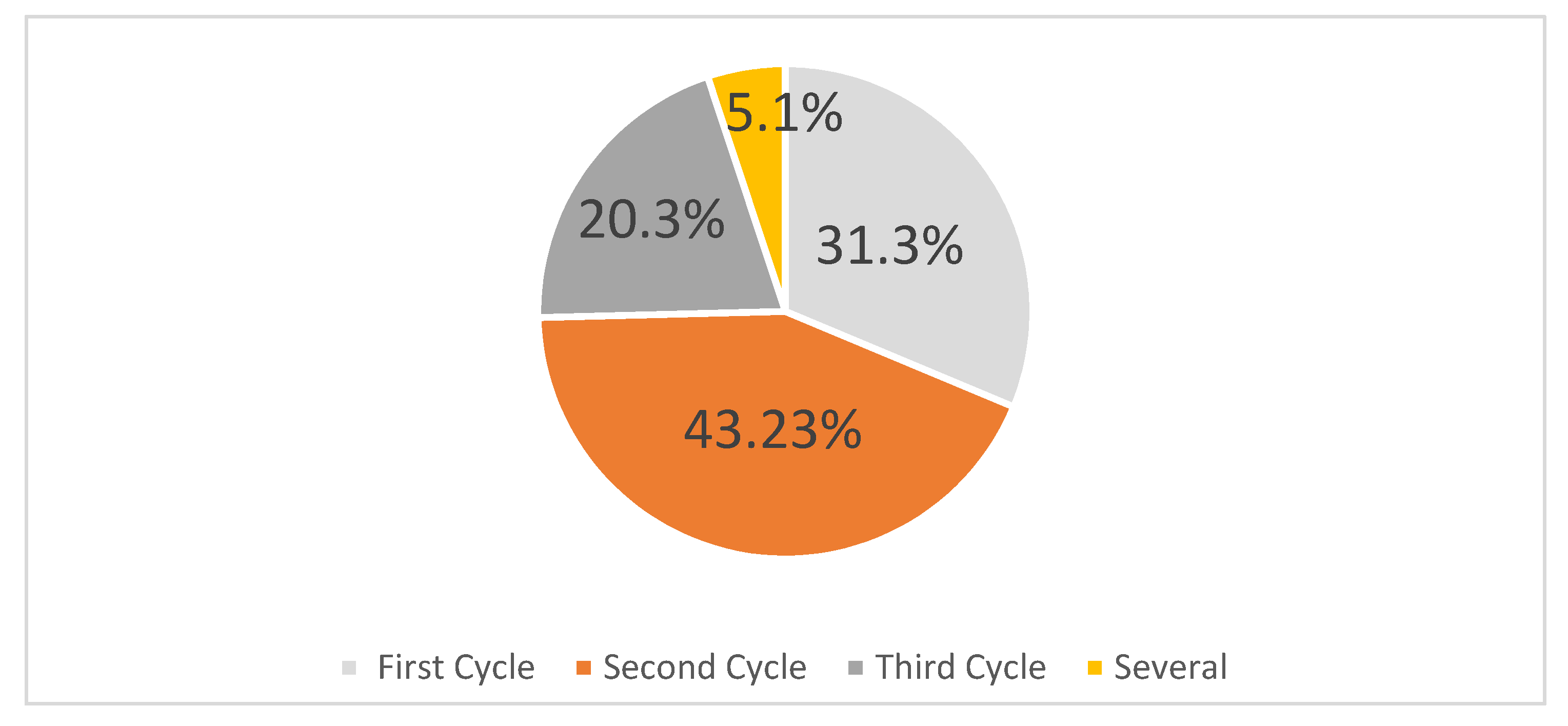
When completing the activity, 31.3% of the students participating found the use of narratives more appropriate for the initial phase of primary school, while 43.3% thought that it was suitable for the second phase, and 20.3% considered it more appropriate for the last one. Only a small portion of the students endorsed their use in any stage of primary education (5.1%). This is shown in
Figure 4.
This is also the case when it comes to their future work as primary-school teachers. 74.7% of the students stated that they would definitely consider narratives as didactic resources for teaching content related to the environment and the SDGs, while 21.2% said they would probably do so. Only 7% of the participants were neutral on the question.
Finally, 89.6% of the students rated the execution of this activity as satisfactory or very satisfactory.
4. Discussion
The trainee teachers largely lacked environmental competencies, even in the last year of their degree programs, which constitutes a handicap in their educations. [
30].
Addressing the above results, it is worth noting, first of all, that the testimonies obtained through the study endorse the validity of the analysis instrument, based on the comparison of several variables. As can be seen, working with content related to the environment, and using narratives or stories as didactic resources, was very motivational and of great interest to the students studying for the degree, which accords with the findings of different authors [
16,
17].
The project enhanced their understanding of the SDGs, as revealed by their knowledge of the SDGs before and after it. Delving more deeply into the reasoning expressed, it may be observed that almost half of the trainee teachers (66.2%) emphasized the importance of the use of storytelling for its ability to "capture attention" in an "attractive and motivating" way, with it being "easier to make them understand what you really want to convey and teach".
The implementation of innovative teaching techniques in university education is of great importance because it can help to promote the introduction of active-learning methodologies related to environmental contents in compulsory educational stages [
19]. It must be said that the reactions to the intervention by the vast majority of the students were very positive, both during and after it. At all times they showed great interest and motivation when working with the most theoretical content, thanks to a way of participating that facilitated creativity and critical and social thinking.
At this point, it is necessary to analyze some of their statements, as well as their arguments, to assess the real value of this tool for teaching environmental content, in general, and the SDGs, in particular.
An analysis of the data obtained shows that the implementation of this type of activity is highly beneficial, improving students’ capacity to think about the issues affecting the environment. Throughout the practice the students reflected on the SDGs, which, in general, favored the development of their critical awareness. The creation of narratives forces students to research the conflicts they want to highlight in their compositions in order to understand their origins, contexts and possible solutions. Only by following these steps will it be possible to produce a narrative appropriate for the learning of environmental content [
31].
The work with the ODS demonstrates this, as the vast majority of the participants in this innovative project confirmed that they had become more aware of their surroundings, perceiving problems that they had worked on in this task that they had not previously noticed. After all, one of the functions of teachers is to be aware of what is happening in the world around them, in order to promote functional learning by their students.
Despite these positive results, the information collected also suggests that there is still a long way to go, as other specialists have also concluded [
4]. In general, teachers in training are aware and understand that it is essential to work on and teach contents related to the environment, but they do not fully understand its problems and conflicts; their knowledge limited to basic notions received via the media and social networks (regarding recycling, climate change, etc.).
In this regard, one noteworthy pattern can, again, be observed: the objective that was chosen as the basis of their stories by the largest number of students, though of great importance, was one not closely related to their immediate surroundings "Underwater life: SDG 14". Initially, a significant number of the students thought of serious environmental problems as a distant issue, a consequence of governments and large multinationals, and they did not see the need for their direct intervention because they assumed that they could do little to change the situation. The other two SDGs that were selected the most were "Gender equality: SDG5" followed by "Ending poverty: SDG1". With regard to SDG5, it is worth noting that the vast majority of those who chose to teach it through storytelling were women, with only eight men opting for it, stating that they were "in favor of equal education".
What is striking is that these selections did not match the SDGs that the students considered the most important. Rather than "Underwater life: SDG 14", students considered vital "Health and well-being: SDG3" followed by "Achieving quality education: SDG4". Paradoxically, these two objectives were among the least used for the drafting of the story. Only "Ending poverty: SDG1" was in the same position. Perhaps students concluded that not all the SDGs lend themselves to the teaching of environmental content at the primary-school stage. Thus, while cognizant of the importance of some goals, they may have decided that, as teachers, it would behoove them to focus on challenges that were easier to narrate and transform into stories. This would explain the popularity of "Underwater life: SDG 14", which can be associated with adventures featuring pirates and mermaids.
This lack of knowledge increases exponentially when addressing the importance of the social sciences to the environment and teaching them. In this regard, we should also reflect, as university professors, on how we are reaching our students and whether we are enabling our students to learn the content covered in the classroom in a meaningful way [
11].
Despite being fourth-year students and having worked on the 2030 Agenda in different courses comprising the degree program, it seems, based on the answers given, that they were still not interested in it, and did not understand it very well, knowing about only some of its goals, and not being aware that they are yet to be achieved. Let us hope that the encouraging feedback received
after the activity is proof of the development of lasting knowledge and the activation of a commitment to the SDGs and the environment, qualities that should characterize trainee teachers [
32].
It is very much worth noting that most of the trainee teachers agreed on the need to introduce entertaining resources into the primary classroom, ones that motivate students to learn. This is also a way to get them to take ownership of their own learning, which is an example of the students’ commitment to the profession they have chosen.
In addition, worth mentioning are those who deemed stories and narrations to be very valuable resources because they favor meaningful learning, with them noting that their use bolsters imagination, an essential component in teaching, in general, and also in environmental didactics and social sciences didactics, in particular, where it is often difficult to work on tangible and concrete phenomena [
33].
The students wrote narratives to teach environmental values, their texts addressing issues related to solidarity, critical citizenship, conservation, sensitivity, environmental respect and responsibility, etc., concepts in relation to which imagination, as well as empathy and putting oneself in another’s place, play fundamental roles in learning, ratifying the suitability of narrative tools for working with youth in this field. It is, therefore, very relevant that the vast majority of respondents highlighted the usefulness of narratives and storytelling to teach the SDGs, and their decision to take them into close account in their professional futures.
Perhaps university students, however, should be made aware that stories, like any other type of narrative, are a highly valuable didactic instrument for those of all ages, as long as the students’ levels of cognitive development are taken into account, so that their contents, concepts and vocabulary can be adequately selected. Therefore, it would be advisable to implement them not only in the most elementary phases of primary school, but also in other educational stages as well, even with adults.
In line with this last idea, we now point out some of the limitations of this research. As has been already mentioned, some answers would be enriched by a qualitative approach, such as a focus group with students, which would allow us to go deeper into some aspects and encourage open-ended responses. It should be noted that, in line with the students’ answers, teachers agree that a review is needed in initial training to make future teachers understand their important role as citizens and as professionals in the challenge of sustainability. However, this perspective should also be incorporated into ongoing training since, as a privileged part of society, we are conditioned by these behaviors and by the growing trend towards individualization. The challenge is to implement in this teacher training not only the theoretical contents regarding sustainability but also methodological strategies that favor a change in pro-environmental attitudes, in all educational stages of professional practice. In short, if we agree to recognizing the capacity of social sciences to foster citizenship that is truly committed to the challenge of sustainability—that is, environmental citizenship—we must go beyond what is being carried out, both in teacher training and in the exercise of their profession with children in pre-school and elementary classrooms, to achieve a significant change in environmental attitudes.
5. Conclusions
Environmental protection is already a pressing issue, so it is vital to have citizens who are well-informed and committed to addressing these problems to achieve a more just, supportive and sustainable world. To this end, it is imperative that the training of undergraduate students account for and reflect the realities of the present, so that in their professional futures they can teach these issues accordingly, from the earliest stages.
This is the main reason why we carried out a study on a classroom teaching practices with pupils studying for a Primary Education degree, aimed at exposing them to content related to the environment and, in particular, the Sustainable Development Goals (SDGs).
Once the internships have been completed, we believe it is necessary to indicate a series of recommendations for future teachers as a result of the theoretical and practical experience of students and teachers that we believe are valid for an optimization of the teaching–learning of contents and competencies related to the environment and, more specifically, to the sustainable development identified in the Sustainable Development Goals.
To achieve these objectives, we devised a methodology that would be interactive and flexible while promoting an open and critical way of thinking through the use of stories as a didactic tool. Since storytelling is of indisputable pedagogical value, it can be applied to work on any content in the curriculum, promoting imagination and interaction in an entertaining way. In this way, it helps students to make a more positive commitment to the teaching–learning process, as it encourages them to take ownership of it, with this leading to more meaningful and functional learning.
When it was decided to carry out this educational experience, we were certain that students would feel a certain reluctance to deal with content that is foreign or complex, such as the terms that are often used related to the natural and social sciences to explain the causes of environmental problems. Thus, the work on the SDGs, featuring narratives as a tool to teach the problems that they entail, was an ideal pedagogical approach to transmit concepts effectively, also serving to develop other types of skills, such as linguistic ones, by stimulating reading and writing, thereby bolstering our students’ transversal training in a very positive way.
The success of this didactic experience, linked to teaching–learning tasks, is reflected not only in the students’ evident interest in and commitment to its different stages, but also in their positive assessments of it. In the final analysis, the implementation of this intervention provided them with significant exposure to both the theoretical and practical content of environmental education in primary education [
34].
In short, the storytelling proved to be of great benefit to these trainee teachers, despite the rigorous planning work involved. Analysis of the results obtained makes it clear that the stories presented by the students in the Environmental Didactics and Social Sciences Didactics classes, in addition to being carried out in a recreational way, were completed by acquiring the basic theoretical knowledge necessary to teach the environmental issues involved in the SDGs.