Article

How Is the Sustainable Consumption Intention Model in Food Industry under Preference Uncertainties? The Consumer Willingness to Pay on Recycled Packaging Material

by
Chih-Cheng Chen
1,
Raditia Yudistira Sujanto
2,3,
Ming-Lang Tseng
4,5,*,
Anthony S. F. Chiu
6 and
Ming K. Lim
7,8
1
Department of Business Administration, Mingdao University, Pitou Township 523, Taiwan
2
Department of Business Administration, Asia University, Taichung City 413, Taiwan
3
Department of Communication, Universitas Aisyiyah Yogyakarta, Yogyakarta 55592, Indonesia
4
Institute of Innovation and Circular Economy, Asia University, Taichung City 413, Taiwan
5
Department of Medical Research, China Medical University Hospital, China Medical University, Taichung City 413, Taiwan
6
Department of Industrial Engineering, De La Salle University, Manila 1004, Philippines
7
College of Mechanical Engineering, Chongqing University, Chongqing 400044, China
8
Faculty Research Centre for Business in Society, Coventry University, Coventry CV1 5FB, UK
*
Author to whom correspondence should be addressed.
Sustainability 2021, 13(21), 11578; https://doi.org/10.3390/su132111578
Submission received: 25 September 2021 / Revised: 10 October 2021 / Accepted: 18 October 2021 / Published: 20 October 2021

Abstract

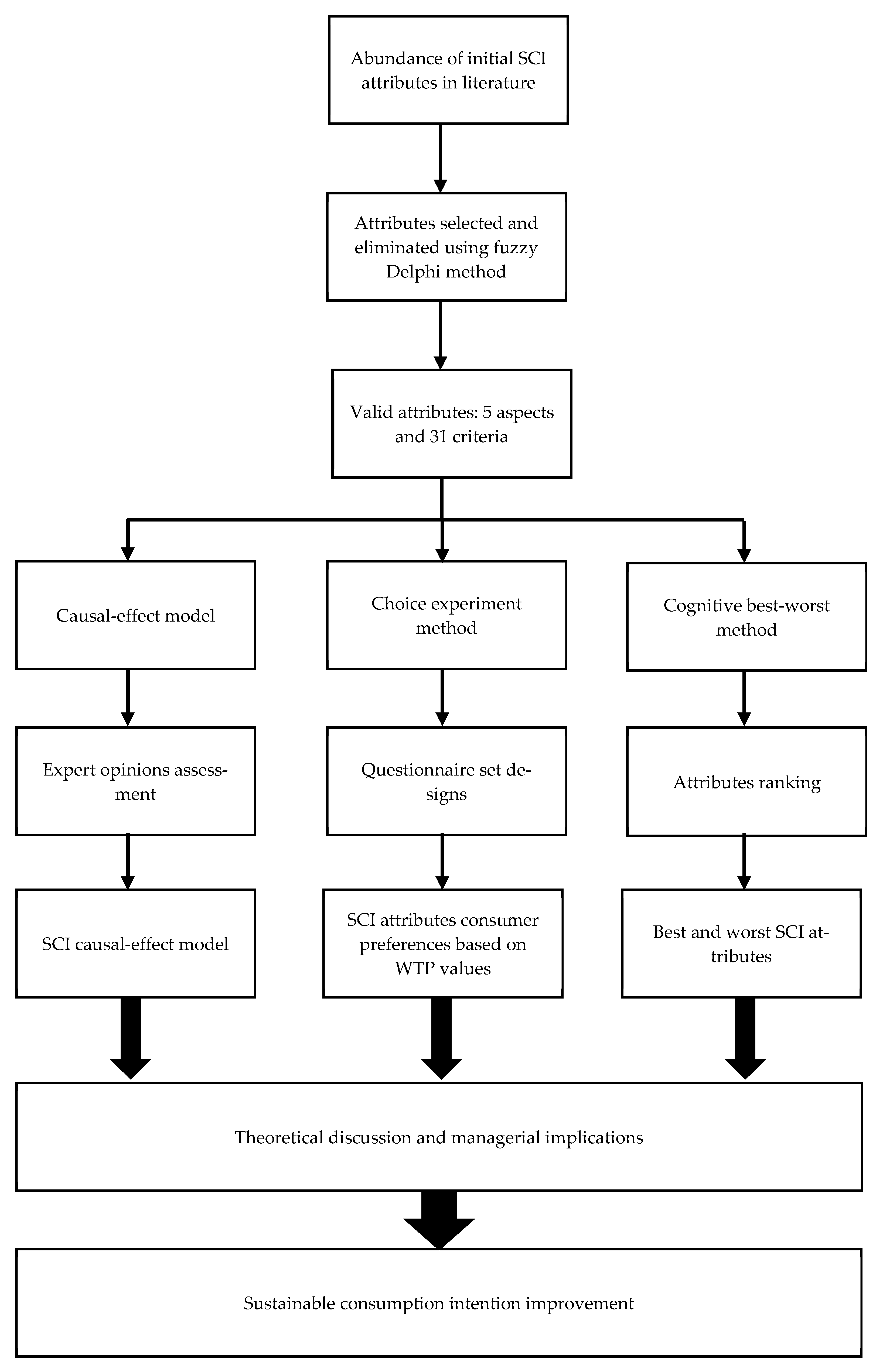
Food packaging is costly to consumers and generates a huge volume of packaging waste, especially in Indonesia. Prior studies have neglected to construct a causal sustainable consumption intention model in food industry and link to the consumer willingness to pay under preference uncertainties. To address the gaps, this study explores consumer attributes to build a causal sustainable consumption intention model and takes the model to address the consumer willingness to pay under preference uncertainties. This study proposes a causal model that integrates five aspects of sustainable consumption intention model: (1) sustainable consumption knowledge, attitudes, and behaviors; (2) government policy and regulation on sustainable consumption; (3) recycled packaging eco-labeling certification; (4) supply chain innovation and infrastructure; and (5) sustainable product purchasing features. This study uses the fuzzy Delphi method to confirm the reliability and validate the criteria and applies cause and effect model to address the causal model. In addition, this study collects 428 valid responses to address the willingness to pay for causal sustainable consumption intention model and a cognitive best-worst choice experiment to confirm the model in the food industry. The result reveals that recycled packaging eco-labeling certification is the major aspect for enhancing the model, followed by government policy and regulation and supply chain innovation and infrastructure. In practice, consumers incur inconvenience in purchasing sustainable food products but prefer recycled packaging material at a standardized price.
Keywords: sustainable consumption intention; recycled packaging; eco-labeling certification; fuzzy Delphi method; choice experiment; cognitive best-worst method sustainable consumption intention; recycled packaging; eco-labeling certification; fuzzy Delphi method; choice experiment; cognitive best-worst method