Article

Why Can’t I Work in a Green Way? Research on the Influencing Mechanism of Employees’ Labor Intentions
1
School of Economics and Management, China University of Mining and Technology, Xuzhou 221116, China
2
School of Business, Jiangnan University, Wuxi 214122, China
3
Institute for National Security and Green Development, Jiangnan University, Wuxi 214122, China
*
Author to whom correspondence should be addressed.
Sustainability 2021, 13(20), 11528; https://doi.org/10.3390/su132011528
Submission received: 28 August 2021 / Revised: 12 October 2021 / Accepted: 12 October 2021 / Published: 19 October 2021
(This article belongs to the Special Issue Theories and Methods of Positive Organizational Behavior)

Abstract

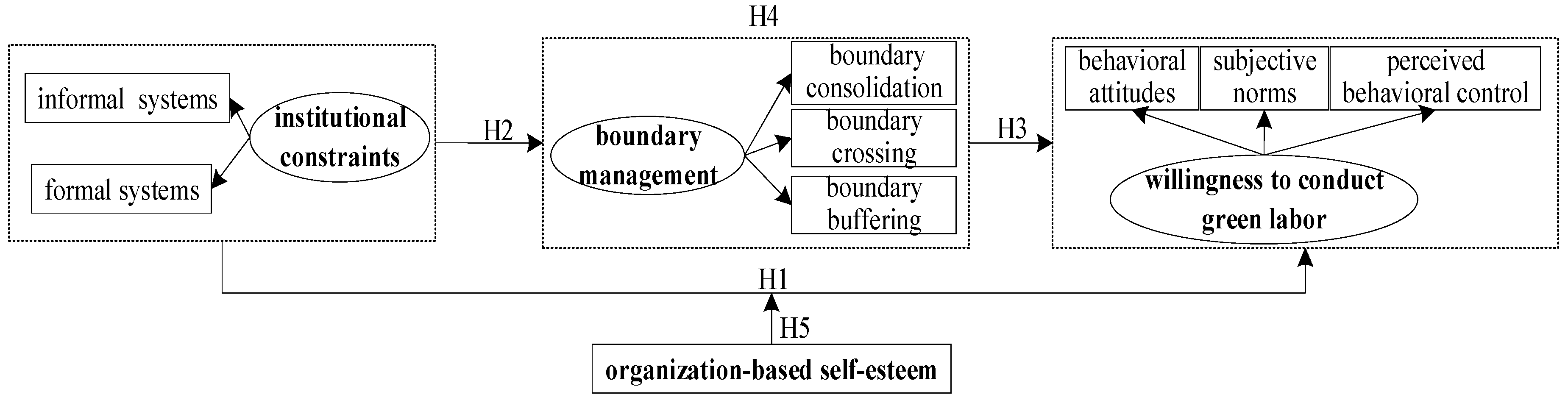
Non-green labor patterns have a negative impact on health and organizational sustainable development. This research proposes a green labor style that takes the sustainable development of employees themselves as the premise, with the protection of their physical and mental health as a long-term goal, that is not only concerned with how to build a reasonable mechanism to guarantee the physical and mental health of employees, but also with the labor protection mechanism of the whole process, from production to output. On the basis of social cognitive theory and the job demands-resources (JD-R) model, this study recruited a sample of 884 Chinese employees to explore the mechanism of their willingness to conduct green labor, including factors such as institutional constraints, boundary management, and organization-based self-esteem (OBSE). The results show that high levels of institutional constraints curbed employee demand for green labor and, in employees, good boundary-management skills acted as a mechanism of resistance against negative constraints. Furthermore, individual OBSE, as a positive psychological resource, could buffer the negative impacts of the organizational scenarios on outcomes.
Keywords: willingness to conduct green labor; institutional constraints; boundary management; organization-based self-esteem willingness to conduct green labor; institutional constraints; boundary management; organization-based self-esteem