A Study on Fiscal Risk of China’s Employees Basic Pension System under Longevity Risk


Abstract
1. Introduction
2. Actuarial Model of Basic Pension Insurance
2.1. Dynamic Mortality Model
2.2. Income Model
2.3. Expenditure Model
2.3.1. Expenditure Model of Retired Staff
2.3.2. Expenditure Model of On-the-Job Employees
2.3.3. Expenditure Model of New Insured On-the-Job Employees
3. Mortality Prediction and Parameter Calibration
3.1. Mortality Prediction
3.1.1. Revision and Supplement of Mortality Data
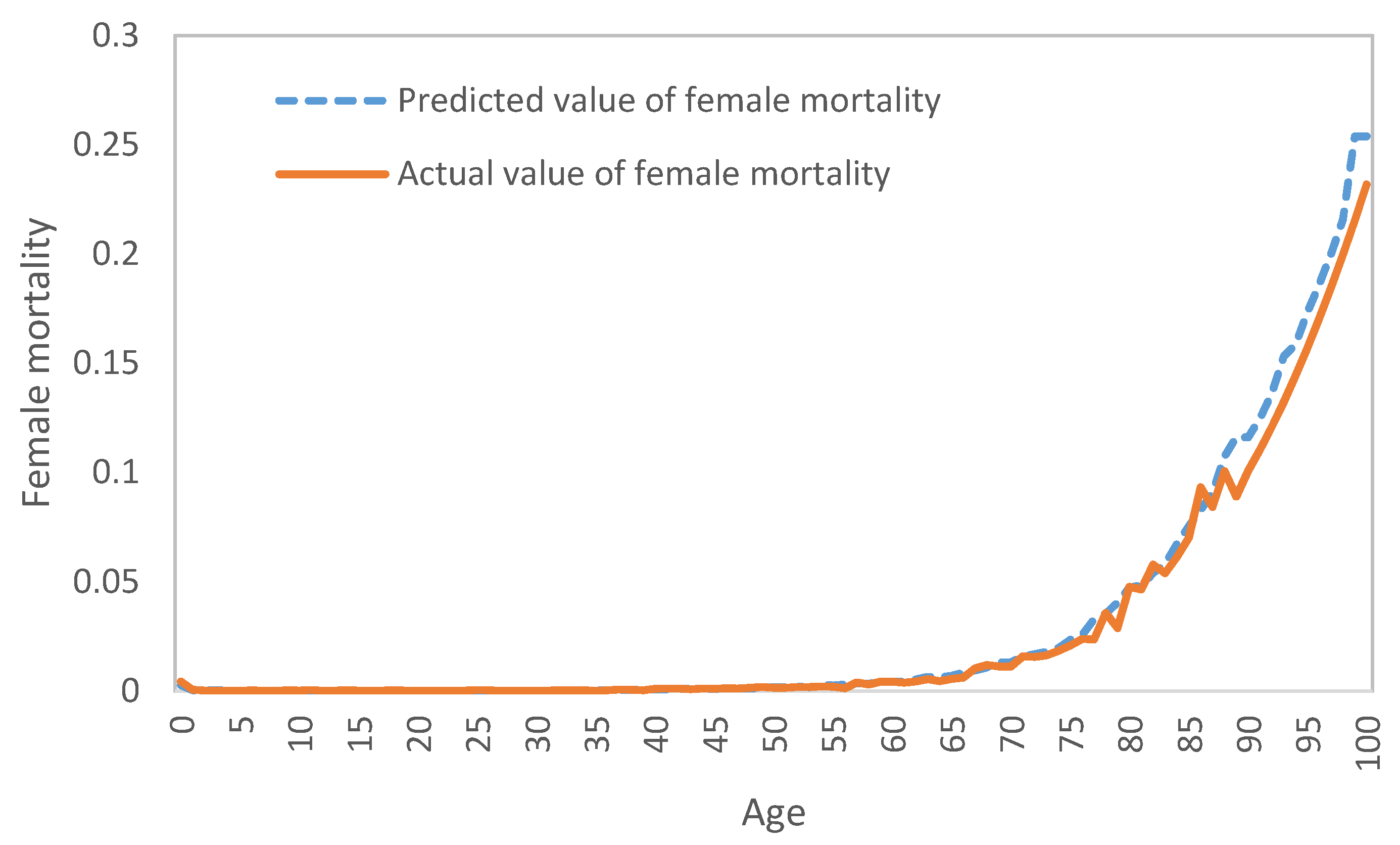
3.1.2. The Lee–Carter Model and Prediction of Mortality
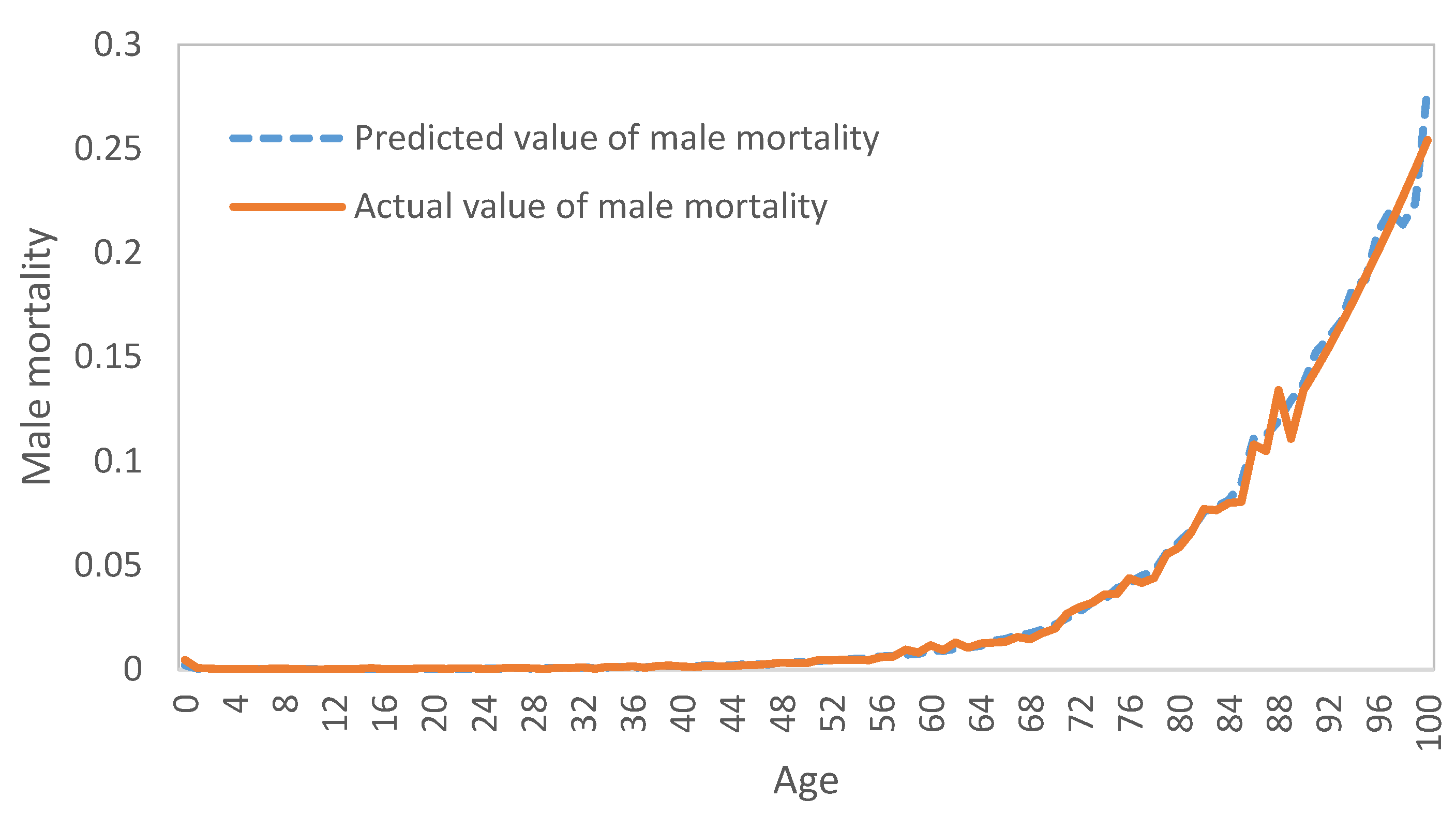
3.1.3. Validity Test of the Lee–Carter Model
3.2. Parameter Setting and Basis
3.2.1. Future Population Structure
- Existing population structure. The proportion of the population of each age was obtained from “China Population and Employment Statistical Yearbook 2010” and was used as the initial population structure of the model.
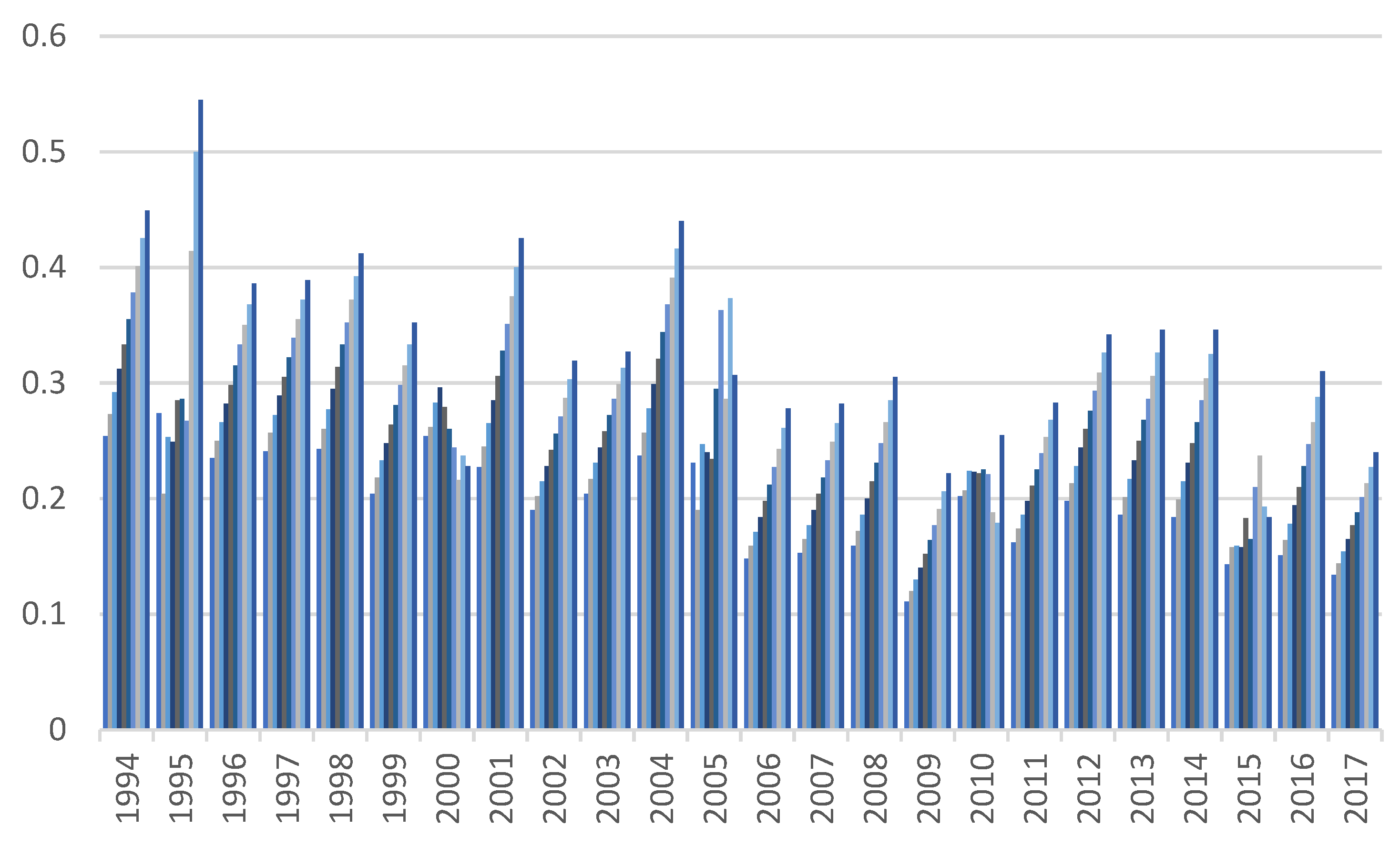
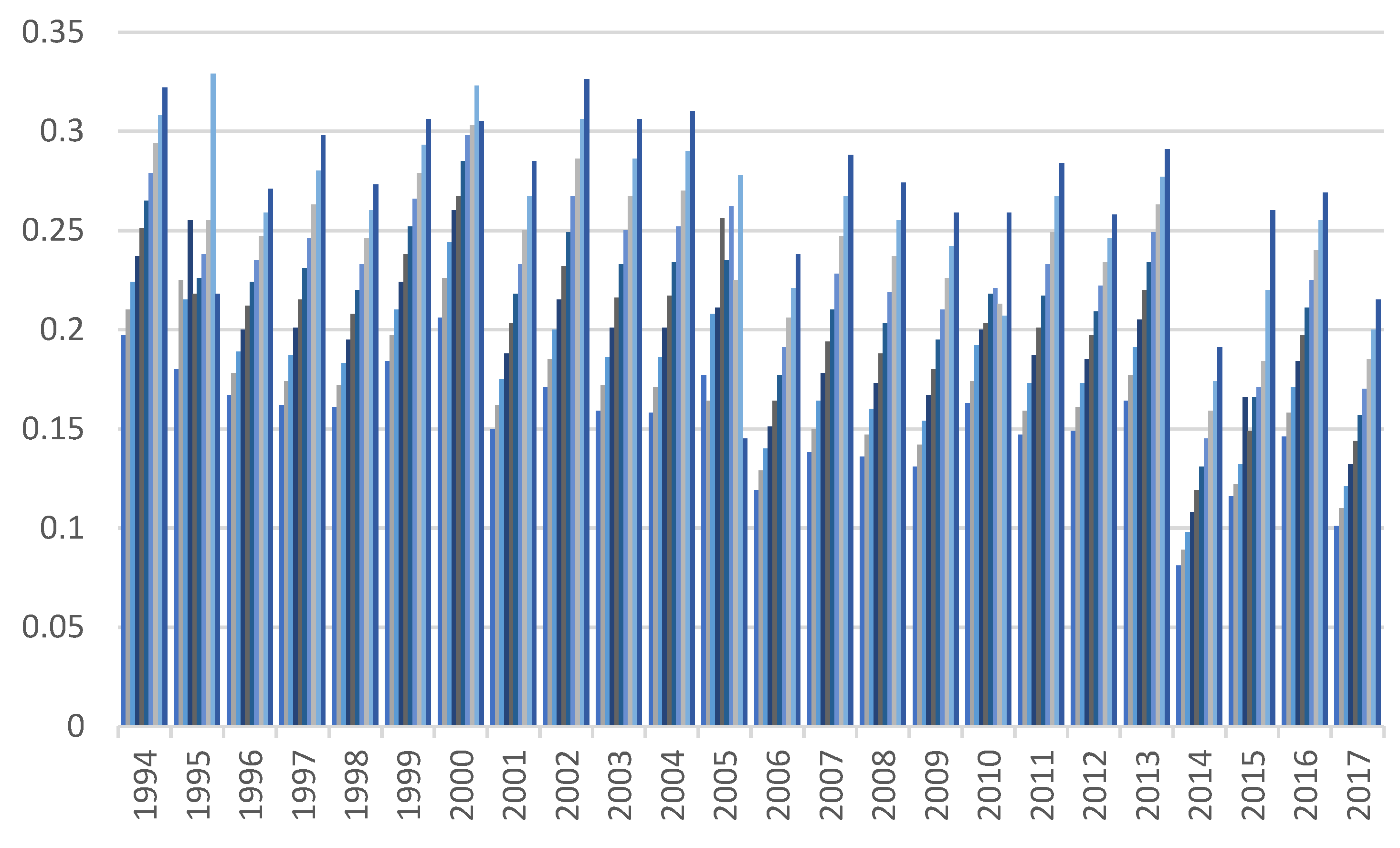
- Future mortality. According to the Lee–Carter model, we obtained 10,000 samples of mortality in each age every year and used the expected value of the sample to represent mortality at each age.
- Future birth rate. Many researchers believed that implementation of the two-child policy would result in a short-term increase in China’s birth rate. However, due to the lag of policy and contemporary youth’s fear of marriage and childbirth, China’s fertility rate has not increased significantly in recent years. The National Bureau of Statistics announced that the fertility rate in 2018 was only 1.094, the lowest value on record. In this paper, we assumed that the effect of the two-child policy is not obvious and took the average fertility rate of women of childbearing age in 2014 and 2015 as the corresponding fertility rate (the National Bureau of Statistics has only published the fertility rate of women of childbearing age in 2015 and before) to calculate the birth rate.
3.2.2. Employment and Wage System
- Human capital parameters. In this paper, we took the average value of human capital parameters calculated by the average wages at every age of Beijing employees participating in CEBPS in 2008 and 2009 as the value of human capital level at every age.
- Wage growth rate. We assumed that the future wage growth rate of enterprise employees was 7.7% in 2018–2020, 6.6% in 2021–2025, and 5.7% in 2026–2068.
- Unemployment rate (the introduction of unemployment rate was due to the interruption of contributions caused by unemployment, which affects pension income). According to the data released by the National Bureau of Statistics, the unemployment rate in China has been relatively stable since the beginning of this century. It has fluctuated between 3.8% and 4.3% from 2002 to 2018. The average value of the unemployment rate over 17 years is about 4.09%. We assumed that the unemployment rate would remain unchanged at 4.09% in the future.
- Urbanization rate (the reason for the introduction of urbanization rate is that China’s urbanization rate has not yet reached saturation and is growing, which will affect the number of new insured people of CEBPS). According to “National Population Development Plan (2016–2030)”, the urbanization rate of China’s permanent population will reach 70% in 2030, whereas it was 58.52% in 2018. Therefore, we predicted that China’s urbanization rate would increase by 1% per year from 2019 to 2030 and would remain unchanged after 2030.
3.2.3. Basic Pension Insurance System
- Age parameters. We assumed that urban residents begin work at the age of 21, male employees retire at the age of 60, and female employees retire at the age of 55.
- Contribution rate and divisor factor. According to the “Decision of the State Council on Improving the Basic Pension Insurance System for Enterprise Employees” (NDRC (2005) No. 38), the contribution rate of the individual account is set at 8%, the contribution rate of the public account is set at 20%, the divisor factor (defined as the number of planned payment months during the payment period of pension insurance benefits, here measured in years) of male retirees is 12 years, and the divisor factor of female retirees is 14 years. In 2019, the State Council promulgated “Notice of the General Office of the State Council on Printing and Distributing Comprehensive Plans for Reducing Social Insurance Rates”, which indicated that the contribution rate of the public account of CEBPS would be reduced to 16% from May 1, 2019. Based on the actual situation, the public account contribution rate was calculated as 20% before May 2019 and 16% after May 2019.
- Return on investment. Referring to “The Annual Report of the National Social Security Fund Council Fund (2013)”, the annual return on investment of the national social security fund since its establishment is 8.13%. Therefore, we assumed that the return on investment of both the pension insurance fund and the personal account would be 8.13% after 2017.
- Basic pension growth rate. According to urban basic pension insurance data released by the National Bureau of Statistics, the annual growth rate of the per capita basic pension was 10% from 2006 to 2015. In 2016, the government work report set the growth rate of the basic pension at 6.5%. It was 5.5% in 2017 and 5% in 2018 and 2019. Therefore, the basic pension growth rate was set at 5%.
- Funeral allowance. Because of the different calculation methods of funeral subsidies in different regions, referring to Liao [29], we assumed that the one-time payment of funeral expenses and pension was 60% of the average social wage at the time of death.
3.2.4. Insurance Status
- Composition of existing insured persons. The “China Labor Statistics Yearbook 2018” shows the number of urban on-the-job employees participating in CEBPS and the number of urban retired employees participating in CEBPS in 2017. Assuming that the proportion of insured people at every age in 2017 is the same as the proportion of the insured people at every age in Beijing in 2008, we calculated the number of the insured people of every age of both on-the-job and retired urban employees in 2017.
- Composition of new insured persons. In 2017, the 21-year-old population as a proportion of the total population was 1.22%. Assuming that it will remain unchanged in future, the size of the 21-year-old population in the future can be calculated, and the product of 21-year-old population, urbanization rate, and labor participation rate can represent the number of new insured people.
4. Fiscal Risk Assessment of CEBPS under Longevity Risk
4.1. Model Validation
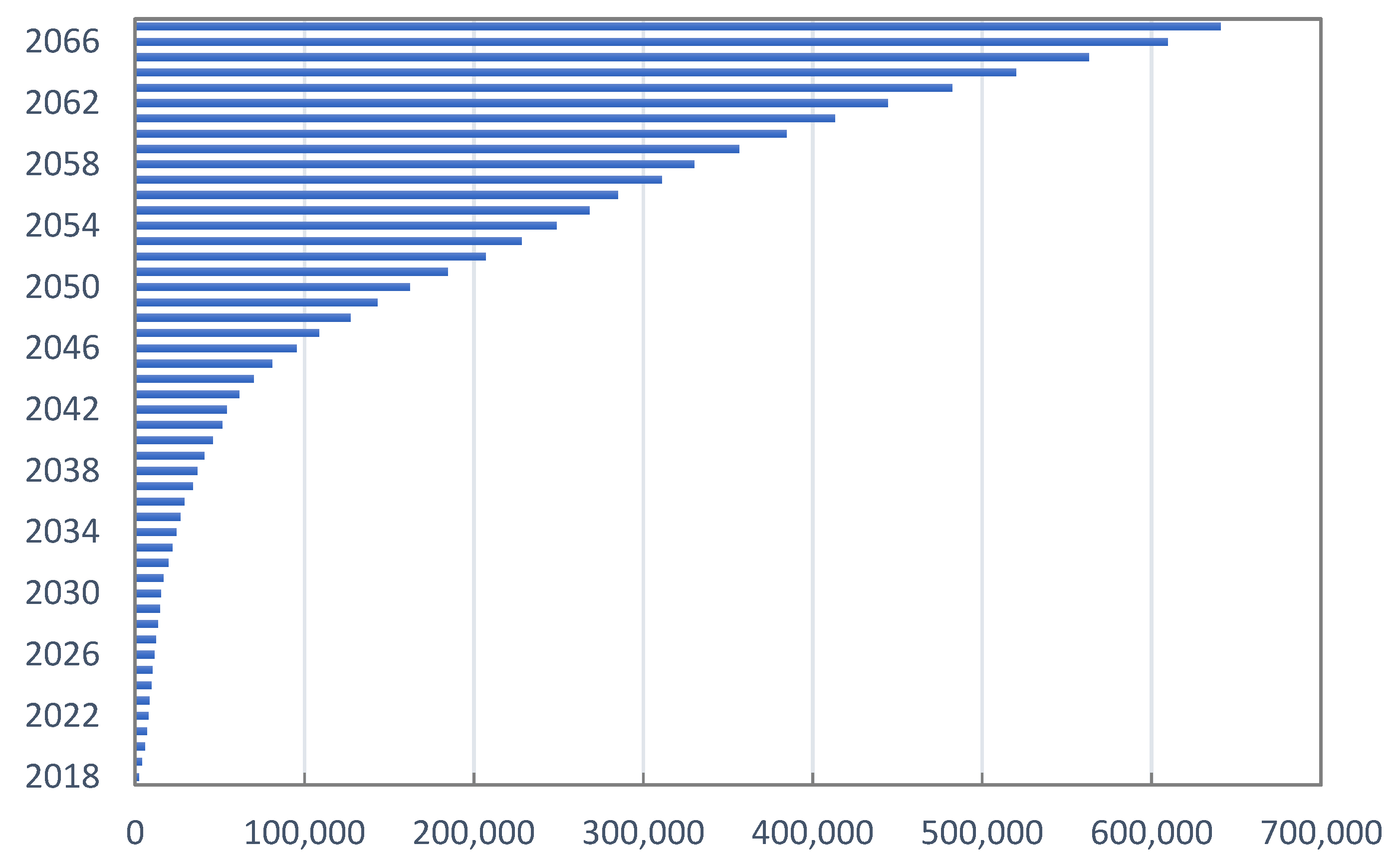
4.2. Fiscal Risk Assessment of CEBPS under Longevity Risk
4.2.1. Fluctuation of the Fund Gap under Longevity Risk
4.2.2. The Knock-On Effect of the Fund Gap under Longevity Risk
4.2.3. Sensitivity Analysis of Fiscal Risk of CEBPS
5. Conclusions
Author Contributions
Funding
Institutional Review Board Statement
Informed Consent Statement
Data Availability Statement
Conflicts of Interest
Appendix A. Estimated Values of Parameters and of Male and Female
| Gender | Male | Female | ||
| Age\Parameters | ||||
| 0 | −4.62156 | 0.03271 | −4.38418 | 0.02688 |
| 1 | −6.57001 | 0.02045 | −6.69297 | 0.02041 |
| 2 | −7.00203 | 0.02498 | −7.01375 | 0.02014 |
| 3 | −7.20135 | 0.02155 | −7.30388 | 0.01379 |
| 4 | −7.36729 | 0.02054 | −7.68324 | 0.01845 |
| 5 | −7.52433 | 0.02074 | −7.95896 | 0.02046 |
| 6 | −7.72190 | 0.01231 | −8.12368 | 0.01075 |
| 7 | −7.62413 | 0.01199 | −8.18860 | 0.01375 |
| 8 | −7.65736 | 0.01433 | −8.17953 | 0.01186 |
| 9 | −7.76815 | 0.00256 | −8.23297 | 0.00833 |
| 10 | −7.81154 | 0.01327 | −8.05884 | 0.00919 |
| 11 | −8.09005 | 0.01938 | −7.96781 | 0.00664 |
| 12 | −8.03120 | 0.00917 | −8.19955 | 0.01490 |
| 13 | −7.76556 | 0.00978 | −8.22248 | 0.02053 |
| 14 | −7.72090 | 0.01125 | −8.16831 | 0.01040 |
| 15 | −7.64872 | 0.01023 | −7.99545 | 0.01770 |
| 16 | −7.55858 | 0.01105 | −8.05549 | 0.00548 |
| 17 | −7.43028 | 0.02019 | −7.99888 | 0.01434 |
| 18 | −7.27804 | 0.01939 | −7.67284 | 0.01495 |
| 19 | −7.12622 | 0.01435 | −7.61026 | 0.01545 |
| 20 | −7.09375 | 0.01772 | −7.84089 | 0.01710 |
| 21 | −6.85488 | 0.01066 | −7.84289 | 0.01658 |
| 22 | −6.95970 | 0.01249 | −7.70703 | 0.02261 |
| 23 | −7.04901 | 0.01194 | −7.48115 | 0.02173 |
| 24 | −6.99608 | 0.01458 | −7.69706 | 0.02197 |
| 25 | −7.00353 | 0.01483 | −7.57436 | 0.02047 |
| 26 | −6.93059 | 0.01595 | −7.52795 | 0.01453 |
| 27 | −6.94696 | 0.01032 | −7.63655 | 0.02301 |
| 28 | −6.85357 | 0.01518 | −7.50668 | 0.01774 |
| 29 | −6.78187 | 0.01044 | −7.50092 | 0.02005 |
| 30 | −6.69146 | 0.01362 | −7.31876 | 0.01801 |
| 31 | −6.60542 | 0.01285 | −7.47704 | 0.01452 |
| 32 | −6.60853 | 0.00635 | −7.36607 | 0.01439 |
| 33 | −6.60972 | 0.01400 | −7.19650 | 0.01105 |
| 34 | −6.46795 | 0.00980 | −7.24633 | 0.01135 |
| 35 | −6.33917 | 0.00811 | −7.30183 | 0.01783 |
| 36 | −6.42502 | 0.00989 | −7.23281 | 0.01244 |
| 37 | −6.40468 | 0.00844 | −7.04852 | 0.00960 |
| 38 | −6.22751 | 0.00639 | −7.02321 | 0.01133 |
| 39 | −6.14788 | 0.00515 | −6.75124 | 0.01060 |
| 40 | −6.04110 | 0.00769 | −6.80048 | 0.00792 |
| 41 | −6.08234 | 0.00677 | −6.66756 | 0.01047 |
| 42 | −5.96965 | 0.00471 | −6.63577 | 0.00521 |
| 43 | −5.90425 | 0.00671 | −6.55378 | 0.00840 |
| 44 | −5.89315 | 0.00712 | −6.49435 | 0.00855 |
| 45 | −5.75320 | 0.00450 | −6.43030 | 0.00979 |
| 46 | −5.64048 | 0.00633 | −6.28376 | 0.00640 |
| 47 | −5.61615 | 0.00852 | −6.22656 | 0.00627 |
| 48 | −5.45081 | 0.00626 | −6.17575 | 0.01115 |
| 49 | −5.39686 | 0.00629 | −5.98499 | 0.00895 |
| 50 | −5.31300 | 0.00450 | −5.94701 | 0.00760 |
| 51 | −5.20185 | 0.00620 | −5.81607 | 0.00893 |
| 52 | −5.18605 | 0.00417 | −5.74637 | 0.00870 |
| 53 | −5.09421 | 0.00531 | −5.72730 | 0.01126 |
| 54 | −5.00930 | 0.00517 | −5.56433 | 0.00628 |
| 55 | −4.88421 | 0.00757 | −5.50715 | 0.00825 |
| 56 | −4.79198 | 0.00561 | −5.41774 | 0.00657 |
| 57 | −4.75442 | 0.00600 | −5.26577 | 0.00683 |
| 58 | −4.59815 | 0.00754 | −5.13659 | 0.01009 |
| 59 | −4.48090 | 0.00847 | −5.06904 | 0.00748 |
| 60 | −4.37499 | 0.00657 | −4.93217 | 0.00864 |
| 61 | −4.30909 | 0.00854 | −4.94986 | 0.00941 |
| 62 | −4.15282 | 0.00951 | −4.72151 | 0.00921 |
| 63 | −4.10731 | 0.00923 | −4.59292 | 0.00770 |
| 64 | −4.02560 | 0.00934 | −4.55246 | 0.00917 |
| 65 | −3.93652 | 0.00719 | −4.41630 | 0.00979 |
| 66 | −3.79845 | 0.00881 | −4.31074 | 0.00807 |
| 67 | −3.71748 | 0.00815 | −4.24819 | 0.00725 |
| 68 | −3.62275 | 0.00895 | −4.06680 | 0.00784 |
| 69 | −3.50980 | 0.00932 | −3.91371 | 0.00726 |
| 70 | −3.37198 | 0.00975 | −3.83106 | 0.00877 |
| 71 | −3.25782 | 0.00906 | −3.73532 | 0.00711 |
| 72 | −3.18089 | 0.00824 | −3.60911 | 0.00818 |
| 73 | −3.07531 | 0.00733 | −3.55004 | 0.00815 |
| 74 | −3.03662 | 0.00715 | −3.44068 | 0.00845 |
| 75 | −2.90625 | 0.00678 | −3.28499 | 0.00804 |
| 76 | −2.79576 | 0.00780 | −3.23901 | 0.00723 |
| 77 | −2.67531 | 0.00853 | −3.05641 | 0.00601 |
| 78 | −2.61787 | 0.00868 | −2.97738 | 0.00606 |
| 79 | −2.51028 | 0.00728 | −2.88624 | 0.00527 |
| 80 | −2.42028 | 0.00726 | −2.71385 | 0.00549 |
| 81 | −2.25320 | 0.00894 | −2.62181 | 0.00672 |
| 82 | −2.22365 | 0.00676 | −2.55495 | 0.00591 |
| 83 | −2.11842 | 0.00828 | −2.40772 | 0.00719 |
| 84 | −2.03546 | 0.00918 | −2.35070 | 0.00550 |
| 85 | −2.00357 | 0.00768 | −2.25595 | 0.00512 |
| 86 | −1.88175 | 0.00552 | −2.16679 | 0.00494 |
| 87 | −1.75388 | 0.00791 | −2.12763 | 0.00396 |
| 88 | −1.69046 | 0.00788 | −1.99767 | 0.00314 |
| 89 | −1.58424 | 0.00835 | −1.86394 | 0.00400 |
| 90 | −1.53899 | 0.00797 | −1.81861 | 0.00483 |
| 91 | −1.49201 | 0.00656 | −1.73445 | 0.00494 |
| 92 | −1.39869 | 0.00752 | −1.64709 | 0.00482 |
| 93 | −1.33766 | 0.00773 | −1.55747 | 0.00417 |
| 94 | −1.26771 | 0.00698 | −1.49454 | 0.00462 |
| 95 | −1.20362 | 0.00788 | −1.42283 | 0.00418 |
| 96 | −1.13022 | 0.00670 | −1.34921 | 0.00406 |
| 97 | −1.06942 | 0.00684 | −1.29018 | 0.00369 |
| 98 | −0.99529 | 0.00915 | −1.19799 | 0.00382 |
| 99 | −0.93120 | 0.00941 | −1.17475 | 0.00095 |
Appendix B. Estimated Values of Parameter of Male and Female
| Time\Gender | Male | Female |
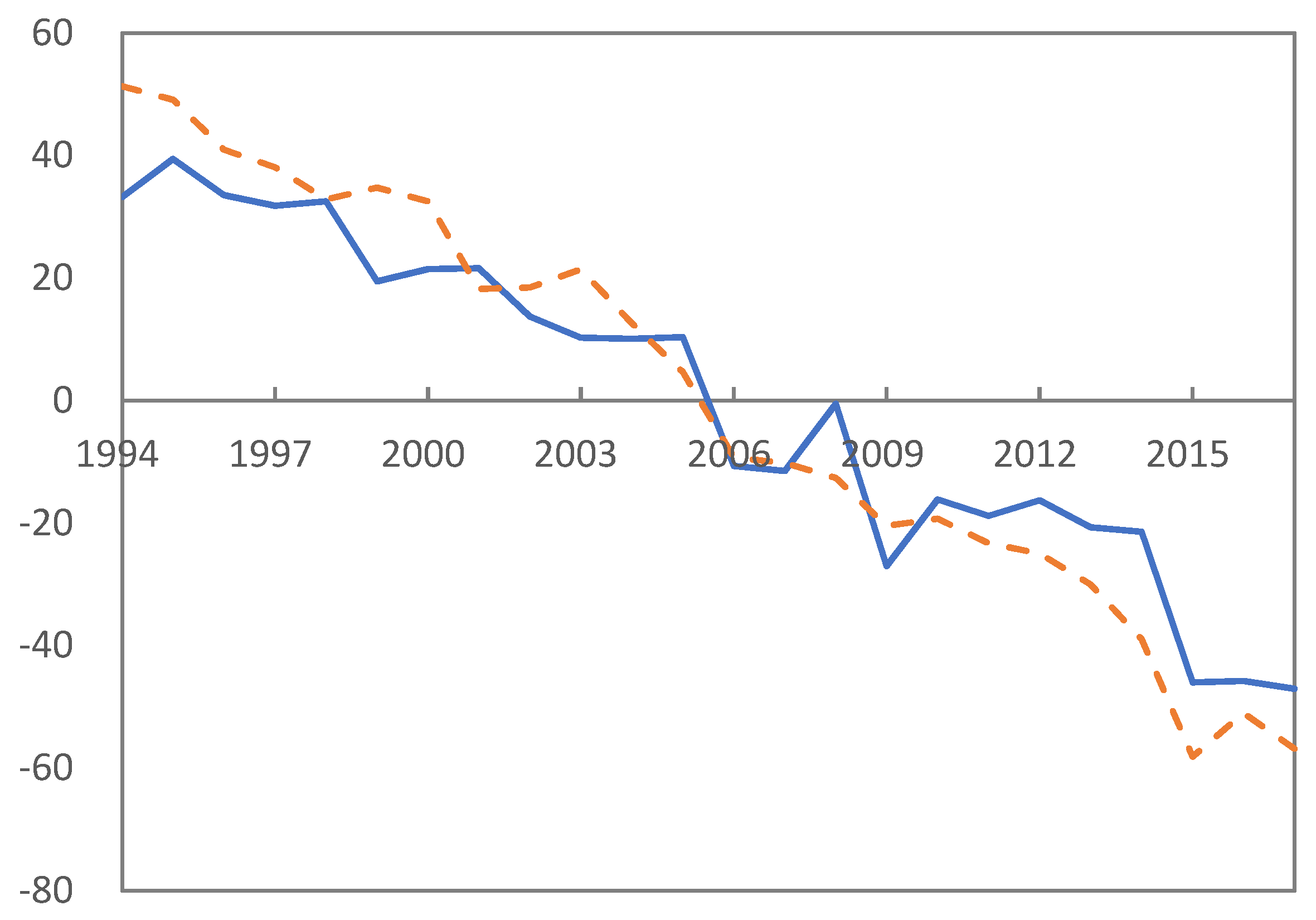
| 1994 | 33.2084 | 51.3184 |
| 1995 | 39.4429 | 49.1193 |
| 1996 | 33.5458 | 40.9681 |
| 1997 | 31.7851 | 38.0873 |
| 1998 | 32.5188 | 32.8505 |
| 1999 | 19.4786 | 34.7427 |
| 2000 | 21.4609 | 32.5212 |
| 2001 | 21.6200 | 18.2203 |
| 2002 | 13.7045 | 18.4637 |
| 2003 | 10.2823 | 21.4180 |
| 2004 | 10.0631 | 12.6208 |
| 2005 | 10.3486 | 4.6885 |
| 2006 | −10.6914 | −9.2847 |
| 2007 | −11.5040 | −10.1855 |
| 2008 | −0.5283 | −12.6329 |
| 2009 | −27.0173 | −20.4423 |
| 2010 | −16.1270 | −19.2904 |
| 2011 | −18.8028 | −23.2862 |
| 2012 | −16.2574 | −24.9482 |
| 2013 | −20.6983 | −30.0364 |
| 2014 | −21.4034 | −38.9570 |
| 2015 | −46.0050 | −58.1271 |
| 2016 | −45.7643 | −51.0063 |
| 2017 | −47.0511 | −56.8212 |
Appendix C. Stationary Processing, ARMA Model Selection, Parameter Estimation, and Model Applicability Test of the ARIMA (p, d, q) Model

| Original Hypothesis | There Is a Unit Root in K1 Sequence | |||
|---|---|---|---|---|
| Model Form Lag Order | Intercept Term 2 (Based on SiC Test, the Maximum Lag Order Is 5) | |||
| t Value | p Value | |||
| ADF test statistics | 0.6178 | 0.9867 | ||
| Significance level | 1% | −3.7880 | ||
| 5% | −3.0124 | |||
| 10% | −2.6461 | |||
| Original Hypothesis | There Is a Unit Root in K2 Sequence | |||
|---|---|---|---|---|
| Model Form Lag Order | Intercept Term 0 (Based on SiC Test, the Maximum Lag Order Is 5) | |||
| t Value | p Value | |||
| ADF test statistics | −0.0954 | 0.9389 | ||
| Significance level | 1% | −3.7529 | ||
| 5% | −2.9981 | |||
| 10% | −2.6388 | |||
| Original Hypothesis | The First Order Difference Sequence of K1 has a Unit Root | |||
|---|---|---|---|---|
| Model Form Lag Order | Intercept Term 1 (Based on SiC Test, the Maximum Lag Order Is 5) | |||
| t Value | p Value | |||
| ADF test statistics | −5.5445 | 0.0002 | ||
| Significance level | 1% | −3.7880 | ||
| 5% | −3.0124 | |||
| 10% | −2.6461 | |||
| Original Hypothesis | The First Order Difference Sequence of K2 has a Unit Root | |||
|---|---|---|---|---|
| Model Form Lag Order | Intercept Term 0 (Based on SiC Test, the Maximum Lag Order Is 5) | |||
| T Value | p Value | |||
| ADF test statistics | −5.7388 | 0.0001 | ||
| Significance level | 1% | −3.7696 | ||
| 5% | −3.0049 | |||
| 10% | −2.6422 | |||
| Sample Years | 1994–2017 | |||||
|---|---|---|---|---|---|---|
| Sample Size | 23 | |||||
| Autocorrelation Graph | Partial Autocorrelation Graph | Lag Phase | Autocorrelation Value | Partial Autocorrelation Value | Q Statistic | p Value |
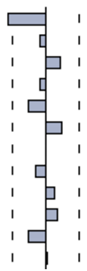 | 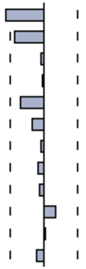 | 1 | −0.462 | −0.462 | 5.5693 | 0.018 |
| 2 | −0.071 | −0.361 | 5.7063 | 0.058 | ||
| 3 | 0.178 | −0.049 | 6.6137 | 0.085 | ||
| 4 | −0.071 | −0.009 | 6.7658 | 0.149 | ||
| 5 | −0.209 | −0.282 | 8.1599 | 0.148 | ||
| 6 | 0.191 | −0.14 | 9.3913 | 0.153 | ||
| 7 | 0.003 | −0.028 | 9.3916 | 0.226 | ||
| 8 | −0.123 | −0.082 | 9.9715 | 0.267 | ||
| 9 | 0.101 | −0.056 | 10.389 | 0.320 | ||
| 10 | 0.14 | 0.153 | 11.251 | 0.338 | ||
| 11 | −0.217 | 0.015 | 13.507 | 0.261 | ||
| 12 | 0.02 | −0.095 | 13.527 | 0.332 | ||
| Sample Years | 1994–2017 | |||||
|---|---|---|---|---|---|---|
| Sample Size | 23 | |||||
| Autocorrelation Graph | Partial Autocorrelation Graph | Lag Phase | Autocorrelation Value | Partial Autocorrelation Value | Q Statistic | p Value |
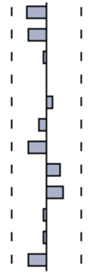 | 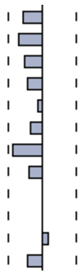 | 1 | −0.241 | −0.241 | 1.5158 | 0.218 |
| 2 | −0.215 | −0.289 | 2.7764 | 0.250 | ||
| 3 | −0.049 | −0.215 | 2.8453 | 0.416 | ||
| 4 | 0.001 | −0.176 | 2.8453 | 0.584 | ||
| 5 | 0.082 | −0.051 | 3.0594 | 0.691 | ||
| 6 | −0.088 | −0.153 | 3.3206 | 0.768 | ||
| 7 | −0.206 | −0.359 | 4.839 | 0.680 | ||
| 8 | 0.163 | −0.163 | 5.8517 | 0.664 | ||
| 9 | 0.189 | 0.008 | 7.3199 | 0.604 | ||
| 10 | −0.026 | 0.003 | 7.3499 | 0.692 | ||
| 11 | −0.028 | 0.069 | 7.3867 | 0.767 | ||
| 12 | −0.209 | −0.181 | 9.6739 | 0.645 | ||
| Model | AIC | AC | Log Maximum Likelihood Estimation | Are the Parameters Significant? |
|---|---|---|---|---|
| ARIMA (0, 1, 0) | 6.580521 | 6.7297 | −66.09547 | No |
| ARIMA (0, 1, 1) | 6.21557 | 6.3143 | −69.479 | Yes |
| ARIMA (0, 1, 2) | 6.198652 | 6.34676 | −68.28449 | No |
| ARIMA (1, 1, 0) | 6.546365 | 6.64555 | −70.01001 | No |
| ARIMA (1, 1, 1) | 5.58491 | 5.73368 | −58.43401 | No |
| ARIMA (1, 1, 2) | 5.53601 | 5.73439 | −56.89617 | No |
| ARIMA (2, 1, 0) | 6.58021 | 6.72934 | −66.09547 | No |
| ARIMA (2, 1, 1) | 6.35593 | 6.55489 | −62.73731 | No |
| ARIMA (2, 1, 2) | 6.435176 | 6.683872 | −62.56935 | No |
| Model | AIC | AC | Log Maximum Likelihood Estimation | Are the Parameters Significant? |
|---|---|---|---|---|
| ARIMA (0, 1, 0) | 7.4249 | 7.4743 | −83.3867 | No |
| ARIMA (0, 1, 1) | 6.8043 | 6.9030 | −72.2491 | Yes |
| ARIMA (0, 1, 2) | 6.8909 | 7.0390 | −76.2458 | No |
| ARIMA (1, 1, 0) | 7.2607 | 7.3599 | −77.8679 | Yes |
| ARIMA (1, 1, 1) | 6.1173 | 6.2660 | −64.2899 | No |
| ARIMA (1, 1, 2) | 6.9346 | 7.1330 | −72.2808 | No |
| ARIMA (2, 1, 0) | 7.2375 | 7.38670 | −72.9941 | No |
| ARIMA (2, 1, 1) | 6.1509 | 6.3498 | −60.5841 | No |
| ARIMA (2, 1, 2) | 7.0318 | 7.2805 | −68.8342 | No |
| Sample Years | 1994–2017 | |||||
|---|---|---|---|---|---|---|
| Sample Size | 23 | |||||
| Autocorrelation Graph | Partial Autocorrelation Graph | Lag Phase | Autocorrelation Value | Partial Autocorrelation Value | Q Statistic | p Value |
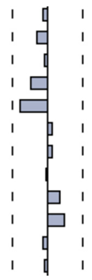 | 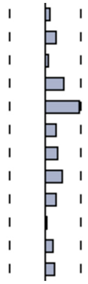 | 1 | −0.055 | −0.055 | 0.0799 | |
| 2 | −0.125 | −0.128 | 0.5058 | 0.477 | ||
| 3 | −0.025 | −0.041 | 0.5241 | 0.769 | ||
| 4 | −0.197 | −0.222 | 1.6967 | 0.638 | ||
| 5 | −0.335 | −0.401 | 5.2864 | 0.259 | ||
| 6 | 0.052 | −0.123 | 5.3787 | 0.371 | ||
| 7 | 0.044 | −0.142 | 5.4470 | 0.488 | ||
| 8 | −0.024 | −0.205 | 5.4693 | 0.603 | ||
| 9 | 0.138 | −0.133 | 6.2533 | 0.619 | ||
| 10 | 0.195 | −0.013 | 7.9296 | 0.541 | ||
| 11 | −0.055 | −0.094 | 8.0753 | 0.621 | ||
| 12 | −0.038 | −0.103 | 8.1495 | 0.700 | ||
| Sample Years | 1994–2017 | |||||
|---|---|---|---|---|---|---|
| Sample Size | 23 | |||||
| Autocorrelation Graph | Partial Autocorrelation Graph | Lag Phase | Autocorrelation Value | Partial Autocorrelation Value | Q Statistic | p Value |
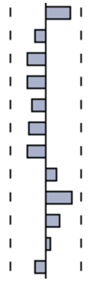 |  | 1 | 0.284 | 0.284 | 2.1038 | |
| 2 | −0.12 | −0.218 | 2.4987 | 0.114 | ||
| 3 | −0.206 | −0.117 | 3.7214 | 0.156 | ||
| 4 | −0.215 | −0.159 | 5.123 | 0.163 | ||
| 5 | −0.161 | −0.12 | 5.9498 | 0.203 | ||
| 6 | −0.199 | −0.24 | 7.2929 | 0.200 | ||
| 7 | −0.206 | −0.247 | 8.8191 | 0.184 | ||
| 8 | 0.127 | 0.1 | 9.4399 | 0.223 | ||
| 9 | 0.3 | 0.072 | 13.142 | 0.107 | ||
| 10 | 0.171 | −0.046 | 14.429 | 0.108 | ||
| 11 | 0.049 | 0 | 14.544 | 0.150 | ||
| 12 | −0.122 | −0.126 | 15.325 | 0.168 | ||
Appendix D. Predicted Values of Parameter
| Time | Predicted Values of Male | Predicted Values of Female |
| 2018 | −50.2707 | −61.7373 |
| 2019 | −54.1598 | −66.6538 |
| 2020 | −58.0489 | −71.5704 |
| 2021 | −61.9380 | −76.4869 |
| 2022 | −65.8271 | −81.4035 |
| 2023 | −69.7162 | −86.3201 |
| 2024 | −73.6053 | −91.2366 |
| 2025 | −77.4944 | −96.1532 |
| 2026 | −81.3835 | −101.0697 |
| 2027 | −85.2726 | −105.9863 |
| 2028 | −89.1618 | −110.9029 |
| 2029 | −93.0509 | −115.8194 |
| 2030 | −96.9400 | −120.7360 |
| 2031 | −100.8291 | −125.6525 |
| 2032 | −104.7182 | −130.5691 |
| 2033 | −108.6073 | −135.4857 |
| 2034 | −112.4964 | −140.4022 |
| 2035 | −116.3855 | −145.3188 |
| 2036 | −120.2746 | −150.2353 |
| 2037 | −124.1637 | −155.1519 |
| 2038 | −128.0528 | −160.0685 |
| 2039 | −131.9419 | −164.9850 |
| 2040 | −135.8310 | −169.9016 |
| 2041 | −139.7201 | −174.8181 |
| 2042 | −143.6092 | −179.7347 |
| 2043 | −147.4984 | −184.6513 |
| 2044 | −151.3875 | −189.5678 |
| 2045 | −155.2766 | −194.4844 |
| 2046 | −159.1657 | −199.4009 |
| 2047 | −163.0548 | −204.3175 |
| 2048 | −166.9439 | −209.2341 |
| 2049 | −170.8330 | −214.1506 |
| 2050 | −174.7221 | −219.0672 |
| 2051 | −178.6112 | −223.9837 |
| 2052 | −182.5003 | −228.9003 |
| 2053 | −186.3894 | −233.8169 |
| 2054 | −190.2785 | −238.7334 |
| 2055 | −194.1676 | −243.6500 |
| 2056 | −198.0567 | −248.5665 |
| 2057 | −201.9459 | −253.4831 |
| 2058 | −205.8350 | −258.3997 |
| 2059 | −209.7241 | −263.3162 |
| 2060 | −213.6132 | −268.2328 |
| 2061 | −217.5023 | −273.1493 |
| 2062 | −221.3914 | −278.0659 |
| 2063 | −225.2805 | −282.9825 |
| 2064 | −229.1696 | −287.8990 |
| 2065 | −233.0587 | −292.8156 |
| 2066 | −236.9478 | −297.7321 |
| 2067 | −240.8369 | −302.6487 |
References
- Blake, D.; Mayhew, L. On the sustainability of the UK state pension system in the light of population ageing and declining fertility. Econ. J. 2006, 116, F286–F305. [Google Scholar] [CrossRef] [Scilit]
- Jimeno, J.F.; Rojas, J.A.; Puente, S. Modelling the impact of aging on social security expenditures. Econ. Model. 2008, 25, 201–224. [Google Scholar] [CrossRef] [Scilit]
- Sonsbeek, J. Micro simulations on the effects of ageing-related policy measures: The social affairs department of the Netherlands ageing and pensions model. Econ. Model. 2010, 27, 968–979. [Google Scholar] [CrossRef] [Scilit]
- Chomik, R.; Piggott, J. Pensions, ageing and retirement in Australia: Long term projections and policies. Aust. Econ. Rev. 2012, 45, 350–361. [Google Scholar] [CrossRef] [Scilit]
- Bonenkamp, J.; Meijdam, L.; Ponds, E.; Westerhout, E. Ageing-driven pension reforms. J. Popul. Econ. 2017, 30, 953–976. [Google Scholar] [CrossRef] [Scilit]
- Barr, N. Economics of the Welfare State, 4th ed.; Oxford University Press: New York, NY, USA, 2004; p. 204. [Google Scholar]
- Zaidi, A. Population aging and financial and social sustainability challenges of pension systems in Europe: A cross-national perspective. In The Future of Multi-Pillar Pensions; Bovenberg, L., Ewijk, C.V., Westerhout, E., Eds.; Cambridge University Press: Cambridge, UK, 2012; pp. 17–45. [Google Scholar]
- Liu, B.; Yang, Z. Population aging shock and fiscal sustainability in china: Mechanism analysis and effect simulation. Singap. Econ. Rev. 2018. [Google Scholar] [CrossRef] [Scilit]
- Brixi, H.P.; Schick, A. Government at Risk: Contingent Liabilities and Fiscal Risk; Oxford University Press: New York, NY, USA, 2002; pp. 2–3. [Google Scholar]
- Zhao, Q.; Mi, H. Evaluation on the sustainability of urban public pension system in China. Sustainability 2019, 11, 1418. [Google Scholar] [CrossRef] [Scilit]
- U.S. Congressional Budget Office. Quantifying Uncertainty in the Analysis of Long-term Social Security Projections; U.S. Congressional Budget Office: Washington, DC, USA, 2005.
- Metzger, C. An actuarial balance sheet of the Swiss old-age pension scheme. Int. Soc. Secur. Rev. 2018, 71, 25–49. [Google Scholar] [CrossRef] [Scilit]
- Belolipetskii, A.A.; Lepskaya, M.A. A Mathematical Model of Pension Fund Operation and Methods of Fund Stability Analysis. Comput. Math. Model. 2018, 29, 233–243. [Google Scholar] [CrossRef] [Scilit]
- Lee, D.R.; Carter, R.L. Modeling and forecasting US mortality. J. Inst. Actuar. 1860, 13, 325–358. [Google Scholar]
- Girosi, F.; Kin, G. Understanding the Lee-Carter Mortality Forecasting Method. 2007. Available online: http://gking.harvard.edu/files/abs/lc-abs.shtml (accessed on 20 November 2020).
- Chernyavskiy, P.; Little, M.P.; Rosenberg, P.S. A unified approach for assessing heterogeneity in age-period-cohort model parameters using random effects. Stat. Methods Med Res. 2019, 28, 20–34. [Google Scholar] [CrossRef] [Scilit]
- Cairns, A.J.G.; Blake, D.P.; Dowd, K. A two-factor model for stochastic mortality with parameter uncertainty: Theory and calibration. J. Risk Insur. 2006, 73, 687–718. [Google Scholar] [CrossRef] [Scilit]
- Carfora, M.F.; Cutillo, L.; Orlando, A. A quantitative comparison of stochastic mortality models on Italian population data. Comput. Stat. Data Anal. 2017, 112, 198–214. [Google Scholar] [CrossRef] [Scilit]
- Jing, P.; Chang, C.; Zhu, H.; Hu, Q. Financial imbalance risk and its control strategy of China’s pension insurance contribution rate reduction. Math. Probl. Eng. 2021, 12. [Google Scholar] [CrossRef] [Scilit]
- Zhao, Y.; Bai, M.; Liu, Y.; Hao, J. Quantitative analyses of transition pension liabilities and solvency sustainability in China. Sustainability 2017, 9, 2252. [Google Scholar] [CrossRef] [Scilit]
- Wang, H.; Huang, J.; Yang, Q. Assessing the financial sustainability of the pension plan in china: The role of fertility policy adjustment and retirement delay. Sustainability 2019, 11, 883. [Google Scholar] [CrossRef] [Scilit]
- Sun, L.; Su, C.; Xian, X. Assessing the sustainability of china’s basic pension funding for urban and rural residents. Sustainability 2020, 12, 2833. [Google Scholar] [CrossRef] [Scilit]
- Tian, Y.; Zhao, X. Stochastic forecast of the financial sustainability of basic pension in China. Sustainability 2016, 8, 46. [Google Scholar] [CrossRef] [Scilit]
- Chen, X.; Yang, Z. Stochastically assessing the financial sustainability of individual accounts in the urban enterprise employees’ pension plan in china. Sustainability 2019, 11, 3568. [Google Scholar] [CrossRef] [Scilit]
- Xie, Y.; Zhang, X.; Lv, H.; Guo, X. The new fertility policy and the actuarial balance of china urban employee basic endowment insurance fund based on stochastic mortality model. Math. Probl. Eng. 2020, 3, 1–12. [Google Scholar]
- Zhao, Y.; Bai, M.; Peng, F.; Zhu, M. Stochastic assessments of urban employees’ pension plan of china. Sustainability 2018, 10, 1028. [Google Scholar] [CrossRef] [Scilit]
- Koissi, M.C.; Shapiro, A.F.; Hognas, G. Evaluating and extending the Lee-carter mortality forecasting:Bootstrap confidence interval. Insur. Math. Econ. 2006, 38, 1–20. [Google Scholar] [CrossRef] [Scilit]
- Wilmoth, J.R. Mortality projections for Japan: A comparison of four methods. In Health and Mortality among Elderly Population; Oxford University Press: New York, NY, USA, 1996. [Google Scholar]
- Liao, P.; Su, H.; Pamučar, D. Will Ending the One-Child Policy and Raising the Retirement Age Enhance the Sustainability of China’s Basic Pension System? Sustainability 2020, 12, 8172. [Google Scholar] [CrossRef] [Scilit]



| Year | Actual Income | Estimated Income | Absolute Percentage Error of Income | Actual Expenditure | Estimated Expenditure | Absolute Percentage Error of Expenditure |
|---|---|---|---|---|---|---|
| 2009 | 9534 | 10,068.66 | 5.61% | 8894.4 | 9735.32 | 9.45% |
| 2010 | 11,110 | 11,765.67 | 5.90% | 10,554.9 | 10,167.91 | 3.67% |
| 2011 | 13,956 | 13,945.07 | 0.08% | 12,765.0 | 11,174.73 | 12.46% |
| 2012 | 16,467 | 15,740.66 | 4.41% | 15,561.8 | 15,622.41 | 0.39% |
| 2013 | 18,634 | 17,547.78 | 5.83% | 18,470.4 | 19,588.41 | 6.05% |
| 2014 | 20,434 | 22,947.38 | 12.30% | 21,754.7 | 20,762.44 | 4.56% |
| 2015 | 23,016 | 24,922.45 | 8.28% | 25,812.7 | 26,352.53 | 2.09% |
| 2016 | 26,768 | 28,013.43 | 4.65% | 31,853.8 | 31,583.61 | 0.85% |
| 2017 | 33,403 | 30,992.80 | 7.22% | 38,051.5 | 37,338.04 | 1.87% |
| 2018 | 38,813 | 37,198.93 | 4.16% | 42,960.8 | 41,928.16 | 2.40% |
| Year | Mean | Standard Deviation | Coefficient of Variation | VaR | ES | TVaR |
|---|---|---|---|---|---|---|
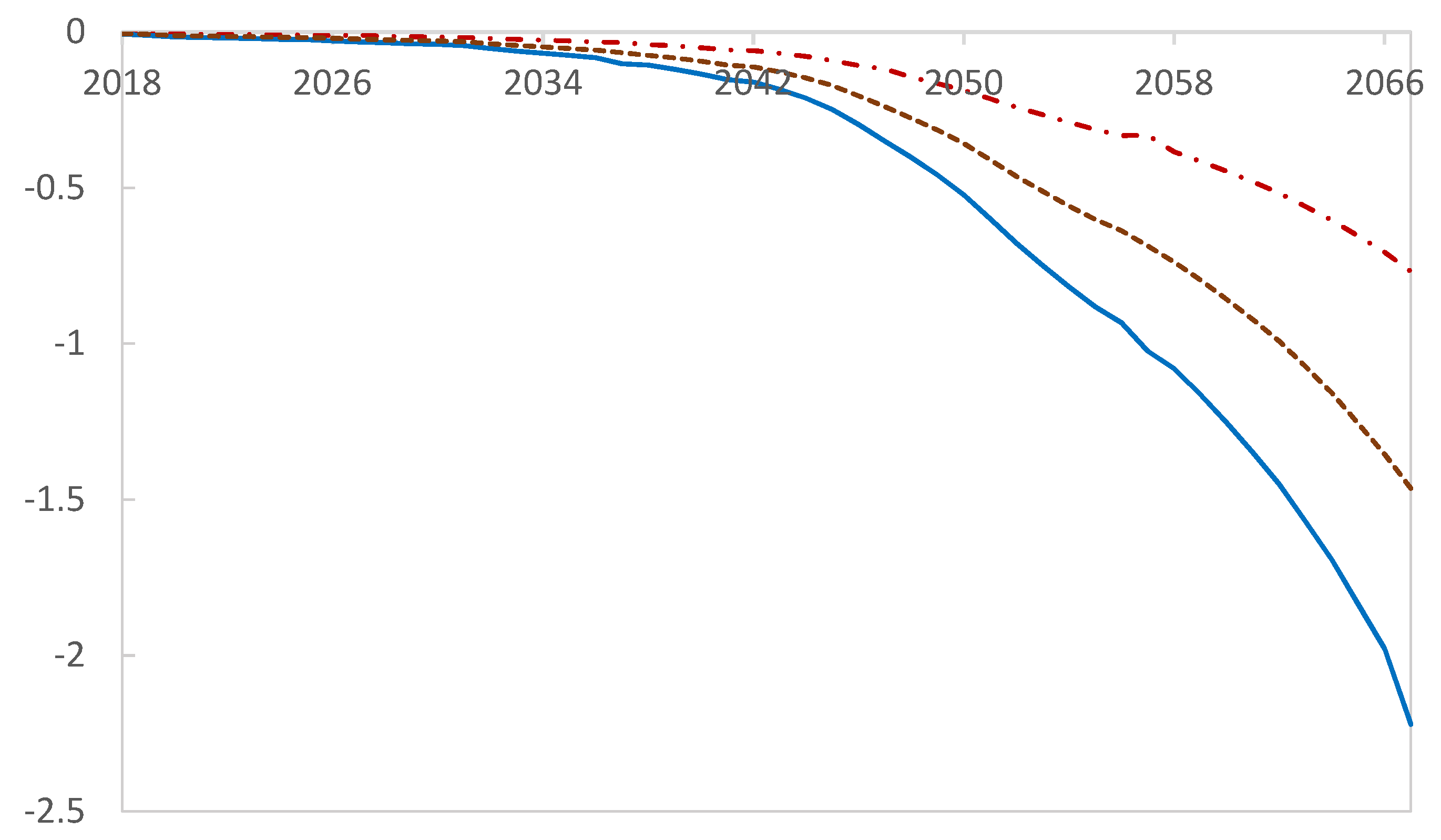
| 2027 | 22,883.7 | 140,641.7 | 6.1 | 35,313.3 | 34,361.0 | 722,533.1 |
| 2037 | 66,945.3 | 755,578.2 | 11.3 | 99,814.3 | 96,610.3 | 2,032,019.4 |
| 2047 | 240,002.1 | 6,249,071.7 | 26.0 | 350,758.4 | 337,653.3 | 7,103,824.8 |
| 2057 | 686,336.9 | 40,403,533.2 | 58.9 | 992,681.7 | 952,773.2 | 20,048,146.2 |
| 2067 | 1,464,021.7 | 196,744,166.8 | 134.4 | 2,124,397.7 | 2,038,943.3 | 42,903,264.3 |
| Year | This Article Mean Fund Gap | Median Pension Gap under Low Mortality Rates [10] | Current Deficits under the Baseline Scenario [19] | Annual Deficit in Baseline Scenario [21] |
|---|---|---|---|---|
| 2027 | 22,883.7 | 54,544.6 | 86,100 | |
| 2037 | 66,945.3 | 131,313.3 | 214,400 | |
| 2047 | 240,002.1 | 15,510 | 249,426.2 | 420,200 |
| 2057 | 686,336.9 | 367,640.5 | 578,900 | |
| 2067 | 1,464,021.7 | 33,820 | 742,300 |
| Sensitive Factor | Reference Value | High-Speed Value | High Rate of Change | Elasticity | Low-Speed Value | Low Rate of Change | Elasticity |
|---|---|---|---|---|---|---|---|
| Enterprise contribution rate | 116.730 | 111.554 | −0.044 | −0.709 | 120.081 | 0.029 | −0.459 |
| Wage growth rate | 116.730 | 104.758 | −0.103 | −0.599 | 148.919 | 0.276 | −1.611 |
| Urbanization rate | 116.730 | 116.325 | −0.003 | −0.237 | 117.225 | 0.004 | −0.289 |
| Pension growth rate | 116.730 | 143.236 | 0.227 | 1.135 | 99.059 | −0.151 | 0.757 |
| Age of receiving pension | 106.884 | 95.485 | −0.107 | −2.091 | 152.683 | 0.428 | −3.539 |
Publisher’s Note: MDPI stays neutral with regard to jurisdictional claims in published maps and institutional affiliations. |
© 2021 by the authors. Licensee MDPI, Basel, Switzerland. This article is an open access article distributed under the terms and conditions of the Creative Commons Attribution (CC BY) license (https://creativecommons.org/licenses/by/4.0/).
Share and Cite
Le, M.; Xiao, X.; Pamučar, D.; Liang, Q. A Study on Fiscal Risk of China’s Employees Basic Pension System under Longevity Risk. Sustainability 2021, 13, 5526. https://doi.org/10.3390/su13105526
Le M, Xiao X, Pamučar D, Liang Q. A Study on Fiscal Risk of China’s Employees Basic Pension System under Longevity Risk. Sustainability. 2021; 13(10):5526. https://doi.org/10.3390/su13105526
Chicago/Turabian StyleLe, Min, Xinrong Xiao, Dragan Pamučar, and Qianling Liang. 2021. "A Study on Fiscal Risk of China’s Employees Basic Pension System under Longevity Risk" Sustainability 13, no. 10: 5526. https://doi.org/10.3390/su13105526
APA StyleLe, M., Xiao, X., Pamučar, D., & Liang, Q. (2021). A Study on Fiscal Risk of China’s Employees Basic Pension System under Longevity Risk. Sustainability, 13(10), 5526. https://doi.org/10.3390/su13105526