Development of Environmental Health Competencies through Compulsory Education. A Polyhedral Approach Based on the SDGs



Abstract
1. Introduction
2. Materials and Methods
3. Results
3.1. Environmental Health Awareness
3.2. Environmental Health Competency Achievement
3.3. Student’s Answers to Environmental Health Problems
- Hunger. Two trends were found in their answers: an individual and subjective (e.g., ‘I feel sad’, ‘it is due to selfishness’, ‘it should not exist’), and another more social, pointing out injustice, inequality, exploitation of poor countries, right to food, etc. When asked about their skills and procedures, the answers kept in the personal level, mentioning actions directed towards volunteering: helping NGOs, sponsoring a child, offering food, not throwing away food, etc. When attitudinal aspects were approached, the answers concentrated on giving opinion ‘it’s wrong’, ‘you have to donate’, ‘you have to think about others’, justifying the answers in most of the cases.
- Consumerism. Approximately 30% of the students did not know and less than 10% mentioned the environmental effects of problems related to consumerism. Those who answered presented two aspects in their responses, a personal one: ‘I lose money’, ‘I waste time’, ‘the addiction that it entails’, and another more social, since they mentioned child exploitation, excessive consumption or pollution. When addressing procedural (knowing-how-to-do) issues, most of them offered answers of personal behaviour: ‘not consuming’, ‘continue using devices while they work’, ‘you have to settle for what you have’, etc. However, others added general or social aspects: ‘money should not be wasted’, ‘my parents will not let me’, ‘it is about whims’. In response to the question directed towards attitudes or expressing opinions, some responses were focused on the awareness of people: ‘we must raise awareness among young people’, ‘try not to exploit the poor’, while other responses were more social: ‘avoid planned obsolescence’, ‘reduce production’, ‘do not take so many models’, ‘raise the market price’, etc.
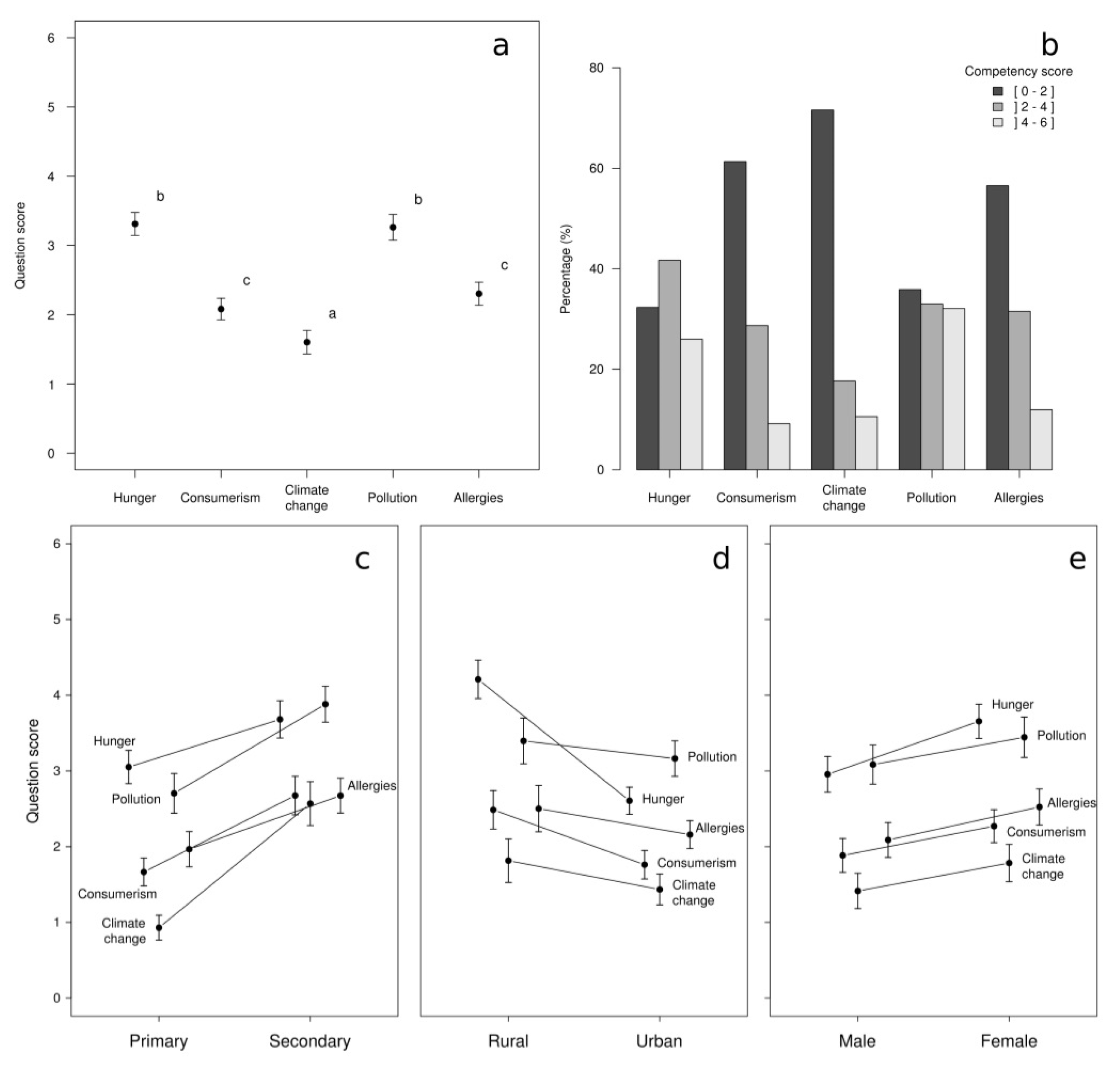
- Climate change. 60% of responses showed an absence of knowledge, either by leaving questions unanswered or considering their mistakes. Most of the answers focused on the effects of climate change on the environment: ‘temperature increase’, ‘acid rain’, ‘greenhouse effect’, ‘loss of biodiversity’, etc. About 20% mentioned individual health consequences (cancer, respiratory problems, skin burns, etc.). The answers that focused on what can be done were all in the personal sphere, with predominance of the three Rs (reduce, reuse and recycle), also pointing out the importance of keeping clean streets, or the environment, not wasting water and using public transport. When asked about knowing-how-to-be or their attitude, the answers were more social and collective: ‘make people aware’, ‘pay attention to scientists’, ‘increase information in the media’ or ‘carry out collective actions’.
- Pollution in the cities. Considering the conceptual dimension of the problem, student responses showed two aspects, the first referring to the environment itself, and most of them stated atmospheric or air pollution, but also acoustic and light pollution; less mentioned were the decrease of the ozone layer, global warming, pointing the use of cars as the great cause. The least mentioned type of pollution is soil pollution. The other aspect referred to health problems generated by these environmental alterations, mentioning heart, respiratory and skin problems, insomnia, bad mood, stress, deafness, etc. When asked on what can be done, most of the answers inclined towards the adoption of personal behaviours, such as saving electricity, using electric cars, using litter bins, mentioning once more the importance of the three Rs, including also global behaviours and governmental measures such as collaboration between countries, limiting the use of private cars, promoting alternative energies, carrying out awareness campaigns to reduce garbage, etc. When faced with the question of attitudinal aspects or knowing-how-to-be, the great majority pointed out the alarming situation of our planet due to global warming, greenhouse effect, ice melting at the poles, situations that can still get worse. With a social vision they pointed out the need to promote people´s awareness, to pay attention to scientists insisting on the fact that the permanence of this problem means the deterioration of our planet and with it our own extinction.
- Allergies. When asked about conceptual issues, most noted both the causes of allergies (dust, acarus, certain bacteria) and the effects on the body: breathing difficulties, sneezing and mucus, skin reactions, headaches, eye redness, etc. When asked about skills or procedures, on the one hand, they pointed out the adoption of preventive actions such as getting vaccinated, cleaning up more, going to the countryside to breathe fresh air and, on the other hand, actions to avoid polluting sources such as ‘getting away from places with dust’, ‘avoiding certain cleaning jobs’, etc. When asked about attitudinal predisposition, the answers were directed towards possible causes such as not having immunity, avoiding transgenics, and excessive cleaning, this last appointed at the same time as improper hygiene.
3.4. Knowledge, Skills and Attitudes on Environmental Health
4. Discussion
5. Conclusions
Author Contributions
Funding
Acknowledgments
Conflicts of Interest
Appendix A. Questionnaires provided to students (translated into English from the Spanish)
| ENVIRONMENTAL HEALTH COMPETENCIES Model A The present questionnaire is anonymous. Think carefully before answering. Thank you very much for your cooperation. A. Personal information Gender: • Male • Female Age: ______ School: ______________________________________ B. Environmental health problems Point out those health problems that you know that are related to the Environment_____________________ _______________________________________________________________________________________ C. Actions addressing the problems. What would you do in these cases? 1.- At the end of the break you see pieces of bread and sandwiches on the floor. However, you know that there are children who go hungry and have nothing to eat for lunch. What can you say about hunger in the world? What can you do about it? What do you think about these two situations occurring in today´s world? 2.- For a year now you have had a mobile phone that works perfectly. However, an impressive new model that you love has come on the market. What problems can excessive consumption cause? What would you do with your old phone? Would you continue with it or replace it? Why? What measures could be adopted to reduce overconsumption in developed countries? 3.- The idea of climate change is being widely used in the media. How does climate change arise? What consequences could it have on health? What can you do to slow down this process? What opinion do you have about alerts from scientists and the media? ENVIRONMENTAL HEALTH COMPETENCIES Model B The present questionnaire is anonymous. Think carefully before answering. Thank you very much for your cooperation. A. Personal information Gender: • Male • Female Age: ______ School: _______________________________________ B. Environmental health problems Point out those health problems that you know that are related to the Environment_____________________ _______________________________________________________________________________________ C. Actions addressing the problems. What would you do in these cases? 1.- Pollution in cities is a fact repeatedly highlighted by the media. What types of pollution do you know? What consequences can it have on citizens? What do you propose to prevent it? Do you think it is an alarming situation or is it being exaggerated? Why? 2.-You have a cousin who leaves the room when it’s being cleaned. He says he has a “dust allergy”. What does “dust allergy” mean? How is it recognized? What could be done to minimize his allergy? The health authorities say that there are more and more people with allergies. What do you think this is due to? |
References
- Bybee, R.W. Planet Earth in Crisis: How Should Science Educators Respond? Am. Biol. Teach. 1991, 53, 146–153. [Google Scholar] [CrossRef] [Scilit]
- Whitmee, S.; Haines, A.; Beyrer, C.; Boltz, F.; Capon, A.G.; de Souza Dias, B.F.; Ezeh, A.; Frumkin, H.; Gong, P.; Head, P.; et al. Safeguarding human health in the Anthropocene epoch: Report of The Rockefeller Foundation–Lancet Commission on planetary health. Lancet 2015, 386, 1973–2028. [Google Scholar] [CrossRef] [Scilit]
- Das, P.; Horton, R. Pollution, health, and the planet: Time for decisive action. Lancet 2018, 391, 407–408. [Google Scholar] [CrossRef] [Scilit]
- Carson, R. Silent Spring; Houghton Mifflin Harcourt: Boston, MA, USA, 1962. [Google Scholar]
- Lalonde, M. New Perspective on the Health of Canadians a Working Document; Minister of Supply and Services, Health Canada: Ottawa, ON, Canada, 1981. [Google Scholar]
- McMichael, A.J.; Friel, S.; Nyong, A.; Corvalan, C. Global environmental change and health: Impacts, inequalities, and the health sector. BMJ 2008, 336, 191–194. [Google Scholar] [CrossRef] [Scilit]
- Prüss-Ustün, A.; Vickers, C.; Haefliger, P.; Bertollini, R. Knowns and unknowns on burden of disease due to chemicals: A systematic review. Environ. Health 2011, 10, 9. [Google Scholar] [CrossRef] [Scilit]
- Cheng, J.J.; Schuster-Wallace, C.J.; Watt, S.; Newbold, B.K.; Mente, A. An ecological quantification of the relationships between water, sanitation and infant, child, and maternal mortality. Environ. Health 2012, 11, 4. [Google Scholar] [CrossRef] [Scilit]
- Vrijheid, M.; Casas, M.; Gascon, M.; Valvi, D.; Nieuwenhuijsen, M. Environmental pollutants and child health-A review of recent concerns. Int. J. Hyg. Environ. Health 2016, 219, 331–342. [Google Scholar] [CrossRef] [Scilit]
- Marcelino, L.; Sjöström, J.; Marques, C.A. Socio-problematization of green chemistry: Enriching systems thinking and social sustainability by education. Sustainability 2019, 11, 7123. [Google Scholar] [CrossRef] [Scilit]
- WHO. Preamble to the Constitution of the World Health Organization as adopted by the International Health Conference, New York, 19–22 June 1946. In Constitution of the World Health Organization; World Health Organization (WHO): Geneva, Switzerland, 1948; Signed on 22 July 1946 by the representatives of 61 States. [Google Scholar]
- Dubos, R.J. Mirage of Health, Utopias, Progress, and Biological Change; Harper: New York, NY, USA, 1959. [Google Scholar]
- McLeroy, K.R.; Bibeau, D.; Steckler, A.; Glanz, K. An ecological perspective on health promotion programs. Health Educ. Q. 1988, 15, 351–377. [Google Scholar] [CrossRef] [Scilit]
- Minkler, M. Health education, health promotion and the open society: An historical perspective. Health Educ. Q. 1989, 16, 17–30. [Google Scholar] [CrossRef] [Scilit]
- Huber, M.; Knottnerus, J.A.; Green, L.; van der Horst, H.; Jadad, A.R.; Kromhout, D.; Leonard, B.; Lorig, K.; Loureiro, M.I.; van der Meer, J.W.M.; et al. How should we define health? BMJ 2011, 343, d4163. [Google Scholar] [CrossRef] [Scilit]
- WHO. WHO Global Strategy for Health and Environment; World Health Organization: Geneva, Switzerland, 1993. [Google Scholar]
- Srinivasan, S.; O’fallon, L.R.; Dearry, A. Creating healthy communities, healthy homes, healthy people: Initiating a research agenda on the built environment and public health. Am. J. Public Health 2003, 93, 1446–1450. [Google Scholar] [CrossRef] [Scilit]
- Stokols, D. Establishing and maintaining healthy environments: Toward a social ecology of health promotion. Am. Psychol. 1992, 47, 6. [Google Scholar] [CrossRef]
- Rydin, Y.; Bleahu, A.; Davies, M.; Dávila, J.D.; Friel, S.; De Grandis, G.; Groce, N.; Hallal, P.C.; Hamilton, I.; Howden-Chapman, P.; et al. Shaping cities for health: Complexity and the planning of urban environments in the 21st century. Lancet 2012, 379, 2079–2108. [Google Scholar] [CrossRef] [Scilit]
- Lee, S.C.; Guo, H.; Li, W.M.; Chan, L.Y. Inter-comparison of air pollutant concentrations in different indoor environments in Hong Kong. Atmos. Environ. 2002, 36, 1929–1940. [Google Scholar] [CrossRef] [Scilit]
- Orr, D.W. Governance in the Long Emergency. In State of the World 2013: Is Sustainability Still Possible? Island Press/Center for Resource Economics: Washington, DC, USA, 2013; pp. 279–291. [Google Scholar]
- Finn, S.; O’Fallon, L. The Emergence of Environmental Health Literacy-From Its Roots to Its Future Potential. Environ. Health Perspect. 2017, 125, 495–501. [Google Scholar] [CrossRef] [Scilit]
- Chepesiuk, R. Environmental literacy: Knowledge for a healthier public. Environ. Health Perspect. 2007, 115, A494–A499. [Google Scholar] [CrossRef] [Scilit]
- Hoover, A.G. Defining Environmental Health Literacy. In Environmental Health Literacy; Finn, S., O’Fallon, L.R., Eds.; Springer International Publishing: Cham, Switzerland, 2019; pp. 3–18. [Google Scholar]
- Gray, K.M. From Content Knowledge to Community Change: A Review of Representations of Environmental Health Literacy. Int. J. Environ. Res. Public Health 2018, 15, 466. [Google Scholar] [CrossRef] [Scilit]
- Gray, K.M.; Lindsey, M. Measuring Environmental Health Literacy. In Environmental Health Literacy; Finn, S., O’Fallon, L.R., Eds.; Springer International Publishing: Cham, Switzerland, 2019; pp. 19–43. [Google Scholar]
- Dixon, J.K.; Hendrickson, K.C.; Ercolano, E.; Quackenbush, R.; Dixon, J.P. The environmental health engagement profile: What people think and do about environmental health. Public Health Nurs. 2009, 26, 460–473. [Google Scholar] [CrossRef] [Scilit]
- Ratnapradipa, D.; Middleton, W.K.; Wodika, A.B.; Brown, S.L.; Preihs, K. What does the public know about environmental health? A qualitative approach to refining an environmental health awareness instrument. J. Environ. Health 2015, 77, 22–28. [Google Scholar]
- Lister-Sharp, D.; Chapman, S.; Stewart-Brown, S.; Sowden, A. Health promoting schools and health promotion in schools: Two systematic reviews. Health Technol. Assess. 1999, 3, 1–207. [Google Scholar] [CrossRef] [Scilit]
- Chapman, D.; Sharma, K. Environmental Attitudes and Behavior of Primary and Secondary Students in Asian Cities: An Overview Strategy for Implementing an Eco-schools Programme. Environmentalist 2001, 21, 265–272. [Google Scholar] [CrossRef] [Scilit]
- Buijs, G.J. Better schools through health: Networking for health promoting schools in Europe. Eur. J. Educ. 2009. [Google Scholar] [CrossRef] [Scilit]
- Boeve-de Pauw, J.; Van Petegem, P. The Effect of Flemish Eco-Schools on Student Environmental Knowledge, Attitudes, and Affect. Int. J. Sci. Educ. 2011, 33, 1513–1538. [Google Scholar] [CrossRef] [Scilit]
- Keil, C.; Haney, J.; Zoffel, J. Improvements in student achievement and science process skills using environmental health science problem-based learning curricula. Electron. J. Sci. 2009. Available online: http://ejse.southwestern.edu/article/download/7782/5549 (accessed on 10 November 2019).
- Cohen, A.K.; Waters, A.; Brown, P. Place-Based Environmental Health Justice Education: A Community-University-Government-Middle School Partnership. Environ. Justice 2012, 5, 188–197. [Google Scholar] [CrossRef] [Scilit]
- Ebong, R.D. Environmental health knowledge and practice survey among secondary schoolchildren in Zaria, Nigeria. Environ. Health Perspect. 1994, 102, 310–312. [Google Scholar] [CrossRef] [Scilit]
- Naquin, M.; Cole, D.; Bowers, A.; Walkwitz, E. Environmental Health Knowledge, Attitudes and Practices of Students in Grades Four through Eight. ICHPER-SD J. Res. 2011, 6, 45–50. Available online: https://eric.ed.gov/?id=EJ954496 (accessed on 10 November 2019).
- Ratnapradipa, D.; Brown, S.L.; Middleton, W.K.; Wodika, A.B. Measuring Environmental Health Perception Among College Students. Health Educ. 2011, 43, 13–20. [Google Scholar]
- Msengi, I.G.; Doe, R. Assessment of Environmental Health Knowledge, Attitude and Behavior among High School Students in a USA Southeast Texas School District. OJPM 2017, 07, 247–260. [Google Scholar] [CrossRef]
- Montero-Pau, J.; Tuzón, P.; Gavidia, V. Health Education in the Spanish Education Laws: Comparative analysis between LOE and LOMCE. Rev Esp Salud Publica 2018, 92. Available online: https://www.ncbi.nlm.nih.gov/pubmed/29880789 (accessed on 10 November 2019).
- Fernández, B.; Álvaro, N.; Mayoral, O.; Gavidia, V. Las Competencias en Salud Ambiental en el Currículo de la Educación Obligatoria. In Los ocho ámbitos de la Educación para la Salud en la Escuela; Gavidia, V., Ed.; Tirant Humanidades: Valencia, Spain, 2016; pp. 425–444. [Google Scholar]
- Cronbach, L.J. Coefficient alpha and the internal structure of tests. Psychometrika 1951, 16, 297–334. [Google Scholar] [CrossRef] [Scilit]
- McDonald, R.P. Test Theory: A Unified Treatment; Taylor & Francis Group Inc.: Mahwah, NJ, USA, 1999. [Google Scholar]
- Revelle, W. Psych: Procedures for Psychological, Psychometric, and Personality Research; 2016. R Package Version 2015, 1. [Google Scholar]
- LDSMR. Ley 45/2007 Para el Desarrollo Sostenible del Medio Rural (LDSMR) [Spanish Law 45/2007 for the Sustainable Development of Rural Areas]. 2007. Available online: https://www.boe.es/buscar/doc.php?id=BOE-A-2007-21493 (accessed on 10 November 2019).
- Holm, S. A Simple Sequentially Rejective Multiple Test Procedure. Scand. Stat. Theory Appl. 1979, 6, 65–70. [Google Scholar]
- Tomczak, M.; Tomczak, E. The need to report effect size estimates revisited. An overview of some recommended measures of effect size. Trends Sport Sci. 2014, 1, 19–25. Available online: http://www.wbc.poznan.pl/Content/325867/5_Trends_Vol21_2014_%20no1_20.pdf (accessed on 10 November 2019).
- Meyer, D.; Zeileis, A.; Hornik, K. vcd: Visualizing Categorical Data. 2017. Available online: https://cran.r-project.org/web/packages/vcd/vcd.pdf (accessed on 10 November 2019).
- Wang, J.; Zamar, R.; Marazzi, A.; Yohai, V.; Salibian-Barrera, M.; Maronna, R.; Zivot, E.; Rocke, D.; Martin, D.; Maechler, M.; et al. Robust: Port of the S+ “Robust Library”. Available online: https://CRAN.R-project.org/package=robust (accessed on 10 November 2019).
- Navarro, D.J. Learning Statistics with R: A Tutorial for Psychology Students and Other Beginners. 2015. Available online: http://www.fon.hum.uva.nl/paul/lot2015/Navarro2014.pdf (accessed on 10 November 2019).
- Venables, W.N.; Ripley, B.D. Modern Applied Statistics with S, 4th ed.; Springer: New York, NY, USA, 2002. [Google Scholar]
- R Core Team. R: A Language and Environment for Statistical Computing. Vienna, Austria: R Foundation for Statistical Computing. 2015. Available online: https://www.R-project.org/ (accessed on 10 November 2019).
- Gavidia, V.; Talavera, M.; Lozano, O. Evaluación de competencias en salud: Elaboración y validación de un cuestionario, primeros resultados. Ciência Educação (Bauru) 2019, 25, 277–296. [Google Scholar]
- Aragonés, J.I.; Sevillano, V.; Cortés, B.; Amérigo, M. Cuestiones ambientales que se perciben como problemas. Medio Ambiente y Comportamiento Humano 2006, 7, 1–19. [Google Scholar]
- Santiago, P. El Medio ambiente en las Encuestas del CIS. La Sensibilidad Medioambiental en España. In Persona, Sociedad y Medio Ambiente Perspectivas de la Investigación Social de la Sostenibilidad; De Castro, R., Ed.; Consejería de Medio Ambiente: Junta de Andalucía, Sevilla, Spain, 2006; pp. 151–166. [Google Scholar]
- Heras-Hernández, F.; Meira Cartea, P.A.; Justel, A. La percepción social de los riesgos del cambio climático sobre la salud en España. Revista de Salud Ambiental 2017, 17, 40–46. [Google Scholar]
- Rajeev Gowda, M.V.; Fox, J.C.; Magelky, R.D. Students’ Understanding of Climate Change: Insights for Scientists and Educators. Bull. Am. Meteorol. Soc. 1997, 78, 2232–2240. [Google Scholar] [CrossRef] [Scilit]
- Papadimitriou, V. Prospective Primary Teachers’ Understanding of Climate Change, Greenhouse Effect, and Ozone Layer Depletion. J. Sci. Educ. Technol. 2004, 13, 299–307. [Google Scholar] [CrossRef] [Scilit]
- Boon, H.J. Climate change? Who knows? A comparison of secondary students and pre-service teachers. Aust. J. Teach. Educ. 2010, 35, 16. [Google Scholar] [CrossRef] [Scilit]
- Wachholz, S.; Artz, N.; Chene, D. Warming to the idea: University students’ knowledge and attitudes about climate change. Int. J. Sustain. High. Educ. 2014, 15, 128–141. [Google Scholar] [CrossRef] [Scilit]
- Lambert, J.L.; Bleicher, R.E. Climate change in the pre-service teacher’smind. J. Sci. Teach. Educ. 2013, 24, 999–1022. [Google Scholar] [CrossRef] [Scilit]
- Ratinen, I.J. Primary student-teachers’ conceptual understanding of the greenhouse effect: A mixed method study. Int. J. Sci. Educ. 2013, 35, 929–955. [Google Scholar] [CrossRef] [Scilit]
- Tolppanen, S.; Claudelin, A.; Kang, J. Pre-service Teachers’ Knowledge and Perceptions of the Impact of Mitigative Climate Actions and Their Willingness to Act. Res. Sci. Educ. 2020, 1–21. [Google Scholar] [CrossRef] [Scilit]
- Ercan, H.; Ozen, A.; Karatepe, H.; Berber, M.; Cengizlier, R. Primary school teachers’ knowledge about and attitudes toward anaphylaxis. Pediatr. Allergy Immunol. 2012, 23, 428–432. [Google Scholar] [CrossRef] [Scilit]
- Zeyer, A.; Álvaro, N.; Arnold, J.; Benninghaus, J.C.; Hasslöf, H.; Kremer, K.; Lundström, M.; Mayoral, O.; Sjöström, S.; Gavidia, V.; et al. Addressing complexity in science| environment| health pedagogy. In Bridging Research and Practice in Science Education; Springer: Cham, Switzerland, 2019; pp. 153–170. [Google Scholar]
- Aznar, P.; Calero, M.; Martínez-Agut, M.P.; Mayoral, O.; Ull, À.; Vázquez-Verdera, V.; Vilches, A. Training Secondary Education teachers through the Prism of Sustainability: The case of the Universitat de València. Sustainability 2018, 10, 4170. [Google Scholar] [CrossRef] [Scilit]
- Bråten, I.; Britt, M.A.; Strømsø, H.I.; Rouet, J.-F. The Role of Epistemic Beliefs in the Comprehension of Multiple Expository Texts: Toward an Integrated Model. Educ. Psychol. 2011, 46, 48–70. [Google Scholar] [CrossRef] [Scilit]
- Vilches, A.; Gil, D. Construyamos un Futuro Sostenible. Diálogos de Supervivencia; Cambridge University Presss: Madrid, Spain, 2003. [Google Scholar]
- Novo, M. El Desarrollo Local en la Sociedad Global: Hacia un Modelo “Glocal” Sistémico y Sostenible. In Desarrollo Local y Agenda 21; Pearson Educación: London, UK, 2006; pp. 5–36. [Google Scholar]


| Variables | N | % | |
|---|---|---|---|
| Educational level | Primary | 516 | 55.9 |
| Secondary | 407 | 44.1 | |
| Gender | Male | 464 | 50.3 |
| Female | 459 | 49.7 | |
| School typology | Rural | 396 | 42.9 |
| Urban | 527 | 57.1 | |
| Educational Level | Gender | Typology | ||||
|---|---|---|---|---|---|---|
| Primary | Secondary | Male | Female | Rural | Urban | |
| Catastrophic events | 10.8 (30) | 5.2 (14) | 10.2 (28) | 6.2 (17) | 14.6 (27) | 4.9 (18) |
| Problems, prevention and solutions | 8.3 (23) | 11.2 (30) | 9.1 (25) | 10.2 (28) | 14.1 (26) | 7.4 (27) |
| Respect for the environment | 12.3 (34) | 3.3 (9) | 7.3 (20) | 8.4 (23) | 6.5 (12) | 8.5 (31) |
| Species extinction | 0.7 (2) | 4.1 (11) | 2.9 (8) | 1.8 (5) | 1.1 (2) | 3.0 (11) |
| Sustainability, consumption and recycling | 5.8 (16) | 1.5 (4) | 3.6 (10) | 3.6 (10) | 1.1 (2) | 4.9 (18) |
| Water and air pollution | 45.1 (125) | 64.7 (174) | 51.6 (142) | 58 (159) | 42.2 (78) | 61.3 (223) |
| Others | 17.0 (47) | 10.0 (27) | 15.3 (42) | 11.7 (32) | 20.5 (38) | 9.9 (36) |
| Factor | df | Robust F | Pr(F) | η2 | ηpartial2 |
|---|---|---|---|---|---|
| Problem | 4 | 90.62 | <0.001 * | 0.115 | 0.136 |
| Level | 1 | 209.34 | <0.001 * | 0.075 | 0.093 |
| Gender | 1 | 27.44 | <0.001 * | 0.009 | 0.012 |
| Typology | 1 | 125.77 | <0.001 * | 0.041 | 0.053 |
| Problem × Level | 4 | 6.50 | <0.001 * | 0.007 | 0.010 |
| Problem × Gender | 4 | 1.11 | 0.350 | 0.002 | 0.003 |
| Problem × Typology | 4 | 11.75 | <0.001 * | 0.015 | 0.020 |
| Level × Gender | 1 | 0.89 | 0.345 | 0.000 | 0.000 |
| Level × Typology | 1 | 0.36 | 0.548 | 0.000 | 0.000 |
| Gender × Typology | 1 | 1.14 | 0.286 | 0.000 | 0.001 |
| Problem × Level × Gender | 4 | 0.75 | 0.560 | 0.001 | 0.001 |
| Problem × Gender × Typology | 4 | 1.05 | 0.382 | 0.001 | 0.002 |
| Problem × Level × Typology | 4 | 5.04 | <0.001 * | 0.007 | 0.009 |
© 2020 by the authors. Licensee MDPI, Basel, Switzerland. This article is an open access article distributed under the terms and conditions of the Creative Commons Attribution (CC BY) license (http://creativecommons.org/licenses/by/4.0/).
Share and Cite
Montero-Pau, J.; Álvaro, N.; Gavidia, V.; Mayoral, O. Development of Environmental Health Competencies through Compulsory Education. A Polyhedral Approach Based on the SDGs. Sustainability 2020, 12, 3215. https://doi.org/10.3390/su12083215
Montero-Pau J, Álvaro N, Gavidia V, Mayoral O. Development of Environmental Health Competencies through Compulsory Education. A Polyhedral Approach Based on the SDGs. Sustainability. 2020; 12(8):3215. https://doi.org/10.3390/su12083215
Chicago/Turabian StyleMontero-Pau, Javier, Nuria Álvaro, Valentín Gavidia, and Olga Mayoral. 2020. "Development of Environmental Health Competencies through Compulsory Education. A Polyhedral Approach Based on the SDGs" Sustainability 12, no. 8: 3215. https://doi.org/10.3390/su12083215
APA StyleMontero-Pau, J., Álvaro, N., Gavidia, V., & Mayoral, O. (2020). Development of Environmental Health Competencies through Compulsory Education. A Polyhedral Approach Based on the SDGs. Sustainability, 12(8), 3215. https://doi.org/10.3390/su12083215