

The Potential Role of Hybrid Constructed Wetlands Treating University Wastewater—Experience from Northern Italy



 , ,
, ,  and
and
Abstract
1. Introduction
2. Materials and Methods
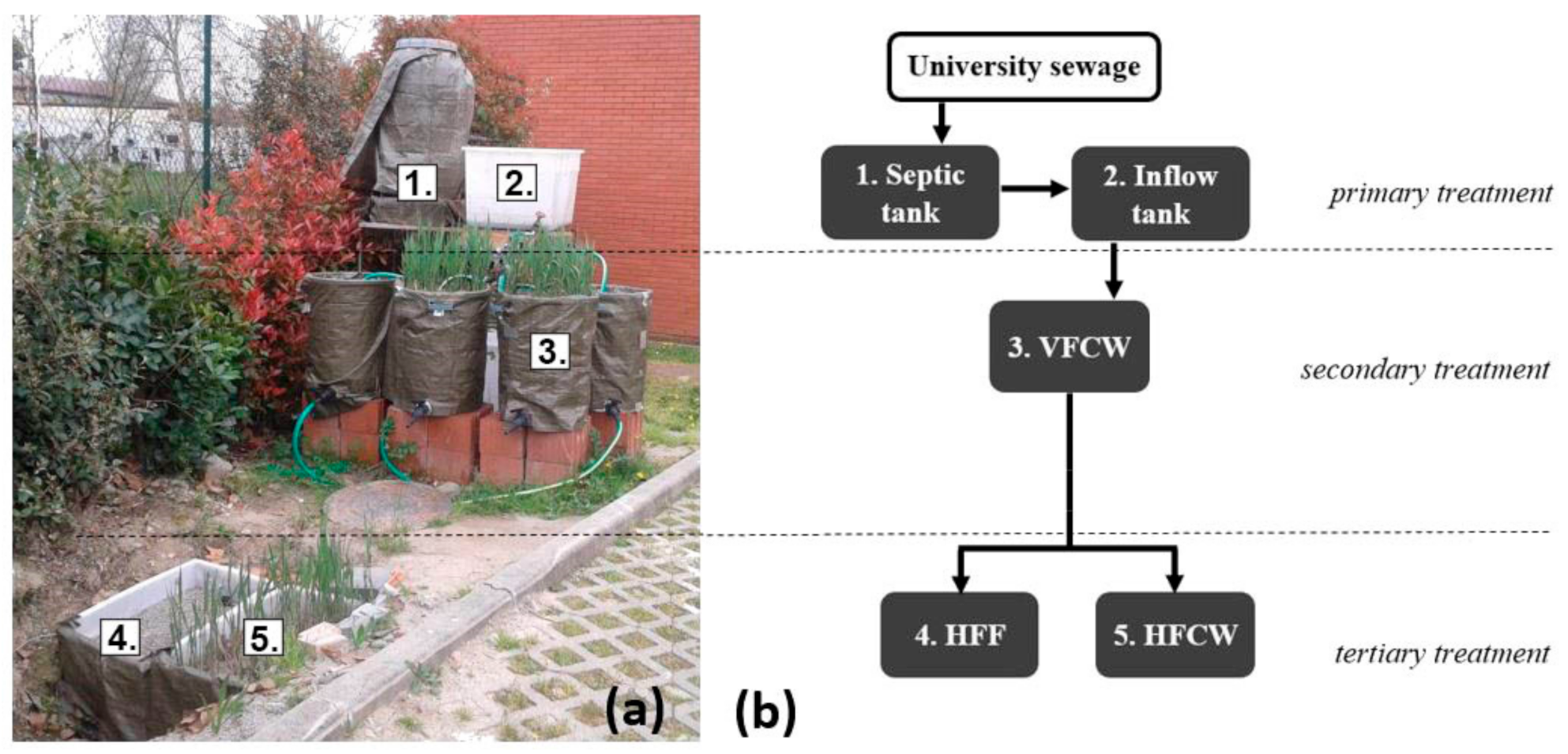
2.1. Experimental Set-Up
2.2. Wastewater Sampling and Analytical Methods
2.3. Effect of Plants on Wastewater Treatment
2.4. Public Acceptance of CWs and Wastewater Reuse
3. Results and Discussion
3.1. Treatment and Reuse Potential
3.2. Hybrid CWs for Wastewater Reuse
3.3. Effect of Plants on Wastewater Treatment
3.4. Public Acceptance of CWs and Their Effluent Reuse
4. Conclusions
Author Contributions
Funding
Conflicts of Interest
References
- Pavanelli, D.; Cavazza, C.; Lavrnić, S.; Toscano, A. The Long-Term Effects of Land Use and Climate Changes on the Hydro-Morphology of the Reno River Catchment (Northern Italy). Water 2019, 11, 1831. [Google Scholar] [CrossRef]
- Nan, X.; Lavrnić, S.; Toscano, A. Potential of Constructed Wetland Treatment Systems for Agricultural Wastewater Reuse under the EU Framework. J. Environ. Manag. 2020, 275, 111219. [Google Scholar] [CrossRef] [PubMed]
- Pap, S.; Šolević Knudsen, T.; Radonić, J.; Maletić, S.; Igić, S.M.; Turk Sekulić, M. Utilization of Fruit Processing Industry Waste as Green Activated Carbon for the Treatment of Heavy Metals and Chlorophenols Contaminated Water. J. Clean. Prod. 2017, 162, 958–972. [Google Scholar] [CrossRef]
- Vymazal, J. Horizontal Sub-Surface Flow and Hybrid Constructed Wetlands Systems for Wastewater Treatment. Ecol. Eng. 2005, 25, 478–490. [Google Scholar] [CrossRef]
- Lavrnić, S.; Alagna, V.; Iovino, M.; Anconelli, S.; Solimando, D.; Toscano, A. Hydrological and Hydraulic Behaviour of a Surface Flow Constructed Wetland Treating Agricultural Drainage Water in Northern Italy. Sci. Total Environ. 2020, 702, 134795. [Google Scholar] [CrossRef] [PubMed]
- Barbagallo, S.; Cirelli, G.L.; Marzo, A.; Milani, M.; Toscano, A. Hydraulic Behaviour and Removal Efficiencies of Two H-SSF Constructed Wetlands for Wastewater Reuse with Different Operational Life. Water Sci. Technol. J. Int. Assoc. Water Pollut. Res. 2011, 64, 1032–1039. [Google Scholar] [CrossRef] [PubMed]
- Jucherski, A.; Nastawny, M.; Walczowski, A.; Gajewska, M.; Józ, K. Assessment of the Technological Reliability of a Hybrid Constructed Wetland for Wastewater Treatment in a Mountain Eco-Tourist Farm in Poland. Water Sci. Technol. 2017, 75, 2649–2658. [Google Scholar] [CrossRef] [PubMed]
- Lavrnić, S.; Nan, X.; Blasioli, S.; Braschi, I.; Anconelli, S.; Toscano, A. Performance of a Full Scale Constructed Wetland as Ecological Practice for Agricultural Drainage Water Treatment in Northern Italy. Ecol. Eng. 2020, 154, 105927. [Google Scholar] [CrossRef]
- Gorgoglione, A.; Torretta, V. Sustainable Management and Successful Application of Constructed Wetlands: A Critical Review. Sustainability 2018, 10, 3910. [Google Scholar] [CrossRef]
- Semeraro, T.; Giannuzzi, C.; Beccarisi, L.; Aretano, R.; De Marco, A.; Pasimeni, M.R.; Zurlini, G.; Petrosillo, I. A Constructed Treatment Wetland as an Opportunity to Enhance Biodiversity and Ecosystem Services. Ecol. Eng. 2015, 82, 517–526. [Google Scholar] [CrossRef]
- Zurita, F.; White, J.R. Comparative Study of Three Two-Stage Hybrid Ecological Wastewater Treatment Systems for Producing High Nutrient, Reclaimed Water for Irrigation Reuse in Developing Countries. Water 2014, 6, 213. [Google Scholar] [CrossRef]
- Lavrnić, S.; Mancini, M.L. Can Constructed Wetlands Treat Wastewater for Reuse in Agriculture? Review of Guidelines and Examples in South Europe. Water Sci. Technol. J. Int. Assoc. Water Pollut. Res. 2016, 73, 2616–2626. [Google Scholar] [CrossRef] [PubMed]
- Milani, M.; Toscano, A. Evapotranspiration from Pilot-Scale Constructed Wetlands Planted with Phragmites Australis in a Mediterranean Environment. J. Environ. Sci. Heal. Part A Toxic Hazardous Subst. Environ. Eng. 2013, 48, 568–580. [Google Scholar] [CrossRef] [PubMed]
- Jordán-Cuebas, F.; Krogmann, U.; Asce, M.; Andrews, C.J.; Senick, J.A.; Hewitt, E.L.; Wener, R.E.; Sorensen Allacci, M.; Plotnik, D. Understanding Apartment End-Use Water Consumption in Two Green Residential Multistory Buildings. J. Water Resour. Plan. Manag. 2018, 144. [Google Scholar] [CrossRef]
- Guedes-Alonso, R.; Montesdeoca-Esponda, S.; Herrera-Melián, J.A.; Rodríguez-Rodríguez, R.; Ojeda-González, Z.; Landívar-Andrade, V.; Sosa-Ferrera, Z.; Santana-Rodríguez, J.J. Pharmaceutical and Personal Care Product Residues in a Macrophyte Pond-Constructed Wetland Treating Wastewater from a University Campus: Presence, Removal and Ecological Risk Assessment. Sci. Total Environ. 2020, 703, 135596. [Google Scholar] [CrossRef]
- Ricart, S. Risk-Yuck Factor Nexus in Reclaimed Wastewater for Irrigation: Comparing Farmers’ Attitudes and Public Perception. Water 2019, 11, 187. [Google Scholar] [CrossRef]
- Ghermandi, A.; Fichtman, E. Cultural Ecosystem Services of Multifunctional Constructed Treatment Wetlands and Waste Stabilization Ponds: Time to Enter the Mainstream? Ecol. Eng. 2015, 84, 615–623. [Google Scholar] [CrossRef]
- Rice, J.; Wutich, A.; White, D.D.; Westerhoff, P. Comparing Actual de Facto Wastewater Reuse and Its Public Acceptability: A Three City Case Study. Sustain. Cities Soc. 2016, 27, 467–474. [Google Scholar] [CrossRef]
- Schmid, S.; Bogner, F. What Germany’s University Beginners Think about Water Reuse. Water 2018, 10, 731. [Google Scholar] [CrossRef]
- Amaral, R.; Ferreira, F.; Galvão, A.; Matos, J.S. Constructed Wetlands for Combined Sewer over Fl Ow Treatment in a Mediterranean Country, Portugal. Water Sci. Technol. 2013, 67, 2739–2745. [Google Scholar] [CrossRef]
- Ciria, M.P.; Solano, M.L.; Soriano, P. Role of Macrophyte Typha Latifolia in a Constructed Wetland for Wastewater Treatment and Assessment of Its Potential as a Biomass Fuel. Biosyst. Eng. 2005, 92, 535–544. [Google Scholar] [CrossRef]
- Villalobos, R.M.; Zúñiga, J.; Salgado, E.; Cristina, M. Constructed Wetlands for Domestic Wastewater Treatment in a Mediterranean Climate Region in Chile. Electron. J. Biotechnol. 2013, 16, 1–13. [Google Scholar] [CrossRef]
- Mancini, B. Application of Sequence Based Typing (SBT) Technique to Typing Strains of Legionella spp.: Development of an Environmental Risk Map; University of Bologna: Bologna, Italy, 2017. [Google Scholar]
- Lavrnić, S.; Cristino, S.; Zapater-Pereyra, M.; Vymazal, J.; Cupido, D.; Lucchese, G.; Mancini, B.; Mancini, M.L. Effect of Earthworms and Plants on the Efficiency of Vertical Flow Systems Treating University Wastewater. Environ. Sci. Pollut. Res. 2019, 26, 10354–10362. [Google Scholar] [CrossRef] [PubMed]
- APHA. Standard Methods for the Examination of Water and Wastewater, 21st ed.; American Public Health Association: Washington, DC, USA, 2005. [Google Scholar]
- ISO. 9308-1 Water Quality—Enumeration of Escherichia Coli and Coliform Bacteria—Part 1: Membrane Filtration Method for Waters with Low Bacterial Background Flora; ISO: Geneva, Switzerland, 2014. [Google Scholar]
- ISO. 7899-2 Water Quality—Detection and Enumeration of Intestinal Enterococci—Part 2: Membrane Filtration Method; ISO: Geneva, Switzerland, 2000. [Google Scholar]
- Tchobanoglous, G.; Burton, E.C.; Stensel, H.D. Wastewater Engineering: Treatment Disposal and Reuse; Metcalf & Eddy: Bedford, MA, USA; McGraw-Hill, Inc.: Singapore, 2004. [Google Scholar]
- Ávila, C.; García, J.; Garfí, M. Influence of Hydraulic Loading Rate, Simulated Storm Events and Seasonality on the Treatment Performance of an Experimental Three-Stage Hybrid Constructed Wetland System. Ecol. Eng. 2016, 87, 324–332. [Google Scholar] [CrossRef]
- Zhai, J.; Xiao, J.; Rahaman, M.H.; John, Y.; Xiao, J. Seasonal Variation of Nutrient Removal in a Full-Scale Artificial Aerated Hybrid Constructed Wetland. Water 2016, 8, 551. [Google Scholar] [CrossRef]
- Kadlec, R.H.; Wallace, S. Treatment Wetlands, 2nd ed.; CRC Press: Boca Raton, FL, USA, 2009. [Google Scholar]
- Torrijos, V.; Gonzalo, O.G.; Trueba-Santiso, A.; Ruiz, I.; Soto, M. Effect of By-Pass and Effluent Recirculation on Nitrogen Removal in Hybrid Constructed Wetlands for Domestic and Industrial Wastewater Treatment. Water Res. 2016, 103, 92–100. [Google Scholar] [CrossRef]
- Gajewska, M.; Skrzypiec, K.; Jó, K.; Mucha, Z.; Karczmarczyk, A.; Bugajski, P. Kinetics of Pollutants Removal in Vertical and Horizontal Flow Constructed Wetlands in Temperate Climate. Sci. Total Environ. 2020, 718, 137371. [Google Scholar] [CrossRef]
- Wojciechowska, E.; Gajewska, M.; Ostojski, A. Reliability of Nitrogen Removal Processes in Multistage Treatment Wetlands Receiving High-Strength Wastewater. Ecol. Eng. 2017, 98, 365–371. [Google Scholar] [CrossRef]
- Jóźwiakowski, K.; Bugajski, P.; Kurek, K.; De Fátima, M.; De Carvalho, N.; Adelaide, M.; Almeida, A.; Siwiec, T.; Borowski, G.; Czeka, W.; et al. The Efficiency and Technological Reliability of Biogenic Compounds Removal during Long-Term Operation of a One-Stage Subsurface Horizontal Flow Constructed Wetland. Sep. Purif. Technol. 2018, 202, 216–226. [Google Scholar] [CrossRef]
- Reddy, G.B.; Raczkowski, C.W.; Cyrus, J.S.; Szogi, A. Carbon Sequestration in a Surface Fl Ow Constructed Wetland after 12 Years of Swine Wastewater Treatment. Water Sci. Technol. 2016, 73, 2501–2508. [Google Scholar] [CrossRef]
- Legislative Decree, n. 152, 03/04/2006, Gazzetta Ufficiale n. 88. Environmental Regulations. Available online: https://www.gazzettaufficiale.it/dettaglio/codici/materiaAmbientale (accessed on 12 August 2020).
- Legislative Decree, n. 185, 23/07/2003 Gazzetta Ufficiale n. 169. Italian Technical Guidelines for Wastewater Reuse. Available online: http://www.gazzettaufficiale.it/eli/id/2003/07/23/003G0210/sg (accessed on 12 August 2020).
- European Union. Regulation (EU) 2020/741 of the European Parliament and of the Council of 25 May 2020 on Minimum Requirements for Water Reuse (Text with EEA Relevance); European Union: Brussels, Belgium, 2020. [Google Scholar]
- Ávila, C.; Garfí, M.; García, J. Three-Stage Hybrid Constructed Wetland System for Wastewater Treatment and Reuse in Warm Climate Regions. Ecol. Eng. 2013, 61, 43–49. [Google Scholar] [CrossRef]
- Wu, S.; Carvalho, P.N.; Müller, J.A.; Manoj, V.R.; Dong, R. Sanitation in Constructed Wetlands: A Review on the Removal of Human Pathogens and Fecal Indicators. Sci. Total Environ. 2016, 541, 8–22. [Google Scholar] [CrossRef]
- Toscano, A.; Hellio, C.; Marzo, A.; Milani, M.; Lebret, K.; Cirelli, G.L.; Langergraber, G. Removal Efficiency of a Constructed Wetland Combined with Ultrasound and UV Devices for Wastewater Reuse in Agriculture. Environ. Technol. 2013, 34, 2327–2336. [Google Scholar] [CrossRef] [PubMed]
- Raboni, M.; Gavasci, R.; Urbini, G. UASB Followed by Sub-Surface Horizontal Flow Phytodepuration for the Treatment of the Sewage Generated by a Small Rural Community. Sustainability 2014, 6, 6998–7012. [Google Scholar] [CrossRef]
- Zapater-Pereyra, M.; Lavrnić, S.; van Dien, F.; van Bruggen, J.J.A.; Lens, P.N.L. Constructed Wetroofs: A Novel Approach for the Treatment and Reuse of Domestic Wastewater. Ecol. Eng. 2016, 94, 545–554. [Google Scholar] [CrossRef]
- Melián, J.A.H.; Rodríguez, A.J.M.; Araña, J.; Díaz, O.G.; Henríquez, J.J.G. Hybrid Constructed Wetlands for Wastewater Treatment and Reuse in the Canary Islands. Ecol. Eng. 2010, 36, 891–899. [Google Scholar] [CrossRef]
- Collison, R.S.; Grismer, M.E. Nitrogen and COD Removal from Septic Tank Wastewater in Subsurface Flow Constructed Wetlands: Plants Effects. Water Environ. Res. Res. Publ. Water Environ. Fed. 2015, 87, 1999–2007. [Google Scholar] [CrossRef]
- Carballeira, T.; Ruiz, I.; Soto, M. Effect of Plants and Surface Loading Rate on the Treatment Efficiency of Shallow Subsurface Constructed Wetlands. Ecol. Eng. 2016, 90, 203–214. [Google Scholar] [CrossRef]
- Headley, T.; Nivala, J.; Kassa, K.; Olsson, L.; Wallace, S.; Brix, H.; van Afferden, M.; Müller, R. Escherichia Coli Removal and Internal Dynamics in Subsurface Flow Ecotechnologies: Effects of Design and Plants. Ecol. Eng. 2013, 61, 564–574. [Google Scholar] [CrossRef]
- Nivala, J.; Wallace, S.; Headley, T.; Kassa, K.; Brix, H.; van Afferden, M.; Müller, R. Oxygen Transfer and Consumption in Subsurface Flow Treatment Wetlands. Ecol. Eng. 2013, 61, 544–554. [Google Scholar] [CrossRef]
- Leto, C.; Tuttolomondo, T.; La Bella, S.; Leone, R.; Licata, M. Effects of Plant Species in a Horizontal Subsurface Flow Constructed Wetland—Phytoremediation of Treated Urban Wastewater with Cyperus alternifolius, L. and Typha latifolia, L. in the West of Sicily (Italy). Ecol. Eng. 2013, 61, 282–291. [Google Scholar] [CrossRef]
- Kasprzyk, M.; Pierzgalski, K.; Wojciechowska, E.; Obarska-pempkowiak, H.; Gajewska, M. Application of Eco-Innovative Technologies of Nutrients Removal in Wastewater—Case Study BARITECH Project. Rocz. Ochr. Sr. 2017, 19, 143–160. [Google Scholar]
- Chen, Y.; Wen, Y.; Zhou, Q.; Huang, J.; Vymazal, J.; Kuschk, P. Sulfate Removal and Sulfur Transformation in Constructed Wetlands: The Roles of Filling Material and Plant Biomass. Water Res. 2016, 102, 572–581. [Google Scholar] [CrossRef] [PubMed]
- Fountoulakis, M.S.; Daskalakis, G.; Papadaki, A.; Kalogerakis, N.; Manios, T. Use of Halophytes in Pilot-Scale Horizontal Flow Constructed Wetland Treating Domestic Wastewater. Environ. Sci. Pollut. Res. 2017, 24, 16682–16689. [Google Scholar] [CrossRef]
- Tian, T.; Tam, N.F.Y.; Zan, Q.; Cheung, S.G.; Shin, P.K.S.; Wong, Y.S.; Zhang, L.; Chen, Z. Performance and Bacterial Community Structure of a 10-Years Old Constructed Mangrove Wetland. Mar. Pollut. Bull. 2017, 124, 1096–1105. [Google Scholar] [CrossRef]
- Arroyo, P.; Blanco, I.; Cortijo, R. Twelve-Year Performance of a Constructed Wetland for Municipal Wastewater Treatment: Water Quality Improvement, Metal Distribution in Wastewater, Sediments, and Vegetation. Water Air Soil Pollut. 2013, 224. [Google Scholar] [CrossRef]
- Garcia-Cuerva, L.; Berglund, E.Z.; Binder, A.R. Public Perceptions of Water Shortages, Conservation Behaviors, and Support for Water Reuse in the U.S. Resour. Conserv. Recycl. 2016, 113, 106–115. [Google Scholar] [CrossRef]
- Zhang, C.; Wen, L.; Wang, Y.; Liu, C.; Zhou, Y.; Lei, G. Can Constructed Wetlands Be Wildlife Refuges? A Review of Their Potential Biodiversity Conservation Value. Sustainability 2020, 12, 1442. [Google Scholar] [CrossRef]
- Ezeah, C.; Reyes, C.A.R.; Gutiérrez, J.F. Constructed Wetland Systems as a Methodology for the Treatment of Wastewater in Bucaramanga Industrial Park. J. Geosci. Environ. Prot. 2015, 3, 1–14. [Google Scholar] [CrossRef]
- Everard, M.; Harrington, R.; McInnes, R.J. Facilitating Implementation of Landscape-Scale Water Management: The Integrated Constructed Wetland Concept. Ecosyst. Serv. 2012, 2, 27–37. [Google Scholar] [CrossRef]

| Parameter | Influent a | VFCW Effluent b | HFF Effluent | HFCW Effluent | t Test e | |||
|---|---|---|---|---|---|---|---|---|
| - | Value | Value | RE c (%) | Value | RE d (%) | Value | RE d (%) | p Value |
| pH | 6.65 (7) | 7.18 (12) | - | 7.27 (10) | - | 6.95 (9) | - | - |
| COD (mg L−1) | 886 ± 74 (13) | 263 ± 32 (15) | 70.4 | 151 ± 29 (15) | 42.5 | 157 ± 30 (14) | 40.1 | 0.953 |
| TSS (mg L−1) | 168 ± 28 (10) | 33 ± 4 (18) | 80.4 | 9 ± 1 (18) | 73.2 | 9 ± 2 (16) | 72.7 | 0.412 |
| TN (mg L−1) | 65 ± 6 (18) | 33 ± 6 (17) | 49.3 | 13 ± 3 (17) | 59.8 | 4 ± 1 (10) | 88.8 | 0.003 |
| NO3−-N (mg L−1) | 0.85 ± 0.12 (19) | 1.16 ± 0.60 (18) | - | 5.20 ± 1.35 (18) | - | 1.16 ± 0.38 (16) | - | 0.009 |
| NO2−-N (mg L−1) | 0.03 ± 0.03 (19) | 0.04 ± 0.04 (18) | - | 2.86 ± 2.79 (18) | - | 3.39 ± 3.39 (16) | - | 0.146 |
| TP (mg L−1) | 12.32 ± 2.83 (17) | 6.50 ± 1.18 (15) | 47.3 | 2.48 ± 0.70 (17) | 61.8 | 0.75 ± 0.19 (14) | 88.5 | 0.008 |
| PO43−-P (mg L−1) | 7.63 ± 1.43 (17) | 4.93 ± 0.83 (15) | 34.2 | 2.03 ± 0.13 (18) | 58.9 | 0.24 ± 0.11 (13) | 95.1 | <0.001 |
| Cl− (mg L−1) | 78 ± 5 (19) | 77 ± 7 (18) | 0 | 74 ± 7 (18) | 5 | 70 ± 15 (15) | 9.7 | 0.396 |
| Br− (mg L−1) | 2.56 ± 0.35 (19) | 1.72 ± 0.26 (18) | 33 | 1.87 ± 0.24 (18) | - | 1.93 ± 0.24 (16) | - | 0.373 |
| SO42− (mg L−1) | 69 ± 5 (19) | 66 ± 9 (18) | 3.5 | 75 ± 8 (18) | - | 59 ± 19 (15) | 10.2 | 0.031 |
| E. coli (log10 CFU 100 mL−1) | 5.69 ± 5.02 (10) | 5.09 ± 4.56 (10) | 74.7 | 3.25 ± 3.03 (14) | 98.5 | 2.54 ± 2.23 (13) | 99.7 | 0.133 |
| Total coliforms (log10 CFU 100 mL−1) | 5.85 ± 5.81 (4) | 4.81 ± 4.40 (10) | 90.7 | 3.84 ± 3.63 (11) | 89.3 | 3.63 ± 3.46 (10) | 93.5 | 0.081 |
| Enterococcus (log10 CFU 100 mL−1) | 5.51 ± 4.59 (10) | 5.21 ± 4.76 (10) | 50.1 | 2.92 ± 2.49 (14) | 99.5 | 2.06 ± 1.90 (13) | 99.9 | 0.015 |
| Parameter | VFCW | HFF | HFCW | Italy Discharge Regulation [37] | Italy Reuse Regulation a [38] | EU Regulation for Water Reuse b [39] | ||||
|---|---|---|---|---|---|---|---|---|---|---|
| - | Mean Value | Mean Value | Mean Value | Natural Water Bodies | General | Irrigational | Type A | Type B | Type C | Type D |
| COD (mg L−1) | 263 | 151 | 157 | 160 | 100 | 100 | - | - | - | - |
| TSS (mg L−1) | 33 | 9 | 9 | 80 | 10 | 10 | 10 | 35 | 35 | 35 |
| TN (mg L−1) | 33 | 13 | 4 | - | 15 | 35 | - | - | - | - |
| TP (mg L−1) | 7 | 2.48 | 0.75 | 10 | 2 | 10 | - | - | - | - |
| E. coli (CFU 100 mL−1) | 123,400 | 1790 | 350 | 5000 c | 50 | 100 | 10 | 100 | 1000 | 10,000 |
| Do you know: | yes | no | |||
| 61% | 39% | |||
| 34% | 66% | |||
| On a scale from 1 to 5 *, how much do you agree with: | 1 | 2 | 3 | 4 | 5 |
| 1% | 5% | 7% | 28% | 59% |
| 1% | 1% | 14% | 20% | 63% |
| 1% | 5% | 8% | 16% | 70% |
| 1% | 3% | 8% | 12% | 76% |
Publisher’s Note: MDPI stays neutral with regard to jurisdictional claims in published maps and institutional affiliations. |
© 2020 by the authors. Licensee MDPI, Basel, Switzerland. This article is an open access article distributed under the terms and conditions of the Creative Commons Attribution (CC BY) license (http://creativecommons.org/licenses/by/4.0/).
Share and Cite
Lavrnić, S.; Zapater Pereyra, M.; Cristino, S.; Cupido, D.; Lucchese, G.; Pascale, M.R.; Toscano, A.; Mancini, M. The Potential Role of Hybrid Constructed Wetlands Treating University Wastewater—Experience from Northern Italy. Sustainability 2020, 12, 10604. https://doi.org/10.3390/su122410604
Lavrnić S, Zapater Pereyra M, Cristino S, Cupido D, Lucchese G, Pascale MR, Toscano A, Mancini M. The Potential Role of Hybrid Constructed Wetlands Treating University Wastewater—Experience from Northern Italy. Sustainability. 2020; 12(24):10604. https://doi.org/10.3390/su122410604
Chicago/Turabian StyleLavrnić, Stevo, Maribel Zapater Pereyra, Sandra Cristino, Domenico Cupido, Giovanni Lucchese, Maria Rosaria Pascale, Attilio Toscano, and Maurizio Mancini. 2020. "The Potential Role of Hybrid Constructed Wetlands Treating University Wastewater—Experience from Northern Italy" Sustainability 12, no. 24: 10604. https://doi.org/10.3390/su122410604
APA StyleLavrnić, S., Zapater Pereyra, M., Cristino, S., Cupido, D., Lucchese, G., Pascale, M. R., Toscano, A., & Mancini, M. (2020). The Potential Role of Hybrid Constructed Wetlands Treating University Wastewater—Experience from Northern Italy. Sustainability, 12(24), 10604. https://doi.org/10.3390/su122410604

