

A Prospective Study for the Mitigation of the Climate Change Effects: The Case of the North Aegean Region of Greece

 ,
,  , and
, and
Abstract
1. Introduction
2. Background of the Study and Theoretical Framework
2.1. Geographic Region of the Plan
2.2. Legislative Framework and the Nature of the Plan
2.3. Introduction to Structural Analysis
- Stage 1: Establishment of the variables inventory.
- Stage 2: Specification of the variables relations.
- Stage 3: Recognition of the key variables.
- It allows the recognition of the critical variables that need to be considered for the system under study.
- It enables the experts’ judgement to be taken into account within the process of planning.
- It encourages a profound analysis among the variables of the system.
- It permits the comparability and the structure of several variables in order of importance.
- It enables indirect classifications so as to bring to light the importance of several variables that, at first, and through direct classification, were not obvious.
3. Prospective Studies vs. Climate Change: A Study via the Structural Analysis Method
3.1. Stage 1: Establishment of the Variables Inventory
3.2. Stage 2: Specification of the Variables Relations
3.3. Stage 3: Recognition of the Key Variables
- Phase 1. Expert consulting.
- Phase 2. Discover the direct relations between the variables of the study.
- Phase 3. Fill the matrix with “0” and “1”.
- Phase 4. Categorize the variables in terms of influence and dependence.
- Phase 5. Diagrammatically represent the matrix of direct interlinks.
- Phase 6. Elevate the matrix to the square so as to identify the indirect relations of second order.
- Phase 7. Categorize the variables concerning the indirect influence and dependence.
- Phase 8. Compare the hierarchical organization of each variable between the matrix of direct and indirect relations of second order.
- Phase 9. Is the hierarchical organization of variables equal?
- Phase 10. If the categorization of variables remains untouched, then the stabilization of the matrix has been achieved. If not, it is necessary to continue elevating the matrix to successive powers until the ranking of each variable, concerning the rates of influence and dependence between power n and power n − 1, is equal.
3.4. Verification of the Interlinks among the Vulnerable Sectors of the North Aegean Region
4. Results
5. Discussion
6. Conclusions
Author Contributions
Funding
Acknowledgments
Conflicts of Interest
References
- Jamison, A. The technological character of the city: Modernity and Urban Life in Europe. In Greening the City: Urban. Environmentalism from Mumford to Malmö; Mikael, H., Thomas, M., Eds.; University Studio Press: Athens, Greece, 2008. [Google Scholar]
- Beriatos, E. Environment: The main goal of spatial planning. In Proceedings of the International Two-day Conference: Medium Cities and Environmental Planning, Volos, Greece, 16–18 May 2008. [Google Scholar]
- Bakogiannis, E.; Kyriakidis, C.; Siti, M.; Eleftheriou, V.; Siolas, A. Urban planning VS environment: Re conciliating the conflicts. In Proceedings of the 4th Pan-Hellenic Conference in Rural and Surveying Engineering, Thessaloniki, Greece, 26–28 September 2014. [Google Scholar]
- Delgado Ramos, G.C. Climate Change-Sensitive Cities: Building Capacities for Urban Resilience, Sustainability, and Equity; National Autonomous University of Mexico Research Program on Climate Change: Mexico City, Mexico, 2017. [Google Scholar]
- Chatziioannou, I.; Alvarez-Icaza, L.; Bakogiannis, E.; Kyriakidis, C.; Chias-Becerril, L. A CLIOS Analysis for the Promotion of Sustainable Plans of Mobility: The Case of Mexico City. Appl. Sci. 2020, 10, 4556. [Google Scholar] [CrossRef]
- Aravantinos, I. Urban. Planning: For a Sustainable Development of the Urban Space; Symmetria Publications: Athens, Greece, 2007. [Google Scholar]
- Lefebvre, H. La Revolucion Urbana; Alianza Editorial: Madrid, Spain, 1983. [Google Scholar]
- Binde, J. Tomorrow the cities. In Cities and Environment in the 21st Century. A Future-Oriented Composition after Habitat II; Lefas, P., Ed.; Plethron Publications: Athens, Greece, 2003. [Google Scholar]
- UNDP. Human Development Report; United Nations Development Programme: New York, NY, USA, 2011. [Google Scholar]
- UN-Habitat. Estado de las ciudades de America Latina y el Caribe. In Programa de las Naciones Unidas para los Asentamientos Humanos; ONUHabitat: Rio de Janeiro, Brazil, 2012. [Google Scholar]
- UN. Las Naciones Unidas y la Asistencia Humanitaria. Organizacion de las Naciones Unidas. Available online: www.un.org/es/humanitarian/overview (accessed on 4 May 2017).
- Bakogiannis, E.; Kyriakidis, C.; Siti, M.; Milioni, T.; Potsiou, C. Increasing urban resilience of Athens’ Historic Center. In Proceedings of the FIG Working Week, Helsinki, Finland, 29 May–2 June 2017. [Google Scholar]
- Evans, M. Resilient City-Definition and Urban Design Principles: Building Cities to be more Resilient to Physical, Social and Economic Challenges. Available online: https://www.thebalance.com/resilient-city-definition-and-urban-design-principles-3157826 (accessed on 17 September 2020).
- Lucatello, S. Tendencias de la Política Medioambiental en la Union Europea y America del Norte: ¿Integracion o Cooperacion? In Cooperacion Internacional Para el Medio Ambiente (CIPMA): Tendencias Actuales y Desafios; Chanona Burguete, A., Sosa Nuñez, G.S., Eds.; FCPySPINCC-UNAM: Mexico City, Mexico, 2014. [Google Scholar]
- Progiou, A.; Dimitrakopoulos, D.; Karalis, K.P.; Doptidis, G.; Evaggelidou, E.; Dimitrakopoulou, S. Περιφερειακό Σχέδιο για την Προσαρμογή στην Κλιματική Aλλαγή (ΠεΣΠΚA) Βορείου Aιγαίου, Στρατηγική Μελέτη Περιβαλλοντικών Επιπτώσεων. Ειδική Υπηρεσία Διαχείρισης Ε.Π. Περιφέρειας Βορείου Aιγαίου. Available online: https://www.pvaigaiou.gov.gr/dyn/userfiles/files/pdf-diavouleysh/PESPKA_BOREIO_AIGAIO.pdf (accessed on 12 May 2020).
- Pavlis, E. North Aegean island landscapes as ecomuseums: The case of Lesvos Island. Isl. Stud. J. 2017, 12, 135–150. [Google Scholar] [CrossRef]
- Bouloutza, P. Greece’s Population Shrinking, Aging. Available online: https://www.ekathimerini.com/233090/article/ekathimerini/news/greeces-population-shrinking-aging#:~:text=A%20bleak%20future%20lies%20ahead,800%2C000%20and%202.5%20million%20people. (accessed on 28 November 2020).
- United States Environmental Protection Agency. Climate Change and the Health of Older Adults. Available online: https://cerch.berkeley.edu/sites/default/files/climate_change_and_the_health_of_older_adults.pdf (accessed on 29 November 2020).
- UNFCCC. United Nations Framework Convention on Climate Change; FCCC/INFORMAL/84 GE.05-62220 (E) 200705; United Nations: New York, NY, USA, 1992. [Google Scholar]
- Ballesteros Riveros, D.P.; Ballesteros Silva, P.P. Análisis estructural prospectivo aplicado al sistema logístico. Sci. Tech. Año Xiv 2008, 39, 194–199. [Google Scholar]
- Wanty, J.; Federwish, J. Modeles Globaux D’economie D’entreprise; Dunod: Paris, France, 1969. [Google Scholar]
- Arcade, J.; Godet, M.; Roubekat, F. Structural Analysis with the Micmac Method & Actors’ strategy with Mactor Method; IIEP/UNESCO Publishing: Paris, France, 1993. [Google Scholar]
- Kane, J. A primer for a new cross impact language-KSIM. Technol. Forecast. Soc. Chang. 1972, 4, 129–142. [Google Scholar] [CrossRef]
- Roberts, F. Signed digraphs and the growing energy demand. Environ. Plan. A 1971, 3, 395–410. [Google Scholar] [CrossRef]
- Duperrin, J.C.; Godet, M. Méthode de Hiérarchisation des Éléments d’un Système: Essai de Prospective du Système de L’énergie Nucléaire Dans son Contexte Societal; Commissariat à l’énergie Atomique: Paris, France, 1973. [Google Scholar]
- Sharma, H.; Gupta, A.; Sushil. The objectives of waste management in India: A futures inquiry. Technol. Forecast. Soc. Chang. 1995, 48, 285–309. [Google Scholar] [CrossRef]
- Arya, D.S.; Abbasi, S.A. Identification and classification of key variables and their role in environmental impact assessment: Methodology and software package intra. Environ. Monit. Assess. 2001, 72, 277–296. [Google Scholar] [CrossRef]
- Kanungo, S.; Duda, S.; Srinivas, Y. A structured model for evaluating information systems effectiveness. Syst. Res. Behav. Sci. 1999, 16, 495–518. [Google Scholar] [CrossRef]
- Kim, J.H.; Barnett, G.A. A structural analysis of international conflict: From a communication perspective. Int. Interact. 2007, 33, 135–165. [Google Scholar] [CrossRef]
- Qureshi, M.N.; Dinesh Kumar, P.K. An integrated model to identify and classify the key criteria and their role in the assessment of 3pl services providers. Asia Pac. J. Mark. Logist. 2008, 20, 227–249. [Google Scholar] [CrossRef]
- Chatziioannou, I.; Alvarez-Icaza, L. A structural analysis method for the management of urban transportation infrastructure and its urban surroundings. Cogent Eng. 2017, 4, 1326548. [Google Scholar] [CrossRef]
- Chatziioannou, I.; Alvarez-Icaza, L.; Bakogiannis, E. A structural analysis method for the promotion of Mexico City’s integral plan of mobility. Cogent Eng. 2020, 7, 1759395. [Google Scholar] [CrossRef]
- Chatziioannou, I.; Alvarez-Icaza, L.; Bakogiannis, E.; Kyriakidis, C.; Chias-Becerril, L. A Structural Analysis for the Categorization of the Negative Externalities of Transport and the Hierarchical Organization of Sustainable Mobility’s Strategies. Sustainability 2020, 12, 6011. [Google Scholar] [CrossRef]
- Chatziioannou, I.; Alvarez-Icaza, L. Evaluation of the urban transportation infrastructure and its urban surroundings in the Iztapalapa County: A geotechnology approach about its management. Cogent Eng. 2017, 4, 1330854. [Google Scholar] [CrossRef]
- Khan, U.; Haleem, A. Smart organisations: Modelling of enablers using an integrated ISM and fuzzy-MICMAC approach. Int. J. Intell. Enterp. 2012, 1, 248–269. [Google Scholar] [CrossRef]
- Romero Perea, A. Metodología Para la Jerarquización de Políticas de Transporte Urbano de Pasajeros Que Minimicen las Externalidades Negativas. Master’s Thesis, Universidad Nacional Autónoma de México, Mexico City, Mexico, 2012. [Google Scholar]
- Colodni, L. Construcción de la Base de Escenarios del Modelo MEDEE-S, Aplicación al Transporte de Caracas; Universidad Simón Bolivar: Venezuela, Caracas, 1987. [Google Scholar]
- Bernacsek, G. Environmental Issues, Capacity and Information Base for Management of Fisheries Affected by Dams. Available online: http://www.fao.org/3/Y2785E/y2785e05.htm (accessed on 29 November 2020).
- Union of Concerned Scientists. Our Energy Choices: Energy and Water Use. Available online: https://www.ucsusa.org/resources/energy-and-water-use (accessed on 1 December 2020).
- Nunez, C. Sea Level Rise, Explained. Available online: https://www.nationalgeographic.com/environment/global-warming/sea-level-rise/#:~:text=Consequences&text=When%20sea%20levels%20rise%20as,fish%2C%20birds%2C%20and%20plants (accessed on 28 November 2020).
- López-Dóriga, U.; Jiménez, J.A.; Valdemoro, H.I.; Nicholls, R.J. Impact of sea-level rise on the tourist-carrying capacity of Catalan beaches. Ocean. Coast. Manag. 2019, 170, 40–50. [Google Scholar] [CrossRef]
- Nidhinarangkoon, P.; Ritphring, S.; Udo, K. Impact of sea level rise on tourism carrying capacity in Thailand. J. Mar. Sci. Eng. 2020, 8, 104. [Google Scholar] [CrossRef]
- Agnew, M.D.; Viner, D. Potential Impacts of Climate Change on International Tourism. Tour. Hosp. Res. 2001, 3, 37–60. [Google Scholar] [CrossRef]
- Baran, E.; Starr, P.; Kura, Y. Influence of Built Structures on Tonle Sap Fisheries; Cambodia National Mekong Committee and the WorldFish Center: Phnom Penh, Cambodia, 2007. [Google Scholar]
- World Tourism Organization. Tourism and Biodiversity. Achieving Common Goals towards Sustainability; World Tourism Organization: Madrid, Spain, 2010. [Google Scholar]
- Lusk, S.; Hartvich, P.; Halacka, K.; Luskova, V.; Holub, M. Impact of extreme floods on fishes in rivers and their floodplains. Ecohydrol. Hydrobiol. 2003, 4, 173–181. [Google Scholar]
- Carlson, A.K.; Fincel, M.J.; Longhenry, C.M.; Graeb, B.D.S. Effects of historic flooding on fishes and aquatic habitats in a Missouri River delta. J. Freshw. Ecol. 2016, 31, 271–288. [Google Scholar] [CrossRef]
- Chukwu Okeah, G.O.; Wekpe, V.E.; Ikebude, C.F. Impact of Coastal Flooding on Fish Production in Brass, Niger Delta Nigeria, Implication for Coastal Resource Management. Oceanogr. Fish. 2018, 6, 555678. [Google Scholar]
- Geertsema, M.; Highland, L.; Vaugeouis, L. Environmental Impact of Landslides. In Landslides—Disaster Risk Reduction; Sassa, K., Canuti, P., Eds.; Springer: Berlin, Germany, 2009. [Google Scholar]
- Dudley, N.; Alexander, S. Agriculture and biodiversity: A review. Biodiversity 2017, 18, 45–49. [Google Scholar] [CrossRef]
- Banerjee, L. Effects of Flood on Agricultural Productivity in Bangladesh. Oxf. Dev. Stud. 2010, 38, 339–356. [Google Scholar] [CrossRef]
- O’Connell, P.E.; Ewen, J.; O’Donnell, G.; Quinn, P. Is there a link between agricultural land-use management and flooding? Hydrol. Earth Syst. Sci. 2007, 11, 96–107. [Google Scholar] [CrossRef]
- Vourdoubas, J. The Nexus between Agriculture and Tourism in the Island of Crete, Greece. J. Agric. Stud. 2020, 8, 393. [Google Scholar] [CrossRef]
- Karampela, S.; Kizos, T. Agritourism and local development: Evidence from two case studies in Greece. Int. J. Tour. Res. 2018, 20, 566–577. [Google Scholar] [CrossRef]
- Zagaria, C.; Schulp, C.J.E.; Kizos, T.; Verburg, P. Perspectives of farmers and tourists on agricultural abandonment in east Lesvos, Greece. Reg. Env. Chang. 2018, 18, 1467–1479. [Google Scholar] [CrossRef]
- Guliz Ugur, N.; Akbiyik, A. Impacts of COVID-19 on global tourism industry: A cross-regional comparison. Tour. Manag. Perspect. 2020, 36, 100744. [Google Scholar] [CrossRef]
- Hall, C.M.; Baird, T.; James, M.; Ram, Y. Climate change and cultural heritage: Conservation and heritage tourism in the Anthropocene. J. Herit. Tour. 2016, 11, 10–24. [Google Scholar] [CrossRef]
- Deschaux, J. Flood-related Impacts on Cultural Heritage. Floods 2017, 1, 53–72. [Google Scholar]
- Canuti, P.; Margottini, C.; Fanti, R.; Bromhead, E.N. Cultural Heritage and Landslides: Research for Risk Prevention and Conservation. In Landslides—Disaster Risk Reduction; Sassa, K., Canuti, P., Eds.; Springer: Berlin, Germany, 2009. [Google Scholar]
- Gluvačević, D. The Power of Cultural Heritage in Tourism—Example of the City of Zadar (Croatia). Int. J. Sci. Manag. Tour. 2016, 2, 3–24. [Google Scholar]
- Litman, T. Evaluating Transportation Land Use Impacts. Available online: https://www.researchgate.net/publication/255632796_Evaluating_Transportation_Land_Use_Impacts (accessed on 30 November 2020).
- Blumstein, D.; Geffroy, B.; Samia, D.; Bessa, E. Ecotourism’s Promise and Peril; Springer: Cham, Switzerland, 2017. [Google Scholar]
- Specht, J. Tourism and the Built Environment. In Architectural Tourism; Springer Gabler: Wiesbaden, Germany, 2014. [Google Scholar]
- Liu, G.; Liu, Z.; Hu, H.; Wu, G.; Limin, D. The impact of tourism on agriculture in Lugu Lake region. Int. J. Sustain. Dev. World Ecol. 2008, 15, 3–9. [Google Scholar] [CrossRef]
- Gariano, S.L.; Guzzetti, F. Landslides in a changing climate. Earth Sci. Rev. 2016, 162, 227–252. [Google Scholar] [CrossRef]
- Kleinen, T.; Petschel-Held, G. Integrated assessment of changes in flooding probabilities due to climate change. Clim. Chang. 2007, 81, 283–312. [Google Scholar] [CrossRef]
- Younger, M.; Morrow-Almeida, H.R.; Vindigni, S.M.; Dannenberg, A.L. The Built Environment, Climate Change, and Health Opportunities for Co-Benefits. Am. J. Prev. Med. 2008, 35, 517–526. [Google Scholar] [CrossRef]
- Mimura, N. Sea-level rise caused by climate change and its implications for society. Proc. Jpn. Acad. Ser. B Phys. Biol. Sci. 2013, 89, 281–301. [Google Scholar] [CrossRef]
- Muller, M. Adapting to climate change: Water management for urban resilience. Environ. Urban 2007, 19, 99–113. [Google Scholar] [CrossRef]
- Carroll, P.; Aarrevaara, E. Review of Potential Risk Factors of Cultural Heritage Sites and Initial Modelling for Adaptation to Climate Change. Geosciences 2018, 8, 322. [Google Scholar]
- European Environment Agency. Energy and Climate Change. Available online: https://www.eea.europa.eu/signals/signals-2017/articles/energy-and-climate-change (accessed on 30 October 2020).
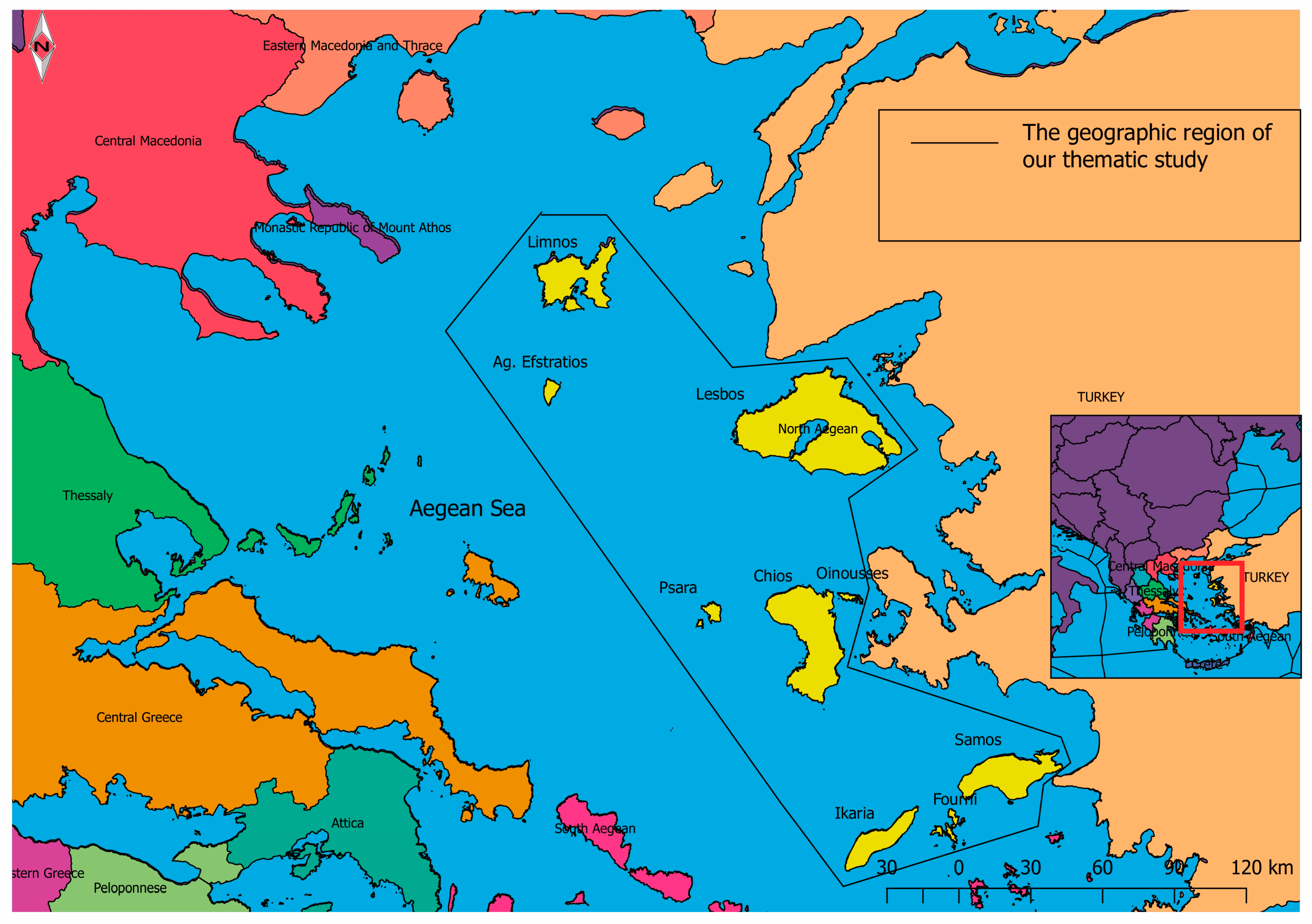
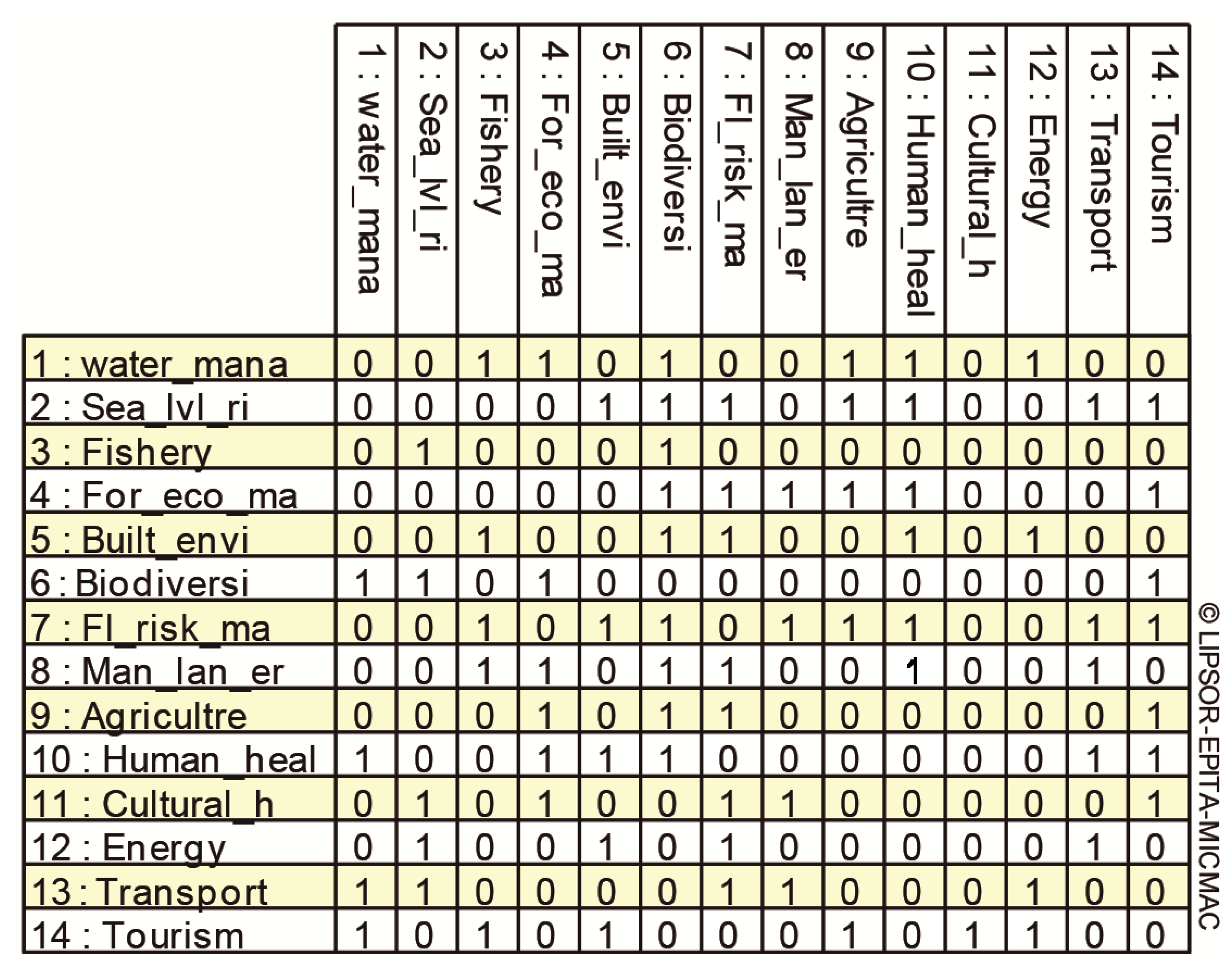
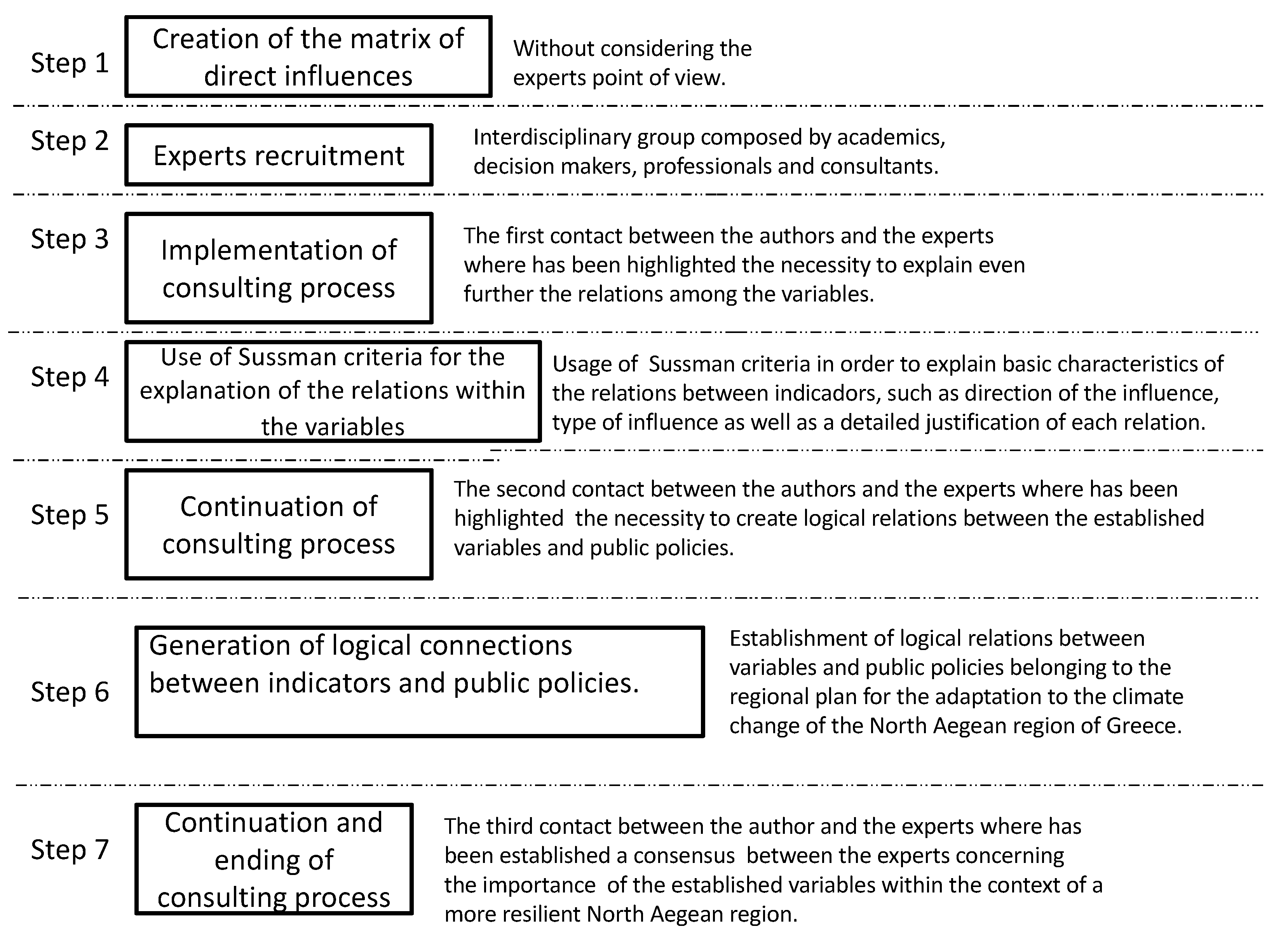
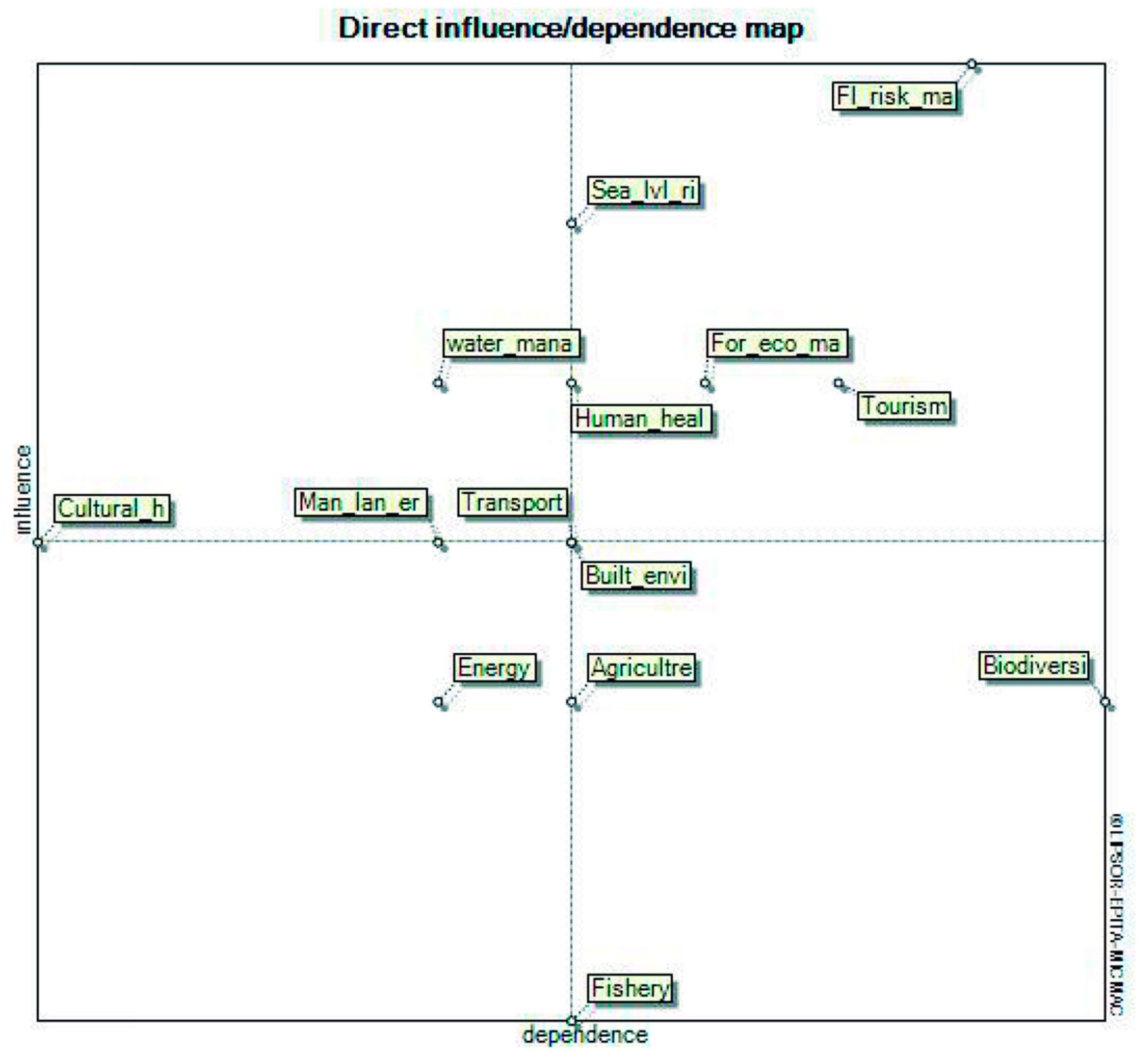
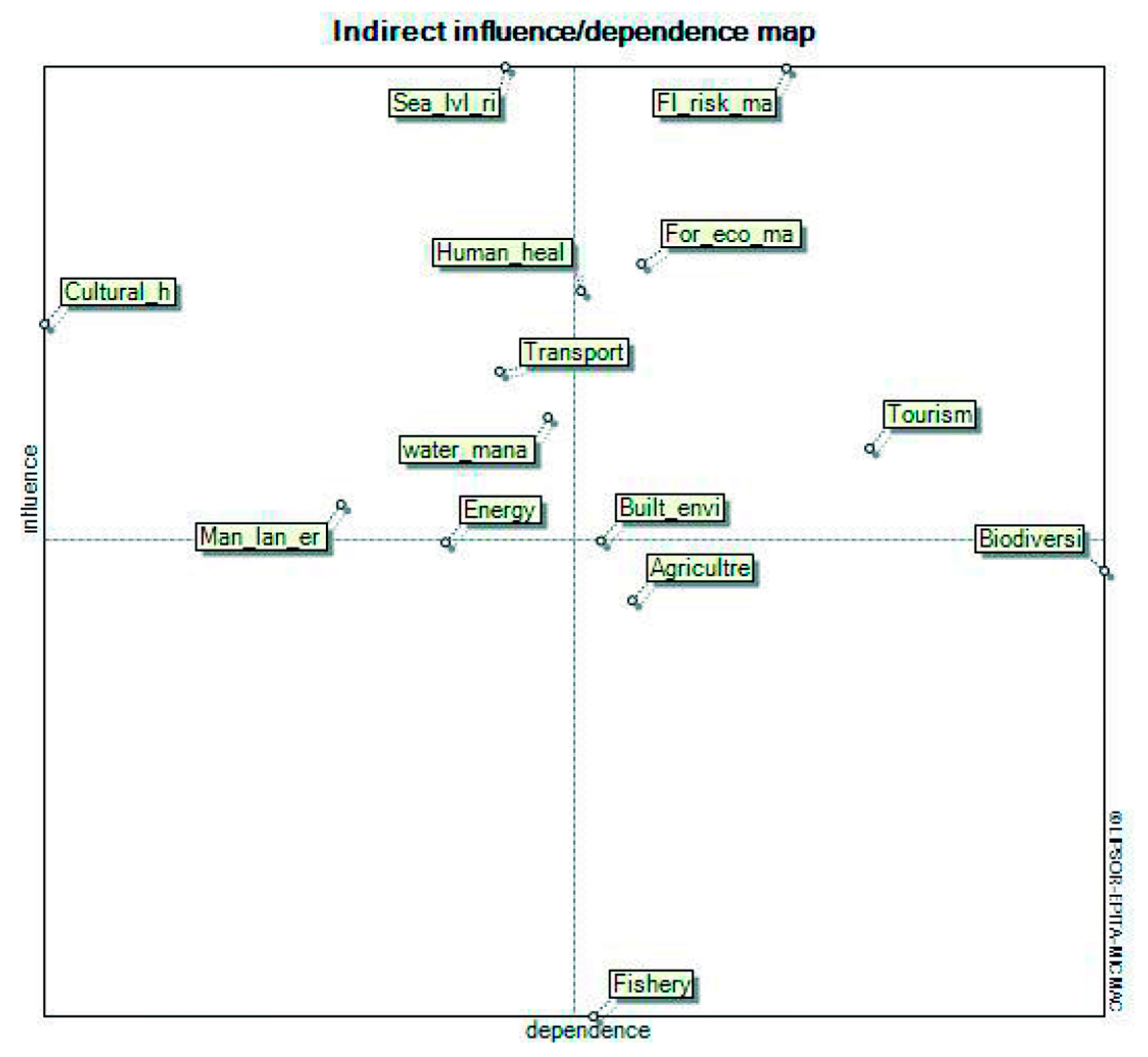

| ID | Nomenclature of the Plan’s Critical Sectors against Climate Change | Symbolization of the Established Critical Sectors for the Mitigation of Climate Change within the Software MICMAC |
|---|---|---|
| 1 | Water management | Water_mana |
| 2 | Sea-level rise | Sea_lvl_ri |
| 3 | Fishery | Fishery |
| 4 | Forest ecosystem management | For_eco_ma |
| 5 | Built environment | Built_envi |
| 6 | Biodiversity | Biodiversi |
| 7 | Flood risk management | Fl_risk_ma |
| 8 | Management of landslides and erosions | Man_lan_er |
| 9 | Agriculture | Agricultre |
| 10 | Human health | Human_heal |
| 11 | Cultural heritage | Cultural_h |
| 12 | Energy | Energy |
| 13 | Transport | Transport |
| 14 | Tourism | Tourism |
| ID | Area of Expertise/ Profession of Experts | General View of the Theme in Analysis |
|---|---|---|
| Expert 1 | Geographer | Highlight the way the urban space and built environment has to be shaped in order to create solutions to the climate deregulation crisis. |
| Expert 2 | Urban Planner | |
| Expert 3 | Civil Engineer | Recognition of the risk that climate change represents for the development of infrastructure systems and how the latter, via adequate measurements, can be more resilient. |
| Expert 4 | Transport Engineer | |
| Expert 5 | Environmentalist-Mechanical Engineer | Identification of the environmental footprints of the climate change within the NAR. Proposals for the reduction of climate crisis. |
| Expert 6 | Energy Consumption Expert | |
| Expert 7 | Physicist | |
| Expert 8 | Mechanical and Electrical Engineer | Evaluate efficient ways for the development of smart grids for managing electricity demand and the promotion of sustainable forms of energy. |
| Expert 9 | Mining Engineer | Assess the risks of climate change upon the region’s mineral resources. |
| Expert 10 | Policy-maker within Government Agencies | Identify relations between the region’s vulnerable groups and strategies/public policies and lines of action. |
| Expert 11 | Policy-maker within Government Agencies | |
| Expert 12 | Hydro-geologist | Analysis of climate change impacts on the water resources and landslides of the region. |
| Expert 13 | Tourism Expert | Identification of the influence that the tourism-cultural heritage sectors exert upon the other sectors of the NAR. |
| Expert 14 | Biologist | Analysis of climate change impacts on biodiversity, fishery and human health. |
| ID | Established Vulnerable Sector | Directly Related Vulnerable Sectors |
|---|---|---|
| 1 | Water management | Fishery, forest ecosystem management, biodiversity, agriculture, human health, energy [15,38,39] |
| 2 | Sea-level rise | Built environment, biodiversity, flood risk management, agriculture, human health, transport, tourism [40,41,42] |
| 3 | Fishery | Sea-level rise, biodiversity [15] |
| 4 | Forest ecosystem management | Biodiversity, flood risk management, management of landslides and erosions, agriculture, human health, tourism [15,43] |
| 5 | Built environment | Fishery, biodiversity, flood risk management, human health, energy [15,44] |
| 6 | Biodiversity | Water management, sea-level rise, forest ecosystem management, flood risk management, tourism [15,45] |
| 7 | Flood risk management | Fishery, built environment, biodiversity, management of landslides and erosions, human health, agriculture, transport, tourism [15,43,46,47,48] |
| 8 | Management of landslides and erosions | Fishery, forest ecosystem management, biodiversity, flood risk management, human health [15,49] |
| 9 | Agriculture | Forest ecosystem management, biodiversity, flood risk management, tourism [15,50,51,52,53,54,55] |
| 10 | Human health | Forest ecosystem management, built environment, biodiversity, transport, tourism [15,56] |
| 11 | Cultural heritage | Sea-level rise, forest ecosystem management, flood risk management, management of landslides and erosions, tourism [15,57,58,59,60] |
| 12 | Energy | Sea-level rise, Built environment, Flood risk management, Transport [15] |
| 13 | Transport | Water management, sea-level rise, flood risk management, management of landslides and erosions, energy [15,61] |
| 14 | Tourism | Water management, fishery, built environment, agriculture, cultural heritage, energy [15,62,63,64] |
| ID | Established Variables for the Present Thematic Study | Sector | Identified Measures and Lines of Action as They Result from the Regional Plan Oriented towards the Mitigation of Climate Change within the North Aegean Region |
|---|---|---|---|
| 1 | Flood Risk Management | 2 | Preparation of strategic master plans for flood protection projects. |
| Integration in security plans of impacts and protection measures from leakage of pollutants after a flood based on hazard maps. | |||
| Replacement and completion of existing rainwater drainage networks. | |||
| Measures for maintenance and cleaning of infrastructures and watercourses. | |||
| Flood protection project studies. | |||
| Construction of Tsiknia dam. | |||
| Measures to mitigate the intensity of corrosion and detachment and transport of materials. | |||
| 2 | Forest Ecosystem Management | 2 | Financing of private/municipal forest management studies. |
| Study for the creation of a fire fighting network in Chios. | |||
| Reduction in pressures on vulnerable ecosystems. | |||
| Support for the prevention of forest damage from forest fires, natural disasters and catastrophic events. | |||
| Support to prevent damage to forests from insect outbreaks. | |||
| 3 | Human Health | 2 | Protection against mosquito-borne diseases. |
| Training of health professionals in disaster management for social organization and emergency management due to sudden disasters. | |||
| 4 | Tourism | 2 | Actions oriented to the extension of the tourist season through the development of alternative forms of tourism. |
| Actions related to the extension of the tourist season, with emphasis on the modernization of existing businesses. | |||
| Subsidizing tourism enterprises for their adaptation to climate change. | |||
| 5 | Built Environment | 2 | Enhancement of urban green and use of bioclimatic materials. |
| Upgrade/create a mechanism for assessing damage and compensations in buildings due to flood events. |
| ID | Established Variables for the Present Thematic Study | Sector | Identified Measures and Lines of Action as they Result from the Regional Plan Oriented towards the Mitigation of Climate Change within the North Aegean Region |
|---|---|---|---|
| 6 | Rise in Sea Level | 1 | Coastal vulnerability study: monitoring, recording and dealing with coastal erosion, coastal floods and sea level rise. |
| Generation of Actology (mathematical simulation of coastal floods and flood estimation of areas, measurements of sea level, sea currents and other environmental factors (temperature, salinity) of the coasts of the North Aegean Region). | |||
| Study for the implementation of a windward mole in Kambi Fournon. | |||
| Study for the extension of the windward mole in Aghios Kyrikas of Ikaria. | |||
| 7 | Cultural Heritage | 1 | Risk investigation/elaboration of studies for the outdoor exhibits of fossil forests. |
| Study on the phenomenon of disintegration in the area of Osia Moni Theoktisti in Ikaria. | |||
| 8 | Transport | 1 | Actions to strengthen the safety of the North Aegean Region’s road network. |
| Lighting installation to enhance the safety of the road network. | |||
| Protection works oriented to the corrosion of the coastal provincial road in the area Aghios Georgios Thermis of Lesbos. | |||
| 9 | Water Management | 1 | Actions oriented to the improvement of the efficiency of water use in ground infrastructure. |
| Enhancement of environmental inspections and controls. | |||
| Maintenance study—repair of Thanous Limnos reservoir and irrigation network. | |||
| Irrigation project study: The case of Karlovasi. | |||
| Studies for the construction of dams and irrigation and water supply networks in several islands of the North Aegean Region. | |||
| Study for the efficient utilization of water resources within the Municipality of Samos. | |||
| 10 | Energy | 1 | Development of smart grids for managing electricity demand. |
| Vulnerability assessment of the proposed renewable energy installation sites. | |||
| 11 | Management of Landslides and erosions | 1 | Reforestation study. |
| Measures to mitigate the intensity of corrosion and detachment and transport of materials. |
| ID | Established Variables for the Present Thematic Study | Sector | Identified Measures and Lines of Action as They Result from the Regional Plan Oriented towards the Mitigation of Climate Change within the North Aegean Region |
|---|---|---|---|
| 12 | Biodiversity | 3 | Activities oriented to the removal of materials and removal of illegal buildings close to wetlands. |
| Reducing pressures on vulnerable ecosystems due to overgrazing. | |||
| 13 | Agriculture | 3 | Recording of the existence of zoonoses and phytopathogenic insects and weeds. |
| Support of the actions associated with the neutralization of olive tree flies. | |||
| Adaptation to climate change of the Rural Development Program | |||
| Installation of rainfall stations in the North Aegean Region. | |||
| 14 | Fishery | 3 | Actions to protect the biodiversity of the marine environment from non-native species, such as changes in the composition of phytoplankton. |
Publisher’s Note: MDPI stays neutral with regard to jurisdictional claims in published maps and institutional affiliations. |
© 2020 by the authors. Licensee MDPI, Basel, Switzerland. This article is an open access article distributed under the terms and conditions of the Creative Commons Attribution (CC BY) license (http://creativecommons.org/licenses/by/4.0/).
Share and Cite
Chatziioannou, I.; Bakogiannis, E.; Kyriakidis, C.; Alvarez-Icaza, L. A Prospective Study for the Mitigation of the Climate Change Effects: The Case of the North Aegean Region of Greece. Sustainability 2020, 12, 10420. https://doi.org/10.3390/su122410420
Chatziioannou I, Bakogiannis E, Kyriakidis C, Alvarez-Icaza L. A Prospective Study for the Mitigation of the Climate Change Effects: The Case of the North Aegean Region of Greece. Sustainability. 2020; 12(24):10420. https://doi.org/10.3390/su122410420
Chicago/Turabian StyleChatziioannou, Ioannis, Efthimios Bakogiannis, Charalampos Kyriakidis, and Luis Alvarez-Icaza. 2020. "A Prospective Study for the Mitigation of the Climate Change Effects: The Case of the North Aegean Region of Greece" Sustainability 12, no. 24: 10420. https://doi.org/10.3390/su122410420
APA StyleChatziioannou, I., Bakogiannis, E., Kyriakidis, C., & Alvarez-Icaza, L. (2020). A Prospective Study for the Mitigation of the Climate Change Effects: The Case of the North Aegean Region of Greece. Sustainability, 12(24), 10420. https://doi.org/10.3390/su122410420

