A Sociological View on Designing a Sustainable Online Community for K–12 Teachers: A Systematic Review

 ,
,  , , and
Abstract
1. Introduction
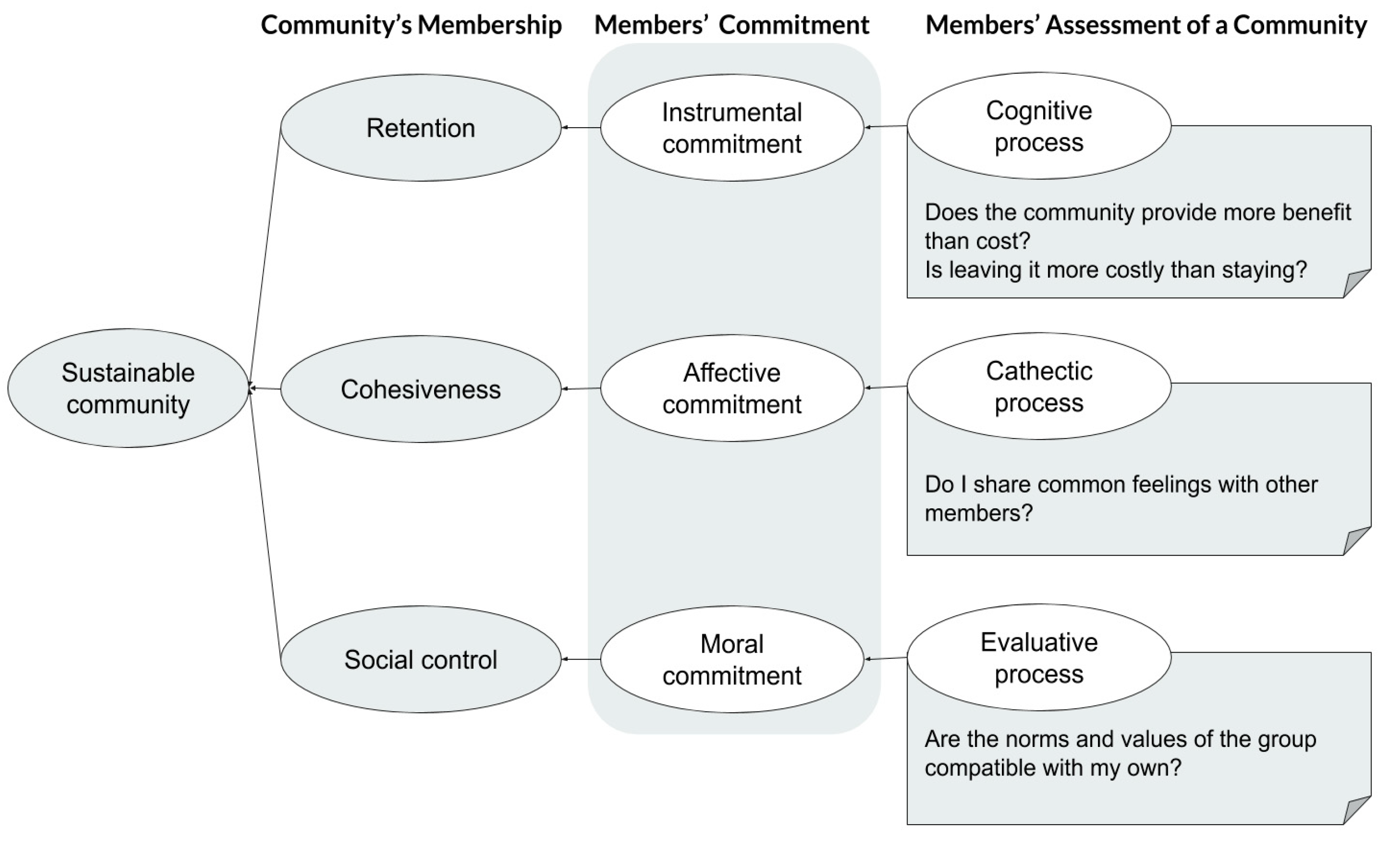
2. Kanter’s Commitment-Based Community Building Framework
2.1. Instrumental Commitment from the Cognitive Process
2.2. Affective Commitment from the Cathectic Process
2.3. Moral Commitment from the Evaluative Process
2.4. Total Commitment
3. Methods
3.1. Article Search
3.2. Article Review
4. Findings
4.1. Instrumental Commitment
4.1.1. Knowledge Capital
4.1.2. Social Network
4.1.3. Time as a Major Investment
4.2. Affective Commitment
4.2.1. Relationship Building and Emotional Support
4.2.2. Extended Interaction
4.3. Moral Commitment
4.3.1. Shared Professional Learning Goals
4.3.2. Healthy Community Culture
4.4. Design Suggestions for Total Commitment
5. Concluding Remarks
Author Contributions
Funding
Conflicts of Interest
Appendix A

| # | First Author | Year | Title |
|---|---|---|---|
| 1 | Balcikanli | 2015 | Prospective English language teachers’ experiences in Facebook: Adoption, use and educational use in Turkish context |
| 2 | Bergviken Rensfeldt | 2018 | Teachers ‘liking’ their work? Exploring the realities of teacher Facebook groups |
| 3 | Bett | 2020 | Can Facebook groups enhance continuing professional development of teachers? Lessons from Kenya |
| 4 | Booth | 2012 | Cultivating knowledge sharing and trust in online communities for educators |
| 5 | Brass | 2011 | The (failed) case of the Winston Society Wikispace: Challenges and opportunities of Web 2.0 and teacher education |
| 6 | Carpenter | 2020 | Broadening borders to build better schools: Virtual professional learning communities |
| 7 | Carr | 2006 | Teacher professional learning in an online community: The experiences of the national quality schooling framework pilot project |
| 8 | Chen | 2011 | Improving teachers’ teaching with communication technology |
| 9 | Choi | 2014 | Learning to get it right: Understanding change processes in professional development for teachers of English learners |
| 10 | Colgan | 1999 | Transforming professional development: An empirical study to determine the key aspects of electronic collaboration and social interaction in the elementary mathematics teaching community |
| 11 | da Cunha Júnior | 2016 | Collaborating on Facebook: Teachers exchanging experiences through social networking sites |
| 12 | Donnelly | 2013 | Consuming and creating: Early-adopting science teachers’ perceptions and use of a wiki to support professional development |
| 13 | Duncan-Howell | 2010 | Teachers making connections: Online communities as a source of professional learning |
| 14 | Farooq | 2007 | Sustaining a community computing infrastructure for online teacher professional development: A case study of designing Tapped In |
| 15 | Fusco | 2000 | Assessing the impact of a large-scale online teacher professional development community |
| 16 | Hodes | 2011 | Developing an online community of in-service teachers |
| 17 | Holmes | 2013 | School teachers’ continuous professional development in an online learning community: Lessons from a case study of an e twinning learning event |
| 18 | Hur | 2009 | Teacher participation in online communities: Why do teachers want to participate in self-generated online communities of K-12 teachers? |
| 19 | Judy Kamalodeen | 2016 | A mixed methods research approach to exploring teacher participation in an online social networking website |
| 20 | Kampylis | 2012 | Fostering innovative pedagogical practices through online networks: The case of eTwinning |
| 21 | Lantz-Andersson | 2018 | Twenty years of online teacher communities: A systematic review of formally organized and informally developed professional learning groups |
| 22 | Lim | 2017 | Teachers empowering teachers in an online community of practice: A case study of Korean EFL teachers’ learning to teach flipped classroom on Naver Band |
| 23 | Luehmann | 2008 | Teacher professional identity development with social networking technologies: Learning reform through blogging |
| 24 | Macià | 2017 | Properties of teacher networks in Twitter: Are they related to community-based peer production? |
| 25 | Marenzi | 2016 | Yell/tell: Online community platform for teacher professional development |
| 26 | Palmquist | 2015 | Participation in the School Orchestra and String Teachers Facebook v2 group: An online community of practice |
| 27 | Parr | 2006 | Building on foundations: Creating an online community |
| 28 | Ranieri | 2012 | Why (and how) do teachers engage in social networks? An exploratory study of professional use of Facebook and its implications for lifelong learning. |
| 29 | Rezende da Cunha | 2016 | Collaborating on Facebook: Teachers exchanging experiences through social networking sites |
| 30 | Robson | 2016 | Engagement in structured social space: an investigation of teachers’ online peer-to-peer interaction |
| 31 | Rolando | 2014 | Learning with their peers: Using a virtual learning community to improve an in-service biology teacher education program in Brazil |
| 32 | Romeu | 2016 | Teacher collaboration network in higher education: Reflective visions from praxis |
| 33 | Schank | 2002 | Painting a landscape onto tapped in 2 |
| 34 | Schlager | 2003 | Designing equity and diversity into online strategies to support new teachers |
| 35 | Selwyn | 2000 | Creating a “connected” community? Teachers’ use of an electronic discussion group |
| 36 | Seo | 2013 | Professional learning of observers, collaborators, and contributors in a teacher-created online community in Korea |
| 37 | Snider | 2009 | A critical analysis of rural teachers’ usage of online communities |
| 38 | Trust | 2019 | Six key elements identified in an active and thriving blended community of practice |
| 39 | Tsai | 2011 | Levels and patterns of participation and social interaction in an online learning community for learning to teach |
| 40 | Vuorikari | 2011 | ICT-based school collaboration, teachers’ networks and their opportunities for teachers’ professional development—a case study on eTwinning |
| 41 | Wesely | 2013 | Investigating the community of practice of world language educators on Twitter |
| 42 | Wu | 2014 | Chinese EFL teachers’ social interaction and socio-cognitive presence in synchronous computer-mediated communication |
| 43 | Yildirim | 2019 | Using Facebook groups to support teachers’ professional development |
Appendix B
| First Author (year) | Instrumental Commitment | Affective Commitment | Moral Commitment | Design Suggestions |
|---|---|---|---|---|
| Balcikanli (2015) | X | X | ||
| Bergviken Rensfeldt (2018) | X | |||
| Bett (2020) | X | X | ||
| Booth (2012) | X | X | ||
| Brass (2011) | X | X | ||
| Carpenter (2020) | X | X | ||
| Carr (2006) | X | |||
| Chen (2011) | X | |||
| Choi (2014) | X | |||
| Colgan (1999) | X | |||
| da Cunha Júnior (2016) | X | |||
| Donnelly (2013) | X | X | ||
| Duncan-Howell (2010) | X | X | ||
| Farooq (2007) | X | |||
| Fusco (2000) | X | |||
| Hodes (2011) | X | |||
| Holmes (2013) | X | |||
| Hur (2009) | X | |||
| Judy Kamalodeen (2016) | X | |||
| Kampylis (2012) | X | |||
| Lantz-Andersson (2018) | X | X | X | X |
| Lim (2017) | X | X | ||
| Luehmann (2008) | X | X | ||
| Macià (2017) | X | |||
| Marenzi (2016) | X | |||
| Palmquist (2015) | X | |||
| Parr (2006) | X | X | ||
| Ranieri (2012) | X | |||
| Rezende da Cunha (2016) | X | X | ||
| Robson (2016) | X | |||
| Rolando (2014) | X | |||
| Romeu (2016) | X | X | X | |
| Schank (2002) | X | |||
| Schlager (2003) | X | |||
| Selwyn (2000) | X | |||
| Seo (2013) | X | X | X | |
| Snider (2009) | X | X | ||
| Trust (2019) | X | X | X | X |
| Tsai (2011) | X | X | ||
| Vuorikari (2011) | X | |||
| Wesely (2013) | X | X | ||
| Wu (2014) | X | X | X | |
| Yildirim (2019) | X | X | X | |
| Total | 26 | 13 | 9 | 23 |
| % | 67% | 33% | 23% | 59% |
Appendix C
| First Author (year) | Name | Size | Country | Subject Area | Membership | Network Used |
|---|---|---|---|---|---|---|
| Balcikanli (2015) | PELTs (Prospective English Language Teachers) | Not reported | Turkey | EFL | By invitation | |
| Bergviken Rensfeldt (2018) | Flip-it | 13,000 | Sweden | Technology-based pedagogy | Initially established as an open group, later reconfigured as closed | |
| Bett (2020) | Teachers of English (ToE) | 20,592 | Africa | English | Not reported | |
| Booth (2012) | Case 1. National Education Leaders Network Case 2. English Teachers’ Online Community | #1: 300 #2: 20,000 | U.S. | #1: All #2: English | #1.By invitation #2. Open | Not reported |
| Brass (2011) | Winston Society | 20 | U.S. | English | By invitation | Wiki |
| Carpenter (2020) | Not reported | N/A | U.S. (Texas), Dominican Republic | N/A | N/A | N/A |
| Carr (2006) | NQSF (National Quality Schooling Framework Pilot Project) | 100 | Australia | All | By invitation | Not reported |
| Chen (2011) | Not reported | 26 | U.S. | All | By invitation | Wikispaces |
| Choi (2014) | Blackboard | 120 | U.S. | English Learners [ELs] | By invitation | Not reported |
| Colgan (1999) | Connect-Me | 60 | International | Math | Not reported | Not reported |
| da Cunha Júnior (2016) | TFC (Teachers who use Facebook in Classrooms) | 43 | Brazil | All | By invitation | |
| Donnelly (2013) | Not reported | 11 | New Zealand | Science | By invitation | Wikispaces |
| Duncan-Howell (2010) | Case 1. BECTA top teachers Case 2. Oz-TeacherNet Case 3. SSABSA English Teachers | #1: 568 #2: 608 #3: 112 | #1: International #2: Australian national #3: Australian state | #1: All #2: All #3: English | Not reported | Not reported |
| Farooq (2007) | Tapped In | 20,000 | U.S. | All | Not reported | Not reported |
| Fusco (2000) | Tapped In | 6000 | U.S. | All | Open | Not reported |
| Hodes (2011) | Not reported | 48 | U.S. | All | By invitation | Not reported |
| Holmes (2013) | eTwinning | Not reported | International (EU) | All | Not reported | Specifically designed platform |
| Hur (2009) | Case 1: Teacher Focus community Case 2: WeTheTeachers community Case 3: The Teaching community in LiveJournal (T-LJ) | Case 1: 5300 Case 2: 2500 Case 3: 1500 | International | All | Not reported | Not reported |
| Judy Kamalodeen (2016) | Not reported | Not reported | Spain | All | By invitation | Not reported |
| Kampylis (2012) | eTwinning | Not reported | International (EU) | All | Not reported | Not reported |
| Lantz-Andersson (2018) | N/A | N/A | N/A | N/A | N/A | Not reported |
| Lim (2017) | The FC BAND (Flipped EFL Classroom Teacher BAND in Future Classroom Network[FCN]) | 95 | S.Korea | EFL | Open | SNS (NAVER BAND) |
| Luehmann (2008) | Implementing Curricular Reform in Science Education | Not reported | U.S. | Science Education | Not reported | Not reported |
| Macià (2017) | N/A | N/A | N/A | N/A | N/A | Not reported |
| Marenzi (2016) | Young/Teen English Language Learners (YELL/TELL) | Not reported | Italy | EFL | Not reported | Not reported |
| Palmquist (2015) | SOST v2 Facebook group | 2000 | International | Orchestra and String teachers | Open | |
| Parr (2006) | FarNet | 284 | New Zealand | All | By invitation | Not reported |
| Ranieri (2012) | Five Facebook group pages | Group 1: 1532 Group 2: 698 Group 3: 746 Group 4: 1078 Group 5: 1510 | Italy | #1,2,3: All #4: Learning support #5: Learning disabilities | 1. Approved by an administrator or invited by another member 2. Open 3. Open 4. Approved by an administrator or invited by another member 5. Approved by an administrator or invited by another member | |
| Rezende da Cunha (2016) | TFC (Teachers who use Facebook in Classrooms) | 43 | Brazil | Not reported | By Invitation | |
| Robson (2016) | Not reported | Forum: 363 Facebook Page: 334 Facebook Group: 563 | U.K. | Religious Education | Not reported | |
| Rolando (2014) | VLC-Bio (Biology teachers network of the State of Rio de Janeiro) | 454 | Brazil | Biology | Not reported | Ning Network (http://biologiacecierj.ning.com/) |
| Romeu (2016) | Not reported | Not reported | Not reported | Not reported | Not reported | Not reported |
| Schank (2002) | Tapped In | Not reported | U.S. | All | Not reported | Not reported |
| Schlager (2003) | MPS (Milwaukee Public Schools) Professional Support Community | Not reported | U.S. | All | Not reported | Specifically designed platform |
| Selwyn (2000) | SENCo forum | 1347 | U.K. | Special Education | Not reported | Not reported |
| Seo (2013) | Indischool | 100,000 | S.Korea | All | Open | Not reported |
| Snider (2009) | N/A | N/A | U.S. | All | N/A | Not reported |
| Trust (2019) | Discovery Educator Network (DEN) | Not reported | U.S. | K-12 teachers, staff, school leaders | Not reported | Not reported |
| Tsai (2011) | NETwork (Nurturing Elementary Teachers’ work) | 92 | Not reported | Science | Closed | Sakai 2.0 |
| Vuorikari (2011) | eTwinning | 76,551 | International | All | Open | Specifically designed platform |
| Wesely (2013) | Not reported | 500 | U.S. | World Languages | Open | |
| Wu (2014) | English Teaching Forum of the China Education Resources and Services Platform | 200 | China | All | Not reported | Not reported |
| Yildirim (2019) | Chamber of Ministry of National Education High School Mathematics Teachers | 13,000 | Turkey | Mathematics | Closed (Approved by the administrators) |
References
- Wenger, E. Communities of practice: Learning as a social system. Syst. Think. 1998, 9, 2–3. Available online: https://thesystemsthinker.com/communities-of-practice-learning-as-a-social-system/ (accessed on 7 May 2020). [CrossRef] [Scilit]
- Carr, N.; Chambers, D.P. Teacher professional learning in an online community: The experiences of the national quality schooling framework pilot project. Technol. Pedagog. Educ. 2006, 15, 143–157. [Google Scholar] [CrossRef] [Scilit]
- Gutierrez, C.; Bryan, C. Online community becomes a pathway to teacher leadership. J. Staff Dev. 2010, 31, 42–47. [Google Scholar]
- OECD. TALIS 2013 Results: An International Perspective on Teaching and Learning; OECD Publishing: Paris, France, 2014. [Google Scholar]
- Farooq, U.; Schank, P.; Harris, A.; Fusco, J.; Schlager, M.S. Sustaining a community computing infrastructure for online teacher professional development: A case study of designing Tapped In. Comput. Supported. Coop. Work 2007, 16, 397–429. [Google Scholar] [CrossRef] [Scilit]
- McPherson, M.; Nunes, M.B. The failure of a virtual social space (VSS) designed to create a learning community: Lessons learned. Br. J. Educ. Technol. 2004, 35, 305–321. [Google Scholar] [CrossRef] [Scilit]
- Brass, J.; Mecoli, S. The (failed) case of the Winston Society Wikispace: Challenges and opportunities of Web 2.0 and teacher education. Contemp. Issues Technol. Teach. Educ. 2011, 11, 149–166. [Google Scholar]
- Booth, S.E. Cultivating Knowledge Sharing and Trust in Online Communities for Educators. J. Educ. Comput. Res. 2012, 47, 1–31. [Google Scholar] [CrossRef] [Scilit]
- Lantz-Andersson, A.; Lundin, M.; Selwyn, N. Twenty years of online teacher communities: A systematic review of formally-organized and informally-developed professional learning groups. Teach. Teach. Educ. 2018, 75, 302–315. [Google Scholar] [CrossRef] [Scilit]
- Vygotsky, L.S. Mind in Society: The Development of Higher Psychological Processes; Harvard University Press: Cambridge, MA, USA, 1978. [Google Scholar]
- Glaser, B.G.; Strauss, A.L.; Strutzel, E. The discovery of grounded theory: Strategies for qualitative research. Nurs. Res. 1968, 17, 364. [Google Scholar] [CrossRef] [Scilit]
- Kanter, R.M. Commitment and the internal organization of millennial movements. Am. Behav. Sci. 1972, 16, 219–243. [Google Scholar] [CrossRef] [Scilit]
- Allen, N.J.; Meyer, J.P. The measurement and antecedents of affective, continuance and normative commitment to the organization. J. Occup. Psychol. 1990, 63, 1–18. [Google Scholar] [CrossRef] [Scilit]
- Bryson, J.M. Strategic Planning for Public and Nonprofit Organizations: A Guide to Strengthening and Sustaining Organizational Achievement; John Wiley & Sons: Hoboken, NJ, USA, 2011; Volume 1. [Google Scholar]
- Gundlach, G.T.; Achrol, R.S.; Mentzer, J.T. The Structure of Commitment in Exchange. J. Mark. 1995, 59, 78–92. [Google Scholar] [CrossRef] [Scilit]
- Gilliland, D.I.; Bello, D.C. Two sides to attitudinal commitment: The effect of calculative and loyalty commitment on enforcement mechanisms in distribution channels. J. Acad. Mark. Sci. 2002, 30, 24–43. [Google Scholar] [CrossRef] [Scilit]
- Kanter, R.M. Commitment and Community: Communes and Utopias in Sociological Perspective; Harvard University Press: Cambridge, MA, USA, 1972. [Google Scholar]
- Hodes, C.; Pritz, S.; Kelley, P.; Foster, J. Developing an online community of inservice teachers. Contemp. Issues Technol. Teach. Educ. 2011, 11, 313–323. [Google Scholar]
- Lim, S.H. Teachers empowering teachers in an online community of practice: A case study of Korean EFL teachers’ learning to teach flipped classroom on Naver Band. Multimed. Assist. Lang. Learn. 2017, 20, 109–143. [Google Scholar] [CrossRef]
- Chen, L. Improving teachers’ teaching with communication technology. J. Educ. Technol. Syst. 2011, 40, 35–43. [Google Scholar] [CrossRef] [Scilit]
- Snider, S.A. A Critical Analysis of Rural Teachers’ Usage of Online Communities. Ph.D. Thesis, Southern Illinois University at Carbondale, Carbondale, IL, USA, 2009. [Google Scholar]
- Duncan-Howell, J. Teachers making connections: Online communities as a source of professional learning. Br. J. Educ. Technol. 2010, 41, 324–340. [Google Scholar] [CrossRef] [Scilit]
- Smith, M. Voice from the WELL: The Logic of the Virtual Commons; Department of Sociology, University of California: Los Angeles, CA, USA, 1992. [Google Scholar]
- Trust, T.; Horrocks, B. Six key elements identified in an active and thriving blended Community of Practice. TechTrends 2019, 63, 108–115. [Google Scholar] [CrossRef] [Scilit]
- Romeu, T.; Guitert, M.; Sangrà, A. Teacher collaboration network in higher education: Reflective visions from praxis. Innov. Educ. Teach. Int. 2016, 53, 592–604. [Google Scholar] [CrossRef] [Scilit]
- Vescio, V.; Ross, D.; Adams, A. A review of research on the impact of professional learning communities on teaching practice and student learning. Teach. Teach. Educ. 2008, 24, 80–91. [Google Scholar] [CrossRef] [Scilit]
- Tsai, I.C. Levels and patterns of participation and social interaction in an online learning community for learning to teach. J. Interact. Learn. Res. 2011, 22, 191–239. [Google Scholar]
- Colgan, L.; Higginson, W.; Sinclair, N. Transforming professional development: An empirical study to determine the key aspects of electronic collaboration and social interaction in the elementary mathematics teaching community. Alta. J. Educ. Res. 1999, 45, 315–319. [Google Scholar]
- Balcikanli, C. Prospective English language teachers’ experiences in Facebook: Adoption, use and educational use in Turkish context. Int. J. Educ. Dev. Using Inf. Commun. Technol. 2015, 11, 82–99. [Google Scholar]
- Seo, K. Professional Learning of observers, collaborators, and contributors in a teacher-created online community in Korea. Asia Pac. J. Educ. 2014, 34, 337–350. [Google Scholar] [CrossRef] [Scilit]
- Carpenter, D.; Munshower, P. Broadening borders to build better schools: Virtual professional learning communities. Int. J. Educ. Manag. 2019, 34, 296–314. [Google Scholar] [CrossRef] [Scilit]
- Palmquist, J.E.; Barnes, G.V. Participation in the school orchestra and string teachers Facebook v2 group: An online community of practice. Int. J. Community Music. 2015, 8, 93–103. [Google Scholar] [CrossRef] [Scilit]
- Bett, H.; Makewa, L. Can Facebook groups enhance continuing professional development of teachers? Lessons from Kenya. Asia Pac. J. Teach. Educ. 2020, 48, 132–146. [Google Scholar] [CrossRef] [Scilit]
- Yildirim, I. Using Facebook groups to support teachers’ professional development. Technol. Pedagog. Educ. 2019, 1–21. [Google Scholar] [CrossRef] [Scilit]
- Stevenson, H.J. Teachers’ informal collaboration regarding technology. J. Res. Technol. Educ. 2004, 37, 129–144. [Google Scholar] [CrossRef] [Scilit]
- Rolando, L.G.R.; Salvador, D.F.; Souza, A.H.S.; Luz, M.R.M.P. Learning with their peers: Using a virtual learning community to improve an in-service biology teacher education program in Brazil. Teach. Teach. Educ. 2014, 44, 44–55. [Google Scholar] [CrossRef] [Scilit]
- Hur, J.; Brush, T.A. Teacher participation in online communities: Why do teachers want to participate in self-generated online communities of K-12 teachers? J. Res. Technol. Educ. 2009, 41, 279–303. [Google Scholar] [CrossRef] [Scilit]
- Donnelly, D.F.; Boniface, S. Consuming and creating: Early-adopting science teachers’ perceptions and use of a wiki to support professional development. Comput. Educ. 2013, 68, 9–20. [Google Scholar] [CrossRef] [Scilit]
- Stevenson, H.J. To adapt or subscribe: Teachers’ informal collaboration and view of mandated curricula. Issues Teach. Educ. 2008, 17, 75–95. [Google Scholar]
- Crawley, C.; Gilleran, A.; Nucci, D.; Scimeca, S. Voices of Etwinning-Teachers Talk; Central Support Service for Etwinning & European Schoolnet: Brussels, Belgium, 2013. [Google Scholar]
- Wesely, P.M. Investigating the community of practice of world language educators on twitter. J. Teach. Educ. 2013, 64, 305–318. [Google Scholar] [CrossRef] [Scilit]
- da Cunha Júnior, F.; van Oers, B.; Kontopodis, M. Collaborating on Facebook: Teachers exchanging experiences through social networking sites. Cult. Hist. Psychol. 2016, 12, 290–309. [Google Scholar] [CrossRef] [Scilit]
- Adrienne, L. Twitter evolving into professional-development tool. Educ. Week 2011, 30, 20. Available online: https://www.edweek.org/ew/articles/2011/07/13/36twitter.h30.html (accessed on 17 June 2019).
- Wu, H.; Gao, J.; Zhang, W. Chinese EFL teachers: Social interaction and socio-cognitive presence in synchronous computer-mediated communication. Lang. Learn. Technol. 2014, 18, 228–254. [Google Scholar]
- Fusco, J.; Gehlbach, H.; Schlager, M.S. Assessing the Impact of a Large-Scale Online Teacher Professional Development Community. In Proceedings of the 11th International Conference for the Society for Information Technology and Teacher Education, Association for the Advancement of Computing in Education (AACE), Waynesville, NC, USA, 5–10 March 2000; pp. 2178–2183. Available online: https://tappedin.org/publications/2000/AssessingComm.pdf (accessed on 22 November 2020).
- Judy Kamalodeen, V.; Jameson-Charles, M. A mixed methods research approach to exploring teacher participation in an online social networking website. Int. J. Qual. Methods 2016, 15, 1–14. [Google Scholar] [CrossRef] [Scilit]
- Yeh, Y. Integrating collaborative PBL with blended learning to explore preservice teachers’ development of online learning communities. Teach. Teach. Educ. Int. J. Res. Stud. 2010, 26, 1630–1640. [Google Scholar] [CrossRef] [Scilit]
- Luehmann, A.L.; Tinelli, L. Teacher professional identity development with social networking technologies: Learning reform through blogging. Educ. Media Int. 2008, 45, 323–333. [Google Scholar] [CrossRef] [Scilit]
- Macià, M.; Garcia, L. Properties of teacher networks in Twitter: Are they related to community-based peer production? Int. Rev. Res. Open Distrib. Learn. 2017, 18, 110–140. [Google Scholar] [CrossRef] [Scilit]
- Jones, A.; Preece, J. Online communities for teachers and lifelong learners: A framework for comparing similarities and identifying differences in communities of practice and communities of interest. Int. J. Learn. Technol. 2006, 2, 112–137. [Google Scholar] [CrossRef] [Scilit]
- Chih-Hsiung, T.; Corry, M. Building Active Online Interaction via a Collaborative Learning Community. Comput. Sch. 2003, 20, 51–59. [Google Scholar]
- Parr, J.; Ward, L. Building on foundations: Creating an online community. J. Technol. Teach. Educ. 2006, 14, 775–793. [Google Scholar]
- Macià, M.; García, I. Informal online communities and networks as a source of teacher professional development: A review. Teach. Teach. Educ. 2016, 55, 291–307. [Google Scholar] [CrossRef] [Scilit]
- Wenger, E.; McDermott, R.A.; Snyder, W. Cultivating Communities of Practice: A Guide to Managing Knowledge; Harvard Business Press: Boston, MA, USA, 2002. [Google Scholar]
- Holmes, B. School teachers’ continuous professional development in an online learning community: Lessons from a case study of an e twinning learning event. Eur. J. Educ. 2013, 48, 97–112. [Google Scholar] [CrossRef] [Scilit]
- Schlager, M.S.; Fusco, J.; Koch, M.; Crawford, V.; Phillips, M. Designing Equity and Diversity into Online Strategies to Support New Teachers. In Proceedings of the National Educational Computing Conference (NECC), Seattle, WA, USA, 1 July 2003. [Google Scholar]
- Vuorikari, R.; Berlanga, A.; Cachia, R.; Cao, Y.; Fetter, S.; Gilleran, A.; Klamma, R.; Punie, Y.; Scimeca, S.; Sloep, P.; et al. ICT-Based School Collaboration, Teachers’ Networks and their Opportunities for Teachers’ Professional Development—A Case Study on Etwinning. In Advances in Web-Based Learning—ICWL 2011; Leung, H., Popescu, E., Cao, Y., Lau, R.H., Nejdl, W., Eds.; Springer: Berlin/Heidelberg, Germany, 2011; Volume 7048, pp. 112–121. [Google Scholar]
- Kampylis, P.; Bocconi, S.; Punie, Y. Fostering Innovative Pedagogical Practices through Online Networks: The Case of Etwinning. In Proceedings of the SQM/INSPIRE 2012 Conference, Tampere, Finland, 21–23 August 2012. [Google Scholar]
- Schlager, M.S.; Fusco, J. Teacher professional development, technology, and communities of practice: Are we putting the cart before the horse? Inf. Soc. 2003, 19, 203–220. [Google Scholar] [CrossRef] [Scilit]
- Tapped In. Available online: http://www.tappedin.org/ (accessed on 7 May 2020).
- Schank, P.K.; Harris, Z.; Schlager, M.S. Painting a Landscape onto Tapped In 2. In Proceedings of the CSCW Workshop on the Role of Place in Virtual Communities, Seattle, WA, USA, 16–20 November 2002; Available online: https://www.tappedin.org/publications/2002/TI2PlaceCSCW.pdf (accessed on 7 May 2020).
- Schlager, M.S.; Fusco, J.; Schank, P.K. Cornerstones for an on-line community of education professionals. Technol. Soc. Mag. IEEE 1998, 17, 15–21. [Google Scholar] [CrossRef] [Scilit]
- Selwyn, N. Creating a “connected” community? Teachers’ use of an electronic discussion group. Teach. Coll. Rec. 2000, 102, 750. [Google Scholar]
- Andrew, N.; Ferguson, D.; Wilkie, G.; Corcoran, T.; Simpson, L. Developing professional identity in nursing academics: The role of communities of practice. Nurse Educ. Today 2009, 29, 607–611. [Google Scholar] [CrossRef] [Scilit]
- Choi, D.S.-Y.; Morrison, P. Learning to get it right: Understanding change processes in professional development for teachers of English learners. Prof. Dev. Educ. 2014, 40, 416–435. [Google Scholar] [CrossRef] [Scilit]
- Simba Information. Teacher learning communities expanding. Electron. Educ. Rep. 2008, 15, 1–3. [Google Scholar]
- Bergviken Rensfeldt, A.; Hillman, T.; Selwyn, N. Teachers ‘liking’ their work? Exploring the realities of teacher Facebook groups. Br. Educ. Res. J. 2018, 44, 230–250. [Google Scholar] [CrossRef] [Scilit]
- Ranieri, M.; Manca, S.; Fini, A. Why (and how) do teachers engage in social networks? An exploratory study of professional use of Facebook and its implications for lifelong learning. Br. J. Educ. Technol. 2012, 43, 754–769. [Google Scholar] [CrossRef] [Scilit]
- Grohol, J. Anonymity and Online Community: Identity Matters. In Community, Usability; 2006; Volume 214, Available online: https://alistapart.com/article/identitymatters/ (accessed on 17 June 2019).
- Kollock, P.; Smith, M. Managing the virtual commons: Cooperation and Conflict in Computer Communities. In Computer-Mediated Communication: Linguistic, Social, and Cross-Cultural Perspectives; Herring, S.C., Ed.; John Benjamins Publishing: Amsterdam, The Netherlands, 1996; pp. 109–128. [Google Scholar]
- Posey, C.; Lowry, P.B.; Roberts, T.L.; Ellis, T.S. Proposing the online community self-disclosure model: The case of working professionals in France and the U.K. who use online communities. Eur. J. Inf. Syst. 2010, 19, 181–195. [Google Scholar] [CrossRef] [Scilit]
- Schlager, M.S.; Schank, P.K. Tapped In: A New On-Line Teacher Community Concept for the Next Generation of Internet Technology. In Proceedings of the 2nd International Conference on Computer Support for Collaborative Learning, Toronto, ON, Canada, 10–14 December 1997; pp. 234–243. Available online: https://www.tappedin.org/publications/1997/NextGenCSCL.pdf (accessed on 22 November 2020).
- Allen, E.I.; Seaman, J. Digital Learning Compass: Distance Education Enrollment Report 2017; Babson Survey Research Group: Wellesley, MA, USA, 2017. [Google Scholar]
- Robson, J. Engagement in structured social space: An investigation of teachers’ online peer-to-peer interaction. Learn. Media Technol. 2016, 41, 119–139. [Google Scholar] [CrossRef] [Scilit]
- Staudt Willet, K.B. Revisiting how and why educators use Twitter: Tweet types and purposes in #Edchat. J. Res. Technol. Educ. 2019, 51, 273–289. [Google Scholar] [CrossRef] [Scilit]
- Marenzi, I.; Bortoluzzi, M.; Kalyani, R. YELL/TELL: Online Community Platform for Teacher Professional Development. In Proceedings of the EUROCALL 2016, Limassol, Cyprus, 24–26 August 2016; pp. 307–312. [Google Scholar]

| Category | Instrumental | Affective | Moral | Design |
|---|---|---|---|---|
| # of Articles | 26 | 13 | 9 | 23 |
| % | 67% | 33% | 23% | 59% |
| Community Size (Min–Max) | 20–100,000 | 48–100,000 | 20–20,000 | 11–100,000 |
Publisher’s Note: MDPI stays neutral with regard to jurisdictional claims in published maps and institutional affiliations. |
© 2020 by the authors. Licensee MDPI, Basel, Switzerland. This article is an open access article distributed under the terms and conditions of the Creative Commons Attribution (CC BY) license (http://creativecommons.org/licenses/by/4.0/).
Share and Cite
Lee, D.; Jung, J.; Shin, S.; Otternbreit-Leftwich, A.; Glazewski, K. A Sociological View on Designing a Sustainable Online Community for K–12 Teachers: A Systematic Review. Sustainability 2020, 12, 9742. https://doi.org/10.3390/su12229742
Lee D, Jung J, Shin S, Otternbreit-Leftwich A, Glazewski K. A Sociological View on Designing a Sustainable Online Community for K–12 Teachers: A Systematic Review. Sustainability. 2020; 12(22):9742. https://doi.org/10.3390/su12229742
Chicago/Turabian StyleLee, Dabae, Jiyoon Jung, Suhkyung Shin, Anne Otternbreit-Leftwich, and Krista Glazewski. 2020. "A Sociological View on Designing a Sustainable Online Community for K–12 Teachers: A Systematic Review" Sustainability 12, no. 22: 9742. https://doi.org/10.3390/su12229742
APA StyleLee, D., Jung, J., Shin, S., Otternbreit-Leftwich, A., & Glazewski, K. (2020). A Sociological View on Designing a Sustainable Online Community for K–12 Teachers: A Systematic Review. Sustainability, 12(22), 9742. https://doi.org/10.3390/su12229742