1. Introduction
“Cities are the guilty victims of energy demand pressures and climate change” [
1]. More than two-thirds of the population of Europe currently reside in cities and their neighboring metropolitan areas [
2,
3], which are responsible for 80% of the overall energy consumption in Europe [
2,
3,
4]. The world’s population has expanded from two billion to six billion and will probably soon reach seven billion, while the number of citizens residing in metropolitan areas grew from 3% in 1800 to 14% in 1900 and is expected to increase from the current 50% to 75% in 2050. The number for Europe remains even higher: by 2050, 83% of residents are predicted to live in cities [
4]. The Earth’s surface temperature has increased by 0.6% and it is predicted to hit 1.5% by 2030. This incremental change in global warming would directly raise metropolitan temperatures and the impact of the heat island effect. Following the Messina earthquake in 1908 (which resulted in almost 83,000 deaths), the hot summer of 2003, with nearly 70,000 deaths, was the second most significant natural catastrophe in Europe during the past century.
The city of Athens is a highly important case in conjunction with extreme urbanization and the associated heat island. Rising urbanization and deficits in urban planning control have had significant repercussions for thermal deterioration of the urban environment and construction quality. As a result of thermal balance, air temperatures are higher in heavily constructed metropolitan areas than in the adjacent rural areas.
The extreme urbanization of Athens and its lack of green nature are the product of an unorganized urban policy throughout the last century, which largely led to the development of a heat-island phenomena, the essential indoor conditions and the consequent rise in the demand for energy in summer.
More comprehensively, a variety of environmental and social issues have compromised the standard of the living through atmosphere as a consequence of the city’s growth [
5]. In addition to a large number of automobiles, the high population density has generated negative consequences in terms of transport congestion and air pollution, since the area was not built to accommodate millions of vehicles. The air quality has also been impaired by periodic forest fires in the Athens area. The Greek government is very conscious of all the problems—not only environmental—related to the urban sprawl. The strategy of urban densification, being connected with the vision of an urban reality where public transport will be effective and natural resources preserved, aims to minimize the urban sprawl and the spread settlements in the rural areas surrounding the city, and thus may represent a powerful paradigm in the sustainable reshaping of the urban built environment.
Keeping in mind that much of the built landscape already occurs in compact communities such as Athens, adaptation and reuse of the current housing stock and the incorporation of adjacent areas as an active portion for a special and synergistic unbuilding whole are vital to the reconstruction of urban policy in the foreseeable future. The inclusion of complementary urban space, indoor and outdoor, is important in order to engage urban citizens in social activity, especially in dense urban settings such as the center of the city of Athens.
As seen, the mitigation of the urban heat island (UHI) in Athens is the main challenge in order to reduce energy demand and improve comfort conditions in the built environment. Densely built urban districts exhibit higher air temperatures than rural regions, as a result of the so-called “Heat Island” (HI) phenomenon. The several factors that affect the HI regard the morphology of the urban setting, the thermal and optical properties of materials used for buildings and external areas, the anthropogenic heat, and the integrated green elements [
6,
7]. This phenomenon is usually assessed in terms of “UHI intensity,” i.e., the maximal recorded difference in temperature between the town center and the neighboring area [
6].
Research studies conducted by the Department of Physics of Athens University [
1,
8] have demonstrated a variety of suitable procedures to reshape urban environments including natural sources, such as green roofs and green walls, and general permeable surfaces. The creation of outdoor areas and the use of natural-based systems—even though restricted to the building envelope for the heritage subjected to urban constraints—are essential means for enhancing the microclimate of urban contexts and reducing pollutants. With this strategy and with the aim to create a framework to upgrade the urban environments into sustainable neighborhoods, urban voids will regain their social character, also reinforced through possible collaborative synergies from the inhabitants and local stakeholders. As a consequence, abandoned areas could be revitalized in a cost-effective manner by adding positive qualities to degraded urban voids. In addition, the increase in the real estate value in private buildings in connection with the reshape of the public surroundings may represent a positive chance for a renewed synergy between private and public areas. In this context, the proposed solutions aim towards the energy saving potential of the urban context and to achieve zero energy and zero CO
2 emission. High pollution levels have been proven to increase deaths related to COVID-19, among other health impacts [
9]. The COVID-19 pandemic has taken a leading role in the organization of social interactions in daily life, and has had an impact on urbanism, with many cities having opened formerly closed areas to give citizens open spaces for daily activities. According to [
10], a new urban policy should be considered in order to reduce the diffusion risks of the COVID-19 pandemic and any pandemic in the future. There is a clear need for an occupation of the public and/or semiprivate space that is not related to any commercial activity while creating sustainable, safe and upgraded interactive urban spaces. Results from research studies clearly show that the alternative configuration of the exterior surfaces’ functions is the prior microclimate adjustment as it increases the outdoor air climate and the consistency of ambient temperatures by up to 2–3 °C [
1,
6]. Since UHI decreases the quality of urban life and its citizens’ quality of life, increases energy needs of the buildings, and also affects the urban socio-economy aspect, important actions should be taken in order to mitigate these intertwined and critical negative conditions. In this perspective, the combined use of innovative technologies, with the feedback of the best practices based on natural and passive components, could be further exploited in order to upgrade the urban environment [
11].
However, the climate in Athens still poses a substantial need for heating throughout the winter period, when the overall energy demand in chosen representative areas is regarded. In this sense, it is necessary to remember that while Athens has milder winter temperatures than the harsh winters of North Europe, there is still a substantial demand for heating during the cold wintertime. January is the coldest month on average at 10 °C in Athens, with an average low temperature of 7 °C and high temperature of 13 °C. In January, Athens has reported the lowest temperature ever, at −2 °C, and 21 °C is the highest recorded. As a consequence of the economic crises and winter energy consumption, a large proportion of the low-income community has been unable to satisfy the requirements for housing energy demands and reside in temperatures that surpass comfort levels [
12,
13]. The National Observatory of Athens provided the climate statistics data about the outdoor atmosphere, in relation to the whole seasonal period considered by the study [
11]. The minimum temperatures were reported during the 2013 winter (0.9 °C in January) and the average temperatures for the coldest months of December and January were, respectively, 11.1 °C and 10.5 °C. In view of all these observations, it is well understood why Athens is widely recognized as one of the most representative metropolises for energy demand conditions, from a high demand for cooling in the summer to a significant need for heating in the winter.
2. Socio-Economic Obstacles in the Renovation Process Towards nZEBs
Sustainable architecture can be achieved through the adoption of a bioclimatic approach to the design process, focused on the appropriate selection of the site and solar orientation, and the layout and distribution of internal spaces and functions. All these factors are significant and contribute to defining the level of indoor comfort and the quality of life, as well as the energy consumption of buildings [
14]. However, if referring to the existing built context, all these passive elements have already been defined and represent strengths or weaknesses, applicable as input of variables for the design of renovation interventions. For instance, the EU residential stock, with approximately 200 million residential units, is responsible for about 27% of energy consumption. Although the potential reduction in carbon emissions generated by energy-efficiency in the housing sector could be significant, just over 1.2% of European existing buildings are energy refurbished (building renovation passports, BPIE). Most of the existing buildings in Europe were constructed before the introduction of regulatory measures to reduce energy consumption for residential buildings, which, until 1995, were very limited or absent. As a consequence, nowadays the existing European building stock presents a very low standard of energy performance [
15].
This alarming gap is due to the presence of economic, political, and social barriers that currently prevent the development of architectural and urban solutions towards nearly zero energy buildings (nZEB). In particular, there is a lack of adequate policy strategies for the activation of deep renovation processes, and hence the instability of the investment market, as well as the excessive risk rate for public authorities, market and social actors, and any other investor. In addition to regulatory barriers, especially in the area of sharing the incentives between owner and tenant of a building or between owners, there is also a lack of decision-making tools and techniques for deep renovation. When talking about multi-family buildings, the property regime is the main problem and causes complexity in decision-making and consensus. In 2016, the European Union revised the Energy Performance of Buildings Directive (EPBD) [
16] and the Energy Efficiency Directive (EED) [
17] and by April 2017, national renovation roadmaps were reviewed—these are important occasions to make end users aware of the potential of deep renovation and to promote a more effective legislative framework [
18].
Findings from the EU Horizon 2020 project “ABRACADABRA—Assistant Buildings’ addition to Retrofit, Adopt, Cure and Develop the Actual Buildings up to zero energy, activating a market for deep renovation” (funded by the European Community through the H2020 Programme, G.A. No 696126) [
19] have shown that condominium unanimity for the add-on choices is a critical issue. The aim is to create policies and encourage the member states (MS) to adopt legislation on the decisions of elevation to be discussed in general meetings regarding multi-owner properties. Additionally, incentives and tax exceptions should be provided to the owners for deep renovation, also for the case of a higher building’s reshape through volumetric additions, provided that the target of nZEB is achieved. Article 19(1) of the EED [
20] acknowledges the importance of addressing the barrier of split incentives in the building sector and entails MS to assess and take appropriate actions to review regulatory and non-regulatory barriers to energy efficiency. Finally, another significant barrier is the limited accessibility of current funding instruments dedicated to the energy efficiency of existing assets, and the low level of private sector confidence and participation in the financing processes of deep renovations (almost exclusively supported by public funding). The ABRACADABRA strategy has been designed to overcome these barriers, in line with the provisions included within the EU energy policies (i.e., EPBD and the EED).
The main path to overcome the current barriers to the diffusion of deep renovation interventions, and to define a unique common solution to face them at EU level, is to share the outcomes from research about the definition and capitalization of win-win solutions based on the mutual cooperation between all the actors involved in the process (financial institutions, policy-makers, social stakeholders, decision-makers, buildings owners and associations).
3. Market Attractiveness and Urban Densification in the ABRACADABRA Strategy
Economic factors are considered as the most influent for the current lack of investments in the deep renovation sector. These are typically distinguished by an extraordinary degree of high risk and long payback periods, whose severity is amplified by the general “invisibility of the energy benefit”. Therefore, new integrated and coordinated strategies are required to unlock the necessary public and private capital, fill the investment gap in energy efficiency and eventually lead to improving the building industry and generating a new employment market.
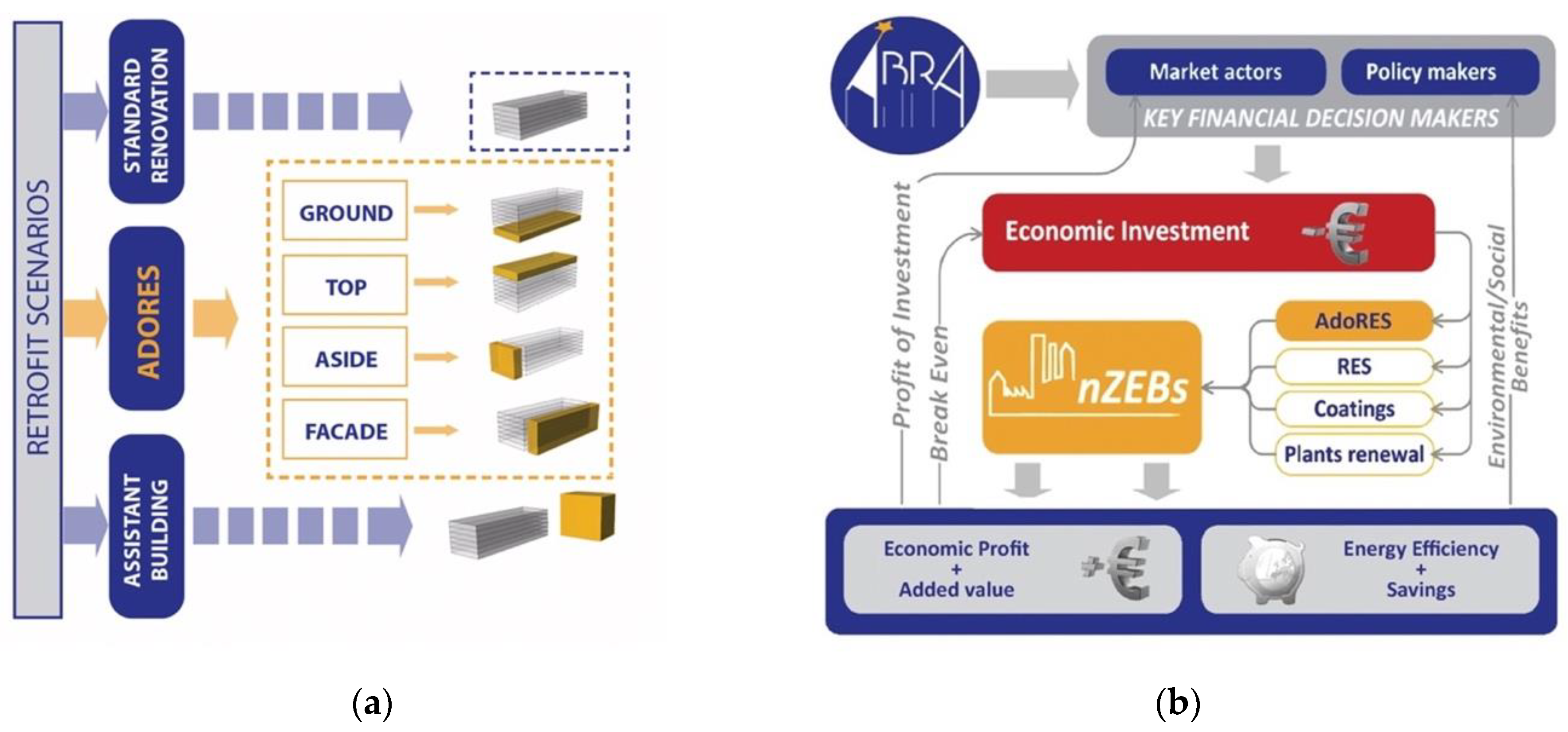
The ABRACADABRA project is founded on the preliminary condition that the augment of the real estate value of existing buildings can have a crucial part within deep renovation processes. Therefore, the aim is to provide an innovative, effective and attractive strategy, grounded on the implementation of volumetric additions (add-ons) and renewable energy sources (RES) for the creation of AdoRES, conceived as a single or a set of support serve units (assistant building units), to be added to existing buildings, in order to reach an energy balance and thus approach the nZEB targets. These units can be conceived as new aside buildings detached from existing construction, or as façade or rooftop volumetric additions.
In this framework, it was essential to carry out a preliminary analysis of the most widely used strategies for improving the energy performance of existing buildings, based on the definition of the most suitable energy conservation measures (ECMs) to be selected as relevant guiding factors for the project strategy based on volumetric additions. Research studies in the literature show that “the most commonly applied ECMs include high-performance building envelope, lighting controls, Heating, Ventilation, Air-Conditioning (HVAC) controls, etc.” and that the feasibility of ECMs “depends on the actual design and retrofit requirements. Not all ECMs are suitable or possible in every building” [
21].
The technical feasibility of AdoRES at the building scale has been based on the categorization of different possible scenarios, starting from the deep energy renovation assumed as “the entry level” for any following renovation through the add-ons, which are classified as: ground, top, aside, façade and assistant building (
Figure 1).
As illustrated in
Figure 1, the AdoRES are classified into five basic solutions including the deep renovation. These options are investigated as alternative and separate, if we consider all the possible combinations, we may end up with 31 possible solutions for each case study. These 31 solutions have been calculated through the formula:
C = n!/k!(n − k)!. Indeed, they correspond to the combination of
n additions taken
k at a time, without replication. At this point, it is especially necessary to have the required articulation of all potential actual requirements to achieve the broader variety of possible solutions. These various settings will support the choice of the best option on a case-based approach, declining the implementation of the
AdoRES strategy according to the specific regulatory, economic and technical contexts.
By grounding the process on this strategy, the following objectives are identified: (i) reducing the payback period of the renovation interventions; (ii) enhancing the trust of main investors; (iii) improving architectural and performance qualities of existing built stocks; (iv) boosting the market sector for the implementation of AdoRES towards the nZEBs target.
The high investment costs for energy refurbishment have motivated the exploration of the strategy of rooftop volumetric additions through several construction experiences conducted all over Europe. Financial institutions, various stakeholders of the market and construction area, and public authorities could support the creation of these social-based models, achieving a win-win strategy that would lead to a more sustainable environment of cities and urban centers. Despite the fact that this idea may seem a purely theoretical framework, already implemented projects in the EU such as “La casa por el tejado” [
23] have successfully demonstrated how such additions demonstrate a real scenario. Another significant, though tricky, aspect that the ABRACADABRA strategy proposes is to associate the addition solutions with the deep energy retrofit of the existing settlements with the aim of realizing an effective synergy between the existing and the new, with the vision to reach an overall balance in terms of energy gain, costs, and soil consumption [
24].
Cost-benefit analysis developed on a wide variety of benchmark buildings in multiple contexts considering the hypothetic investment in AdoRES shows that the potential economic benefits from the sales will cover the energy retrofit intervention costs and the expense of the included renewable energy technologies that will bring the energy consumption of the whole building to zero. This category of deep renovation costs more than the “softer” conventional interventions (focused on the installation of new plants, new windows, thermal insulations) but the reduced payback makes them winning solutions in terms of both technical and economic feasibility.
In order to increase confidence in “self-sufficient” financial business schemes as win-win solutions able to activate long-term incentives through the deep renovation of residential buildings to meet the nZEB target, the AdoRES have always acted as triggers in the renovation process, playing a key role within the context of low private finance.
As mentioned in the introduction, the strategy proposed is based on the prior assumption that non-energy related benefits play a key role in the deep renovation of existing buildings, focusing on the following main profit: the generation of a substantial increase in the real estate value of the buildings. The latter is achievable thanks to the integration of AdoRES, in order to go beyond the minimum energy performance and hence achieve nearly zero energy buildings (nZEBs). Therefore, the deep renovation process can significantly improve the energy performances of existing buildings and, at the same time, reach economic, financial, environmental and social co-benefits, in terms of payback time and net present value (NPV) of the investments. The development of AdoRES seeks to minimize the payback period needed for deep renovation by establishing a synergy between old and new buildings. If implemented at an urban scale, this action can contribute to the development of an urban densification strategy in the framework of the existing built areas that can still be reshaped. In this sense, a regulatory and market reform can definitely intensify the revolutionary approach towards nearly zero energy buildings regarding the existing built heritage.
Initially designed to address the market for private residential buildings—of which the existing heritage is mainly composed—at the scale of the individual building project, this approach has also effectively addressed another current highly critical issue: urban expansion. Indeed, thanks to the implementation of AdoRES as a strategy for activating a sustainable urban densification, it is possible to minimize urban growth, reduce land use and preserve green spaces across cities. In fact, urban planners and researchers have recognized the benefits of increasing the density of metropolitan areas and thus have identified the compact urban form as more efficient in terms of energy use and carbon emissions than its surroundings [
25,
26].
The use of existing infrastructures in the dense urban city and the related intensification of public services and pollution reduction [
27] lead to the optimization of energy and transport flows by encouraging decreased gaps between housing and offices, enterprises and public utilities as well as facilities and, as a result, contribute to the growth of security for agricultural land and open areas [
28,
29,
30,
31]. Following a sustainable approach, implementing the compact urban paradigm should entail the implementation of densification strategies designed to integrate the “quantitative concept” of density level with other criteria and specifications improving urban quality. Volumetric incentives for promoting and financing energy retrofit interventions have been now implemented for the development of densification processes, in particular within already built areas [
31,
32].
Adding extra surfaces without increasing ground sealing represents a valid solution for both architectural and urban renewal. This aspect becomes even more important in relation to the double challenge that both housing and cities face—how to find land to build affordable housing units and how to accelerate the renovation of existing housing. This extra surface, through the income it creates for the social housing provider, can help to finance the renovation of the entire building and, as a result, can also help to reshape the urban landscape. Social housing and the public sector can play a key role in the activation of a market for deep renovation processes regarding the aim of nearly zero energy buildings and neighborhoods, the identification of best practices and positively influencing private home and land owners.
As no innovation in technical, procedural and strategic solutions can be achieved without legislative change, it should be stressed that public authorities and municipalities in the MS of Europe should promote social and market attractiveness, security, and urban densification in order to effectively activate energy and environmental regeneration and to achieve the nZEB objectives in existing buildings. In practice, to meet these objectives, public entities might also transcend the current legislation concerning urban capacity, standard restrictions, and land use constraints. Of course, the possibility to make these types of exceptions should be closely linked to the highest energy performance target (towards nZEB), to the demonstrated reduction in the ecological impact and to the social acceptance as a whole. Even though this concept might appear as a theoretical scenario, both literature and construction practices show that densification and extension actually exist within the urban contexts of many cities. The following step could be the energy refurbishment of existing buildings to achieve an effectively synergy between old and new heritage, aimed at achieving an energy, economic and environmental balance.
The Toolkits
In order to achieve the above mentioned objectives and overcome the technical, legislative, financial and social barriers that hinder the development of deep renovation actions regarding the nZEB target, the project has developed three toolkits, focused on renovation through AdoRES, and a series of policy recommendation (PR) documents that support the AdoRES policies and regulatory standards that provide equalization criteria.
Several projects have built their principal aim upon a limited acknowledgment and implementation of deep retrofit measures and techniques at the demand side. This leaves a large space for improvements in this newly emerging renovation market and shows a need for an effective integral multi-benefit renovation approach. Such complete integrated renovation strategies are adopted by several EU-funded projects [
33], such as “BIM4EEB”, which aims to evolve the renovation industry by developing an attractive and strong toolset based on Building Information Modeling (BIM) that can support experts during the design and planning phase, construction companies in developing their work and suppliers in providing the required solutions for building retrofitting [
34]. Other projects, such as “MORE-CONNECT” [
35] and Retrokit [
36], have developed deep retrofit packages that include multi-benefit renovation concepts where the customer can estimate and choose the complete renovation strategy and technical solutions (according to costs and benefits). In the framework of European projects, there are many other proposed tools for energy renovation. Projects such as “Tabula” [
37] have developed a web platform where you can obtain an estimation of energy consumption before and after renovation based on results from previous case studies. Other projects, such as “RenoZeb” [
38], have developed more detailed software for energy consumption analysis, and in some cases they are not free access. There are many projects that propose specific tools regarding Indoor Environmental Quality (IEQ), monitoring activities, Photovoltaics (PV) and business model protocols.
In contrast, ABRACADABRA toolkits involve not only technological, but also economic and financial, aspects of the retrofit actions, focusing on the added value produced by the additional units and space extension. Therefore, they are tools of a technical, legislative–normative and economic–financial nature, which provide the technical basis for the investors’ involvement in the drafting of the energy retrofitting process through the implementation of the AdoRES strategy in the existing built environment. These toolkits are conceived and developed so as to guarantee the replicability of the successful retrofitting actions.
The technical toolkit consists of two parts: (i) the simplified energy model (SEM) for the calculation of the energy performance of the building at the initial state and after the application of the deep renovation solutions; (ii) the technical toolkit catalogue including packages and solutions for energy retrofit and volumetric addition options.
(i) The SEM focuses on the energy consumption of the functioning of all mechanical, electrical and water-sanitary systems inside a residential building. After the input data are gathered and prepared in the Microsoft Excel table, the SEM offers an easy, stationary model to calculate the energy consumption of the renovated building within various AdoRES scenarios, before and after renovation. The toolkit takes into account the different residential blocks in terms of volume, fuel for the heating system, planned use and geographical position. The model of the existing building is geometrically defined with existing actual data given by the owner. Thermal characteristics of transparent and opaque components are included in the tool as examples of common packages in European building typologies. It is indeed possible to insert specific values if available. The SEM standard reference calculation is based on the respective CEN (European Committee for Standardization) standards (considering standard utilization values and local (national or regional) climatic data)and the calculation of the energy requirement for heating/cooling (centered on an each-zone model, on a monthly basis) is based on EN ISO 13790 (International Organization for Standardization). The SEM aims to determine the energy consumption of a building in a simplified way, in order to ensure transparency, ease of use of the calculation and high accessibility for any type of user involved, not only for experts in the field.
(ii) The technical toolkit catalogue consists of a collection of the most common building technologies and techniques within existing building stock, complete with a description of their advantages and disadvantages in terms of energy consumption. In order to achieve the nZEB objective, it is necessary to start from a complete and accurate picture of the building components in their current state. This catalogue is therefore divided into three parts covering the following topics: inventory of existing technical solutions; deep renovation measures; construction packages for the implementation of AdoRES.
The legislative–normative toolkit mainly addresses policy makers, taking into account the possibilities for improving retrofitting from an energy efficiency perspective. To this extent, the project investigated the regulatory best practices adopted by the countries involved (Italy, Spain, Greece, Bulgaria, Latvia, Romania, Norway, the Netherlands, and France), along with the selection of some case studies in the same countries. The primary objective of the regulatory toolkit is to assist the public authorities responsible for urban and architectural legislation to assess the limits of the volumetric additions allowed, so that occupants, investors and owners can achieve an affordable and cost-effective business model. The regulatory toolkit features: (i) a checklist part where interested stakeholders, who have planned or are about to plan an energy refurbishment intervention through AdoRES, are guided through a self-assessment series of questions in the means of a checklist to see whether all considerations related to AdoRES and their impacts are being taken into consideration; (ii) a decision tree, which can be explored on a country basis and provides a series of information on regulatory aspects of the specific country and some case studies. This decision tree capitalizes on the knowledge acquired at EU and local level.
The economic–financial toolkit includes guidance and resources to support the process from the main stakeholders involved, based on an accurate economic feasibility analysis aimed at the development of successful deep renovation design projects. This study also includes a simplified costs analysis for conducting an expeditive estimation of the following factors: return of investment (ROI) and payback time for the various intervention scenarios; NPV; new real estate value of the renovated building. The calculation also considers the impact of the legislative incentives and limits. Therefore, this tool supports potential investors by providing an accessible and simplified model for defining the intervention scenarios, and considering all the significant issues related to the energy costs forecast for the different countries, the expected inflation at the international level, and the economic esteem of the costs for renovation and maintenance during the lifespan of the building.
In addition, the payback time calculation toolkit is used for the cost assessment of a wide range of various possible scenarios in order to evaluate, on a case-by-case basis, the costs–benefits balance and the specific opportunities and obstacles, thus defining a general and repeatable scheme to be applied to other economic–financial processes in different contexts. The payback time calculation is based on cash flow analysis, the corresponding value is the year in which the cumulated cash flow, corrected with inflation and interest rates, results as positive. Costs are obtained through market analysis while energy carrier costs are taken from services such as Eurostat. The data required as input for the calculation of the payback time of the intervention selected by the potential investor are listed below: overall assessed amount of annual energy costs (except for taxes or other charges), obtained from the technical toolkit in regard to the kind of energy source; overall amount of renovation costs, calculated with the technical toolkit; the financial data concerning the loan (if present); the real estate value of the existing building before and after intervention [€/m2]; the calculated energy savings [%] achievable thanks to the deep renovation intervention.
This tool permits operators to compare different intervention solutions and assess them from an economic point of view, supplying a quantitative analysis expressed by the following factors: the real estate value of the renovated building through the implementation of AdoRES; (2) the payback period of the investment calculated only through the function of the possible energy savings, calculated considering the return of the investment cashflow generated by the energy bill savings; (3) the payback period of the investment calculated in the function of both possible savings and gains, calculated also considering the real estate value of the new volumetric addition.
This toolkit’s strength is the user-oriented design approach and the offered potentiality to simulate and assess the add-on solutions. Property residents, owners and investors can estimate the energy performance of their buildings and simulate different scenarios of renovation, obtaining technical information about the new energy performance and the economic evaluation with the corresponding payback time of their possible future investment. Users are given the possibility of being fully aware of the pros and cons of different retrofit options.
In order to explore the feasibility of the AdoRES strategy for energy refurbishment and urban densification, the particular case of the Kallithea district in the Athens metropolitan region has been analyzed through the adoption of the above-mentioned toolkits. This dense urban area represents a highly significant and particularly challenging case, as it is characterized by a market context where the real estate value is significantly lower than other European capitals.
4. The Case of Athens
In the last 170 years, Athens has seen a significant increase in population, growing from 9000 to 3.75 million inhabitants from 1824 to 2014, including all 58 municipalities belonging to the metropolitan area of Athens. Since 1951, it has experienced an expansion spread of 95% in suburban areas, increasing from 100,000 to 2.30 million inhabitants [
39]. Since 1971, all population growth has been identified within the extra-urban and suburban areas. Although the current growth is remarkably slow—sometimes also negative—the metropolitan area of Athens is still one of the most dense cities worldwide (even ahead of the city of London and about double that of the cities of Toronto and Los Angeles). From an administrative and urban perspective, Athens could be conceived as the synergy of neighbors that surround the historic city: a total of 35 municipalities, including that of the city center, constitute the prefecture of Athens.
As far as the climate is concerned, Athens belongs to the Mediterranean zone and presents a temperate climate, recording high temperatures in the summer and cold average temperatures in the winter. It represents one of the European cities with the highest number of sunny days per year, which on average can be counted as 179 clear sunny days. In the summer months, rainfall is very rare and is relatively scarce even in the winter period, when compared to the western Ionian side, as the city is sheltered by the Pindus mountain range, which also blocks the flow of cold air currents from Eastern Europe.
Athens is affected by a heavy HI effect, deriving from the intense enthronization of the environment, which has resulted in the formation of a warmer microclimate within urban areas, compared to peripheral and rural areas. Additionally, Athens presents a degraded historical–business center due to the period of the economic crisis and the high level of seismic vulnerability.
4.1. The Urban Context in the Metropolitan Area of Athens
At the end of the last century, several urban plans were developed against the context of the metropolitan area of Athens, with the aim of re-organizing and reforming the city. This new approach brought several negative consequences, typical of compact cities grown without clear planning, characterized by highly densified blocks, the lack of urban green and vegetation, the insufficiency of public and social spaces, the increase in urban traffic, the lack of parking, infrastructure and public services, and the consequent increase in noise and air pollution [
40]. The regulatory context—continuously modified by the progressive amendments of the General Building Code of 1929—has led to further expansion of the urban area up to 70% of the territory, leading to the creation of dense urban blocks characterized by a continuous profile along the street fabric [
41]. This “continuous building system”, which first appeared in the 1950s and was adopted until the 1990s, has led to the creation of adjoining buildings, attached side by side, creating unified street façades. As a result, on the rear side of each lot there are still some urban spaces without a specific constructive or social function, which occupy up to 30% of the outdoor area. These urban space leftovers—the so-called “urban voids”—constitute a sort of inner-block courtyard with the exclusive function of supplying natural light to the rear façades of the buildings [
42]. The presence of a flat roof is another significant feature denoting the Greek urban blocks, which are mostly used for maintenance interventions. Nowadays, these anonymous architectural and urban spaces present a high environmental and social potential for the development of innovative urban strategy [
43].
Nowadays, Athens is a mix of different realities, a mix of historical and modern characteristics. The prefecture of Athens consists of 35 municipalities of different scales, which are grouped into different administrative subdivisions (western, consisting of seven prefectures; central, consisting of eight prefectures; southern, consisting of eight prefectures; northern, consisting of twelve prefectures). Diverging from European models, over recent years the city has expanded without following a precise overall urban plan. This chaotic city organization presents significant criticalities, and, for this reason, the new urban plans are studied not only by expert politicians, but also by public opinion. Hence, the new urban regulations, which often go together with the more modernizing reforms of developed European capitalist countries, are continuously under revision [
44]. In order to upgrade the existing consolidated urban setting and increase the real estate value, especially in denser and degraded areas, a new legislation has been introduced in the last few years, focusing on the reduction in income taxes in a specific percentage of the costs of energy renovation interventions of buildings (thermal insulation, solar and photovoltaic systems, etc.). The New Building Law no. 4067 deals with the energy efficiency of buildings at an architectural and urban scale [
45]. Athens is a very representative case study in this framework, with regard both to the energy performance and to the environmental sustainability issues.
A preliminary study was conducted on the densities of each individual municipality, based on data relating to the 2001 census. The three most common methods to calculate the urban density of a residential district are listed below:
Ratio between housing units and the horizontal urban surface;
Ratio between the number of resident citizens and the horizontal urban surface;
Ratio between the residential surface and the horizontal urban surface (FAR—floor area ratio);
The greater population density is evident in the central prefectures and around Athens, in the municipalities of Kallithea, Nea Smyrni, Dafni-Ymittos and Nea Ionia, which affect a total of 938,525 inhabitants in an area of only 54 km2, for a population density of 17,380 inhabitants/km2.
This contribution explores the theme of urban densification and the compact city model, focusing mainly on the municipality of Kallithea, which is considered most significant for the regularity of the urban grid and for the strategic and functional position within the Athens area.
4.2. The Pilot Case: Kallithea District
Kallithea is a region in the administrative subdivision of southern Athens. It covers an area of only 5 km
2 with a total of 100,641 inhabitants for a population density of 20,128.2 inhabitants/km
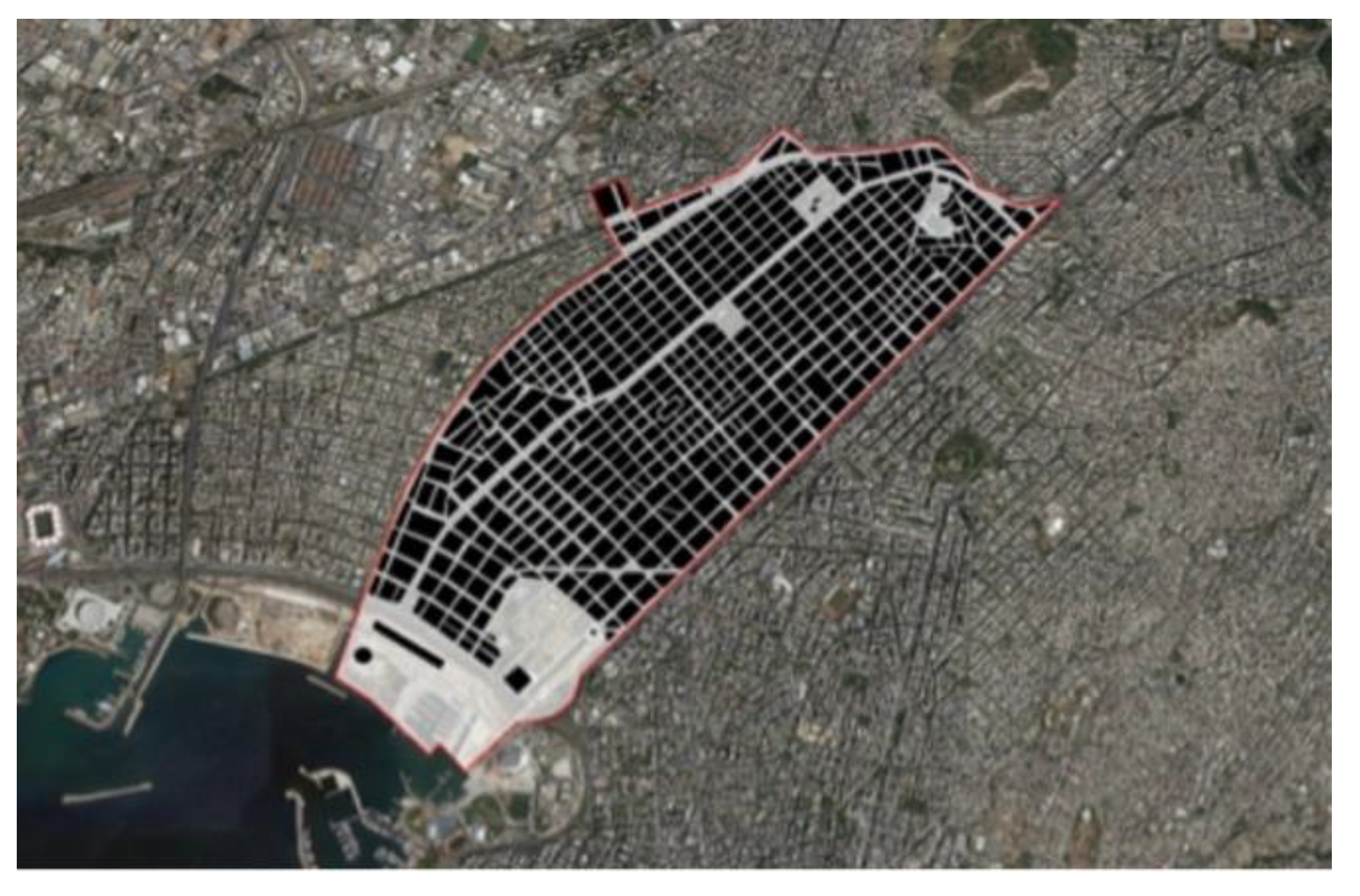
2, which is the highest of all 35 prefectures in the metropolitan area of Athens. As can be seen from the layout of the urban fabric (
Figure 2), Kallithea has a very well-defined grid subdivision, composed of the classic Athenian block. The entire municipality is then divided by a main artery—Thiseos Leof. El. Venizelou avenue—that connects the center of Athens to the coast. The urban blocks are characterized by the succession of buildings made of reinforced concrete, similar to each other in architectural and structural characteristics, they open towards the main streets through numerous balconies, and internally they open towards small courtyards. This building type is predominantly present in all suburban areas of the Athens metropolitan area (AMA), but similar buildings can also be found in many peripheral areas of other European cities. Within this typical urban plot, green areas are limited and almost non-existent.
The position of Kallithea is particularly interesting. In addition to connecting Athens and Piraeus and the south coast, it also represents the main view of the capital from the coastal area. In the urban fabric of Kallithea, the subdivision into blocks is clearly distinguishable, with a precise and regular grid that is exceptionally lost in the central-eastern area and in the northern part, due to the morphological conformation of the land not allowing the continuation of the subdivision. This rigid and densely built subdivision is typical of the first suburbs surrounding the city of Athens. Kallithea is one of the municipalities that is undergoing major transformation, aiming at transforming the extended area into a new cultural and touristic center within the AMA, equipped with new infrastructures and spots of national interest. This urban project will exploit the important elements already present in the area and will build new ones by exploiting the abandoned areas, which, in most cases, derived from the disused facilities of the 2004 Olympic Games. Given the future projects for this area, provided by the town plan [
47], despite the demographic decline currently recorded, a growth in demand for housing in this area can be expected. In this context, it becomes interesting to understand what impact the adoption of a densification strategy could have, especially in consideration of the scarcity of built areas and what the effect could be in an urban fabric that is highly densified—for instance, that of Kallithea.
5. Methodology and Scenarios of Intervention of a Selected Area
To have a complete idea of the study area, one km
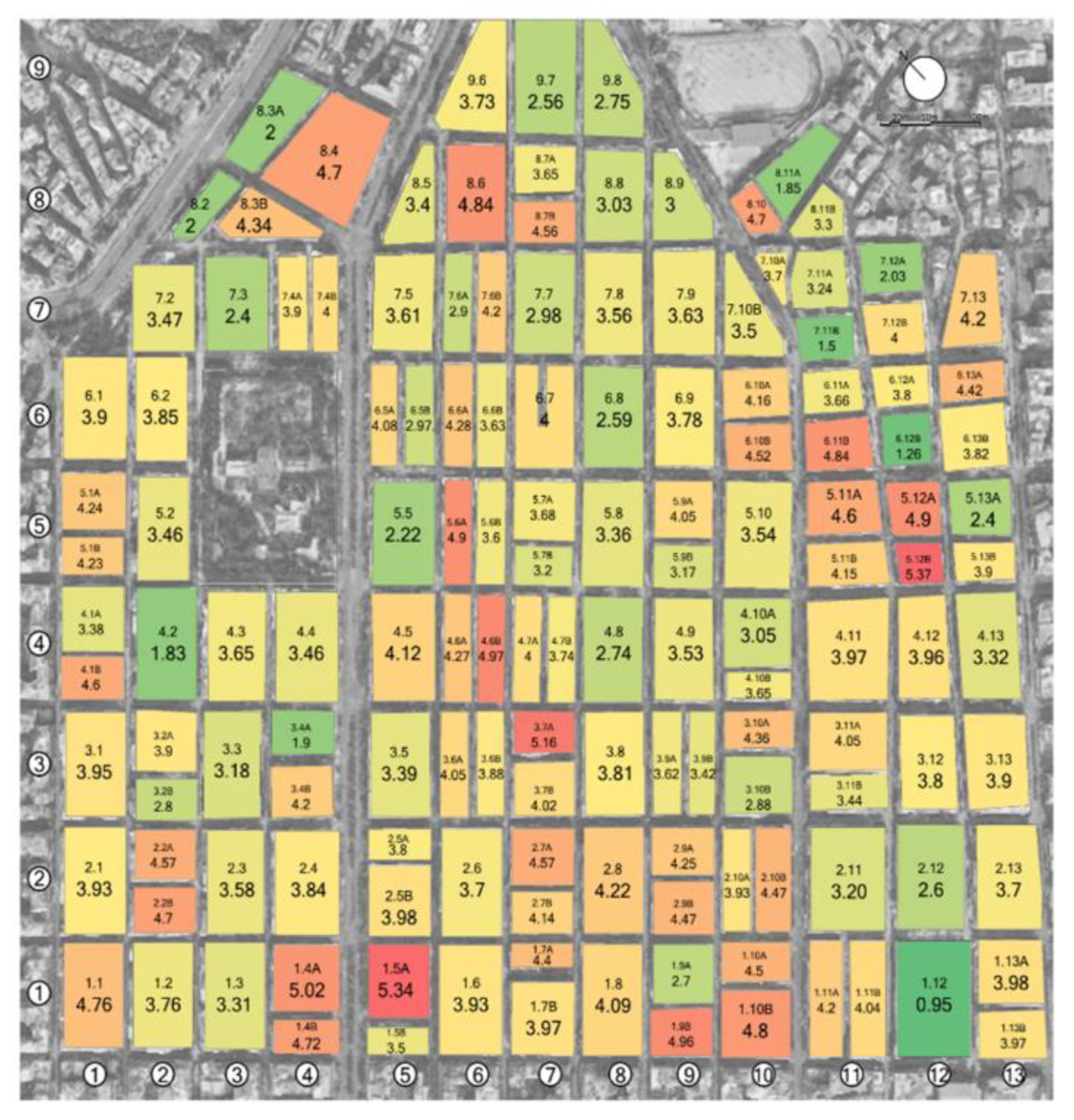
2 was mapped in the northern area, on which the FAR and the index of housing densification was estimated. The mapping of the area, the urban lots and buildings were created in vector format and reproduced with the use of aerial photos. The results obtained confirm the initial data. Out of 143 mapped lots, 84% have a very high population density (
Figure 3).
The following step was to select 8 representative lots of the different densities, out of a total of 143, on which to perform a mapping of the surfaces, so as to be able to evaluate where it would be possible to intervene, through punctual densification works, with volumetric additions.
Successively, the possible options for add-ons and reconstruction of the buildings within the area under study were evaluated in order to determine, through a comparison between costs and benefits, the feasibility and convenience of the construction of the new additions. In particular, the possibility of proposing a redevelopment that could change the aesthetic–architectural characteristics of the whole block was evaluated. The first phase of this procedure consists of the evaluation of the present constraints and in the mapping of the façades, in order to evaluate which buildings and scenarios are most suitable for any type of intervention. In fact, most of the buildings in this area have an average height ranging from 18 to 21 m (approximately 6–7 floors above ground) and some minor exceptions can reach up to 27 m. The use is mainly for residential purpose, with the exception of the ground floor that has some commercial character. In this context, however, there are also some buildings, which are mainly listed, of 2–3 floors that create “gaps” within the urban fabric. These exceptions, if not characterized as listed buildings, were presumably caused by the rapid uncontrolled growth of these suburbs.
It is precisely these buildings that this study has focused the relevant analysis on, as they represent the zones where it will be possible to intervene and obtain greater results through volumetric additions, using strategies such as infill and on top additions. As an alternative to these strategies, in the case of existing buildings with an excessively damaged and seismically dangerous structure, therefore not conservable, demolition and reconstruction is proposed. At the basis of the project lies the redevelopment of buildings on which the volumetric additions will be realized, also with the aim of reconstructing and finalizing the urban plot. Therefore, not only the options that could bring greater benefit from an economic point of view have been identified, but also from the architectural benefit and aesthetical value points of view. For this reason, it was decided to fully exploit the available surfaces according to the regulations, while at the same time preserving the characteristics of the buildings. Through these interventions, it is really possible to avoid the consumption of new soil and preserve the open areas that are still unexploited, through reusing the volumes unused so far to create new housing units. This objective could have a crucial role in an ever-growing municipality such as Athens. Future expansion and reconstruction projects will be based on the principles of “energy conscious design”, aiming to create architectural organisms that optimize relations with the natural environment, thanks to the morphology, orientation, the type of building envelope, and the basis of bioclimatic architecture, in order to minimize the consumption of primary energy, reaching nZEBs buildings.
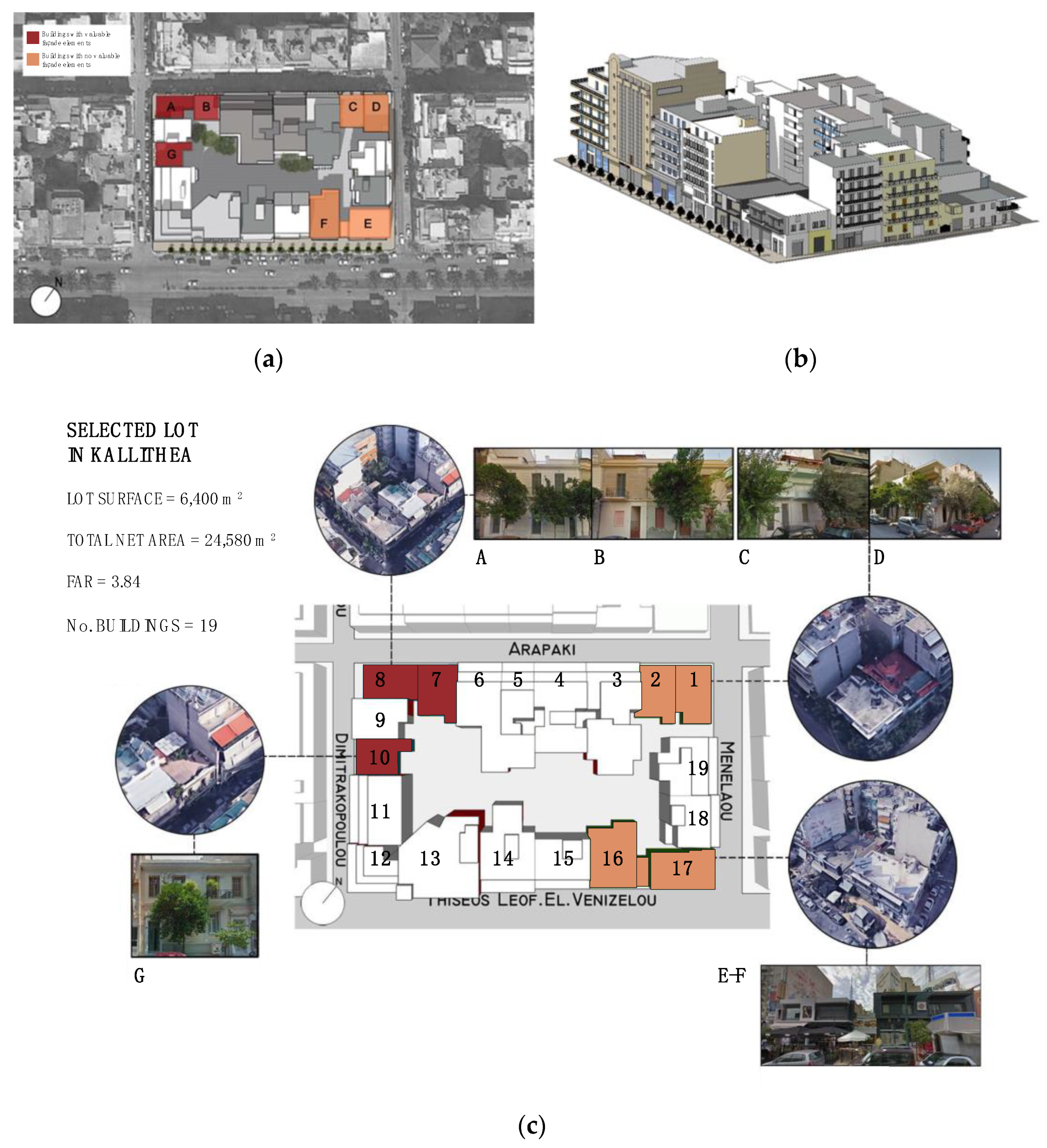
From the selected eight lots (from the 143 lots involved in the initial analysis), lot 2.4 was selected for an extended and detailed analysis (
Figure 4) of the area regarding the feasibility of volumetric addition interventions, in order to verify the economic and energy feasibility of the proposed strategy. The selection of this block is due to its particularly favorable position overlooking the main artery of Kallithea (better exposure to the South) and because of the presence of seven buildings within it, where it is possible to intervene, offering the possibility to hypothesize all possible intervention scenarios (see following
Table 1). There are no listed buildings within the area examined. However, substantial differences are evident from an architectural and aesthetic point of view: some buildings (buildings A, B, G) have remarkable architectural characteristics, which are believed to be safeguarded despite the fact that there is no legislative constraint that imposes their protection, while others (C, D, E, F) have no particularly noteworthy architectural features. Therefore, it was decided to consider the buildings according to two main categories:
Seven different scenarios have been foreseen and studied for lot 2.4, as shown in
Table 1.
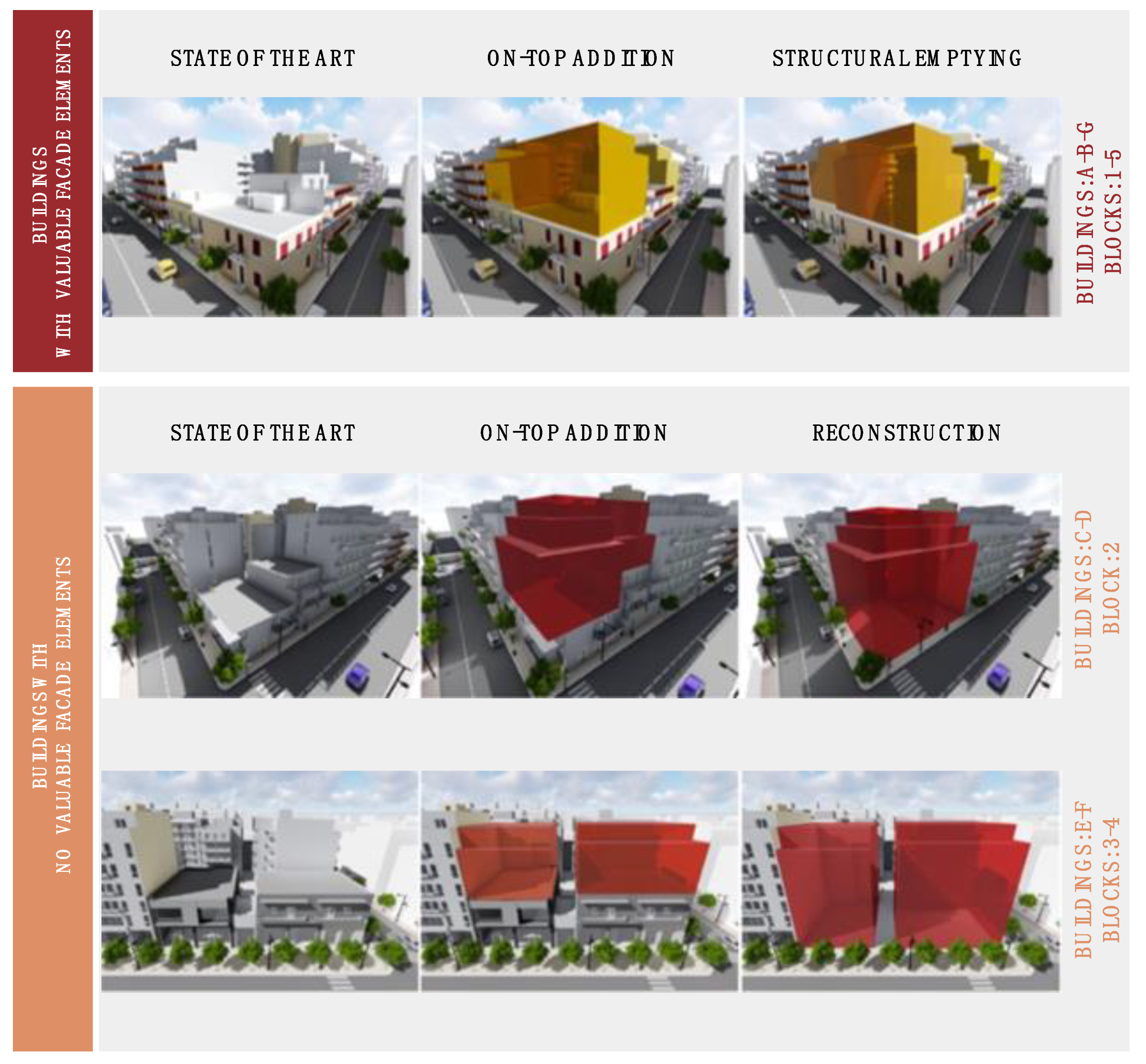
For each building category (listed or not), different intervention strategies are envisaged, which will take into account the different characteristics found, trying to enhance them as much as possible (
Figure 5). Regarding the first category, the interventions considered feasible are the following two:
A.1. Raising through an autonomous structure (“on top”), with conservation of the entire underlying structure and addition of structural reinforcements where necessary;
A.2. Structural emptying, through the construction of an endoskeleton for the new spatial arrangement of the interior spaces and the further development of the vertical structure.
It is important to note that in all the proposals presented, the main façades will remain unchanged in order to maintain the interesting architectural characteristics and thus avoiding excessively altering the urban context. The second category of buildings, on the other hand, concerns residential complexes that are not characterized by significant architectural elements and consists of four structures located on the east side of the block. The elevations of these buildings are anonymous from an architectural point of view and, in most cases, are in very bad condition. For this type of building, it was decided to intervene with a different approach and in a more invasive way both from a structural and architectural point of view, using two different strategies:
B.1. Raising through an autonomous structure (“on top”), with conservation of the entire underlying structure and addition of structural reinforcements where necessary;
B.2. Complete reconstruction, after demolition of the whole existing structure and replacement with a newly built volume.
The construction of the elevation is assumed with the use of standardized prefabricated dry assembled modules. This intervention, however, implies the need—especially in seismic areas such as Athens—of applying reinforcement structures in existing buildings, which are thus subjected to excessive stress induced by the loads. To limit the added load on existing buildings and reduce the prefabrication and installation time, the modules consist of a structure framed in aluminum profiles, laminated wood floors or alternatively in concrete with corrugated sheet, with vertical walls in Cross Laminated Timber sandwich panels and interposed with a layer of rock wool.
All the options have common architectural elements, such as vertical and mobile shading, which allow the control of the solar gain regardless of the exposure of the modules. Furthermore, a construction system was designed to redevelop the roofs of the existing buildings, which are entirely flat and currently unused, and convert them into green roofs, with the application of steel frames that could allow the installation of photovoltaic systems.
6. Results
This research study has developed an energy and economic analysis of the assumed interventions, at a district level. From the energy performance point of view, the design of all new building units and volumetric additions meets the nZEB requirements, with low energy requirements of around 30 kWh/m
2 or even lower, which could be completely covered by renewable sources that produce energy on site. The energy feasibility is therefore verified, and thus falls within the limits and targets set in the EPBD 2010/31/EU [
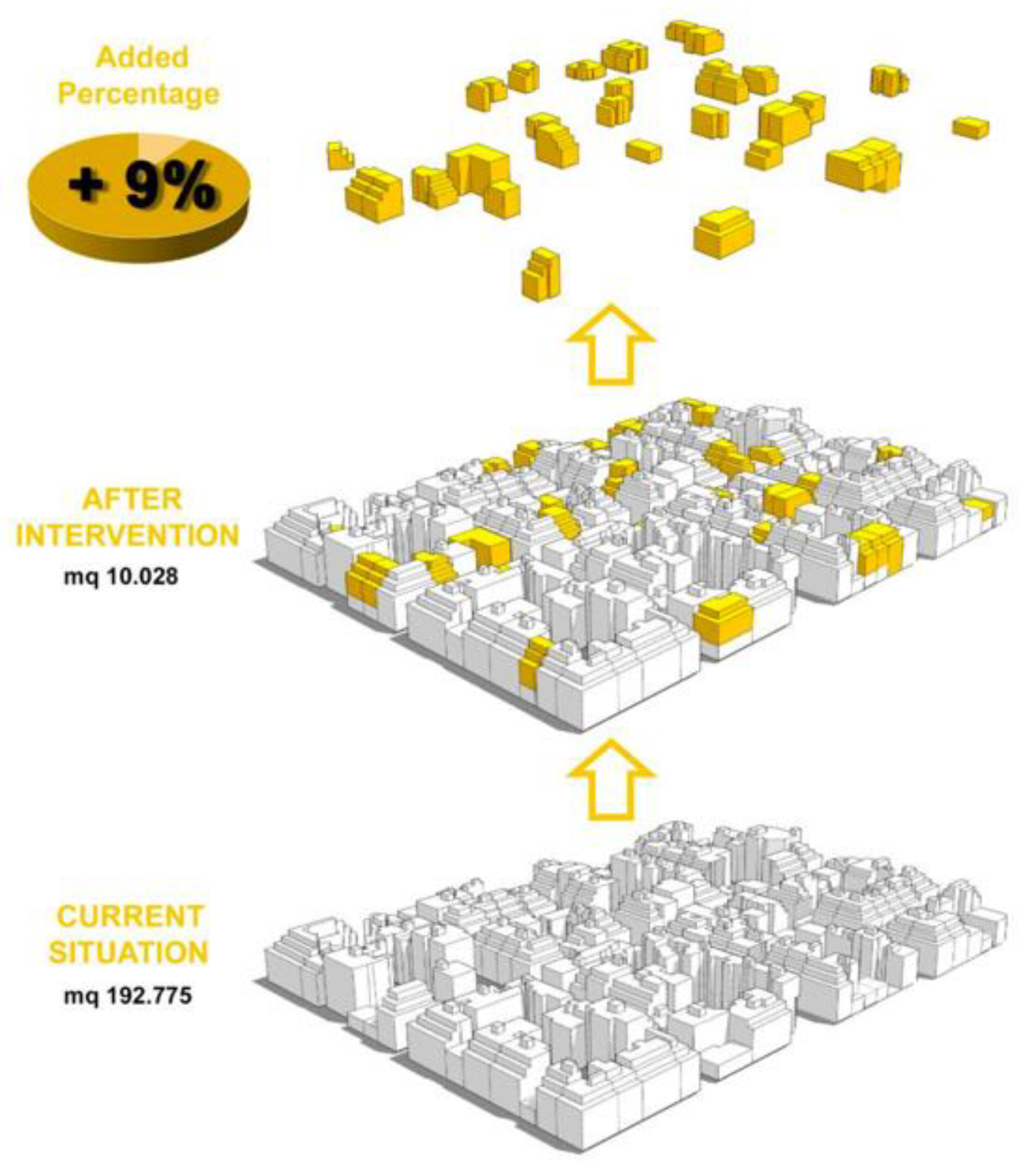
48], which requires that all new buildings from 31 December 2020 will be almost zero-energy. In addition, an increase of 9% of the built area was obtained (
Figure 6) through add-ons, with no impact on soil consumption, in compliance with energy and environmental sustainability criteria.
Regarding the financial–economic aspects, the research has preliminarily defined a list of hypotheses concerning the current situation of the real estate market and construction costs, identifying the prices (€/m2) with reference to the following interventions:
Deep renovation (in case of complete reconstruction);
Demolition (in case of replacement);
Construction (for new buildings);
Real estate value (potential gain from the sale of new units).
For the last item, the average selling prices of buildings in the area were considered, and slightly increased to take into account the higher energy performance of the new buildings, according to the standard identified by EPBD 2010/31/EU, which requires MS to reduce the energy consumption of buildings through new nZEBs.
As far as the cost analysis is concerned, assumptions have been made to assess a price (€/m2) for new additions and a consequent sales price. A sales price of 2200 €/m2 and a construction cost of 1200 €/m2 have been estimated for the different project buildings, except the E–F buildings with the steel reinforcement structure as the adopted solution, which would imply an increase in construction prices of up to 1400 €/m2, these values were added to the estimates of the previous phase to make a comparison between costs and benefits.
A controlled demolition cost is also foreseen, so as not to ruin the adjacent buildings, whose has been identified through the current price list of the Italian region of Emilia Romagna, which is believed to have prices and costs in line with those currently in force in the municipality of Kallithea. The projects presented have the primary aim of increasing the living surface area of the buildings, where possible, in order to obtain new housing units to be placed on the market. The proposed intervention strategy is based on the principle that the net gains achieved are subsequently used to perform deep renovations in neighboring buildings.
The final phase of the research study concerns the verification of the economic feasibility of the whole project and the hypothesis of different variations of the same project, through the use of the calculation tool created within the ABRACADABRA project: the payback time tool. This toolkit [
49], thanks to the acquirement of input data, allows us to obtain economic estimates on the buildings and therefore to evaluate the added values that can be obtained through the new interventions and the payback time of the investments. In the analysis presented here, there is a cost of 300 €/m
2 for the deep renovation, 1200 €/m
2 for the elevation and a minimum cost of 1400 €/m
2 for the realization of assistant Building, which is variable between the different scenarios, according to the related costs of demolition and installation of photovoltaic systems.
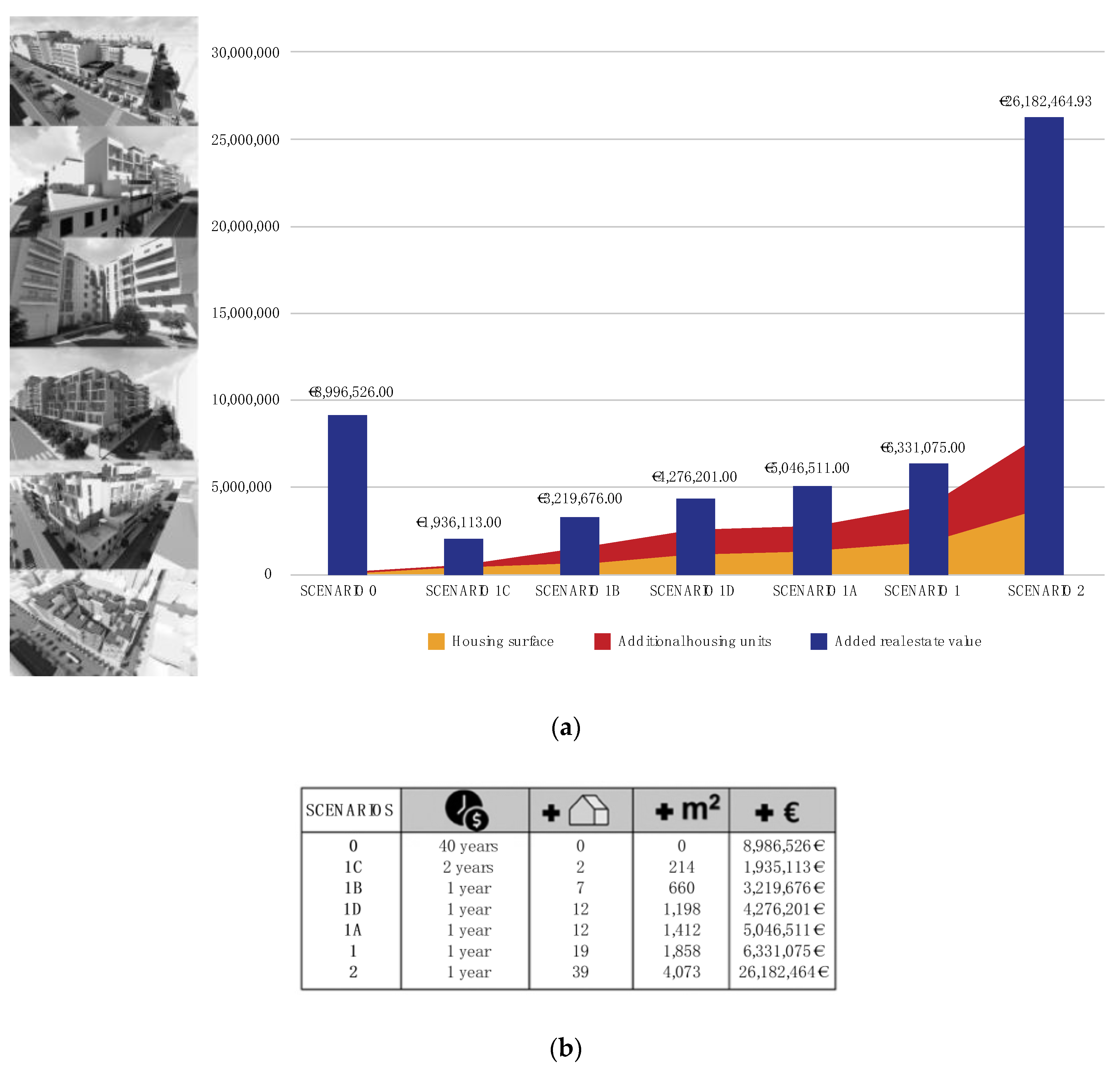
The graph and table in
Figure 7 represent the summary and comparison of the analyses carried out on the seven scenarios (
Table 1) in the selected lot 2.4 (
Figure 4). It is possible to see how the added real estate value grows linearly together with the additional surface area, thanks to the new densification interventions. These data confirm the success of the densification strategy within already consolidated contexts, promoting its use. It should be noted that the best solutions result from the ones set out in scenarios 1 and 2, i.e., those with a higher number of newly built units. This means that by intervening punctually in the urban voids currently present in this highly urbanized context, it is possible to balance the redevelopment interventions, resulting in very short payback times for initial investments, and thus recreating a visual and composing unity in the area.
Moreover, it is interesting to note that the solution is feasible both on an architectural scale (shown specifically with scenario 1d) and on an urban scale (scenario 2), considering the whole block as a unicum. Finally, the results obtained in scenario 1 and all its declensions should not be underestimated. In these structural emptying interventions, the costs of controlled demolition and subsequent structural consolidation of the existing façades are considerable, doubling the costs that would have been incurred in case of complete demolition. In conclusion, all the scenarios that envisage this type of intervention present considerable added value, and thus resulting in effective interventions, from an aesthetic–architectural, performance and economic point of view.
7. Conclusions
The results reached by this work demonstrate how the add-ons, combined with energy and other non-energy related aspects, may reduce the payback times of the investments and increase the real estate value, providing at the same time an extraordinary opportunity to enhance urban resiliency in highly populated metropolises facing the challenge of evolving climate change.
These impacts can also be detected in contexts where the market real estate value is significantly lower, especially in high-density urban areas, such as the Kallithea district in Athens.
After a preliminary phase of study of the urban and architectural context of the intervention, the cataloguing of the structures suitable for the implementation of volumetric additions was conducted, based on the architectural and structural characteristics, followed by the development of design hypotheses for the individual categories and finally by the design development of the most suitable hypothesis. Definitively, the energy and economic checks carried out using the toolkits developed within the strategy proposed led to positive results. The densification of urbanized areas is therefore confirmed as an optimal solution to the twofold need to redevelop the building heritage and reduce the consumption of urban land.
The study also shows that the economic value increases linearly to the percentage of densification applied to the area. Greater densification can bring better gains and results, both in terms of increasing the number of property units and in terms of raising the real estate value of existing buildings, demonstrating a successful strategy at architectural and urban level. This result acquires even greater value if related to the specific case of the Kallithea district, where there are many areas suitable for this type of intervention, presented in a constant manner in all the mapped parcels. The proposed strategy is therefore suitable and resolutive in a fast growing, urban context that is undergoing redevelopment.
In conclusion, if adopted at the urban scale, the proposed strategy can effectively contribute to extending and applying nearly zero energy targets in the context of existing and consolidated built urban areas, as well as reducing landscape urban expansion and soil impermeability, in order to pursue a holistic approach to urban design that is attentive to the decarbonization aspect. The use of existing structures and grids in the urban settings proposed by the strategy, if combined with a sustainable public transport policy, would therefore result in a significant reduction in the amount of CO2 embodied and produced.
To achieve these results in practice, public authorities should be able to abandon current local urban legislation, which regulates urban planning capacity, regulatory standards and land-use restrictions. Of course, the possibility to make these exceptions should be closely linked to the highest target in terms of energy efficiency (towards nZEB), environmental impact and social acceptance.