The Tea Bag Index—UK: Using Citizen/Community Science to Investigate Organic Matter Decomposition Rates in Domestic Gardens


Abstract
1. Introduction
2. Materials and Methods
2.1. Tea Bag Index
2.2. Project Design
- A personally signed thank you note from the project director;
- Three pairs of preweighed (on a four decimal place balance) tea bags (1 green, 1 rooibos in each pair). Each pair was tied to a colour coded labelled marker stick, enabling easy identification of returned samples, marking the burial location for participants, and standardising the depth at which tea bags were buried;
- Three polythene sample bags for soil samples, labelled and colour coded to match their corresponding tea bag pairs;
- An information pack, which briefly introduced the project and provided instructions on the procedure, including suggestions for where to bury them (see Supplementary Information, Figure S1);
- A short questionnaire asking the participants to provide information on the locations where they buried the tea bags and how long they were buried. Participants were asked for the post code/GPS location of where they buried the tea bags as this was not necessarily the same as the address that they were posted to. Some participants, for example, buried their tea bags in allotments, or in the residence of family members. The questionnaire was kept very simple to promote completion and consisted of tick boxes. Participants were asked, for each of the three locations:
- Where did you bury this pair of tea bags (lawn, flower bed, vegetable patch, etc.)
- Do you apply any compost, manure, or similar to this area of your garden? (Yes or No)
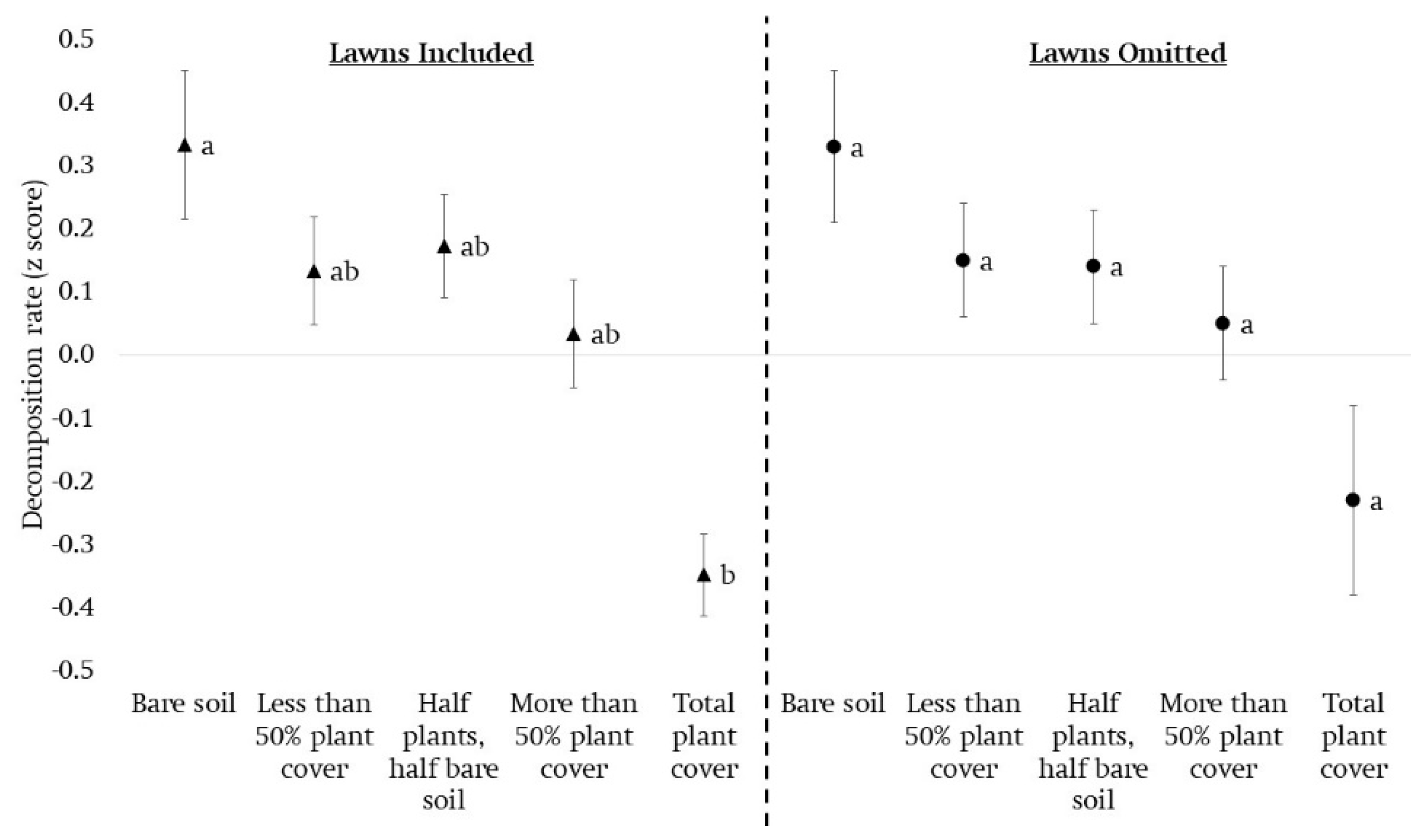
- If we drew a rough 50 cm (1½ft) square, with the tea bags in the centre, what would the plant cover be? (Bare soil; less than 50% plant cover; half plants, half bare soil; more than 50% plant cover; or total plant cover).
2.3. Recruitment and Communication with Volunteers
2.4. Statistical Analysis
3. Results
3.1. Sample Return
3.2. Lawn Data Only
3.3. All Samples
3.4. Decomposition Rate
3.5. Stabilisation Factor
3.6. Soil Carbon and Nitrogen
3.7. Within Garden Effects
4. Discussion
4.1. UK Garden Soils
4.2. Effect of Amendment Application
4.3. Use of Garden Samples in International Soil Assessments
4.4. Engaging with the Community
4.5. Further Research and Considerations
5. Conclusions
Supplementary Materials
Author Contributions
Funding
Acknowledgments
Conflicts of Interest
References
- Calvet-Mir, L.; Gómez-Baggethun, E.; Reyes-García, V. Beyond food production: Ecosystem services provided by home gardens. A case study in Vall Fosca, Catalan Pyrenees, Northeastern Spain. Ecol. Econ. 2012, 74, 153–160. [Google Scholar] [CrossRef]
- Camps-Calvet, M.; Langemeyer, J.; Calvet-Mir, L.; Gómez-Baggethun, E. Ecosystem services provided by urban gardens in Barcelona, Spain: Insights for policy and planning. Environ. Sci. Policy 2016, 62, 14–23. [Google Scholar] [CrossRef]
- Livesley, S.J.; Dougherty, B.J.; Smith, A.J.; Navaud, D.; Wylie, L.J.; Arndt, S.K. Soil-atmosphere exchange of carbon dioxide, methane and nitrous oxide in urban garden systems: Impact of irrigation, fertiliser and mulch. Urban Ecosyst. 2010, 13, 273–293. [Google Scholar] [CrossRef]
- Cameron, R.W.F.; Blanuša, T.; Taylor, J.E.; Salisbury, A.; Halstead, A.J.; Henricot, B.; Thompson, K. The domestic garden—Its contribution to urban green infrastructure. Urban For. Urban Green. 2012, 11, 129–137. [Google Scholar] [CrossRef]
- Beumer, C. Show me your garden and I will tell you how sustainable you are: Dutch citizens’ perspectives on conserving biodiversity and promoting a sustainable urban living environment through domestic gardening. Urban For. Urban Green. 2018, 30, 260–279. [Google Scholar] [CrossRef]
- Keesstra, S.D.; Bouma, J.; Wallinga, J.; Tittonell, P.; Smith, P.; Cerdà, A.; Montanarella, L.; Quinton, J.N.; Pachepsky, Y.; Van Der Putten, W.H.; et al. The significance of soils and soil science towards realization of the United Nations sustainable development goals. Soil 2016, 2, 111–128. [Google Scholar] [CrossRef]
- Bouma, J. Soil Security in Sustainable Development. Soil Syst. 2019, 3, 5. [Google Scholar] [CrossRef]
- Tresch, S.; Frey, D.; Bayon, R.L.; Mäder, P.; Stehl, B.; Fliessbach, A.; Moretti, M. Direct and indirect effects of urban gardening on aboveground and belowground diversity influencing soil multifunctionality. Sci. Rep. 2019, 9, 1–13. [Google Scholar] [CrossRef]
- Ghosh, S.; Wilson, B.; Ghoshal, S.; Senapati, N.; Mandal, B. Organic amendments influence soil quality and carbon sequestration in the Indo-Gangetic plains of India. Agric. Ecosyst. Environ. 2012, 156, 134–141. [Google Scholar] [CrossRef]
- Olk, D.C.; Gregorich, E.G. Overview of the Symposium Proceedings, “Meaningful Pools in Determining Soil Carbon and Nitrogen Dynamics”. Soil Sci. Soc. Am. J. 2006, 70, 967–974. [Google Scholar] [CrossRef]
- Pérez-Piqueres, A.; Edel-Hermann, V.; Alabouvette, C.; Steinberg, C. Response of soil microbial communities to compost amendments. Soil Biol. Biochem. 2006, 38, 460–470. [Google Scholar] [CrossRef]
- Gerzabek, M.H.; Haberhauer, G.; Kandeler, E.; Sessitsch, A.; Kirchmann, H. Response of organic matter pools and enzyme activities in particle size fractions to organic amendments in a long-term field experiment. Dev. Soil Sci. 2002, 28, 329–344. [Google Scholar]
- González, M.; Gomez, E.; Comese, R.; Quesada, M.; Conti, M. Influence of organic amendments on soil quality potential indicators in an urban horticultural system. Bioresour. Technol. 2010, 101, 8897–8901. [Google Scholar] [CrossRef] [PubMed]
- Schmidt, M.W.I.; Torn, M.S.; Abiven, S.; Dittmar, T.; Guggenberger, G.; Janssens, I.A.; Kleber, M.; Kögel-Knabner, I.; Lehmann, J.; Manning, D.A.C.; et al. Persistence of soil organic matter as an ecosystem property. Nature 2011, 478, 49–56. [Google Scholar] [CrossRef] [PubMed]
- Leifeld, J.; Kögel-Knabner, I. Soil organic matter fractions as early indicators for carbon stock changes under different land-use? Geoderma 2005, 124, 143–155. [Google Scholar] [CrossRef]
- Minasny, B.; Malone, B.P.; McBratney, A.B.; Angers, D.A.; Arrouays, D.; Chambers, A.; Chaplot, V.; Chen, Z.-S.; Cheng, K.; Das, B.S.; et al. Soil carbon 4 per mille. Geoderma 2017, 292, 59–86. [Google Scholar] [CrossRef]
- Davies, Z.G.; Fuller, R.A.; Loram, A.; Irvine, K.N.; Sims, V.; Gaston, K.J. A national scale inventory of resource provision for biodiversity within domestic gardens. Biol. Conserv. 2009, 142, 761–771. [Google Scholar] [CrossRef]
- Loram, A.; Tratalos, J.; Warren, P.H.; Gaston, K.J. Urban domestic gardens (X): The extent & structure of the resource in five major cities. Landsc. Ecol. 2007, 22, 601–615. [Google Scholar] [CrossRef]
- Davies, Z.G.; Dallimer, M.; Edmondson, J.L.; Leake, J.R.; Gaston, K.J. Identifying potential sources of variability between vegetation carbon storage estimates for urban areas. Environ. Pollut. 2013, 183, 133–142. [Google Scholar] [CrossRef]
- Bradley, R.I.; Milne, R.; Bell, J.; Lilly, A.; Jordan, C.; Higgins, A. A soil carbon and land use database for the United Kingdom. Soil Use Manag. 2005, 21, 363–369. [Google Scholar] [CrossRef]
- Edmondson, J.L.; Davies, Z.G.; McHugh, N.; Gaston, K.J.; Leake, J.R. Organic carbon hidden in urban ecosystems. Sci. Rep. 2012, 2, 1–7. [Google Scholar] [CrossRef] [PubMed]
- Alonso, I.; Weston, K.; Gregg, R.; Morecroft, M. Carbon Storage by Habitat: Review of the Evidence of the Impacts of Management Decisions and Condition on Carbon Stores and Sources. In Natural England Research Report NERR024; Natural England: Sheffield, UK, 2012; ISBN 9781783540136. [Google Scholar]
- Fragnière, A. Climate Change and Individual Duties. Interdiscip. Rev. Clim. Chang. 2016, 7, 798–814. [Google Scholar] [CrossRef]
- Rossiter, D.G.; Liu, J.; Carlisle, S.; Xing Zhu, A. Can citizen science assist digital soil mapping? Geoderma 2015, 259–260, 71–80. [Google Scholar] [CrossRef]
- Ryan, S.F.; Adamson, N.L.; Aktipis, A.; Andersen, L.K.; Austin, R.; Barnes, L.; Beasley, M.R.; Bedell, K.D.; Briggs, S.; Chapman, B.; et al. The role of citizen science in addressing grand challenges in food and agriculture research. Proc. R. Soc. B Biol. Sci. 2018, 285, 1–10. [Google Scholar] [CrossRef]
- Fritz, S.; See, L.; Carlson, T.; Haklay, M.; Oliver, J.L.; Fraisl, D.; Mondardini, R.; Brocklehurst, M.; Shanley, L.A.; Schade, S.; et al. Citizen science and the United Nations Sustainable Development Goals. Nat. Sustain. 2019, 2, 922–930. [Google Scholar] [CrossRef]
- Fraisl, D.; Campbell, J.; See, L.; Wehn, U.; Wardlaw, J.; Gold, M.; Moorthy, I.; Arias, R.; Piera, J.; Oliver, J.L.; et al. Mapping citizen science contributions to the UN sustainable development goals. Sustain. Sci. 2020, s11625, 1–17. [Google Scholar] [CrossRef]
- Silvertown, J. A new dawn for citizen science. Trends Ecol. Evol. 2009, 24, 467–471. [Google Scholar] [CrossRef]
- Tweddle, J.C.; Robinson, L.D.; Pocock, M.J.O.; Roy, H.E. Guide to Citizen Science: Developing Implementing and Evaluating Citizen Science to Study Biodiversity and the Environment in the UK; Natural History Museum and NERC Centre for Ecology & Hydrology for UK-EOF: Wallingford, UK, 2012. [Google Scholar]
- Tregidgo, D.J.; West, S.E.; Ashmore, M.R. Can citizen science produce good science? Testing the OPAL Air Survey methodology, using lichens as indicators of nitrogenous pollution. Environ. Pollut. 2013, 182, 448–451. [Google Scholar] [CrossRef]
- Tulloch, A.I.T.; Possingham, H.P.; Joseph, L.N.; Szabo, J.; Martin, T.G. Realising the full potential of citizen science monitoring programs. Biol. Conserv. 2013, 165, 128–138. [Google Scholar] [CrossRef]
- Reid, K. Improving Your Soil: A Practical Guide to Soil Management for the Serious Home Gardener; Firefly Books Ltd.: Richmond Hill, ON, Canada, 2014. [Google Scholar]
- Murphy, E. Building Soil: A Down-To-Earth Approach; Cool Springs Press: Minneapolis, MN, USA, 2015. [Google Scholar]
- Alexander, P.D.; Nevison, I.M. The long-term effects of repeated application of the same organic material to soil in a horticultural context. Acta Hortic. 2015, 1076, 143–150. [Google Scholar] [CrossRef]
- Ryals, R.; Kaiser, M.; Torn, M.S.; Berhe, A.A.; Silver, W.L. Impacts of organic matter amendments on carbon and nitrogen dynamics in grassland soils. Soil Biol. Biochem. 2014, 68, 52–61. [Google Scholar] [CrossRef]
- Lima, D.L.D.; Santos, S.M.; Scherer, H.W.; Schneider, R.J.; Duarte, A.C.; Santos, E.B.H.; Esteves, V.I. Effects of organic and inorganic amendments on soil organic matter properties. Geoderma 2009, 150, 38–45. [Google Scholar] [CrossRef]
- Medina, E.; Paredes, C.; Bustamante, M.A.; Moral, R.; Moreno-Caselles, J. Relationships between soil physico-chemical, chemical and biological properties in a soil amended with spent mushroom substrate. Geoderma 2012, 173–174, 152–161. [Google Scholar] [CrossRef]
- Tresch, S.; Moretti, M.; Le Bayon, R.C.; Mäder, P.; Zanetta, A.; Frey, D.; Fliessbach, A. A gardener’s influence on urban soil quality. Front. Environ. Sci. 2018, 6, 1–17. [Google Scholar] [CrossRef]
- Rinaldi, S.; De Lucia, B.; Salvati, L.; Rea, E. Understanding complexity in the response of ornamental rosemary to different substrates: A multivariate analysis. Sci. Hortic. 2014, 176, 218–224. [Google Scholar] [CrossRef]
- Sandén, T.; Spiegel, H.; Stüger, H.P.; Schlatter, N.; Haslmayr, H.P.; Zavattaro, L.; Grignani, C.; Bechini, L.; D’Hose, T.; Molendijk, L.; et al. European long-term field experiments: Knowledge gained about alternative management practices. Soil Use Manag. 2018, 34, 167–176. [Google Scholar] [CrossRef]
- Marschner, B.; Brodowski, S.; Dreves, A.; Gleixner, G.; Gude, A.; Grootes, P.M.; Hamer, U.; Heim, A.; Jandl, G.; Ji, R.; et al. How relevant is recalcitrance for the stabilization of organic matter in soils? J. Plant Nutr. Soil Sci. 2008, 171, 91–110. [Google Scholar] [CrossRef]
- Karberg, N.J.; Scott, N.A.; Giardina, C.P. Methods for Estimating Litter Decomposition. In Field Measurements for Forest Carbon Monitoring; Hoover, C.M., Ed.; Springer: Berlin/Heidelberg, Germany, 2008; pp. 103–111. ISBN 978-1-4020-8505-5. [Google Scholar]
- Keuskamp, J.A.; Dingemans, B.J.J.; Lehtinen, T.; Sarneel, J.M.; Hefting, M.M. Tea Bag Index: A novel approach to collect uniform decomposition data across ecosystems. Methods Ecol. Evol. 2013, 4, 1070–1075. [Google Scholar] [CrossRef]
- Elliott, K.C.; Rosenberg, J. Philosophical Foundations for Citizen Science. Citiz. Sci. Theory Pract. 2019, 4, 1–9. [Google Scholar] [CrossRef]
- Pocock, M.J.O.; Chapman, D.S.; Sheppard, L.J.; Roy, H.E. A Strategic Framework to Support the Implementation of Citizen Science for Environmental Monitoring: Final Report to SEPA; Centre for Ecology & Hydrology: Wallingford, UK, 2014. [Google Scholar]
- Metzger, M.J.; Bunce, R.G.H.; Jongman, R.H.G.; Mücher, C.A.; Watkins, J.W. A climatic stratification of the environment of Europe. Glob. Ecol. Biogeogr. 2005, 14, 549–563. [Google Scholar] [CrossRef]
- Joost, A.K.; Dingemans, B.J.; Sarneel, J.M.; Lehtinen, T.M.; Hefting, M.M. The Tea Bag Index for Decomposition: A standard decomposition reference for global comparison of scientific results. Utr. Univ. 2009, 94, 1. [Google Scholar]
- Emmett, B.A.; Reynolds, B.; Chamberlain, P.M.; Rowe, E.; Spurgeon, D.; Brittain, S.A.; Frogbrook, Z.; Hughes, S.; Lawlor, A.J.; Poskitt, J.; et al. Countryside Survey: Soils Report from 2007: CS Technical Report No. 9/07; Centre for Ecology & Hydrology: Wallingford, UK, 2010. [Google Scholar]
- Wang, W.J.; Baldock, J.A.; Dalal, R.C.; Moody, P.W. Decomposition dynamics of plant materials in relation to nitrogen availability and biochemistry determined by NMR and wet-chemical analysis. Soil Biol. Biochem. 2004, 36, 2045–2058. [Google Scholar] [CrossRef]
- Edmondson, J.L.; Davies, Z.G.; McCormack, S.A.; Gaston, K.J.; Leake, J.R. Land-cover effects on soil organic carbon stocks in a European city. Sci. Total Environ. 2014, 472, 444–453. [Google Scholar] [CrossRef] [PubMed]
- Powlson, D.S.; Bhogal, A.; Chambers, B.J.; Coleman, K.; Macdonald, A.J.; Goulding, K.W.T.; Whitmore, A.P. The potential to increase soil carbon stocks through reduced tillage or organic material additions in England and Wales: A case study. Agric. Ecosyst. Environ. 2012, 146, 23–33. [Google Scholar] [CrossRef]
- Poulton, P.; Johnston, J.; Macdonald, A.; White, R.; Powlson, D. Major limitations to achieving “4 per 1000” increases in soil organic carbon stock in temperate regions: Evidence from long-term experiments at Rothamsted Research, United Kingdom. Glob. Chang. Biol. 2018, 24, 2563–2584. [Google Scholar] [CrossRef] [PubMed]
- Duddigan, S.; Shaw, L.J.; Alexander, P.D.; Collins, C.D. Chemical Underpinning of the Tea Bag Index: An Examination of the Decomposition of Tea Leaves. Appl. Environ. Soil Sci. 2020, 2020, 6085180. [Google Scholar] [CrossRef]
- Dewaelheyns, V.; Elsen, A.; Vandendriessche, H.; Gulinck, H. Garden management and soil fertility in Flemish domestic gardens. Landsc. Urban Plan. 2013, 116, 25–35. [Google Scholar] [CrossRef]
- Livesley, S.J.; Ossola, A.; Threlfall, C.G.; Hahs, A.K.; Williams, N.S.G. Soil Carbon and Carbon/Nitrogen Ratio Change under Tree Canopy, Tall Grass, and Turf Grass Areas of Urban Green Space. J. Environ. Qual. 2016, 45, 215–223. [Google Scholar] [CrossRef]
- Jo, H.K.; McPherson, E.G. Carbon storage and flux in urban residential greenspace. J. Environ. Manag. 1995, 45, 109–133. [Google Scholar] [CrossRef]
- Pouyat, R.V.; Yesilonis, I.D.; Nowak, D.J. Carbon Storage by Urban Soils in the United States. J. Environ. Qual. 2006, 35, 1566–1575. [Google Scholar] [CrossRef]
- Rawlins, B.G.; Vane, C.H.; Kim, A.W.; Tye, A.M.; Kemp, S.J.; Bellamy, P.H. Methods for estimating types of soil organic carbon and their application to surveys of UK urban areas. Soil Use Manag. 2008, 24, 47–59. [Google Scholar] [CrossRef]
- Lorenz, K.; Lal, R. Biogeochemical C and N cycles in urban soils. Environ. Int. 2009, 35, 1–8. [Google Scholar] [CrossRef] [PubMed]
- Cleveland, D.A.; Phares, N.; Nightingale, K.D.; Weatherby, R.L.; Radis, W.; Ballard, J.; Campagna, M.; Kurtz, D.; Livingston, K.; Riechers, G.; et al. The potential for urban household vegetable gardens to reduce greenhouse gas emissions. Landsc. Urban Plan. 2017, 157, 365–374. [Google Scholar] [CrossRef]
- Paul, K.; Quinn, M.S.; Huijser, M.P.; Graham, J.; Broberg, L. An evaluation of a citizen science data collection program for recording wildlife observations along a highway. J. Environ. Manag. 2014, 139, 180–187. [Google Scholar] [CrossRef]
- Martin, V.Y. Citizen science as a means for increasing public engagement in science: Presumption or possibility? Sci. Commun. 2017, 39, 142–168. [Google Scholar] [CrossRef]
- Lakeman-Fraser, P.; Gosling, L.; Moffat, A.J.; West, S.E.; Fradera, R.; Davies, L.; Ayamba, M.A.; van der Wal, R. To have your citizen science cake and eat it? Delivering research and outreach through Open Air Laboratories (OPAL). BMC Ecol. 2016, 16, 57–70. [Google Scholar] [CrossRef]
- UN General Assembly. Work of the Statistical Commission pertaining to the 2030 Agenda for Sustainable Development (A/RES/71/313). Gen. Assem. 2017, 71, 1–25. [Google Scholar]
- Charles, A.; Rochette, P.; Whalen, J.K.; Angers, D.A.; Chantigny, M.H.; Bertrand, N. Global nitrous oxide emission factors from agricultural soils after addition of organic amendments: A meta-analysis. Agric. Ecosyst. Environ. 2017, 236, 88–98. [Google Scholar] [CrossRef]
- Thangarajan, R.; Bolan, N.S.; Tian, G.; Naidu, R.; Kunhikrishnan, A. Role of organic amendment application on greenhouse gas emission from soil. Sci. Total Environ. 2013, 465, 72–96. [Google Scholar] [CrossRef]
- Kaartinen, R.; Hardwick, B.; Roslin, T. Using citizen scientists to measure an ecosystem service nationwide. Ecology 2013, 94, 2645–2652. [Google Scholar] [CrossRef]
- UK Government Office for National Statistics. Overview of the UK Population; UK Government Office for National Statistics: London, UK, 2019.



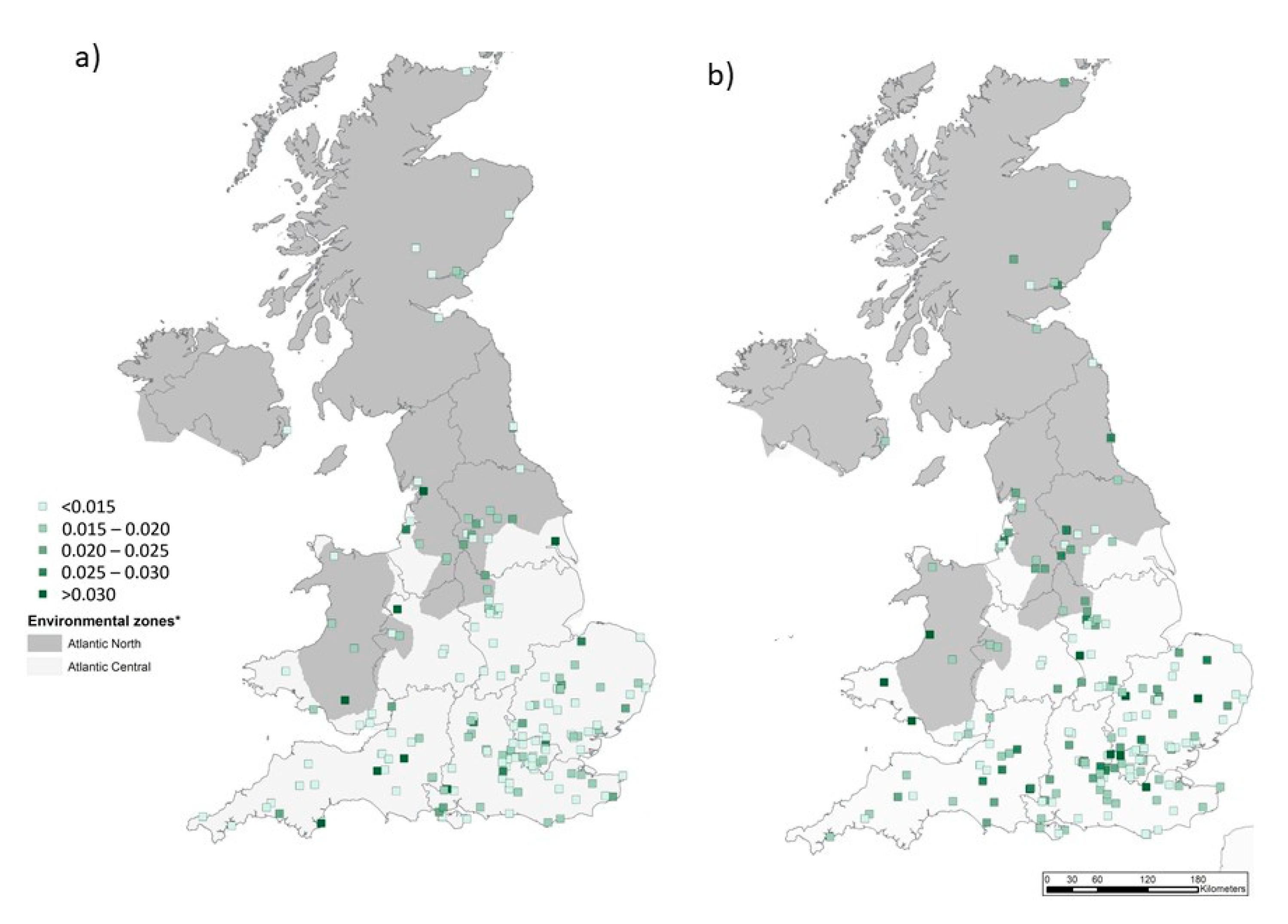
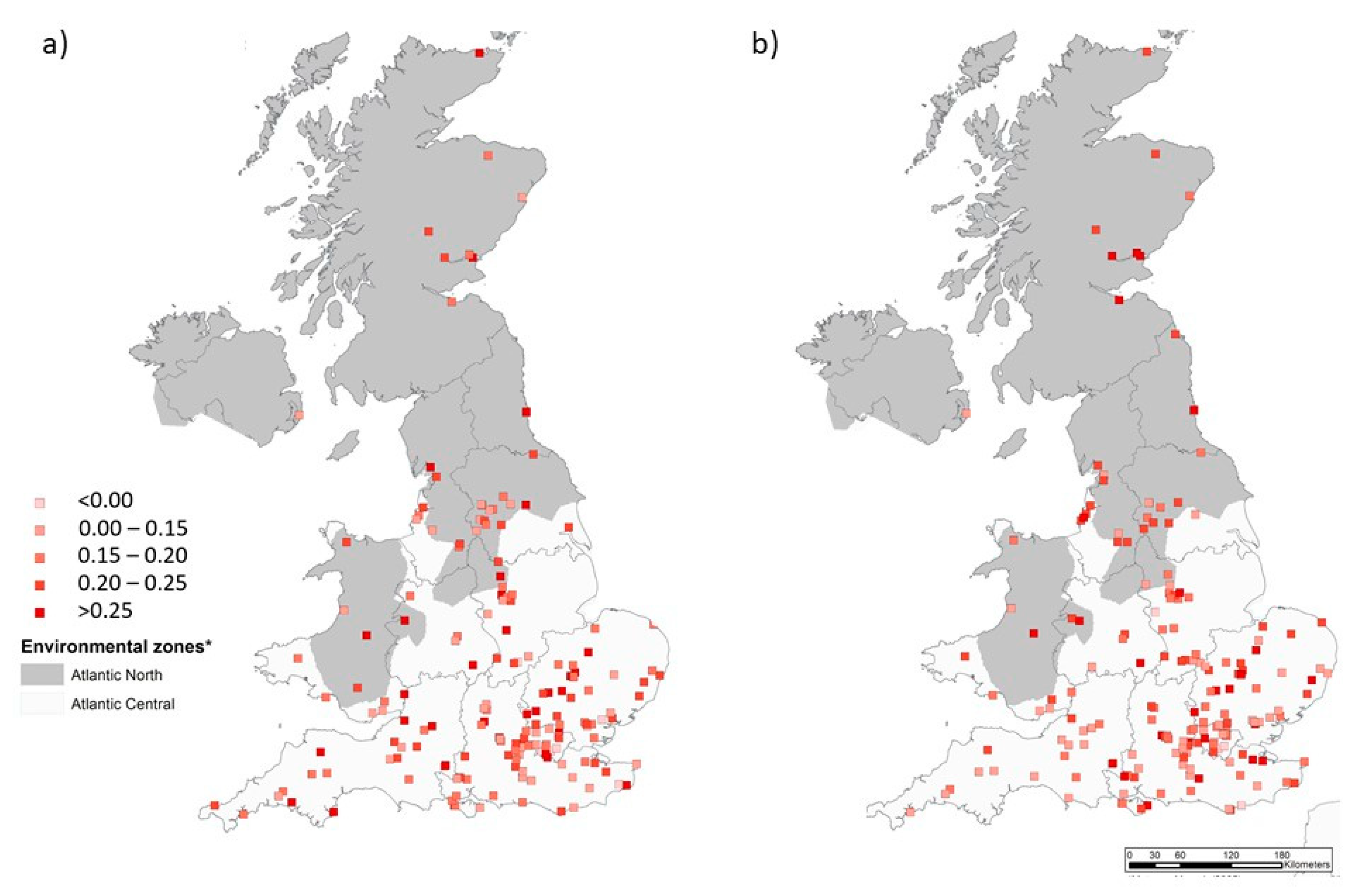
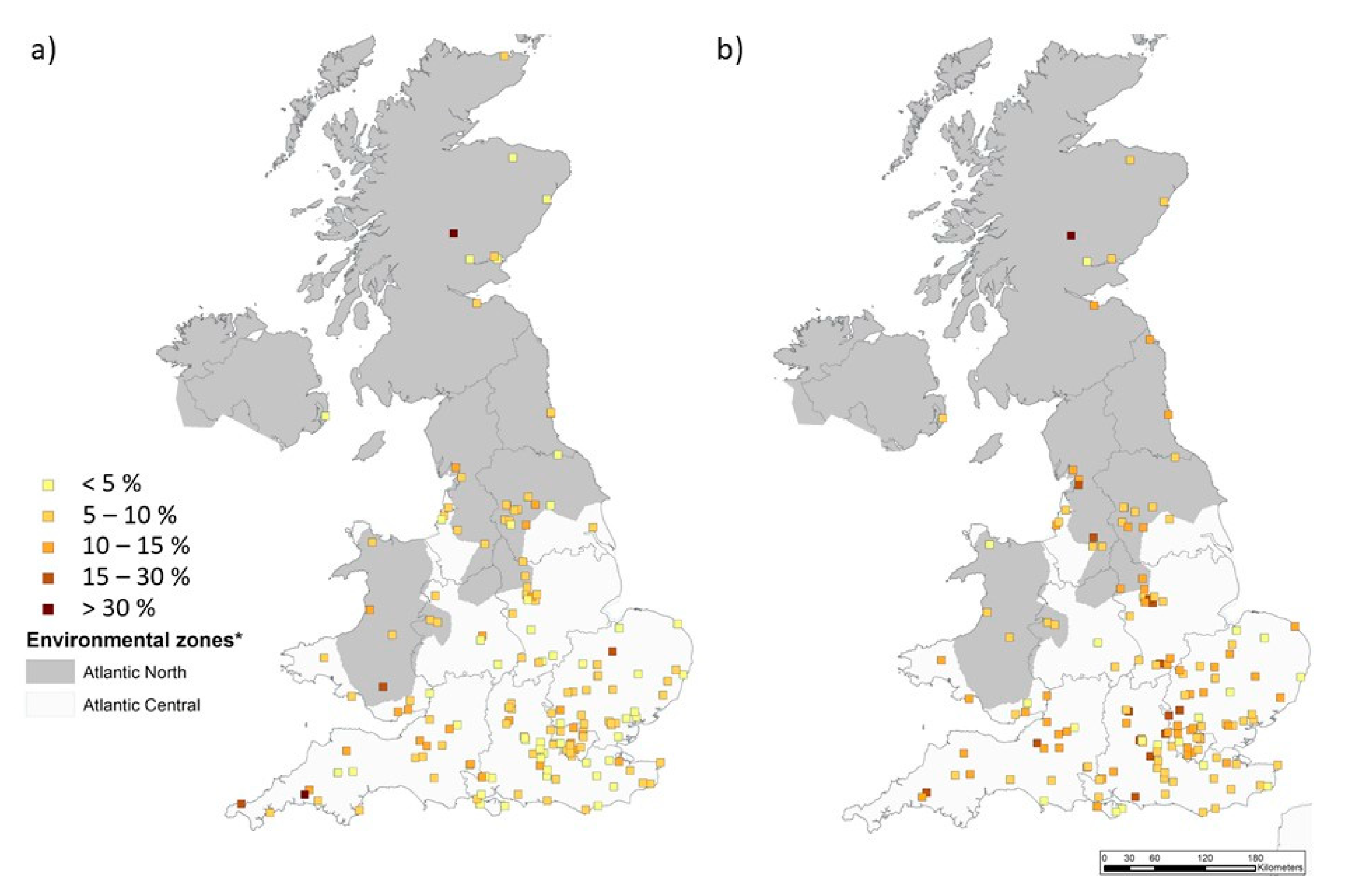
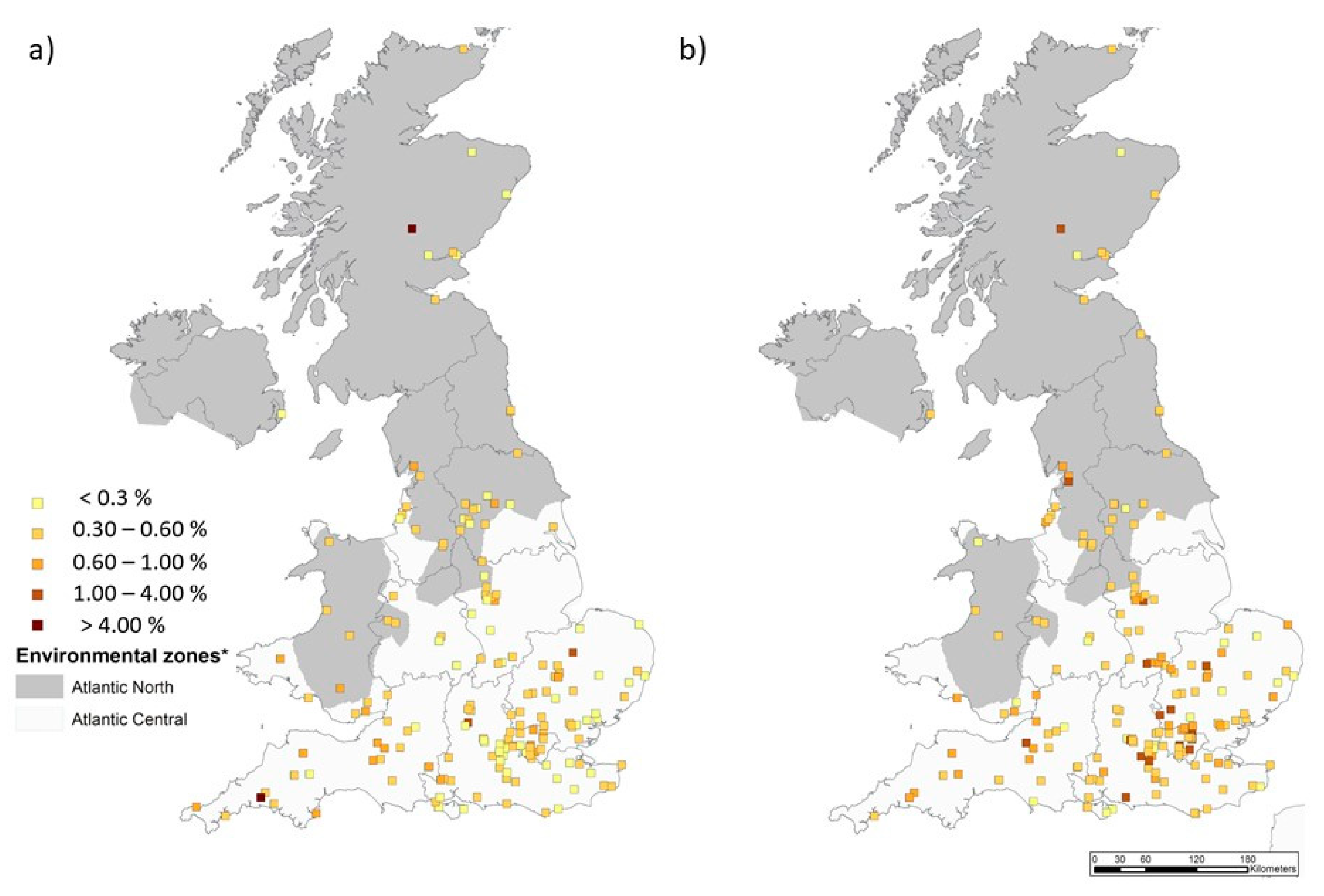
| Decomposition Rate, k | Stabilisation Factor, S | Total Soil C (%) | Total Soil N (%) | C:N | ||
|---|---|---|---|---|---|---|
| Lawns only (no amendments applied) | Atlantic Central (n = 106) | 0.014 ± 0.001 | 0.187 ± 0.007 | 6.39 ± 0.29 | 0.41 ± 0.02 | 15.80 ± 0.43 |
| Atlantic North (n = 32) | 0.015 ± 0.001 | 0.203 ± 0.014 | 7.29 ± 0.66 | 0.39 ± 0.03 | 18.34 ± 0.84 | |
| GLM p-value (environmental zone as a factor) | 0.631 | 0.506 | 0.397 | 0.808 | <0.01 | |
| No amendments applied | Lawn (n = 138) | 0.014 ± 0.001 | 0.191 ± 0.007 | 6.59 ± 0.27 | 0.62 ± 0.21 | 16.26 ± 0.41 |
| Not lawn (n = 112) | 0.017 ± 0.001 | 0.175 ± 0.008 | 7.94 ± 0.50 | 0.42 ± 0.02 | 19.06 ± 0.64 | |
| GLM p-value (location in garden as a factor) | <0.05 | 0.530 | <0.05 | 0.693 | <0.01 |
| p-Value from REML Mixed Effect Model | ||||||
|---|---|---|---|---|---|---|
| Term | Levels | Decomposition Rate, k | Stabilisation Factor, S | Total Soil C (%) | Total Soil N (%) | C:N |
| Environment Zone | Atlantic Central; Atlantic North | 0.296 | 0.132 | 0.074 | 0.729 | <0.05 |
| Location in Garden | Lawn; Not lawn | <0.05 | 0.654 | 0.251 | 0.869 | <0.05 |
| Apply Amendments? | Yes; No | 0.160 | 0.576 | <0.05 | <0.05 | 0.587 |
| Environmental Zone × Location in Garden | 0.745 | 0.940 | 0.182 | 0.635 | 0.553 | |
| Environmental Zone × Apply Amendments? | 0.902 | 0.615 | 0.917 | 0.771 | 0.896 | |
| p-Value from REML Mixed Effect Model | ||||||
|---|---|---|---|---|---|---|
| Term | Levels | Decomposition Rate, k | Stabilisation Factor, S | Total Soil C (%) | Total Soil N (%) | C:N |
| Environment Zone | Atlantic Central; Atlantic North | 0.205 | <0.05 | 0.535 | 0.396 | <0.05 |
| Apply Amendments? | Yes; No | 0.221 | 0.937 | <0.05 | <0.05 | 0.806 |
| Environmental Zone × Apply Amendments? | 0.942 | 0.989 | 0.985 | 0.731 | 0.567 | |
© 2020 by the authors. Licensee MDPI, Basel, Switzerland. This article is an open access article distributed under the terms and conditions of the Creative Commons Attribution (CC BY) license (http://creativecommons.org/licenses/by/4.0/).
Share and Cite
Duddigan, S.; Alexander, P.D.; Shaw, L.J.; Sandén, T.; Collins, C.D. The Tea Bag Index—UK: Using Citizen/Community Science to Investigate Organic Matter Decomposition Rates in Domestic Gardens. Sustainability 2020, 12, 6895. https://doi.org/10.3390/su12176895
Duddigan S, Alexander PD, Shaw LJ, Sandén T, Collins CD. The Tea Bag Index—UK: Using Citizen/Community Science to Investigate Organic Matter Decomposition Rates in Domestic Gardens. Sustainability. 2020; 12(17):6895. https://doi.org/10.3390/su12176895
Chicago/Turabian StyleDuddigan, Sarah, Paul D. Alexander, Liz J. Shaw, Taru Sandén, and Chris D. Collins. 2020. "The Tea Bag Index—UK: Using Citizen/Community Science to Investigate Organic Matter Decomposition Rates in Domestic Gardens" Sustainability 12, no. 17: 6895. https://doi.org/10.3390/su12176895
APA StyleDuddigan, S., Alexander, P. D., Shaw, L. J., Sandén, T., & Collins, C. D. (2020). The Tea Bag Index—UK: Using Citizen/Community Science to Investigate Organic Matter Decomposition Rates in Domestic Gardens. Sustainability, 12(17), 6895. https://doi.org/10.3390/su12176895