Article

A Systems Engineering Framework for Bioeconomic Transitions in a Sustainable Development Goal Context


1
Ruralis—Institute for Rural and Regional Research, N-7049 Trondheim, Norway
2
Department of Mechanical and Industrial Engineering, Norwegian University of Science and Technology, 7491 Trondheim, Norway
*
Author to whom correspondence should be addressed.
Sustainability 2020, 12(16), 6650; https://doi.org/10.3390/su12166650
Submission received: 3 July 2020 / Revised: 12 August 2020 / Accepted: 13 August 2020 / Published: 17 August 2020
(This article belongs to the Special Issue Systems Engineering for Sustainable Development Goals)

Abstract

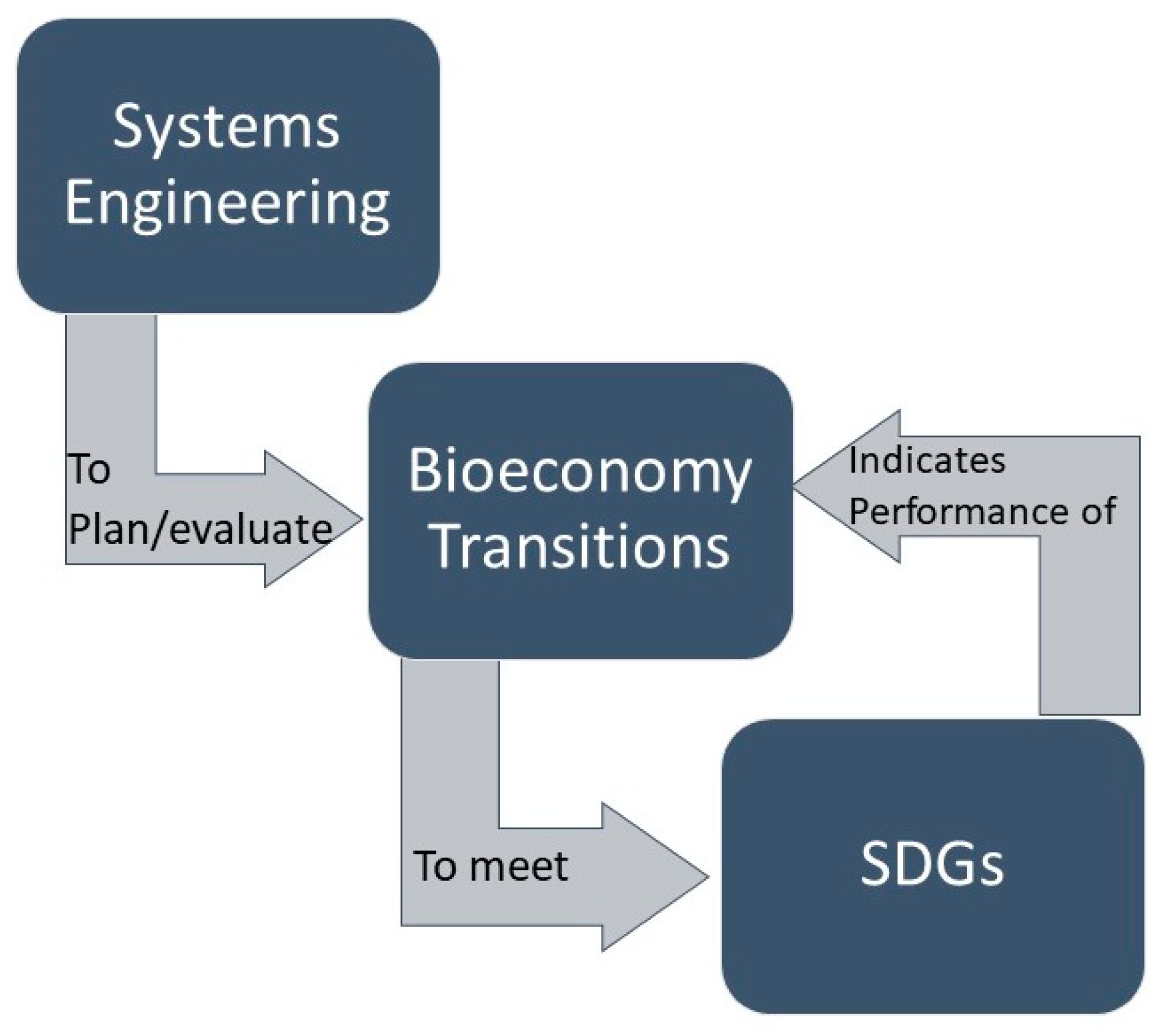
To address sustainable development goals (SDGs), national and international strategies have been increasingly interested in the bioeconomy. SDGs have been criticized for lacking stakeholder perspectives and agency, and for requiring too little of business. There is also a lack of both systematic and systemic frameworks for the strategic planning of bioeconomy transitions. Using a systems engineering approach, we seek to address this with a process framework to bridge bioeconomy transitions by addressing SDGs. In this methodology paper, we develop a systems archetype mapping framework for sustainable bioeconomy transitions, called MPAST: Mapping Problem Archetypes to Solutions for Transitions. Using this framework with sector-specific stakeholder data facilitates the establishment of the start (problem state) and end (solution state) to understand and analyze sectorial transitions to the bioeconomy. We apply the MPAST framework to the case of a Norwegian agricultural bioeconomy transition, using data from a survey of the Norwegian agricultural sector on transitioning to a bioeconomy. The results of using this framework illustrate how visual mapping methods can be combined as a process, which we then discuss in the context of SDG implementation.
Keywords: systems engineering; bioeconomy; Sustainable Development Goals (SDGs) systems engineering; bioeconomy; Sustainable Development Goals (SDGs)