Determinants of Smart Tourist Environmentally Responsible Behavior Using an Extended Norm-Activation Model




Abstract
1. Introduction
2. Literature Review
2.1. Smart Tourists’ Environmentally Responsible Behavior
2.2. Norm-Activation Model
2.3. Extension of the Norm-Activation Model
3. Methods
3.1. Measurement Items and Survey Development
3.2. Sampling and Data Collection
3.3. Sample Profiles
4. Results
4.1. Confirmatory Factor Analysis
4.2. Structural Equation Modeling
4.3. Indirect-Impact Assessment
4.4. Model Comparison
5. Discussions
5.1. General Discussions
5.2. Implications
5.3. Limitations and Recommendations for Future Research
Author Contributions
Funding
Conflicts of Interest
References
- Bramwell, B. Rural tourism and sustainable rural tourism. J. Sustain. Tour. 1994, 2, 1–6. [Google Scholar] [CrossRef]
- Shen, S.; Sotiriadis, M.; Zhou, Q. Could Smart Tourists Be Sustainable and Responsible as Well? The Contribution of Social Networking Sites to Improving Their Sustainable and Responsible Behavior. Sustainability 2020, 12, 1470. [Google Scholar] [CrossRef]
- Solís-Radilla, M.M.; Hernández-Lobato, L.; Callarisa-Fiol, L.J.; Pastor-Durán, H.T. The Importance of Sustainability in the Loyalty to a Tourist Destination through the Management of Expectations and Experiences. Sustainability 2019, 11, 4132. [Google Scholar] [CrossRef]
- Femenia-Serra, F.; Neuhofer, B.; Ivars-Baidal, J.A. Towards a conceptualisation of smart tourists and their role within the smart destination scenario. Serv. Ind. J. 2019, 39, 109–133. [Google Scholar] [CrossRef]
- Vargas-Sánchez, A. Exploring the concept of smart tourist destination. Enl. Tour. Pathmaking J. 2016, 6. [Google Scholar]
- Gretzel, U.; Sigala, M.; Xiang, Z.; Koo, C. Smart tourism: Foundations and developments. Electron. Mark. 2015, 25, 179–188. [Google Scholar] [CrossRef]
- Sotiriadis, M.; Shen, S.; Zhou, Q. Influence of Social Networks on Responsible Behaviour by Smart Tourists. In Proceedings of the Advances in Digital Marketing and eCommerce; Martínez-López, F.J., D’Alessandro, S., Eds.; Springer International Publishing: Cham, Switzerland, 2020; pp. 9–16. [Google Scholar]
- Weaver, D.B.; Moyle, B.D. ‘Tourist stupidity’ as a basic characteristic of ‘smart tourism’: Challenges for destination planning and management. Tour. Recreat. Res. 2019, 44, 387–391. [Google Scholar] [CrossRef]
- Bamberg, S.; Möser, G. Twenty years after Hines, Hungerford, and Tomera: A new meta-analysis of psycho-social determinants of pro-environmental behaviour. J. Environ. Psychol. 2007, 27, 14–25. [Google Scholar] [CrossRef]
- Blake, J. Overcoming the ‘value-action gap’in environmental policy: Tensions between national policy and local experience. Local Environ. 1999, 4, 257–278. [Google Scholar] [CrossRef]
- Budeanu, A. Sustainable tourist behaviour–a discussion of opportunities for change. Int. J. Consum. Stud. 2007, 31, 499–508. [Google Scholar] [CrossRef]
- Carlsson-Kanyama, A. Climate change and dietary choices—how can emissions of greenhouse gases from food consumption be reduced? Food Policy 1998, 23, 277–293. [Google Scholar] [CrossRef]
- Han, H.; Yoon, H.J. Hotel customers’ environmentally responsible behavioral intention: Impact of key constructs on decision in green consumerism. Int. J. Hosp. Manag. 2015, 45, 22–33. [Google Scholar] [CrossRef]
- Miller, D.; Merrilees, B.; Coghlan, A. Sustainable urban tourism: Understanding and developing visitor pro-environmental behaviours. J. Sustain. Tour. 2015, 23, 26–46. [Google Scholar] [CrossRef]
- Yu, X. Is environment ‘a city thing’in China? Rural–urban differences in environmental attitudes. J. Environ. Psychol. 2014, 38, 39–48. [Google Scholar] [CrossRef]
- Kollmuss, A.; Agyeman, J. Mind the gap: Why do people act environmentally and what are the barriers to pro-environmental behavior? Environ. Educ. Res. 2002, 8, 239–260. [Google Scholar] [CrossRef]
- Han, H. The norm activation model and theory-broadening: Individuals’ decision-making on environmentally-responsible convention attendance. J. Environ. Psychol. 2014, 40, 462–471. [Google Scholar] [CrossRef]
- Onwezen, M.C.; Antonides, G.; Bartels, J. The Norm Activation Model: An exploration of the functions of anticipated pride and guilt in pro-environmental behaviour. J. Econ. Psychol. 2013, 39, 141–153. [Google Scholar] [CrossRef]
- De Groot, J.I.; Steg, L. Morality and prosocial behavior: The role of awareness, responsibility, and norms in the norm activation model. J. Soc. Psychol. 2009, 149, 425–449. [Google Scholar] [CrossRef]
- Steg, L.; De Groot, J. Explaining prosocial intentions: Testing causal relationships in the norm activation model. Br. J. Soc. Psychol. 2010, 49, 725–743. [Google Scholar] [CrossRef]
- Stern, P.C.; Dietz, T.; Abel, T.; Guagnano, G.A.; Kalof, L. A value-belief-norm theory of support for social movements: The case of environmentalism. Hum. Ecol. Rev. 1999, 81–97. [Google Scholar]
- Perugini, M.; Bagozzi, R.P. The role of desires and anticipated emotions in goal-directed behaviours: Broadening and deepening the theory of planned behaviour. Br. J. Soc. Psychol. 2001, 40, 79–98. [Google Scholar] [CrossRef] [PubMed]
- Kiatkawsin, K.; Han, H. An alternative interpretation of attitude and extension of the value–attitude–behavior hierarchy: The destination attributes of Chiang Mai, Thailand. Asia Pac. J. Tour. Res. 2017, 22, 481–500. [Google Scholar] [CrossRef]
- Bui, N.A.; Kiatkawsin, K. Examining Vietnamese Hard-Adventure Tourists’ Visit Intention Using an Extended Model of Goal-Directed Behavior. Sustainability 2020, 12, 1747. [Google Scholar] [CrossRef]
- Ramkissoon, H.; Smith, L.D.G.; Weiler, B. Testing the dimensionality of place attachment and its relationships with place satisfaction and pro-environmental behaviours: A structural equation modelling approach. Tour. Manag. 2013, 36, 552–566. [Google Scholar] [CrossRef]
- Thogersen, J. The motivational roots of norms for environmentally responsible behavior. Basic Appl. Soc. Psychol. 2009, 31, 348–362. [Google Scholar] [CrossRef]
- Pinto, D.C.; Nique, W.M.; Añaña, E.D.; Herter, M.M. Green consumer values: How do personal values influence environmentally responsible water consumption? Int. J. Consum. Stud. 2011, 35, 122–131. [Google Scholar] [CrossRef]
- Gajdošík, T. Smart tourists as a profiling market segment: Implications for DMOs. Tour. Econ. 2019, 1354816619844368. [Google Scholar] [CrossRef]
- Choe, Y.; Kim, J.; Fesenmaier, D.R. Use of social media across the trip experience: An application of latent transition analysis. J. Travel Tour. Mark. 2017, 34, 431–443. [Google Scholar] [CrossRef]
- Buhalis, D.; Amaranggana, A. Smart tourism destinations enhancing tourism experience through personalisation of services. In Information and Communication Technologies in Tourism 2015; Springer: Berlin, Germany, 2015; pp. 377–389. [Google Scholar]
- Femenia-Serra, F.; Perles-Ribes, J.F.; Ivars-Baidal, J.A. Smart destinations and tech-savvy millennial tourists: Hype versus reality. Tour. Rev. 2019. [Google Scholar] [CrossRef]
- Kiatkawsin, K.; Han, H. Young travelers’ intention to behave pro-environmentally: Merging the value-belief-norm theory and the expectancy theory. Tour. Manag. 2017, 59, 76–88. [Google Scholar] [CrossRef]
- Chi, X.; Lee, S.K.; Ahn, Y.; Kiatkawsin, K. Tourist-Perceived Quality and Loyalty Intentions towards Rural Tourism in China. Sustainability 2020, 12, 3614. [Google Scholar] [CrossRef]
- Sarlat, E.M.; García, O.; Wood, P. Urban ethno-botanists, storytellers of our cities: An ecotourism initiative from Barcelona, Spain. J. Ecotourism 2013, 12, 189–196. [Google Scholar] [CrossRef]
- Beerli, A.; Martin, J.D. Factors influencing destination image. Ann. Tour. Res. 2004, 31, 657–681. [Google Scholar] [CrossRef]
- Crouch, G.I.; Ritchie, J.B. Tourism, competitiveness, and societal prosperity. J. Bus. Res. 1999, 44, 137–152. [Google Scholar] [CrossRef]
- del Bosque, I.R.; San Martín, H. Tourist satisfaction a cognitive-affective model. Ann. Tour. Res. 2008, 35, 551–573. [Google Scholar] [CrossRef]
- Dwyer, L.; Kim, C. Destination competitiveness: Determinants and indicators. Curr. Issues Tour. 2003, 6, 369–414. [Google Scholar] [CrossRef]
- Kim, J.-H. The antecedents of memorable tourism experiences: The development of a scale to measure the destination attributes associated with memorable experiences. Tour. Manag. 2014, 44, 34–45. [Google Scholar] [CrossRef]
- Chang, H.S.; Huh, C.; Lee, M.J. Would an Energy Conservation Nudge in Hotels Encourage Hotel Guests to Conserve? Cornell Hosp. Q. 2016, 57, 172–183. [Google Scholar] [CrossRef]
- Hunter-Jones, P.; Jeffs, A.; Smith, D. Backpacking your way into crisis: An exploratory study into perceived risk and tourist behaviour amongst young people. J. Travel Tour. Mark. 2008, 23, 237–247. [Google Scholar] [CrossRef]
- Lee, H.-J.; Wilkins, H.; Lee, Y.-S. Feeling ‘Protected’In Mass Organized Group Tours: -A South Korean case. Int. J. Tour. Sci. 2011, 11, 131–159. [Google Scholar]
- Konrad, K.; Wittowsky, D. Virtual mobility and travel behavior of young people – Connections of two dimensions of mobility. Res. Transp. Econ. 2018, 68, 11–17. [Google Scholar] [CrossRef]
- Fan, Y.; Chen, Q.; Liao, C.-F.; Douma, F. Smartphone-Based Travel Experience Sampling and Behavior Intervention among Young Adults; Intelligent Transportation Systems Institute, Center for Transportation Studies, University of Minnesota: Minneapolis, Minnesota, 2012. [Google Scholar]
- Bryce, J.; Klang, M. Young people, disclosure of personal information and online privacy: Control, choice and consequences. Inf. Secur. Tech. Rep. 2009, 14, 160–166. [Google Scholar] [CrossRef]
- Steeves, V.; Regan, P. Young people online and the social value of privacy. J. Inf. Commun. Ethics Soc. 2014. [Google Scholar] [CrossRef]
- Murata, K.; Orito, Y.; Fukuta, Y. Social attitudes of young people in japan towards online privacy. JL Inf. Sci. 2014, 23, 137. [Google Scholar]
- Johnson, C.Y.; Bowker, J.M.; Cordell, H.K. Ethnic variation in environmental belief and behavior: An examination of the new ecological paradigm in a social psychological context. Environ. Behav. 2004, 36, 157–186. [Google Scholar] [CrossRef]
- Autio, M.; Heinonen, V. To consume or not to consume? Young people’s environmentalism in the affluent Finnish society. Young 2004, 12, 137–153. [Google Scholar] [CrossRef]
- Dunlap, R.E.; Van Liere, K.D.; Mertig, A.G.; Jones, R.E. New trends in measuring environmental attitudes: Measuring endorsement of the new ecological paradigm: A revised NEP scale. J. Soc. Issues 2000, 56, 425–442. [Google Scholar] [CrossRef]
- Kaiser, F.G.; Hübner, G.; Bogner, F.X. Contrasting the Theory of Planned Behavior with the Value-Belief-Norm Model in Explaining Conservation Behavior 1. J. Appl. Soc. Psychol. 2005, 35, 2150–2170. [Google Scholar] [CrossRef]
- Oreg, S.; Katz-Gerro, T. Predicting proenvironmental behavior cross-nationally: Values, the theory of planned behavior, and value-belief-norm theory. Environ. Behav. 2006, 38, 462–483. [Google Scholar] [CrossRef]
- Han, H. Travelers’ pro-environmental behavior in a green lodging context: Converging value-belief-norm theory and the theory of planned behavior. Tour. Manag. 2015, 47, 164–177. [Google Scholar] [CrossRef]
- Schwartz, S.H. Normative influences on altruism. Adv. Exp. Soc. Psychol. 1977, 10, 221–279. [Google Scholar]
- McKercher, B.; Du Cros, H. Cultural Tourism: The Partnership between Tourism and Cultural Heritage Management; Routledge: Abingdon, UK, 2002. [Google Scholar]
- McKercher, B. Towards a classification of cultural tourists. Int. J. Tour. Res. 2002, 4, 29–38. [Google Scholar] [CrossRef]
- Smith, M.K. Issues in Cultural Tourism Studies; Routledge: Abingdon, UK, 2009. [Google Scholar]
- Gnoth, J.; Zins, A.H. Developing a tourism cultural contact scale. J. Bus. Res. 2013, 66, 738–744. [Google Scholar] [CrossRef]
- Gullestrup, H. Cultural Analysis: Towards Cross-Cultural Understanding; Copenhagen Business School Press DK: Frederiksberg, Denmark, 2006. [Google Scholar]
- Kiatkawsin, K.; Han, H. What drives customers’ willingness to pay price premiums for luxury gastronomic experiences at michelin-starred restaurants? Int. J. Hosp. Manag. 2019, 82, 209–219. [Google Scholar] [CrossRef]
- Park, C.-W.; Moon, B.-J. The relationship between product involvement and product knowledge: Moderating roles of product type and product knowledge type. Psychol. Mark. 2003, 20, 977–997. [Google Scholar] [CrossRef]
- Bian, X.; Moutinho, L. The role of product involvement, knowledge, and perceptions in explaining consumer purchase behaviour of counterfeits: Direct and indirect effects. Res. Memo. 2008, 77, 1–34. [Google Scholar]
- Aertsens, J.; Mondelaers, K.; Verbeke, W.; Buysse, J.; Van Huylenbroeck, G. The influence of subjective and objective knowledge on attitude, motivations and consumption of organic food. Br. Food J. 2011. [Google Scholar] [CrossRef]
- Ajzen, I.; Madden, T.J. Prediction of goal-directed behavior: Attitudes, intentions, and perceived behavioral control. J. Exp. Soc. Psychol. 1986, 22, 453–474. [Google Scholar] [CrossRef]
- Fishbein, M.; Ajzen, I. Belief, attitude, intention, and behavior: An introduction to theory and research; Addison-Wesley: Reading, MA, USA, 1977. [Google Scholar]
- Ajzen, I. From intentions to actions: A theory of planned behavior. In Action Control; Springer: Berlin, Germany, 1985; pp. 11–39. [Google Scholar]
- Ramkissoon, H.; Weiler, B.; Smith, L.D.G. Place attachment and pro-environmental behaviour in national parks: The development of a conceptual framework. J. Sustain. Tour. 2012, 20, 257–276. [Google Scholar] [CrossRef]
- Grønhøj, A.; Thøgersen, J. Action speaks louder than words: The effect of personal attitudes and family norms on adolescents’ pro-environmental behaviour. J. Econ. Psychol. 2012, 33, 292–302. [Google Scholar] [CrossRef]
- Leonidou, L.C.; Leonidou, C.N.; Kvasova, O. Antecedents and outcomes of consumer environmentally friendly attitudes and behaviour. J. Mark. Manag. 2010, 26, 1319–1344. [Google Scholar] [CrossRef]
- Howell, B.J. Weighing the risks and rewards of involvement in cultural conservation and heritage tourism. Hum. Organ. 1994, 150–159. [Google Scholar] [CrossRef]
- Hair, J.; Black, W.; Babin, B.; Anderson, R. Multivariate Data Analysis, 7th ed.; Pearson New International Edition; Pearson Education limited: Essex, UK, 2014. [Google Scholar]
- Nunkoo, R.; Ramkissoon, H.; Gursoy, D. Use of structural equation modeling in tourism research: Past, present, and future. J. Travel Res. 2013, 52, 759–771. [Google Scholar] [CrossRef]
- Bagozzi, R.P.; Yi, Y. Specification, evaluation, and interpretation of structural equation models. J. Acad. Mark. Sci. 2012, 40, 8–34. [Google Scholar] [CrossRef]
- Nunally, J.C.; Bernstein, I. Psychometric Theory; McGraw-Hill: New York, NY, USA, 1978. [Google Scholar]
- Scott, D.; Peeters, P.; Gössling, S. Can tourism deliver its “aspirational” greenhouse gas emission reduction targets? J. Sustain. Tour. 2010, 18, 393–408. [Google Scholar] [CrossRef]


| AC | AR | PN | ERBI | INV | AT | |
|---|---|---|---|---|---|---|
| AC | 0.845a | |||||
| AR | 0.653 b (0.426) | 0.842 | ||||
| PN | 0.469 (0.220) | 0.586 (0.343) | 0.822 | |||
| ERBI | 0.338 (0.114) | 0.350 (0.123) | 0.665 (0.442) | 0.800 | ||
| INV | 0.259 (0.067) | 0.279 (0.078) | 0.432 (0.187) | 0.498 (0.248) | 0.891 | |
| AT | 0.303 (0.092) | 0.376 (0.141) | 0.611 (0.373) | 0.689 (0.474) | 0.689 (0.475) | 0.822 |
| AVE | 0.646 | 0.640 | 0.541 | 0.502 | 0.674 | 0.699 |
| Standardized Estimate | t-Value | |||
|---|---|---|---|---|
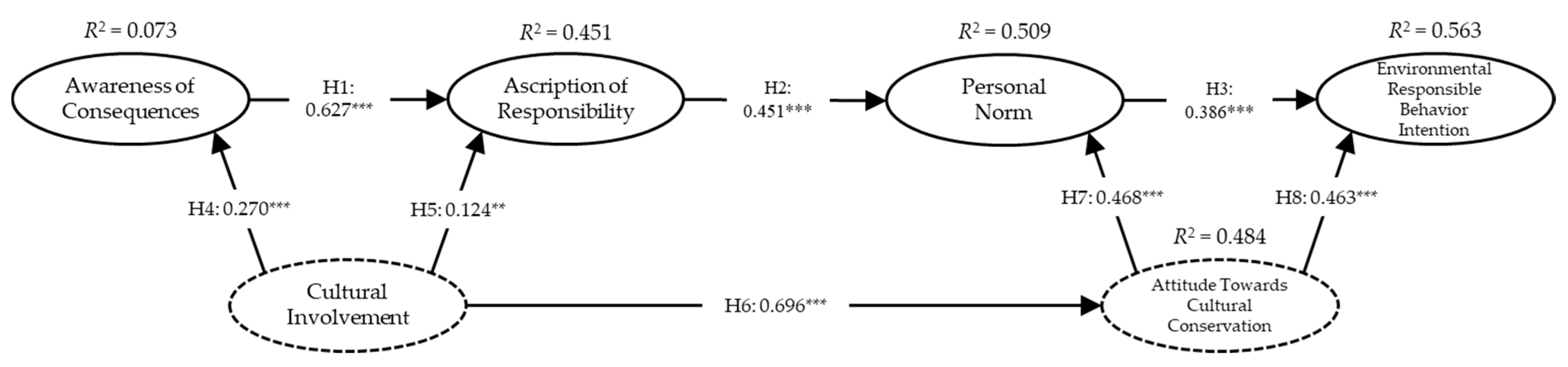
| H1: Awareness of Consequences | → | Ascription of Responsibility | 0.627 | 11.709 *** |
| H2: Ascription of Responsibility | → | Personal Norm | 0.451 | 9.613 *** |
| H3: Personal Norm | → | Environmental Responsible Behavior Intention | 0.386 | 7.027 *** |
| H4: Cultural Involvement | → | Awareness of Consequences | 0.270 | 5.598 *** |
| H5: Cultural Involvement | → | Ascription of Responsibility | 0.124 | 2.962 ** |
| H6: Cultural Involvement | → | Attitude Towards Cultural Conservation | 0.696 | 14.840 *** |
| H7: Attitude Towards Cultural Conservation | → | Personal Norm | 0.468 | 10.274 *** |
| H8: Attitude Towards Cultural Conservation | → | Environmental Responsible Behavior Intention | 0.463 | 8.251 *** |
| Goodness-of-fit statistics: χ2 = 294.375, df = 159, χ2/df = 1.851, RMSEA = 0.039, CFI = 0.978, PNFI = 0.798, TLI = 0.973, NFI = 0.953, PGFI = 0.720 *** p < 0.001, ** p < 0.01 | Total variance explained: R2 of ERBI = 0.563 R2 of PN = 0.509 R2 of AR = 0.451 R2 of AC = 0.073 R2 of AT = 0.484 | Total impact on ERBI: PN = 0.386 AR = 0.174 AC = 0.109 INV = 0.499 AT = 0.643 | ||
| Indirect Effect of | On | ||
|---|---|---|---|
| AR | PN | ERBI | |
| INV | 0.169 *** | 0.458 *** | 0.499 *** |
| AC | - | 0.283 *** | 0.109 *** |
| AR | - | - | 0.174 *** |
| AT | - | - | 0.180 *** |
| Goodness-of-Fit Statistics and R Squared | NAM | Study Model |
|---|---|---|
| Fit indices | ||
| χ2 | 159.717 | 294.375 |
| df | 72 | 159 |
| χ2/df | 2.218 | 1.851 |
| RMSEA | 0.047 | 0.039 |
| CFI | 0.976 | 0.978 |
| PNFI | 0.757 | 0.798 |
| TLI | 0.970 | 0.973 |
| NFI | 0.957 | 0.953 |
| PGFI | 0.659 | 0.720 |
| R2 (Adjusted) | ||
| ERB | 0.440 | 0.563 |
© 2020 by the authors. Licensee MDPI, Basel, Switzerland. This article is an open access article distributed under the terms and conditions of the Creative Commons Attribution (CC BY) license (http://creativecommons.org/licenses/by/4.0/).
Share and Cite
Kiatkawsin, K.; Sutherland, I.; Lee, S.K. Determinants of Smart Tourist Environmentally Responsible Behavior Using an Extended Norm-Activation Model. Sustainability 2020, 12, 4934. https://doi.org/10.3390/su12124934
Kiatkawsin K, Sutherland I, Lee SK. Determinants of Smart Tourist Environmentally Responsible Behavior Using an Extended Norm-Activation Model. Sustainability. 2020; 12(12):4934. https://doi.org/10.3390/su12124934
Chicago/Turabian StyleKiatkawsin, Kiattipoom, Ian Sutherland, and Seul Ki Lee. 2020. "Determinants of Smart Tourist Environmentally Responsible Behavior Using an Extended Norm-Activation Model" Sustainability 12, no. 12: 4934. https://doi.org/10.3390/su12124934
APA StyleKiatkawsin, K., Sutherland, I., & Lee, S. K. (2020). Determinants of Smart Tourist Environmentally Responsible Behavior Using an Extended Norm-Activation Model. Sustainability, 12(12), 4934. https://doi.org/10.3390/su12124934