1. Introduction
The communication of scientific information faces new challenges. The notion that science is an appropriate means for informing policy may no longer hold the weight it once did; this trend has been commented upon in news media, as well as within academia [
1], with some labeling these conditions as a post-truth age [
2]. In 2016, the Oxford English Dictionary dubbed post-truth the word of the year, defining it as “relating to or denoting circumstances in which objective facts are less influential in shaping public opinion than appeals to emotion or personal belief” [
3]. These circumstances correspond a widespread rejection of the establishment in the forms of the mainstream media, experts, elites, officials, and scientists, while embracing arguments couched in the logic of commonsense [
4,
5], and pose a significant challenge for any efforts to foster a collective and just transition toward sustainability, especially when communicating facts about climate change to the public.
Although disingenuous politicians and the propagation of conspiracy theories are hardly novel [
6,
7], there is nevertheless merit to claims about the advent of new conditions. Specifically, this study understands the conditions of post-truth in regard to the rise in social media platforms that now serve as a dominant medium of communication, a development that has had profound implications for science communication due to the shift in how individuals access and interact with information [
1]. This is in stark contrast to early internet optimism, which saw democratic and emancipatory potential in the internet and even related internet-mediated discourse to the Habermasian “ideal speech situation” [
8,
9,
10].
New research suggests that these conditions may be a dominant characteristic of social media. Emotional content has been shown to travel faster and wider on social media platforms [
11,
12], while the largest study of its kind found that false news stories travel faster, wider, and deeper in online networks than truthful ones, with the degree of novelty and emotional reactions of viewers cited as likely causes of the heightened diffusion of false information [
13]. Because online spaces are inundated with false information, the line between what is real and fabricated is often difficult to distinguish [
14,
15]. The result is a proliferation of conspiracy theories and falsities that at one time would have been considered fringe [
16] but are now corroborated by networks of individuals and independent media outlets [
15,
17].
Along with this development, a series of coordinated efforts on behalf of political and commercial interests seek to shape public perception for political and financial gain. Opaque misinformation campaigns take place within these spaces, and social media are now an instrumental tool in coercive efforts to sway electoral politics [
4]. Automated bots masquerading as humans routinely insert inflammatory remarks into public discussion [
4,
12] in much the same vein as an agent provocateur. There are also concerns over surveillance stemming from a lack of control and transparency over access to the personal data of the billions of social media users [
18]. ‘Fake news’ has become a commonplace signifier for delegitimizing online content published by laypeople, established media outlets, and political organizations alike [
19,
20]. Meanwhile, trolls stoke the flames of division, doubt, and conspiracy at a distance [
15,
17].
The previous literature concerning post-truth is limited insofar as it fails to consider post-truth as a structural phenomenon. Indeed, characterizations of post-truth have largely been situated within the discipline of psychology. Some have narrowed in on how subtle underlying psychological tendencies influence online behavior, focusing on phenomena such the backfire effect [
21] or echo chambers [
22]. Another popular position is to emphasize the role of dispositions and argue the widespread rejection of the facts is the result of a deep-seated racism, sexism, or xenophobia [
23]. Such explanations have been leveraged to explain how post-truth resulted in the election of a president who was often overtly misogynistic, racist, or xenophobic [
23]. However, while psychological explanations can surely help to explain why people behave the way they do online, they are insufficient as they tend to ignore the larger structural conditions in which post-truth is situated. A risk of this line of reasoning is that by focusing only on psychological tendencies, it may be easy to simply dismiss those who make choices not in their best interest as racist, sexist, or deplorable (e.g., see Reference [
24]); a tactic which offers no clear pathway forward for addressing post-truth as a social, rather than individual, phenomenon.
Another danger is that without a larger structural understanding, solutions based on psychology may take an instrumental stance on how to best sway public opinion. The logic here is that if appeals to personal belief and emotions are most effective, then those are the avenues which should be explored for communicating with the public [
25]. This tactic has been advocated for from within academia in direct relation to communicating climate change (CC) [
25], as well as more broadly in the traditional media (e.g., [
26]) However, strategies that take an instrumental stance on the role of emotions and employ psychological techniques to yield a wanted response are fundamentally coercive. Regardless of whether the desired outcome is, for example, to convince individuals to accept the reality of CC (e.g., [
25]), this strategy does nothing to reorient public discourse toward rational discussion and at worst reinforces the conditions of a post-truth age; as such, it is self-defeating.
So far, the dominant response from the academic community has been a heightened emphasis on the value of scientific knowledge. This is evident in the sudden proliferation of fact-checking organizations [
2,
19] and flood of academic op-eds on popular news outlets asserting that the facts still matter (e.g., [
27,
28]). Currently, the dominant strategy of scientific communication within online spaces resembles an information deficit model, through which ‘fake news’ is countered with ‘real facts’ [
2,
29] it is assumed that the problem is ignorance and the solution is education. However, our position is that this strategy fails to capture the extent of the problem under the conditions of post-truth. In other words, the information deficit model that underpins much of science communication is ineffective and inadequate.
In light of these shortcomings in the literature, our research investigates whether the conditions of post-truth can be explained as a new iteration of ideological struggle under capitalist hegemony. Our aim is to offer a robust and actionable sociological explanation as a basis for communicating science in regard to the pressing sustainability challenges that require urgent action.
Therefore, we reframe the discursive aspects of post-truth not as a psychological phenomenon but as a struggle over signifiers and their meaning. We adopt a critical position on the nature of ideology, which we take to be a set of discourses that conceal or legitimize injustices and that must be considered in terms of their social and material contexts. We substantiate this claim through a mixed methods investigation that synthesizes corpus-assisted lexical analysis and critical discourse analysis to evaluate 900 user-generated comments taken from three articles on socioenvironmental topics published on Facebook by news organizations in the United States. The motivation for selecting the US is twofold. First, the US has the highest social media penetration in the English-speaking world and is expected to exceed over 200 million users by 2020 [
30], meaning that social media are a prevailing medium of communication. Second, society is characterized by deep class inequalities, with market capitalism as the dominant organizing principle of social life [
31]. Within the US, views on climate change are diverse; only one in three Americans believes that climate change has a direct effect on the US [
32], and there are partisan divisions over presenting information about climate change [
33]. By analyzing the discussion of socioenvironmental issues on Facebook, we substantiate the claim that post-truth can be explained as an ideological struggle under hegemony, thereby demonstrating the explanatory power of neo-Gramscian theory in a novel context. Finally, we offer suggestions for how sustainability studies might respond to post-truth given these findings and conclude that the current practice of communicating in online spaces can no longer stand unchallenged.
2. Theory
We argue that post-truth is best explained as a new facet of ideological struggle under capitalist hegemony, which is sustained through a process of structural mystification. This explanation draws from Neo-Marxian theory, specifically the work of Antonio Gramsci, who proposed the theory of hegemony as an organizing force within unequal societies, as well as recent work by Fairclough, who outlines a critical perspective on the nature of ideology.
A critical perspective implies that ideologies are modalities of power that are involved in the formation and maintenance of unequal social relations [
34]. Ideological framings work by taking the lived experiences of subjects and reframing those experiences in a way that is intuitively appealing but in fact serves to maintain existing power relations. Following this reasoning, ideological struggle is characterized by the fight to diffuse one’s own worldview, rather than as a clash between two polarized paradigms, as different class formations seek to appropriate and reappropriate discursive elements [
34]. Therefore, when analyzed in relation to their larger social context, discursive struggles represent a concrete point of entry for locating the mechanisms that formulate and sustain the unequal power relations of late-capitalism [
35].
Though the precise connections between ideology and emotion are debated, there is general recognition that experiences mediated by ideology are connected to and make use of emotions [
34,
36,
37,
38]. In practice, ideological premises provide reassurance over the whole breadth of human emotion, which work to elevate the perceived validity of a position [
34]. Thus, the relationship between ideology and emotion is described as a “nexus” that aids the organization and construction of ideological framings [
37] (p. 22).
Hegemony refers to the way in which a dominant class maintains power through a combination of coercion and consent through both material and discursive pathways [
39]. The balance between these two forces is such that the dominant class does not exclusively rely on exercising violence or establishing legal and or structural controls but tends to favor more subtle means aimed at pervading the realm of ideas and values. Thus, hegemony refers explicitly to the way in which unequal power relations are established and maintained within the social order of capitalism. Importantly, hegemony deepens the notion of ideology by situating it alongside the political, economic, and cultural spheres in acquiring the consent of the public to their own domination [
40]. According to Gramsci, the entire range of institutions (schools, hospitals, advertising agencies, etc.) as well as those members of the public involved in shaping the values and attitudes of a society (doctors, lawyers, religious figures, teachers. etc.) all contribute to the hegemonic project [
40]. Thus, hegemony includes ideology but cannot be reduced to it, as it stresses both the discursive and nondiscursive pathways employed by the elite to secure power [
34].
Hegemony is established discursively through the manipulation of collective belief-systems to instill a common-sense worldview [
39]. Within this context, subjects adopt ideological positions and make choices that they perceive to be in their best interest, even when these choices may be counter to their wellbeing [
39]. Ultimately, social conditions that serve the elite class are maintained, despite being considered as beneficial to all [
39]. Because ideological formations or common-sense worldviews are in a constant state of fluctuation, they must be habitually reconstructed and reinforced by the hegemonic apparatuses within civil society and the state. Therefore, to employ the concept of hegemony is to provide a tangible entry point for the analysis of the systemic features of societies with unequal power relations. One of the strengths of Gramsci’s theory of hegemony is the emphasis on the human creators of culture, each with their own situated needs and interests [
40]. Gramsci avoids reifying culture into an autonomous system, instead focusing on how hegemonic apparatuses struggle to define the boundaries of a common-sense reality through ideological means [
34,
40].
Within this study, we understand ideology to have most, if not all, of the following characteristics: (1) Seeks to naturalize the status quo, especially existing power relationships; (2) demonstrably functions to maintain this status quo; (3) functions against the best interest of the individual who adopts it; and (4) appeals to ‘common-sense’ reasoning or rhetoric.
Notably, there are some limits to the explanatory power of hegemony. Cultural hegemony emphasizes the rationalized consent to one’s own domination. Here, when ideology is insufficient, rationalized justifications serve to ‘patch up’ the contradictions inherent in societies with unequal social relations. The concept of structural mystification is therefore necessary for explaining a stable hegemony, as Gramsci alone is unable to explain the durability of capitalism.
Although we do not directly peruse the avenue of mystification within our data analysis, this force is relevant as it relates to “the double reversal of exploitation” in advanced capitalism, where the objective truth of exploitation is concealed from the subjective truth of the individual [
41] (p. 191). The relationship between mystification and hegemony is that the former renders exploitation opaque, while the latter organizes consent to domination.
3. Materials and Methods
Investigating whether post-truth can be understood as an ideological struggle under hegemony necessitates that we select a case distinct in its spatial and cyberspatial locations. Therefore, we chose to investigate discussion relating to socioenvironmental issues on Facebook’s comment section, spatially bound to the US. This case study was selected according to Flyvberg’s criteria for a critical case [
42], which is to say both Facebook and US politics have strategic importance in relation to post-truth, especially in the context of climate change; this is the most likely place for confirming or denying the presence of ideological struggle taking place in online debate.
Since its inception in 2004 as a virtual networking site for students at Harvard University, Facebook has grown to host over 2.13 billion monthly users [
43]. In the US, 81 percent of the population reports regularly using the service. If ideological rather than rational struggle is motivating discussion of socioenvironmental issues on social media, Facebook’s expansive user base makes it the most likely place to uncover these mechanisms.
We accessed discussion of socioenvironmental issues on Facebook by locating the top ten most engaged-with news articles, measured in likes, comments, and shares, according to the BuzzSumo platform for market research, using the search term “climate change”. We opted for a time frame of articles published in the six-month period between October 2017 and March 2018 to capture a breadth of topics. Following this, we narrowed our focus by selecting those articles published directly on Facebook by news organizations in the US as opposed to being linked to the platform by another type of user. We did so as this allowed us to assess the response to the article without an individual or business further influencing the discussion. We then refined this selection to three articles based on their thematic qualities in order to have a representative sample of the most discussed topics. The final three articles in order of popularity are visible in
Table 1 below.
As shown in the above table, the first article relates to a video filmed by National Geographic of a dying polar bear. The second article, published by the Washington Post, describes an extreme weather event on the Eastern coast of the United States. Finally, the third article is related to the US withdrawal from the Paris Agreement, posted by ifls.com. After selecting these cases, we extracted a sample of the 300 most relevant comments for analysis, resulting in a total sample size of
N = 900 comments. “Relevant Comments” is a filter available from Facebook which shows the most engaged-with comments, filters out languages other than English, and omits potentially fake accounts. According to Facebook’s transparency guidelines, these are accounts flagged by Facebook that appear to violate the community standards related to authentic representation. It is worth noting that Facebook does not provide precise information regarding the criteria used for identifying potential inauthentic accounts. The decision to select the most relevant comments (in contrast to a random sample, or the first or last 300) is this allowed us to interpret the largest range of viewpoints of users who commented on the articles rather than revealing relatively long conversations between only a few individuals. Sample size was selected based upon a benchmark for assessing online user comments adapted from Koteyko et al. [
44].
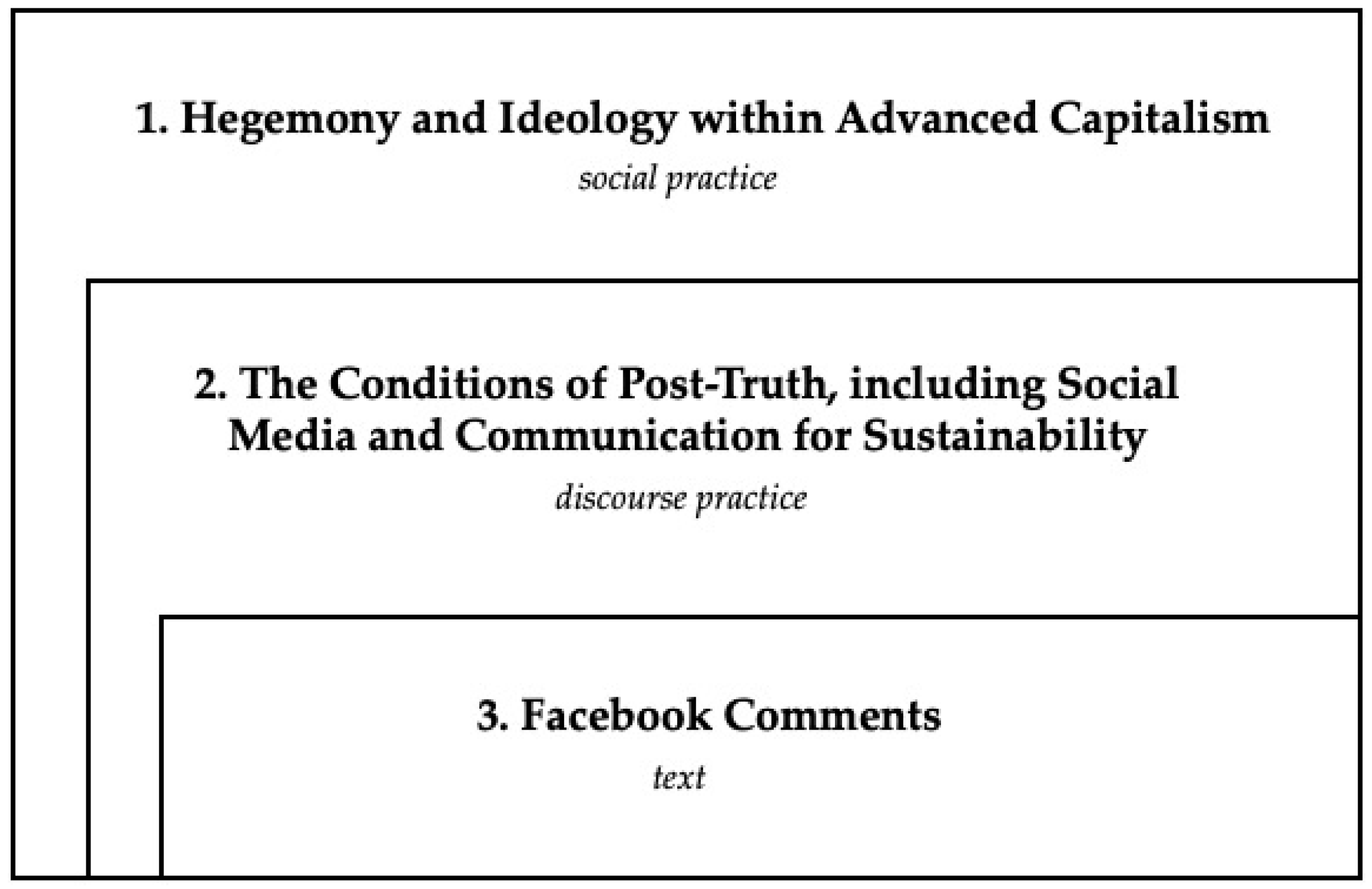
To analyze the data, we undertook a mixed method data-driven approach to textual analysis by coupling tools from Corpus Linguistics with critical discourse analysis (CDA). The qualitative element of this work is centered around Fairclough’s three-part analytical model for CDA, which entails an analysis of text, discourse practice, and social practice (see
Figure 1 below). Though aspects are analytically distinct, we can think of each category as existing in a dialectical relationship with each other where text influences social practice, and social practice influences the text. Textual analysis can enhance the study of hegemony by looking at how texts function to reproduce or challenge the dominance of social groups [
44].
The quantitative aspects of this work centered around corpus-assisted linguistic analysis (CALA) and made use of the open-access Lancs Box platform (Lancaster University). This method allowed for a statistical evaluation of word frequencies, or keywords, which are defined as the statistically significant relative frequency of words in a corpus, with reference to another corpus [
44,
45]. The keywords guided us towards the context and salience of discursive elements in the collection of electronically stored texts. CALA helped us to identify trends within the dataset and served as a starting point for a qualitative analysis, in this case, discursive indicators of ideological struggle, hegemony, and post-truth.
4. Results
Based on the quantitative analysis, it was immediately noticeable that the absolute frequencies of the keywords extracted from the articles varied drastically between each dataset (see
Table 2 below). In the comments responding to the National Geographic article (Dataset 1), the absolute word frequencies of the top five keywords were more than double those of the Washington Post article (Dataset 2), and over five times greater than for the ifl.com article (Dataset 3).
The keywords provide an initial insight into the themes and tones of the comments (see
Table 1 above). Dataset 1 contains many emotional terms, such as ‘sad’, ‘heartbreaking’, ‘suffering’, and ‘starving’, and a clear link between CC, polar bears, and human action is immediately visible. Dataset 2 shows that ‘weather’, ‘climate’, and ‘Trump’ are central concepts, while words like ‘hoax’ suggest dialogue may be contentious. Dataset 3 shows that discourse is contentious, with words like ‘climate’, ‘embarrassing’, ‘fucking’, ‘billions’, and ‘pay’ suggesting there are connections being made between CC, the Paris Agreement, and economic cost. Based on the statistical analysis, we can see that commenters are bringing in topics that are not discussed in the articles. While this is not immediately visible in Dataset 1, Dataset 2 shows that global warming and Donald Trump are brought into discussion despite being absent from the contents of the article. Given that these are both within the top five keywords, these topics are likely salient in the data. Dataset 3 shows a similar result, with an emphasis on ‘paying’, ‘millions’, ‘billions’, and ‘money’, all within the top 50 keywords, yet economic cost is absent from the article.
The qualitative critical discourse analysis revealed a highly diverse set of discourses. However, there are three trends that we will discuss in detail given their saliency within the data and links to ideological struggle. These are a widespread rejection of establishment authorities, a struggle over scientific legitimacy, and a struggle to suppress climate denialism.
The backdrop of these trends was a polarity between those who believe CC is real and those who are skeptical. In descending order, the four dominant positions on CC were:
- (1)
CC is real;
- (2)
CC may or may not be real but may not be responsible for the events in the article;
- (3)
CC is not real;
- (4)
CC is real, but humans are not the cause.
These categories were selected based on their prevalence within the comments and were delineated where the commenter either explicitly stated their position on CC or where their position logically followed from their statement. Within the dataset, it was possible to ascertain the commenters’ position on CC in 47 percent of the comments.
4.1. Anti-Elitism
Each of the datasets revealed a strong distrust in certain elites. Often, this occurred as commenters evoked a public figure or institution (e.g., Al Gore or National Geographic), which was then framed as corrupt. The media were the most widely distrusted authority among climate skeptics (groups 2–4) and was described as “fake news” having an “agenda” or spreading “misinformation” with the intention of scaring the public or generating profits. In dataset 2, claims that elites are profiting from or responsible for extreme weather were common.
In dataset 3, the media were not discussed. Instead, other nations were evoked by skeptics to delegitimize the Paris Agreement (for example, Syria, Saudi Arabia, and North Korea). There were also attempts to delegitimize “liberals” and “democrats”, who were construed to be ignorant and uninformed. However, the dominant rhetorical strategy among skeptics in this dataset was to frame the Paris Agreement as financially irresponsible. Here, there was a rejection of international action on CC in favor of fiscally conservative, America first-style policies. For a representative sample of comments in this category, see
Table 3 below.
4.2. ‘Good Science’ versus ‘Bad Science’
The concept of science was only explicitly brought into discussion twice in dataset 3. Instead, comments centered around whether leaving the Paris Agreement is a good or bad choice (see above). In datasets 1 and 2, science was a central and contentious topic. However, while the concept of ‘science’ was evoked, it was not done in a way reflective of the epistemic validity of science. Instead, science was discussed superficially and without substantiation.
All groups used the premise of scientific authority to delegitimize contrary positions and to legitimize their own position on whether CC is real, or responsible for the events in the articles. It was also common to rely on anger, emotive argumentation, or ridicule. These samples displayed a high amount of interdiscursivity, in which commenters introduced claims made by scientists or other authorities in order to legitimize their position. Among those who believe CC is real, emphasis was placed on consensus and the authority of science was almost wholly unquestioned. However, there was a low incidence of substantiating claims beyond anecdotal evidence. In all groups, there was a distinction drawn between ‘good’ science and ‘bad science’, and references to an “agenda” or “corruption” amongst scientists were common. Skeptics were much more likely to introduce counterexamples, often taking the form of anecdotes or claims associated with unrigorous sources, in order to legitimize a position. For a representative sample of this trend, see
Table 4 below.
4.3. Suppressing Climate Denialism
In all three datasets, those who believe in CC sought to discredit climate skeptics through different strategies of legtimization and delegitimation. While legitimization is the practice of attributing acceptability to social actors, actions, or relations aligned with the status quo [
45], delegitimation is aimed at perceived negative aspects of social actors, actions, or relations and typically makes use of speech acts such as ridiculing, accusing, insulting [
46]. In our study, the most common strategies of delegitimation were negative-other representation, attacks on authority, moral evaluation, argumentation, and emotional appeals. In practice, this ranged from making death threats, implying that climate skeptics are “stupid” and “pathetic”, to claiming that those who do not believe in CC lack a moral compass or are wholly responsible for CC. Often, sentiments were anthemic, emotive, or dehumanizing, and the intention was to suppress climate denialism. Similarly, those convinced of CC sought to place blame on other groups for events in the articles or CC more broadly. Donald Trump was blamed more than any other group or figure and was either wholly to blame, partially to blame, or seen as exacerbating the issue of CC. This was followed by placing blame on climate denialists, Trump voters, the wider government, or America in general, with a similar spectrum of accountability. However, it is important to note that this blame in all categories was often linked to a perceived hostility to climate science. A sample representative of this trend is presented in
Table 5 below.
The strategies used to delegitimize authority among skeptics were centered around rhetorical elements such as “fake news” or “misinformation”, where commenters sought to discredit the validity of the media. In this case, these statements were typically linked to the Republican establishment and its affiliates.
5. Discussion
These results expose a discursive battle over the concept of science. Notably, in this struggle, scientific claims were not evaluated in regard to their internal consistency and empirical correspondence but were instead attacked in regard to the perceived agenda of the scientist or institution, dismissed on the basis of anecdotal evidence and common-sense arguments, or rather defended through accusatory and emotionally-laden ad hominem attacks. As an element of hegemonic struggle, this discursive battle seeks to restructure and contest discourses by incorporating and reincorporating what others have said into new formations—in other words, commenters are struggling over who has the rightful claim to scientific authority and legitimacy. This struggle can be conceptualized as ideological because many of the commenters’ positions uncritically naturalize positions that serve the interest of existing power relations.
For example, climate skeptics tended to view the progression of ideas from within the scientific community (such as the change in terminology from “global warming” to “climate change”) as evidence of a larger nefarious agenda centered around wealth and privilege; thus, common-sense reasoning is used to justify a position not within the group’s own best interest. Similarly, those who believe the climate is changing but not for anthropogenic reasons sought to reframe the content of the articles as a product of natural processes. As did many commenters whose positions on climate change was left ambiguous. Commenters in these camps often pointed to the fact that the climate has always fluctuated, and therefore, species extinction is a naturally occurring process. Although it is correct that the climate has changed cyclically in the past, this position contributes to maintaining existing power relations by deproblematizing the anthropogenic drivers of climate change.
Both CC skeptics and the convinced made distinctions between ‘good science’ and ‘bad science’. However, while skeptics tended to use rhetorical strategies such as ‘don’t be fooled’ or ‘don’t believe everything you hear’, suggesting that elites should not always be trusted or information should not be accepted without question, those who believe in CC tended to resort to outright suppression. This group rallied against figures they viewed as culpable for CC and discursively construed any opposition as ‘stupid’, ‘unintelligent’, and ‘immoral’ in an attempt to naturalize the position that “climate change is real” and that scientific consensus is conclusive. Again, in both cases, scientific information was largely not discussed and evaluated based upon its internal consistency and correspondence to empirical evidence.
In fighting over climate change, CC-convinced commenters sought to reframe those adhering to post-truth trends (such as a distrust in expert knowledge or the media) as culpable for the state of the environment. In practice, Donald Trump, those who voted for him, climate denialists, and America in general were construed as susceptible to misinformation and the conditions of post-truth, which were then leveraged discursively to place blame. Thus, the concepts of ‘fake news’ and the rejection of scientific authority were plucked from skeptics and transformed into a rhetorical tool to delegitimize the climate-denying other. We can see this strategy clearly in the following user comment, taken from dataset 2:
What’s wrong with America? A social disease? Science deniers, silly tweet-driven people.
What else do you know besides: drain the swamp, lock her up, fake news, Chinese hoax?
An entire world, a huge scientific consensus and you believe in who? In your millionaire
preachers? In yours dirty industries funded republicans? In your intellectual president
Trumpocalipse?
As evident in the text above, the anti-establishment sentiments of skeptics are repackaged as an intellectual weakness and applied in a generalized form to all those who do not believe in CC. We can say this rhetorical move is rooted in ideology because it attempts to render CC an unquestionable truth. Thus, this strategy can be understood as a discursive struggle to naturalize the position that CC is real and that by extension, those who are skeptical of CC are in some way intellectually or morally deficient. Furthermore, the use of humiliation and aggression to suppress those who deny or are skeptical of scientific information can be conceptualized as the struggle to diffuse one’s own worldview through ideological means. Moreover, when we consider that ideologies function as organizing forces that legitimize one’s emotions [
34], we can understand the collective anger toward those with opposing opinions as a facet of ideological struggle.
After all, it is not the case that the average Facebook commenter who is a CC denier and susceptible to misinformation is responsible for CC. Rather, CC is an emergent property of economic and social systems [
48], in which the costs and benefits of CC are inequitably distributed [
49]. Further, existing power relationships are threatened by the system change that is necessary to effectively combat CC [
34,
50]. Effectively, in the pattern of CC-denialism suppression that was observed, these power relationships are maintained.
The findings show that ideological positions are not unified; rather, they are varied and highly contradictory. We can contextualize these fragmented ideologies as the means by which hegemony arranges “consent but not necessarily consensus” in late-capitalism [
51] (p. 12). This is because societal cohesion is not essential for capitalism to function—it is sustained by any matrix of ideological formations which allow for sustained commodity production and consumption and which impart obedience in the labor force [
31,
51]. The significance of the cultural fragmentation that characterizes postmodernity and is visible in the data as a new iteration of ideological struggle has the hegemonic function of dividing people with common interests to hinder the possibility of solidarity and a collective and progressive transformation. Thus, the conditions of post-truth can be further explained as a continuation of the postmodern condition whose logic is internally consistent with the cultural logic of late-capitalism [
52].
It is worth noting that the nature of discourse taking place online is highly likely to differ depending upon cultural context. In the data, it appeared that commenters operated without fear of recourse despite the inflammatory nature of their comments. This was perhaps in part due to the culture of radical free speech in the US, where citizens may voice any opinion even if it is offensive, profane, or undermines democracy. In cultures where citizens are less likely to openly contradict authorities, or where social media are monitored closely by the state, it is possible that the modalities within the discourse may also differ. However, as previously stated, we consider post-truth to be a phenomenon that emerges within advanced capitalism.
In looking for a pathway forward, it is helpful to consider Fairclough’s model for CDA, which supposes a dialectical relationship between discourse practice and social practice. This is to say that sustainability studies ought to employ a rational theory of change that addresses both discursive and material dimensions. Gramsci’s radical theory of counter-hegemony is consistent with this theoretical basis; it places culture as central to transforming the political sphere and offers a tangible starting point for addressing the conditions of post-truth. Essentially, Gramsci’s vision of a counter-hegemony aims to foster consensus around a collective emancipatory revolution [
51]. Counter-hegemony also seeks to embrace the opportunity provided by crisis as potential entry points for challenging the ideological and material roots of hegemony [
39]. The model for this transformation places the driver for political change at the sociocultural level in the realm of values and customs [
34]. However, it is not enough to simply change the culture. A transformation in the lived relations of ideology must be accompanied by a change in concrete material conditions. In practice, this means both addressing the structural conditions of inequality, as well as embracing a critical perspective on social structures and power relations within disciplines concerned with sustainability.
Due to issues of scope, we chose to focus only on textual analysis and omitted a larger semiotic analysis related to the role of images and video in influencing the public’s response to online content. Neither did we consider the role of media outlets in framing the debates we analyzed. It is highly likely that that the images, videos, news headlines, and reputation of the media organizations all influenced the tone of the debates we analyzed. Future research should consider delving deeper into the nature of these forms of intertextuality online, especially in terms of their potential role in ideological formation and reformation.
We cannot guarantee all of the comments we considered originated from within the US, although we aimed to minimize this through our case selection. Further, we cannot be certain all comments were in fact produced by users operating independently and not by online bots or via sponsored trolling operations even with Facebook’s attempts to omit fake accounts using the “Relevant Comments” filter. This lack of verifiability represents a key challenge for the analysis of social media discourse and further demonstrates that Facebook is not free from coercion. Lastly, the comments we considered may represent users with a strong interest in climate politics and should not be taken as a comprehensive sampling of discourses related to climate change within the US.
6. Conclusions: Implications for Sustainability Studies and Communication
The purpose of this work has been to provide an explanation for the shift in discourse observed online and popularly labeled as post-truth, so as to offer a pathway forward in light of pressing sustainability challenges. Toward this aim, we have provided a sociological explanation of post-truth as resulting from the material and discursive roots of hegemony. Through a mixed methods approach integrating corpus-assisted linguistic analysis into a larger framework for critical discourse analysis, we have established that post-truth can be explained as a new facet of ideological struggle in the cases selected. Our analysis has shown that the nature of this struggle is tied explicitly to the role of science in society, in which the legitimacy of science is caught in a tug-of-war of values between elitism on the one hand and a rejection of the establishment on the other.
It follows that the use and usefulness of social media should be critically questioned, and it should not be taken a priori that these platforms are appropriate channels for science communication. In contrast to other forms of media where the conditions of post-truth are not so readily observed, social media are characterized by minimal moderation and encourage contention to increase content engagement, while also profiting from the sale of user information. As we have shown, this creates a forum inseparable from a wider cultural hegemony, where values are a vehicle for ideological struggle rather than a basis for building consensus. Importantly, to say that that discourse is rooted in ideology does not insulate it from reason altogether. If those working within scientific institutions are to effectively communicate scientific information, it is necessary to strive for a forum conducive to building consensus through reason. Here, reason is taken to be the sort of discussion that would take place in as wide a group as possible engaging in dialogue under conditions as free as possible from coercion [
34]. Based on this analysis, Facebook does not yet offer such a tool.
Further, our study demonstrated that there is lack of consensus not simply about whether climate change is real but about why scientific knowledge of climate change is important. Moreover, this extends to a lack of discussion about why truth is important and how it relates to emancipation. In this context, any counter-hegemony supported from within sustainability studies (and academia in general) must address this fundamental value. In practice, this means moving away from Scientism—conceptualized as maintaining a priori that science and truth are the most appropriate means for informing debate (e.g., the information deficit model of science communication). Despite the epistemic validity of scientific knowledge, whether it is accepted or rejected within the social sphere is largely determined by the ever-evolving values that are the object of cultural struggle within advanced capitalism. Within this struggle, truth is not value-neutral. Moving forward, one useful starting point will be to confront the perception of a culture of elitism within scientific institutions—widely present in the data we analyzed—in recognition that these institutions play their own discursive role in maintaining power relations. Furthermore, scientific institutions must be willing to engage in hegemonic struggle through material strategies, which include increasing scientific literacy across class lines, questioning accessibility to education within these institutions, and taking action to remedy the structural aspects of inequality.
To summarize, in search of a pathway forward reflective of these findings, we argue those working from within academia to support a democratic and just transition to a more sustainable future ought to consider the material and discursive roots of the post-truth moment when communicating with civil society. In the age of post-truth, the truth matters not for those who can wield hegemonic power but for those who wish to move beyond the conditions of their own domination.