Ecohydraulic Modelling to Support Fish Habitat Restoration Measures


Abstract
1. Introduction
2. Materials and Methods
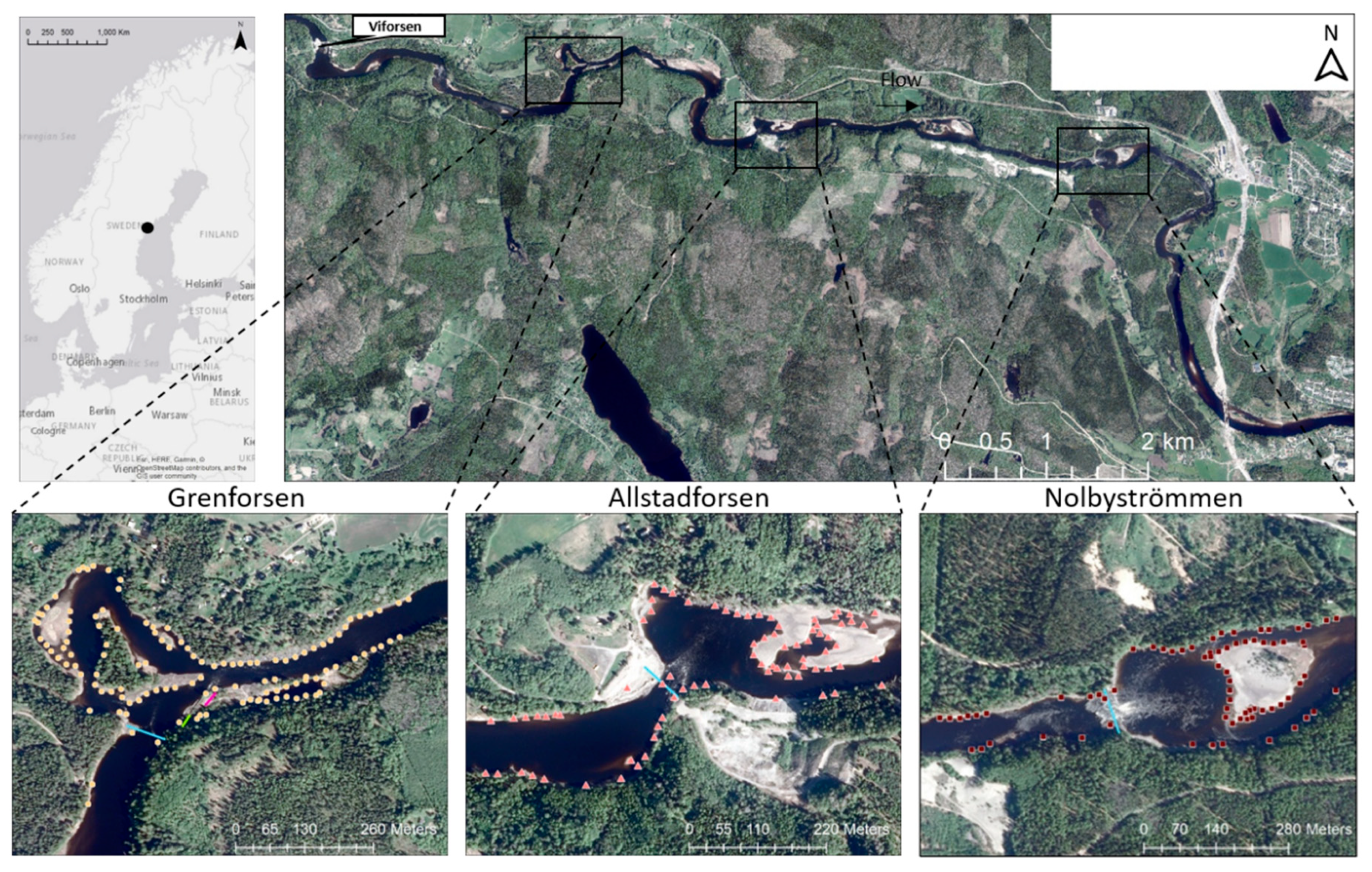
2.1. Study Area
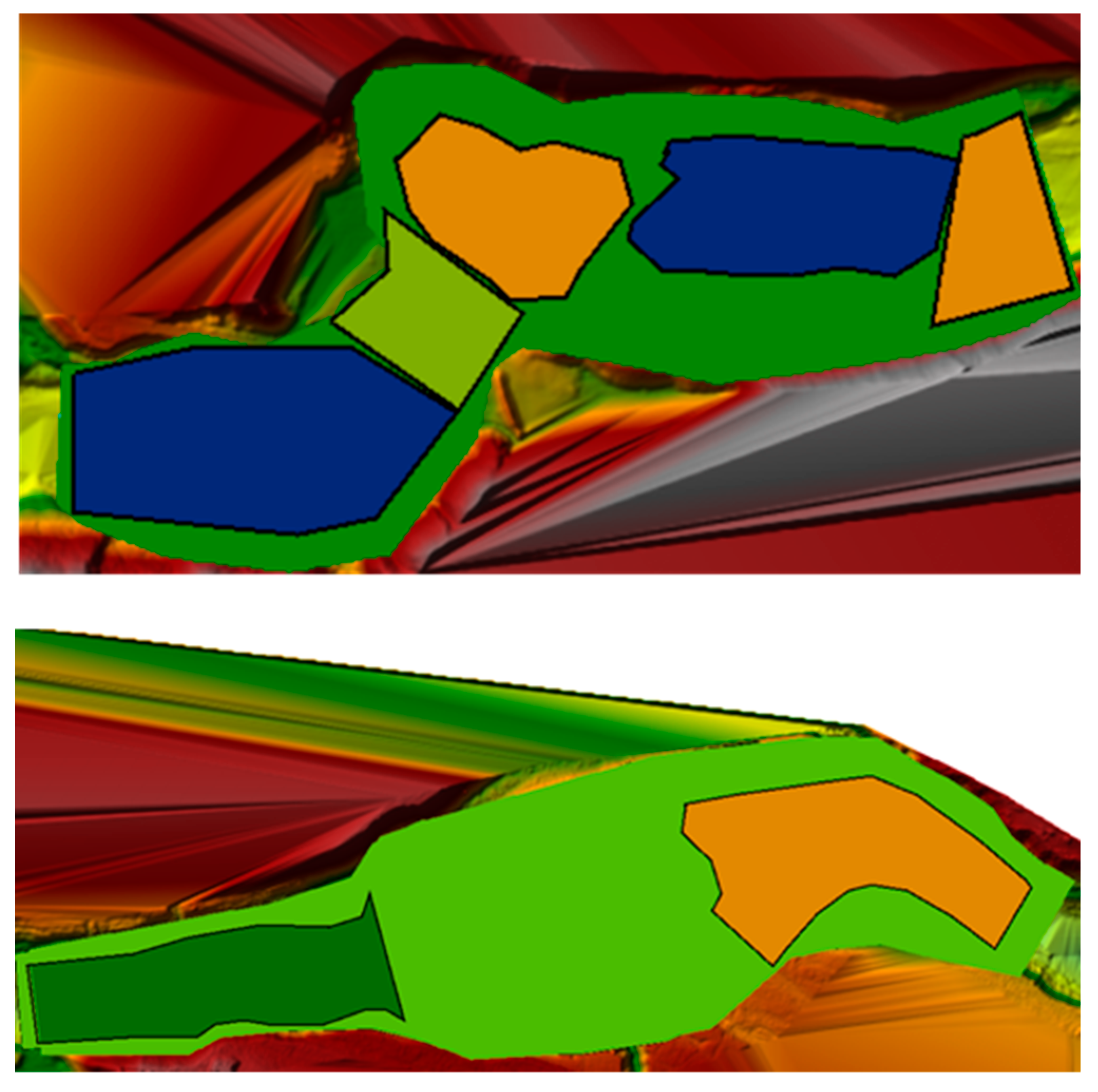
2.2. Terrain Modification
2.3. Hydraulic Modeling
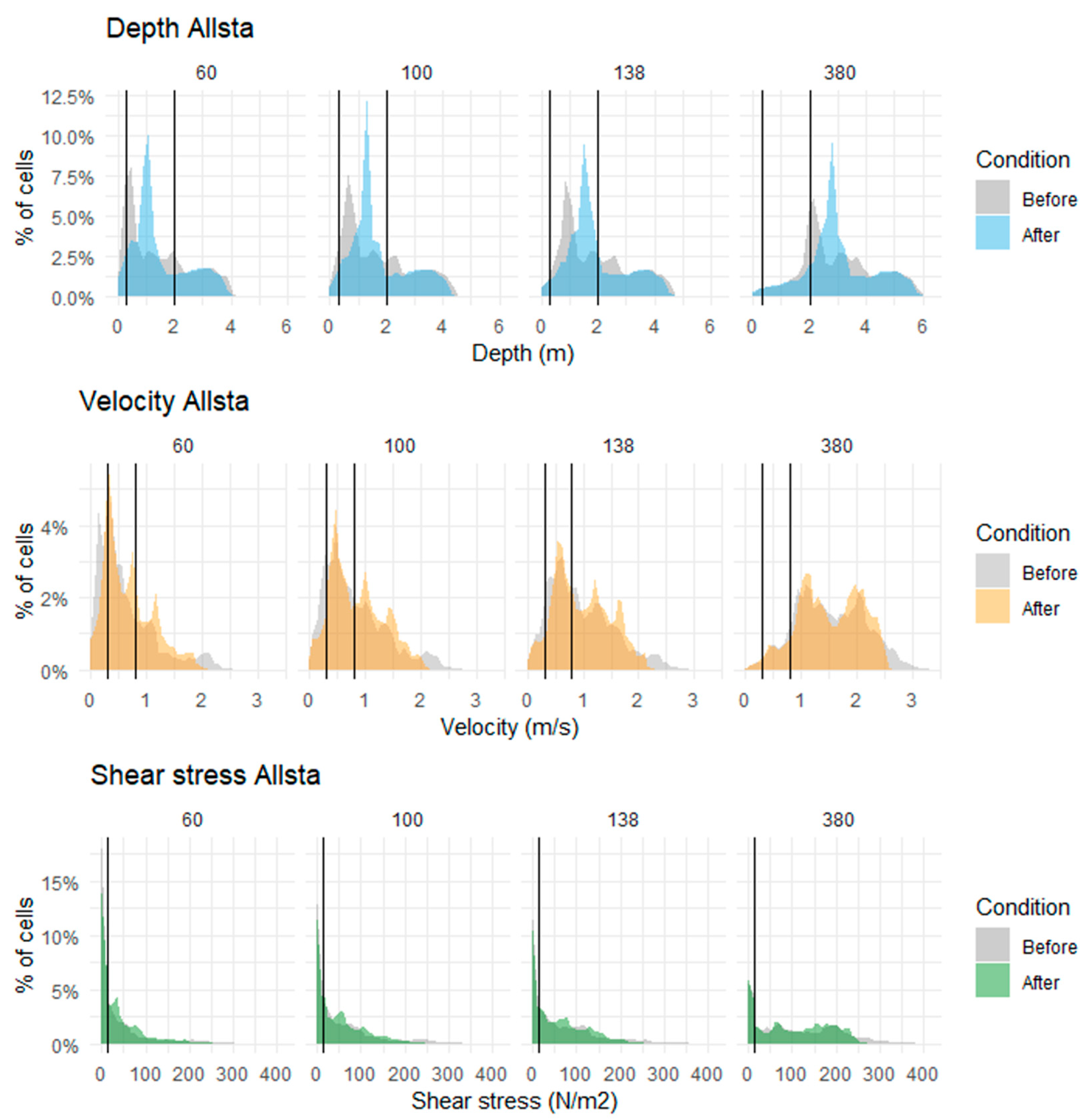
2.4. Depth, Velocity and Shear Stress Distribution and Potential Suitable Area
2.5. Calculation of Costs Per Unit of Potential Suitable Area
3. Results
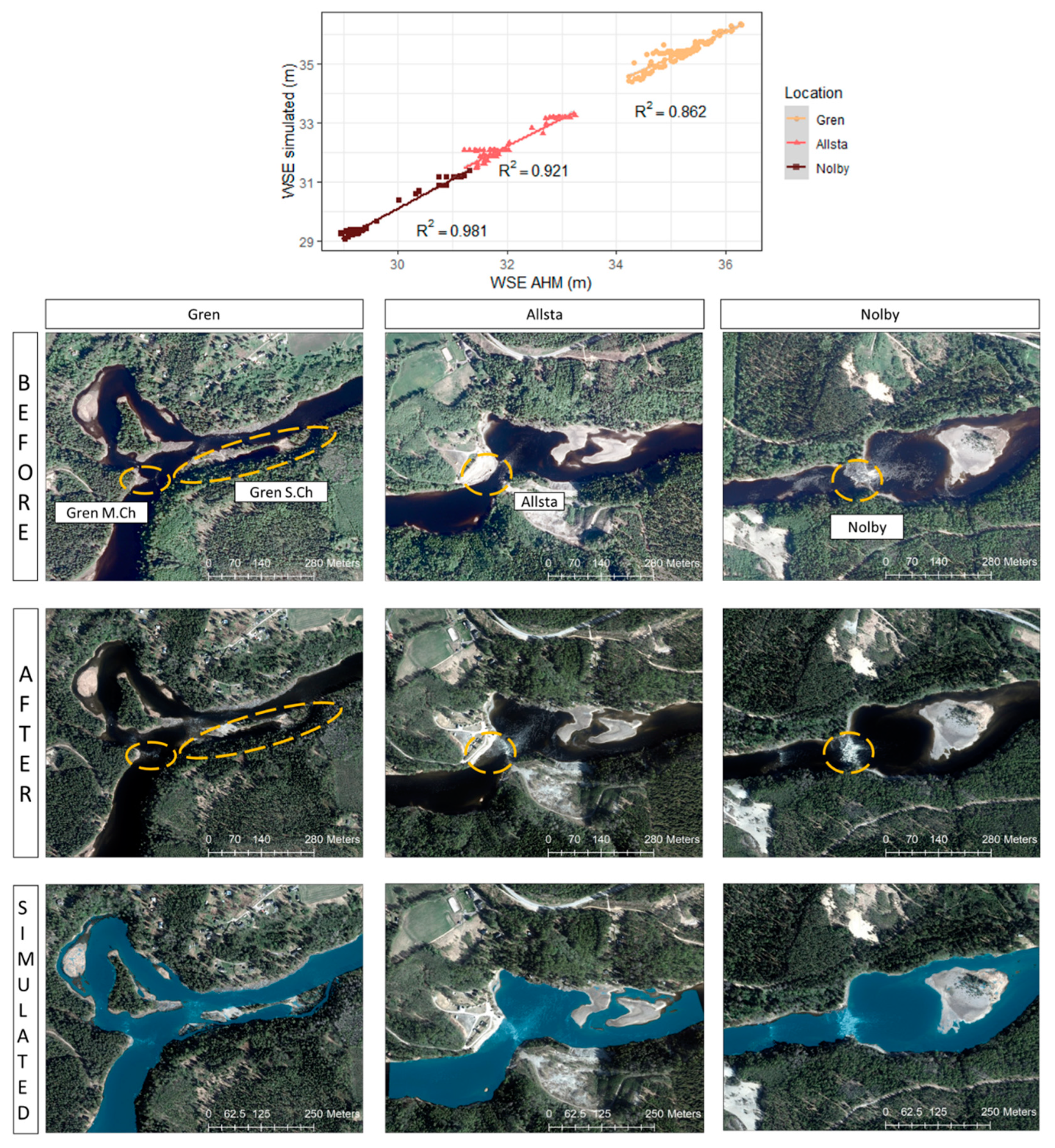
3.1. Calibration & Verification
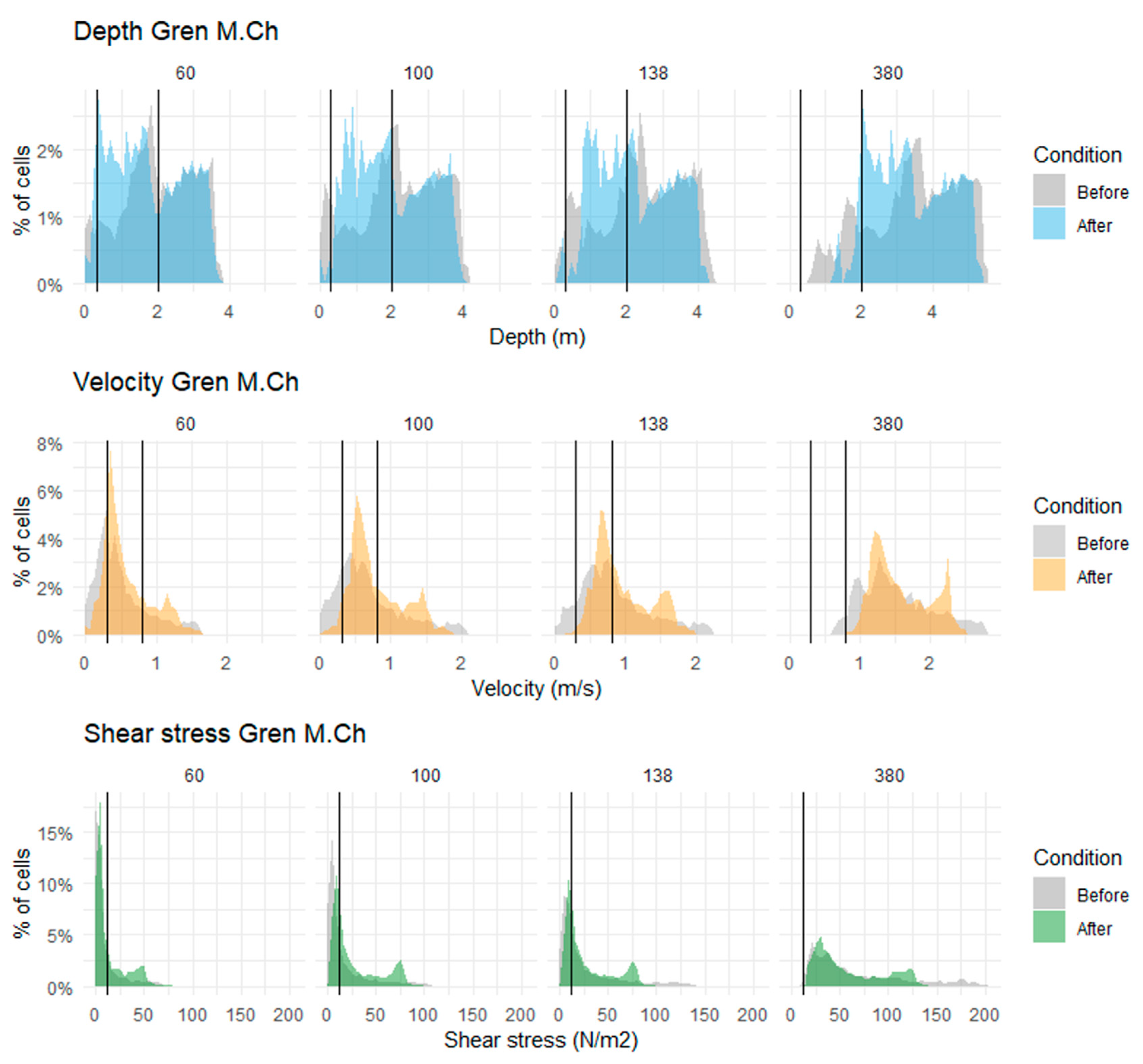
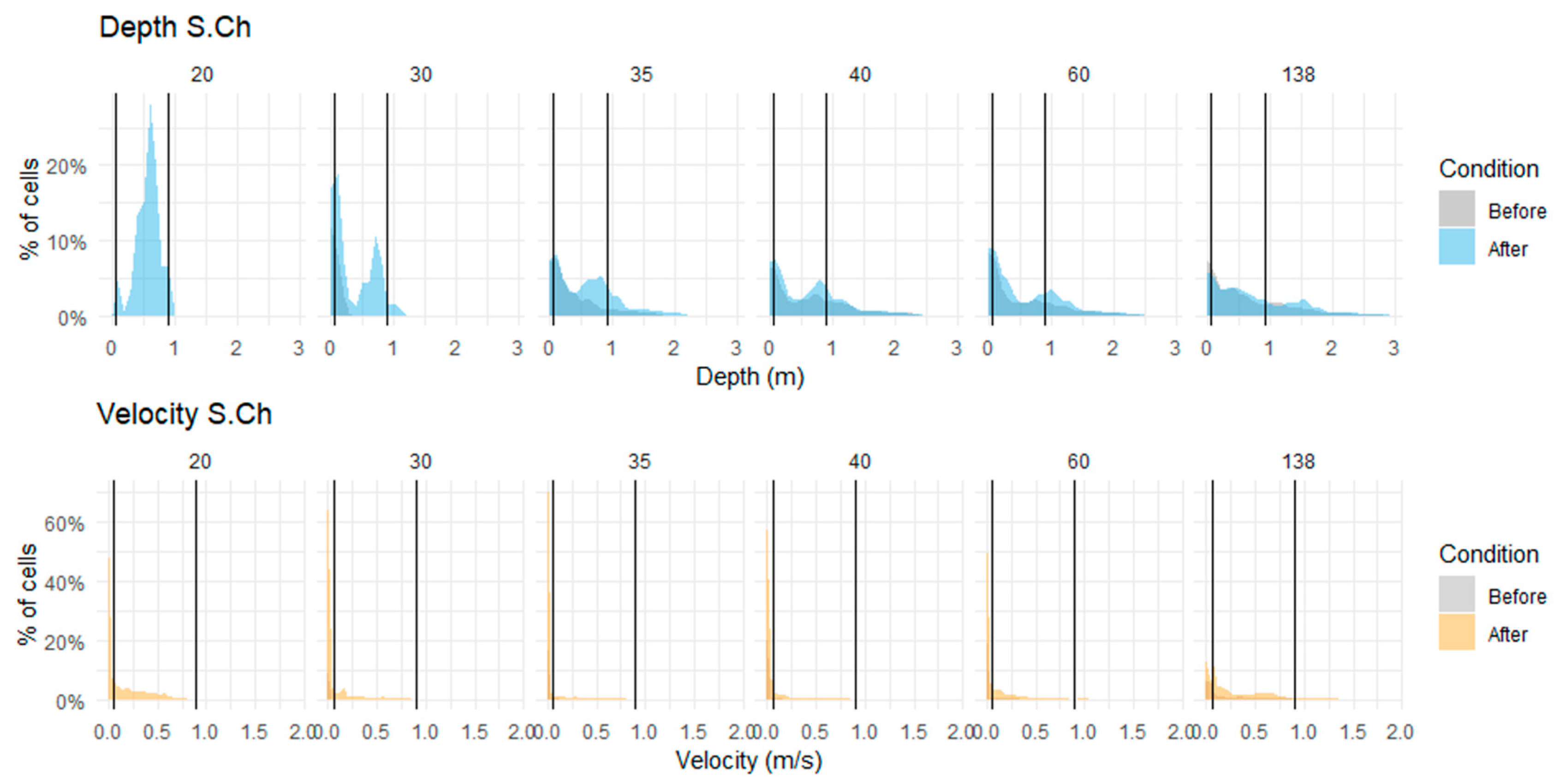
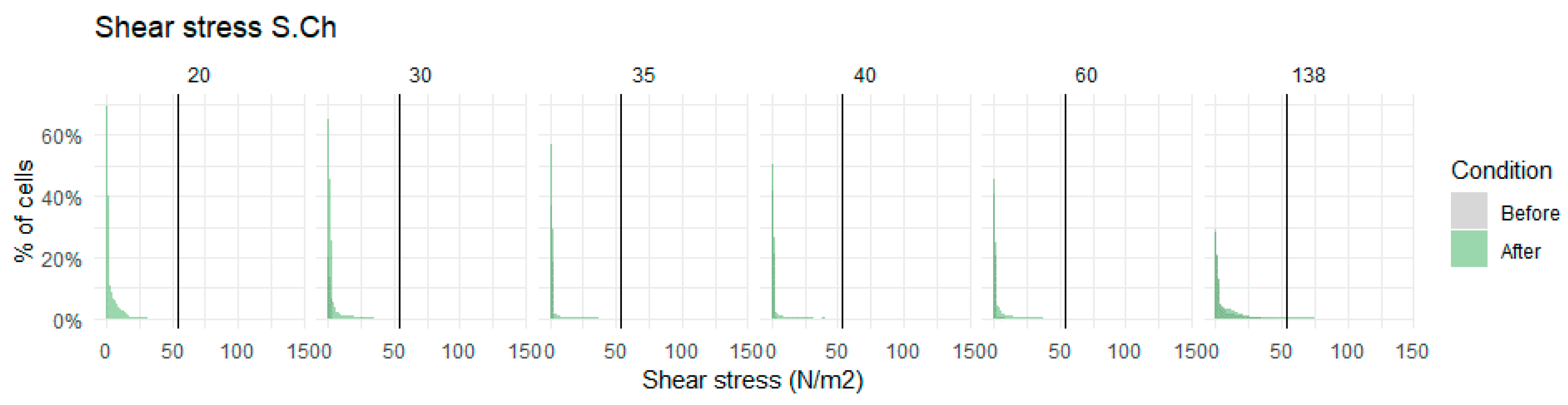
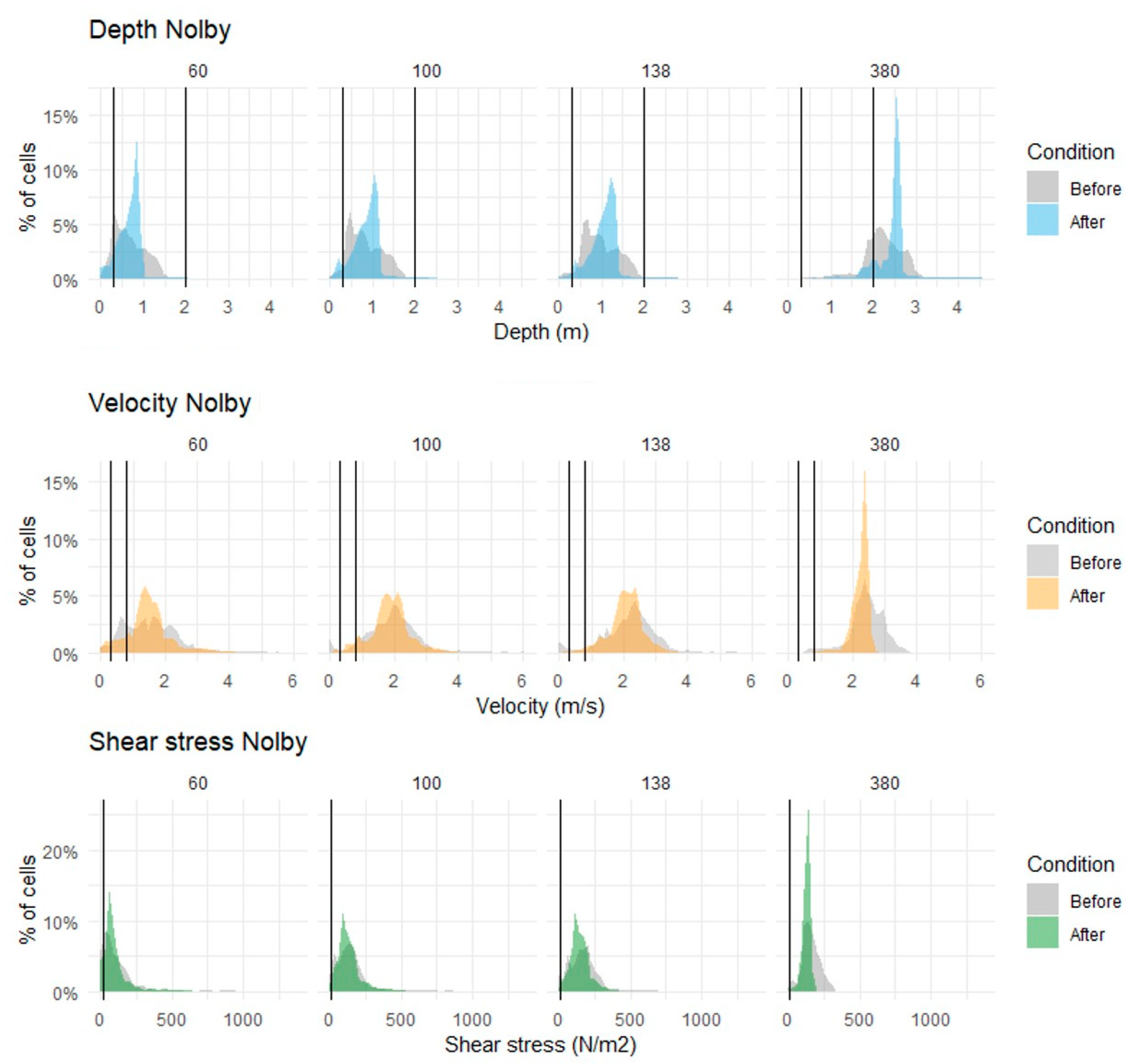
3.2. Depth, Velocity and Shear Stress Distribution
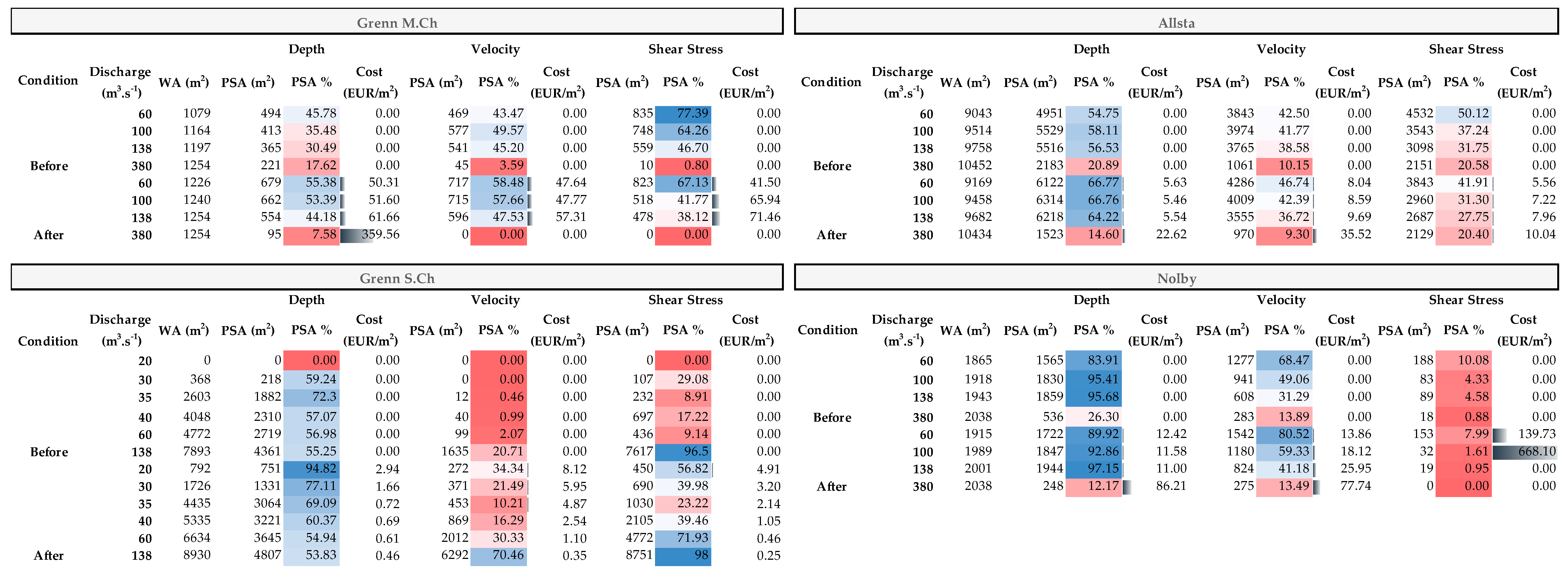
3.3. Cost Per Unit of Potential Suitable Area
4. Discussion
4.1. Hydraulic Responses and PSA
4.2. Expected Ecological Responses
4.3. Cost-Effectiveness
Author Contributions
Funding
Acknowledgments
Conflicts of Interest
Appendix A

Appendix B
References
- Erwin, S.O.; Jacobson, R.B.; Elliott, C.M. Quantifying habitat benefits of channel reconfigurations on a highly regulated river system, Lower Missouri River, USA. Ecol. Eng. 2017, 103, 59–75. [Google Scholar] [CrossRef] [Scilit]
- Armstrong, J.D.; Kemp, P.S.; Kennedy, G.J.A.; Ladle, M.; Milner, N.J. Habitat requirements of Atlantic salmon and brown trout in rivers and streams. Fish. Res. 2003, 62, 143–170. [Google Scholar] [CrossRef] [Scilit]
- Stamou, A.; Polydera, A.; Papadonikolaki, G.; Martínez-Capel, F.; Muñoz-Mas, R.; Papadaki, C.; Zogaris, S.; Bui, M.D.; Rutschmann, P.; Dimitriou, E. Determination of environmental flows in rivers using an integrated hydrological-hydrodynamic-habitat modelling approach. J. Environ. Manag. 2018, 209, 273–285. [Google Scholar] [CrossRef] [Scilit] [PubMed]
- Fabris, L.; Malcolm, I.A.; Buddendorf, W.B.; Millidine, K.J.; Tetzlaff, D.; Soulsby, C. Hydraulic modelling of the spatial and temporal variability in Atlantic salmon parr habitat availability in an upland stream. Sci. Total Environ. 2017, 601–602, 1046–1059. [Google Scholar] [CrossRef] [Scilit]
- Friberg, N.; Angelopoulos, N.V.; Buijse, A.D.; Cowx, I.G.; Kail, J.; Moe, T.F.; Moir, H.; O’Hare, M.T.; Verdonschot, P.F.M.; Wolter, C. Chapter Eleven—Effective River Restoration in the 21st Century: From Trial and Error to Novel Evidence-Based Approaches. In Advances in Ecological Research; Dumbrell, A.J., Kordas, R.L., Woodward, G., Eds.; Academic Press: Cambridge, MA, USA, 2016; Volume 55, pp. 535–611. [Google Scholar]
- Milhous, R.T.; Updike, M.A.; Schneider, D.M. Physical Habitat Simulation System Reference Manual: Version II; US Fish and Wildlife Service: Falls Church, VA, USA, 1989.
- Waddle, T. PHABSIM for Windows User’s Manual and Exercises; Geological Survey: Denver, CO, USA, 2001.
- Jay Lacey, R.W.; Millar, R.G. Reach scale hydraulic assessment of instream salmonid habitat restoration 1. JAWRA J. Am. Water Resour. Assoc. 2004, 40, 1631–1644. [Google Scholar] [CrossRef] [Scilit]
- Crowder, D.; Diplas, P. Using two-dimensional hydrodynamic models at scales of ecological importance. J. Hydrol. 2000, 230, 172–191. [Google Scholar] [CrossRef] [Scilit]
- Boavida, I.; Santos, J.M.; Cortes, R.V.; Pinheiro, A.N.; Ferreira, M.T. Assessment of instream structures for habitat improvement for two critically endangered fish species. Aquat. Ecol. 2011, 45, 113–124. [Google Scholar] [CrossRef] [Scilit]
- Mandlburger, G.; Hauer, C.; Wieser, M.; Pfeifer, N. Topo-bathymetric LiDAR for monitoring river morphodynamics and instream habitats—A case study at the Pielach River. Remote Sens. 2015, 7, 6160–6195. [Google Scholar] [CrossRef] [Scilit]
- AHM. New Possibilitiesin Bathymetricandtopographicsurvey; A. GmbH: Innsbruck, Austria, 2015. [Google Scholar]
- Alne, I.S. Topo-Bathymetric LiDAR for Hydraulic Modeling—Evaluation of LiDAR Data From Two Rivers; NTNU: Trondheim, Norway, 2016. [Google Scholar]
- McKean, J.; Nagel, D.; Tonina, D.; Bailey, P.; Wright, C.W.; Bohn, C.; Nayegandhi, A. Remote Sensing of Channels and Riparian Zones with a Narrow-Beam Aquatic-Terrestrial LIDAR. Remote Sens. 2009, 1, 1065–1096. [Google Scholar] [CrossRef] [Scilit]
- Andersen, M.S.; Gergely, Á.; Al-Hamdani, Z.; Steinbacher, F.; Larsen, L.R.; Ernstsen, V.B.J.H.; Sciences, E.S. Processing and performance of topobathymetric lidar data for geomorphometric and morphological classification in a high-energy tidal environment. Hydrol. Earth Syst. Sci. 2017, 21, 43–63. [Google Scholar] [CrossRef] [Scilit]
- Mandlburger, G.; Pfennigbauer, M.; Steinbacher, F.; Pfeifer, N. Airborne Hydrographic LiDAR Mapping–Potential of a new technique for capturing shallow water bodies. In Proceedings of the 19th International Congress on Modelling and Simulation, Perth, Australia, 12–16 December 2011; pp. 12–16. [Google Scholar]
- Klemas, V.; Pieterse, A. Using remote sensing to map and monitor water resources in arid and semiarid regions. In Advances in Watershed Science and Assessment; Springer: Berlin, Germany, 2015; pp. 33–60. [Google Scholar]
- HELCOM. Salmon and Sea Trout Populations and Rivers in the Baltic Sea—HELCOM Assessment of Salmon (Salmo salar) and Sea Trout (Salmo trutta) Populations and Habitats in Rivers Flowing to the Baltic Sea. Baltic Sea Environment Proceedings no. 126A; H. Commission: Helsinki, Finland, 2011; p. 79. [Google Scholar]
- Helfield, J.M.; Capon, S.J.; Nilsson, C.; Jansson, R.; Palm, D. Restoration of rivers used for timber floating: Effects on riparian plant diversity. Ecol. Appl. 2007, 17, 840–851. [Google Scholar] [CrossRef] [Scilit] [PubMed]
- Petersen Jr, R.; Madsen, B.; Wilzbach, M.; Magadza, C.; Paarlberg, A.; Kullberg, A.; Cummins, K. Stream management: Emerging global similarities. Ambio 1987, 16, 166–179. [Google Scholar]
- Muotka, T.; Paavola, R.; Haapala, A.; Novikmec, M.; Laasonen, P.J.B.C. Long-term recovery of stream habitat structure and benthic invertebrate communities from in-stream restoration. Biol. Conserv. 2002, 105, 243–253. [Google Scholar] [CrossRef] [Scilit]
- Törnlund, E.; Östlund, L.J.E. Floating timber in northern Sweden: The construction of floatways and transformation of rivers. Environ. Hist. 2002, 8, 85–106. [Google Scholar] [CrossRef] [Scilit]
- Johansson, U. Stream Channelization Effects on Fish Abundance and Species Composition; Department of Physics, Chemistry and Biology, Linköping universitet: Linköping, Sweden, 2013. [Google Scholar]
- Dudgeon, D.; Arthington, A.H.; Gessner, M.O.; Kawabata, Z.-I.; Knowler, D.J.; Lévêque, C.; Naiman, R.J.; Prieur-Richard, A.-H.; Soto, D.; Stiassny, M.L.J.; et al. Freshwater biodiversity: Importance, threats, status and conservation challenges. Biol. Rev. 2006, 81, 163–182. [Google Scholar] [CrossRef] [Scilit]
- Nilsson, C.; Lepori, F.; Malmqvist, B.; Törnlund, E.; Hjerdt, N.; Helfield, J.M.; Palm, D.; Östergren, J.; Jansson, R.; Brännäs, E.J.E. Forecasting environmental responses to restoration of rivers used as log floatways: An interdisciplinary challenge. Ecosystems 2005, 8, 779–800. [Google Scholar] [CrossRef] [Scilit]
- HELCOM. Salmon and Sea Trout Populations and Rivers in Sweden—HELCOM Assessment of Salmon (Salmo salar) and Sea Trout (Salmo trutta) Populations and Habitats in Rivers Flowing to the Baltic Sea; Balt. Sea Environ. Proc. No. 126B; H. Commission: Helsinki, Finland, 2011; p. 110. [Google Scholar]
- Riegl. RIEGL-VQ-880-G Data Sheet. 2014. Available online: http://www.riegl.com/uploads/tx_pxpriegldownloads/Infosheet_VQ-880-G_2016-05-23.pdf (accessed on 19 November 2018).
- Sontek. RiverSurveyor Specifications. 2016. Available online: http://www.quantum-hydrometrie.de/RiverSurveyor-S5-M9.pdf (accessed on 19 November 2018).
- ESRI. ArcGIS Release 10.5; E.S.R. Institute: Redlands, CA, USA, 2016. [Google Scholar]
- HEC. HEC-RAS River Analysis System Version 5.0—User Manual; Hydrologic Engineering Center: Davis, CA, USA, 2016. [Google Scholar]
- Chow, V.T. Open-channel hydraulics. In Open-Channel Hydraulics; McGraw-Hill: New York, NY, USA, 1959. [Google Scholar]
- Forseth, T.; Harby, A.; Ugedal, O.; Pulg, U.; Fjeldstad, H.-P.; Robertsen, G.; Barlaup, B.T.; Alfredsen, K.; Sundt, H.; Saltveit, S.J. Handbook for Environmental Design in Regulated Salmon Rivers; NINA: Trondheim, Norway, 2014. [Google Scholar]
- Skoglund, H.; Gabrielsen, S.-E.; Wiers, T. Survey of Salmon Spawning and Juvenile Habitat in River Ljungan in Sweden 2014; Uni Research Environment: Bergen, Norway, 2015. (In Norwegian) [Google Scholar]
- Scruton, D.A.; Heggenes, J.; Valentin, S.; Harby, A.; Bakken, T.H. Field sampling design and spatial scale in habitat–hydraulic modelling: Comparison of three models. Fish. Manag. Ecol. 1998, 5, 225–240. [Google Scholar] [CrossRef] [Scilit]
- Berenbrock, C.; Tranmer, A.W. Simulation of Flow, Sediment Transport, and Sediment Mobility of the Lower Coeur d’Alene River; U.S. Geological Survey Scientific Investigations Report 2008–5093; Geological Survey: Reston, ID, USA, 2008; p. 164.
- Pisaturo, G.R.; Righetti, M.; Dumbser, M.; Noack, M.; Schneider, M.; Cavedon, V. The role of 3D-hydraulics in habitat modelling of hydropeaking events. Sci. Total Environ. 2017, 575, 219–230. [Google Scholar] [CrossRef] [Scilit]
- Heggenes, J. Flexible summer habitat selection by wild, allopatric brown trout in lotic environments. Trans. Am. Fish. Soc. 2002, 131, 287–298. [Google Scholar] [CrossRef] [Scilit]
- Niayifar, A.; Oldroyd, H.J.; Lane, S.N.; Perona, P. Modeling Macroroughness Contribution to Fish Habitat Suitability Curves. Water Resour. Res. 2018, 54, 9306–9320. [Google Scholar] [CrossRef] [Scilit]
- Juárez, A.; Adeva-Bustos, A.; Alfredsen, K.; Dønnum, B.O. Performance of A Two-Dimensional Hydraulic Model for the Evaluation of Stranding Areas and Characterization of Rapid Fluctuations in Hydropeaking Rivers. Water 2019, 11, 201. [Google Scholar] [CrossRef] [Scilit]
- Gardeström, J.; Holmqvist, D.; Polvi, L.E.; Nilsson, C. Demonstration Restoration Measures in Tributaries of the Vindel River Catchment. Ecol. Soc. 2013, 18. [Google Scholar] [CrossRef] [Scilit]
- Bair, R. Modeling Large Wood Impacts on Stream Hydrodynamics and Juvenile Salmon Habitat; Oregon State University: Eugene, OR, USA, 2016. [Google Scholar]
- Wilcock, P.R.; McArdell, B.W. Surface-based fractional transport rates: Mobilization thresholds and partial transport of a sand-gravel sediment. Water Resour. Res. 1993, 29, 1297–1312. [Google Scholar] [CrossRef] [Scilit]
- Scruton, D.A.; Anderson, T.C.; King, L.W. Pamehac Brook: A case study of the restoration of a Newfoundland, Canada, river impacted by flow diversion for pulpwood transportation. Aquat. Conserv. Mar. Freshw. Ecosyst. 1998, 8, 145–157. [Google Scholar] [CrossRef] [Scilit]
- Barlaup, B.T.; Gabrielsen, S.E.; Skoglund, H.; Wiers, T. Addition of spawning gravel—A means to restore spawning habitat of atlantic salmon (Salmo salar L.), and Anadromous and resident brown trout (Salmo trutta L.) in regulated rivers. River Res. Appl. 2008, 24, 543–550. [Google Scholar] [CrossRef] [Scilit]
- Gard, M. Modeling changes in salmon spawning and rearing habitat associated with river channel restoration. Int. J. River Basin Manag. 2006, 4, 201–211. [Google Scholar] [CrossRef] [Scilit]
- Fjeldstad, H.P.; Barlaup, B.T.; Stickler, M.; Gabrielsen, S.E.; Alfredsen, K. Removal of weirs and the influence on physical habitat for salmonids in a norwegian river. River Res. Appl. 2012, 28, 753–763. [Google Scholar] [CrossRef] [Scilit]
- McKean, J.; Tonina, D. Bed stability in unconfined gravel bed mountain streams: With implications for salmon spawning viability in future climates. J. Geophys. Res. Earth Surf. 2013, 118, 1227–1240. [Google Scholar] [CrossRef] [Scilit]
- Koljonen, S.; Huusko, A.; Mäki-Petäys, A.; Louhi, P.; Muotka, T. Assessing Habitat Suitability for Juvenile Atlantic Salmon in Relation to In-Stream Restoration and Discharge Variability. Restor. Ecol. 2013, 21, 344–352. [Google Scholar] [CrossRef] [Scilit]
- Palmer, M.A.; Menninger, H.L.; Bernhardt, E. River restoration, habitat heterogeneity and biodiversity: A failure of theory or practice? Freshw. Biol. 2010, 55, 205–222. [Google Scholar] [CrossRef] [Scilit]
- Marttila, M.; Louhi, P.; Huusko, A.; Mäki-Petäys, A.; Yrjänä, T.; Muotka, T. Long-term performance of in-stream restoration measures in boreal streams. Ecohydrology 2016, 9, 280–289. [Google Scholar] [CrossRef] [Scilit]
- ICES. Summary of ICES Advice on the Exploitation of Baltic Sea fish Stocks in 2018; The Fisheries Secretariat Stockholm: Stockholm, Sweden, 2017. [Google Scholar]
- Johnsen, B.O.; Arnekleiv, J.V.; Asplin, L.; Barlaup, B.T.; Næsje, T.F.; Rossenland, B.O.; Saltveit, S.J.; Tvede, A. Hydropower Development- Ecological Eeffects. In Atlantic Salmon Ecology; Aas, Ø., Einum, S., Klemetsen, A., Skurdal, J., Eds.; John Wiley & Sons Ltd.: Chichester, UK, 2011. [Google Scholar]
- Saltveit, S.J. The effects of stocking Atlantic salmon, Salmo salar, in a Norwegian regulated river. Fish. Manag. Ecol. 2006, 13, 197–205. [Google Scholar] [CrossRef] [Scilit]
- Palmé, A.; Wennerström, L.; Guban, P.; Ryman, N.; Laikre, L. Compromising Baltic Salmon Genetic Diversity: Conservation Genetic Risks Associated with Compensatory Releases of Salmon in the Baltic Sea; Havs-och vattenmyndigheten: Göteborg, Sweden, 2012. [Google Scholar]
- Szałkiewicz, E.; Jusik, S.; Grygoruk, M.J.S. Status of and Perspectives on River Restoration in Europe: 310,000 Euros per Hectare of Restored River. Sustainability 2018, 10, 129. [Google Scholar] [CrossRef] [Scilit]
- Pulg, U.; Barlaup, B.T.; Sternecker, K.; Trepl, L.; Unfer, G. Restoration of spawning habitats of brown trout (Salmo trutta) in a regulated chalk stream. River Res. Appl. 2013, 29, 172–182. [Google Scholar] [CrossRef] [Scilit]
- Skeie, L. Hydrauliskc Modelling of Tokkeåi-Hydraulisk Modellering av Kraftverksdrift i Tokkeåi; NTNU: Trondheim, Norway, 2017. (In Norwegian) [Google Scholar]
- Kennen, J.G.; Stein, E.D.; Webb, J.A. Evaluating and managing environmental water regimes in a water-scarce and uncertain future. Freshw. Biol. 2018, 63, 733–737. [Google Scholar] [CrossRef] [Scilit]
- Palmer, M.A.; Bernhardt, E.S.; Allan, J.D.; Lake, P.S.; Alexander, G.; Brooks, S.; Carr, J.; Clayton, S.; Dahm, C.N.; Follstad Shah, J.; et al. Standards for ecologically successful river restoration. J. Appl. Ecol. 2005, 42, 208–217. [Google Scholar] [CrossRef] [Scilit]

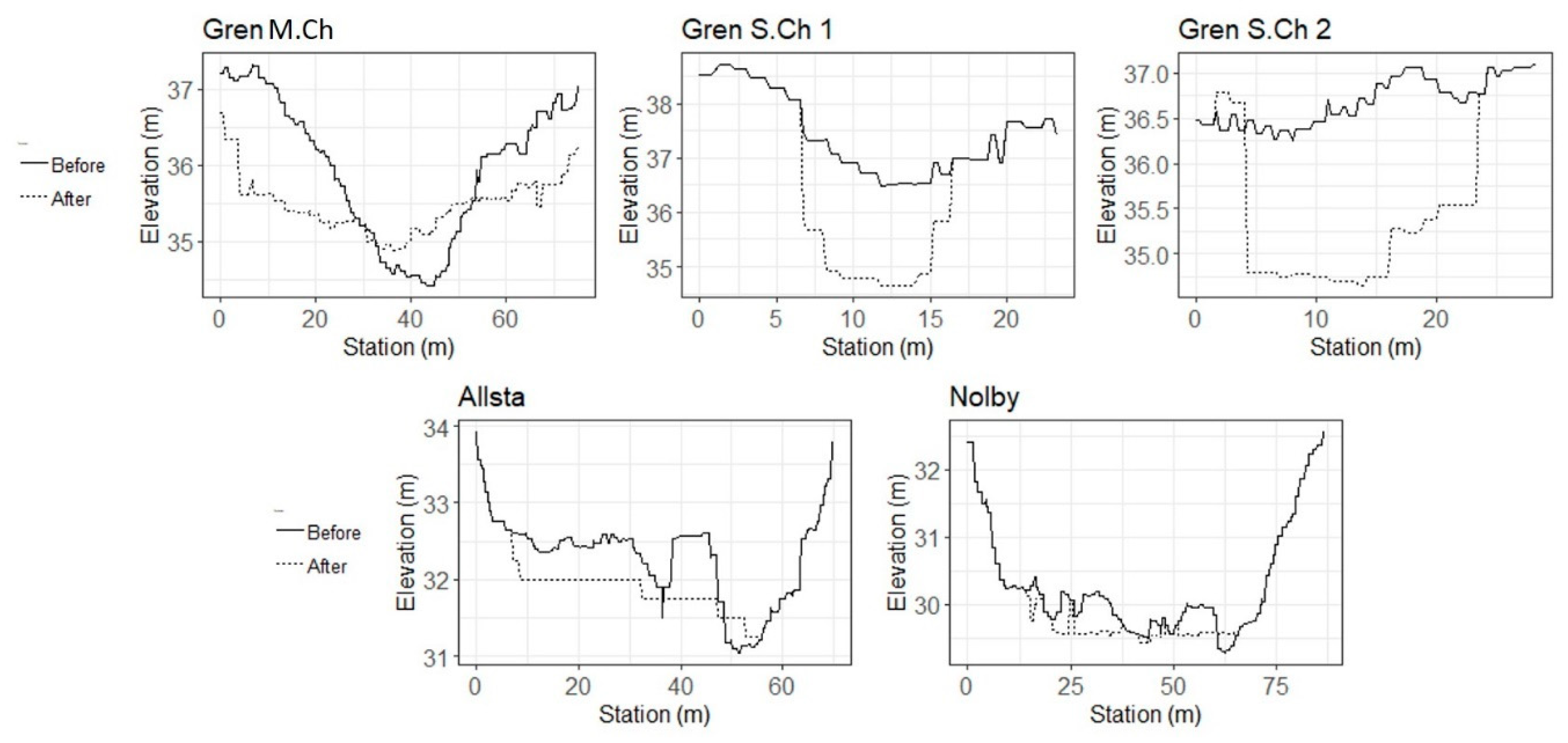





| Location | Sub Location | Before Modifications | After Modifications | Objective |
|---|---|---|---|---|
| Gren | Gren M.Ch | Narrow channel with high banks | Wider channel, rocks that were on the banks were placed in the middle. Gravel and cobbles were added. | Reduce water velocities, increase the wetted area and create suitable habitat for spawning. |
| Gren S.Ch | Concrete wall was blocking water to flow in the right-side channel under low flows | Wall was opened in two channels (Gren. S.Ch 1 & Gren. S.Ch 2) so water could flow inside the right-side channel, even at low flows | Restore the right-side channel and its function as a nursery area as well as to restore connectivity. | |
| Allsta | Narrow channel with higher elevations in the banks | Wider channel, rocks that were on the banks were placed in the middle. Gravel and cobbles are added. | Reduce water velocities, increase the wetted area and create suitable habitat for spawning. | |
| Nolby | Narrow channel with higher elevations specially in the right-side bank | Wider channel, rocks that were on the right-side banks were placed in the middle. Gravel and cobbles are added. | Reduce water velocities, increase the wetted area and create suitable habitat for spawning. | |
| Reach | Discharge (m3 s−1) | # of Cells | Dimensions (m2) | Normal Depth (m) | Manning’s 1 |
|---|---|---|---|---|---|
| Gren | 20, 30, 35, 40, 60, 100, 138, 380 | 364.436 | Max: 1.92 m2 Min: 0.01 m2 Avg: 0.90 m2 | 0.01 | 0.06 |
| Allsta | 60, 100, 138, 380 | 147.229 | Max: 1.73 m2 Min: 0.34 m2 Avg: 0.99 m2 | 0.001 | 0.03, 0.06, 0.15 |
| Nolby | 223.121 | Max: 1.74 m2 Min: 0.05 m2 Avg: 0.93 m2 | 0.001 | 0.06, 0.08, 0.15 |
| Spawning Area | Nursery Area | |
|---|---|---|
| Depth (m) | 0.3–2.0 | 0.05–0.9 |
| Water velocity (m s−1) | 0.3–0.8 | 0.06–0.9 |
| Critical shear Stress (N/m2) | 12.2 | 53.8 |
| Excavator | Helicopter | Gravel 1–10 cm | Cobbles 10–100 cm | Coarse Cobbles 50–100 cm | Total | |
|---|---|---|---|---|---|---|
| Gren M.Ch | 2208 | 24,089 | 6551 | 0 | 1310 | 34,158 |
| Gren S.Ch | 2208 | 0 | 0 | 0 | 0 | 2208 |
| Allsta | 2504 | 24,089 | 6551 | 0 | 1310 | 34,454 |
| Nolby | 5404 | 12,045 | 3275 | 0 | 655 | 21,379 |
| Total | 12,324 | 60,223 | 16,376 | 0 | 3275 | 92,199 |
© 2019 by the authors. Licensee MDPI, Basel, Switzerland. This article is an open access article distributed under the terms and conditions of the Creative Commons Attribution (CC BY) license (http://creativecommons.org/licenses/by/4.0/).
Share and Cite
Adeva-Bustos, A.; Alfredsen, K.; Fjeldstad, H.-P.; Ottosson, K. Ecohydraulic Modelling to Support Fish Habitat Restoration Measures. Sustainability 2019, 11, 1500. https://doi.org/10.3390/su11051500
Adeva-Bustos A, Alfredsen K, Fjeldstad H-P, Ottosson K. Ecohydraulic Modelling to Support Fish Habitat Restoration Measures. Sustainability. 2019; 11(5):1500. https://doi.org/10.3390/su11051500
Chicago/Turabian StyleAdeva-Bustos, Ana, Knut Alfredsen, Hans-Petter Fjeldstad, and Kenneth Ottosson. 2019. "Ecohydraulic Modelling to Support Fish Habitat Restoration Measures" Sustainability 11, no. 5: 1500. https://doi.org/10.3390/su11051500
APA StyleAdeva-Bustos, A., Alfredsen, K., Fjeldstad, H.-P., & Ottosson, K. (2019). Ecohydraulic Modelling to Support Fish Habitat Restoration Measures. Sustainability, 11(5), 1500. https://doi.org/10.3390/su11051500