Article

Empirical Study of Omnichannel Purchasing Pattern with Real Customer Data from Health and Lifestyle Company


1
Seoul Business School, aSSIST, Seoul 03767, Korea
2
Business School Lausanne (BSL), CH-1022 Chavannes (VD), Switzerland
*
Author to whom correspondence should be addressed.
Sustainability 2019, 11(24), 7185; https://doi.org/10.3390/su11247185
Submission received: 31 October 2019 / Revised: 3 December 2019 / Accepted: 9 December 2019 / Published: 15 December 2019

Abstract

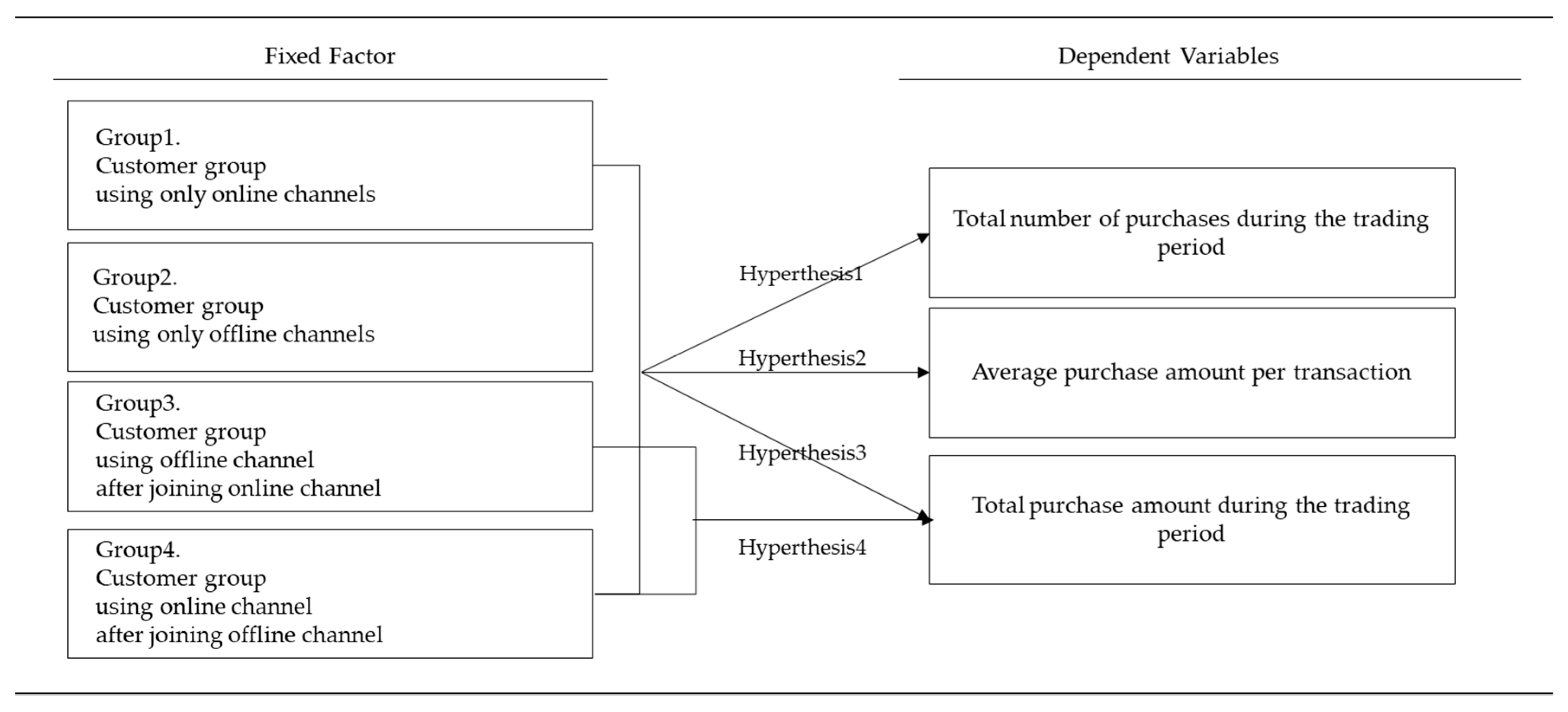
This study examines the effect of omnichannel usage pattern on customers’ purchasing amount by determining statistical significance of different purchasing amount occurred for online and offline channel usage pattern with empirical analysis. The data is collected from a health and lifestyle company operated by Major Pharmaceutical company in Korea, which sells health supplement and skincare products through their owned online and offline channels. The channel usage pattern of customers is categorized into four groups: Customer using online channel only, customer using offline channel only, customer first joined membership through online and use both on/offline channels and customers joined membership through offline channel and use both on/offline. Then, the trading period, total number of purchasing, average purchasing amount per transaction and total purchasing amount during trading period among the above four groups were analyzed. The result demonstrated the number of purchasing, average purchasing amount and total purchasing amount for the omnichannel customer groups who cross used on and offline showed statistical significance. However, the difference in purchasing amount between the group of customers who joined online membership and use offline channel and another customer group that joined offline membership and use online channel was not statistically significant. This study overcame the limitation of conventional studies used survey based data, by the application of empirical data from the real customers in on/offline channels, and provides meaningful insights based on empirical real data that group of customers with higher purchasing experience in both on/offline channels shows high performance.
Keywords: omnichannel; digital marketing; consumer behavior; retail industry; all other miscellaneous store retailers omnichannel; digital marketing; consumer behavior; retail industry; all other miscellaneous store retailers