Evaluation of the Environmental and Economic Impacts on the Life Cycle of Different Solutions for Toilet Flush Systems



Abstract
1. Introduction
2. Materials and Methods
2.1. Environmental Impacts Considered in This Study
2.2. Quantification of Environmental Impacts
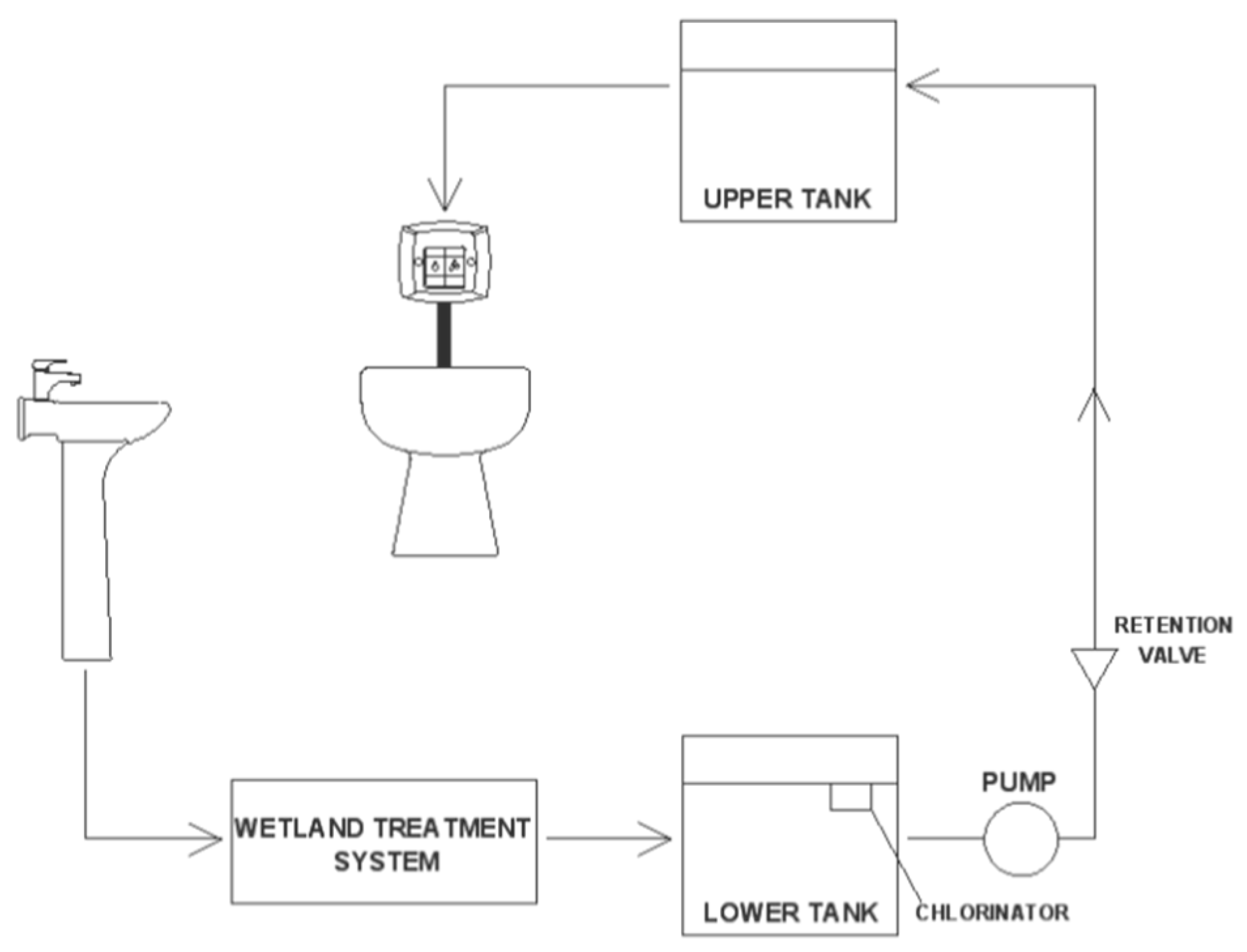
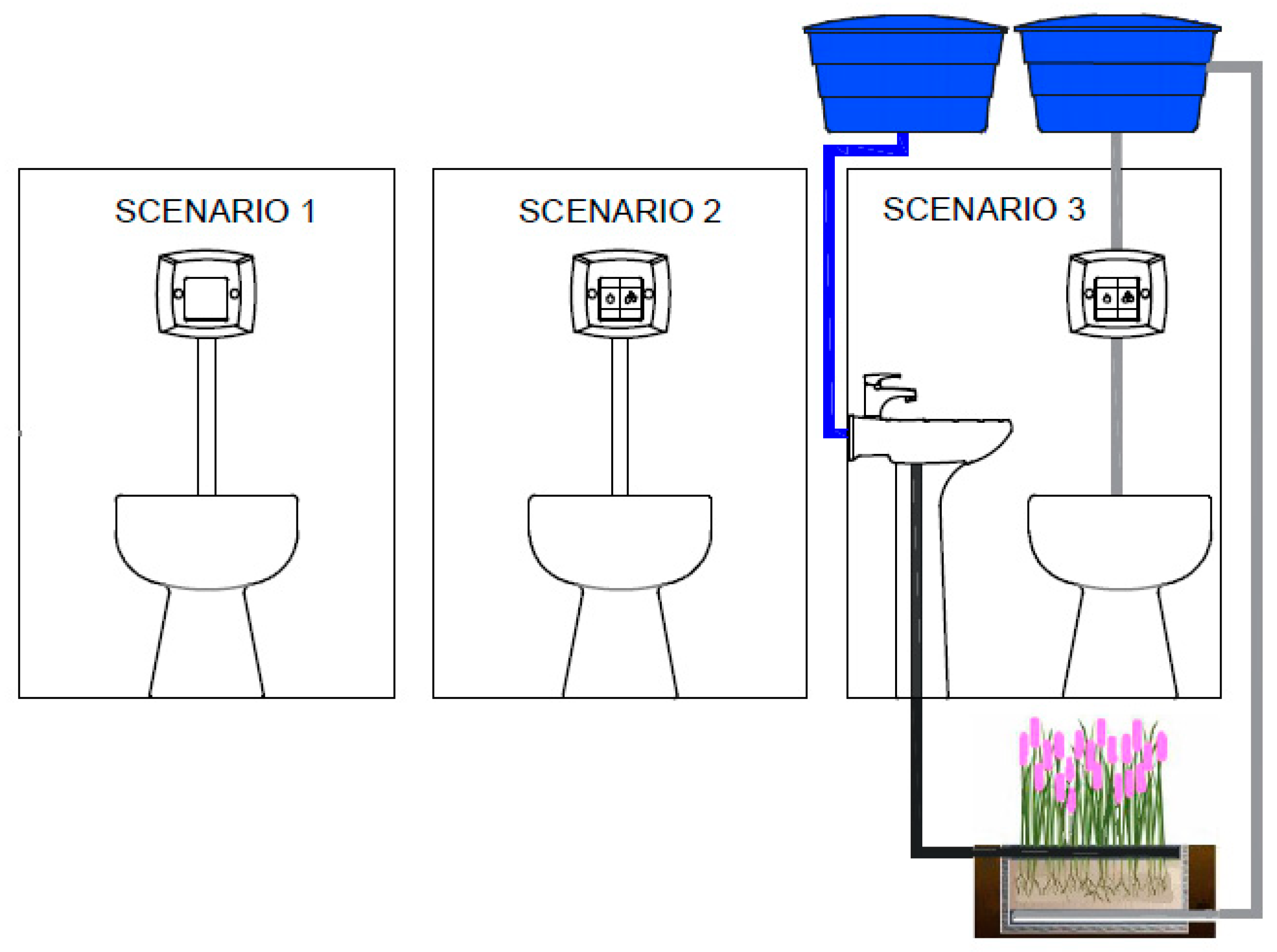
2.3. Scenarios
2.4. Life Cycle Cost
3. Results and Discussion
3.1. Application of LCA Methodology in the Analyzed Scenarios
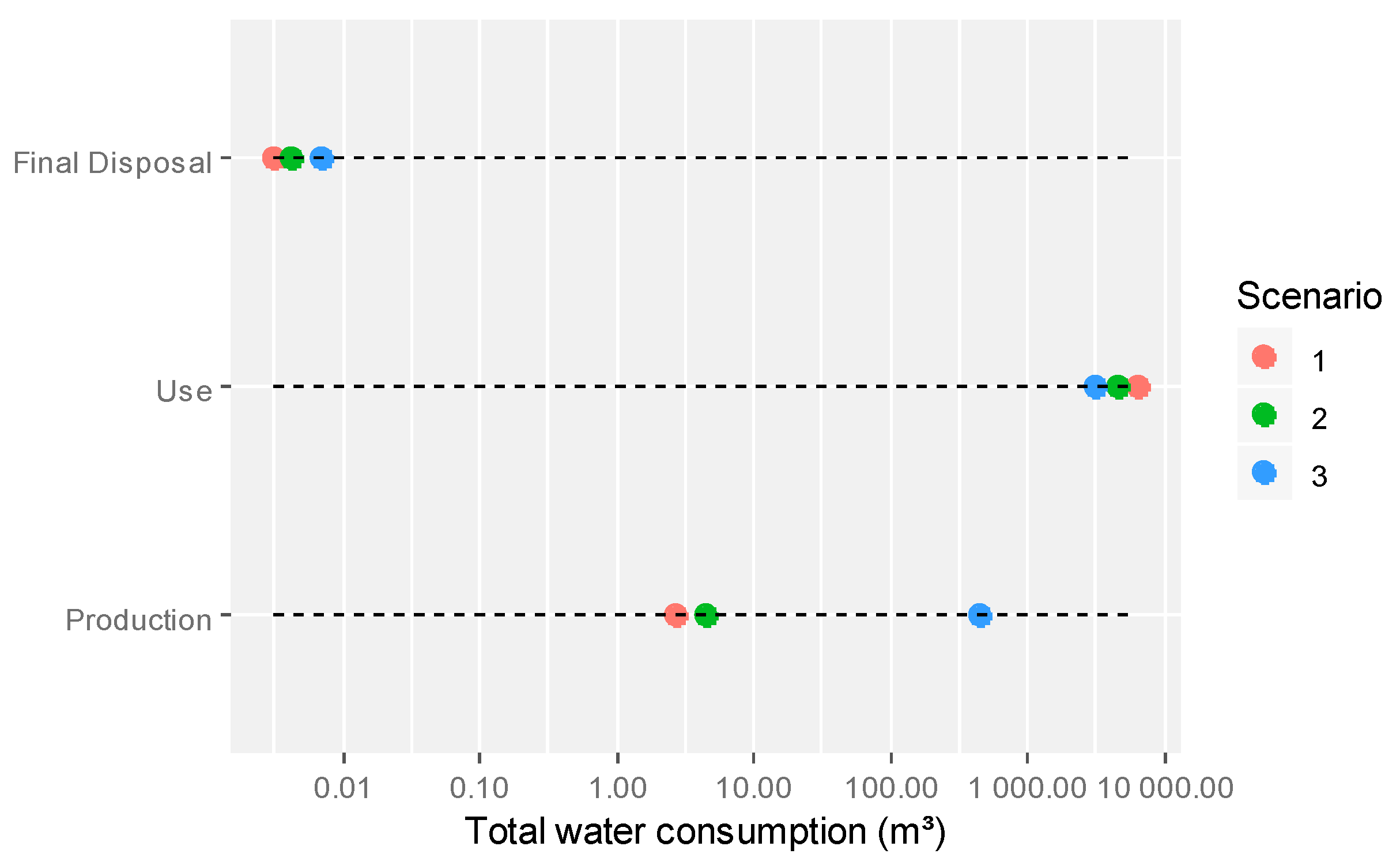
3.2. Water Consumption
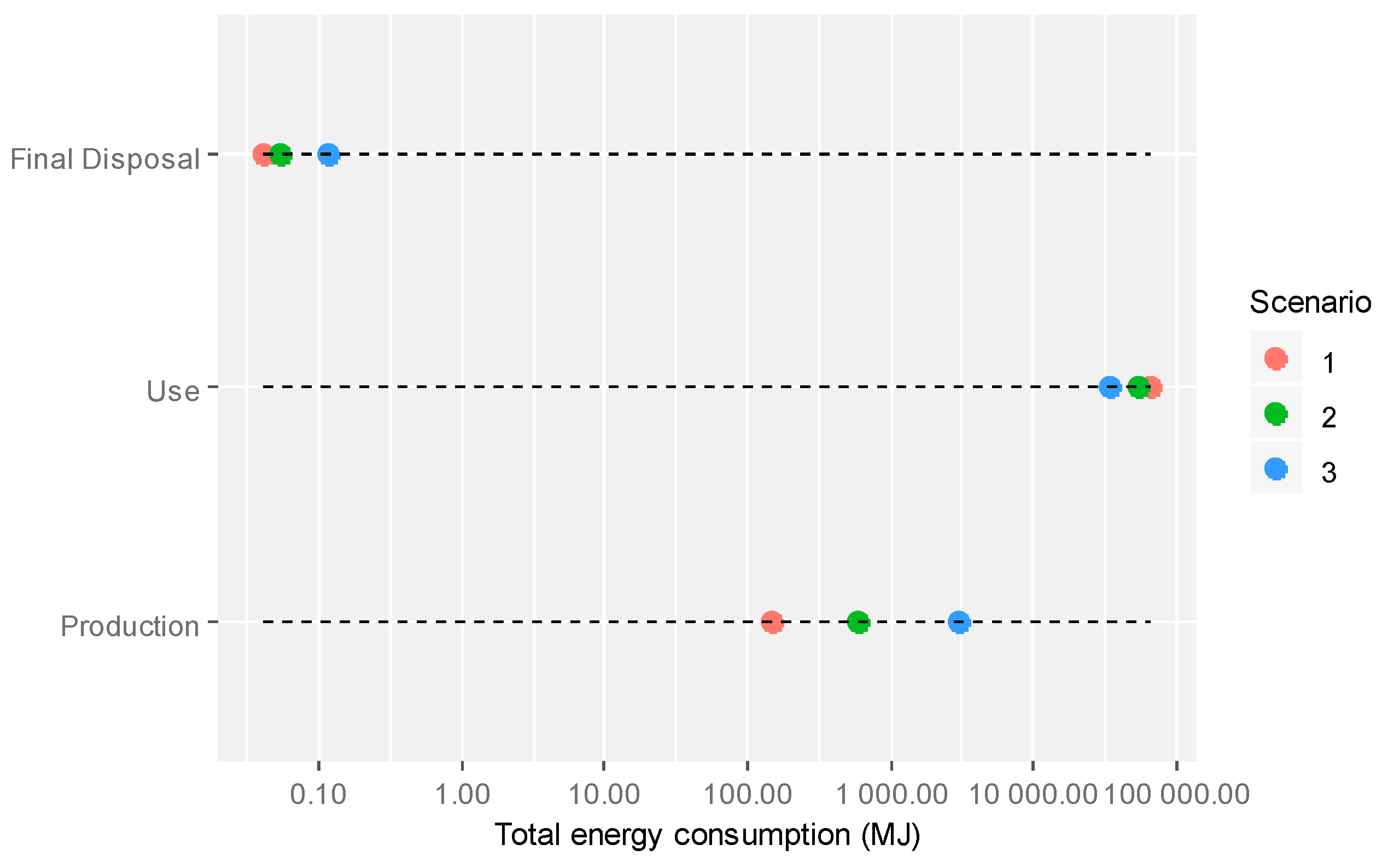
3.3. Energy Consumption
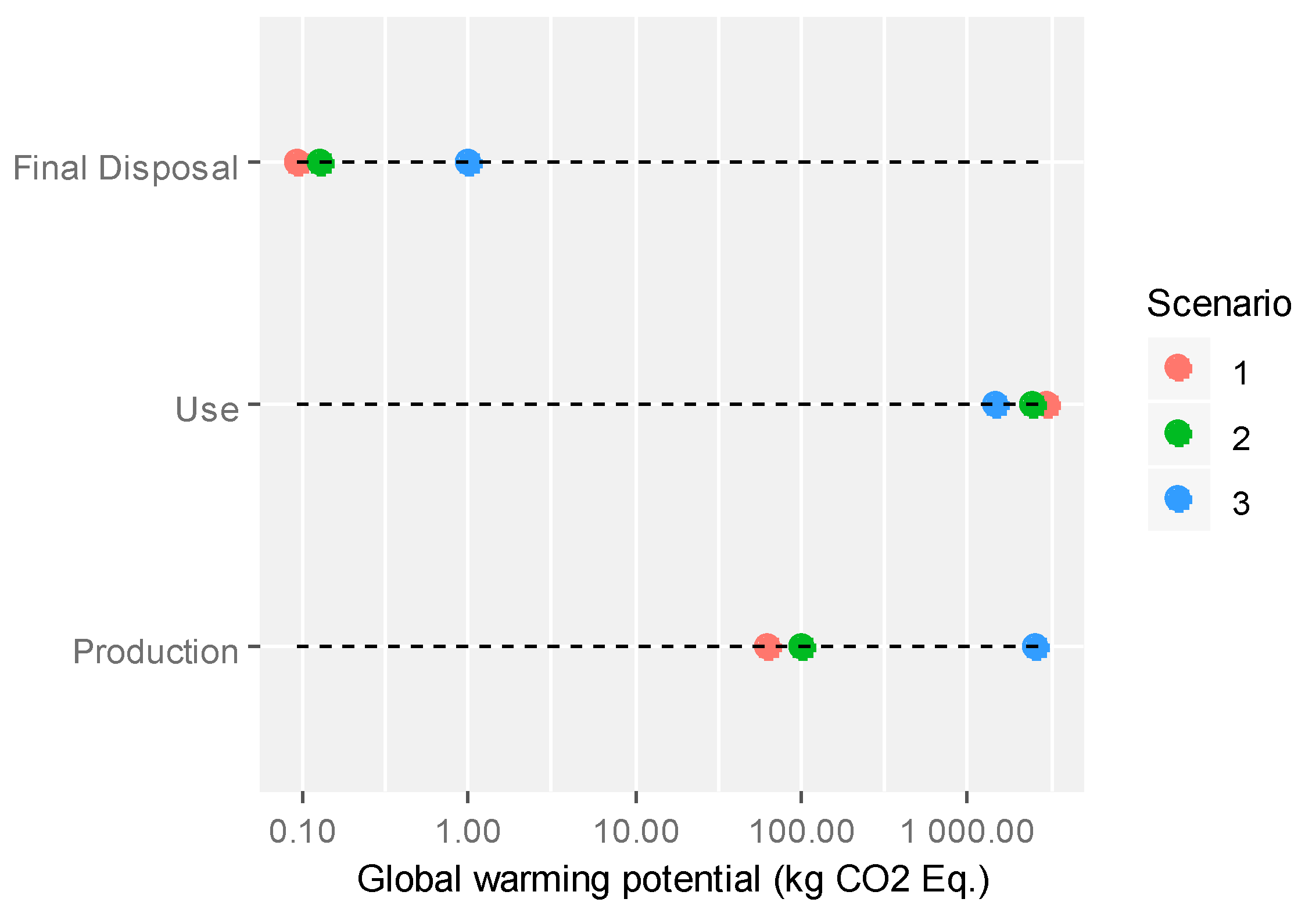
3.4. Global Warming Potential
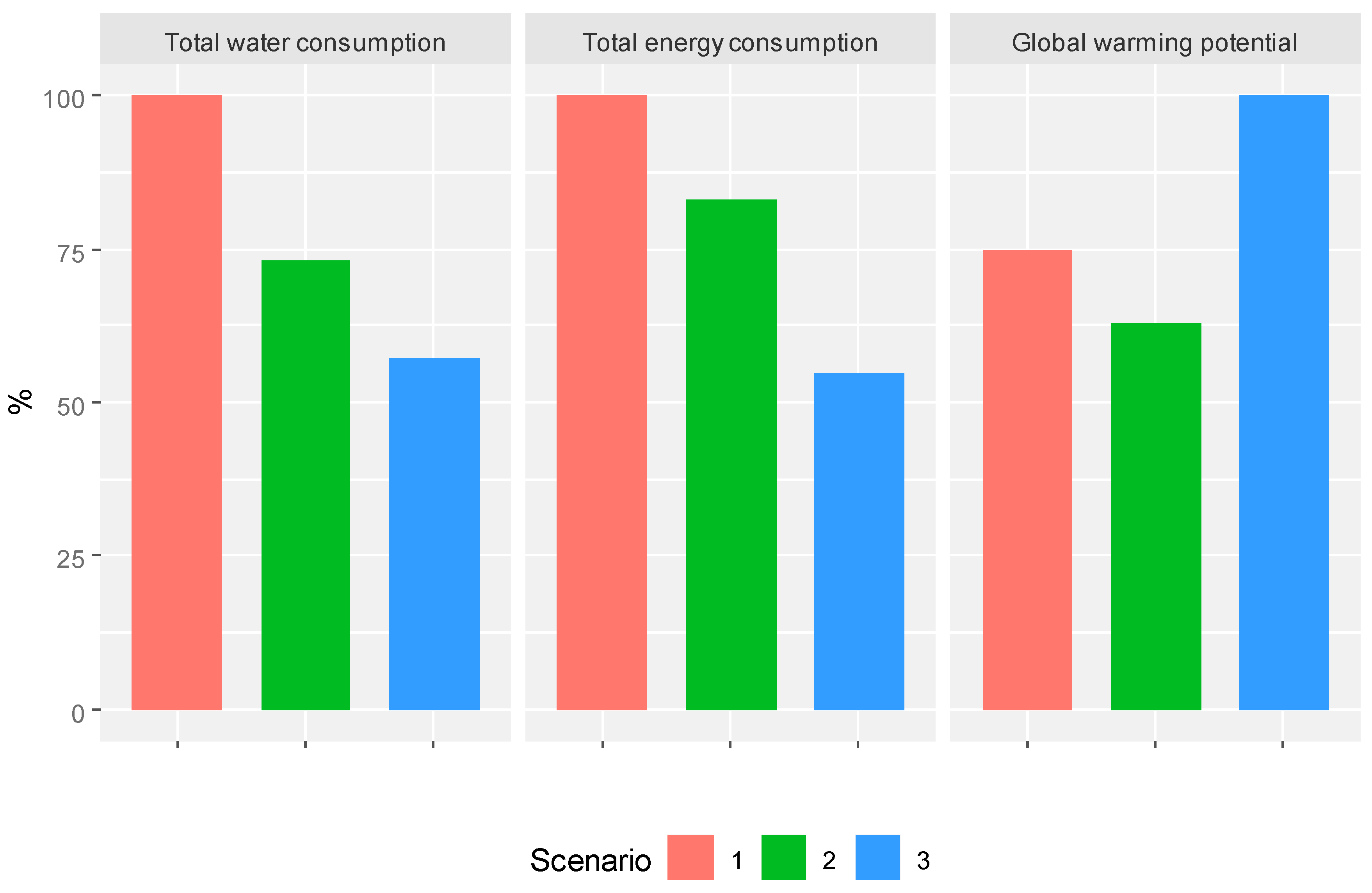
3.5. Comparison of the Life Cycle Impacts of the Three Scenarios
3.6. Economic Analysis Results
4. Conclusions
Author Contributions
Funding
Acknowledgments
Conflicts of Interest
References
- Geng, S.; Wang, Y.; Zuo, J.; Zhou, Z.; Du, H.; Mao, G. Building life cycle assessment research: A review by bibliometric analysis. Renew. Sustain. Energy Rev. 2017, 76, 176–184. [Google Scholar] [CrossRef] [Scilit]
- Cabeza, L.F.; Rincón, L.; Vilariño, V.; Pérez, G.; Castell, A. Life cycle assessment (LCA) and life-cycle energy analysis (LCEA) of buildings and the building sector: A review. Renew. Sustain. Energy Rev. 2014, 29, 394–416. [Google Scholar] [CrossRef] [Scilit]
- Perez, G.; Cabeza, L.F. Buildings Life Cycle Assessment. In Encyclopedia of Sustainable Technologies; Elsevier: Amsterdam, The Netherlands, 2017; pp. 275–290. [Google Scholar] [CrossRef] [Scilit]
- Bribián, I.Z.; Capilla, A.V.; Usón, A.A. Life cycle assessment of building materials: Comparative analysis of energy and environmental impacts and evaluation of the eco-efficiency improvement potential. Build. Environ. 2011, 46, 1133–1140. [Google Scholar] [CrossRef] [Scilit]
- Asdrubali, F.; Baldassarri, C.; Fthenakis, V. Life cycle analysis in the construction sector: Guiding the optimization of conventional Italian buildings. Energy Build. 2013, 64, 73–89. [Google Scholar] [CrossRef] [Scilit]
- Gan, X.; Zuo, J.; Ye, K.; Skitmore, M.; Xiong, B. Why sustainable construction? Why not? An owner’s perspective. Habitat Int. 2015, 47, 61–68. [Google Scholar] [CrossRef] [Scilit]
- Balaguera, A.; Carvajal, G.I.; Albertí, J.; Fullana-i-Palmer, P. Life cycle assessment of road construction alternative materials: A literature review. Resour. Conserv. Recycl. 2018, 132, 37–48. [Google Scholar] [CrossRef] [Scilit]
- Abd Rashid, A.; Idris, J.; Yusoff, S. Environmental Impact Analysis on Residential Building in Malaysia Using Life Cycle Assessment. Sustainability 2017, 9, 329. [Google Scholar] [CrossRef] [Scilit]
- Weiler, V.; Harter, H.; Eicker, U. Life cycle assessment of buildings and city quarters comparing demolition and reconstruction with refurbishment. Energy Build. 2017, 134, 319–328. [Google Scholar] [CrossRef] [Scilit]
- Kern, A.P.; Antoniolli, C.B.; Wander, P.R.; Mancio, M.; González, M.A.S. Energy and water consumption during the post-occupancy phase and the users’ perception of a commercial building certified by Leadership in Energy and Environmental Design (LEED). J. Clean. Prod. 2016, 133, 826–834. [Google Scholar] [CrossRef] [Scilit]
- Maslesa, E.; Jensen, P.A.; Birkved, M. Indicators for quantifying environmental building performance: A systematic literature review. J. Build. Eng. 2018, 19, 552–560. [Google Scholar] [CrossRef] [Scilit]
- Lu, W.; Chi, B.; Bao, Z.; Zetkulic, A. Evaluating the effects of green building on construction waste management: A comparative study of three green building rating systems. Build. Environ. 2019, 155, 247–256. [Google Scholar] [CrossRef] [Scilit]
- Słyś, D.; Stec, A. The Analysis of Variants of Water Supply Systems in Multi-Family Residential Building. Ecol. Chem. Eng. S 2015, 21, 623–635. [Google Scholar] [CrossRef] [Scilit]
- Marinoski, A.K.; Rupp, R.F.; Ghisi, E. Environmental benefit analysis of strategies for potable water savings in residential buildings. J. Environ. Manag. 2018, 206, 28–39. [Google Scholar] [CrossRef] [Scilit] [PubMed]
- Fidar, A.; Memon, F.A.; Butler, D. Environmental implications of water efficient microcomponents in residential buildings. Sci. Total Environ. 2010, 408, 5828–5835. [Google Scholar] [CrossRef] [Scilit] [PubMed]
- López Zavala, M.Á.; Castillo Vega, R.; López Miranda, R.A. Potential of Rainwater Harvesting and Greywater Reuse for Water Consumption Reduction and Wastewater Minimization. Water 2016, 8, 264. [Google Scholar] [CrossRef] [Scilit]
- Teston, A.; Geraldi, M.S.; Colasio, B.M.; Ghisi, E. Rainwater Harvesting in Buildings in Brazil: A Literature Review. Water 2018, 10, 471. [Google Scholar] [CrossRef] [Scilit]
- Stec, A.; Zeleňáková, M. An Analysis of the Effectiveness of Two Rainwater Harvesting Systems Located in Central Eastern Europe. Water 2019, 11, 458. [Google Scholar] [CrossRef] [Scilit]
- Słyś, D. Potential of rainwater utilization in residential housing in Poland. Water Environ. J. 2009, 23, 318–325. [Google Scholar] [CrossRef] [Scilit]
- Juan, Y.; Chen, Y.; Lin, J. Greywater Reuse System Design and Economic Analysis for Residential Buildings in Taiwan. Water 2016, 8, 546. [Google Scholar] [CrossRef] [Scilit]
- Marinoski, A.K.; Ghisi, E. Environmental performance of hybrid rainwater-greywater systems in residential buildings. Resour. Conserv. Recycl. 2019, 144, 100–114. [Google Scholar] [CrossRef] [Scilit]
- Ecoinvent Centre. Converted Ecoinvent 3.3 Data as Unit Processes with Links to Other Processes, Including Uncertainty Data; Ecoinvent Centre: Zurich, Switzerland, 2016. [Google Scholar]
- Li, W.; Mo, W.; Zhang, X.; Squiers, J.J.; Lu, Y.; Sellke, E.W.; Thatcher, J.E. Outlier detection and removal improves accuracy of machine learning approach to multispectral burn diagnostic imaging. J. Biomed. Opt. 2015, 20, 121305. [Google Scholar] [CrossRef] [Scilit] [PubMed]
- Liao, H.; Li, Y.; Brooks, G. Outlier Impact and Accommodation Methods: Multiple Comparisons of Type I Error Rates. J. Mod. Appl. Stat. Methods 2016, 15, 23. [Google Scholar] [CrossRef] [Scilit]
- Hoffmann, H.; Platzer, C.; Winker, M.; Muench, E. Technology Review of Constructed Wetlands. Subsurface Flow Constructed Wetlands for Greywater and Domestic Wastewater Treatment; Deutsche Gesellschaft für Technische Zusammenarbeit GmbH (GTZ) Sustainable Sanitation-Ecosan Program: Eschborn, Germany, 2011; Available online: http://www.susana:_resources/documents/default/2-930-giz2011-en-technology-review-constructed-wetlands.pdf (accessed on 08 January 2019).
- Platzer, C.; Hoffmann, H.; Cárdia, W. The wetlands as an Ecosan component-experiences with its use and sizing in subtropical climates. In Proceedings of the International Conference on Sustainable Sanitation: Food and Water Security for Latin America, Fortaleza, Brazil, 26–29 November 2007. [Google Scholar]
- Avery, L.M.; Frazer-Williams, R.A.D.; Winward, G.; Shirley-Smith, C.; Liu, S.; Memon, F.A.; Jefferson, B. Constructed wetlands for grey water treatment. Ecohydrol. Hydrobiol. 2007, 7, 191–200. [Google Scholar] [CrossRef] [Scilit]
- Vieira, A.S.; Ghisi, E. Water-energy nexus in low-income houses in Brazil: The influence of integrated on-site water and sewage management strategies on the energy consumption of water and sewerage services. J. Clean. Prod. 2016, 133, 145–162. [Google Scholar] [CrossRef] [Scilit]
- Headley, T.R.; Davison, L.; Huett, D.O.; Müller, R. Evapotranspiration from subsurface horizontal flow wetlands planted with Phragmites australis in sub-tropical Australia. Water Res. 2012, 46, 345–354. [Google Scholar] [CrossRef] [Scilit] [PubMed]
- Kalbusch, A.; Ghisi, E. Comparative life-cycle assessment of ordinary and water-saving taps. J. Clean. Prod. 2016, 112, 4585–4593. [Google Scholar] [CrossRef] [Scilit]
- Velazquez, L.; Munguia, N.; Ojeda, M. Optimizing water use in the University of Sonora, Mexico. J. Clean. Prod. 2013, 46, 83–88. [Google Scholar] [CrossRef] [Scilit]
- Marinho, M.; Gonçalves, M.S.; Kiperstok, A. Water conservation as a tool to support sustainable practices in a Brazilian public university. J. Clean. Prod. 2014, 62, 98–106. [Google Scholar] [CrossRef] [Scilit]
- Silva-Afonso, A.; Pimentel-Rodrigues, C.; Meireles, I.; Sousa, V. Feasibility Study of Water Saving Measures in Higher Education Buildings: A Case Study of the University of Aveiro. Br. J. Environ. Clim. Chang. 2016, 16, 116–127. [Google Scholar] [CrossRef] [Scilit]
- Ortiz, O.; Castells, F.; Sonnemann, G. Sustainability in the construction industry: A review of recent developments based on LCA. Constr. Build. Mater. 2009, 23, 28–39. [Google Scholar] [CrossRef] [Scilit]
- Lee, M.; Tansel, B. Life cycle based analysis of demands and emissions for residential water-using appliances. J. Environ. Manag. 2012, 101, 75–81. [Google Scholar] [CrossRef] [Scilit] [PubMed]
- Wakeel, M.; Chen, B. Energy consumption in urban water cycle. Energy Procedia 2016, 104, 123–128. [Google Scholar] [CrossRef] [Scilit]
- Chang, J.; Lee, W.; Yoon, S. Energy consumptions and associated greenhouse gas emissions in operation phases of urban water reuse systems in Korea. J. Clean. Prod. 2017, 141, 728–736. [Google Scholar] [CrossRef] [Scilit]
- Corominas, L.; Foley, J.; Guest, J.S.; Hospido, A.; Larsen, H.F.; Morera, S.; Shaw, A. Life cycle assessment applied to wastewater treatment: State of the art. Water Res. 2013, 47, 5480–5492. [Google Scholar] [CrossRef] [Scilit] [PubMed]
- Vilches, A.; Garcia-Martinez, A.; Sanchez-Montañes, B. Life cycle assessment (LCA) of building refurbishment: A literature review. Energy Build. 2017, 135, 286–301. [Google Scholar] [CrossRef] [Scilit]
- Houghton, J.T.; Meira Filho, L.G.; Callander, B.A.; Harris, N.; Kattenberg, A.; Maskell, K. Climate Change 1995: The Science of Climate Change: Contribution of Working Group I to the Second Assessment Report of the Intergovernmental Panel on Climate Change; Cambridge University Press: Cambridge, UK, 1996. [Google Scholar]
- Heijungs, R.; Guinée, J. Software as a bridge between theory and practice in life cycle assessment. J. Clean. Prod. 1993, 1, 185–189. [Google Scholar] [CrossRef] [Scilit]
- Häfliger, I.F.; John, V.; Passer, A.; Lasvaux, S.; Hoxha, E.; Saade, M.R.M.; Habert, G. Buildings environmental impacts’ sensitivity related to LCA modelling choices of construction materials. J. Clean. Prod. 2017, 156, 805–816. [Google Scholar] [CrossRef] [Scilit]
- Chang, N.; Qi, C.; Yang, Y.J. Optimal expansion of a drinking water infrastructure system with respect to carbon footprint, cost-effectiveness and water demand. J. Environ. Manag. 2012, 110, 194–206. [Google Scholar] [CrossRef] [Scilit]
- Brasil. Diagnóstico dos Serviços de Água e Esgotos; Sistema Nacional de Informações Sobre Saneamento–SNIS: Brasília, Brazil, 2015. [Google Scholar]
- R Development Core Team. R: A Language and Environment for Statistical Computing; R Foundation for Statistical Computing: Vienna, Austria, 2018; Available online: https://www.R-project.org/ (accessed on 25 September 2017).
- Morera, S.; Comas, J.; Poch, M.; Corominas, L. Connection of neighboring wastewater treatment plants: Economic and environmental assessment. J. Clean. Prod. 2015, 90, 34–42. [Google Scholar] [CrossRef] [Scilit]



| Toilets | Measurement Period | Average Water Consumption (Liters/Day) |
|---|---|---|
| Female | First | 931.933 (s = 344.572) |
| Second | 702.460 (s = 233.199) | |
| Male | First | 553.366 (s = 202.909) |
| Second | 540.602 (s = 259.744) |
| Toilets | Average Number of Activations (Activations/Day) | p-Value | |
|---|---|---|---|
| First Period | Second Period | ||
| Female | 116 (s = 43) | 118 (s = 38) | 0.9146 |
| Male | 70 (s = 26) | 66 (s = 27) | 0.4898 |
© 2019 by the authors. Licensee MDPI, Basel, Switzerland. This article is an open access article distributed under the terms and conditions of the Creative Commons Attribution (CC BY) license (http://creativecommons.org/licenses/by/4.0/).
Share and Cite
Gnoatto, E.L.; Kalbusch, A.; Henning, E. Evaluation of the Environmental and Economic Impacts on the Life Cycle of Different Solutions for Toilet Flush Systems. Sustainability 2019, 11, 4742. https://doi.org/10.3390/su11174742
Gnoatto EL, Kalbusch A, Henning E. Evaluation of the Environmental and Economic Impacts on the Life Cycle of Different Solutions for Toilet Flush Systems. Sustainability. 2019; 11(17):4742. https://doi.org/10.3390/su11174742
Chicago/Turabian StyleGnoatto, Eloise Leonora, Andreza Kalbusch, and Elisa Henning. 2019. "Evaluation of the Environmental and Economic Impacts on the Life Cycle of Different Solutions for Toilet Flush Systems" Sustainability 11, no. 17: 4742. https://doi.org/10.3390/su11174742
APA StyleGnoatto, E. L., Kalbusch, A., & Henning, E. (2019). Evaluation of the Environmental and Economic Impacts on the Life Cycle of Different Solutions for Toilet Flush Systems. Sustainability, 11(17), 4742. https://doi.org/10.3390/su11174742