Quali—A Quantitative Environmental Assessment Method According to Italian CAM, for the Sustainable Design of Urban Neighbourhoods in Mediterranean Climatic Regions



Abstract
:1. Introduction
- Identification of critical factors, of a project of an urban district, with respect to the minimum thresholds defined by the parameters of the Italian CAM;
- Identification of the strategies, and the relative costs, for the achievement of the basic minimum thresholds;
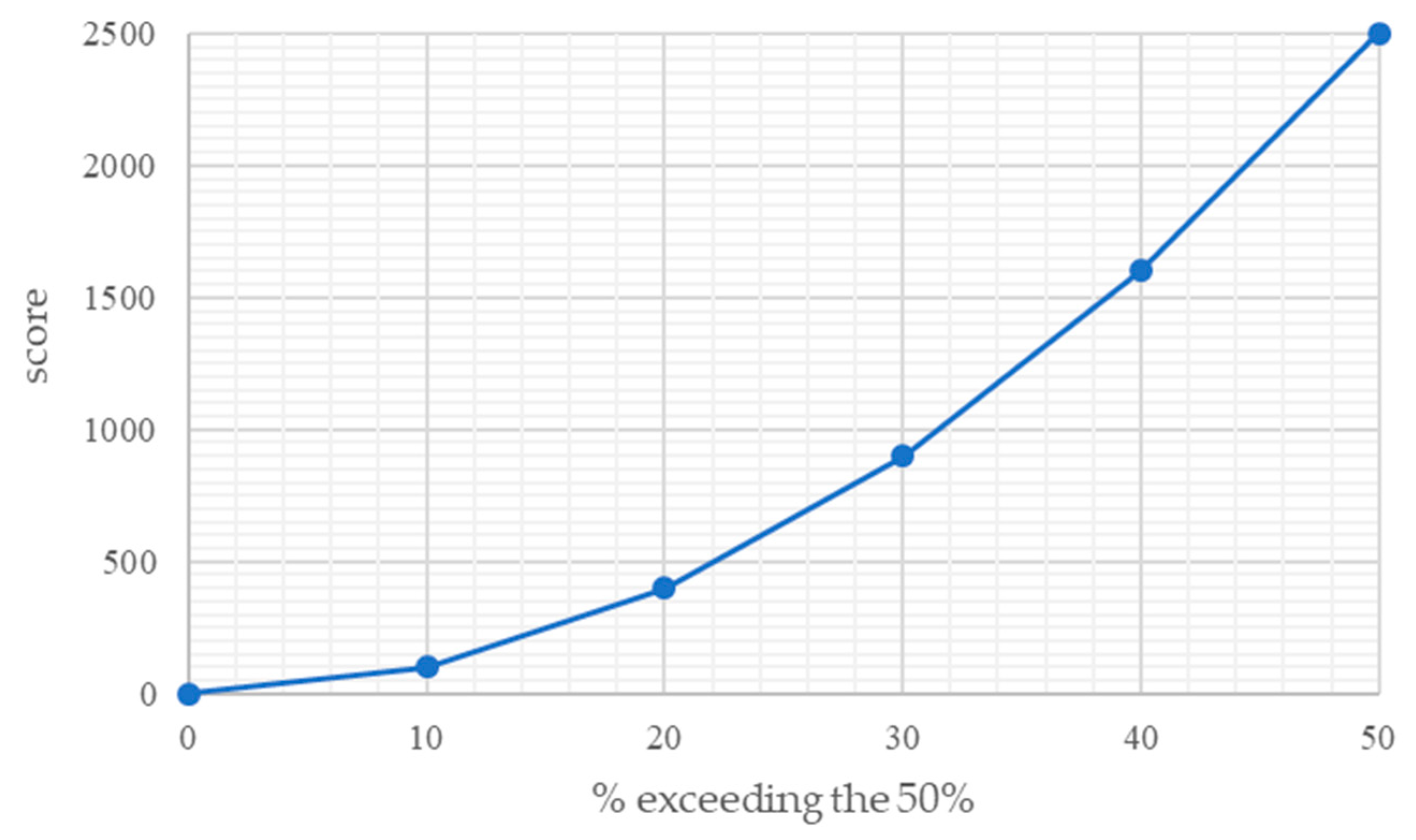
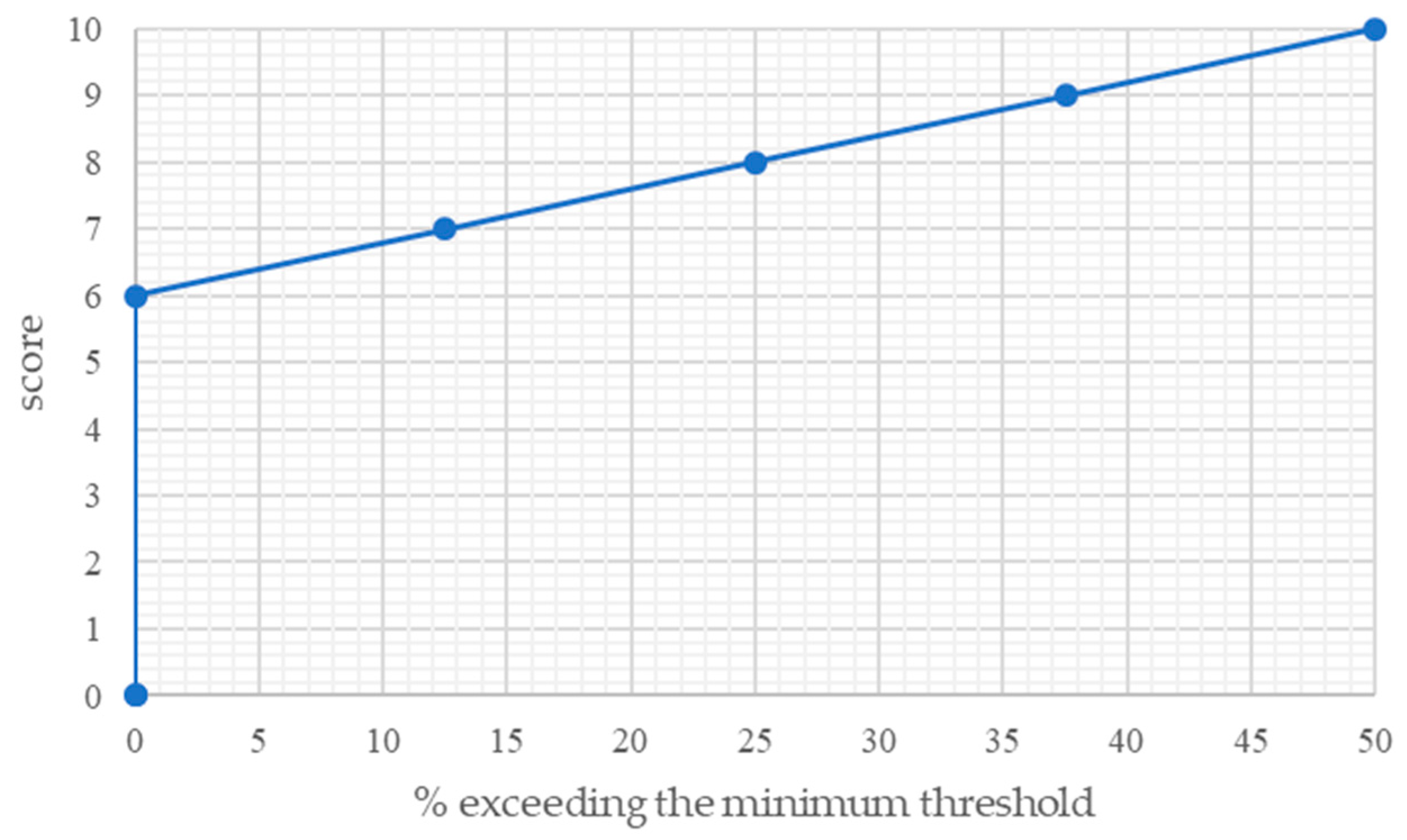
- Identification of the strategies, and the relative costs, for the exceeding of the above-mentioned thresholds; that is to say, for the achievement of the bonuses;
- Evaluation, among various project solutions, of the most suitable one for the choice of the financial investment.
2. The Role of Italian CAM in Environmental Certification Protocols
3. Materials
3.1. Indicators
3.2. Multi-Criteria Analysis
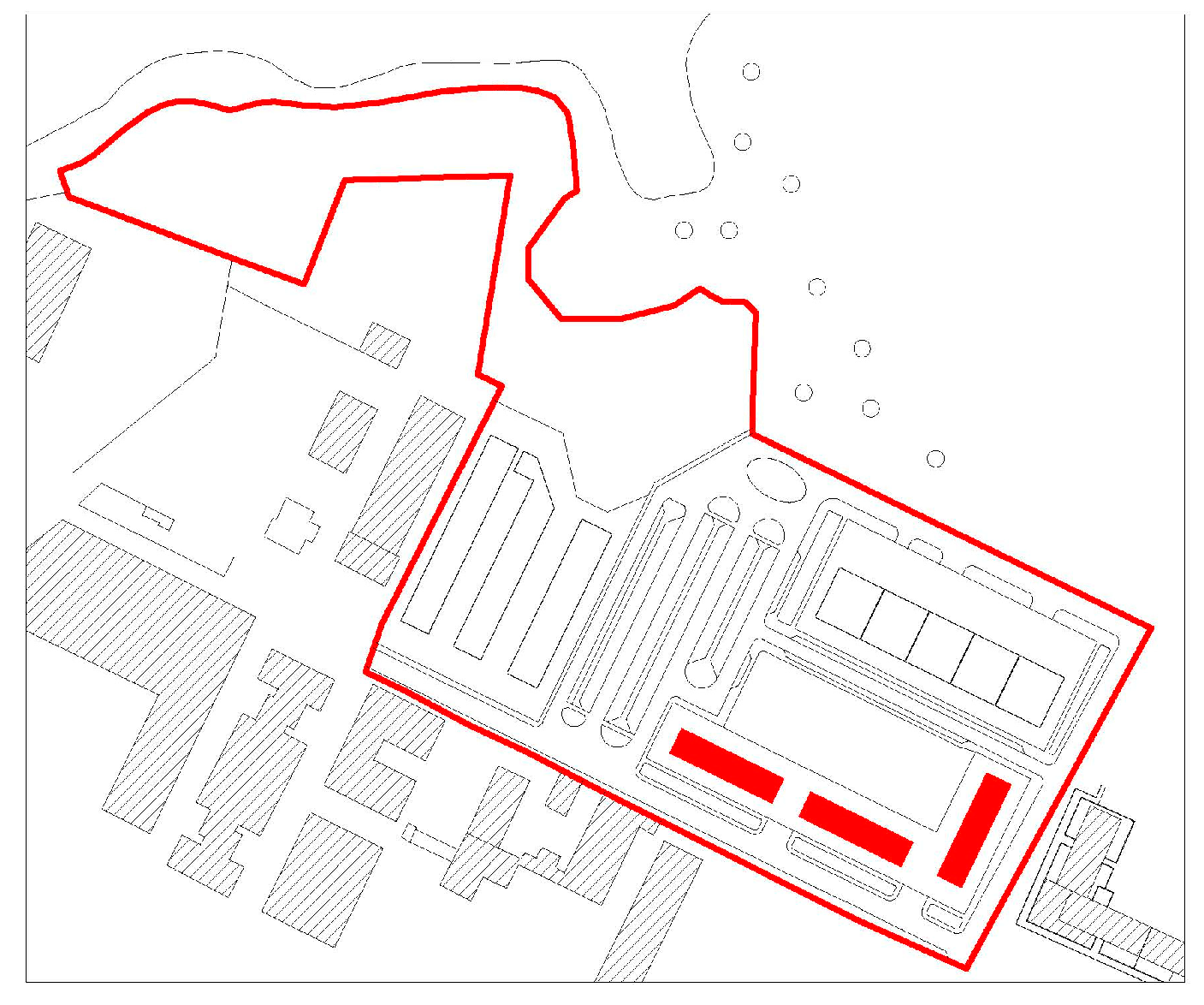
3.3. Case Studies
- Urban area extension: From 20,000 to 50,000 m2;
- Project functions: Residential and commercial buildings, appurtenant car parks, outdoor areas used as public spaces, parks, parking areas;
- Construction of primary and secondary infrastructure works;
- Climatic characteristics of the area: Temperate Mediterranean climate.
3.4. Stakeholders
- Academic teaching staff;
- Freelancers.
- (1)
- With regard to the selection of academic staff, first and second level teachers (full and associate professors) have been identified, belonging to the university institutions of Southern Italy, belonging to the disciplines related to the topics under study: Technical architecture, environmental impact assessment, urban planning technique, technical environmental physics, water resource management, energy and environmental sustainability and economic evaluation of projects;
- (2)
- With regard to the selection of freelancers, professionals in the sector (private or associated) operating in Southern Italy have been identified, with over ten years of experience in the field of architectural and urban design of public works, directly involved in the dynamics of transformation of the urbanized territory.
4. Methods
- First phase: Definition of the questionnaire to be administered to the stakeholders, on the basis of the methodology of the comparison in pairs, for the determination of the weights to be assigned to each parameter;
- Second phase: Elaboration of the data and determination of the weights of the indicators and sub-indicators, through the development of the model;
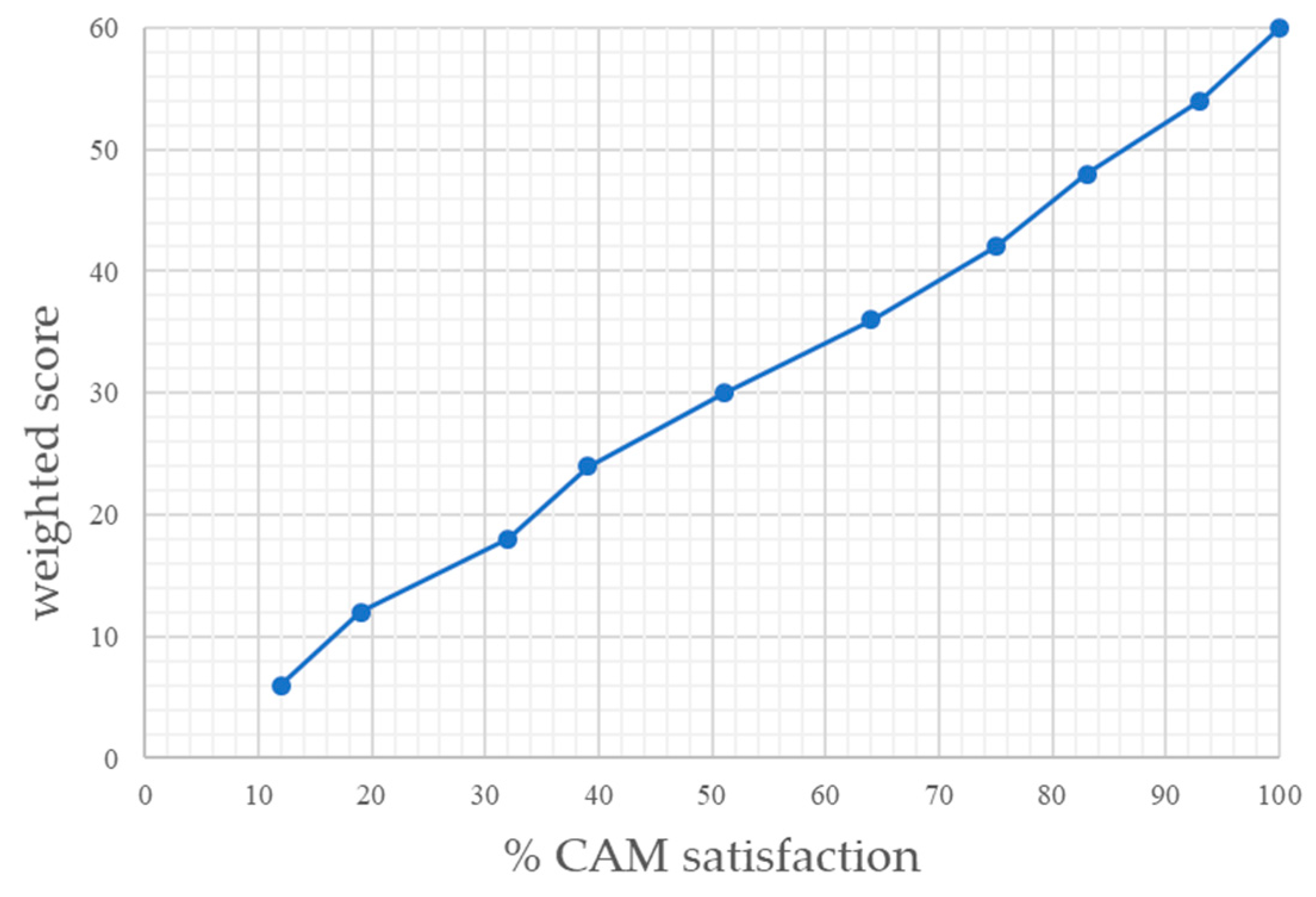
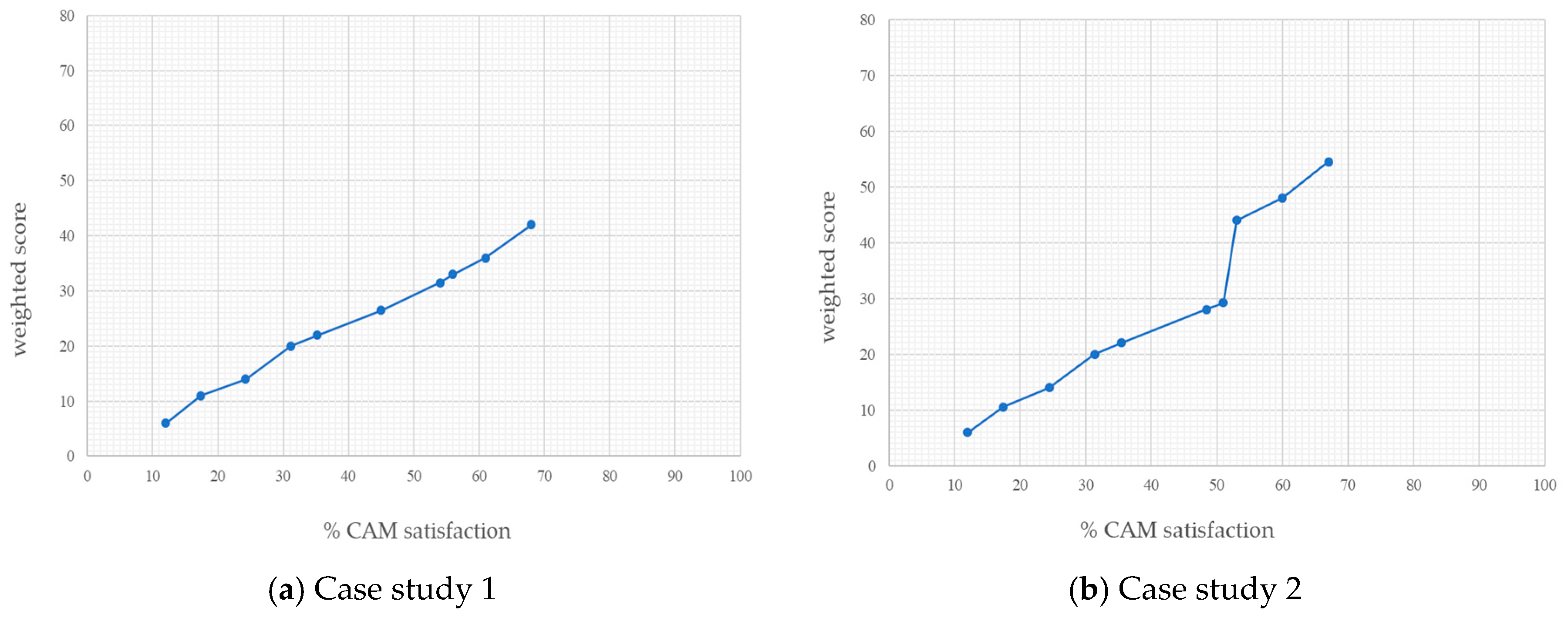
- Third phase: Application of the model to the case studies for the purpose of assessing the compliance rate of the basic CAM;
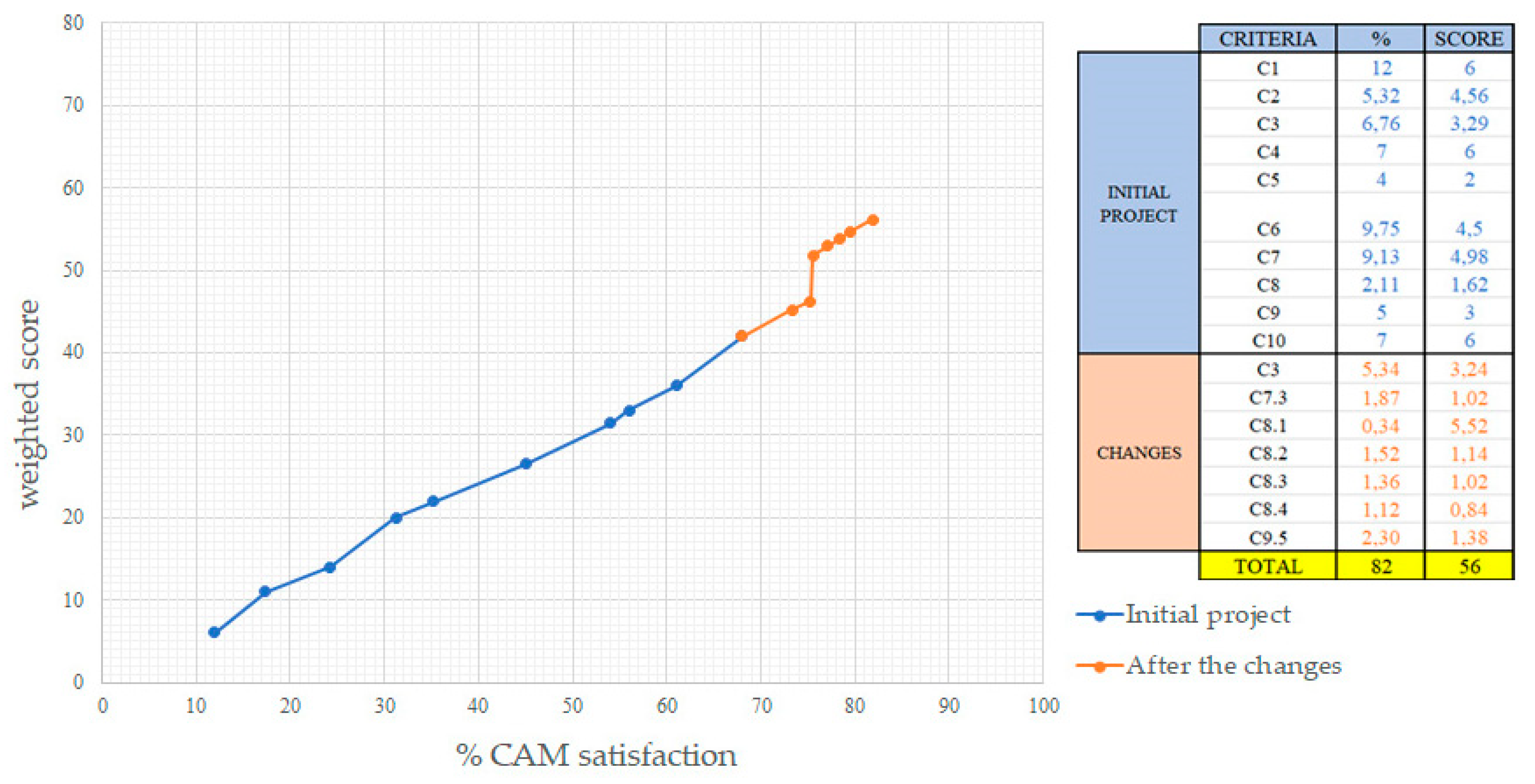
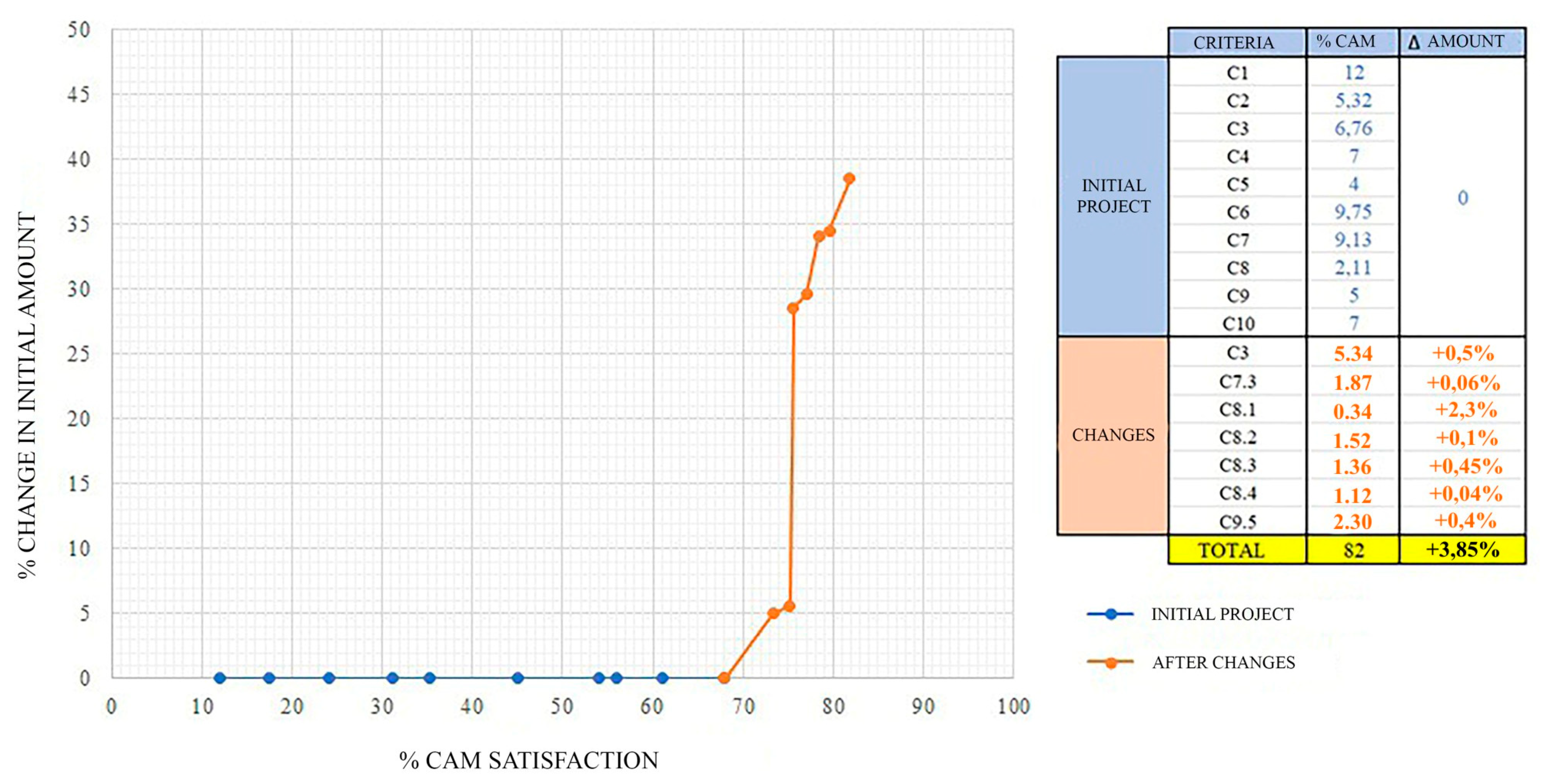
- Fourth phase: Improvement strategies for the achievement of the minimum thresholds of CAM, as well as for the possible exceeding of the same in order to obtain the rewarding scores.
4.1. Definition of the Questionnaire to Be Administered to the Stakeholder
4.2. Elaboration of the Data and Determination of the Weights of the Indicators and Sub-Indicators
- All weights are pure numbers included in the interval [0;1];
- The sum of all weights is always equal to 1.
4.3. Application of the Model to the Case Studies for the Purpose of Assessing the Compliance Rate of the Basic CAM
- All weights are numbers in the range [0,1];
- The sum of all weights is always equal to 1.
4.4. Improvement Strategies for the Achievement of the Minimum Thresholds of CAM
- (a)
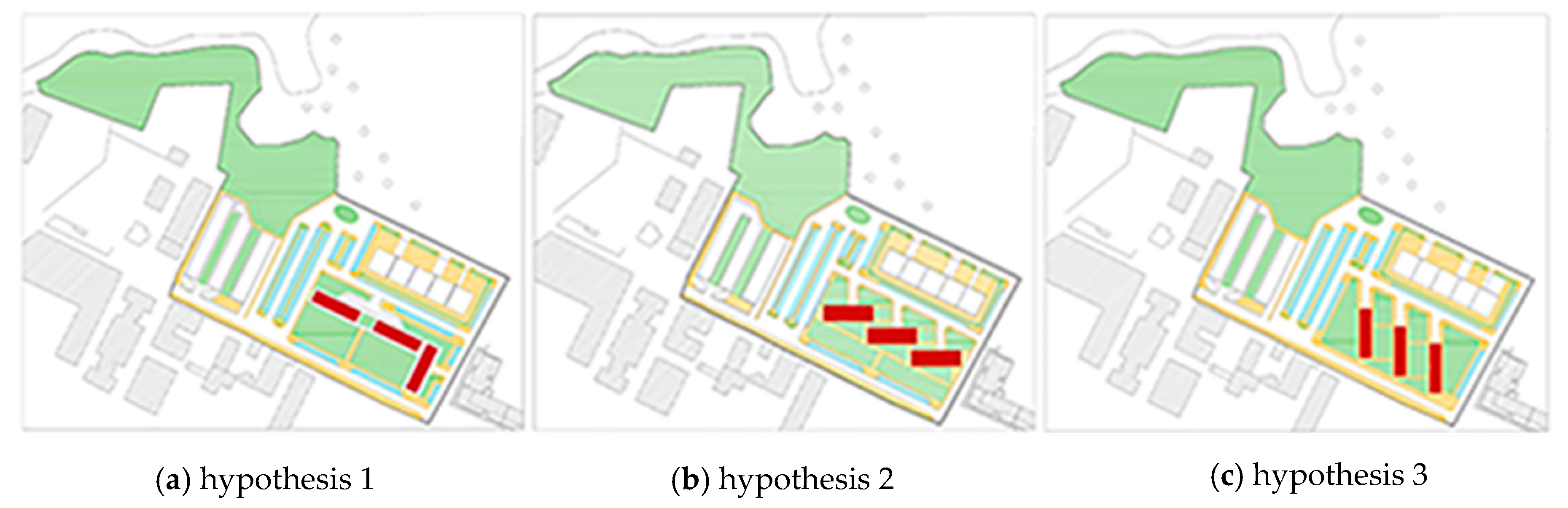
- Arrangement and orientation of buildings within the area;
- (b)
- Interventions concerning the entire building complex.
- Reduction of soil consumption and maintenance of soil permeability.
- (3.2)
- Permeable territorial area;
- (3.3)
- Area to be used as green area;
- (3.4)
- Arboreal and shrub cover in public green areas;
- (3.5)
- Drainage materials for pedestrian and driveway surfaces.
- Reduction of the impact on the surface and underground river basin system.
- (7.3)
- Realize first rain water purification plants.
- Primary infrastructure.
- (8.1)
- Roads (Interventions for parking areas);
- (8.1.1)
- Cover with masts suitable for parking;
- (8.1.3)
- To realize the covers of the parking lot with photovoltaic shelters;
- (8.1.4)
- Provide space for motorcycles, mopeds and bicycle racks;
- (8.2)
- Collection, purification and reuse of rainwater;
- (8.2.1)
- Establish a separate network for collecting rainwater;
- (8.3)
- Irrigation network of public green areas;
- (8.3.1)
- Use drip irrigation systems powered by renewable energy sources;
- (8.4)
- Areas for collection and storage of materials and waste;
- (8.4.1)
- Establishing areas for local separate collection.
- Secondary infrastructure and sustainable mobility.
- (9.5)
- Network of protected cycle and pedestrian paths with adequate tree and/or shrub accommodation.
| SCORE | % CAM SATISFACTION | |
| INITIAL PROJECT (CASE STUDY) | 3.29 | 6.76% |
| POST-MODIFICATION PRJECT | 6.53 | 12.10% |
| DIVERGENCE | +3.24 | +5.34% |
| SCORE | % CAM SATISFACTION | |
| INITIAL PROJECT (CASE STUDY) | 0.60 | 0.75% |
| POST-MODIFICATION PRJECT | 6.12 | 1.09% |
| DIVERGENCE | +5.52 | +0.34% |
- the first collection network, sends water directly to the tanks;
- the second network first purifies the water (if it comes from polluted surfaces such as roads) and then sends it to the tanks (this is linked to the point “Reducing the impact on the surface and underground hydrographic system”).
4.5. Economic Evaluations
- Residential function: 1200 m2;
- Commercial function: 1800 m2;
- Arrangement of outdoor areas (parking, public gardens, sidewalk and rest areas): 38,000 m2.
5. Discussion
6. Conclusions
Author Contributions
Funding
Conflicts of Interest
Appendix A

| 1. Naturalistic and landscape integration (*) |
| The project must indicate a selection of tree and shrub species to be planted in these areas, taking into account the function of absorption of pollutants in the atmosphere, and regulation of the microclimate and using species that have the following characteristics: reduced water requirement; resistance to phytopathology; absence of harmful effects on human health (allergenic, stinging, thorny, poisonous, etc.). |
| 1.1 Conservation of habitats in the area |
| 2. Green areas design (*) |
| The project must include actions to facilitate subsequent management and maintenance, so that the positive effects of adopting the environmental criteria adopted in the project can continue. During the execution of the works, techniques for the maintenance of the existing green heritage must be adopted with control interventions (e.g., mowing) prior to the flowering period in order to avoid the spread of pollen. |
| 2.1 Using native plant species with low allergen pollens |
| 2.2 In the case of species with moderate to high allergenic power, favour female plants, sterile or with entomophilous pollination |
| 2.3 Do not use stinging, thorny or toxic plant species (es. Gleditsia triacanthos L.—Spino di Giuda, Robinia pseudoacacia L.—Falsa acacia, Pyracantha—Piracanto, Elaeagnus angustifolia L.—Olivagno) or toxic (es. Nerium oleander L.—Oleandro, Taxus baccata L.—Tasso, Laburnum anagyroides Meddik—Maggiociondolo) |
| 2.4 Use deep-rooting herbaceous species in the case of green areas with steep slopes or subject to landslides |
| 2.5 Do not use tree species with fragile roots, stems or foliage that could cause damage in the event of intense weather events |
| 3. Soil consumption reduction and maintenance of soil permeability (*) |
| The project must ensure a reduction in soil consumption by containing the new building, increasing the permeable surface area and using draining materials. |
| 3.1 Avoiding the construction of new buildings or the extension of existing buildings in protected areas |
| 3.2 Permeable land area of not less than 60% of the unbuilt project area not built |
| 3.3 Area to be allocated to green areas equal to at least 40% of the project area not built on and 30% of the total area of the lot |
| 3.4 In public green areas, at least 40% tree cover (trees at least 5 m high) and at least 20% shrub cover (bushes or hedges) with native plant species must be guaranteed |
| 3.5 Use of draining materials (capable of absorbing rainwater and disposing of it underground in a natural way) for pedestrian and vehicular urbanised areas |
| 3.6 In the execution phase, a surface scotic of at least 60 cm must be provided for the areas where excavations and embankments are planned |
| 4. Conservation of morphological characters (*) |
| The project must justify the choice of suitable and functional plant species for the site of inclusion. The best possible vegetative conditions and the quality of the substrates must be guaranteed. Instructions must be given on the next technique for the maintenance of green areas. |
| 4.1 Maintaining existing morphological profiles, i.e., preserving the natural course of the land in which the project will be carried out |
| 5. Energy supply from renewable sources (*) |
| The project must provide for the reduction of greenhouse gas emissions into the atmosphere, through the use of plants powered by renewable sources. The share of coverage by renewable sources of the energy needs of the complex of buildings cannot be less than the sum of the specific shares of the individual buildings, as increased in accordance with the provisions of criterion 2.3.3 below (e.g., in the case of a complex made up of two buildings A and B with different uses and requests for coverage by different renewable sources for each of the two buildings, the coverage by renewable sources of the overall energy needs is increased by a share of at least 10%). |
| Is required an energy supply system capable of covering part or all of the requirements through one or more of the following systems: |
| 5.1 Construction of cogeneration/trigeneration plants |
| 5.2 Installation of photovoltaic parks |
| 5.3 Installation of solar thermal collectors for domestic hot water heating |
| 5.4 Installation of low-enthalpy geothermal systems |
| 5.5 Installation of heat pump systems |
| 5.6 Installation of biomass systems |
| 6. Reduction of the impact on the microclimate and air pollution (*) |
| In order to reduce emissions into the atmosphere and limit the effects of solar radiation (heat island effect), the design of new buildings or the renovation of existing buildings must provide for the creation of a green area with a high biomass that ensures adequate absorption of pollutant emissions into the atmosphere and promotes sufficient evapotranspiration, in order to ensure an adequate microclimate. For new planting areas, native tree and shrub species with reduced water requirements, resistance to phytopathology and a preference for species with predominantly entomophilous reproductive strategies should be used. A management and irrigation plan for green areas must be prepared. |
| 6.1 Use plant species with adequate capacity to absorb CO2 so as to ensure evapotranspiration and promote an adequate microclimate (for the types of plant species to be used see the table in the decree of 11 October 2017 [13]) |
| 6.2 Use permeable materials for pedestrian and driveway areas with an SRI Index of at least 29, to facilitate proper rainwater drainage [13]) |
| 6.3 The use of garden roofs should be preferred for roofs. |
| 6.4 For roofs other than garden roofs, materials with an SRI index of 29 for slopes greater than 15% and 76 for slopes less than or equal to 15% must be used. |
| 7. Reduction of the impact on the surface and underground river basin system (*) |
| The project should include actions aimed at the maintenance and conservation of river ecosystems and corresponding riparian strips, in order to ensure the proper flow of rainwater and reduce the risk of erosion of these ecosystems. |
| 7.1 To preserve and/or restore the naturalness of river ecosystems, river beds and their riparian belt by avoiding the discharge of untreated waste water. |
| 7.2 Ordinary and extraordinary maintenance through the removal of waste and woody material deposited along the riverbed and in the ditches |
| 7.3 Realize first rain water purification plants (first 5 mm of each independent rain event) from draining surfaces subject to pollution |
| 7.4 Preventing or preventing erosion, compaction, landslides or floods (gullies or consolidation of banks and slopes along ditches) |
| 7.5 Preventing the release of pollutants into the soil and subsoil through control and purification measures |
| 8. Primary infrastructure (*) |
| The project will have to include: |
| the use of "cold" type flooring (reinforced grass, brick, light stone, cobblestone, gravel, wood, limestone and opting for permeable self-locking); |
| the conveyance of unpolluted water (from pavements, pedestrian or cycle paths and areas, gardens, etc.) into collection basins for reuse for irrigation or to feed the storage boxes of toilets. The water coming from draining surfaces subject to pollution (driveways, car parks) must be previously conveyed to purification and de-oiling systems, also of a natural type; |
| in order to minimize water consumption, installation of automatic drip irrigation systems (reusing rainwater), powered by renewable energy sources; |
| special areas for the separate collection of waste from residences, offices, commerce, etc., such as paper, cardboard, glass, aluminium, steel, plastic, textiles/leather/leather, rubber, wet, WEEE; |
| realization of canalizations of the technological networks foreseen, for a correct management of the space in the subsoil. |
| 8.1 Road system (Interventions for parking areas) |
| 8.1.1 Coverage with suitable masts equal to at least 10% of the gross area |
| 8.1.2. The perimeter shall be bounded by a green belt at least 1 m high and more than 75% opaque. |
| 8.1.3 Creating roofs with photovoltaic shelters to serve the lighting system of the car park |
| 8.1.4 Provide space for motorcycles, mopeds and bicycle racks based on the number of potential inhabitants |
| 8.2 Collection, purification and reuse of rainwater |
| 8.2.1 Create a system for the purification and de-oiling of water coming from polluting surfaces according to UNI/TS 11445 “Installations for the collection and use of rainwater for uses other than human consumption -Design, installation and maintenance” [38] and the UNI EN 805 standard “Water supply—Requirements for systems and constituents outside buildings” |
| 8.3 Public green areas irrigation network |
| 8.3.1 Use drip irrigation systems powered by renewable energy sources designed according to UNI/TS 11445 standard [38] |
| 8.4 Material and waste collection and storage areas |
| 8.4.1 Special areas must be provided for, which may be used for the local separate collection of waste from residences, offices, commerce, etc. such as paper, cardboard, glass, aluminium, steel, plastic, textiles/leather/leather, rubber, wet, WEEE, in line with municipal regulations of waste management. |
| 8.5 Public lighting system |
| 8.5.1 Designing a public lighting system respecting the requirements of the CAM document “Lighting” (decree 23 December 2013) [39] |
| 8.6 Subservices/channels for technological infrastructures |
| 8.6.1 Creating channels to place all technological networks in order to properly manage underground space |
| 9. Secondary infrastructure and sustainable mobility (*) |
| The project must provide the necessary infrastructure to reduce the movement of people. In addition, it must ensure and encourage sustainable mobility, through the use of bicycles or environmentally friendly shuttles, in order to reduce the environmental pressure associated with the movement of people. |
| 9.1 Provide a mix of residences, workplaces and services to contain travel (expressed in% of internal travel) |
| 9.2 To realize public services or metropolitan stations at short distance less than 500 m from the houses, in case of residential projects; metropolitan stations at less than 800 m and/or railway stations at less than 2.000 m from the new complex. |
| 9.3 Provide shuttle services to reach public services (if stations are not available at less than 800 m) |
| 9.4 Bicycle racks at interchange points |
| 9.5 Network of protected footpaths and/or cycle paths with suitable tree and/or shrub accommodation |
| 10. State of the environment report (*) |
| 10.1 The planned interventions must guarantee an environmental improvement of the site, through the preparation of a report (Report on the State of the Environment) drawn up by a qualified professional who reports on the ante-operam status, the planned interventions and the post-operam status. |
References
- IPCC. Climate Change 2007, Synthesis Report; Contribution of Working Groups I, II and III to the Fourth Assessment Report of the Intergovernmental Panel on Climate Change; Pachauri, R.K., Reisinger, A., Eds.; IPCC: Geneva, Switzerland, 2007; Available online: https://www.ipcc.ch/reports/ (accessed on 6 May 2019).
- GCP-Global Carbon Budget team: Pep Canadell, Philippe Ciais, Thomas Conway, Christopher B. Field, Corinne Le Quéré, Richard A. Houghton, Gregg Marland, Michael R. Raupach. Available online: https://www.globalcarbonproject.org/carbonbudget/archive/2008/CarbonBudget_2008.pdf (accessed on 6 May 2019).
- Earth System Research Laboratory–Global Monitoring Division. Trends in Atmospheric Carbon Dioxide. Available online: http://www.esrl.noaa.gov/gmd/ccgg/trends (accessed on 6 May 2019).
- Lüthi, D.; Le Floch, M.; Bereiter, B.; Blunier, T.; Barnola, J.M.; Siegenthaler, U.; Raynaud, D.; Jouzel, J.; Fischer, H.; Kawamura, K.; et al. High-Resolution Carbon Dioxide Concentration Record 650,000-800,000 years Before Present. Nature 2008, 453, 379–382. Available online: https://www.researchgate.net/publication/5370384 (accessed on 6 May 2019). [CrossRef] [PubMed]
- Comunicazione Della Commissione al Consiglio e al Parlamento Europeo Politica integrata dei prodotti Sviluppare il concetto di “ciclo di vita ambientale”. Bruxelles, 18.6.2003 COM (2003) 302. Available online: https://eur-lex.europa.eu/lexuriserv/lexuriserv.do?uri=com:2003:0302:fin:it:pdf (accessed on 7 May 2019).
- Mokrzecka, M. Influence of Building Shape and Orientation on Heating Demand: Simulations for Student Dormitories in Temperate Climate Conditions. Volume: E3S Web of Conferences 44 July 2018, doi:10.1051/e3sconf/20184400117. Available online: https://www.researchgate.net/publication/326150554 (accessed on 22 May 2019).
- Hidayah, N.; Rodzi Ismail, M. A Review on the Impact of Building Geometry Factors of Glass Façade High-rise Buildings. In Proceedings of the 3rd International Conference-Workshop on Sustainable Architecture and Urban Design 2017 (ICWSAUD2017), Penang, Malaysia, 13–15 November 2017; Available online: https://www.researchgate.net/publication/327070097 (accessed on 22 May 2019).
- Sicignano, E.; Di Ruocco, G.; Melella, R. Mitigation Strategies for Reduction of Embodied Energy and Carbon, in the Construction Systems of Contemporary Quality Architecture. Sustainability 2019, 11, 3806. [Google Scholar] [CrossRef]
- Legge 27 Dicembre 2006, n. 296, Disposizioni Per la Formazione del Bilancio Annuale e Pluriennale Dello Stato (Legge finanziaria 2007). Available online: http://www.parlamento.it/parlam/leggi/06296l.htm (accessed on 8 May 2019).
- Canton, M. Codice Degli Appalti e Norme Collegate: Aggiornato al 1° Gennaio 2019-5a ed; Epub: Mario Canton, 2019. [Google Scholar]
- Commission Staff Working Document–Technology Assessment Accompanying the document–Energy Technologies and Innovation–Brussels, 2.5.2013, SWD (2013) 158 Final, p.68, 2013. Available online: https://ec.europa.eu/energy/sites/ener/files/swf_2013_0158_en.pdf (accessed on 13 May 2019).
- Crepaldi, G. Gli acquisti eco-sostenibili nel nuovo Codice dei Contratti Pubblici Italiano: Considerazioni sul life cycle costing. Rev. do Direito 2018. [Google Scholar] [CrossRef]
- Decreto 11 ottobre 2017–Criteri Ambientali Minimi per L’affidamento di Servizi di Progettazione e Lavori per la nuova Costruzione, Ristrutturazione e Manutenzione di Edifici Pubblici. Available online: http://www.anit.it/wp-content/uploads/2017/11/DM-11-ottobre-2017.pdf (accessed on 5 April 2018).
- Cellura, T.; Cellura, L. Il Nuovo Manuale dei Criteri Minimi Ambientali in Edilizia; Maggioli Editore, Santarcangelo di Romagna: Rimini, Italy, 2018; pp. 7–8. [Google Scholar]
- Fantozzi, F.; Gargari, C.; Rovai, M.; Salvadori, G. Energy Upgrading of Residential Building Stock: Use of Life Cycle Cost Analysis to Assess Interventions on Social Housing in Italy. Sustainability 2019, 11, 1452. [Google Scholar] [CrossRef]
- Bellia, L.; Borrelli, M.; De Masi, R.F.; Ruggiero, S.; Vanoli, G.P. University building: Energy diagnosis and refurbishment design with Cost-Optimal approach. Discussion about the effect of numerical modelling assumptions. J. Build. Eng. 2018, 18, 1–18. [Google Scholar] [CrossRef]
- Corrado, V.; Ballarini, I.; Paduos, S.; Tulipano, L. A new procedure of energy audit and cost analysis for the transformation of a school into a nearly zero-energy building. Energy Procedia 2017, 140, 325–338. [Google Scholar] [CrossRef]
- Sharif, S.A.; Hammad, A. Simulation-Based Multi-Objective Optimization of Institutional Building Renovation Considering Energy Consumption, Life-Cycle Cost and Life-Cycle Assessment. J. Build. Eng. 2018, 21, 429–445. [Google Scholar] [CrossRef]
- Stokes, E.; Akram, S. Project Management in Construction; McGraw-Hill: New York, NY, USA, 2008; ISBN1 8389780615. ISBN2 9788389780614. [Google Scholar]
- Plebankiewicz, E.; Juszczykorcide, M.; Kozik, R. Trends, Costs, and Benefits of Green Certification of Office Buildings: A Polish Perspective. Sustainability 2019, 11, 2359. [Google Scholar] [CrossRef]
- Di Ruocco, G.; Nesticò, A. Archaeological Site Conservation and Enhancement: An Economic Evaluation Model for the Selection of Investment Projects. Sustainability 2018, 10, 3907. [Google Scholar] [CrossRef]
- Gerundo, R.; Fasolino, I.; Grimaldi, M. ISUT Model. A composite index to measure the sustainability of the urban transformation. In Smart Energy in the Smart City. Urban Planning for a Sustainable Future; Papa, R., Fistola, R., Eds.; Springer: Berlin/Heidelberg, Germany, 2016; pp. 117–130, Scopus code: 2-s2.0-85013449838. [Google Scholar]
- Grimaldi, M.; Pellecchia, V.; Fasolino, I. Urban Plan and Water Infrastructures Planning: A Methodology Based on Spatial ANP. Sustainability 2017, 9, 771. [Google Scholar] [CrossRef]
- Munier, N. Multicriteria Environmental Assessment-A Practical Guide; Kluwer Academic Publishers: Dordrecht, The Netherlands, 2004. [Google Scholar]
- Brown, S. A primer on Q Methodology. Operant Subj. 1993, 16, 91–138. [Google Scholar]
- Leskinen, P. Comparison of alternative scoring techniques when assessing decision maker’s multi-objective preferences in natural resource management. J. Environ. Manag. 2007, 85, 363–370. [Google Scholar] [CrossRef] [PubMed]
- Belgiorno, V.; Naddeo, V.; Zarra, T. Tecniche per la Valutazione di Impatto Ambientale; ASTER onlus Editore, Fisciano: Salerno, Italy, 2011. [Google Scholar]
- Saaty, T.L. The Analytic Hierarchy Process; McGraw-Hill: New York, NY, USA, 1980. [Google Scholar]
- Handfield, R.; Walton, S.V.; Sroufe, R.; Melnyk, S.A. Applying environmental criteria to supplier assessment: A study in the application of the Analytic Hierarchy Process. Eur. J. Oper. Res. 2002, 141, 70–87. [Google Scholar] [CrossRef]
- Franeka, J.; Krestaa, A. Judgment scales and consistency measure in AHP. In Proceedings of the Enterprise and the Competitive Environment 2014 conference (ECE 2014), Brno, Czech Republic, 6–7 March 2014; p. 166. [Google Scholar]
- Carter, L.W.; Kamath, J. Questionnaire checklist for cumulative impacts. Environ. Impact Assess. Rev. 1995, 15, 311–339. [Google Scholar]
- Zidane, Y.J.; Johansen, A.; Ekambaram, A. Project Evaluation Holistic Framework–Application on Megaproject Case. Procedia Comput. Sci. 2015, 64, 409–416. [Google Scholar] [CrossRef]
- Comunicazione Della Commissione Europea–Sviluppo sostenibile in Europa per un mondo migliore: Strategia dell’Unione Europea per lo Sviluppo Sostenibile. Bruxelles, 15.5.2001 COM (2001)264. Available online: https://eur-lex.europa.eu/legal-content/it/txt/pdf/?uri=celex:52001DC0264&from=en (accessed on 7 May 2019).
- LEED v4 for Building Design and Construction. Available online: https://www.certificazioneleed.com/blogcl/wp-content/uploads/2017/10/LEED-v4-BDC-Italian_0.pdf (accessed on 16 July 2019).
- Breeam International New Construction 2016. Available online: https://hbreavis.com/wp-content/uploads/2017/06/BREEAM-International-New-Construction-2016.pdf (accessed on 16 July 2019).
- Protocollo Itaca 2009. “Norme per l’edilizia sostenibile” “Linee Guida e Disciplinare Tecnico” Valutazione Energetico–Ambientale Edifici Residenziali: Nuova Costruzione e Recupero. Available online: http://www.itaca.org/documenti/protocollo_itaca/lineeguidaItaca.pdf (accessed on 16 July 2019).
- Tam, V.Y.; Le, K.N. Sustainable Construction Technologies: Life-Cycle Assessment; Butterworth-Heinemann: Oxford, UK, 2019. [Google Scholar]
- Norma UNI/TS 11445, Impianti per la raccolta e utilizzo dell’acqua piovana per usi diversi dal consumo umano-Progettazione, installazione e manutenzione. 2012.
- Decreto Ministeriale 23 dicembre 2013, Criteri ambientali minimi per l’acquisto di lampade a scarica ad alta intensità e moduli led per illuminazione pubblica, …, e successivo Decreto 27 settembre 2017. Available online: https://www.gazzettaufficiale.it/eli/id/2014/01/23/14A00271/sg (accessed on 14 November 2018).



| Indicators | A-B | A-C | A-F | B-C | B-F | C-F | Score | Weight |
|---|---|---|---|---|---|---|---|---|
| A | 1 | 1 | 1 | - | - | - | 3 | 0.5 |
| B | 0 | - | - | 0 | 1 | - | 1 | 0.17 |
| C | - | 0 | - | 1 | - | 1 | 2 | 0.33 |
| F | - | - | 0 | - | 0 | 0 | 0 | 0 |
| Italian CAM Parameters (for Design of Groups of Buildings) | Weights |
|---|---|
| Naturalistic and Landscape Integration | 12% |
| Green Areas Design | 7% |
| Soil Consumption Reduction and Maintenance of Soil Permeability | 13% |
| Conservation of Morphological Characters | 7% |
| Energy Supply from Renewable Sources | 12% |
| Reduction of the Impact on the Microclimate and Air Pollution | 13% |
| Reduction of the Impact on the Surface and Underground River Basin System | 11% |
| Primary Infrastructure | 8% |
| Secondary Infrastructure and Sustainable Mobility | 10% |
| State of the Environment Report | 7% |
| 100% |
| Weight | Percentage | |
|---|---|---|
| 1. Naturalistic and landscape integration | 1 | 12% |
| 1.1 Conservation of habitats in the area | 1 | 12% |
| 2. Green areas design | 1 | 7% |
| 2.1 Using native species with low allergen pollens | 0.23 | 1.61% |
| 2.2 In the case of species with moderate to high allergenic power, favour female plants, sterile or with entomophilous pollination | 0.23 | 1.61% |
| 2.3 Avoid stinging or spiny species | 0.07 | 0.49% |
| 2.4 Use deep-rooting herbaceous species in the case of steeply sloping green areas | 0.23 | 1.61% |
| 2.5 Do not use tree species with fragile roots, stems or foliage. | 0.23 | 1.61% |
| 3. Soil consumption reduction and maintenance of soil permeability | 1 | 13% |
| 3.1 Avoiding the construction of new buildings or the extension of existing buildings in protected areas | 0.07 | 0.91% |
| 3.2 Permeable land area of not less than 60% of the project area not built | 0.17 | 2.21% |
| 3.3 Area to be allocated to green areas equal to at least 40% of the project area not built on and 30% of the total area of the lot | 0.24 | 3.12% |
| 3.4 In public green areas, at least 40% tree cover and at least 20% shrub cover with native species must be guaranteed. | 0.24 | 3.12% |
| 3.5 Use of drainage materials for pedestrian and vehicular urban areas | 0.21 | 2.73% |
| 3.6 In the execution phase, the realization of a surface scotic of at least 60 cm must be envisaged. | 0.07 | 0.91% |
| 4. Conservation of morphological characters | 1 | 7% |
| 4.1 Maintenance of existing morphological profiles | 1 | 7% |
| 5. Energy supply from renewable sources | 1 | 12% |
| 5.1 Construction of cogeneration/trigeneration plants | 0.166 | 2% |
| 5.2 Installation of photovoltaic parks | 0.166 | 2% |
| 5.3 Installation of solar thermal collectors for domestic hot water heating | 0.166 | 2% |
| 5.4 Installation of low-enthalpy geothermal systems | 0.166 | 2% |
| 5.5 Installation of heat pump systems | 0.166 | 2% |
| 5.6 Installation of biomass systems | 0.166 | 2% |
| 6. Reduction of the impact on the microclimate and air pollution | 1 | 13% |
| 6.1 Use plant species with CO2 absorption capacity for green areas | 0.30 | 3.9% |
| 6.2 Use permeable materials for pedestrian and driveway areas with an SRI Index of at least 29 | 0.20 | 2.6% |
| 6.3 Use of garden roofs should be preferred for roofs. | 0.25 | 3.25% |
| 6.4 For roofs other than garden roofs, materials with an SRI index of 29 for slopes greater than 15% and 76 for slopes less than or equal to 15% must be used. | 0.25 | 3.25% |
| 7. Reduction of the impact on the surface and underground river basin system | 1 | 11% |
| 7.1 Preserve and/or restore the naturalness of river ecosystems, river beds and their riparian belt, excluding the release of unpurified effluents. | 0.23 | 2.53% |
| 7.2 Ordinary and extraordinary maintenance through the removal of waste and woody material deposited along the riverbed and in the ditches | 0.20 | 2.2% |
| 7.3 Realize plants for the purification of first rain water from draining surfaces subject to pollution | 0.17 | 1.87% |
| 7.4 Carry out interventions to prevent or prevent phenomena of compaction, landslides or floods | 0.20 | 2.2% |
| 7.5 Controlling the release of pollutants into the soil and subsoil | 0.20 | 2.2% |
| 8. Primary infrastructure | 1 | 8% |
| 8.1 Road system (Interventions for parking areas) | 0.17 | 1.36% |
| 8.1.1 Coverage with suitable masts equal to at least 10% of the gross area | 0.051 | 0.41% |
| 8.1.2. The perimeter shall be bounded by a green belt at least 1 m high and more than 75% opaque. | 0.034 | 0.27% |
| 8.1.3 Creating roofs with photovoltaic shelters to serve the lighting system of the car park | 0.0425 | 0.34% |
| 8.1.4 Provide space for motorcycles, mopeds and bicycle racks based on the number of potential inhabitants | 0.0425 | 0.34% |
| 8.2 Collection, purification and reuse of rainwater | 0.19 | 1.52% |
| 8.2.1 Create a system for the purification and de-oiling of water coming from polluting surfaces according to UNI/TS 11,445 standard for the reuse for irrigation purposes or to feed the storage boxes of toilets | ||
| 8.3 Public green areas irrigation network | 0.17 | 1.36% |
| 8.3.1 Use drip irrigation systems powered by renewable energy sources designed according to UNI/TS 11,445 | ||
| 8.4 Material and waste collection and storage areas | 0.14 | 1.12% |
| 8.4.1 Establishing areas for local separate collection | ||
| 8.5 Public lighting system | 0.17 | 1.36% |
| 8.5.1 Designing a public lighting system in compliance with the requirements of the CAM document "Lighting" issued by the Ministerial Decree of 23 December 2013 | ||
| 8.6 Subservices/channels for technological infrastructures | 0.17 | 1.36% |
| 8.6.1 Creating channels to place all technological networks for proper management of underground space | ||
| 9. Secondary infrastructure and sustainable mobility | 1 | 10% |
| 9.1 Provide a mix of residences, workplaces and services to contain travel | 0.30 | 3% |
| 9.2 Implementing public services or short-distance underground stations | 0.20 | 2% |
| 9.3 Provide shuttle services to reach public services (if not within a short distance) | 0.17 | 1.7% |
| 9.4 Bicycle racks at interchange points | 0.10 | 1% |
| 9.5 Network of protected footpaths and/or cycle paths with suitable tree and/or shrub accommodation | 0.23 | 2.3% |
| 10. State of the environment report | 1 | 7% |
| 10.1 The planned measures must lead to an environmental improvement of the site | 1 | 7% |
| Hypothesis | ∆ Permeable Territorial Area (CAM Threshold) | ∆ Reward Score | |
|---|---|---|---|
| 1 | original orientation/but different layout of buildings | +7% | 0.42 |
| 2 | west-east orientation | +11% | 0.65 |
| 3 | north-south orientation | +8% | 0.23 |
| CRITERION | CAM THRESHOLD | PROJECT | VARIATION RESPECTED to CAM THRESHOLD |
|---|---|---|---|
| (3.2) Permeable territorial area not less than 60%. | 26,434 m2 | 29,368 m2 | +11% |
| (3.3) Surface to be assigned to green: | |||
| At least 40% of the project area | 15,398 m2 | 19,140 m2 | +24% |
| At least 30% of the total area of the lot | 13,217 m2 | +45% | |
| (3.4) In public green areas: | |||
| 40% tree cover | 2325 m2 | 2520 m2 | +8.5% |
| 20% shrub cover | 1163 m2 | 1221 m2 | +6% |
| CRITERION | SCORE | % CAM SATISFACTION |
|---|---|---|
| (3.1) Avoid the construction of new buildings or extension of existing buildings in protected areas | 0.07 × 6 | 0.91% |
| (3.2) Permeable territorial area not less than 60%. | 6.88 × 0.17 | 2.21% |
| (3.3) Surface to be assigned to green: | ||
| At least 40% of the project area | 7.92 × 0.12 | 1.56% |
| At least 30% of the total area of the lot | 9.6 × 0.12 | 1.56% |
| (3.4) In public green areas: | ||
| 40% tree cover | 6.68 × 0.12 | 1.56% |
| 20% shrub cover | 6.48 × 0.12 | 1.56% |
| (3.5) Use of drainage materials for pedestrian and vehicular crossings | 0.21 × 6 | 2.73% |
| TOTAL | 6.53 | 12,11% |
| CRITERION | SCORE | % CAM SATISFACTION |
|---|---|---|
| (7.3) Construction of water purification plants for first rain water and ensure interventions for the proper flow of surface water from the waterproofed surfaces | 0.17 × 6 | 1.87% |
| TOTAL | 1.02 | 1.87% |
| UNDER-CRITERION | SCORE | % CAM SATISFACTION |
|---|---|---|
| (8.1.1) At least 10% of the car park is covered with trees | 0.051 × 10 | 0.41% |
| 0.051 × 10² | ||
| (8.1.3) Realizing photovoltaic shelters for the roofing of car parks | 0.0425 × 6 | 0.34% |
| (8.1.4) Provide space for motorcycles, mopeds and bicycle racks | 0.0425 × 6 | 0.34% |
| TOTAL | 6.12 | 1.09% |
| CRITERION | SCORE | % CAM SATISFACTION |
|---|---|---|
| (8.2) Construction of a separate network for the collection and reuse of rainwater | 0.19 × 6 | 1.52% |
| TOTAL | 1.14 | 1.52% |
| CRITERION | SCORE | % CAM SATISFACTION |
|---|---|---|
| (8.3) Use drip irrigation systems powered by renewable energy sources | 0.17 × 6 | 1.36% |
| TOTAL | 1.02 | 1.36% |
| CRITERION | SCORE | % CAM SATISFACTION |
|---|---|---|
| (8.4) Localization of areas for local separate collection | 0.14 × 6 | 1.12% |
| TOTAL | 0.84 | 1.12% |
| CRITERION | SCORE | % CAM SATISFACTION |
|---|---|---|
| (9.5) Creation of a network of protected footpaths with adequate tree and/or shrub accommodation | 0.23 × 6 | 2.3% |
| TOTAL | 1.38 | 2.3% |
| Satisfaction CAM | Score | |
|---|---|---|
| 3. Soil consumption reduction and maintenance of soil permeability | ||
| 3.2 Permeable land area of not less than 60% of the project area not built | +5.34% | +3.24 |
| 3.3 Area to be allocated to green areas equal to at least 40% of the project area not built on and 30% of the total area of the lot | ||
| 3.4 In public green areas, at least 40% tree cover and at least 20% shrub cover with native species must be guaranteed. | ||
| 3.5 Use of drainage materials for pedestrian and vehicular urban areas | ||
| 7. Reduction of the impact on the surface and underground river basin system | ||
| 7.3 Realize plants for the purification of first rain water from draining surfaces subject to pollution | +1.87% | +1.02 |
| 8. Primary infrastructure | ||
| 8.1 Road system (Interventions for parking areas) | +0.34% | +5.52 |
| 8.1.1 Coverage with suitable masts equal to at least 10% of the gross area | ||
| 8.1.3 Creating roofs with photovoltaic shelters to serve the lighting system of the car park | ||
| 8.2 Collection, purification and reuse of rainwater | +1.52% | +1.14 |
| 8.2.1 Create a system for the purification and de-oiling of water coming from polluting surfaces according to UNI/TS 11,445 standard for the reuse for irrigation purposes or to feed the storage boxes of toilets | ||
| 8.3 Public green areas irrigation network | ||
| 8.3.1 Use drip irrigation systems powered by renewable energy sources designed according to UNI/TS 11,445 | +1.36% | +1.02 |
| 8.4 Material and waste collection and storage areas | +1.12% | +0.84 |
| 8.4.1 Establishing areas for local separate collection | ||
| 9. Secondary infrastructure and sustainable mobility | ||
| 9.5 Network of protected footpaths and/or cycle paths with suitable tree and/or shrub accommodation | +2.3% | +1.38 |
| CRITERION | % MODIFICATION RESPECT TO INITIAL PROJECT COST |
|---|---|
| (C3) Reduction of soil consumption and maintenance of soil permeability | +0.5% |
| (C7.3) Construction of first rain water purification plants | +0.06% |
| (C8.1) Construction of photovoltaic shelters | +2.3% |
| (C8.2) Construction of a separate stormwater collection network | +0.1% |
| (C8.3) Construction of drip irrigation systems | +0.45% |
| (C8.4) Creation of areas for the separate collection of waste | +0.04% |
| (C8.5) Construction of a covered pedestrian crossing | +0.4% |
| TOTAL | +3.85% |
| CRITERION | ∆ INITIAL COSTS | SCORE | % CAM SATISFACTION |
|---|---|---|---|
| (C3) Reduction of soil consumption and maintenance of soil permeability | +0.5% | 3.24 | +5–34% |
| (C7.3) Construction of first rain water purification plants | +0.06% | 1.02 | +1.87% |
| (C8.1) Construction of photovoltaic shelters | +2.3% | 5.52 | +0.34% |
| (C8.2) Construction of a separate stormwater collection network | +0.1% | 1.14 | +1.52% |
| (C8.3) Construction of drip irrigation systems | +0.45% | 1.02 | +1.36% |
| (C8.4) Creation of areas for the separate collection of waste | +0.04% | 0.84 | +1.12% |
| (C9.5) Construction of a covered pedestrian crossing | +0.4% | 1.38 | +2.3% |
| TOTAL | +3.85% | 14.16 | +13.85 |
| LEED | BREEAM | ITACA | CAM | |
|---|---|---|---|---|
| (generic for all types of new construction) | (generic for all types of new construction) | (generic for all types of new construction) | (specific for groups of buildings) | |
| SITE | 21% | 18% | 5% | 26% |
| RESOURCES | 56% | 50% | 44% | 36.6% |
| ENVIRONMENTAL PRESSURES | 4% | 12% | 18% | 25.7% |
| INDOOR QUALITY | 15% | 11% | 14% | |
| SERVICES | 9% | 19% | 11.7% | |
| GENERAL QUALITIES | 4% | |||
| 100% | 100% | 100% | 100% |
© 2019 by the authors. Licensee MDPI, Basel, Switzerland. This article is an open access article distributed under the terms and conditions of the Creative Commons Attribution (CC BY) license (http://creativecommons.org/licenses/by/4.0/).
Share and Cite
Sicignano, E.; Di Ruocco, G.; Stabile, A. Quali—A Quantitative Environmental Assessment Method According to Italian CAM, for the Sustainable Design of Urban Neighbourhoods in Mediterranean Climatic Regions. Sustainability 2019, 11, 4603. https://doi.org/10.3390/su11174603
Sicignano E, Di Ruocco G, Stabile A. Quali—A Quantitative Environmental Assessment Method According to Italian CAM, for the Sustainable Design of Urban Neighbourhoods in Mediterranean Climatic Regions. Sustainability. 2019; 11(17):4603. https://doi.org/10.3390/su11174603
Chicago/Turabian StyleSicignano, Enrico, Giacomo Di Ruocco, and Anna Stabile. 2019. "Quali—A Quantitative Environmental Assessment Method According to Italian CAM, for the Sustainable Design of Urban Neighbourhoods in Mediterranean Climatic Regions" Sustainability 11, no. 17: 4603. https://doi.org/10.3390/su11174603
APA StyleSicignano, E., Di Ruocco, G., & Stabile, A. (2019). Quali—A Quantitative Environmental Assessment Method According to Italian CAM, for the Sustainable Design of Urban Neighbourhoods in Mediterranean Climatic Regions. Sustainability, 11(17), 4603. https://doi.org/10.3390/su11174603