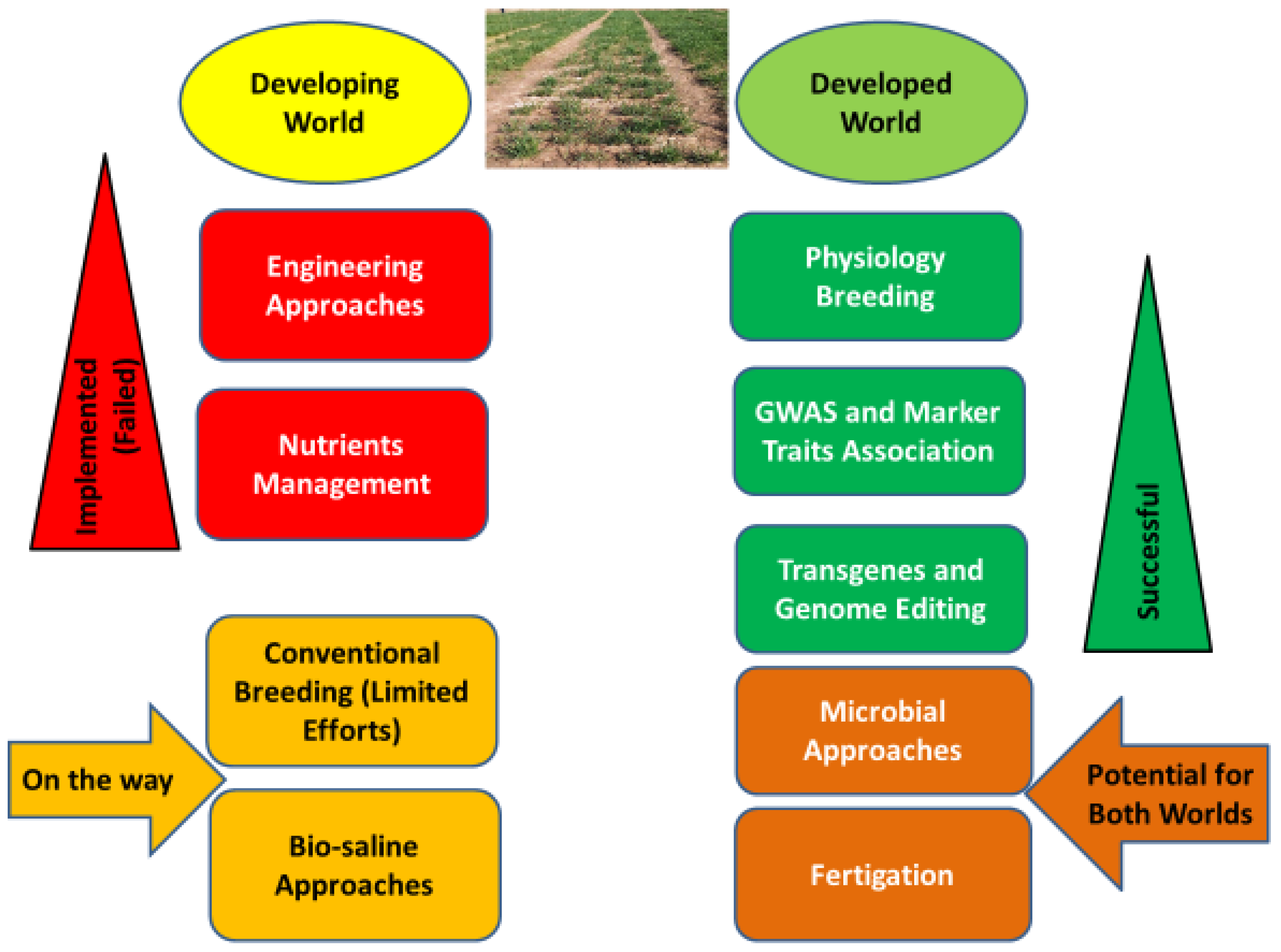
Tackling Salinity in Sustainable Agriculture—What Developing Countries May Learn from Approaches of the Developed World


Abstract
1. Introduction
1.1. Basic Classification of Salinity
1.2. Effect of Changing Climate, Underground and Canal Water on the Global Distribution of Salinity
1.3. Soil Salinity and Plant Interactions
2. Efforts to Alleviate Salinity Impact on Crops in Developing Countries
2.1. Engineering Approaches
2.2. Conventional Breeding (Limited Efforts)
2.3. Unsustainable Efforts on Biosaline Approaches
2.4. Nutrient Management
3. Approaches from the Developed World
3.1. Physiological Breeding
3.2. Genome-Wide Associations for Marker–Trait Associations
3.3. Transgenes and Genome Editing
3.4. Microbial Approaches
3.5. Effective Fertigation to Tackle Salinity
4. Limitations of Current Approaches, Potential of Approaches in the Developed World, and Their Challenges
5. Conclusions
Author Contributions
Funding
Conflicts of Interest
References
- Ahmed, M.Z.; Gul, B.; Khan, M.A.; Watanabe, K.N. 1-Characterization and Function of Sodium Exchanger Genes in Aeluropus lagopoides Under NaCl Stress. In Halophytes for Food Security in Dry Lands; Academic Press: Cambridge, MA, USA, 2016; pp. 1–16. [Google Scholar]
- Jamil, A.; Riaz, S.; Ashraf, M.; Foolad, M.R. Gene Expression Profiling of Plants under Salt Stress. Crit. Rev. Plant Sci. 2011, 30, 435–458. [Google Scholar] [CrossRef]
- Fischer, G.; Hizsnyik, E.; Prieler, S.; Wiberg, D. Scarcity and Abundance of Land Resources: Competing Uses and the Shrinking Land Resource Base. In Proceedings of the Worlds Within Reach: From Science to Policy-IIASA 40th Anniversary Conference, Laxenburg, Austria, 24–26 October 2012. [Google Scholar]
- Alam, S.M.; Ansari, R.; Khan, M.A. Saline agriculture and Pakistan. Ind. Econ. 2010, 21, 21. [Google Scholar]
- NSW. Office of Environment & Heritage; All about salinity: Sydney, Australia, 2002; pp. 10–22. [Google Scholar]
- Szabolcs, I. Soil Salinity and Sodicity as Particular Plant/Crop Stress Factors. In Handbook of Plant and Crop Stress, 2nd ed.; CRC Press: Boca Raton, FL, USA, 1993. [Google Scholar]
- Khan, A.A.; McNeilly, T.; Azhar, F. Stress Tolerance in Crop Plants. Review: 3. Int. J. Agric. Biol. 2011, 3, 250–255. [Google Scholar]
- Tanji, K.K. Nature and Extent of Agricultural Salinity. In Agricultural Salinity Assessment and Management; Anuals and Reports on Engineering Practices; Tanji, K.K., Ed.; American Society of Civil Engineers: New York, NY, USA, 1990; pp. 1–18. [Google Scholar]
- Dornburg, V.; Vashev, B.; Turkenburg, W.; Wicke, B.; Smeets, E.; Gaiser, T.; Faaij, A. The global technical and economic potential of bioenergy from salt-affected soils. Energy Environ. Sci. 2011, 4, 2669. [Google Scholar]
- Dasgupta, S.; Hossain, M.M.; Huq, M.; Wheeler, D. Climate change and soil salinity: The case of coastal Bangladesh. Ambio 2015, 44, 815–826. [Google Scholar] [CrossRef] [PubMed]
- Evans, L.T.; Evans, L.T.; Evans, L.T. Feeding the Ten Billion: Plants and Population Growth; Cambridge University Press: Cambridge, UK, 1998. [Google Scholar]
- McWilliam, J. The National and International Importance of Drought and Salinity Effects on Agricultural Production. Funct. Plant Biol. 1986, 13, 1–13. [Google Scholar] [CrossRef]
- Mateo-Sagasta, J.; Burke, J.; FAO. Agriculture and water quality interactions: A global overview. In SOLAW Background Thematic Report-TR08; FAO: Rome, Italy, 2003. [Google Scholar]
- Galli, V.; Messias, R.D.S.; Perin, E.C.; Borowski, J.M.; Bamberg, A.L.; Rombaldi, C.V. Mild salt stress improves strawberry fruit quality. LWT 2016, 73, 693–699. [Google Scholar] [CrossRef]
- Grattan, S.; Grieve, C. Mineral element acquisition and growth response of plants grown in saline environments. Agric. Ecosyst. Environ. 1992, 38, 275–300. [Google Scholar] [CrossRef]
- Azaizeh, H.; Steudle, E. Effects of Salinity on Water Transport of Excised Maize (Zea mays L.) Roots. Plant Physiol. 1991, 97, 1136–1145. [Google Scholar] [CrossRef]
- Kao, W.Y.; Tsai, H.C.; Tsai, T.T. Effect of NaCl and nitrogen availability on growth and photosynthesis of seedlings of a mangrove species, Kandelia candel (L.) Druce. J. Plant Physiol. 2001, 158, 841–846. [Google Scholar] [CrossRef]
- Sudhir, P.; Murthy, S. Effects of salt stress on basic processes of photosynthesis. Photosynthetica 2004, 42, 481–486. [Google Scholar] [CrossRef]
- Chaves, M.M.; Flexas, J.; Pinheiro, C. Photosynthesis under drought and salt stress: Regulation mechanisms from whole plant to cell. Ann. Bot. 2009, 103, 551–560. [Google Scholar] [CrossRef] [PubMed]
- Salim, M. Comparative Growth Responses and Ionic Relations of Four Cereals during Salt Stress. J. Agron. Crop. Sci. 1991, 166, 204–209. [Google Scholar] [CrossRef]
- Dubey, R.S. Protein synthesis by plants under stress. In Handbook of Plant and Crop Stress; CRC Press: Boca Raton, FL, USA, 2010. [Google Scholar]
- Villa-Castorena, M.; Ulery, A.L.; Catalán-Valencia, E.A.; Remmenga, M.D. Salinity and Nitrogen Rate Effects on the Growth and Yield of Chile Pepper Plants. Soil Sci. Soc. Am. J. 2003, 67, 1781. [Google Scholar] [CrossRef]
- Fernández-Garcí, N.; Martinez, V.; Cerdá, A.; Carvajal, M. Fruit quality of grafted tomato plants grown under saline conditions. J. Hortic. Sci. Biotechnol. 2004, 79, 995–1001. [Google Scholar] [CrossRef]
- Chadirin, Y.; Matsuoka, T.; Suhardiyanto, H. Application of Deep Sea Water for Multi-Trusses Cultivation of Tomato Using A Nutrient Film Technique. HAYATI J. Biosci. 2017, 15, 49–55. [Google Scholar] [CrossRef][Green Version]
- Colla, G.; Roupahel, Y.; Cardarelli, M.; Rea, E. Effect of Salinity on Yield, Fruit Quality, Leaf Gas Exchange, and Mineral Composition of Grafted Watermelon Plants. HortScience 2006, 41, 622–627. [Google Scholar] [CrossRef]
- Navarro, J.; Garrido, C.; Flores, P.; Martinez, V. The effect of salinity on yield and fruit quality of pepper grown in perlite. Span. J. Agric. Res. 2010, 8, 142. [Google Scholar] [CrossRef]
- Djangsou, H.; Enrico, F.; Domenico, R.; Matteo, B. Blossom end-rot in tomato (Solanum lycopersicum L.): A multi-disciplinary overview of inducing factors and control strategies. Sci. Hortic. 2019, 249, 49–58. [Google Scholar]
- Francois, L.E.; Youngs, V.L.; Maas, E.V.; Donovan, T.J. Effect of Salinity on Grain Yield and Quality, Vegetative Growth, and Germination of Semi-Dwarf and Durum Wheat1. Agron. J. 1986, 78, 1053–1058. [Google Scholar] [CrossRef]
- Katerji, N.; Van Hoorn, J.; Fares, C.; Hamdy, A.; Mastrorilli, M.; Oweis, T. Salinity effect on grain quality of two durum wheat varieties differing in salt tolerance. Agric. Water Manag. 2005, 75, 85–91. [Google Scholar] [CrossRef]
- Zheng, Y.; Xu, X.; Li, Z.; Yang, X.; Zhang, C.; Li, F.; Jiang, G. Differential Responses of Grain Yield and Quality to Salinity between Contrasting Winter Wheat Cultivars. Seed Sci. Technol. 2009, 3, 40–43. [Google Scholar]
- Thitisaksakul, M.; Chun, A.; Tanadul, O.U.M.; Beckles, D.M.; Tananuwong, K.; Shoemaker, C.F.; Labavitch, J.M. Effects of Timing and Severity of Salinity Stress on Rice (Oryza sativa L.) Yield, Grain Composition, and Starch Functionality. J. Agric. Food Chem. 2015, 63, 2296–2304. [Google Scholar] [CrossRef] [PubMed]
- Leogrande, R.; Vitti, C.; Lopedota, O.; Ventrella, D.; Montemurro, F. Effects of Irrigation Volume and Saline Water on Maize Yield and Soil in Southern Italy. Irrig. Drain. 2016, 65, 243–253. [Google Scholar] [CrossRef]
- Abbas, G.; Saqib, M.; Rafique, Q.; Rahman, M.A.U.; Akhtar, J.; Haq, M.A.U.; Nasim, M. Effect of Irrigation and Nitrogen Levels on Grain Yield and Quality of Wheat (Triticum aestivum). Pak. J. Agric. Sci. 2013, 50, 185–189. [Google Scholar]
- Rao, P.S.; Mishra, B.; Gupta, S. Effects of Soil Salinity and Alkalinity on Grain Quality of Tolerant, Semi-Tolerant and Sensitive Rice Genotypes. Rice Sci. 2013, 20, 284–291. [Google Scholar] [CrossRef]
- Munns, R. The Impact of Salinity Stress. 2002. Available online: http://www.plantstress.com/articles/salinity_i/salinity_i.htm (accessed on 6 April 2019).
- Rontein, D.; Basset, G.; Hanson, A.D. Metabolic Engineering of Osmoprotectant Accumulation in Plants. Metab. Eng. 2002, 4, 49–56. [Google Scholar] [CrossRef]
- Mujtaba, S.M.; Mughal, S.; Naqvi, M.H. Reclamation of Saline Soils through Biological Approaches. Business Recorder. 30 June 2003. Available online: https://epaper.brecorder.com/2019/06/03/1-page.html (accessed on 18 August 2019).
- Govt of Pakistan, Finance Division, Economic Advisor’s Wing, I. Economic Survey of Pakistan; DSpace BU Repository: Islamabad, Pakistan, 2003. [Google Scholar]
- Szabolcs, I. Salt-Affected Soils; CRC Press: Boca Raton, FL, USA, 1989. [Google Scholar]
- Zia-ur-Rehman, M.; Murtaza, G.; Qayyum, M.; Saifullah, S.M.; Akhtar, J. Salt-affected Soils: Sources, Genesis and Management. Soil Sci. Concepts Appl. 2016, 9, 190–216. [Google Scholar]
- Nabi, G.; Azhar, F.M.; Khan, A.A. Genetic mechanisms controlling variation for salinity tolerance in upland cotton at plant maturity. Int. J. Agric. Biol. 2010, 12, 521–526. [Google Scholar]
- Dagar, J. Soil Salinity Research in India: An Overview. Bull. Natl. Inst. Ecol. 2005, 15, 69–80. [Google Scholar]
- CSSRI Vision-2020. CSSRI Perspective Plan. In Indian Council of Agricultural Research; Central Soil Salinity Research Institute: Karnal, India, 1997; p. 95. [Google Scholar]
- Tyagi, N. Management of Salt-Affected Soils. In Fifty Years of Natural Resource Management Research; Singh, G.B., Sharma, B.R., Eds.; Indian Council of Agricultural Research: New Delhi, India, 1999; pp. 363–401. [Google Scholar]
- Tyagi, N.K.; Rao, D.L.N. Salinity Research: Today and Tomorrow. Salinity Management in Agriculture; Gupta, S.K., Sharma, S.K., Taygi, N.K., Eds.; Central Soil Salinity Research Institute: Karnal, India, 2000; pp. 17–26. [Google Scholar]
- Akbar, M.; Yabuno, T.; Nakao, S. Breeding for saline resistant varieties of rice. I. Variability for salt tolerance among some rice varieties. Jpn. J. Breed. 1972, 22, 272–284. [Google Scholar] [CrossRef]
- Kingsbury, R.W.; Epstein, E. Selection for salt tolerance spring wheat. Crop Sci. 1984, 24, 310–315. [Google Scholar] [CrossRef]
- Rana, R.S. Breeding Crop Varieties for Salt Affected Soil. In Breeding for Stress Resistance; Oxford and IBH: New Delhi, India, 1986. [Google Scholar]
- Gad-El-Hak, M. Breeding a new variety of rice adapted to recently reclaim saline soils. Agric. Res. Rev. 1966, 44, 1–13. [Google Scholar]
- Ashour, N.I.; Abd-El’Hamid, A.E.H.M. Relative salt tolerance of Egyptian cotton varieties during germination and early seedlings development. Plant Soil 1970, 33, 493–495. [Google Scholar] [CrossRef]
- Jafri, A.Z.; Ahmad, R. Plant growth and ionic distribution in cotton (Gossypium hirsutum L.) under saline environment. Pak. J. Bot. 1994, 26, 105–114. [Google Scholar]
- Qadir, M.; Shams, M. Some Agronomic and Physiological Aspects of Salt Tolerance in Cotton (Gossypium hirsutum L.). J. Agron. Crop. Sci. 1997, 179, 101–106. [Google Scholar] [CrossRef]
- Raja, S. Screening of tomato (Solanum lycopersicum L.) genotypes at different salinity levels. J. Plant Breed. Crop. Sci. 2012, 4, 94–100. [Google Scholar]
- Nabi, G.; Shokat, S.; Azhar, M.T.; Azhar, F.M. Genetic basis of ion uptake and proline accumulation in Gossypium hirsutum L. Bulg. J. Agric. Sci. 2015, 21, 835–842. [Google Scholar]
- Zafar, S.A.; Shokat, S.; Saddam, M.S.; Ahmed, H.G.M. Assessment of salinity tolerance in rice using seedling based morpho-physiological indices. Adv. Life Sci. 2015, 2, 142–149. [Google Scholar]
- Glenn, E.P.; Jed Brown, J.; O’Leary, J.W. Irrigating Crops with Seawater. Sci. Am. 2009, 279, 76–81. [Google Scholar] [CrossRef]
- Turnbull, J.W. Eucalyptus in Asia. In Proceedings of the International Conference, Zhanjiang, China, 7–11 April 2003. [Google Scholar]
- Chipeta, M.E.; FAO-SFE. Eucalyptus in East Africa. The Socio-economic and Environmental Issues. Available online: http://www.fao.org/3/a-aq401e.pdf (accessed on 5 July 2019).
- Aslam, Z.; Awan, A.R.; Rizwan, M.; Gulnaz, A.; Malik, K.A. Saline Agriculture Farmer Participatory Development Project. In Pakistan Punjab Component Terminal Report; Pakistan Atomic Energy Commission: Faisalabad, Pakistan, 2009. [Google Scholar]
- Pessarakli, M.; Tucker, T.C. Uptake of N15 by cotton under salt stress. Soil Sci. Soc. Am. J. 1985, 49, 149–152. [Google Scholar] [CrossRef]
- Shaaban, M.M.; El-Fouly, M.M.; El-Zanaty; Abou El-Nour, A.A.; Abdel-Maguid, A.W. Halophytes and foliar fertilization as a useful technique for growing processing tomatoes in the saline affected soils. Pak. J. Biol. Sci. 2004, 7, 503–507. [Google Scholar]
- Tester, M.; Davenport, R. Na+tolerance and Na+ transport in higher plants. Ann. Bot. 2003, 91, 503–527. [Google Scholar] [CrossRef] [PubMed]
- Hadi, M.R.; Karimi, N. The Role of Calcium in Plants’ Salt Tolerance. J. Plant Nutr. 2012, 35, 2037–2054. [Google Scholar] [CrossRef]
- Abbasi, G.; Akhtar, J.; Anwar-ul-Haq, M.; Ali, S.; Chen, Z.; Malik, W. Exogenous potassium differentially mitigates salt stress in tolerant and sensitive maize hybrids. Pak. J. Bot. 2014, 46, 135–146. [Google Scholar]
- Yousuf, P.Y.; Ahmad, A.; Ganie, A.H.; Iqbal, M. Salt stress-induced modulations in the shoot proteome of Brassica juncea genotypes. Environ. Sci. Pollut. Res. 2016, 23, 2391–2401. [Google Scholar] [CrossRef] [PubMed]
- Rashid, A.; Rafique, E.; Bhatti, A.U.; Ryan, J.; Bughio, N.; Yau, S.K. Boron Deficiency in Rainfed Wheat in Pakistan: Incidence, Spatial Variability and Management Strategies. J. Plant Nutr. 2011, 34, 600–613. [Google Scholar] [CrossRef]
- Abid, M.; Khan, M.M.H.; Kanwal, M.; Sarfraz, M. Boron application mitigates salinity effects in canola (Brassica napus) under calcareous soil conditions. Int. J. Agric. Biol. 2014, 16, 1165–1170. [Google Scholar]
- Abdel-Haliem, M.E.; Hegazy, H.S.; Hassan, N.S.; Naguib, D.M. Effect of silica ions and nano silica on rice plants under salinity stress. Ecol. Eng. 2017, 99, 282–289. [Google Scholar] [CrossRef]
- Großkinsky, D.K.; Svensgaard, J.; Christensen, S.; Roitsch, T. Plant phenomics and the need for physiological phenotyping across scales to narrow the genotype-to-phenotype knowledge gap. J. Exp. Bot. 2015, 66, 5429–5440. [Google Scholar] [CrossRef]
- Rush, D.W.; Epstein, E. Genotypic responses to salinity: Differences between salt-sensitive and salt-tolerant genotypes of the tomato. Plant Physiol. 1976, 57, 162–166. [Google Scholar] [CrossRef] [PubMed]
- Flowers, T.J.; Troke, P.F.; Yeo, A.R. The Mechanism of Salt Tolerance in Halophytes. Annu. Rev. Plant Physiol. 1977, 28, 89–121. [Google Scholar] [CrossRef]
- Tal, M.; Shannon, M.C. Salt tolerance in the wild relatives of the cultivated tomato: Responses of Lycopersicon esculentum, L. Cheesmanii, L. peruvianum, Solanum pennellii and F1 hybrids to high salinity. Aust. J. Plant Physiol. 1983, 10, 109–117. [Google Scholar] [CrossRef]
- Noble, C.; Halloran, G.; West, D. Identification and selection for salt tolerance in lucerne (Medicago sativa L.). Aust. J. Agric. Res. 1984, 35, 239–252. [Google Scholar] [CrossRef]
- Morgan, J.M. Osmotic Components and Properties Associated with Genotypic Differences in Osmoregulation in Wheat. Aust. J. Plant Physiol. 1992, 19, 67. [Google Scholar]
- Shannon, M.C.; Gronwald, J.W.; Tal, M.M. Effects of salinity on growth and accumulation of organic and inorganic ions in cultivated and wild tomato species. J. Am. Soc. Hortic. Sci. 1987, 112, 416–423. [Google Scholar]
- Khan, A.A.; McNeilly, T.; Collins, J.C. Accumulation of amino acids, proline, and carbohydrates in response to aluminum and manganese stress in maize. J. Plant Nutr. 2000, 23, 1303–1314. [Google Scholar] [CrossRef]
- Roy, D.; Basu, N.; Bhunia, A.; Banerjee, S.K. Counteraction of exogenous L-proline with NaCl in salt-sensitive cultivar of rice. Biol. Plant. 1993, 35, 69–72. [Google Scholar] [CrossRef]
- Lauchli, A.; Epstein, E. Plant Responses to Saline and Sodic Conditions. In Agricultural Salinity Assessment and Management; ASCE: New York, NY, USA, 1990; pp. 113–137. [Google Scholar]
- Turan, M.A.; Katkat, V.; Taban, S. Variations in Proline, Chlorophyll and Mineral Elements Contents of WheatPlants Grown under Salinity Stress. J. Agron. 2007, 6, 137–141. [Google Scholar]
- Turan, M.A.; Katkat, V.; Taban, S. Salinity-Induced Stomatal Resistance, Proline, Chlorophyll and Ion Concentrations of Bean. Int. J. Agric. Res. 2007, 2, 483–488. [Google Scholar]
- Harinasut, P.; Tsutsui, K.; Takabe, T.; Nomura, M.; Takabe, T.; Kishitani, S. Exogenous Glycinebetaine Accumulation and Increased Salt-tolerance in Rice Seedlings. Biosci. Biotechnol. Biochem. 1996, 60, 366–368. [Google Scholar] [CrossRef] [PubMed]
- Cuin, T.A.; Betts, S.A.; Chalmandrier, R.; Shabala, S. A root’s ability to retain K+correlates with salt tolerance in wheat. J. Exp. Bot. 2008, 59, 2697–2706. [Google Scholar] [CrossRef] [PubMed]
- Stavridou, E.; Hastings, A.; Webster, R.J.; Robson, P.R.H. The impact of soil salinity on the yield, composition and physiology of the bioenergy grass Miscanthus×giganteus. GCB Bioenergy 2017, 9, 92–104. [Google Scholar] [CrossRef]
- Darko, E.; Gierczik, K.; Hudák, O.; Forgó, P.; Pál, M.; Türkösi, E.; Kovács, V.; Dulai, S.; Majláth, I.; Molnár, I.; et al. Differing metabolic responses to salt stress in wheat-barley addition lines containing different 7H chromosomal fragments. PLoS ONE 2017, 12, 1–20. [Google Scholar] [CrossRef] [PubMed]
- Bartoli, C.; Roux, F. Genome-Wide Association Studies in Plant Pathosystems: Toward an Ecological Genomics Approach. Front. Plant Sci. 2017, 8, 763. [Google Scholar] [CrossRef] [PubMed]
- Gabriel, S.B.; Schaffner, S.F.; Nguyen, H.; Moore, J.M.; Roy, J.; Blumenstiel, B.; Higgins, J.; DeFelice, M.; Lochner, A.; Faggart, M.; et al. The Structure of Haplotype Blocks in the Human Genome. Science 2002, 296, 2225–2229. [Google Scholar] [CrossRef] [PubMed]
- Singh, S.; Vikram, P.; Sehgal, D.; Burgueño, J.; Sharma, A.; Singh, S.K.; Sansaloni, C.P.; Joynson, R.; Brabbs, T.; Ortiz, C.; et al. Harnessing genetic potential of wheat germplasm banks through impact-oriented-prebreeding for future food and nutritional security. Sci. Rep. 2018, 8, 12527. [Google Scholar] [CrossRef]
- Brachi, B.; Morris, G.P.; Borevitz, O.J. Genome-wide association studies in plants: The missing heritability is in the field. Genome Biol. 2011, 12, 232. [Google Scholar] [CrossRef]
- Al-Tamimi, N.; Brien, C.; Oakey, H.; Berger, B.; Saade, S.; Ho, Y.S.; Schmöckel, S.M.; Tester, M.; Negrão, S. Salinity tolerance loci revealed in rice using high-throughput non-invasive phenotyping. Nat. Commun. 2016, 7, 13342. [Google Scholar] [CrossRef]
- Xiao, Y.; Liu, H.; Wu, L.; Warburton, M.; Yan, J. Genome-wide Association Studies in Maize: Praise and Stargaze. Mol. Plant 2017, 10, 359–374. [Google Scholar] [CrossRef]
- Angelovici, R.; Batushansky, A.; Deason, N.; Gonzalez-Jorge, S.; Gore, M.A.; Fait, A.; DellaPenna, D. Network-Guided GWAS Improves Identification of Genes Affecting Free Amino Acids. Plant Physiol. 2017, 173, 872–886. [Google Scholar] [CrossRef] [PubMed]
- Liu, N.; Xue, Y.; Guo, Z.; Li, W.; Tang, J. Genome-Wide Association Study Identifies Candidate Genes for Starch Content Regulation in Maize Kernels. Front. Plant Sci. 2016, 7, 1046. [Google Scholar] [CrossRef] [PubMed]
- Munns, R.; James, R.A.; Xu, B.; Athman, A.; Conn, S.J.; Jordans, C.; Byrt, C.S.; Hare, R.A.; Tyerman, S.D.; Tester, M.; et al. Wheat grain yield on saline soils is improved by an ancestral Na+transporter gene. Nat. Biotechnol. 2012, 30, 360–364. [Google Scholar] [CrossRef] [PubMed]
- James, R.A.; Blake, C.; Zwart, A.B.; Hare, R.A.; Rathjen, A.J.; Munns, R. Impact of ancestral wheat sodium exclusion genes Nax1 and Nax2 on grain yield of durum wheat on saline soils. Funct. Plant Biol. 2012, 39, 609–618. [Google Scholar] [CrossRef]
- Shi, H.; Zhu, J.K. Regulation of expression of the vacuolar Na+/H+ antiporter gene AtNHX1 by salt stress and abscisic acid. Plant Mol. Biol. 2002, 50, 543–550. [Google Scholar] [CrossRef] [PubMed]
- Yamaguchi, T.; Blumwald, E. Developing salt-tolerant crop plants: Challenges and opportunities. Trends Plant Sci. 2005, 10, 615–620. [Google Scholar] [CrossRef] [PubMed]
- Xu, K.; Hong, P.; Luo, L.; Xia, T. Overexpression of AtNHX1, a vacuolar Na+/H+antiporter from arabidopsis thalina, in petunia hybrida enhances salt and drought tolerance. J. Plant Biol. 2009, 52, 453–461. [Google Scholar] [CrossRef]
- Osakabe, K.; Osakabe, Y.; Toki, S. Site-directed mutagenesis in Arabidopsis using custom-designed zinc finger nucleases. Proc. Natl. Acad. Sci. USA 2010, 107, 12034–12039. [Google Scholar] [CrossRef]
- Sikora, E.; Arendt, T.; Bennett, M.; Narita, M. Impact of cellular senescence signature on ageing research. Ageing Res. Rev. 2011, 10, 146–152. [Google Scholar] [CrossRef]
- Li, T.; Yang, X.; Yu, Y.; Si, X.; Zhai, X.; Zhang, H.; Dong, W.; Gao, C.; Xu, C. Domestication of wild tomato is accelerated by genome editing. Nat. Biotechnol. 2018, 36, 1160–1163. [Google Scholar] [CrossRef]
- Zsögön, A.; Čermák, T.; Naves, E.R.; Notini, M.M.; Edel, K.H.; Weinl, S.; Freschi, L.; Voytas, D.F.; Kudla, J.; Peres, L.E.P. De novo domestication of wild tomato using genome editing. Nat. Biotechnol. 2018, 36, 1211–1216. [Google Scholar] [CrossRef] [PubMed]
- Sánchez-León, S.; Gil-Humanes, J.; Ozuna, C.V.; Giménez, M.J.; Sousa, C.; Voytas, D.F.; Barro, F. Low-gluten, nontransgenic wheat engineered with CRISPR/Cas9. Plant Biotechnol. J. 2018, 16, 902–910. [Google Scholar] [CrossRef] [PubMed]
- Arora, L.; Narula, A. Gene Editing and Crop Improvement Using CRISPR-Cas9 System. Front. Plant Sci. 2017, 8, 1932. [Google Scholar] [CrossRef] [PubMed]
- James, R.A.; Davenport, R.J.; Munns, R. Physiological Characterization of Two Genes for Na+Exclusion in Durum Wheat, Nax1 and Nax2. Plant Physiol. 2006, 142, 1537–1547. [Google Scholar] [CrossRef] [PubMed]
- Hirsch, R.E. A Role for the AKT1 Potassium Channel in Plant Nutrition. Science 1998, 280, 918–921. [Google Scholar] [CrossRef]
- Deeken, R.; Sanders, C.; Ache, P.; Hedrich, R. Developmental and light-dependent regulation of a phloem-localised K+channel of Arabidopsis thaliana. Plant J. 2000, 23, 285–290. [Google Scholar] [CrossRef] [PubMed]
- Wu, H.; Shabala, L.; Azzarello, E.; Huang, Y.; Pandolfi, C.; Su, N.; Wu, Q.; Cai, S.; Bazihizina, N.; Wang, L.; et al. Na+extrusion from the cytosol and tissue-specific Na+sequestration in roots confer differential salt stress tolerance between durum and bread wheat. J. Exp. Bot. 2018, 69, 3987–4001. [Google Scholar] [CrossRef]
- Albacete, A.; Cantero-Navarro, E.; Großkinsky, D.K.; Arias, C.L.; Balibrea, M.E.; Bru, R.; Fragner, L.; Ghanem, M.E.; González, M.D.L.C.; Hernández, J.A.; et al. Ectopic overexpression of the cell wall invertase gene CIN1 leads to dehydration avoidance in tomato. J. Exp. Bot. 2015, 66, 3431–3432. [Google Scholar] [CrossRef][Green Version]
- Sessitsch, A.; Pfaffenbichler, N.; Mitter, B. Microbiome Applications from Lab to Field: Facing Complexity. Trends Plant Sci. 2019, 24, 194–198. [Google Scholar] [CrossRef]
- Bagheri, A.A.; Saadatmand, S.; Niknam, V.; Nejadsatari, T.; Babaeizad, V. Effect of endophytic fungus, Piriformospora indica, on growth and activity of antioxidant enzymes of rice (Oryza sativa L.) under salinity stress. Int. J. Adv. Biol. Biomed. Res. 2013, 1, 1337–1350. [Google Scholar]
- Baltruschat, H.; Fodor, J.; Harrach, B.D.; Niemczyk, E.; Barna, B.; Gullner, G.; Janeczko, A.; Kogel, K.H.; Schäfer, P.; Schwarczinger, I.; et al. Salt tolerance of barley induced by the root endophyte Piriformospora indica is associated with a strong increase in antioxidants. New Phytol. 2008, 180, 501–510. [Google Scholar] [CrossRef] [PubMed]
- Li, L.; Li, L.; Wang, X.; Zhu, P.; Wu, H.; Qi, S. Plant growth-promoting endophyte Piriformospora indica alleviates salinity stress in Medicago truncatula. Plant Physiol. Biochem. 2017, 119, 211–223. [Google Scholar] [CrossRef] [PubMed]
- Alikhani, M.; Khatabi, B.; Sepehri, M.; Nekouei, M.K.; Mardi, M.; Salekdeh, G.H. A proteomics approach to study the molecular basis of enhanced salt tolerance in barley (Hordeum vulgare L.) conferred by the root mutualistic fungus Piriformospora indica. Mol. BioSyst. 2013, 9, 1498. [Google Scholar] [CrossRef] [PubMed]
- Helsel, Z.; Gond, S.; Torres, M.; Bergen, M.; White, J. Induction of salt tolerance and up-regulation of aquaporin genes in tropical corn by rhizobacterium Pantoea agglomerans. Lett. Appl. Microbiol. 2015, 60, 392–399. [Google Scholar]
- Mayak, S.; Tirosh, T.; Glick, B.R. Plant growth-promoting bacteria confer resistance in tomato plants to salt stress. Plant Physiol. Biochem. 2004, 42, 565–572. [Google Scholar] [CrossRef] [PubMed]
- Khan, A.L.; Waqas, M.; Asaf, S.; Kamran, M.; Shahzad, R.; Bilal, S.; Khan, M.A.; Kang, S.-M.; Kim, Y.-H.; Yun, B.-W.; et al. Plant growth-promoting endophyte Sphingomonas sp. LK11 alleviates salinity stress in Solanum pimpinellifolium. Environ. Exp. Bot 2017, 133, 58–69. [Google Scholar] [CrossRef]
- Großkinsky, D.K.; van der Graaff, E.; Roitsch, T. Regulation of Abiotic and Biotic Stress Responses by Plant Hormones. In Plant Pathogen Resistance Biotechnology; Wiley: Hoboken, NJ, USA, 2016; pp. 131–154. [Google Scholar]
- Großkinsky, D.K.; Petrášek, J. Auxins and cytokinins—The dynamic duo of growth-regulating phytohormones heading for new shores. New Phytol. 2019, 221, 1187–1190. [Google Scholar] [CrossRef] [PubMed]
- Egamberdieva, D. Alleviation of salt stress by plant growth regulators and IAA producing bacteria in wheat. Acta Physiol. Plant. 2009, 31, 861–864. [Google Scholar] [CrossRef]
- Egamberdieva, D.; Jabborova, D.; Hashem, A. Pseudomonas induces salinity tolerance in cotton (Gossypium hirsutum) and resistance to Fusarium root rot through the modulation of indole-3-acetic acid. Saudi J. Biol. Sci. 2015, 22, 773–779. [Google Scholar] [CrossRef]
- Shahzad, R.; Khan, A.L.; Bilal, S.; Waqas, M.; Kang, S.-M.; Lee, I.-J. Inoculation of abscisic acid-producing endophytic bacteria enhances salinity stress tolerance in Oryza sativa. Environ. Exp. Bot. 2017, 136, 68–77. [Google Scholar] [CrossRef]
- Khan, A.L.; Hamayun, M.; Ahmad, N.; Hussain, J.; Kang, S.-M.; Kim, Y.-H.; Adnan, M.; Tang, D.-S.; Waqas, M.; Radhakrishnan, R.; et al. Salinity stress resistance offered by endophytic fungal interaction between Penicillium minioluteum LHL09 and Glycine max. L. J. Microbiol. Biotechnol. 2011, 21, 893–902. [Google Scholar] [CrossRef] [PubMed]
- Khan, A.L.; Waqas, M.; Khan, A.R.; Hussain, J.; Kang, S.M.; Gilani, S.A.; Hamayun, M.; Shin, J.-H.; Kamran, M.; Al-Harrasi, A.; et al. Fungal endophyte Penicillium janthinellum LK5 improves growth of ABA-deficient tomato under salinity. World J. Microbiol. Biotechnol. 2013, 29, 2133–2144. [Google Scholar] [CrossRef] [PubMed]
- Khan, A.L.; Waqas, M.; Lee, I.J. Resilience of Penicillium resedanum LK6 and exogenous gibberellin in improving Capsicum annuum growth under abiotic stresses. J. Plant Res. 2015, 128, 259–268. [Google Scholar] [CrossRef] [PubMed]
- Qin, Y.; Druzhinina, I.S.; Pan, X.; Yuan, Z. Microbially Mediated Plant Salt Tolerance and Microbiome-based Solutions for Saline Agriculture. Biotechnol. Adv. 2016, 34, 1245–1259. [Google Scholar] [CrossRef] [PubMed]
- Großkinsky, D.K.; Tafner, R.; Moreno, M.V.; Stenglein, S.A.; De Salamone, I.E.G.; Nelson, L.M.; Novak, O.; Strnad, M.; Van Der Graaff, E.; Roitsch, T. Cytokinin production by Pseudomonas fluorescens G20-18 determines biocontrol activity against Pseudomonas syringae in Arabidopsis. Sci. Rep. 2016, 6, 23310. [Google Scholar] [CrossRef]
- Liu, F.; Xing, S.; Ma, H.; Du, Z.; Ma, B. Cytokinin-producing, plant growth-promoting rhizobacteria that confer resistance to drought stress in Platycladus orientalis container seedlings. Appl. Microbiol. Biotechnol. 2013, 97, 9155–9164. [Google Scholar] [CrossRef] [PubMed]
- Großkinsky, D.K.; Edelsbrunner, K.; Pfeifhofer, H.; van der Graaff, E.; Roitsch, T. Cis- and trans-zeatin differentially modulate plant immunity. Plant Signal. Behav. 2013, 8, e24798. [Google Scholar] [CrossRef]
- Arkhipova, T.N.; Veselov, S.U.; Melentiev, A.I.; Martynenko, E.V.; Kudoyarova, G.R. Ability of bacterium Bacillus subtilis to produce cytokinins and to influence the growth and endogenous hormone content of lettuce plants. Plant Soil 2005, 272, 201–209. [Google Scholar] [CrossRef]
- Ortíz-Castro, R.; Valencia-Cantero, E.; López-Bucio, J. Plant growth promotion by Bacillus megaterium involves cytokinin signaling. Plant Signal. Behav. 2008, 3, 263–265. [Google Scholar] [CrossRef]
- Parnell, J.J.; Berka, R.; Young, H.A.; Sturino, J.M.; Kang, Y.; Barnhart, D.M.; Dileo, M.V. From the Lab to the Farm: An Industrial Perspective of Plant Beneficial Microorganisms. Front. Plant Sci. 2016, 7, 8672. [Google Scholar] [CrossRef]
- Shrivastava, P.; Kumar, R. Soil salinity: A serious environmental issue and plant growth promoting bacteria as one of the tools for its alleviation. Saudi J. Biol. Sci. 2015, 22, 123–131. [Google Scholar] [CrossRef] [PubMed]
- Bhattacharyya, P.N.; Goswami, M.P.; Bhattacharyya, L.H. Perspective of beneficial microbes in agriculture under changing climatic scenario: A review. J. Phytol. 2016, 8, 26. [Google Scholar] [CrossRef]
- Machado, R.M.A.; Serralheiro, R.P. Soil Salinity: Effect on Vegetable Crop Growth. Management Practices to Prevent and Mitigate Soil Salinization. Horticulturae 2017, 3, 30. [Google Scholar] [CrossRef]
- Aydin, A. Humic acid application alleviate salinity stress of bean (Phaseolus vulgaris L.) plants decreasing membrane leakage. Afr. J. Agric. Res. 2012, 7, 1073–1086. [Google Scholar] [CrossRef]
- Bargaz, A.; Nassar, R.M.A.; Rady, M.M.; Gaballah, M.S.; Thompson, S.M.; Brestic, M.; Schmidhalter, U.; Abdelhamid, M.T.; Abdelhamid, M. Improved Salinity Tolerance by Phosphorus Fertilizer in Two Phaseolus vulgaris Recombinant Inbred Lines Contrasting in Their P-Efficiency. J. Agron. Crop. Sci. 2016, 202, 497–507. [Google Scholar] [CrossRef]
- Bacilio, M.; Moreno, M.; Bashan, Y. Mitigation of negative effects of progressive soil salinity gradients by application of humic acids and inoculation with Pseudomonas stutzeri in a salt-tolerant and a salt-susceptible pepper. Appl. Soil Ecol. 2016, 107, 394–404. [Google Scholar] [CrossRef]
- Kaya, C.; Tuna, A.L.; Ashraf, M.; Altunlu, H. Improved salt tolerance of melon (Cucumis melo L.) by the addition of proline and potassium nitrate. Environ. Exp. Bot. 2007, 60, 397–403. [Google Scholar] [CrossRef]
- Martinez, V.; Cerdá, A. Influence of N source on rate of Cl, N, Na and K uptake by cucumber seedling grown in saline condition. J. Plant Nutr. 1989, 12, 971–983. [Google Scholar] [CrossRef]
- Romero-Aranda, M.R.; Jurado, O.; Cuartero, J. Silicon alleviates the deleterious salt effect on tomato plant growth by improving plant water status. J. Plant Physiol. 2006, 163, 847–855. [Google Scholar] [CrossRef]
- Karlidag, H.; Yildirim, E.; Turan, M. Salicylic acid ameliorates the adverse effect of salt stress on strawberry. Sci. Agricola 2009, 66, 180–187. [Google Scholar] [CrossRef]
- Savvas, D.; Giotis, D.; Chatzieustratiou, E.; Bakea, M.; Patakioutas, G. Silicon supply in soilless cultivations of zucchini alleviates stress induced by salinity and powdery mildew infections. Environ. Exp. Bot. 2009, 65, 11–17. [Google Scholar] [CrossRef]
- Ma, X.; Zheng, J.; Zhang, X.; Hu, Q.; Qian, R. Salicylic Acid Alleviates the Adverse Effects of Salt Stress on Dianthus superbus (Caryophyllaceae) by Activating Photosynthesis, Protecting Morphological Structure, and Enhancing the Antioxidant System. Front. Plant Sci. 2017, 8, 685. [Google Scholar] [CrossRef]
- Brouwer, C.; Goffeau, A.; Heibloem, M. Irrigation Water Management; Food and Agriculture Organization: Rome, Italy, 1985. [Google Scholar]
- Malash, N.M.; Flowers, T.J.; Ragab, R. Effect of irrigation methods, management and salinity of irrigation water on tomato yield, soil moisture and salinity distribution. Irrig. Sci. 2008, 26, 313–323. [Google Scholar] [CrossRef]
- Lamm, F.R. Cotton, Tomato, Corn, and Onion Production with Subsurface Drip Irrigation: A Review. Trans. ASABE 2016, 59, 263–278. [Google Scholar]


| Crop Species | Physiological Traits | Traits | Reference |
|---|---|---|---|
| Oryza sativa | Glycine Betaine | Quantum yield of PSII under salinity | Harinasut et al. [81] |
| Nicotiana tabacum | Glycine betaine, proline, mannitol, and Sorbitol | Salinity tolerance | Rontein et al. [36] |
| Triticum aestivum and Triticum durum | Higher K+ around root zone | Plant biomass and yield | Cuin et al. [82] |
| Gossypium hirsutum | Higher K+/Na+ ratio, and proline accumulation | Better performance at higher salinity levels | Nabi et al. [54] |
| Miscanthus x giganteus | Water Use Efficiency, stomatal conductance, and leaf water contents | Plant Biomass | Stavridou et al. [83] |
| Triticum aestivum and Hordeum vulgare | Higher proline within roots, and osmotic adjustment | better performance at salinity | Darko et al. [84] |
| Transgene | Plant Species | Physiological Improvement | Reference |
|---|---|---|---|
| Nax1 | Triticum durum | Na+ was removed from the xylem | James et al. [104] |
| Nax2 | Triticum durum | Plants did not retain Na+ within the leaf and Na+ functioned only in the root | James et al. [104] |
| AtNHX1 | Petunia hybrida | Maintained higher water contents, proline and higher K+/Na+ ratio | Xu et al. [97] |
| AKT1 | Arabidopsis thaliana | K+ channel is expressed in roots. | Hirsch et al. [105] |
| AKT2 | Arabidopsis thaliana | Expressed in the leaf phloem tissue. | Deeken et al. [106] |
| SOS1 | Triticum durum Triticum aestivum | Extrusion of Na+ from roots to external zones | Wu et al. [107] |
| CIN | Solanum lycopersicum | Increased in sucrolytic activities (cwInv, sucrose synthase, and vacuolar, and cytoplasmic invertases), and decreased in the 1-aminocyclopropane-1-carboxylic acid (ACC) activity | Albacete et al. [108] |
| Approaches | Status | Expectation/Potential Benefits | Limitations |
|---|---|---|---|
| Developing world | |||
| Engineering approaches - Chemical approach - Hydrological approach | Closed | Swift to cure soil from salinity and water-logging | High cost of chemicals, labor, and energy. Increased the level of chemicals and lower the water table |
| Conventional breeding | On-going | Salt tolerant crop plants will ensure enough production | Less diversity Flimsy research at international organizations of agriculture |
| Bio-saline approach | Closed | Diverse options to tackle salinity at farmers’ fields | Lacking continuous supply of funds |
| Nutrient management | Scanty use | Acclimation of crop plants at saline areas | Challenging to convince farmers |
| Developed world | |||
| Physiology breeding | Regularly used | Improvement of certain agronomic parameters Better ideotype to tackle salinity | Technical expertise required |
| Genome wide associations for marker-trait associations | Consistently being utilized | Investigation of complex traits with low error rates Applicable to any crop independent of genome size Grains intake of toxic ions can be studied for food and feed consumption | Expensive to utilize High level of expertise in bioinformatics are required |
| Transgenes and genome editing | Regular part of many breeding programs | To improve the tolerance of the plants by minimum uptake of toxic ions Elimination of undesirable genes in short time | Skilled scientific infrastructure and higher investment required |
| Microbial approaches | On the way | Cost-efficient, applicable to diverse crops and conditions, combination of beneficial effects, environmentally-friendly | Complex interactions between microbes, plants, and environment need to be elucidated Microbial mode-of-actions need to be identified Technical solutions for field application have to be optimized |
| Fertigation | On the way | Applicable to almost all crops Improve the water and nutrient use efficiency | Installation of drip irrigation or sub-surface irrigation is expensive |
© 2019 by the authors. Licensee MDPI, Basel, Switzerland. This article is an open access article distributed under the terms and conditions of the Creative Commons Attribution (CC BY) license (http://creativecommons.org/licenses/by/4.0/).
Share and Cite
Shokat, S.; Großkinsky, D.K. Tackling Salinity in Sustainable Agriculture—What Developing Countries May Learn from Approaches of the Developed World. Sustainability 2019, 11, 4558. https://doi.org/10.3390/su11174558
Shokat S, Großkinsky DK. Tackling Salinity in Sustainable Agriculture—What Developing Countries May Learn from Approaches of the Developed World. Sustainability. 2019; 11(17):4558. https://doi.org/10.3390/su11174558
Chicago/Turabian StyleShokat, Sajid, and Dominik K. Großkinsky. 2019. "Tackling Salinity in Sustainable Agriculture—What Developing Countries May Learn from Approaches of the Developed World" Sustainability 11, no. 17: 4558. https://doi.org/10.3390/su11174558
APA StyleShokat, S., & Großkinsky, D. K. (2019). Tackling Salinity in Sustainable Agriculture—What Developing Countries May Learn from Approaches of the Developed World. Sustainability, 11(17), 4558. https://doi.org/10.3390/su11174558