Serving Local Fish in School Meals: The Nutritional Importance of Consuming Oily Fish

 ,
,
Abstract
1. Introduction
2. Materials and Methods
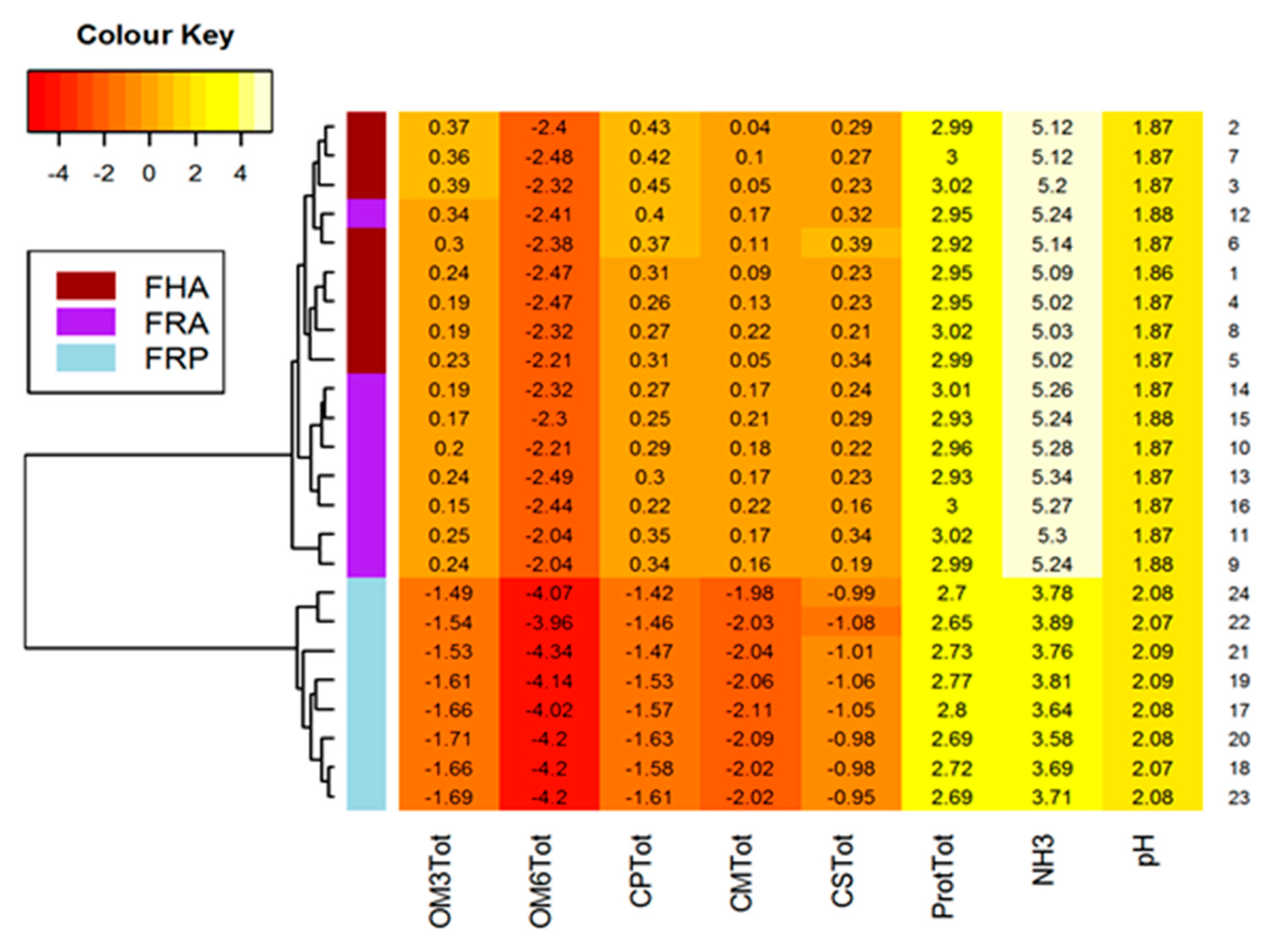
- 24 fresh European anchovies (E. encrasicolus) caught by and obtained from professional fishermen in the Adriatic Sea (FHA);
- 24 frozen European anchovies (E. encrasicolus) caught by and obtained from professional fishermen in the Adriatic Sea (FRA);
- 8 frozen fillets of farmed Vietnamese pangasius purchased from a supermarket (FRP).
3. Results
4. Discussion
5. Conclusions
Author Contributions
Funding
Acknowledgments
Conflicts of Interest
References and Notes
- Taşbozan, O.; Gökçe, M.A. Fatty Acids in Fish. In Fatty Acids; Angel, C., Ed.; In Tech: London, UK, 2017; pp. 143–159. [Google Scholar]
- Albracht-Schulte, K.; Kalupahana, N.S.; Ramalingam, L.; Wang, S.; Rahman, S.M.; Robert-McComb, J.; Moustaid-Moussa, N. Omega-3 fatty acids in obesity and metabolic syndrome: A mechanistic update. J. Nutr. Biochem. 2018, 58, 1–16. [Google Scholar] [CrossRef] [Scilit] [PubMed]
- Siscovick, D.S.; Barringer, T.A.; Fretts, A.M.; Wu, J.H.; Lichtenstein, A.H.; Costello, R.B.; Kris-Etherton, P.M.; Jacobson, T.A.; Engler, M.B.; Alger, H.M.; et al. Omega-3 Polyunsaturated Fatty Acid (Fish Oil) Supplementation and the Prevention of Clinical Cardiovascular Disease: A Science Advisory from the American Heart Association. Circulation 2017, 13, e867–e884. [Google Scholar] [CrossRef] [Scilit] [PubMed]
- Rest, O.; Wang, Y.; Barnes, L.L.; Tangney, C.; Bennett, D.A.; Morris, M.C. APOE ε4 and the associations of seafood and long-chain omega-3 fatty acids with cognitive decline. Neurology 2016, 86, 2063–2070. [Google Scholar] [CrossRef] [Scilit] [PubMed]
- Bloomingdale, A.; Guthrie, L.B.; Price, S.; Wright, R.O.; Platek, D.; Haines, J.; Oken, E. A qualitative study of fish consumption during pregnancy. Am. J. Clin. Nutr. 2010, 92, 1234–1240. [Google Scholar] [CrossRef] [Scilit] [PubMed]
- Coletta, J.M.; Bell, S.J.; Roman, A.S. Omega-3 Fatty Acids and Pregnancy. Rev. Obstet. Gynecol. 2010, 3, 163–171. [Google Scholar] [PubMed]
- Lane, K.E.; Derbyshire, E.J. Omega-3 fatty acids–A review of existing and innovative delivery methods. Crit. Rev. Food Sci. Nutr. 2018, 58, 62–69. [Google Scholar] [CrossRef] [Scilit]
- Sprague, M.; Dick, J.R.; Tocher, D.R. Impact of sustainable feeds on omega-3 long-chain fatty acid levels in farmed Atlantic salmon, 2006–2015. Sci. Rep. 2016, 6, 21892. [Google Scholar] [CrossRef] [Scilit] [PubMed]
- Raatz, S.; Silverstein, J.; Jahns, L.; Picklo, M. Issues of fish consumption for cardiovascular disease risk reduction. Nutrients 2013, 5, 1081–1097. [Google Scholar] [CrossRef] [Scilit]
- Westhoek, H.; Lesschen, J.P.; Rood, T.; Wagner, S.; De Marco, A.; Murphy-Bokern, D.; Leip, A.; Grinsven, H.; Sutton, M.A.; Oenema, O. Food choices, health and environment: Effects of cutting Europe’s meat and dairy intake. Glob. Environ. Chang. 2014, 26, 196–205. [Google Scholar] [CrossRef] [Scilit]
- World Health Organization (WHO). European Food and Nutrition Action Plan 2015-2020 (Internet). 2014. [cited 2015 May 15]. Available online: http://www.euro.who.int/en/about-us/governance/regional-committee-for-europe/64th-session/documentation/working-documents/eurrc6414-european-food-and-nutrition-action-plan-2015-2020 (accessed on 30 May 2019).
- Cauwenberghe, E.; Maes, L.; Spittaels, H.; Lenthe, F.J.; Brug, J.; Oppert, J.M.; Bourdeaudhuij, I. Effectiveness of school-based interventions in Europe to promote healthy nutrition in children and adolescents: Systematic review of published and ‘grey’ literature. Br. J. Nutr. 2010, 103, 781–797. [Google Scholar] [CrossRef] [Scilit]
- Birt, C.; Buzeti, T.; Grosso, G.; Justesen, L.; Lachat, C.; Lafranconi, A.; Mertanen, E.; Rangelov, N.; Sarlio-Lähteenkorva, S. Healthy and Sustainable Diets for European Countries; EUPHA: Utrecht, The Netherlands, 2017. [Google Scholar]
- Weichselbaum, E.; Gibson-Moore, H.; Ballam, R.; Buttriss, J.L. Nutrition in Schools across Europe: A Summary Report of a Meeting of European Nutrition Foundations. Nutr. Bull. 2010, 36, 124–141. [Google Scholar] [CrossRef] [Scilit]
- Vieux, F.; Dubois, C.; Duchêne, C.; Darmon, N. Nutritional Quality of School Meals in France: Impact of Guidelines and the Role of Protein Dishes. Nutrients 2018, 10, 205. [Google Scholar] [CrossRef] [Scilit] [PubMed]
- EUMOFA. EU Consumer Habits Regarding Fishery and Aquaculture Products; Final Report; EUMOFA: Brussels, Belgium, 2017. [Google Scholar]
- Pappa Fish Video Report. Available online: youtube.com/watch?v=V5thXoMfpys (accessed on 30 May 2019).
- EUMOFA. The EU Fish Market; Directorate-General for Maritime Affairs and Fisheries of the European Commission: Brussels, Belgium, 2015; p. 66. [Google Scholar]
- FAO. The State of Mediterranean and Black Sea Fisheries; General Fisheries Commission for the Mediterranean: Rome, Italy, 2018; p. 172. [Google Scholar]
- Prato, E.; Biandolino, F. Total lipid content and fatty acid composition of commercially important fish species from the Mediterranean, Mar Grande Sea. Food Chem. 2012, 131, 1233–1239. [Google Scholar] [CrossRef] [Scilit]
- EUMOFA. European Market Observatory for Fisheries and Aquaculture Products Monthly Highlights; EUMOFA: Brussels, Belgium, 2018. [Google Scholar]
- EUMOFA. Pangasius Imported in the EU. Monthly Highlights No. 4/2014, European Market Observatory for Fisheries and Aquaculture Products; EUMOFA: Brussels, Belgium, 2014. [Google Scholar]
- AOAC Official Method 920.39. Fat (Crude) or Ether Extract in Animal Feed, 18th ed.; AOAC International: Gaithersburg, MD, USA, 2005. [Google Scholar]
- AOAC Official Method 999.01. Volatile bases in fish, ammonia ion selective electrode method. In AOAC Official Methods of Analysis; AOAC: Gaithersburg, MD, USA, 2002; Volume II, Chapter 35; pp. 34–35. [Google Scholar]
- Baldini, M.; Fabietti, F.; Giammarioli, S.; Onori, R.; Orefice, L.; Lipidi, S.A. Metodi di Analisi Utilizzati Per il Controllo Chimico Degli Alimenti; Rapporti ISTISAN 96/34; International Committee of Medical Journal Editors, pp. 39–40.
- Baldini, M.; Fabietti, F.; Giammarioli, S.; Onori, R.; Orefice, L.; Stacchini, A. Ceneri Metodi di Analisi Utilizzati Per il Controllo Chimico Degli Alimenti; Rapporti ISTISAN 96/34; International Committee of Medical Journal Editors, pp. 78–79.
- EEC 2568/91. Characteristics of olive and olive pomance oils and their analytical methods. Off. J. Eur. Communities 1991, L248, 1–82. [Google Scholar]
- AOAC Official Method 950.46. Moisture in Meat. In Official Methods of Analysis, 15th ed.; AOAC International: Arlington, VA, USA, 1990. [Google Scholar]
- AOAC Official Method 981.12. pH of Acidified Foods; AOAC: Gaithersburg, MD, USA, 1982. [Google Scholar]
- International Centre for Advanced Mediterranean Agronomic Studies/Food and Agriculture Organization of the United Nations. Mediterranean Food Consumption Patterns: Diet, Environment, Society, Economy and Health; A White Paper Priority 5 of the Expo Milan 2015 Feeding Knowledge Programme; FAO: Rome, Italy, 2015. [Google Scholar]
- Belahsen, R. Cultural diversity of sustainable diets. Nutrition transition and food sustainability. Proc. Nutr. Soci. 2014, 73, 385–388. [Google Scholar] [CrossRef] [Scilit] [PubMed]
- Guimarães, C.F.M.; Mársico, E.T.; Monteiro, M.L.G.; Lemos, M.; Mano, S.B.; Conte-Junior, C.A. The chemical quality of frozen Vietnamese Pangasius hypophthalmus fillets. Food Sci. Nutr. 2016, 4, 398–408. [Google Scholar] [CrossRef] [Scilit] [PubMed]
- Kaya, Y.; Turan, H. Comparison of protein, lipid and fatty acids composition of anchovy (Engraulis encrasicolus L. 1758) during the commercial catching season. J. Muscle Foods 2010, 21, 474–483. [Google Scholar] [CrossRef] [Scilit]
- Orban, E.; Nevigato, T.; Lena, G.; Masci, M.; Casini, I.; Gambelli, L.; Caproni, R. New trends in the seafood market. Sutchi catfish (Pangasius hypophthalmus) fillets from Vietnam: Nutritional quality and safety aspects. Food Chem. 2008, 110, 383–389. [Google Scholar] [CrossRef] [Scilit]
- Usydus, Z.; Szlinder-Richert, J.; Adamczyk, M.; Szatkowska, U. Marine and farmed fish in the Polish market: Comparison of the nutritional value. Food Chem. 2011, 126, 78–84. [Google Scholar] [CrossRef] [Scilit]
- Karl, H.; Lehmann, I.; Rehbein, H.; Schubring, R. Composition and quality attributes of conventionally and organically farmed Pangasius fillets (Pangasius hypophthalmus) on the German market. Int. J. Food Sci. Technol. 2010, 45, 56–66. [Google Scholar] [CrossRef] [Scilit]
- Stansby, M.E. Chemical characteristics of fish caught in the northeast Pacific Ocean. Mar. Fish. Rev. 1976, 38, 1–11. [Google Scholar]
- Islami, S.N.; Faisal, M.; Akter, M.; Reza, M.S.; Kamal, M. Comparative shelf life study of whole fish and fillets of cultured striped catfish (Pangasianodon hypophthalmus) during ice storage condition. Res. Agric. Livest. Fish. 2015, 2, 177–183. [Google Scholar] [CrossRef] [Scilit]
- Lai, H.T.; Oliveira, M.C.; Lemaitre, R.N.; McKnight, B.; Song, X.; King, I.B.; Chaves, P.H.; Odden, M.C.; Newman, A.B.; Siscovick, D.S.; et al. Serial circulating omega 3 polyunsaturated fatty acids and healthy ageing among older adults in the Cardiovascular Health Study: Prospective cohort study. BMJ 2018, 363, k4067. [Google Scholar] [CrossRef] [Scilit] [PubMed]
- Strobel, C.; Jahreis, G.; Kuhnt, K. Survey of n-3 and n-6 polyunsaturated fatty acids in fish and fish products. Lipids Health Dis. 2012, 11, 144. [Google Scholar] [CrossRef] [Scilit] [PubMed]
- Farmery, A.K.; Gardner, C.; Green, B.S.; Jennings, S.; Watson, R.A. Domestic or imported? An assessment of carbon footprints and sustainability of seafood consumed in Australia. Environ. Sci. Policy 2015, 54, 35–43. [Google Scholar] [CrossRef] [Scilit]
- Parker, R.W.; Tyedmers, P.H. Fuel consumption of global fishing fleets: Current understanding and knowledge gaps. Fish Fish. 2015, 16, 684–696. [Google Scholar] [CrossRef] [Scilit]
- Lucchetti, A.; Piccinetti, C.; Meconi, U.; Frittelloni, C.; Marchesan, M.; Palladino, S.; Virgili, M. Transferable Fishing Concessions (TFC): A pilot study on the applicability in the Mediterranean Sea. Mar. Policy 2012, 44, 438–447. [Google Scholar] [CrossRef] [Scilit]
- Dernini, S.; Berry, E.M.; Serra-Majem, L.; La Vecchia, C.; Capone, R.; Medina, F.X.; Aranceta-Bartrina, J.; Belahsen, R.; Burlingame, B.; Calabrese, G.; et al. Med Diet 4.0: The Mediterranean diet with four sustainable benefits. Public Health Nutr. 2017, 20, 1322–1330. [Google Scholar] [CrossRef] [Scilit]
- Cosmina, M.; Demartini, E.; Gaviglio, A.; Mauracher, C.; Prestamburgo, S.; Trevisan, G. Italian consumers’ attitudes towards small pelagic fish. New Medit 2012, 11, 52–57. [Google Scholar]
- Bonanomi, S.; Colombelli, A.; Malvarosa, L.; Cozzolino, M.; Sala, A. Towards the Introduction of Sustainable Fishery Products: The Bid of a Major Italian Retailer. Sustainability 2017, 9, 438. [Google Scholar] [CrossRef] [Scilit]
- EUMOFA; The EU Fish Market. European Market Observatory for Fisheries and Aquaculture Products, 2016th ed.; European Commission: Brussel, Belgium, 2016. [Google Scholar]


| FRP | FRA | FHA | |
|---|---|---|---|
| Lipids * | 0.709 ± 0.022 | 3.783 ± 0.133 | 3.849 ± 0.117 |
| Protein * | 15.18 ± 0.725 | 19.56 ± 0.675 | 19.72 ± 0.675 |
| Ammonia ** | 42.00 ± 4.140 | 194.6 ± 7.089 | 163.3 ± 10.44 |
| pH | 8.008 ± 0.043 | 6.516 ± 0.013 | 6.483 ± 0.019 |
| Fatty Acids | FRP | FRA | FHA |
|---|---|---|---|
| Saturated, SFA | |||
| C 12:0 | 0.0225 ± 0.00338 | 0.0157 ± 0.00341 | 0.01512 ± 0.00331 |
| C 14:0 | 0.0668 ± 0.00356 | 0.2900 ± 0.03591 | 0.2975 ± 0.03732 |
| C 15:0 | <0.01 | <0.01 | <0.01 |
| C 16:0 | 0.0742 ± 0.00471 | 0.7437 ± 0.04533 | 0.7525 ± 0.03955 |
| C 18:0 | 0.2000 ± 0.01851 | 0.2350 ± 0.02927 | 0.2543 ± 0.03852 |
| C 20:0 | <0.01 | <0.01 | <0.01 |
| C 21:0 | <0.01 | <0.01 | <0.01 |
| Total SFA | 0.3636 ± 0.01631 | 1.2845 ± 0.08412 | 1.3188 ± 0.08598 |
| Monounsaturated, MUFA | |||
| C 16:1 | 0.0427 ± 0.00500 | 0.4250 ± 0.02563 | 0.3375 ± 0.04773 |
| C 18:1n9c | 0.0476 ± 0.00366 | 0.6637 ± 0.03814 | 0.6587 ± 0.03136 |
| C 20:1 | 0.0196 ± 0.00226 | N.R. < 0.1 | N.R. < 0.1 |
| C 22:1n9t | 0.0195 ± 0.00325 | 0.1087 ± 0.01959 | 0.1087 ± 0.01807 |
| Total MUFA | 0.1295 ± 0.00537 | 1.1975 ± 0.02492 | 1.1050 ± 0.06866 |
| Polyunsaturated, PUFA | |||
| C 18:2n6c | 0.0160 ± 0.00192 | 0.1035 ± 0.01837 | 0.0930 ± 0.00888 |
| C 18:2n6t | N.R. < 0.1 | N.R. < 0.1 | N.R. < 0.1 |
| C 18:3n3 | 0.0175 ± 0.00218 | 0.0137 ± 0.00168 | 0.0122 ± 0.00225 |
| C 18:3n6 | N.R. < 0.1 | N.R. < 0.1 | N.R. < 0.1 |
| C 20:2 | N.R. < 0.1 | N.R. < 0.1 | N.R. < 0.1 |
| C 20:3n3 | N.R. < 0.1 | N.R. < 0.1 | N.R. < 0.1 |
| C 20:3n6 | N.R. < 0.1 | N.R. < 0.1 | N.R. < 0.1 |
| C 20:5n3 | 0.0672 ± 0.00523 | 0.4387 ± 0.03090 | 0.4512 ± 0.03870 |
| C 22:2 | N.R. < 0.1 | N.R. < 0.1 | N.R. < 0.1 |
| C 22:6n3 | 0.1212 ± 0.01642 | 0.8012 ± 0.07754 | 0.8687 ± 0.08007 |
| Total n-6 | 0.0160 ± 0.00192 | 0.1035 ± 0.01837 | 0.0930 ± 0.00888 |
| Total n-3 | 0.2002 ± 0.01622 | 1.2513 ± 0.07581 | 1.3322 ± 0.10863 |
| Total PUFA | 0.2162 ± 0.01673 | 1.3548 ± 0.07986 | 1.4252 ± 0.10777 |
| n-3/n-6 1 | 12.661 ± 1.79714 | 12.402 ± 2.20971 | 14.444 ± 1.82757 |
| MUFA | ||
|---|---|---|
| FHA | FRA | |
| FRA | 0.23648 | - |
| FRP | 0.039 | 0.00012 |
| PUFA | ||
| FRA | 0.63393 | - |
| FRP | 0.00055 | 0.01418 |
| Total n-6 | ||
| FRA | 0.75809 | - |
| FRP | 0.01014 | 0.00081 |
| Total n-3 | ||
| FRA | 0.67652 | - |
| FRP | 0.00064 | 0.01278 |
| SFA | ||
| FRA | 0.8521 | - |
| FRP | 0.0012 | 0.0079 |
| NH3 | ||
| FRA | 0.077 | - |
| FRP | 0.077 | 0.000035 |
| pH | ||
| FRA | 0.16 | - |
| FRP | 0.000072 | 0.05 |
| Protein | ||
| FRA | 0.9393 | - |
| FRP | 0.0017 | 0.0056 |
© 2019 by the authors. Licensee MDPI, Basel, Switzerland. This article is an open access article distributed under the terms and conditions of the Creative Commons Attribution (CC BY) license (http://creativecommons.org/licenses/by/4.0/).
Share and Cite
Bonanomi, S.; Colombelli, A.; Bucciarelli, B.; De Angelis, R.; Sala, A. Serving Local Fish in School Meals: The Nutritional Importance of Consuming Oily Fish. Sustainability 2019, 11, 3990. https://doi.org/10.3390/su11143990
Bonanomi S, Colombelli A, Bucciarelli B, De Angelis R, Sala A. Serving Local Fish in School Meals: The Nutritional Importance of Consuming Oily Fish. Sustainability. 2019; 11(14):3990. https://doi.org/10.3390/su11143990
Chicago/Turabian StyleBonanomi, Sara, Alessandro Colombelli, Bruno Bucciarelli, Riccardo De Angelis, and Antonello Sala. 2019. "Serving Local Fish in School Meals: The Nutritional Importance of Consuming Oily Fish" Sustainability 11, no. 14: 3990. https://doi.org/10.3390/su11143990
APA StyleBonanomi, S., Colombelli, A., Bucciarelli, B., De Angelis, R., & Sala, A. (2019). Serving Local Fish in School Meals: The Nutritional Importance of Consuming Oily Fish. Sustainability, 11(14), 3990. https://doi.org/10.3390/su11143990