

Multicriteria Evaluation of Tourism Potential in the Central Highlands of Vietnam: Combining Geographic Information System (GIS), Analytic Hierarchy Process (AHP) and Principal Component Analysis (PCA)




Abstract
1. Introduction
2. Materials and Methods
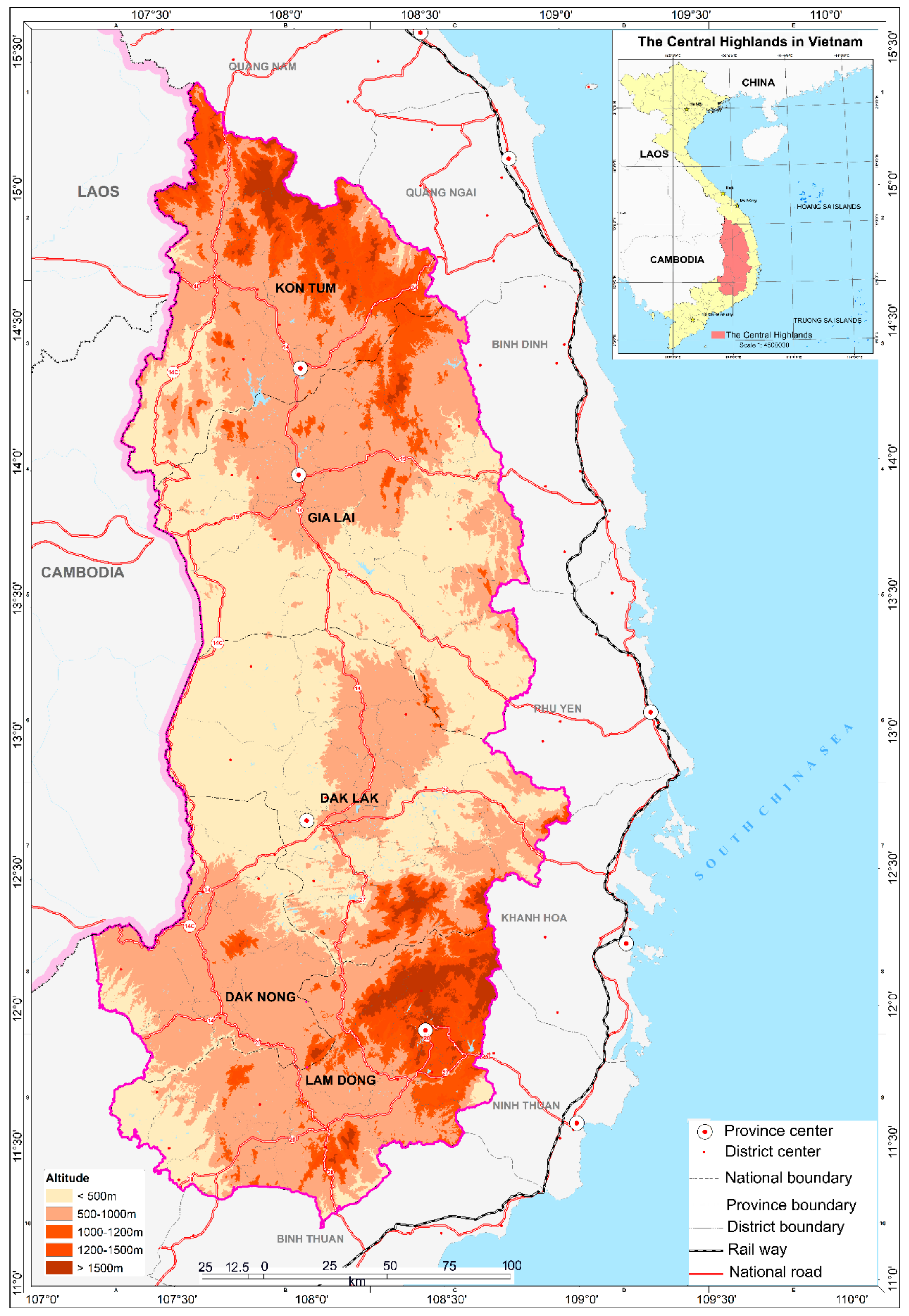
2.1. Study Area
2.2. Multicriteria Evaluation for Tourism Potential
2.2.1. Selected Criteria
2.2.2. Analytic Hierarchy Process and Principal Component Analysis
- Analytic Hierarchy Process (AHP)
- Principal Component Analysis (PCA)
3. Results
3.1. Weighting the Criteria
3.2. Tourism Potential
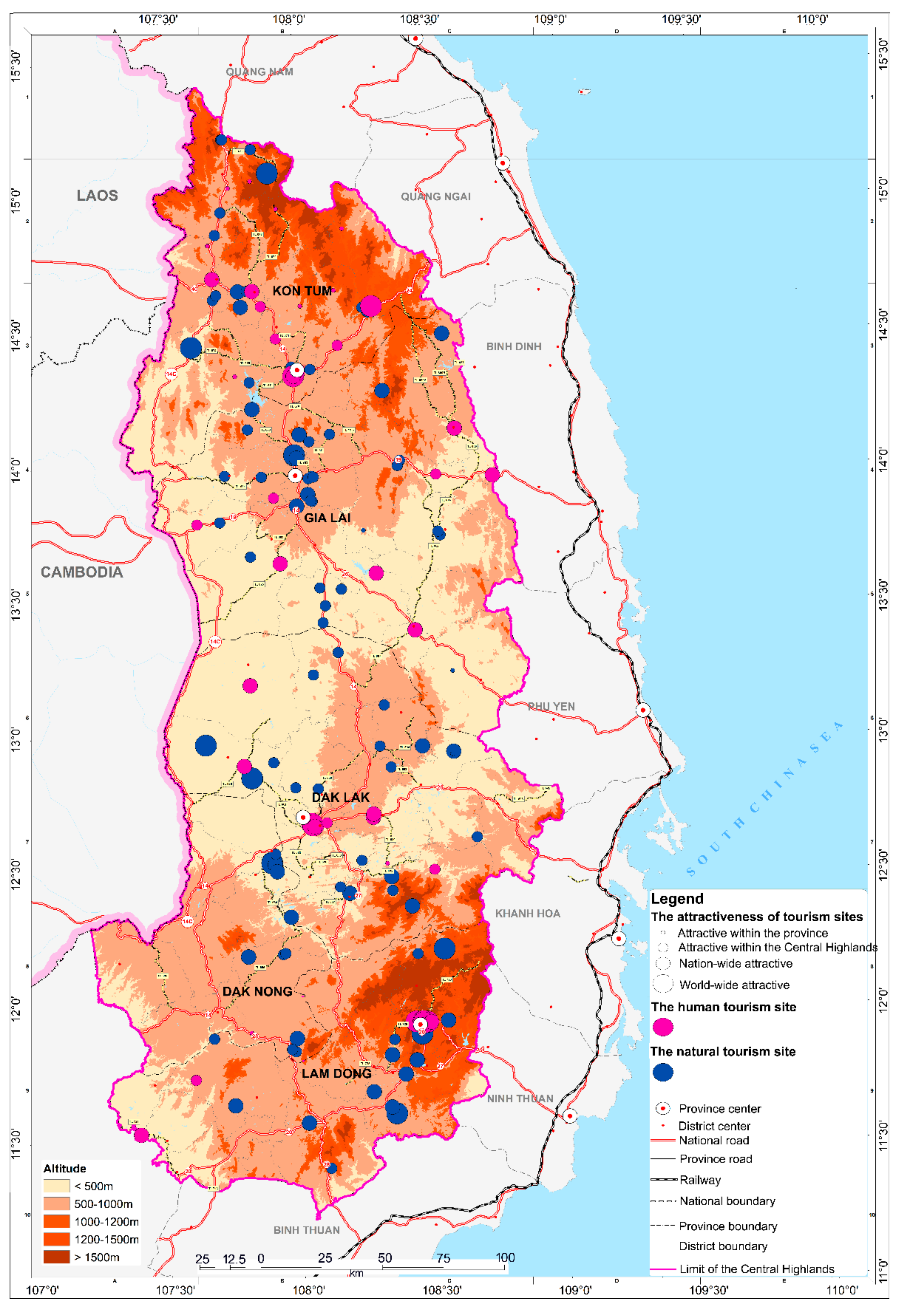
3.2.1. Potential of Tourist Sites
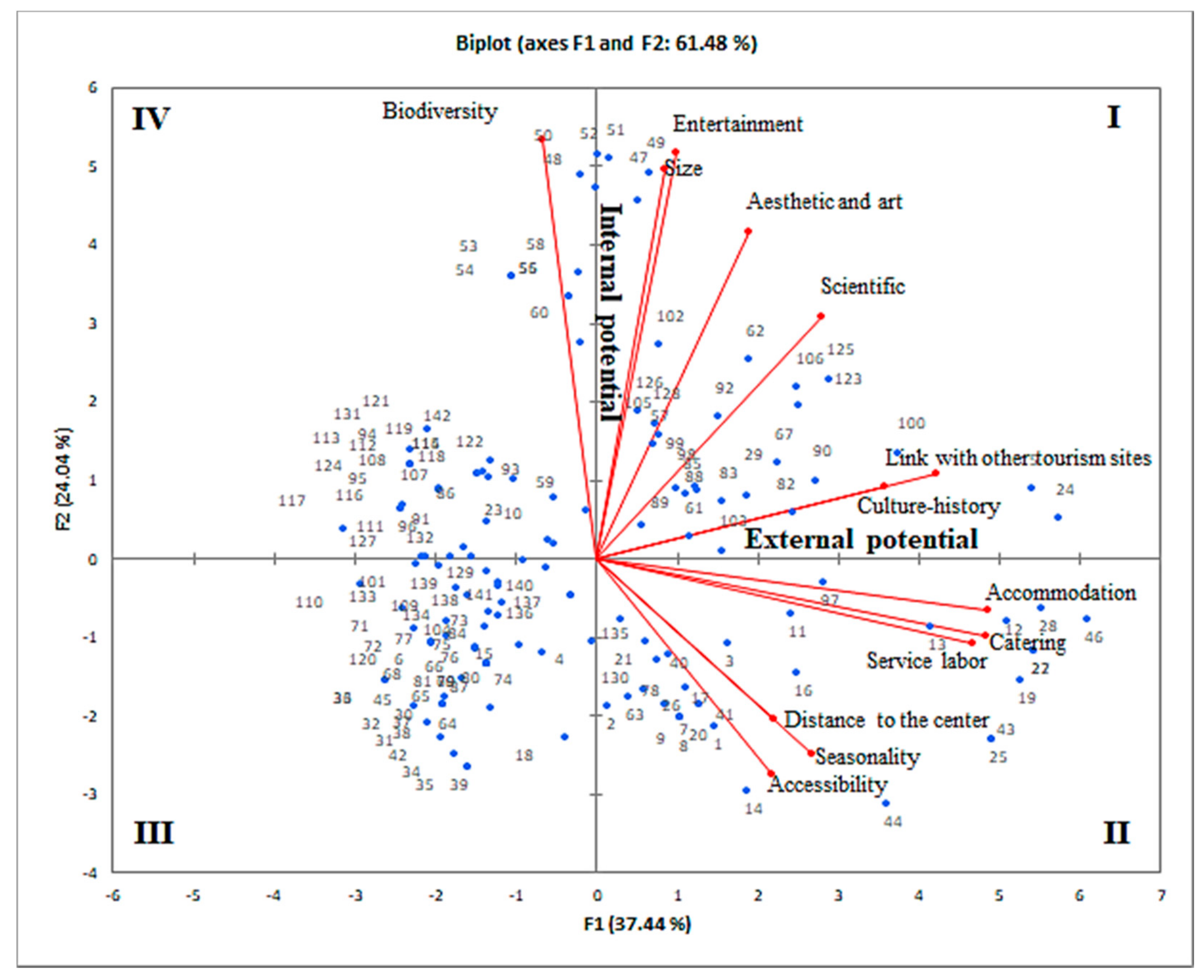
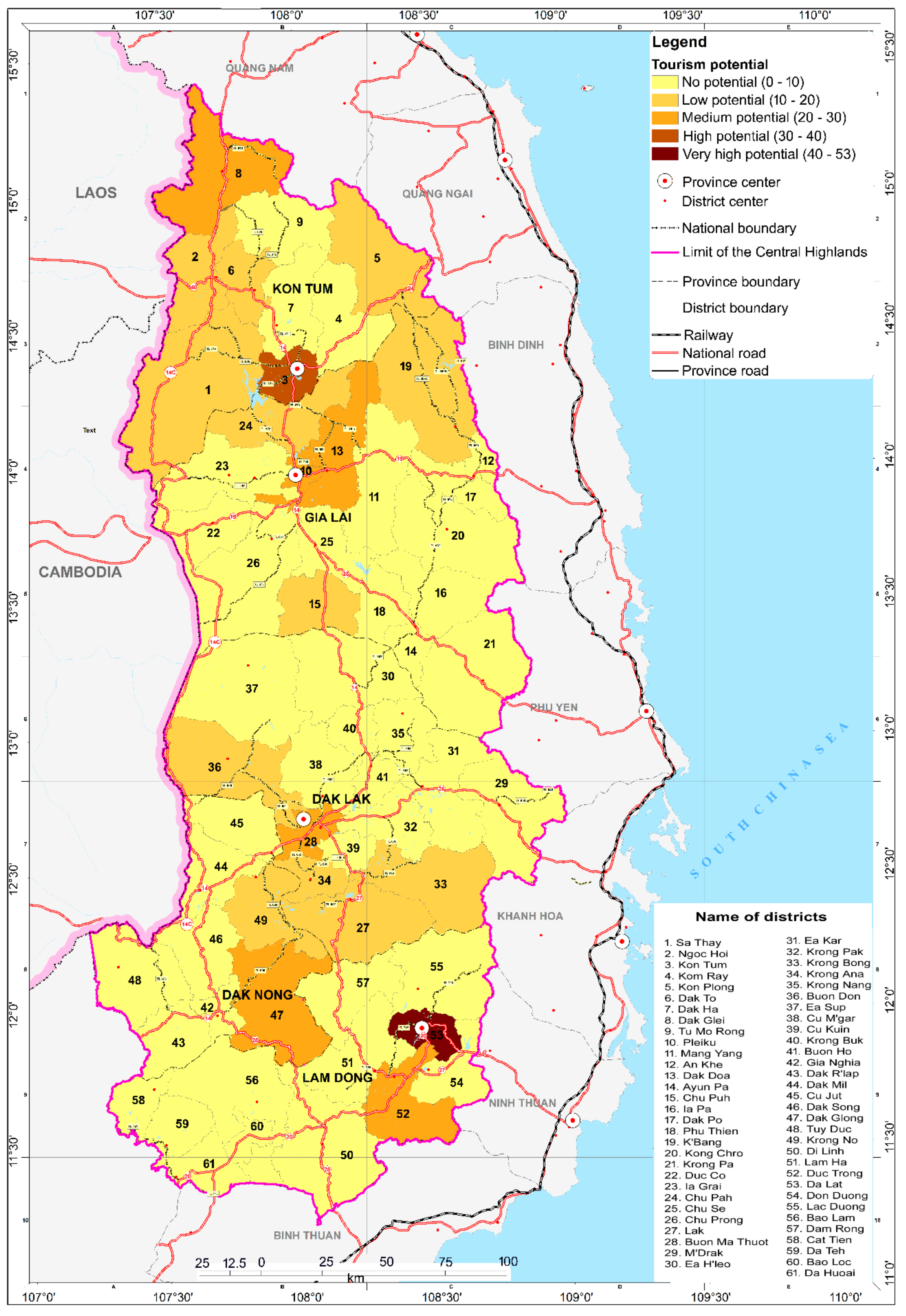
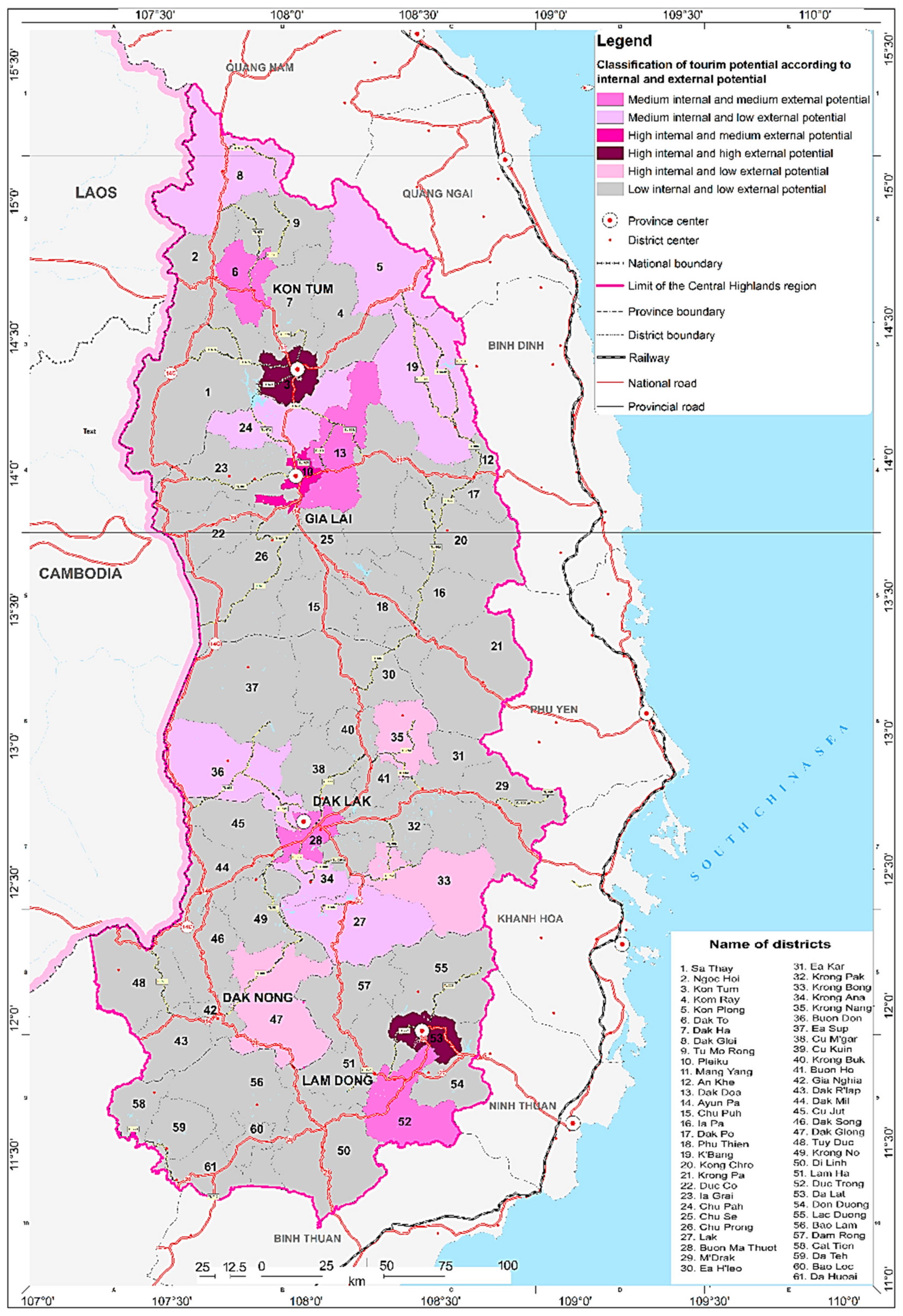
3.2.2. Potential of District-Wide Tourism
- Type 1: Medium internal potential and medium external potential;
- Type 2: Medium internal potential and low external potential;
- Type 3: High internal potential and medium external potential;
- Type 4: High internal potential and high external potential;
- Type 5: High internal potential and low external potential; and
- Type 6: Low internal potential and low external potential.
4. Conclusions and Discussion
Author Contributions
Funding
Conflicts of Interest
References
- Jansen-Verbeke, M.; Go, F. Tourism development in Vietnam. Tour. Manag. 1995, 16, 315–321. [Google Scholar] [CrossRef] [Scilit]
- Dwyer, L.; Kim, C.W. Destination competitiveness: A model and indicators. Curr. Issues Tour. 2003, 6, 369–414. [Google Scholar] [CrossRef] [Scilit]
- Martín, J.M.M.; Fernández, J.A.S.; Martín, J.A.R.; Aguilera, J.D.D.J. Assessment of the Tourism’s Potential as a Sustainable Development Instrument in Terms of Annual Stability: Application to Spanish Rural Destinations in Process of Consolidation. Sustainability 2017, 9, 1692. [Google Scholar] [CrossRef] [Scilit]
- Sánchez, M.; Sánchez, J.M.; Rengifo, J.I. Methodological approach for assessing the potential of a rural tourism destination: An application in the province of Cáceres (Spain). Curr. Issues Tour. 2014, 19, 1084–1102. [Google Scholar] [CrossRef] [Scilit]
- Vystoupil, J.; Šauer, M.; Repík, O. Quantitative analysis of tourism potential in the Czech Republic. Acta Univ. Agric. Silvic. Mendel. Brun. 2017, 6, 1085–1098. [Google Scholar] [CrossRef] [Scilit]
- Cetin, M.; Sevik, H. Evaluating the recreation potential of Ilgaz Mountain National Park in Turkey. Environ. Monit. Assess. 2016, 188, 52. [Google Scholar] [CrossRef] [Scilit] [PubMed]
- Kocan, N.; Yucesoy, N. Kizilcahamam-Camlidere Geopark (Ankara/Turkey) with its geological heritage values and geotourism planning. J. Geol. Soc. India 2016, 87, 112–118. [Google Scholar] [CrossRef] [Scilit]
- Pourahmad, A.; Hosseini, A.; Pourahmad, A.; Zoghi, M.; Sadat, M. Tourist Value Assessment of Geotourism and Environmental Capabilities in Qeshm Island, Iran. Geoheritage 2017, 1–20. [Google Scholar] [CrossRef] [Scilit]
- Vargo, S.; Lusch, R. Evolving to a new dominant logic for marketing. J. Mark. 2004, 68, 1–17. [Google Scholar] [CrossRef] [Scilit]
- Feng, X.-H.; Ju, C.-Y. Evaluation and analysis on the tourism resources in Hami Region based on GIS mapping technology. Ecol. Econ. 2010, 6, 457–462. [Google Scholar]
- Cerro, F.L. La evaluación del potencial turístico en un proceso de planificación: El Canal de Castilla. Estud. Turísticos 1992, 116, 49–85. [Google Scholar]
- Sánchez, J.M.; Sánchez, M.; Rengifo, J.I. La evaluación del potencial para el desarrollo del turismo rural. Aplicación metodológica sobre la provincia de Cáceres. Geofocus 2013, 13, 99–130. [Google Scholar]
- Mikery, M.J.; Pérez, A. Métodos para el análisis del potencial turístico del territorio rural (Methods for the analysis of tourism potential of rural areas). Rev. Mex. Cienc. Agríc. 2014, 9, 1729–1740. [Google Scholar]
- López, D. La evaluación de los recursos territoriales turísticos de las comarcas del interior castellonense (Comunidad Valenciana). [An assessment of the local tourism resources of the inland regions of Castellon (Comunidad Valenciana)]. Investig. Geogr. 2001, 25, 137–157. [Google Scholar]
- Reyes, O.; Sánchez, A. Metodología para determinar el potencial de los recursos turísticos naturales en el Estado de Oaxaca, México [Methodology for determining the potential of natural tourism resources in the State of Oaxaca, Mexico]. Cuad. Turismo 2005, 16, 157–173. [Google Scholar]
- MINCETUR. Guía Metodológica Para la Formulación del Inventario y Evaluación del Patrimonio Turístico Nacional. [Methodological Guide for the Development of the Inventory and Assessment of the National Tourism Heritage]. 2006. Available online: http://www.mincetur.gob.pe/turismo/OTROS/inventario%20turistico/categoria.htm (accessed on 5 August 2018).
- Cerezo, A.; Galacho, F.B. Propuesta metodológica con SIG para la evaluación de la potencialidad del territorio respecto a actividades ecoturísticas y de turismo activo: Aplicación en la Sierra de Las Nieves (Málaga, España). [A GIS methodological proposal for the evaluation of the potential of the territory regarding ecotourism and adventure tourism activities: Application to a case study in Sierra de Las Nieves]. Investig. Turísticas 2011, 1, 134–147. [Google Scholar]
- Soria, E. Proyección del Modelo FUZZY-SECTUR para evaluar el potencial turístico de un territorio/Proposal of the FUZZY-SECTUR model to evaluate the tourist potential of a territory. Retos Turísticos 2014, 13. Available online: http://retos.mes.edu.cu/index.php/retojs/article/view/118 (accessed on 29 August 2018).
- Thong, L.; Thao, N.Q.; Dinh, B.X.; Loi, D.D.; Phu, N.V.; Tue, N.M.; Viet, P.C.; Vu, N.D. Viet Nam: Land and People; Vietnam Education Publishing House: Hanoi, Vietnam, 2012; p. 544. [Google Scholar]
- Tang, C.; Zhong, L.; Kristen, M.; Cheng, S. A comprehensive evaluation of tourism climate suitability in Qinghai Province, China. J. Mt. Sci. 2012, 9, 403–413. [Google Scholar] [CrossRef] [Scilit]
- Franco-Maass, S.; Osorio-García, M.; Nava-Bernal, G.; Regil-García, Y.H.H. Evaluación multicriterio de los recursos turísticos [Multicriteria evaluation of tourism resources]. Estudios Y Perspectivas En Turismo 2009, 18, 208–226. [Google Scholar]
- Gil, A.M.L. La evaluación del medio para la práctica de actividades turístico-deportivas en la naturaleza [Assessment of the environment for sports tourism activities in natural areas]. Cuad. Turismo 2003, 12, 131–149. [Google Scholar]
- Yan, L.; Gao, B.W.; Zhang, M. A mathematical model for tourism potential assessment. Tour. Manag. 2017, 63, 355–365. [Google Scholar] [CrossRef] [Scilit]
- Meyfroidt, P.; Vu, T.P.; Hoang, V.A. Trajectories of deforestation, coffee expansion and displacement of shifting cultivation in the Central Highlands of Vietnam. Glob. Environ. Chang. 2013, 23, 1187–1198. [Google Scholar] [CrossRef] [Scilit]
- Koninck, R.D. The theory and practice of frontier development: Vietnam’s contribution. Asia Pac. Viewp. 2000, 41, 7–21. [Google Scholar] [CrossRef] [Scilit]
- Doutriaux, S.; Geisler, C.; Shively, G. Competing for coffee space: Development-induced displacement in the Central Highlands of Vietnam. Rural Sociol. 2008, 73, 528–554. [Google Scholar] [CrossRef] [Scilit]
- Li, Z.; Fox, J.M. Mapping rubber tree growth in mainland Southeast Asia using time-series MODIS 250 m NDVI and statistical data. Appl. Geogr. 2012, 32, 420–432. [Google Scholar] [CrossRef] [Scilit]
- Ziegler, A.D.; Fox, J.M.; Xu, J. The Rubber Juggernaut. Science 2009, 324, 1024–1025. [Google Scholar] [CrossRef] [Scilit] [PubMed]
- General Statistics Office (GSO). Statistical Yearbook of Vietnam 2015; Thong ke: Hanoi, Vietnam, 2015. [Google Scholar]
- MOCST (Ministry of Culture-Sports and Tourism). Tourism Development in Association with Environmental Protection in the Central Highlands of Vietnam; Ministry of Culture-Sports and Tourism: Kom Tum, Vietnam, 2018.
- Tao-fang, Y.; Chao-lin, G.; Hong, W.; Xue-jun, D.; Xiao-feng, Y. The evaluation and analysis of the tourism resources in Jilin province. Chin. Geogr. Sci. 2002, 12, 186–192. [Google Scholar]
- Cetin, M.; Zeren, I.; Sevik, H.; Cakir, C.; Akpinar, H. A study on the determination of the natural park’s sustainable tourism potential. Environ. Monit. Assess. 2018, 190, 167. [Google Scholar] [CrossRef] [Scilit] [PubMed]
- Obasi and Nelson Torti. Tourism Aesthetics and Values. J. Tour. Herit. Stud. 2015, 4, 48–56. [Google Scholar]
- Yıldırım, T.B.; Ak, T.; Ölmez, Z. Assessment of the natural-cultural resources in Çanakkale for nature-based tourism. Environ. Dev. Sustain. 2008, 10, 871–881. [Google Scholar] [CrossRef] [Scilit]
- Gowreesunkar, V.; Soteriades, M. Entertainment of leisure tourists in island destinations: Evidence from the island of Mauritius. Afr. J. Hosp. 2014, 4, 1–19. [Google Scholar]
- Darabseh, F.M.; Ababneh, A.; Almuhaisen, F. Assessing Umm el-Jimal’s Potential for Heritage Tourism. Archaeologies 2017, 13, 460–488. [Google Scholar] [CrossRef] [Scilit]
- You-jun, L.; Zheng-xin, L. Innovation and Application on Evaluation Methods of Regional Tourism Resources. In Proceedings of the 2009 International Conference on Information Management, Innovation Management and Industrial Engineering, Xi’an, China, 26–27 December 2009; IEEE: Beijing, China; pp. 608–611. [Google Scholar]
- Kim, H.; Chung, Y.; Nishii, K.; Jung, B.D. The effect of accessibility improvement on tourist excursion behaviors. KSCE J. Civ. Eng. 2011, 15, 1443–1448. [Google Scholar] [CrossRef] [Scilit]
- Bigman, D.; Deichmann, U. Spatial indicators of access and fairness for the location of public facilities. In Geographic Targeting for Poverty Alleviation: Methodology and Application; Bigman, D., Fofack, H., Eds.; World Bank: Washington, DC, USA, 2000; pp. 181–206. [Google Scholar]
- Duke, J.M.; Aull-hyde, R. Identifying public preferences for land preservation using the analytic hierarchy process. Ecol. Econ. 2002, 42, 131–145. [Google Scholar] [CrossRef] [Scilit]
- Ferrari, P. A method for choosing from among alternative transportation projects. Eur. J. Oper. Res. 2003, 150, 194–203. [Google Scholar] [CrossRef] [Scilit]
- Ramanathan, R. A note on the use of the analytic hierarchy process for environmental impact assessment. J. Environ. Manag. 2001, 63, 27–35. [Google Scholar] [CrossRef] [Scilit] [PubMed]
- Tiwary, D.N.; Loof, R.; Paudyal, G.N. Environmental-economic decision-making in lowland irrigated agriculture using multi-criteria analysis techniques. Agric. Syst. 1999, 60, 99–112. [Google Scholar] [CrossRef] [Scilit]
- Erfani, M.; Afrougheh, S.; Ardakani, T.; Sadeghi, A. Tourism positioning using decision support system (case study: Chahnime—Zabol, Iran). Environ. Earth Sci. 2015, 74, 3135–3144. [Google Scholar] [CrossRef] [Scilit]
- Gumusay, M.; Koseoglu, G.; Bakirman, T. An assessment of site suitability for marina construction in Istanbul, Turkey, using GIS and AHP multicriteria decision analysis. Environ. Monit. Assess. 2016, 188, 677. [Google Scholar] [CrossRef] [Scilit] [PubMed]
- Saaty, T.L. The Analytic Hierarchy Process: Planning, Priority Setting and Resource Allocation; McGraw-Hill: New York, NY, USA, 1980. [Google Scholar]
- Saaty, T.L. Fundamentals of Decision Making and Priority Theory with the Analytic Hierarchy Process; RWS Publication: Pittsburg, CA, USA, 2000; p. 478. [Google Scholar]
- Bryant, F.B.; Yarnold, P. Principal components analysis and exploratory and confirmatory factor analysis. In Reading and Understanding Multivariate Analysis; Grimm, L.G., Yarnold, P.R., Eds.; American Psychological Association Books: Washington, DC, USA, 1995. [Google Scholar]
- Jing, W.; Linsheng, Z.; Tian, C. Ecotourism Resources Assessment and Development Strategy for Guizhou Province, China. J. Resour. Ecol. 2017, 8, 648–654. [Google Scholar] [CrossRef] [Scilit]
- Tomić, N.; Antić, A.; Marković, S.B.; Đorđević, T.; Zorn, M.; Valjavec, M.B. Exploring the Potential for Speleotourism Development in Eastern Serbia. Geoheritage 2018, 1–11. [Google Scholar] [CrossRef] [Scilit]
- Višnić, T.; Spasojević, B.; Vujičić, M. The Potential for Geotourism Development on the Srem Loess Plateau Based on a Preliminary Geosite Assessment Model (GAM). Geoheritage 2016, 8, 173–180. [Google Scholar] [CrossRef] [Scilit]

| Tourism Potential | Selected Criteria | Explanation and References | Evaluation Scale | Rating |
|---|---|---|---|---|
| Internal potential | Aesthetic and art value (AA) | Aesthetics and art deals with beauty and artistic taste. Tourism aesthetics and art are characterized into philosophical, practical and cultural attributes [6,7,8,32,33,34]. | Very high | 10 |
| High | 7 | |||
| Medium | 4 | |||
| Low | 1 | |||
| Entertainment value (EN) | From a consumer perspective, the entertainment available at a destination is probably less important than its perceived quality or uniqueness. Even more important for destination competitiveness is the degree to which the entertainment is appropriate for the destination [2,6,7,8,9,35]. | Very high | 10 | |
| High | 7 | |||
| Medium | 4 | |||
| Low | 1 | |||
| Cultural-historical value (CH) | Rating cultural, historical, and scientific value decentralized under the State ranking: province-wide, region-wide, nation-wide, and world-wide attraction [6,7,8,10,36,37]. | World-wide attractive | 10 | |
| Nation-wide attractive | 7 | |||
| Region-wide attractive | 4 | |||
| Province-wide attractive | 1 | |||
| Scientific value (SI) | World-wide attractive | 10 | ||
| Nation-wide attractive | 7 | |||
| Region-wide attractive | 4 | |||
| Province-wide attractive | 1 | |||
| Biodiversity (BI) | Biodiversity value is assessed according to the number of endemic species in protected areas [2,6]. | Very high | 10 | |
| High | 7 | |||
| Medium | 4 | |||
| Low | 1 | |||
| The size of tourism destination (TD) | The bigger the tourist destination, the higher the tourism carrying capacity [2]. | >50 ha | 10 | |
| >10–50 ha | 7 | |||
| 1–10 ha | 4 | |||
| <1 ha | 1 | |||
| Tourism seasonality (TS) | Appropriate duration for tourism activities [37]. | >300 days per year | 10 | |
| >200–300 days per year | 7 | |||
| 100–200 days per year | 4 | |||
| <100 days per year | 1 | |||
| External potential | Linkages with other tourist sites (LT) | The density of tourist sites [8]. | Very high | 10 |
| High | 7 | |||
| Medium | 4 | |||
| Low | 1 | |||
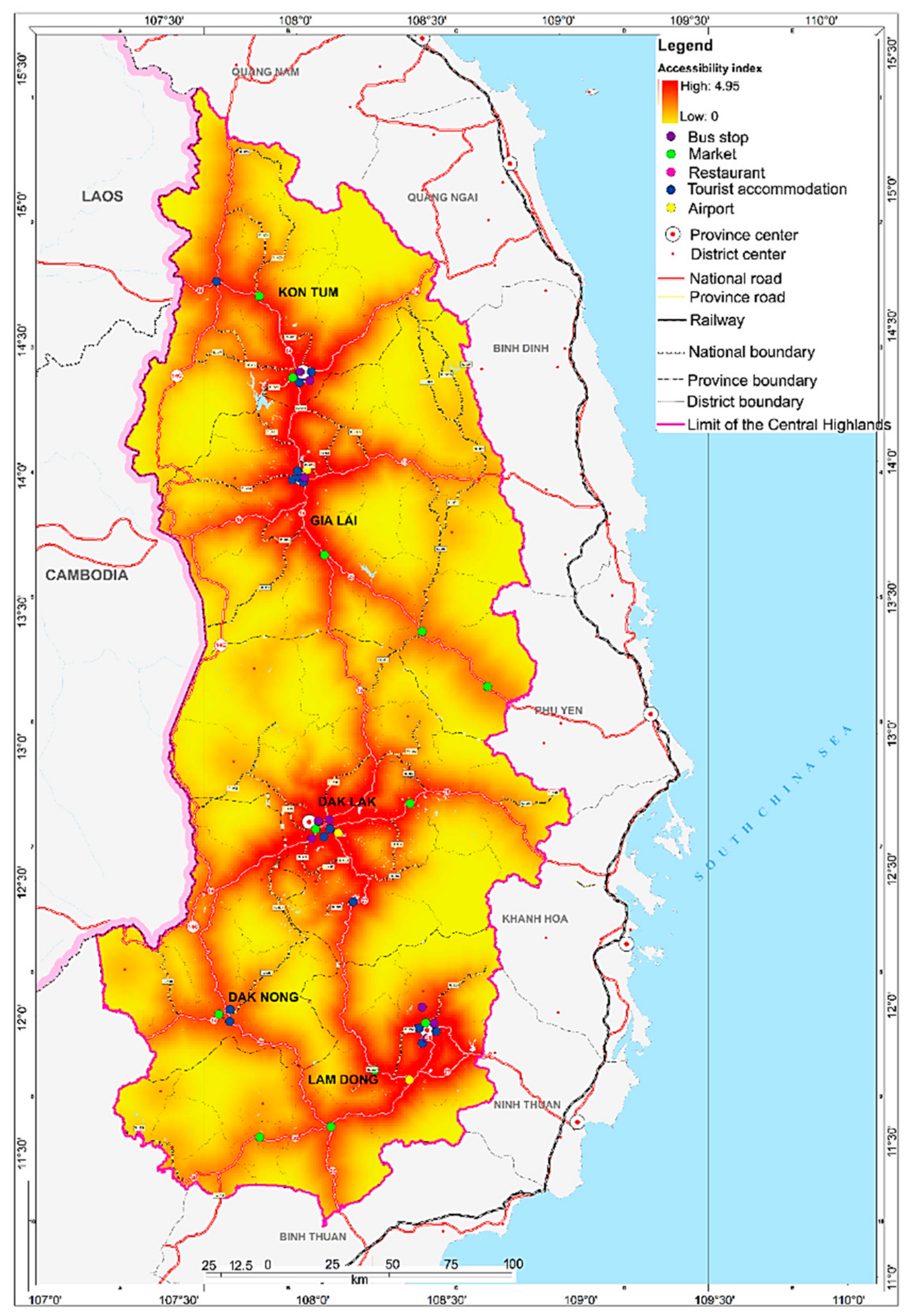
| Potential accessibility (AC) | Travel time from each tourist site to the accommodations, restaurants, markets, bus stations, and airport [38]. | >3 | 10 | |
| >2–3 | 7 | |||
| >1–2 | 4 | |||
| 0–1 | 1 | |||
| The distance from tourist attractions to the city center (DF) | The closer the city center, the higher the potential of the tourist market [4] | <20 km | 10 | |
| 20–40 km | 7 | |||
| >40–60 km | 4 | |||
| >60 km | 1 | |||
| Accommodation quality (AQ) | The quality of accommodation is graded using the star ranking of the hotels [2]. | Very good | 10 | |
| Good | 7 | |||
| Medium | 4 | |||
| Bad | 1 | |||
| Catering quality (CQ) | Catering quality and service labor quality refers to the statistical yearbooks [2,8]. | Very good | 10 | |
| Good | 7 | |||
| Service labor quality (SL) | Medium | 4 | ||
| Bad | 1 |
| Value of axy | Interpretation |
|---|---|
| 1 | x and y are equally important |
| 3 | x is slightly more important than y |
| 5 | x is more important than y |
| 7 | x is strongly more important than y |
| 9 | x is absolutely more important than y |
| n | 1 | 2 | 3 | 4 | 5 | 6 | 7 | 8 | 9 | 10 | 11 | 12 | 13 | 14 | 15 |
|---|---|---|---|---|---|---|---|---|---|---|---|---|---|---|---|
| RI | 0.00 | 0.00 | 0.58 | 0.90 | 1.12 | 1.24 | 1.32 | 1.41 | 1.45 | 1.49 | 1.51 | 1.48 | 1.56 | 1.57 | 1.59 |
| Criteria | AA | EN | CH | SI | BI | TD | TS | LT | AC | DF | AQ | CQ | SL | Weight Scores |
|---|---|---|---|---|---|---|---|---|---|---|---|---|---|---|
| Internal potential | 0.72 | |||||||||||||
| Aesthetic and art value (AA) | 1.0 | 1.9 | 0.6 | 2.5 | 3.9 | 6.0 | 5.6 | 5.0 | 3.1 | 5.4 | 3.5 | 3.0 | 4.8 | 0.13 |
| Entertainment value (EN) | 1.0 | 0.6 | 2.9 | 3.9 | 5.5 | 5.6 | 4.0 | 3.1 | 7.2 | 3.5 | 3.4 | 4.6 | 0.13 | |
| Cultural-historical value (CH) | 1.0 | 3.8 | 5.2 | 5.8 | 6.2 | 5.2 | 3.7 | 6.0 | 4.2 | 4.2 | 5.8 | 0.18 | ||
| Scientific value (SI) | 1.0 | 3.2 | 6.2 | 5.6 | 5.0 | 3.1 | 5.8 | 4.2 | 4.4 | 6.0 | 0.13 | |||
| Biodiversity (BI) | 1.0 | 4.5 | 3.9 | 2.5 | 1.4 | 3.5 | 3.6 | 3.8 | 4.8 | 0.09 | ||||
| The size of tourism destination (TD) | 1.0 | 1.3 | 0.8 | 0.6 | 2.5 | 1.5 | 1.7 | 1.1 | 0.03 | |||||
| Tourism seasonality (TS) | 1.0 | 1.3 | 1.4 | 3.9 | 1.4 | 1.1 | 0.8 | 0.03 | ||||||
| External potential | 0.28 | |||||||||||||
| Linkages with other tourist sites (LT) | 1.0 | 0.9 | 3.2 | 0.8 | 2.8 | 2.4 | 0.04 | |||||||
| Potential accessibility (AC) | 1.0 | 3.8 | 3.7 | 3.2 | 3.3 | 0.08 | ||||||||
| The distance from tourist attractions to city center (DF) | 1.0 | 0.8 | 1.3 | 1.4 | 0.03 | |||||||||
| Accommodation quality (AQ) | 1.0 | 2.0 | 1.9 | 0.05 | ||||||||||
| Catering quality (CQ) | 1.0 | 1.9 | 0.04 | |||||||||||
| Service labor quality (SL) | 1.0 | 0.03 |
| F1 | F2 | F3 | F4 | F5 | F6 | F7 | F8 | F9 | F10 | F11 | F12 | F13 | |
|---|---|---|---|---|---|---|---|---|---|---|---|---|---|
| Eigenvalue | 4.9 | 3.1 | 1.3 | 1.3 | 0.7 | 0.5 | 0.3 | 0.3 | 0.2 | 0.2 | 0.1 | 0.1 | 0.0 |
| Variability (%) | 37.5 | 24.2 | 10.2 | 10.0 | 5.1 | 3.5 | 2.6 | 2.2 | 1.7 | 1.2 | 1.1 | 0.5 | 0.2 |
| Cumulative % | 37.5 | 61.7 | 71.9 | 81.8 | 87.0 | 90.4 | 93.1 | 95.3 | 97.0 | 98.2 | 99.3 | 99.8 | 100.0 |
| Order | Name | Order | Name | Order | Name | Order | Name |
|---|---|---|---|---|---|---|---|
| 1 | Kon Tum prison | 37 | The Dak Pet victory monument | 73 | Ea Tan | 108 | Le Kim water fall |
| 2 | Dak Glei prison | 38 | Dak Sieng victory monument | 74 | Ea Ho | 109 | Lo O water fall |
| 3 | Dak To-Tan Canh victory relic | 39 | Kon Braih victory relic | 75 | Ea Drong | 110 | Suoi Tien water fall |
| 4 | Plei Kan victory relic | 40 | Serepok ferry | 76 | Ea Ba | 111 | Xung Khoeng water fall |
| 5 | Historical and scenic area of Mang Den | 41 | Ca Da temple | 77 | Dak Blao | 112 | Yang Yung water fall |
| 6 | Revolutionary base of Kon Tum People’s Committees | 42 | The cave complex of Khue Ngoc Dien | 78 | Me Linh | 113 | Ya Ma water fall |
| 7 | Vo Lam temple | 43 | Buon Ma Thuot war memorial | 79 | Chu A crater | 114 | Gou water fall |
| 8 | Trung Luong temple | 44 | 1968 Monument | 80 | Ia Bang crater | 115 | Ngam water fall |
| 9 | Bac Ai temple | 45 | Hang No victory monument | 81 | Plei Nh Prong crater | 116 | Dak R’lung water fall |
| 10 | Plei Oi village | 46 | The Wood-blocks of Nguyen reign | 82 | Plei Ku crater | 117 | Bay water fall |
| 11 | The Tay Son relic religion | 47 | Chu Mon Ray national park | 83 | Bien Ho crater | 118 | Bim Bip water fall |
| 12 | Pleiku prison | 48 | Kon Ka Kinh national park | 84 | Ha Bau crater | 119 | Dray Dlong water fall |
| 13 | The Stor resistance village | 49 | Yor Don national park | 85 | Hang Rong crater | 120 | Dray H’Yer water fall |
| 14 | The revolution of Zone 9 | 50 | Chu Yang Sin national park | 86 | Po Drang crater | 121 | Dray Kpor water fall |
| 15 | Dak Po victory relic | 51 | BiDoup-NuiBa national park | 87 | Dry crater | 122 | Thuy tien water fall |
| 16 | Victory relic of Road 7-Bo river | 52 | Ngoc Linh national park | 88 | Chu Dang Ya crater | 123 | Seven branches-water fall |
| 17 | Plei Me victory relic | 53 | Kon Cha Rang conservation area | 89 | Krong Kmar water fall | 124 | Mo water fall |
| 18 | Chu Ty victory monument | 54 | Ea So conservation area | 90 | Jraiblian water fall | 125 | Dray Nur water fall |
| 19 | Buon Ma Thuot prison | 55 | Nam Ka conservation area | 91 | Nine-floors water fall | 126 | Tan Canh Cliff of Stone |
| 20 | Cocoa plantation | 56 | Ta Dung conservation area | 92 | BoBla water fall | 127 | Pa Sy water fall |
| 21 | Dak Tuar cave | 57 | Ho Lak conservation area | 93 | Li Liang water fall | 128 | Ia Ly water fall |
| 22 | Lac Giao temple | 58 | Nam Nung conservation area | 94 | Dak Che water fall | 129 | Nhon Hoa water fall |
| 23 | Ancient Cham Tower of Yang Prong | 59 | Dak Uy conservation area | 95 | Dragon water fall | 130 | Hiep Thanh water fall |
| 24 | Bao Dai Villa | 60 | DraySap Gia Long conservation area | 96 | Dak Ke water fall | 131 | Da Che water fall |
| 25 | Da Lat children prison | 61 | Ngoc Hoi-Dak To Geological Heritage Complex | 97 | Lieng Rowoa water fall | 132 | Dak Krong fluvial terrace |
| 26 | Loc Bac relic region | 62 | KonPlong Geomorphological Heritage | 98 | Pongour seven-floors water fall | 133 | Dak Mon fluvial terrace |
| 27 | Da Lat station | 63 | Kon Tum Geomorphological Heritage | 99 | Tiger Cave water fall | 134 | Dak Xu fluvial terrace |
| 28 | Lycee Yersin school | 64 | Cu M’gra | 100 | Datanla water fall | 135 | Tan Canh fluvial terrace |
| 29 | Cat Tien holy land | 65 | Chu Black | 101 | Princess water fall | 136 | Dak Bla fluvial terrace |
| 30 | H16n revolutionary base | 66 | Duc Co | 102 | Dam B’ri water fall | 137 | Dak Cam fluvial terrace |
| 31 | Chư Tan Kra-High Point 995 | 67 | Bien Ho | 103 | Cam Ly water fall | 138 | Dak Doa fluvial terrace |
| 32 | Dak Ui resistance base | 68 | K’dang | 104 | Trinh Nu water fall | 139 | Ia Le fluvial terrace |
| 33 | Xong Dui resistance village | 69 | La Bang | 105 | Gia Long water fall | 140 | Ea H’Leo fluvial terrace |
| 34 | Kon H’ring war remnants | 70 | Ia Pet | 106 | Dray Sap water fall | 141 | Dak Xu swamp |
| 35 | Peak 601 | 71 | Dak Troi | 107 | La Nhi water fall | 142 | Erosion tower formation |
| 36 | the Mang But victory monument | 72 | Nhon Hoa |
| Group of Districts | Tourism Potential | Priority for Tourism Investment |
|---|---|---|
| Da Lat (Lam Dong province) | High internal and high external potential | Most priority for tourism investment |
| Pleiku (Gia Lai province) | High internal and medium external potential | Priority for tourism investment. Necessary investing more in infrastructure. |
| Kom Tum and Dak To (Kon Tum province), Dak Doa (Giai Lai province), Buon Ma Thuot city (Dak Lak province) and Duc Trong (Lam Dong) | Medium internal and medium external potential | Priority for tourism investment. Necessary to upgrade the tourism infrastructure, strengthen links with the other tourist sites to increase tourism attraction, and diversify tourism products. |
| Krong Nong, Krong Bong (Dak Lak province); Dak Glong (Dac Nong province) | High internal and low external tourism potential | Priority for tourism investment. Necessary to attract more tourism investment and improve the quality of tourism services. |
© 2018 by the authors. Licensee MDPI, Basel, Switzerland. This article is an open access article distributed under the terms and conditions of the Creative Commons Attribution (CC BY) license (http://creativecommons.org/licenses/by/4.0/).
Share and Cite
Hoang, H.T.T.; Truong, Q.H.; Nguyen, A.T.; Hens, L. Multicriteria Evaluation of Tourism Potential in the Central Highlands of Vietnam: Combining Geographic Information System (GIS), Analytic Hierarchy Process (AHP) and Principal Component Analysis (PCA). Sustainability 2018, 10, 3097. https://doi.org/10.3390/su10093097
Hoang HTT, Truong QH, Nguyen AT, Hens L. Multicriteria Evaluation of Tourism Potential in the Central Highlands of Vietnam: Combining Geographic Information System (GIS), Analytic Hierarchy Process (AHP) and Principal Component Analysis (PCA). Sustainability. 2018; 10(9):3097. https://doi.org/10.3390/su10093097
Chicago/Turabian StyleHoang, Huong T.T., Quang Hai Truong, An Thinh Nguyen, and Luc Hens. 2018. "Multicriteria Evaluation of Tourism Potential in the Central Highlands of Vietnam: Combining Geographic Information System (GIS), Analytic Hierarchy Process (AHP) and Principal Component Analysis (PCA)" Sustainability 10, no. 9: 3097. https://doi.org/10.3390/su10093097
APA StyleHoang, H. T. T., Truong, Q. H., Nguyen, A. T., & Hens, L. (2018). Multicriteria Evaluation of Tourism Potential in the Central Highlands of Vietnam: Combining Geographic Information System (GIS), Analytic Hierarchy Process (AHP) and Principal Component Analysis (PCA). Sustainability, 10(9), 3097. https://doi.org/10.3390/su10093097

