

Consultancy Centres and Pop-Ups as Local Authority Policy Instruments to Stimulate Adoption of Energy Efficiency by Homeowners

Abstract
1. Introduction
2. Research Methodology and Structure of the Article
3. Regulatory Framework for Energy Efficiency in Owner-Occupied Housing
3.1. Barriers
3.2. Policy Instruments
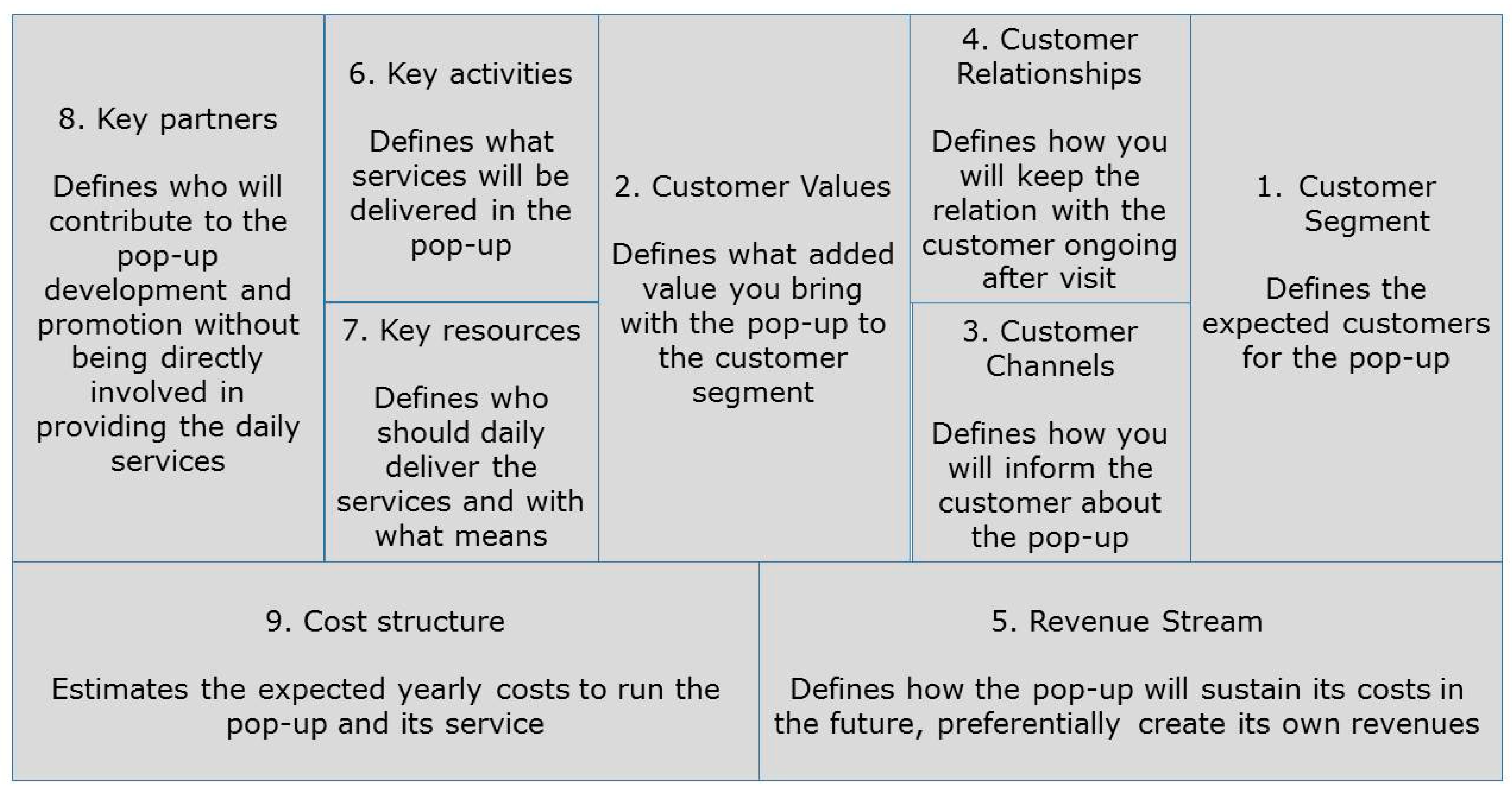
4. Pop-Ups and Consultancy Centres as an Addition to the Policy Mix
4.1. Typology
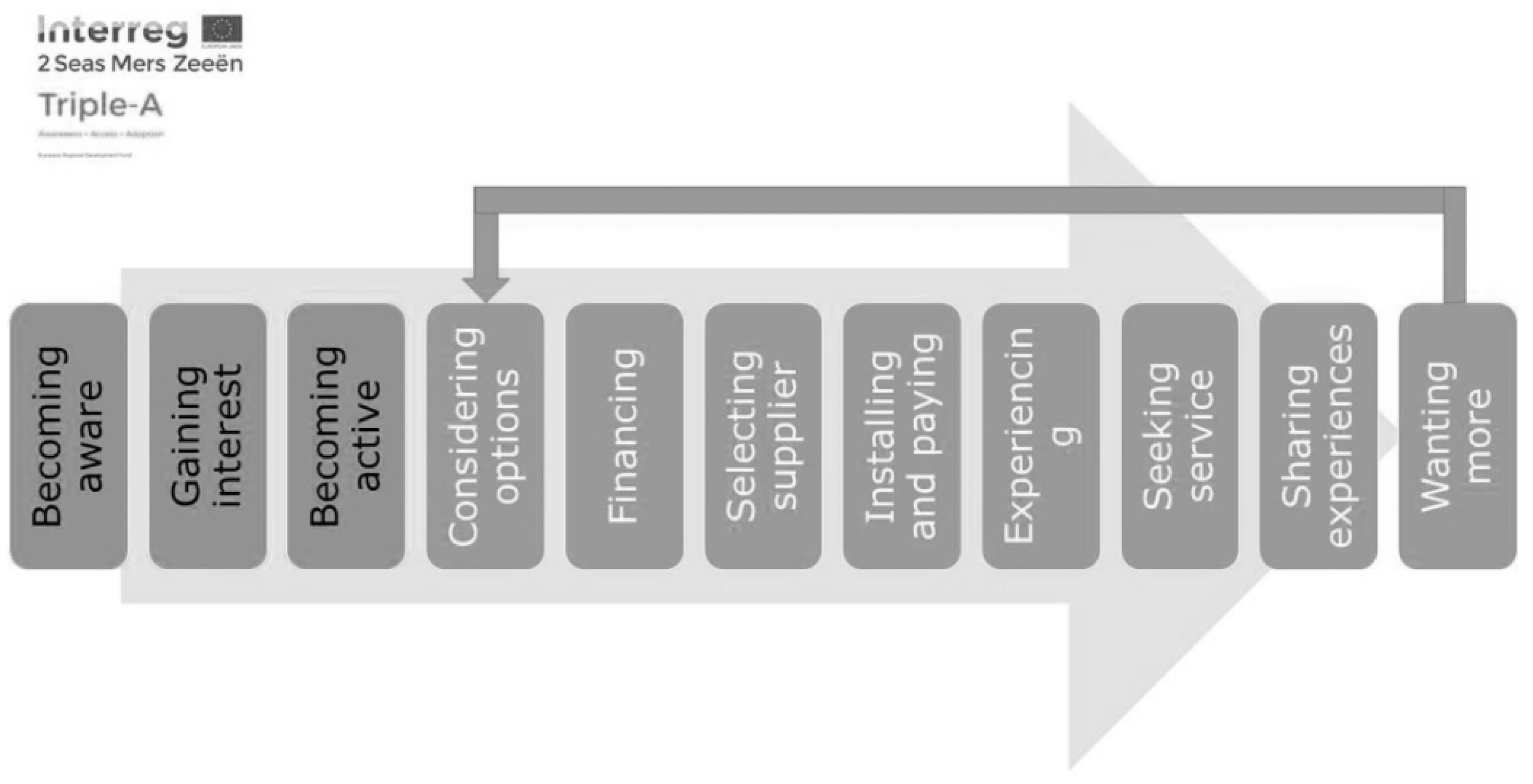
4.2. Service Provision: The Customer Journey Model
5. Case Studies
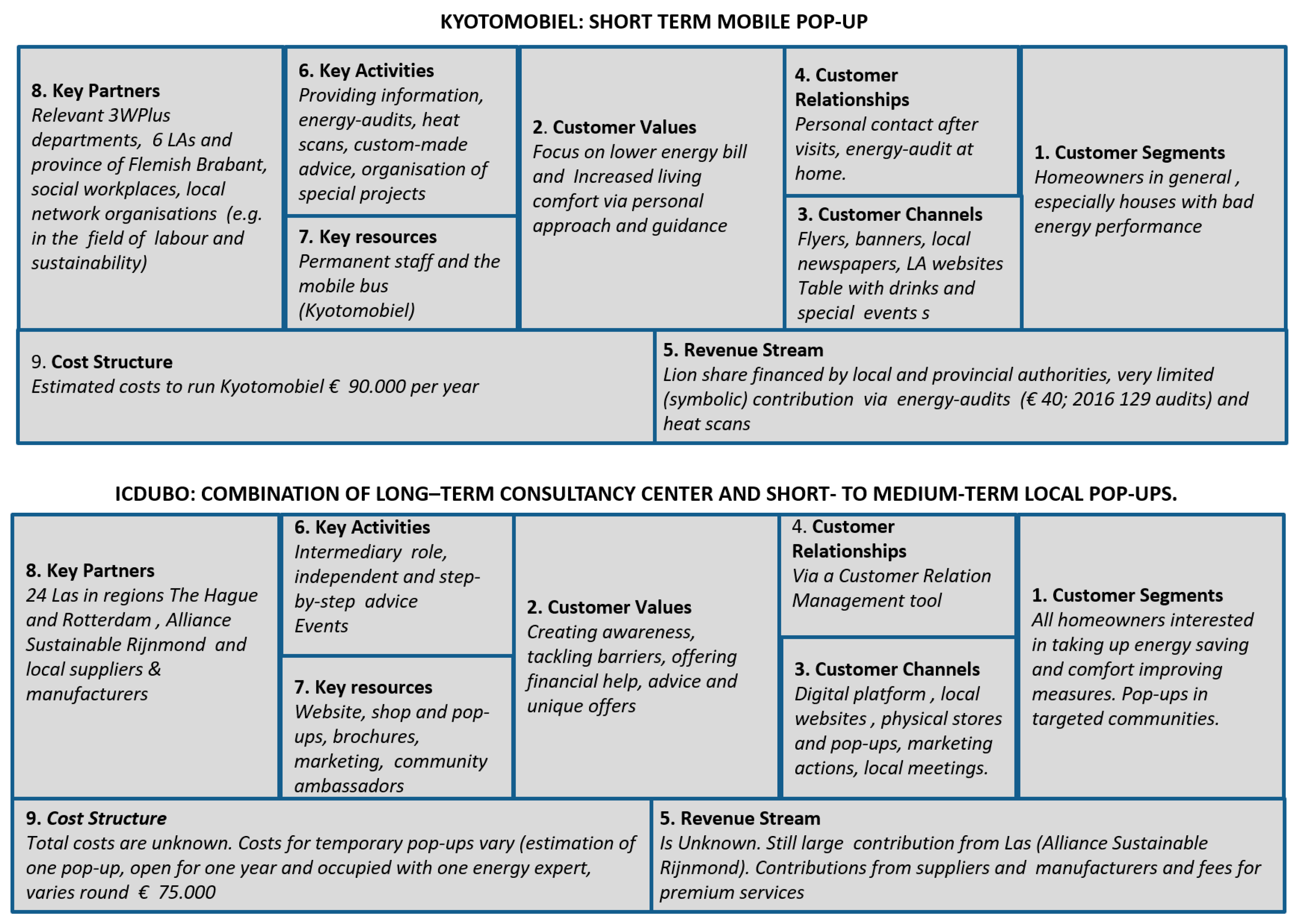
5.1. 3WPlus Halle-Vilvoorde, Belgium: Kyotomobiel
- Type: a short term, mobile pop-up.
- Initiative: public initiative taken by regional and local authorities.
- Customer Journey: although in principle the complete customer journey can be covered, in practice the emphasis lies on creating awareness and assisting during the planning phase.
- The potential to attract visitors (e.g., a busy place where the Kyotomobiel “sticks out”).
- Accessibility: the Kyotomobiel must be easy and safely accessible for all potential visitors
- Close to city centre or (in specific cases) close to the centre of a targeted neighbourhoods.
5.2. ICDuBo, Netherlands: WoonWijzerWinkel and Pop-Ups
- Type: a combination of a long–term information and consultancy centre in an existing office with short to medium-term local pop-ups (both mobile as in an existing building).
- Initiative: regional and local authorities have taken the initiative. Currently ICDuBo is a partnership between public bodies, local, regional authorities and representatives of the (private) supply side (builders, installers, advisors, etc.).
- Customer Journey: almost the complete journey is taken care of: from raising awareness and initiating renovation plans up to the assistance during the execution of the work.
6. Discussion: Could Pop-Ups Make a Difference?
- Type of measures that is taken by homeowners.
- Investments made in their dwellings and the way the investments are financed.
- Effects on the reduction of energy use, emissions and other sustainable issues.
- Effectiveness of the multiple tasks and services the centres and pop-ups deliver.
- Effectiveness of the various approaches (e.g., consultancy centres in the city centre versus pop-ups in targeted neighbourhoods or communities).
- Role and contribution of market intermediaries in the initiatives.
- Relation between the costs of the instrument and it’s benefits and effectiveness,
- Effects on the awareness and neighbourliness, sense of community and cooperation (especially related to energysaving/sustainability issues) of individual homeowners.
7. Conclusions
Author Contributions
Funding
Acknowledgments
Conflicts of Interest
References
- Eurostat. Energy Consumption in Households. Available online: http://ec.europa.eu/eurostat/statistics-explained/index.php/Energy_consumption_in_households (accessed on 21 March 2018).
- Eurostat. Housing Statistics. Available online: http://ec.europa.eu/eurostat/statistics-explained/index.php/Housing_statistics (accessed on 21 March 2018).
- Gram-Hanssen, K.; Jensen, J.O.; Friis, F. Local strategies to promote energy retrofitting of single-family houses. In Energy Efficiency; Springer: Dordrecht, The Netherlands, 2018; pp. 1–16. [Google Scholar]
- Meijer, F.; Straub, A.; Mlecnik, E. Concepts for Consultancy Centres and Pop-Ups for the Adoption of Low-Carbon Technologies by Homeowners (Triple-A: Stimulating the Adoption of Low-Carbon Technologies by Homeowners through Increased Awareness and Easy Access); TUDelft: Delft, The Netherlands, 2018. [Google Scholar]
- VNG. Klantreis Energiebesparing Woningeigenaren. Report VNG in Collaboration with PwC. 2015. Available online: https://vng.nl/files/vng/20172106-vng-rapport-klantreis-energiemaatregelen-woningeigenaren.pdf (accessed on 29 January 2016).
- Osterwalder, A.; Pigneur, Y. Business Model Generation: A Handbook for Visionaries, Game Changers, and Challengers; Wiley: New York, NY, USA, 2010. [Google Scholar]
- Guertler, P.; Smith, W. Energy efficiency in the sustainable refurbishment of high-rise residential buildings: Mapping out an integrated policy approach. In Energy for Sustainable Development; Elsevier: Amsterdam, The Netherlands, 2006; Volume 10, pp. 37–44. [Google Scholar]
- Klinkenberg, F.; Sunikka, M. Better Buildings through Energy Efficiency: A Roadmap for Europe; Report as part of the Eurima Blueprint Project; Eurima: Brussels, Belgium, 2006. [Google Scholar]
- Meijer, F.; Itard, L.; Sunikka-Blank, M. Comparing European residential building stocks: performance, renovation and policy opportunities. Build. Res. Inf. 2009, 37, 533–551. [Google Scholar] [CrossRef]
- European Bank for Reconstruction and Development (ERBD). Energy Efficiency Governance: Handbook, 2nd ed.; International Energy Agency (IEA): Paris, France, 2010. [Google Scholar]
- Haavik, T.; Mlecnik, E.; Rødsjø, A. From demonstration projects to volume market of sustainable construction. Energy Procedia 2012, 30, 1411–1421. [Google Scholar] [CrossRef]
- Stieß, I.; Dunkelberg, E. Objectives, barriers and occasions for energy efficient refurbishment by private homeowners. J. Clean. Prod. 2013, 48, 250–259. [Google Scholar] [CrossRef]
- Organ, S.; Proverbs, D.; Squires, G. Motivations for energy efficiency refurbishment in owner-occupied housing. Struct. Surv. 2013, 31, 101–120. [Google Scholar] [CrossRef]
- Straub, A. COHERENO: Collaboration for Housing Nearly Zero-Energy Renovation Publishable Report; TU Delft: Delft, The Netherlands, 2016. [Google Scholar]
- Wilson, C.; Crane, L.; Chryssochoidis, G. Why do homeowners renovate energy efficiently? Contrasting perspectives and implications for policy. Energy Res. Soc. Sci. 2015, 7, 12–22. [Google Scholar] [CrossRef]
- Langlois-Bertrand, S.; Benhaddadi, M.; Jegen, M.; Pineau, P.O. Political-institutional barriers to energy efficiency. Energy Strategy Rev. 2015, 8, 30–38. [Google Scholar] [CrossRef]
- Vogel, J.A.; Lundqvist, P.; Ariasa, J. Categorizing barriers to energy efficiency in buildings (The 7th International Conference on Applied Energy—ICAE2015). Energy Procedia 2015, 75, 2839–2845. [Google Scholar] [CrossRef]
- Klöckner, C.; Nayum, A. Specific Barriers and Drivers in Different Stages of Decision-Making about Energy Efficiency Upgrades in Private Homes. Front. Psychol. 2016, 7, 1362. [Google Scholar] [CrossRef] [PubMed]
- Palm, J.; Reindl, K. Understanding barriers to energy-efficiency renovations of multifamily dwellings. Energy Effic. 2018, 11, 53–65. [Google Scholar] [CrossRef]
- Kivimaa, P.; Martiskainen, M. Innovation, low energy buildings and intermediaries in Europe: Systematic case study review. Energy Effic. 2018, 11, 31–51. [Google Scholar] [CrossRef]
- Martiskainena, M.; Kivimaaa, P. Creating innovative zero carbon homes in the United Kingdom: Intermediaries and champions in building projects. Environ. Innov. Soc. Transit. 2018, 26, 15–31. [Google Scholar] [CrossRef]
- Killip, G.; Fawcett, T.; Janda, K.B.; Beillan, V.; Nösperger, S. Building Expertise: Industry responses to the low-energy housing retrofit agenda in the UK and France. In Proceedings of the ECEEE Summer Study, Toulon/Hyères, France, 29 May–3 June 2017. [Google Scholar]
- Killip, G.; Owen, A.; Morgan, E.; Topouzi, M. A co-evolutionary approach to understanding construction industry innovation in renovation practices for low-carbon outcomes. Int. J. Entrep. Innov. 2018, 19, 9–20. [Google Scholar] [CrossRef]
- Itard, L.C.M.; Meijer, F. Towards a Sustainable Northern European Housing Stock Figures, Facts and Future; IOS Press (TUD): Amsterdam, The Netherlands, 2008. [Google Scholar]
- European Environment Agency (EEA). Achieving Energy Efficiency through Behaviour Change: What Does It Take? EEA Technical report; EEA: Copenhagen, Denmark, 2013. [Google Scholar]
- Mlecnik, E.; Straub, A. Barriers and Opportunities for Business Collaboration in the nZEB Single-Family Housing Renovation Market, IEE Intelligent Energy Europe COHERENO Project Report; TU Delft: Delft, The Netherlands, 2014; Available online: http://www.cohereno.eu/fileadmin/media/Dateien/COHERENO_Report_Collaboration.pdf (accessed on 9 April 2018).
- Rogers, E.M. Diffusion of Innovations, 5th ed.; Free Press: New York, NY, USA, 2003. [Google Scholar]
- Axon, S. “The Good Life”: Engaging the public with community-based carbon reduction strategies. Environ. Sci. Policy 2016, 66, 82–92. [Google Scholar] [CrossRef]
- Axon, S. “Keeping the ball rolling”: Addressing the enablers of, and barriers to, sustainable lifestyles. J. Environ. Psychol. 2017, 52, 11–25. [Google Scholar] [CrossRef]
- 3WPlus. Wonen, Werken & Welzijn in Halle-Vilvoorde; Jaarverslag; 3WPlus: Halle-Vilvoorde, Belgium, 2016. [Google Scholar]
- Gyberg, P.; Palm, J. Influencing Households’ Energy Behaviour—How is this Done and on What Premises? Energy Policy 2009, 37, 2807–2813. [Google Scholar] [CrossRef]
- Oikonomou, V.; Becchis, F.; Steg, L.; Russolillo, D. Energy Saving and Energy Efficiency Concepts for Policy Making. Energy Policy 2009, 37, 4787–4796. [Google Scholar] [CrossRef]
- Palm, J. The Public–private Divide in Household Behaviour: How Far into Home Can Energy Guidance Reach? Energy Policy 2010, 38, 2858–2864. [Google Scholar] [CrossRef]
- Ellegard, K.; Palm, J. Visualizing Energy Consumption Activities as a Tool for Making Everyday Life More Sustainable. Appl. Energy 2011, 88, 1920–1926. [Google Scholar] [CrossRef]
- Mills, B.; Schleich, J. Residential Energy-efficient Technology Adoption, Energy Conservation, Knowledge, and Attitudes: An Analysis of European Countries. Energy Policy 2012, 49, 616–628. [Google Scholar] [CrossRef]
- Steg, L. Promoting Household Energy Conservation. Energy Policy 2008, 36, 4449–4453. [Google Scholar] [CrossRef]
- MBZK (Ministerie van Binnenlandse Zaken en Koninkrijksrelaties). Voortgangsbrief Energiebesparing (Kenmerk 2017-0000268686); MBZK: Den Haag, The Netherlands, 2017. [Google Scholar]
- VNG. Gives an Overview in Dutch of the National/Provincial and Local Policies. Available online: https://vng.nl/wegwijzer-energie (accessed on 18 May 2018).
- Vlaanderen. Is Duurzaam, Elaborates in Dutch on the Way Provincial Supporting Points Function. Available online: http://www.do.vlaanderen.be/provinciale-en-stedelijke-steunpunten (accessed on 18 May 2018).
- DBEIS (Department for Business, Energy & Industrial Strategy). Policy Paper, Clean Growth Strategy; DBEIS: London, UK, 2017.
- Gouvernement. Gives an Overview of the French Energy Policies. Available online: http://www.gouvernement.fr/en/energy-transition (accessed on 15 December 2017).

| Barriers | Examples |
|---|---|
| Institutional and political | Lack of clarity or coherence, or the presence of conflicting rules and energy regulations. |
| Market and economical | Imperfect (or sometimes asymmetric) information to appraise the actual value of taking energy saving measures, split-incentive problems and limited access to capital. Lack of adequate professional advice and support. Limited offers and complicated procurement procedures are also often attributed to this category. The current fragmentation of the supply side means that homeowners can be forced to play a coordinating role during construction. Most homeowners not only lack the skills, but in many cases also the time to play this role. |
| Financial | Lack of upfront money to pay for the measures and the (under homeowners) widely shared opinion that the benefits (energy saving) do not weigh up against the investment costs. |
| Technical | Lack of affordable energy efficiency technologies that are suitable to local and individual conditions and needs. This also could include the discrepancies between projected and the actual savings that are realised after the renovation, due to, for instance, the use of inadequate technologies or faults in design or calculations. |
| Behavioural (or social) | The form of information, lack of sharing objectives, credibility and trust, values, inertia and bounded rationality. |
| Categories | Examples |
|---|---|
| Regulatory instruments | General and specific laws and rules, specific exemptions, covenants and agreements that are generally used to force homeowners to comply with certain demands. These could include energy reduction targets, minimum energy standards, compulsory energy audits or the use of energy management systems. |
| Economic instruments | Usually deployed as an incentive to move homeowners into action: grants, subsidies, low rented loans, revolving funds and tax incentives for investments that lead to an improvement of the energy performance. However, they can also be used as a disincentive like tariff structures where higher consumption of energy leads to higher tariffs, a mortgage system or real estate tax system where owners with an energy poor dwelling have a higher mortgage or tax rate. |
| Organisational instruments | Aim to streamline the organisation of the process. Especially in neighbourhoods it can be difficult to activate multiple homeowners based on one demonstration project. Individual homeowners have various and sometimes competing wishes, needs and possibilities. Guidance for multiple homeowners at the same time can steer homeowners in a predefined direction. |
| Communicative instruments | Communicative instruments are used to enlarge the awareness of the homeowners, to offer them possible technical, financial and practical solutions and guidance throughout the process. This can vary from (national) public information campaigns and promotions to the provision of tailor made information and demonstrations on individual level (e.g., training, personal advice, peer-to-peer testimonies and demonstration exemplars). |
| Type | Example |
|---|---|
| Short-term in an existing building | Energy advice consultants that “pop-up” for a part of the day or up to one or two weeks in a local coffee bar (e.g., Sussex) or the temporary opening of an “open house” to show neighbours what energy saving measures are possible in their dwelling and how they can be realised (e.g., Amersfoort and The Hague). |
| Short-term in a mobile office | Mobile centres (e.g., a caravan or bus) that visit targeted streets or neighbourhoods for a day or up to one or two weeks to provide information and guidance to local homeowners. Examples can be found in Halle Vilvoorde (Belgium: Kyotomobiel) and Rotterdam/The Hague (WoonWijzerWagen). |
| Medium-term in an existing building | The energy advice and guidance is delivered in an existing building for a period up-to 2 years. For instance, in various neighbourhoods in Rotterdam this type of pop-up has proved to be successful. |
| Long-term in an existing building | This category appears to be the most common variant in the local authorities that participate in the Triple-A project. In the Netherlands, the city of Rotterdam has the WoonWijzerWinkel in Rotterdam, Amersfoort the 033Energie shop and Reimarkt has energy advice shops in various municipalities. In the Belgian town of Antwerp citizens can contact and visit the advisors in the EcoHuis in Antwerp. Residents living in the metropolitan area of Lille (France) can turn to the Maison de l’habitat durable. |
© 2018 by the authors. Licensee MDPI, Basel, Switzerland. This article is an open access article distributed under the terms and conditions of the Creative Commons Attribution (CC BY) license (http://creativecommons.org/licenses/by/4.0/).
Share and Cite
Meijer, F.; Straub, A.; Mlecnik, E. Consultancy Centres and Pop-Ups as Local Authority Policy Instruments to Stimulate Adoption of Energy Efficiency by Homeowners. Sustainability 2018, 10, 2734. https://doi.org/10.3390/su10082734
Meijer F, Straub A, Mlecnik E. Consultancy Centres and Pop-Ups as Local Authority Policy Instruments to Stimulate Adoption of Energy Efficiency by Homeowners. Sustainability. 2018; 10(8):2734. https://doi.org/10.3390/su10082734
Chicago/Turabian StyleMeijer, Frits, Ad Straub, and Erwin Mlecnik. 2018. "Consultancy Centres and Pop-Ups as Local Authority Policy Instruments to Stimulate Adoption of Energy Efficiency by Homeowners" Sustainability 10, no. 8: 2734. https://doi.org/10.3390/su10082734
APA StyleMeijer, F., Straub, A., & Mlecnik, E. (2018). Consultancy Centres and Pop-Ups as Local Authority Policy Instruments to Stimulate Adoption of Energy Efficiency by Homeowners. Sustainability, 10(8), 2734. https://doi.org/10.3390/su10082734

