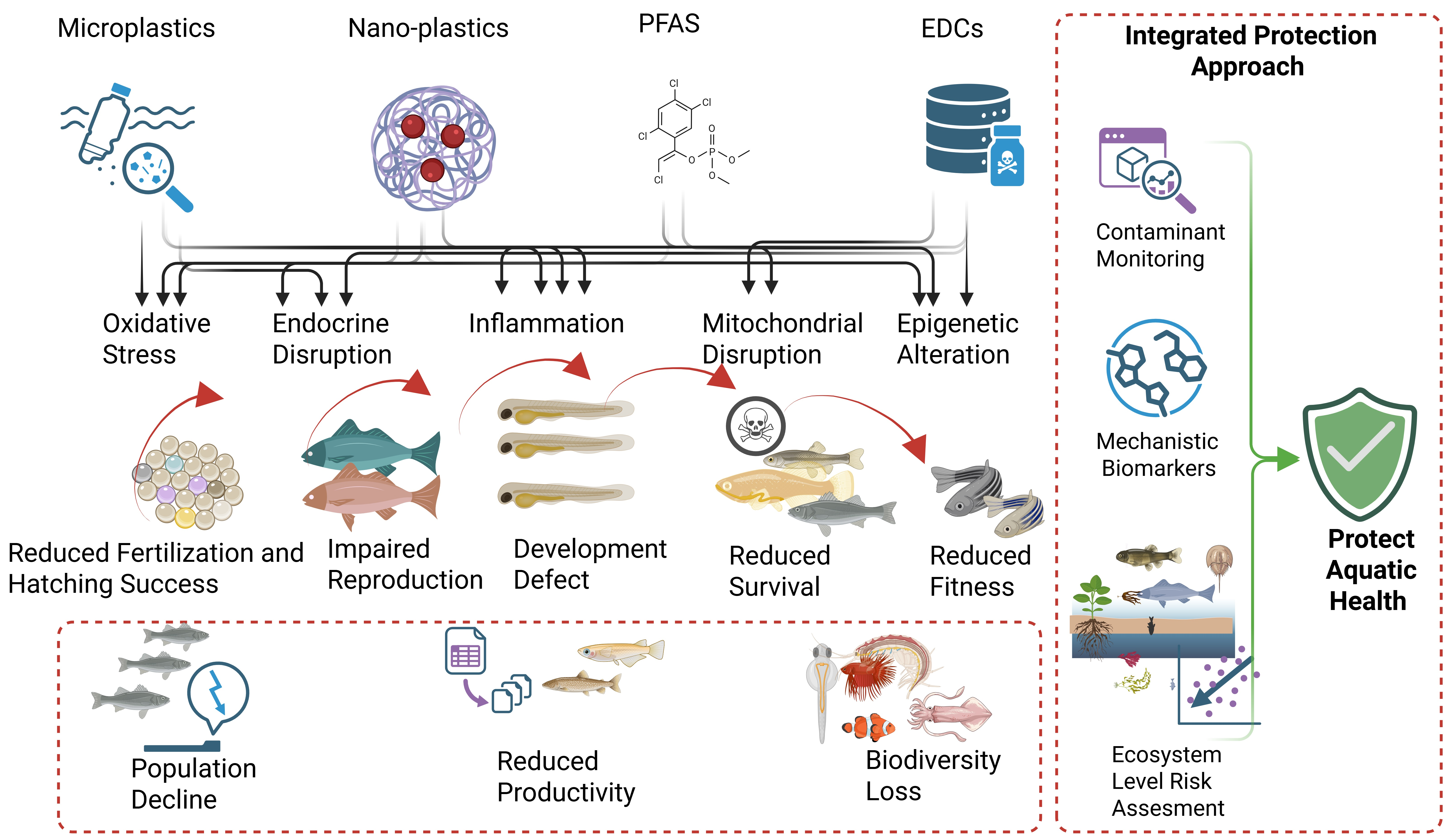

Emerging Environmental Toxicants Undermine Reproductive Success in Aquatic Animals: A Narrative Review

Abstract
1. Introduction
2. Data Collection and Selection Criteria
3. Sources, Occurrence and Exposure Pathways of Emerging Contaminants in Aquatic Environments
3.1. Major Sources of Microplastics, Nanoplastics, PFAS and EDCs in Aquatic Systems
3.2. Environmental Distribution in Water, Sediment and Suspended Particles
3.3. Biological Exposure Routes in Fish and Other Aquatic Animals
3.4. Bioaccumulation, Trophic Transfer and Maternal Transfer
3.5. Factors Controlling Exposure Risk: Particle Properties, Species Traits and Environmental Conditions
4. Mechanistic Pathways Linking Emerging Contaminants to Reproductive Toxicity

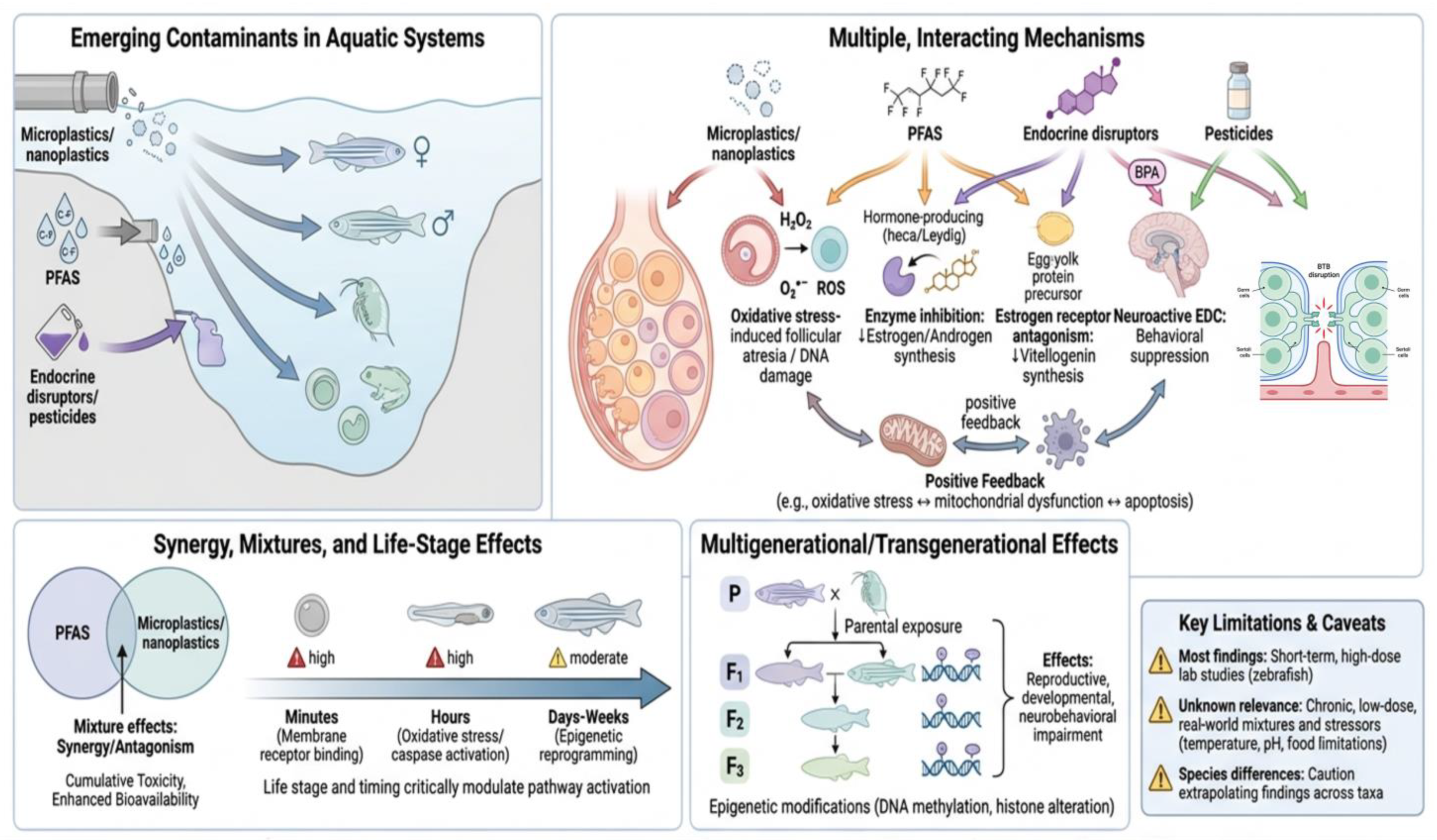
| Mechanistic Pathway | Main Contaminants Involved | Key Biomarkers | Reported Results | Reproductive Consequence |
|---|---|---|---|---|
| Oxidative stress | Microplastics, nanoplastics, PFAS, pesticides, BPA, phthalates | ROS, MDA/lipid peroxidation, SOD, CAT and nitric oxide | Polystyrene microplastics increased ROS and apoptotic signals in female zebrafish and were associated with reduced fecundity, altered gonadosomatic index and hormonal imbalance [10] | Oxidative injury to gonadal cells, impaired oocyte development, reduced fecundity and potentially poorer offspring quality |
| Inflammation and immune stress | Microplastics, nanoplastics, PFAS, pesticides | Pro-inflammatory cytokines, NF-κB-related signaling and immune-response genes | Micro/nanoplastic exposure is linked with oxidative stress, inflammation, apoptosis and cellular injury in aquatic organisms [73,74]. | Gonadal tissue injury, reduced reproductive condition and altered embryo–larval development |
| Mitochondrial dysfunction | Aged microplastics, nanoplastics, PFAS | Mitochondrial membrane potential, ROS, cytochrome-c and caspase-9/-3 signaling | Ding et al. [75] reported that aged polystyrene microplastics induced oxidative damage, reduced mitochondrial membrane potential, promoted cytochrome-c release and activated caspase-3/-9 signaling in early-life zebrafish | Reduced sperm motility, impaired oocyte competence, embryo toxicity and larval developmental defects |
| Endocrine disruption and HPG/HPGL-axis dysregulation | Microplastics, PFAS, BPA, phthalates, pesticides | GSI, estradiol, testosterone, cyp19b, esr2b, fshb, lhb, fshr, 17βhsd, cyp19a, lhr, vtg1 and vtg2 | PFBS exposure reduced egg production and hatching rate, decreased gonadosomatic index by 73% in males and 50% in females, and disrupted hormone synthesis and HPGL-axis gene expression in zebrafish [76] | Altered gametogenesis, impaired spawning, reduced fecundity and abnormal sex-hormone balance |
| Apoptosis and ovarian-cell injury | Polystyrene microplastics | Expression of p53, bax, bcl2, cas3, and cas9, and TUNEL-positive ovarian cells | Gupta et al. [10] reported that polystyrene microplastic exposure altered SIRT1/p53-associated apoptotic gene expression and increased TUNEL-positive ovarian cells, together with disrupted oocyte maturation and impaired reproductive performance in female zebrafish | Ovarian-cell apoptosis, impaired oocyte maturation, reduced fecundity and fertilization, and decreased offspring hatching success |
| Oxidative DNA damage | Aged polystyrene microplastics | 8-OHdG and ROS | Aged polystyrene microplastics increased 8-OHdG and ROS levels in early-life zebrafish, indicating oxidative DNA damage accompanied by mitochondrial dysfunction and apoptosis [75] | Impaired embryo–larval development, including reduced heart rate, body length and tail-coiling frequency |
| Epigenetic alteration | BPA | dnmt1 transcription, global gonadal DNA methylation, and gene-specific DNA methylation | BPA exposure reduced dnmt1 transcription, decreased global DNA methylation in the testes and ovaries, altered epigenetic- and reproduction-related gene expression, and reduced fertilization success in breeding zebrafish [77] | Epigenetic dysregulation in adult gonadal tissues and impaired fertilization. |
4.1. Oxidative Stress, Inflammation and Mitochondrial Dysfunction
4.2. Endocrine Disruption and Interference with the HPG Axis
4.3. Genotoxicity, Apoptosis and Epigenetic Alterations
4.4. Effects on Gametogenesis, Embryo Development and Larval Fitness
4.5. Transgenerational and Population-Level Reproductive Consequences
5. Contaminant-Specific Reproductive Effects in Aquatic Animals
5.1. Microplastics and Nanoplastics Interference
5.2. PFAS Interference
5.3. Bisphenols, Phthalates and Pesticides Interference
5.4. Mixture Toxicity and Combined Contaminant Exposure
5.5. Comparative Sensitivity Across Aquatic Taxa and Life Stages
6. Biomarkers and Endpoints for Assessing Reproductive Toxicity
6.1. Hormonal and Endocrine Biomarkers
6.2. Oxidative Stress, Inflammation and Mitochondrial Biomarkers
6.3. Gonadal Histology and Gamete-Quality Endpoints
6.4. Embryo, Larval and Offspring-Fitness Endpoints
7. Ecological and Aquaculture Implications
7.1. Consequences for Wild Fish Populations
7.2. Implications for Shellfish, Crustaceans and Aquatic Invertebrates
7.3. Relevance to Aquaculture Productivity and Reproductive Management
7.4. Food-Web Transfer and Ecosystem-Level Reproductive Risk
8. Risk Assessment and Regulatory Challenges
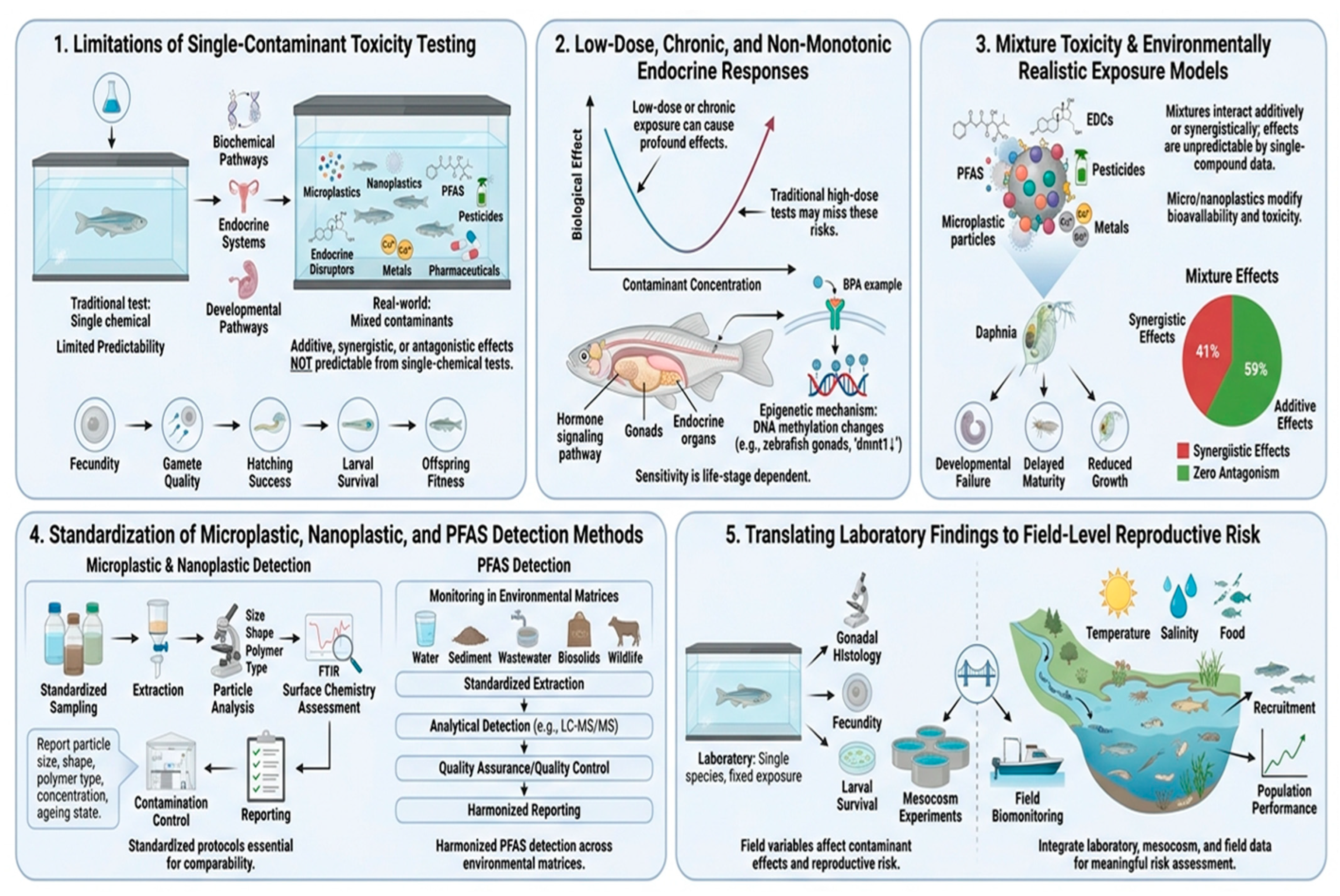
8.1. Limitations of Single-Contaminant Toxicity Testing
8.2. Experimental Concentrations Versus Environmentally Observed Levels
8.3. Low-Dose, Chronic and Non-Monotonic Endocrine Responses
8.4. Mixture Toxicity and Environmentally Realistic Exposure Models
8.5. Standardization of Microplastic, Nanoplastic and PFAS Detection Methods
8.6. Translating Laboratory Findings to Field-Level Reproductive Risk
9. Mitigation Strategies and Future Research Priorities
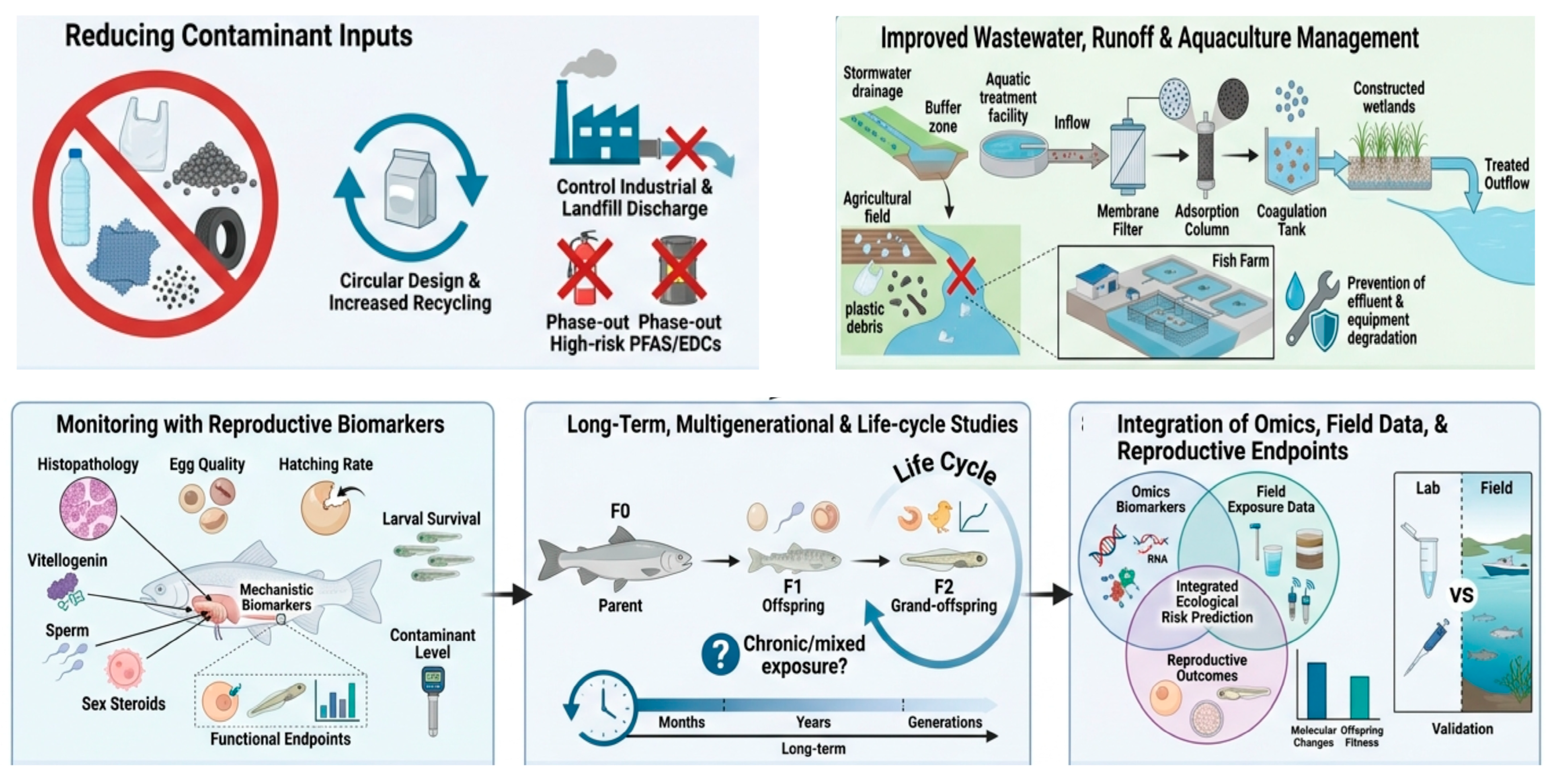
9.1. Reducing Contaminant Inputs into Aquatic Environments
9.2. Improved Wastewater, Runoff and Aquaculture-System Management
9.3. Monitoring Programs Using Reproductive Biomarkers
9.4. Long-Term, Multigenerational and Life-Cycle Studies
9.5. Integration of Omics, Field Data and Reproductive Performance Endpoints
10. Conclusions
Author Contributions
Funding
Institutional Review Board Statement
Informed Consent Statement
Data Availability Statement
Acknowledgments
Conflicts of Interest
Abbreviations
| ATP | adenosine triphosphate |
| BPA | bisphenol A |
| BPS | bisphenol S |
| CAT | catalase |
| DNA | deoxyribonucleic acid |
| dpf | days post-fertilization |
| EDCs | endocrine-disrupting chemicals |
| EPA | United States Environmental Protection Agency |
| F0 | parental generation |
| F1 | first filial generation |
| F2 | second filial generation |
| F3 | third filial generation |
| GPx | glutathione peroxidase |
| GSH | reduced glutathione |
| GSI | gonadosomatic index |
| GST | glutathione S-transferase |
| HPG axis | hypothalamic–pituitary–gonadal axis |
| HPGL axis | hypothalamic–pituitary–gonadal–liver axis |
| hpf | hours post-fertilization |
| LC–MS/MS | liquid chromatography–tandem mass spectrometry |
| MDA | malondialdehyde |
| MEHP | mono-(2-ethylhexyl) phthalate |
| MPs | microplastics |
| mRNA | messenger RNA |
| NPs | nanoplastics |
| OECD | Organisation for Economic Co-operation and Development |
| PE-MPs | polyethylene microplastics |
| PFAS | per- and polyfluoroalkyl substances |
| PFBS | perfluorobutane sulfonate |
| PFOA | perfluorooctanoic acid |
| PFOS | perfluorooctane sulfonate |
| PS-MPs | polystyrene microplastics |
| ROS | reactive oxygen species |
| SIRT1 | sirtuin 1 |
| SOD | superoxide dismutase |
| WWTP | wastewater treatment plant |
References
- Brander, S.M.; Swan, S.H.; Mehinto, A.C.; Kidd, K.A.; Weis, J.S.; Belcher, S.M.; DeWitt, J.C.; Harper, S.L.; Helbing, C.C. Impacts of environmental stressors on fertility and fecundity across taxa, with implications for planetary health. npj Emerg. Contam. 2026, 2, 12. [Google Scholar] [CrossRef] [PubMed]
- Nishmitha, P.; Akhilghosh, K.A.; Aiswriya, V.P.; Ramesh, A.; Muthuchamy, M.; Muthukumar, A. Understanding emerging contaminants in water and wastewater: A comprehensive review on detection, impacts, and solutions. J. Hazard. Mater. Adv. 2025, 18, 100755. [Google Scholar] [CrossRef]
- Peskova, N.; Blahova, J. Bisphenols: Endocrine Disruptors and Their Impact on Fish: A Review. Fishes 2025, 10, 365. [Google Scholar] [CrossRef]
- Buck, R.C.; Franklin, J.; Berger, U.; Conder, J.M.; Cousins, I.T.; De Voogt, P.; Jensen, A.A.; Kannan, K.; Mabury, S.A.; Van Leeuwen, S.P. Perfluoroalkyl and polyfluoroalkyl substances in the environment: Terminology, classification, and origins. Integr. Environ. Assess. Manag. 2011, 7, 513–541. [Google Scholar] [CrossRef] [PubMed]
- Tao, R.; Sun, M.; Ma, J.; Li, J.; Yao, X.; Li, M.; Guo, L.-H. Advancing the understanding of PFAS-induced reproductive toxicity in key model species. Environ. Sci. Processes Impacts 2025, 27, 3050–3075. [Google Scholar] [CrossRef] [PubMed]
- Park, C.-B.; Kim, G.-E.; Kim, Y.J.; On, J.; Park, C.-G.; Kwon, Y.-S.; Pyo, H.; Yeom, D.-H.; Cho, S.-H. Reproductive dysfunction linked to alteration of endocrine activities in zebrafish exposed to mono-(2-ethylhexyl) phthalate (MEHP). Environ. Pollut. 2020, 265, 114362. [Google Scholar] [CrossRef] [PubMed]
- Ye, T.; Yang, R.; He, S.; Li, J.; Liu, Y.; Li, C.; Luo, H. Synergistic endocrine disruption and cellular toxicity of polyethylene microplastics and bisphenol A in MLTC-1 cells and zebrafish. Sci. Rep. 2025, 15, 10752. [Google Scholar] [CrossRef] [PubMed]
- Yi, J.; Ma, Y.; Ruan, J.; You, S.; Ma, J.; Yu, H.; Zhao, J.; Zhang, K.; Yang, Q.; Jin, L. The invisible Threat: Assessing the reproductive and transgenerational impacts of micro-and nanoplastics on fish. Environ. Int. 2024, 183, 108432. [Google Scholar] [CrossRef] [PubMed]
- Organisation for Economic Co-operation and Development. Policy Scenarios for Eliminating Plastic Pollution by 2040: A Global Plastic Outlook Model-Based Analysis; Organisation for Economic Co-operation and Development: Paris, France, 2024. [Google Scholar]
- Gupta, P.; Mahapatra, A.; Suman, A.; Ray, S.S.; Malafaia, G.; Singh, R.K. Polystyrene microplastics disrupt female reproductive health and fertility via sirt1 modulation in zebrafish (Danio rerio). J. Hazard. Mater. 2023, 460, 132359. [Google Scholar] [CrossRef] [PubMed]
- Lin, W.; Luo, H.; Wu, J.; Liu, X.; Cao, B.; Liu, Y.; Yang, P.; Yang, J. Polystyrene microplastics enhance the microcystin-LR-induced gonadal damage and reproductive endocrine disruption in zebrafish. Sci. Total Environ. 2023, 876, 162664. [Google Scholar] [CrossRef] [PubMed]
- Brendel, S.; Fetter, É.; Staude, C.; Vierke, L.; Biegel-Engler, A. Short-chain perfluoroalkyl acids: Environmental concerns and a regulatory strategy under REACH. Environ. Sci. Eur. 2018, 30, 9. [Google Scholar] [CrossRef] [PubMed]
- Fallet, M.; Zetzsche, J.; Di Criscio, M.; Yon, C.; Aro, R.; Duberg, D.; Yeung, L.W.; Ogunleye, A.; Antczak, P.; Scherbak, N. Developmental exposure to environmentally relevant PFOS and PFBS disrupts adult behaviour, reproductive fitness, and lipid metabolism in Zebrafish. Environ. Sci. Eur. 2025, 37, 226. [Google Scholar] [CrossRef]
- Okuthe, G.E.; Dube, E.; Mafunda, P.S. Effects of pharmaceuticals and endocrine-disrupting chemicals on reproductive biology of aquatic fauna: Penguins as sentinel species. J. Xenobiotics 2025, 15, 110. [Google Scholar] [CrossRef]
- Ashrafy, A.; Liza, A.A.; Islam, M.N.; Billah, M.M.; Arafat, S.T.; Rahman, M.M.; Rahman, S.M. Microplastics pollution: A brief review of its source and abundance in different aquatic ecosystems. J. Hazard. Mater. Adv. 2023, 9, 100215. [Google Scholar] [CrossRef]
- Boucher, J.; Friot, D. Primary Microplastics in the Oceans: A Global Evaluation of Sources; IUCN: Gland, Switzerland, 2017; Volume 10. [Google Scholar]
- De Falco, F.; Di Pace, E.; Cocca, M.; Avella, M. The contribution of washing processes of synthetic clothes to microplastic pollution. Sci. Rep. 2019, 9, 6633. [Google Scholar] [CrossRef] [PubMed]
- Cojoc, L.; de Castro-Català, N.; de Guzmán, I.; González, J.; Arroita, M.; Besolí-Mestres, N.; Cadena, I.; Freixa, A.; Gutiérrez, O.; Larrañaga, A. Pollutants in urban runoff: Scientific evidence on toxicity and impacts on freshwater ecosystems. Chemosphere 2024, 369, 143806. [Google Scholar] [CrossRef] [PubMed]
- Wang, Y.; Wang, J.; Cao, X.; Qi, W.; Peng, J.; Liu, H.; Qu, J. Tire wear particles in aquatic ecosystems: Current knowledge and future perspectives. TrAC Trends Anal. Chem. 2025, 183, 118095. [Google Scholar] [CrossRef]
- Sun, Y.; van Wijnen, J.; Ragas, A.M. Quantification and mapping of tyre wear emissions: From EU regional analysis to global projections. Environ. Int. 2025, 203, 109720. [Google Scholar] [CrossRef] [PubMed]
- Xu, X.; Jian, Y.; Xue, Y.; Hou, Q.; Wang, L. Microplastics in the wastewater treatment plants (WWTPs): Occurrence and removal. Chemosphere 2019, 235, 1089–1096. [Google Scholar] [CrossRef] [PubMed]
- Cavazzoli, S.; Murari, F.; Donegà, M.; Tirler, W.; Andreottola, G. Microplastic removal and environmental emissions from municipal wastewater treatment plants. J. Clean. Prod. 2025, 521, 146267. [Google Scholar] [CrossRef]
- Yamahara, S.; Nakata, H. Road dust-associated microplastics as a carrier of plastic additives in urban small-scale river sediment. Environ. Monit. Contam. Res. 2025, 5, 10–25. [Google Scholar] [CrossRef]
- Iordachescu, L.; Papacharalampos, K.; Barritaud, L.; Denieul, M.-P.; Plessis, E.; Baratto, G.; Julien, V.; Vollertsen, J. Microplastics in an advanced wastewater treatment plant: Sustained and robust removal rates unfazed by seasonal variations. Microplastics Nanoplastics 2024, 4, 18. [Google Scholar] [CrossRef]
- Miino, M.C.; Galafassi, S.; Zullo, R.; Torretta, V.; Rada, E.C. Microplastics removal in wastewater treatment plants: A review of the different approaches to limit their release in the environment. Sci. Total Environ. 2024, 930, 172675. [Google Scholar] [CrossRef]
- Fouda-Mbanga, B.G.; Nyoni, B.; Mnyango, J.I.; Phiri, C.; Hlangothi, S.P.; Miracle, A.; Boluwatife, A.; Celestina, O.; Voukeng, S.N.K.; Tsague, C.F. The nexuses of micro (nano) plastics at environmental interfaces: Challenges in wastewater treatment and sustainable water management. J. Environ. Chem. Eng. 2025, 13, 119952. [Google Scholar] [CrossRef]
- Yang, Y.; Qiu, J.; Zhang, H.; He, P.; Lü, F. How soon will landfilled plastics integrate into the geological carbon cycle? Environ. Sci. Ecotechnol. 2025, 26, 100590. [Google Scholar] [CrossRef] [PubMed]
- Jia, Y.; Li, Y.; Kang, S.; Li, C.; Munoz, G.; Hao, S.; Xiao, F.; Zhi, Y.; Liu, C.; Zhang, C. Sources and occurrence of per-and polyfluoroalkyl substances in industrial wastewater and assessment of current treatment approaches: A review. J. Hazard. Mater. 2025, 499, 140195. [Google Scholar] [CrossRef] [PubMed]
- Duru, C.I.; Sherchan, S.P. A Systematic Review and Meta Analysis on the Occurrence of Per-and Polyfluoroalkyl Substances (PFAS) in Wastewater Treatment Plants. Water Air Soil Pollut. 2025, 236, 627. [Google Scholar] [CrossRef]
- Kang, D.; Jang, H.; Nguyen, L.T.L.; Le, T.N.; Nguyen, A.N.; Le, L.T.; Ho, H.T.; Nguyen, T.T.T.; Nguyen, G.T.H.; Jeon, J. Emerging contaminant pollution and source contributions in a mixed-land-use lake in Lam Dong, Vietnam: An integrated multivariate, receptor modeling, and ecological risk assessment. Environ. Technol. Innov. 2026, 42, 104928. [Google Scholar] [CrossRef]
- Sefali, S.; Ruby, R.; Dimple, D.; Giri, A. Toxicological implications of emerging pollutants on aquatic organisms. Discov. Environ. 2026, 4, 43. [Google Scholar] [CrossRef]
- Akcay, M.; Ates-Kalkan, P.S.; Ustundag, U.V.; Unal, I.; Cansız, D.; Alturfan, E.E.; Alturfan, A.A. Determination of bisphenol a and phthalate levels in wastewater samples. Experimed 2022, 12, 134–138. [Google Scholar] [CrossRef]
- Pericherla, S.; Vara, S. Effects of diffused pollution on surface waters due to agricultural runoff. J. Adv. Zool. 2023, 44, 811–826. [Google Scholar] [CrossRef]
- Soleimani, F.; Tavakoli, M.; Ghaemi, M. Occurrence, fate and ecological risks of phthalate esters and bisphenol A in coastal wastewater discharges. Sci. Rep. 2025, 15, 41796. [Google Scholar] [CrossRef] [PubMed]
- Macaulay, O.A.; Sobola, A.O.; Obayori, O.S. Environmental and health implications of emerging pollutants in landfill leachate: A review. Discov. Hazards 2026, 2, 40. [Google Scholar] [CrossRef]
- Campanale, C.; Massarelli, C.; Savino, I.; Locaputo, V.; Uricchio, V.F. A detailed review study on potential effects of microplastics and additives of concern on human health. Int. J. Environ. Res. Public Health 2020, 17, 1212. [Google Scholar] [CrossRef] [PubMed]
- Jiang, H.; Li, Z.; Zhu, L.; Zhou, J.; Huang, Y.; Sun, D. Comprehensive review of the co-transport of microplastics and suspended sediments in aquatic environments: Macroscopic transport and microscopic mechanisms. Environ. Sci. Eur. 2025, 37, 210. [Google Scholar] [CrossRef]
- Gao, W.; Zhang, P.; Wang, H.; Yang, X.; An, C. From water to sediment: A meta-analysis of microplastic distribution and the impact of dams in reservoir ecosystems. Eco-Environ. Health 2025, 4, 100188. [Google Scholar] [CrossRef] [PubMed]
- Wang, M.-M.; Xia, Z.; Jiang, J.; Wu, H.; Huang, H.; Zhang, X.; Hong, W.-J.; Li, M.; Guo, L.-H. Per-and polyfluoroalkyl substances in coastal plain water network areas: Shifting management focus to sediments. Front. Mar. Sci. 2025, 12, 1586800. [Google Scholar] [CrossRef]
- Chen, C.; Yi, H.; Xu, S.; Zhang, Y.; Zhao, Q.; Jia, R.; Bu, C.; Qin, X.; Bi, S.; Ma, L. Occurrence and ecological risks of endocrine-disrupting chemicals in three National Aquatic Germplasm Resources Reserves in the South China Sea. Environ. Chem. Ecotoxicol. 2025, 7, 1787–1797. [Google Scholar] [CrossRef]
- Gao, J.; Shen, T.; Wang, L.; Yang, Q.; Wang, J.; Zhang, D. Exposure pathway derived accumulation of microplastics in freshwater fish: A critical review. J. Hazard. Mater. 2025, 500, 140270. [Google Scholar] [CrossRef] [PubMed]
- Ullah, I.; Chen, H.; Wang, J.; Kaiser, H.; Basher, A.A.; Li, J.; Zhu, X. Impacts of Microplastics on the Early Life Stages of Fish: Sources, Mechanisms, Ecological Consequences, and Mitigation Strategies. Toxics 2025, 14, 27. [Google Scholar] [CrossRef] [PubMed]
- Shurson, G.C. The alarming effects of per-and polyfluoroalkyl substances (PFAS) on one health and interconnections with food-producing animals in circular and sustainable agri-food systems. Sustainability 2025, 17, 6957. [Google Scholar] [CrossRef]
- Wang, W.-X. Environmental toxicology of marine microplastic pollution. Camb. Prism. Plast. 2023, 1, e10. [Google Scholar] [CrossRef]
- Yang, G.; Wang, Y.; Fang, D.; Lin, J.; Ma, X.; Wang, M.; Magnuson, J.T.; Qiu, W. Trophic transfer of per-and polyfluoroalkyl substances in aquatic ecosystems. New Contam. 2026, 2, e009. [Google Scholar] [CrossRef]
- Ferretti, F.; Barbarossa, A.; Bardhi, A. An overview of the impact of PFAS on animals, humans, and the environment using a One Health approach. Environ. Sci. Pollut. Res. 2026, 33, 1461–1489. [Google Scholar] [CrossRef]
- Ijaz, M.U.; Nadeem, A.; Hayat, M.F.; Ehsan, N.; Al-Ghanim, K.A.; Atique, U. Evaluation of Possible Ameliorative Role of Robinetin to Counteract Polystyrene Microplastics Instigated Renal Toxicity in Rats. Pak. Vet. J. 2024, 44, 400–404. [Google Scholar] [CrossRef]
- Junaid, M.; Liu, S.; Chen, G.; Liao, H.; Wang, J. Transgenerational impacts of micro (nano) plastics in the aquatic and terrestrial environment. J. Hazard. Mater. 2023, 443, 130274. [Google Scholar] [CrossRef] [PubMed]
- Banaee, M.; Multisanti, C.R.; Impellitteri, F.; Piccione, G.; Faggio, C. Environmental toxicology of microplastic particles on fish: A review. Comp. Biochem. Physiol. Part C Toxicol. Pharmacol. 2025, 287, 110042. [Google Scholar] [CrossRef]
- Aljohani, A.S. Chromium and Nickel Toxicity in Sheep: Pathophysiology and Management Approaches. Pak. Vet. J. 2025, 45, 62–72. [Google Scholar]
- Lee, Y.-J.; Moon, G.; Cha, H.; Lee, J.; Kwon, E.E. Perfluoroalkyl chain-length-dependent environmental fate and treatment outcomes of PFAS in water. npj Clean Water 2026, 9, 35. [Google Scholar] [CrossRef]
- Hooper, M.J.; Ankley, G.T.; Cristol, D.A.; Maryoung, L.A.; Noyes, P.D.; Pinkerton, K.E. Interactions between chemical and climate stressors: A role for mechanistic toxicology in assessing climate change risks. Environ. Toxicol. Chem. 2013, 32, 32–48. [Google Scholar] [CrossRef] [PubMed]
- Hong, J.; Hengelbrok, O.; Gigault, J.; Ghoshal, S.; Moores, A. Accelerated weathering of microplastics: A systematic approach to model microplastic production. Environ. Sci. Technol. 2025, 59, 15956–15965. [Google Scholar] [CrossRef] [PubMed]
- Li, W.; Gao, K.; Lu, L. Environmental pollutant-induced cholinergic disruption: Advances and perspectives in mechanistic insights, target heterogeneity, and neurotoxic synergy. Ecotoxicol. Environ. Saf. 2025, 308, 119470. [Google Scholar] [CrossRef] [PubMed]
- Lohmann, R.; Cousins, I.T.; DeWitt, J.C.; Gluge, J.; Goldenman, G.; Herzke, D.; Lindstrom, A.B.; Miller, M.F.; Ng, C.A.; Patton, S. Are fluoropolymers really of low concern for human and environmental health and separate from other PFAS? Environ. Sci. Technol. 2020, 54, 12820–12828. [Google Scholar] [CrossRef] [PubMed]
- Vemula, S.; Mylaram, J.; Yadala, R.; Alla, G.; Banothu, A.; Veera, H.D.D. Protective Effects of Naringenin on 5-Fluorouracil Induced Pulmonary Toxicity Via Modulation of NF-? B and Nrf2 Pathway. Pak. Vet. J. 2024, 44, 63–70. [Google Scholar] [CrossRef]
- Hasan, A.M.; Hamed, M.; Hasan, J.; Martyniuk, C.J.; Niyogi, S.; Chivers, D.P. A review of the neurobehavioural, physiological, and reproductive toxicity of microplastics in fishes. Ecotoxicol. Environ. Saf. 2024, 282, 116712. [Google Scholar] [CrossRef] [PubMed]
- Gaballa, M.M.; Ahmed, O.; Elsharkawey, S.; Abdow, M.F.; Shoulah, S.; Wahba, F.; Hassan, M.A.; Mohamed, K.; Soliman, A.; Farag, A. Modulation of energy drink-induced hepato-renal and testicular toxicity by pomegranate peel extract: Insights from histopathological and immunohistochemical analyses. Pak. Vet. J. 2024, 45, 703–771. [Google Scholar]
- Liu, J.; Zhu, R.; Wang, S.; Dai, X.; Zou, A.; Jiang, F.; Sun, S.; Ou, J.; Zhao, W. BPA disrupts crustacean reproduction: Tissue-specific accumulation, oxidative stress, and gene dysregulation in Macrobrachium nipponense. Aquat. Toxicol. 2025, 287, 107538. [Google Scholar] [CrossRef] [PubMed]
- Green, D.R.; Reed, J.C. Mitochondria and apoptosis. Science 1998, 281, 1309–1312. [Google Scholar] [CrossRef] [PubMed]
- Cedergreen, N. Quantifying synergy: A systematic review of mixture toxicity studies within environmental toxicology. PLoS ONE 2014, 9, e96580. [Google Scholar] [CrossRef] [PubMed]
- Jomova, K.; Raptova, R.; Alomar, S.Y.; Alwasel, S.H.; Nepovimova, E.; Kuca, K.; Valko, M. Reactive oxygen species, toxicity, oxidative stress, and antioxidants: Chronic diseases and aging. Arch. Toxicol. 2023, 97, 2499–2574. [Google Scholar] [CrossRef] [PubMed]
- Wang, Y.; Su, M.; Chen, Y.; Huang, X.; Ruan, L.; Lv, Q.; Li, L. Research progress on the role and mechanism of DNA damage repair in germ cell development. Front. Endocrinol. 2023, 14, 1234280. [Google Scholar] [CrossRef]
- Vandegehuchte, M.B.; Janssen, C.R. Epigenetics in an ecotoxicological context. Mutat. Res./Genet. Toxicol. Environ. Mutagen. 2014, 764, 36–45. [Google Scholar] [CrossRef] [PubMed]
- Chen, J.; Xiao, Y.; Gai, Z.; Li, R.; Zhu, Z.; Bai, C.; Tanguay, R.L.; Xu, X.; Huang, C.; Dong, Q. Reproductive toxicity of low level bisphenol A exposures in a two-generation zebrafish assay: Evidence of male-specific effects. Aquat. Toxicol. 2015, 169, 204–214. [Google Scholar] [CrossRef] [PubMed]
- Wang, J.; Li, Y.; Lu, L.; Zheng, M.; Zhang, X.; Tian, H.; Wang, W.; Ru, S. Polystyrene microplastics cause tissue damages, sex-specific reproductive disruption and transgenerational effects in marine medaka (Oryzias melastigma). Environ. Pollut. 2019, 254, 113024. [Google Scholar] [CrossRef] [PubMed]
- Ribas, L.; Piferrer, F. The zebrafish (Danio rerio) as a model organism, with emphasis on applications for finfish aquaculture research. Rev. Aquac. 2014, 6, 209–240. [Google Scholar]
- Alves, L.M.; Lemos, M.F.; Cabral, H.; Novais, S.C. Elasmobranchs as bioindicators of pollution in the marine environment. Mar. Pollut. Bull. 2022, 176, 113418. [Google Scholar] [CrossRef] [PubMed]
- Rodríguez, E.M. Endocrine disruption in crustaceans: New findings and perspectives. Mol. Cell. Endocrinol. 2024, 585, 112189. [Google Scholar] [CrossRef] [PubMed]
- Cole, M.; Galloway, T.S. Ingestion of nanoplastics and microplastics by Pacific oyster larvae. Environ. Sci. Technol. 2015, 49, 14625–14632. [Google Scholar] [CrossRef] [PubMed]
- Mills, L.J.; Chichester, C. Review of evidence: Are endocrine-disrupting chemicals in the aquatic environment impacting fish populations? Sci. Total Environ. 2005, 343, 1–34. [Google Scholar] [CrossRef] [PubMed]
- Sunny, A.R.; Sazzad, S.A.; Islam, M.A.; Mithun, M.H.; Hussain, M.; Raposo, A.; Bhuiyan, M.K.A. Microplastics in aquatic ecosystems: A global review of distribution, ecotoxicological impacts, and human health risks. Water 2025, 17, 1741. [Google Scholar] [CrossRef]
- Hasan, A.M.; Hossain, M.F.; Uddin, M.; Khan, M.T.; Saif, U.M.; Hamed, M.; Martyniuk, C.J.; Chivers, D.P. Mechanistic insights into microplastic-induced reproductive toxicity in aquatic organisms: A comprehensive review. Aquat. Toxicol. 2025, 286, 107478. [Google Scholar] [CrossRef] [PubMed]
- Kundu, S.; Kumar, N.; Kumar, P.; PS, B.; Singh, A.K.; Godse, D.; Reddy, K.S. Micro/nanoplastics pollution: Emerging challenges for aquatic animals and food crops. Front. Toxicol. 2026, 8, 1768236. [Google Scholar] [CrossRef] [PubMed]
- Ding, P.; Xiang, C.; Yao, Q.; Li, X.; Zhang, J.; Yin, R.; Zhang, L.; Li, A.J.; Hu, G. Aged polystyrene microplastics exposure affects apoptosis via inducing mitochondrial dysfunction and oxidative stress in early life of zebrafish. J. Environ. Manag. 2024, 367, 121995. [Google Scholar] [CrossRef]
- Santhi, J.J.; Issac, P.K.; Velayutham, M.; Hussain, S.A.; Shaik, M.R.; Shaik, B.; Guru, A. Reproductive toxicity of perfluorobutane sulfonate in zebrafish (Danio rerio): Impacts on oxidative stress, hormone disruption and HPGL axis dysregulation. Comp. Biochem. Physiol. Part C Toxicol. Pharmacol. 2025, 289, 110122. [Google Scholar] [CrossRef]
- Laing, L.; Viana, J.; Dempster, E.; Trznadel, M.; Trunkfield, L.; Uren Webster, T.; Van Aerle, R.; Paull, G.; Wilson, R.; Mill, J. Bisphenol A causes reproductive toxicity, decreases dnmt1 transcription, and reduces global DNA methylation in breeding zebrafish (Danio rerio). Epigenetics 2016, 11, 526–538. [Google Scholar] [CrossRef] [PubMed]
- Dasmahapatra, A.K.; Chatterjee, J.; Tchounwou, P.B. A systematic review of the effects of nanoplastics on fish. Front. Toxicol. 2025, 7, 1530209. [Google Scholar] [CrossRef] [PubMed]
- Zhang, W.; Sheng, N.; Wang, M.; Zhang, H.; Dai, J. Zebrafish reproductive toxicity induced by chronic perfluorononanoate exposure. Aquat. Toxicol. 2016, 175, 269–276. [Google Scholar] [CrossRef] [PubMed]
- Tang, K.H.D. Genotoxicity of microplastics on living organisms: Effects on chromosomes, DNA and gene expression. Environments 2025, 12, 10. [Google Scholar] [CrossRef]
- Wu, B.; Yu, H.; Yi, J.; Lei, P.; He, J.; Ruan, J.; Xu, P.; Tao, R.; Jin, L.; Wu, W. Behavioral studies of zebrafish reveal a new perspective on the reproductive toxicity of micro-and nanoplastics. Toxics 2024, 12, 178. [Google Scholar] [CrossRef] [PubMed]
- Dubey, I.; Khan, S.; Kushwaha, S. Developmental and reproductive toxic effects of exposure to microplastics: A review of associated signaling pathways. Front. Toxicol. 2022, 4, 901798. [Google Scholar] [CrossRef] [PubMed]
- Kim, Y.; Lee, H.; Kim, Y.H.; Oh, C.-K. Polyethylene microplastics perforate the chorion defense, triggering developmental cardiotoxicity at zebrafish. Aquat. Toxicol. 2025, 282, 107331. [Google Scholar] [CrossRef] [PubMed]
- Sussarellu, R.; Suquet, M.; Thomas, Y.; Lambert, C.; Fabioux, C.; Pernet, M.E.J.; Le Goïc, N.; Quillien, V.; Mingant, C.; Epelboin, Y. Oyster reproduction is affected by exposure to polystyrene microplastics. Proc. Natl. Acad. Sci. USA 2016, 113, 2430–2435. [Google Scholar] [CrossRef] [PubMed]
- Tallec, K.; Huvet, A.; Di Poi, C.; González-Fernández, C.; Lambert, C.; Petton, B.; Le Goïc, N.; Berchel, M.; Soudant, P.; Paul-Pont, I. Nanoplastics impaired oyster free living stages, gametes and embryos. Environ. Pollut. 2018, 242, 1226–1235. [Google Scholar] [CrossRef] [PubMed]
- Bringer, A.; Thomas, H.; Prunier, G.; Dubillot, E.; Bossut, N.; Churlaud, C.; Clérandeau, C.; Le Bihanic, F.; Cachot, J. High density polyethylene (HDPE) microplastics impair development and swimming activity of Pacific oyster D-larvae, Crassostrea gigas, depending on particle size. Environ. Pollut. 2020, 260, 113978. [Google Scholar] [CrossRef] [PubMed]
- Al-Sid-Cheikh, M.; Rowland, S.J.; Stevenson, K.; Rouleau, C.; Henry, T.B.; Thompson, R.C. Uptake, whole-body distribution, and depuration of nanoplastics by the scallop Pecten maximus at environmentally realistic concentrations. Environ. Sci. Technol. 2018, 52, 14480–14486. [Google Scholar] [CrossRef] [PubMed]
- Besseling, E.; Wang, B.; Lurling, M.; Koelmans, A.A. Nanoplastic affects growth of S. obliquus and reproduction of D. magna. Environ. Sci. Technol. 2014, 48, 12336–12343. [Google Scholar] [CrossRef] [PubMed]
- Lee, K.-W.; Shim, W.J.; Kwon, O.Y.; Kang, J.-H. Size-dependent effects of micro polystyrene particles in the marine copepod Tigriopus japonicus. Environ. Sci. Technol. 2013, 47, 11278–11283. [Google Scholar] [CrossRef] [PubMed]
- Luo, Y.; Zhang, Z.; Li, X.; Zhuang, Z.; Li, Y.; Wang, X.; Liao, C.; Chen, L.; Luo, Q.; Chen, X. Reproductive toxicity and transgenerational effects of co-exposure to polystyrene microplastics and arsenic in zebrafish. Comp. Biochem. Physiol. Part C Toxicol. Pharmacol. 2025, 290, 110134. [Google Scholar] [CrossRef]
- Socha, M.; Chyb, J.; Suder, A.; Bojarski, B. How endocrine disruptors affect fish reproduction on multiple levels: A review. Fish. Aquat. Life 2024, 32, 128–136. [Google Scholar] [CrossRef]
- Tarasco, M.; Gavaia, P.J.; Bensimon-Brito, A.; Cordelieres, F.P.; Santos, T.; Martins, G.; De Castro, D.T.; Silva, N.; Cabrita, E.; Bebianno, M.J. Effects of pristine or contaminated polyethylene microplastics on zebrafish development. Chemosphere 2022, 303, 135198. [Google Scholar] [CrossRef] [PubMed]
- Li, Z.; Xian, H.; Ye, R.; Zhong, Y.; Liang, B.; Huang, Y.; Dai, M.; Guo, J.; Tang, S.; Ren, X. Gender-specific effects of polystyrene nanoplastic exposure on triclosan-induced reproductive toxicity in zebrafish (Danio rerio). Sci. Total Environ. 2024, 932, 172876. [Google Scholar] [CrossRef] [PubMed]
- Wang, J.; Zheng, M.; Lu, L.; Li, X.; Zhang, Z.; Ru, S. Adaptation of life-history traits and trade-offs in marine medaka (Oryzias melastigma) after whole life-cycle exposure to polystyrene microplastics. J. Hazard. Mater. 2021, 414, 125537. [Google Scholar] [CrossRef] [PubMed]
- Zhang, C.; Li, L.; Alava, J.J.; Yan, Z.; Chen, P.; Gul, Y.; Wang, L.; Xiong, D. Female zebrafish (Danio rerio) exposure to polystyrene nanoplastics induces reproductive toxicity in mother and their offspring. Aquat. Toxicol. 2024, 273, 107023. [Google Scholar] [CrossRef] [PubMed]
- Teng, M.; Zhao, X.; Zhao, L.; Shi, D.; Li, Y.; Sun, J.; Zhao, W.; Zhou, L.; Wang, X.; Giesy, J.P. Zebrafish (Danio rerio) reproduction is affected by life-cycle exposure to differently charged polystyrene nanoplastics with sex-specific responses. ACS ES T Water 2022, 2, 2558–2566. [Google Scholar] [CrossRef]
- Martín, J.; Santos, J.L.; Aparicio, I.; Alonso, E. Microplastics and associated emerging contaminants in the environment: Analysis, sorption mechanisms and effects of co-exposure. Trends Environ. Anal. Chem. 2022, 35, e00170. [Google Scholar] [CrossRef]
- Kannan, U.; Ravichandran, M.K.; Monisha, M.; Krishnasamy, S.; Prabakar, P.; Darshini, D.; Sunantha, G. Short-chain PFAS: A global challenge-Environmental fate, health risks, and promising removal technologies. Results Chem. 2025, 20, 103000. [Google Scholar]
- Al-Maqtari, Q.A.; Mahdi, A.A.; Othman, N.; Noman, A.E.; Alsubhi, L.M.; AlAnsi, W.; Asharuddin, S.M.; khairuddin Talib, M.; Supramanium, S.; Al-Gheethi, A. Comprehensive review of per-and polyfluoroalkyl substances in drinking water: Physiochemical properties, sources, health impacts, regulatory limits, and future perspectives. Results Eng. 2025, 28, 107169. [Google Scholar] [CrossRef]
- Senarath Pathirajage, K.; Rajapaksa, G. Long-term exposure to environmentally relevant Bisphenol-A levels affects growth, swimming, condition factor, sex ratio and histology of juvenile zebrafish. Sci. Rep. 2024, 14, 24503. [Google Scholar] [CrossRef] [PubMed]
- Yang, L.; Li, L.; Kong, Z.; Zhang, Y.; Francis, F.; Fan, B.; Li, M. Environmental reproductive toxicity of common pesticides: Mechanisms and implications throughout the zebrafish life cycle. Ecotoxicol. Environ. Saf. 2025, 304, 119029. [Google Scholar] [CrossRef] [PubMed]
- Burch, E.; Hussein, M.A.; Zaki, M.; Kamal, L.T.; Zaki, G.; Shoeib, T.; Dawood, M.; Sewilam, H.; Abdelnaser, A. Assessing the effects of pesticides on aquacultured fish and ecosystems: A comprehensive environmental health review. Fishes 2025, 10, 223. [Google Scholar] [CrossRef]
- Soltanighias, T.; Umar, A.; Abdullahi, M.; Abdallah, M.A.-E.; Orsini, L. Combined toxicity of perfluoroalkyl substances and microplastics on the sentinel species Daphnia magna: Implications for freshwater ecosystems. Environ. Pollut. 2024, 363, 125133. [Google Scholar] [CrossRef] [PubMed]
- Xue, M.; Jia, M.; Qin, Y.; Francis, F.; Gu, X. Toxicity of parental co-exposure of microplastic and bisphenol compounds on adult zebrafish: Multi-omics investigations on offspring. Sci. Total Environ. 2024, 955, 176897. [Google Scholar] [CrossRef] [PubMed]
- Wang, P.; Shi, Y.-Z.; Guan, Q. The microplastic–PFAS nexus: From co-occurrence to combined toxicity in aquatic environments. Toxics 2025, 13, 1041. [Google Scholar] [CrossRef] [PubMed]
- Knigge, T.; LeBlanc, G.A.; Ford, A.T. A crab is not a fish: Unique aspects of the crustacean endocrine system and considerations for endocrine toxicology. Front. Endocrinol. 2021, 12, 587608. [Google Scholar] [CrossRef]
- Delbes, G.; Blázquez, M.; Fernandino, J.I.; Grigorova, P.; Hales, B.F.; Metcalfe, C.; Navarro-Martín, L.; Parent, L.; Robaire, B.; Rwigemera, A. Effects of endocrine disrupting chemicals on gonad development: Mechanistic insights from fish and mammals. Environ. Res. 2022, 204, 112040. [Google Scholar] [CrossRef] [PubMed]
- Hutchinson, T.H.; Ankley, G.T.; Segner, H.; Tyler, C.R. Screening and testing for endocrine disruption in fish—Biomarkers as “signposts,” not “traffic lights,” in risk assessment. Environ. Health Perspect. 2005, 114, 106. [Google Scholar]
- Matozzo, V.; Gagné, F.; Marin, M.G.; Ricciardi, F.; Blaise, C. Vitellogenin as a biomarker of exposure to estrogenic compounds in aquatic invertebrates: A review. Environ. Int. 2008, 34, 531–545. [Google Scholar] [CrossRef] [PubMed]
- Onishi, Y.; Tatarazako, N.; Koshio, M.; Okamura, T.; Watanabe, H.; Sawai, A.; Yamamoto, J.; Ishikawa, H.; Sato, T.; Kawashima, Y. Summary of reference chemicals evaluated by the fish short-term reproduction assay, OECD TG229, using Japanese Medaka, Oryzias latipes. J. Appl. Toxicol. 2021, 41, 1200–1221. [Google Scholar] [CrossRef] [PubMed]
- Grădinariu, L.; Crețu, M.; Vizireanu, C.; Dediu, L. Oxidative stress biomarkers in fish exposed to environmental concentrations of pharmaceutical pollutants: A review. Biology 2025, 14, 472. [Google Scholar] [CrossRef] [PubMed]
- U.S. Environmental Protection Agency. Validation of the Fish Short-Term Reproduction Assay: Integrated Summary Report; US Environmental Agency: Washington, DC, USA, 2007.
- Bugel, S.M.; White, L.A.; Cooper, K.R. Impaired reproductive health of killifish (Fundulus heteroclitus) inhabiting Newark Bay, NJ, a chronically contaminated estuary. Aquat. Toxicol. 2010, 96, 182–193. [Google Scholar] [CrossRef] [PubMed]
- Uddin, M.H.; Ritu, J.R.; Niyogi, S.; Chivers, D.P. Multigenerational effects of selected environmental contaminants in fishes: A comprehensive review. Comp. Biochem. Physiol. Part C Toxicol. Pharmacol. 2026, 302, 110453. [Google Scholar] [CrossRef]
- Cunha, I.; Hoff, P.; Van de Vijver, K.; Guilhermino, L.; Esmans, E.; De Coen, W. Baseline study of perfluorooctane sulfonate occurrence in mussels, Mytilus galloprovincialis, from north-central Portuguese estuaries. Mar. Pollut. Bull. 2005, 50, 1128–1132. [Google Scholar] [CrossRef] [PubMed]
- Smolarz, K.; Larsson, J.; Dinnetz, P.; Obszarski, J.; Leprêtre, A.; Świeżak, J.; Hallman, A.; Grahn, M.; Porseryd, T. Exposure to environmentally relevant levels of perfluorotetradecanoic acid (PFTeDA) affects respiratory and reproductive functions of Mytilus trossulus: An experimental study. J. Hazard. Mater. 2025, 500, 140306. [Google Scholar] [CrossRef] [PubMed]
- Blevins, K.; Reiner, J.; Watson, A.M.; Janech, M.; Boggs, A.S. Per-and polyfluoroalkyl substances (PFAS) in aquaculture feeds and potential dietary exposure to and from aquaculture fish. Food Chem. Toxicol. 2026, 212, 116058. [Google Scholar] [CrossRef] [PubMed]
- Ricolfi, L.; Yang, Y.; Pottier, P.; Morrison, K.; Williams, C.; Pollo, P.; Hesselson, D.; Neely, G.G.; Taylor, M.D.; Nakagawa, S. Unravelling the magnitude and drivers of PFAS trophic magnification: A meta-analysis. Nat. Commun. 2025, 16, 10720. [Google Scholar] [CrossRef] [PubMed]
- Das, B.K.; Das, S.; Kumar, V.; Roy, S.; Mitra, A.; Mandal, B. Microplastics in ecosystems: Ecotoxicological threats and strategies for mitigation and governance. Front. Mar. Sci. 2025, 12, 1672484. [Google Scholar] [CrossRef]
- Khoshmanesh, M.; Sanati, A.M.; Farjadfard, S.; Ramavandi, B. Per-and polyfluoroalkyl substances in fish: A review of bioaccumulation, trophic transfer, and environmental health risks. Environ. Chall. 2026, 23, 101516. [Google Scholar] [CrossRef]
- Subaramaniyam, U.; Allimuthu, R.S.; Vappu, S.; Ramalingam, D.; Balan, R.; Paital, B.; Panda, N.; Rath, P.K.; Ramalingam, N.; Sahoo, D.K. Effects of microplastics, pesticides and nano-materials on fish health, oxidative stress and antioxidant defense mechanism. Front. Physiol. 2023, 14, 1217666. [Google Scholar] [CrossRef] [PubMed]
- Ma, T.; Wu, P.; Wang, L.; Li, Q.; Li, X.; Luo, Y. Toxicity of per-and polyfluoroalkyl substances to aquatic vertebrates. Front. Environ. Sci. 2023, 11, 1101100. [Google Scholar] [CrossRef]
- Diamanti-Kandarakis, E.; Bourguignon, J.-P.; Giudice, L.C.; Hauser, R.; Prins, G.S.; Soto, A.M.; Zoeller, R.T.; Gore, A.C. Endocrine-disrupting chemicals: An Endocrine Society scientific statement. Endocr. Rev. 2009, 30, 293–342. [Google Scholar] [CrossRef] [PubMed]
- Hamid, N.; Junaid, M.; Pei, D.-S. Combined toxicity of endocrine-disrupting chemicals: A review. Ecotoxicol. Environ. Saf. 2021, 215, 112136. [Google Scholar] [CrossRef] [PubMed]
- Burns, E.E.; Boxall, A.B. Microplastics in the aquatic environment: Evidence for or against adverse impacts and major knowledge gaps. Environ. Toxicol. Chem. 2018, 37, 2776–2796. [Google Scholar] [CrossRef] [PubMed]
- Adam, V.; Yang, T.; Nowack, B. Toward an ecotoxicological risk assessment of microplastics: Comparison of available hazard and exposure data in freshwaters. Environ. Toxicol. Chem. 2019, 38, 436–447. [Google Scholar] [PubMed]
- Ahrens, L.; Bundschuh, M. Fate and effects of poly-and perfluoroalkyl substances in the aquatic environment: A review. Environ. Toxicol. Chem. 2014, 33, 1921–1929. [Google Scholar] [CrossRef] [PubMed]
- Arvaniti, O.S.; Stasinakis, A.S. Review on the occurrence, fate and removal of perfluorinated compounds during wastewater treatment. Sci. Total Environ. 2015, 524, 81–92. [Google Scholar] [CrossRef] [PubMed]
- Hu, X.C.; Andrews, D.Q.; Lindstrom, A.B.; Bruton, T.A.; Schaider, L.A.; Grandjean, P.; Lohmann, R.; Carignan, C.C.; Blum, A.; Balan, S.A. Detection of poly-and perfluoroalkyl substances (PFASs) in US drinking water linked to industrial sites, military fire training areas, and wastewater treatment plants. Environ. Sci. Technol. Lett. 2016, 3, 344–350. [Google Scholar] [CrossRef] [PubMed]
- Corrales, J.; Kristofco, L.A.; Steele, W.B.; Yates, B.S.; Breed, C.S.; Williams, E.S.; Brooks, B.W. Global assessment of bisphenol A in the environment: Review and analysis of its occurrence and bioaccumulation. Dose-Response 2015, 13, 1559325815598308. [Google Scholar] [CrossRef] [PubMed]
- Net, S.; Sempéré, R.; Delmont, A.; Paluselli, A.; Ouddane, B. Occurrence, fate, behavior and ecotoxicological state of phthalates in different environmental matrices. Environ. Sci. Technol. 2015, 49, 4019–4035. [Google Scholar] [CrossRef] [PubMed]
- Stehle, S.; Schulz, R. Agricultural insecticides threaten surface waters at the global scale. Proc. Natl. Acad. Sci. USA 2015, 112, 5750–5755. [Google Scholar] [CrossRef] [PubMed]
- Vandenberg, L.N.; Colborn, T.; Hayes, T.B.; Heindel, J.J.; Jacobs, D.R., Jr.; Lee, D.-H.; Shioda, T.; Soto, A.M.; vom Saal, F.S.; Welshons, W.V. Hormones and endocrine-disrupting chemicals: Low-dose effects and nonmonotonic dose responses. Endocr. Rev. 2012, 33, 378–455. [Google Scholar] [CrossRef] [PubMed]
- Faheem, M.; Bhandari, R.K. Detrimental effects of bisphenol compounds on physiology and reproduction in fish: A literature review. Environ. Toxicol. Pharmacol. 2021, 81, 103497. [Google Scholar] [CrossRef] [PubMed]
- Wang, Z.; Pilechi, A.; Ariya, P.A. Waterborne nanoplastics and microplastics: Analytical advances, modelling, and future directions. Environ. Sci. Nano 2026, 13, 1776–1802. [Google Scholar] [CrossRef]
- Kamalasekaran, K.; Sundramoorthy, A.K. A review on microplastics: Sources, environmental fate, degradation pathways, and analytical identification methods. RSC Adv. 2026, 16, 13851–13874. [Google Scholar] [CrossRef] [PubMed]
- EPA. PFAS Analytical Methods Development and Sampling Research; EPA: Washington, DC, USA, 2024.
- EPA. EPA’s PFAS Strategic Roadmap: Three Years of Progress; EPA: Washington, DC, USA, 2024.
- Zang, H.; Feng, Y.; Gao, S.; Su, M.; Feng, Q.; Chen, X. A review on technologies for the removal of per-and polyfluoroalkyl substances (PFASs) in aquatic environments. Environ. Sci. Adv. 2025, 4, 1712–1734. [Google Scholar] [CrossRef]
- Badawi, A.K.; Hasan, R.; Ismail, B. Sustainable coagulative removal of microplastic from aquatic systems: Recent progress and outlook. RSC Adv. 2025, 15, 25256–25273. [Google Scholar] [CrossRef] [PubMed]
- Joo, S.H.; Liang, Y.; Kim, M.; Byun, J.; Choi, H. Microplastics with adsorbed contaminants: Mechanisms and Treatment. Environ. Chall. 2021, 3, 100042. [Google Scholar] [CrossRef]
- Griffin, A.M.; Elbers, J.; Bellona, C.; Strathmann, T.J. Combining nanofiltration and adsorbents to achieve effective PFAS removal in wastewater effluent. Environ. Sci. Technol. 2026, 60, 12587–12597. [Google Scholar] [CrossRef] [PubMed]
- Yimrattanabovorn, J.; Kanjanapruthipong, K.; Wonglertarak, W.; Wichitsathian, B.; Khowattana, M.; Nawong, S. Microplastic removal in coagulation-flocculation: Optimization through chemometric and morphological insights. J. Ecol. Eng. 2026, 27, 277–292. [Google Scholar] [CrossRef]
- Le, T.X.H.; Haflich, H.; Shah, A.D.; Chaplin, B.P. Energy-efficient electrochemical oxidation of perfluoroalkyl substances using a Ti4O7 reactive electrochemical membrane anode. Environ. Sci. Technol. Lett. 2019, 6, 504–510. [Google Scholar] [CrossRef]
- Kushwaha, A.; Goswami, L.; Kim, B.S.; Lee, S.S.; Pandey, S.K.; Kim, K.-H. Constructed wetlands for the removal of organic micropollutants from wastewater: Current status, progress, and challenges. Chemosphere 2024, 360, 142364. [Google Scholar] [CrossRef] [PubMed]
- Li, B.; Zhang, Y.; Du, J.; Liu, C.; Zhou, G.; Li, M.; Yan, Z. Application of multi-omics techniques in aquatic ecotoxicology: A review. Toxics 2025, 13, 653. [Google Scholar] [CrossRef] [PubMed]


| Pathway | Major EDCs | Relative Importance | Main Concern |
|---|---|---|---|
| Municipal wastewater [32] | Bisphenols, pharmaceuticals, synthetic hormones, phthalates | High | Continuous discharge and incomplete removal during treatment |
| Agricultural runoff [33] | Pesticides, veterinary pharmaceuticals, hormones | High | Seasonal pulses and widespread contamination of surface waters |
| Industrial effluents [34] | Bisphenols, phthalates, specialty chemicals | Moderate–High | Localized high concentrations near discharge points |
| Landfill leachate [35] | Bisphenols, PFAS, plastic additives | Moderate | Long-term contaminant release to groundwater and surface waters |
| Plastic-associated chemical release [36] | Bisphenols, phthalates, additives | Moderate | Chronic diffuse contamination and co-exposure with microplastics |
| Contaminant/Stressor | Chemical Characteristics | Species/Model, Stage and Sex | Exact Concentration/Dose | Concentration/Dose | Main Reproductive/Developmental Results | Proposed Mechanism/Biomarkers | Ref. |
|---|---|---|---|---|---|---|---|
| Polystyrene microplastics | Carboxylate-modified commercial PS-MPs; nominal mean size, 0.5 µm; hydrodynamic diameter, 529.3 ± 161.9 nm; zeta potential, −24.9 ± 0.61 mV; pristine particles | Sexually mature adult female zebrafish, Danio rerio | 50 and 500 µg/L PS-MPs | 60 days | PS-MPs accumulated in ovarian tissue and significantly increased GSI at 500 µg/L. Exposure reduced egg production and spawning, lowered fertilization at 500 µg/L, reduced F1 hatching success, altered ovarian oocyte-stage distribution and impaired oocyte maturation | Ovarian oxidative stress, increased TUNEL-positive cells, altered estradiol/testosterone balance and steroidogenic-enzyme activity, and dysregulation of SIRT1/p53-associated apoptotic, steroidogenic and HPG-axis-related gene expression | [10] |
| Pristine/contaminated polyethylene microplastics | Fluorescent PE microspheres, 20–27 µm, density 1.005 g/cm3 | AB-strain zebrafish, Danio rerio, both sexes; exposed from larvae to adults; F1 larvae assessed | 1% w/w PE-MPs in diet; MP-BaP contained 2.68 ± 0.13 µg BaP/g MPs | From 5 dpf through adulthood; reproduction assessed at 3–4 months and F1 development at 6 dpf | MP-BaP reduced relative fecundity and altered egg morphology and yolk area, while sperm quality, embryo viability and hatching were unaffected. Both MP and MP-BaP impaired growth and skeletal development and reduced offspring operculum growth | BaP transport, altered xenobiotic-metabolism and oxidative-stress pathways, including nr1i2, cyp1a, cat, gpx1a, sod1/2 and hsp70/90 | [92] |
| Polystyrene nanoplastics + triclosan | Spherical PS-NPs; nominal size 50 nm, hydrodynamic diameter 54.7 nm, zeta potential −38.3 mV; TCS altered particle dispersion characteristics | Four-month-old adult zebrafish, Danio rerio, AB strain; males and females; F1 embryos assessed | PS-NPs: 1 mg/L; TCS: 0.482–48.2 µg/L in females and 0.361–36.1 µg/L in males | 21 days | Co-exposure attenuated TCS-induced ovarian and hormonal disturbances in females but increased testicular TCS accumulation, spermatogenic suppression and hormonal disruption in males; high-dose co-exposure increased F1 embryonic mortality and larval malformations | Sex-specific TCS biodistribution, gonadal histopathology, steroid-hormone disruption and HPGL-axis gene dysregulation; aqp12–dctn2 pathway in females and pck2–katnal1 pathway in males | [93] |
| Polyethylene microplastics + BPA | Irregular PE-MPs, mean diameter 20 µm; surfaces ranged from smooth to rough and porous; BPA, endocrine-disrupting chemical | Adult zebrafish, Danio rerio, males and females; MLTC-1 Leydig cells also assessed | Zebrafish: PE-MPs 1 mg/L + BPA 1.5 µg/L; cells: PE-MPs 100 µg/mL + BPA 100–150 µM | Zebrafish: 28 days; cells: 48 h | Co-exposure increased GSI in both sexes and altered sex-specific HPG-axis and gonadal steroidogenic gene expression; in MLTC-1 cells, it reduced viability and increased apoptosis and G2/M arrest | HPG-axis disruption; altered Gnrh2/3, Esr1, Ar, Star, Cyp11a1, Cyp19a1a and hydroxysteroid-dehydrogenase genes; apoptosis, cell-cycle disruption and altered steroidogenesis | [7] |
| Perfluorobutane sulfonate/perfluorobutane sulfonic acid, PFBS | Nonafluorobutane-1-sulfonic acid; 97% purity; molecular weight 300.1 g/mol; | Wild-type adult zebrafish, Danio rerio, males and females | 0.14, 1.4 and 14 µM PFBS | 28 days | PFBS was detected in the testes and ovaries at 14 µM. Exposure reduced embryo production, hatching rate and GSI in both sexes; the highest concentration reduced mature spermatogenic cells and early- and late-vitellogenic oocytes | Reduced SOD, CAT, GSH, GST and GPx activities; increased MDA and NO; altered estradiol, testosterone and HPGL-axis genes, including cyp19b, esr2b, fshb, lhb, fshr, hsd17β, lhr, cyp19a, vtg1 and vtg2 | [76] |
| Perfluorooctane sulfonate, PFOS, and PFBS | PFOS and PFBS; plastic-particle descriptors: NA | PFOS potassium salt and PFBS tetrabutylammonium salt; purity > 98% | 0.2 and 2 µg/L of PFOS or PFBS | 2 hpf to 28 dpf; depuration thereafter; adult endpoints assessed at >3 months | Developmental PFOS exposure reduced adult egg production, whereas high PFBS exposure reduced spawning success. Both compounds caused persistent sex-specific changes in growth, organ indices and anxiety-like behavior | Sex-specific hepatic lipidomic disruption involving fatty-acid, sterol/steroid, phospholipid and sphingolipid pathways, with lipid changes associated with reproductive and behavioral endpoints | [13] |
| Bisphenol A, BPA | BPA, purity > 99%; CAS 80-05-7 | Wild-type AB zebrafish, Danio rerio; F1 and F2 males, females and offspring assessed | 1 nM BPA, nominally 0.228 µg/L; measured concentration 0.372 µg/L | Continuous exposure from 8 hpf to 150 dpf over one or two generations | Female-biased sex ratios in F1 and F2; reduced sperm density, motility, velocity and ATP, with increased lipid peroxidation. Offspring from exposed F2 parents showed delayed hatching and increased malformation and mortality, predominantly through paternal exposure | Altered mitochondrial biogenesis and oxidative phosphorylation, dysregulated canonical and non-canonical Wnt signaling in F2 testes, and reduced dnmt1, dnmt3, dnmt5 and sp3 expression in F2-derived larvae | [65] |
| Mono-(2-ethylhexyl) phthalate, MEHP | Major DEHP metabolite; CAS 4376-20-9 | Adult AB-strain zebrafish, Danio rerio, 4–6 months old; males and females | 2, 10 and 50 µg/mL MEHP | 21 days; semi-static exposure | At 50 µg/mL, MEHP significantly reduced the number of ovulated eggs and inhibited spawning. GSI and gonadal histology were not significantly altered, and the principal reproductive effects occurred in females | Altered female steroid profiles, including increased estradiol, progesterone and cortisol and an increased T/E2 ratio; reduced hepatic VTG and ERα mRNA at 50 µg/mL; ERβ mRNA unchanged; no significant endocrine effects in males | [6] |
| Mixture/Co-Exposure | Material/Particle Characteristics | Species/Model | Main Reported Reproductive/Developmental Effects | Interaction Pattern | Relevance to Reproductive Toxicity | Ref. |
|---|---|---|---|---|---|---|
| Polystyrene nanoplastics + triclosan | PS-NPs, 50 nm; polymer: polystyrene; pristine commercial particles; shape and surface charge NR; TCS co-exposure altered PS-NP physical characteristics | Adult zebrafish (Danio rerio), males and females; offspring endpoints assessed | PS-NPs modified TCS biodistribution. In males, co-exposure increased TCS accumulation in testes and liver, worsened spermatogenesis suppression, and increased embryonic mortality and larval malformations. In females, PS-NPs partly mitigated TCS-induced ovarian inhibition. | Sex-specific interaction; aggravating in males and partly mitigating in females | Shows that nanoplastics can modify contaminant distribution and intensify male reproductive and offspring toxicity | [93] |
| PFAS + microplastics | PET microplastics with PFAS mixture; PFAS included PFOA and PFOS; particle size, shape, surface charge and weathering state NR | Daphnia magna; developmental and reproductive/life-history endpoints | Combined exposure caused developmental problems, delayed sexual maturity, reduced growth and lower reproductive output. Combined effects were reported as approximately 59% additive and 41% synergistic. | Additive and synergistic | Demonstrates that persistent chemicals and microplastics can jointly reduce fitness-related traits and reproductive capacity in aquatic invertebrates | [103] |
| Polyethylene microplastics + bisphenol A | PE-MPs; polymer: polyethylene; particle size, shape, surface charge and weathering state NR; BPA co-exposure | Zebrafish and MLTC-1 cells | Co-exposure produced stronger endocrine disruption and cellular toxicity than individual exposure, including stronger disruption of HPG-axis-related genes such as gnrh3, esr1 and ar. | Synergistic endocrine disruption | Indicates that microplastics can intensify BPA-related reproductive endocrine toxicity | [7] |
| Polyethylene microplastics + BPA/BPS | PE-MPs, 25 µm; polymer: polyethylene; shape, surface charge and weathering state NR; co-exposure with BPA or BPS | Adult zebrafish parental generation and F1 offspring; adult males and females assessed | Co-exposure aggravated reproductive toxicity in adult zebrafish. Transcriptomic and metabolomic changes involved apoptosis, calcium signaling and glycerophospholipid metabolism. Offspring effects included altered lipid and carbohydrate metabolism. | Additive/interactive parental and offspring effects | Links parental mixture exposure with reproductive impairment and offspring metabolic disruption | [104] |
| Microplastics + PFAS mixtures | Review-level synthesis of micro/nanoplastics and PFAS; polymer type, particle size, shape, surface charge and weathering state varied among studies | Aquatic food-web/risk synthesis; no single experimental model | The microplastic–PFAS nexus is associated with co-occurrence, adsorption/interfacial interactions, altered transport, trophic transfer, modified uptake/bioaccumulation and enhanced toxicity risk. | Context-dependent mixture risk | Supports mixture-based reproductive risk assessment rather than single-contaminant testing | [105] |
| Contaminant Group | Representative Species | Key Reproductive Effects | Major Ecological Effects | Aquaculture Impacts |
|---|---|---|---|---|
| Microplastics/Nanoplastics [121] | Fish, mollusks, crustaceans | Reduced fecundity, impaired gamete quality, decreased larval survival | Food-web disruption and reduced population recruitment | Reduced reproductive performance and offspring quality |
| PFAS [122] | Fish (e.g., zebrafish, medaka, salmonids) | Endocrine disruption, reduced egg production, impaired embryo development | Bioaccumulation and trophic transfer | Reduced hatching success and stock sustainability |
| Endocrine-disrupting chemicals (EDCs) [123] | Fish and aquatic invertebrates | Altered sex differentiation, hormonal imbalance, reproductive impairment | Population instability and reduced reproductive fitness | Reduced breeding efficiency and juvenile survival |
| Approach | Main Target Contaminants | Advantages | Limitations | Typical Removal Efficiency * |
|---|---|---|---|---|
| Membrane filtration [141] | Microplastics, PFAS, EDCs | High removal efficiency; effective for both particles and dissolved contaminants | High cost, membrane fouling, concentrated waste streams | >90–99% |
| Adsorption (e.g., activated carbon) [142] | PFAS, EDCs | Widely used; effective for many organic contaminants | Reduced effectiveness for some short-chain PFAS; media regeneration required | 70–95% |
| Coagulation–flocculation [143] | Microplastics, EDCs | Cost-effective and suitable for large-scale treatment | Performance depends on water chemistry and particle properties | 60–90% |
| Advanced oxidation/electrochemical treatment [144] | PFAS, EDCs | Can degrade contaminants rather than only remove them | High energy demand and operational costs | 60–95% |
| Constructed wetlands and bio-based treatment [145] | Microplastics, EDCs, selected PFAS | Environmentally friendly; useful for runoff and wastewater management | Variable performance and land requirements | 40–80% |
Disclaimer/Publisher’s Note: The statements, opinions and data contained in all publications are solely those of the individual author(s) and contributor(s) and not of MDPI and/or the editor(s). MDPI and/or the editor(s) disclaim responsibility for any injury to people or property resulting from any ideas, methods, instructions or products referred to in the content. |
© 2026 by the authors. Licensee MDPI, Basel, Switzerland. This article is an open access article distributed under the terms and conditions of the Creative Commons Attribution (CC BY) license.
Share and Cite
Du, Y.; Chang, H.; Wang, Q.; Liang, Y.; Shang, L.; Yang, C.; Li, L.; Xiang, X. Emerging Environmental Toxicants Undermine Reproductive Success in Aquatic Animals: A Narrative Review. J. Xenobiot. 2026, 16, 137. https://doi.org/10.3390/jox16040137
Du Y, Chang H, Wang Q, Liang Y, Shang L, Yang C, Li L, Xiang X. Emerging Environmental Toxicants Undermine Reproductive Success in Aquatic Animals: A Narrative Review. Journal of Xenobiotics. 2026; 16(4):137. https://doi.org/10.3390/jox16040137
Chicago/Turabian StyleDu, Yuchen, Hua Chang, Qiuyue Wang, Yaqin Liang, Liqian Shang, Chun Yang, Ling Li, and Xun Xiang. 2026. "Emerging Environmental Toxicants Undermine Reproductive Success in Aquatic Animals: A Narrative Review" Journal of Xenobiotics 16, no. 4: 137. https://doi.org/10.3390/jox16040137
APA StyleDu, Y., Chang, H., Wang, Q., Liang, Y., Shang, L., Yang, C., Li, L., & Xiang, X. (2026). Emerging Environmental Toxicants Undermine Reproductive Success in Aquatic Animals: A Narrative Review. Journal of Xenobiotics, 16(4), 137. https://doi.org/10.3390/jox16040137