
Exploratory SSR-Based Assessment of Genetic Diversity and Differentiation Among Four Wild Almond Populations in Kazakhstan
 , , , , , , and
Abstract
1. Introduction
2. Materials and Methods
2.1. Study Species, Sampling Localities, and Field Sampling
2.2. DNA Extraction and Quality Control
2.3. nSSR Screening, PCR Amplification, and Genotyping
2.4. Genetic Diversity and Data Completeness
2.5. Genetic Differentiation, Ordination, Clustering, and Population Structure
3. Results
3.1. Marker Screening, Data Completeness, and Locus Performance
3.2. Genetic Diversity Within Sampled Populations
3.3. Partitioning of Molecular Variation
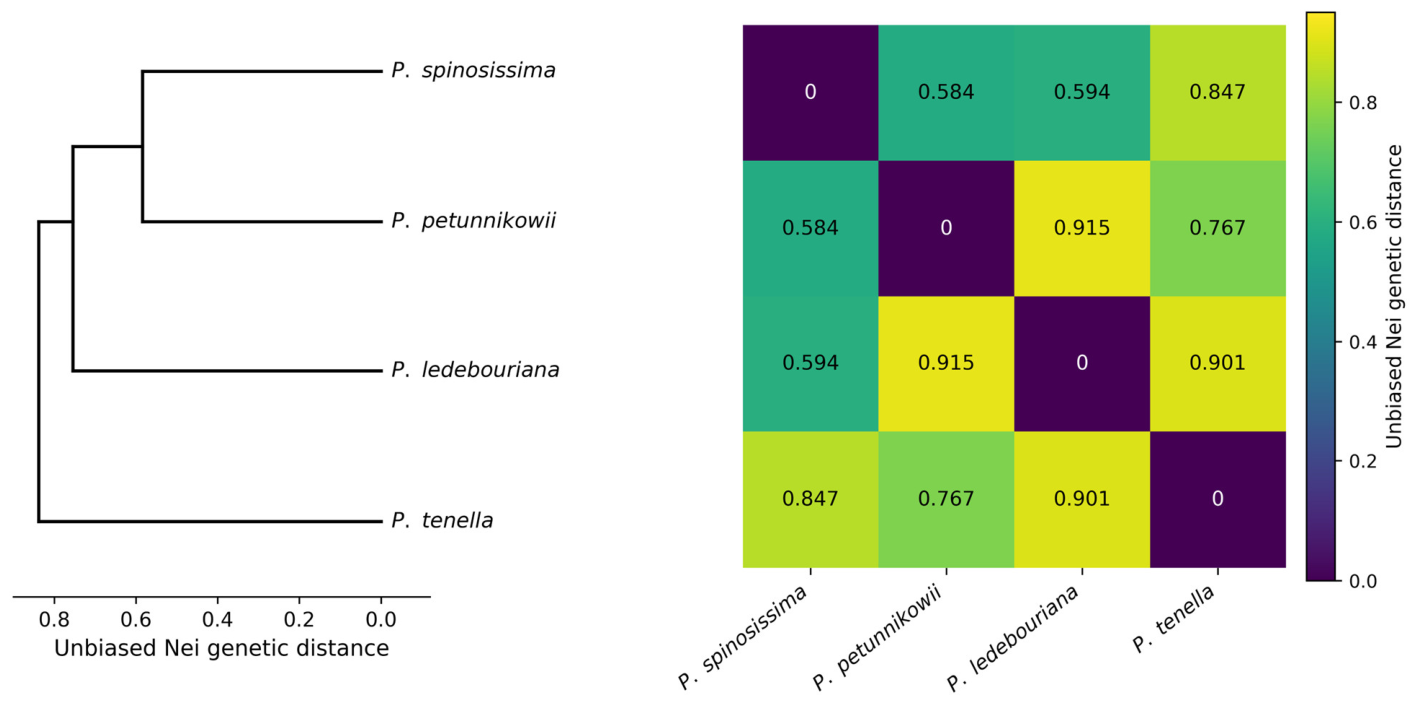
3.4. Genetic Distances, PCoA, and UPGMA Clustering
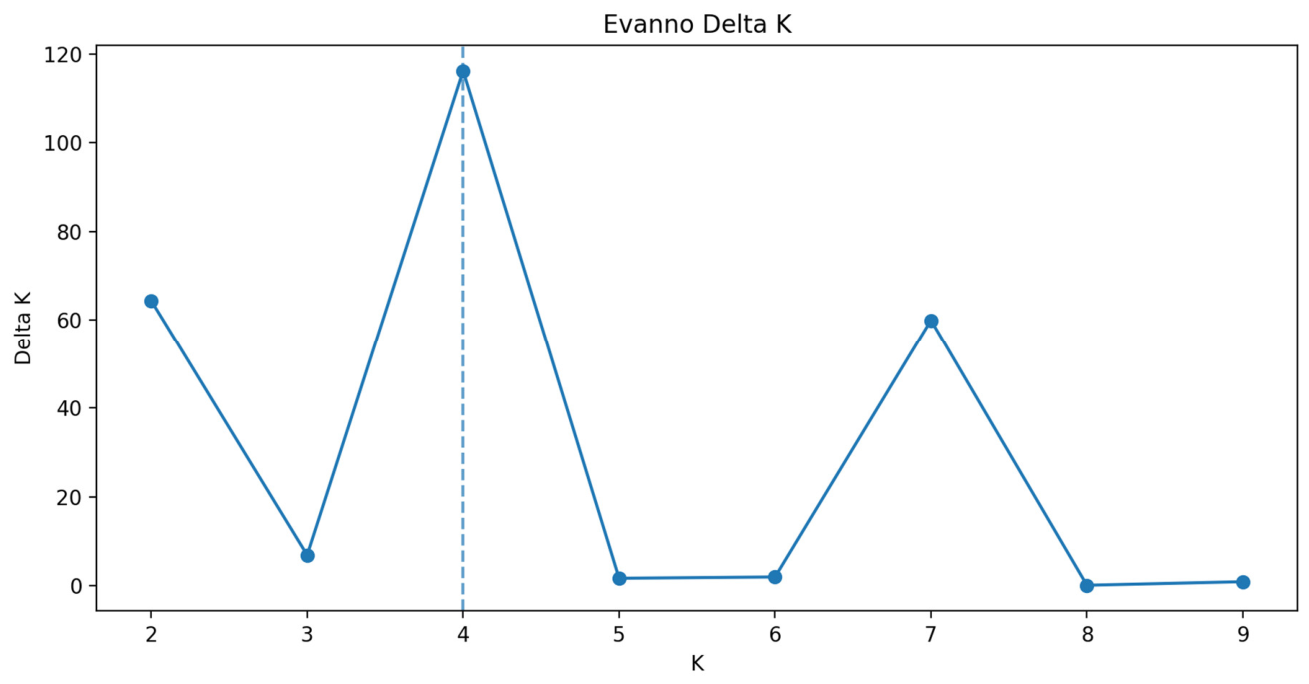
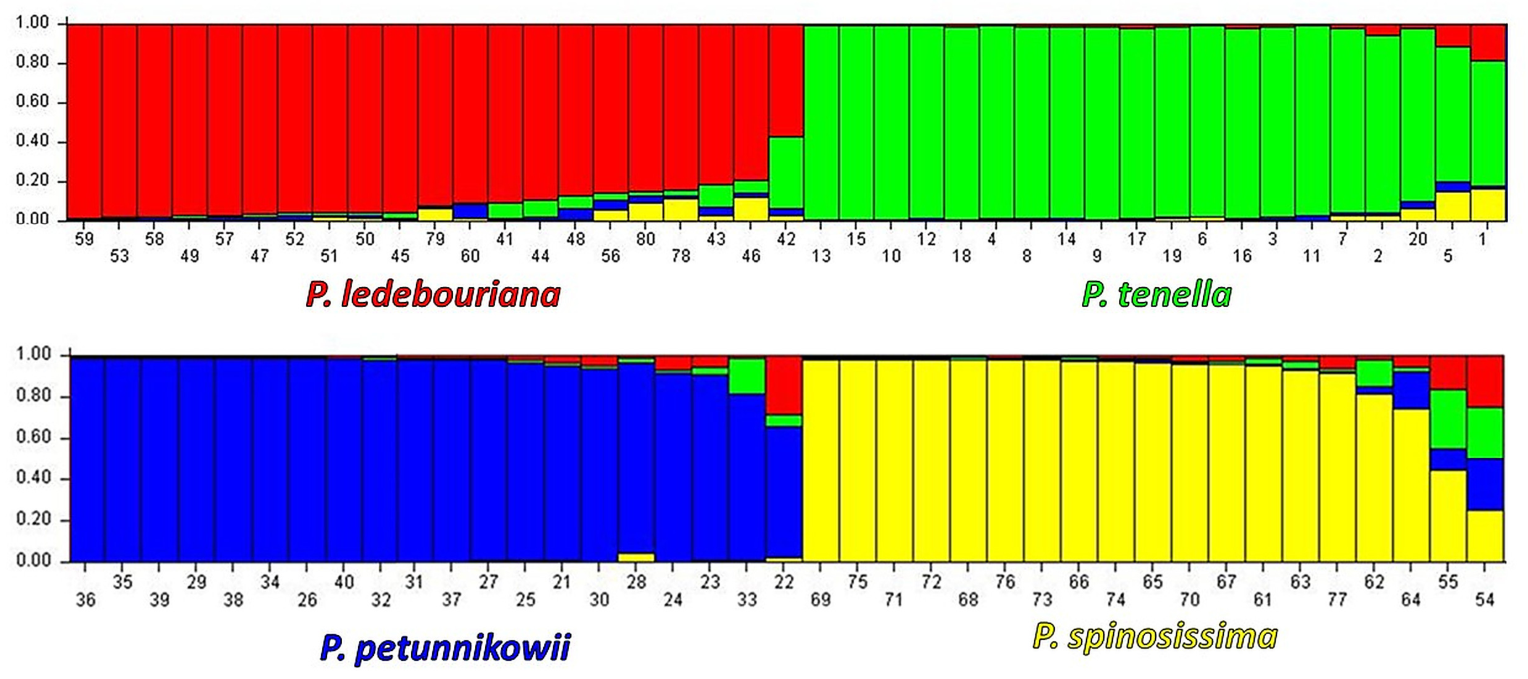
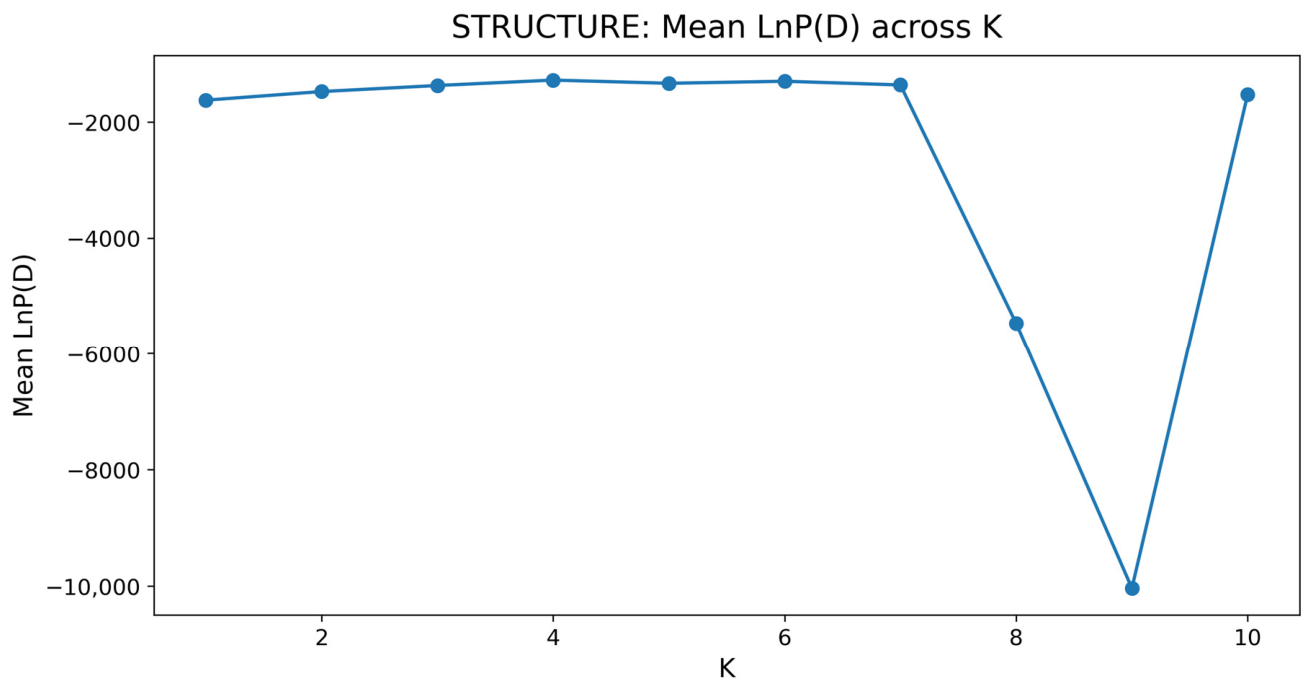
3.5. Bayesian Population Structure
4. Discussion
5. Conclusions
Author Contributions
Funding
Data Availability Statement
Conflicts of Interest
Abbreviations
| AMOVA | analysis of molecular variance |
| CTAB | cetyltrimethylammonium bromide |
| DNei | unbiased Nei genetic distance |
| He | expected heterozygosity |
| INei | unbiased Nei genetic identity |
| MCMC | Markov chain Monte Carlo |
| Na | number of alleles |
| Ne | effective number of alleles |
| nSSR | nuclear simple sequence repeat |
| P | percentage of polymorphic loci |
| PCoA | principal coordinates analysis |
| PCR | polymerase chain reaction |
| PhiPT | AMOVA-based genetic differentiation statistic |
| uHe | unbiased expected heterozygosity |
| UPGMA | unweighted pair group method with arithmetic mean |
Appendix A

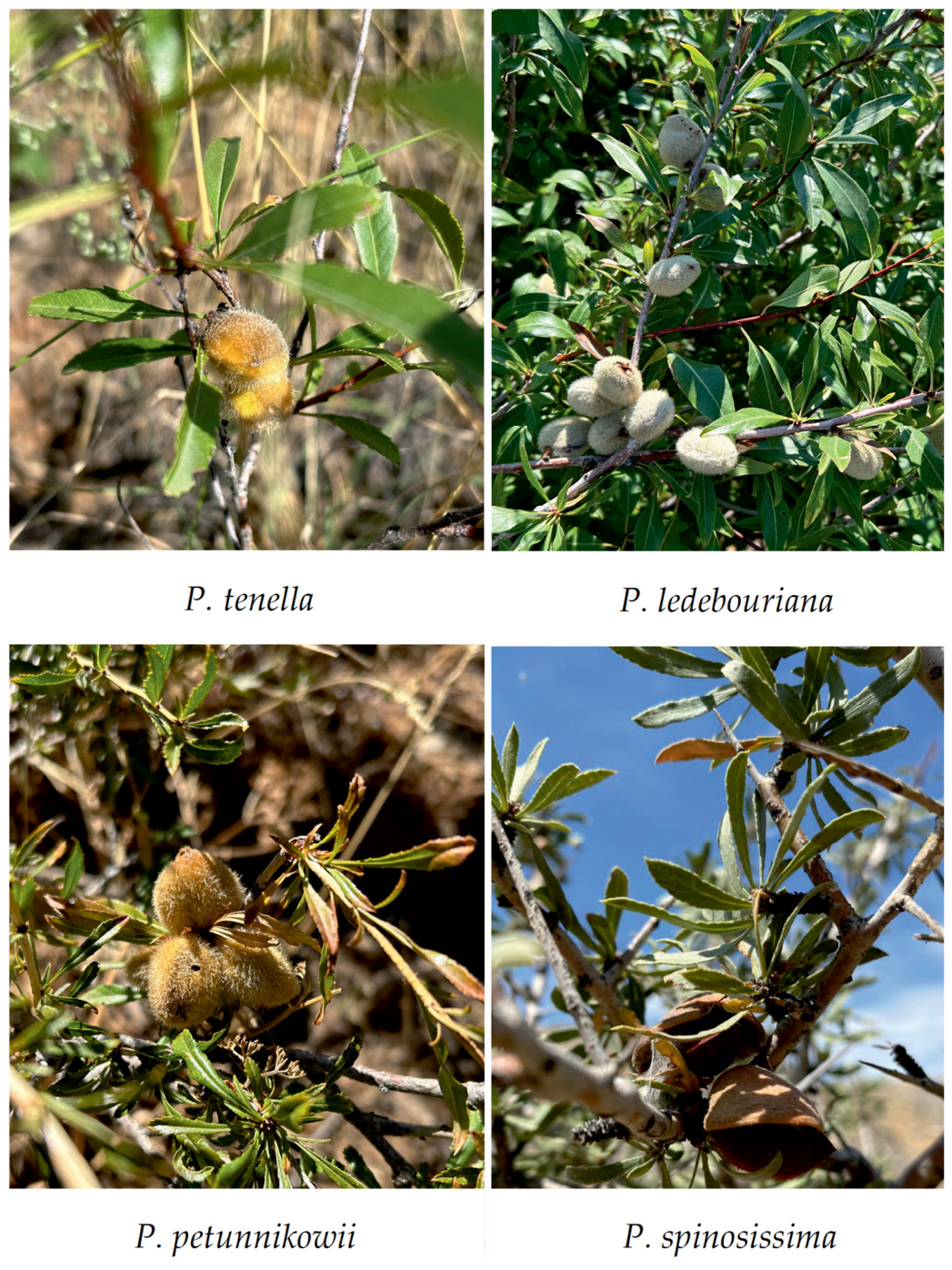
| Character | P. ledebouriana | P. tenella | P. petunnikowii | P. spinosissima |
|---|---|---|---|---|
| Habitus | Shrub 1.5–2.0 m; spreading, unarmed branches | Shrub 0.5–1.5 m; many short shoots; often suckering | Shrub to 1 m; erect, unarmed branches | Shrub to 2 m; spreading branches with long horizontal spines |
| Leaves | Lanceolate to oblong-ovate; 3.5–7.5 × 0.8–1.5 cm; serrate-dentate | Linear to lanceolate; 3.5–7.0 × 1–2 cm; serrate-dentate | Linear to linear-lanceolate; 2–3 × 0.3–0.5 cm; serrate-dentate | Lanceolate to cuneate-spatulate; 1.5–2.0 × 0.4–0.5 cm; entire or glandular-serrate |
| Petiole | 4–8 mm | 4–7 mm | Short, generally <4 mm | Sessile or very short |
| Fruit | Densely tomentose; broadly ovate to rounded; 1.5–2.5 cm | Densely tomentose; broadly ovate; 1.0–2.5 cm | Densely tomentose; asymmetric, obliquely narrowed; 1.5–2.5 cm | Short-tomentose to nearly glabrous; ovate to lanceolate, commonly falcate; 1.5–2.4 cm |
| Stone | Broadly ovate to oblong-ovate; rough, shallowly grooved | Broadly rounded to oblong-ovate; nearly symmetrical | Irregularly ovate; asymmetric; obliquely tapered base | Ovate to lanceolate; frequently asymmetric or falcate |
| No. | Locus | Repeat Motif | Primer Sequence (5′-3′) | Expected Size (bp) | Annealing Temperature (°C) |
|---|---|---|---|---|---|
| 1 | CPDCT005 | (CT)14 | F: TTCAAGGAGAAGGCCTGAAA; R: ATTGTGGGTTCCAACCAATG | 114 | 60 °C |
| 2 | CPDCT007 | (GA)19 | F: TGCAAGTTGAATGTGGCAAT; R: CTTTGGGTAGTGCAGGGATG | 164 | 58–62 °C |
| 3 | CPDCT008 | (GA)18 | F: GAAGCAGCCATTCCTAGTGC; R: TGTTTATGGACCTTAGTAGTCTGG | 191 | 58–60 °C |
| 4 | CPDCT012 | (GA)12 | F: CAGACCGTCGTGTTGAAGTC; R: GACCCGAATCGGAGTTGTAA | 198 | 58–60 °C |
| 5 | CPDCT015 | (CT)20 | F: GAAACTCAGTGGCACAATCG; R: GCAGGAGTTTCGAAAGGAAG | 154 | 60 °C |
| 6 | CPDCT016 | (GA)19 | F: GGAAACCTGATTAGGGCACTT; R: GGTCTGCTATACTGACCTAGGATT | 196 | 60 °C |
| 7 | CPDCT022 | (CT)17 | F: TGATCGGCGTCTCCTTTATC; R: AAAGCAAGCAGGCAAATGAA | 152 | 60 °C |
| 8 | CPDCT023 | (GA)9 | F: GTGGCAAATGTTGGCAAAG; R: AACACAAAGCAGCACCAAGA | 172 | 58–60 °C |
| 9 | CPDCT025 | (CT)10 | F: GACCTCATCAGCATCACCAA; R: TTCCCTAACGTCCCTGACAC | 172 | 60 °C |
| 10 | CPDCT027 | (CT)19 | F: TGAGGAGAGCACTGGAGGAG; R: CAACCGATCCCTCTAGACCA | 174 | 60 °C |
| 11 | CPDCT028 | (GA)19 | F: TGAACGTTGCACTCCTTCAC; R: ACCACCACCATAACCACCAT | 171 | 60 °C |
| 12 | CPDCT031 | (GA)22 | F: AATTCATAAATCAACAAATCAACA; R: GCAGAGCTTTTGGGTCAACT | 179 | 60 °C |
| 13 | CPDCT033 | (CT)18 | F: CAAAACACAAAAACCCACCA; R: ATTCGGGGAGTCAATCAGG | 132 | 60 °C |
| 14 | CPDCT035 | (GA)17 | F: TCGAAGGAGGATGAAGTTGC; R: ATATCACGAGGGGCAAAATG | 146 | 60 °C |
| 15 | CPDCT038 | (GA)25 | F: ATCACAGGTGAAGGCTGTGG; R: CAGATTCATTGGCCCATCTT | 181 | 58–60 °C |
| 16 | CPDCT039 | (GA)15 | F: GGGAGAGAGGAGGAGAGTGG; R: CAACCTCCAATTTCTTCGACA | 142 | 60 °C |
| 17 | CPDCT040 | (GA)24 | F: TGATGAGGCCTAGAAATTGGA; R: CACAGCAATCAGCAAAAAGC | 164 | 58–60 °C |
| 18 | CPDCT042 | (GA)27 | F: ACGCGTTACAAGTGAGATGC; R: TTGAAAAATCTTGATGGACGTG | 194 | 58–60 °C |
| 19 | CPDCT043 | (GA)21 | F: CCTTCGTGAGTGTCCACCTG; R: AGGGTCTGACTATCCACGATCT | 118 | 58–60 °C |
| 20 | CPDCT044 | (GA)21 | F: ACATGCCGGGTAATTAGCAA; R: AAAATGCACGTTTCGTCTCC | 175 | 60 °C |
| 21 | CPDCT045 | (GA)16 | F: TGTGGATCAAGAAAGAGAACCA; R: AGGTGTGCTTGCACATGTTT | 142 | 60 °C |
| 22 | CPDCT046 | (GA)21 | F: TGGACATCGATTCAGAGAAAAA; R: CGCAAGGTCAAACTTTCTCA | 166 | 60 °C |
| K | Mean LnP(D) | SD LnP(D) | ΔK |
|---|---|---|---|
| 1 | −1622.80 | 0.62 | — |
| 2 | −1474.30 | 0.69 | 64.33 |
| 3 | −1370.37 | 1.56 | 6.85 |
| 4 | −1277.10 | 1.28 | 116.26 |
| 5 | −1332.27 | 55.15 | 1.64 |
| 6 | −1297.00 | 51.43 | 1.93 |
| 7 | −1360.80 | 67.53 | 59.89 |
| 8 | −5468.70 | 7298.37 | 0.06 |
| 9 | −10,039.37 | 15,102.30 | 0.87 |
| 10 | −1526.00 | 153.12 | — |
| Population | Locus | Missing Data (%) | Valid Genotypes | Missing Genotypes |
|---|---|---|---|---|
| P. petunnikowii | CPDCT038/1 | 75 | 5 | 15 |
| P. petunnikowii | CPDCT008 | 70 | 6 | 14 |
| P. petunnikowii | CPDCT043 | 65 | 7 | 13 |
| P. ledebouriana | CPDCT038/1 | 60 | 8 | 12 |
| P. tenella | CPDCT007 | 60 | 8 | 12 |
| P. petunnikowii | CPDCT012 | 60 | 8 | 12 |
| P. petunnikowii | CPDCT023 | 50 | 10 | 10 |
| P. tenella | CPDCT012 | 40 | 12 | 8 |
| P. petunnikowii | CPDCT007 | 45 | 11 | 9 |
| P. petunnikowii | CPDCT015 | 35 | 13 | 7 |
| Change | Nine-Locus Sensitivity Means He | Full 15-Locus Mean He | Population |
|---|---|---|---|
| +0.039 | 0.598 | 0.559 | P. ledebouriana |
| +0.037 | 0.525 | 0.488 | P. tenella |
| +0.138 | 0.609 | 0.471 | P. petunnikowii |
| +0.043 | 0.699 | 0.656 | P. spinosissima |
| +0.064 | 0.608 | 0.544 | Overall mean |
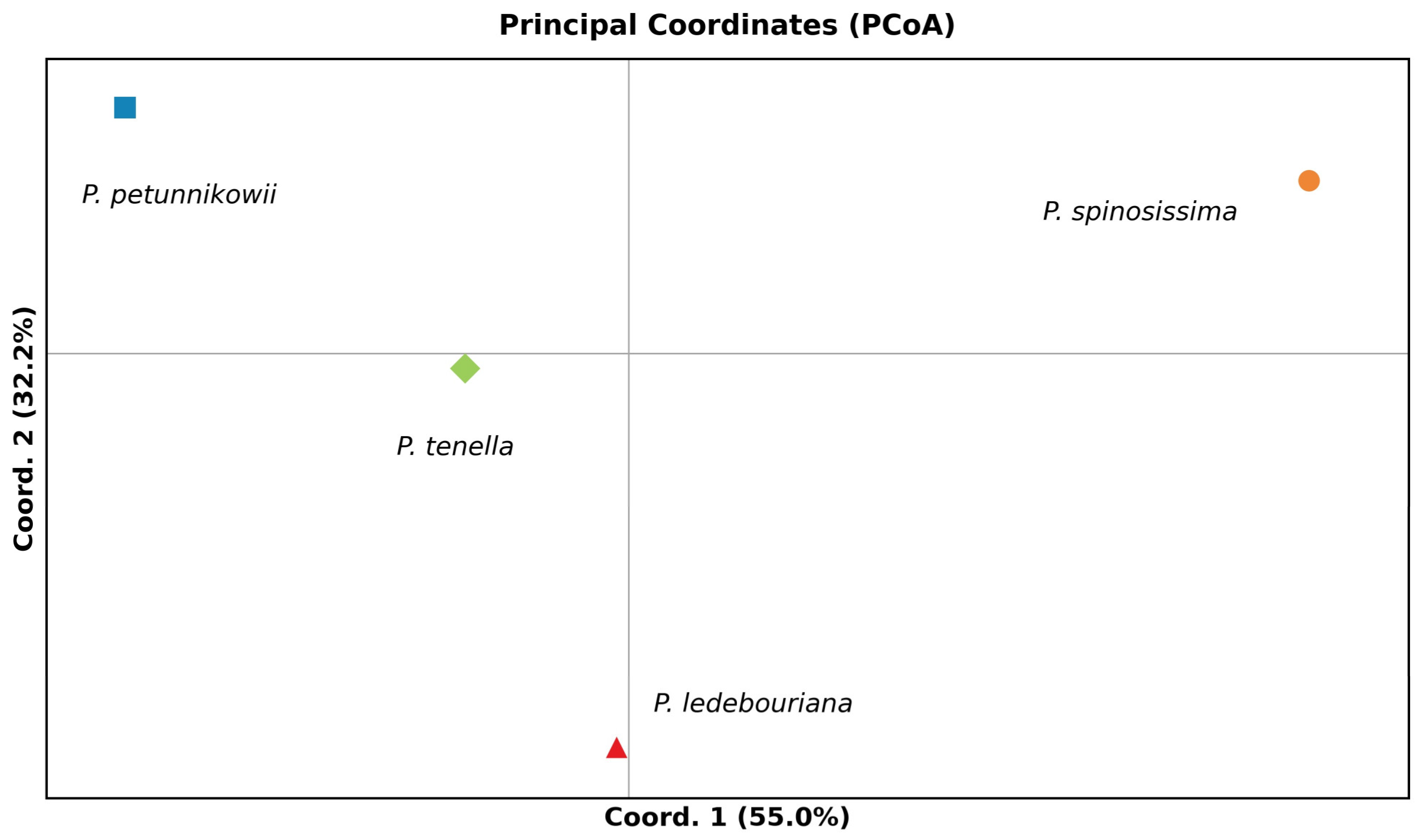
| Population Pair | DNei | INei |
|---|---|---|
| P. petunnikowii–P. spinosissima | 0.584 | 0.557 |
| P. ledebouriana–P. spinosissima | 0.594 | 0.552 |
| P. tenella–P. petunnikowii | 0.767 | 0.464 |
| P. tenella–P. spinosissima | 0.847 | 0.429 |
| P. ledebouriana–P. tenella | 0.901 | 0.406 |
| P. ledebouriana–P. petunnikowii | 0.915 | 0.401 |
| Locus | P. ledebouriana | P. tenella | P. petunnikowii | P. spinosissima | Mean He | Mean Missing Data (%) |
|---|---|---|---|---|---|---|
| CPDCT005 | 0.575 | 0.735 | 0.401 | 0.705 | 0.604 | 2.5 |
| CPDCT007 | 0.277 | 0.375 | 0.678 | 0.765 | 0.524 | 27.5 |
| CPDCT008 | 0.792 | 0.637 | 0 | 0.540 | 0.492 | 22.5 |
| CPDCT012 | 0.388 | 0.153 | 0 | 0.420 | 0.240 | 26.2 |
| CPDCT015 | 0.588 | 0.432 | 0.746 | 0.735 | 0.625 | 13.8 |
| CPDCT016 | 0.451 | 0 | 0.547 | 0.635 | 0.408 | 7.5 |
| CPDCT022 | 0.623 | 0.278 | 0.664 | 0.735 | 0.575 | 10 |
| CPDCT023 | 0.505 | 0.600 | 0.180 | 0.645 | 0.482 | 12.5 |
| CPDCT025 | 0.580 | 0.643 | 0.519 | 0.595 | 0.584 | 5 |
| CPDCT027 | 0.781 | 0.781 | 0.727 | 0.690 | 0.745 | 15 |
| CPDCT038/1 | 0.656 | 0.360 | 0.480 | 0.405 | 0.475 | 37.5 |
| CPDCT039 | 0.515 | 0.660 | 0.492 | 0.655 | 0.581 | 7.5 |
| CPDCT043 | 0.388 | 0.475 | 0.245 | 0.775 | 0.471 | 22.5 |
| CPDCT045 | 0.755 | 0.673 | 0.740 | 0.825 | 0.748 | 6.2 |
| CPDCT046 | 0.515 | 0.521 | 0.643 | 0.720 | 0.600 | 2.5 |
References
- Tirnaz, S.; Zandberg, J.; Thomas, W.J.W.; Marsh, J.; Edwards, D.; Batley, J. Application of crop wild relatives in modern breeding: An overview of resources, experimental and computational methodologies. Front. Plant Sci. 2022, 13, 1008904. [Google Scholar] [CrossRef] [Scilit] [PubMed]
- Barreca, D.; Nabavi, S.M.; Sureda, A.; Rasekhian, M.; Raciti, R.; Silva, A.S.; Annunziata, G.; Arnone, A.; Tenore, G.C.; Süntar, İ.; et al. Almonds (Prunus dulcis Mill. D.A. Webb): A source of nutrients and health-promoting compounds. Nutrients 2020, 12, 672. [Google Scholar] [CrossRef] [Scilit] [PubMed]
- Rahemi, A.; Gradziel, T. The Almonds and Related Species: Identification, Characteristics and Uses; Springer: Cham, Switzerland, 2024. [Google Scholar] [CrossRef] [Scilit]
- Govaerts, R.; Nic Lughadha, E.; Black, N.; Turner, R.; Paton, A. The World Checklist of Vascular Plants is a continuously updated resource for exploring global plant diversity. Sci. Data 2021, 8, 215. [Google Scholar] [CrossRef] [Scilit] [PubMed]
- Orazov, A.; Myrzagaliyeva, A.; Tustubayeva, S.; Irsaliyev, S.; Sailaubekova, A.; Turalin, B. Valuable morphological traits and genetic resources of wild almond relatives in Kazakhstan. ES Food Agrofor. 2025, 20, 1577. [Google Scholar] [CrossRef] [Scilit]
- Yazbek, M. Systematics of Prunus Subgenus Amygdalus: Monograph and Phylogeny. Ph.D. Thesis, Cornell University, Ithaca, NY, USA, 2010. [Google Scholar]
- Tao, R.; Iezzoni, A.F. The S-RNase-based gametophytic self-incompatibility system in Prunus exhibits distinct genetic and molecular features. Sci. Hortic. 2010, 124, 423–433. [Google Scholar] [CrossRef] [Scilit]
- Gómez, E.M.; Dicenta, F.; Batlle, I.; Romero, A.; Ortega, E. Cross-incompatibility in the cultivated almond (Prunus dulcis): Updating, revision and correction. Sci. Hortic. 2019, 245, 218–223. [Google Scholar] [CrossRef] [Scilit]
- Sáez, A.; Aizen, M.A.; Medici, S.; Viel, M.; Villalobos, E.; Negri, P. Bees increase crop yield in an alleged pollinator-independent almond variety. Sci. Rep. 2020, 10, 3177. [Google Scholar] [CrossRef] [Scilit] [PubMed]
- Nicotra, A.; Moser, L. Prunus tenella as a hypothetical rootstock for sweet cherry. Acta Hortic. 1985, 169, 217–224. [Google Scholar] [CrossRef] [Scilit]
- Jordano, P. Pollination biology of Prunus mahaleb L.: Deferred consequences of gender variation for fecundity and seed size. Biol. J. Linn. Soc. 1993, 50, 65–84. [Google Scholar] [CrossRef]
- García, C.; Jordano, P.; Godoy, J.A. Contemporary pollen and seed dispersal in a Prunus mahaleb population: Patterns in distance and direction. Mol. Ecol. 2007, 16, 1947–1955. [Google Scholar] [CrossRef] [Scilit] [PubMed]
- Grünewald, C.; Breitbach, N.; Böhning-Gaese, K. Tree visitation and seed dispersal of wild cherries by terrestrial mammals along a human land-use gradient. Basic Appl. Ecol. 2010, 11, 532–541. [Google Scholar] [CrossRef] [Scilit]
- Mnejja, M.; Garcia-Mas, J.; Howad, W.; Arús, P. Development and transportability across Prunus species of 42 polymorphic almond microsatellites. Mol. Ecol. Notes 2005, 5, 531–535. [Google Scholar] [CrossRef] [Scilit]
- Martínez-Gómez, P.; Arulsekar, S.; Potter, D.; Gradziel, T.M. An extended interspecific gene pool available to peach and almond breeding as characterised using simple sequence repeat markers. Euphytica 2003, 131, 313–322. [Google Scholar] [CrossRef] [Scilit]
- Rahemi, A.; Fatahi, R.; Ebadi, A.; Taghavi, T.; Hassani, D.; Gradziel, T.; Folta, K.; Chaparro, J. Genetic diversity of some wild almonds and related Prunus species revealed by SSR and EST-SSR markers. Plant Syst. Evol. 2012, 298, 173–192. [Google Scholar] [CrossRef] [Scilit]
- Orazov, A.; Yermagambetova, M.; Myrzagaliyeva, A.; Mukhitdinov, N.; Tustubayeva, S.; Turuspekov, Y.; Almerekova, S. Plant height variation and genetic diversity between Prunus ledebouriana and Prunus tenella based on SSR markers in East Kazakhstan. PeerJ 2024, 12, e16735. [Google Scholar] [CrossRef] [Scilit] [PubMed]
- Hasanbegović, J.; Hadžiabulić, S.; Kurtović, M.; Gaši, F.; Lazović, B.; Dorbić, B.; Skender, A. Genetic characterisation of almond (Prunus amygdalus L.) using microsatellite markers in the area of the Adriatic Sea. Turk. J. Agric. For. 2021, 45, 797–806. [Google Scholar] [CrossRef] [Scilit]
- Yangöz, G.B.; Güney, M. Characterisation and diversity assessment of almond (Prunus dulcis Mill.) genotypes and cultivars using simple sequence repeat markers. Genet. Resour. Crop Evol. 2025, 72, 5887–5901. [Google Scholar] [CrossRef] [Scilit]
- Bayazıt, S.; Çalışkan, O.; Coşkun, Ö.F.; Yaman, M. Genetic variability in almond (Prunus dulcis L.) in South Türkiye: Morphological, biochemical, and SSR analyses. BMC Plant Biol. 2025, 25, 1176. [Google Scholar] [CrossRef] [Scilit] [PubMed]
- Doyle, J.J.; Doyle, J.L. A rapid DNA isolation procedure for small quantities of fresh leaf tissue. Phytochem. Bull. 1987, 19, 11–15. [Google Scholar]
- Porebski, S.; Bailey, L.G.; Baum, B.R. Modification of a CTAB DNA extraction protocol for plants containing high polysaccharide and polyphenol components. Plant Mol. Biol. Rep. 1997, 15, 8–15. [Google Scholar] [CrossRef] [Scilit]
- Peakall, R.; Smouse, P.E. GenAlEx 6.5: Genetic analysis in Excel. Population genetic software for teaching and research: An update. Bioinformatics 2012, 28, 2537–2539. [Google Scholar] [CrossRef] [Scilit] [PubMed]
- Tamura, K.; Stecher, G.; Kumar, S. MEGA11: Molecular Evolutionary Genetics Analysis version 11. Mol. Biol. Evol. 2021, 38, 3022–3027. [Google Scholar] [CrossRef] [Scilit] [PubMed]
- Pritchard, J.K.; Stephens, M.; Donnelly, P. Inference of population structure using multilocus genotype data. Genetics 2000, 155, 945–959. [Google Scholar] [CrossRef] [Scilit] [PubMed]
- Evanno, G.; Regnaut, S.; Goudet, J. Detecting the number of clusters of individuals using the software STRUCTURE: A simulation study. Mol. Ecol. 2005, 14, 2611–2620. [Google Scholar] [CrossRef] [Scilit] [PubMed]
- Earl, D.A.; vonHoldt, B.M. STRUCTURE HARVESTER: A website and program for visualising STRUCTURE output and implementing the Evanno method. Conserv. Genet. Resour. 2012, 4, 359–361. [Google Scholar] [CrossRef] [Scilit]
- Szikriszt, B.; Hegedűs, A.; Halász, J. Review of genetic diversity studies in almond (Prunus dulcis). Acta Agron. Hung. 2011, 59, 379–395. [Google Scholar] [CrossRef] [Scilit]
- Zeinalabedini, M.; Majidian, P.; Ashori, R.; Gholaminejad, A.; Ebrahimi, M.A.; Martinez-Gomez, P. Integration of molecular and geographical data analysis of Iranian Prunus scoparia populations for genetic diversity assessment and conservation planning. Sci. Hortic. 2019, 247, 49–57. [Google Scholar] [CrossRef] [Scilit]
- Delplancke, M.; Alvarez, N.; Benoit, L.; Espíndola, A.; Joly, H.; Neuenschwander, S.; Arrigo, N. Evolutionary history of almond tree domestication in the Mediterranean basin. Mol. Ecol. 2013, 22, 1092–1104. [Google Scholar] [CrossRef] [Scilit] [PubMed]
- Tahan, O.; Geng, Y.; Zeng, L.; Dong, S.; Chen, F.; Chen, J.; Song, Z.; Zhong, Y. Assessment of genetic diversity and population structure of Chinese wild almond, Amygdalus nana, using EST- and genomic SSRs. Biochem. Syst. Ecol. 2009, 37, 146–153. [Google Scholar] [CrossRef] [Scilit]
- Fernández i Martí, A.; Font i Forcada, C.; Kamali, K.; Rubio-Cabetas, M.J.; Wirthensohn, M.; Socias i Company, R. Molecular analyses of evolution and population structure in a worldwide almond pool assessed by microsatellite markers. Genet. Resour. Crop Evol. 2015, 62, 205–219. [Google Scholar] [CrossRef] [Scilit]
- Halász, J.; Kodad, O.; Galiba, G.M.; Skola, I.; Ercisli, S.; Ledbetter, C.A.; Hegedűs, A. Genetic variability is preserved among strongly differentiated and geographically diverse almond germplasm: An assessment by simple sequence repeat markers. Tree Genet. Genomes 2019, 15, 12. [Google Scholar] [CrossRef] [Scilit]
- Delplancke, M.; Alvarez, N.; Espíndola, A.; Joly, H.; Benoit, L.; Brouck, E.; Arrigo, N. Gene flow among wild and domesticated almond species: Insights from chloroplast and nuclear markers. Evol. Appl. 2012, 5, 317–329. [Google Scholar] [CrossRef] [Scilit] [PubMed]
- Rahimi-Dvin, S.; Gharaghani, A.; Pourkhaloee, A. Genetic diversity, population structure, and relationships among wild and domesticated almond germplasm revealed by ISSR markers. Adv. Hortic. Sci. 2020, 34, 287–300. [Google Scholar] [CrossRef] [Scilit]
- Khojand, S.; Zeinalabedini, M.; Azizinezhad, R.; Imani, A.; Ghaffari, M.R. Genomic exploration of Iranian almond germplasm: Diversity, population structure, and linkage disequilibrium through genotyping-by-sequencing. BMC Genom. 2024, 25, 1101. [Google Scholar] [CrossRef] [Scilit] [PubMed]
- Zhang, H.X.; Zhang, X.F.; Zhang, J. Genetic divergence and evolutionary adaptation of four wild almond species. Forests 2024, 15, 834. [Google Scholar] [CrossRef] [Scilit]



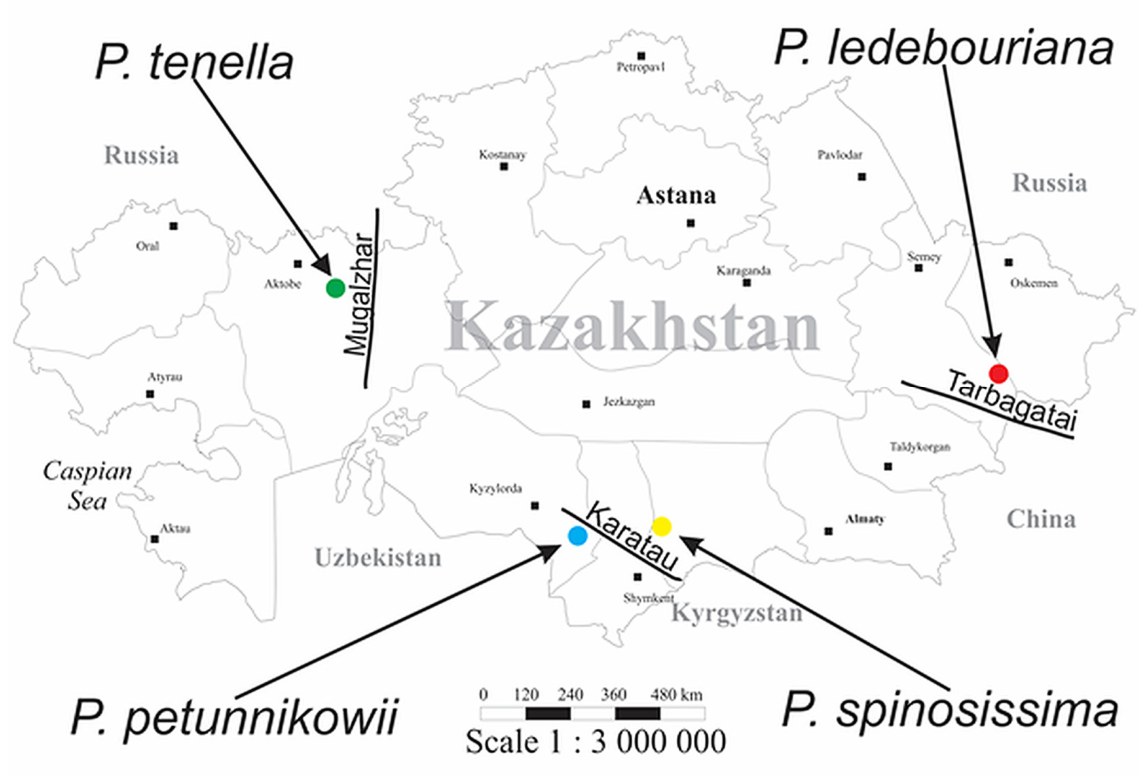
| Species | Coordinates | Elevation (m) | Region and Locality | Climate and Precipitation | Soil and Humidity |
|---|---|---|---|---|---|
| P. ledebouriana | 47.151592, 82.021929 | ~1400 | Tarbagatai, eastern Kazakhstan; Tarbagatai State National Nature Park, Abai Region | Jan −15 °C; Jul +22 to +25 °C; 300–500 mm year−1 | Kastanozem and mountain-meadow soils; 55–70% |
| P. tenella | 48.936730, 58.646700 | ~300–500 | Mugalzhar, western Kazakhstan; near Emba, Aktobe Region | Jan −16 °C; Jul +24 to +26 °C; 250–350 mm year−1 | Light Kastanozem, calcareous and saline soils; 45–60% |
| P. petunnikowii | 43.599153, 68.705125 | ~800–1000 | Karatau, southern Kazakhstan; Karatau State Nature Reserve, Turkistan Region | Jan −5 °C; Jul +28 to +30 °C; 200–300 mm year−1 | Light Kastanozem, chernozem-derived and gravelly soils; 30–40% |
| P. spinosissima | 42.430817, 70.056503 | ~700–900 | Mashat, southern Kazakhstan; near Mashat Nature Reserve, Turkistan Region | Jan −5 °C; Jul +28 to +30 °C; 200–300 mm year−1 | Light Kastanozem, chernozem-derived and gravelly soils; 30–40% |
| Locus | N | Na | Ne | I | He | uHe | Missing Data (%) | He Rank |
|---|---|---|---|---|---|---|---|---|
| CPDCT005 | 19.5 | 3.50 | 2.80 | 1.077 | 0.604 | 0.636 | 2.5 | 4 |
| CPDCT007 | 14.5 | 3.75 | 2.59 | 0.981 | 0.524 | 0.568 | 27.5 | 9 |
| CPDCT008 | 15.5 | 4.00 | 2.69 | 0.985 | 0.492 | 0.520 | 22.5 | 10 |
| CPDCT012 | 14.8 | 1.75 | 1.38 | 0.369 | 0.240 | 0.255 | 26.2 | 15 |
| CPDCT015 | 17.3 | 4.00 | 2.97 | 1.143 | 0.625 | 0.666 | 13.8 | 3 |
| CPDCT016 | 19.0 | 2.75 | 1.90 | 0.710 | 0.392 | 0.413 | 5.0 | 13 |
| CPDCT022 | 19.8 | 3.50 | 2.38 | 0.908 | 0.510 | 0.531 | 1.2 | 6 |
| CPDCT023 | 16.0 | 3.50 | 2.13 | 0.814 | 0.452 | 0.481 | 20.0 | 11 |
| CPDCT025 | 18.0 | 3.25 | 2.33 | 0.874 | 0.500 | 0.530 | 10.0 | 7 |
| CPDCT027 | 17.0 | 6.00 | 4.01 | 1.546 | 0.745 | 0.792 | 15.0 | 2 |
| CPDCT038/1 | 12.5 | 2.75 | 1.94 | 0.710 | 0.401 | 0.439 | 37.5 | 12 |
| CPDCT039 | 18.8 | 3.25 | 2.32 | 0.862 | 0.493 | 0.518 | 6.2 | 8 |
| CPDCT043 | 16.0 | 2.75 | 1.89 | 0.672 | 0.373 | 0.398 | 20.0 | 14 |
| CPDCT045 | 18.8 | 5.00 | 4.18 | 1.477 | 0.748 | 0.791 | 6.2 | 1 |
| CPDCT046 | 19.3 | 3.50 | 2.76 | 1.044 | 0.565 | 0.594 | 3.8 | 5 |
| Population | N | Na | Ne | I | He | uHe | P (%) | Missing Data (%) |
|---|---|---|---|---|---|---|---|---|
| P. ledebouriana | 18.1 | 3.67 | 2.59 | 1.018 | 0.559 | 0.595 | 100.0 | 9.7 |
| P. tenella | 17.2 | 3.07 | 2.33 | 0.854 | 0.488 | 0.519 | 93.3 | 14.0 |
| P. petunnikowii | 13.1 | 3.00 | 2.31 | 0.831 | 0.471 | 0.511 | 86.7 | 34.7 |
| P. spinosissima | 20.0 | 4.47 | 3.24 | 1.250 | 0.656 | 0.691 | 100.0 | 0.0 |
| Overall mean | 17.1 | 3.55 | 2.62 | 0.988 | 0.544 | 0.579 | 95.0 | 14.6 |
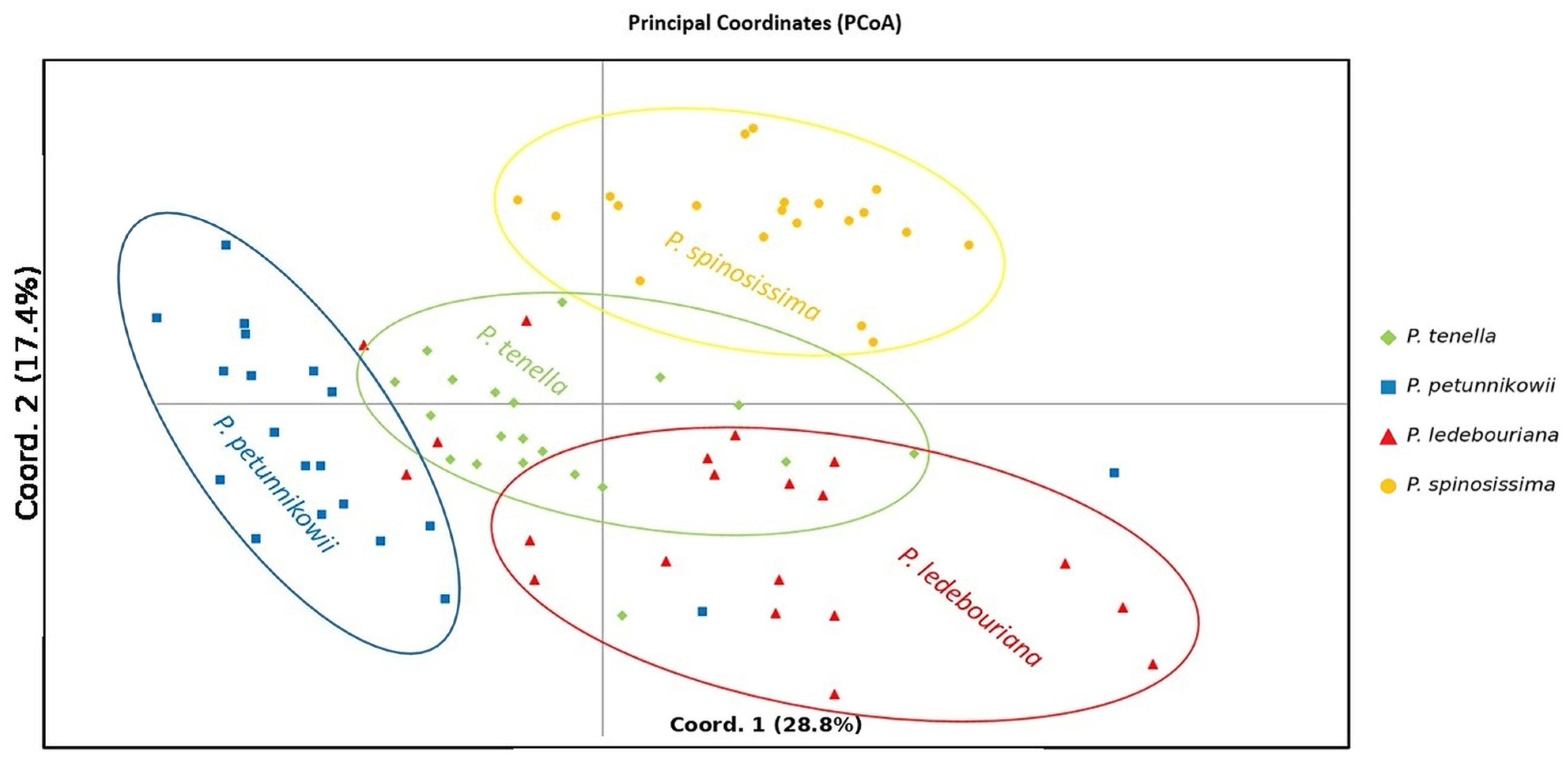
| Source of Variation | df | SS | MS | Estimated Variance | Variation (%) |
|---|---|---|---|---|---|
| Among populations | 3 | 103.138 | 34.379 | 1.478 | 23.5 |
| Within populations | 76 | 366.500 | 4.822 | 4.822 | 76.5 |
| Total | 79 | 469.637 | — | 6.300 | 100.0 |
Disclaimer/Publisher’s Note: The statements, opinions and data contained in all publications are solely those of the individual author(s) and contributor(s) and not of MDPI and/or the editor(s). MDPI and/or the editor(s) disclaim responsibility for any injury to people or property resulting from any ideas, methods, instructions or products referred to in the content. |
© 2026 by the authors. Licensee MDPI, Basel, Switzerland. This article is an open access article distributed under the terms and conditions of the Creative Commons Attribution (CC BY) license.
Share and Cite
Orazov, A.; Samarkhanov, T.; Myrzagaliyeva, A.; Yermagambetova, M.; Kauanov, S.; Turuspekov, Y.; Irsaliyev, S.; Tustubayeva, S.; Turalin, B. Exploratory SSR-Based Assessment of Genetic Diversity and Differentiation Among Four Wild Almond Populations in Kazakhstan. Int. J. Plant Biol. 2026, 17, 67. https://doi.org/10.3390/ijpb17080067
Orazov A, Samarkhanov T, Myrzagaliyeva A, Yermagambetova M, Kauanov S, Turuspekov Y, Irsaliyev S, Tustubayeva S, Turalin B. Exploratory SSR-Based Assessment of Genetic Diversity and Differentiation Among Four Wild Almond Populations in Kazakhstan. International Journal of Plant Biology. 2026; 17(8):67. https://doi.org/10.3390/ijpb17080067
Chicago/Turabian StyleOrazov, Aidyn, Talant Samarkhanov, Anar Myrzagaliyeva, Moldir Yermagambetova, Sultan Kauanov, Yerlan Turuspekov, Serik Irsaliyev, Shynar Tustubayeva, and Bauyrzhan Turalin. 2026. "Exploratory SSR-Based Assessment of Genetic Diversity and Differentiation Among Four Wild Almond Populations in Kazakhstan" International Journal of Plant Biology 17, no. 8: 67. https://doi.org/10.3390/ijpb17080067
APA StyleOrazov, A., Samarkhanov, T., Myrzagaliyeva, A., Yermagambetova, M., Kauanov, S., Turuspekov, Y., Irsaliyev, S., Tustubayeva, S., & Turalin, B. (2026). Exploratory SSR-Based Assessment of Genetic Diversity and Differentiation Among Four Wild Almond Populations in Kazakhstan. International Journal of Plant Biology, 17(8), 67. https://doi.org/10.3390/ijpb17080067