Brief Report

A Novel Biostimulant for Enhancing Biomass and Therapeutic Compounds in Cannabis sativa

by
Carlos Armas-Díaz
1,
David Montesinos-Pereira
1,2,
Lázaro Grisales
3,
Maria Corujo
3,
José Luis Vázquez-Gutiérrez
1,
Daniel Blandón-Granada
4,
Eduardo Hernández-Bolaños
1,
Andrés Acosta-Pérez
1,
Violeta Sánchez-Retuerta
4,
Beatriz Porras
3,
Laura Cuyas
4,* and
Luis Matías-Hernández
1,4
1
Biotech Tricopharming Research SL, Finca El Pico, Camino Pico Bermejo 179, 38260 San Cristóbal de La Laguna, Spain
2
Instituto de Bioquímica Vegetal y Fotosíntesis (IBVF), Consejo Superior de Investigaciones Científicas (CSIC)-Universidad de Sevilla, Avenida Américo Vespucio, 49, 41092 Sevilla, Spain
3
Ecomedics S.A.S. (d.b.a. Clever Leaves), Industrial Park, Tibitoc P.H., Wharehouse 19-B, 34 y 60, Tocancipa 251017, Colombia
4
Biotech Tricopharming Research SL, Carrer Pallars 108, 08018 Barcelona, Spain
*
Author to whom correspondence should be addressed.
Int. J. Plant Biol. 2026, 17(3), 18; https://doi.org/10.3390/ijpb17030018
Submission received: 26 January 2026 / Revised: 20 February 2026 / Accepted: 27 February 2026 / Published: 3 March 2026

Abstract

Biostimulants represent a sustainable strategy to enhance the therapeutic potential of medicinal plants, which often exhibit low and variable levels of bioactive compounds. Cannabis sativa, a medicinally important species, produces diverse cannabinoids, such as THC, CBD, CBG, and CBC, whose profiles depend on plant chemotype and determine pharmacological activity. We developed a novel plant-based biostimulant, Tricostimulant™, to optimize cannabinoid production in Cannabis sativa. Field trials demonstrated increased biomass and selective enhancement of cannabinoid content. In high-CBD chemotypes, Tricostimulant™ was associated with higher CBD and CBG without relevant changes in THC levels, whereas in high-THC chemotypes, higher THC values were observed without evident variation in CBD. The most pronounced differences were observed when the biostimulant was applied during the vegetative stage, highlighting the importance of application timing. These results indicate the potential of Tricostimulant™ to modulate cannabinoid profiles, contributing to improved optimization and standardization of cannabis-based therapeutics. Further research is required to confirm these findings and elucidate the underlying mechanisms of biostimulant action.

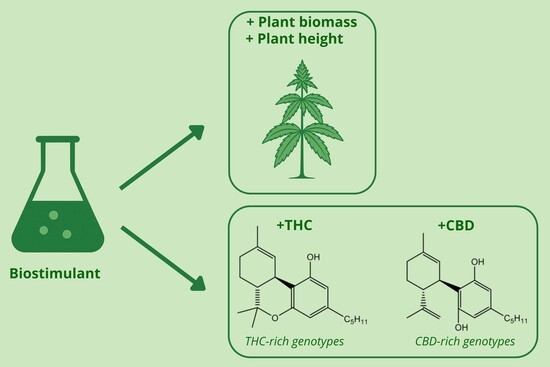
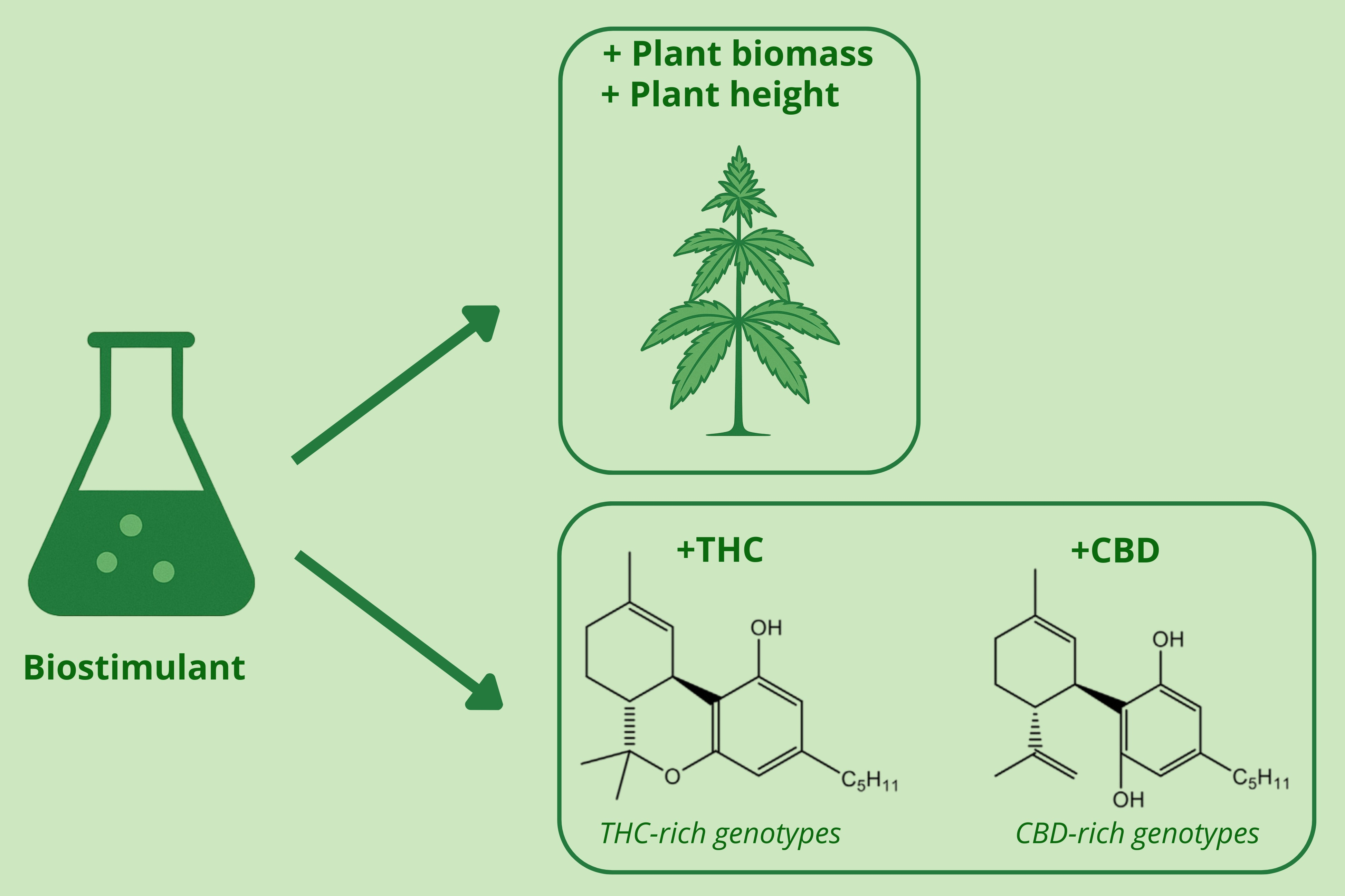
Graphical Abstract

1. Introduction

Biostimulants are natural substances or microorganisms that enhance plant growth and metabolism through mechanisms independent of their nutrient content, improving efficiency, stress tolerance, and overall plant quality [1]. In response to major challenges facing current agriculture, such as soil degradation, increasing food demand driven by population growth, climate change-related abiotic stresses, and the need to reduce synthetic chemical inputs, biostimulants offer a sustainable strategy to improve crop resilience, health, and yield [2,3,4,5,6,7,8,9,10]. Beyond traditional crops, their use has expanded to medicinal and aromatic plants (MAPs), where they help stabilize and enhance bioactive compound profiles, a critical aspect for pharmaceutical and nutraceutical applications [11,12,13,14,15,16,17,18,19,20].
Among these plants, Cannabis sativa stands out as a medicinal and aromatic plant with high biochemical and therapeutic value, producing cannabinoids, terpenes, and flavonoids that contribute to its aroma and bioactivity. These secondary metabolites have been associated with neuroprotective, analgesic, anti-inflammatory, antioxidant, and antimicrobial effects, largely through interactions with the endocannabinoid system [21,22,23,24,25]. The species comprises multiple agronomic varieties classified into three main chemotypes based on cannabinoid profiles (THC-dominant, balanced THC:CBD, and CBD-dominant). Varieties characterized by a CBD-dominant profile are generally associated with what is legally defined as industrial hemp; however, this designation is regulatory in nature and based on THC thresholds that vary among countries (commonly 0.2–1.0%) [26,27,28,29,30]. Major cannabinoids originate from a common biosynthetic precursor, cannabigerolic acid (CBG-A), synthesized in glandular trichomes and enzymatically converted into acidic forms that become bioactive after decarboxylation [31,32,33,34].
Despite its potential, Cannabis sativa faces significant challenges regarding biochemical standardization and industrial scalability, as cannabinoids naturally occur at low concentrations and are strongly influenced by genotype, environmental conditions, cultivation practices, and developmental stage [35,36,37,38]. Regulatory constraints linked to THC thresholds further complicate production and commercialization. This complexity highlights the need for controlled, sustainable, and reproducible production strategies. In this context, biostimulants represent a promising yet underexplored approach in Cannabis sativa to enhance plant performance, biomass accumulation, and cannabinoid biosynthesis, supporting the development of more consistent and high-value cultivation systems.

2. Materials and Methods

2.1. Biostimulant Information

The biostimulant evaluated in this study, Tricostimulant™, is a botanical extract-based formulation containing Centella asiatica, Echinacea purpurea, Taraxacum officinale, Urtica dioica, and fermented rice extract. Its nutritional characterization showed 0.132% (w/w) total nitrogen (N), <0.011% (w/w) total phosphorus (P2O5), 0.036% (w/w) total potassium (K2O), 0.009% (w/w) total magnesium (MgO), and 0.011% (w/w) total calcium (CaO). The formulation also contains 6.9 mg/kg total boron (B), 2.98 mg/kg total iron (Fe), <2.00 mg/kg total manganese (Mn), <2.00 mg/kg total copper (Cu), and 1.49 mg/kg total zinc (Zn), along with a total organic matter content of 0.402% (w/w) and a pH of 7. Tricostimulant™ has been registered across different EU markets including the Czech Republic, Portugal and Spain.

2.2. Plant Material, Experimental Design, and Biostimulant Treatment

Industrial hemp (Cannabis sativa L.) plants of the Carmagnola Selezionata (CS) variety were used for the first two field trials, both conducted at Tricopharming’s facilities in Tenerife (Canary Islands, Spain). Seeds were germinated under controlled nursery conditions, transplanted to open-field plots at the vegetative stage, and grown following standard agronomic practices. Plants were harvested approximately two months after transplanting. The first trial was conducted during the winter period with temperatures ranging from 13 °C to 21 °C, with relative humidity between 82% and 86% and cumulative monthly precipitation between 46.5 and 65 mm. In contrast, the second trial was performed in late-summer conditions with average temperatures between 19 °C and 26 °C, relative humidity around 89%, and substantially lower monthly precipitation (2.4–2.9 mm). Observed differences in overall plant growth between the two Tenerife trials are therefore likely attributable to seasonal climatic variation.
Plants were foliar-treated with the botanical extract-based biostimulant Tricostimulant™ using a single application at 2 mL L−1 (150 mL per plant), applied from the lower stem upwards to ensure total foliar coverage. Treatments were applied at three phenological stages: vegetative (active shoot and leaf development during nursery culture), pre-anthesis (formation of floral buds prior to first flowers opening), and post-anthesis (after flowering, during early seed and fruit development). In both trials, plants receiving the same treatment were arranged together within the experimental area. Seven plants per treatment were included in the first trial and seven to eight plants in the second, with each plant considered an independent biological replicate.
A third validation trial was conducted at the Clever Leaves facilities in Colombia under commercial production conditions. Cannabis sativa plants with contrasting cannabinoid profiles were used, including two THC-rich chemotypes and one CBD-rich chemotype. The plants were grown in a greenhouse at a density of 0.7–0.8 plants m−2 (70–80 plants per 100 m2), following standard agronomic practices. The photoperiod was set to 18 h light/6 h dark during the vegetative stage and 12 h light/12 h dark during flowering. The average greenhouse temperature was 22 °C.
The experiment followed a randomized assignment of plants to treatments under controlled and environmentally and homogeneous conditions. Twenty plants per THC-rich variety and experimental conditions (control and Tricostimulant™) were included, whereas forty plants per treatment were used for the CBD-rich variety. Plants were arranged by treatment within the experimental area to facilitate management and application procedures. Treatments consisted of a single foliar application at the vegetative stage, applied according to an optimized protocol defined in preliminary trials to ensure complete coverage. Although multiple plants were cultivated per treatment, each experimental condition was evaluated using a single pooled sample; therefore, the data from this trial should be considered exploratory.
In all experiments, control plants received water-only applications at the same volume used for the biostimulant treatment.

2.3. Agronomic Measurements

Plants from each experimental condition were evaluated for key agronomic traits. In the first trial, plant height was measured at harvest from the base of the stem to the apical meristem. Total shoot fresh biomass was quantified. In the second trial, plant height was determined using the same method. After harvest, plants were separated into their stems, leaves, and flowers. The fresh weight of each part was recorded using an analytical balance. Total fresh shoot biomass was calculated as the sum of the fresh weights of all organs. Each plant was considered an independent biological replicate. In the third trial, dry inflorescence yield (g plot−1) was determined at harvest. This was calculated as the total dry weight of all pooled flowers per experimental condition.

2.4. Metabolite Extraction and Quantification

The first cannabinoid analysis was conducted on dried, finely ground, and homogenized flower samples, with all flowers pooled per experimental condition to generate a single composite sample. Approximately 100 mg of each sample was extracted with analytical-grade ethanol under constant agitation for 30 min at room temperature. This was followed by centrifugation at 12,000 rpm for 10 min. The supernatant was filtered through 0.22 µm PTFE syringe filters before analysis. Quantitative cannabinoid determination was performed using a UPLC-MS/MS system, comprising an Acquity UPLC H-Class liquid chromatograph coupled to a Xevo TQD triple quadrupole mass spectrometer (Waters, Milford, MA, USA). The cannabinoids quantified included CBD, CBD-A, THC, THC-A, CBG, and CBN, with concentrations expressed on a dry-weight basis. Chromatographic separation was achieved using a Cortecs C18 reversed-phase column (2.7 µm) and an Acquity UPLC® HSS T3 column (100 × 2.1 mm, 1.8 µm) with a corresponding precolumn (5 × 2.1 mm, 1.8 µm), employing a water/acetonitrile gradient with both solvents containing 0.1% formic acid.
The second cannabinoid determination was performed at the Clever Leaves facilities in Colombia, where CBD and THC were quantified using ultra-high-performance liquid chromatography (UHPLC), with results expressed on a dry-weight basis. Analyses were conducted on inflorescences dried under controlled temperatures (15–23 °C). Moisture loss was determined by drying approximately 10 g of each sample in a vacuum oven, starting at 40 °C for 10 min under 20 mbar, followed by gradual pressure stabilization to ambient conditions over 24 h. Moisture content was calculated as the difference between initial and final weights. Dried, ground, and homogenized inflorescences (5 g) were sieved, diluted in chromatographic-grade ethanol, and analyzed by UHPLC with a photodiode array (PDA) detector. Chromatographic separation was achieved using an InfinityLab Poroshell 120 EC-C18 column (2.7 µm, 150 × 3.0 mm) (Agilent Technologies, Santa Clara, CA, USA) and a corresponding guard column (2.7 µm, 2.1 × 5 mm), with phosphoric acid and acetonitrile as mobile phases. Detection was carried out at wavelengths between 225 and 306 nm. Calibration curves were prepared using analytical standards diluted in methanol, and results were reported as the percentage of total THC or CBD on a dry-weight basis, with one assessment per experimental condition and three technical replicates.

2.5. Statistical Analysis

Data from the first two trials were statistically analyzed to evaluate the effects of the Tricostimulant™ treatment under the different experimental conditions. All values are presented as mean ± standard deviation (SD). For each response variable within each trial, homogeneity of variances among treatments was first assessed using Levene’s test. When this assumption was met, differences among treatments were evaluated using one-way analysis of variance (ANOVA). When a significant treatment effect was detected, mean separation was performed using Duncan’s multiple range post hoc test. Statistical significance was indicated by different letters (p < 0.05), whereas n.s. denotes non-significant differences. Statistical analyses were performed using RStudio 2025.05.0 (Posit, PBC, Boston, MA, USA).
In contrast, for the third trial, although multiple plants were cultivated per treatment, each assessment corresponded to a single pooled measurement per experimental condition. Since this pooled value does not represent a biological replicate, no statistical analysis was conducted. The resulting data are presented as exploratory.

3. Results

3.1. Effect of Biostimulant Application Timing on Plant Growth

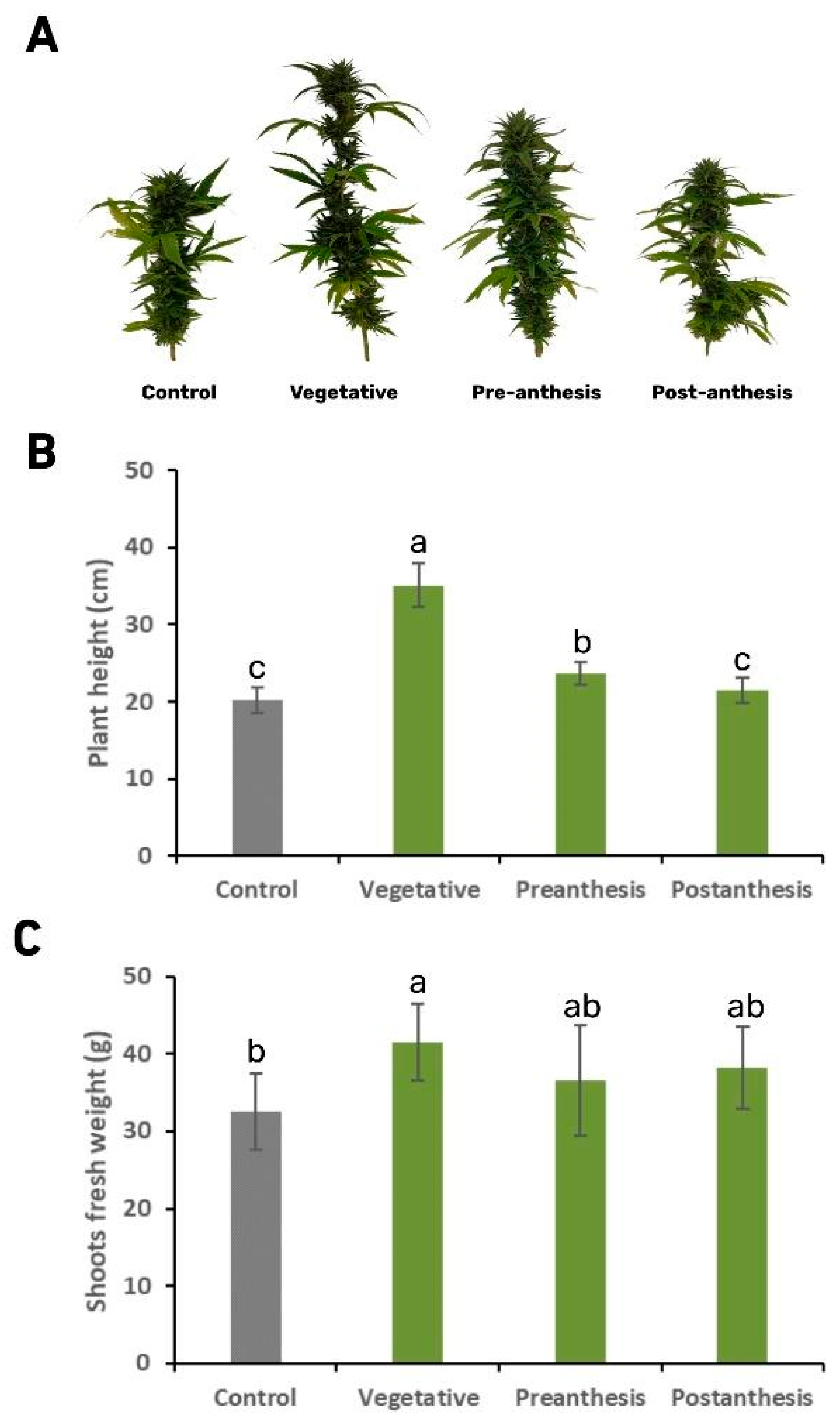
A preliminary trial was conducted to evaluate the efficacy of the biostimulant and to identify the optimal timing of application in Cannabis sativa var. Carmagnola Selezionata (CS). Plants were established under controlled conditions, transplanted to the field, and treated at different phenological stages (vegetative, pre-anthesis, and post-anthesis). Biostimulant application significantly affected plant growth, with the strongest response observed when applied at the vegetative stage. This treatment resulted in the greatest increase in plant height and shoot fresh biomass compared to the control, while pre-anthesis application produced moderate effects and post-anthesis treatment showed no improvement. These results indicate that application timing is critical, with the vegetative stage being the most effective for promoting growth and biomass accumulation (Figure 1).

3.2. Vegetative-Stage Application: Biomass Allocation and Cannabinoid Profile

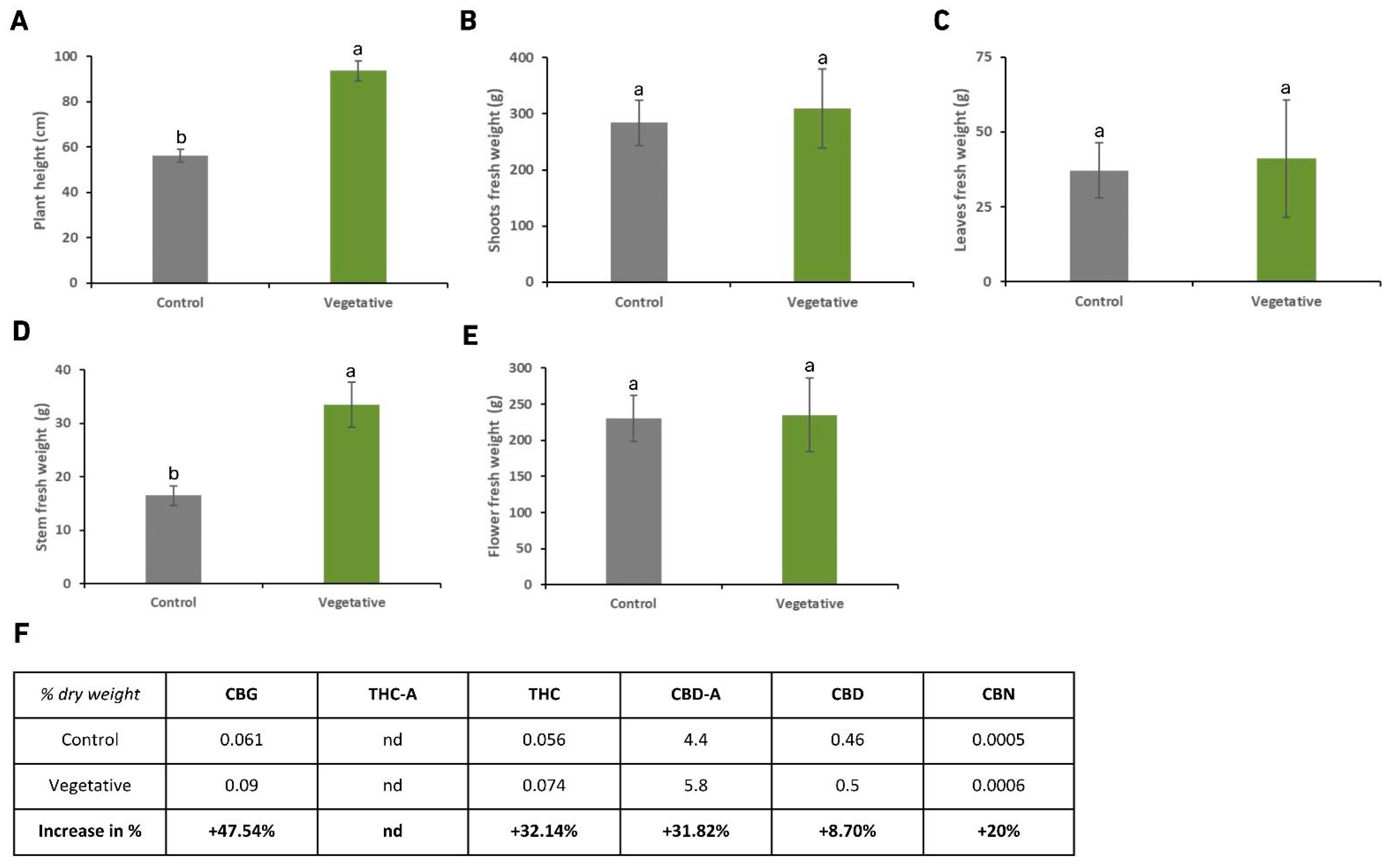
A second trial was conducted to validate the effects of vegetative-stage application and to further evaluate biomass allocation and cannabinoid accumulation. Vegetative application significantly increased plant height, thereby confirming the preliminary findings, while total shoot fresh weight exhibited a non-significant upward trend. Analysis of biomass allocation revealed a significant increase in stem fresh weight, whereas leaf and flower fresh weights were not significantly affected. Cannabinoid profiling, based on a single pooled biological sample and therefore considered exploratory, and presented to indicate trends, showed higher values for several cannabinoids in treated plants compared to the control. Specifically, cannabidiolic acid (CBD-A) showed a 31.82% higher value, cannabidiol (CBD) 8.70%, cannabigerol (CBG) 47.54%, and cannabinol (CBN) 20%. THC values were 37% higher relative to the control, reaching 0.074% on a dry weight basis, while THC-A was undetectable. This concentration remains well below regulatory thresholds and is consistent with the industrial hemp profile of CS. Overall, these results suggest that vegetative-stage application enhances plant growth and may positively influence cannabinoid biosynthesis (Figure 2).

3.3. Validation Under Production Conditions and Across Chemotypes

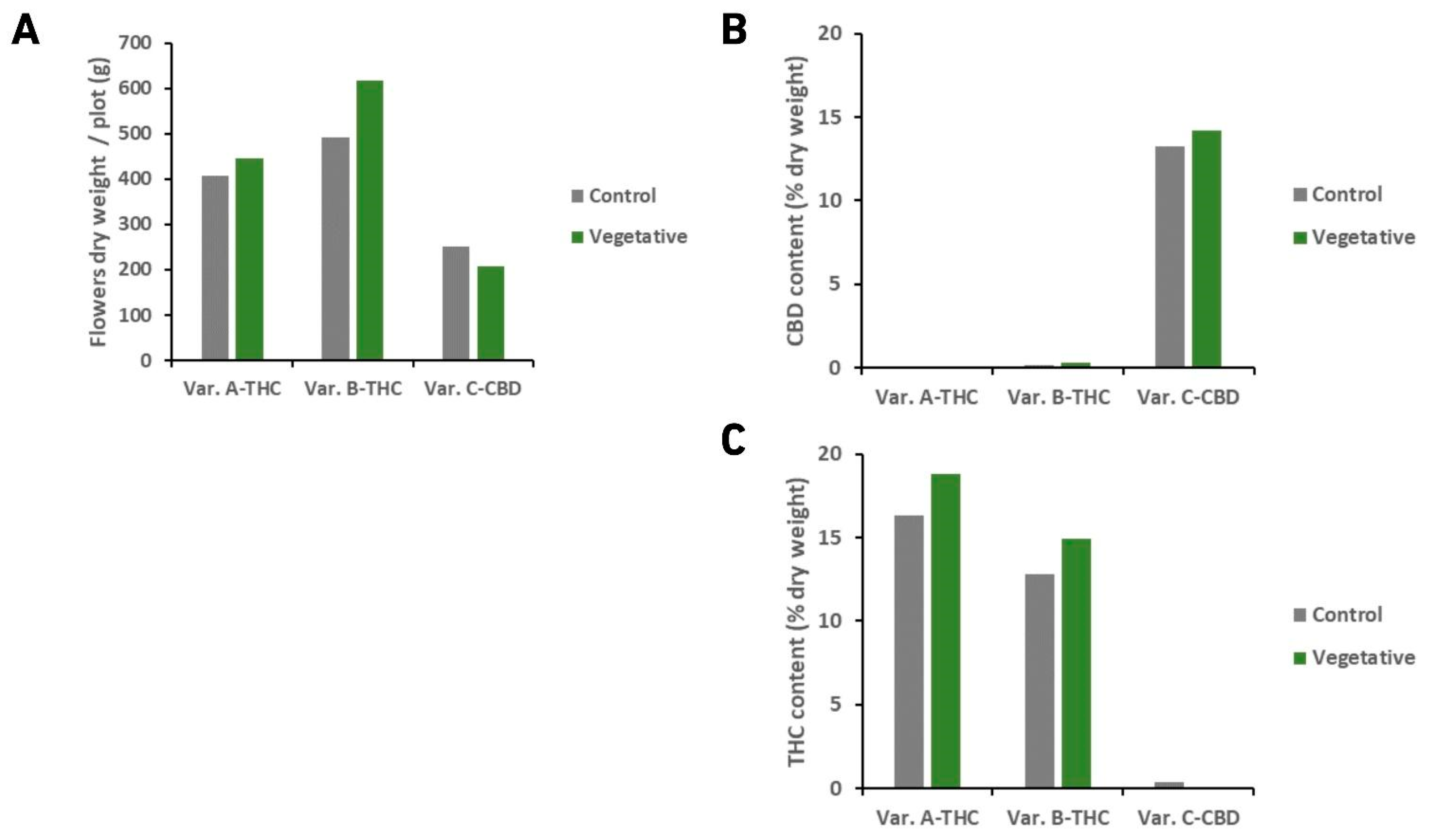
To assess performance under commercial conditions, a greenhouse validation trial was conducted using Cannabis sativa varieties with contrasting chemotypes (THC-rich and CBD-rich). Vegetative-stage biostimulant application resulted in higher flower yield values in THC-dominant varieties, whereas lower values were observed in the CBD-rich genotype compared to the control. Cannabinoid analysis of pooled flower samples (single measurements per treatment) showed a chemotype-dependent pattern: higher THC values were observed in THC-rich varieties, while higher CBD values were observed in the CBD-dominant genotype. Although exploratory, these results suggest a potential chemotype-specific response in yield and cannabinoid accumulation under production conditions (Figure 3).

4. Discussion

This study shows that the botanical biostimulant Tricostimulant™ enhances plant height, growth, and cannabinoid accumulation in Cannabis sativa, with the strongest effects when applied during the vegetative stage. These findings support the idea that early stimulation of physiological and metabolic processes improves resource allocation to both vegetative and reproductive tissues, increasing yield and promoting biosynthesis of bioactive compounds [39,40]. These results align with timing-dependent biostimulant responses reported in other crops and highlight the importance of optimized application strategies in precision agriculture [41].
The study also suggests a chemotype-dependent effect on cannabinoid accumulation: CBD and CBD-A increase in CBD-dominant plants, while THC rises in THC-dominant chemotypes. We hypothesize that this selective modulation may involve an enhanced metabolic flux toward the common precursor CBG-A, resulting in final cannabinoid profiles that reflect each chemotype’s specific enzymatic balance. Such selectivity may be critical for ensuring product standardization, therapeutic consistency, and regulatory compliance [31]. Nevertheless, further investigation is required to validate these preliminary findings and hypotheses.
Cannabinoid biosynthesis occurs in glandular trichomes, mainly located on female flowers and nearby leaves, while other tissues (e.g., stems and fan leaves) typically contain much lower cannabinoid levels [35,42]. Since the primary growth responses in this study were increases in plant height and stem biomass, along with a positive effect on flower biomass, future studies should determine whether Tricostimulant™ enhances trichome density or increases biosynthetic activity within existing trichomes.
Plant architecture (particularly height, branches, and light penetration) is linked to vertical gradients in cannabinoid concentration, with upper canopy sections often showing higher cannabinoid levels. Although factors such as light exposure, spectral quality, and photosynthetic activity have been proposed as drivers of these gradients, their direct relationship with cannabinoid biosynthesis remains unclear and requires further investigation [43,44,45,46].
Overall, the results highlight Tricostimulant™ as a promising and sustainable solution for boosting biomass, yield, and enhancing the therapeutic potential of Cannabis sativa. The formulation, which combines botanical extracts (Centella asiatica, Echinacea purpurea, Taraxacum officinale, Urtica dioica, and fermented rice extract), with some of them with established biostimulant properties individually [17,47,48], presents an innovative approach to precision agriculture in cannabis. Notably, its specific application in this crop has not been documented previously.
To clarify its mode of action, future studies should integrate molecular, biochemical, and agronomic analyses, including gene expression, enzyme activity, metabolomics, and trichome quantification across canopy positions and chemotypes. Beyond yield improvement, biostimulants offer a sustainable strategy to enhance low-abundance bioactive compounds, supporting product standardization, regulatory compliance, and more eco-efficient, high-value cultivation systems [18,49,50].
In summary, Tricostimulant™ shows strong potential to enhance both biomass production and cannabinoid accumulation when applied during the vegetative stage, thus supporting more consistent and sustainable cultivation. Future research should confirm these findings with a larger number of replicates and incorporate in-depth molecular, metabolomic, and physiological analyses to further elucidate its mechanisms of action. Overall, these results underscore the importance of MAP-targeted biostimulants in advancing the cultivation of medicinal plants.

Author Contributions

C.A.-D., D.M.-P., L.G., M.C., J.L.V.-G. and L.M.-H. conceived and designed the experiments. C.A.-D., D.M.-P., L.G., J.L.V.-G., E.H.-B., A.A.-P., V.S.-R., B.P. and L.M.-H. performed the experiments. C.A.-D., M.C., E.H.-B., L.G., D.B.-G., L.M.-H. and L.C. analyzed the data. E.H.-B., L.M.-H. and L.C. wrote, reviewed, and edited the manuscript with input and comments from all other authors. All authors have read and agreed to the published version of the manuscript.

Funding

This work was supported by a co-funding grant (SNEO-20211348) from Centre for Technological Development and Innovation (CDTI), and diverse MICINN/AEI fellowships. J.L.V.-G. and L.C. were supported by Torres Quevedo Programme (PTQ-2019-010428 and PTQ2022-012388 respectively); while V.S.-R. was supported by the Industrial PhD Programme (DIN2020-011072).

Data Availability Statement

The original contributions presented in this study are included in the article. Further inquiries can be directed to the corresponding author.

Conflicts of Interest

The authors declare no conflicts of interest. The biostimulant Tricostimulant™ discussed in this study was developed, produced, and commercialized by Biotech Tricopharming Research SL, with most of the authors affiliated with the company. This commercial relationship did not influence the design, execution, or interpretation of the study.

References

  1. Du Jardin, P. Plant Biostimulants: Definition, Concept, Main Categories and Regulation. Sci. Hortic. 2015, 196, 3–14. [Google Scholar] [CrossRef]
  2. Khoulati, A.; Ouahhoud, S.; Taibi, M.; Ezrari, S.; Mamri, S.; Merah, O.; Hakkou, A.; Addi, M.; Maleb, A.; Saalaoui, E. Harnessing Biostimulants for Sustainable Agriculture: Innovations, Challenges, and Future Prospects. Discov. Agric. 2025, 3, 56. [Google Scholar] [CrossRef]
  3. Rabhi, M.L.; Derbak, L.; Bendif, H.; Boufahja, F.; Abu-Elsaoud, A.M.; Garzoli, S. Seaweed-Derived Biostimulants for Sustainable Crop Production: A Review. J. Biotechnol. 2025, 408, 201–216. [Google Scholar] [CrossRef]
  4. Sun, W.; Shahrajabian, M.H.; Kuang, Y.; Wang, N. Amino Acids Biostimulants and Protein Hydrolysates in Agricultural Sciences. Plants 2024, 13, 210. [Google Scholar] [CrossRef]
  5. Du Jardin, P.; Brown, P.H.; DeJong, T.M.; Cassán, F.; Ferrante, A.; Fotopoulos, V.; Manganaris, G.A.; Carillo, P. Unlocking the Black Box of Plant Biostimulants. Sci. Hortic. 2025, 350, 114281. [Google Scholar] [CrossRef]
  6. Johnson, R.; Joel, J.M.; Puthur, J.T. Biostimulants: The Futuristic Sustainable Approach for Alleviating Crop Productivity and Abiotic Stress Tolerance. J. Plant Growth Regul. 2024, 43, 659–674. [Google Scholar] [CrossRef]
  7. Sible, C.N.; Seebauer, J.R.; Below, F.E. Plant Biostimulants: A Categorical Review, Their Implications for Row Crop Production, and Relation to Soil Health Indicators. Agronomy 2021, 11, 1297. [Google Scholar] [CrossRef]
  8. Pingali, P.L. Green Revolution: Impacts, Limits, and the Path Ahead. Proc. Natl. Acad. Sci. USA 2012, 109, 12302–12308. [Google Scholar] [CrossRef]
  9. Food and Agriculture Organization (FAO). Feeding the World in 2050; FAO: Rome, Italy, 2009. [Google Scholar]
  10. FAO. Scientific Review of the Impact of Climate Change on Plant Pests; FAO on behalf of the IPPC Secretariat: Rome, Italy, 2021; ISBN 978-92-5-134435-4. [Google Scholar]
  11. Truzzi, E.; Benvenuti, S.; Bertelli, D.; Francia, E.; Ronga, D. Effects of Biostimulants on the Chemical Composition of Essential Oil and Hydrosol of Lavandin (Lavandula x intermedia Emeric ex Loisel.) Cultivated in Tuscan-Emilian Apennines. Molecules 2021, 26, 6157. [Google Scholar] [CrossRef]
  12. Cardone, L.; Polito, F.; Denora, M.; Casiello, D.; Castronuovo, D.; Cicco, N.; Perniola, M.; De Feo, V.; Candido, V. Effects of Biostimulant Foliar Applications on Morphological Traits, Yield, Antioxidant Capacity, and Essential Oil Composition of Thymus vulgaris L. Under Field Conditions. Agronomy 2025, 15, 442. [Google Scholar] [CrossRef]
  13. Farruggia, D.; Di Miceli, G.; Licata, M.; Leto, C.; Salamone, F.; Novak, J. Foliar Application of Various Biostimulants Produces Contrasting Response on Yield, Essential Oil and Chemical Properties of Organically Grown Sage (Salvia officinalis L.). Front. Plant Sci. 2024, 15, 1397489. [Google Scholar] [CrossRef]
  14. Farruggia, D.; Tortorici, N.; Iacuzzi, N.; Alaimo, F.; Leto, C.; Tuttolomondo, T. Biostimulants Improve Plant Performance of Rosemary Growth in Agricultural Organic System. Agronomy 2024, 14, 158. [Google Scholar] [CrossRef]
  15. Giannoulis, K.D.; Bartzialis, D.; Asimaki, K.; Breza, A.-Z.; Malamou, P.-K.; Zournatzis, E.; Wogiatzi-Kamvoukou, E.; Danalatos, N.G. The Impact of Biostimulants on the Yield and Quality Attributes of Essential Oil from Different Basil Varieties. Crops 2025, 5, 14. [Google Scholar] [CrossRef]
  16. Shahrajabian, M.H.; Sun, W. Sustainable Approaches to Boost Yield and Chemical Constituents of Aromaticand Medicinal Plants by Application of Biostimulants. Recent Adv. Food Nutr. Agric. 2022, 13, 72–92. [Google Scholar] [CrossRef]
  17. Hernández-Bolaños, E.; Sánchez-Retuerta, V.; Matías-Hernández, L.; Cuyas, L. Promising Applications on the Use of Medicinal and Aromatic Plants in Agriculture. Discov. Agric. 2025, 3, 36. [Google Scholar] [CrossRef]
  18. Sun, W.; Shahrajabian, M.H.; Petropoulos, S.A.; Shahrajabian, N. Developing Sustainable Agriculture Systems in Medicinal and Aromatic Plant Production by Using Chitosan and Chitin-Based Biostimulants. Plants 2023, 12, 2469. [Google Scholar] [CrossRef] [PubMed]
  19. García-García, A.L.; Matos, A.R.; Feijão, E.; Cruz de Carvalho, R.; Boto, A.; Marques da Silva, J.; Jiménez-Arias, D. The Use of Chitosan Oligosaccharide to Improve Artemisinin Yield in Well-Watered and Drought-Stressed Plants. Front. Plant Sci. 2023, 14, 1200898. [Google Scholar] [CrossRef] [PubMed]
  20. Boutahiri, S.; Benrkia, R.; Tembeni, B.; Idowu, O.E.; Olatunji, O.J. Effect of Biostimulants on the Chemical Profile of Food Crops under Normal and Abiotic Stress Conditions. Curr. Plant Biol. 2024, 40, 100410. [Google Scholar] [CrossRef]
  21. ElSohly, M.A.; Radwan, M.M.; Gul, W.; Chandra, S.; Galal, A. Phytochemistry of Cannabis sativa L. In Phytocannabinoids—Unraveling the Complex Chemistry and Pharmacology of Cannabis sativa; Progress in the Chemistry of Organic Natural Products; Springer: Cham, Switzerland, 2017; Volume 103, pp. 1–36. [Google Scholar] [CrossRef]
  22. Laaboudi, F.-Z.; Rejdali, M.; Amhamdi, H.; Salhi, A.; Elyoussfi, A.; Ahari, M. In the Weeds: A Comprehensive Review of Cannabis; Its Chemical Complexity, Biosynthesis, and Healing Abilities. Toxicol. Rep. 2024, 13, 101685. [Google Scholar] [CrossRef] [PubMed]
  23. Saifi, M.S.; Arif, M.; Kaish, M.D.; Kushwaha, S.P. Cannabis sativa L.—An Important Medicinal Plant: A Review of Its Phytochemistry, Pharmacological Activities and Applications in Sustainable Economy. Int. J. Pharma Prof. Res. IJPPR 2023, 14, 43–59. [Google Scholar] [CrossRef]
  24. Hourfane, S.; Mechqoq, H.; Bekkali, A.Y.; Rocha, J.M.; El Aouad, N. A Comprehensive Review on Cannabis sativa Ethnobotany, Phytochemistry, Molecular Docking and Biological Activities. Plants 2023, 12, 1245. [Google Scholar] [CrossRef] [PubMed]
  25. Kaminski, K.P.; Hoeng, J.; Lach-Falcone, K.; Goffman, F.; Schlage, W.K.; Latino, D. Exploring Aroma and Flavor Diversity in Cannabis sativa L.—A Review of Scientific Developments and Applications. Molecules 2025, 30, 2784. [Google Scholar] [CrossRef]
  26. De Meijer, E.P.M.; Bagatta, M.; Carboni, A.; Crucitti, P.; Moliterni, V.M.C.; Ranalli, P.; Mandolino, G. The Inheritance of Chemical Phenotype in Cannabis sativa L. Genetics 2003, 163, 335–346. [Google Scholar] [CrossRef]
  27. Sawler, J.; Stout, J.M.; Gardner, K.M.; Hudson, D.; Vidmar, J.; Butler, L.; Page, J.E.; Myles, S. The Genetic Structure of Marijuana and Hemp. PLoS ONE 2015, 10, e0133292. [Google Scholar] [CrossRef]
  28. Wang, S.; Zhong, X.; Cheng, Y.; Yu, Y.; Wan, J.; Liu, Q.; Shu, Y.; Wu, X.; Li, Y. Pan-Genome Analysis of Cannabis sativa: Insights on Genomic Diversity, Evolution, and Environment Adaption. Int. J. Mol. Sci. 2025, 26, 8354. [Google Scholar] [CrossRef]
  29. Pertwee, R. (Ed.) Handbook of Cannabis; Oxford University Press: Oxford, UK, 2014; ISBN 978-0-19-966268-5. [Google Scholar]
  30. Jin, D.; Henry, P.; Shan, J.; Chen, J. Identification of Chemotypic Markers in Three Chemotype Categories of Cannabis Using Secondary Metabolites Profiled in Inflorescences, Leaves, Stem Bark, and Roots. Front. Plant Sci. 2021, 12, 699530. [Google Scholar] [CrossRef] [PubMed]
  31. Tahir, M.N.; Raz, F.S.; Rondeau-Gagné, S.; Trant, J.F. The Biosynthesis of the Cannabinoids. J. Cannabis Res. 2021, 3, 7. [Google Scholar] [CrossRef]
  32. Melzer, R.; McCabe, P.F.; Schilling, S. Evolution, Genetics and Biochemistry of Plant Cannabinoid Synthesis: A Challenge for Biotechnology in the Years Ahead. Curr. Opin. Biotechnol. 2022, 75, 102684. [Google Scholar] [CrossRef]
  33. Gülck, T.; Møller, B.L. Phytocannabinoids: Origins and Biosynthesis. Trends Plant Sci. 2020, 25, 985–1004. [Google Scholar] [CrossRef]
  34. Kearsey, L.J.; Yan, C.; Prandi, N.; Toogood, H.S.; Takano, E.; Scrutton, N.S. Biosynthesis of Cannabigerol and Cannabigerolic Acid: The Gateways to Further Cannabinoid Production. Synth. Biol. 2023, 8, ysad010. [Google Scholar] [CrossRef] [PubMed]
  35. Livingston, S.J.; Bae, E.J.; Unda, F.; Hahn, M.G.; Mansfield, S.D.; Page, J.E.; Samuels, A.L. Cannabis Glandular Trichome Cell Walls Undergo Remodeling to Store Specialized Metabolites. Plant Cell Physiol. 2021, 62, 1944–1962. [Google Scholar] [CrossRef]
  36. De Prato, L.; Timmins, M.; Ansari, O.; Ruthrof, K.X.; Hardy, G.E.S.J.; Howieson, J.; O’Hara, G. Semi-Quantitative Analysis of Cannabinoids in Hemp (Cannabis sativa L.) Using Gas Chromatography Coupled to Mass Spectrometry. J. Cannabis Res. 2022, 4, 51. [Google Scholar] [CrossRef] [PubMed]
  37. Azwell, T.; Ciotti, C.; Adams, A.; Pauli, G.F. Variation among Hemp (Cannabis sativus L.) Analytical Testing Laboratories Evinces Regulatory and Quality Control Issues for the Industry. J. Appl. Res. Med. Aromat. Plants 2022, 31, 100434. [Google Scholar] [CrossRef]
  38. Jardim, C.; Delgado-Charro, M.B. The Regulatory Environment Surrounding Cannabis Medicines in the EU, the USA, and Australia. Pharmaceutics 2025, 17, 635. [Google Scholar] [CrossRef] [PubMed]
  39. Lucini, L.; Rouphael, Y.; Cardarelli, M.; Bonini, P.; Baffi, C.; Colla, G. A Vegetal Biopolymer-Based Biostimulant Promoted Root Growth in Melon While Triggering Brassinosteroids and Stress-Related Compounds. Front. Plant Sci. 2018, 9, 472. [Google Scholar] [CrossRef]
  40. Rouphael, Y.; Colla, G. Editorial: Biostimulants in Agriculture. Front. Plant Sci. 2020, 11, 40. [Google Scholar] [CrossRef]
  41. Andreotti, C.; Rouphael, Y.; Colla, G.; Basile, B. Rate and Timing of Application of Biostimulant Substances to Enhance Fruit Tree Tolerance toward Environmental Stresses and Fruit Quality. Agronomy 2022, 12, 603. [Google Scholar] [CrossRef]
  42. Mahlberg, P.G.; Kim, E.S. Accumulation of Cannabinoids in Glandular Trichomes of Cannabis (Cannabaceae). J. Ind. Hemp 2004, 9, 15–36. [Google Scholar] [CrossRef]
  43. Bernstein, N.; Gorelick, J.; Koch, S. Interplay between Chemistry and Morphology in Medical Cannabis (Cannabis sativa L.). Ind. Crops Prod. 2019, 129, 185–194. [Google Scholar] [CrossRef]
  44. Danziger, N.; Bernstein, N. Shape Matters: Plant Architecture Affects Chemical Uniformity in Large-Size Medical Cannabis Plants. Plants 2021, 10, 1834. [Google Scholar] [CrossRef]
  45. Kotiranta, S.; Sarka, A.; Kotilainen, T.; Palonen, P. Decreasing R:FR Ratio in a Grow Light Spectrum Increases Inflorescence Yield but Decreases Plant Specialized Metabolite Concentrations in Cannabis sativa. Environ. Exp. Bot. 2025, 229, 106059. [Google Scholar] [CrossRef]
  46. Garrido, J.; Corral, C.; García-Valverde, M.T.; Hidalgo-García, J.; Ferreiro-Vera, C.; Martínez-Quesada, J.J. Subcanopy and Inter-Canopy Supplemental Light Enhances and Standardizes Yields in Medicinal Cannabis (Cannabis sativa L.). Plants 2025, 14, 1469. [Google Scholar] [CrossRef] [PubMed]
  47. Sarin, P.; Boonlue, S.; Mongkolthanaruk, W.; Riddech, N. Enhancing Rice Seedling Growth in Acidic Soil Using Fermented Raw Rice Husk as Soil Amendment. J. Soil Sci. Plant Nutr. 2024, 24, 7543–7557. [Google Scholar] [CrossRef]
  48. Adisti, J.P.; Suwirmen, S.; Idris, M. The Effect of Centella (Centella asiatica (L.) Urb.) Extract with Several Types of Solvents as a Biostimulant on the Growth of Pagoda Mustard (Brassica rapa var. narinosa L.). J. Biol. UNAND 2023, 11, 54–61. [Google Scholar] [CrossRef]
  49. Malík, M.; Velechovský, J.; Praus, L.; Janatová, A.; Kahánková, Z.; Klouček, P.; Tlustoš, P. Amino Acid Supplementation as a Biostimulant in Medical Cannabis (Cannabis sativa L.). Plant Nutr. Front. Plant Sci. 2022, 13, 868350. [Google Scholar] [CrossRef]
  50. Garrido, J.; Rico, S.; Corral, C.; Sánchez, C.; Vidal, N.; Martínez-Quesada, J.J.; Ferreiro-Vera, C. Exogenous Application of Stress-Related Signaling Molecules Affect Growth and Cannabinoid Accumulation in Medical Cannabis (Cannabis sativa L.). Front. Plant Sci. 2022, 13, 1082554. [Google Scholar] [CrossRef]
Figure 1. Representative Cannabis sativa plants at harvest (two months after transplanting) (A). Treatments were applied at different phenological stages: vegetative, pre-anthesis, and post-anthesis. Effects of biostimulant application timing on plant height (B) and shoot fresh weight (C) are shown. Values represent means ± standard deviation (n = 7). Different letters indicate statistically significant differences among treatments according to Duncan’s post hoc test (p < 0.05), following one-way ANOVA.
Ijpb 17 00018 g001
Figure 2. Effect of biostimulant application during the vegetative stage on plant height (A), shoot fresh weight (B), leaf fresh weight (C), stem fresh weight (D), flower fresh weight (E), and targeted cannabinoid quantification analysis (F) of Cannabis sativa var. Carmagnola Selezionata (CS). Values are expressed as means ± standard deviation (n = 7–8). Different letters indicate statistically significant differences among treatments according to one-way ANOVA followed by Duncan’s multiple range post hoc test (p < 0.05). Targeted cannabinoid quantification analysis was performed using a single biological replicate per treatment, indicating a trend rather than statistically significant differences.
Ijpb 17 00018 g002
Figure 3. Effects of biostimulant application during the vegetative stage on flower dry weight per plot (g) (A) and cannabinoid content (% dry weight), including CBD (B) and THC (C), in three Cannabis sativa varieties with differing predominant cannabinoid profiles: Var. A and Var. B (THC-rich), and Var. C (CBD-rich). All values correspond to a single biological replicate per treatment, indicating a trend rather than statistically significant differences.
Ijpb 17 00018 g003
Disclaimer/Publisher’s Note: The statements, opinions and data contained in all publications are solely those of the individual author(s) and contributor(s) and not of MDPI and/or the editor(s). MDPI and/or the editor(s) disclaim responsibility for any injury to people or property resulting from any ideas, methods, instructions or products referred to in the content.