Article

Effects of Different Mineral, Foliar Macro- and Micronutrient, and Biofertilizer Fertilization Strategies on Oil Flax (Linum usitatissimum L.) Yield and Seed Quality Under Semi-Arid Rainfed Conditions


by
Almagul Malimbayeva
1,
Batyrgali Amangaliev
1,
Erbol Zhusupbekov
1,
Akerke Soltanayeva
1,
Aina Sagimbayeva
2,
Zhuldyz Oshakbayeva
3,
Karlyga Rustemova
1 and
Maksat Batyrbek
1,*
1
Kazakh Research Institute of Agriculture and Plant Growing, Almalybak 040909, Almaty, Kazakhstan
2
Department of Soil Science, Agrochemistry and Ecology, Faculty of Agrobiology, Kazakh National Agrarian Research University, Almaty 050010, Kazakhstan
3
Department of Standardization and Food Technologies, Kostanay Engineering and Economics University Named after M. Dulatov, Kostanay 110007, Kazakhstan
*
Author to whom correspondence should be addressed.
Int. J. Plant Biol. 2026, 17(3), 19; https://doi.org/10.3390/ijpb17030019
Submission received: 28 January 2026 / Revised: 12 February 2026 / Accepted: 25 February 2026 / Published: 3 March 2026
(This article belongs to the Section Plant Physiology)

Abstract

Efficient nutrient management is essential for enhancing flax productivity under semi-arid conditions. A two-year field experiment (2024–2025) was conducted in southeast Kazakhstan to evaluate the effects of integrated foliar fertilization with macro- and micronutrients and biofertilizers on the growth, seed quality, and yield of flax (Linum usitatissimum L.). The experiment was arranged in a randomized complete block design with five treatments: T1 (control, absolute zero fertilization (N0P0K0), i.e., soil without any additional nutrient applications), T2 (N60P60K60), T3 (N60P60K60 + foliar macro–micronutrients), T4 (biofertilizer), and T5 (N60P60K60 + foliar macro–micronutrients + biofertilizer). Integrated foliar fertilization significantly increased nitrogen, phosphorus, and potassium concentrations in vegetative biomass and seeds, leading to higher nutrient uptake and improved nutrient use efficiency compared with mineral fertilization alone. Treatments combining foliar macro- and micronutrients with biofertilizers (T3 and T5) enhanced plant establishment, biomass accumulation, and dry matter allocation to reproductive organs. Seed yield increased from 0.58 to 0.89 t ha−1, while protein and oil contents ranged from 27.0 to 28.4% and 39.8–41.8%, respectively. The combined foliar treatment showed the highest and most stable performance, likely due to improved nutrient uptake and plant growth. These findings indicate that integrated foliar fertilization is an effective and sustainable strategy for improving flax yield stability, nutrient efficiency, and seed quality under semi-arid conditions.

1. Introduction

Flax (Linum usitatissimum L.) is one of the world’s most important natural fiber crops and ranks among the top oilseed species [1,2,3]. It is a highly versatile plant, as every part of the plant has an economic use. Major flax-producing countries include Canada, the United States, China, Argentina, India, and several European nations [4,5]. In recent years, Kazakhstan has significantly expanded its flax cultivation area, with plans to reach nearly 1 million hectares by 2026 [6]. Flax holds an important position in the global market due to its technical-grade oil, and the seeds are widely used for oil extraction [7]. Flaxseed oil is recognized as a high-quality edible vegetable oil of considerable nutritional and commercial importance [8,9], and is also regarded as an essential nutraceutical that is increasingly incorporated into functional foods due to its proven health benefits [10,11]. With growing interest in flax-derived functional foods and dietary supplements, there is increasing demand for strategies to enhance crop productivity [12].
Oil flax is predominantly grown in dryland ecological zones, where it is valued for its tolerance to cold and drought stress [13,14]. Improving nutrient management is critical for maintaining productivity under such environmental conditions. Mineral fertilizers are widely used to optimize seed yield and composition in oilseed crops, as they provide essential macronutrients required for growth and yield formation [15,16].
In addition to mineral fertilizers, biofertilizers play a significant role in improving plant growth. They enhance photosynthesis, hormone levels, ion uptake, nucleic acid synthesis, and protein formation, ultimately contributing to improved plant development [17]. However, soil fertilization alone is often insufficient, particularly under dryland conditions, making foliar fertilization an important complementary strategy. Because leaf tissue has the same morphological structure as root tissue, plants may rapidly absorb dissolved minerals. As a result, foliar fertilization can effectively manage soil micro-element deficit [18].
Humans need more than 50 important nutrients, such as proteins, fatty acids, energy sources, and macro- and micronutrients [19], making nutrient-rich crops particularly important. Crop yield and quality can be improved using various fertilization methods such as soil application, fertigation, and foliar feeding [20,21]. Foliar fertilization is especially useful when soil conditions limit nutrient availability [22]. Foliar application of macro- and micronutrients can quickly alleviate nutrient deficiencies and reduce the risk of toxicity due to the small quantities required compared with soil fertilization. This method is particularly effective for supplying critical micronutrients such as boron (B) and zinc (Zn). Multi-nutrient foliar applications have been widely reported to enhance yield performance across different crop species, including cereals such as wheat [23] and maize [24], often exceeding the effects of single-nutrient treatments.
Although the benefits of individual fertilization strategies are well recognized, there is limited information on how the combined application of soil-applied macronutrients with foliar-applied macro- and micronutrients, along with biofertilizers, affects flaxseed yield, oil content, protein content, and overall quality, particularly under semi-arid conditions. Therefore, the aim of this study was to evaluate the effects of integrating soil-applied macronutrients with foliar applications of macro- and micronutrients and biofertilizers on the productivity and seed quality of oil flax grown in the semi-arid regions of Kazakhstan.

2. Materials and Methods

2.1. Experimental Design and Treatments

The field experiment was conducted in the growing seasons of 2024 and 2025 at the experimental site of the Kazakh Research Institute of Agriculture and Plant Growing, which is situated in a semi-arid climate zone in southeast Kazakhstan (43°13′ N, 76°40′ E; 740 m a.s.l.). The oil flax variety ‘Karabalyksky’ was used in this study. Sowing was conducted on 1 April 2024 and 5 April 2025, and harvested on 21 July 2024 and 25 July 2025, respectively. The soil of the experimental site is classified as light chestnut soil (corresponding to Kas-tanozem in the WRB system), developed on loess-like loam, with a medium loamy texture and a humus horizon of 0–46 cm. With total nitrogen, phosphorus, and potassium concentrations of 0.15%, 0.21%, and 1.67%, respectively, the arable layer has a humus content of 1.60–1.90%. The soil reaction was alkaline, with a pH of 7.8.
The content of plant-available nutrients was as follows: nitrate nitrogen (NO3–N) 19 mg kg−1, available phosphorus 10 mg kg−1, and exchangeable potassium 197 mg kg−1. Available micronutrient concentrations were: boron 0.09 mg kg−1, zinc 0.07 mg kg−1, iron 1.61 mg kg−1, manganese 2.3 mg kg−1, and copper 0.2 mg kg−1.
The alkaline soil reaction is known to limit the availability of several micronutrients, particularly boron and zinc, which supports the rationale for foliar application in the present study. The experiment followed a single-factor randomized complete block design with three replications. Five treatments were evaluated: T1 (control, absolute zero fertilization N0P0K0, i.e., soil without any additional nutrient applications), T2 (N60P60K60), T3 (N60P60K60 + foliar macro- and micronutrients), T4 (N60P60K60 + foliar biofertilizer), and T5 (N60P60K60 + combined foliar biofertilizer and macro- and micronutrients). Each plot covered 25 m2, with 50 cm spacing between plots, 50 cm between blocks, and a 1 m protective buffer around the experiment. The flax variety ‘Karabalyksky’ was sown at a rate of 40 kg ha−1 at a depth of 2–3 cm.
Basal fertilization consisted of 60 kg ha−1 each of nitrogen, phosphorus, and potassium, applied using urea (46% N), monoammonium phosphate (12% N, 52% P2O5), and potassium sulfate (50% K2O), respectively. The foliar biofertilizer Terra Sorb Complex was used at 2 L ha−1, containing 20% free amino acids, 5% organic nitrogen, 5.5% total nitrogen, 1.5% boron, 0.1% manganese, 0.25% copper, 0.1% zinc, 1% iron, 0.8% magnesium, 0.001% molybdenum, and 25% organic matter. It was applied at 2 L ha−1 during the 5–6 leaf stage, 8–9 leaf stage, budding, and flowering phases. Foliar macro- and micronutrient application consisted of a tank mixture containing urea (46% N) 5 kg ha−1, magnesium sulfate (Mg-16%, SO3-32%) 1 kg ha−1, monopotassium phosphate (P2O5-52%, K2O-34%) or potassium sulfate (K2O-51%, SO4-45%) 1 kg ha−1, and the micronutrient formulations Bortrac 150 (11% B, 4,7% N +adjuvants) and Zintrac 700 (40% Zn, 1% N+ adjuvants) 0.1 kg ha−1 each. This mixture was applied at the same four growth stages as the biofertilizer.
Protein content was measured using the Kjeldahl method, and oil content was determined using infrared spectroscopy [25]. Oil yield was calculated using the formula: Oil yield (kg ha−1) = oil content (%) × seed yield (kg ha−1). Nitrogen (N) concentration was determined using the Kjeldahl method, while phosphorus (P) and potassium (K) contents were analyzed following wet digestion using standard spectrophotometric and flame photometric techniques, respectively [26]. Seed yield (kg ha−1), 1000-seed weight (g), plant height, capsule number per plant, and dry weight (biomass, g) were recorded following harvest.

2.2. Experimental Site and Climatic Conditions

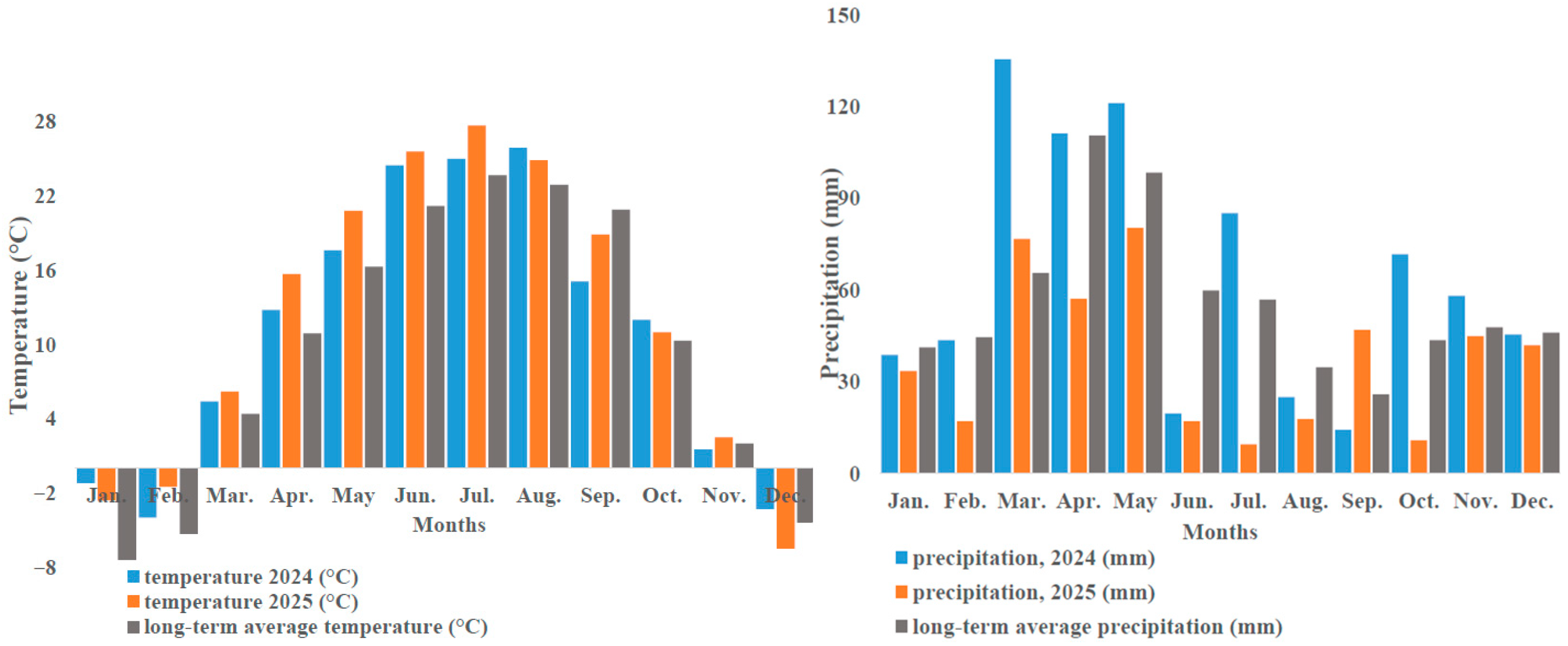
Weather conditions during the flax growing season (April–August) in 2024 and 2025 were characterized using monthly mean air temperature and total precipitation data obtained from a nearby meteorological station (Figure 1). Climatic data were compared with long-term averages to assess deviations from normal conditions. During the 2024 growing season, mean air temperatures were generally slightly higher than the long-term average, particularly from May to August. Precipitation was above the long-term average in early growth stages (April–May), providing favorable moisture conditions for crop establishment and vegetative growth. In contrast, June and July experienced markedly lower rainfall than the long-term average, indicating periods of moisture stress during reproductive development. In 2025, growing season temperatures were consistently higher than the long-term average across most months, with pronounced warming in May and July. Precipitation during 2025 was substantially lower than the long-term average throughout much of the growing season, especially in June and July, resulting in relatively dry conditions during flowering and seed filling. Overall, the two growing seasons differed markedly in thermal and moisture regimes, enabling assessment of treatment effects under contrasting temperature and precipitation conditions.

2.3. Statistical Analysis

The data were analyzed using analysis of variance (ANOVA), with year and treatment considered as fixed effects. Treatment means were compared using the least significant difference (LSD) test at a significance level of p ≤ 0.05. All statistical analyses were performed using IBM SPSS Statistics 27, and results are reported as mean values with corresponding significance groupings.

3. Results

3.1. Oilseed Nitrogen, Phosphorus, and Potassium Content

Fertilization treatments significantly affected nitrogen (N), phosphorus (P), and potassium (K) concentrations in oilseeds during both the 2024 and 2025 growing seasons (Table 1). Treatments involving foliar nutrient applications resulted in higher nutrient accumulation compared with the unfertilized control and sole mineral fertilization. In 2024, oilseed N content ranged from 2.16% in the control (T1) to 3.12% in T3, which showed a statistically significant advantage over all other treatments (p ≤ 0.05). Treatments T4 and T5 also significantly increased seed N concentration compared with the control. In 2025, absolute N concentrations were slightly lower; however, T5 recorded the highest oilseed N content (2.47%), followed by T4 and T3. Phosphorus concentration in oilseeds showed a strong response to foliar fertilization. In 2024, P content increased from 0.20% in the control to 0.60% in T3, which was significantly higher than all other treatments. In 2025, the highest P concentration was recorded in T5 (0.52%), followed by T4 and T3. Potassium content in oilseeds showed smaller but statistically significant differences among treatments. In 2024, K concentration ranged from 0.15% in the control to 0.17% in T3. In 2025, K concentration increased from 0.21% in the control to 0.37% in T5. Treatments combining foliar macro- and microelements with biofertilizers consistently resulted in higher K accumulation.

3.2. Nutrient Concentration in Vegetative Biomass During Growth Stages

Fertilization treatments significantly INFLUENCED N, P, and K concentrations in vegetative biomass during growth stages in both 2024 and 2025 (Table 2). The unfertilized control (T1) consistently showed the lowest nutrient concentrations. Mineral fertilization alone (T2) resulted in only marginal increases.
Treatments involving foliar applications significantly enhanced nutrient concentrations. The highest N, P, and K contents in vegetative biomass were recorded under T3, where N concentration reached 2.96%. Treatments T4 and T5 also showed significant improvements.
At the 5–6 and 7–8 leaf stages, treatments T3 and T5 consistently produced higher nutrient concentrations. During budding, flowering, and pre-harvest stages in 2025, nutrient concentrations declined across all treatments; however, significant differences among treatments persisted. T3 recorded the highest N concentration at budding, while T5 showed the highest P and K concentrations at pre-harvest.

3.3. Effects of Fertilization Treatments on Nutrient Uptake

Foliar fertilizer applications significantly affected N, P, and K uptake in oilseed, green biomass, and total plant biomass in both experimental years (Table 3).
In 2024, total N uptake increased from 22.9 kg ha−1 in T1 to 54.0 kg ha−1 in T3. Treatment T5 also showed significantly higher N uptake (41.5 kg ha−1) than the control. In 2025, although absolute uptake values were lower, T5 recorded the highest total N uptake (38.4 kg ha−1).
Total P uptake in 2024 was highest in T3, followed by T5. In 2025, the highest total P uptake was observed in T5 (21.0 kg ha−1), followed by T4.
Potassium uptake showed statistically significant but smaller differences among treatments. In 2024, total K uptake ranged from 4.8 kg ha−1 in T1 to 7.4 kg ha−1 in T3. In 2025, K uptake increased to 13.9 kg ha−1 under T5.

3.4. Effect of Treatments on Plant Density, Growth, and Yield Components

Plant density was significantly affected by treatments in both years (Table 4). In 2024, plant density ranged from 61.0 plants m−2 in T1 to 72.0 plants m−2 in T3. In 2025, the highest densities were recorded in T3 (102 plants m−2) and T5 (100 plants m−2), while T1 consistently showed the lowest values.
Plant height differed significantly among treatments. In 2024, the tallest plants were recorded under T3 (64.0 cm). In 2025, plant height increased across all treatments, with T3 and T5 producing the tallest plants (62–64 cm).
Total plant biomass varied significantly. In 2024, T3 produced the highest total biomass (71.2 g plant−1), whereas T1 recorded the lowest. In 2025, biomass accumulation increased substantially, with T5 achieving the highest total biomass (86.3 g plant−1).
Stem biomass followed a similar trend, with the highest values recorded under T3 in 2024 and under T3 and T5 in 2025. Capsule biomass was significantly higher under T2–T5 than under T1 in both years, with the highest values generally recorded under T3. Seed biomass also responded strongly, with T3 and T5 producing the highest values in both years.
The 1000-seed weight differed significantly among treatments, with T3 and T5 consistently producing heavier seeds than the control.

3.5. Effects of Fertilization Treatments on Seed Yield and Quality

Seed yield was significantly influenced by fertilization treatments in both years (Table 5). In 2024, yield ranged from 0.72 t ha−1 in T1 to 0.89 t ha−1 in T3. In 2025, yields were lower overall, with the highest yield recorded in T5 (0.84 t ha−1), followed by T3 (0.81 t ha−1).
Protein content ranged from 27.0% in T1 to 28.4% in T3 in 2024, while in 2025, the highest protein content was recorded in T5 (27.7%).
Oil content increased under fertilization treatments in both years, ranging from 39.8% in T1 to 41.3–41.8% in T5.

4. Discussion

The results clearly demonstrate that foliar fertilization with macro- and microelements, particularly when integrated with biofertilizers, significantly enhances nutrient accumulation in oilseeds and vegetative biomass compared with sole mineral fertilization or no fertilization. The higher N concentrations observed under combined treatments suggest improved nitrogen uptake efficiency and assimilation, likely due to better synchronization between nutrient availability and crop demand [27,28]. Similar benefits of integrated nutrient management have been reported in maize and soybean grown under semi-arid conditions [29,30].
The strong response of oilseed phosphorus concentration to foliar fertilization confirms the effectiveness of foliar P application in overcoming soil-related limitations to phosphorus availability. By bypassing soil fixation processes, foliar P improves uptake and translocation to seeds, particularly when combined with biofertilizers that enhance microbial activity and root function [31,32].
Although potassium concentration showed smaller absolute variation, the consistent increase under integrated treatments highlights its importance in supporting enzyme activation, assimilate transport, and seed quality formation. Improved K nutrition during flowering and seed filling is known to enhance carbohydrate translocation and oil synthesis [33,34].
Enhanced nutrient concentrations in vegetative biomass during early growth stages under foliar treatments indicate more efficient physiological activity and sustained nutrient uptake. The decline in nutrient concentrations during reproductive stages reflects nutrient remobilization toward developing seeds, a process that was more efficient under integrated nutrient management. Biofertilizers likely contributed to improved phosphorus mobilization and sustained nutrient availability throughout the growing season [35,36].
Higher nutrient uptake under combined foliar treatments translated into improved plant density, biomass accumulation, and yield components. Increased stem and capsule biomass under optimized treatments reflects improved source–sink relationships and assimilate partitioning, which are critical for yield formation in oilseed crops [37]. The consistent superiority of T3 and T5 across years indicates the robustness of these treatments under varying environmental conditions. These findings underscore the novelty of applying an integrated strategy combining mineral fertilization, foliar nutrients, and biofertilizers for oil flax, a crop where such approaches are less studied.
Finally, the observed increases in seed yield, protein content, and oil concentration under integrated fertilization highlight the importance of balanced macro- and micronutrient supply combined with biofertilizers enhanced nitrogen metabolism, enzyme activity, and lipid biosynthesis under these treatments support previous findings that integrated nutrient management improves both productivity and seed quality in oilseed crops [38,39,40], while providing practical guidance for sustainable fertilization strategies
Overall, our findings indicate that integrating soil-applied mineral fertilization with foliar applications of macro- and micronutrients and biofertilizers can effectively enhance nutrient use efficiency, stabilize yield, and improve seed quality in oil flax under semi-arid conditions.

5. Conclusions

This study demonstrated that integrated nutrient management, combining basal mineral fertilization with foliar applications of macro- and micronutrients and biofertilizers, substantially improves nutrient uptake, growth, yield, and seed quality of oil flax under field conditions. Across two growing seasons, foliar fertilization consistently enhanced nitrogen, phosphorus, and potassium concentrations in both vegetative biomass and seeds compared with sole mineral fertilization or the unfertilized control. Treatments combining foliar macro- and micronutrients with biofertilizers (T5) maintained nutrient availability during critical growth stages, resulting in higher nutrient uptake and more stable nutrient dynamics across years. Enhanced vegetative nutrition led to improved crop establishment, increased plant height, and greater biomass accumulation, with a notable shift in dry matter toward reproductive organs. These physiological improvements strengthened source–sink relationships, producing higher capsule and seed biomass, increased thousand-seed weight, and superior seed yield.
Seed yield and quality responded positively even under less favorable conditions, with T5 delivering the most stable yields, protein content, and oil concentration. Basal mineral fertilization alone provided limited benefits, highlighting the importance of synchronizing nutrient supply with crop demand through foliar feeding. Overall, integrated foliar nutrient management is an effective and sustainable strategy to enhance productivity, nutrient use efficiency, and seed quality in oil flax, particularly under semi-arid conditions.

Author Contributions

Conceptualization, A.M. and M.B.; methodology, B.A.; software, A.S. (Akerke Soltanayeva), K.R. and A.S. (Aina Sagimbayeva); validation, A.M., E.Z. and B.A.; formal analysis, M.B.; investigation, Z.O.; resources, A.M.; data curation, E.Z.; writing—original draft preparation, A.M.; writing—review and editing, M.B., K.R. and A.S. (Aina Sagimbayeva); visualization, Z.O.; supervision, A.M.; project administration, A.M.; funding acquisition, A.M. All authors have read and agreed to the published version of the manuscript.

Funding

This research was funded by the Science Committee of the Ministry of Science and Higher Education of the Republic of Kazakhstan under the project “Developing effective methods for applying traditional and innovative fertilizers for oilseed flax under dryland conditions in southeastern Kazakhstan” (Grant No. AP23486266).

Data Availability Statement

The original contributions presented in this study are included in the article. Further inquiries can be directed to the corresponding author.

Acknowledgments

We acknowledge the institutional support and resources that made this work possible.

Conflicts of Interest

The authors declare no conflicts of interest.

References

  1. Stavropoulos, P.; Mavroeidis, A.; Papadopoulos, G.; Roussis, I.; Bilalis, D.; Kakabouki, I. On the path towards a “Greener” EU: A mini review on flax (Linum usitatissimum L.) as a case study. Plants 2023, 12, 1102. [Google Scholar] [CrossRef]
  2. Arslanoglu, Ş.F.; Sert, S.; Şahin, H.A.; Aytaç, S.; El Sabagh, A. Yield and yield criteria of flax fiber (Linum usitatissimum L.) as influenced by different plant densities. Sustainability 2022, 14, 4710. [Google Scholar] [CrossRef]
  3. Zharkikh, O.A.; Dmitrevskaya, I.I.; Seregina, I.I. Use of new complex fertilizers to increase the yield and quality of flax products. Braz. J. Biol. 2025, 85, e287276. [Google Scholar] [CrossRef] [PubMed]
  4. Saleem, M.H.; Ali, S.; Hussain, S.; Kamran, M.; Chattha, M.S.; Ahmad, S.; Aqeel, M.; Rizwan, M.; Aljarba, N.H.; Alkahtani, S.; et al. Flax (Linum usitatissimum L.): A potential candidate for phytoremediation? Biological and economical points of view. Plants 2020, 9, 496. [Google Scholar] [CrossRef] [PubMed]
  5. Hall, L.M.; Booker, H.; Siloto, R.M.; Jhala, A.J.; Weselake, R.J. Flax (Linum usitatissimum L.). In Industrial Oil Crops; AOCS Press: Urbana, IL, USA, 2016; pp. 157–194. [Google Scholar]
  6. Der AUDITOR. Flaxseed: Kazakhstan Wants to Expand Oilseed Cultivation. Mundus Agri, 13 February 2025. Available online: https://www.mundus-agri.eu/news/flaxseed-kazakhstan-expand-oilseed-cultivation.n34427.html (accessed on 12 December 2025).
  7. Cravotto, C.; Claux, O.; Bartier, M.; Fabiano-Tixier, A.S.; Tabasso, S. Leading edge technologies and perspectives in industrial oilseed extraction. Molecules 2023, 28, 5973. [Google Scholar] [CrossRef] [PubMed]
  8. Yang, J.; Wen, C.; Duan, Y.; Deng, Q.; Peng, D.; Zhang, H.; Ma, H. The composition, extraction, analysis, bioactivities, bioavailability and applications in food system of flaxseed (Linum usitatissimum L.) oil: A review. Trends Food Sci. Technol. 2021, 118, 252–260. [Google Scholar] [CrossRef]
  9. Goyal, A.; Sharma, V.; Upadhyay, N.; Gill, S.; Sihag, M. Flax and flaxseed oil: An ancient medicine & modern functional food. J. Food Sci. Technol. 2014, 51, 1633–1653. [Google Scholar] [CrossRef]
  10. Raole, V.M.; Raole, V.V. Flaxseed and seed oil: Functional food and dietary support for health. EAS J. Nutr. Food Sci. 2022, 4, 68–77. [Google Scholar] [CrossRef]
  11. Shim, Y.Y.; Kim, J.H.; Cho, J.Y.; Reaney, M.J. Health benefits of flaxseed and its peptides (linusorbs). Crit. Rev. Food Sci. Nutr. 2024, 64, 1845–1864. [Google Scholar] [CrossRef]
  12. Kaur, P.; Waghmare, R.; Kumar, V.; Rasane, P.; Kaur, S.; Gat, Y. Recent advances in utilization of flaxseed as potential source for value addition. OCL 2018, 25, A304. [Google Scholar] [CrossRef]
  13. Desta, D.S. Genomics of Drought Tolerance in Flax (Linum usitatissimum L.). Doctoral Dissertation, Université d’Ottawa/University of Ottawa, Ottawa, ON, Canada, 2019. [Google Scholar]
  14. Ma, X.; Gao, Y.; Wu, B.; Ma, X.; Wang, Y.; Yan, B.; Cui, Z.; Wen, M.; Zhang, X.; Wang, H. Organic manure significantly promotes the growth of oilseed flax and improves its grain yield in dry areas of the Loess Plateau of China. Agronomy 2023, 13, 2304. [Google Scholar] [CrossRef]
  15. Amangaliev, B.M.; Zhusupbekov, E.K.; Malimbaeva, A.Z.; Batyrbek, M.; Rustemova, K.U.; Tabynbayeva, L.K. Dynamics of fertility indicators of light-chestnut soil and oil flax productivity under bogarian conditions of Southeast Kazakhstan. SABRAO J. Breed. Genet. 2023, 55, 2195–2206. [Google Scholar] [CrossRef]
  16. Trukhachev, V.I.; Belopukhov, S.L.; Dmitrevskaia, I.I.; Baibekov, R.F.; Seregina, I.I. Changes in flax yield and quality in response to various mineral nutrition. Braz. J. Biol. 2023, 84, e264215. [Google Scholar] [CrossRef]
  17. Fazeli Kakhki, S.F.; Eskandari Torbaghan, M.; Ghasemi Arian, A. The enhancing role of biofertilizers on the quality and quantity characteristics of flax (Linum usitatissimum L.). J. Plant Nutr. 2022, 45, 798–815. [Google Scholar] [CrossRef]
  18. Brankov, M.; Simić, M.; Dolijanović, Ž.; Rajković, M.; Mandić, V.; Dragičević, V. The response of maize lines to foliar fertilizing. Agriculture 2020, 10, 365. [Google Scholar] [CrossRef]
  19. Yaseen, M.; Abbas, T.; Aziz, M.Z.; Wakeel, A.; Yasmeen, H.; Ahmed, W.; Ullah, A.; Naveed, M. Microbial assisted foliar feeding of micronutrients enhance growth, yield and biofortification of wheat. Int. J. Agric. Biol. 2018, 20, 353–360. [Google Scholar] [CrossRef]
  20. Alı, A.; Hussain, M.; Habib, H.S.; Kıanı, T.T.; Anees, M.A.; Rahman, M.A. Foliar spray surpasses soil application of potassium for maize production under rainfed conditions. Turk. J. Field Crops 2016, 21, 36–43. [Google Scholar] [CrossRef]
  21. Bakry, B.A.; Tawfik, M.M.; Mekki, B.B.; Zeidan, M.S. Yield and yield components of three flax cultivars (Linum usitatissimum L.) in response to foliar application with Zn, Mn and Fe under newly reclaimed sandy soil conditions. Agric. Environ. Sci. 2012, 12, 1075–1080. [Google Scholar]
  22. Niu, J.; Liu, C.; Huang, M.; Liu, K.; Yan, D. Effects of foliar fertilization: A review of current status and future perspectives. J. Soil Sci. Plant Nutr. 2021, 21, 104–118. [Google Scholar] [CrossRef]
  23. Hossain, M.S.; Paul, A.K.; Khan, M.A.; Hasan, M.M. Effect of foliar application of zinc and boron on the growth and yield of wheat. Int. J. Bio-Resour. Stress Manag. 2025, 16, 4. [Google Scholar] [CrossRef]
  24. Wasaya, A.; Shahzad Shabir, M.; Hussain, M.; Ansar, M.; Aziz, A.; Hassan, W.; Ahmad, I. Foliar application of zinc and boron improved the productivity and net returns of maize grown under rainfed conditions of Pothwar plateau. J. Soil Sci. Plant Nutr. 2017, 17, 33–45. [Google Scholar] [CrossRef]
  25. Malimbayeva, A.; Amangaliyev, B.; Zhusupbekov, E.; Oshakbayeva, Z.; Soltanayeva, A.; Sagimbayeva, A.; Rustemova, K.; Batyrbek, M. Foliar fertilization enhances oil flax yield and quality in semi-arid rainfed zones. Int. J. Agric. Biosci. 2025, 14, 1261–1270. [Google Scholar]
  26. Batyrbek, M.; Abbas, F.; Fan, R.; Han, Q. Influence of mineral fertilizer and manure application on the yield and quality of maize in relation to intercropping in the Southeast Republic of Kazakhstan. Plants 2022, 11, 2644. [Google Scholar] [CrossRef] [PubMed]
  27. Kikon, N.; Solo, V.; Longkumer, L.T.; Amlari, I.; Singh, A.K.; Tzudir, L. Effect of soil and foliar nitrogen fertilization on performance and economics of linseed (Linum usitatissimum L.) cultivation under rainfed conditions of Nagaland. Indian J. Agric. Res. 2024, 58, 5. [Google Scholar] [CrossRef]
  28. Balachandra, Y.; Tej, M.K.; Raju, S.J.; Reddy, B.J. Foliar fertilization for nutrient use efficiency. Int. J. Agric. Nutr. 2025, 7, 96–101. [Google Scholar] [CrossRef]
  29. Emam, S.M.; Osman, E.A. Integrated application of organic, bio and mineral fertilizers on nutrient uptake and productivity of Zea mays L. under semi-arid condition. J. Plant Nutr. 2021, 44, 309–321. [Google Scholar] [CrossRef]
  30. Dass, A.; Rajanna, G.A.; Babu, S.; Lal, S.K.; Choudhary, A.K.; Singh, R.; Rathore, S.S.; Kaur, R.; Dhar, S.; Singh, T.; et al. Foliar application of macro- and micronutrients improves the productivity, economic returns, and resource-use efficiency of soybean in a semiarid climate. Sustainability 2022, 14, 5825. [Google Scholar] [CrossRef]
  31. Görlach, B.M.; Mühling, K.H. Phosphate foliar application increases biomass and P concentration in P-deficient maize. J. Plant Nutr. Soil Sci. 2021, 184, 360–370. [Google Scholar] [CrossRef]
  32. Rafiullah; Khan, M.J.; Muhammad, D.; Mussarat, M.; Huma; Adnan, M.; Fahad, S.; Wahid, F.; Arif, M.; Amanullah, Jr. Foliar versus soil phosphorus (P) application for improving P use efficiency in wheat and maize in calcareous soils. J. Plant Nutr. 2021, 44, 1598–1610. [Google Scholar]
  33. Hafez, E.M.; Osman, H.S.; El-Razek, U.A.; Elbagory, M.; Omara, A.E.; Eid, M.A.; Gowayed, S.M. Foliar-applied potassium silicate coupled with plant growth-promoting rhizobacteria improves growth, physiology, nutrient uptake and productivity of faba bean (Vicia faba L.) irrigated with saline water in salt-affected soil. Plants 2021, 10, 894. [Google Scholar] [CrossRef]
  34. Karmakar, K.; Patil, S.S.; Kundu, B. From soil to oil: The crucial roles of potassium and sulphur in enhancing oilseed crop quality. J. Adv. Biol. Biotechnol. 2024, 27, 335–346. [Google Scholar] [CrossRef]
  35. Kubheka, B.P.; Laing, M.D.; Yobo, K.S. Combinations of a biofertilizer with micro-dosed chemical fertilizers increased yield of maize in a high acid saturated soil. Rhizosphere 2020, 13, 100189. [Google Scholar] [CrossRef]
  36. Das, P.P.; Singh, K.R.; Nagpure, G.; Mansoori, A.; Singh, R.P.; Ghazi, I.A.; Kumar, A.; Singh, J. Plant–soil–microbes: A tripartite interaction for nutrient acquisition and better plant growth for sustainable agricultural practices. Environ. Res. 2022, 214, 113821. [Google Scholar] [CrossRef]
  37. Nofal, O.A.; Rezk, A.I.; Abbas, M.M. The role of different fertilization strategies on the yield and quality of different flax varieties in the new lands. Sci. Arch. 2020, 1, 84–88. [Google Scholar] [CrossRef]
  38. Iqbal, M.A.; Raza, R.Z.; Zafar, M.; Ali, O.M.; Ahmed, R.; Rahim, J.; Ijaz, R.; Ahmad, Z.; Bethune, B.J. Integrated fertilizers synergistically bolster temperate soybean growth, yield, and oil content. Sustainability 2022, 14, 2433. [Google Scholar] [CrossRef]
  39. Safdar, M.E.; Qamar, R.; Javed, A.; Nadeem, M.A.; Javeed, H.M.; Farooq, S.; Głowacka, A.; Michałek, S.; Alwahibi, M.S.; Elshikh, M.S.; et al. Combined application of boron and zinc improves seed and oil yields and oil quality of oilseed rape (Brassica napus L.). Agronomy 2023, 13, 2020. [Google Scholar] [CrossRef]
  40. Amanullah; Khan, J.A.; Yasir, M. Improving soybean yield and oil productivity: An integrated nutrient management approach for sustainable soybean production. BMC Plant Biol. 2025, 25, 293. [Google Scholar] [CrossRef] [PubMed]
Figure 1. Temperatures and precipitation recorded during 2024–2025, along with their long-term averages.
Ijpb 17 00019 g001
Table 1. Effect of soil mineral fertilization and foliar macrofertilization, microfertilization, and biofertilization on N, P, and K content (%) of oilseed flax.
Treatments20242025
NPKNPK
T12.16 c0.20 d0.15 c2.21 d0.28 d0.21 d
T22.24 c0.28 c0.16 bc2.29 c0.34 c0.25 c
T33.12 a0.60 a0.17 a2.36 b0.42 b0.29 b
T42.80 b0.35 bc0.16 bc2.43 ab0.44 b0.34 ab
T52.88 ab0.41 b0.16 bc2.47 a0.52 a0.37 a
Note: Means followed by the same lowercase letters within a column are not significantly different at p ≤ 0.05 according to the LSD test.
Table 2. Dynamics of nitrogen (N), phosphorus (P), and potassium (K) content (%) in oil flax plants at different growth stages.
Treatments20242025
Vegetative Biomass5–6 Leaves7–8 LeavesBuddingFloweringBefore Harvesting
NPKNPKNPKNPKNPKNPK
T11.04 c0.10 c0.53 c1.24 c0.67 c0.46 c0.93 c0.23 c0.42 c0.89 c0.19 c0.35 c0.81 c0.16 c0.29 c0.72 c0.13 c0.25 c
T21.20 c0.15 c0.55 c1.32 c0.71 c0.49 c1.04 c0.26 c0.44 c1.81 b0.26 c1.29 b1.49 b0.61 b0.85 b1.31 b0.43 b0.63 b
T32.96 a0.43 a0.67 a1.43 a0.90 a0.59 a1.17 a0.43 a1.24 a3.80 a0.57 b1.43 a2.12 a0.92 ab1.41 a1.75 ab0.86 ab1.22 ab
T41.60 b0.19 b0.55 b1.41 ab1.11 a0.52 b1.19 a0.46 a0.48 b2.60 ab0.77 ab1.43 a1.82 ab1.12 a1.33 a1.64 ab1.80 a1.07 ab
T51.96 ab0.33 ab0.58 ab1.46 a1.15 a0.58 a1.23 a0.37 ab0.59 ab2.35 ab0.58 b1.40 a2.28 a0.93 ab1.36 a2.15 a2.07 a1.33 a
Note: Means followed by the same lowercase letters within a column are not significantly different at p ≤ 0.05 according to the LSD test.
Table 3. Effect of fertilization treatments on N, P, and K uptake from oilseed, green biomass, and total uptake (kg ha−1).
Treatments20242025
Uptake of OilseedUptake of Green YieldTotalUptake of OilseedUptake of Green YieldTotal
NPKNPKNPKNPKNPKNPK
T115.5 ± 0.8 c1.4 ± 0.05 c1.0 ± 0.03 c7.4 ± 0.4 c0.7 ± 0.03 c3.8 ± 0.2 c22.9 ± 1.2 c2.1 ± 0.08 c4.8 ± 0.2 c12.8 ± 0.6 c1.6 ± 0.05 c1.2 ± 0.04 c4.1 ± 0.2 c0.7 ± 0.03 c1.4 ± 0.05 c16.9 ± 0.8 c2.3 ± 0.07 c2.6 ± 0.1 c
T216.8 ± 0.9 c2.1 ± 0.06 c1.2 ± 0.04 c9.0 ± 0.5 c1.10 ± 0.05 c4.1 ± 0.2 c25.8 ± 1.4 c3.2 ± 0.1 c5.3 ± 0.3 c14.8 ± 0.7 c2.2 ± 0.07 c1.6 ± 0.05 c8.5 ± 0.4 c2.7 ± 0.08 c4.0 ± 0.2 c23.3 ± 1.2 c4.9 ± 0.2 c5.6 ± 0.3 c
T327.7 ± 1.1 a5.3 ± 0.15 a1.5 ± 0.06 a26.3 ± 1.2 a3.8 ± 0.12 a5.9 ± 0.3 a54.0 ± 2.3 a9.1 ± 0.25 a7.4 ± 0.4 a19.4 ± 0.9 ab4.0 ± 0.15 ab2.5 ± 0.1 ab14.1 ± 0.7 b6.9 ± 0.2 b9.8 ± 0.4 b33.5 ± 1.6 b10.9 ± 0.3 b12.3 ± 0.5 b
T423.2 ± 1.0 b2.9 ± 0.08 b1.3 ± 0.05 b13.2 ± 0.6 b1.5 ± 0.05 b4.5 ± 0.2 b36.4 ± 1.6 b4.4 ± 0.15 b5.8 ± 0.3 b16.9 ± 0.8 b3.0 ± 0.1 b2.0 ± 0.08 b11.8 ± 0.6 b12.9 ± 0.4 a7.7 ± 0.3 b28.7 ± 1.4 b15.9 ± 0.5 a9.7 ± 0.4 b
T524.7 ± 1.1 ab3.5 ± 0.09 ab1.3 ± 0.05 b16.8 ± 0.7 b2.8 ± 0.08 ab4.9 ± 0.2 ab41.5 ± 1.8 ab6.3 ± 0.2 ab6.2 ± 0.3 ab20.4 ± 0.9 a3.7 ± 0.12 a2.8 ± 0.
1 a
18.0 ± 0.8 a17.3 ± 0.5 a11.1 ± 0.4 a38.4 ± 1.7 a21.0 ± 0.6 a13.9 ± 0.5 a
Note: Means followed by the same lowercase letters within a column are not significantly different at p ≤ 0.05 according to the LSD test.
Table 4. Effect of integrated fertilizers on plant density, growth, and yield components.
Treatments20242025
Plant Density, Plants/m2Plant Height, cmPlant Biomass, gStem Biomass, gCapsule Biomass, gSeed Biomass, g1000-Seed Weight, gPlant Density, Plants/m2Plant Height, cmPlant Biomass, gStem Biomass, gCapsule Biomass, gSeed Biomass, g1000-Seed Weight, g
T161.0 ± 1.5 c61.0 ± 1.2 b62.7 ± 1.8 c35.8 ± 1.0 c23.1 ± 0.9 b14.4 ± 0.7 c6.0 ± 0.2 b67 ± 1.8 c57 ± 1.5 b65.3 ± 2.0 c28.2 ± 1.1 c20.9 ± 0.9 b12.6 ± 0.6 c5.6 ± 0.2 b
T270.0 ± 1.4 b63.0 ± 1.1 ab69.2 ± 1.6 b42.4 ± 1.1 b25.6 ± 0.9 a17.7 ± 0.8 b7.0 ± 0.2 a74 ± 1.7 b59 ± 1.3 ab76.8 ± 1.9 b37.6 ± 1.2 b22.4 ± 0.8 a14.3 ± 0.7 a6.0 ± 0.2 ab
T372.0 ± 1.3 a64.0 ± 1.0 a71.2 ± 1.5 a44.8 ± 1.0 a27.4 ± 0.8 a18.6 ± 0.7 a7.2 ± 0.3 a102 ± 2.1 a62 ± 1.2 a77.8 ± 1.8 b39.7 ± 1.1 a25.1 ± 0.8 a16 ± 0.6 a6.2 ± 0.2 a
T470.0 ± 1.4 b63.0 ± 1.1 ab69.3 ± 1.6 b42.6 ± 1.1 b25.8 ± 0.9 a16.6 ± 0.7 b7.0 ± 0.2 a96 ± 1.9 a59 ± 1.3 ab76.7 ± 1.9 b37.9 ± 1.2 b22.8 ± 0.8 a14.8 ± 0.7 b6.0 ± 0.2 ab
T571.00 ± 1.3 ab63.0 ± 1.1 ab69.7 ± 1.6 b42.5 ± 1.1 b25.3 ± 0.9 a17.5 ± 0.7 b7.1 ± 0.2 a100 ± 1.9 a64 ± 1.2 a86.3 ± 2.0 a39.9 ± 1.1 a22.7 ± 0.8 a15.3 ± 0.7 a6.2 ± 0.2 a
Note: Means followed by the same lowercase letters within a column are not significantly different at p ≤ 0.05 according to the LSD test.
Table 5. Effect of integrated fertilization treatments on yield and quality of oil flax.
Treatments20242025
Yield, t ha−1Protein, %Oil Content, %Yield, t ha−1Protein, %Oil Content, %
T10.72 c27 c39.8 c0.58 c26.2 c40.2 c
T20.75 bc27.3 bc40.1 bc0.65 bc26.4 bc40.4 bc
T30.89 a28.4 a41.1 ab0.81 ab26.9 b41.6 ab
T40.83 ab27.5 b40.8 b0.72 b26.7 b40.9 b
T50.86 a28.2 a41.3 a0.84 a27.7 a41.8 a
Note: Means followed by the same lowercase letters within a column are not significantly different at p ≤ 0.05 according to the LSD test.
Disclaimer/Publisher’s Note: The statements, opinions and data contained in all publications are solely those of the individual author(s) and contributor(s) and not of MDPI and/or the editor(s). MDPI and/or the editor(s) disclaim responsibility for any injury to people or property resulting from any ideas, methods, instructions or products referred to in the content.