
Self-Limited Focal Epilepsies in Childhood: How Many and How to Treat

 ,
, 
 , ,
, ,  ,
,
Abstract
1. Introduction
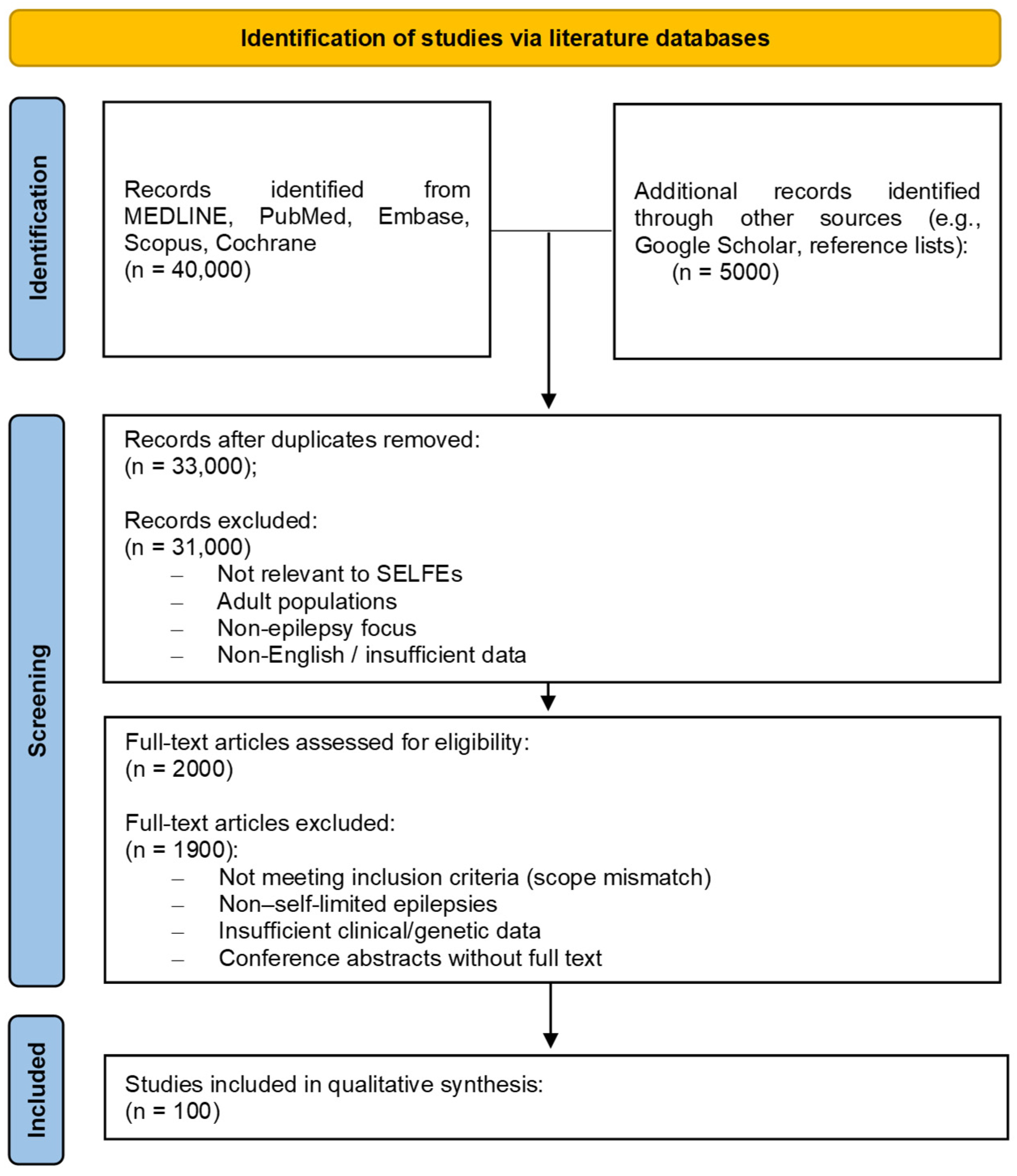
2. Materials and Methods
3. Discussion
3.1. SeLFNIE
3.2. SeLECTS
3.3. SeLEAS
3.4. COVE
3.5. POLE
3.6. Genetic Epilepsy with Febrile Seizures Plus (GEFS+)
3.7. MEI
3.8. Benign Genetic Epilepsies: From Molecular Pathogenesis to Clinical Phenotypes
3.9. Evolution and Treatment
4. Limitations
5. Conclusions
Supplementary Materials
Author Contributions
Funding
Institutional Review Board Statement
Informed Consent Statement
Data Availability Statement
Conflicts of Interest
Abbreviations
| BFIS | Benign familial infantile seizures |
| ILAE | International League Against Epilepsy |
| SeLE | Self-limited epilepsy syndrome |
| SeLFNE | Self-limited (familial) neonatal epilepsy |
| SeLFNIE | Self-limited neonatal-infantile epilepsy |
| SeLIE | Self-limited (familial) infantile epilepsy |
| GEFS+ | Genetic epilepsy with febrile seizures plus |
| MEI | Myoclonic epilepsy of infancy |
| SeLECTS | Self-limited epilepsy with centrotemporal spikes |
| SeLEAS | Self-limited epilepsy with autonomic seizures |
| COVE | Childhood occipital visual epilepsy |
| POLE | Photosensitive occipital lobe epilepsy |
| SeLFE | Self-limited focal epilepsies |
| BECT | Benign epilepsy with centrotemporal spikes |
| BRE | Benign rolandic epilepsy |
| COE-G | Childhood occipital epilepsy-Gastaut |
| RMEI | Reflex myoclonic epilepsy of infancy |
| PMEI | Photosensitive myoclonic epilepsy |
| FMEI | Familial infantile myoclonic epilepsy |
| ASM | Antiseizure management |
References
- Fukuyama, Y.; Arima, M.; Okada, R.; Suzuki, M.; Komiya, H.; Komiya, K.; Kamoshita, S. Electro-clinical characteristics of epilepsies in infancy and childhood. Paediatr. Univ. Tokyo 1963, 9, 11–16. [Google Scholar] [PubMed]
- Rett, A.; Teubel, R. Neugeborenen Krampfe im Rahmen einer epileptisch belasten Familie. Wien. Klin. Wochenschr. 1964, 76, 609–613. [Google Scholar]
- Bjerre, I.; Corelius, E. Benign familial neonatal convulsions. Acta Paediatr. Scand. 1968, 57, 557–561. [Google Scholar] [CrossRef] [Scilit] [PubMed]
- Carton, D. Benign familial neonatal convulsions. Neuropadiatrie 1978, 9, 167–171. [Google Scholar] [CrossRef] [Scilit] [PubMed]
- Pavone, P.; Praticò, A.D.; Falsaperla, R.; Striano, P.; Ruggieri, M. Is benign familial neonatal KCNQ2-related epilepsy always familially benign? J. Pediatr. Neonatal Individ. Med. (JPNIM) 2018, 7, e070221. [Google Scholar] [CrossRef] [Scilit]
- Watanabe, K.; Yamamoto, N.; Negoro, T.; Takaesu, E.; Aso, K.; Furune, S.; Takahashi, I. Benign complex partial epilepsies in infancy. Pediatr. Neurol. 1987, 3, 208–211. [Google Scholar] [CrossRef] [Scilit] [PubMed]
- Watanabe, K.; Negoro, T.; Aso, K. Benign partial epilepsy with secondarily generalized seizures in infancy. Epilepsia 1993, 34, 635–638. [Google Scholar] [CrossRef] [Scilit] [PubMed]
- Vigevano, F.; Di Capua, M.; Fusco, L.; Ricci, S.; Sebastianelli, R.; Lucchini, P. Sixth-month benign familial convulsions. Epilepsy Res. Suppl. 1992, 6, 127–129. [Google Scholar] [PubMed]
- Vigevano, F.; Fusco, L.; Di Capua, M.; Ricci, S.; Sebastianelli, R.; Lucchini, P. Benign infantile familial convulsions. Eur. J. Pediatr. 1992, 151, 608–612. [Google Scholar] [CrossRef] [Scilit] [PubMed]
- Specchio, N.; Vigevano, F. The spectrum of benign infantile seizures. Epilepsy Res. 2006, 70, S156–S167. [Google Scholar] [CrossRef] [Scilit] [PubMed]
- Specchio, N.; Wirrell, E.C.; Scheffer, I.E.; Nabbout, R.; Riney, K.; Samia, P.; Guerreiro, M.; Gwer, S.; Zuberi, S.M.; Wilmshurst, J.M.; et al. International League Against Epilepsy classification and definition of epilepsy syndromes with onset in childhood: Position paper by the ILAE Task Force on Nosology and Definitions. Epilepsia 2022, 63, 1398–1442. [Google Scholar] [CrossRef] [Scilit] [PubMed]
- Mulley, J.C.; Heron, S.E.; Dibbens, L.M. Proposed genetic classification of the ‘benign’ familial neonatal and infantile epilepsies. Epilepsia 2011, 52, 649–650. [Google Scholar] [CrossRef] [Scilit] [PubMed]
- Zuberi, S.M.; Wirrell, E.; Yozawitz, E.; Wilmshurst, J.M.; Specchio, N.; Riney, K.; Pressler, R.; Auvin, S.; Samia, P.; Hirsch, E.; et al. ILAE classification and definition of epilepsy syndromes with onset in neonates and infants: Position statement by the ILAE Task Force on Nosology and Definitions. Epilepsia 2022, 63, 1349–1397. [Google Scholar] [CrossRef] [Scilit] [PubMed]
- Manokaran, R.K.; Sharma, S.; Ramachandrannair, R. The 2022 International League Against Epilepsy Classification and Definition of Childhood Epilepsy Syndromes: An Update for Pediatricians. Indian Pediatr. 2024, 61, 179–183. [Google Scholar] [CrossRef] [Scilit] [PubMed]
- Menon, R.N.; Helen Cross, J. Childhood epilepsy. Lancet 2025, 406, 636–649. [Google Scholar] [CrossRef] [Scilit] [PubMed]
- Quito-Betancourt, B.F.; Reyes Valenzuela, G. Self-limited focal epilepsies of childhood. Medicina 2023, 83, 57–62. [Google Scholar] [PubMed]
- Gunasekaran, V.; Ighodaro, E.T.; Govil-Dalela, T. Neonatal Seizures and Neonatal Epilepsy. In StatPearls; StatPearls Publishing: Treasure Island, FL, USA, 2025. Available online: http://www.ncbi.nlm.nih.gov/books/NBK609108/ (accessed on 15 February 2026). [PubMed]
- Deonna, T.; Ziegler, A.L. So-called benign epilepsies in children. Rev. Med. Suisse Rom. 1994, 114, 861–867. [Google Scholar] [PubMed]
- Pressler, R.M.; Abend, N.S.; Auvin, S.; Boylan, G.; Brigo, F.; Cilio, M.R.; De Vries, L.S.; Elia, M.; Espeche, A.; Hahn, C.D.; et al. Treatment of seizures in the neonate: Guidelines and consensus-based recommendations-Special report from the ILAE Task Force on Neonatal Seizures. Epilepsia 2023, 64, 2550–2570. [Google Scholar] [CrossRef] [Scilit] [PubMed]
- Bayat, A.; Bayat, M.; Rubboli, G.; Møller, R.S. Epilepsy Syndromes in the First Year of Life and Usefulness of Genetic Testing for Precision Therapy. Genes 2021, 12, 1051. [Google Scholar] [CrossRef] [Scilit] [PubMed] [PubMed Central]
- Vikin, T.; Lossius, M.I.; Brandlistuen, R.E.; Chin, R.F.; Aaberg, K.M. Incidence of childhood and youth epilepsy: A population-based prospective cohort study utilizing current International League Against Epilepsy classifications for seizures, syndromes, and etiologies. Epilepsia 2025, 66, 776–789. [Google Scholar] [CrossRef] [Scilit] [PubMed] [PubMed Central]
- Miceli, F.; Soldovieri, M.V.; Weckhuysen, S.; Cooper, E.C.; Taglialatela, M. KCNQ3-Related Disorders. In GeneReviews®; Adam, M.P., Bick, S., Mirzaa, G.M., Pagon, R.A., Wallace, S.E., Amemiya, A., Eds.; University of Washington: Seattle, WA, USA, 1993. Available online: http://www.ncbi.nlm.nih.gov/books/NBK201978/ (accessed on 15 February 2026). [PubMed]
- Benign Rolandic Epilepsy (BRE): Seizure Semiology and the Role of an EEG Study. Available online: https://search.emarefa.net/en/detail/BIM-1440125-benign-rolandic-epilepsy-bre-lrm-seizure-semiology-and-the-r (accessed on 15 February 2026).
- Amrutkar, C.V.; Riel-Romero, R.M. Rolandic Epilepsy Seizure. In StatPearls; StatPearls Publishing: Treasure Island, FL, USA, 2025. Available online: http://www.ncbi.nlm.nih.gov/books/NBK534845/ (accessed on 15 February 2026). [PubMed]
- Hamada, Y.; Okuno, T.; Hattori, H.; Mikawa, H. Indication for anti-epileptic drug treatment of benign childhood epilepsy with centro-temporal spikes. Brain Dev. 1994, 16, 159–161. [Google Scholar] [CrossRef] [Scilit] [PubMed]
- Vargas, R.; Beltrán, L.; Lizama, R.; Valenzuela, G.R.; Caraballo, R. Benign rolandic epilepsy and generalized paroxysms: A study of 13 patients. Seizure 2018, 57, 27–31. [Google Scholar] [CrossRef] [Scilit] [PubMed]
- Fan, L.; Shen, Y.; Zhang, J.; Wang, X.; Li, Y.; Rao, X.; Liu, H.; Chen, J.; Wang, J.; Gong, X.; et al. Safety and efficacy of one-dose nocturnal levetiracetam for the treatment of self-limited epilepsy with centrotemporal spikes: A randomized clinical trial. Sci. Rep. 2025, 15, 34302. [Google Scholar] [CrossRef] [Scilit] [PubMed] [PubMed Central]
- Ross, E.E.; Stoyell, S.M.; Kramer, M.A.; Berg, A.T.; Chu, C.J. The natural history of seizures and neuropsychiatric symptoms in childhood epilepsy with centrotemporal spikes (CECTS). Epilepsy Behav. EB 2020, 103, 106437. [Google Scholar] [CrossRef] [Scilit] [PubMed] [PubMed Central]
- Pérez-Villena, A.; López-Marín, L.; García-Peñas, J.J.; Calleja-Gero, M.L.; Castaño-De la Mota, C.; Losada-Del Pozo, R.; Castillo, M.C.F.-D. Benign childhood epilepsies: Academic difficulties and behavioural disorders. Rev. Neurol. 2012, 54, 17–23. [Google Scholar] [PubMed]
- Canavese, C.; Rigardetto, R.; Viano, V.; Vittorini, R.; Bassi, B.; Pieri, I.; Capizzi, G. Are dyslexia and dyscalculia associated with Rolandic epilepsy? A short report on ten Italian patients. Epileptic Disord. Int. Epilepsy J. Videotape 2007, 9, 432–436. [Google Scholar] [CrossRef] [Scilit] [PubMed]
- Lacey, A.S.; Jones, C.B.; Ryoo, S.G.; Stephen, J.; Weir, C.J.; Pickrell, W.O.; Chin, R.F. Epidemiology of self-limited epilepsy with centrotemporal spikes (SeLECTS): A population study using primary care records. Seizure 2024, 122, 52–57. [Google Scholar] [CrossRef] [Scilit] [PubMed]
- Goad, B.S.; Lee-Messer, C.; He, Z.; Porter, B.E.; Baumer, F.M. Connectivity increases during spikes and spike-free periods in self-limited epilepsy with centrotemporal spikes. Clin. Neurophysiol. 2022, 144, 123–134. [Google Scholar] [CrossRef] [Scilit] [PubMed] [PubMed Central]
- Kramer, U. Atypical presentations of benign childhood epilepsy with centrotemporal spikes: A review. J. Child Neurol. 2008, 23, 785–790. [Google Scholar] [CrossRef] [Scilit] [PubMed]
- Verrotti, A.; Casciato, S.; Spalice, A.; Carotenuto, M.; Striano, P.; Parisi, P.; Zamponi, N.; Savasta, S.; Rinaldi, V.E.; D’Alonzo, R.; et al. Coexistence of childhood absence epilepsy and benign epilepsy with centrotemporal spikes: A case series. Eur. J. Paediatr. Neurol. 2017, 21, 570–575. [Google Scholar] [CrossRef] [Scilit] [PubMed]
- Neubauer, B.A.; Waldegger, S.; Heinzinger, J.; Hahn, A.; Kurlemann, G.; Fiedler, B.; Eberhard, F.; Muhle, H.; Stephani, U.; Garkisch, S.; et al. KCNQ2 and KCNQ3 mutations contribute to different idiopathic epilepsy syndromes. Neurology 2008, 71, 177–183. [Google Scholar] [CrossRef] [Scilit] [PubMed]
- Strug, L.J.; Clarke, T.; Chiang, T.; Chien, M.; Baskurt, Z.; Li, W.; Dorfman, R.; Bali, B.; Wirrell, E.; Kugler, S.L.; et al. Centrotemporal sharp wave EEG trait in rolandic epilepsy maps to Elongator Protein Complex 4 (ELP4). Eur. J. Hum. Genet. 2009, 17, 1171–1181. [Google Scholar] [CrossRef] [Scilit] [PubMed] [PubMed Central]
- Lemke, J.R.; Lal, D.; Reinthaler, E.M.; Steiner, I.; Nothnagel, M.; Alber, M.; Geider, K.; Laube, B.; Schwake, M.; Finsterwalder, K.; et al. Mutations in GRIN2A cause idiopathic focal epilepsy with rolandic spikes. Nat. Genet. 2013, 45, 1067–1072. [Google Scholar] [CrossRef] [Scilit]
- Panayiotopoulos, C.P. Benign nocturnal childhood occipital epilepsy: A new syndrome with nocturnal seizures, tonic deviation of the eyes, and vomiting. J. Child Neurol. 1989, 4, 43–49. [Google Scholar] [CrossRef] [Scilit] [PubMed]
- Covanis, A. Panayiotopoulos syndrome: A benign childhood autonomic epilepsy frequently imitating encephalitis, syncope, migraine, sleep disorder, or gastroenteritis. Pediatrics 2006, 118, e1237–e1243. [Google Scholar] [CrossRef] [Scilit] [PubMed]
- Koukounas, C. Panayiotopoulos Syndrome: A Clinical Perspective. Available online: https://www.hilarispublisher.com/open-access/panayiotopoulos-syndrome-a-clinical-perspective-105460.html (accessed on 16 February 2026).
- Felgueiras, A.; Bolas, S.; Ferreira, D.M.; Raimundo, D. Self-Limited Epilepsy with Autonomic Seizures: A Case Report. Cureus 2024, 16, e66355. [Google Scholar] [CrossRef] [Scilit] [PubMed] [PubMed Central]
- Caraballo, R.; Cersósimo, R.; Fejerman, N. Panayiotopoulos syndrome: A prospective study of 192 patients. Epilepsia 2007, 48, 1054–1061. [Google Scholar] [CrossRef] [Scilit] [PubMed]
- Durá-Travé, T.; Yoldi-Petri, M.E.; Gallinas-Victoriano, F. Panayiotopoulos syndrome: Epidemiological and clinical characteristics and outcome. Eur. J. Neurol. 2008, 15, 336–341. [Google Scholar] [CrossRef] [Scilit] [PubMed]
- Koutroumanidis, M.; Ferrie, C.D.; Valeta, T.; Sanders, S.; Michael, M.; Panayiotopoulos, C.P. Syncope-like epileptic seizures in Panayiotopoulos syndrome. Neurology 2012, 79, 463–467. [Google Scholar] [CrossRef] [Scilit] [PubMed]
- Oguni, H. A reappraisal of interictal EEG characteristics in self-limited epilepsy with autonomic seizures, formerly known as Panayiotopoulos syndrome or early-onset benign occipital epilepsy. Eur. J. Paediatr. Neurol. 2023, 47, 18–24. [Google Scholar] [CrossRef] [Scilit] [PubMed]
- Caraballo, R.H.; Astorino, F.; Cersósimo, R.; Soprano, A.M.; Fejerman, N. Atypical evolution in childhood epilepsy with occipital paroxysms (Panayiotopoulos type). Epileptic Disord. Int. Epilepsy J. Videotape 2001, 3, 157–162. [Google Scholar] [CrossRef] [Scilit] [PubMed]
- Hodges, S.L.; Gabriel, M.T.; Perry, M.S. Neuropsychological findings associated with Panayiotopoulos syndrome in three children. Epilepsy Behav. EB 2016, 54, 158–162. [Google Scholar] [CrossRef] [Scilit] [PubMed]
- Fonte, J.; Videira, G.; Chorão, R.; Freitas, J.; Carrilho, I.; Freixo, J.P.; Oliveira, J.; Chaves, J. Familial occipital lobe epilepsy associated with GABAA receptor variants. Seizure 2023, 112, 139–142. [Google Scholar] [CrossRef] [Scilit] [PubMed]
- Beal, J.C. Childhood Occipital Visual Epilepsy; Lewis, S.L., Ed.; Chief MedLink Neurol MedLink LLC.: San Diego, CA, USA, 2024; Available online: www.medlink.com (accessed on 3 January 2025).
- Emmady, P.D.; Das, J.M. Benign Occipital Seizure. In StatPearls; StatPearls Publishing: Treasure Island, FL, USA, 2025. Available online: http://www.ncbi.nlm.nih.gov/books/NBK557470/ (accessed on 16 February 2026). [PubMed]
- Caraballo, R.H.; Cersósimo, R.O.; Fejerman, N. Childhood occipital epilepsy of Gastaut: A study of 33 patients. Epilepsia 2008, 49, 288–297. [Google Scholar] [CrossRef] [Scilit] [PubMed]
- Caraballo, R.; Koutroumanidis, M.; Panayiotopoulos, C.P.; Fejerman, N. Idiopathic childhood occipital epilepsy of Gastaut: A review and differentiation from migraine and other epilepsies. J. Child Neurol. 2009, 24, 1536–1542. [Google Scholar] [CrossRef] [Scilit] [PubMed]
- Wakamoto, H.; Nagao, H.; Fukuda, M.; Watanabe, S.; Motoki, T.; Ohmori, H.; Ishii, E. Idiopathic childhood occipital epilepsy of Gastaut: Report of 12 patients. Pediatr. Neurol. 2011, 44, 183–186. [Google Scholar] [CrossRef] [Scilit] [PubMed]
- Verrotti, A.; Laino, D.; Rinaldi, V.E.; Suppiej, A.; Giordano, L.; Toldo, I.; Margari, L.; Parisi, P.; Rizzo, R.; Matricardi, S.; et al. Clinical dissection of childhood occipital epilepsy of Gastaut and prognostic implication. Eur. J. Neurol. 2016, 23, 241–246. [Google Scholar] [CrossRef] [Scilit] [PubMed]
- Atacan Yaşgüçlükal, M.; Güleç, B.; Emre, D.H.; Elmalı, A.D.; Ertürk Çetin, Ö.; Demirbilek, A.V. Clinical and Electrophysiological Characteristics and Prognosis of Childhood Occipital Visual Epilepsy in Light of Current ILAE Criteria. Clin. EEG Neurosci. 2025, 57, 293–298. [Google Scholar] [CrossRef] [Scilit] [PubMed]
- Shu, X.M.; Zhang, G.P.; Yang, B.Z.; Li, J. The characterization of childhood occipital epilepsy of Gastaut: A study of seven patients. Cell Biochem. Biophys. 2013, 67, 991–995. [Google Scholar] [CrossRef] [Scilit] [PubMed]
- Rots, M.L.; De Vos, C.C.; Smeets-Schouten, J.S.; Portier, R.; van Putten MJa, M. Suppressors of interictal discharges in idiopathic childhood occipital epilepsy of Gastaut. Epilepsy Behav. EB 2012, 25, 189–191. [Google Scholar] [CrossRef] [Scilit] [PubMed]
- Hanif, S.; Musick, S.T. Reflex Epilepsy. Aging Dis. 2021, 12, 1010–1020. [Google Scholar] [CrossRef] [Scilit]
- Cerrahoğlu Şirin, T.; Yılmaz, T.; Elmalı, A.D.; Bebek, N.; Demirbilek, V.; Baykan, B. Photosensitive occipital lobe epilepsy: Delineation of an under-recognized reflex epilepsy syndrome according to the new ILAE criteria and long-term follow-up. Epileptic Disord. Int. Epilepsy J. Videotape 2023, 25, 187–199. [Google Scholar] [CrossRef] [Scilit] [PubMed]
- Guerrini, R.; Dravet, C.; Genton, P.; Bureau, M.; Bonanni, P.; Ferrari, A.R.; Roger, J. Idiopathic photosensitive occipital lobe epilepsy. Epilepsia 1995, 36, 883–891. [Google Scholar] [CrossRef] [Scilit] [PubMed]
- Politi-Elishkevich, K.; Kivity, S.; Shuper, A.; Levine, H.; Goldberg-Stern, H. Idiopathic photosensitive occipital epilepsy: Clinical and electroencephalographic (EEG) features. J. Child Neurol. 2014, 29, 307–311. [Google Scholar] [CrossRef] [Scilit] [PubMed]
- Li, X.; Guo, S.; Sun, Y.; Ding, J.; Chen, C.; Wu, Y.; Li, P.; Sun, T.; Wang, X. GABRG2 mutations in genetic epilepsy with febrile seizures plus: Structure, roles, and molecular genetics. J. Transl. Med. 2024, 22, 767. [Google Scholar] [CrossRef] [Scilit] [PubMed] [PubMed Central]
- Ding, J.; Wang, C.; Huang, G.Q.; Zhang, J.W.; Zhai, Q.X.; Chen, Z.H.; Zhang, Y.-X.; Guo, Y.-X. Functional characterization of a KCNAB3 genetic epilepsy with febrile seizures plus adult mouse model. Transl. Pediatr. 2022, 11, 1615–1623. [Google Scholar] [CrossRef] [Scilit] [PubMed] [PubMed Central]
- Scheffer, I.E.; Berkovic, S.F. Generalized epilepsy with febrile seizures plus. A genetic disorder with heterogeneous clinical phenotypes. Brain J. Neurol. 1997, 120, 479–490. [Google Scholar] [CrossRef] [Scilit] [PubMed]
- Camfield, P.; Camfield, C. Febrile seizures and genetic epilepsy with febrile seizures plus (GEFS+). Epileptic Disord. Int. Epilepsy J. Videotape 2015, 17, 124–133. [Google Scholar] [CrossRef] [Scilit] [PubMed]
- Panagiotakaki, E.; Papadopoulou, M.; Karanikola, F.; Arzimanoglou, A. Genetic Epilepsy with Febrile Seizures Plus; Lewis, S.L., Ed.; Chief MedLink Neurol LLC.: San Diego, CA, USA, 2024; Available online: www.medlink.com (accessed on 11 November 2024).
- Zhang, Y.H.; Burgess, R.; Malone, J.P.; Glubb, G.C.; Helbig, K.L.; Vadlamudi, L.; Kivity, S.; Afawi, Z.; Bleasel, A.; Grattan-Smith, P.; et al. Genetic epilepsy with febrile seizures plus: Refining the spectrum. Neurology 2017, 89, 1210–1219. [Google Scholar] [CrossRef] [Scilit] [PubMed]
- Thomas, R.H.; Johnston, J.A.; Hammond, C.L.; Bagguley, S.; White, C.; Smith, P.E.; Rees, M.I. Genetic epilepsy with febrile seizures plus: Definite and borderline phenotypes. J. Neurol. Neurosurg. Psychiatry 2012, 83, 336–338. [Google Scholar] [CrossRef] [Scilit] [PubMed]
- Chen, S.; Quan, Y.; Yin, F.; Peng, J. Clinical and genetics spectrum of 392 Chinese patients with genetic epilepsy with febrile seizures plus. J. Neurol. 2025, 273, 18. [Google Scholar] [CrossRef] [Scilit] [PubMed]
- Baso, P.; Masnada, S.; Lodi, M.M.; Teutonico, F.; Vignoli, A.; Ricci, E.; Canevini, M.P.; Brustia, F.; Viri, M.; Cereda, C.; et al. Prediction of evolution to epilepsy or genetic epilepsy with febrile seizures plus (GEFS+) in children presenting with febrile seizures: A retrospective multicenter longitudinal study. Seizure 2025, 132, 147–153. [Google Scholar] [CrossRef] [Scilit] [PubMed]
- Ding, J.; Miao, Q.F.; Zhang, J.W.; Guo, Y.X.; Zhang, Y.X.; Zhai, Q.X.; Chen, Z. H258R mutation in KCNAB3 gene in a family with genetic epilepsy and febrile seizures plus. Brain Behav. 2020, 10, e01859. [Google Scholar] [CrossRef] [Scilit]
- Poliquin, S.; Nwosu, G.; Randhave, K.; Shen, W.; Flamm, C.; Kang, J.Q. Modulating Endoplasmic Reticulum Chaperones and Mutant Protein Degradation in GABRG2(Q390X) Associated with Genetic Epilepsy with Febrile Seizures Plus and Dravet Syndrome. Int. J. Mol. Sci. 2024, 25, 4601. [Google Scholar] [CrossRef] [Scilit] [PubMed] [PubMed Central]
- Li, X.; Guo, S.; Liu, K.; Zhang, C.; Chang, H.; Yang, W.; Rong, S.; Hu, Q.; Cui, J.; Wang, F.; et al. GABRG2 Deletion Linked to Genetic Epilepsy with Febrile Seizures Plus Affects the Expression of GABAA Receptor Subunits and Other Genes at Different Temperatures. Neuroscience 2020, 438, 116–136. [Google Scholar] [CrossRef] [Scilit]
- Polizzi, A.; Incorpora, G.; Pavone, P.; Ruggieri, M.; Annesi, G.; Gambardella, A.; Pavone, L.; Quattrone, A. Generalised epilepsy with febrile seizures plus (GEFS+): Molecular analysis in a restricted area. Childs Nerv. Syst. 2012, 28, 141–145. [Google Scholar] [CrossRef] [Scilit] [PubMed]
- Sager, G.; Cetin, B.S.; Cag, Y.; Pinar, Z.V.; Akin, Y. Auditory phoneme discrimination, articulation, and language disorders in patients with genetic epilepsy with febrile seizures plus: A case-control study. Epilepsy Behav. EB 2022, 129, 108626. [Google Scholar] [CrossRef] [Scilit] [PubMed]
- Jeavons, P.M. Nosological problems of myoclonic epilepsies in childhood and adolescence. Dev. Med. Child Neurol. 1977, 19, 3–8. [Google Scholar] [CrossRef] [Scilit]
- Dravet, C.; Bureau, M. Benign myoclonic epilepsy in infancy. Adv. Neurol. 2005, 95, 127–137. [Google Scholar] [PubMed]
- Dravet, C.; Giraud, N.; Bureau, M.; Roger, J.; Gobbi, G.; Dalla Bernardina, B. Benign myoclonus of early infancy or benign non-epileptic infantile spasms. Neuropediatrics 1986, 17, 33–38. [Google Scholar] [CrossRef] [Scilit]
- Ito, S.; Oguni, H.; Osawa, M. Benign myoclonic epilepsy in infancy with preceding afebrile generalized tonic-clonic seizures in Japan. Brain Dev. 2012, 34, 829–833. [Google Scholar] [CrossRef] [Scilit] [PubMed]
- Balasundaram, P.; Anilkumar, A.C. Myoclonic Epilepsy of Infancy. In StatPearls; StatPearls Publishing: Treasure Island, FL, USA, 2025. Available online: http://www.ncbi.nlm.nih.gov/books/NBK570566/ (accessed on 18 February 2026). [PubMed]
- Zafeiriou, D.; Vargiami, E.; Kontopoulos, E. Reflex myoclonic epilepsy in infancy: A benign age-dependent idiopathic startle epilepsy. Epileptic Disord. Int. Epilepsy J. Videotape 2003, 5, 121–122. [Google Scholar] [CrossRef] [Scilit] [PubMed]
- Prabhu, A.M.; Pathak, S.; Khurana, D.; Legido, A.; Carvalho, K.; Valencia, I. Nocturnal variant of benign myoclonic epilepsy of infancy: A case series. Epileptic Disord. Int. Epilepsy J. Videotape 2014, 16, 45–49. [Google Scholar] [CrossRef] [Scilit] [PubMed]
- de Falco, F.A.; Majello, L.; Santangelo, R.; Stabile, M.; Bricarelli, F.D.; Zara, F. Familial infantile myoclonic epilepsy: Clinical features in a large kindred with autosomal recessive inheritance. Epilepsia 2001, 42, 1541–1548. [Google Scholar] [CrossRef] [Scilit] [PubMed]
- Caraballo, R.H.; Capovilla, G.; Vigevano, F.; Beccaria, F.; Specchio, N.; Fejerman, N. The spectrum of benign myoclonus of early infancy: Clinical and neurophysiologic features in 102 patients. Epilepsia 2009, 50, 1176–1183. [Google Scholar] [CrossRef] [Scilit] [PubMed]
- Caraballo, R.H.; Flesler, S.; Pasteris, M.C.; Lopez Avaria, M.F.; Fortini, S.; Vilte, C. Myoclonic epilepsy in infancy: An electroclinical study and long-term follow-up of 38 patients. Epilepsia 2013, 54, 1605–1612. [Google Scholar] [CrossRef] [Scilit] [PubMed]
- Zuberi, S.M.; O’Regan, M.E. Developmental outcome in benign myoclonic epilepsy in infancy and reflex myoclonic epilepsy in infancy: A literature review and six new cases. Epilepsy Res. 2006, 70, S110–S115. [Google Scholar] [CrossRef] [Scilit] [PubMed]
- Prats-Viñas, J.M.; Garaizar, C.; Ruiz-Espinoza, C. Benign myoclonic epilepsy in infant. Rev. Neurol. 2002, 34, 201–204. [Google Scholar] [PubMed]
- Mangano, S.; Fontana, A.; Cusumano, L. Benign myoclonic epilepsy in infancy: Neuropsychological and behavioural outcome. Brain Dev. 2005, 27, 218–223. [Google Scholar] [CrossRef] [Scilit] [PubMed]
- Domínguez-Carral, J.; García-Peñas, J.J.; Pérez-Jiménez, M.Á.; Fournier-Del Castillo, M.C.; Carreras-Sáez, I.; Jiménez-Echevarría, S. Benign myoclonic epilepsy in infancy: Natural history and behavioral and cognitive outcome. Rev. Neurol. 2014, 58, 97–102. [Google Scholar] [PubMed]
- Campostrini, G.; Difrancesco, J.; Castellotti, B.; Milanesi, R.; Gnecchi-Ruscone, T.; Bonzanni, M.; Bucchi, A.; Baruscotti, M.; Ferrarese, C.; Franceschetti, S.; et al. A loss-of-function HCN4 mutation associated with familial benign myoclonic epilepsy in infancy causes increased neuronal excitability. Front. Mol. Neurosci. 2018, 11, 269. [Google Scholar] [CrossRef] [Scilit]
- Wang, J.; Lin, Z.J.; Liu, L.; Xu, H.Q.; Shi, Y.W.; Yi, Y.H.; He, N.; Liao, W.-P. Epilepsy-associated genes. Seizure 2017, 44, 11–20. [Google Scholar] [CrossRef] [Scilit] [PubMed]
- Millevert, C.; Weckhuysen, S.; ILAE Genetics Commission. ILAE Genetic Literacy Series: Self-limited familial epilepsy syndromes with onset in neonatal age and infancy. Epileptic Disord. Int. Epilepsy J. Videotape 2023, 25, 445–453. [Google Scholar] [CrossRef] [Scilit] [PubMed]
- Balestrini, S.; Arzimanoglou, A.; Blümcke, I.; Scheffer, I.E.; Wiebe, S.; Zelano, J.; Walker, M.C. The aetiologies of epilepsy. Epileptic Disord. Int. Epilepsy J. Videotape 2021, 23, 1–16. [Google Scholar] [CrossRef] [Scilit] [PubMed]
- Myers, K.A. Genetic Epilepsy Syndromes. Continuum 2022, 28, 339–362. [Google Scholar] [CrossRef] [Scilit] [PubMed]
- Kovačević, M.; Milićević, O.; Branković, M.; Janković, M.; Novaković, I.; Sokić, D.; Ristić, A.; Shamsani, J.; Vojvodić, N. Novel variants in established epilepsy genes in focal epilepsy. Seizure 2023, 110, 146–152. [Google Scholar] [CrossRef] [Scilit] [PubMed]
- Talarico, M.; Procopio, R.; Gagliardi, M.; Sarubbi, M.C.; Fortunato, F.; Sammarra, I.; Lesca, G.; Malanga, D.; Annesi, G.; Gambardella, A. Novel KCNQ2 Variants Related to a Variable Phenotypic Spectrum Ranging from Epilepsy with Auditory Features to Severe Developmental and Epileptic Encephalopathies. Int. J. Mol. Sci. 2024, 26, 295. [Google Scholar] [CrossRef] [Scilit]
- de Sainte Agathe, J.M.; Monin, P.; Riccardi, F.; Nava, C.; Arnaud, L.; Mignot, C.; Ville, D.; Auvin, S.; Tardieu, S.; Larcher, K.; et al. The Clinical and Genetic Landscape of a French Multicenter Cohort of 2563 Epilepsy Patients Referred for Genetic Diagnosis. Eur. J. Neurol. 2025, 32, e70324. [Google Scholar] [CrossRef] [Scilit] [PubMed] [PubMed Central]
- Bigay, D. Frequency of genetic variants associated with epilepsy in pediatric patients. Genet. Clin. Genom. 2023, 1, 12–21. [Google Scholar] [CrossRef] [Scilit]
- Vikin, T.; Chin, R.F.; Lossius, M.I.; Hofoss, D.; Brandlistuen, R.E.; Aaberg, K.M. Syndromic and etiological classification predicts seizure freedom in childhood and youth onset epilepsy: A population-based study from the Norwegian Mother, Father, and Child Cohort Study. Epilepsia 2025, 67, 726–740. [Google Scholar] [CrossRef] [Scilit] [PubMed]
- Page, M.J.; McKenzie, J.E.; Bossuyt, P.M.; Boutron, I.; Hoffmann, T.C.; Mulrow, C.D.; Shamseer, L.; Tetzlaff, J.M.; Akl, E.A.; Brennan, S.E.; et al. The PRISMA 2020 statement: An updated guideline for reporting systematic reviews. BMJ 2021, 372, n71. [Google Scholar] [CrossRef] [Scilit] [PubMed]


| Syndrome | Age of Onset | Key Clinical Features | Interictal EEG | Gene Mutations | Spontaneous Remission |
|---|---|---|---|---|---|
| SeLFNIE | 2–5 day of life (neonatal); first weeks–months (infantile) | Focal motor tonic/clonic seizures in clusters, alternating sides; apnea, cyanosis | Normal background; focal temporal/posterior discharges | KCNQ2, KCNQ3, SCN2A, SCN8A, PRRT2 | 6 weeks–24 months of age |
| SeLECTS | 3–13 years (peak 9–10 yrs) | Brief hemifacial motor seizures; hypersalivation, drooling; predominantly nocturnal | Unilateral centrotemporal high-amplitude spikes, increased in sleep | KCNQ2, KCNQ3, ELP4, GRIN2A | Typically by adolescence |
| SeLEAS | 1–14 years (peak 3–6 yrs) | Nocturnal seizures; tonic eye deviation, vomiting, pallor, ictal syncope; possible autonomic status epilepticus | Multifocal high-voltage spikes/slow waves, predominantly occipital | None identified (polygenic) | ~82.9% seizure-free within 2 years from onset |
| COVE | 1–18 years (peak 8–9 yrs) | Brief visual hallucinations, ictal blindness, post-ictal headache; mainly in awake state | Occipital spike-wave paroxysms; fixation-off sensitivity | Polygenic (GABRA1, GABRG2 in familial cases) | 77% achieve seizure freedom; EEG normalizes in 85% by late adolescence |
| POLE | 4–17 years (mean 11 yrs) | Photic-induced visual seizures (colored spots, hallucinations, visual blurring); strong female predominance | Occipital spikes and waves; photoparoxysmal response | Polygenic | Remission in most cases by puberty |
| GEFS+ | Infancy to childhood (variable) | Febrile seizures ± afebrile seizures; broad spectrum: absence, myoclonic, atonic, GTCS | Normal background; generalized discharges | SCN1A, SCN1B, KCNT1, CACNA1A, GABRG2, ABRA1, GABRB2, ABRB3 | Tends to remit by late childhood/puberty |
| MEI | First 3 years of life | Brief (1–3 s) myoclonic jerks of upper limbs and head; triggered by drowsiness or sensory stimuli | Normal interictal EEG; generalized spike-wave under photostimulation in ~20% | HCN4, TBCID24 (rare) | Variable; seizure control usually achieved with treatment |
Disclaimer/Publisher’s Note: The statements, opinions and data contained in all publications are solely those of the individual author(s) and contributor(s) and not of MDPI and/or the editor(s). MDPI and/or the editor(s) disclaim responsibility for any injury to people or property resulting from any ideas, methods, instructions or products referred to in the content. |
© 2026 by the authors. Licensee MDPI, Basel, Switzerland. This article is an open access article distributed under the terms and conditions of the Creative Commons Attribution (CC BY) license.
Share and Cite
Pavone, P.; Scrofani, F.; Caruso, C.; Parano, E.; Polizzi, A.; Falsaperla, R.; Corsello, A.; Dell’Isola, G.B.; Pappalardo, X.G. Self-Limited Focal Epilepsies in Childhood: How Many and How to Treat. Pediatr. Rep. 2026, 18, 74. https://doi.org/10.3390/pediatric18030074
Pavone P, Scrofani F, Caruso C, Parano E, Polizzi A, Falsaperla R, Corsello A, Dell’Isola GB, Pappalardo XG. Self-Limited Focal Epilepsies in Childhood: How Many and How to Treat. Pediatric Reports. 2026; 18(3):74. https://doi.org/10.3390/pediatric18030074
Chicago/Turabian StylePavone, Piero, Francesca Scrofani, Chiara Caruso, Enrico Parano, Agata Polizzi, Raffaele Falsaperla, Antonio Corsello, Giovanni Battista Dell’Isola, and Xena Giada Pappalardo. 2026. "Self-Limited Focal Epilepsies in Childhood: How Many and How to Treat" Pediatric Reports 18, no. 3: 74. https://doi.org/10.3390/pediatric18030074
APA StylePavone, P., Scrofani, F., Caruso, C., Parano, E., Polizzi, A., Falsaperla, R., Corsello, A., Dell’Isola, G. B., & Pappalardo, X. G. (2026). Self-Limited Focal Epilepsies in Childhood: How Many and How to Treat. Pediatric Reports, 18(3), 74. https://doi.org/10.3390/pediatric18030074