Review

Diagnostic Accuracy of Utilizing Artificial Intelligence for Malaria Diagnostic: A Systematic Review and Meta-Analysis


by
Icha Farihah Deniyati Faratisha
1,2,*,
Khadijah Cahya Yunita
2,
Hanifa Rizky Rahmawati
2,
Loeki Enggar Fitri
2,3,*,
Nuning Winaris
2,3 and
Lailil Muflikah
4
1
Master Program in Biomedical Science, Faculty of Medicine, Universitas Brawijaya, Malang 65145, Indonesia
2
ATOM Research Group, Faculty of Medicine, Universitas Brawijaya, Malang 65145, Indonesia
3
Department of Clinical Parasitology, Faculty of Medicine, Universitas Brawijaya, Malang 65145, Indonesia
4
Department of Informatics Engineering, Faculty of Computer Science, Universitas Brawijaya, Malang 65145, Indonesia
*
Authors to whom correspondence should be addressed.
Infect. Dis. Rep. 2026, 18(1), 11; https://doi.org/10.3390/idr18010011
Submission received: 28 November 2025 / Revised: 1 January 2026 / Accepted: 9 January 2026 / Published: 13 January 2026
(This article belongs to the Section Neglected Tropical Diseases)

Abstract

Background: Malaria remains a major public health concern around the world. Microscopic blood smear examination continues to be the gold standard for diagnosis; however, it requires high technical skills and expertise, limiting diagnostic accuracy in resource-poor settings. Artificial intelligence (AI) has emerged as a promising tool to support malaria detection. This systematic review provides an overview of the diagnostic performance of AI-based systems for malaria diagnosis in a clinical setting. Methods: This study followed the Preferred Reporting Items for Systematic reviews and Meta-Analyses (PRISMA) guidelines and involved articles within the last 10 years that were collected from PubMed, ScienceDirect, Cochrane, EBSCO, and Wiley Online Library. Original articles that reported AI diagnostic accuracy with external validation were involved. The quality of each study was evaluated using the Quality Assessment of Diagnostic Accuracy Studies (QUADAS-2). Results: Ten studies with 6754 patients were analyzed. Pooled results of sensitivity [87.7% (95% CI: 78.2–93.4)] and specificity [91.4% (95% CI: 77.3–97.1)] revealed how much the AI agrees with each method when that method is used as a gold standard. Additionally, AI achieved a sensitivity of 87.7% and a specificity of 91.4% compared to microscopy examination and a sensitivity of 90.7% and a specificity of 88.3% compared to polymerase chain reaction (PCR). Conclusions: AI-based systems improve malaria diagnosis by providing high accuracy, automation, and lower costs. Showing performance comparable to reference methods such as microscopy and PCR, AI is a promising complementary tool for malaria control.

1. Introduction

Malaria is a life-threatening disease transmitted by female Anopheles mosquitoes and caused by Plasmodium spp. [1]. Globally, Malaria is predicted to affect 263 million people worldwide, with 597,000 deaths occurring in 83 countries [2]. The prevalence of malaria cases in Indonesia is estimated at 1.1 million cases with 1900 deaths [3]. Along with India, Indonesia ranks among the highest malaria prevalence and mortality rates in Southeast Asia and South Asia [2]. Although currently, 77% of regions in Indonesia are declared malaria-free, malaria cases remain very high in Eastern Indonesia, especially Papua Province [4].
One of the challenges in eliminating malaria is the emergence of resistance to antimalarial medications and insecticides [5]. Antimalarial drug resistance reduces the success of therapy and increases the risk of complications and transmission, while insecticide resistance reduces the effectiveness of vector control [6]. Globally, there have been reports of resistance to commonly used antimalarial drugs, and resistance has emerged to almost all categories of antimalarial drugs. Now, the current recommended treatment is artemisinin combination therapy (ACT), which involves the use of two active pharmaceuticals with distinct mechanisms of action: an artemisinin derivative and a partner drug [7]. Moreover, despite the fact that malaria vaccines have been a significant area of research for numerous years, it was only in 2021 that the RTS,S/AS01 vaccine gained endorsement from the World Health Organization (WHO), followed by the R21/Matrix-M vaccine in 2023 [8]. Both vaccines have been advised for the prevention of Plasmodium falciparum malaria infection, especially among children residing in endemic regions, with an emphasis on moderate to high transmission [6].
Accurate malaria diagnosis and timely therapy are prerequisites for effective malaria management. In areas with high malaria incidence, the process of diagnosing and detecting malaria through blood smear examination is a complex laboratory task and increases the workload for clinical parasitologists [4]. The use of microscopy as a method for examining blood smears remains a gold standard for diagnosis globally. This is because the method is considered inexpensive, rapid, and universal. However, microscopic examination requires a high level of skill and experience to ensure accurate diagnosis, making this method a major challenge in malaria control efforts [9]. In some recent studies, microscopists detected fewer malaria cases than polymerase chain reaction (PCR), with a sensitivity ranging from 73 to 88%, with false-positive rates up to 47% [10,11,12]. Additionally, the deletion of pfhrp2 and/or pfhrp3 genes leads to false negatives in malaria rapid diagnostic tests (RDTs). The deletion of pfhrp2/3 genes complicates malaria detection has been observed in 42 countries, which poses a risk to malaria control strategies [6,13].
The challenges of effective malaria diagnosis have led to the development of artificial intelligence (AI) systems for detecting Plasmodium spp. [9,14]. AI can assist in identifying infected and uninfected erythrocytes using deep learning-based models [15]. Various deep learning methods, including neural networks, convolutional neural networks (CNNs), and convolutional encoder–decoders, have been developed, focusing on three main areas: image segmentation, image quality enhancement, and particle tracking [16]. One example is the iMAGING AI-based Diagnostic System, a fully automated malaria diagnostic platform that integrates AI-driven image analysis with a robotized microscope. This system analyzes Giemsa-stained blood smears using CNNs trained on labeled malaria datasets to determine the presence of Plasmodium parasites. The microscope and AI model are operated via a smartphone or computer application, enabling automated diagnosis with minimal operator intervention [15].
Similarly, Liu et al. developed an artificial intelligence-based object detection system for malaria diagnosis (AIDMAN). This system integrates the YOLOv5 model with the Transformer model to execute the complete process, ranging from image analysis to the diagnosis of malaria [9]. These AI-driven image analysis techniques allow for reliable detection of Plasmodium spp. in digital images by training pre-trained models on large datasets, thereby emulating conventional optical microscopy of thin and thick blood smears while automating the examination process [10].
While microscopic examination remains rapid and inexpensive, AI is considered a potential solution to existing testing limitations by providing more reliable diagnoses, reduced screening costs, improved healthcare access, and reduced physician workload. AI-driven tools can assist in managing diagnostic workflows by automating routine tasks with large datasets quickly, allowing physicians to focus on more complex cases, thereby improving efficiency in parasite detection [17]. Furthermore, the use of smartphones that can be integrated with AI-based image analysis technology offers a valuable option, especially in resource-limited settings in endemic areas [15].
Although various artificial intelligence models have been developed and trained to detect malaria parasites, their application in clinical practice still faces several challenges. These include limited datasets, a limited number of datasets with low variation in red blood cells and parasite morphology, and the use of data generally sourced from the National Institutes of Health (NIH), which often exhibits overlapping between cells and overly idealized staining results. Furthermore, most AI-based studies for malaria detection still focus on internal validation, thus limiting the applicability and generalizability of their results to clinical setting conditions [9]. Therefore, this systematic review provides an overview of the diagnostic performance of AI for malaria detection, focusing on studies that use robust reference standards and external validation in clinical settings.

2. Materials and Methods

2.1. Data Sources and Search Strategy

We conducted a systematic review using the Preferred Reporting Items for Systematic Reviews and Meta-Analyses (PRISMA) 2020. The literature review covered data sources such as PubMed, ScienceDirect, Cochrane, EBSCO, and Wiley Online Library over the past 10 years. Boolean operators (OR and AND) were used to obtain the desired results. The search terms were (“Artificial Intelligence” OR “Machine Learning” OR AI OR “Machine intelligence” OR CNN OR “Deep Learning”) AND (“Malaria” OR “Infection, Malaria” OR “Plasmodium infection”) AND (“Diagnosis” OR “Diagnostic” OR “sensitivity” OR “specificity”).

2.2. Study Selection

Three authors independently identified reliable studies from each data source. All retrieved records were imported into Mendeley reference management software (version 2.82.0, Elsevier, Amsterdam, The Netherlands) and the duplications were identified using a manual screening process by comparing titles, authors, publication years, journal names, and digital object identifiers (DOI).
We reviewed the full text of potential scientific articles and assessed their compliance with the established inclusion criteria. Eligibility criteria included: study design in the form of an original article accessible in full (full text), discussion of malaria diagnostic methods using artificial intelligence (AI, deep learning, machine learning, convolutional neural networks, etc.), study outcomes in the form of AI method accuracy (sensitivity, specificity, area under the curve), and studies conducted only in human studies with clinical validation.
Studies were excluded if the article was published before 2015, was a pre-print article, was a chapter, proceeding paper, guideline, review, or commentary, contained duplicate publications, had incomplete data, included non-peer-reviewed articles, or was written in a language other than English. and was written in a language other than English.

2.3. Data Extraction

The authors independently extracted relevant data using a standardized form, including the first author and year of study, location/setting, number of patients, gold standard examination (polymerase chain reaction/expert microscopy), AI index, type of validity, units used, true positive (TP), false positive (FP), true negative (TN), false negative (FN) rates, and other annotations.

2.4. Study Outcomes

The primary outcome of this study included the overall pooled sensitivity and specificity of the diagnostic method using artificial intelligence. We also analyzed subgroups, such as comparing AI with polymerase chain reaction (PCR) and AI with expert microscopy.

2.5. Statistical Analysis

MetaDTA: Diagnostic Test Accuracy Meta-Analysis v2.01 Shiny App (NIHR Complex Reviews Support Unit, University of Leicester, Leicester, UK) [18] was used to generate forest plots, summary receiver operating characteristic (SROC) plots, and summary sensitivity and specificity plots using a bivariate random effects model.

2.6. Quality Assessment

Study quality was evaluated using the Quality Assessment of Diagnostic Accuracy Studies (QUADAS-2) instrument, a validated methodological instrument developed by Whiting et al. (University of Bristol, UK) [19] for patient selection, performance index tests, performance reference tests, as well as time and flow.

3. Results

3.1. Selection Findings

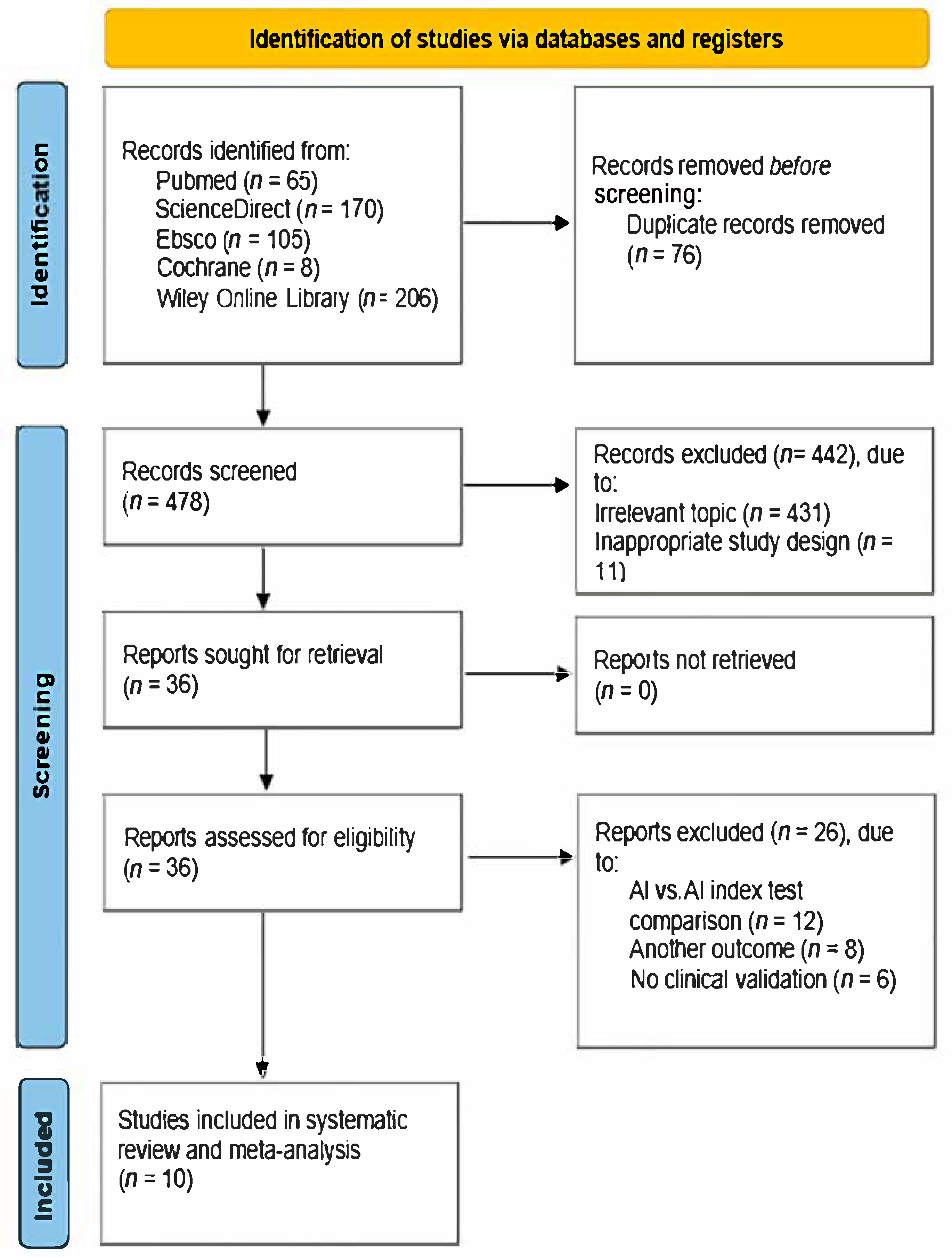
We identified 554 articles related to artificial intelligence and malaria diagnosis through online scientific databases according to the search descriptions of the databases. After excluding duplicate articles, we found 478 articles. We screened for unrelated articles (n = 431) and inappropriate study designs (n = 11). In addition, exclusions were made by determining inappropriate eligibility criteria, such as comparisons only with individual AI model indices (n = 12), inappropriate study outcomes (n = 8), and lack of clinical validation (n = 6). Ultimately, 10 studies were included in this study. Figure 1 illustrates the study selection process using PRISMA.

3.2. Study Characteristics

This study included 6754 patients from various countries, including those with malaria endemic areas, a history of travel to endemic areas, or exposure from relatives who traveled from endemic areas, such as Spain, Sierra Leone, the United States, Ghana, Ethiopia, the United Kingdom, Burkina Faso, Kenya, the Republic of Congo, Senegal, South Africa, Uganda, Bangladesh, Cambodia, Nepal, Thailand, Brazil, Sudan, and Peru. Table 1 describes the study characteristics of each included study. Detailed raw data related to sampling sites, examined species, and comparative diagnostic techniques from each study can be found in the Supplementary Materials File S1.

3.3. Risk of Bias Assessment

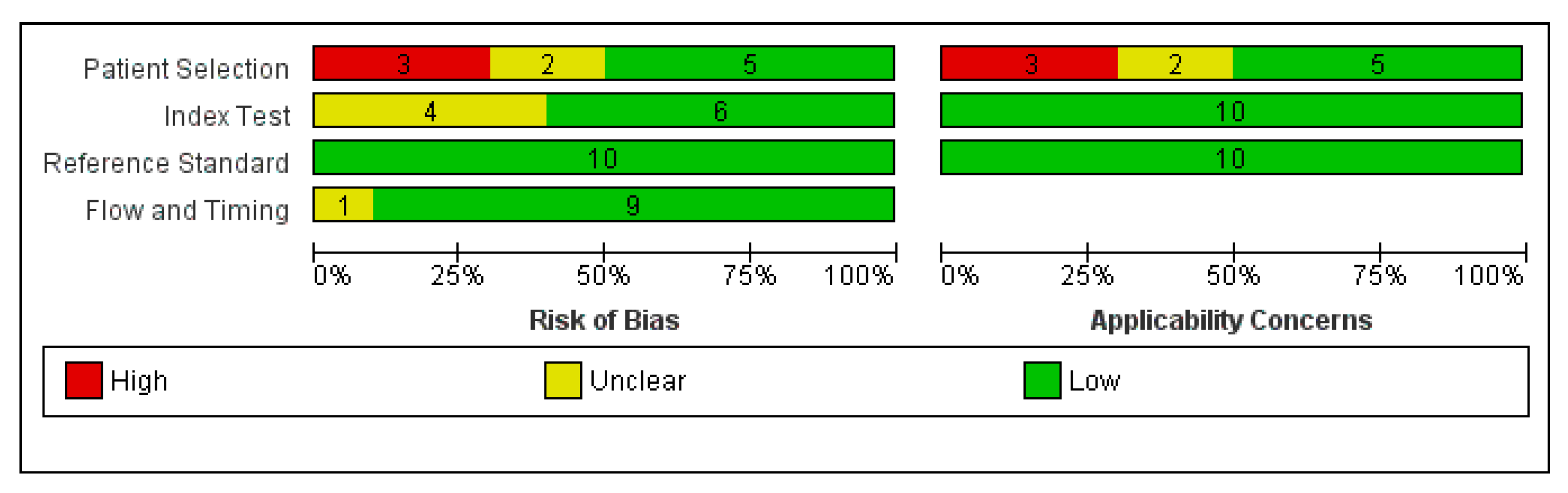
Risk of bias was assessed using the QUADAS-2 instrument. Figure 2 depicts the QUADAS-2 chart of the ten reviewed studies. Most of these studies were of good methodological quality, although some weaknesses persisted.
Of the 10 studies included in this meta-analysis, 3 of the 10 (33%) demonstrated a risk of bias in patient selection, with some using retrospective data, dataset-based studies, or special populations (e.g., travelers/migrants). Two other studies did not detail their patient recruitment methods and were therefore deemed unclear (20%). Regarding the index test, 4 of the 10 studies (40%) did not explicitly report blinding and were therefore categorized as unclear, but none of the studies were considered high risk. The reference standard consistently had a low risk because almost all used trained microscopists and/or PCR testing, the gold standard for malaria diagnosis. The flow and timing aspects were also mostly assessed as good, as the index test and reference standard were performed on the same specimens at short intervals, although one study was considered unclear (10%) due to its dataset-based nature.
In the applicability domain, 5 of the 10 studies had a high or unclear risk of applicability (50%), particularly in the patient selection domain, with 3 of the 10 (30%) categorized as high risk and 2 of the 10 (20%) categorized as unclear. This is because the studies were conducted on travelers in non-endemic countries or were dataset-based, with low applicability to populations in endemic areas. For the other domains, the index test, reference standard, and flow and timing generally did not raise any applicability concerns.
Overall, the assessment results show that the main strengths of the studies were the strong reference standard and the appropriateness of the examination timeline, while the main weaknesses were patient selection and the reporting of blinding of the index test.

3.4. Study Outcomes

Ten studies were identified that met the eligibility criteria for this systematic review and meta-analysis. Sample sizes varied across the included studies, ranging from 46 patients to 2250. The types of AI used varied. Most studies (80%) utilized a Convolutional Neural Network (CNN) approach, either in the form of EasyScan GO [21,22,23], Autoscope [26], or Malaria Screener and PVF-Net [24]. Additionally, YOLOv5-based CNN models were also used, such as in AIDMAN [9] and iMAGING [15]. Several other studies (20%) evaluated the MiLab deep learning platform [14,20,25], both in laboratory and field settings. The reference standards used varied widely, ranging from expert microscopy, PCR/qPCR, to RT-PCR. Five of the ten studies (50%) combined more than one reference standard, with PCR as molecular confirmation.
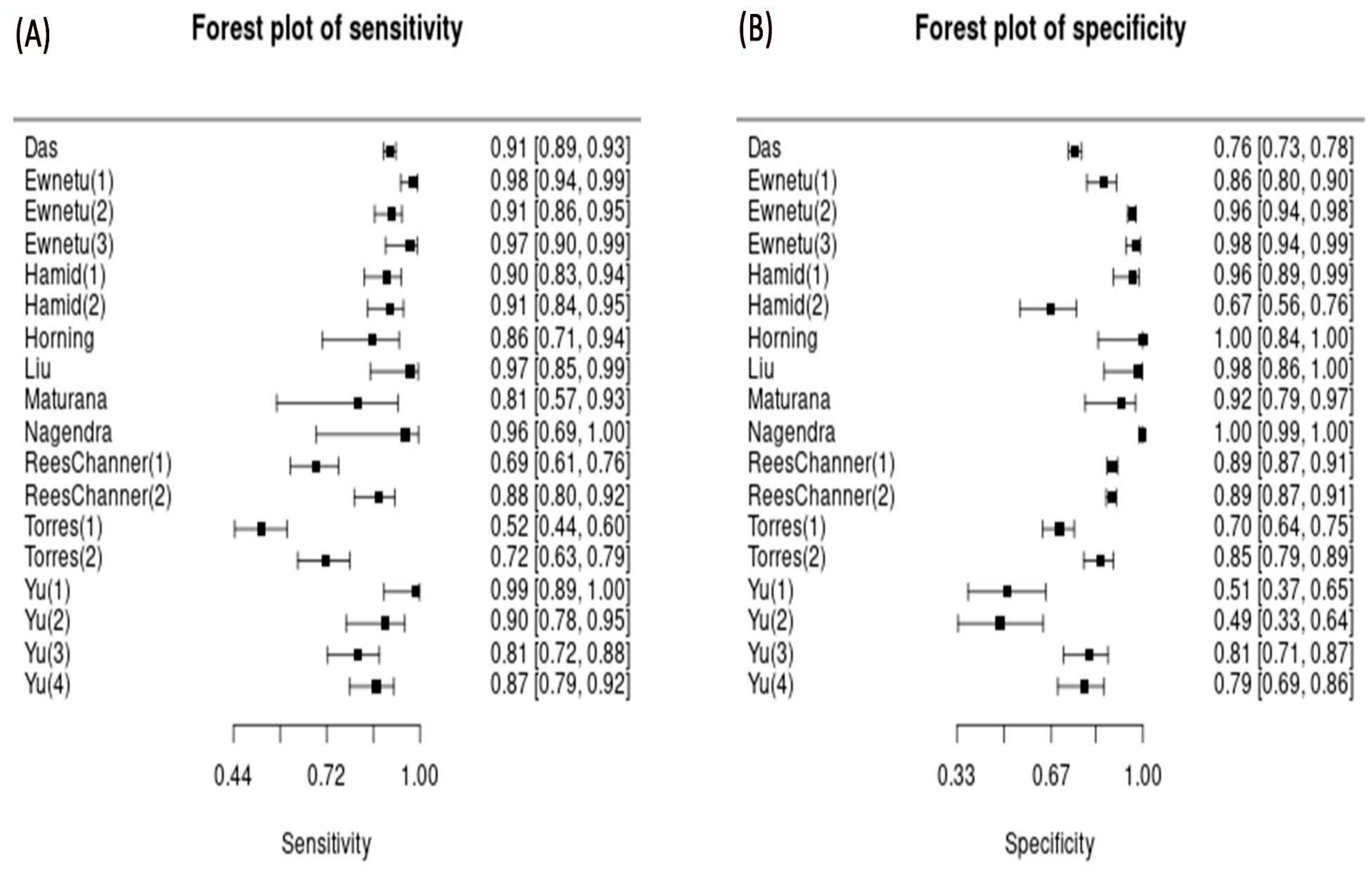
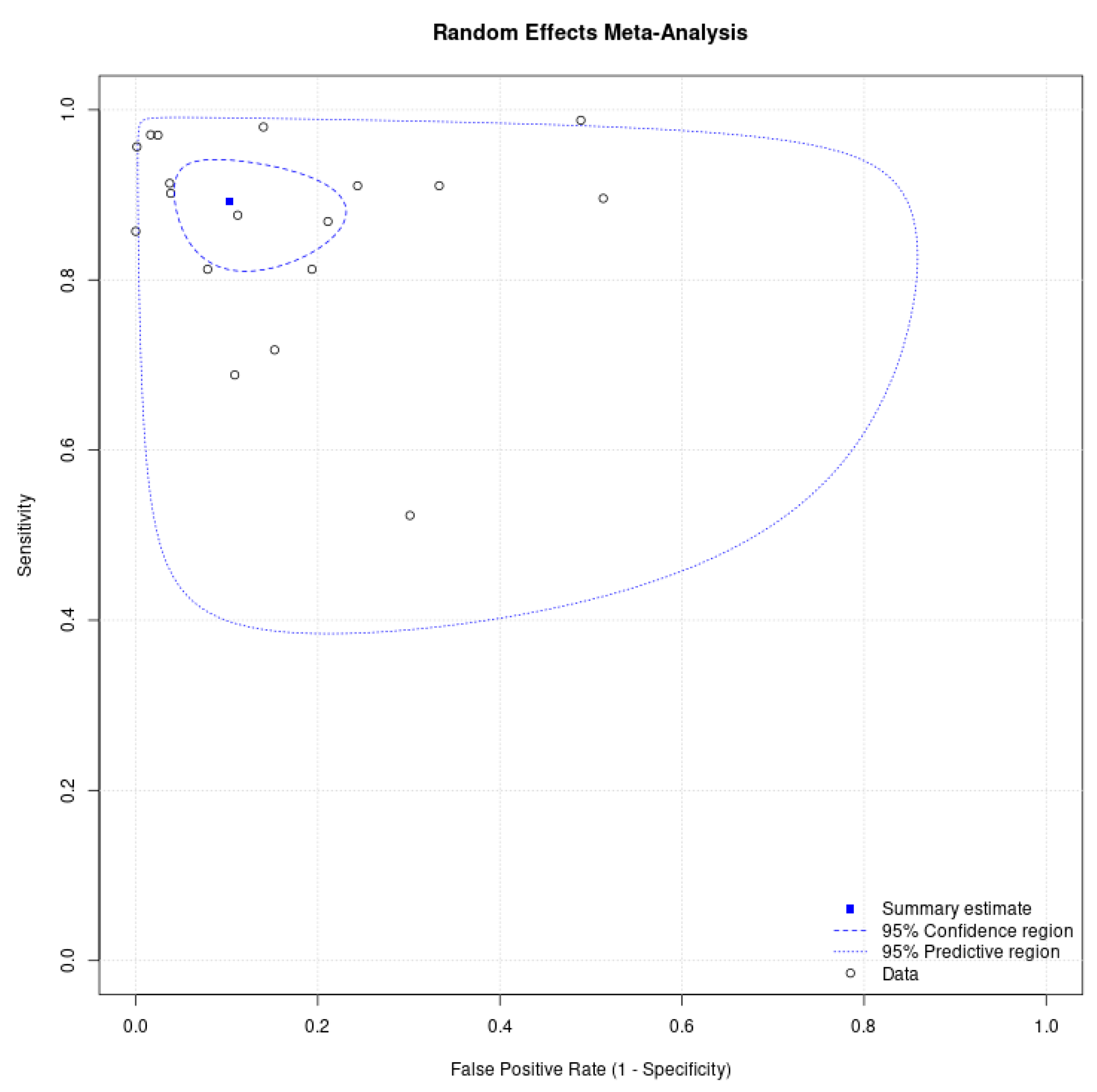
External validation, as a reference for AI implementation in daily clinical practice, was reported in seven of the ten studies (70%), while three of the ten (30%) studies were limited to clinical trials with unclear validation. Figure 3 shows a forest plot of the diagnostic accuracy of all studies. Through bivariate random effects model analysis, the pooled sensitivity of all studies for AI testing was 89.2% (95% CI: 83.7–93.1), and the pooled specificity was 89.7% (95% CI: 81.2–94.6) (Figure 4). Raw confusion matrix data and additional information can be found in the Supplementary Materials File S2.
Differences in reference standards between studies can impact diagnostic accuracy. We also analyzed subgroup outcomes: AI versus PCR and AI versus microscopy. Pooled analysis showed that AI-based malaria detection had higher diagnostic accuracy compared to both PCR and microscopy. When compared to microscopy, AI had a pooled sensitivity of 87.7% (95% CI: 78.2–93.4) and a specificity of 91.4% (95% CI: 77.3–97.1). When comparing AI with PCR as the reference standard, the pooled sensitivity of AI reached 90.7% (95% CI: 83.7–94.9) and a specificity of 88.3% (95% CI: 76.2–94.6). Table 2 illustrates the diagnostic accuracy results for each analysis group. Forest plots for each sub-group analysis are shown in the Supplementary Materials File S3.

4. Discussion

This systematic review and meta-analysis involved 6754 patients diagnosed with malaria using AI and gold-standard methods, including microscopic examination and PCR. We assessed the performance of malaria diagnosis using AI compared to gold-standard methods through an external validation approach, which uses an independent dataset to validate the performance of a model trained on initial input data and then tested on significantly different datasets, including different locations, time periods, populations, and dataset sources. This is important because it allows us to determine whether the AI model can be generalized in the real world [27]. Generalizability is the main challenging concept in diagnostic accuracy using AI. The model of AI has been reported with high accuracy during internal validation tests in several studies, but fails to maintain its performance when exposed to external datasets due to domain shift (including patient population, disease prevalence, image features, demographic diversity, scanner hardware, and imaging protocols) [28,29]. Researchers often rely solely on validation to describe internal procedures, such as hyperparameters or compare the performance of models across internal different data subsets to determine the best model [29]. Thus, the external validation approach applied in this study offers significant methodological advantages.
In this study, we incorporated diverse geographic regions to provide an external validation using real-world data. The study encompassed several regions, which were categorized into high-income, non/low-endemic countries (such as United States, United Kingdom, Spain), malaria-endemic countries in Southeast Asia (such as Indonesia, Thailand, Cambodia, Myanmar, Bangladesh), sub-Saharan Africa (such as Ghana, Ethiopia, Nigeria, Kenya, Uganda, and others), Latin America (such as Peru and Brazil), and Oceania (Solomon Islands). Data sources were mostly obtained from travelers, visits from friends and relatives, and migrants arriving from endemic areas. Some data were also collected from hospitals and primary health care facilities in rural and endemic areas. In addition, data sources were also obtained from datasets such as the National Institute of Health (NIH) and the World Health Organization (WHO) External Competence Assessment of Malaria Microscopist (ECAMM) program, which were then tested in different location settings, times, and other dataset sources.
According to the WHO classification for malaria slide readers, which includes four competency levels, with successive parasite detection accuracy: level 1 or expert (90–100%), level 2 or advanced (80–89%), level 3 or competent (70–79%), and level 4 or basic (0–69%), thus ongoing training to improve reader skills [29]. The findings in this study demonstrate that artificial intelligence for malaria diagnosis achieves good diagnostic performance, with overall sensitivity 89.2% and specificity 89.7% when compared with gold standard methods, including microscopic examination and PCR. This shows that the diagnostic accuracy performance with AI is equivalent to WHO level 2 (advanced) expertise. This finding suggests that AI has reached a level of diagnostic accuracy that is clinically meaningful, particularly in malaria-endemic settings when access to expert microscopes or PCR is limited [15]. However, the result of this study also indicates that AI has not yet achieved an expert level based on the WHO classification [30], suggesting both its potential and limitations in clinical implementation.
Based on the results of sub-group analysis, malaria diagnosis using AI compared to microscopic experts or PCR also showed good accuracy, namely 87.7% for sensitivity and 91.4% for specificity compared to microscopic experts and 90.7% for sensitivity and 88.3% for specificity compared to PCR. When converted to the WHO microscopic competence level, malaria diagnosis using AI compared to both gold standard methods is equivalent to level 2 (Advanced), meaning it can be considered at the “reference” level because at this level microscopic experts are expected to provide parasite detection and species identification accuracy of more than 80% and can count the number of parasites within a deviation of 40–25% of the original count (depending on the specific area criteria) [31]. The ability of AI that is equivalent to level 2, rather than level 1 (Expert) can be caused by several things. First, AI is known to be less accurate in determining parasitemia, with parasite quantification often lower than expert microscopist readings [14,20] and even falling short of the WHO’s ±25% true count standard [22]. Second, AI specificity is significantly affected by slide quality; poor staining or artifacts often lead to false positives [23,24]. Furthermore, AI sensitivity decreases significantly in cases with low parasitemia [15,22,25], increasing the risk of false negatives in mild infections. Nearly all studies also emphasize that AI is less able to accurately differentiate Plasmodium species, potentially impacting the selection of appropriate antimalarial therapy. In particular, slide artifacts can exacerbate the problem of false positives, decreasing the accuracy of automated diagnosis [23].
Microscopic examination and PCR methods are known to be the gold standard for malaria diagnosis in various regions. Each method has its own advantages and disadvantages. For example, microscopic examination is known to be more economical, facilitates species identification and parasite density through thick and thin smears, and can be stored for long periods. However, this examination requires experienced staff, and its accuracy decreases with low parasite counts [32,33]. PCR is known to be the most sensitive method, capable of detecting even low parasite levels, even below 5 parasites/µL, and accurately identifying parasite species. However, its application is also complex, requires experienced personnel, is more expensive, requires specific reagents, and carries a high risk of cross-contamination [33,34]. A study in India showed that PCR was able to detect 76.5% of positive cases, while microscopic examination only detected 64.4% and rapid diagnostic tests (RDTs) only 63% [11]. Another study in Saudi Arabia also showed that microscopic examination, RDTs, and nested PCR were able to detect positive samples in 10.5%, 12%, and 14.3%, respectively [34]. In this study, AI demonstrated higher diagnostic accuracy compared to PCR. This shows that AI has great potential as a diagnostic support tool that may be comparable to PCR, especially in remote or isolated areas where there are limited microscopy experts or sophisticated PCR equipment.
Beyond diagnostic accuracy, cost–benefit analysis is essential to the implementation of AI-based malaria diagnostics, especially in areas with limited resources. Several clinical fields, such as radiology, pathology, and cardiology, showed that the implementation of AI in clinical diagnosis may require a significant initial investment with annual maintenance expenditures depending on the specialty. However, long-term financial modeling revealed positive Net Present Values (NPVs) in all three specialties, demonstrating that AI-based diagnostic systems consistently improve accuracy and efficiency while generating significant cost savings over time [35]. Although formal cost–benefit analyses for malaria diagnostics are currently unavailable, these findings suggest that utilizing AI for malaria diagnosis could be economically viable, requiring a more prospective economic evaluation.
To our knowledge, this study is the first to assess the diagnostic performance of AI in malaria cases through an external validation approach, meaning the dataset used is independent and reflects performance in a clinical setting. Furthermore, a comparison with two standard methods for malaria diagnosis, microscopy and PCR, provides a comprehensive analysis of AI’s diagnostic accuracy.

5. Limitation

This study has various limitations that must be acknowledged. Despite a comprehensive literature search, only ten studies met the inclusion criteria. This small number of studies indicates the scarcity of malaria diagnosis research using AI with an external validation approach. The inclusion criteria, which encompass external validation, are essential for evaluating the clinical significance and generalizability of findings; however, they may impact the precision of pooled estimates. There is also considerable heterogeneity, such as differences in the number of datasets between studies: some studies used only small datasets, whereas others used multicenter field trials with large sample sizes. Furthermore, this meta-analysis is unable to fully meet the three main requirements for malaria diagnosis through microscopic analysis of peripheral blood smears recommended by the WHO, particularly species identification and parasitemia quantification, which are essential for appropriate therapy selection. This study focused solely on the detection of malaria-causing parasites without considering the species and degree of parasitemia. Furthermore, the units of analysis used also differed in each study (slides, patches, pixels, specimens). Therefore, the presence of human analysts is still necessary for final interpretation. One study mentions the concept of human-in-the-loop, where the results of AI algorithms can be corrected by microscopists. This approach has been shown to significantly improve specificity compared to fully automated modes, confirming that at this stage, AI is better positioned as a decision support tool rather than a full replacement for human expertise [17].

6. Recommendation

Further research is needed, focusing on low parasitemia conditions, the identification of species and mixed-infections, and employing a multicenter validation in endemic regions to ensure broad clinical generalizability. Furthermore, the involvement of trained human analysts remains indispensable for final diagnostic adjudication and clinical interpretation.

7. Conclusions

The use of AI as a malaria diagnostic tool has significant potential to strengthen the malaria diagnostic system. AI is known to have quite good sensitivity and specificity, equivalent to WHO level 2 (advanced), and has diagnostic accuracy comparable to reference standards (microscopy and PCR). However, at this stage, AI is more appropriately positioned as a decision support tool rather than a complete replacement for experts. Therefore, further research and development related to malaria diagnosis using AI to improve diagnostic performance is needed.

Supplementary Materials

The following supporting information can be downloaded at: https://www.mdpi.com/article/10.3390/idr18010011/s1, Supplementary Materials File S1: The detailed raw data related to sampling sites, examined species, and comparative diagnostic techniques from each included study. Supplementary Materials File S2: Raw confusion matrix data. Supplementary Materials File S3: Forest plots for sub-group analysis.

Author Contributions

Conceptualization, I.F.D.F.; methodology, I.F.D.F. and K.C.Y.; software, I.F.D.F. and K.C.Y.; validation, H.R.R.; L.E.F. and N.W., formal analysis, H.R.R. investigation, N.W.; resources, I.F.D.F. and K.C.Y.; data curation, L.E.F. and L.M.; writing—original draft preparation, I.F.D.F.; K.C.Y. and H.R.R.; writing—review and editing, L.E.F.; N.W. and L.M.; visualization, I.F.D.F.; supervision, L.M.; project administration, N.W.; funding acquisition, L.E.F. All authors have read and agreed to the published version of the manuscript.

Funding

This research was funded by the Ministry of Higher Education, Science and Technology of the Republic of Indonesia with grant number 00659/UN10.A0501/B/PT.01.03.2/2025.

Institutional Review Board Statement

Not applicable.

Informed Consent Statement

Not applicable.

Data Availability Statement

The data that support the findings of this study are available from the corresponding author upon reasonable request.

Conflicts of Interest

The authors declare no conflicts of interest. The funders had no role in the design of the study; in the collection, analyses, or interpretation of data; in the writing of the manuscript; or in the decision to publish the results.

Abbreviations

The following abbreviations are used in this manuscript:
ACTArtemisinin combination therapy
AIArtificial intelligence
CIConfidence interval
CNNConvolutional neural network
DOIDigital object identifiers
ECAMMExternal competence assessment of malaria microscopists
FPFalse positive
FNFalse negative
NIHNational institutes of health
nPCRNested polymerase chain reaction
PCRPolymerase chain reaction
PRISMAPreferred reporting items for systematic reviews and meta-analysis
QUADASQuality assessment of diagnostic accuracy
qPCRQuantitative polymerase chain reaction
RDTRapid diagnostic test
RT-PCRReverse transcription polymerase chain reaction
SROCSummary receiver operating characteristic
TNTrue negative
TPTrue positive
WHOWorld Health Organization

References

  1. Buck, E.; Finnigan, N.A. Malaria. In StatPearls [Internet]; StatPearls Publishing: Treasure Island, FL, USA, 2023. Available online: https://www.ncbi.nlm.nih.gov/books/NBK551711/ (accessed on 27 November 2025).
  2. World Health Organization. Malaria. 2024. Available online: https://www.who.int/news-room/fact-sheets/detail/malaria (accessed on 27 November 2025).
  3. World Health Organization. World Malaria Report–Country Profile (Indonesia). 2024. Available online: https://cdn.who.int/media/docs/default-source/country-profiles/malaria/malaria-2024-idn.pdf?sfvrsn=5e73498e_4&download=true (accessed on 20 November 2025).
  4. Fowkes, F.J.I.; Robinson, L.J.; Simpson, J.A.; Thriemer, K.; Laman, M.; Oo, W.H. The challenges of malaria elimination in the Asia–Pacific region. Med. J. Aust. 2024, 221, 182–185. [Google Scholar] [CrossRef] [PubMed]
  5. Basu, L.; Bhowmik, B.; Pal, A.; Roy, P.; Dey, B.; Mondal, R.; Roy, C.; Halder, L. Drugs resistance and new strategies of prevention against Malaria: An ongoing battle. J. Vector Borne Dis. 2024, 62, 9–15. [Google Scholar] [CrossRef] [PubMed]
  6. World Health Organization. World Malaria Report 2025. 2025. Available online: https://www.who.int/publications/i/item/9789240117822 (accessed on 31 December 2025).
  7. World Health Organization. Global Malaria Programme. 2025. Available online: https://www.who.int/teams/global-malaria-programme/case-management/treatment (accessed on 31 December 2025).
  8. Feehan, J.; Plebanski, M.; Apostolopoulos, V. Recent perspectives in clinical development of malaria vaccines. Nat Commun. 2025, 16, 3565. [Google Scholar] [CrossRef] [PubMed]
  9. Liu, R.; Liu, T.; Dan, T.; Yang, S.; Li, Y.; Luo, B.; Zhuang, Y.; Fan, X.; Zhang, X.; Cai, H.; et al. AIDMAN: An AI-based object detection system for malaria diagnosis from smartphone thin-blood-smear images. Patterns 2023, 4, 9. [Google Scholar] [CrossRef]
  10. Osun, O.G.; Ahmed, A.S.; Suliman, S.A.; Olorunfemi, A.B.; Thomas, B.N.; Ojurongbe, O. Comparative evaluation of microscopy, rapid diagnostic tests, and polymerase chain reaction (pcr) for malaria diagnosis in Nigerian children. Cureus 2024, 16, e73739. [Google Scholar] [CrossRef]
  11. Ahmad, A.; Soni, P.; Kumar, L.; Singh, M.P.; Verma, A.K.; Sharma, A.; Das, A.; Bharti, P.K. Comparison of polymerase chain reaction, microscopy, and rapid diagnostic test in malaria detection in a high burden state (Odisha) of India. Pathog. Glob. Health 2021, 115, 267–272. [Google Scholar] [CrossRef]
  12. Arifin, S.; Fitri, L.E.; Sujuti, H.; Hermansyah, B.; Endharti, A.T.; Burhan, N.; Candradikusuma, D.; Sulistyaningsih, E.; Tuda, J.S.B.; Zein, U. Sensitivity and specificity of nested PCR for diagnosing malaria: Cases in several areas of Indonesia. J. Trop Life Sci. 2018, 8, 172–176. [Google Scholar] [CrossRef]
  13. Molina-de la Fuente, I.; Pastor, A.; Herrador, Z.; Benito, A.; Berzosa, P. Impact of Plasmodium falciparum pfhrp2 and pfhrp3 gene deletions on malaria control worldwide: A systematic review and meta-analysis. Malar. J. 2021, 20, 276. [Google Scholar] [CrossRef]
  14. Nagendra, S.; Hayes, R.; Bae, D.; Dodge, K. Diagnosis of Plasmodium infections using artificial intelligence techniques versus standard microscopy in a reference laboratory. J. Clin. Microbiol. 2025, 63, e0077524. [Google Scholar] [CrossRef]
  15. Rubio Maturana, C.; de Oliveira, A.D.; Zarzuela, F.; Mediavilla, A.; Martínez-Vallejo, P.; Silgado, A.; Goterris, L.; Muixí, M.; Abelló, A.; Veiga, A.; et al. Evaluation of an artificial intelligence-nased tool and a universal low-cost robotized microscope for the automated diagnosis of malaria. Int. J. Environ. Res. Public Health 2025, 22, 47. [Google Scholar] [CrossRef]
  16. Nema, S.; Rahi, M.; Sharma, A.; Bharti, P.K. Strengthening malaria microscopy using artificial intelligence-based approaches in India. Lancet Reg. Health-Southeast Asia 2022, 5, 100054. [Google Scholar] [CrossRef]
  17. Cabral, B.P.; Braga, L.A.M.; Conte Filho, C.G.; Penteado, B.; Freire de Castro Silva, S.L.; Castro, L.; Fornazin, M.; Mota, F. Future use of AI in diagnostic medicine: 2-wave cross-sectional survey study. J. Med. Internet Res. 2025, 27, e53892. [Google Scholar] [CrossRef] [PubMed] [PubMed Central]
  18. Patel, A.; Cooper, N.J.; Freeman, S.C.; Sutton, A.J. Graphical enhancements to summary receiver operating characteristic plots to facilitate the analysis and reporting of meta-analysis of diagnostic test accuracy data. Res. Synth. Methods 2020, 12, 34–44. [Google Scholar] [CrossRef] [PubMed]
  19. Whiting, P.F.; Rutjes, A.W.; Westwood, M.E.; Mallett, S.; Deeks, J.J.; Reitsma, J.B.; Leeflang, M.M.; Sterne, J.A.; Bossuyt, P.M. QUADAS-2: A revised tool for the quality assessment of diagnostic ac-curacy studies. Ann Intern Med. 2011, 155, 529–536. [Google Scholar] [CrossRef] [PubMed]
  20. Ewnetu, Y.; Badu, K.; Carlier, L.; Vera-Arias, C.A.; Troth, E.V.; Mutala, A.H.; Afriyie, S.O.; Addison, T.K.; Berhane, N.; Lemma, W.; et al. A digital microscope for the diagnosis of Plasmodium falciparum and Plasmodium vivax, including P. falciparum with hrp2/hrp3 deletion. PLoS Glob. Public Health 2024, 4, 5. [Google Scholar] [CrossRef]
  21. Horning, M.P.; Delahunt, C.B.; Bachman, C.M.; Luchavez, J.; Luna, C.; Hu, L.; Jaiswal, M.S.; Thompson, C.M.; Kulhare, S.; Janko, S.; et al. Performance of a fully-automated system on a WHO malaria microscopy evaluation slide set. Malar. J. 2021, 20, 110. [Google Scholar] [CrossRef]
  22. Rees-Channer, R.R.; Bachman, C.M.; Grignard, L.; Gatton, M.L.; Burkot, S.; Horning, M.P.; Delahunt, C.B.; Hu, L.; Mehanian, C.; Thompson, C.M.; et al. Evaluation of an automated microscope using machine learning for the detection of malaria in travelers returned to the UK. Front. Malar. 2023, 1, 1148115. [Google Scholar] [CrossRef]
  23. Das, D.; Vongpromek, R.; Assawariyathipat, T.; Srinamon, K.; Kennon, K.; Stepniewska, K.; Ghose, A.; Sayeed, A.A.; Faiz, M.A.; Netto, R.L.A.; et al. Field evaluation of the diagnostic performance of EasyScan GO: A digital malaria microscopy device based on machine-learning. Malar. J. 2022, 21, 122. [Google Scholar] [CrossRef]
  24. Yu, H.; Mohammed, F.O.; Abdel Hamid, M.; Yang, F.; Kassim, Y.M.; Mohamed, A.O.; Maude, R.J.; Ding, X.C.; Owusu, E.D.A.; Yerlikaya, S.; et al. Patient-level performance evaluation of a smartphone-based malaria diagnostic application. Malar. J. 2023, 22, 33. [Google Scholar] [CrossRef]
  25. Hamid, M.M.A.; Mohamed, A.O.; Mohammed, F.O.; Elaagip, A.; Mustafa, S.A.; Elfaki, T.; Jebreel, W.M.A.; Albsheer, M.M.; Dittrich, S.; Owusu, E.D.A.; et al. Diagnostic accuracy of an automated microscope solution (miLabTM) in detecting malaria parasites in symptomatic patients at point-of-care in Sudan: A case–control study. Malar. J. 2024, 23, 200. [Google Scholar] [CrossRef]
  26. Torres, K.; Bachman, C.M.; Delahunt, C.B.; Baldeon, J.A.; Alava, F.; Vilela, D.G.; Proux, S.; Mehanian, C.; McGuire, S.K.; Thompson, C.M.; et al. Automated microscopy for routine malaria diagnosis: A field comparison on Giemsa-stained blood films in Peru. Malar. J. 2018, 17, 399. [Google Scholar] [CrossRef] [PubMed]
  27. Ho, S.Y.; Phua, K.; Wong, L.; Bin Goh, W.W. Extensions of the external validation for checking learned model interpretability and generalizability. Patterns 2020, 1, 100129. [Google Scholar] [CrossRef]
  28. Suleman, M.U.; Mursaleen, M.; Khalil, U.; Saboor, A.; Bilal, M.; Khan, S.A.; Subhani, M.A.; Hussnain, M.A.; Tabassum, S.N.; Tahir, M. Assessing the generalizability of artificial intelligence in radiology: A systematic review of performance across different clinical settings. Ann. Med. Surg. 2025, 87, 8803–8811. [Google Scholar] [CrossRef]
  29. Marconi, L.; Cabitza, F. Show and tell: A critical review on robustness and uncertainty for a more responsible medical AI. Int. J. Med. Inform. 2025, 202, 105970. [Google Scholar] [CrossRef]
  30. World Health Organization. Malaria Microscopy Quality Assurance Manual; Version 2; WHO Press: Geneva, Switzerland, 2016; Available online: https://www.who.int/docs/default-source/documents/publications/gmp/malaria-microscopy-quality-assurance-manual.pdf (accessed on 20 November 2025).
  31. Ashraf, S.; Kao, A.; Hugo, C.; Christophel, E.M.; Fatunmbi, B.; Luchavez, J.; Lilley, K.; Bell, D. Developing standards for malaria microscopy: External competency assessment for malaria microscopists in the Asia-Pacific. Malar. J. 2012, 11, 352. [Google Scholar] [CrossRef]
  32. Diallo, M.A.; Diongue, K.; Seck, M.C.; Ndiaye, M.; Diallo, I.; Diedhiou, Y.; Ndiaye, T.; Ndiaye, Y.D.; Badiane, A.S.; Ndiaye, D. Quality control of malaria microscopy reveals misdiagnosed non-falciparum species and other microscopically detectable pathogens in Senegal. Ann. Clin. Microbiol. Antimicrob. 2018, 17, 8. [Google Scholar] [CrossRef]
  33. Fitri, L.E.; Widaningrum, T.; Endharti, A.T.; Prabowo, M.H.; Winaris, N.; Nugraha, R.Y.B. Malaria diagnostic update: From conventional to advanced method. J. Clin. Lab. Anal. 2022, 36, e24314. [Google Scholar] [CrossRef]
  34. Madkhali, A.M.; Ghzwani, A.H.; Al-Mekhlafi, H.M. Comparison of rapid diagnostic test, microscopy, and polymerase chain reaction for the detection of Plasmodium falciparum Malaria in a low-transmission area, Jazan Region, Southwestern Saudi Arabia. Diagnostics 2022, 12, 1485. [Google Scholar] [CrossRef] [PubMed]
  35. Adeyoju, O.; Kayode, O. Cost-Benefit Analysis of Artificial Intelligence in Diagnostics. 2025. Available online: https://www.researchgate.net/publication/395394414_Cost-benefit_analysis_of_Artificial_Intelligence_in_diagnostics (accessed on 31 December 2025).
Figure 1. Flowchart of the study selection process using PRISMA.
Idr 18 00011 g001
Figure 2. Risk of bias assessment using QUADS-2.
Idr 18 00011 g002
Figure 3. Forest plot for performance across studies included in this meta-analysis. The pooled sensitivity (A) and specificity (B) were conducted in studies of all diagnostic methods (PCR and microscopy) with 95% confidence intervals. Generated by MetaDTA: Diagnostic Test Accuracy Meta-Analysis v2.01 Shiny App. Each study labeled (1), (2), (3), and so forth denotes variations in sampling sites, examined species, and comparative diagnostic techniques. Detailed raw data can be found in the Supplementary Materials File S1.
Idr 18 00011 g003
Figure 4. Summary receiver operating characteristic (ROC) of AI application for malaria diagnosis generated from MetaDTA: diagnostic test accuracy meta-analysis v2.01 Shiny App. 95% confidence intervals (thick blue dashed line) are displayed around the summary estimate (blue box). The predictive region (thin blue dashed line) shows the 95% confidence area in which the true sensitivity and specificity of future studies lie, taking into account the statistical heterogeneity of the studies shown in this review.
Idr 18 00011 g004
Table 1. Baseline characteristics of all included studies.
Author, Year and ReferenceLocation/SettingIndex TestStudy DesignReference StandardData SourceSample SizeExternal ValidationUnit of Analysis
Maturana et al., 2025 [15]SpainCNN (Yolov5: iMAGING)RetrospectiveConventional optical microscopy and RT-PCRTravelers, VFR, and migrant coming from endemic area attending the International Health Unit Drassanes-Vall d’Hebron46UnclearFoV
Liu et al., 2023 [9]Sierra LeoneCNN (YOLOv5: AIDMAN)ProspectiveExpert microscopistProspective: Sierra Leone-China Friendship Hospital. Dataset: NIH Malaria Dataset maintained by the National Library of Medicine64YesPatches
Nagendra et al., 2024 [14]United States of AmericaDeep-Learning (Milab MAL)RetrospectiveHematopathologist using traditional microscopyNorth Carolina, South Carolina, Virginia, the District of Columbia, and Maryland408YesPixels
Ewnetu et al., 2024 [20]Ghana and EthiopiaDeep-Learning (Milab MAL)Prospective, Multicenterq-PCR and expert microscopyMaraki health center in Gondar, Ethiopia and Agona and Mankranso Government hospitals near Kumasi, Ghana1650YesSlides
Horning et al., 2021 [21]Thailand, Kenya, Nigeria, Peru, Indonesia, Cambodia, DR Congo, United Kingdom, United States of America and other countries, Solomon Islands, MyanmarEasy-Scan GoRetrospectiveExpert microscopy and PCRWHO External Competence Assessment of Malaria Microscopists (ECAMM) program55YesPixels
Rees-Channer et al., 2023 [22]United KingdomCNN (Easy-Scan GO)ProspectiveExpert in manual light microscopy and RT-PCRAdult travelers, Hospital for Tropical Diseases and Homerton University Hospital, London1202YesPixels
Das et al., 2022 [23]11 countries (Burkina Faso, Kenya, Republic of Congo, Senegal, South Africa, Uganda, Bangladesh, Cambodia, Nepal, Thailand, Brazil)CNN (Easy-Scan GO)Multicenter, majority prospective, only South Africa retrospectiveExpert microscopyEndemic area2250UnclearPixels
Yu et al., 2023 [24]SudanCNN (Malaria Screener) and VF-NetProspectiveExpert microscopists (WHO Level 1) and n-PCRRural hospital, Alsororab and Gezira Slanj, near Khartoum189YesPixels
Hamid et al., 2024 [25]SudanDeep-Learning (MiLAB)Prospectiven-PCRPrimary health care centers at Gezira Slanj (GS) and Alsororab (SOR) in rural Omdurman190YesFoV
Torres et al., 2018 [26]PeruCNN (Autoscope)ProspectivePCR and manual microscopySan Juan de Miraflores Health Centre (San Juan), and Santa Clara de Nanay Health Post (Santa Clara)700YesUnclear
CNN = convolutional neural network; ECAMM = External Competence Assessment of Malaria Microscopists; FoV = field of view; NIH = National Institute of Health; nPCR = nested polymerase chain reaction; PCR = polymerase chain reaction; qPCR = quantitative polymerase chain reaction; RT-PCR = reverse transcription polymerase chain reaction; VF = -net = voxel feature network; VFR = visit friends and relatives; WHO = world health organization; YOLOv5 = you only look once version 5.
Table 2. Accuracy of AI diagnosis in malaria.
GroupTotal Number of StudiesSample SizePooled Result (95% CI)Random Effect Correlation
SensitivitySpecificityDiagnostic Odds RatioLikelihood Odds Ratio (+ve)Likelihood Odds Ratio (−ve)
AI vs. PCR/microscopic examination (overall study)1067540.892 (0.837–0.931)0.897 (0.812–0.946)71.958 (28.744–180.143)8.637 (4.569–16.326)0.120 (0.077–0.188)0.215
AI vs. microscopic examination (sub-group)952730.877 (0.782–0.934)0.914 (0.773–0.971)75.615 (18.125–315.540)10.188 (3.539–29.334)0.135 (0.072–0.252)0.216
AI vs. PCR (sub-group)431820.907 (0.837–0.949)0.883 (0.762–0.946)73.259 (22.857–234.801)7.730 (3.591–16.640)0.106 (0.057–0.194)0.225
AI = artificial intelligence; CI = confidence interval; PCR = polymerase chain reaction; vs. = versus.
Disclaimer/Publisher’s Note: The statements, opinions and data contained in all publications are solely those of the individual author(s) and contributor(s) and not of MDPI and/or the editor(s). MDPI and/or the editor(s) disclaim responsibility for any injury to people or property resulting from any ideas, methods, instructions or products referred to in the content.