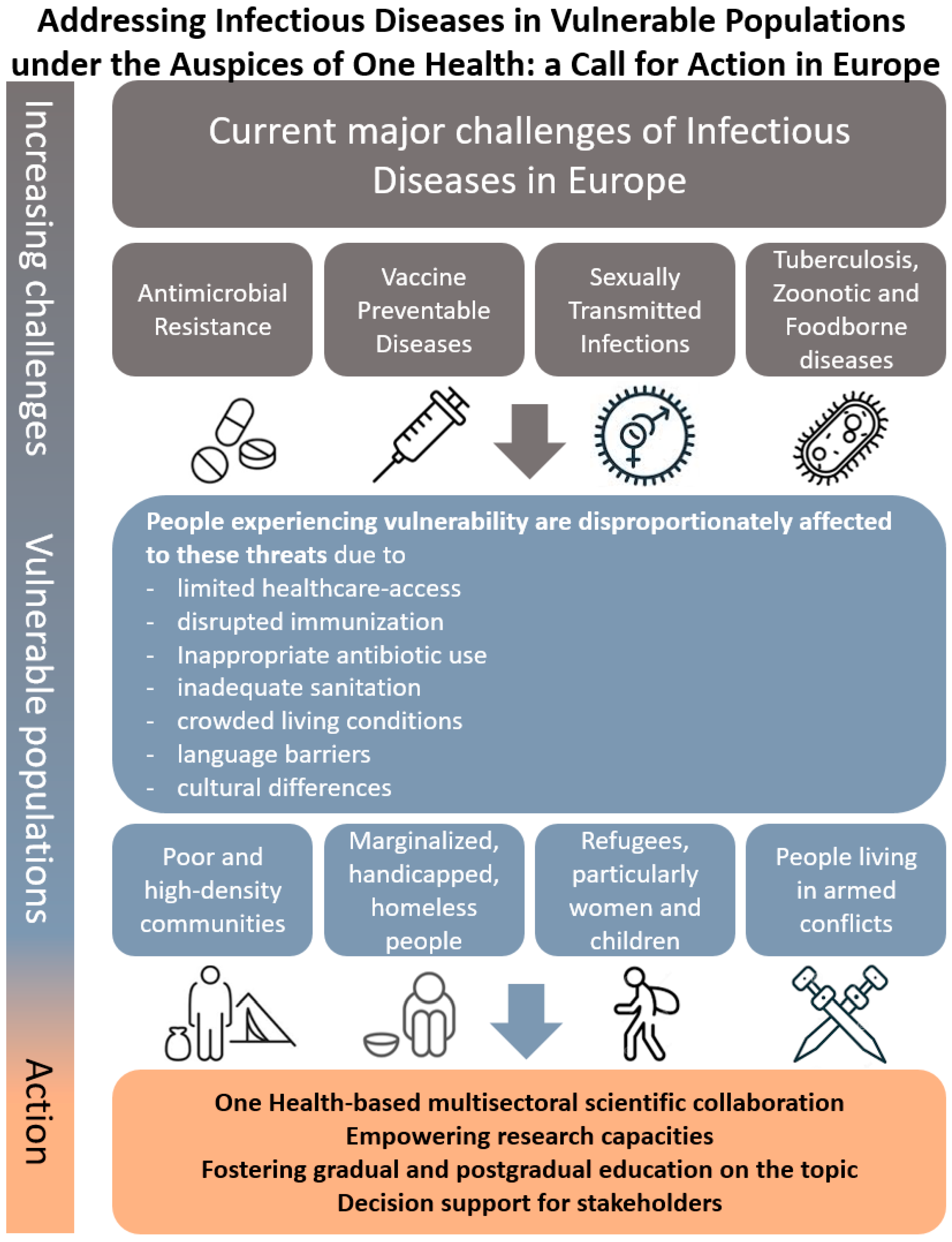
Addressing Infectious Diseases in Vulnerable Populations Under the Auspices of One Health: A Call for Action in Europe


 , ,
, , 
1. Background
2. Populations Vulnerable to Infectious Diseases
3. Potential to Move Ahead
Author Contributions
Funding
Conflicts of Interest
References
- Coronese, M.; Lamperti, F.; Keller, K.; Chiaromonte, F.; Roventini, A. Evidence for sharp increase in the economic damages of extreme natural disasters. Proc. Natl. Acad. Sci. USA 2019, 116, 21450–21455. [Google Scholar] [CrossRef] [PubMed]
- Fact Sheet: An Adjustment to Global Poverty Lines. Available online: https://www.worldbank.org/en/news/factsheet/2022/05/02/fact-sheet-an-adjustment-to-global-poverty-lines#:~:text=The%20World%20Bank%20updated%20the,Why%20raise%20the%20poverty%20line? (accessed on 10 October 2025).
- People at Risk of Poverty or Social Exclusion in 2023. Available online: https://ec.europa.eu/eurostat/web/products-eurostat-news/w/ddn-20240612-1 (accessed on 10 October 2025).
- Increase of Pertussis Cases in the EU/EEA. Available online: https://www.ecdc.europa.eu/en/publications-data/increase-pertussis-cases-eueea (accessed on 10 October 2025).
- Measles on the Rise Again in Europe: Time to Check Your Vaccination Status. Available online: https://www.ecdc.europa.eu/en/news-events/measles-rise-again-europe-time-check-your-vaccination-status#:~:text=After%20a%20period%20of%20unusually,people%20were%20diagnosed%20with%20measles (accessed on 11 October 2025).
- Andani, A.; Bunge, E.; Kassianos, G.; Eeuwijk, J.; Mellou, K.; Van Damme, P.; Mukherjee, P.; Steffen, R. Hepatitis A occurrence and outbreaks in Europe over the past two decades: A systematic review. J. Viral Hepat. 2023, 30, 497–511. [Google Scholar] [CrossRef] [PubMed]
- Tuberculosis Surveillance and Monitoring in Europe 2025–2023 Data. Available online: https://www.ecdc.europa.eu/en/publications-data/tuberculosis-surveillance-and-monitoring-europe-2025-2023-data (accessed on 11 October 2025).
- Antimicrobial Resistance in the EU/EEA (EARS-Net)—Annual Epidemiological Report 2023. Available online: https://www.ecdc.europa.eu/en/publications-data/antimicrobial-resistance-eueea-ears-net-annual-epidemiological-report-2023#:~:text=Estimates%20based%20on%20EARS%2DNet,incidence%20of%20carbapenem%2Dresistant%20K (accessed on 10 October 2025).
- STI Cases Continue to Rise Across Europe. Available online: https://www.ecdc.europa.eu/en/news-events/sti-cases-continue-rise-across-europe#:~:text=In%202023%2C%2041%20051%20confirmed,a%20doubling%20compared%20to%202014 (accessed on 10 October 2025).
- Zoonotic Diseases on the Rise in EU: Listeriosis Cases Hit Highest Level Since 2007. Available online: https://www.ecdc.europa.eu/en/news-events/zoonotic-diseases-rise-eu-listeriosis-cases-hit-highest-level-2007 (accessed on 10 October 2025).
- Mosquito-Borne Diseases. Available online: https://www.ecdc.europa.eu/assets/mosquito-borne-diseases-2024/index.html#/ (accessed on 10 October 2025).
- Scagliarini, A.; Mistral De Pascali, A.; Brandolini, M.; Ingletto, L.; Succi, A.; Calzolari, M.; Frassineti, V.; Silvestrini, G.; Angelini, R.; Fabbri, M.; et al. Living Laboratory to operationalize One Health Surveillance of climate related emerging zoonoses. Int. J. Infect. Dis. 2025, 152, 107375. [Google Scholar] [CrossRef]
- The European Commission Hosts Key One Health Meeting. Available online: https://ec.europa.eu/newsroom/sante/newsletter-archives/63609 (accessed on 11 October 2025).
- Vulnerable populations: Who are they? Am. J. Manag. Care 2006, 12, S348–S352.
- Wisner, B.; Adams, J.; World Health Organization. Environmental Health in Emergencies and Disasters: A Practical Guide; Wisner, B., Adams, J., Eds.; World Health Organization: Geneva, Switzerland, 2002; Available online: https://www.who.int/publications/i/item/9241545410 (accessed on 12 January 2026).
- Vulnerability and Vulnerable Populations. Available online: https://wkc.who.int/our-work/health-emergencies/knowledge-hub/community-disaster-risk-management/vulnerability-and-vulnerable-populations (accessed on 10 October 2025).
- Vulnerable Populations. Glossary of Essential Health Equity Terms. National Collaboration Centre for Determinants of Health (NCCDH). Available online: https://nccdh.ca/glossary/entry/vulnerable-populations (accessed on 11 October 2025).
- Hu, Y.; Lin, Z.; Jiao, S.; Zhang, R. High-Density Communities and Infectious Disease Vulnerability: A Built Environment Perspective for Sustainable Health Development. Buildings 2024, 14, 103. [Google Scholar] [CrossRef]
- Cotugno, S.; De Vita, E.; Frallonardo, L.; Novara, R.; Papagni, R.; Asaduzzaman, M.; Segala, F.V.; Veronese, N.; Nicastri, E.; Morea, A.; et al. Antimicrobial Resistance and Migration: Interrelation Between Two Hot Topics in Global Health. Ann. Glob. Health 2025, 91, 12. [Google Scholar] [CrossRef] [PubMed]
- Brandt, L.; Liu, S.; Heim, C.; Heinz, A. The effects of social isolation stress and discrimination on mental health. Transl. Psychiatry 2022, 12, 398. [Google Scholar] [CrossRef]
- Granata, G.; Petersen, E.; Capone, A.; Donati, D.; Andriolo, B.; Gross, M.; Cicalini, S.; Petrosillo, N. The impact of armed conflict on the development and global spread of antibiotic resistance: A systematic review. Clin. Microbiol. Infect. 2024, 30, 858–865. [Google Scholar] [CrossRef] [PubMed]
- Vasylyev, M.; Lamberink, H.; Svyst, I.; Khlypnyach, O.; Sluzhynska, O.; Sluzhynska, M.; Shtoiko, I.; Hrushynska, O.; Demianenko, D.; Rokx, C. The infectious disease burden among war related internally displaced people in the Lviv region of Ukraine. Germs 2024, 14, 322–343. [Google Scholar] [CrossRef] [PubMed]
- Yasir Essar, M.; Matiashova, L.; Tsagkaris, C.; Vladychuk, V.; Head, M. Infectious diseases amidst a humanitarian crisis in Ukraine: A rising concern. Ann. Med. Surg. 2022, 78, 103950. [Google Scholar] [CrossRef] [PubMed]
- Granata, G.; Petrosillo, N. From battlefields to global health: The war-driven spread of multidrug-resistant bacteria. Lancet Reg. Health Eur. 2025, 54, 101325. [Google Scholar] [CrossRef] [PubMed]
- World Health Organization. Refugee and Migrant Health: Global Competency Standards for Health Workers. Geneva. 16 December 2021. Available online: https://www.who.int/publications/i/item/9789240030626 (accessed on 10 October 2025).
- Larson, H.; Simas, C.; Horton, R. The emotional determinants of health: The Lancet-London School of Hygiene & Tropical Medicine Commission. Lancet 2020, 395, 768–769. [Google Scholar] [PubMed]
- Tao, H.; Liu, L.; Cui, J.; Wang, K.; Peng, L.; Nahata, M.C. Potential Use of ChatGPT for the Treatment of Infectious Diseases in Vulnerable Populations. Ann. Biomed. Eng. 2024, 52, 3141–3144. [Google Scholar] [CrossRef] [PubMed]

Disclaimer/Publisher’s Note: The statements, opinions and data contained in all publications are solely those of the individual author(s) and contributor(s) and not of MDPI and/or the editor(s). MDPI and/or the editor(s) disclaim responsibility for any injury to people or property resulting from any ideas, methods, instructions or products referred to in the content. |
© 2026 by the authors. Licensee MDPI, Basel, Switzerland. This article is an open access article distributed under the terms and conditions of the Creative Commons Attribution (CC BY) license.
Share and Cite
Lakatos, B.; Farkas, F.B.; Guido, G.; Saracino, A.; Di Gennaro, F. Addressing Infectious Diseases in Vulnerable Populations Under the Auspices of One Health: A Call for Action in Europe. Infect. Dis. Rep. 2026, 18, 12. https://doi.org/10.3390/idr18010012
Lakatos B, Farkas FB, Guido G, Saracino A, Di Gennaro F. Addressing Infectious Diseases in Vulnerable Populations Under the Auspices of One Health: A Call for Action in Europe. Infectious Disease Reports. 2026; 18(1):12. https://doi.org/10.3390/idr18010012
Chicago/Turabian StyleLakatos, Botond, Ferenc Balázs Farkas, Giacomo Guido, Annalisa Saracino, and Francesco Di Gennaro. 2026. "Addressing Infectious Diseases in Vulnerable Populations Under the Auspices of One Health: A Call for Action in Europe" Infectious Disease Reports 18, no. 1: 12. https://doi.org/10.3390/idr18010012
APA StyleLakatos, B., Farkas, F. B., Guido, G., Saracino, A., & Di Gennaro, F. (2026). Addressing Infectious Diseases in Vulnerable Populations Under the Auspices of One Health: A Call for Action in Europe. Infectious Disease Reports, 18(1), 12. https://doi.org/10.3390/idr18010012